Skip to contents Skip to Global Navigation Menu
  • KDCA
  • Contact us
  • E-Submission

PHRP : Osong Public Health and Research Perspectives

OPEN ACCESS. pISSN: 2210-9099. eISSN: 2233-6052

Page Path

132
results for

"ica"

Article category

Keywords

Publication year

Authors

Funded articles

"ica"

Review Article

Prevalence and genotype diversity of rotavirus A in humans, animals, and environmental water samples in West Africa: a systematic review and meta-analysis
Jacques Danho Monney, Clémence Marie Rose Adjoua Konan Kouassi, Yannick Konan, Edgard Valery Adjogoua, Yahaya Karamoko
Received April 10, 2026  Accepted July 21, 2026  Published online September 3, 2026  
DOI: https://doi.org/10.24171/j.phrp.2026.0331    [Epub ahead of print]
Objectives
To systematically review and meta-analyze the prevalence and genetic diversity of rotavirus A (RVA) in humans, animals, and environmental water samples in West Africa and to describe its geographic distribution and circulation patterns.
Methods
PubMed, Scopus, Web of Science, African Journals Online, ScienceDirect, SpringerLink, JSTOR, clinical trial registries, and global health libraries were searched for observational studies published from January 1, 2010, to December 20, 2025, reporting molecular RVA genotyping data from West Africa. Two reviewers independently screened studies, extracted data, assessed risk of bias using the Joanna Briggs Institute and SYRCLE tools, and summarized genotype distributions narratively. Random-effects meta-analyses were used to estimate pooled prevalence by source category.
Results
Fifty-four studies were included, comprising 21,532 samples and 2,080 RVA-positive cases. The overall pooled prevalence was 12.6% (95% confidence interval [CI], 9.9%–15.6%). Prevalence was highest in animals (19.77%; 95% CI, 5.4%–40.1%), followed by environmental water samples (14.81%; 95% CI, 3.5%–31.1%) and humans (11.37%; 95% CI, 9.0%–14.0%). Overall heterogeneity was very high (I²=97.1%). In human studies, G1P[8], G9P[8], and G2P[4] were among the most frequently detected and geographically widespread genotype combinations.
Conclusion
RVA circulates widely in humans, animals, and environmental water samples across West Africa, although evidence is characterized by substantial heterogeneity, uneven geographic representation, and limited animal and environmental water data. These findings support integrated One Health surveillance, monitoring for genotype shifts, and stronger water, sanitation, and hygiene interventions.
  • 760 View
  • 29 Download

Original Articles

Long-term trends and post-pandemic deviations in cervical cancer burden in South India, 1990–2023: a Global Burden of Disease 2023 study
Indra Sivakumar, Jeevarathinam Thirumalai, Anees Ahmed Farooq Mohammed
Received March 13, 2026  Accepted July 22, 2026  Published online August 26, 2026  
DOI: https://doi.org/10.24171/j.phrp.2026.0252    [Epub ahead of print]
Objectives
Cervical cancer remains a major public health challenge in India despite advances in prevention through human papillomavirus (HPV) vaccination and screening. Although national estimates indicate gradual declines, marked regional disparities persist, and coronavirus disease 2019–related disruptions may have affected recent disease trajectories. This study assessed long-term trends, post-pandemic deviations, and progress toward World Health Organization (WHO) elimination targets in South India.
Methods
This population-based observational analysis used Global Burden of Disease Study 2023 estimates for women aged 30–69 years in South India from 1990 to 2023. Pre-pandemic trends and counterfactual projections were evaluated, and age-standardized incidence rates (ASRs) were descriptively compared with the WHO elimination threshold of ≤4 cases per 100,000 woman-years.
Results
Age-standardized cervical cancer incidence and mortality declined until the early 2010s but remained above national and global rates. Thereafter, declines stagnated and reversed. In 2023, incidence ranged from 26.1 per 100,000 women in Kerala to 65.8 in Telangana; all states exceeded the WHO threshold based on these ASRs. Observed rates exceeded counterfactual projections, but uncertainty envelopes included zero for every location and outcome. Thus, the findings are consistent with possible post-pandemic disruption to cervical cancer services rather than statistically demonstrated excess burden, and this ecological comparison cannot establish causality. Disability-adjusted life-year rates were highest among women aged 50–69 years.
Conclusion
South India appears to have experienced a recent loss of momentum in cervical cancer control. Strengthening HPV vaccination coverage, expanding screening, and improving the resilience of cancer prevention services are essential for accelerating progress toward elimination targets.
  • 605 View
  • 16 Download
Optimal control strategies for dengue transmission under varying adult prevalence of Wolbachia-carrying mosquitoes: a deterministic mathematical modeling study
Fadilaturrohmah Nur, Yongkuk Kim
Received January 29, 2026  Accepted June 11, 2026  Published online August 14, 2026  
DOI: https://doi.org/10.24171/j.phrp.2026.0110    [Epub ahead of print]
Objectives
This study aimed to develop prevalence-informed post-release dengue control strategies for settings in which Wolbachia-carrying Aedes aegypti mosquitoes have become established through population replacement and to quantify how optimal supplementary intervention intensity and duration vary with adult Wolbachia prevalence, pW. Methods: A deterministic human–mosquito model was formulated that included Wolbachia-free and Wolbachia-carrying mosquitoes and incorporated cytoplasmic incompatibility, maternal transmission, and reduced vector competence. Two bounded supplementary controls were optimized over a 3-year horizon: reduction of effective human–mosquito contact and conventional adult mosquito suppression, represented by increased adult mortality. A quadratic-cost optimal-control problem was solved numerically using the Pontryagin maximum principle and a forward/backward sweep algorithm. Outcomes were compared across representative pW scenarios and prevalence scans. Results: The optimal policies applied high-intensity supplementary control early in the planning horizon and then relaxed control as infection pressure declined. Higher pW reduced the uncontrolled infection burden, decreased the incremental benefit of additional intervention, and shortened the duration of maximum control. In coarse scans with umax=0.30, the terminal dengue infection near-elimination indicator, defined as IH (T)≤10–4 at T=3 years, changed between pW=0.45 and pW=0.50 for all tested cost-weight combinations. A separate refined continuation example demonstrated non-monotonic mean control use and a sharp decrease in cumulative incidence. Conclusion: Adult Wolbachia prevalence measured through entomological surveillance may represent an actionable index for post-release dengue management. The identified transition band is a model-based planning indicator, not a universal field threshold or evidence of mosquito population elimination.
  • 700 View
  • 32 Download
Use of artificial intelligence for medication adherence assessment in patients with type 2 diabetes: an exploratory study in Morocco using ChatGPT and the validated general medication adherence scale
Maryem Arraji, Mohamed Khalis, Mohamed Chahboune
Received September 26, 2025  Accepted June 28, 2026  Published online August 14, 2026  
DOI: https://doi.org/10.24171/j.phrp.2025.0396    [Epub ahead of print]
Objectives
Medication adherence remains a major challenge in the management of type 2 diabetes (T2D), especially in middle-income countries such as Morocco. With the rapid development of artificial intelligence, large language models, including ChatGPT, may offer new opportunities for clinical research through simulated patient profiles. This study examined the feasibility of using ChatGPT to generate culturally contextualized virtual profiles of Moroccan patients with T2D and to apply the validated Moroccan Arabic dialect version of the general medication adherence scale (GMAS). Methods: This exploratory pilot simulation study used ChatGPT-4 to generate 11 virtual profiles based on representative sociodemographic and clinical characteristics of Moroccan patients with T2D. Each profile was administered the validated Moroccan Arabic dialect version of the GMAS. Results: Four profiles (36.4%) showed high adherence, 6 (54.5%) displayed moderate adherence, and 1 (9.1%) exhibited low adherence. Expert evaluations were consistent, with all ratings ≥3 on a 4-point scale, supporting the credibility and cultural appropriateness of the profiles. The simulated patterns reflected real-world trends, with higher adherence among profiles treated with oral antidiabetic drugs, covered by health insurance, and having shorter disease duration, and lower adherence among profiles using insulin, lacking insurance, and having longer disease duration. Conclusion: ChatGPT generated credible, culturally adapted patient profiles that enabled application of a validated psychometric tool in a simulated environment. This rapid, low-cost approach may support exploratory research, healthcare training, and intervention design. Comparative studies using real patient data are needed to confirm validity.
  • 816 View
  • 24 Download

Review Articles

Systematic review of emerging environmental contaminants: sources, environmental fate, and impacts
Abdulwasiu Olawale Salaudeen, Yemisi Ajoke Olawore, Hajara Yakubu, Habeeb Abdulkadiri, Emmanuel Ibukun Aduloju
Received January 21, 2026  Accepted May 27, 2026  Published online July 28, 2026  
DOI: https://doi.org/10.24171/j.phrp.2026.0041    [Epub ahead of print]
Objectives
This review aimed to synthesize recent advances in the understanding of emerging contaminants (ECs), including per- and polyfluoroalkyl substances, pharmaceuticals, personal care products, microplastics and nanoplastics, endocrine-disrupting chemicals, and engineered nanomaterials. It critically assessed their sources, environmental pathways, transformation mechanisms, and ecological and human health impacts, while identifying knowledge gaps and future research priorities.
Methods
A systematic literature review was conducted according to the Preferred Reporting Items for Systematic Reviews and Meta-Analyses framework. Peer-reviewed research articles and critical reviews were retrieved from Scopus, Web of Science, and PubMed. Emphasis was placed on studies that used advanced analytical techniques, including high-resolution mass spectrometry, nuclear magnetic resonance spectroscopy, Fourier-transform infrared spectroscopy, and biosensor-based detection methods.
Results
The findings indicated that ECs are characterized by high environmental persistence, complex transformation pathways, bioaccumulation, and trophic transfer potential. Reported impacts included endocrine disruption, genotoxicity, antimicrobial resistance, and ecological imbalance. Across global environmental compartments, these pollutants pose long-term risks to ecosystems and human health. Their distinctive partitioning behavior and environmental persistence challenge standard ecological assessment frameworks and underscore the need for comprehensive toxicological evaluations and robust regulatory oversight to mitigate long-term biological accumulation and adverse physiological effects in aquatic and terrestrial wildlife.
Conclusion
This review highlights the urgent need for improved regulatory frameworks, standardized monitoring approaches, and sustainable remediation strategies for ECs. By integrating advanced analytical methods, computational tools, and circular economy principles, the review provides a timely contribution to environmental science and policy and supports informed decision-making for environmental protection and public health.

Citations

Citations to this article as recorded by  Crossref logo
  • Micro- and nanoplastic pollution in wetland ecosystems: Ecological risks, health implications, and mitigation strategies toward a One Health future
    Van Giang Le, Minh-Ky Nguyen
    Environmental Pollution.2026; : 129329.     CrossRef
  • 2,194 View
  • 97 Download
  • Crossref
Mapping rehabilitation interventions for long COVID and post-viral syndromes: a bibliometric and thematic analysis of PubMed-indexed literature, 2020–2025
Madhusmita Koch
Received April 14, 2026  Accepted July 7, 2026  Published online July 23, 2026  
DOI: https://doi.org/10.24171/j.phrp.2026.0338    [Epub ahead of print]
The health care community has moved from emergency response models to sustained recovery models for the rehabilitation of post-acute sequelae of severe acute respiratory syndrome coronavirus 2 infection, commonly referred to as long COVID. This study aimed to provide a comprehensive bibliometric visualization and thematic analysis of global research output from 2020 to 2025 on rehabilitation interventions for long COVID and related post-viral disorders. The PubMed database was systematically searched to retrieve bibliometric records. VOSviewer and Biblioshiny were used to conduct a multidimensional analysis. Key metrics included annual scientific production, Lotka’s law for author productivity, Bradford’s law for core source identification, and country collaboration mapping. The life-cycle model (R2=0.929) indicated that the field evolved in a predictable pattern, with continuous and accelerated development. However, the projected stabilization should be interpreted as a description of initial growth rather than as definitive evidence of disciplinary maturity. Scientific output in this area increased sharply and peaked in 2024. Thematic visualization identified 3 broad thematic groupings. Lotka’s law indicated a dispersed and fragmented research community, with approximately 90% of authors contributing only 1 document. Physiotherapy research for long COVID has shifted from early pulmonary-centered approaches toward more interdisciplinary models focused on cognitive health and fatigue.
  • 1,401 View
  • 36 Download
Rethinking mpox: epidemiology, clinical variants, diagnosis, and response
Renu Thakur, Devendra Pratap Singh Rajput, Nikunj Rajkumar Agrawal, Abhimanyu Agrawal
Osong Public Health Res Perspect 2026;17(4):290-299.
Published online May 27, 2026
DOI: https://doi.org/10.24171/j.phrp.2025.0402
Rethinking mpox: epidemiology, clinical variants, diagnosis, and response
Monkeypox disease, now commonly referred to as mpox, was once considered a geographically restricted zoonotic disease but has emerged as a global public health concern. The 2022 multinational outbreak marked a turning point, with notable shifts in transmission dynamics, affected populations, and clinical manifestations. Classical cases typically involve fever, lymphadenopathy, and a centrifugal vesiculopustular rash; however, recent outbreaks have revealed atypical presentations, including genital and perianal lesions, minimal or absent prodromal symptoms, and asynchronous rash evolution. These variations have complicated early clinical recognition and may contribute to delayed diagnosis and onward transmission. This review synthesizes current evidence on the evolving epidemiology of mpox, highlights differences between endemic and non-endemic outbreaks, and describes the full spectrum of typical and atypical clinical features. It also assesses diagnostic approaches, including molecular and point-of-care techniques, and evaluates the efficacy and limitations of current and emerging vaccines, such as JYNNEOS and ACAM2000. Future priorities include improving global surveillance, refining case definitions, expanding diagnostic access, and ensuring equitable vaccine distribution. Understanding the expanding clinical and epidemiological profile of mpox is essential for timely diagnosis, containment, and preparedness against future outbreaks.
  • 3,203 View
  • 81 Download

Original Article

Modeling social and behavioral factors associated with community participation in community-based surveillance of communicable diseases: a cross-sectional study in Kelantan, Malaysia
Ahmed Azeez Hasan, Anis Kausar Ghazali, Norsa’adah Bachok, Najib Majdi Yaacob, Suhaily Mohd Hairon, Nur Amira Mohd Nadir, Fatimah Muhd Shukri
Osong Public Health Res Perspect 2026;17(3):229-241.
Published online May 11, 2026
DOI: https://doi.org/10.24171/j.phrp.2025.0447
Modeling social and behavioral factors associated with community participation in community-based surveillance of communicable diseases: a cross-sectional study in Kelantan, Malaysia
Objectives
This study examined the social and behavioral factors influencing community leaders’ participation in community-based surveillance (CBS) of infectious diseases. We hypothesized that knowledge, attitudes, and perceptions significantly predict the behavioral likelihood of engaging in CBS activities. Methods: A cross-sectional study was conducted among 470 schoolteachers in Kelantan, Malaysia, from March to June 2024. Participants were selected using multistage sampling, with random selection of schools followed by convenience sampling of teachers. Data were collected using the validated KAP-CBS-ID questionnaire, which was based on the Theory of Reasoned Action and Health Belief Model. Structural equation modeling was used to analyze relationships among the study variables with the maximum likelihood robust estimator. Results: The final model demonstrated good fit (comparative fit index, 0.921; standardized root mean square residual, 0.071; root mean square error of approximation, 0.040 [90% confidence interval, 0.036–0.044]). Ten significant path relationships were identified, explaining 46.1% of the variance in behavioral likelihood. Knowledge of infectious diseases (β=0.419, p<0.001), subjective norms (β=0.235, p=0.038), and negative attitudes (β=–0.432, p<0.001) significantly influenced intention. Behavioral likelihood was directly predicted by intention (β =0.347, p<0.001), perceived susceptibility (β=0.310, p<0.001), perceived benefits (β=0.198, p=0.001), and perceived barriers (β=–0.132, p=0.008). Self-efficacy showed significant indirect effects through perceived benefits (β=0.785, p<0.001) and perceived susceptibility (β=0.765, p<0.001). Conclusion: Knowledge and psychosocial factors significantly inf luence community engagement in CBS of infectious diseases. Public health interventions should address these interconnected determinants to strengthen early disease detection and reporting systems.
  • 1,425 View
  • 71 Download

Review Article

Collaborative networks, trends, and comparative analysis of artificial intelligence techniques in healthcare research: a narrative review
Objectives
Artificial intelligence (AI) is reshaping healthcare by improving diagnosis and treatment planning, increasing operational efficiency, and streamlining administrative workflows. This paper integrates findings from an extensive PubMed search (2015–2025) with bibliometric analysis using RStudio and VOSviewer to investigate the comparative applications of AI methods in healthcare, collaborative networks, and emerging trends.
Methods
A total of 1,243 records were identified through the PubMed search, and after removal of 143 duplicates, 1,100 records were screened. Following full-text assessment and exclusion of ineligible studies, 986 articles were included in the final bibliometric analysis.
Results
The main research areas included robotic-assisted surgery, predictive analytics, diagnostic imaging, and precision medicine, with particular emphasis on the prevalence of machine learning and deep learning in imaging and the increasing application of natural language processing to unstructured medical information.
Conclusion
The review emphasizes the need for greater budgetary allocation to scalable and pragmatic AI technologies and for interdisciplinary cooperation among researchers, industry, and healthcare providers. Despite this growth, challenges such as algorithmic bias, data integration, and ethical concerns persist. The paper also highlights the importance of equitable collaboration, accountable AI, and multinational partnerships in ensuring that AI can be used ethically and efficiently in healthcare over the long term to improve patient care and biomedical innovation. It does so by mapping international and regional trends, identifying the most influential authors, institutions, and funding sources, and evaluating methodological approaches.
  • 5,518 View
  • 71 Download

Original Articles

Correlates and co-occurrence of risk factors for non-communicable diseases among adolescents in schools in Karnataka, India: a cross-sectional study
Tejaswini Bangalore Darukaradhya, Krishnamurthy Jayanna, Shivaraj Nallur Somanna, Sony Sequeira, Shalini Chandrashekar Nooyi
Osong Public Health Res Perspect 2026;17(1):83-93.
Published online February 10, 2026
DOI: https://doi.org/10.24171/j.phrp.2025.0204
Correlates and co-occurrence of risk factors for non-communicable diseases among adolescents in schools in Karnataka, India: a cross-sectional study
Objectives
Non-communicable disease (NCD) risk among adolescents represents a growing concern due to modifiable, lifestyle-related behavioral risk factors. Early identification and control of these factors are essential for prevention. This study assessed the correlates and cooccurrence of NCD-related lifestyle risk factors among school-going adolescents in Karnataka, India, aiming to inform intervention development. Methods: Screening was conducted among 1,100 school adolescents aged 13–16 years from 8 randomly selected urban and rural schools in Karnataka. Data were collected using a validated self-administered questionnaire covering sociodemographic characteristics and social cognitive theory predictors of lifestyle practices. Descriptive statistics, chi-square tests, and logistic regression were employed. Results: Of the 1,100 adolescents surveyed, 552 and 548 were from urban and rural areas, respectively. Both groups reported high rates of insufficient fruit and vegetable (FV) intake (96.7% and 67.7%, respectively), inadequate physical activity (96.7% and 68.6%), tobacco use (5.6% and 11.5%), and alcohol consumption (5.6% and 10.8%). On logistic regression, urban adolescents were significantly more likely than rural peers to exhibit multiple behavioral risk factors, with 19-fold higher odds of having ≥1 factor (adjusted odds ratio [AOR], 19.04; p< 0.001) and 4-fold higher odds of having ≥2 (AOR, 4.06; p < 0.001). Parental (particularly maternal) education was associated with NCD risk (AOR, 1.82; p= 0.001). Physical inactivity significantly co-occurred with low FV intake (71.7%) and junk food consumption (72.8%). Conclusion: Unhealthy lifestyle behaviors among adolescents displayed significant cooccurrence, underscoring the critical need for comprehensive, theory-based school interventions to address multiple interconnected risk factors and mitigate the burden of NCDs.
  • 1,993 View
  • 107 Download
Analysis of factors influencing hemorrhagic fever with renal syndrome and its prediction in Weifang, China from 2013 to 2021
Hui Zhang, Wan-Ying Zhao, Yan-Qing Yang, Xue-Yan Guo, Yi-Han Shi, Qi-Yong Liu, Jing Li
Osong Public Health Res Perspect 2025;16(6):575-585.
Published online December 16, 2025
DOI: https://doi.org/10.24171/j.phrp.2025.0367
Analysis of factors influencing hemorrhagic fever with renal syndrome and its prediction in Weifang, China from 2013 to 2021
Objectives
This study aimed to analyze the epidemiology and trends of hemorrhagic fever with renal syndrome (HFRS) in Weifang, China (2013–2021) and to guide prevention strategies.
Methods
The study examined the prevalence and incidence trends of HFRS in Weifang (2013–2021). Spearman correlation and wavelet analysis were employed to explore variable relationships and their associations with HFRS incidence. Generalized additive models (GAMs) were used to identify key risk factors, while structural equation modeling (SEM) quantified direct and indirect pathways influencing HFRS transmission. Finally, Bayesian time-series models were applied to predict future HFRS risk.
Results
Weifang reported 2,118 HFRS cases, which displayed distinct seasonality. Spearman correlation linked economic factors (gross domestic product [GDP], crop area, grain output, green space) and meteorological factors (temperature, pressure) to incidence (r>0.8). Wavelet analysis identified Mus musculus (2013–2016) and Rattus norvegicus (2017–2021) as dominant reservoirs, with temperature, precipitation, and humidity correlating with incidence. GAMs revealed a U-shaped relationship between rodent density and HFRS and an inverted U-shaped relationship between temperature (threshold, 11.64 °C) and HFRS. SEM highlighted the direct and indirect effects of climate via rodent density, mirrored by economic factors (e.g., GDP). Bayesian models effectively predicted HFRS (root mean square error, 7.36; mean absolute percentage error, 0.28; R2=0.65).
Conclusion
Climate, economic, and anthropogenic factors drive the spread of HFRS. Prevention strategies should integrate local economic conditions with meteorological and anthropogenic factors. Bayesian time-series modeling effectively predicts HFRS trends, supporting precision prevention strategies.

Citations

Citations to this article as recorded by  Crossref logo
  • Epidemiological characteristics and spatiotemporal heterogeneity of hemorrhagic fever with renal syndrome in the Jiaodong Peninsula region, China, 2019–2025
    Xiaofang Guo, Ti Liu, Ruixiao Li, Xueying Tian, Yuwei Zhang, Xiaotong Shi, Qing Duan, Renpeng Li, Zengqiang Kou
    Frontiers in Public Health.2026;[Epub]     CrossRef
  • Drivers of Viral Spillover: An Examination of How Pathogens Spread
    Elenoire Sole, Giulia Montalbano, Giuseppe Motta, Maria Maddalena Pansera, Angelina Midiri, Mariarita Iacopino, Paolo Liotta, Giuseppe Mancuso, Carmelo Biondo
    Pathogens.2026; 15(9): 901.     CrossRef
  • 2,193 View
  • 91 Download
  • 2 Web of Science
  • Crossref
Trends and risk factors for physical and psychological sequelae of induced abortion: a cross-sectional study of contemporary women in the Republic of Korea
Seung-Ah Choe, Juhyun Park, Eunsol Song, Eunja Park
Osong Public Health Res Perspect 2025;16(6):552-559.
Published online December 9, 2025
DOI: https://doi.org/10.24171/j.phrp.2025.0266
Trends and risk factors for physical and psychological sequelae of induced abortion: a cross-sectional study of contemporary women in the Republic of Korea
Objectives
This study aimed to examine trends and factors associated with severe physical and psychological consequences following induced abortion among women in the Republic of Korea.
Methods
An online survey was conducted of adolescent and adult Korean women aged 13 to 64 years, termed the 2022 Sex and Reproductive Health Survey. Respondents who reported a history of induced abortion were analyzed. Logistic regression models that accounted for individual risk factors were fitted to calculate adjusted odds ratios (aOR).
Results
The prevalence of induced abortion was 20.1% (914 of 4,552 respondents). The most frequent indications for abortion were social reasons, and across all periods, approximately half of the women or more reported non-medical challenges at the time of their most recent abortion. Severe physical and psychological sequelae after abortion increased 5-fold from 1980–1992 to 2013–2022. Among those whose most recent abortion occurred in 2003 or later, the risk of severe psychological sequelae was higher in 2013–2022, after the Korean Constitutional Court upheld the existing criminal codes, than in 2003–2012 (aOR, 2.31; 95% confidence interval, 1.09–4.91).
Conclusion
In the absence of institutionalized safe and respectful abortion services, severe physical and psychological sequelae among women who underwent induced abortion were more likely to occur. These findings highlight the importance of safe, affordable, nondiscriminatory, and respectful abortion care.
  • 3,574 View
  • 154 Download
Scrub typhus in the era of climate change: exploring lagged and cumulative effects of meteorological factors in the Republic of Korea, 2001–2024, a nationwide time-series study
Objectives
Scrub typhus, caused by Orientia tsutsugamushi, is a climate-sensitive vector-borne disease with high incidence in the Republic of Korea. This study examined long-term epidemiological trends and changing meteorological influences in the context of climate change.
Methods
A retrospective time-series study was conducted using national surveillance data on 149,289 scrub typhus cases (2001–2024) across 4 surveillance phases. Temporal trends in age-standardized incidence rates were evaluated using Joinpoint regression. Associations between monthly meteorological variables and incidence were assessed with Spearman correlation analysis and time-series regression analysis using distributed lag non-linear models.
Results
The national incidence increased until 2017 and has decreased since 2018, whereas the AAPC rebound to 4.32% during phase IV (2019–2024). The proportion of female cases decreased, while that of adults ≥70 years increased significantly. In phase IV, the average annual percent change increased in central and urban regions. The lag effect of meteorological factors lengthened from 4 to 6 months, with mean temperature (Tmean) and relative humidity (RH) representing the primary predictors. Phase III (2013–2018) displayed the highest cumulative relative risk (RR) for Tmean at 25.2 °C (RR, 5.86; 95% confidence interval [CI], 2.56–13.42), whereas in phase IV, only moderate RH (58%) remained significantly associated with incidence (RR, 1.68; 95% CI, 1.29–2.20).
Conclusion
Over the past 2 decades, the influence of meteorological factors on scrub typhus has shifted, with recent years marked by greater uncertainty under increasing climate variability and instability. For timely risk prediction and targeted prevention, adaptive surveillance systems that integrate dynamic climate indicators—capturing the intensity, frequency, and variability of extreme weather events—are needed.

Citations

Citations to this article as recorded by  Crossref logo
  • A Review of Domestic Research and Response Trends Regarding the Environmental and Health Impacts of Climate Change
    Young Sun Kwon, Junsuk Kang
    Journal of Environmental Health Sciences.2026; 52(1): 7.     CrossRef
  • Non-linear effects and lag patterns of eco-environmental factors on scrub typhus: a spatiotemporal analysis in Yunnan, China, 2015–2022
    Xiangnan Jing, Yuewei Ling, Ruonan Jing, Fuying Guo, Feifei Yin, Dongsheng Huang, Lijie Zhang, Xiangyu Yan, Tiejun Shui
    Parasites & Vectors.2026;[Epub]     CrossRef
  • 3,491 View
  • 145 Download
  • 1 Web of Science
  • Crossref
Relationship between diabetes medication self-efficacy and quality of life in older adults with diabetes: a cross-sectional study in Turkey
Nilhan Töyer Şahin, İlayda Kömürcü, Seda Aşcı
Osong Public Health Res Perspect 2025;16(5):498-507.
Published online September 30, 2025
DOI: https://doi.org/10.24171/j.phrp.2025.0218
Relationship between diabetes medication self-efficacy and quality of life in older adults with diabetes: a cross-sectional study in Turkey
Objectives
The aim of this study was to investigate the relationship between diabetes medication self-efficacy and quality of life in older adults with diabetes.
Methods
The study included 192 older adults who attended the diabetes clinic of a public hospital in Istanbul. Data were collected between June and October 2024. Participants were informed about the study and provided both verbal and written consent. Data collection instruments comprised a sociodemographic questionnaire, the diabetes medication self-efficacy scale, and the quality of life scale for older adults.
Results
Of the participants, 98 (51.0%) were women and 105 (54.7%) were aged 65 to 74 years. The mean diabetes medication self-efficacy score was 38.95±10.31, and the mean quality of life score was 18.24±6.37. A weak but statistically significant positive correlation was observed between the autonomy and satisfaction subscale of quality of life and the necessity subscale of self-efficacy (p<0.05).
Conclusion
This study, which examined the relationship between self-efficacy in diabetes management and quality of life in older adults, provides valuable guidance for clinical practice aimed at improving care for this population.
  • 2,207 View
  • 82 Download
Comparative effectiveness of construal-level messaging in the COVID-19 Vaccine Injury Compensation Program in the Republic of Korea: a randomized controlled trial
Jihyun Moon, Se-Hoon Jeong, Young June Choe, Cho Ryok Kang, Taemi Kim, Dooyoung Kim, Jong-Koo Lee
Osong Public Health Res Perspect 2025;16(5):486-497.
Published online September 12, 2025
DOI: https://doi.org/10.24171/j.phrp.2024.0354
Comparative effectiveness of construal-level messaging in the COVID-19 Vaccine Injury Compensation Program in the Republic of Korea: a randomized controlled trial
Objectives
This study aimed to assess the impact of high-level versus low-level construal messages about the coronavirus disease 2019 (COVID-19) Vaccine Injury Compensation Program (CVICP) on public attitudes toward the program and COVID-19 vaccination.
Methods
A randomized controlled experimental design was employed. Adults aged 18 to 64 residing in the Republic of Korea were randomly assigned to either an experimental group (high-level construal message) or a control group (low-level construal message). Both groups viewed a 2-minute video about the CVICP, with construal level as the sole variable. Pre- and post-intervention questionnaires evaluated attitudes toward the CVICP and COVID-19 vaccination, including satisfaction, perceived necessity, and perceived effectiveness in enhancing vaccine acceptance. Data were analyzed using the paired t-test, repeated measures 2-way analysis of variance, and multiple linear regression.
Results
The experimental group showed statistically significant improvements across all 6 attitude measures following exposure to the high-level construal message. By contrast, the control group demonstrated significant improvement in only 3 attitudes: satisfaction with the CVICP, willingness to recommend vaccination, and willingness for future vaccination. A significant difference between groups was observed for perceived effectiveness of the CVICP in enhancing vaccine acceptance (p=0.01), with high-level construal messaging being more impactful.
Conclusion
High-level construal messages are more effective than low-level messages in shaping public perceptions and addressing vaccine hesitancy. Policymakers and health authorities should incorporate high-level construal elements into communication strategies to build trust and support for vaccination programs.
  • 2,754 View
  • 53 Download
A confirmatory analysis of the knowledge, attitudes, and perceptions questionnaire for community-based surveillance of infectious diseases: a cross-sectional study in Malaysia
Ahmed Azeez Hasan, Anis Kausar Ghazali, Najib Majdi Yacoob, Norsa’adah Bachok, Suhaily Mohd Hairon, Nur Amira M. Nadir, Fatimah Muhd Shukri
Osong Public Health Res Perspect 2025;16(5):508-518.
Published online August 12, 2025
DOI: https://doi.org/10.24171/j.phrp.2025.0106
A confirmatory analysis of the knowledge, attitudes, and perceptions questionnaire for community-based surveillance of infectious diseases: a cross-sectional study in Malaysia
Objectives
This study aimed to validate the psychometric properties of the recently developed knowledge, attitudes, and perceptions questionnaire for community-based surveillance of infectious diseases (KAP-CBS-ID questionnaire), using confirmatory factor analysis (CFA) and item response theory (IRT).
Methods
A cross-sectional study using multistage sampling recruited 470 schoolteachers from Kelantan, Malaysia. The self-administered KAP-CBS-ID questionnaire consists of 3 domains: knowledge (31 items), attitudes (23 items), and perceptions (21-items). Two-parameter logistic (2-PL) IRT analysis and CFA were performed to validate the knowledge section. For attitudes and perceptions sections, CFA proceeded using a 4-factor model to evaluate both model fit and construct validity.
Results
Two-PL IRT analysis of the knowledge section resulted in elimination of 14 items due to inadequate discrimination or difficulty parameters. The 3-factor CFA model demonstrated good fit indices for knowledge (root mean square error of approximation [RMSEA], 0.028; comparative fit index [CFI], 0.945; Tucker-Lewis index [TLI], 0.941) without any modifications. The attitudes section required re-specification, ultimately yielding 21 items across 4 factors with acceptable fit indices (standardized root mean square residual [SRMR], 0.067; RMSEA, 0.055; CFI, 0.937; TLI, 0.927). Similarly, the perceptions section was refined to 17 items across 4 factors, showing good model fit (SRMR, 0.055; RMSEA, 0.059; CFI, 0.962; TLI, 0.954). Factor loadings ranged from 0.33 to 0.98, while Raykov’s rho reliability estimates ranged from 0.71 to 0.93. Factor determinacy exceeded 80% for all factors.
Conclusion
The KAP-CBS-ID is a valid and reliable instrument for assessing community representatives’ knowledge, attitudes, and perceptions regarding community-based surveillance of infectious diseases.

Citations

Citations to this article as recorded by  Crossref logo
  • Modeling social and behavioral factors associated with community participation in community-based surveillance of communicable diseases: a cross-sectional study in Kelantan, Malaysia
    Ahmed Azeez Hasan, Anis Kausar Ghazali, Norsa’adah Bachok, Najib Majdi Yaacob, Suhaily Mohd Hairon, Nur Amira Mohd Nadir, Fatimah Muhd Shukri
    Osong Public Health and Research Perspectives.2026; 17(3): 229.     CrossRef
  • 2,499 View
  • 92 Download
  • 1 Web of Science
  • Crossref
Impact of direct prehospital transport on mortality in patients with severe trauma based on the injury severity score: a nationwide observational study in the Republic of Korea
Sun Ju Kim, KeunKyun Kim, Oh Hyun Kim, Chan Yong Park
Osong Public Health Res Perspect 2025;16(4):381-391.
Published online August 11, 2025
DOI: https://doi.org/10.24171/j.phrp.2025.0102
Impact of direct prehospital transport on mortality in patients with severe trauma based on the injury severity score: a nationwide observational study in the Republic of Korea
Objectives
Severe trauma remains a leading cause of death in the Republic of Korea. In response, regional trauma centers were established in 2012. This study evaluated the impact of direct prehospital transport to trauma centers on in-hospital mortality among patients with severe trauma using the national trauma registry. Methods: This nationwide observational study utilized data from the Korean community-based trauma registry between 2016 and 2020. Patients with an injury severity score >15 who were directly transported from the prehospital setting were included. Variables analyzed encompassed demographics, injury mechanism, transport time, hospital level, and outcomes. The primary outcome was in-hospital mortality. Both logistic regression and decision tree models were employed. Results: A total of 24,567 patients were included. Overall mortality decreased by 5.2% during the study period. Patients transported to level 1 or 2 trauma centers had a lower mortality rate (23.6%) compared to those transported to level 3 or 4 hospitals (28.0%). The proportion of direct transports to high-level centers increased from 46.7% to 64.1% between 2016 and 2020. Despite longer transport times, patients transported to high-level institutions exhibited improved survival, particularly when transport exceeded 30 minutes, suggesting that hospital selection may be more critical than minimizing transport time. Conclusion: Direct transport to high-level trauma centers improves survival among patients with severe trauma, even when transport times are prolonged. These findings support the importance of a well-organized trauma system that emphasizes hospital capability in prehospital triage decisions.

Citations

Citations to this article as recorded by  Crossref logo
  • Geospatial Optimization of Trauma Care Resource Allocation and Timely Access for Severely Injured Patients
    Ryan B. Choi, Deeksha Bidare, Byung Hee Kang, Junsik Kwon, Kyungwon Jung, Jeff Choi
    JAMA Network Open.2026; 9(9): e2636840.     CrossRef
  • Prehospital transport prioritization and time-varying selection bias in traffic-related multi-patient incidents: a nationwide retrospective cohort study
    Atsushi Kubo, Shinobu Tamura, Atsushi Hiraide, Daigo Morioka, Ryu Murakami, Kenko Fukui, Shigeaki Inoue
    Critical Care.2026;[Epub]     CrossRef
  • Artificial intelligence and biohealth: the Republic of Korea’s emerging priorities in health care R&D
    Jong-Koo Lee
    Osong Public Health and Research Perspectives.2025; 16(4): 309.     CrossRef
  • 2,279 View
  • 69 Download
  • 1 Web of Science
  • Crossref
Prevalence and determinants of medication adherence in Moroccan patients with type 2 diabetes: a multicenter cross-sectional study
Maryem Arraji, Nadia Al Wachami, Younes Iderdar, Fatima Zahra Bouchachi, Karima Boumendil, Mohamed Chahboune
Osong Public Health Res Perspect 2025;16(4):392-405.
Published online July 9, 2025
DOI: https://doi.org/10.24171/j.phrp.2025.0014
Prevalence and determinants of medication adherence in Moroccan patients with type 2 diabetes: a multicenter cross-sectional study
Objectives
This study was performed to evaluate the prevalence of medication adherence and its determinants among Moroccan patients with type 2 diabetes mellitus. Methods: A multicenter cross-sectional survey was conducted from February to June 2024, involving 584 patients from the Casablanca-Settat and Rabat-Sale-Kenitra regions of Morocco. Medication adherence was assessed using the general medication adherence scale. Associations between independent variables and adherence were analyzed using chi-square tests and multivariate logistic regression. Results: Medication adherence was observed in 96.2% of participants. Multivariate analysis revealed significantly lower medication adherence among patients using 2 or more oral antidiabetic drugs (adjusted odds ratio [aOR], 0.026; 95% confidence interval [CI], 0.001–0.642; p=0.026) and those with a diabetes duration of 11 to 15 years (aOR, 0.037; 95% CI, 0.001–0.956; p=0.047). Conclusion: Despite a high overall adherence rate, patients on dual or polytherapy and those with longer disease duration exhibited lower adherence in multivariate analysis. Targeted interventions are needed to improve adherence in these high-risk groups.
  • 3,222 View
  • 119 Download
  • 1 Web of Science
The level of household food insecurity is associated with the risk of infectious diseases among toddlers in Indonesia: a cross-sectional study
Siti Masitoh, Tri Wurisastuti, Woro Riyadina, Sudarto Ronoatmodjo
Osong Public Health Res Perspect 2025;16(3):261-269.
Published online June 4, 2025
DOI: https://doi.org/10.24171/j.phrp.2025.0009
The level of household food insecurity is associated with the risk of infectious diseases among toddlers in Indonesia: a cross-sectional study
Objectives
This study investigated the correlation between food insecurity and infectious diseases among toddlers in Indonesia.
Methods
This research employed a cross-sectional study design using data from the 2021 Indonesian Nutrition Status Survey, which included a sample of 84,115 toddlers. Food insecurity levels were assessed using the food insecurity experience scale, developed by the Food and Agriculture Organization. The dependent variable, infectious disease, was defined as a toddler experiencing 1 or more of the following conditions: acute respiratory infections, diarrhea, pneumonia, measles, or worms. Multivariate analysis was conducted using multiple logistic regression to determine adjusted odds ratios (ORs).
Results
The findings indicate that 23.78% of toddlers experienced at least 1 infectious disease. While more than half of the respondents were food secure, 26.5% faced mild food insecurity, 13.6% moderate food insecurity, and 6.5% severe food insecurity. Toddlers from households experiencing mild, moderate, and severe food insecurity had higher risks of infectious diseases compared to those from food-secure households, with adjusted ORs of 1.367 (95% confidence interval [CI], 1.308–1.428), 1.490 (95% CI, 1.399–1.588), and 1.500 (95% CI, 1.374–1.638), respectively.
Conclusion
In conclusion, more severe food insecurity is correlated with an increased risk of toddlers suffering infectious diseases.

Citations

Citations to this article as recorded by  Crossref logo
  • From pantry to physiology: A narrative review linking food insecurity to biological dysfunction
    Liahm Blank, Joshua Khorsandi, Nicole Kang, Kaloyan Momchilov, Itai Blank, Kavita Batra
    Dialogues in Health.2026; 8: 100308.     CrossRef
  • Structural Equation Modelling of Socioeconomic Status on Malnutrition Among Urban Preschoolers: Multi-Group Analysis of Hungary and Indonesia
    Arie Dwi Alristina, Éva Kovács, Diyah Arini, Helga Judit Feith
    International Journal of Environmental Research an.2026; 23(7): 858.     CrossRef
  • Implementasi Gerakan Kebun Gizi Keluarga (GK2) Sebagai Upaya Ketahanan Pangan dan Gizi Keluarga di Desa Gading Watu, Kabupaten Gresik
    Noveansyah Maskur Nurgah, Dhuha Nuri Samsiyah, Shafa Dwi Candra Syahputra, Aisyah Rahmah Maulidiyah , Rambu Breathy Salwasty Ananda Tamu Rambu, Intan Adinda Putri, Nabil Habib Abdillah, Devita Astrid Renata, Nurul I.A. Cahyo Wibowo, Muchammad Bachrul Ulu
    Journal of Community Development.2026; 7(2): 1.     CrossRef
  • Prematurity and Low Birth Weight Among Food-Secure and Food-Insecure Households: A Comparative Study in Surabaya, Indonesia
    Arie Alristina, Nour Mahrouseh, Anggi Irawan, Rizky Laili, Alexandra Zimonyi-Bakó, Helga Feith
    Nutrients.2025; 17(15): 2479.     CrossRef
  • 6,919 View
  • 143 Download
  • 1 Web of Science
  • Crossref

Review Articles

Effectiveness of non-pharmacological school-based therapies for cigarette smoking cessation among adolescents in South and Southeast Asian countries: a systematic review and meta-analysis
Fahad Ali Mangrio, Penpaktr Uthis, Suwimon Rojnawee, Alicia K Matthews
Osong Public Health Res Perspect 2025;16(3):195-210.
Published online April 30, 2025
DOI: https://doi.org/10.24171/j.phrp.2024.0320
Effectiveness of non-pharmacological school-based therapies for cigarette smoking cessation among adolescents in South and Southeast Asian countries: a systematic review and meta-analysis
Objectives
This review and meta-analysis examined the effectiveness of non-pharmacological therapies delivered through school-based interventions for smoking cessation among adolescents in South and Southeast Asian countries.
Methods
A systematic search was conducted across PubMed, Scopus, Science Direct, BioMed Central, the Cochrane Library, and ProQuest Dissertations & Theses Global from inception to October 2024. Eligible studies comprised randomized controlled trials and quasi-experimental studies that compared non-pharmacological smoking cessation interventions delivered in schools or other educational institutions. Data on smoking abstinence outcomes were extracted from published studies, and odds ratios (ORs) with 95% confidence intervals (CIs) were pooled using a random-effects model via the Mantel-Haenszel estimator.
Results
Seven studies involving 1,260 participants were included. The meta-analysis demonstrated that non-pharmacological school-based therapies significantly increased smoking abstinence compared to controls (OR, 2.83; 95% CI, 1.83–4.40; p<0.001. Subgroup analyzes revealed benefits across both randomized controlled trials and quasi-experimental studies with varying abstinence rates. Studies utilizing biochemical verification showed significant positive effects despite substantial heterogeneity, and short-term (<3 months) abstinence was significantly higher in intervention groups compared to controls. Overall, no differences were found between subgroups regarding intervention effectiveness.
Conclusion
This meta-analysis indicates that non-pharmacological school-based interventions positively impact smoking abstinence rates, although effectiveness may vary based on study design, follow-up duration, and use of biochemical verification. The findings underscore the need for further research with larger sample sizes, extended follow-up periods, and improved methodological rigor in these regions.

Citations

Citations to this article as recorded by  Crossref logo
  • Global disease burden of laryngeal cancer attributable to smoking from 1990 to 2021
    Xiao Han, Shanchun Gong, Chao Wang, Yulin Zhang, Yufei Pan, Jing Li, Kai Liu, Zhenkun Yu
    European Journal of Cancer Prevention.2026; 35(4): 291.     CrossRef
  • Adapting and Implementing a School-Based “Implementation Intentions” Program Within FRESHAIR4Life to Prevent Smoking Initiation Among Adolescents in Greece: A Study Protocol
    Izolde Bouloukaki, Antonios Christodoulakis, Sevasti Peraki, Floor A. Van Den Brand, Faraz Siddiqui, Theodoros Krasanakis, Antonia Aravantinou-Karlatou, Purva Abhyankar, Siân Williams, Julia van Koeveringe, Rianne MJJ van der Kleij, Ioanna Tsiligianni
    Healthcare.2026; 14(7): 938.     CrossRef
  • 8,622 View
  • 214 Download
  • 3 Web of Science
  • Crossref
Global health security in the post-COVID-19 era: threats, preparation, and response
Chaeshin Chu
Osong Public Health Res Perspect 2025;16(2):116-125.
Published online April 4, 2025
DOI: https://doi.org/10.24171/j.phrp.2025.0037
Global health security in the post-COVID-19 era: threats, preparation, and response
Global health security threats in the post-coronavirus disease 2019 era include dense urban populations, increased human–animal proximity, migration driven by political or economic instability, climate change, humanitarian crises, antimicrobial resistance (AMR), and the misuse of biological research—including the accidental or intentional release of high-risk pathogens. The foundational preparation for these threats is to establish a robust, resilient public health system based on universal health coverage. The World Health Organization’s International Health Regulations must continue to promote global solidarity by maintaining core capacities such as surveillance, national laboratories, and epidemiological investigations of emerging infectious diseases, with timely reporting and information sharing within the global health security community. A One Health approach is essential for addressing AMR. Infection prevention and control must be enhanced to reduce healthcare-associated infections in medical facilities. Additionally, regulations concerning biosafety and biosecurity should address dual-use research of concern as well as the accidental or intentional release of highrisk pathogens from laboratories. Global health security is a collective responsibility because these threats know no borders and require coordinated action.

Citations

Citations to this article as recorded by  Crossref logo
  • The Role of Environmental and Climatic Factors in Accelerating Antibiotic Resistance in the Mediterranean Region
    Nikolaos P. Tzavellas, Natalia Atzemoglou, Petros Bozidis, Konstantina Gartzonika
    Acta Microbiologica Hellenica.2026; 71(1): 1.     CrossRef
  • Global health preparedness for biosecurity threats: a review of emerging technologies and solutions
    Omotade Adebimpe Ijarotimi, Adeyemi Akeem Amuda, Christopher Oluwatosin Omokanye, Mariam Amuda
    Frontiers in Public Health.2026;[Epub]     CrossRef
  • 11,374 View
  • 187 Download
  • 1 Web of Science
  • Crossref

Short Communication

Characteristics and trends of severe/critical COVID-19 cases in the Republic of Korea (January 2020 to August 2023)
Se-Jin Jeong, Shin Young Park, Boyeong Ryu, Misuk An, Jin-Hwan Jeon, So Young Choi, Seong-Sun Kim
Osong Public Health Res Perspect 2025;16(1):81-88.
Published online February 7, 2025
DOI: https://doi.org/10.24171/j.phrp.2024.0295
Characteristics and trends of severe/critical COVID-19 cases in the Republic of Korea (January 2020 to August 2023)
Objectives
We analyzed the demographic and clinical characteristics of patients diagnosed with coronavirus disease 2019 (COVID-19), focusing specifically on severe/critical cases, and assessed the trends and rates of severity and fatality among these patients in the Republic of Korea.
Methods
Clinical data on patients with COVID-19 from January 20, 2020 to August 30, 2023 were collected from the Korea Disease Control and Prevention Agency’s database. We identified patients who progressed to severe/critical conditions and analyzed their demographic and clinical profiles. Severity and fatality rates were calculated and compared annually to track the disease progression over time.
Results
During the surveillance period, 34,572,554 COVID-19 cases were confirmed, among whom 38,112 (0.11%) progressed to severe/critical conditions. Most severe/critical cases occurred in individuals aged ≥60 years, with a notable increase in patients aged ≥80 years from 2022. The overall severity rate was 0.19%, with a fatality rate of 0.10%. However, the severity of cases gradually diminished during the study period. In 2022, the severity and fatality rates decreased to 0.14% and 0.09%, respectively. In 2023, while the severity rate remained stable at 0.15%, the fatality rate further decreased to 0.06%. Notably, throughout the study period, individuals aged ≥80 years had a significantly higher severity rate (2.44%), with a fatality rate of 1.75%.
Conclusion
These findings underscore the importance of prioritizing protection and management strategies for older adults and high-risk groups to mitigate the impact of COVID-19. Continued surveillance and analysis are essential to effectively control COVID-19 and minimize its burden on public health.
  • 4,408 View
  • 82 Download

Review Article

The prevalence of tobacco, alcohol, stimulant, khat, and cannabis use among school-going students in African and Arab countries: a systematic review and meta-analysis
Chaimaa El Moubchiri, Mohamed Chahboune, Morad Guennouni, Abderraouf Hilali
Osong Public Health Res Perspect 2025;16(1):28-41.
Published online December 13, 2024
DOI: https://doi.org/10.24171/j.phrp.2024.0204
The prevalence of tobacco, alcohol, stimulant, khat, and cannabis use among school-going students in African and Arab countries: a systematic review and meta-analysis
Objectives
The objectives of this review and meta-analysis were twofold: first, to determine the prevalence of substance use among school-going children in Arab and African countries; and second, to highlight the considerable influence of variables such as the nation’s region and the timeframe of the study on the prevalence of substance use.
Methods
Research was sourced from Science Direct, Scopus, Web of Science, Google Scholar, and PubMed. Thirty-seven articles were incorporated in accordance with the PRISMA guidelines. This review included studies published from 2013 to 2023. The statistical meta-analysis was performed using Comprehensive Meta-Analysis ver. 3 software. Across 37 studies, the total number of study participants was 73,508.
Results
The meta-analysis revealed that tobacco was the most commonly used substance, with a prevalence of 16% (95% confidence interval [CI], 12.7%–20.02%). This was closely followed by alcohol, which had a prevalence of 15% (95% CI, 10.5%–22.8%), stimulants at 11.4% (95% CI, 7.4%–17%), khat at 10% (95% CI, 5.7%–15%), and cannabis at 8% (95% CI, 3.3%–18.4%). Notably, alcohol was the only substance that showed an increasing trend in prevalence from before to after 2019, rising from 13.3% (95% CI, 6.2%–26.1%) to 17% (95% CI, 10.2%–27%) (p<0.001). Additionally, the prevalence of substance use varied significantly between Arab and African countries (p<0.001).
Conclusion
Although the prevalence of substance use among school-going populations has significantly decreased over time, with the exception of alcohol, it is imperative that both African and Arab countries implement comprehensive measures and stringent laws to address the production and marketing of substances.

Citations

Citations to this article as recorded by  Crossref logo
  • Association of Substance Use Pattern and Family Factors With Use-Related Problems According to Arabic Drug Abuse Screening Test-10: A Cross-Sectional Study
    Hussam Aly Sayed Murad, Marwan Bakarman
    Substance Use: Research and Treatment.2026;[Epub]     CrossRef
  • 12,413 View
  • 234 Download
  • 1 Web of Science
  • Crossref

Original Articles

Effectiveness of a cognitive behavioral therapy program in stroke patients in the Republic of Korea: a mixed-methods study
So-Eun Choi, Deok-Ju Kim
Osong Public Health Res Perspect 2024;15(5):461-475.
Published online September 30, 2024
DOI: https://doi.org/10.24171/j.phrp.2024.0116
Effectiveness of a cognitive behavioral therapy program in stroke patients in the Republic of Korea: a mixed-methods study
Objectives
This study aimed to explore the effects of a cognitive behavioral therapy (CBT) program on stroke patients, as well as their experiences participating in the program. Methods: This study employed a mixed-methods design, integrating qualitative case studies with quantitative analysis. We included 20 stroke patients, randomly divided into 2 groups of 10 each: an experimental group and a control group. The experimental group underwent a CBT program comprising 20 sessions, in addition to receiving general occupational therapy. Conversely, the control group participated in meditation relaxation sessions alongside their general occupational therapy. Both interventions were administered daily for 60 minutes, 5 days a week, over a 4-week period. Results: After the intervention, the experimental group exhibited significant improvements in depression, anxiety, self-efficacy, and rehabilitation motivation (p<0.01, p<0.05). In contrast, the control group only demonstrated a significant reduction in anxiety (p<0.05). A comparison of the changes between the 2 groups showed significant differences in depression and anxiety (p<0.01), but no significant differences in self-efficacy and rehabilitation motivation (p>0.05). In-depth interviews with 10 participants from the experimental group were conducted and analyzed, revealing 4 core themes: “psychological stability,” “physical symptom relief,” “altered daily routines,” and “challenges and hopes for change.” Conclusion: The findings of this study suggest that CBT programs may serve as a valuable intervention, offering psychological support and rehabilitation for stroke patients.

Citations

Citations to this article as recorded by  Crossref logo
  • Efficacy of cognitive behavioral therapy for post-stroke fatigue: A systematic review and meta-analysis
    Fusen Sun, Yan Li, Fengli Liu
    Journal of Stroke and Cerebrovascular Diseases.2026; 35(8): 108697.     CrossRef
  • Effects of a Cognitive Behavioral Therapy Program Combined with an Exercise Therapy Program on Balance, Gait, EEG, and Quality of Life in Patients with Chronic Stroke
    You-Kyoung Jang
    Journal of The Korean Society of Physical Medicine.2026; 21(3): 1.     CrossRef
  • 7,955 View
  • 220 Download
  • 3 Web of Science
  • Crossref
Molecular characteristics of drug-susceptible Mycobacterium tuberculosis clinical isolates based on treatment duration
Eon-Min Ko, Jinsoo Min, Hyungjun Kim, Ji-A Jeong, Sungkyoung Lee, Seonghan Kim
Osong Public Health Res Perspect 2024;15(5):385-394.
Published online September 30, 2024
DOI: https://doi.org/10.24171/j.phrp.2024.0101
Molecular characteristics of drug-susceptible Mycobacterium tuberculosis clinical isolates based on treatment duration
Objectives
In this study, we performed comparative genomic and transcriptomic analysis of clinical isolates of Mycobacterium tuberculosis collected from patients with drug-susceptible tuberculosis (DS-TB). The clinical isolates were categorized based on treatment duration: standard 6 months or >6 months.
Methods
Study participants were recruited from a 2016 to 2018 tuberculosis cohort, and clinical M. tuberculosis isolates were collected from the sputum of patients with tuberculosis. We analyzed the genome and transcriptome of the isolated M. tuberculosis.
Results
Genomic analysis revealed a specific non-synonymous single-nucleotide polymorphism in pe_pgrs9 and ppe34, exclusive to the group treated for >6 months. Transcriptomic analysis revealed increased expression of various virulence-associated protein family genes and decreased expression of ribosomal protein genes and ppe38 genes in the group treated for >6 months.
Conclusion
The identified genetic variation and gene expression patterns may influence treatment outcomes by modulating host immune responses, increasing virulence, and potentially contributing to persister cell formation in M. tuberculosis. This study provides insights into the genetic and transcriptomic factors associated with prolonged DS-TB treatment. However, our study identified molecular characteristics using a small sample size, and further detailed studies are warranted.

Citations

Citations to this article as recorded by  Crossref logo
  • Transcriptomic and genomic analysis of successful Ethiopian Mycobacterium tuberculosis sub-lineage 4.2.2.2 reveals differential expression of DosR-regulated genes
    Tesfaye Gebreyohannis Hailemariam, Abaysew Ayele, Tesfaye Gelanew, Michael Brennan, Kayleigh Floyd, Zemedkun Abebe Debella, Workineh Shibeshi, Kidist Bobosha, Yonas K. Hirutu, Simon J. Waddell, Ephrem Engidawork
    Scientific Reports.2026;[Epub]     CrossRef
  • RNA extraction and RNA-sequencing method for transcriptomic analysis of Mycobacterium tuberculosis
    Morgan R. Hiebert, Meenu K. Sharma, Alwyn Go, Christine Bonner, Vanessa Laminman, Morag Graham, Hafid Soualhine
    BioTechniques.2025; 77(1): 23.     CrossRef
  • 5,833 View
  • 97 Download
  • 1 Web of Science
  • Crossref
BCED-Net: Breast Cancer Ensemble Diagnosis Network using transfer learning and the XGBoost classifier with mammography images
Drishti Arora, Rakesh Garg, Farhan Asif
Osong Public Health Res Perspect 2024;15(5):409-419.
Published online September 10, 2024
DOI: https://doi.org/10.24171/j.phrp.2023.0361
BCED-Net: Breast Cancer Ensemble Diagnosis Network using transfer learning and the XGBoost classifier with mammography images
Objectives
Breast cancer poses a significant global health challenge, characterized by complex origins and the potential for life-threatening metastasis. The critical need for early and accurate detection is underscored by the 685,000 lives claimed by the disease worldwide in 2020. Deep learning has made strides in advancing the prompt diagnosis of breast cancer. However, obstacles persist, such as dealing with high-dimensional data and the risk of overfitting, necessitating fresh approaches to improve accuracy and real-world applicability.
Methods
In response to these challenges, we propose BCED-Net, which stands for Breast Cancer Ensemble Diagnosis Network. This innovative framework leverages transfer learning and the extreme gradient boosting (XGBoost) classifier on the Breast Cancer RSNA dataset. Our methodology involved feature extraction using pre-trained models—namely, Resnet50, EfficientnetB3, VGG19, Densenet121, and ConvNeXtTiny—followed by the concatenation of the extracted features. Our most promising configuration combined features extracted from deep convolutional neural networks—namely Resnet50, EfficientnetB3, and ConvNeXtTiny—that were classified using the XGBoost classifier.
Results
The ensemble approach demonstrated strong overall performance with an accuracy of 0.89. The precision, recall, and F1-score values, which were all at 0.86, highlight a balanced trade-off between correctly identified positive instances and the ability to capture all actual positive samples.
Conclusion
BCED-Net represents a significant leap forward in addressing persistent issues such as the high dimensionality of features and the risk of overfitting.

Citations

Citations to this article as recorded by  Crossref logo
  • Deep transfer learning for breast cancer classification in mammography: A systematic review
    Adedoyin Elizabeth Oyekanmi, Yanxia Sun, Olugbenga Jeremiah Olamijuwon
    Computer Methods and Programs in Biomedicine Updat.2026; 9: 100251.     CrossRef
  • A cross data learning architecture for breast cancer classification using mammograms
    J. Aina, O. Akinniyi, M.N.A. Mulla, J.W. Gichoya, H. Trivedi, T.J. Meeker, Md M. Rahman, F. Khalifa
    Biomedical Signal Processing and Control.2026; 123: 110592.     CrossRef
  • The predictive value of multiple artificial intelligence models in axillary lymph node metastasis of breast cancer detected by ultrasound — a network meta-analysis
    Zhen Wang, Jian Dong, Yuhang Cheng, Yang Y, Wen Liu, Jun Li, Ting Ma
    Frontiers in Oncology.2026;[Epub]     CrossRef
  • Brest cancer classification using optimized EfficientNet deep learning model
    Sheilla Ann Pacheco, Jayzel P. Bangoy, Zain G Rehman, Sania F Rehman, Mahesh Goyani, Smit Goyani
    Procedia Computer Science.2026; 283: 4377.     CrossRef
  • Self-knowledge distillation for prediction of breast cancer molecular subtypes based on digital breast tomosynthesis
    Wei Guo, Jiayi Bo, Shilin Chen, Zhaoxuan Gong, Guodong Zhang, Hanxun Zhou, Zekun Wang, Peng Zhao, Wenyan Jiang
    Medical & Biological Engineering & Computing.2025; 63(11): 3169.     CrossRef
  • Artificial Intelligence Pipeline for Mammography-Based Breast Cancer Detection: An Integrated Systematic Review and Large-Scale Experimental Validation
    Daniel Añez, Giuseppe Conti, Juan José Uriarte, José-Javier Serrano-Olmedo, Ricardo Martínez-Murillo, Oscar Casanova-Carvajal
    Medicina.2025; 61(12): 2237.     CrossRef
  • Dual‐View Deep Learning Model for Accurate Breast Cancer Detection in Mammograms
    Dilawar Shah, Mohammad Asmat Ullah Khan, Mohammad Abrar, Muhammad Tahir, Zhiyuan Qi
    International Journal of Intelligent Systems.2025;[Epub]     CrossRef
  • 12,372 View
  • 108 Download
  • 6 Web of Science
  • Crossref
Immunoinformatics approach for design novel multi-epitope prophylactic and therapeutic vaccine based on capsid proteins L1 and L2 and oncoproteins E6 and E7 of human papillomavirus 16 and human papillomavirus 18 against cervical cancer
Nicholas Ryan, Sari Eka Pratiwi, Mardhia Mardhia, Ysrafil Ysrafil, Delima Fajar Liana, Mahyarudin Mahyarudin
Osong Public Health Res Perspect 2024;15(4):307-328.
Published online July 23, 2024
DOI: https://doi.org/10.24171/j.phrp.2024.0013
Immunoinformatics approach for design novel multi-epitope prophylactic and therapeutic vaccine based on capsid proteins L1 and L2 and oncoproteins E6 and E7 of human papillomavirus 16 and human papillomavirus 18 against cervical cancer
Objectives
This study aimed to identify the optimal protein construction for designing a multi-epitope vaccine with both prophylactic and therapeutic effects against cervical cancer, utilizing an immunoinformatics approach. The construction process involved using capsid epitopes L1 and L2, as well as oncoproteins E5, E6, and E7 from human papillomavirus (HPV) types 16 and 18.
Methods
An experimental in silico analysis with an immunoinformatics approach was used to develop 2 multi-epitope vaccine constructs (A and B). Further analysis was then conducted to compare the constructs and select the one with the highest potential against cervical cancer.
Results
This study produced 2 antigenic, non-allergenic, and nontoxic multi-epitope vaccine constructs (A and B), which exhibited the ideal physicochemical properties for a vaccine. Further analysis revealed that construct B effectively induced both cellular and humoral immune responses.
Conclusion
The multi-epitope vaccine construct B for HPV 16 and 18, designed for both prophylactic and therapeutic purposes, met the development criteria for a cervical cancer vaccine. However, these findings need to be validated through in vitro and in vivo experiments.

Citations

Citations to this article as recorded by  Crossref logo
  • In-silico design and evaluation of a novel mRNA vaccine against human bocavirus 1: A neglected viral pathogen
    Aleeza Rubab, Asifa Sarfraz, Muhammad Umer Khan, Khaled Fahmi Fawy, Mohibullah Shah
    Computers in Biology and Medicine.2026; 200: 111344.     CrossRef
  • Design of a Multi‐Epitope Vaccine Targeting α‐Synuclein for Parkinson's Disease Using Immunoinformatics Tools
    Tatiane Batista dos Santos, Helena de Almeida Cerqueira Kodel, Geniana da Silva Gomes, Tatiane de Oliveira Xavier Machado, Dalton Ferreira Matos, Rafael Junqueira Borges, Daniela Droppa‐Almeida, Margarete Zanardo Gomes
    Peptide Science.2026;[Epub]     CrossRef
  • In-silico design of a multi-epitope vaccine candidate against Strongyloides stercoralis
    Yanick Aqua Stong Tangan, G. Takop Nchanji, Eric Ndumu, Abey Blessings Ayuk, Kongnyu Brandon Ngala, Melvis Berinyuy Dulandzev, Ntang Emmaculate Yaah, Lahngong Methodius Shinyuy, Cabirou Mounchili Shintouo, Bernis Neneyoh Yengo, Andreen Egbe Enowkpen, Mary
    BMC Infectious Diseases.2026;[Epub]     CrossRef
  • The current landscape of therapeutic vaccination approaches for treatment of HPV-dependent malignancies
    Johanne Audouze-Chaud, Ann-Katrin Schlosser, Angelika B. Riemer
    npj Vaccines.2026;[Epub]     CrossRef
  • Design of Multi‐Epitope DIVA‐Compatible Vaccine Candidate Against Canine Parvovirus 2
    Shubham Sharma, Pratishtha Sharma, Ravindra Pal Mandar, Ram Kumar, Ashok Gaur, Mamta Gurjar, Rajesh Singathia, Braj Nandan Shringi, Sunita Choudhary, Amit Kumar Pandey
    Journal of Molecular Recognition.2026;[Epub]     CrossRef
  • A bioinformatics pipeline for the design of a SART3-targeted cancer vaccine with enhanced immunogenicity
    Zeynab Bayat, Faezeh Mahdian-Khoo, Lida Samie, Amir Taherkhani
    Genomics & Informatics.2026;[Epub]     CrossRef
  • Computational design of a novel chimeric multi-epitope vaccine against chlamydia trachomatis serovar a to prevent trachoma
    Muhammad Irsyad Amien, Bimanda Rizki Nurhidayat, Siti Ulfatur Rizqa, Siti Zahra Arfiani, Latiefah Noer Widiastuti, Galuh Prasasti Isbach
    Brazilian Journal of Microbiology.2026;[Epub]     CrossRef
  • Computationally guided multi-epitope vaccine design targeting oncoprotein BZLF1, EBNA1, LMP1, and LMP2 for of EBV associated gastric cancer
    Elvin Delonio, Ysrafil Ysrafil, Herlina Eka Shinta, Sari Eka Pratiwi
    Journal of the Egyptian National Cancer Institute.2026;[Epub]     CrossRef
  • Immunoinformatics Approach to Develop a Novel Chimeric L1/L2 Messenger RNA-based Vaccine Targeting a Broad Spectrum of Human Papillomavirus Species
    Nshimiyimana Sylvere, James Kimotho, Caroline Wangari Ngugi
    World's Veterinary Journal.2025; 15(2): 341.     CrossRef
  • Multi-epitope vaccine construct against Staphylococcus aureus : insights from immunoinformatics and molecular dynamics simulations
    K. Nachammai, P. Sangavi, K. Abishek, K. Langeswaran
    SAR and QSAR in Environmental Research.2025; 36(9): 795.     CrossRef
  • Designing a Multi-Epitope Vaccine Against HPV 16, 18, 33, and 45 Targeting L1 and E7 Proteins: An Immunoinformatics Approach for Cervical Cancer Prevention and Therapy
    Md. Touki Tahamid Tusar, Niamul Haq, Hafizur Rahman Gazi, Raduyan Farazi, Mamun Bhuya, Md. Enamul Haque, Md. Golzar Hossain, Abdullah-Al-Jubayer
    Bioinformatics and Biology Insights.2025;[Epub]     CrossRef
  • Modulation of epithelial homeostasis by HPV using Notch and Wnt
    June See Chong, John Doorbar
    Tumour Virus Research.2024; 18: 200297.     CrossRef
  • 8,051 View
  • 202 Download
  • 9 Web of Science
  • Crossref

Brief Report

Replication kinetics and infectivity of SARS-CoV-2 Omicron variant sublineages recovered in the Republic of Korea
Jeong-Min Kim, Dongju Kim, Jee Eun Rhee, Cheon Kwon Yoo, Eun-Jin Kim
Osong Public Health Res Perspect 2024;15(3):260-264.
Published online June 27, 2024
DOI: https://doi.org/10.24171/j.phrp.2023.0216
Replication kinetics and infectivity of SARS-CoV-2 Omicron variant sublineages recovered in the Republic of Korea
Objectives
We analyzed the correlation between the infectivity and transmissibility of the severe acute respiratory syndrome coronavirus 2 Omicron sublineages BA.1, BA. 2, BA.4, and BA.5. Methods: We assessed viral replication kinetics and infectivity at the cellular level. Nasopharyngeal and oropharyngeal specimens were obtained from patients with coronavirus disease 2019, confirmed using whole-genome sequencing to be caused by the Omicron sublineages BA.1, BA.2, BA.4, or BA.5. These specimens were used to infect Vero E6 cells, derived from monkey kidneys, for the purpose of viral isolation. Viral stocks were then passaged in Vero E6 cells at a multiplicity of infection of 0.01, and culture supernatants were harvested at 12-hour intervals for 72 hours. To evaluate viral replication kinetics, we determined the cycle threshold values of the supernatants using real-time reverse transcription polymerase chain reaction and converted these values to genome copy numbers. Results: The viral load was comparable between BA.2, BA.4, and BA.5, whereas BA.1 exhibited a lower value. The peak infectious load of BA.4 was approximately 3 times lower than that of BA.2 and BA.5, while the peak load of BA.2 and BA.5 was about 7 times higher than that of BA.1. Notably, BA.1 demonstrated the lowest infectivity over the entire study period. Conclusion: Our results suggest that the global BA.5 wave may have been amplified by the higher viral replication and infectivity of BA.5 compared to other Omicron sublineages. These analyses could support the rapid assessment of the impact of novel variants on case incidence.

Citations

Citations to this article as recorded by  Crossref logo
  • 최근 코로나바이러스감염증-19 변이 바이러스 유행 현황 및 세포기반의 오미크론 세부계통 KP.3 감염성 분석
    정민 김, 진선 노, 동주 김, 지영 노, 채영 이, 상희 우, 남주 이, 지은 이, 일환 김, 은진 김
    Public Health Weekly Report.2024; 17(39): 1671.     CrossRef
  • 6,251 View
  • 65 Download
  • Crossref

Original Articles

Estimation of the onset time of diabetic complications in type 2 diabetes patients in Thailand: a survival analysis
Natthanicha Sauenram, Jutatip Sillabutra, Chukiat Viwatwongkasem, Pratana Satitvipawee
Osong Public Health Res Perspect 2023;14(6):508-519.
Published online November 23, 2023
DOI: https://doi.org/10.24171/j.phrp.2023.0084
Estimation of the onset time of diabetic complications in type 2 diabetes patients in Thailand: a survival analysis
Objectives
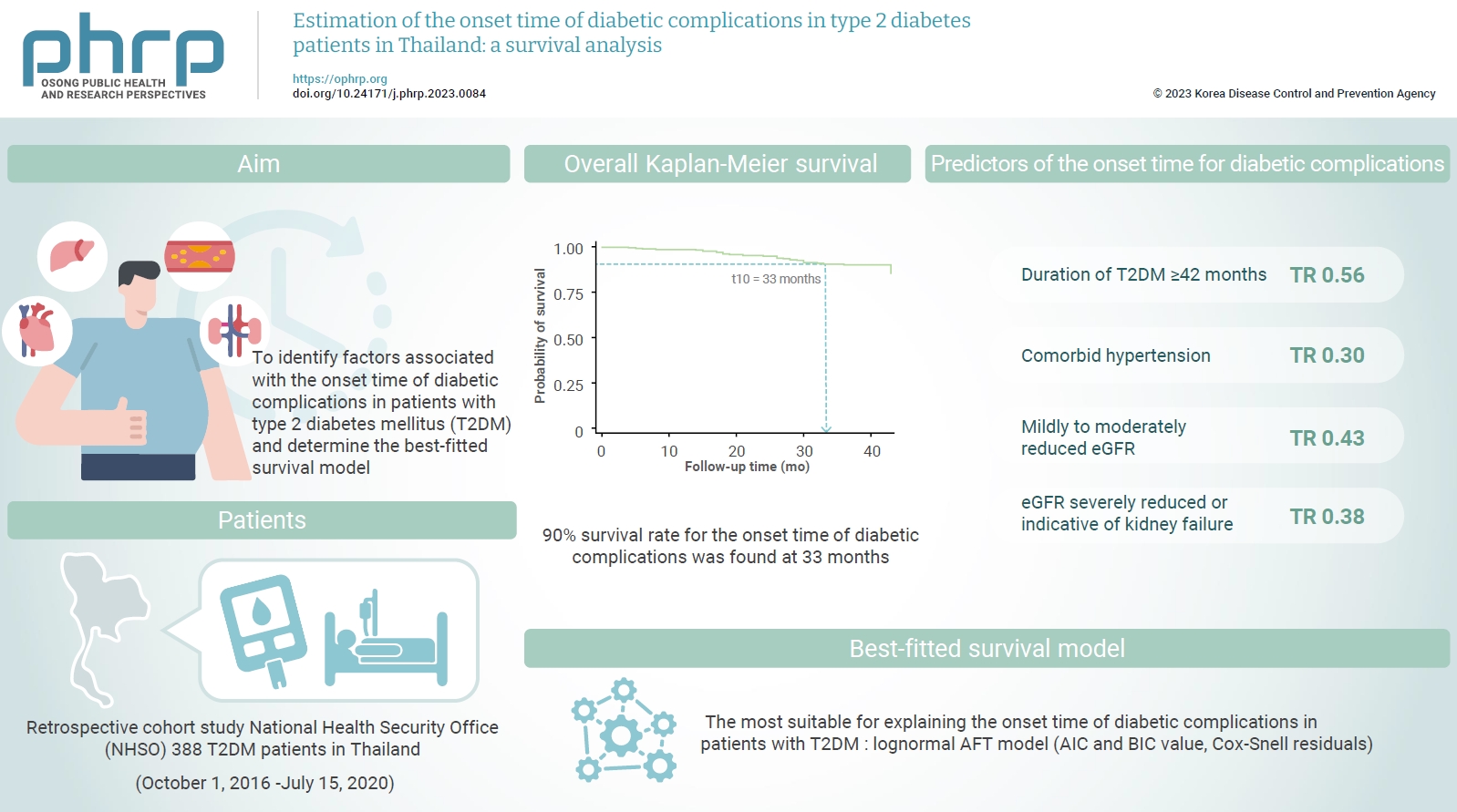
This study aimed to identify factors associated with the onset time of diabetic complications in patients with type 2 diabetes mellitus (T2DM) and determine the best-fitted survival model. Methods: A retrospective cohort study was conducted among T2DM patients enrolled from October 1, 2016 to July 15, 2020 at the National Health Security Office (NHSO). In total, 388 T2DM patients were included. Cox proportional-hazard and parametric models were used to identify factors related to the onset time of diabetic complications. The Akaike information criterion, Bayesian information criterion, and Cox-Snell residual were compared to determine the best-fitted survival model. Results: Thirty diabetic complication events were detected among the 388 patients (7.7%). A 90% survival rate for the onset time of diabetic complications was found at 33 months after the first T2DM diagnosis. According to multivariate analysis, a duration of T2DM ≥42 months (time ratio [TR], 0.56; 95% confidence interval [CI], 0.33–0.96; p=0.034), comorbid hypertension (TR, 0.30; 95% CI, 0.15–0.60; p=0.001), mildly to moderately reduced levels of the estimated glomerular filtration rate (eGFR) (TR, 0.43; 95% CI, 0.24–0.75; p=0.003) and an eGFR that was severely reduced or indicative of kidney failure (TR, 0.38; 95% CI, 0.16–0.88; p=0.025) were significantly associated with the onset time of diabetic complications (p<0.05). Conclusion: Patients with T2DM durations of more than 42 months, comorbid hypertension, and decreased eGFR were at risk of developing diabetic complications. The NHSO should be aware of these factors to establish a policy to prevent diabetic complications after the diagnosis of T2DM.

Citations

Citations to this article as recorded by  Crossref logo
  • Survival and predictors of mortality among adults with type 2 diabetes at a teaching hospital in Ghana: a retrospective cohort study
    Issah Haruna, Abdul-Rauf Sulemana, Emmanuel Kweku Nakua, Daniel Boateng
    BMC Public Health.2026;[Epub]     CrossRef
  • Survival analysis of patients with chronic diseases: a statistical approach to mortality risk factors
    Vladimiro Ibañez Quispe, Juan Reinaldo Paredes Quispe, Remo Choquejahua Acero, Teresa Paola Alvarez Rozas, Edgar Eloy Carpio Vargas, Godofredo Quispe Mamani, Percy Huata Panc
    Journal of Advanced Pharmacy Education and Researc.2026; 16(1): 211.     CrossRef
  • An elevated level of one-hour postprandial plasma glucose is an independent risk factor for developing chronic complications of type 2 diabetes mellitus
    Yanyan Jin, Jing Wei, Jie Yang, Hongxia Qian, Yan Wu, Mengmeng Liu
    Archives of Physiology and Biochemistry.2025; 131(6): 1025.     CrossRef
  • Advanced age and elevated cholesterol predict diabetic neuropathy in patients with type II diabetes mellitus in Southern Ethiopia
    Fasika Merid, Habtamu Esubalew, Tamirat Gezahegn Guyo, Firdawek Getahun
    Cardiovascular Diabetology – Endocrinology Reports.2025;[Epub]     CrossRef
  • 7,895 View
  • 229 Download
  • 4 Web of Science
  • Crossref
Evaluation of COVID-19 vaccine effectiveness in different high-risk facility types during a period of Delta variant dominance in the Republic of Korea: a cross-sectional study
Min Jei Lee, Myung-Jae Hwang, Dong Seob Kim, Seon Kyeong Park, Jihyun Choi, Ji Joo Lee, Jong Mu Kim, Young-Man Kim, Young-Joon Park, Jin Gwack, Sang-Eun Lee
Osong Public Health Res Perspect 2023;14(5):418-426.
Published online October 19, 2023
DOI: https://doi.org/10.24171/j.phrp.2023.0188
Evaluation of COVID-19 vaccine effectiveness in different high-risk facility types during a period of Delta variant dominance in the Republic of Korea: a cross-sectional study
Objectives
We evaluated the effectiveness of coronavirus disease 2019 vaccination in high-risk facilities in the Republic of Korea during the period when the highly transmissible Delta variant was prevalent. Additionally, we aimed to explore any disparities in vaccine effectiveness (VE) across various types of institutions, specifically distinguishing between non-medical and medical establishments. Methods: We examined 8 outbreak clusters covering 243 cases and 895 contacts from 8 high-risk facilities divided into 2 groups: group A (4 non-medical institutions) and group B (4 medical institutions). These clusters were observed from July 27, 2021 to October 16, 2021 for the attack rate (AR) and VE with respect to disease severity. A generalized linear model with a binomial distribution was used to determine the odds ratio (OR) for disease severity and death. Results: AR was notably lower in group B (medical institutions). Furthermore, VE analysis revealed that group A exhibited higher effectivity for disease severity and death than group B. The OR for disease severity was 0.24 (95% confidence interval [CI], 0.03–2.16) for group A and 0.27 (95% CI, 0.12–0.64) for group B, with the OR for death at 0.12 (95% CI, 0.01–1.32) in group A and 0.34 (95% CI, 0.14–0.87) in group B. Conclusion: Although VE may vary across institutions, our findings underscore the importance of implementing vaccinations in high-risk facilities. Customized vaccination programs, tailored response plans, and competent management personnel are essential for effectively addressing and mitigating public health challenges.
  • 5,189 View
  • 80 Download
The risk associated with psychiatric disturbances in patients with diabetes in Indonesia (2018): a cross-sectional observational study video
Siti Isfandari, Betty Roosihermiatie, Sulistyowati Tuminah, Laurentia Konadi Mihardja
Osong Public Health Res Perspect 2023;14(5):368-378.
Published online October 18, 2023
DOI: https://doi.org/10.24171/j.phrp.2023.0144
The risk associated with psychiatric disturbances in patients with diabetes in Indonesia (2018): a cross-sectional observational study
Objectives
The global prevalence of psychiatric disturbances is rising, detrimentally affecting the quality of care and treatment outcomes for individuals, particularly those with diabetes.This study investigated the association of risk factors for psychiatric disturbances among productive-age patients with diabetes (ages 30−59 years), considering sociodemographic characteristics and co-existing diseases. The risk factors considered included sociodemographic factors (e.g., residence, age, sex, marital status, education, and occupation) and co-existing diseases (e.g., hypertension, heart disease, stroke, renal failure, rheumatism, asthma, and cancer). Methods: This cross-sectional study utilized data from the 2018 Indonesian National Health Survey (Riskesdas). The study population comprised respondents aged between 30 and 59 years who had diabetes and had completed the 20-question self-reporting questionnaire (SRQ-20). After the exclusion of incomplete SRQ-20 data, the sample included 8,917 respondents. Data were analyzed using logistic regression. Results: Approximately 18.29% of individuals with diabetes displayed symptoms indicative of psychiatric disturbances. After adjusting for sociodemographic factors such as age, sex, education level, occupation, marital status, and place of residence, patients with diabetes who had co-existing conditions such as hypertension, heart diseases, rheumatic disorders, asthma, or cancer had a higher risk for developing psychiatric disturbances than those with diabetes alone (adjusted odds ratio, 6.67; 95% confidence interval, 4.481−9.928; p<0.001). Conclusion: The elevated risk of psychiatric disturbances among patients with diabetes who had comorbidities underscores the importance of addressing mental health issues in the management of diabetes, especially in patients with concurrent disease conditions.

Citations

Citations to this article as recorded by  Crossref logo
  • The impact of dietary consumption on hypertension in indonesia: An analysis of indonesian health survey 2023
    Cici A. Yanti, Ratna Djuwita, Evi Martha, Besral, Debby Ratno Kustanto, Noor Mastura Mohd Mujar
    Journal of Education and Health Promotion.2025;[Epub]     CrossRef
  • Investigating the association between physical fitness and blood pressure among healthcare workers in Indonesia
    Wahyu Sulistiadi, Riswandy Wasir, Astriana, Badra Al Aufa, Sri Rahayu, Wasir Thalib, Fadilah Aulia Rahma
    Discover Social Science and Health.2024;[Epub]     CrossRef
  • Correction to “The risk associated with psychiatric disturbances in patients with diabetes in Indonesia (2018): a cross-sectional observational study” [Osong Public Health Res Perspect 2023;14(5):368–78]
    Siti Isfandari, Betty Roosihermiatie, Sulistyowati Tuminah, Laurentia Konadi Mihardja
    Osong Public Health and Research Perspectives.2023; 14(6): 530.     CrossRef
  • 6,107 View
  • 129 Download
  • 4 Web of Science
  • Crossref

Short Communication

Perceptions of older adults and generativity among older citizens in Japan: a descriptive cross-sectional study
Yuho Shimizu, Tomoya Takahashi, Kenichiro Sato, Susumu Ogawa, Daisuke Cho, Yoshifumi Takahashi, Daichi Yamashiro, Yan Li, Keigo Hinakura, Ai Iizuka, Tomoki Furuya, Hiroyuki Suzuki
Osong Public Health Res Perspect 2023;14(5):427-432.
Published online October 10, 2023
DOI: https://doi.org/10.24171/j.phrp.2023.0063
Perceptions of older adults and generativity among older citizens in Japan: a descriptive cross-sectional study
Objectives
As the population ages worldwide, including in Japan, there is a growing expectation for older adults to remain active participants in society. The act of sharing one’s experiences and knowledge with younger generations through social engagement not only enriches the lives of older individuals, but also holds significant value for our society. In this study, we examined both positive and negative perceptions of older adults and investigated the correlation between these perceptions and generativity among older citizens. Additionally, we evaluated the impact of life satisfaction on these factors. Methods: We conducted a survey of 100 older adults in Japan (mean age, 71.68 years) and utilized multiple regression analyses, using positive and negative perceptions of older adults, life satisfaction, and demographic factors as independent variables. The sub-categories of generativity—namely, generative action, concern, and accomplishment—were used as dependent variables. Results: Participants who held a more positive perception of older adults demonstrated a higher level of generative actions and concerns. Additionally, participants who reported higher levels of life satisfaction also exhibited more generative actions, concerns, and accomplishments. Conversely, those who held a more negative perception of older adults were found to have higher levels of generative actions. Conclusion: Enhancing positive perceptions of older adults among them can boost the sub-categories of generativity. This study, which was conducted from an exploratory perspective, has several limitations, including a potential sampling bias. A more comprehensive examination of the relationship between perceptions of older adults and generativity is anticipated in future research.

Citations

Citations to this article as recorded by  Crossref logo
  • How ageism may constrain generativity in later life: Introducing the ageism–generativity pathways model
    Yuho Shimizu
    Educational Gerontology.2026; : 1.     CrossRef
  • Revision and Reliability-Validity Test of the Loyola Generativity Scale (LGS) in Chinese Elderly
    义鑫 张
    Advances in Psychology.2025; 15(02): 123.     CrossRef
  • 6,331 View
  • 129 Download
  • 1 Web of Science
  • Crossref

Review Article

Public health agencies’ use of social media for communication during pandemics: a scoping review of the literature
Babatunde Abiodun Balogun, Anne Hogden, Nenagh Kemp, Lin Yang, Maria Agaliotis
Osong Public Health Res Perspect 2023;14(4):235-251.
Published online August 9, 2023
DOI: https://doi.org/10.24171/j.phrp.2023.0095
Public health agencies’ use of social media for communication during pandemics: a scoping review of the literature
Public health agencies (PHAs) have increasingly incorporated social media into their communication mix during successive pandemics in the 21st century. However, the quality, timing, and accuracy of their health messages have varied significantly, resulting in mixed outcomes for communication, audience engagement, and pandemic management. This study aimed to identify factors influencing the effectiveness of pandemic-related health messages shared by PHAs on social media and to report their impact on public engagement as documented in the literature. A scoping literature review was conducted following a predefined protocol. An electronic search of 7 relevant databases and 5 grey literature repositories yielded 9,714 papers published between January 2003 and November 2022. Seventy-three papers were deemed eligible and selected for review. The results underscored the insufficiency of social media guidance policies for PHAs. Six themes were identified: message source, message topic, message style, message timing, content credibility and reliability, and message recipient profile. These themes encompassed 20 variables that could inform PHAs’ social media public health communication during pandemics. Additionally, the findings revealed potential interconnectedness among the variables, and this study concluded by proposing a conceptual model that expands upon existing theoretical foundations for developing and evaluating pandemic-related health messaging.

Citations

Citations to this article as recorded by  Crossref logo
  • Dynamics of public health messaging and healthcare activity in children during the 2022 iGAS surge: an observational study in England
    Alexandra L Creavin, Ruth Kipping, Alastair D Hay
    Journal of Public Health.2026; 48(1): 281.     CrossRef
  • Using Humor to Promote Directives: Public Service Announcements During a Protracted Crisis
    Babatunde A. Balogun, Lin Yang, Nenagh Kemp, Maria Agaliotis, Anne Hogden
    Health Communication.2026; 41(11): 1941.     CrossRef
  • Citizen engagement with information when adapting to health crises: four distinctive profiles
    Marilla Kortesalmi, Harri Jalonen, Valdemar R. V. Kallunki
    International Journal of Public Sector Management.2026; 39(5): 579.     CrossRef
  • Ethnopharmacy of Medicinal Plants in the Production of Ma'jun as Traditional Medicine in Blang Dalam Village, Darul Hikmah District, Aceh Jaya Regency
    Vera Maulida, Muhammad Ridhwan, Rubiah, Husna, Cut Morina Zubainur
    Jurnal Penelitian Pendidikan IPA.2026; 12(3): 59.     CrossRef
  • Planning and Implementing Social Media Communication in a Public Health Crisis: An Analytical Perspective
    Babatunde A. Balogun, A. Hogden, L. Yang, M. Agaliotis, N. Kemp
    Health Promotion Journal of Australia.2026;[Epub]     CrossRef
  • Misinformation Through the Lens of Dutch News Media and Public Health Authorities: Content Analysis of Topics and Narratives Present in Pandemic-Related Misinformation During COVID-19
    David Blanco-Herrero, Bas van den Putte, Toni G L A van der Meer
    JMIR Infodemiology.2026; 6: e91743.     CrossRef
  • Mapping risk communication practices in public health emergencies: a scoping review and comparison with Italian regional pandemic plans
    Erica De Vita, Guglielmo Arzilli, Francesco Gesualdo, Virginia Casigliani, Milena Pasquale, Gianluca Cruschelli, Federico Tecchio, Filippo Tosi, Andrea Davide Porretta, Diana Romersi, Cesare Buquicchio, Caterina Rizzo
    BMC Public Health.2026;[Epub]     CrossRef
  • Co‐Designing a Framework for Social Media Health Communication to Young People: A Participatory Research Study
    Melody Taba, Julie Ayre, Kirsten McCaffery, Diana Vassilenko, Ivan C. K. Ma, Tara Haynes, Julie Leask, Andrew Wilson, Carissa Bonner
    Health Expectations.2025;[Epub]     CrossRef
  • Living health-promotion campaigns for communities in the United States: Decentralized content extraction and sharing through AI
    Man-pui Sally Chan, Haesung Jung, Alex Morales, Angela Zhang, Devlin O’Keefe, Sarah Joseph, Anthony Hron, Janet Davis, Tito Terry, Tiffany Peterson, Corey Herrman, Melissa Phillips, Jennifer Osborne, Kelley G McBride, Martin Hensley, Adriana Todorov, Alai
    PNAS Nexus.2025;[Epub]     CrossRef
  • Paid Social Media Advertising on Vaping in Australia: A Descriptive Study Using Meta Ad Library
    Xiao Li, Robyn Gillespie, Alberto Nettel‐Aguirre, Lisa Gaye Smithers
    Health Promotion Journal of Australia.2025;[Epub]     CrossRef
  • 11,736 View
  • 306 Download
  • 9 Web of Science
  • Crossref

Original Articles

Vaccine effectiveness and the epidemiological characteristics of a COVID-19 outbreak in a tertiary hospital in Republic of Korea
Seonhee Ahn, Tae Jong Son, Yoonsuk Jang, Jihyun Choi, Young Joon Park, Jiseon Seong, Hyun Hee Kwon, Muk Ju Kim, Donghyok Kwon
Osong Public Health Res Perspect 2023;14(3):188-196.
Published online June 8, 2023
DOI: https://doi.org/10.24171/j.phrp.2023.0066
Vaccine effectiveness and the epidemiological characteristics of a COVID-19 outbreak in a tertiary hospital in Republic of Korea
Objectives
Healthcare facilities are high-risk sites for infection. This study analyzed the epidemiological characteristics of a coronavirus disease 2019 (COVID-19) outbreak in a tertiary hospital after COVID-19 vaccination had been introduced in Republic of Korea. Vaccine effectiveness (VE) and shared anti-infection strategies are also assessed.
Methods
The risk levels for 4,074 contacts were evaluated. The epidemiological characteristics of confirmed cases were evaluated using the chi-square test. The “1 minus relative risk” method was used to determine VE in preventing infection, progression to severe disease, and death. In the largest affected area (the 8th floor), a separate relative risk analysis was conducted. A multivariate logistic regression analysis (with 95% confidence interval [CIs]) was used to identify transmission risk factors with a significance level <10% via the backward elimination method.
Results
In total, 181 cases of COVID-19 were confirmed, with an attack rate of 4.4%. Of those cases, 12.7% progressed to severe disease, and 8.3% died. In the cohort isolation area on the 8th floor, where 79.0% of the confirmed cases occurred, the adjusted odds ratio was 6.55 (95% CI, 2.99–14.33) and 2.19 (95% CI, 1.24–3.88) for caregivers and the unvaccinated group, respectively. VE analysis revealed that 85.8% of the cases that progressed to severe disease and 78.6% of the deaths could be prevented by administering a second vaccine.
Conclusion
Caregiver training for infection prevention and control is necessary to reduce infection risk. Vaccination is an important intervention to reduce the risk of progression to severe disease and death.
  • 4,931 View
  • 118 Download
Risk factors associated with death due to severe fever with thrombocytopenia syndrome in hospitalized Korean patients (2018–2022)
Jia Kim, Hyo-jeong Hong, Ji-hye Hwang, Na-Ri Shin, Kyungwon Hwang
Osong Public Health Res Perspect 2023;14(3):151-163.
Published online June 8, 2023
DOI: https://doi.org/10.24171/j.phrp.2023.0048
Risk factors associated with death due to severe fever with thrombocytopenia syndrome in hospitalized Korean patients (2018–2022)
Objectives
Severe fever with thrombocytopenia syndrome (SFTS) has no vaccine or treatment and an extremely high fatality rate. We aimed to analyze and evaluate the risk factors for death associated with SFTS.
Methods
Among reports from 2018 to 2022, we compared and analyzed 1,034 inpatients aged 18 years or older with laboratory-confirmed SFTS who underwent complete epidemiological investigations.
Results
Most of the inpatients with SFTS were aged 50 years or older (average age, 67.6 years). The median time from symptom onset to death was 9 days, and the average case fatality rate was 18.5%. Risk factors for death included age of 70 years or older (odds ratio [OR], 4.82); agriculture-related occupation (OR, 2.01); underlying disease (OR, 7.20); delayed diagnosis (OR, 1.28 per day); decreased level of consciousness (OR, 5.53); fever/chills (OR, 20.52); prolonged activated partial thromboplastin time (OR, 4.19); and elevated levels of aspartate aminotransferase (OR, 2.91), blood urea nitrogen (OR, 2.62), and creatine (OR, 3.21).
Conclusion
The risk factors for death in patients with SFTS were old age; agriculture-related occupation; underlying disease; delayed clinical suspicion; fever/chills; decreased level of consciousness; and elevated activated partial thromboplastin time, aspartate aminotransferase, blood urea nitrogen, and creatine levels.

Citations

Citations to this article as recorded by  Crossref logo
  • Seroprevalence and Epidemiological Characteristics of Severe Fever with Thrombocytopenia Syndrome in Patients with Chronic Diseases in Korea
    Jongyoun Yi, Ahreum Kim, Maeng Seok Noh, Changhoon Kim, Hyun Jin Son, Mee Kyung Ko, Kye-Hyung Kim
    Viruses.2026; 18(2): 217.     CrossRef
  • Overwintering Ticks as a Reservoir for Severe Fever With Thrombocytopenia Syndrome Virus in the Republic of Korea
    Hyunyoung Yoon, Hee Il Lee, Seong Yoon Kim
    Entomological Research.2026;[Epub]     CrossRef
  • Ecological signature on the epidemiological dynamics of severe fever with thrombocytopenia syndrome
    Zhe Lou, Jing Lu, Shuyi Liang, Wei Zhao, Ling Huang, Haowei Wang, Xiang Li, Jianli Hu, Ruiyun Li, Bo Zhang
    PLOS Neglected Tropical Diseases.2026; 20(6): e0014408.     CrossRef
  • Clinical Predictors of Mortality in Severe Fever with Thrombocytopenia Syndrome: An Updated Systematic Review and Meta-Analysis
    Ke-Xin Wang, Guo-Mei Xia, Yu-Han Liu, Shuai-Ru Jiao, Yu-Feng Gao, Sheng-Qun Deng
    Pathogens.2026; 15(7): 767.     CrossRef
  • Commentary on “Low Thoracic Muscle Mass: A Novel Indicator of Poor Prognosis in Patients With Severe Fever With Thrombocytopenia Syndrome”
    Mohammad Barary, Mostafa Javanian, Mohammad Golparvar Azizi, Mehran Shokri, Soheil Ebrahimpour
    Immunity, Inflammation and Disease.2026;[Epub]     CrossRef
  • Identification of early prognostic biomarkers in Severe Fever with Thrombocytopenia Syndrome using machine learning algorithms
    Jie Zhu, Jianmei Zhou, Chunhui Tao, Guomei Xia, Bingyan Liu, Xiaowei Zheng, Xu Li, Zhenhua Zhang
    Annals of Medicine.2025;[Epub]     CrossRef
  • The immunogenicity and protection efficacy evaluation of mRNA vaccine candidate for severe fever with thrombocytopenia syndrome in mice
    Da-Eun Jeong, Jack Yoon, Baek Kim, Jun-Gu Kang, Abdallah M. Samy
    PLOS Neglected Tropical Diseases.2025; 19(4): e0012999.     CrossRef
  • Retrospective Analysis of Severe Fever With Thrombocytopenia Syndrome and Construction of a Nomogram Prediction Model for Mortality Risk Factors
    Gang Chen, Yuchen Du, Xiuchang Ma, Yaowen Liang, Apeng Chen, Jie Wei, Jinhuan Wu, Wenxian Qian, Shuqin Xie, Yi Yan, Zheng Hu, Yishan Zheng, Man Tian, Changhua Yi
    Open Forum Infectious Diseases.2025;[Epub]     CrossRef
  • Deciphering the evolutionary landscape of severe fever with thrombocytopenia syndrome virus across East Asia
    Dongbin Park, Kwan Woo Kim, Young-Il Kim, Mark Anthony B Casel, Hyunwoo Jang, Woohyun Kwon, Kanghee Kim, Se-Mi Kim, Monford Paul Abishek N, Eun-Ha Kim, Hobin Jang, Suhee Hwang, Seok-Min Yun, Joo-Yeon Lee, Hye Won Jeong, Su-Jin Park, Young Ki Choi
    Virus Evolution.2024;[Epub]     CrossRef
  • Acute kidney injury as a prognostic marker in severe fever with thrombocytopenia syndrome
    Jin Mi Lee, Hae Lee Kim, Myoung-nam Lim, Changhyup Kim, Yeon Ju La, Yong Duk Jeon, Won Sup Oh, Seongmin Son, Sunhwa Lee, Hyunjeong Baek, Daniel Duck-Jin Hwang, Ji In Park
    Scientific Reports.2024;[Epub]     CrossRef
  • Double-Stranded RNA-Based Method for Diagnosing Severe Fever with Thrombocytopenia
    Jung Wan Park, Jaemin Jeon, Yoosik Kim, Min Hyok Jeon
    Journal of Clinical Medicine.2024; 14(1): 105.     CrossRef
  • 7,185 View
  • 254 Download
  • 10 Web of Science
  • Crossref
Effectiveness of the COVID-19 vaccine in the Honam region of the Republic of Korea
In-Sook Shin, Yong-Pyo Lee, Seung-Hoon Lee, Jae-Young Lee, Jong-Ha Park, Yoon-Seok Chung
Osong Public Health Res Perspect 2023;14(3):197-206.
Published online June 8, 2023
DOI: https://doi.org/10.24171/j.phrp.2022.0308
Effectiveness of the COVID-19 vaccine in the Honam region of the Republic of Korea
Objectives
In 2021, the effectiveness of the COVID-19 vaccine was analyzed among people living in the Honam region (Gwangju, Jeollanam-do, Jeollabuk-do, and Jeju) of the Republic of Korea. And we investigated changes in the dominant virus strain.
Methods
This study used the data provided by the Korean Ministry of the Interior and Safety for individuals ≥12 years old in the Honam region, and the Integrated Disease and Health Management System of the Korea Centers for Disease Control and Prevention for COVID-19-vaccinated individuals as of December 31, 2021. Statistical analyzes were performed using IBM SPSS ver. 23.0. The occurrence of confirmed cases by vaccination status, the relative risk, and vaccine effectiveness by vaccine type were calculated.
Results
In 2021, the COVID-19 vaccination rate in Honam was 88.6%. The overall vaccine effectiveness (after 2 and 3 doses) was 98.7% (p<0.001). and the breakthrough infection rate was 0.16%. From week 21 to week 27 of 2021 (June 27 to July 3), the genome sequencing results were mostly alpha variants. The Delta variant emerged as the dominant variant after 27 weeks and the Omicron variant was found at 50 weeks (December 5–11).
Conclusion
Vaccine effectiveness changed with the outbreak of new variants of the virus as well as over time as antibody levels decreased. that the prevention effectiveness of vaccination in Honam was >98%, and the effect among persons who received 2 doses was >90% regardless of the vaccine type. Although vaccine effectiveness decreased because of reduced antibody levels over time (as observed in breakthrough infections), receiving a booster dose restored the neutralizing antibody levels.
  • 5,886 View
  • 98 Download

Review Article

Points to consider when developing drugs for dry eye syndrome
Suyoung Bae, Hosun Seung, Ho Jung Oh
Osong Public Health Res Perspect 2023;14(2):70-75.
Published online April 26, 2023
DOI: https://doi.org/10.24171/j.phrp.2023.0031
Points to consider when developing drugs for dry eye syndrome
Changes in both the social environment (e.g., the increased use of electronic media) and the atmospheric environment (e.g., air pollution and dust) have contributed to an increasing incidence of eye disease and an increased need for eye care. Notably, the signs and symptoms of dry eye syndrome can impact the daily quality of life for various age groups, including the elderly, and usually requires active treatment. The symptoms of dry eye syndrome include tear film instability, hyperosmolarity, ocular surface inflammation and damage, and neurosensory abnormalities. As treatments for dry eye are being developed, a standardized guideline is needed to increase the efficiency of drug development and improve the quality of clinical trial data. In this paper, we present general considerations for the pharmaceutical industry and clinical trial investigators designing clinical trials focused on the development of drugs to treat dry eye syndrome.

Citations

Citations to this article as recorded by  Crossref logo
  • Hypoxia, Humidity and Low Temperature on In-flight Dry Eye
    Ayi Adikanyaa Paramesthi, Ferdi Afian
    The Korean Journal of Aerospace and Environmental .2025; 35(2): 74.     CrossRef
  • Glucose-Responsive Superlubricity of a Self-Healing Hydrogel Containing Dynamic Boronic Ester Bonds under Ocular Conditions
    Hongdong Wang, Yuxuan He, Qi Wang, Xiacong Zhang, Yuhong Liu, Jianhua Zhang
    Langmuir.2025; 41(39): 26683.     CrossRef
  • 5,940 View
  • 166 Download
  • 2 Web of Science
  • Crossref

Original Articles

The incidence and clinical characteristics of myocarditis and pericarditis following mRNA-based COVID-19 vaccination in Republic of Korea adolescents from July 2021 to September 2022
Objectives
Age-specific information regarding myocarditis/pericarditis in adolescents following mRNA-based coronavirus disease 2019 (COVID-19) vaccination in Asia remains insufficient. This study investigated the incidence and clinical characteristics of myocarditis/pericarditis in Republic of Korea adolescents after mRNA-based COVID-19 vaccination.
Methods
This retrospective descriptive study utilized patient data from the Korea Immunization Management System. Incidence rates were calculated according to age and sex. Clinical characteristics (symptoms/signs, laboratory values, and imaging results) were compared between mild and severe cases.
Results
Between July 19, 2021 and September 30, 2022, 3,728,224 individuals aged 12 to 19 years received 6,484,165 mRNA-based COVID-19 vaccines, and 173 cases met the case definition for myocarditis/pericarditis: 151 mild (87.3%) and 22 severe (12.7%). The incidence was 3.8-fold higher in males than in females. Troponin I/ troponin T was elevated in 96% of myocarditis cases, demonstrating higher sensitivity than creatine kinase-myocardial band (67.6%) or C-reactive protein (75.2%). ST-segment or Twave on electrography abnormalities were found in 60.3% (85/141). Paroxysmal/sustained atrial/ventricular arrhythmias were more common in severe than in mild cases (45.5% vs. 16.8%, p=0.008). Edema on T2-weighted magnetic imaging occurred in 21.6% (8/37) and 62.5% (5/8) of mild and severe cases, respectively (p=0.03). Abnormal pericardial fluid collection or pericardial inflammation was found in 75.4% of pericarditis cases (49/65).
Conclusion
Myocarditis/pericarditis occurred in rare cases following mRNA-based COVID-19 vaccination. Most cases were mild, but the incidence was higher in adolescent males and after the second dose. As bivalent severe acute respiratory syndrome coronavirus 2 mRNA vaccination started in Republic of Korea in October 2022, the post-vaccination incidence of myocarditis/pericarditis should be closely monitored, considering clinical characteristics.

Citations

Citations to this article as recorded by  Crossref logo
  • Factors associated with carditis adverse events following SARS-COV-2-19 vaccination
    Kyung Hyun Min, Jun Hyeob Kim, Jin Yeon Gil, Jun Hyuk Park, Ji Min Han, Kyung Eun Lee
    Epidemiology and Infection.2025;[Epub]     CrossRef
  • Unique Features and Collateral Immune Effects of mRNA-LNP COVID-19 Vaccines: Plausible Mechanisms of Adverse Events and Complications
    János Szebeni
    Pharmaceutics.2025; 17(10): 1327.     CrossRef
  • Responses to Common Misconceptions Relating to COVID-19 Variant-Adapted mRNA Vaccines
    George Kassianos, Pauline MacDonald, Ivan Aloysius, Shanti Pather
    Vaccines.2024; 12(1): 57.     CrossRef
  • Comparative safety of monovalent and bivalent mRNA COVID-19 booster vaccines in adolescents aged 12 to 17 years in the Republic of Korea
    Mijeong Ko, Seontae Kim, Seok-Kyoung Choi, Seung Hwan Shin, Yeon-Kyeng Lee, Yunhyung Kwon
    Osong Public Health and Research Perspectives.2024; 15(4): 364.     CrossRef
  • Epidemiological Characteristics and Outcome of Myocarditis and Pericarditis Temporally Associated With BNT162b2 COVID-19 Vaccine in Adolescents: Korean National Surveillance
    Bin Ahn, Seung Hwan Shin, Myung-Jae Hwang, HyoSug Choi, Sara Na, Sangshin Park, Jue Seong Lee, Young June Choe, Yoonsun Yoon, Kyoungsan Seo, Jong Hee Kim, Hyun Mi Kang
    Journal of Korean Medical Science.2024;[Epub]     CrossRef
  • To become a more stronger and safer country
    Jong-Koo Lee
    Osong Public Health and Research Perspectives.2023; 14(2): 67.     CrossRef
  • 11,720 View
  • 288 Download
  • 6 Web of Science
  • Crossref
Association between the empirical dietary inflammatory index and musculoskeletal pain in community-dwelling older adults: a cross-sectional study
Mahshid Rezaei, Zahra Tajary, Zahra Esmaeily, Atefeh Eyvazkhani, Shahrzad Daei, Marjan Mansouri Dara, Mohaddeseh Rezaei, Abolghassem Djazayeri, Ahmadreza Dorosty Motlagh
Osong Public Health Res Perspect 2023;14(1):51-58.
Published online February 20, 2023
DOI: https://doi.org/10.24171/j.phrp.2022.0194
Association between the empirical dietary inflammatory index and musculoskeletal pain in community-dwelling older adults: a cross-sectional study
Objectives
Inflammation has been proposed to be one of the main causes of musculoskeletal pain. Diet is a lifestyle factor that plays an important role in managing inflammation; thus, we assessed the inflammatory potential of diets using the empirical dietary inflammatory index (EDII) to investigate the relationship between diet and musculoskeletal pain.
Methods
This cross-sectional study included 212 elderly individuals who were selected from health centers in Tehran, Iran. Dietary intake was evaluated using a valid and reliable 147-item food frequency questionnaire. To measure the intensity of pain, a visual analogue scale was used. Multiple linear regression was applied to assess the association between the EDII and musculoskeletal pain.
Results
In total, 62.7% and 37.3% of participants had mild and severe pain, respectively. The EDII values were 0.97±0.72 and 1.10±0.66, respectively, in those with mild and severe pain. A higher EDII score was associated with more intense musculoskeletal pain after adjusting for age and sex (β=0.20; 95% confidence interval [CI], 0.06–0.26; p<0.001), but not after adjustment for other confounders (β=–0.13; 95% CI, –1.54 to 0.60; p=0.39).
Conclusion
Our findings indicated that higher dietary inflammation might not be associated with musculoskeletal pain in older adults. However, further investigations are required to confirm these findings.

Citations

Citations to this article as recorded by  Crossref logo
  • Skeletal Muscle Disorders: Navigating Management and Natural Products
    Hesham M. El‐Sayed, Khaled Hussien, Heba R. Ghaiad, Mai A. Abd‐Elmawla, Nourhan M. Abdelmaksoud, Asmaa Ramadan, Riham A. El‐Shiekh, Mohamed Bakr Zaki
    Chemistry & Biodiversity.2026;[Epub]     CrossRef
  • Proinflammatory diet is associated with higher pain, disease severity and biochemical parameters associated with inflammation in fibromyalgia
    Nursena Ersoy Söke, Hansa İnceöz, İlker Solmaz, Hülya Yardımcı
    Pain Medicine.2025; 26(3): 131.     CrossRef
  • Exploring the association between dietary Inflammatory Index and chronic pain in US adults using NHANES 1999–2004
    Lunxue Qing, Yingying Zhu, Changhe Yu, Yang Zhang, Jinxia Ni
    Scientific Reports.2024;[Epub]     CrossRef
  • The dietary inflammatory index and cardiometabolic parameters in US firefighters
    Andria Christodoulou, Costas A. Christophi, Mercedes Sotos-Prieto, Steven Moffatt, Longgang Zhao, Stefanos N. Kales, James R. Hébert
    Frontiers in Nutrition.2024;[Epub]     CrossRef
  • Association between dietary inflammatory index and musculoskeletal disorders in adults
    Firoozeh Khamoushi, Davood Soleimani, Farid Najafi, Neshat Ahmadi, Neda Heidarzadeh-Esfahani, Bita Anvari, Ebrahim Shakiba, Yahya Pasdar
    Scientific Reports.2023;[Epub]     CrossRef
  • 6,543 View
  • 116 Download
  • 5 Web of Science
  • Crossref
mRNA vaccine effectiveness against SARS-CoV-2 B.1.617.2 (Delta) and B.1.1.529 (Omicron) variant transmission from home care cases to household contacts in South Korea
Hanul Park, Young Joon Park, Sang Eun Lee, Min Jei Lee, Hyungtae Ahn
Osong Public Health Res Perspect 2022;13(6):435-442.
Published online November 28, 2022
DOI: https://doi.org/10.24171/j.phrp.2022.0243
mRNA vaccine effectiveness against SARS-CoV-2 B.1.617.2 (Delta) and B.1.1.529 (Omicron) variant transmission from home care cases to household contacts in South Korea
Objectives
Household contacts of confirmed cases of coronavirus disease 2019 (COVID-19) areexposed to a high risk of viral transmission, and secondary incidence is an important indicatorof community transmission. This study analyzed the secondary attack rate and mRNA vaccineeffectiveness against transmission (VET) for index cases (patients treated at home) confirmedto be infected with the Delta and Omicron variants.Methods: The subjects of the study were 4,450 index cases and 10,382 household contacts.Logistic regression analysis was performed to compare the secondary attack rate byvaccination status, and adjusted relative risk and 95% confidence intervals were identified.Results: The secondary attack rate of the Delta variant was 27.3%, while the secondary attackrate of the Omicron variant was 29.8%. For the Delta variant, groups with less than 90 daysand more than 90 days after 2 doses of mRNA vaccination both showed a VET of 37%. For theOmicron variant, a 64% VET was found among those with less than 90 days after 2 doses ofmRNA vaccination.Conclusion: This study provides useful data on the secondary attack rate and VET of mRNAvaccines for household contacts of COVID-19 cases in South Korea.

Citations

Citations to this article as recorded by  Crossref logo
  • Impact of disease severity, age, sex, comorbidity, and vaccination on secondary attack rates of SARS-CoV-2: a global systematic review and meta-analysis
    Dewan Md. Sumsuzzman, Yang Ye, Zhen Wang, Abhishek Pandey, Joanne M. Langley, Alison P. Galvani, Seyed M. Moghadas
    BMC Infectious Diseases.2025;[Epub]     CrossRef
  • Child Transmission of SARS-CoV-2 Throughout the Pandemic: An Updated Systematic Review and Meta-analysis
    Eugene Kwon, Gabriel Blank, Samantha Starkey, Cassidy Chapman, Conné Lategan, Hennady Shulha, Vanessa Kitchin, Sarah Silverberg, Laura Sauvé, Manish Sadarangani
    Pediatric Infectious Disease Journal.2025; 44(7): 696.     CrossRef
  • Household secondary attack rates and risk factors during periods of SARS-CoV-2 Delta and Omicron variant predominance in the Republic of Korea
    Jin Lee, Mijeong Ko, Seontae Kim, Dosang Lim, Gemma Park, Sang-Eun Lee
    Osong Public Health and Research Perspectives.2023; 14(4): 263.     CrossRef
  • 13,142 View
  • 204 Download
  • 3 Web of Science
  • Crossref
Clinical outcomes of remdesivir-treated COVID-19 patients in South Korea
Mi Yu, Bryan Inho Kim, Jungyeon Kim, Jin Gwack
Osong Public Health Res Perspect 2022;13(5):370-376.
Published online October 18, 2022
DOI: https://doi.org/10.24171/j.phrp.2022.0138
Objectives
This study analyzed the clinical outcomes of remdesivir treatment in coronavirus disease 2019 (COVID-19) patients in South Korea.
Methods
This retrospective cohort study involved the secondary analysis of epidemiological data. Among patients diagnosed with COVID-19 from July 2, 2020 to March 23, 2021 (12 AM), 4,868 who received oxygen therapy and were released from isolation after receiving remdesivir treatment were assigned to the treatment group, and 6,068 patients who received oxygen therapy but not remdesivir were assigned to the untreated group. The study subjects included children under the age of 19. The general characteristics and severity were compared between the groups. Differences in the time to death and mortality were also compared.
Results
In the untreated group, the hazard ratio [HR] for mortality was 1.59 among patients aged ≥70 years and 2.32 in patients with severe disease in comparison to the treatment group. In a comparison of survival time among patients with severe disease aged ≥70 years, the HR for mortality before 50 days was 2.09 in the untreated group compared to the treatment group.
Conclusion
Patients with remdesivir treatment showed better clinical outcomes in this study, but these results should be interpreted with caution since this study was not a fully controlled clinical trial.

Citations

Citations to this article as recorded by  Crossref logo
  • The Role of Multidimensional Prognostic Index to Identify Hospitalized Older Adults with COVID-19 Who Can Benefit from Remdesivir Treatment: An Observational, Prospective, Multicenter Study
    Carlo Custodero, Nicola Veronese, Eva Topinkova, Helena Michalkova, Maria Cristina Polidori, Alberto Cella, Alfonso J. Cruz-Jentoft, Christine A. F. von Arnim, Margherita Azzini, Heidi Gruner, Alberto Castagna, Giovanni Cenderello, Romina Custureri, Tania
    Drugs & Aging.2023; 40(7): 643.     CrossRef
  • Remdesivir: A Review in COVID-19
    Hannah A. Blair
    Drugs.2023; 83(13): 1215.     CrossRef
  • 5,536 View
  • 96 Download
  • 2 Web of Science
  • Crossref

Review Article

Effects of medication adherence interventions for older adults with chronic illnesses: a systematic review and meta-analysis
Hae Ok Jeon, Myung-Ock Chae, Ahrin Kim
Osong Public Health Res Perspect 2022;13(5):328-340.
Published online October 12, 2022
DOI: https://doi.org/10.24171/j.phrp.2022.0168
This systematic review and meta-analysis aimed to understand the characteristics of medication adherence interventions for older adults with chronic illnesses, and to investigate the average effect size by combining the individual effects of these interventions. Data from studies meeting the inclusion criteria were systematically collected in accordance with the Preferred Reporting Items for Systematic Reviews and Meta-Analysis guidelines. The results showed that the average effect size (Hedges’ g) of the finally selected medication adherence interventions for older adults with chronic illnesses calculated using a random-effects model was 0.500 (95% confidence interval [CI], 0.342−0.659). Of the medication adherence interventions, an implementation intention intervention (using face-to-face meetings and telephone monitoring with personalized behavioral strategies) and a health belief model–based educational program were found to be highly effective. Face-to-face counseling was a significantly effective method of implementing medication adherence interventions for older adults with chronic illnesses (Hedges’ g=0.531, 95% CI, 0.186−0.877), while medication adherence interventions through education and telehealth counseling were not effective. This study verified the effectiveness of personalized behavioral change strategies and cognitive behavioral therapy based on the health belief model, as well as face-to-face meetings, as medication adherence interventions for older adults with chronic illnesses.

Citations

Citations to this article as recorded by  Crossref logo
  • Impact of telemedicine on chronic disease patients: An overview of systematic reviews
    Kun Zhang, Yanhua Chen, Peicheng Wang, Yanrong He, Yanrong Du, Hailun Liang, Weiguo Zhu, Xiao Long, Leiyu Shi, Jiming Zhu
    Intelligent Medicine.2026; 6(2): 226.     CrossRef
  • Updating Interventions to Enhance Medication Adherence among Community-Dwelling Older Adults with Chronic Diseases
    Luu Thi Thuy, Nguyen Thi Yen Hoai, Diep Thi Tieu Mai
    Home Healthcare Now.2026; 44(1): 40.     CrossRef
  • Treatment Adherence and Persistence of Anti-Fibrotic Drugs in Real Life in Greece
    Georgia Kourlaba, Stylianos Ravanidis, Garyfallia Stefanou, Konstantinos Mathioudakis, Anastasios Tsolakidis, Dimitrios Zografopoulos
    Advances in Respiratory Medicine.2026; 94(1): 6.     CrossRef
  • Reasons for delayed medical treatment among cholelithiasis patients: a qualitative study based on the health belief model
    Min Jiang, Yajie Shi, Jiao Liu, Yan Liu, Yanzhang Tian, Fang He
    BMC Health Services Research.2026;[Epub]     CrossRef
  • Can We Predict Older Adults’ Long-Term Healthy Behavior Maintenance? Identifying the Optimal Machine Learning Model
    HeSen Li, WeiCheng Pan, Hong Chen, YiZhuo Hou
    International Journal of Human–Computer Interactio.2026; 42(20): 17782.     CrossRef
  • Medication adherence trajectories and association with risk factors and clinical outcomes in type 2 diabetes treatment
    Sara Mucherino, Valentina Orlando, Marcia Vervloet, Yvette Weesie, Liset van Dijk, Enrica Menditto, Yee Gary Ang
    PLOS One.2026; 21(2): e0342056.     CrossRef
  • Designing age-friendly interfaces and wearable–environment integrations to enhance medication adherence: a discrete choice experiment among older adults
    Jialin Qin, Zeyu Wu, Hao Zhang, Xiaopan Qi
    Frontiers in Medicine.2026;[Epub]     CrossRef
  • Psychosocial predictors of non-adherence to antihypertensive medication among Korean adults: A nationwide cross-sectional study
    Kunhee Han, Hwa Sun Kim, Young Lee, Chung-woo Lee, Muhammad Haroon Stanikzai
    PLOS One.2026; 21(3): e0345509.     CrossRef
  • Nurse-led interventions in enhancing outcomes for patients with tuberculosis: a scoping review
    Nita Arisanti Yulanda, Hidayat Arifin, Titan Ligita, Lestari Makmuriana, Alfi Syahri, Susanti Susanti, Komang Ardidhana Nugraha Putra, Andri Setiya Wahyudi, Somsak Thojampa, Tintin Sukartini
    Journal of Research in Nursing.2026;[Epub]     CrossRef
  • Bedside Cognitive Behavioral Therapy Techniques in Primary Care
    Meredith L.C. Williamson, Danielle L. Terry, Kaylee J. Jackson
    Primary Care: Clinics in Office Practice.2026; 53(2): 251.     CrossRef
  • Mobile health apps for older adults: real-world evidence on engagement and medication adherence
    Elyssa Wiecek, Scott Taylor, Hugo Rourke, Fiona Hammond, Noelia Amador-Fernandez
    Frontiers in Digital Health.2026;[Epub]     CrossRef
  • Medication adherence in older adults with chronic diseases: a scoping review of barriers, facilitators, and effective interventions
    Doris Cardona-Arango, Valeria Santacruz-Restrepo, Alejandra Rendón-Montoya, Juliana Madrigal-Cadavid, Alejandra Segura-Cardona, Jorge Iván Estrada-Acevedo
    Frontiers in Aging.2026;[Epub]     CrossRef
  • A pilot feasibility study of a tablet-based virtual community application with shared avatars for promoting health behavior change in older adult care facilities
    Kenji Nakamura, Keiichi Yamazaki, Akiko Yamazaki, Yoshiaki Ohyama
    Frontiers in Digital Health.2026;[Epub]     CrossRef
  • Chrono-modulated drug delivery systems for oncology: Mechanisms, translational evidence, and pharmaceutical innovations
    Santoshini Nayak, Rajat Kumar Kar, Prasanta Kumar Biswal, Ranjit Prasad Swain, Snehamayee Mohapatra
    Chronobiology International.2026; 43(11): 1728.     CrossRef
  • Medication Adherence Interventions for Older Adults: A National Mixed‐Methods Study of Implementation Across Italian Healthcare Settings
    Sara Mucherino, Luca Pasina, Manuela Casula, Monia Donati, Carlotta Lunghi, Elena Olmastroni, Valentina Orlando, Emanuel Raschi, Stefano Scotti, Marco Salluzzo, Elisabetta Poluzzi, Alessandro Nobili, Enrica Menditto
    Journal of the American Geriatrics Society.2026;[Epub]     CrossRef
  • Yaşlılarda ilaç uyumunun geliştirilmesine yönelik stratejiler
    Soner Mete, Kamuran Özdil
    Mersin Üniversitesi Sağlık Bilimleri Dergisi.2026; 19(2): 415.     CrossRef
  • Confronting finitude and treatment adherence in older adults with chronic diseases: a qualitative study
    Leovaldo Alcântara, Luís Midão, Elísio Costa, Constança Paúl
    BMC Geriatrics.2026;[Epub]     CrossRef
  • Adherencia terapéutica en pacientes con hipertensión arterial en segundo nivel de atención
    Vidal Marcelino Villanueva Pérez, Daniel Canaán Pérez, Diego Sánchez Rodríguez
    REDSA Revista Ecuatoriana de Desarrollo Social y A.2026; 1(3): 268.     CrossRef
  • Medication adherence in older people: Predictors and strategies for improvement
    Vladimir Petković, Jelena Horvat, Svitlica Brestovački
    Timocki medicinski glasnik.2025; 50(1-2): 32.     CrossRef
  • Educational intervention for mental health and health behaviors in elderly Iranian women randomized controlled trial
    Razieh Asadi, Mahin Nazari, Abdolrahim Asadollahi, Narges Mobasheri
    Scientific Reports.2025;[Epub]     CrossRef
  • Religious, Belief Medication, and Adherence Among Elderly with Chronic Diseases: A Multicenter Cross-Sectional Study in Papua, Indonesia
    AZ Izzah, DA Perwitasari, ES Sinaga, FE Appa, EI Sianturi
    Nigerian Journal of Clinical Practice.2025; 28(11): 1269.     CrossRef
  • EXAMINING PRESCRIPTION DRUG USE AND HEALTH CARE ACCESS AMONG OLDER ADULTS IN RURAL AREAS: A CROSS-SECTIONAL STUDY BASED ON THE HEALTH BELIEF MODEL
    Yağmur ÖZKAYA, Büşra DEMİR ÇETİNKAYA, Gülden HAKVERDİ, Eyüp Can POLAT, Gülbin ÖZÇELİKAY
    Turkish Journal of Geriatrics.2025;[Epub]     CrossRef
  • Health Behavior Change to Mitigate Dementia Risk: An Updated Review
    Victoria Sanborn, Jennifer D. Davis, Laura E. Korthauer
    Current Geriatrics Reports.2024; 13(3): 162.     CrossRef
  • Relationship Between Depression and Medication Adherence Among Chronic Disease Patients in the Middle East
    Abdulrahman O Alomar, Rakan H Khushaim, Shahad K Al-Ghanem, Abeer T Bin Jumaiah, Suhail M Albaqami, Lujain A Alleft, Eman A Abahussain
    Cureus.2024;[Epub]     CrossRef
  • Development and Preliminary Psychometric Testing of a Brief Tool to Measure Medication Adherence in Older Populations
    Paolo Iovino, Paola Obbia, Vincenzo De Luca, Clara Donnoli, Lola Patumi, Lisa Leonardini, Ernesto Palummeri, Manuela Ruatta, Anna Basso, Yari Longobucco, Laura Rasero, Giuseppe Liotta, Maddalena Illario
    Clinical Interventions in Aging.2024; Volume 19: 1765.     CrossRef
  • 29,628 View
  • 652 Download
  • 22 Web of Science
  • Crossref

Brief Report

Isolation and identification of monkeypox virus MPXV-ROK-P1-2022 from the first case in the Republic of Korea
Jin-Won Kim, Minji Lee, Hwachul Shin, Chi-Hwan Choi, Myung-Min Choi, Jee Woong Kim, Hwajung Yi, Cheon-Kwon Yoo, Gi-Eun Rhie
Osong Public Health Res Perspect 2022;13(4):308-311.
Published online August 31, 2022
DOI: https://doi.org/10.24171/j.phrp.2022.0232
Isolation and identification of monkeypox virus MPXV-ROK-P1-2022 from the first case in the Republic of Korea
Objectives
Monkeypox outbreaks in nonendemic countries have been reported since early May 2022. The first case of monkeypox in the Republic of Korea was confirmed in a patient who traveled to Europe in June 2022, and an attempt was made to isolate and identify the monkeypox virus (MPXV) from the patient’s specimens.
Methods
Clinical specimens from the patient were inoculated in Vero E6 cells. The isolated virus was identified as MPXV by the observation of cytopathic effects on Vero E6 cells, transmission electron microscopy, conventional polymerase chain reaction (PCR), and sequencing of PCR products.
Results
Cytopathic effects were observed in Vero E6 cells that were inoculated with skin lesion swab eluates. After multiple passages from the primary culture, orthopoxvirus morphology was observed using transmission electron microscopy. In addition, both MPXV-specific (F3L and ATI) and orthopoxvirus-specific genes (A39R, B2R, and HA) were confirmed by conventional PCR and Sanger sequencing.
Conclusion
These results indicate the successful isolation and identification of MPXV from the first patient in the Republic of Korea. The isolated virus was named MPXV-ROK-P1-2022.

Citations

Citations to this article as recorded by  Crossref logo
  • MPXV: Update on Morphological and Morphogenesis Aspects Through Transmission and Scanning Electron Microscopies and 3D Reconstruction
    Debora Ferreira Barreto‐Vieira, Milene Dias Miranda, Marcos Alexandre Nunes da Silva, Andressa Santos de Almeida, Ana Luisa Teixeira de Almeida, Derick Mendes Bandeira, Vivian Neuza S. Ferreira, Alice Santos Rosa, Wendell Girard‐Dias, Bráulio Soares Archa
    Journal of Medical Virology.2025;[Epub]     CrossRef
  • Ultrasensitive one-pot detection of monkeypox virus with RPA and CRISPR in a sucrose-aided multiphase aqueous system
    Yue Wang, Yixin Tang, Yukang Chen, Guangxi Yu, Xue Zhang, Lihong Yang, Chenjie Zhao, Pei Wang, Song Gao, Frederick S. B. Kibenge, Ruijie Deng, Wei Chen, Shuang Yang
    Microbiology Spectrum.2024;[Epub]     CrossRef
  • Molecular Methods for Diagnosis of Monkeypox: A Mini-review
    Rodrigo Michelini de Oliveira Thomasi, Thais da Silva Correa, Dalise Silva do Carmo, Déborah Fernandes Rodrigues, Luiz Vinicius da Silva Correa, Sandra Rodrigues Xavier, Líria Souza Silva, Jonatas Oliveira da Silva, Michelli dos Santos, Alessandra da Silv
    Current Molecular Medicine.2024; 24(10): 1208.     CrossRef
  • Factors Predicting the Intention to Engage in Self-Protective Behavior against Monkeypox Infection among Thai People
    Awirut Singkun, Wichan Phibarn, Wichaporn Intharachuti, Arunothai Derramon, Thitika Kimise
    Journal of Health Research.2024;[Epub]     CrossRef
  • Epidemiological, Clinical, and Virological Investigation of the First Four Cases of Monkeypox in Cartagena during the 2022 Outbreak
    Steev Loyola, Mashiel Fernández-Ruiz, Doris Gómez-Camargo
    Pathogens.2023; 12(2): 159.     CrossRef
  • 원숭이두창바이러스의 분리 배양과 전장유전체 정보 분석
    민지 이, 진원 김, 치환 최, 화철 신, 명민 최, 상은 이, 화중 이, 윤석 정
    Public Health Weekly Report.2023; 16(15): 464.     CrossRef
  • Overview of Diagnostic Methods, Disease Prevalence and Transmission of Mpox (Formerly Monkeypox) in Humans and Animal Reservoirs
    Ravendra P. Chauhan, Ronen Fogel, Janice Limson
    Microorganisms.2023; 11(5): 1186.     CrossRef
  • How to cope with suspected mpox patients in the outpatient clinic
    Nam Joong Kim, Sun Huh
    Journal of the Korean Medical Association.2023; 66(5): 325.     CrossRef
  • An Updated Review on Monkeypox Viral Disease: Emphasis on Genomic Diversity
    Ali Rabaan, Nada Alasiri, Mohammed Aljeldah, Abeer Alshukairiis, Zainab AlMusa, Wadha Alfouzan, Abdulmonem Abuzaid, Aref Alamri, Hani Al-Afghani, Nadira Al-baghli, Nawal Alqahtani, Nadia Al-baghli, Mashahed Almoutawa, Maha Mahmoud Alawi, Mohammed Alabdull
    Biomedicines.2023; 11(7): 1832.     CrossRef
  • Monkeypox (Mpox) virus isolation and ultrastructural characterisation from a Brazilian human sample case
    Milene Dias Miranda, Gabriela Cardoso Caldas, Vivian Neuza Ferreira, Ortrud Monika Barth, Aline de Paula Dias da Silva, Mayara Secco Torres Silva, Beatriz Grinsztejn, Valdiléa Gonçalves Veloso, Thiago Moreno Souza, Edson Elias da Silva, Debora Ferreira Ba
    Memórias do Instituto Oswaldo Cruz.2023;[Epub]     CrossRef
  • Isolation and Characterization of Monkeypox Virus from the First Case of Monkeypox — Chongqing Municipality, China, 2022
    Baoying Huang, Hua Zhao, Jingdong Song, Li Zhao, Yao Deng, Wen Wang, Roujian Lu, Wenling Wang, Jiao Ren, Fei Ye, Houwen Tian, Guizhen Wu, Hua Ling, Wenjie Tan
    China CDC Weekly.2022; 4(46): 1019.     CrossRef
  • 13,431 View
  • 223 Download
  • 12 Web of Science
  • Crossref
Original Articles
The role of risk perception, risk communication, and demographic factors in COVID-19 preventive behaviors: an online survey in Iran
Mansour Rezaei, Nader Rajabi Gilan, Ali Almasi, Mehdi Khezeli, Fatemeh Jamshidi Nazar, Zahra Jorjoran Shushtari, Yahya Salimi, Farid Najafi, Neda Sarabi, Shahram Saeidi, Saeid Saeidi
Osong Public Health Res Perspect 2022;13(4):282-289.
Published online August 31, 2022
DOI: https://doi.org/10.24171/j.phrp.2021.0345
Objectives
This study investigated preventive behaviors toward coronavirus disease 2019 (COVID-19) and related factors in a Kurdish Iranian sample.
Methods
This online survey was conducted among the population aged 18 and above in Kermanshah Province, in western Iran, in April 2020. Samples were invited and recruited through social media. Data were collected using a questionnaire consisting of 4 sections (questions on demographic variables, risk perception, risk communication, and COVID-19 preventive behaviors) and analyzed using Stata ver. 8.
Results
The Pearson correlation test showed that risk communication was significantly correlated with COVID-19 preventive behaviors (r=0.320, p<0.01). In the final model, where the explanatory power increased with the entry of the risk communication variable, the variables explained a total of 14% of variance in COVID-19 preventive behaviors. Sex (β=−0.482), risk perception (β=0.047), and risk communication (β=0.662) were significant determinants.
Conclusion
Risk communication and risk perception related to COVID-19, as well as being a woman, were determinants of COVID-19 preventive behaviors.

Citations

Citations to this article as recorded by  Crossref logo
  • A study protocol for co-designing risk communication strategies for hepatitis C virus (HCV) testing among priority populations in Johannesburg district, Gauteng, South Africa
    Nyeleti P. Chauke, Tivani Mashamba-Thompson, Kuhlula Maluleke
    Discover Public Health.2026;[Epub]     CrossRef
  • Predisposing factors of using cosmetics in Iranian female students: application of prototype willingness model
    Shandiz Moslehi, Asghar Tavan, Sajjad Narimani, Fatemeh Ahmadi, Masoomeh Kazemzadeh, Nadia Sedri
    Frontiers in Psychology.2024;[Epub]     CrossRef
  • Utilizing social media for community risk communication in megacities: analysing the impact of WeChat group information interaction and perception on communication satisfaction during the COVID-19 pandemic in Shanghai
    Yasai Chen, Yiru Chen, Shan Yu, Shuni Yu
    BMC Public Health.2024;[Epub]     CrossRef
  • The strongest predictors of compliance with health protocols among marketers and guilds based on the transtheoretical model
    Shandiz Moslehi, Asghar Tavan, Sajjad Narimani, Fardin shahbazzadeh, Nadia Sedri, Sama Sabahi
    BMC Public Health.2024;[Epub]     CrossRef
  • Adaptive measures to deal with the next pandemic caused by climate change in at-risk groups
    Laleh Hassani, Reihaneh Taheri Kondar, Sajjad Narimani, Amin Ghanbarnejad
    BMC Psychiatry.2024;[Epub]     CrossRef
  • Understanding Australian Government Risk Communication Early in the COVID-19 Pandemic: Sociodemographics, Risk Attitudes and Media Consumption
    Yiyun Shou, Louise M. Farrer, Amelia Gulliver, Eryn Newman, Philip J. Batterham, Michael Smithson
    Journal of Health Communication.2023; 28(4): 254.     CrossRef
  • Risk perception and avoidance of preventive behavior on the COVID‐19 among cancer patients
    Mehdi Khezeli, Asghar Tavan, Sajjad Narimani, Vahideh Hoseini, Elham Zare Hosseinzadeh, Parisa Motamedi
    Health Science Reports.2023;[Epub]     CrossRef
  • The Role of Risk Communication in Shaping Health-Protective Behavior Amid the COVID-19 Pandemic in Thailand
    Suphunnika Termmee, Bing Wang
    Social Sciences.2023; 12(10): 551.     CrossRef
  • 8,700 View
  • 88 Download
  • 8 Web of Science
  • Crossref
Characteristics of COVID-19 outbreaks and risk factors for transmission at an army training center in South Korea from June to August 2021
U Jin Cho, Seongjin Wang, Seonju Yi, Yeon Hwa Choi, Eun-Young Kim, Jin A Kim, Sanghwan Bae, Jungyeon Yu, Jangkyu Choi, Young-Joon Park
Osong Public Health Res Perspect 2022;13(4):263-272.
Published online July 27, 2022
DOI: https://doi.org/10.24171/j.phrp.2022.0149
Objectives
It is crucial to establish the characteristics of coronavirus disease 2019 (COVID-19) outbreaks at army training centers to develop preventive measures. Therefore, this study aimed to determine the COVID-19 transmission patterns and risk factors in a sequence of outbreaks at an army training center from June to August 2021.
Methods
This study included 1,324 trainees at an army training center where outbreaks occurred from June to August 2021. The outbreak was qualitatively analyzed according to the period, attack rate, demographic characteristics, vaccination history, and living areas. An aerodynamic experiment was performed to evaluate aerosol transmission in living areas.
Results
Three outbreaks occurred at the army training center from June to August 2021. The first, second, and third outbreaks lasted for 32, 17, and 24 days, and the attack rates were 12.8%, 18.1%, and 8.9%, respectively. Confirmed cases were distributed in all age groups. Recruits and the unvaccinated were at higher risk for COVID-19. The aerodynamic experiment verified the possibility of aerosol transmission within the same living area.
Conclusion
COVID-19 transmission at army training centers should be minimized through quarantine and post-admission testing during the latency period as part of integrated measures that include facility ventilation, vaccination, indoor mask-wearing, and social distancing.

Citations

Citations to this article as recorded by  Crossref logo
  • Socioecological Model-based Factors Influencing Respiratory Infection Prevention Behaviors among Soldiers in an Army Training Center
    Eunbin Jeong, Sookyung Hyun
    Journal of Korean Public Health Nursing.2024; 38(2): 176.     CrossRef
  • COVID-19 outbreak in a religious village community in Republic of Korea and risk factors for transmission
    Jiae Shim, Eunju Lee, Eunyoung Kim, Yeonhwa Choi, Giseok Kang, Bryan Inho Kim
    Osong Public Health and Research Perspectives.2023; 14(2): 110.     CrossRef
  • Epidemiological Characteristics of a COVID-19 Outbreak in a Psychiatric Hospital in Chung-buk
    Se-Hyuk Jang, Young-Joon Park, Ji-Joo Lee, Woo-Jin Jung
    Healthcare.2023; 11(16): 2332.     CrossRef
  • 7,458 View
  • 155 Download
  • 2 Web of Science
  • Crossref
Clinical epidemiological applicability of real-time polymerase chain reaction for COVID-19
Geehyuk Kim, Jun-Kyu Kang, Jungho Kim, Jiyoung Lee, Jin Gwack
Osong Public Health Res Perspect 2022;13(4):252-262.
Published online July 27, 2022
DOI: https://doi.org/10.24171/j.phrp.2022.0135
Clinical epidemiological applicability of real-time polymerase chain reaction for COVID-19
Objectives
Real-time polymerase chain reaction is currently used as a confirmatory test for coronavirus disease 2019 (COVID-19). The test results are interpreted as positive, negative, or inconclusive, and are used only for a qualitative classification of patients. However, the test results can be quantitated using threshold count (Ct) values to determine the amount of virus present in the sample. Therefore, this study investigated the diagnostic usefulness of Ct results through various quantitative analyzes, along with an analysis of clinical and epidemiological characteristics.
Methods
Clinical and epidemiological data from 4,642 COVID-19 patients in April 2021 were analyzed, including the Ct values of the RNA-dependent RNA polymerase (RdRp), envelope (E), and nucleocapsid (N) genes. Clinical and epidemiological data (sex, age, underlying diseases, and early symptoms) were collected through a structured questionnaire. A correlation analysis was used to examine the relationships between variables.
Results
All 3 genes showed statistically significant relationships with symptoms and severity levels. The Ct values of the RdRp gene decreased as the severity of the patients increased. Moreover, statistical significance was observed for the presence of underlying diseases and dyspnea.
Conclusion
Ct values were found to be related to patients’ clinical and epidemiological characteristics. In particular, since these factors are closely related to symptoms and severity, Ct values can be used as primary data for predicting patients’ disease prognosis despite the limitations of this method. Conducting follow-up studies to validate this approach might enable using the data from this study to establish policies for preventing COVID-19 infection and spread.

Citations

Citations to this article as recorded by  Crossref logo
  • Age, sex and seasonal differences in COVID-19 viral load: a Lebanese cross-sectional study
    Elie Charro, Karolina Jaalouk, Fatima Kourani, Youmna Mrad, Fadi Fakih, Chadi Fakih
    BMC Infectious Diseases.2025;[Epub]     CrossRef
  • 6,207 View
  • 185 Download
  • 2 Web of Science
  • Crossref
Phylogenetic and genome-wide mutational analysis of SARS-CoV-2 strains circulating in Nigeria: no implications for attenuated COVID-19 outcomes
Daniel B. Kolawole, Malachy I. Okeke
Osong Public Health Res Perspect 2022;13(2):101-113.
Published online April 22, 2022
DOI: https://doi.org/10.24171/j.phrp.2021.0329
Phylogenetic and genome-wide mutational analysis of SARS-CoV-2 strains circulating in Nigeria: no 
implications for attenuated COVID-19 outcomes
Objectives
Severe acute respiratory syndrome coronavirus 2 (SARS-CoV-2) is the causative agent of coronavirus disease 2019 (COVID-19). The COVID-19 incidence and mortality rates are low in Nigeria compared to global trends. This research mapped the evolution of SARS-CoV-2 circulating in Nigeria and globally to determine whether the Nigerian isolates are genetically distinct from strains circulating in regions of the world with a high disease burden. Methods: Bayesian phylogenetics using BEAST 2.0, genetic similarity analyses, and genomewide mutational analyses were used to characterize the strains of SARS-CoV-2 isolated in Nigeria. Results: SARS-CoV-2 strains isolated in Nigeria showed multiple lineages and possible introductions from Europe and Asia. Phylogenetic clustering and sequence similarity analyses demonstrated that Nigerian isolates were not genetically distinct from strains isolated in other parts of the globe. Mutational analysis demonstrated that the D614G mutation in the spike protein, the P323L mutation in open reading frame 1b (and more specifically in NSP12), and the R203K/ G204R mutation pair in the nucleocapsid protein were most prevalent in the Nigerian isolates. Conclusion: The SARS-CoV-2 strains in Nigeria were neither phylogenetically nor genetically distinct from virus strains circulating in other countries of the world. Thus, differences in SARS-CoV-2 genomes are not a plausible explanation for the attenuated COVID-19 outcomes in Nigeria.

Citations

Citations to this article as recorded by  Crossref logo
  • COVID19 Sero-epidemiology and vaccine uptake in two Southern Nigerian clinics
    Chinedu A. Ugwu, Ooreofe Odebode, Israel O. Ajayi, Josiah Olubunmi, Bejide Ifeoluwa, Jolly A. Adole, Kazeem Akano, Johnson Okolie, Philomena Eromon, Imonikhe K. Kio, Judith Amadi, Precious F. Adebayo, Iheanyi Mgbeokwere, Akeem O. Lawal, Olayemisi A. Adego
    PLOS Global Public Health.2026; 6(3): e0006126.     CrossRef
  • A retrospective whole genome sequencing of SARS-CoV-2 isolate from respiratory sample of an individual from Ota – Ogun State, Nigeria
    Olajumoke Olufunmilayo Joseph, Samuel Olatunde Dahunsi, Anthony Okoh
    Gene Reports.2024; 37: 102032.     CrossRef
  • 8,380 View
  • 95 Download
  • 2 Web of Science
  • Crossref
Spatiotemporal analysis of environmental and physiographic factors related to malaria in Bareilly district, India
Shikhar Chaudhary, Biju Soman
Osong Public Health Res Perspect 2022;13(2):123-132.
Published online March 31, 2022
DOI: https://doi.org/10.24171/j.phrp.2021.0304
Spatiotemporal analysis of environmental and physiographic factors related to malaria in Bareilly district, India
Objectives
The aim of this study was to explore the spatiotemporal clustering of reported malaria cases and to study the effects of various environmental and physiographic factors on malaria incidence in Bareilly district, Uttar Pradesh, India. Methods: Malaria surveillance data were collected from the state health department and cleaned into an analyzable format. These data were analyzed along with meteorological, physiographic, and 2019 population data, which were obtained from the Indian Meteorological Department, National Aeronautics and Space Administration web portal, the Bhuvan platform of the Indian Space Research Organization, and the 2011 Census of India. Results: In total, 46,717 malaria cases were reported in Bareilly district in 2019, of which 25.99% were Plasmodium vivax cases and 74.01% were P. falciparum cases. The reported malaria cases in the district showed clustering, with significant spatial autocorrelation (Moran’s I value=0.63), and space-time clustering (p<0.01). A significant positive correlation was found between monthly malaria incidence and the monthly mean temperature (with a lag of 1−2 months) and rainfall (with a lag of 1 month). A significant negative correlation was detected between the elevation of blocks (i.e., intermediate-level administrative districts) and annual malaria reporting. Conclusion: The presence of space-time clustering of malaria cases and its correlation with meteorological and physiographic factors indicate that routine spatial analysis of the surveillance data could help control and manage malaria outbreaks in the district.

Citations

Citations to this article as recorded by  Crossref logo
  • Revisiting the impacts of geographical aspects on public health in the tropical-Asian countries: a review
    Arif Ashari, Muhamad Ervin, Grace Helena Amaranthois Kapisan, Muhammad Asrori Indra Wardoyo, Raisya Arzety Olivia, Bagus Tegar Sakti Prakosa
    Reviews on Environmental Health.2026; 41(2): 307.     CrossRef
  • Spatial Analysis of Malaria in Bangladesh: Insights from Bayesian Disease Mapping Models
    Ummehani Mimi, Md. Rezaul Karim, Sultana Begum, Khadiza Akter Eme, Denekew Bitew Belay
    PLOS One.2026; 21(8): e0353483.     CrossRef
  • Association between temperature and malaria (1959-2019): a systematic review and meta-analysis
    Yogesh Murugan, Vaibhavkumar Shrivastav
    Archives of Public Health.2025;[Epub]     CrossRef
  • Digital health: trends, opportunities and challenges in medical devices, pharma and bio-technology
    Naresh Kasoju, N. S. Remya, Renjith Sasi, S. Sujesh, Biju Soman, C. Kesavadas, C. V. Muraleedharan, P. R. Harikrishna Varma, Sanjay Behari
    CSI Transactions on ICT.2023; 11(1): 11.     CrossRef
  • 10,769 View
  • 145 Download
  • 3 Web of Science
  • Crossref
Seroprevalence of antibodies to SARS-CoV-2 and predictors of seropositivity among employees of a teaching hospital in New Delhi, India
Pragya Sharma, Rohit Chawla, Ritika Bakshi, Sonal Saxena, Saurav Basu, Pradeep Kumar Bharti, Meera Dhuria, S. K. Singh, Panna Lal
Osong Public Health Res Perspect 2021;12(2):88-95.
Published online April 29, 2021
DOI: https://doi.org/10.24171/j.phrp.2021.12.2.06
Objectives
Healthcare workers (HCWs) are at a high risk of contracting severe acute respiratory syndrome coronavirus 2 (SARS-CoV-2) due to the increased likelihood of clinical exposure during patient management. The study objective was to determine the seroprevalence of antibodies to SARS-CoV-2 and its predictors among hospital employees.
Methods
The cross-sectional study was conducted at a teaching hospital from August 2020 to September 2020 among 1,401 employees, including 1,217 HCWs, in New Delhi, India. The serum samples were examined for immunoglobulin G (IgG) antibodies to SARS-CoV-2 using the COVID Kavach-Anti-SARS-CoV-2 IgG Antibody Detection enzyme-linked immunosorbent assay kit. Data were collected electronically using the EpiCollect mobile platform. A <italic>p</italic><0.05 was considered to indicate statistical significance.
Results
A total of 169 participants (12.1%) had detectable IgG antibodies to SARS-CoV-2. The highest seropositivity rate was observed in the administrative staff (20.1%), while it was lowest among medical doctors (5.5%, <italic>p</italic><0.001). Male sex and ever having lived in a containment zone were independently associated with past infection with SARS-CoV-2.
Conclusion
The seroprevalence of SARS-CoV-2 infection in health workers may be lower than in the general population in New Delhi. However, non-pharmaceutical interventions were not associated with a reduction in the risk of acquisition of SARS-CoV-2.

Citations

Citations to this article as recorded by  Crossref logo
  • SARS-CoV-2 infection rates and associated risk factors in healthcare workers: systematic review and meta-analysis
    Amit Bansal, Mai-Chi Trieu, Emily M. Eriksson, Fan Zhou, Jodie McVernon, Karl Albert Brokstad, Rebecca Jane Cox
    Scientific Reports.2025;[Epub]     CrossRef
  • Socio-demographic and behavioural risk factors of SARS- CoV-2 seropositivity in rural tribal population of Tripura: A population based cross-sectional study
    Subrata Baidya, Shampa Das, Biraj K. Kalita, Tapan Majumder, Puneet Misra
    Journal of Family Medicine and Primary Care.2025; 14(9): 4047.     CrossRef
  • Serosurveillance of COVID-19 amongst health care workers in a teaching institution – A prospective cohort study in Puducherry district
    Muhamed Kamaludeen, Pajanivel Ranganadin, Agieshkumar Balakrishna Pillai, Arun Sugumaran
    Journal of Family Medicine and Primary Care.2024; 13(5): 1917.     CrossRef
  • Assessment of potential risk factors for COVID-19 among health care workers in a health care setting in Delhi, India -a cohort study
    Mridu Dudeja, Aqsa Shaikh, Farzana Islam, Yasir Alvi, Mohammad Ahmad, Varun Kashyap, Vishal Singh, Anisur Rahman, Meely Panda, Neetu Shree, Shyamasree Nandy, Vineet Jain, Amitava Mukherjee
    PLOS ONE.2023; 18(1): e0265290.     CrossRef
  • Seroprevalence of IgG antibodies against SARS-CoV-2 in India, March 2020 to August 2021: a systematic review and meta-analysis
    Nuzrath Jahan, Adarsha Brahma, Muthusamy Santhosh Kumar, Bhavani Shankara Bagepally, Manickam Ponnaiah, Tarun Bhatnagar, Manoj V Murhekar
    International Journal of Infectious Diseases.2022; 116: 59.     CrossRef
  • Risk Factors for COVID-19 Infection Among Healthcare Workers. A First Report From a Living Systematic Review and meta-Analysis
    Tafadzwa Dzinamarira, Sphamandla Josias Nkambule, Mbuzeleni Hlongwa, Malizgani Mhango, Patrick Gad Iradukunda, Itai Chitungo, Mathias Dzobo, Munyaradzi Paul Mapingure, Innocent Chingombe, Moreblessing Mashora, Roda Madziva, Helena Herrera, Pelagia Makanda
    Safety and Health at Work.2022; 13(3): 263.     CrossRef
  • Seroprevalence of SARS-CoV-2 and Risk Assessment Among Healthcare Workers at a Dedicated Tertiary Care COVID-19 Hospital in Delhi, India: A Cohort Study
    Pragya Sharma, Rohit Chawla, Saurav Basu, Sonal Saxena, Warisha Mariam, Pradeep Kumar Bharti, Shivani Rao, Neha Tanwar, Anisur Rahman, Mohammad Ahmad
    Cureus.2021;[Epub]     CrossRef
  • Leading from the Forefront: Role of Indian Association of Preventive and Social Medicine during the COVID-19 Pandemic in India
    Suneela Garg, Bratati Banerjee, Neelam Anupama Toppo, Amiruddin Kadri
    Health and Population: Perspectives and Issues.2021; 44(3): 167.     CrossRef
  • 10,259 View
  • 125 Download
  • 8 Web of Science
  • Crossref
Psychological outcomes of the COVID-19 pandemic among pregnant women in Indonesia: a cross-sectional study
Rahmah Hida Nurrizka, Yuri Nurdiantami, Feda Anisah Makkiyah
Osong Public Health Res Perspect 2021;12(2):80-87.
Published online April 29, 2021
DOI: https://doi.org/10.24171/j.phrp.2021.12.2.05
Objectives
The objective of this study was to analyze the psychological outcomes of pregnant women during the coronavirus disease 2019 (COVID-19) pandemic in several areas that are epicenters for the spread of the severe acute respiratory syndrome coronavirus 2 (SARS-CoV-2) in Indonesia.
Methods
This cross-sectional study used data obtained from an online survey administered to 120 women who were pregnant and gave birth during the COVID-19 pandemic in Indonesia. The psychological condition of pregnant women was measured using the Depression, Anxiety, and Stress Scale-21 questionnaire which was modified for conditions experienced during the COVID-19 pandemic. We classified pregnant women into 2 groups according to their psychological condition: pregnant women who experienced anxiety and pregnant women who did not experience anxiety or felt normal. Receiver operating characteristic (ROC) analysis was undertaken for the 2 groups. This study also used univariate analysis and bivariate analysis.
Results
The results of the ROC analysis resulted in a cutoff score of 3.56. The proportion of respondents who felt anxious was 53.3% and the proportion of respondents who did not feel anxious or felt normal was 46.7%. Anxiety was most common among pregnant women with high education levels, gestational age <19 weeks, and working pregnant women.
Conclusion
Maternal health services need to be performed with strict health protocols, complemented by pregnancy counseling services. This will provide a feeling of comfort and safety as pregnant women receive health services and give birth.

Citations

Citations to this article as recorded by  Crossref logo
  • Nutrition and non-nutrition determinants of maternal mental disorders, stress and depression in pregnancy amidst a global pandemic: findings from Action against Stunting Hub Indonesia
    Umi Fahmida, Min Kyaw Htet, Amanda Safiera Ameline, Tiffany Cornelia Angelin, Risatianti Kolopaking, Hilary Davies-Kershaw, Elaine L. Ferguson
    British Journal of Nutrition.2026; 135(6): 653.     CrossRef
  • Lessons of practices of community-based maternal and child health surveillance system during and post COVID-19 in Indonesia
    Wahyu Septiono, Ferdinand Pangihutan Siagian, Lutfan Lazuardi, Samsriyaningsih Handayani, Sabarinah Prasetyo
    Global Health Action.2025;[Epub]     CrossRef
  • Validation of the pregnancy-related anxiety scale (PrAS) for pregnant women in Indonesia
    Wiwit Kurniawati, Wai Tong Chien, Nurlela Lantu, Neni Fidya Santi, Yunita Laila Astuti, Fayna Faradiena, Arie Kusumaningrum
    BMC Pregnancy and Childbirth.2025;[Epub]     CrossRef
  • Recomendações para educação em saúde de gestantes e puérperas no contexto da Covid-19
    Michelle Leane Santana da Silva, Claudete Ferreira de Sousa Monteiro, Ana Paula Cardoso Costa, Fernando José Guedes da Silva Júnior
    Physis: Revista de Saúde Coletiva.2024;[Epub]     CrossRef
  • The prevalence of mental ill-health in women during pregnancy and after childbirth during the Covid-19 pandemic: a systematic review and Meta-analysis
    Gayathri Delanerolle, Mary McCauley, Martin Hirsch, Yutian Zeng, Xu Cong, Heitor Cavalini, Sana Sajid, Ashish Shetty, Shanaya Rathod, Jian Qing Shi, Dharani K. Hapangama, Peter Phiri
    BMC Pregnancy and Childbirth.2023;[Epub]     CrossRef
  • The effect of COVID-19 on women’s experiences of pregnancy, birth and postpartum in Indonesia: a rapid online survey
    Linda McGowan, Andari Astuti, Firdaus Hafidz, Cesa Pratiwi, Vinami Yulian, Elizabeth Hughes, Arum Pratiwi, Emi Nurjasmi Indomo, Yu Fu
    BMC Pregnancy and Childbirth.2023;[Epub]     CrossRef
  • Risk factors for depression and anxiety in pregnant women during the COVID-19 pandemic: Evidence from meta-analysis
    Yupeng Luo, Kui Zhang, Mengxue Huang, Changjian Qiu, Ali Rostami
    PLOS ONE.2022; 17(3): e0265021.     CrossRef
  • 11,932 View
  • 274 Download
  • 8 Web of Science
  • Crossref
Page of 3