Introduction
Background
Dengue remains a major mosquito-borne public health threat in many endemic settings, with transmission driven primarily by female
Aedes aegypti mosquitoes [
1–
3]. Conventional prevention strategies rely on integrated vector management, including environmental management, chemical control, and community-based measures [
4].
However, sustained suppression of Aedes aegypti populations is difficult in practice, and dengue outbreaks may continue even when substantial vector control resources are deployed.
Wolbachia-based biocontrol has emerged as a complementary strategy for dengue prevention. In this study, the
Wolbachia component is interpreted as a population replacement strategy rather than a population suppression approach. In this approach,
Wolbachia-carrying
Aedes aegypti mosquitoes are introduced so that
Wolbachia becomes established in the local mosquito population [
5–
9]. Cytoplasmic incompatibility and maternal transmission support
Wolbachia spread and persistence, whereas reduced vector competence decreases the ability of mosquitoes to transmit dengue virus [
8–
13].
Recent empirical studies have strengthened the evidence base for
Wolbachia-based population replacement. A cluster-randomized trial in Yogyakarta, Indonesia, demonstrated substantial reductions in dengue incidence and dengue-related hospitalizations after deployment of wMel-infected mosquitoes [
14]. Large-scale operational studies have reported similar public health benefits in real-world settings. In Niterói, Brazil, phased deployments of adult wMel-infected
Aedes aegypti mosquitoes were associated with a substantial reduction in dengue incidence despite heterogeneous
Wolbachia introgression across release zones [
15]. In the Aburra Valley, Colombia, citywide wMel releases in Bello, Medellín, and Itagüí were associated with large reductions in notified dengue incidence after
Wolbachia establishment [
16]. Together, these studies support the relevance of adult
Wolbachia prevalence as an operational entomological indicator for dengue control planning.
A substantial body of mathematical work has examined dengue transmission under vaccination, seasonality, vector control, and optimal intervention strategies [
17–
22]. Several
Wolbachia-based mathematical models have focused on release, invasion, establishment, and persistence dynamics [
10–
13,
23]. However, after
Wolbachia has become established in the field, public health programs face a different operational question: how should supplementary dengue control measures be adjusted according to observed adult
Wolbachia prevalence, P
W? This question is important because
Wolbachia prevalence can vary across space and time, and additional interventions may be necessary when resources are limited.
Objectives
This study develops prevalence-informed optimal control strategies for dengue after Wolbachia establishment. Adult Wolbachia prevalence, PW, is used as a surveillance-based index for post-release decision-making. Two time-varying supplementary interventions are considered: (1) reduction of effective human–mosquito contact and (2) conventional adult mosquito suppression through a control-induced increase in adult mosquito mortality. The second intervention represents measures such as targeted adulticiding and is modeled separately from the Wolbachia population replacement mechanism.
Using a mating-structured Wolbachia–dengue model adapted from published work [
23], this study solves a bounded optimal-control problem and quantifies how optimal intervention intensity, duration, and expected health gains vary across adult Wolbachia prevalence levels and representative post-release scenarios. The objective is not to propose a new optimal-control theorem but to provide a prevalence-informed planning framework that links an observable entomological metric to post-release dengue control allocation and budgeting.
Relative to the release-impact assessment in reference [
23] the added analysis optimizes two bounded supplementary controls after release and compares their intensity, duration, and infection outcomes across initial adult Wolbachia prevalence levels.
Materials and Methods
Study Design and Setting
This deterministic mathematical modeling study was designed to support decision-making for dengue control after Wolbachia establishment. No human participants, animals, or patient-level data were used.
Model Structure and Mathematical Modeling Process
The model was adapted from a published
Wolbachia–dengue framework and reformulated for a post-release setting in which
Wolbachia-carrying mosquitoes were already present and no explicit release program was modeled [
23]. The human population was divided into susceptible, infected, and recovered classes, denoted by S
H, I
H, and R
H, respectively, with N
H=S
H+I
H+R
H. Mosquitoes were divided into
Wolbachia-free and
Wolbachia-carrying types. For each type, the model included an aquatic-stage compartment and susceptible and infected adult female compartments.
Mosquito recruitment incorporated mating structure, cytoplasmic incompatibility, and imperfect maternal transmission [
10–
13]. Human–mosquito transmission was represented using direction-specific biting and transmission parameters [
8,
9,
24–
26]. The
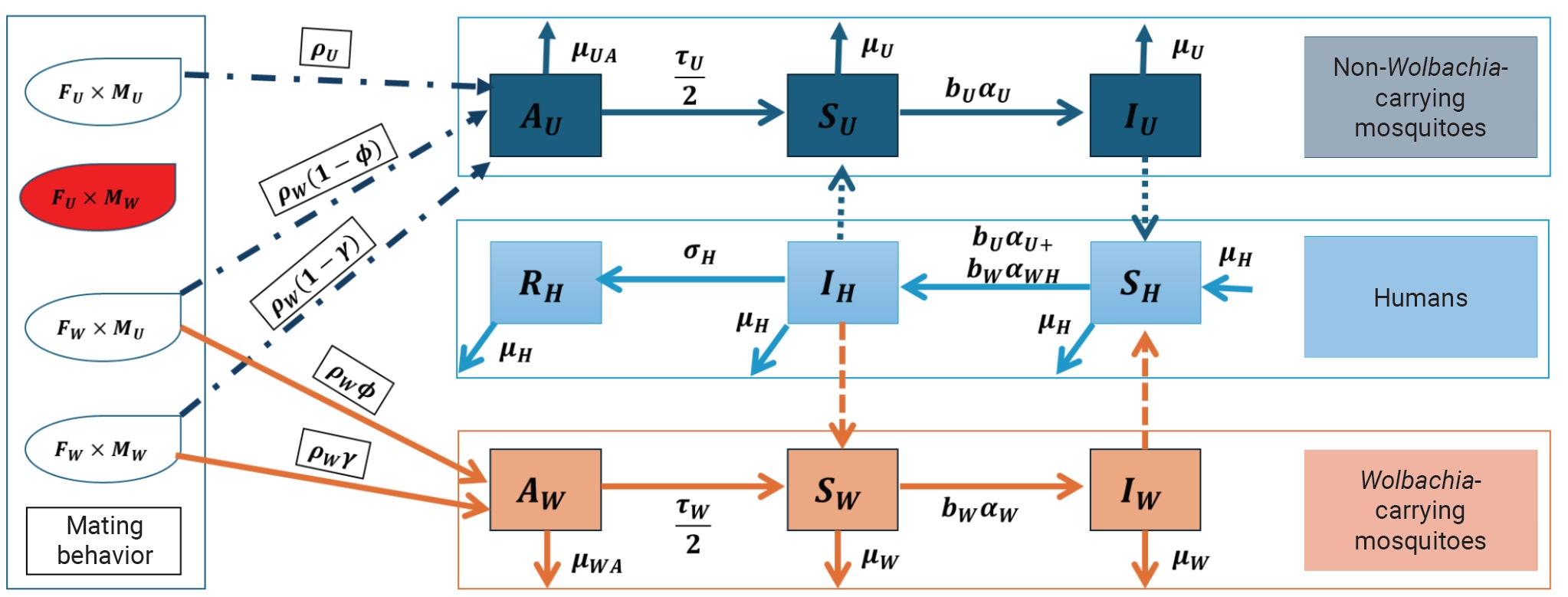
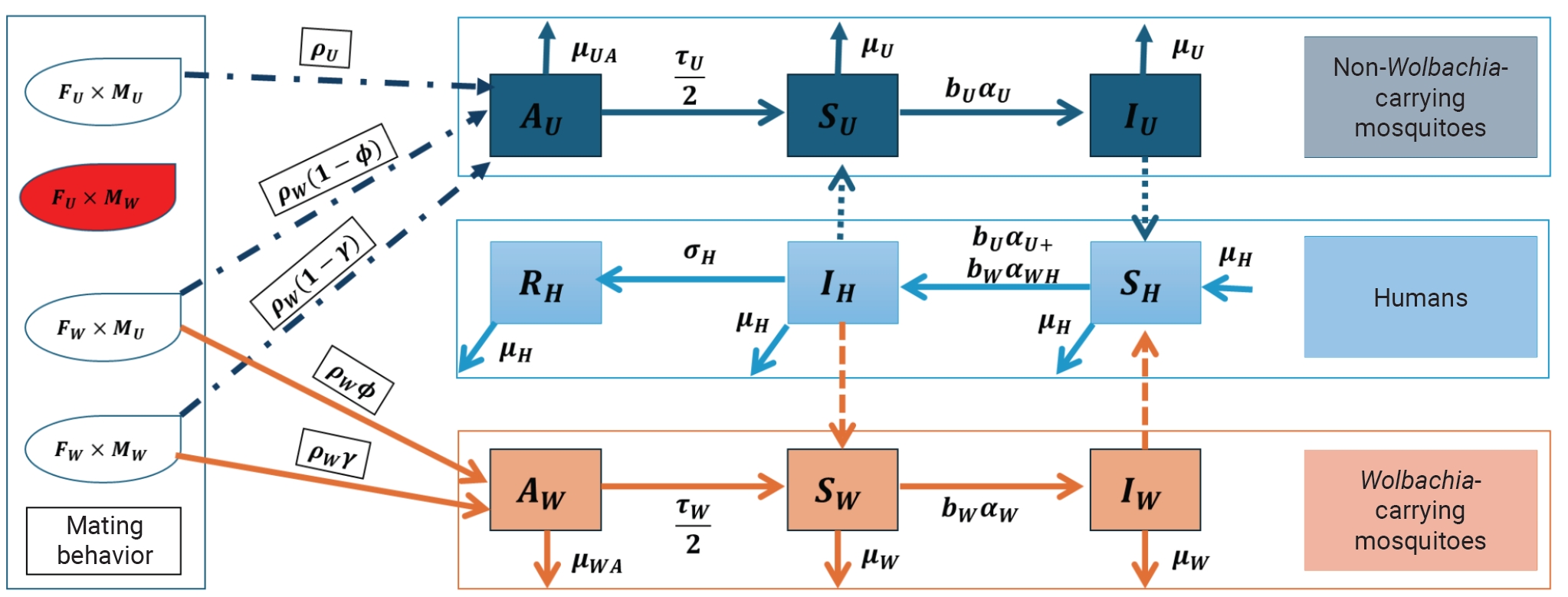
Wolbachia component represented population replacement rather than population suppression. Adult mosquito suppression was modeled separately through the control u
2(t), which increased adult mosquito mortality (
Figure 1).
Controlled Dynamical System
The controlled model is given below. Here, FU=SU+IU, FW=SW+IW, and NH=SH+IH+RH is constant.
Interventions and Controls
Two time-dependent supplementary controls were introduced. Control u1 (t) represents reductions in effective human–mosquito contact, including personal protection, community-based exposure reduction, and other measures that reduce effective biting. Control u2 (t) represents conventional adult mosquito suppression, such as targeted adulticiding and other interventions that increase adult mosquito mortality rates. In the controlled system, this intervention was incorporated by multiplying the baseline adult mosquito mortality rates by (1+ξu2 (t)). Thus, u2 (t) acts on the mortality terms for both Wolbachia-free and Wolbachia-carrying adult mosquitoes and is distinct from the Wolbachia population replacement mechanism.
Controls were bounded by operational limits. Unless otherwise stated, the bounds were 0≤u1(t)≤u1,max=0.75 and 0≤u2(t)≤u2,max=0.75. In the coarse prevalence scans used to summarize near-elimination transitions, a tighter common bound, umax=0.30, was also considered.
Objective Functional and Computation
A weighted objective was minimized that consisted of the time-integrated infected-human burden and quadratic intervention costs:
Cumulative incidence was computed separately as an epidemiological outcome to compare controlled and uncontrolled scenarios. Necessary optimality conditions were derived using the Pontryagin maximum principle, yielding projection expressions for u
1(t) and u
2(t). The discretized problem was solved in Python using fourth-order Runge–Kutta forward integration, backward discrete-adjoint sweeps, and a bounded line search. Final states were recomputed using the returned controls and checked for population balance, cumulative-incidence consistency, and numerical stationarity. Details of the derivation, adjoint system, and switching functions are provided in
Supplementary Material 1. Disease-free equilibria and the basic reproduction number are provided in
Supplementary Material 2.
Initial Conditions, Parameter Sources, and Scenario Design
The planning horizon was T=3×365 days. The baseline human initial conditions were SH(0)=9,999, IH(0)=1, and RH(0)=0, with NH=10,000. Assumed non-equilibrium post-release totals of 30,000 aquatic and 84,225 adult female mosquitoes were partitioned according to the prescribed initial adult Wolbachia prevalence, PW(0). Scans varied PW(0); subsequent PW(t) evolved under the model. Unless otherwise stated, a small initial number of infected mosquitoes was introduced for each adult mosquito type, with IU(0)=IW(0)=10.
The representative scenarios PW(0)=0.20, 0.40, and 0.45 were chosen to representlow, intermediate, and higher initial Wolbachia prevalence levels. The baseline admissible bounds were 0≤u1(t)≤0.75 and 0≤u2(t)≤0.75, representing high but imperfect operational efficacy. In the coarse prevalence scans, a tighter common bound, umax=0.30, was also used to examine whether a near-elimination transition could occur under more restrictive intervention feasibility. The baseline objective weights were A=100 and c1=c2=0.001. The mortality-scaling parameter xi (ξ) was set to 1 in the baseline simulations.
Parameter values were taken from published dengue and
Wolbachia modeling studies whenever available. Parameters for which directly comparable field estimates were unavailable were treated as baseline illustrative values and are identified as assumed values in
Table 1 [
8,
9,
12,
24–
29]. These assumed values were not intended as site-specific estimates; rather, they defined a reference setting for comparing prevalence-indexed control scenarios. Aquatic density limitation, human recovery, mosquito demographic quantities, and carrying-capacity assumptions are supported by studies of
Aedes container ecology and dengue modeling [
26–
29].
Outcome Measures
The primary reported epidemiological outcome was cumulative incidence over the planning horizon, defined as
This quantity integrates the incidence rate in persons/day and represents the cumulative number of new human infections (persons) over [0,T], excluding IH(0). For concision, this quantity is denoted as CumInf in the tables and figures. CumInf(OFF) denotes the uncontrolled baseline, and CumInf(ON) denotes the optimal-control case.
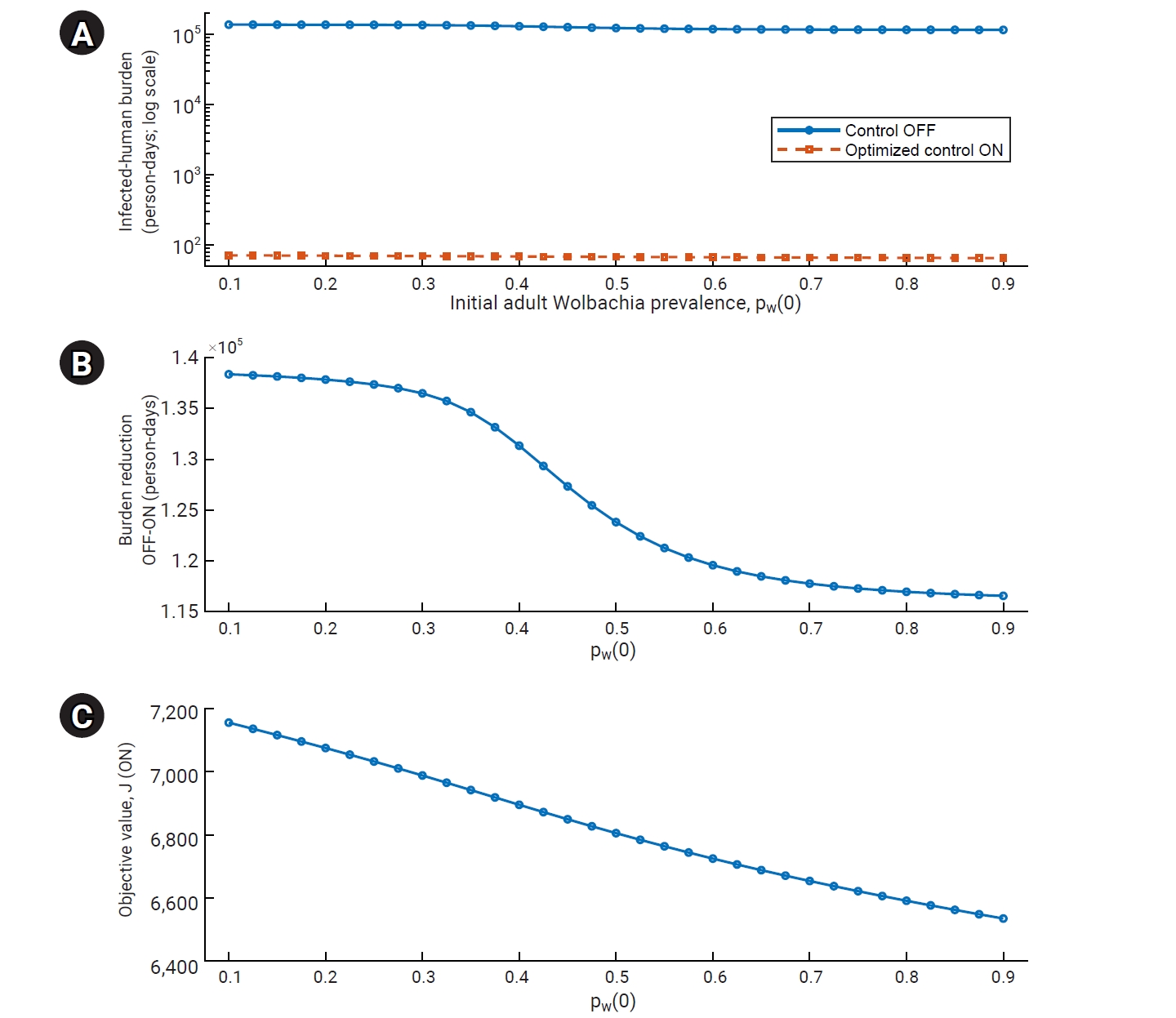
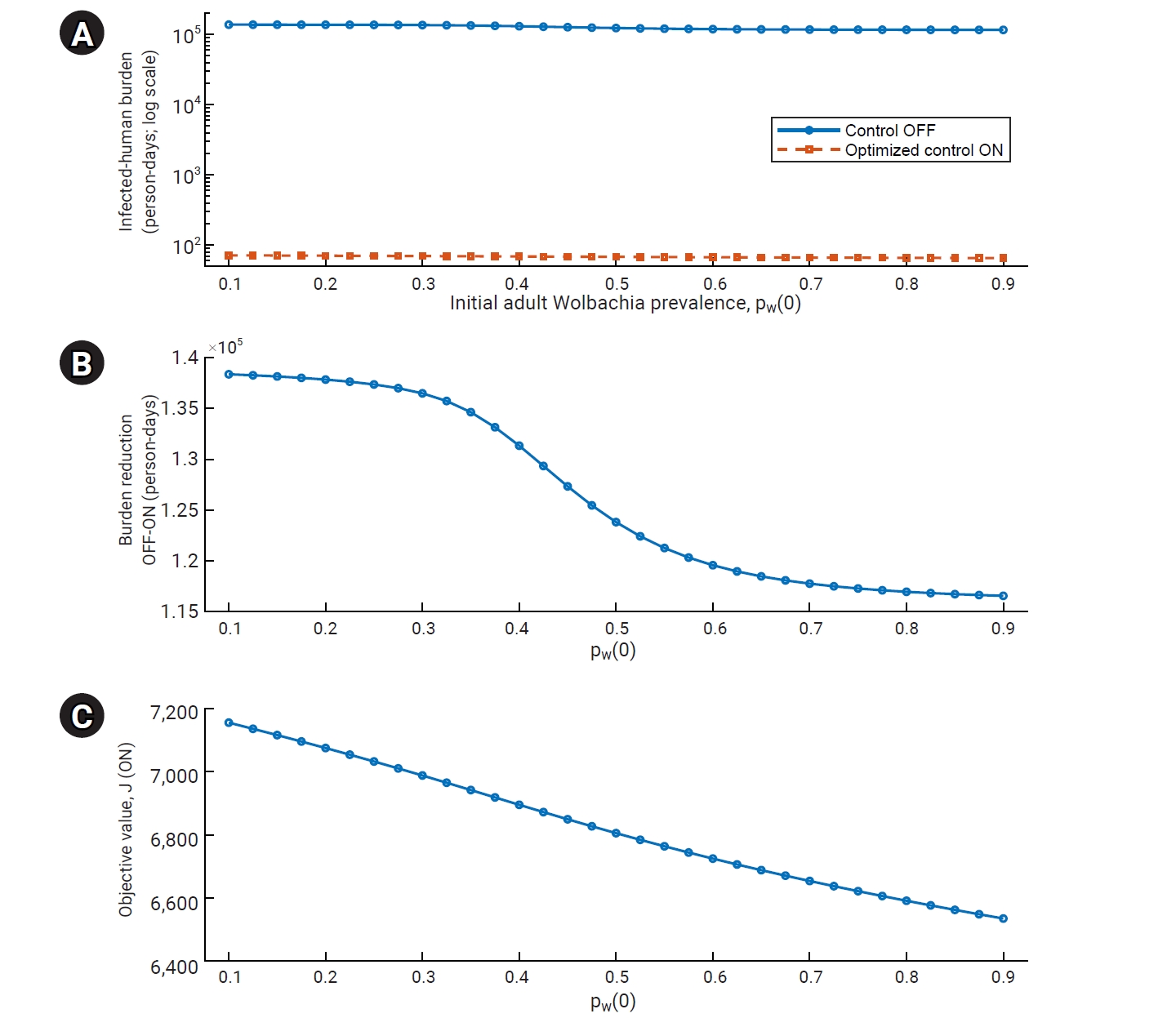
By contrast, the time-integrated infected-human burden,
∫0TIH (t) dt, was reported separately in the broad prevalence scan (
Figure 2). Writing B(T)=
∫0TIH (t) dt, this burden has units person-days, and CumInf=IH(T)−IH(0)+(σH+μH)B(T).
A terminal dengue infection near-elimination indicator was also evaluated. In this study, near elimination was defined operationally as the infected-human state variable satisfying IH (T)≤10-4 at T=3 years. Because the model is deterministic, IH(t) is treated as a continuous state variable; therefore, this criterion should be interpreted as the infected-human compartment being numerically close to zero at the terminal time. It refers to the near elimination of dengue infection in the human population, not the elimination of the Aedes aegypti mosquito population.
Clinical Trials
Not applicable. This study did not involve clinical trials, laboratory animals, or pathogens requiring institutional biosafety review.
Sex and Gender
Not applicable. The study did not include human participants, animals, or cell lines.
IRB/IACUC Approval
Not applicable. Institutional review board approval and informed consent were not required for this modeling study.
Results
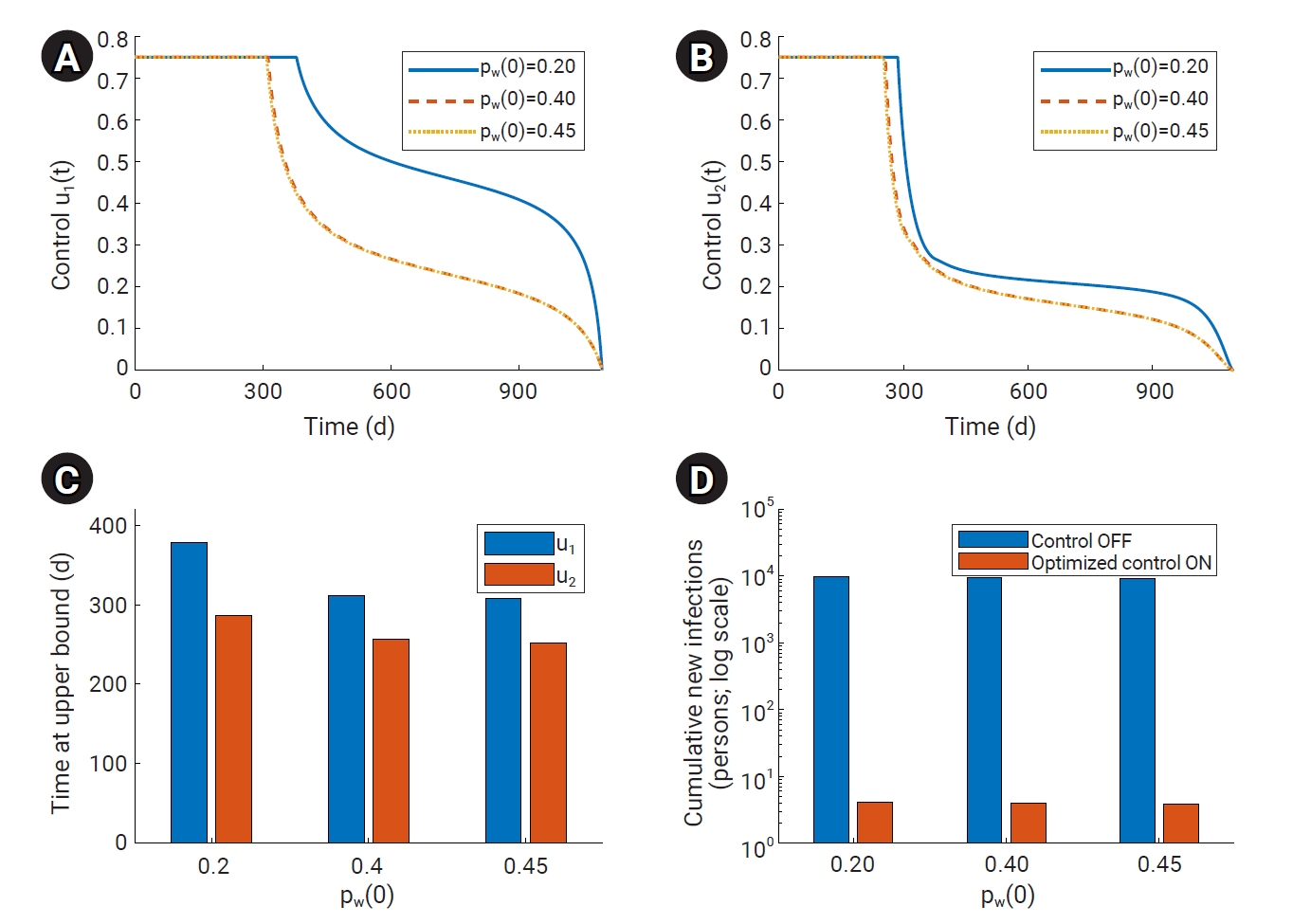
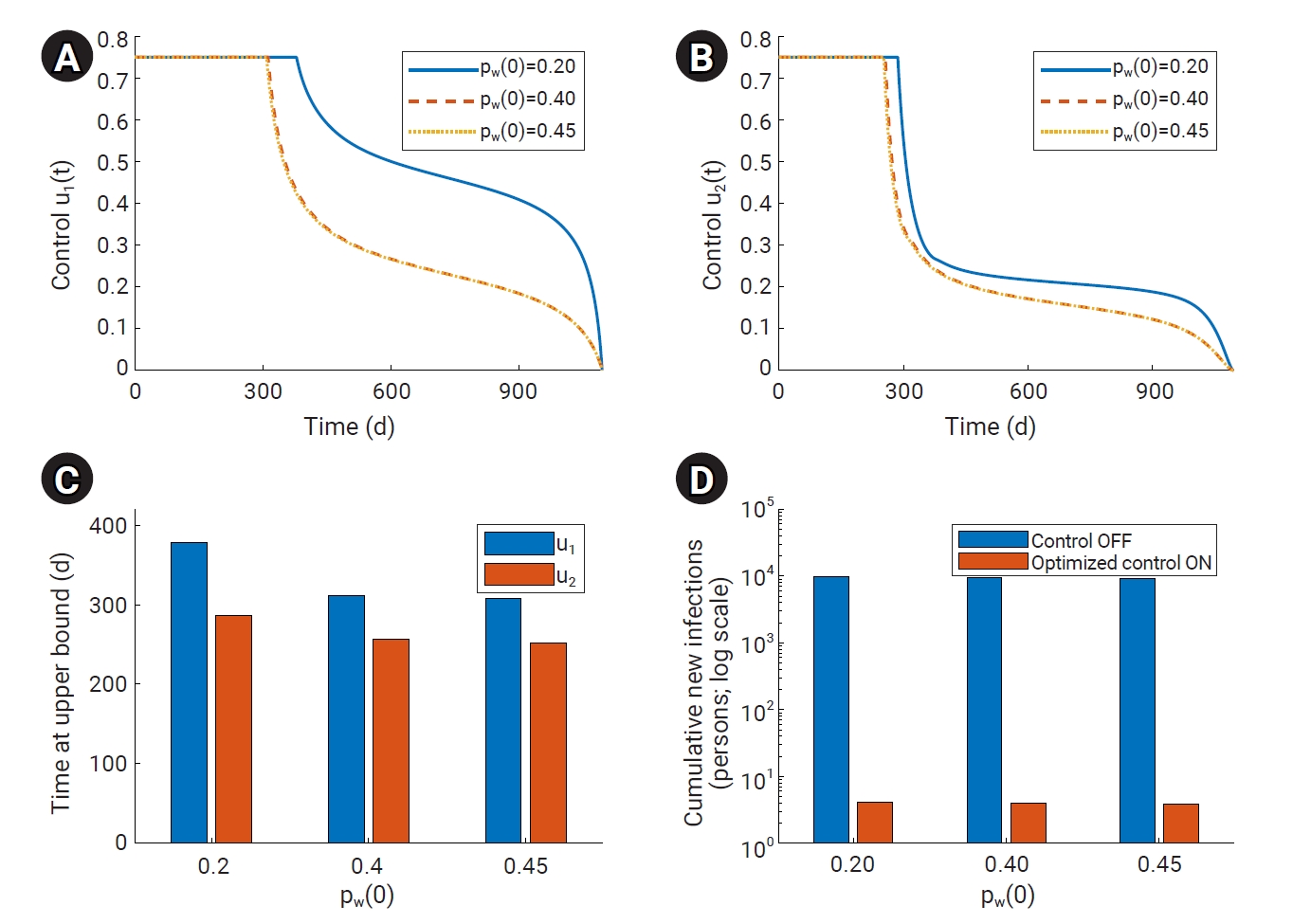
Across representative post-release scenarios, the optimal supplementary controls generally began at or near their admissible maximum values and were then relaxed as infection pressure declined. This early-intensive pattern was observed for both contact reduction, u
1(t), and conventional adult mosquito suppression, u
2(t). The 3 representative adult
Wolbachia prevalence scenarios are listed in
Table 2, and quantitative summaries of scenario-specific outcomes and optimal-control use are provided in
Table 3.
Scenario-specific comparisons showed that increasing adult
Wolbachia prevalence lowered the uncontrolled cumulative incidence and reduced the incremental benefit of additional supplementary intervention. Under the baseline admissible bounds, u
1,max=u
2,max=0.75, the total duration at maximum control decreased as P
W increased. In practical terms, when
Wolbachia was already established at a higher adult prevalence, the model did not require maximum-intensity supplementary control to be maintained for as long. For example, as P
W increased from 0.20 to 0.45, the time at maximum contact reduction decreased from approximately 379 to 308 days. The time at maximum adult mosquito suppression decreased from approximately 286 to 252 days. This pattern reflects the lower effective transmission potential of mosquito populations with higher
Wolbachia prevalence and the resulting diminishing marginal benefit of prolonged maximum-intensity intervention (
Figure 3).
Additional heatmap summaries of the duration at the upper bound under parameter scans are provided in
Figures S1–
S3.
The scenario summaries also showed that optimal control substantially reduced cumulative incidence compared with the uncontrolled baseline. However, the magnitude of the incremental reduction decreased as PW increased. This pattern indicates that higher established Wolbachia prevalence already provides a lower-transmission baseline, such that additional supplementary control yields smaller marginal gains. This result supports the use of PW as a prevalence-indexed planning variable for determining whether sustained maximum-intensity intervention is warranted.
In the broad prevalence scan over PW, the uncontrolled time-integrated infected-human burden declined as adult Wolbachia prevalence increased. Optimal control further reduced the burden across the scanned range, but the reduction achieved by optimal control relative to no additional intervention decreased with increasing PW. The optimal objective value also decreased with increasing PW.
These findings indicate that the operational value of supplementary intervention is greatest at lower or intermediate
Wolbachia prevalence and becomes smaller once
Wolbachia is more strongly established (
Figure 2).
Empirical threshold intervals from the coarse prevalence scan are reported in
Table 4. Under the tighter common control bound u
max=0.30, the terminal dengue infection near-elimination indicatorchanged between P
W=0.55 and P
W=0.60 for 7 of the 12 tested cost-weight combinations; the other 5 did not reach the criterion on the tested grid. Here, near elimination refers to the terminal infected-human state satisfying
IH (
T)≤10
-4 at T = 3 years. This criterion refers to dengue infection in the human population in the deterministic model and does not imply elimination of the
Aedes aegypti mosquito population.
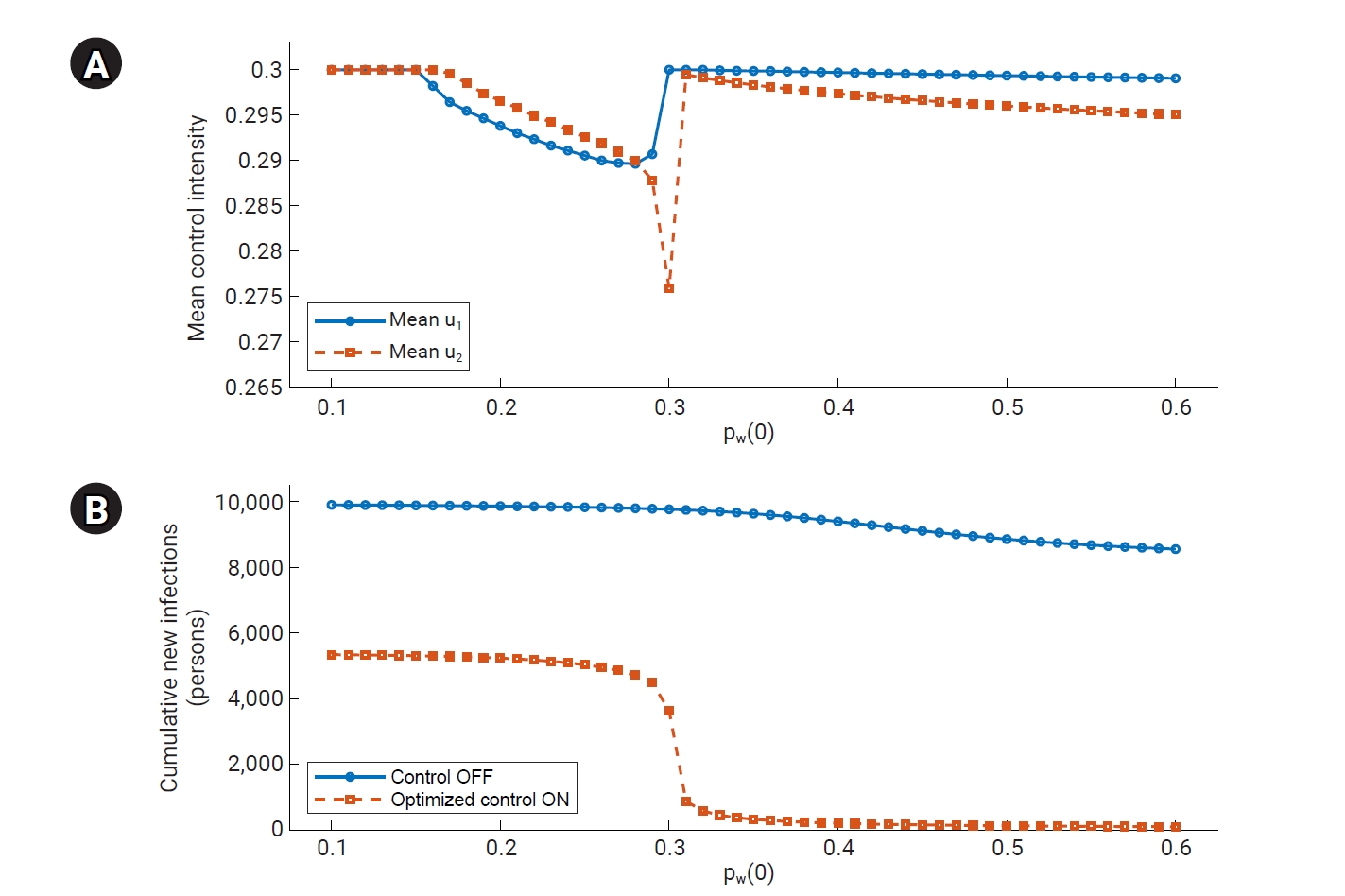
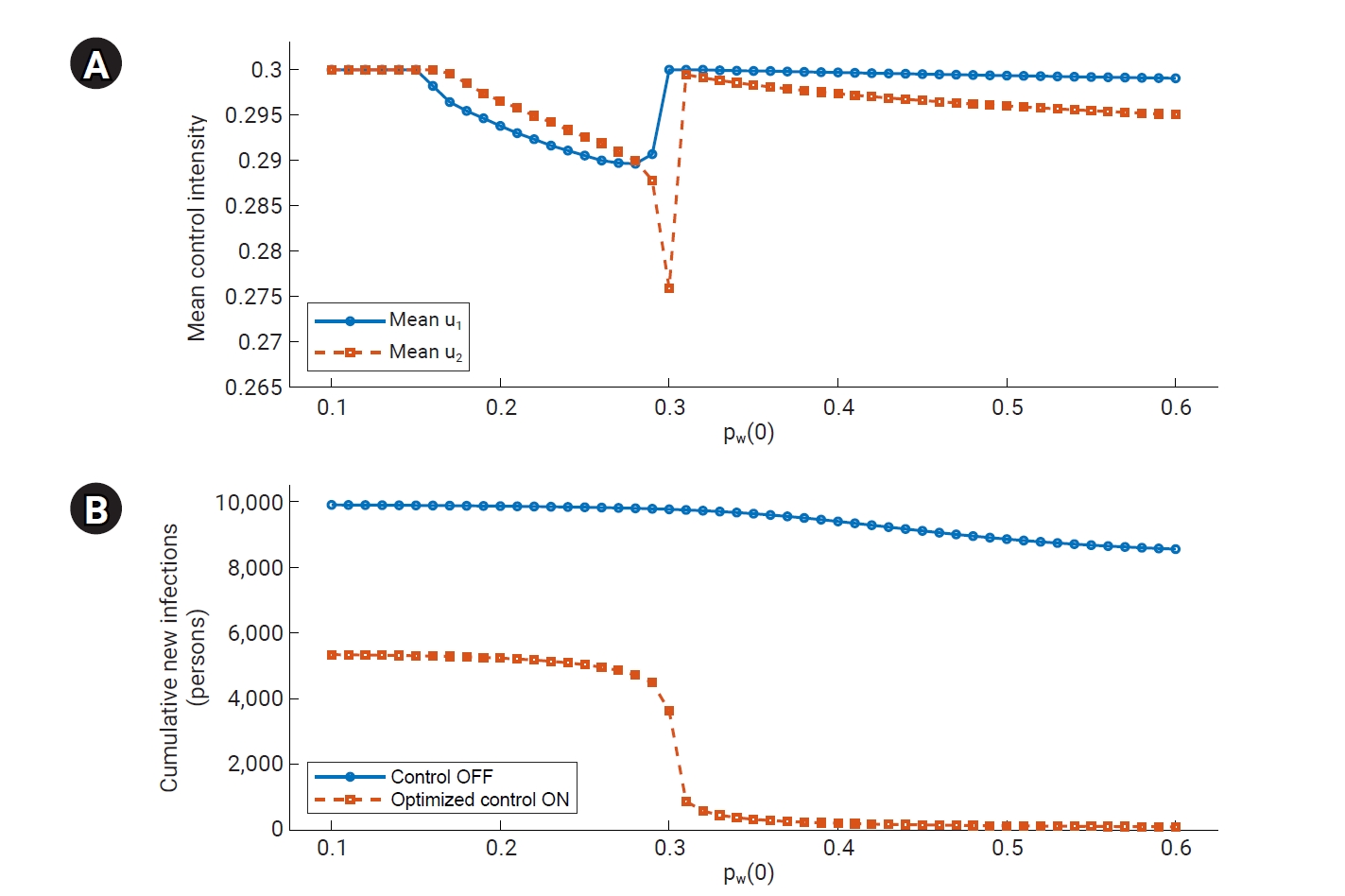
A separate refined continuation example showed that mean control use can vary non-monotonically and that CumInf(ON) may decrease sharply over a narrow P
W interval. Because this refined scan reports cumulative incidence and mean control levels rather than the terminal near-elimination flag, it complements rather than replaces the coarse-grid threshold summary in
Table 4 (
Figure 4). The terminal criterion was not reached on the refined grid.
Discussion
This study provides a quantitative framework for post-release dengue management when Wolbachia-carrying mosquitoes are already established. By treating adult Wolbachia prevalence, PW, as an index observable through routine entomological surveillance, the model links a practical field metric to time-dependent control decisions and expected health gains.
The results should be interpreted in the context of the growing field evidence for
Wolbachia-based population replacement. Recent studies from Indonesia, Brazil, and Colombia have shown that
Wolbachia establishment can be associated with substantial reductions in dengue incidence in operational settings [
14–
16]. These studies support the practical relevance of using
Wolbachia prevalence as a surveillance-based planning indicator. At the same time, the prevalence threshold band identified in the simulations should not be interpreted as a universal field threshold. Rather, it is a model-based operational indicatorunder the assumed parameter set, initial conditions, time horizon, admissible control bounds, cost weights, and terminal criterion.
Under the baseline control bounds and cost weights, the diminishing marginal benefit of additional intervention as PW increases has operational implications. When baseline PW is high, intensified post-release measures may yield relatively small incremental reductions in infections, and earlier relaxation may be justified. Alternative parameter values or terminal thresholds may shift the interval or prevent the criterion from being reached; the band alone therefore cannot justify relaxing control. Broader sensitivity assessment and local calibration are needed before operational use.
The near-elimination transition band should be interpreted as an operational, model-based indicator rather than a declaration of epidemiological elimination. Specifically, it brackets adjacent tested PW values between which the terminal criterion IH(T)≤10-4 changes from unmet to met under the stated conditions. It does not imply extinction of Aedes aegypti or universal elimination of dengue transmission in field settings.
This study has several limitations. The analysis was based on literature-derived parameter values rather than site-specific calibration, and it did not explicitly incorporate seasonal or climate-driven variation in vector abundance or transmission. In addition, the control set was restricted to contact reduction and adult mosquito suppression. Future work should incorporate uncertainty quantification and sensitivity analyses, calibrate the model to local entomological and epidemiological surveillance data, include explicit seasonality or climatic forcing, and examine complementary strategies, such as larval habitat reduction and spatially targeted interventions, to improve generalizability and programmatic relevance.