Skip to contents Skip to Global Navigation Menu
  • KDCA
  • Contact us
  • E-Submission

PHRP : Osong Public Health and Research Perspectives

OPEN ACCESS. pISSN: 2210-9099. eISSN: 2233-6052

Page Path

45
results for

"vaccine"

Article category

Keywords

Publication year

Authors

Funded articles

"vaccine"

Review Article

Bridging innovation and policy: comparative pathways of national vaccine development in low- and middle-income countries
Vahid Marandi
Osong Public Health Res Perspect 2025;16(5):425-436.
Published online September 17, 2025
DOI: https://doi.org/10.24171/j.phrp.2025.0208
Bridging innovation and policy: comparative pathways of national vaccine development in low- and middle-income countries
Objectives
To examine how national innovation and policy configurations enabled vaccine development in Brazil, Cuba, India, and Iran, and to distil lessons for low- and middle-income country (LMIC) vaccine sovereignty.
Methods
Narrative review of peer-reviewed and grey literature (2020–2023), guided by a structured search and screening approach; synthesis mapped to national and sectoral innovation system perspectives and technology readiness levels.
Results
Cuba and Iran leveraged mission-oriented public research and development (R&D) and domestic platforms; India combined indigenous R&D with large-scale licensed manufacturing; Brazil’s scientific capacity was constrained by fragmented governance and supply-chain dependence. Adaptive regulation (e.g., emergency use authorization/conditional approvals), targeted technology transfer, and South–South partnerships accelerated progress but raised longer-term questions about intellectual property (IP) control and economic sustainability.
Conclusion
Institutional coherence, strategic IP management, and regional manufacturing alliances are as critical as scientific capacity for LMIC vaccine self-reliance. Policy priorities include pre-negotiated tech-transfer frameworks, regulatory preparedness, and investment in public R&D linked to distributed manufacturing.

Citations

Citations to this article as recorded by  Crossref logo
  • Next-Generation Vaccines Leveraging T Cell-Centric Design, Mucosal Immunity, and Trained Innate Immunity for Respiratory and Enteric Pathogens
    Md. Abdus Salam, Md. Yusuf Al-Amin, Kasireddy Sudarshan, Aidan Lynch, Victor Reyes, Madeline Stevenson
    Vaccines.2026; 14(5): 462.     CrossRef
  • From Global Insights to Local Action: Bridging Vaccine Design and Manufacturing Gaps in H5N1 Pandemic Readiness
    María Alicia Delfino, Jimena Borgo, Luciano Chaneton, Natacha Cerny, Augusto Ernesto Bivona, Pierre Gsell, Fernando Lobos, Ike James, Martin Friede, German Sánchez Alberti, Andrés Sánchez Alberti
    Vaccines.2026; 14(6): 519.     CrossRef
  • Harnessing trained immunity for next-generation vaccines: from rational adjuvant design to self-adjuvanting antigens
    Jing Wang, Xiao-Yong Fan, Zhidong Hu
    Expert Review of Vaccines.2026;[Epub]     CrossRef
  • Vigilancia tecnológica de vacunas contra arbovirus en Latinoamérica
    Diana Priscila Estrella-Santiago, Rubén Oliver Espinoza
    Entreciencias diálogos en la Sociedad del Conocimi.2026; 14(28): 1.     CrossRef
  • Role of Academia and Research Institutions in Advancing Indigenous Vaccine Development
    Saira Afzal, Muhammad Maaz Arif
    Pakistan BioMedical Journal.2026; : 01.     CrossRef
  • 5,023 View
  • 202 Download
  • 3 Web of Science
  • Crossref

Original Articles

Comparative effectiveness of construal-level messaging in the COVID-19 Vaccine Injury Compensation Program in the Republic of Korea: a randomized controlled trial
Jihyun Moon, Se-Hoon Jeong, Young June Choe, Cho Ryok Kang, Taemi Kim, Dooyoung Kim, Jong-Koo Lee
Osong Public Health Res Perspect 2025;16(5):486-497.
Published online September 12, 2025
DOI: https://doi.org/10.24171/j.phrp.2024.0354
Comparative effectiveness of construal-level messaging in the COVID-19 Vaccine Injury Compensation Program in the Republic of Korea: a randomized controlled trial
Objectives
This study aimed to assess the impact of high-level versus low-level construal messages about the coronavirus disease 2019 (COVID-19) Vaccine Injury Compensation Program (CVICP) on public attitudes toward the program and COVID-19 vaccination.
Methods
A randomized controlled experimental design was employed. Adults aged 18 to 64 residing in the Republic of Korea were randomly assigned to either an experimental group (high-level construal message) or a control group (low-level construal message). Both groups viewed a 2-minute video about the CVICP, with construal level as the sole variable. Pre- and post-intervention questionnaires evaluated attitudes toward the CVICP and COVID-19 vaccination, including satisfaction, perceived necessity, and perceived effectiveness in enhancing vaccine acceptance. Data were analyzed using the paired t-test, repeated measures 2-way analysis of variance, and multiple linear regression.
Results
The experimental group showed statistically significant improvements across all 6 attitude measures following exposure to the high-level construal message. By contrast, the control group demonstrated significant improvement in only 3 attitudes: satisfaction with the CVICP, willingness to recommend vaccination, and willingness for future vaccination. A significant difference between groups was observed for perceived effectiveness of the CVICP in enhancing vaccine acceptance (p=0.01), with high-level construal messaging being more impactful.
Conclusion
High-level construal messages are more effective than low-level messages in shaping public perceptions and addressing vaccine hesitancy. Policymakers and health authorities should incorporate high-level construal elements into communication strategies to build trust and support for vaccination programs.
  • 2,754 View
  • 53 Download
Immunoinformatics study of CD40 ligand-targeting vaccine constructs: a novel immunotherapeutic approach
Seyed Amir Sadeghi, Mahroo Mohamadi, Hadi Bamehr, Fatemeh Heidarnejad, Azam Bolhassani
Osong Public Health Res Perspect 2025;16(4):311-332.
Published online August 11, 2025
DOI: https://doi.org/10.24171/j.phrp.2025.0077
Immunoinformatics study of CD40 ligand-targeting vaccine constructs: a novel immunotherapeutic approach
Objectives
Incorporating CD40 ligand (CD40L) into vaccine strategies has shown considerable potential for enhancing immune responses. In this study, we designed and formulated a CD40Lbased multi-epitope vaccine construct using immunoinformatics approaches, and compared it to a full-length CD40L-based vaccine construct. Methods: The study commenced with the identification and screening of potential T-cell and B-cell epitopes derived from the CD40L protein, followed by the construction of a multi-epitope vaccine from these selected epitopes. We analyzed and validated the physicochemical and structural properties of the vaccine constructs. Further, we predicted disulfide bonds, performed protein-protein docking, and conducted molecular dynamics simulations to evaluate the constructs. Comparative analyses of the ligand-binding site localization were conducted using LigPlot. Additionally, simulation trajectories were analyzed using multiple descriptors, including root mean square deviations, radius of gyration, and root mean square fluctuations. Results: Our findings indicated that the CD40L multi-epitope vaccine construct possessed favorable physicochemical properties and a validated structural profile. Immune simulation studies showed a stronger affinity of the multi-epitope construct for the CD40 receptor compared to the full-length CD40L construct. Conclusion: Overall, the CD40L multi-epitope vaccine construct demonstrated greater potency in eliciting an effective immune response than the full-length CD40L construct. These results highlight a promising approach to vaccine design for the prevention or treatment of infections and cancers.

Citations

Citations to this article as recorded by  Crossref logo
  • Artificial intelligence and biohealth: the Republic of Korea’s emerging priorities in health care R&D
    Jong-Koo Lee
    Osong Public Health and Research Perspectives.2025; 16(4): 309.     CrossRef
  • 3,263 View
  • 107 Download
  • Crossref
Assessment of healthcare workers’ knowledge and attitudes toward mpox and acceptance of its vaccine: a health belief model-based analysis in the Gulf region
Mona Gamal Mohamed, Eman Abdelaziz Ahmed Dabou, Fatma M. Ibrahim, Shaimaa Abdelsamad, Jibin Kunjavara, Kamaruddeen Mannethodi, Moayad Ahmad Wishah, Abdullah Y. Shihab, Khaled Mohammed Al-Sayaghi, Hammad Ali Fadlalmola, Mohammed Musaed Al-Jabri
Osong Public Health Res Perspect 2025;16(4):357-372.
Published online June 25, 2025
DOI: https://doi.org/10.24171/j.phrp.2025.0113
Assessment of healthcare workers’ knowledge and attitudes toward mpox and acceptance of its vaccine: a health belief model-based analysis in the Gulf region
Objectives
This study aimed to (1) assess healthcare workers’ (HCWs) knowledge and attitudes toward mpox across 3 Gulf countries, and (2) examine factors influencing their acceptance of the mpox vaccine using the health belief model (HBM). This model evaluated perceptions related to susceptibility, severity, benefits, barriers, cues to action, and self-efficacy. Additionally, the study explored the impact of prior coronavirus disease 2019 (COVID-19) vaccination history on mpox vaccine acceptance. Methods: A cross-sectional study was conducted among 764 HCWs from the United Arab Emirates (UAE), Saudi Arabia, and Qatar. Data were collected through a structured online questionnaire based on HBM constructs. Logistic regression and structural equation modeling were employed to analyze predictors of vaccine acceptance. Results: Knowledge levels varied across the countries, with the highest proportion of good knowledge reported in the UAE (59%). UAE HCWs also demonstrated higher perceived susceptibility, perceived benefits, and intention to vaccinate compared to those in Saudi Arabia and Qatar (p<0.001). Receiving 4 doses of the COVID-19 vaccine was associated with greater acceptance of the mpox vaccine. Among the HBM constructs, perceived benefits and self-efficacy were identified as the strongest predictors of vaccine acceptance. Perceived barriers, such as fear of side effects and concerns about vaccine safety, were more prominent among HCWs in Saudi Arabia and Qatar. Conclusion: The HBM effectively explains the factors influencing mpox vaccine acceptance among Gulf HCWs. Targeted interventions that improve perceived benefits, reduce barriers, and improve self-efficacy may facilitate greater vaccine uptake and preparedness for emerging infectious diseases.

Citations

Citations to this article as recorded by  Crossref logo
  • Determinants of Mpox vaccine uptake and hesitancy among healthcare workers in Port Harcourt, Nigeria
    Moore Ikechi Mike-Ogburia, Chiziyara Orluibna Obunwo, Elizabeth Efeelobari Letam, Ayebaemi Wilfred Dambo, Samuel Chima Agumagu, Tamunosaki Fubara-Manuel, Charles Henry Esukpa
    BMC Infectious Diseases.2026;[Epub]     CrossRef
  • Knowledge and attitudes toward mpox among the Lebanese population during the second wave and their attitudes toward vaccination
    Mohammad Tanashat, Nour Fakih, Nour El Bizri, Mohamed Saad Rakab, Mohamed Abouzid, Karen Sleiman, Hadi Hassan, Moetasem Al Sayed, Zahraa Zibara, Ahmad Afyouni, Pascale Salameh
    Scientific Reports.2026;[Epub]     CrossRef
  • Decoding Vaccine Hesitancy in Mpox Across Multiple Middle Eastern Countries: Public Knowledge, Attitudes, Worry, Conspiracy Beliefs, and Acceptance
    Mona Gamal Mohamed, Huda Mohamed Ali Rasheed, Manjula G. Bhagavathy, Moayad Ahmad Wishah, Dibbo Protim Ghosh, Md. Rabiul Islam, Ramya Kundayi Ravi
    Health Science Reports.2026;[Epub]     CrossRef
  • Mpox Awareness and Infection Control Practices Among Hospital Nurses and Healthcare Workers in Bangladesh
    Hemayet Hossain, Md. Abdur Nur Sakib, Mostafizor Rahman, Zerin Tasnim Romana, Md. Hasan Ali, Snigdha Sharmin Binte Sayeed, Khadiza Akter Brishty, Md. Shahidur Rahman Chowdhury, Md. Mahfujur Rahman
    Public Health Challenges.2026;[Epub]     CrossRef
  • Artificial intelligence and biohealth: the Republic of Korea’s emerging priorities in health care R&D
    Jong-Koo Lee
    Osong Public Health and Research Perspectives.2025; 16(4): 309.     CrossRef
  • Nursing Students’ Knowledge, Attitudes, and Practices Toward Monkeypox Virus: A Cross-Sectional Survey at the University of Palermo, 2022
    Barbara Ravazzolo, Francesco Leonforte, Letizia Cascio, Clara Ferrara, Federico Li Causi, Francesco Armetta, Maria Lampasona, Rinaldo Stefano Miceli, Carlo Fantini, Klara Komici, Alberto Firenze
    Zoonotic Diseases.2025; 6(1): 1.     CrossRef
  • 3,801 View
  • 145 Download
  • 6 Web of Science
  • Crossref
Design and evaluation of a multi-epitope subunit vaccine against human norovirus using an immunoinformatics approach
Zxcy L. Nonog, Edward C. Banico, Ma. Easter V. Sajo, Pablo V. Serrano, Fredmoore L. Orosco
Osong Public Health Res Perspect 2025;16(3):236-251.
Published online April 25, 2025
DOI: https://doi.org/10.24171/j.phrp.2024.0349
Design and evaluation of a multi-epitope subunit vaccine against human norovirus using an immunoinformatics approach
Objectives
This study aimed to identify safe, conserved, and highly immunogenic epitopes from all proteins of human-infecting norovirus (NoV) and to design a multi-epitope subunit vaccine construct from these epitopes using an immunoinformatics approach. Additionally, the vaccine construct was evaluated using both sequence- and structure-based assessments.
Methods
Conserved fragments were identified from all proteins of human-infecting NoV, and B and T lymphocyte epitopes were subsequently predicted using multiple epitope prediction tools. The selected epitopes were linked to form a multi-epitope construct, incorporating various adjuvants in the design. Vaccine constructs with different adjuvants were analyzed for their physicochemical properties and immune simulation profiles, and the optimal combination was selected as the final vaccine candidate for further study. Finally, molecular docking and dynamics simulations were performed to visualize the interaction between the construct and a host immune receptor.
Results
Twenty-two safe, conserved, and highly immunogenic epitopes were identified from all human-infecting NoV proteins. The construct adjuvanted with 50S ribosomal protein L7/L12 (50SrpL7/L12) was chosen as the final vaccine candidate due to its optimal physicochemical properties and favorable immune simulation profile. Furthermore, the construct exhibited high binding affinity and a stable interaction with toll-like receptor 4).
Conclusion
The multi-epitope subunit vaccine designed in this study shows promise as a potential NoV vaccine candidate for human immunization. Further in vitro and in vivo experiments are warranted to validate these findings.

Citations

Citations to this article as recorded by  Crossref logo
  • A multi-epitope pan-betacoronavirus vaccine construct predicted to induce broad-spectrum and durable immune responses: an immunoinformatics approach
    Anabella Margareth Arapa, Trina Ekawati Tallei, Rinaldi Idroes, Fatimawali, Elly Juliana Suoth, Maghfirah Savitri, Ahmad Akroman Adam, Beivy Jonathan Kolondam, Chika Yamada, Rosy Iara Maciel de Azambuja Ribeiro, Amama Rani, Moon Nyeo Park, Youdiil Ophinn
    Frontiers in Bioinformatics.2026;[Epub]     CrossRef
  • A Multi-Domain Approach for Designing of Novel Epitopes-Based Vaccine Against Chandipura Virus
    Alhanouf I. Al-Harbi, Raed Amer Ali Alsahoo, Asad Ullah, Sajjad Ahmad
    Journal of Pharmaceutical Innovation.2026;[Epub]     CrossRef
  • Immunoinformatics-based design of artificial chimeric proteins as universal vaccine candidates against foot-and-mouth disease virus serotypes A, O, and SAT2
    Alyaa Elrashedy, Mohamed Nayel, Akram Salama, Ahmed Zaghawa, Mohamed E. Hasan
    Scientific Reports.2026;[Epub]     CrossRef
  • Immunoinformatics-guided design of a multi-epitope mRNA vaccine candidate against Western Equine Encephalitis virus
    Elijah Kolawole Oladipo, Boluwatife Ayobami Irewolede, Stephen Toluwanimi Gbadero, Favour Adebimpe Adebisi, Noor-Al-Hudah Nurudeen, Emmanuel Ololade Oyediran, Rukayat Romoke Tajudeen, Taiwo Dorcas Akinpelu, Christiana Iyanuoluwa Kolapo, Balqis Ajoke Adeji
    The Veterinary Journal: Pharmacology & Toxicology.2026; 1(4): 100019.     CrossRef
  • 6,108 View
  • 143 Download
  • 3 Web of Science
  • Crossref

Review Article

Comparison and consideration of vaccine injury compensation programs in the Republic of Korea, Japan, and Taiwan
Cho Ryok Kang, Young June Choe, Jihyun Moon, Dooyoung Kim, Taemi Kim, Jong-Koo Lee
Osong Public Health Res Perspect 2024;15(6):479-488.
Published online November 12, 2024
DOI: https://doi.org/10.24171/j.phrp.2024.0129
Comparison and consideration of vaccine injury compensation programs in the Republic of Korea, Japan, and Taiwan
This study aimed to establish a foundation for future collaborations aimed at preparing for and responding to infectious diseases by examining the vaccine injury compensation programs (VICPs) of East Asian countries. We reviewed the current status of VICPs in the Republic of Korea, Japan, and Taiwan by searching national government websites and reviewing relevant literature. Additionally, we conducted email inquiries targeting experts from Japan and Taiwan. Through the comprehensive analysis of VICPs in these 3 countries covered various aspects, we identified several similarities and differences in the VICPs across these countries. While the governments of the Republic of Korea, Japan, and Taiwan play a central role in supporting investigations into vaccine injuries and managing compensation procedures based on legal statutes, they differ in terms of financial resources for compensation, the range of vaccines covered, and the criteria for assessing causality. In the Republic of Korea, Japan, and Taiwan, compensation is typically paid in a lump sum, although the specific benefits available vary by country. This study on VICPs in the Republic of Korea, Japan, and Taiwan provides valuable insights for the further development and management of domestic systems.

Citations

Citations to this article as recorded by  Crossref logo
  • The Vaccine That Was Never Mentioned: A Comparative Medico-Legal Analysis of the Duty to Inform and Document Preventive Immunization, with Proposed Practice Guidelines
    Sanit Thongsriratch, Therdpong Thongseiratch, Saratis Pairoh, Puttichart Khantee
    Vaccines.2026; 14(8): 664.     CrossRef
  • Local Vaccine Manufacturing in Saudi Arabia: Examining the Role of National Legal Frameworks and Strategic Policies
    Tareq S. Alshammari
    Beijing Law Review.2025; 16(04): 2147.     CrossRef
  • 12,872 View
  • 128 Download
  • 1 Web of Science
  • Crossref

Brief Report

Safety of the bivalent COVID-19 mRNA booster vaccination among persons aged over 18 years in the Republic of Korea
Seok-Kyoung Choi, Seontae Kim, Mijeong Ko, Yeseul Heo, Tae Eun Kim, Yeonkyeong Lee, Juyeon Jang, Eunok Bahng
Osong Public Health Res Perspect 2024;15(6):542-549.
Published online October 29, 2024
DOI: https://doi.org/10.24171/j.phrp.2024.0194
Safety of the bivalent COVID-19 mRNA booster vaccination among persons aged over 18 years in the Republic of Korea
Objectives
The aim of this study was to disseminate information about the safety of bivalent coronavirus disease 2019 (COVID-19) mRNA booster vaccines administered to adults in the Republic of Korea.
Methods
Two databases were used to assess the safety of COVID-19 booster doses of Pfizer BA.1, Pfizer BA.4/5, Moderna BA.1, and Moderna BA.4/5 vaccines for adults aged 18 years and older. Adverse events (AEs) were analyzed using data reported to the web-based COVID-19 vaccination management system (CVMS) and a self-reported text-message survey.
Results
Between October 11, 2022 and March 30, 2023, the CVMS received reports of 2,369 (93.7%) non-serious AEs from vaccinated adults, along with 158 (6.3%) serious AEs, which included 5 cases of anaphylaxis and 33 deaths. From October 11, 2022 to January 27, 2023, 40,022 people aged 18 and older responded to a survey conducted via text message. The booster doses were associated with fewer local and systemic AEs compared to the original vaccines. After receiving the bivalent vaccine, the most commonly reported AEs were pain at the injection site, headache, fatigue, and myalgia.
Conclusion
Overall, bivalent vaccines exhibited fewer AEs compared to the original vaccines. The majority of AEs were non-serious, and serious AEs were rare among adults aged 18 years and older following vaccination with the Pfizer and Moderna bivalent vaccines.

Citations

Citations to this article as recorded by  Crossref logo
  • Cross-neutralizing antibody responses among individuals with or without bivalent vaccine: a six-month prospective cohort study
    Hye Hee Cha, Ji Yeun Kim, Seung Beom Kim, Junho Cha, Ji-Soo Kwon, Woori Kim, Ju Yeon Son, Choi Young Jang, Min-Chul Kim, So Yun Lim, Sung-Han Kim
    The Korean Journal of Internal Medicine.2026; 41(3): 516.     CrossRef
  • Safety of COVID-19 mRNA-1273 booster doses in Asian populations: A literature review of post-marketing observational studies
    Chris Clarke, Daina Esposito, Veronica Urdaneta, Piyali Mukherjee, Amanda K. Buttery
    Human Vaccines & Immunotherapeutics.2026;[Epub]     CrossRef
  • 3,932 View
  • 76 Download
  • 2 Web of Science
  • Crossref

Original Articles

Methodology of comparative studies on the relative effectiveness of COVID-19 vaccines: a systematic review
Erdenetuya Bolormaa, Jiae Shim, Young-Sook Choi, Donghyok Kwon, Young June Choe, Seung-Ah Choe
Osong Public Health Res Perspect 2024;15(5):395-408.
Published online October 15, 2024
DOI: https://doi.org/10.24171/j.phrp.2024.0063
Methodology of comparative studies on the relative effectiveness of COVID-19 vaccines: a systematic review
Objectives
This study aimed to comprehensively outline the methodological approaches used in published research comparing the vaccine effectiveness (VE) of coronavirus disease 2019 (COVID-19) vaccines.
Methods
A systematic search was conducted on June 13, 2024, to identify comparative studies evaluating the effectiveness of mRNA versus non-mRNA and monovalent versus bivalent COVID-19 vaccines. We screened titles, abstracts, and full texts, collecting data on publication year, country, sample size, study population composition, study design, VE estimates, outcomes, and covariates. Studies that reported relative VE (rVE) were analyzed separately from those that did not.
Results
We identified 25 articles comparing rVE between mRNA and non-mRNA COVID-19 vaccines, as well as between monovalent and bivalent formulations. Among the studies assessing VE by vaccine type, 126 did not provide rVE estimates. Comparative VE studies frequently employed retrospective cohort designs. Among the definitions of rVE used, the most common were hazard ratio and absolute VE, calculated as (1−odds ratio)×100. Studies were most frequently conducted in the United Kingdom and the United States, and the most common outcome was infection. Most targeted the general population and assessed the VE of mRNA vaccines using the AstraZeneca vaccine as a reference. A small proportion, 7.3% (n=11), did not adjust for any variables. Only 3 studies (2.0%) adjusted for all core confounding variables recommended by the World Health Organization.
Conclusion
Few comparative studies of COVID-19 vaccines have incorporated rVE methodologies. Reporting rVE and employing a consistent set of covariates can broaden our understanding of COVID-19 vaccines.

Citations

Citations to this article as recorded by  Crossref logo
  • Protection from second booster vaccines and natural immunity against SARS-CoV-2 infections, 2022–2023
    Dritan Bejko, Anne Vergison, Saverio Stranges, Joël Mossong, Maurice Zeegers
    Epidemiology and Infection.2026;[Epub]     CrossRef
  • 8,871 View
  • 92 Download
  • 1 Web of Science
  • Crossref
Novel prophylactic and therapeutic multi-epitope vaccine based on Ag85A, Ag85B, ESAT-6, and CFP-10 of Mycobacterium tuberculosis using an immunoinformatics approach
Muhammad Fikri Nugraha, Daniel Alexander Changestu, Rizky Ramadhan, Tasya Salsabila, Arsila Nurizati, Sari Eka Pratiwi, Ysrafil Ysrafil
Osong Public Health Res Perspect 2024;15(4):286-306.
Published online July 26, 2024
DOI: https://doi.org/10.24171/j.phrp.2024.0026
Novel prophylactic and therapeutic multi-epitope vaccine based on Ag85A, Ag85B, ESAT-6, and CFP-10 of Mycobacterium tuberculosis using an immunoinformatics approach
Objectives
Current tuberculosis (TB) control strategies face limitations, such as low antibiotic treatment compliance and a rise in multidrug resistance. Furthermore, the lack of a safe and effective vaccine compounds these challenges. The limited efficacy of existing vaccines against TB underscores the urgency for innovative strategies, such as immunoinformatics. Consequently, this study aimed to design a targeted multi-epitope vaccine against TB infection utilizing an immunoinformatics approach.
Methods
The multi-epitope vaccine targeted Ag85A, Ag85B, ESAT-6, and CFP-10 proteins. The design adopted various immunoinformatics tools for cytotoxic T lymphocyte (CTL), helper T lymphocyte (HTL), and linear B lymphocyte (LBL) epitope prediction, the assessment of vaccine characteristics, structure modeling, population coverage analysis, disulfide engineering, solubility prediction, molecular docking/dynamics with toll-like receptors (TLRs), codon optimization/cloning, and immune simulation.
Results
The multi-epitope vaccine, which was assembled using 12 CTL, 25 HTL, and 21 LBL epitopes associated with CpG adjuvants, showed promising characteristics. The immunoinformatics analysis confirmed the antigenicity, immunogenicity, and lack of allergenicity. Physicochemical evaluations indicated that the proteins were stable, thermostable, hydrophilic, and highly soluble. Docking simulations suggested high-affinity binding to TLRs, including TLR2, TLR4, and TLR9. In silico immune simulation predicted strong T cell (cytokine release) and B cell (immunoglobulin release) responses.
Conclusion
This immunoinformatics-designed multi-epitope vaccine targeting Ag85A, Ag85B, ESAT-6, and CFP-10 proteins showed promising characteristics in terms of stability, immunogenicity, antigenicity, solubility, and predicted induction of humoral and adaptive immune responses. This suggests its potential as a prophylactic and therapeutic vaccine against TB.

Citations

Citations to this article as recorded by  Crossref logo
  • Multidrug-resistant tuberculosis: a comprehensive review of pathogenesis, drug resistance, current treatment and future prospects
    Shweta Tiwari, Ankit Kumar Singh, Aarshu Acharya, Joyabroto Ghosh, Rashmi Prabha Singh
    Archives of Microbiology.2026;[Epub]     CrossRef
  • Genome-Guided Mining and Integrated in Silico Approach Uncover Potential of Streptomyces Secondary Metabolites as Multi-Target Agents Against Candida albicans Biofilm Formation
    Ismail Ismail, Sylvia Utami Tunjung Pratiwi, Ema Damayanti, Jaka Widada, Ysrafil Ysrafil, Syamsu Nur, Abdul Halim Umar, Ira Handayani, Shanti Ratnakomala
    Network Modeling Analysis in Health Informatics an.2026;[Epub]     CrossRef
  • Domain arrangement–driven immunogenicity of a computationally designed mRNA vaccine targeting PPE68, IrtA, and PE9 of Mycobacterium tuberculosis
    Theerawat Dobutr, Elena Stylianou, Helen McShane, Nawamin Pinpathomrat
    Scientific Reports.2026;[Epub]     CrossRef
  • In silico framework for designing and validating a multi-stage subunit vaccine against Tuberculosis using reverse vaccinology approach
    Ayesha Liaqat, Kubra Dastgir, Muhammad Sajjad, Hafiz Muzzammel Rehman, Muhammad Waheed Akhtar, Masoud Foroutan
    PLOS One.2026; 21(8): e0356788.     CrossRef
  • Computationally guided multi-epitope vaccine design targeting oncoprotein BZLF1, EBNA1, LMP1, and LMP2 for of EBV associated gastric cancer
    Elvin Delonio, Ysrafil Ysrafil, Herlina Eka Shinta, Sari Eka Pratiwi
    Journal of the Egyptian National Cancer Institute.2026;[Epub]     CrossRef
  • Antigen 85B of Mycobacterium tuberculosis: From Immunodominant Antigen to Vaccine Candidate
    Vivek Chauhan, Gaytri Mahajan, Rakesh Kumar, Shrikanth S. Gadad, Subhash C. Chauhan, Chinnaswamy Jagannath, Subramanian Dhandayuthapani
    Vaccines.2026; 14(9): 811.     CrossRef
  • Immunogenicity and protective efficacy of recombinant BCG expressing a multi-epitope vaccine against mycobacterium tuberculosis
    Xuan-ji Zhang, Jia-rui Luo, Ting-ting Tian, Juan Shi, Zheng-long Chai, Chuang Li, Si-yu Zhang, Tao Qu, Feng-bo Zhang, Yue-jie Zhu
    Frontiers in Cellular and Infection Microbiology.2026;[Epub]     CrossRef
  • Computational systems immunology and multi-scale modeling for the design of a Multi-Epitope Vaccine (MEV) against emerging multidrug-resistant Klebsiella michiganensis
    Rasha Assad Assiri, Fayez M. Saleh, Sher Muhammad, Emmanuel O. Fenibo, Tonderayi Matambo
    International Microbiology.2026;[Epub]     CrossRef
  • In Silico Targeting and Immunological Profiling of PpiA in Mycobacterium tuberculosis: A Computational Approach
    Mohammad J. Nasiri, Lily Rogowski, Vishwanath Venketaraman
    Pathogens.2025; 14(4): 370.     CrossRef
  • New Advances in the Development and Design of Mycobacterium tuberculosis Vaccines: Construction and Validation of Multi-Epitope Vaccines for Tuberculosis Prevention
    Osnat Barazani, Thomas Erdos, Raafi Chowdhury, Gursimratpreet Kaur, Vishwanath Venketaraman
    Biology.2025; 14(4): 417.     CrossRef
  • In-silico epitope-based vaccines design: progress, challenges and the road ahead
    Federica Cernuto, Avisa Maleki, Giulia Russo, Valentina Di Salvatore, Francesco Pappalardo
    Expert Opinion on Drug Discovery.2025; 20(12): 1701.     CrossRef
  • Design of multi-epitope-based therapeutic vaccine candidates from HBc and HBx proteins of hepatitis B virus using reverse vaccinology and immunoinformatics approaches
    Patricia Gita Naully, Marselina Irasonia Tan, Husna Nugrahapraja, Aluicia Anita Artarini, Reza Aditama, Ernawati Arifin Giri-Rachman, Sheikh Arslan Sehgal
    PLOS ONE.2024; 19(12): e0313269.     CrossRef
  • 8,020 View
  • 194 Download
  • 12 Web of Science
  • Crossref
Comparative safety of monovalent and bivalent mRNA COVID-19 booster vaccines in adolescents aged 12 to 17 years in the Republic of Korea
Mijeong Ko, Seontae Kim, Seok-Kyoung Choi, Seung Hwan Shin, Yeon-Kyeng Lee, Yunhyung Kwon
Osong Public Health Res Perspect 2024;15(4):364-374.
Published online July 9, 2024
DOI: https://doi.org/10.24171/j.phrp.2024.0081
Comparative safety of monovalent and bivalent mRNA COVID-19 booster vaccines in adolescents aged 12 to 17 years in the Republic of Korea
Objectives
This study analyzed the safety of coronavirus disease 2019 (COVID-19) bivalent and monovalent booster vaccines, including the frequency of adverse events (AEs) such as myocarditis and pericarditis, in adolescents aged 12 to 17 years in the Republic of Korea. We aimed to share the safety profile of the COVID-19 bivalent vaccine booster doses.
Methods
We analyzed the frequencies of AEs reported to the COVID-19 vaccination management system (CVMS) or self-reported through the text message survey (TMS). Diagnostic eligibility and causality with vaccines were compared using odds ratios (ORs) by vaccine type, and incidence rates per 100,000 person-days were calculated for confirmed cases of myocarditis and pericarditis following monovalent and bivalent booster doses.
Results
In the CVMS, the AE reporting rate (per 100,000 doses) was lower after the bivalent booster (66.5) than after the monovalent booster (264.6). Among the AEs reported for both monovalent and bivalent vaccines 98.3% were non-serious and 1.7% were serious. According to the TMS, both local and systemic AEs were reported less frequently after the bivalent vaccination than after the monovalent vaccination in adolescents aged 12 to 17 years (p<0.001). The incidence rates per 100,000 person-days for confirmed myocarditis/pericarditis following monovalent and bivalent booster doses were 0.03 and 0.05, respectively; this difference was not statistically significant (OR, 1.797; 95% confidence interval, 0.210–15.386).
Conclusion
AEs in 12- to 17-year-olds following the bivalent booster were less frequent than those following the monovalent booster in the Republic of Korea, and no major safety issues were identified. However, the reporting rates for AEs were low.

Citations

Citations to this article as recorded by  Crossref logo
  • Health-related quality of life in adolescents with myocarditis and pericarditis after BNT162b2 COVID-19 vaccination: Korean national surveillance
    Yoonsun Yoon, Myung-Jae Hwang, Seung Hwan Shin, HyoSug Choi, Sara Na, Sangshin Park, Jue Seong Lee, Young June Choe, Hyun Mi Kang, Bin Ahn, Jong Hee Kim, Kyoungsan Seo
    European Journal of Cardiovascular Nursing.2025; 24(5): 713.     CrossRef
  • Updated Evidence for Covid-19, RSV, and Influenza Vaccines for 2025–2026
    Jake Scott, Michael S. Abers, Harleen K. Marwah, Nicole C. McCann, Eric A. Meyerowitz, Aaron Richterman, Derek F. Fleming, Elise J. Holmes, Leah E. Moat, Sydney G. Redepenning, Emily A. Smith, Clare J. Stoddart, Maria E. Sundaram, Angela K. Ulrich, Christ
    New England Journal of Medicine.2025; 393(22): 2221.     CrossRef
  • Tozinameran

    Reactions Weekly.2024; 2029(1): 605.     CrossRef
  • 6,070 View
  • 95 Download
  • 2 Web of Science
  • Crossref

Special Article

The COVID-19 Vaccine Safety Research Center: a cornerstone for strengthening safety evidence for COVID-19 vaccination in the Republic of Korea
Na-Young Jeong, Hyesook Park, Sanghoon Oh, Seung Eun Jung, Dong-Hyun Kim, Hyoung-Shik Shin, Hee Chul Han, Jong-Koo Lee, Jun Hee Woo, Jaehun Jung, Joongyub Lee, Ju-Young Shin, Sun-Young Jung, Byung-Joo Park, Nam-Kyong Choi
Osong Public Health Res Perspect 2024;15(2):97-106.
Published online April 4, 2024
DOI: https://doi.org/10.24171/j.phrp.2023.0343
The COVID-19 Vaccine Safety Research Center:  a cornerstone for strengthening safety evidence for COVID-19 vaccination in the Republic of Korea
The COVID-19 Vaccine Safety Research Committee (CoVaSC) was established in November 2021 to address the growing need for independent, in-depth scientific evidence on adverse events (AEs) following coronavirus disease 2019 (COVID-19) vaccination. This initiative was requested by the Korea Disease Control and Prevention Agency and led by the National Academy of Medicine of Korea. In September 2022, the COVID-19 Vaccine Safety Research Center was established, strengthening CoVaSC’s initiatives. The center has conducted various studies on the safety of COVID-19 vaccines. During CoVaSC’s second research year, from September 29, 2022 to July 19, 2023, the center was restructured into 4 departments: Epidemiological Research, Clinical Research, Communication & Education, and International Cooperation & Policy Research. Its main activities include (1) managing CoVaSC and the COVID-19 Vaccine Safety Research Center, (2) surveying domestic and international trends in AE causality investigation, (3) assessing AEs following COVID-19 vaccination, (4) fostering international collaboration and policy research, and (5) organizing regular fora and training sessions for the public and clinicians. Causality assessments have been conducted for 27 diseases, and independent research has been conducted after organizing ad hoc committees comprising both epidemiologists and clinical experts on each AE of interest. The research process included protocol development, data analysis, interpretation of results, and causality assessment. These research outcomes have been shared transparently with the public and healthcare experts through various fora. The COVID-19 Vaccine Safety Research Center plans to continue strengthening and expanding its research activities to provide reliable, high-quality safety information to the public.

Citations

Citations to this article as recorded by  Crossref logo
  • Active Surveillance for COVID-19 Vaccine Safety Using Sequential Analysis in Korea: Population-Based Retrospective Observational Study
    Na-Young Jeong, Haerin Cho, Heehyun Won, Suvin Park, Joongyub Lee, Hyesook Park, Nam-Kyong Choi
    JMIR Public Health and Surveillance.2026; 12: e75094.     CrossRef
  • Risk of new-onset polymyalgia rheumatica following COVID-19 vaccination in South Korea: a self-controlled case-series study
    Jieun Woo, Mu Kyung Kim, HyunJoo Lim, Ju Hwan Kim, Hyunah Jung, Hyoun-Ah Kim, Ju-Young Shin
    RMD Open.2025; 11(2): e005138.     CrossRef
  • SARS-CoV-2-Vaccine-Related Endocrine Disorders: An Updated Narrative Review
    Avraham Ishay, Kira Oleinikov, Elena Chertok Shacham
    Vaccines.2024; 12(7): 750.     CrossRef
  • Active Surveillance for Safety Monitoring of XBB.1.5-Containing COVID-19 mRNA Vaccines in Korea
    Bomi Park, Hye Ah Lee, Yeonjae Kim, Chung Ho Kim, Hyunjin Park, Seunghee Jun, Hyelim Lee, Seunghyun Lewis Kwon, Yesul Heo, Hyungmin Lee, Hyesook Park
    Journal of Korean Medical Science.2024;[Epub]     CrossRef
  • 8,089 View
  • 159 Download
  • 5 Web of Science
  • Crossref

Review Article

Psychiatric adverse events associated with the COVID-19 vaccines approved in the Republic of Korea: a systematic review
Seungeun Ryoo, Miyoung Choi, Nam-Kyong Choi, Hyoung-Shik Shin, Jun Hee Woo, Byung-Joo Park, Sanghoon Oh
Osong Public Health Res Perspect 2024;15(2):107-114.
Published online March 28, 2024
DOI: https://doi.org/10.24171/j.phrp.2023.0325
Psychiatric adverse events associated with the COVID-19 vaccines approved in the Republic of Korea:  a systematic review
This systematic review evaluated psychiatric adverse events (AEs) following vaccination against coronavirus disease 2019 (COVID-19). We included studies that reported or investigated psychiatric AEs in individuals who had received an approved COVID-19 vaccine in the Republic of Korea. Systematic electronic searches of Ovid-Medline, Embase, CENTRAL, and KoreaMed databases were conducted on March 22, 2023. Risk of bias was assessed using the Risk of Bias Assessment Tool for Non-randomized Studies 2.0. The study protocol was registered in the International Prospective Register of Systematic Reviews (CRD42023449422). Of the 301 articles initially selected, 7 were included in the final analysis. All studies reported on sleep disturbances, and 2 highlighted anxiety-related AEs. Sleep disorders like insomnia and narcolepsy were the most prevalent AEs, while depression was not reported. Our review suggests that these AEs may have been influenced by biological mechanisms as well as the broader psychosocial context of the COVID-19 pandemic. Although this study had limitations, such as a primary focus on the BNT162b2 vaccine and an observational study design, it offered a systematic, multi-vaccine analysis that fills a critical gap in the existing literature. This review underscores the need for continued surveillance of psychiatric AEs and guides future research to investigate underlying mechanisms, identify risk factors, and inform clinical management.

Citations

Citations to this article as recorded by  Crossref logo
  • Risk of anxiety disorders and insomnia following COVID-19 vaccination
    Haerin Cho, Joon Hyung Jung, Hwoyeon Seo, Won Chul Shin, Jung-Ick Byun, Suvin Park, Na-Young Jeong, Sanghoon Oh, Nam-Kyong Choi
    Journal of Psychiatric Research.2026; 192: 109.     CrossRef
  • A review of the scientific literature on experimental toxicity studies of COVID-19 vaccines, with special attention to publications in toxicology journals
    Jose L. Domingo
    Archives of Toxicology.2024; 98(11): 3603.     CrossRef
  • 25,973 View
  • 209 Download
  • 4 Web of Science
  • Crossref

Original Article

COVID-19 infection among people with disabilities in 2021 prior to the Omicron-dominant period in the Republic of Korea: a cross-sectional study
Objectives
This study investigated the characteristics of coronavirus disease 2019 (COVID-19) among individuals with disabilities on a nationwide scale in the Republic of Korea, as limited research has examined this population. Methods: Between January 1 and November 30, 2021, a total of 5,687 confirmed COVID-19 cases among individuals with disabilities were reported through the Korea Disease Control and Prevention Agency’s COVID-19 web reporting system. Follow-up continued until December 24, and demographic, epidemiological, and clinical characteristics were analyzed. Results: Individuals with disabilities represented approximately 1.5% of confirmed cases, with a mean age of 58.1 years. Most resided in or near metropolitan areas (86.6%) and were male (60.6%). Frequent sources of infection included home (33.4%) and contact with confirmed cases (40.7%). Many individuals (75.9%) had underlying conditions, and 7.7% of cases were severe. People with disabilities showed significantly elevated risk of severe infection (adjusted odds ratio [aOR], 1.63; 95% confidence interval [CI], 1.47–1.81) and mortality (aOR, 1.65; 95% CI, 1.43–1.91). Vaccination against COVID-19 was associated with significantly lower risk of severe infection (aORs for the first, second, and third doses: 0.60 [95% CI, 0.42–0.85], 0.28 [95% CI, 0.22–0.35], and 0.16 [95% CI, 0.05–0.51], respectively) and death (adjusted hazard ratios for the first and second doses: 0.57 [95% CI, 0.35–0.93] and 0.30 [95% CI, 0.23–0.40], respectively). Conclusion: Individuals with disabilities showed higher risk of severe infection and mortality from COVID-19. Consequently, it is critical to strengthen COVID-19 vaccination initiatives and provide socioeconomic assistance for this vulnerable population.
  • 4,183 View
  • 79 Download

Commentary

Challenges in capacity building of national immunization programs and emergency or pandemic vaccination responses in the Global Health Security Agenda member countries
Sookhyun Lee, Jung Ju Oh, Sang Hyun Park, Dasol Ro, Ye Jin Jeong, So Yoon Kim
Osong Public Health Res Perspect 2024;15(2):182-185.
Published online March 28, 2024
DOI: https://doi.org/10.24171/j.phrp.2023.0159
  • 5,052 View
  • 211 Download

Original Article

Evaluation of COVID-19 vaccine effectiveness in different high-risk facility types during a period of Delta variant dominance in the Republic of Korea: a cross-sectional study
Min Jei Lee, Myung-Jae Hwang, Dong Seob Kim, Seon Kyeong Park, Jihyun Choi, Ji Joo Lee, Jong Mu Kim, Young-Man Kim, Young-Joon Park, Jin Gwack, Sang-Eun Lee
Osong Public Health Res Perspect 2023;14(5):418-426.
Published online October 19, 2023
DOI: https://doi.org/10.24171/j.phrp.2023.0188
Evaluation of COVID-19 vaccine effectiveness in different high-risk facility types during a period of Delta variant dominance in the Republic of Korea: a cross-sectional study
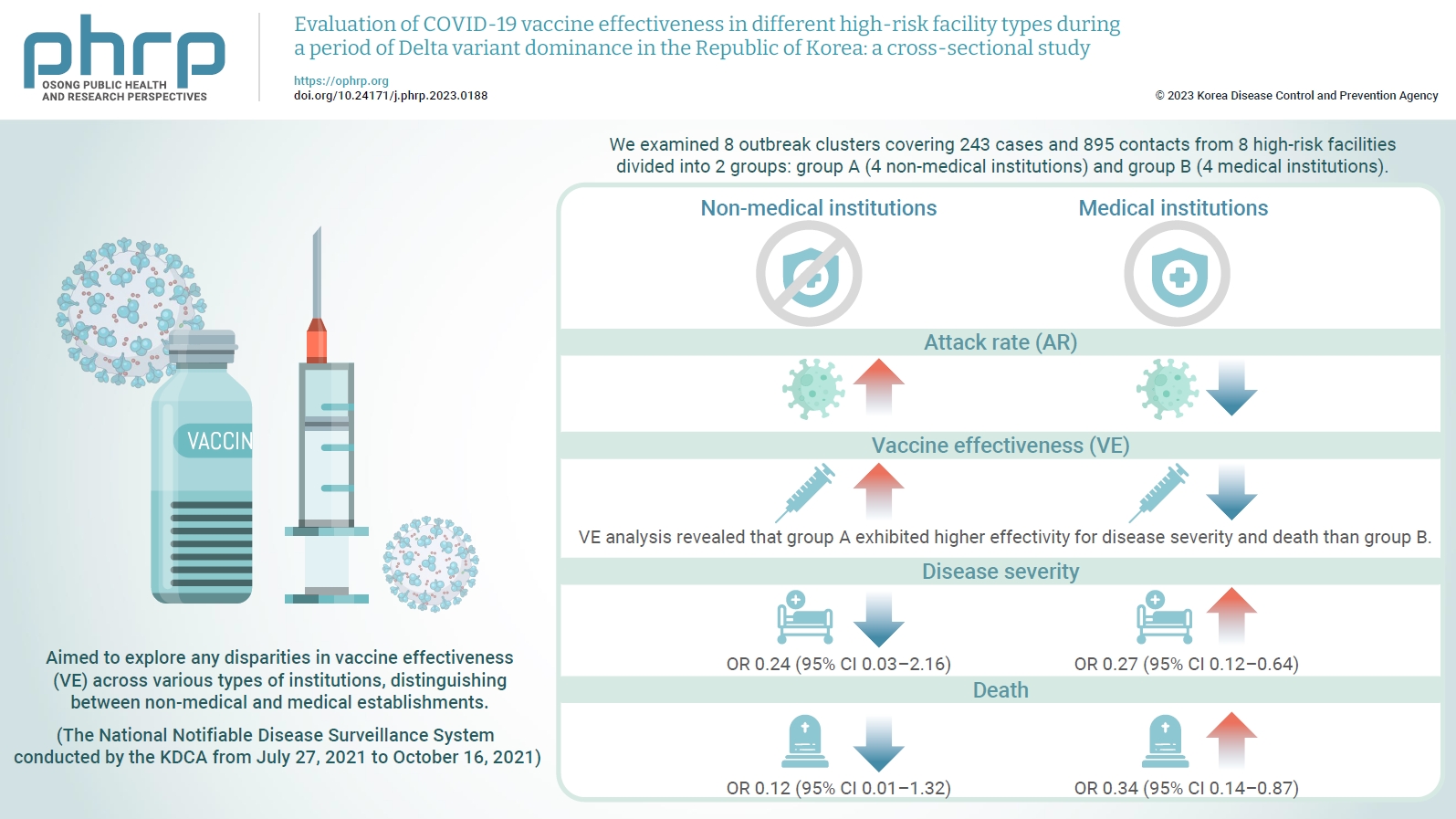
Objectives
We evaluated the effectiveness of coronavirus disease 2019 vaccination in high-risk facilities in the Republic of Korea during the period when the highly transmissible Delta variant was prevalent. Additionally, we aimed to explore any disparities in vaccine effectiveness (VE) across various types of institutions, specifically distinguishing between non-medical and medical establishments. Methods: We examined 8 outbreak clusters covering 243 cases and 895 contacts from 8 high-risk facilities divided into 2 groups: group A (4 non-medical institutions) and group B (4 medical institutions). These clusters were observed from July 27, 2021 to October 16, 2021 for the attack rate (AR) and VE with respect to disease severity. A generalized linear model with a binomial distribution was used to determine the odds ratio (OR) for disease severity and death. Results: AR was notably lower in group B (medical institutions). Furthermore, VE analysis revealed that group A exhibited higher effectivity for disease severity and death than group B. The OR for disease severity was 0.24 (95% confidence interval [CI], 0.03–2.16) for group A and 0.27 (95% CI, 0.12–0.64) for group B, with the OR for death at 0.12 (95% CI, 0.01–1.32) in group A and 0.34 (95% CI, 0.14–0.87) in group B. Conclusion: Although VE may vary across institutions, our findings underscore the importance of implementing vaccinations in high-risk facilities. Customized vaccination programs, tailored response plans, and competent management personnel are essential for effectively addressing and mitigating public health challenges.
  • 5,189 View
  • 80 Download

Brief Report

JYNNEOS vaccine safety monitoring in the Republic of Korea, 2022: a cross-sectional study
Jaeeun Lee, Seunghyun Lewis Kwon, Jinhee Park, Hyuna Bae, Hyerim Lee, Geun-Yong Kwon
Osong Public Health Res Perspect 2023;14(5):433-438.
Published online October 18, 2023
DOI: https://doi.org/10.24171/j.phrp.2023.0182
JYNNEOS vaccine safety monitoring in the Republic of Korea, 2022: a cross-sectional study
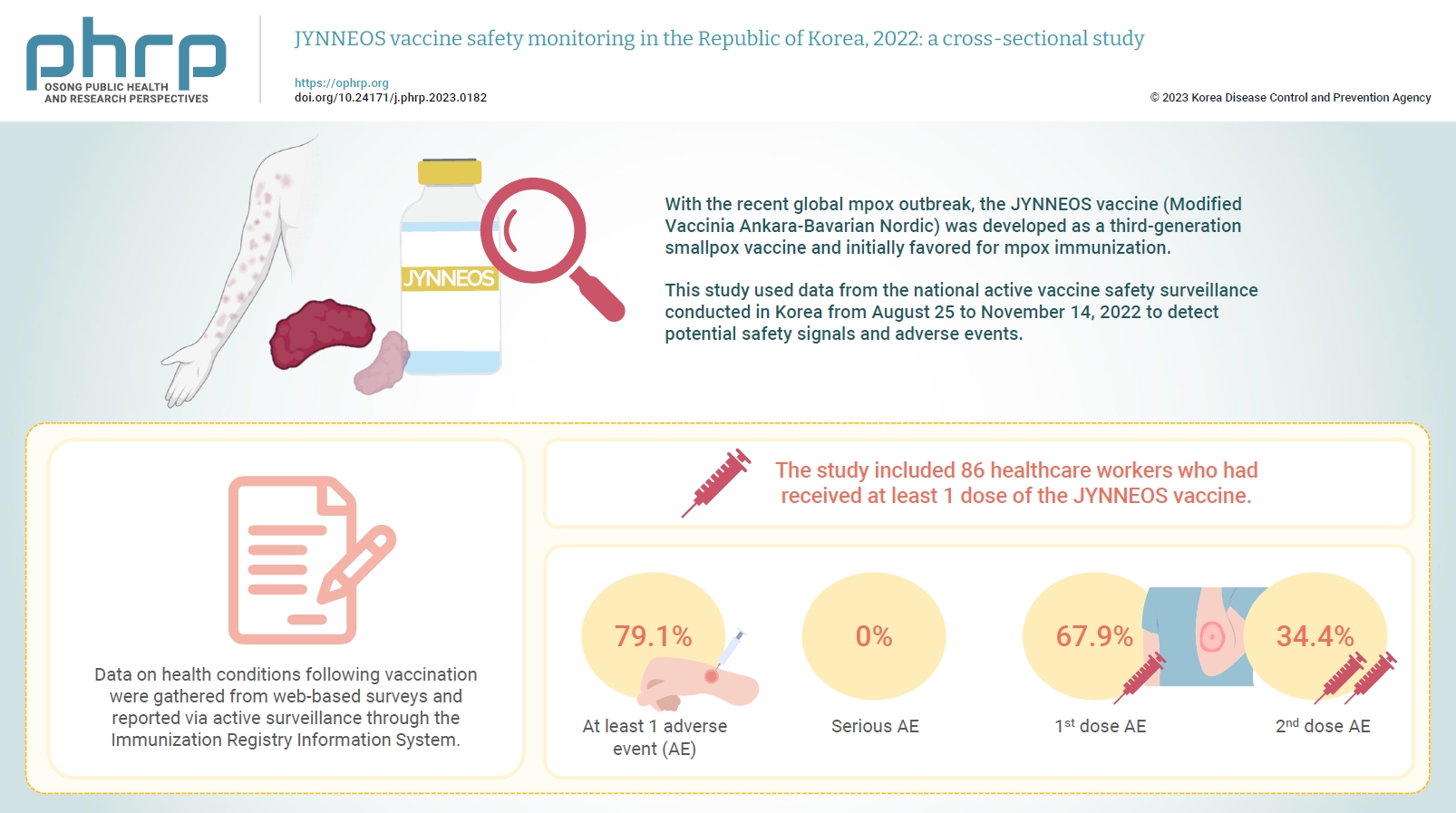
Objectives
With the recent global mpox outbreak, the JYNNEOS vaccine (Modified Vaccinia Ankara-Bavarian Nordic) was developed as a third-generation smallpox vaccine and initially favored for mpox immunization. Vaccine-associated side effects contribute to vaccine hesitancy. Consequently, tracking adverse events post-immunization is crucial for safety management. This study used data from the national active vaccine safety surveillance conducted in Korea from August 25 to November 24, 2022 to detect potential safety signals and adverse events. Methods: Data on health conditions following vaccination were gathered from web-based surveys and reported via active surveillance through the Immunization Registry Information System. This follow-up system functioned via a text message link, surveying adverse events and health conditions beginning on the second day post-vaccination. Information about specific adverse events, including both local and systemic reactions, was collected. Results: The study included 86 healthcare workers who had received at least 1 dose of the JYNNEOS vaccine. Among the respondents, 79.1% reported experiencing at least 1 adverse event, with the majority being local reactions at the injection site. The incidence of adverse events was higher following the first dose (67.9%) than after the second dose (34.4%). The most frequently reported adverse event for both doses was mild pain at the injection site. Conclusion: The study provides crucial information on the safety of the JYNNEOS vaccine, demonstrating that most adverse events were manageable and predominantly localized to the injection site. Nonetheless, additional research is needed on the safety of various vaccine administration techniques and the vaccine’s effects on broader demographics.

Citations

Citations to this article as recorded by  Crossref logo
  • Enhanced Immunogenicity and Affinity with A35R-Fc-Based Chimeric Protein Compared to MPXV A35R Protein
    Shimeng Bai, Yanxin Cui, Qibin Liao, Hongyang Yi, Zhonghui Liao, Gengwei Zhang, Fenfang Wu, Hongzhou Lu
    Viruses.2025; 17(1): 116.     CrossRef
  • The Role of Adverse Event Follow-Up in Advancing the Knowledge of Medicines and Vaccines Safety: A Scoping Review
    Vijay Kara, Florence Van Hunsel, Andrew Bate, Eugène van Puijenbroek
    Drug Safety.2025; 48(9): 977.     CrossRef
  • Potential of MRNA vaccines for mpox prevention: current evidence and future directions
    Toufik Abdul-Rahman, Ogungbemi Evelyn Faith, Oyinbolaji Akinwande Ajetunmobi, Hala Ibrahim Thaalibi, Chinelo Geraldine Ikele, Gargi Gautam, Faith Olanrewaju Omotayo, Poulami Roy, Alhazan Amir Adebayo, Muslimat Abolore Mojeed, Tolulope Taiwo Kareem, Halima
    Annals of Medicine & Surgery.2025; 87(9): 5650.     CrossRef
  • Adverse Reactions After Intradermal Vaccination With JYNNEOS for Mpox in Korea
    So Yun Lim, Yu Mi Jung, Yeonjae Kim, Gayeon Kim, Jaehyun Jeon, BumSik Chin, Min-Kyung Kim
    Journal of Korean Medical Science.2024;[Epub]     CrossRef
  • First Nationwide Mpox Vaccination Program in the Republic of Korea: Implications for an Enhanced Public Health Response
    Seunghyun Lewis Kwon, Minju Song, Wonkyung Lee, Jeeyeon Shin, Su-Yeon Lee, Sang-Gu Yeo, Minjeong Kim, Sanggyun Jeong, Joonku Park, Dongwoo Lee, Sookyoung Lim
    Journal of Korean Medical Science.2024;[Epub]     CrossRef
  • Global perspectives on smallpox vaccine against monkeypox: a comprehensive meta-analysis and systematic review of effectiveness, protection, safety and cross-immunogenicity
    Hao Liu, Wenjing Wang, Yang Zhang, Fuchun Wang, Junyi Duan, Tao Huang, Xiaojie Huang, Tong Zhang
    Emerging Microbes & Infections.2024;[Epub]     CrossRef
  • 5,086 View
  • 81 Download
  • 7 Web of Science
  • Crossref

Original Article

Prevalence and patterns of adverse events following childhood immunization and the responses of mothers in Ile-Ife, South West Nigeria: a facility-based cross-sectional survey
Olorunfemi Akinbode Ogundele, Funmito Omolola Fehintola, Mubarak Salami, Rahmat Usidebhofoh, Mary Aderemi Abaekere
Osong Public Health Res Perspect 2023;14(4):291-299.
Published online July 27, 2023
DOI: https://doi.org/10.24171/j.phrp.2023.0071
Prevalence and patterns of adverse events following childhood immunization and the responses of mothers in Ile-Ife, South West Nigeria: a facility-based cross-sectional survey
Objectives
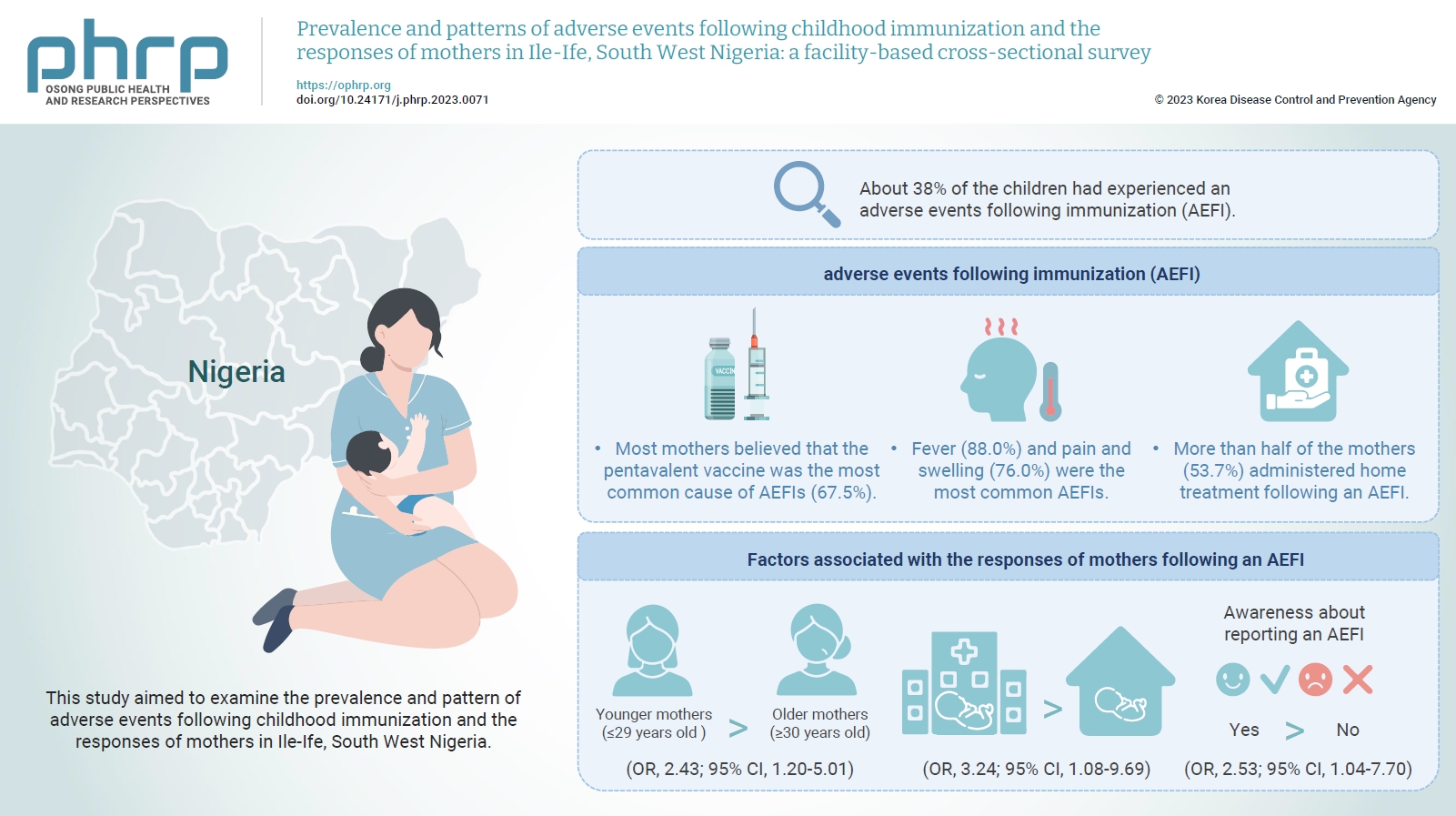
This study aimed to examine the prevalence and pattern of adverse events following childhood immunization and the responses of mothers in Ile-Ife, South West Nigeria.
Methods
This descriptive cross-sectional study was conducted among 422 mothers of children aged 0 to 24 months attending any of the 3 leading immunization clinics in Ile-Ife, Nigeria. The respondents were selected using the multi-stage sampling technique. Data were collected using a pretested structured interviewer-administered questionnaire and analyzed using IBM SPSS ver. 26.0. The chi-square test was used to test associations, while binary logistic regression was used to determine the predictors of mothers’ responses to adverse events following immunization (AEFIs). A p-value of <0.05 was considered statistically significant.
Results
The mean age of the respondents was 29.99±5.74 years. About 38% of the children had experienced an AEFI. Most mothers believed that the pentavalent vaccine was the most common cause of AEFIs (67.5%). Fever (88.0%) and pain and swelling (76.0%) were the most common AEFIs. More than half of the mothers (53.7%) administered home treatment following an AEFI. Younger mothers (odds ratio [OR], 2.43; 95% confidence interval [CI], 1.20–5.01), mothers who delivered their children at a healthcare facility (OR, 3.24; 95% CI, 1.08–9.69), and mothers who were knowledgeable about reporting AEFIs (OR, 2.53; 95% CI, 1.04–7.70) were most likely to respond appropriately to AEFIs.
Conclusion
The proportion of mothers who responded poorly to AEFIs experienced by their children was significant. Therefore, strategies should be implemented to improve mothers’ knowledge about AEFIs to improve their responses.

Citations

Citations to this article as recorded by  Crossref logo
  • A comprehensive evaluation of the AEFI surveillance system in Ethiopia: An insight from a national study
    Admas Abera, Behailu Hawulte, Tesfaye Gobena, Lemma Demissie Regassa, Saba Hailu, Ahmed Mohammed, Berhanu Fikadie Endehabtu, Mulumebet Abera Wordofa, Keneni Gutema Negeri, Girma Taye, Michael Tarekegn, Binyam Tilahun, Mesoud Mohammed, Naod Wondirad, Kibro
    Journal of Global Health Economics and Policy.2026;[Epub]     CrossRef
  • Análisis epidemiológico de eventos adversos graves posteriores a la vacunación en Colombia, 2019-2023
    Cristhian Camilo Martinez Torres, Diana Marcela Russy Roa
    Salud Javeriana.2026;[Epub]     CrossRef
  • Perception of healthcare administrators on the impediments of optimizing adverse events following immunization e-Reporting in Nigeria
    Grace Fubara Erekosima, Saheed Dipo Isiaka, Folake Oni, Ahmed Rufai Garba, Oluchi Bassey, Stephen Olabode Asaolu, Olugbemisola Wuraola Samuel, Genevieve Ozioko, Oluwafisayo Azeez Ayodeji, Euphemia Chigekwu Agomuo, Irene Odira Okoye, Sidney Sampson, Precio
    PLOS One.2025; 20(8): e0331093.     CrossRef
  • Advancing Immunization in Africa: Overcoming Challenges to Achieve the 2030 Global Immunization Targets
    Olalekan Okesanya, Gbolahan Olatunji, Noah Olaleke, Mba Mercy, Ayodele Ilesanmi, Hassan Kayode, Emery Manirambona, Mohamed Ahmed, Bonaventure Ukoaka, Don Lucero-Prisno III
    Adolescent Health, Medicine and Therapeutics.2024; Volume 15: 83.     CrossRef
  • 7,592 View
  • 243 Download
  • 2 Web of Science
  • Crossref

Brief Report

Temporal association between the age-specific incidence of Guillain-Barré syndrome and SARS-CoV-2 vaccination in Republic of Korea: a nationwide time-series correlation study
Hyunju Lee, Donghyok Kwon, Seoncheol Park, Seung Ri Park, Darda Chung, Jongmok Ha
Osong Public Health Res Perspect 2023;14(3):224-231.
Published online June 22, 2023
DOI: https://doi.org/10.24171/j.phrp.2023.0050
Temporal association between the age-specific incidence of Guillain-Barré syndrome and SARS-CoV-2 vaccination in Republic of Korea: a nationwide time-series correlation study
Objectives
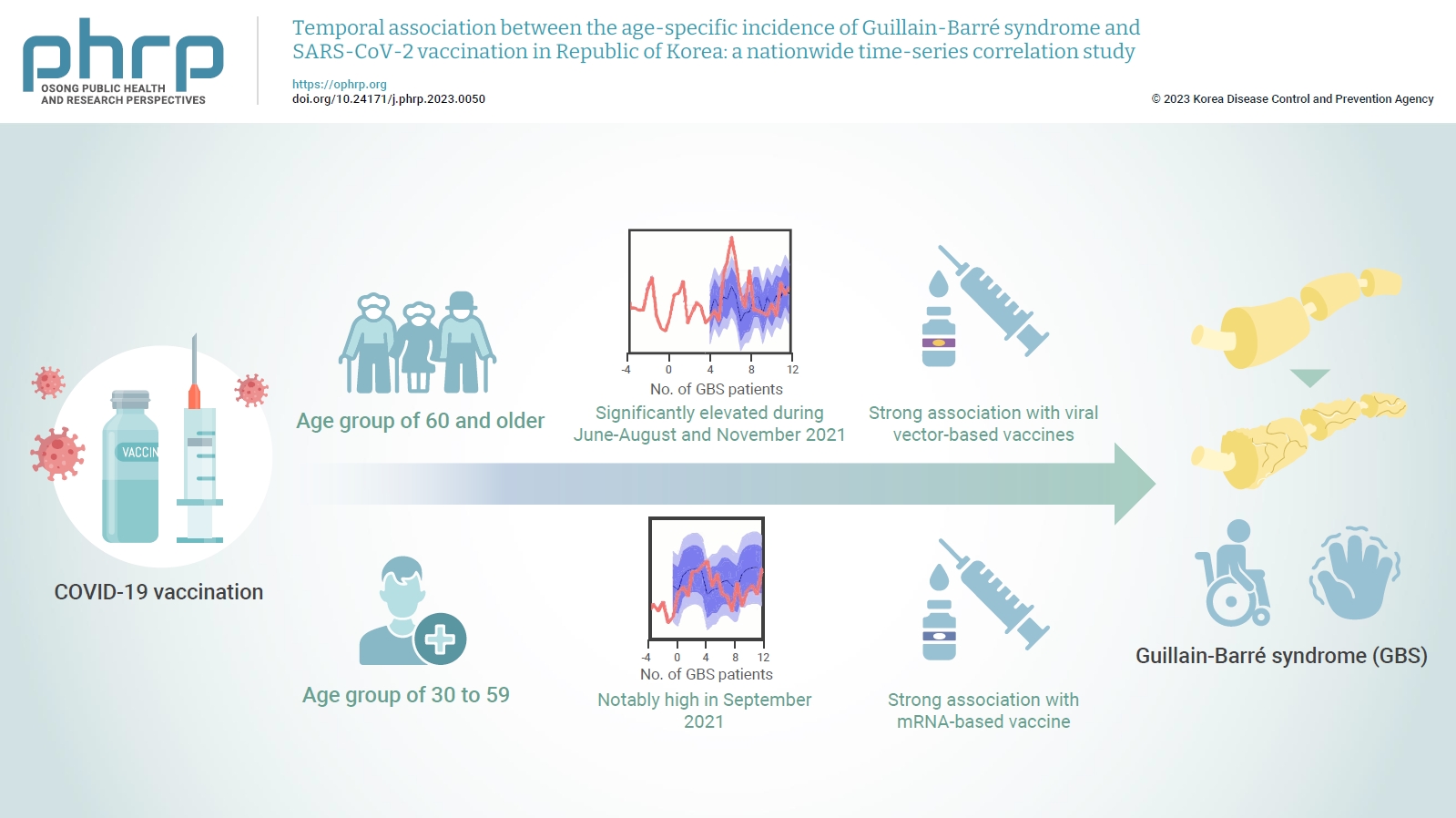
The incidence of Guillain-Barré syndrome (GBS) changed significantly during the coronavirus disease 2019 (COVID-19) pandemic. Emerging reports suggest that viral vector-based vaccines may be associated with an elevated risk of GBS.
Methods
In this nationwide time-series correlation study, we examined the age-specific incidence of GBS from January 2011 to August 2022, as well as data on severe acute respiratory syndrome coronavirus 2 (SARS-CoV-2) vaccinations and infections from February 2021 to August 2022. We compared the forecasted estimates of age-specific GBS incidence, using the pre-SARS-CoV-2 period as a benchmark, with the actual incidence observed during the post-vaccination period of the pandemic. Furthermore, we assessed the temporal association between GBS, SARS-CoV-2 vaccinations, and COVID-19 for different age groups.
Results
In the age group of 60 and older, the rate ratio was significantly elevated during June-August and November 2021. A significant, strong positive association was observed between viral vector-based vaccines and GBS incidence trends in this age group (r=0.52, p=0.022). For the 30 to 59 years age group, the rate ratio was notably high in September 2021. A statistically significant, strong positive association was found between mRNA-based vaccines and GBS incidence in this age group (r=0.61, p=0.006).
Conclusion
Viral vector-based SARS-CoV-2 vaccines were found to be temporally associated with an increased risk of GBS, particularly in older adults. To minimize age-specific and biological mechanism-specific adverse events, future vaccination campaigns should adopt a more personalized approach, such as recommending homologous mRNA-based SARS-CoV-2 vaccines for older adults to reduce the heightened risk of GBS.

Citations

Citations to this article as recorded by  Crossref logo
  • Assessing the Impact of Vaccination Strategies on COVID-19 Dynamics Via Time-varying Copulas
    Atina Ahdika, Muhammad Fakhruddin, Putu Veri Swastika
    Acta Biotheoretica.2026;[Epub]     CrossRef
  • mRNA-LNP COVID-19 Vaccine Lipids Induce Complement Activation and Production of Proinflammatory Cytokines: Mechanisms, Effects of Complement Inhibitors, and Relevance to Adverse Reactions
    Tamás Bakos, Tamás Mészáros, Gergely Tibor Kozma, Petra Berényi, Réka Facskó, Henriette Farkas, László Dézsi, Carlo Heirman, Stefaan de Koker, Raymond Schiffelers, Kathryn Anne Glatter, Tamás Radovits, Gábor Szénási, János Szebeni
    International Journal of Molecular Sciences.2024; 25(7): 3595.     CrossRef
  • Guillain–Barre syndrome following COVID-19 vaccination: a study of 70 case reports
    Biki Kumar Sah, Zahra Fatima, Rajan Kumar Sah, Bushra Syed, Tulika Garg, Selia Chowdhury, Bikona Ghosh, Binita Kunwar, Anagha Shree, Vivek Kumar Sah, Anisha Raut
    Annals of Medicine & Surgery.2024; 86(4): 2067.     CrossRef
  • Deciphering changes in the incidence of hemorrhagic stroke and cerebral venous sinus thrombosis during the coronavirus disease 2019 pandemic: A nationwide time-series correlation study
    Soo Hyeon Cho, Dong Kyu Kim, Min Cheol Song, Euiho Lee, Seoncheol Park, Darda Chung, Jongmok Ha, Sonu Bhaskar
    PLOS ONE.2024; 19(10): e0301313.     CrossRef
  • Before Diagnosing SARS-CoV-2 Vaccination-Related Funicular Myelosis, GBS and Other Differentials Must be Ruled Out
    Josef Finsterer
    Neurology India.2024; 72(5): 1100.     CrossRef
  • 6,213 View
  • 134 Download
  • 5 Web of Science
  • Crossref

Original Articles

Vaccine effectiveness and the epidemiological characteristics of a COVID-19 outbreak in a tertiary hospital in Republic of Korea
Seonhee Ahn, Tae Jong Son, Yoonsuk Jang, Jihyun Choi, Young Joon Park, Jiseon Seong, Hyun Hee Kwon, Muk Ju Kim, Donghyok Kwon
Osong Public Health Res Perspect 2023;14(3):188-196.
Published online June 8, 2023
DOI: https://doi.org/10.24171/j.phrp.2023.0066
Vaccine effectiveness and the epidemiological characteristics of a COVID-19 outbreak in a tertiary hospital in Republic of Korea
Objectives
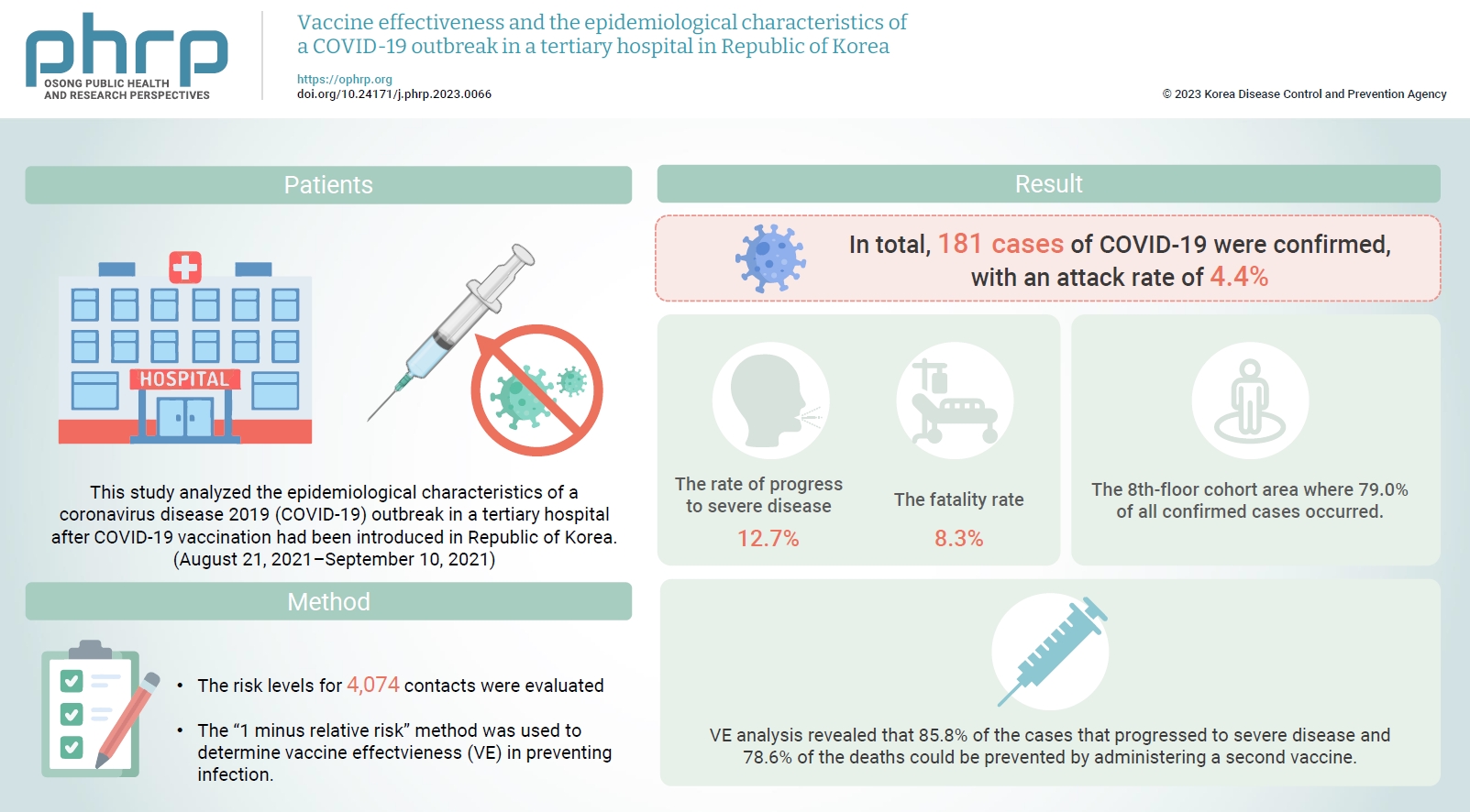
Healthcare facilities are high-risk sites for infection. This study analyzed the epidemiological characteristics of a coronavirus disease 2019 (COVID-19) outbreak in a tertiary hospital after COVID-19 vaccination had been introduced in Republic of Korea. Vaccine effectiveness (VE) and shared anti-infection strategies are also assessed.
Methods
The risk levels for 4,074 contacts were evaluated. The epidemiological characteristics of confirmed cases were evaluated using the chi-square test. The “1 minus relative risk” method was used to determine VE in preventing infection, progression to severe disease, and death. In the largest affected area (the 8th floor), a separate relative risk analysis was conducted. A multivariate logistic regression analysis (with 95% confidence interval [CIs]) was used to identify transmission risk factors with a significance level <10% via the backward elimination method.
Results
In total, 181 cases of COVID-19 were confirmed, with an attack rate of 4.4%. Of those cases, 12.7% progressed to severe disease, and 8.3% died. In the cohort isolation area on the 8th floor, where 79.0% of the confirmed cases occurred, the adjusted odds ratio was 6.55 (95% CI, 2.99–14.33) and 2.19 (95% CI, 1.24–3.88) for caregivers and the unvaccinated group, respectively. VE analysis revealed that 85.8% of the cases that progressed to severe disease and 78.6% of the deaths could be prevented by administering a second vaccine.
Conclusion
Caregiver training for infection prevention and control is necessary to reduce infection risk. Vaccination is an important intervention to reduce the risk of progression to severe disease and death.
  • 4,931 View
  • 118 Download
Effectiveness of the COVID-19 vaccine in the Honam region of the Republic of Korea
In-Sook Shin, Yong-Pyo Lee, Seung-Hoon Lee, Jae-Young Lee, Jong-Ha Park, Yoon-Seok Chung
Osong Public Health Res Perspect 2023;14(3):197-206.
Published online June 8, 2023
DOI: https://doi.org/10.24171/j.phrp.2022.0308
Effectiveness of the COVID-19 vaccine in the Honam region of the Republic of Korea
Objectives
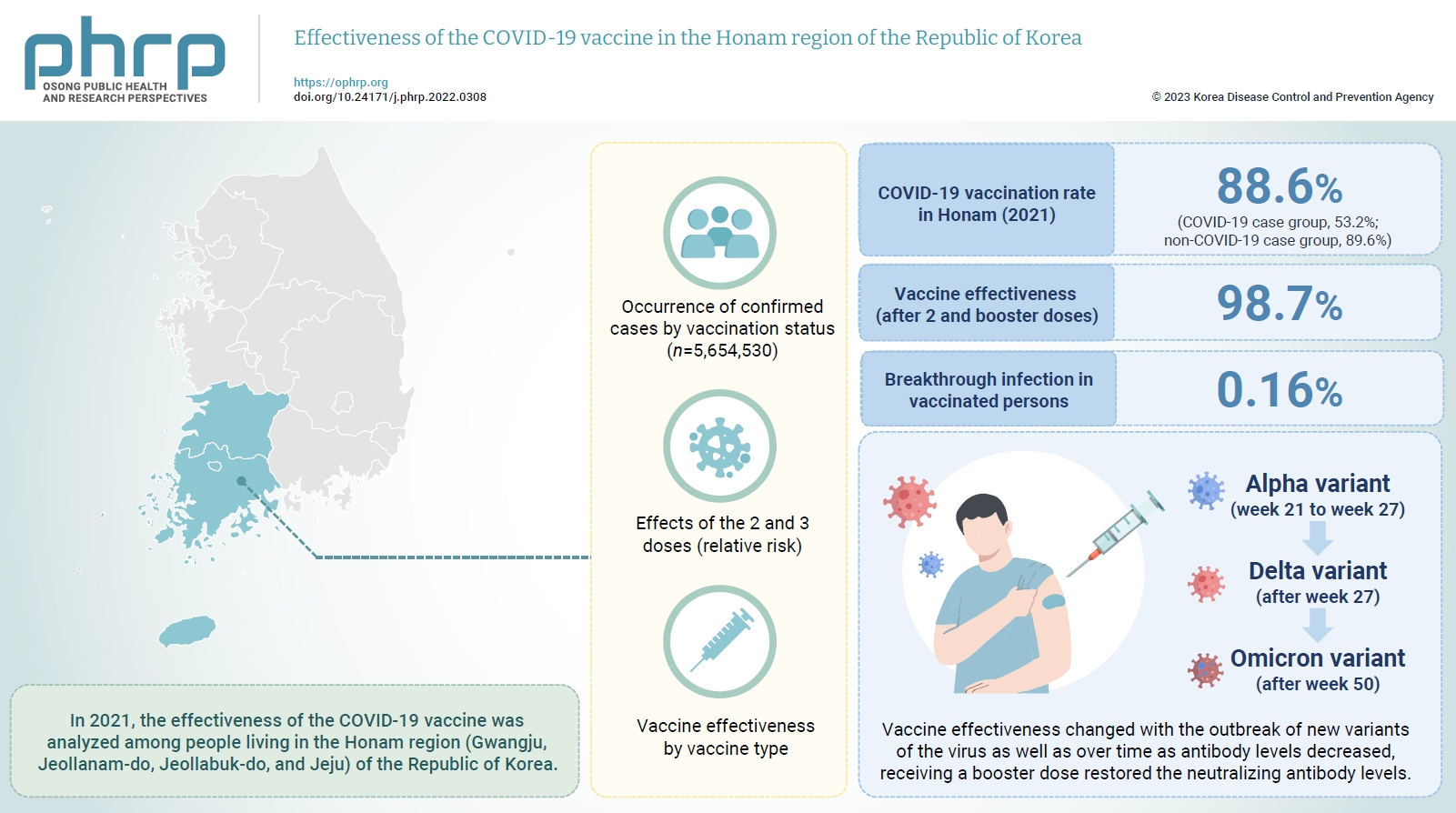
In 2021, the effectiveness of the COVID-19 vaccine was analyzed among people living in the Honam region (Gwangju, Jeollanam-do, Jeollabuk-do, and Jeju) of the Republic of Korea. And we investigated changes in the dominant virus strain.
Methods
This study used the data provided by the Korean Ministry of the Interior and Safety for individuals ≥12 years old in the Honam region, and the Integrated Disease and Health Management System of the Korea Centers for Disease Control and Prevention for COVID-19-vaccinated individuals as of December 31, 2021. Statistical analyzes were performed using IBM SPSS ver. 23.0. The occurrence of confirmed cases by vaccination status, the relative risk, and vaccine effectiveness by vaccine type were calculated.
Results
In 2021, the COVID-19 vaccination rate in Honam was 88.6%. The overall vaccine effectiveness (after 2 and 3 doses) was 98.7% (p<0.001). and the breakthrough infection rate was 0.16%. From week 21 to week 27 of 2021 (June 27 to July 3), the genome sequencing results were mostly alpha variants. The Delta variant emerged as the dominant variant after 27 weeks and the Omicron variant was found at 50 weeks (December 5–11).
Conclusion
Vaccine effectiveness changed with the outbreak of new variants of the virus as well as over time as antibody levels decreased. that the prevention effectiveness of vaccination in Honam was >98%, and the effect among persons who received 2 doses was >90% regardless of the vaccine type. Although vaccine effectiveness decreased because of reduced antibody levels over time (as observed in breakthrough infections), receiving a booster dose restored the neutralizing antibody levels.
  • 5,886 View
  • 98 Download
The incidence and clinical characteristics of myocarditis and pericarditis following mRNA-based COVID-19 vaccination in Republic of Korea adolescents from July 2021 to September 2022
Objectives
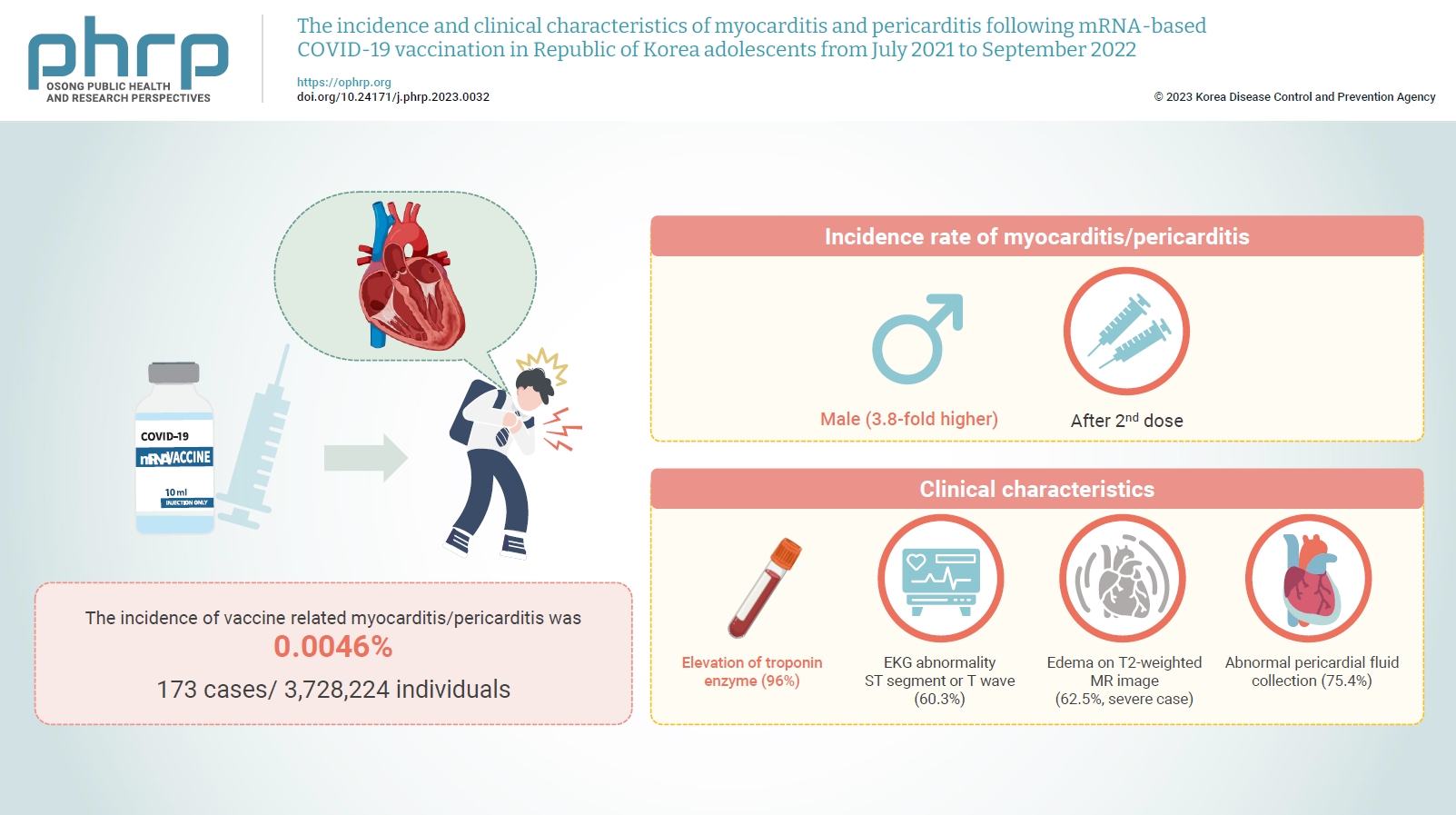
Age-specific information regarding myocarditis/pericarditis in adolescents following mRNA-based coronavirus disease 2019 (COVID-19) vaccination in Asia remains insufficient. This study investigated the incidence and clinical characteristics of myocarditis/pericarditis in Republic of Korea adolescents after mRNA-based COVID-19 vaccination.
Methods
This retrospective descriptive study utilized patient data from the Korea Immunization Management System. Incidence rates were calculated according to age and sex. Clinical characteristics (symptoms/signs, laboratory values, and imaging results) were compared between mild and severe cases.
Results
Between July 19, 2021 and September 30, 2022, 3,728,224 individuals aged 12 to 19 years received 6,484,165 mRNA-based COVID-19 vaccines, and 173 cases met the case definition for myocarditis/pericarditis: 151 mild (87.3%) and 22 severe (12.7%). The incidence was 3.8-fold higher in males than in females. Troponin I/ troponin T was elevated in 96% of myocarditis cases, demonstrating higher sensitivity than creatine kinase-myocardial band (67.6%) or C-reactive protein (75.2%). ST-segment or Twave on electrography abnormalities were found in 60.3% (85/141). Paroxysmal/sustained atrial/ventricular arrhythmias were more common in severe than in mild cases (45.5% vs. 16.8%, p=0.008). Edema on T2-weighted magnetic imaging occurred in 21.6% (8/37) and 62.5% (5/8) of mild and severe cases, respectively (p=0.03). Abnormal pericardial fluid collection or pericardial inflammation was found in 75.4% of pericarditis cases (49/65).
Conclusion
Myocarditis/pericarditis occurred in rare cases following mRNA-based COVID-19 vaccination. Most cases were mild, but the incidence was higher in adolescent males and after the second dose. As bivalent severe acute respiratory syndrome coronavirus 2 mRNA vaccination started in Republic of Korea in October 2022, the post-vaccination incidence of myocarditis/pericarditis should be closely monitored, considering clinical characteristics.

Citations

Citations to this article as recorded by  Crossref logo
  • Factors associated with carditis adverse events following SARS-COV-2-19 vaccination
    Kyung Hyun Min, Jun Hyeob Kim, Jin Yeon Gil, Jun Hyuk Park, Ji Min Han, Kyung Eun Lee
    Epidemiology and Infection.2025;[Epub]     CrossRef
  • Unique Features and Collateral Immune Effects of mRNA-LNP COVID-19 Vaccines: Plausible Mechanisms of Adverse Events and Complications
    János Szebeni
    Pharmaceutics.2025; 17(10): 1327.     CrossRef
  • Responses to Common Misconceptions Relating to COVID-19 Variant-Adapted mRNA Vaccines
    George Kassianos, Pauline MacDonald, Ivan Aloysius, Shanti Pather
    Vaccines.2024; 12(1): 57.     CrossRef
  • Comparative safety of monovalent and bivalent mRNA COVID-19 booster vaccines in adolescents aged 12 to 17 years in the Republic of Korea
    Mijeong Ko, Seontae Kim, Seok-Kyoung Choi, Seung Hwan Shin, Yeon-Kyeng Lee, Yunhyung Kwon
    Osong Public Health and Research Perspectives.2024; 15(4): 364.     CrossRef
  • Epidemiological Characteristics and Outcome of Myocarditis and Pericarditis Temporally Associated With BNT162b2 COVID-19 Vaccine in Adolescents: Korean National Surveillance
    Bin Ahn, Seung Hwan Shin, Myung-Jae Hwang, HyoSug Choi, Sara Na, Sangshin Park, Jue Seong Lee, Young June Choe, Yoonsun Yoon, Kyoungsan Seo, Jong Hee Kim, Hyun Mi Kang
    Journal of Korean Medical Science.2024;[Epub]     CrossRef
  • To become a more stronger and safer country
    Jong-Koo Lee
    Osong Public Health and Research Perspectives.2023; 14(2): 67.     CrossRef
  • 11,720 View
  • 288 Download
  • 6 Web of Science
  • Crossref
COVID-19 outbreak in a religious village community in Republic of Korea and risk factors for transmission
Jiae Shim, Eunju Lee, Eunyoung Kim, Yeonhwa Choi, Giseok Kang, Bryan Inho Kim
Osong Public Health Res Perspect 2023;14(2):110-118.
Published online April 5, 2023
DOI: https://doi.org/10.24171/j.phrp.2023.0002
COVID-19 outbreak in a religious village community in Republic of Korea  and risk factors for transmission
Objectives
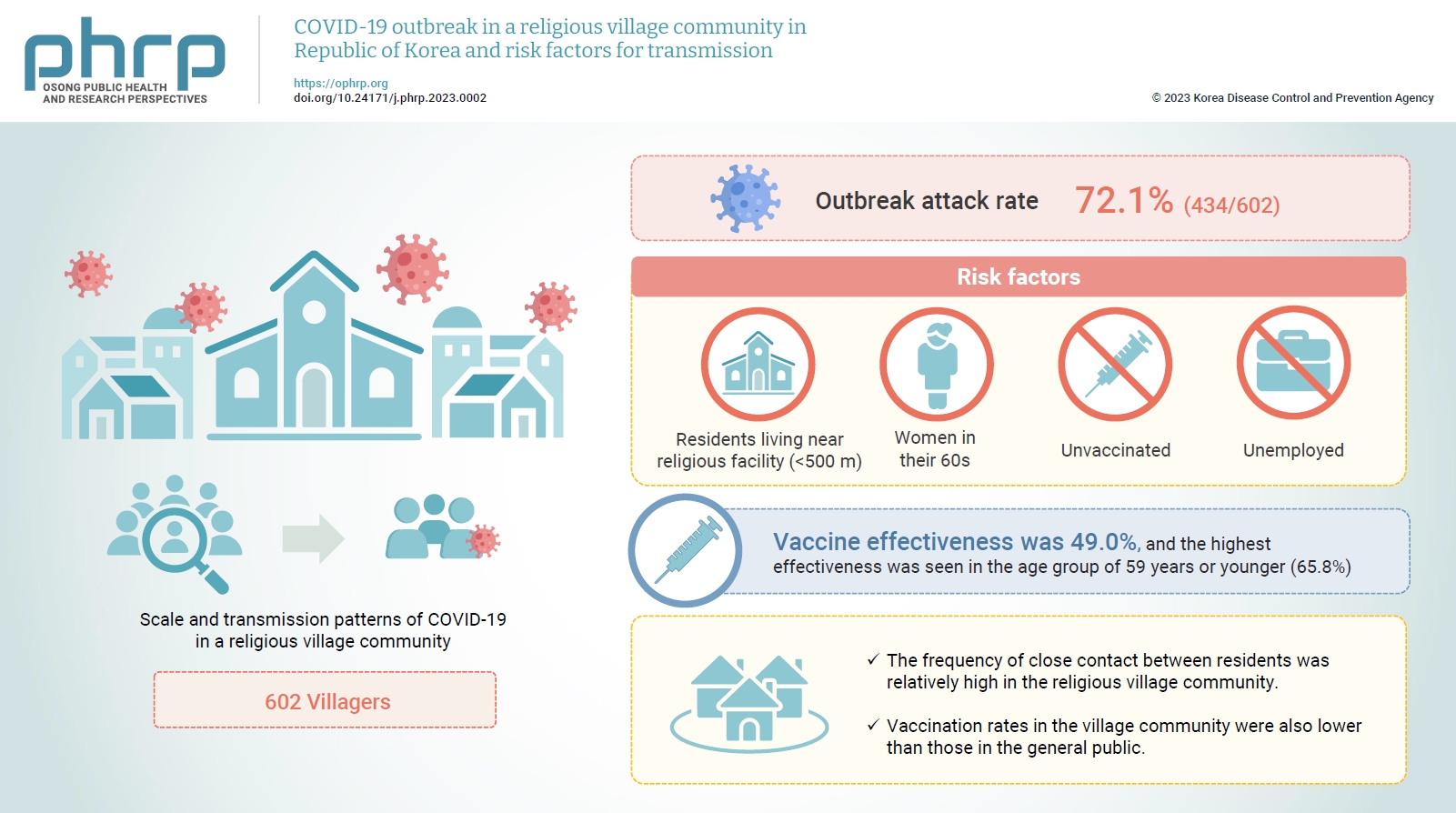
This study aimed to assess the scale and transmission patterns of coronavirus disease 2019 (COVID-19) in a religious village community in South Korea, to determine the risk factors of transmission, and to evaluate vaccine effectiveness.
Methods
An epidemiological survey was conducted, and data were collected and analyzed from 602 villagers in the religious village community. Multivariate logistic regression analysis was used to identify the risk factors for COVID-19 transmission and to evaluate vaccine effectiveness.
Results
The outbreak attack rate was 72.1% (434/602). The attack rate was high among women in their 60s, the unemployed, residents living near religious facility (<500 m), and the unvaccinated. Age, the distance between religious facility and residences, and the absence of vaccination were identified as risk factors for transmission. Vaccine effectiveness was 49.0%, and the highest effectiveness was seen in the age group of 59 years or younger (65.8%).
Conclusion
This village community was isolated, with little communication with the outside world. However, the frequency of close contact between residents was relatively high, contributing to the spread of COVID-19 in the village even with relatively short exposure. Vaccination rates in the village community were also lower than those in the general public. Public health authorities should consider the potential impact of cultural factors, including religion, that could lead to the exponential spread of COVID-19 in closed village communities.

Citations

Citations to this article as recorded by  Crossref logo
  • Impact of disease severity, age, sex, comorbidity, and vaccination on secondary attack rates of SARS-CoV-2: a global systematic review and meta-analysis
    Dewan Md. Sumsuzzman, Yang Ye, Zhen Wang, Abhishek Pandey, Joanne M. Langley, Alison P. Galvani, Seyed M. Moghadas
    BMC Infectious Diseases.2025;[Epub]     CrossRef
  • Quantitative analysis of self-reporting and contact tracing in heterogeneous risk groups: a stochastic modeling study of the COVID-19 outbreak in Daegu, Korea
    Jiwon Han, Eunok Jung
    BMC Public Health.2025;[Epub]     CrossRef
  • Trends of fear and anger on YouTube during the initial stage of the COVID-19 outbreak in South Korea
    Jae-Joon Lee, Jongwoo Kim, Soo-Kyoung Lee
    BMC Public Health.2024;[Epub]     CrossRef
  • 6,238 View
  • 104 Download
  • 3 Web of Science
  • Crossref

Special Article

A framework for nationwide COVID-19 vaccine safety research in the Republic of Korea: the COVID-19 Vaccine Safety Research Committee
Na-Young Jeong, Hyesook Park, Sanghoon Oh, Seung Eun Jung, Dong-Hyun Kim, Hyoung-Shik Shin, Hee Chul Han, Jong-Koo Lee, Jun Hee Woo, Byung-Joo Park, Nam-Kyong Choi
Osong Public Health Res Perspect 2023;14(1):5-14.
Published online February 28, 2023
DOI: https://doi.org/10.24171/j.phrp.2023.0026
A framework for nationwide COVID-19 vaccine safety research in the Republic of Korea: the COVID-19 Vaccine Safety Research Committee
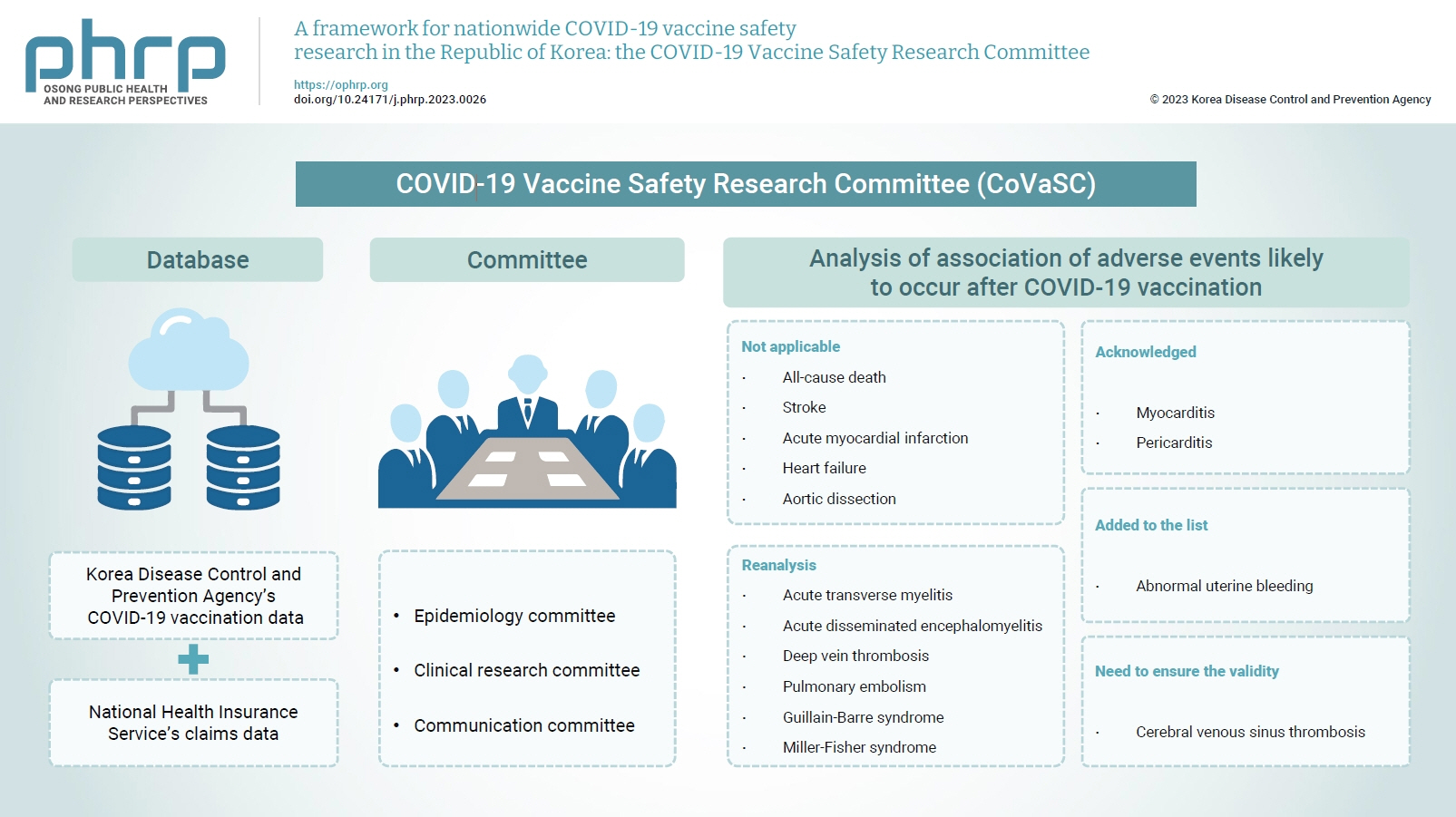
With the introduction of coronavirus disease 2019 (COVID-19) vaccines, the Korea Disease Control and Prevention Agency (KDCA) commissioned the National Academy of Medicine of Korea to gather experts to independently assess post-vaccination adverse events. Accordingly, the COVID-19 Vaccine Safety Research Committee (CoVaSC) was launched in November 2021 to perform safety studies and establish evidence for policy guidance. The CoVaSC established 3 committees for epidemiology, clinical research, and communication. The CoVaSC mainly utilizes pseudonymized data linking KDCA’s COVID-19 vaccination data and the National Health Insurance Service’s claims data. The CoVaSC’s 5-step research process involves defining the target diseases and organizing ad-hoc committees, developing research protocols, performing analyses, assessing causal relationships, and announcing research findings and utilizing them to guide compensation policies. As of 2022, the CoVaSC completed this research process for 15 adverse events. The CoVaSC launched the COVID-19 Vaccine Safety Research Center in September 2022 and has been reorganized into 4 divisions to promote research including international collaborative studies, long-/short-term follow-up studies, and education programs. Through these enhancements, the CoVaSC will continue to swiftly provide scientific evidence for COVID-19 vaccine research and compensation and may serve as a model for preparing for future epidemics of new diseases.

Citations

Citations to this article as recorded by  Crossref logo
  • Risk of anxiety disorders and insomnia following COVID-19 vaccination
    Haerin Cho, Joon Hyung Jung, Hwoyeon Seo, Won Chul Shin, Jung-Ick Byun, Suvin Park, Na-Young Jeong, Sanghoon Oh, Nam-Kyong Choi
    Journal of Psychiatric Research.2026; 192: 109.     CrossRef
  • Active Surveillance for COVID-19 Vaccine Safety Using Sequential Analysis in Korea: Population-Based Retrospective Observational Study
    Na-Young Jeong, Haerin Cho, Heehyun Won, Suvin Park, Joongyub Lee, Hyesook Park, Nam-Kyong Choi
    JMIR Public Health and Surveillance.2026; 12: e75094.     CrossRef
  • MIS‐C Overlap, Not Prior COVID‐19 Itself, Drives Treatment Escalation in Kawasaki Disease: A Nationwide Cohort Study
    Min Ji Kim, Jong Seung Kim, Jee Young Hong, Jihye You
    Pediatrics International.2026;[Epub]     CrossRef
  • Postmenopausal Bleeding Risk after COVID-19 Vaccination: A Population-Based Self-Controlled Case Series Study
    Na-Young Jeong, HyeMin Park, SiHyun Cho, Nam-Kyong Choi
    Yonsei Medical Journal.2026; 67(11): 831.     CrossRef
  • Risk of Kawasaki Disease/Multisystem Inflammatory Syndrome Following COVID-19 Vaccination in Korean Children: A Self-Controlled Case Series Study
    Suyeon Kim, Hwa Yeon Ko, Jeongin Oh, Dongwon Yoon, Ju Hwan Kim, Young June Choe, Ju-Young Shin
    Journal of Korean Medical Science.2025;[Epub]     CrossRef
  • The association between acute transverse myelitis and COVID‐19 vaccination in Korea: Self‐controlled case series study
    Eunsun Lim, Yoo Hwan Kim, Na‐Young Jeong, Su‐Hyun Kim, Heehyun Won, Jong‐Seok Bae, Nam‐Kyong Choi
    European Journal of Neurology.2025;[Epub]     CrossRef
  • Coronavirus disease vaccine linked menstrual changes: mobile application study
    Sung Eun Kim, Joseph J. Noh, Yoo-Young Lee
    Obstetrics & Gynecology Science.2025; 68(2): 155.     CrossRef
  • Multilevel analysis of individual, household, and community factors influencing COVID-19 vaccination intention: evidence from the 2021 Korea Community Health Survey
    Ji-seon Seong, Jong-Yeon Kim
    Osong Public Health and Research Perspectives.2025; 16(2): 169.     CrossRef
  • Association between COVID-19 vaccination and first healthcare utilization for chronic obstructive pulmonary disease: A nationwide population-based cohort study
    Sang Hyuk Kim, Seung-Hun You, Ju Won Lee, Eunji Kim, Youlim Kim, Hyun Lee, Sun-Young Jung, Ji-Yong Moon
    Vaccine.2025; 61: 127367.     CrossRef
  • Evaluating Vaccine Safety Through the Vaccine Safety Datalink: A Comprehensive Review of Research Contributions
    Eunsun Lim, Na-Young Jeong, Heehyun Won, Nam-Kyong Choi
    Journal of Health Informatics and Statistics.2025; 50(2): 113.     CrossRef
  • COVID-19 vaccination and the risk of abnormal uterine bleeding: A nationwide self-controlled case series study
    Na-Young Jeong, SiHyun Cho, Eunsun Lim, Jung Ryeol Lee, Jae Yen Song, Joong Shin Park, Nam-Kyong Choi
    Vaccine.2025; 63: 127619.     CrossRef
  • Risk of new-onset seizures following immunization against COVID-19: a self-controlled case-series study
    Hwa Yeon Ko, Dongwon Yoon, Ju Hwan Kim, Han Eol Jeong, Seung Bong Hong, Won-Chul Shin, Ju-Young Shin
    Epidemiology and Health.2025; 47: e2025024.     CrossRef
  • Risk of encephalitis and meningitis after COVID-19 vaccination in South Korea: a self-controlled case series analysis
    Ju Hwan Kim, Dongwon Yoon, Hwa Yeon Ko, Kyungyeon Jung, Jun-Sang Sunwoo, Won Chul Shin, Jung-Ick Byun, Ju-Young Shin
    BMC Medicine.2024;[Epub]     CrossRef
  • The COVID-19 Vaccine Safety Research Center: a cornerstone for strengthening safety evidence for COVID-19 vaccination in the Republic of Korea
    Na-Young Jeong, Hyesook Park, Sanghoon Oh, Seung Eun Jung, Dong-Hyun Kim, Hyoung-Shik Shin, Hee Chul Han, Jong-Koo Lee, Jun Hee Woo, Jaehun Jung, Joongyub Lee, Ju-Young Shin, Sun-Young Jung, Byung-Joo Park, Nam-Kyong Choi
    Osong Public Health and Research Perspectives.2024; 15(2): 97.     CrossRef
  • A Causality Assessment Framework for COVID-19 Vaccines and Adverse Events at the COVID-19 Vaccine Safety Research Center
    Seyoung Kim, Jeong Ah Kim, Hyesook Park, Sohee Park, Sanghoon Oh, Seung Eun Jung, Hyoung-Shik Shin, Jong Koo Lee, Hee Chul Han, Jun Hee Woo, Byung-Joo Park, Nam-Kyong Choi, Dong-Hyun Kim
    Journal of Korean Medical Science.2024;[Epub]     CrossRef
  • To become a more stronger and safer country
    Jong-Koo Lee
    Osong Public Health and Research Perspectives.2023; 14(2): 67.     CrossRef
  • Risk of lymphadenopathy from SARS-CoV-2 vaccination in Korea: a self-controlled case series analysis
    Mi-Sook Kim, Bongyoung Kim, Jeong Pil Choi, Nam-Kyong Choi, Jung Yeon Heo, Jun Yong Choi, Joongyub Lee, Sang Il Kim
    Epidemiology and Health.2023; 45: e2023090.     CrossRef
  • 9,792 View
  • 212 Download
  • 18 Web of Science
  • Crossref

Brief Report

The effectiveness of Paxlovid treatment in long-term care facilities in South Korea during the outbreak of the Omicron variant of SARS-CoV-2
Hanul Park, Young Joon Park, Hye Young Lee, Mi Yu, Yeong-Jun Song, Sang Eun Lee, Ji-Joo Lee, Eun-Sol Lee, Yeonjung Kim
Osong Public Health Res Perspect 2022;13(6):443-447.
Published online December 23, 2022
DOI: https://doi.org/10.24171/j.phrp.2022.0262
The effectiveness of Paxlovid treatment in long-term care facilities in South Korea during the outbreak of the Omicron variant of SARS-CoV-2
Objectives
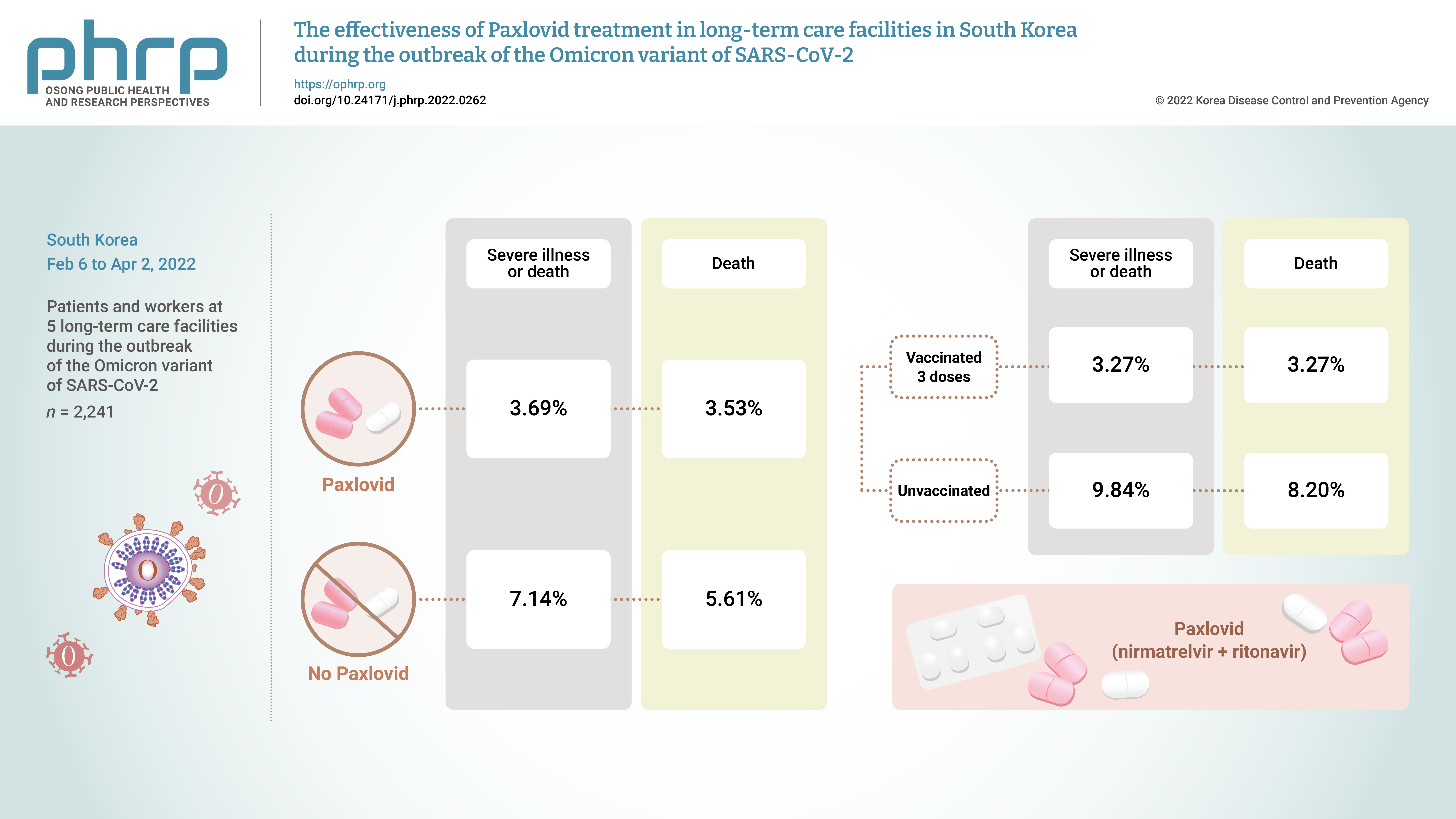
On November 5, 2021, Pfizer Inc. announced Paxlovid (nirmatrelvir +ritonavir) asa treatment method that could reduce the risk of hospitalization or death for patients withconfirmed coronavirus disease 2019 (COVID-19).Methods: From February 6, 2022 to April 2, 2022, the incidence of COVID-19 and the effectsof treatment with Paxlovid were analyzed in 2,241 patients and workers at 5 long-term carefacilities during the outbreak of the Omicron variant of severe acute respiratory syndromecoronavirus 2 in South Korea.Results: The rate of severe illness or death in the group given Paxlovid was 51% lower thanthat of the non-Paxlovid group (adjusted risk ratio [aRR], 0.49; 95% confidence interval [CI],0.24−0.98). Compared to unvaccinated patients, patients who had completed 3 doses of thevaccine had a 71% reduced rate of severe illness or death (aRR, 0.29; 95% CI, 0.13−0.64) and a65% reduced death rate (aRR, 0.35; 95% CI, 0.15−0.79).Conclusion: Patients given Paxlovid showed a lower rate of severe illness or death and alower fatality rate than those who did not receive Paxlovid. Patients who received 3 dosesof the vaccine had a lower rate of severe illness or death and a lower fatality rate than theunvaccinated group.

Citations

Citations to this article as recorded by  Crossref logo
  • Effectiveness of Nirmatrelvir/Ritonavir for Outpatients in the Era of Omicron, Vaccination, and Previous Infection: A Meta-analysis
    Mark Ebell, Peter Kurotschka
    Journal of General Internal Medicine.2026; 41(12): 3516.     CrossRef
  • Direct and indirect effects of the COVID-19 pandemic on mortality and critical care utilization in South Korea
    Mindong Sung, Hye Jin Jang, Soyul Han, Sungho Won, Bora Lee, Young Sam Kim
    Acute and Critical Care.2026; 41(2): 315.     CrossRef
  • Evaluating the Effectiveness of Antivirals for COVID-19 in the Post-vaccine, Omicron Era: A Systematic Review and Meta-analysis
    Laura J Edwards, Bette Liu, James G Wood, Nicola Stephens, Allen C Cheng
    Open Forum Infectious Diseases.2026;[Epub]     CrossRef
  • Tracking SARS-CoV-2 RNA in the air: Lessons from a COVID-19 outbreak in an infirmary unit
    Shuk-Ching Wong, Jonathan Hon-Kwan Chen, Pui-Hing Chau, Wai-On Tam, Germaine Kit-Ming Lam, Lithia Lai-Ha Yuen, Wan-Mui Chan, Allen Wing-Ho Chu, Jonathan Daniel Ip, Hoi-Wah Tsoi, Simon Yung-Chun So, Kelvin Hei-Yeung Chiu, Kwok-Yung Yuen, Kelvin Kai-Wang To
    American Journal of Infection Control.2025; 53(3): 348.     CrossRef
  • Efficacy and safety of antiviral treatments for symptomatic COVID-19 outpatients: Systematic review and network meta-analysis
    Meital Zur, Thalia Peselev, Stav Yanko, Victoria Rotshild, Ilan Matok
    Antiviral Research.2024; 221: 105768.     CrossRef
  • Clinical Effectiveness of Ritonavir-Boosted Nirmatrelvir—A Literature Review
    Sydney Paltra, Tim O. F. Conrad
    Advances in Respiratory Medicine.2024; 92(1): 66.     CrossRef
  • Effectiveness of nirmatrelvir‐ritonavir on severe outcomes of COVID‐19 in the era of vaccination and Omicron: An updated meta‐analysis
    Sien Ombelet, Diego Castanares‐Zapatero, Fabian Desimpel, Frank Hulstaert, Sabine Stordeur, Dominique Roberfroid
    Journal of Medical Virology.2024;[Epub]     CrossRef
  • Epidemiological evolution and economic impact of the COVID-19 pandemic in the European Union and worldwide and effects of control strategies on them: An ecological study
    J.A. Caylà, J.M. Bellmunt, J.M. Jansà, A. Marco, J.P. Millet
    Medicina de Familia. SEMERGEN.2024; 50(6): 102274.     CrossRef
  • Clinical real-world effectiveness of nirmatrelvir/ritonavir for the treatment of SARS-CoV-2 infection: A meta-analysis
    Chienhsiu Huang, Sufang Kuo, Lichen Lin
    Tungs' Medical Journal.2024; 18(Suppl 1): S35.     CrossRef
  • Comparing the effectiveness of molnupiravir and nirmatrelvir‐ritonavir in non‐hospitalized and hospitalized COVID‐19 patients with type 2 diabetes: A target trial emulation study
    Eric Y. F. Wan, Zoey C. T. Wong, Vincent K. C. Yan, Celine S. L. Chui, Francisco T. T. Lai, Xue Li, Ian C. K. Wong, Esther W. Y. Chan
    Diabetes, Obesity and Metabolism.2024; 26(10): 4653.     CrossRef
  • COVID‐19 infection in patients with haematological malignancies: A single‐centre survey in the latest Omicron wave in China
    Xiaolu Zhu, Qian Jiang, Jin Lu, Yuqian Sun, Xiaosu Zhao, Shenmiao Yang, Feifei Tang, Wenjing Yu, Ting Zhao, Xiaohong Liu, Jinsong Jia, Wenbing Duan, Lijuan Hu, Jing Wang, Yang Liu, Nan Peng, Xuelin Dou, Rui Ma, Qiang Fu, Huifang Wang, Kaiyan Liu, Xiaojun
    British Journal of Haematology.2023; 202(1): 31.     CrossRef
  • The association mental health of adolescents with economic impact during the COVID-19 pandemic: a 2020 Korean nationally representative survey
    Hanul Park, Kang-Sook Lee
    BMC Public Health.2023;[Epub]     CrossRef
  • Efficacy and safety of paxlovid (nirmatrelvir/ritonavir) in the treatment of COVID‐19: An updated meta‐analysis and trial sequential analysis
    Haokun Tian, Changsen Yang, Tiangang Song, Kechen Zhou, Lequan Wen, Ye Tian, Lirui Tang, Weikai Xu, Xinyuan Zhang
    Reviews in Medical Virology.2023;[Epub]     CrossRef
  • Real-World Effectiveness of Nirmatrelvir-Ritonavir and Its Acceptability in High-Risk COVID-19 Patients
    Min-Kyung Kim, Kyung-Shin Lee, Sin Young Ham, Youn Young Choi, Eunyoung Lee, Seungjae Lee, Bora Lee, Jaehyun Jeon, BumSik Chin, Yeonjae Kim, Gayeon Kim, Hee-Chang Jang, Jae-Phil Choi, Sang-Won Park
    Journal of Korean Medical Science.2023;[Epub]     CrossRef
  • Effectiveness of Molnupiravir Treatment in Patients with COVID-19 in Korea: A Propensity Score Matched Study
    Hye Rim Park, Min-Gyu Yoo, Jong Mu Kim, Soon Jong Bae, Hyungmin Lee, Jungyeon Kim
    Infection & Chemotherapy.2023; 55(4): 490.     CrossRef
  • Nirmatrelvir combined with ritonavir for preventing and treating COVID-19
    Stefanie Reis, Maria-Inti Metzendorf, Rebecca Kuehn, Maria Popp, Ildiko Gagyor, Peter Kranke, Patrick Meybohm, Nicole Skoetz, Stephanie Weibel
    Cochrane Database of Systematic Reviews.2023;[Epub]     CrossRef
  • 8,625 View
  • 268 Download
  • 13 Web of Science
  • Crossref

Original Article

mRNA vaccine effectiveness against SARS-CoV-2 B.1.617.2 (Delta) and B.1.1.529 (Omicron) variant transmission from home care cases to household contacts in South Korea
Hanul Park, Young Joon Park, Sang Eun Lee, Min Jei Lee, Hyungtae Ahn
Osong Public Health Res Perspect 2022;13(6):435-442.
Published online November 28, 2022
DOI: https://doi.org/10.24171/j.phrp.2022.0243
mRNA vaccine effectiveness against SARS-CoV-2 B.1.617.2 (Delta) and B.1.1.529 (Omicron) variant transmission from home care cases to household contacts in South Korea
Objectives
Household contacts of confirmed cases of coronavirus disease 2019 (COVID-19) areexposed to a high risk of viral transmission, and secondary incidence is an important indicatorof community transmission. This study analyzed the secondary attack rate and mRNA vaccineeffectiveness against transmission (VET) for index cases (patients treated at home) confirmedto be infected with the Delta and Omicron variants.Methods: The subjects of the study were 4,450 index cases and 10,382 household contacts.Logistic regression analysis was performed to compare the secondary attack rate byvaccination status, and adjusted relative risk and 95% confidence intervals were identified.Results: The secondary attack rate of the Delta variant was 27.3%, while the secondary attackrate of the Omicron variant was 29.8%. For the Delta variant, groups with less than 90 daysand more than 90 days after 2 doses of mRNA vaccination both showed a VET of 37%. For theOmicron variant, a 64% VET was found among those with less than 90 days after 2 doses ofmRNA vaccination.Conclusion: This study provides useful data on the secondary attack rate and VET of mRNAvaccines for household contacts of COVID-19 cases in South Korea.

Citations

Citations to this article as recorded by  Crossref logo
  • Impact of disease severity, age, sex, comorbidity, and vaccination on secondary attack rates of SARS-CoV-2: a global systematic review and meta-analysis
    Dewan Md. Sumsuzzman, Yang Ye, Zhen Wang, Abhishek Pandey, Joanne M. Langley, Alison P. Galvani, Seyed M. Moghadas
    BMC Infectious Diseases.2025;[Epub]     CrossRef
  • Child Transmission of SARS-CoV-2 Throughout the Pandemic: An Updated Systematic Review and Meta-analysis
    Eugene Kwon, Gabriel Blank, Samantha Starkey, Cassidy Chapman, Conné Lategan, Hennady Shulha, Vanessa Kitchin, Sarah Silverberg, Laura Sauvé, Manish Sadarangani
    Pediatric Infectious Disease Journal.2025; 44(7): 696.     CrossRef
  • Household secondary attack rates and risk factors during periods of SARS-CoV-2 Delta and Omicron variant predominance in the Republic of Korea
    Jin Lee, Mijeong Ko, Seontae Kim, Dosang Lim, Gemma Park, Sang-Eun Lee
    Osong Public Health and Research Perspectives.2023; 14(4): 263.     CrossRef
  • 13,142 View
  • 204 Download
  • 3 Web of Science
  • Crossref

Brief Reports

Adverse events of the Pfizer-BioNTech COVID-19 vaccine in Korean children and adolescents aged 5 to 17 years
Seontae Kim, Yeseul Heo, Soon-Young Seo, Do Sang Lim, Enhi Cho, Yeon-Kyeng Lee
Osong Public Health Res Perspect 2022;13(5):382-390.
Published online October 14, 2022
DOI: https://doi.org/10.24171/j.phrp.2022.0233
Objectives
This study aimed to identify potential safety signals and adverse events following the primary Pfizer-BioNTech coronavirus disease 2019 (COVID-19) vaccination series among children and adolescents aged 5 to 17 years in the Republic of Korea. Methods: Adverse events reported through the COVID-19 vaccination management system (CVMS, a web-based passive vaccine safety surveillance system) and adverse events and health conditions collected from a text message-based survey were analyzed. Results: A total of 14,786 adverse events among 5 to 17-year-old children and adolescents were reported in the CVMS; 14,334 (96.9%) were non-serious and 452 (3.1%) were serious, including 125 suspected cases of acute cardiovascular injury and 101 suspected cases of anaphylaxis. The overall reporting rate was lower in 5 to 11-year-old children (64.5 per 100,000 doses) than in 12 to 17-year-old adolescents (300.5 per 100,000 doses). The text message survey identified that local and systemic adverse events after either dose were reported less frequently in 5 to 11-year-old children than in 12 to 17-year-old adolescents (p<0.001). The most commonly reported adverse events were pain at the injection site, myalgia, headache, and fatigue/tiredness. Conclusion: The overall results are consistent with the results of controlled trials; serious adverse events were extremely rare among 5 to 17-year-old children and adolescents following Pfizer-BioNTech COVID-19 vaccination. Adverse events were less frequent in children aged 5 to 11 years than in adolescents aged 12 to 17 years.

Citations

Citations to this article as recorded by  Crossref logo
  • Post vaccination acute kidney injury and other renal complications after COVID-19 and influenza vaccination
    Yunn Honey Aye Kyaw, Pierre Yip, Kay Choong See
    World Journal of Nephrology.2026;[Epub]     CrossRef
  • The descriptive epidemiology of adverse events following two doses of mRNA COVID-19 vaccination in Curaçao, the Caribbean
    Jonathan Lambo, Sirving Keli, Shaheen Khan Kaplan, Temiloluwa Njideaka-Kevin, Sireesha Bala Arja, Alaa Khedir Omer Altahir, Itunu Olonade, Rohit Kumar
    Infectious Diseases.2025; 57(2): 137.     CrossRef
  • Myocarditis and Pericarditis are Temporally Associated with BNT162b2 COVID-19 Vaccine in Adolescents: A Systematic Review and Meta-analysis
    Yongyeon Choi, Jue Seong Lee, Young June Choe, Hyeran Lee, Yoonsun Yoon, Seung Hwan Shin, Myung-Jae Hwang, HyoSug Choi, Sara Na, Jong Hee Kim, Hyun Mi Kang, Bin Ahn, Kyoungsan Seo, Sangshin Park
    Pediatric Cardiology.2025; 46(8): 2193.     CrossRef
  • mRNA COVID-19 vaccine safety among children and adolescents: a Canadian National Vaccine Safety Network cohort study
    Phyumar Soe, Otto G. Vanderkooi, Manish Sadarangani, Monika Naus, Matthew P. Muller, James D. Kellner, Karina A. Top, Hubert Wong, Jennifer E. Isenor, Kimberly Marty, Hennady P. Shulha, Gaston De Serres, Louis Valiquette, Allison McGeer, Julie A. Bettinge
    The Lancet Regional Health - Americas.2024; 40: 100949.     CrossRef
  • Safety of the bivalent COVID-19 mRNA booster vaccination among persons aged over 18 years in the Republic of Korea
    Seok-Kyoung Choi, Seontae Kim, Mijeong Ko, Yeseul Heo, Tae Eun Kim, Yeonkyeong Lee, Juyeon Jang, Eunok Bahng
    Osong Public Health and Research Perspectives.2024; 15(6): 542.     CrossRef
  • Safety monitoring of COVID-19 vaccines: February 26, 2021, To June 4, 2022, Republic of Korea
    Yeon-Kyeng Lee, Yunhyung Kwon, Yesul Heo, Eun Kyoung Kim, Seung Yun Kim, Hoon Cho, Seontae Kim, Mijeong Ko, Dosang Lim, Soon-Young Seo, Enhi Cho
    Clinical and Experimental Pediatrics.2023; 66(10): 415.     CrossRef
  • Effectiveness of the BNT162b2 vaccine in preventing morbidity and mortality associated with COVID-19 in children aged 5 to 11 years: A systematic review and meta-analysis
    Sumayyah Ebrahim, Ntombifuthi Blose, Natasha Gloeck, Ameer Hohlfeld, Yusentha Balakrishna, Rudzani Muloiwa, Andy Gray, Andy Parrish, Karen Cohen, Ruth Lancaster, Tamara Kredo, Julia Robinson
    PLOS Global Public Health.2023; 3(12): e0002676.     CrossRef
  • 7,529 View
  • 154 Download
  • 5 Web of Science
  • Crossref
Presumed population immunity to SARS-CoV-2 in South Korea, April 2022
Eun Jung Jang, Young June Choe, Seung Ah Choe, Yoo-Yeon Kim, Ryu Kyung Kim, Jia Kim, Do Sang Lim, Ju Hee Lee, Seonju Yi, Sangwon Lee, Young-Joon Park
Osong Public Health Res Perspect 2022;13(5):377-381.
Published online October 14, 2022
DOI: https://doi.org/10.24171/j.phrp.2022.0209
Presumed population immunity to SARS-CoV-2 in South Korea, April 2022
Objectives
We estimated the overall and age-specific percentages of the Korean population with presumed immunity against severe acute respiratory syndrome coronavirus 2 (SARSCoV-2) as of April 2022 using the national registry.
Methods
We used the national coronavirus disease 2019 (COVID-19) infection and vaccination registry from South Korea, as described to define individuals with a previous history of COVID-19 infection, vaccination, or both, as persons with presumed immunity.
Results
Of a total of 53,304,627 observed persons, 24.4% had vaccination and infection, 58.1% had vaccination and no infection, 7.6% had infection and no vaccination, and 9.9% had no immunity. The SARS-CoV-2 Omicron variant emerged at a time when the presumed population immunity ranged from 80% to 85%; however, nearly half of the children were presumed to have no immunity.
Conclusion
We report a gap in population immunity, with lower presumed protection in children than in adults. The approach presented in this work can provide valuable informed tools to assist vaccine policy-making at a national level.

Citations

Citations to this article as recorded by  Crossref logo
  • Realistic Estimation of COVID-19 Infection by Seroprevalence Surveillance of SARS-CoV-2 Antibodies: An Experience From Korea Metropolitan Area From January to May 2022
    In Hwa Jeong, Jong-Hun Kim, Min-Jung Kwon, Jayoung Kim, Hee Jin Huh, Byoungguk Kim, Junewoo Lee, Jeong-hyun Nam, Eun-Suk Kang
    Journal of Korean Medical Science.2024;[Epub]     CrossRef
  • Epidemiology of Coronavirus Disease 2019 in Infants and Toddlers, Seoul, South Korea
    JiWoo Sim, Euncheol Son, Young June Choe
    Pediatric Infection & Vaccine.2024; 31(1): 94.     CrossRef
  • Predicting adherence to COVID-19 preventive measures among South Korean adults aged 40 to 69 Years using the expanded health empowerment model
    Su-Jung Nam, Tae-Young Pak
    SSM - Population Health.2023; 22: 101411.     CrossRef
  • Acute COVID-19 in unvaccinated children without a history of previous infection during the delta and omicron periods
    Jee Min Kim, Ji Yoon Han, Seung Beom Han
    Postgraduate Medicine.2023; 135(7): 727.     CrossRef
  • 6,723 View
  • 101 Download
  • 3 Web of Science
  • Crossref

Review Article

India’s efforts to achieve 1.5 billion COVID-19 vaccinations: a narrative review
Kapil Singh, Ashwani Verma, Monisha Lakshminarayan
Osong Public Health Res Perspect 2022;13(5):316-327.
Published online October 14, 2022
DOI: https://doi.org/10.24171/j.phrp.2022.0104
India’s efforts to achieve 1.5 billion COVID-19 vaccinations: a narrative review
The initial case of coronavirus disease 2019 (COVID-19) in India was reported on January 30, 2020, and subsequently, the number of COVID-19-infected patients surged during the first wave of April 2020 and the second wave in the same month of 2021. The government of India imposed a strict nationwide lockdown in April 2020 and extended it until May 2020. The second wave of COVID-19 in India overwhelmed the country’s health facilities and exhausted its medical and paramedical workforce. This narrative review was conducted with the aim of summarizing the evidence drawn from policy documents of governmental and non-governmental organizations, as well as capturing India's COVID-19 vaccination efforts. The findings from this review cover the Indian government's vaccination initiatives, which ranged from steps taken to combat vaccine hesitancy to vaccination roadmaps, deployment plans, the use of digital health technology, vaccination monitoring, adverse effects, and innovative strategies such as Har Ghar Dastak and Jan Bhagidari Andolan (people’s participation). These efforts collectively culminated in the successful administration of more than 1.8 billion doses of COVID-19 vaccines in India. This review also provides insights into other countries’ responses to COVID-19 and guidance for future pandemics.

Citations

Citations to this article as recorded by  Crossref logo
  • The Lancet Commission on a citizen-centred health system for India
    Vikram Patel, Anuska Kalita, Kheya Melo Furtado, Nachiket Mor, Shubhangi Bhadada, Sandra Albert, Hasna Ashraf, Satchit Balsari, Indu Bhushan, Vijay Chandru, Mirai Chatterjee, Sarika Chaturvedi, Raghu Dharmaraju, Atul Gupta, Kiran Mazumdar-Shaw, Gautam I M
    The Lancet.2026; 407(10526): 388.     CrossRef
  • Psychosocial Factors in Help-Seeking Among Older Adults During the COVID-19 Pandemic: A Qualitative Analysis of Calls to India’s National Psychosocial Support and Mental Health Services Helpline
    Allen D Christopher, Jayakumar Christy, Bangalore Roopesh, Sanjeev K Manikappa, Marimuthu Palaniyappan
    Cureus.2026;[Epub]     CrossRef
  • Usability of peer assisted SARS CoV 2 self testing model among factory workers in india using a mixed methods cross sectional study
    Meghana Ratna Pydi, Neha Parikh, Purnima Ranawat, Ravneet Kaur, A. G. Shankar, Angela Chaudhuri, Petra Stankard, Sonjelle Shilton, Aditi Srinivasan, Joyita Chowdhury, Elena Ivanova Reipold, Syama B. Syam
    Discover Public Health.2026;[Epub]     CrossRef
  • Strengthening cervical cancer prevention through district-wide HPV vaccination: an implementation case study from Bareilly district, Uttar Pradesh, India
    Anurag Gautam, Prashant Ranjan, Vinit Yajurvedi, Renu Shrivas
    International Journal of Research in Medical Scien.2026; 14(10): 4667.     CrossRef
  • Multi-strain COVID-19 dynamics with vaccination strategies: Mathematical modeling and case study
    Venkatesh Ambalarajan, Ankamma Rao Mallela, Prasantha Bharathi Dhandapani, Vinoth Sivakumar, Víctor Leiva, Cecilia Castro
    Alexandria Engineering Journal.2025; 119: 665.     CrossRef
  • Influenza vaccination uptake of health care workers in a tertiary hospital: Findings from qualitative research in Mysuru, India
    Jantine Marly van Wijlick, K. S. Sahana, P. A. Mahesh, B. S. Jayaraj, Gangadhar Mysore Rajagopal, Christopher Pell
    Global Public Health.2025;[Epub]     CrossRef
  • COVID-19 Vaccine Acceptance and Hesitancy: Perceptions in Kerala, the Indian State With the Highest Literacy
    Dhanya Muralidharan, Arun Paul, Suhaila Panangadanakath, Sreelakshmi T. Nandakumar, Shana S. Poothotill, Rahila A. MoiduKunhi, Zainul Ameen
    Journal of Preventive Medicine and Public Health.2025; 58(5): 527.     CrossRef
  • Global Mapping of Evidence on Vaccination Related Education Through School Based Curriculum
    Bhupender Singh Khanuja, Palak Badhwar, Kapil Singh, Shipra Verma, Anjori Agrawal, Ashwani Verma
    Delaware Journal of Public Health.2025; 11(5): 44.     CrossRef
  • Developments and Trends of Immunization in India: A Narrative Review
    Pratik P Tawde, Zahiruddin Quazi, Abhay Gaidhane, Sonali G Choudhari
    Cureus.2024;[Epub]     CrossRef
  • Digital health technology used in emergency large-scale vaccination campaigns in low- and middle-income countries: a narrative review for improved pandemic preparedness
    Paula Mc Kenna, Lindsay A. Broadfield, Annik Willems, Serge Masyn, Theresa Pattery, Ruxandra Draghia-Akli
    Expert Review of Vaccines.2023; 22(1): 243.     CrossRef
  • Media Reporting Relating to COVID-19 Vaccination as a Driver of Vaccine Hesitancy Prior to the Second Wave of the COVID-19 Pandemic in India: A Content Analysis of Newspaper and Digital Media Reports
    Saurav Basu, Himanshi Sharma
    Cureus.2023;[Epub]     CrossRef
  • An assessment of the strategy and status of COVID-19 vaccination in India
    Sneh Lata Gupta, Surbhi Goswami, Ananya Anand, Namrata Naman, Priya Kumari, Priyanka Sharma, Rishi K. Jaiswal
    Immunologic Research.2023; 71(4): 565.     CrossRef
  • Development of a Choice-framework for Covid vaccines in India using a multi-criteria decision analysis approach
    Tarun K. George, Nayana P. Nair, Awnish Kumar Singh, A. Dilesh Kumar, Arup Deb Roy, Varshini Neethi Mohan, Gagandeep Kang
    Vaccine.2023; 41(25): 3755.     CrossRef
  • COVID-19 Booster Dose Coverage and Hesitancy among Older Adults in an Urban Slum and Resettlement Colony in Delhi, India
    Nandini Sharma, Saurav Basu, Heena Lalwani, Shivani Rao, Mansi Malik, Sandeep Garg, Rahul Shrivastava, Mongjam Meghachandra Singh
    Vaccines.2023; 11(7): 1177.     CrossRef
  • Review of the unmet medical need for vaccination in adults with immunocompromising conditions: An Indian perspective
    Ashok Vaid, Neha Rastogi, T. Mark Doherty, Peter San Martin, Yashpal Chugh
    Human Vaccines & Immunotherapeutics.2023;[Epub]     CrossRef
  • Translating the COVID-19 experience in widening the HPV vaccination campaign for cervical cancer in India
    Aruni Ghose, Anisha Agarwal, Bhawna Sirohi, Shona Nag, Linus Chuang, Swarupa Mitra
    Gynecologic Oncology Reports.2023; 48: 101247.     CrossRef
  • Symptomatic prevalence of covid-19 in vaccinated and non-vaccinated population
    Jay Bhupesh Pandya, Nirali Milind Shethia, Divya Bangera, Shailaja Gada Saxena
    IP International Journal of Medical Microbiology a.2023; 9(2): 110.     CrossRef
  • Active surveillance of adverse events following COVID-19 vaccines in a tertiary care hospital
    Naveena Mary Cherian, Dravya Anna Durai, Muhammed Jaisel, Divyansh Sharma, Juny Sebastian, Chetak Kadabasal Basavaraja, Merrin Mathew
    Therapeutic Advances in Vaccines and Immunotherapy.2023;[Epub]     CrossRef
  • Effectiveness of ayurvedic formulation, NAOQ19 along with standard care in the treatment of mild-moderate COVID-19 patients: A double blind, randomized, placebo-controlled, multicentric trial
    Pankaj Bhardwaj, Kalaiselvan Ganapathy, Monika Pathania, K.H. Naveen, Jaykaran Charan, Siddhartha Dutta, Ravisekhar Gadepalli, Srikanth Srinivasan, Manoj Kumar Gupta, Akhil D. Goel, Naresh Midha, Bharat Kumar, Meenakshi Sharma, Praveen Sharma, Mithu Baner
    Journal of Ayurveda and Integrative Medicine.2023; 14(6): 100778.     CrossRef
  • Balancing Routine and Pandemic: The Synergy of India’s Universal Immunization Program and COVID-19 Vaccination Program
    Pawan Kumar, Ashish Birendra Chakraborty, Suhas Dhandore, Pritu Dhalaria, Ajeet Kumar Singh, Disha Agarwal, Kapil Singh, Pretty Priyadarshini, Paras Jain, Vidushi Bahl, Gunjan Taneja
    Vaccines.2023; 11(12): 1776.     CrossRef
  • Unveiling vaccine safety: a narrative review of pharmacovigilance in India's COVID-19 vaccination
    Megha Hegde, Saurav Raj, Dhananjay Tikadar, Sanatkumar B Nyamagoud
    Monaldi Archives for Chest Disease.2023;[Epub]     CrossRef
  • 15,037 View
  • 156 Download
  • 16 Web of Science
  • Crossref

Brief Report

Safety monitoring of COVID-19 vaccination among adolescents aged 12 to 17 years old in the Republic of Korea
Seontae Kim, Insob Hwang, Mijeong Ko, Yunhyung Kwon, Yeon-Kyeng Lee
Osong Public Health Res Perspect 2022;13(3):230-237.
Published online June 10, 2022
DOI: https://doi.org/10.24171/j.phrp.2022.0122
Safety monitoring of COVID-19 vaccination among adolescents aged 12 to 17 years old in the Republic of Korea
Objectives
This study aimed to disseminate information on coronavirus disease 2019 (COVID-19) vaccine safety among adolescents aged 12 to 17 years in the Republic of Korea. Methods: Two databases were used to assess COVID-19 vaccine safety in adolescents aged 12 to 17 years who completed the primary Pfizer-BioNTech vaccination series. Adverse events reported to the web-based COVID-19 vaccination management system (CVMS) and collected in the text message-based system were analyzed. Results: From March 5, 2021 to February 13, 2022, 12,216 adverse events among 12- to 17-yearolds were reported to the CVMS, of which 97.1% were non-serious adverse events and 2.9% were serious adverse events, including 85 suspected cases of anaphylaxis, 74 suspected cases of myocarditis and/or pericarditis, and 2 deaths. From December 13, 2021 to January 26, 2022, 10,389 adolescents responded to a text message survey, and local/systemic adverse events were more common after dose 2 than after dose 1. The most commonly reported events following either vaccine dose were pain at the injection site, headache, fatigue/tiredness, and myalgia. Conclusion: The overall results are consistent with previous findings; the great majority of adverse events were non-serious, and serious adverse events were rare among adolescents aged 12 to 17 years following Pfizer-BioNTech COVID-19 vaccination.

Citations

Citations to this article as recorded by  Crossref logo
  • Post vaccination acute kidney injury and other renal complications after COVID-19 and influenza vaccination
    Yunn Honey Aye Kyaw, Pierre Yip, Kay Choong See
    World Journal of Nephrology.2026;[Epub]     CrossRef
  • Identifying adverse reactions following COVID-19 vaccination in Korea using data from active surveillance: a text mining approach
    Hye Ah Lee, Bomi Park, Chung Ho Kim, Yeonjae Kim, Hyunjin Park, Seunghee Jun, Hyelim Lee, Seunghyun Lewis Kwon, Yesul Heo, Hyungmin Lee, Hyesook Park
    Epidemiology and Health.2025; 47: e2025034.     CrossRef
  • Suspected Myocarditis after mRNA COVID-19 Vaccination among South Korean Adolescents
    Mi Jin Kim, Jin Hee Kim, Hyun Ok Jun, Kyung Min Kim, Min Sub Jeung, Jun Sung Park
    Journal of Pediatric Infectious Diseases.2024; 19(02): 075.     CrossRef
  • Characterization of Brighton Collaboration criteria for myocarditis and pericarditis following COVID-19 vaccine in Korean adolescents
    Jue Seong Lee, HyoSug Choi, Seung Hwan Shin, Myung-Jae Hwang, Sara Na, Jong Hee Kim, Sangshin Park, Yoonsun Yoon, Hyun Mi Kang, Bin Ahn, Kyoungsan Seo, Young June Choe
    Vaccine.2024; 42(14): 3333.     CrossRef
  • Myopericarditis following COVID-19 vaccination in children: a systematic review and meta-analysis
    Ashiley Annushri Thenpandiyan, Ryan Ruiyang Ling, Robert Grignani, Megan Ruien Ling, Arthena Anushka Thenpandiyan, Bee Choo Tai, Jyoti Somani, Kollengode Ramanathan, Swee Chye Quek
    Singapore Medical Journal.2024;[Epub]     CrossRef
  • Comparative safety of monovalent and bivalent mRNA COVID-19 booster vaccines in adolescents aged 12 to 17 years in the Republic of Korea
    Mijeong Ko, Seontae Kim, Seok-Kyoung Choi, Seung Hwan Shin, Yeon-Kyeng Lee, Yunhyung Kwon
    Osong Public Health and Research Perspectives.2024; 15(4): 364.     CrossRef
  • Association of new onset seizure and COVID‐19 vaccines and long‐term follow‐up: A systematic review and meta‐analysis
    Ali Rafati, Melika Jameie, Mobina Amanollahi, Yeganeh Pasebani, Nastaran Salimi, Mohammad Hosein Feyz Kazemi, Mana Jameie, Mohammad Yazdan Pasebani, Delaram Sakhaei, Fateme Feizollahi, Churl‐Su Kwon
    Epilepsia.2024; 65(10): 3010.     CrossRef
  • mRNA COVID-19 vaccine safety among children and adolescents: a Canadian National Vaccine Safety Network cohort study
    Phyumar Soe, Otto G. Vanderkooi, Manish Sadarangani, Monika Naus, Matthew P. Muller, James D. Kellner, Karina A. Top, Hubert Wong, Jennifer E. Isenor, Kimberly Marty, Hennady P. Shulha, Gaston De Serres, Louis Valiquette, Allison McGeer, Julie A. Bettinge
    The Lancet Regional Health - Americas.2024; 40: 100949.     CrossRef
  • Safety of the bivalent COVID-19 mRNA booster vaccination among persons aged over 18 years in the Republic of Korea
    Seok-Kyoung Choi, Seontae Kim, Mijeong Ko, Yeseul Heo, Tae Eun Kim, Yeonkyeong Lee, Juyeon Jang, Eunok Bahng
    Osong Public Health and Research Perspectives.2024; 15(6): 542.     CrossRef
  • Immunogenicity, effectiveness, and safety of COVID-19 vaccines among children and adolescents aged 2–18 years: an updated systematic review and meta-analysis
    Peng Gao, Liang-Yu Kang, Jue Liu, Min Liu
    World Journal of Pediatrics.2023; 19(11): 1041.     CrossRef
  • Incidence of myopericarditis after mRNA COVID-19 vaccination: A meta-analysis with focus on adolescents aged 12–17 years
    Bao-Qiang Guo, Hong-Bin Li, Li-Qiang Yang
    Vaccine.2023; 41(28): 4067.     CrossRef
  • Safety monitoring of COVID-19 vaccines: February 26, 2021, To June 4, 2022, Republic of Korea
    Yeon-Kyeng Lee, Yunhyung Kwon, Yesul Heo, Eun Kyoung Kim, Seung Yun Kim, Hoon Cho, Seontae Kim, Mijeong Ko, Dosang Lim, Soon-Young Seo, Enhi Cho
    Clinical and Experimental Pediatrics.2023; 66(10): 415.     CrossRef
  • Risk of Coronavirus Disease 2019 Messenger RNA Vaccination-Associated Myocarditis and Pericarditis – A Systematic Review of Population-Based Data
    Yen-Ching Lin, Chia-Hsuin Chang, Wei-Ju Su, Chin-Hui Yang, Jann-Tay Wang
    Risk Management and Healthcare Policy.2023; Volume 16: 2085.     CrossRef
  • COVID-19 Vaccination in Korea: Past, Present, and the Way Forward
    Eliel Nham, Joon Young Song, Ji Yun Noh, Hee Jin Cheong, Woo Joo Kim
    Journal of Korean Medical Science.2022;[Epub]     CrossRef
  • 9,728 View
  • 174 Download
  • 12 Web of Science
  • Crossref

Review Article

Immune-related therapeutics: an update on antiviral drugs and vaccines to tackle the COVID-19 pandemic
Iqra Mir, Sania Aamir, Syed Rizwan Hussain Shah, Muhammad Shahid, Iram Amin, Samia Afzal, Amjad Nawaz, Muhammad Umer Khan, Muhammad Idrees
Osong Public Health Res Perspect 2022;13(2):84-100.
Published online April 27, 2022
DOI: https://doi.org/10.24171/j.phrp.2022.0024
Immune-related therapeutics: an update on antiviral drugs and vaccines to tackle the COVID-19 pandemic
The coronavirus disease 2019 (COVID-19) pandemic rapidly spread globally. Severe acute respiratory syndrome coronavirus 2 (SARS-CoV-2), which causes COVID-19, is a positive-sense single-stranded RNA virus with a reported fatality rate ranging from 1% to 7%, and people with immune-compromised conditions, children, and older adults are particularly vulnerable. Respiratory failure and cytokine storm-induced multiple organ failure are the major causes of death. This article highlights the innate and adaptive immune mechanisms of host cells activated in response to SARS-CoV-2 infection and possible therapeutic approaches against COVID-19. Some potential drugs proven to be effective for other viral diseases are under clinical trials now for use against COVID-19. Examples include inhibitors of RNA-dependent RNA polymerase (remdesivir, favipiravir, ribavirin), viral protein synthesis (ivermectin, lopinavir/ ritonavir), and fusion of the viral membrane with host cells (chloroquine, hydroxychloroquine, nitazoxanide, and umifenovir). This article also presents the intellectual groundwork for the ongoing development of vaccines in preclinical and clinical trials, explaining potential candidates (live attenuated-whole virus vaccines, inactivated vaccines, subunit vaccines, DNAbased vaccines, protein-based vaccines, nanoparticle-based vaccines, virus-like particles and mRNA-based vaccines). Designing and developing an effective vaccine (both prophylactic and therapeutic) would be a long-term solution and the most effective way to eliminate the COVID-19 pandemic.

Citations

Citations to this article as recorded by  Crossref logo
  • Organ‐Specific Human Microbiomes and Dysbiosis: Mechanistic Links to Disease and Emerging Therapeutic Strategies
    Awadh Alanazi
    Journal of Clinical Laboratory Analysis.2026;[Epub]     CrossRef
  • 12,625 View
  • 135 Download
  • 1 Web of Science
  • Crossref

Original Article

Objectives
We descriptively reviewed a coronavirus disease 2019 (COVID-19) outbreak at a nursing hospital in Gyeonggi Province (South Korea) and assessed the effectiveness of the first dose of the Oxford-AstraZeneca vaccine in a real-world population. Methods: The general process of the epidemiological investigation included a public health intervention. The relative risk (RR) of vaccinated and unvaccinated groups was calculated and compared to confirm the risk of severe acute respiratory syndrome coronavirus-2 (SARSCoV-2) infection, and vaccine effectiveness was evaluated based on the calculated RR. Results: The population at risk was confined to ward E among 8 wards of Hospital X, where the outbreak occurred. This population comprised 55 people, including 39 patients, 12 nurses, and 4 caregivers, and 19 cases were identified. The RR between the vaccinated and unvaccinated groups was 0.04, resulting in a vaccine effectiveness of 95.3%. The vaccination rate of the nonpatients in ward E was the lowest in the entire hospital, whereas the overall vaccination rate of the combined patient and non-patient groups in ward E was the third lowest. Conclusion: The first dose of the Oxford-AstraZeneca vaccine (ChAdOx1-S) was effective in preventing SARS-CoV-2 infection. To prevent COVID-19 outbreaks in medical facilities, it is important to prioritize the vaccination of healthcare providers.

Citations

Citations to this article as recorded by  Crossref logo
  • Preparing for Future Pandemics: Vaccine Effectiveness Against SARS-CoV-2 Variant in a High-Risk Hospital Environment—A Case Study From Vietnam
    Hien Thi Nguyen, Luong Huy Duong, Thai Quang Pham, Than Huu Dao, Kieu-Anh Thi Nguyen, Huyen Thi Nguyen, Nghia Duy Ngu, Duong Nhu Tran, Kim-Nhung Thi Le, Tung Son Trinh, H. Rogier van Doorn, Florian Vogt, Khanh Cong Nguyen
    Asia Pacific Journal of Public Health.2025; 37(8): 681.     CrossRef
  • COVID-19 Vaccination in Korea: Past, Present, and the Way Forward
    Eliel Nham, Joon Young Song, Ji Yun Noh, Hee Jin Cheong, Woo Joo Kim
    Journal of Korean Medical Science.2022;[Epub]     CrossRef
  • 9,448 View
  • 119 Download
  • 2 Web of Science
  • Crossref

Review Article

Points to consider for COVID-19 vaccine quality control and national lot release in Republic of Korea: focus on a viral vector platform
Jung Hun Ju, Naery Lee, Sun-hee Kim, Seokkee Chang, Misook Yang, Jihyun Shin, Eunjo Lee, Sunhwa Sung, Jung-Hwan Kim, Jin Tae Hong, Ho Jung Oh
Osong Public Health Res Perspect 2022;13(1):4-14.
Published online February 8, 2022
DOI: https://doi.org/10.24171/j.phrp.2021.0311
Points to consider for COVID-19 vaccine quality control and national lot release in Republic of Korea: focus on a viral vector platform
Due to the global public health crisis caused by the coronavirus disease 2019 (COVID-19) pandemic, the importance of vaccine development has increased. In particular, a rapid supply of vaccines and prompt deployment of vaccination programs are essential to prevent and overcome the spread of COVID-19. As a part of the vaccine regulations, national lot release is regulated by the responsible authorities, and this process involves the assessment of the lot before a vaccine is marketed. A lot can be released for use when both summary protocol (SP) review and quality control testing are complete. Accelerated lot release is required to distribute COVID-19 vaccines in a timely manner. In order to expedite the process by simultaneously undertaking the verification of quality assessment and application for approval, it is necessary to prepare the test methods before marketing authorization. With the prolonged pandemic and controversies regarding the effectiveness of the COVID-19 vaccine against new variants, public interest for the development of a new vaccine are increasing. Domestic developers have raised the need to establish standard guidance on the requirements for developing COVID-19 vaccine. This paper presents considerations for quality control in the manufacturing process, test items, and SP content of viral vector vaccines.

Citations

Citations to this article as recorded by  Crossref logo
  • Development of an identity test for COVID-19 mRNA vaccines using SARS-CoV-2 NAT standard
    Miran Jo, Eunjo Lee, Ho Jung Oh, Jin Tae Hong, Kyung Hee Sohn
    Biosafety and Health.2025; 7(4): 224.     CrossRef
  • 12,654 View
  • 245 Download
  • 2 Web of Science
  • Crossref

Brief Report

COVID-19 vaccine safety monitoring in Republic of Korea from February 26, 2021 to October 31, 2021
Insob Hwang, Kyeongeun Park, Tae Eun Kim, Yunhyung Kwon, Yeon-Kyeng Lee
Osong Public Health Res Perspect 2021;12(6):396-402.
Published online December 21, 2021
DOI: https://doi.org/10.24171/j.phrp.2021.0310
COVID-19 vaccine safety monitoring in Republic of Korea from February 26, 2021 to October 31, 2021
Objectives
This study aimed to present data on reported adverse events following coronavirus disease 2019 (COVID-19) vaccination in Republic of Korea from February 26 to October 31, 2021, and to determine whether any significant patterns emerged from an analysis of the characteristics of suspected adverse event cases for each type of vaccine.
Methods
Adverse events following COVID-19 vaccination reported by medical doctors and forensic pathologists were analyzed. Cases of suspected anaphylaxis were classified using the Brighton Collaboration definition.
Results
By October 31, 2021, a total of 353,535 (0.45%) adverse events were reported after 78,416,802 COVID-19 vaccine doses. Of the adverse events, 96.4% were non-serious and 3.6% were serious. The most frequently reported adverse events were headache, myalgia, and dizziness. Of the 835 reported deaths after COVID-19 vaccination, 2 vaccine-related deaths were confirmed. Suspected anaphylaxis was confirmed in 454 cases using the Brighton Collaboration definition.
Conclusion
The commonly reported symptoms were similar to those described in clinical trials. Most reported adverse events were non-serious, and the reporting rate of adverse events following COVID-19 vaccination was higher in women than in men (581 vs. 315 per 100,000 vaccinations). Confirmed anaphylaxis was reported in 5.8 cases per 1,000,000 vaccinations.

Citations

Citations to this article as recorded by  Crossref logo
  • Safety of COVID-19 mRNA-1273 booster doses in Asian populations: A literature review of post-marketing observational studies
    Chris Clarke, Daina Esposito, Veronica Urdaneta, Piyali Mukherjee, Amanda K. Buttery
    Human Vaccines & Immunotherapeutics.2026;[Epub]     CrossRef
  • Mortality in severe serious adverse events following heterologous and homologous prime-boost vaccination strategies for SARS-CoV-2: A retrospective cohort study
    Min Cheol Song, Jongmok Ha, Suyeon Park, Hyunwook Kang, Taeeun Kyung, Namoh Kim, Dong Kyu Kim, Kihoon Bae, Kwang Jun Lee, Euiho Lee, Jin Myoung Seok, Jinyoung Youn, Sunny Narayan
    PLOS One.2025; 20(5): e0323736.     CrossRef
  • Evaluation of adverse events and comorbidity exacerbation following the COVID-19 booster dose: A national survey among randomly-selected booster recipients
    Dvora Frankenthal, Miri Zatlawi, Ziv Karni-Efrati, Lital Keinan-Boker, Aharona Glatman-Freedman, Michal Bromberg, Amirhossein Akhavan-Sigari
    PLOS One.2025; 20(7): e0326231.     CrossRef
  • Anaphylaxis post-COVID-19 vaccinations in Singapore
    Li Fung Peck, Wang Woon Poh, Adena Theen Lim, Sally Bee Leng Soh, Mun Yee Tham, Belinda Pei Qin Foo, Amelia Jing Jing Ng, Patricia Suet Ling Ng, Pei San Ang, Cheng Leng Chan, Dorothy Su Lin Toh, Edmund Jon Deoon Lee, Amelia Santosa, Bernard Yu-Hor Thong,
    Singapore Medical Journal.2024;[Epub]     CrossRef
  • Safety of the bivalent COVID-19 mRNA booster vaccination among persons aged over 18 years in the Republic of Korea
    Seok-Kyoung Choi, Seontae Kim, Mijeong Ko, Yeseul Heo, Tae Eun Kim, Yeonkyeong Lee, Juyeon Jang, Eunok Bahng
    Osong Public Health and Research Perspectives.2024; 15(6): 542.     CrossRef
  • A Nationwide Survey of mRNA COVID-19 Vaccinee’s Experiences on Adverse Events and Its Associated Factors
    Dongwon Yoon, Ha-Lim Jeon, Yunha Noh, Young June Choe, Seung-Ah Choe, Jaehun Jung, Ju-Young Shin
    Journal of Korean Medical Science.2023;[Epub]     CrossRef
  • Temporal association between the age-specific incidence of Guillain-Barré syndrome and SARS-CoV-2 vaccination in Republic of Korea: a nationwide time-series correlation study
    Hyunju Lee, Donghyok Kwon, Seoncheol Park, Seung Ri Park, Darda Chung, Jongmok Ha
    Osong Public Health and Research Perspectives.2023; 14(3): 224.     CrossRef
  • Safety monitoring of COVID-19 vaccines: February 26, 2021, To June 4, 2022, Republic of Korea
    Yeon-Kyeng Lee, Yunhyung Kwon, Yesul Heo, Eun Kyoung Kim, Seung Yun Kim, Hoon Cho, Seontae Kim, Mijeong Ko, Dosang Lim, Soon-Young Seo, Enhi Cho
    Clinical and Experimental Pediatrics.2023; 66(10): 415.     CrossRef
  • Allergic Reactions to COVID-19 Vaccines: Risk Factors, Frequency, Mechanisms and Management
    Nicoletta Luxi, Alexia Giovanazzi, Alessandra Arcolaci, Patrizia Bonadonna, Maria Angiola Crivellaro, Paola Maria Cutroneo, Carmen Ferrajolo, Fabiana Furci, Lucia Guidolin, Ugo Moretti, Elisa Olivieri, Giuliana Petrelli, Giovanna Zanoni, Gianenrico Senna,
    BioDrugs.2022; 36(4): 443.     CrossRef
  • Safety monitoring of COVID-19 vaccination among adolescents aged 12 to 17 years old in the Republic of Korea
    Seontae Kim, Insob Hwang, Mijeong Ko, Yunhyung Kwon, Yeon-Kyeng Lee
    Osong Public Health and Research Perspectives.2022; 13(3): 230.     CrossRef
  • Incidence and Characteristics of Adverse Events after COVID-19 Vaccination in a Population-Based Programme
    Laura Bonzano, Olivera Djuric, Pamela Mancuso, Lidia Fares, Raffaele Brancaccio, Marta Ottone, Eufemia Bisaccia, Massimo Vicentini, Alessia Cocconcelli, Alfonso Motolese, Rostyslav Boyko, Paolo Giorgi Rossi, Alberico Motolese
    Vaccines.2022; 10(7): 1111.     CrossRef
  • Global Predictors of COVID-19 Vaccine Hesitancy: A Systematic Review
    Carla Pires
    Vaccines.2022; 10(8): 1349.     CrossRef
  • Anaphylaxis and Related Events Following COVID‐19 Vaccination: A Systematic Review
    Pradipta Paul, Emmad Janjua, Mai AlSubaie, Vinutha Ramadorai, Beshr Mushannen, Ahamed Lazim Vattoth, Wafa Khan, Khalifa Bshesh, Areej Nauman, Ibrahim Mohammed, Imane Bouhali, Mohammed Khalid, Dalia Zakaria
    The Journal of Clinical Pharmacology.2022; 62(11): 1335.     CrossRef
  • Adverse events of the Pfizer-BioNTech COVID-19 vaccine in Korean children and adolescents aged 5 to 17 years
    Seontae Kim, Yeseul Heo, Soon-Young Seo, Do Sang Lim, Enhi Cho, Yeon-Kyeng Lee
    Osong Public Health and Research Perspectives.2022; 13(5): 382.     CrossRef
  • COVID-19 Vaccination in Korea: Past, Present, and the Way Forward
    Eliel Nham, Joon Young Song, Ji Yun Noh, Hee Jin Cheong, Woo Joo Kim
    Journal of Korean Medical Science.2022;[Epub]     CrossRef
  • Self-reported adverse events after 2 doses of COVID-19 vaccine in Korea
    Yunhyung Kwon, Insob Hwang, Mijeong Ko, Hyungjun Kim, Seontae Kim, Soon-Young Seo, Enhi Cho, Yeon-Kyeng Lee
    Epidemiology and Health.2022; 45: e2023006.     CrossRef
  • 12,601 View
  • 235 Download
  • 17 Web of Science
  • Crossref

Original Article

Factors influencing acceptance of the COVID-19 vaccine in Malaysia: a web-based survey
June Fei Wen Lau, Yuan Liang Woon, Chin Tho Leong, Hoon Shien Teh
Osong Public Health Res Perspect 2021;12(6):361-373.
Published online November 25, 2021
DOI: https://doi.org/10.24171/j.phrp.2021.0085
Objectives
The coronavirus disease 2019 (COVID-19) pandemic has set a precedent for the fastest-produced vaccine as a result of global collaboration and outreach. This study explored Malaysians’ acceptance of the COVID-19 vaccine and its associated factors.
Methods
A cross-sectional anonymous web-based survey was disseminated to Malaysian adults aged ≥18 years old via social media platforms between July 10, 2020 and August 31, 2020.
Results
In the analysis of 4,164 complete responses, 93.2% of participants indicated that they would accept the COVID-19 vaccine if it was offered for free by the Malaysian government. The median out-of-pocket cost that participants were willing to pay for a COVID-19 vaccine was Malaysian ringgit (MYR) 100 (interquartile range [IQR], 100) if it was readily available and MYR 150 (IQR, 200) if the supply was limited. Respondents with a low likelihood of vaccine hesitancy had 13 times higher odds of accepting the COVID-19 vaccine (95% confidence interval [CI], 8.69 to 19.13). High perceived risk and severity were also associated with willingness to be vaccinated, with adjusted odds ratios of 2.22 (95% CI, 1.44 to 3.41) and 2.76 (95% CI, 1.87 to 4.09), respectively. Age and ethnicity were the only independent demographic characteristics that predicted vaccine uptake.
Conclusion
Public health strategies targeting perceived risk, perceived susceptibility and vaccine hesitancy could be effective in enhancing vaccine uptake.

Citations

Citations to this article as recorded by  Crossref logo
  • Longitudinal Analysis of Antibody Dynamics in Post-COVID-19 Patients following CoronaVac-Based Hybrid Immunity
    Akmal Shukri Amir Muhaimin, Muhammad Amin Ibrahim, Mohammed Fauzi Abdul Rani, Mariam Mohamad, Seok Mui Wang, Ariza Adnan, Madyhah Abd. Monir, Fatmawati Kamal, Siti Farah Alwani Mohd Nawi
    Journal of Pure and Applied Microbiology.2026; 20(2): 1278.     CrossRef
  • Impact of confidence in scientific community, manufacturers, and regulatory authorities on acceptance of locally manufactured mRNA vaccines
    Li Ping Wong, Haridah Alias, Hai Yen Lee
    Vaccine.2026; 88: 128792.     CrossRef
  • Factors Affecting Reluctance to Malaysian Adults’ COVID-19 Vaccine Booster Doses
    Nadhiah Abd Rahman, Hemaloshinee Vasudevan, Heinko Dona Madon, Noorseha Ayob
    Buletin Ilmu Kebidanan dan Keperawatan.2026; 5(02): 116.     CrossRef
  • Does the messenger make the difference? Perceived reliability of health information sources during the COVID-19 pandemic in multi-ethnic Malaysia
    Nicholas Yee Liang Hing, Yew Kong Lee, Hyung Joon Kim, Nurhyikmah M. Lothfi, Elizabeth Wong, Joan Costa-Font, Theingi Maung Maung
    PLOS Global Public Health.2026; 6(10): e0007397.     CrossRef
  • From infodemic to resilience: Exploring COVID‐19 protective measures in armed‐conflict zone
    Mona Salim, Jiuchang Wei
    Risk Analysis.2025; 45(6): 1453.     CrossRef
  • Development and validation of COVID-19 vaccination perception (CoVaP) instrument among healthcare workers in Malaysia
    Siti Nur Aisyah Zaid, Azidah Abdul Kadir, Mohd Noor Norhayati, Basaruddin Ahmad, Muhamad Saiful Bahri Yusoff, Anis Safura Ramli, Jasy Suet Yan Liew
    PeerJ.2025; 13: e19318.     CrossRef
  • Assessing the Determinants of Influenza Vaccine Uptake in Malaysia: Strategies to Improve Public Health and Service Delivery
    Prebha Manickam, Tina Varghese, Suwarna Senthilvasan, Rubithra Ramesh, Suveitra Balanei Balasubramaniam
    Cureus.2025;[Epub]     CrossRef
  • Enablers and Barriers of COVID-19 Vaccination in the Philippines
    Evalyn Roxas, Paulyn Jean Acacio-Claro, Maria Margarita Lota, Alvin Abeleda, Soledad Natalia Dalisay, Madilene Landicho, Yoshiki Fujimori, Jan Zarlyn Rosuello, Jessica Kaufman, Margaret Danchin, Vicente Belizario, Florian Vogt
    Vaccines.2025; 13(7): 719.     CrossRef
  • Assessment of Allergic Reaction of Covid-19 Vaccination among Malaysian Adults: A Cross-sectional Study
    Abdah Md Akim, Nurhazwani Abd Rauf, Yazan Ranneh, Gul-e-Saba Chaudhry
    Malaysian Journal of Medicine and Health Sciences.2025;[Epub]     CrossRef
  • Awareness, knowledge, disease prevention practices, and immunization attitude of hepatitis E virus among food handlers in Klang Valley, Malaysia
    Sakshaleni Rajendiran, Wong Li Ping, Yuvaneswary Veloo, Syahidiah Syed Abu Thahir
    Human Vaccines & Immunotherapeutics.2024;[Epub]     CrossRef
  • Acceptability of COVID-19 booster vaccine in malaysia: a cross-sectional study
    Cheryl Minn Jee Khoo, Eve Zhi Qing Dea, Li Yeow Law, Sharon Siew Tong Wong, Khuen Yen Ng, Athirah Bakhtiar
    Scientific Reports.2024;[Epub]     CrossRef
  • To Vaccinate or Not? Perceived Benefits and Social Media Exposure as Predictors of COVID-19 Booster Jab Vaccination Practices with Self-Efficacy as Moderator
    Tak Jie Chan, Pei Xin Chong, Sheh Chin Foo, Yang Tian, Riki Arswendi
    Journal of Communication, Language and Culture.2024; 4(2): 142.     CrossRef
  • COVID-19 vaccine uptake and its determinants among teenagers and their parents in Zhejiang, China
    Yu Huang, Qingqing Wu, Shuiyang Xu, Xiang Zhao, Lei Wang, Qiaohong Lv, Suxian Wu, Xuehai Zhang
    Asian Pacific Journal of Tropical Medicine.2023; 16(4): 176.     CrossRef
  • Factors influencing parents’ hesitancy to vaccinate their children aged 5–11 years old against COVID-19: results from a cross-sectional study in Malaysia
    Roy Rillera Marzo, Ritankar Chakraborty, Shean Yih Soh, Hui Zhu Thew, Collins Chong, Ching Sin Siau, Khairuddin Bin Abdul Wahab, Indang Ariati Binti Ariffin, Shekhar Chauhan, Ken Brackstone, Bijaya Kumar Padhi, Petra Heidler
    Frontiers in Public Health.2023;[Epub]     CrossRef
  • A survey on Malaysian’s acceptance and perceptions towards COVID-19 booster dose
    Suresh Rajakumar, Noorasyikin Shamsuddin, Mohammed Abdullah Alshawsh, Sutha Rajakumar, Hasniza Zaman Huri
    Saudi Pharmaceutical Journal.2023; 31(11): 101797.     CrossRef
  • Cross-sectional assessment of predictors for COVID-19 vaccine uptake: an online survey in Greece
    Petros Galanis, Irene Vraka, Olga Siskou, Olympia Konstantakopoulou, Aglaia Katsiroumpa, Ioannis Moisoglou, Daphne Kaitelidou
    Vacunas.2022; 23: S60.     CrossRef
  • Key predictors of COVID-19 vaccine hesitancy in Malaysia: An integrated framework
    Jason Wei Jian Ng, Santha Vaithilingam, Mahendhiran Nair, Li-Ann Hwang, Kamarul Imran Musa, Anat Gesser-Edelsburg
    PLOS ONE.2022; 17(5): e0268926.     CrossRef
  • Intention to receive a COVID-19 vaccine booster dose and associated factors in Malaysia
    Li Ping Wong, Haridah Alias, Yan-Li Siaw, Mustakiza Muslimin, Lee Lee Lai, Yulan Lin, Zhijian Hu
    Human Vaccines & Immunotherapeutics.2022;[Epub]     CrossRef
  • Determinants of COVID-19 vaccine acceptance in Ethiopia: A systematic review and meta-analysis
    Ayenew Mose, Abebaw Wasie, Solomon Shitu, Kassahun Haile, Abebe Timerga, Tamirat Melis, Tadesse Sahle, Amare Zewdie, Dong Keon Yon
    PLOS ONE.2022; 17(6): e0269273.     CrossRef
  • When do persuasive messages on vaccine safety steer COVID-19 vaccine acceptance and recommendations? Behavioural insights from a randomised controlled experiment in Malaysia
    Nicholas Yee Liang Hing, Yuan Liang Woon, Yew Kong Lee, Hyung Joon Kim, Nurhyikmah M Lothfi, Elizabeth Wong, Komathi Perialathan, Nor Haryati Ahmad Sanusi, Affendi Isa, Chin Tho Leong, Joan Costa-Font
    BMJ Global Health.2022; 7(7): e009250.     CrossRef
  • COVID-19 vaccine acceptance rate and its predictors in Ethiopia: A systematic review and meta-analysis
    Getaneh Mulualem Belay, Tewodros Getaneh Alemu, Masresha Asmare Techane, Chalachew Adugna Wubneh, Nega Tezera Assimamaw, Tadesse Tarik Tamir, Addis Bilal Muhye, Destaye Guadie Kassie, Amare Wondim, Bewuketu Terefe, Bethlehem Tigabu Tarekegn, Mohammed Seid
    Human Vaccines & Immunotherapeutics.2022;[Epub]     CrossRef
  • Cross-sectional assessment of predictors for COVID-19 vaccine uptake: an online survey in Greece
    Petros Galanis, Irene Vraka, Olga Siskou, Olympia Konstantakopoulou, Aglaia Katsiroumpa, Ioannis Moisoglou, Daphne Kaitelidou
    Vacunas (English Edition).2022; 23: S60.     CrossRef
  • 22,579 View
  • 595 Download
  • 20 Web of Science
  • Crossref

Brief Reports

COVID-19 vaccine safety monitoring in the Republic of Korea: February 26, 2021 to April 30, 2021
Hyun-kyung Oh, Eun Kyeong Kim, Insob Hwang, Tae Eun Kim, Yeon-kyeong Lee, Eunju Lee, Yeon-Kyeng Lee
Osong Public Health Res Perspect 2021;12(4):264-268.
Published online August 13, 2021
DOI: https://doi.org/10.24171/j.phrp.2021.0157
Objectives
On February 26, 2021, coronavirus disease 2019 (COVID-19) vaccination was started for high-priority groups based on the recommendation of the Advisory Committee on Immunization Practices with 2 available COVID-19 vaccines (AstraZeneca and Pfizer-BioNTech) in Korea. This report provides a summary of adverse events following COVID-19 vaccination as of April 30, 2021.
Methods
Adverse events following immunization are notifiable by medical doctors to the Korea Immunization Management System (KIMS) under the national surveillance system. We analyzed all adverse events reports following COVID-19 vaccination to the KIMS from February 26 to April 30, 2021.
Results
In total, 16,196 adverse events following 3,586,814 administered doses of COVID-19 vaccines were reported in approximately 2 months (February 26 to April 30, 2021). Of these, 15,658 (96.7%) were non-serious adverse events, and 538 (3.3%) were serious adverse events, including 73 (0.5%) deaths. The majority of adverse events (n=13,063, 80.7%) were observed in women, and the most frequently reported adverse events were myalgia (52.2%), fever (44.9%), and headache (34.9%). Of the 73 deaths following the COVID-19 vaccination, none were related to the vaccines.
Conclusion
By April 30, 3.6 million doses of the COVID 19 vaccine had been given in Korea, and the overwhelming majority of reports were for non-serious events. The Korea Disease Control and Prevention Agency continues to monitor the safety of COVID-19 vaccination.

Citations

Citations to this article as recorded by  Crossref logo
  • A prospective cohort study protocol: monitoring and surveillance of adverse events following heterologous booster doses of Oxford AstraZeneca COVID-19 vaccine in previous recipients of two doses of Sinopharm or Sputnik V vaccines in Iran
    Shahin Soltani, Behzad Karami Matin, Mohammad Mehdi Gouya, Sayed Mohsen Zahraei, Ghobad Moradi, Omid Chehri, Moslem Soofi, Mehdi Moradinazar, Fatemeh Khosravi Shadmani, Mahsa Kalantari, Hamidreza Khajeha, Mohammad Hassan Emamian, Farid Najafi
    BMC Public Health.2023;[Epub]     CrossRef
  • Herpes Zoster Reactivation After mRNA and Adenovirus-Vectored Coronavirus Disease 2019 Vaccination: Analysis of National Health Insurance Database
    Jin Gu Yoon, Young-Eun Kim, Min Joo Choi, Won Suk Choi, Yu Bin Seo, Jaehun Jung, Hak-Jun Hyun, Hye Seong, Eliel Nham, Ji Yun Noh, Joon Young Song, Woo Joo Kim, Dong Wook Kim, Hee Jin Cheong
    The Journal of Infectious Diseases.2023; 228(10): 1326.     CrossRef
  • Safety and effectiveness of BNT162b2 mRNA Covid-19 vaccine in adolescents
    Young June Choe, Seonju Yi, Insob Hwang, Jia Kim, Young-Joon Park, Eunhee Cho, Myoungyoun Jo, Hyunju Lee, Eun Hwa Choi
    Vaccine.2022; 40(5): 691.     CrossRef
  • Direct and Indirect Associations of Media Use With COVID-19 Vaccine Hesitancy in South Korea: Cross-sectional Web-Based Survey
    Minjung Lee, Myoungsoon You
    Journal of Medical Internet Research.2022; 24(1): e32329.     CrossRef
  • Self-Reported COVID-19 Vaccines’ Side Effects among Patients Treated with Biological Therapies in Saudi Arabia: A Multicenter Cross-Sectional Study
    Lama T AlMutairi, Wesal Y Alalayet, Sondus I Ata, Khalidah A Alenzi, Yazed AlRuthia
    Vaccines.2022; 10(6): 977.     CrossRef
  • COVID-19 vaccine safety monitoring in Republic of Korea from February 26, 2021 to October 31, 2021
    Insob Hwang, Kyeongeun Park, Tae Eun Kim, Yunhyung Kwon, Yeon-Kyeng Lee
    Osong Public Health and Research Perspectives.2021; 12(6): 396.     CrossRef
  • 10,541 View
  • 177 Download
  • 7 Web of Science
  • Crossref
The laboratory test procedure to confirm rotavirus vaccine infection in severe complex immunodeficiency patients
Su-Jin Chae, Seung-Rye Cho, Wooyoung Choi, Myung-Guk Han, Deog-Yong Lee
Osong Public Health Res Perspect 2021;12(4):269-273.
Published online August 13, 2021
DOI: https://doi.org/10.24171/j.phrp.2021.0079
The rotavirus vaccine is a live vaccine, and there is a possibility of infection by the virus strain used in the vaccine. We investigated the process of determining whether an infection was caused by the vaccine strain in a severe complex immunodeficiency (SCID) patient with rotavirus infection. The patient was vaccinated with RotaTeq prior to being diagnosed with SCID. The testing process was conducted in the following order: confirming rotavirus infection, determining its genotype, and confirming the vaccine strain. Rotavirus infection was confirmed through enzyme immunoassay and VP6 gene detection. G1 and P[8] were identified by multiplex polymerase chain reaction for the genotype, and G3 was further identified using a single primer. By detecting the fingerprint gene (WC3) of RotaTeq, it was confirmed that the detected virus was the vaccine strain. Genotypes G1 and P[8] were identified, and the infection was suspected of having been caused by rotavirus G1P[8]. G1P[8] is the most commonly detected genotype worldwide and is not included in the recombinant strains used in vaccines. Therefore, the infection was confirmed to have been caused by the vaccine strain by analyzing the genetic relationship between VP4 and VP7. Rotavirus infection by the vaccine strain can be identified through genotyping and fingerprint gene detection. However, genetic linkage analysis will also help to identify vaccine strains.

Citations

Citations to this article as recorded by  Crossref logo
  • Enhanced numerical techniques for solving generalized rotavirus mathematical model via iterative method and ρ-Laplace transform
    Rishi Kumar Pandey, Kottakkaran Sooppy Nisar
    Partial Differential Equations in Applied Mathemat.2024; 12: 100963.     CrossRef
  • 9,236 View
  • 130 Download
  • Crossref

Original Article

Perceptions of the COVID-19 vaccine and willingness to receive vaccination among health workers in Nigeria
Oluseyi Ademola Adejumo, Olorunfemi Akinbode Ogundele, Cynthia Roli Madubuko, Rosena Olubanke Oluwafemi, Ogochukwu Chinedum Okoye, Kenechukwu Chukwuemeka Okonkwo, Sunday Samson Owolade, Oladimeji Adedeji Junaid, Olutoyin Morenike Lawal, Adenike Christianah Enikuomehin, Maureen Iru Ntaji, Aisha Sokunbi, Aina Omodele Timothy, Olatunji Sunday Abolarin, Emmanuel Olalekan Ali, John Oghenevwirhe Ohaju-Obodo
Osong Public Health Res Perspect 2021;12(4):236-243.
Published online July 19, 2021
DOI: https://doi.org/10.24171/j.phrp.2021.0023
Perceptions of the COVID-19 vaccine and willingness to receive vaccination among health workers in Nigeria
Objectives
The study aimed to examine health workers’ perceptions of the coronavirus disease 2019 (COVID-19) vaccine in Nigeria and their willingness to receive the vaccine when it becomes available.
Methods
This multi-center cross-sectional study used non-probability convenience sampling to enroll 1,470 hospital workers aged 18 and above from 4 specialized hospitals. A structured and validated self-administered questionnaire was used for data collection. Data entry and analysis were conducted using IBM SPSS ver. 22.0.
Results
The mean age of respondents was 40±6 years. Only 53.5% of the health workers had positive perceptions of the COVID-19 vaccine, and only slightly more than half (55.5%) were willing to receive vaccination. Predictors of willingness to receive the COVID-19 vaccine included having a positive perception of the vaccine (adjusted odds ratio [AOR], 4.55; 95% confidence interval [CI], 3.50−5.69), perceiving a risk of contracting COVID-19 (AOR, 1.50; 95% CI, 1.25–3.98), having received tertiary education (AOR, 3.50; 95% CI, 1.40−6.86), and being a clinical health worker (AOR, 1.25; 95% CI, 1.01−1.68).
Conclusion
Perceptions of the COVID-19 vaccine and willingness to receive the vaccine were sub-optimal among this group. Educational interventions to improve health workers' perceptions and attitudes toward the COVID-19 vaccine are needed.

Citations

Citations to this article as recorded by  Crossref logo
  • Acceptance, hesitancy, and ethical challenges of the COVID-19 vaccine in sub-Saharan Africa: a systematic review and meta-analysis
    Denise P. Ilboudo, Abibou Simpore, Joseph Sawadogo, Abdoul Karim Ouattara, Alice R. Ouedraogo, Luc Zongo, Albert T. Yonli, Abdou Azaque Zouré, Théodora M. Zohoncon, Florencia W. Djigma, Dorcas Obiri-Yeboah, Charlemagne M. Ouedraogo, Jacques Simpore
    Vaccine.2026; 69: 127966.     CrossRef
  • Willingness to COVID-19 Vaccination: Empirical Evidence from EU
    Arslan Austin, Imran Ur Rahman, Naveed Nelson
    SSRN Electronic Journal.2025;[Epub]     CrossRef
  • Prevalence of COVID-19 Vaccine Hesitancy Among Healthcare Workers in Nigeria: A Systematic Review and Meta-Analysis
    Taagbara Jolly Abaate, Dabota Yvonne Buowari, Utchay A. Agiri, Tamunodiepiriye Inimgba, Vivian Ifeoma Ogbonna, Chizaram Onyeaghala, Glory Ovunda Worgu, Abiye Somiari, Emmanuella I. Ezebuiro, Ibe Arthur Onuah
    International Journal of Public Health.2025;[Epub]     CrossRef
  • Sağlık Algısı ve COVID-19 Aşısına Yönelik Tutumların İncelenmesi: Sağlık Çalışanları Örneği
    Melek Seyhan Demir, Ozcan Aygun
    Sağlık Akademisi Kastamonu.2025; 10(1): 27.     CrossRef
  • Lessons from COVID-19 vaccine hesitancy among healthcare workers in West Africa and strategies for future pandemic preparedness: a structured literature review
    Sunday Iphierohor Asasah, Emmanuel Edoghogho Imade, Ben Jesuorsemwen Enagbonma
    Journal of Public Health.2025; 47(3): 487.     CrossRef
  • How did health service utilization and delivery change during the COVID-19 pandemic? Frontline healthcare workers’ perceptions from the Central African Republic, the Democratic Republic of Congo, and Bangladesh
    Chiara Altare, Madison Bates, Hannah Crockett, Gbètoho Fortuné Gankpe, Md Abul Hasan, Linda Matadi Basadia, Jogie Abucejo Agbogan, Marie Petry, Abdoul Azizi Almoustapha Abaradine, Brigitte Tonon, Sophie Bruneau, Caroline Antoine, Paul Spiegel
    BMC Health Services Research.2025;[Epub]     CrossRef
  • COVID-19 vaccine hesitancy and its predictors among healthcare workers in a tertiary hospital in Ghana: A cross-sectional survey
    Israel Abebrese Sefah, Perry Ofori, Araba Hutton-Nyameaye, Peter Yamoah, Frank Baiden, Varsha Bangalee, Mubarick Nungbaso Asumah
    PLOS One.2025; 20(9): e0333412.     CrossRef
  • Nigerians’ attitudes and perceptions towards vaccine acceptance during and after the COVID-19 pandemic
    Jonas Lotanna Ibekwe, Victor Oluwafemi Femi-Lawal, Jolly Akor Thomas, Faith Uzoamaka Okei, Moses Ojomakpenen Ojile, Oluwatobiloba Oladipupo Akingbulugbe
    Journal of Medicine, Surgery, and Public Health.2024; 2: 100066.     CrossRef
  • Knowledge, attitudes, and factors determining the willingness for COVID-19 vaccination among students in Bangladesh: An online-based cross-sectional study
    Ashis Talukder, Soheli Sharmin, Chuton Deb Nath, Iqramul Haq, Md. Ismail Hossain, Md. Jakaria Habib, Sabiha Shirin Sara
    Journal of Public Health.2024; 32(4): 663.     CrossRef
  • Knowledge, attitude, and perception towards COVID-19 vaccinations among the adults in Rwanda: a cross-sectional study
    Abakundana Nsenga Ariston Gabriel, Xiao-Yang Wang, Laila Jamil, Mulugeta Shegaze Shimbre, Gerard Bikorimana, Lin Zhao, Wu-Chun Cao
    BMC Public Health.2024;[Epub]     CrossRef
  • Healthcare professionals’ perception and COVID-19 vaccination attitudes in North-Western Ghana: A multi-center analysis
    Augustine Ngmenemandel Balegha, Suburu Abdul-Aziz, Louis Mornah, Pracheth Raghuveer
    PLOS ONE.2024; 19(2): e0298810.     CrossRef
  • Behavioral Insights from Vaccine Adoption in Nigeria: Cross-Sectional Survey Findings
    Sohail Agha, Ifeanyi Nsofor, Drew Bernard, Sarah Francis, Nandan Rao
    Interactive Journal of Medical Research.2024; 13: e47817.     CrossRef
  • COVID-19 and COVID-19 vaccination experiences and perceptions among health workers during the pandemic in Ebonyi state, Nigeria: An analytical cross-sectional study
    Ugwu I. Omale, Cordis O. Ikegwuonu, Glory E. Nkwo, Ugochi I. A. Nwali, Olaedo O. Nnachi, Okechukwu O. Ukpabi, Ifeyinwa M. Okeke, Richard L. Ewah, Osarhiemen Iyare, Chidinma I. Amuzie, Onyinyechukwu U. Oka, Victor U. Uduma, Azuka S. Adeke, Ayi Vandi Kwaghe
    PLOS ONE.2024; 19(5): e0303172.     CrossRef
  • COVID-19 vaccination intention among internally displaced persons in complex humanitarian emergency context, Northeast Nigeria
    Saheed Gidado, Melton Musa, Ahmed Ibrahim Ba’aba, Lilian Akudo Okeke, Patrick M. Nguku, Isa Ali Hassan, Ibrahim Muhammad Bande, Rabi Usman, Gideon Ugbenyo, Idris Suleman Hadejia, J. Pekka Nuorti, Salla Atkins, Sylvester Maleghemi Maleghemi
    PLOS ONE.2024; 19(8): e0308139.     CrossRef
  • Predictors of the willingness to accept a free COVID-19 vaccine among households in Nigeria
    Oghenowede Eyawo, Uchechukwu Chidiebere Ugoji, Shenyi Pan, Patrick Oyibo, Amtull Rehman, Mishel Mahboob, Olapeju Adefunke Esimai
    Vaccine.2024; 42(23): 126225.     CrossRef
  • COVID-19 hand hygiene practices and its barriers among health care workers in a low-resource setting: a cross-sectional study in Nigeria
    Ezinne Chika Ekediegwu, Ogochukwu Kelechi Onyeso, Chiamaka Nwanne, Ifeoma Blessing Nwosu, Chiedozie James Alumona, Kelechi Mirabel Onyeso, Echezona Nelson Domnic Ekechukwu, Ebere Yvonne Ihegihu, Ifeoma Adaigwe Amaechi, Okwukweka Emmanuela Aruma, Adesola C
    Discover Social Science and Health.2024;[Epub]     CrossRef
  • COVID-19 Vaccination Uptake and Associated Factors in Selected Communities in Two Southwestern States in Nigeria
    Oluseye Ayodele Ajayi, Olabanjo Okunlola Ogunsola, Ajibola Idowu, Oluwaseun Kikelomo Ajayi, Kucheli Wudiri, Rita Ayoka-Ikechukwu, Prosper Okonkwo
    Advances in Infectious Diseases.2024; 14(01): 260.     CrossRef
  • COVID-19 vaccine hesitancy in Latin America and Africa: a scoping review
    Bruna Aparecida Gonçalves, Camila Carvalho de Souza Amorim Matos, Jonathan Vicente dos Santos Ferreira, Renata Fortes Itagyba, Vinicius Rocha Moço, Marcia Thereza Couto
    Cadernos de Saúde Pública.2023;[Epub]     CrossRef
  • Suspecting the Figures: What Church Leaders Think About Government’s Commitment to Combating COVID-19 in Nigeria
    Uchechukwu M. Agbo, George C. Nche
    Journal of Asian and African Studies.2023; 58(5): 725.     CrossRef
  • Access to COVID-19 vaccines and testing in Africa: the importance of COVAX - Nigeria as a case study
    Rafaella Fortini Queiroz Grenfell, Oyetunde Timothy Oyeyemi
    Pathogens and Global Health.2023; 117(2): 152.     CrossRef
  • COVID-19 vaccine acceptance prediction: The roles of students’ attitude towards science and mathematics and knowledge of COVID-19 pandemic
    Sunday Ogbu, Ogochukwu Ebere Emenike, Amaka Loretta Nwankwo
    Electronic Journal of Medical and Educational Tech.2023; 16(2): em2304.     CrossRef
  • Factors associated with COVID-19 vaccine hesitancy among healthcare workers in Cameroon and Nigeria: a web-based cross-sectional study
    Jerry Brown Aseneh, Valirie Ndip Agbor, Benjamin Momo Kadia, Elvis Anyaehiechukwu Okolie, Chinelo Janefrances Ofomata, Christie Linonge Etombi, Domin Sone M Ekaney, Yvonne Walburga Joko Fru
    International Health.2023; 15(6): 702.     CrossRef
  • Willingness to COVID-19 vaccination: Empirical evidence from EU
    Imran Ur Rahman, Arslan Austin, Naveed Nelson
    Heliyon.2023; 9(5): e15776.     CrossRef
  • Radiographers’ knowledge, attitude and adherence to standard COVID-19 precautions and the policy implications: a national cross-sectional study in Nigeria
    Charles Ikechukwu Ezema, Okechukwu Felix Erondu, Ogochukwu Kelechi Onyeso, Chiedozie James Alumona, Andrew Wueseter Ijever, Charity Ndidiamaka Amarachukwu, Amaeze Augustine Amaeze
    Annals of Medicine.2023;[Epub]     CrossRef
  • Declining trends in vaccine confidence across sub-Saharan Africa: A large-scale cross-sectional modeling study
    A. de Figueiredo, E. Temfack, R. Tajudeen, H. J. Larson
    Human Vaccines & Immunotherapeutics.2023;[Epub]     CrossRef
  • Knowledge and acceptance of COVID-19 vaccine among healthcare workers in Enugu metropolis, Enugu state, Nigeria
    Kelechi U. Imediegwu, Jude C. Abor, Chiamaka Q. Onyebuchukwu, Hilary I. Ugwu, Ogechi I. Ugwu, Udo Ego Anyaehie, Oluchi A. Onyia
    Frontiers in Public Health.2023;[Epub]     CrossRef
  • COVID-19 vaccination acceptance (uptake, hesitancy, intention to receive and timeliness of the intention to receive) and the determinants among health workers in Ebonyi state, Nigeria: an analytical cross-sectional study
    Ugwu I Omale, Onyinyechukwu U Oka, Chidinma I Amuzie, Victor U Uduma, Azuka S Adeke, Cordis O Ikegwuonu, Glory E Nkwo, Ugochi I A Nwali, Osarhiemen Iyare, Richard L Ewah, Olaedo O Nnachi, Okechukwu O Ukpabi, Ifeyinwa M Okeke
    BMJ Open.2023; 13(7): e068668.     CrossRef
  • Hesitação vacinal contra a COVID-19 na América Latina e África: uma revisão de escopo
    Bruna Aparecida Gonçalves, Camila Carvalho de Souza Amorim Matos, Jonathan Vicente dos Santos Ferreira, Renata Fortes Itagyba, Vinicius Rocha Moço, Marcia Thereza Couto
    Cadernos de Saúde Pública.2023;[Epub]     CrossRef
  • The Social Ecological Model: A Framework for Understanding COVID-19 Vaccine Uptake among Healthcare Workers—A Scoping Review
    Damian Naidoo, Anna Meyer-Weitz, Kaymarlin Govender
    Vaccines.2023; 11(9): 1491.     CrossRef
  • Health service factors affecting the COVID-19 vaccination campaign in a Ghanaian metropolis: A qualitative exploratory study
    Susanna Aba Aba Abraham, John Oti Amoah, Dorcas Frempomaa Agyare, Deogratias Kaheeru Sekimpi, Diana Bosomtwe-Duker, Andrews Adjei Druye, Gifty Osei Berchie, Dorcas Obiri-Yeboah
    BMJ Open.2023; 13(12): e076184.     CrossRef
  • Health workers’ knowledge, attitudes, and practices on reporting adverse events following immunization (AEFI) in Nigeria: a cross-sectional study
    Itse Olaoye, Fatiregun Akinola, Kyriaki Myrissa, Eirini Kelaiditi, Aniebet Ekong, Tsemaye Jacdonmi, Famokun Gboyega, Stephen Fagbemi
    Journal of Health Research.2023; 37(4): 224.     CrossRef
  • Evaluation of Knowledge, Attitude, and Satisfaction after COVID-19 Vaccination among Healthcare Workers at Mashhad University of Medical Sciences
    Kiavash Hushmandi, Seyed Saeed Tabatabaee, Sam Saghari, Khaled Samiee Roudi, Rasoul Raesi
    The Open Public Health Journal.2023;[Epub]     CrossRef
  • ‘Why Should I Take the COVID-19 Vaccine after Recovering from the Disease?’ A Mixed-methods Study of Correlates of COVID-19 Vaccine Acceptability among Health Workers in Northern Nigeria
    Zubairu Iliyasu, Muhammad R. Garba, Auwalu U. Gajida, Taiwo G. Amole, Amina A. Umar, Hadiza M. Abdullahi, Aminatu A. Kwaku, Hamisu M. Salihu, Muktar H. Aliyu
    Pathogens and Global Health.2022; 116(4): 254.     CrossRef
  • A Global Map of COVID-19 Vaccine Acceptance Rates per Country: An Updated Concise Narrative Review
    Malik Sallam, Mariam Al-Sanafi, Mohammed Sallam
    Journal of Multidisciplinary Healthcare.2022; Volume 15: 21.     CrossRef
  • Knowledge, Attitudes, and Perception towards COVID-19 Vaccination among the Adult Population: A Cross-Sectional Study in Turkey
    Meliha Cagla Sonmezer, Taha Koray Sahin, Enes Erul, Furkan Sacit Ceylan, Muhammed Yusuf Hamurcu, Nihal Morova, Ipek Rudvan Al, Serhat Unal
    Vaccines.2022; 10(2): 278.     CrossRef
  • Factors influencing COVID-19 vaccine uptake among adults in Nigeria
    Halimat Adedeji-Adenola, Olubusola A. Olugbake, Shakirat A. Adeosun, Ismaeel Yunusa
    PLOS ONE.2022; 17(2): e0264371.     CrossRef
  • Perception and Prevention Practices Relating to Covid 19 Infection Among Elderly in Ogun State, Nigeria
    Adenitire G., Agbede C.O.
    International Journal of Public Health and Pharmac.2022; 2(1): 29.     CrossRef
  • Predicting nursing students' intention to attend face‐to‐face classes on school reopening: A theory of planned behavior application
    Ryan Michael F. Oducado, Jerome V. Cleofas, Gil P. Soriano
    Nursing Forum.2022; 57(5): 733.     CrossRef
  • COVID-19 vaccination in Nigeria: A rapid review of vaccine acceptance rate and the associated factors
    Oluwatosin Olu-Abiodun, Olumide Abiodun, Ngozi Okafor, Nusirat Elelu
    PLOS ONE.2022; 17(5): e0267691.     CrossRef
  • COVID-19 vaccine acceptance among health care workers in Africa: A systematic review and meta-analysis
    Martin Ackah, Louise Ameyaw, Mohammed Gazali Salifu, Delali Pearl Afi Asubonteng, Cynthia Osei Yeboah, Eugene Narkotey Annor, Eunice Abena Kwartemaa Ankapong, Hosea Boakye, Muhammad Shahzad Aslam
    PLOS ONE.2022; 17(5): e0268711.     CrossRef
  • A national survey of COVID-19 vaccine acceptance in Nigeria
    Ahmad Ibrahim Al-Mustapha, Ochulor Okechukwu, Ademola Olayinka, Oyeniyi Rasheed Muhammed, Muftau Oyewo, Samuel A. Owoicho, Ahmed Tijani Abubakar, Abdulsalam Olabisi, Aliyu Jibril, Simon Ereh, Oluwatosin Enoch Fakayode, Oluwaseun Adeolu Ogundijo, Nusirat E
    Vaccine.2022; 40(33): 4726.     CrossRef
  • COVID-19 vaccine hesitancy in Africa: a scoping review
    Betty B. B. Ackah, Michael Woo, Lisa Stallwood, Zahra A. Fazal, Arnold Okpani, Ugochinyere Vivian Ukah, Prince A. Adu
    Global Health Research and Policy.2022;[Epub]     CrossRef
  • COVID-19 Vaccine Acceptance and Associated Factors Among College Students in Dessie City, Northeastern Ethiopia
    Gete Berihun, Zebader Walle, Daniel Teshome, Leykun Berhanu, Mohammed Derso
    Journal of Multidisciplinary Healthcare.2022; Volume 15: 1735.     CrossRef
  • Career Aspiration Fulfillment and COVID-19 Vaccination Intention among Nigerian Youth: An Instrumental Variable Approach
    Abayomi Samuel Oyekale
    International Journal of Environmental Research an.2022; 19(16): 9813.     CrossRef
  • COVID-19 Vaccine Attitude and Its Predictors Among People Living With Chronic Health Conditions in Ibadan, Nigeria
    Lucia Yetunde Ojewale, Rotimi Felix Afolabi, Adesola Ogunniyi
    International Journal of Public Health.2022;[Epub]     CrossRef
  • Associations between COVID-19 vaccine hesitancy and the experience of violence among women and girls living with and at risk of HIV in Nigeria
    Morenike Oluwatoyin Folayan, Olujide Arije, Amaka Enemo, Aaron Sunday, Amira Muhammad, Hasiya Yunusa Nyako, Rilwan Mohammed Abdullah, Henry Okiwu, Erik Lamontagne
    African Journal of AIDS Research.2022; 21(4): 306.     CrossRef
  • Willingness to receive COVID-19 vaccine: A survey among medical radiation workers in Nigeria
    Grace Ben Inah, Samuel Archibong Efanga, Ekaete Vincent Ukpong, Christiana Ifeyinwa Obiora
    Calabar Journal of Health Sciences.2022; 6: 80.     CrossRef
  • Acceptance of COVID-19 vaccine among healthcare workers in Africa, systematic review and meta-analysis
    Zerihun Figa, Tesfaye Temesgen, Addisu Getnet Zemeskel, Moges Ganta, Asrat Alemu, Mesfin Abebe, Zemachu Ashuro
    Public Health in Practice.2022; 4: 100343.     CrossRef
  • Perception and willingness to accept COVID-19 Vaccines: A cross-sectional survey of the general population of Sokoto State, Nigeria
    Oche Mansur Oche, Habibullah Adamu, Musa Yahaya, Hudu Garba Illo, Abdulaziz Mohammad Danmadami, Adamu Ijapa, Asmau Mohammad Wali, Hamza Yusuf, Hafsat Muhammad, Abba Aji, Harapan Harapan
    PLOS ONE.2022; 17(12): e0278332.     CrossRef
  • COVID-19 vaccination acceptance among community members and health workers in Ebonyi state, Nigeria: study protocol for a concurrent-independent mixed method analyses of intention to receive, timeliness of the intention to receive, uptake and hesitancy to
    Ugwu I Omale, Osarhiemen Iyare, Richard L Ewah, Chidinma I Amuzie, Onyinyechukwu U Oka, Victor U Uduma, Azuka S Adeke, Cordis O Ikegwuonu, Olaedo O Nnachi, Okechukwu O Ukpabi, Ifeyinwa M Okeke, Glory E Nkwo, Ugochi IA Nwali
    BMJ Open.2022; 12(12): e061732.     CrossRef
  • Drivers of COVID-19 Vaccine Uptake amongst Healthcare Workers (HCWs) in Nigeria
    Sohail Agha, Adaobi Chine, Mathias Lalika, Samikshya Pandey, Aparna Seth, Alison Wiyeh, Alyssa Seng, Nandan Rao, Akhtar Badshah
    Vaccines.2021; 9(10): 1162.     CrossRef
  • 18,137 View
  • 494 Download
  • 47 Web of Science
  • Crossref

Brief Report

Evaluation of Potency on Diphtheria and Tetanus Toxoid for Adult Vaccines by In Vivo Toxin Neutralization Assay Using National Reference Standards
Chan Woong Choi, Jae Hoon Moon, Jae Ok Kim, Si Hyung Yoo, Hyeon Guk Kim, Jung-Hwan Kim, Tae Jun Park, Sung Soon Kim
Osong Public Health Res Perspect 2018;9(5):278-282.
Published online October 31, 2018
DOI: https://doi.org/10.24171/j.phrp.2018.9.5.10
<sec> <title>Objectives</title> <p>Vaccinations against diphtheria and tetanus are essential in providing immunity against these bacterial infections. The potency of diphtheria and tetanus toxoid vaccines can be measured using the in vivo toxin neutralization assay. The limit of potency of this assay was determined only for children. Therefore, we assessed the potency of adult vaccines using this assay to identify the feasibility of limit for adult vaccines.</p></sec> <sec> <title>Methods</title> <p>Fifteen lots of tetanus-reduced diphtheria and tetanus-diphtheria-acellular pertussis vaccines were used. In vivo toxin neutralization and lethal challenge assays were conducted on each vaccine to calculate the potencies of the toxoids. National reference standards for toxins and antitoxins were used for in vivo toxin neutralization assay.</p></sec> <sec> <title>Results</title> <p>All 15 lots satisfied the limits of potency for lethal challenge assay. The potency of diphtheria and tetanus toxoids exceeded 1 and 8 units/mL, respectively, for in vivo toxin neutralization assay.</p></sec> <sec> <title>Conclusion</title> <p>Although additional studies are required for new assays and limits, the current level of potency for adult vaccines as determined by in vivo toxin neutralization assay, was demonstrated in this study. Such efforts to improve assays are expected to promote the development of diphtheria and tetanus vaccines for adults and to contribute to vaccine self-sufficiency.</p></sec>

Citations

Citations to this article as recorded by  Crossref logo
  • Pertussis Outbreak Investigation in a Korean Middle School: Insights on Tdap and Td Vaccination
    Seonyu Park, Kyujin Chang, Soon Young Lee, Yeong Jun Ju, Jung Yeon Heo
    Journal of Korean Medical Science.2026;[Epub]     CrossRef
  • Smart nanoparticle vaccines integrate nanotechnology artificial intelligence and immunoengineering for precision immunization
    Iman Morshedi, Zahra Roodaki, Pejman Gheibi, Ghazal Zamani, Amirhossein Jaberi, JaafarAlsadeq Hasan, Shams Chaloob, Mohammad Teymourzadeh, Sepideh KarkonShayan
    Discover Nano.2026;[Epub]     CrossRef
  • Discovery and development of COVID‐19 vaccine from laboratory to clinic
    Venkatesan Saravanan, Bharath Kumar Chagaleti, Pavithra Lakshmi Narayanan, Vijay Babu Anandan, Haritha Manoharan, G.V. Anjana, Ramalingam Peraman, S. Karthik Raja Namasivayam, M. Kavisri, Jesu Arockiaraj, Kathiravan Muthu Kumaradoss, Meivelu Moovendhan
    Chemical Biology & Drug Design.2024;[Epub]     CrossRef
  • Establishment of the 2nd National Reference Standard for Diphtheria toxin in Korea
    So Young Kim, Jinwoong Lee, Sol Jeon, Su Jung An, In yeong Hwang, Jae Hoon Moon, Jong Kwan Park, Taeseung Yang, Jaewoon Son, Daegeun Kim, Jeongwon Jang, Seulgi Park, Eun Ah Choi, Jin Kyu Kim, Jin Tae Hong, Jong Won Kim
    Journal of Bacteriology and Virology.2021; 51(4): 1.     CrossRef
  • 9,463 View
  • 84 Download
  • Crossref

Original Articles

Development of a New Approach to Determine the Potency of Bacille Calmette–Guérin Vaccines Using Flow Cytometry
Eunjeong Gweon, Chanwoong Choi, Jaeok Kim, Byungkuk Kim, Hyunkyung Kang, Taejun Park, Sangja Ban, Minseok Bae, Sangjin Park, Jayoung Jeong
Osong Public Health Res Perspect 2017;8(6):389-396.
Published online December 31, 2017
DOI: https://doi.org/10.24171/j.phrp.2017.8.6.06
<sec><title>Objectives</title><p>To circumvent the limitations of the current golden standard method, colony-forming unit (CFU) assay, for viability of Bacille Calmette–Guérin (BCG) vaccines, we developed a new method to rapidly and accurately determine the potency of BCG vaccines.</p></sec><sec><title>Methods</title><p>Based on flow cytometry (FACS) and fluorescein diacetate (FDA) as the most appropriate fluorescent staining reagent, 17 lots of BCG vaccines for percutaneous administration and 5 lots of BCG vaccines for intradermal administration were analyzed in this study. The percentage of viable cells measured by flow cytometry along with the total number of organisms in BCG vaccines, as determined on a cell counter, was used to quantify the number of viable cells.</p></sec><sec><title>Results</title><p>Pearson correlation coefficients of FACS and CFU assays for percutaneous and intradermal BCG vaccines were 0.6962 and 0.7428, respectively, indicating a high correlation. The coefficient of variation value of the FACS assay was less than 7%, which was 11 times lower than that of the CFU assay.</p></sec><sec><title>Conclusion</title><p>This study contributes to the evaluation of new potency test method for FACS-based determination of viable cells in BCG vaccines. Accordingly, quality control of BCG vaccines can be significantly improved.</p></sec>

Citations

Citations to this article as recorded by  Crossref logo
  • Quality analysis of BCG vaccine for bladder cancer immunotherapy using Shewhart control charts
    A. A. Savina, A. A. Voropaev, A. A. Alesina
    Biological Products. Prevention, Diagnosis, Treatm.2024; 24(1): 76.     CrossRef
  • Evaluation of the viability of the Bulgarian BCG vaccine by the adenosine triphosphate assay
    Elitsa Pavlova, Alexander Mihaylov, Tzvetelina Stefanova
    Biotechnology & Biotechnological Equipment.2024;[Epub]     CrossRef
  • Analysis of current regulatory requirements for the quality of live bacterial vaccines and prospects for the improvement of vaccine quality control methods
    T. I. Nemirovskaya, I. V. Kasina, N. V. Aleksandrova, S. A. Alekseeva
    Biological Products. Prevention, Diagnosis, Treatm.2024; 24(4): 456.     CrossRef
  • Development of a fast and precise potency test for BCG vaccine viability using flow cytometry compared to MTT and colony-forming unit assays
    Hend M. Moghawry, Mohamed E. Rashed, Kareeman Gomaa, Sameh AbdelGhani, Tarek Dishisha
    Scientific Reports.2023;[Epub]     CrossRef
  • Prospects for using flow cytometry in the quality control of live plague vaccines
    N. V. Abzaeva, I. V. Kuznetsova, S. E. Gostischeva, A. M. Zhirov, D. A. Kovalev, A. V. Kostrominov, A. A. Fisun, G. F. Ivanova
    Biological Products. Prevention, Diagnosis, Treatm.2023; 23(4): 560.     CrossRef
  • Recent Developments in the Application of Flow Cytometry to Advance our Understanding of Mycobacteriumtuberculosis Physiology and Pathogenesis
    Trisha Parbhoo, Samantha L. Sampson, Jacoba M. Mouton
    Cytometry Part A.2020; 97(7): 683.     CrossRef
  • 8,489 View
  • 58 Download
  • Crossref
Preparation and Evaluation of a New Lipopolysaccharide-based Conjugate as a Vaccine Candidate for Brucellosis
Seyed Davar Siadat, Farzam Vaziri, Mamak Eftekhary, Maryam Karbasian, Arfa Moshiri, Mohammad R. Aghasadeghi, Mehdi S. Ardestani, Meghdad Abdollahpour Alitappeh, Amin Arsang, Abolfazl Fateh, Shahin Najar Peerayeh, Ahmad R. Bahrmand
Osong Public Health Res Perspect 2015;6(1):9-13.
Published online February 28, 2015
DOI: https://doi.org/10.1016/j.phrp.2014.10.012
Objectives
Development of an efficacious vaccine against brucellosis has been a challenge for scientists for many years. At present, there is no licensed vaccine against human brucellosis. To overcome this problem, currently, antigenic determinants of <i>Brucella</i> cell wall such as Lipopolysaccharide (LPS) are considered as potential candidates to develop subunit vaccines.
Methods
In this study, <i>Brucella abortus</i> LPS was used for conjugation to <i>Neisseria meningitidis</i> serogroup B outer membrane vesicle (OMV) as carrier protein using carbodiimide and adipic acid–mediated coupling and linking, respectively. Groups of eight BALB/c mice were injected subcutaneously with 10 μg LPS alone, combined LPS + OMV and conjugated LPS–OMV on 0 days, 14 days, 28 days and 42 days. Anti-LPS IgG was measured in serum.
Results
The yield of LPS to OMV in LPS–OMV conjugate was 46.55%, on the basis of carbohydrate content. The ratio for LPS to OMV was 4.07. The LPS–OMV conjugate was the most immunogenic compound that stimulated following the first injection with increased IgG titer of ∼5-fold and ∼1.3-fold higher than that produced against LPS and LPS in noncovalent complex to OMV (LPS + OMV), respectively. The highest anti-LPS IgG titer was detected 2 weeks after the third injection (Day 42) of LPS–OMV conjugate. The conjugated compound elicited higher titers of IgG than LPS + OMV, that showed a 100–120-fold rise of anti-LPS IgG in mice.
Conclusion
These results indicate that our conjugated LPS–OMV can be used as a brucellosis vaccine, but further investigation is required.

Citations

Citations to this article as recorded by  Crossref logo
  • Engineering Bacterial Extracellular Vesicles as Nanoweapons to Fight against Bacterial Infections
    Yejiao Shi, Yuting Li, Zhinan Liu, Xiangxiang Kong, Xiaochun Hu, Xi Liu, Cuiping Zhang, Honggang Hu
    Research.2026;[Epub]     CrossRef
  • Engineered bacterial extracellular vesicles as next-generation precision postbiotics: strategies, challenges and prospects
    Jiali Chen, Qiyan Chen, Baoxian Li, Chunqiang Pan, Roberto Grau, Tao Liu, Shiyu Li, Qingchi Wang, Yanan Wang, Yi Yang, Jintao Cheng, Yuanxiang Jin, Guiling Yang
    Extracellular Vesicles and Circulating Nucleic Aci.2026; 7(2): 714.     CrossRef
  • Bacterial Outer Membrane Vesicles in Veterinary Vaccinology: Immunological Insights and Translational Opportunities
    Sana Asif, Muhammad Wasif Gulzar, Arslan Muhammad Ali Khan, Haider Ali, Muhammad Sohaib Hassan
    Zoonoses.2026;[Epub]     CrossRef
  • Engineered bacterial extracellular vesicles for gastrointestinal diseases
    Xinke Nie, Qiqiong Li, Ying He, Yushan Xu, Shanfeng Qiao, Xingdong Wang, Fan Meng, Junhua Xie, Shaoping Nie
    Journal of Controlled Release.2025; 385: 113972.     CrossRef
  • Immunopotential of the Combine Vaccine against Fowl Cholera and Avian Influenza Virus in Poultry
    M. Rafique, A. Shahzad, G. Z. Jahangir, S. Naz
    Molecular Genetics, Microbiology and Virology.2025; 40(1): 83.     CrossRef
  • Engineered Bacterial Extracellular Vesicles: Developments, Challenges, and Opportunities
    Qiqiong Li, Xinyang Chen, Junhua Xie, Shaoping Nie
    Engineering.2025; 54: 291.     CrossRef
  • Bioengineering Outer-Membrane Vesicles for Vaccine Development: Strategies, Advances, and Perspectives
    Ayesha Zahid, Hazrat Ismail, Jennifer C. Wilson, I. Darren Grice
    Vaccines.2025; 13(7): 767.     CrossRef
  • Development of a colloidal gold immunochromatographic test strip for detecting the smooth Brucella
    Qi Wu, Xiaohan Guo, Qianhan Huang, Yujia Xie, Liping Guo, Xiangdong Yang, Mingjun Sun, Dehui Yin
    Scientific Reports.2024;[Epub]     CrossRef
  • Engineered bacterial membrane vesicles are promising carriers for vaccine design and tumor immunotherapy
    Qiong Long, Peng Zheng, Xiao Zheng, Weiran Li, Liangqun Hua, Zhongqian Yang, Weiwei Huang, Yanbing Ma
    Advanced Drug Delivery Reviews.2022; 186: 114321.     CrossRef
  • Isolation of Extracellular Vesicles of Akkermansia muciniphila as a Potential Therapeutic Platform
    Pegah Noori, Fattah Sotoodehnejadnematalali, Pooneh Rahimi, Seyed davar Siadat
    Vaccine Research.2022; 9(2): 27.     CrossRef
  • Novel Simple Conjugation Chemistries for Decoration of GMMA with Heterologous Antigens
    Roberta Di Benedetto, Renzo Alfini, Martina Carducci, Maria Aruta, Luisa Lanzilao, Alessandra Acquaviva, Elena Palmieri, Carlo Giannelli, Francesca Necchi, Allan Saul, Francesca Micoli
    International Journal of Molecular Sciences.2021; 22(19): 10180.     CrossRef
  • Outer membrane vesicle vaccines
    Francesca Micoli, Calman A. MacLennan
    Seminars in Immunology.2020; 50: 101433.     CrossRef
  • Designing an immunosensor for detection of Brucella abortus based on coloured silica nanoparticles
    Arash Shams, Bahareh Rahimian Zarif, Mojtaba Salouti, Reza Shapouri, Sako Mirzaii
    Artificial Cells, Nanomedicine, and Biotechnology.2019; 47(1): 2562.     CrossRef
  • Bioengineering bacterial outer membrane vesicles as vaccine platform
    Matthias J.H. Gerritzen, Dirk E. Martens, René H. Wijffels, Leo van der Pol, Michiel Stork
    Biotechnology Advances.2017; 35(5): 565.     CrossRef
  • 6,798 View
  • 36 Download
  • Crossref
Diversity of Rotavirus Strain Circulated in Gwangju, Republic of Korea
Min Ji Kim, Hye Sook Jeong, Seon Gyeong Kim, Se Mi Lee, Sun Hee Kim, Hye-Young Kee, Eun-hye Jo, Hye-jung Park, Dong-Ryong Ha, Eun Sun Kim, Kye-Won Seo, Jae Keun Chung
Osong Public Health Res Perspect 2014;5(6):364-369.
Published online December 31, 2014
DOI: https://doi.org/10.1016/j.phrp.2014.10.004
Objectives
The introduction of new rotavirus vaccines into the public sphere makes it necessary to maintain constant surveillance and to heighten public awareness of the appearance of new rotavirus strains. We describe the molecular epidemiology of circulating rotavirus strains after vaccine introduction.
Methods
We collected a total of 1070 stool samples from children with gastroenteritis from January 2013 to June 2013. The antigenic prevalence of rotavirus group A was distinguished using enzyme immunoassay. The G and P genotypes of enzyme immunoassay-positive samples were determined with reverse transcription-polymerase chain reaction and nucleotide sequencing analysis.
Results
Of the 1070 samples collected, 277 (25.9%) tested positive for rotaviruses by enzyme-linked immunoabsorbent assay. The most prevalent circulating genotype G was G1 (51.3%), followed by G2 (34.7%) and G9 (10.8%). The predominant type of genotype P was P[8] (66.1%), followed by P[4] (31.4%). In this study, nine genotypes were found. G1P[8] was the most prevalent (51.8%), followed by G2P[4] (30.5%), G9P[8] (9.9%), and G2P[8] (4.0%). Several unusual combinations (G1P[4], G3P[9], G3P[8], G4P[6], and G9P[4]) were also identified.
Conclusion
Molecular epidemiological knowledge of rotaviruses is critical for the development of effective preventive measures, including vaccines. These data will help us monitor the effectiveness of current rotavirus vaccines.

Citations

Citations to this article as recorded by  Crossref logo
  • Rotavirus infection among hospitalized children under five years of age with acute watery diarrhea in Sri Lanka
    Paba Palihawadana, Gagandeep Kang, Janakan Navaratnasingam, Geethani Galagoda, Janaki Abeynayake, Madhava Gunasekera, Shilanthi Seneviratne
    Vaccine.2018; 36(51): 7846.     CrossRef
  • Complete genome sequence analysis of rare G4P[6] rotavirus strains from human and pig reveals the evidence for interspecies transmission
    Rungnapa Malasao, Pattara Khamrin, Kattareeya Kumthip, Hiroshi Ushijima, Niwat Maneekarn
    Infection, Genetics and Evolution.2018; 65: 357.     CrossRef
  • Post-marketing safety surveillance conducted in Korea (2008–2013) following the introduction of the rotavirus vaccine, RIX4414 (Rotarix™)
    Son Moon Shin, Chun Soo Kim, Naveen Karkada, Aixue Liu, Girish Jayadeva, Htay Htay Han
    Human Vaccines & Immunotherapeutics.2016; 12(10): 2590.     CrossRef
  • 7,101 View
  • 33 Download
  • Crossref

Brief Report

Ebola Hemorrhagic Fever and the Current State of Vaccine Development
Joo Eun Hong, Kee-Jong Hong, Woo Young Choi, Won-Ja Lee, Yeon Hwa Choi, Chung-Hyeon Jeong, Kwang-il Cho
Osong Public Health Res Perspect 2014;5(6):378-382.
Published online December 31, 2014
DOI: https://doi.org/10.1016/j.phrp.2014.09.006
Current Ebola virus outbreak in West Africa already reached the total number of 1,323 including 729 deaths by July 31st. the fatality is around 55% in the southeastern area of Guinea, Sierra Leone, Liberia, and Nigeria. The number of patients with Ebola Hemorrhagic Fever (EHF) was continuously increasing even though the any effective therapeutics or vaccines has not been developed yet. The Ebola virus in Guinea showed 98% homology with Zaire Ebola Virus.Study of the pathogenesis of Ebola virus infection and assess of the various candidates of vaccine have been tried for a long time, especially in United States and some European countries. Even though the attenuated live vaccine and DNA vaccine containing Ebola viral genes were tested and showed efficacy in chimpanzees, those candidates still need clinical tests requiring much longer time than the preclinical development to be approved for the practical treatment.It can be expected to eradicate Ebola virus by a safe and efficient vaccine development similar to the case of smallpox virus which was extinguished from the world by the variola vaccine.

Citations

Citations to this article as recorded by  Crossref logo
  • Recent developments and strategies of Ebola virus vaccines
    Ashish Ranjan Sharma, Yeon-Hee Lee, Sudarshini Nath, Sang-Soo Lee
    Current Opinion in Pharmacology.2021; 60: 46.     CrossRef
  • Predictive Effects of Novelty Measured by Temporal Embeddings on the Growth of Scientific Literature
    Jiangen He, Chaomei Chen
    Frontiers in Research Metrics and Analytics.2018;[Epub]     CrossRef
  • Social network analysis and modeling of cellphone-based syndromic surveillance data for Ebola in Sierra Leone
    Jia B. Kangbai
    Asian Pacific Journal of Tropical Medicine.2016; 9(9): 851.     CrossRef
  • El desarrollo de nuevas vacunas
    Fernando González-Romo, Juan J. Picazo
    Enfermedades Infecciosas y Microbiología Clínica.2015; 33(8): 557.     CrossRef
  • Out of Africa, Into Global Health Security Agenda
    Hae-Wol Cho, Chaeshin Chu
    Osong Public Health and Research Perspectives.2014; 5(6): 313.     CrossRef
  • 6,838 View
  • 30 Download
  • Crossref
Original Articles
Prevalent Multidrug-resistant Nonvaccine Serotypes in Pneumococcal Carriage of Healthy Korean Children Associated with the Low Coverage of the Seven-valent Pneumococcal Conjugate Vaccine
Sungkyoung Lee, Ji-Hye Kim, Seong-Han Kim, Misun Park, Songmee Bae
Osong Public Health Res Perspect 2013;4(6):316-322.
Published online December 31, 2013
DOI: https://doi.org/10.1016/j.phrp.2013.10.004
Objectives
Our previous longitudinal multicenter-based carriage study showed that the average carriage rate of <i>Streptococcus pneumoniae</i> was 16.8% in 582 healthy children attending kindergarten or elementary school in Seoul, Korea. We assessed serotype-specific prevalence and antimicrobial resistance among colonizing pneumococcal isolates from young children in the era of low use of the seven-valent pneumococcal conjugate vaccine (PCV7).
Methods
Serotypes were determined by an agglutination test with specific antisera or by a multiplex polymerase chain reaction (PCR) assay. An antimicrobial susceptibility test was performed with broth microdilution in Korean 96-well panels from Dade-MicroScan (Sacramento, CA, USA).
Results
Pneumococcal colonization patterns were dynamic and longterm persistent carriage was rare, which indicated a sequential turnover of pneumococcal strains. Of the 369 pneumococci (except for 23 killed isolates), 129 (34.9%) isolates were PCV7 vaccine serotypes (VTs); 213 (57.8%) isolates were nonvaccine serotypes (NVTs); and the remaining 27 (7.2%) isolates were nontypable (NT). The highest rates of multidrug resistance (MDR) were observed in VTs (86.0%; 111/129 isolates) and NVTs (70.0%; 149/213 isolates).
Conclusion
This study overall showed the frequent carriage of VTs and NVTs with MDR in healthy children attending kindergarten or elementary school. Efforts should be directed toward reducing the extensive prescription of antibiotics and using new broader vaccines to reduce the expansion of MDR strains of NVTs in our community.

Citations

Citations to this article as recorded by  Crossref logo
  • Characterization of Pneumococcal Colonization Dynamics and Antimicrobial Resistance Using Shotgun Metagenomic Sequencing in Intensively Sampled South African Infants
    Rendani I. Manenzhe, Felix S. Dube, Meredith Wright, Katie Lennard, Stephanie Mounaud, Stephanie W. Lo, Heather J. Zar, William C. Nierman, Mark P. Nicol, Clinton Moodley
    Frontiers in Public Health.2020;[Epub]     CrossRef
  • Encouraging rational antibiotic use in childhood pneumonia: a focus on Vietnam and the Western Pacific Region
    Nguyen T. K. Phuong, Tran T. Hoang, Pham H. Van, Lolyta Tu, Stephen M. Graham, Ben J. Marais
    Pneumonia.2017;[Epub]     CrossRef
  • Burden of bacterial upper respiratory tract pathogens in school children of Nepal
    Sangita Thapa, Shishir Gokhale, Annavarapu Laxminarasimha Sharma, Lokendra Bahadur Sapkota, Shamshul Ansari, Rajendra Gautam, Sony Shrestha, Puja Neopane
    BMJ Open Respiratory Research.2017; 4(1): e000203.     CrossRef
  • Bacterial Density, Serotype Distribution and Antibiotic Resistance of Pneumococcal Strains from the Nasopharynx of Peruvian Children Before and After Pneumococcal Conjugate Vaccine 7
    Christiane R. Hanke, Carlos G. Grijalva, Sopio Chochua, Mathias W. Pletz, Claudia Hornberg, Kathryn M. Edwards, Marie R. Griffin, Hector Verastegui, Ana I. Gil, Claudio F. Lanata, Keith P. Klugman, Jorge E. Vidal
    Pediatric Infectious Disease Journal.2016; 35(4): 432.     CrossRef
  • 5,829 View
  • 27 Download
  • Crossref
Evaluation of the Effectiveness of Pandemic Influenza A(H1N1) 2009 Vaccine Based on an Outbreak Investigation During the 2010–2011 Season in Korean Military Camps
Kyo-Hyun Kim, Yoon Gu Choi, Hyun-Bae Yoon, Jung-Woo Lee, Hyun-Wook Kim, Chaeshin Chu, Young-Joon Park
Osong Public Health Res Perspect 2013;4(4):209-214.
Published online August 31, 2013
DOI: https://doi.org/10.1016/j.phrp.2013.07.002
Objectives
In December 2010, there was an outbreak of acute febrile respiratory disease in many Korean military camps that were not geographically related. A laboratory analysis confirmed a number of these cases to be infected by the pandemic influenza A(H1N1) 2009 (H1N1pdm09) virus. Because mass vaccination against H1N1pdm09 was implemented at the infected military camps eleven months ago, the outbreak areas in which both vaccinated and nonvaccinated individuals were well mixed, gave us an opportunity to evaluate the effectiveness of H1N1pdm09 vaccine through a retrospective cohort study design.
Methods
A self-administered questionnaire was distributed to the three military camps in which the outbreak occurred for case detection, determination of vaccination status, and characterization of other risk factors. The overall response rate was 86.8% (395/455). Case was defined as fever (≥38 °C) with cough or sore throat, influenza-like illness (ILI), and vaccination status verified by vaccination registry. Crude vaccine effectiveness (VE) was calculated as “1 − attack rate in vaccinated individuals/attack rate in nonvaccinated individuals”, and adjusted VE was calculated as “1 – odds ratio” using logistic regression adjusted for potential confounding factor. A number of ILI definitions were used to test the robustness of the result.
Results
The attack rate of ILI was 12.8% in register-verified vaccinated individuals and 24.0% in nonvaccinated individuals. The crude VE was thus calculated to be 46.8% [95% confidence interval (CI): 14.5–66.9]. The adjusted VE rate was 46.8% (95% CI: –9.4 to 74.1). Various combinations of ILI symptoms also showed similar VE rates.
Conclusion
We evaluated the effectiveness of H1N1pdm09 vaccine in the 2010–2011 season in an outbreak setting. Although the result was not sensitive to any analytical method used and ILI case definition, the magnitude of effectiveness was lower than estimated in the 2009–2010 season.

Citations

Citations to this article as recorded by  Crossref logo
  • Monitoring Influenza in a Military Setting in Germany: Its Relevance in the 2023/2024 Season and Comparison to the Civil Population
    Julia Wenzel, Anna Leibinger, Ralf Dürrwald, Alexander Burgdorff, Daniela Cortnum, Leopold Böhm, Melanie Schmeil, Carsten Balczun, Svenja Liebler, Kai Kehe, Ralf Matthias Hagen, Manuela Andrea Hoffmann
    Military Medicine.2026; 191(3-4): e798.     CrossRef
  • Assessment of Intensive Vaccination and Antiviral Treatment in 2009 Influenza Pandemic in Korea
    Chaeshin Chu, Sunmi Lee
    Osong Public Health and Research Perspectives.2015; 6(1): 47.     CrossRef
  • Was the Mass Vaccination Effective During the Influenza Pandemic 2009–2010 in Korea?
    Hae-Wol Cho, Chaeshin Chu
    Osong Public Health and Research Perspectives.2013; 4(4): 177.     CrossRef
  • 5,859 View
  • 33 Download
  • Crossref
Phylogenetic Analysis of the Rotavirus Genotypes Originated from Children < 5 Years of Age in 16 Cities in South Korea, between 2000 and 2004
Ho-Kyung Oh, Seung-Hwa Hong, Byung-Yoon Ahn, Hye-Kyoung Min
Osong Public Health Res Perspect 2012;3(1):36-42.
Published online December 31, 2011
DOI: https://doi.org/10.1016/j.phrp.2012.01.006
Objectives
The purpose of this study was to examine the diversity of the <i>G</i> and <i>P</i> types of human rotavirus strains isolated in South Korea during 2000 to 2004.
Methods
We selected 38 Group A rotavirus isolates among 652 fecal samples, which were collected from infants and children < 5 years of age with acute gastroenteritis or diarrhea admitted in 8 hospitals representative of five provinces of South Korea between 2000 and 2004. Rotavirus <i>P</i>- and <i>G</i>-genotypes were determined by nucleotide sequencing and phylogenetic analysis was performed.
Results
One <i>G1P[4]</i> consisted <i>G1-Id-P[4]-V</i>; one <i>G1P[6]</i> consisted <i>G1-Id-P[6]-Ia</i>; nine <i>G1P[8]</i> consisted <i>G1-Ib-P[8]-Ia</i> (<i>n</i>=3), <i>G1-Ic-P[8]-Ia</i> (<i>n</i>=1), and <i>G1-Id-P[8]-Ia</i> (<i>n</i>=5); 13 <i>G2P[4]</i> consisted <i>G2-V-P[4]-V</i>; two <i>G3P[4]</i> consisted <i>G3-IIId-P[4]-V</i>; five <i>G3P[8]</i> consisted <i>G3-IIId-P[8]-Ia</i>; four <i>G4P[6]</i> consisted <i>G4-Ie-P[6]-Ia</i>; two <i>G4P[8]</i> consisted <i>G4-Ie-P[8]-II</i>; one <i>G9P[6]</i> consisted <i>G9-III-P[6]-Ia</i>.
Conclusions
A considerable amount of rotavirus genotypic diversity was detected in South Korea from 2000 to 2004. These findings are important to develop the effective vaccines and to undertake epidemiologic studies.

Citations

Citations to this article as recorded by  Crossref logo
  • Molecular typing of rotaviruses in gastroenteritis cases detected in foreign-born children aged 0–5 years
    Salam Charbak, Mustafa Sağlam, Tekin Karsligil, Christopher Aaron Rice
    Microbiology Spectrum.2026;[Epub]     CrossRef
  • Long-term monitoring of G1P[8] rotaviruses circulating without vaccine pressure in Nizhny Novgorod, Russia, 1984-2019
    N. A. Novikova, T. A. Sashina, N. V. Epifanova, A. U. Kashnikov, O. V. Morozova
    Archives of Virology.2020; 165(4): 865.     CrossRef
  • Prevalence, risk factors, and clinical characteristics of rotavirus and adenovirus among Lebanese hospitalized children with acute gastroenteritis
    Rasha Zaraket, Ali Salami, Marwan Bahmad, Ali El Roz, Batoul Khalaf, Ghassan Ghssein, Hisham F. Bahmad
    Heliyon.2020; 6(6): e04248.     CrossRef
  • Prevalence and Genotypic Distribution of Rotavirus in Thailand: A Multicenter Study
    Pimmada Sakpaisal, Sasikorn Silapong, Amara Yowang, Gaysorn Boonyasakyothin, Boonyaorn Yuttayong, Umaporn Suksawad, Siriporn Sornsakrin, Paphavee Lertsethtakarn, Ladaporn Bodhidatta, John M. Crawford, Carl J. Mason
    The American Journal of Tropical Medicine and Hygi.2019; 100(5): 1258.     CrossRef
  • Monitoring Shedding of Five Genotypes of RotaTeq Vaccine Viruses by Genotype-Specific Real-Time Reverse Transcription-PCR Assays
    Yuki Higashimoto, Masaru Ihira, Yu Miyazaki, Ayumi Kuboshiki, Sayaka Yoshinaga, Hiroyuki Hiramatsu, Ryota Suzuki, Masafumi Miyata, Hiroki Miura, Satoshi Komoto, Jun Yukitake, Koki Taniguchi, Yoshiki Kawamura, Tetsushi Yoshikawa, Yi-Wei Tang
    Journal of Clinical Microbiology.2018;[Epub]     CrossRef
  • Molecular analysis of group A rotaviruses detected in hospitalized children from Rawalpindi, Pakistan during 2014
    Massab Umair, Bilal Haider Abbasi, Nadia Nisar, Muhammad Masroor Alam, Salmaan Sharif, Shahzad Shaukat, Muhammad Suleman Rana, Adnan Khurshid, Ghulam Mujtaba, Uzma Bashir Aamir, Syed Sohail Zahoor Zaidi
    Infection, Genetics and Evolution.2017; 53: 160.     CrossRef
  • Analysis of rotavirus genotypes in Korea during 2013: An increase in the G2P[4] genotype after the introduction of rotavirus vaccines
    Jae-Seok Kim, Hyun Soo Kim, Jungwon Hyun, Han-Sung Kim, Wonkeun Song, Kyu Man Lee, Seon-Hee Shin
    Vaccine.2014; 32(48): 6396.     CrossRef
  • 5,892 View
  • 31 Download
  • Crossref
Page of 1