Skip to contents Skip to Global Navigation Menu
  • KDCA
  • Contact us
  • E-Submission

PHRP : Osong Public Health and Research Perspectives

OPEN ACCESS. pISSN: 2210-9099. eISSN: 2233-6052

Page Path

122
results for

"health"

Article category

Keywords

Publication year

Authors

Funded articles

"health"

Original Articles

Visibility of the Korean National Health Information Portal across search engines and generative artificial intelligence platforms: a repeated cross-sectional study
Younglee Choi, Hee-kyoung Nam, Belong Cho
Received April 28, 2026  Accepted August 9, 2026  Published online October 8, 2026  
DOI: https://doi.org/10.24171/j.phrp.2026.0365    [Epub ahead of print]
Objectives
This study assessed changes in the visibility of the National Health Information Portal (NHIP), operated by the Korea Disease Control and Prevention Agency, across conventional search portals and generative artificial intelligence (AI) platforms.
Methods
We analyzed 150 health-related keywords derived from NHIP traffic data, Daum search logs, and chronic disease categories across 7 platforms: Naver, Google, Bing, Daum, ChatGPT, Perplexity, and Gemini. Searches were conducted in September 2025 and February 2026; Gemini was assessed only in the second survey. NHIP exposure was defined as appearance within the top 10 organic search results, whereas AI citation was defined as explicit source attribution. Changes were tested using McNemar's test.
Results
Organic search exposure for the NHIP increased on Naver (64.0% to 73.3%, p=0.018) and decreased on Bing (72.0% to 61.3%, p=0.021). AI-summary citation rates increased more substantially on Naver AI Briefing (8.0% to 62.7%, p<0.001), Bing AI Summary (6.7% to 44.7%, p<0.001), Google AI Overview (30.0% to 48.0%, p=0.001), and ChatGPT (16.7% to 38.0%, p<0.001). Gemini cited the NHIP for 96.0% of keywords. For dyslipidemia-related keywords (n=10), Google and ChatGPT showed no NHIP exposure, whereas Gemini cited the NHIP for all keywords.
Conclusion
AI citation represents a new dimension of health information accessibility. To address visibility gaps and marked platform divergence, public health portals should implement a 3-level optimization strategy encompassing machine-readable infrastructure, AI-friendly content formatting, and continuous multi-platform monitoring.
  • 612 View
  • 5 Download
Age- and sex-specific patterns in the prevalence of metabolic syndrome components in the Republic of Korea, 2014–2023: a repeated cross-sectional study of national health screening statistics
Yu-Mi Jang, Woo-Hyeon Son
Received February 22, 2026  Accepted August 3, 2026  Published online September 23, 2026  
DOI: https://doi.org/10.24171/j.phrp.2026.0195    [Epub ahead of print]
Objectives
This study described 10-year trends in the prevalence of 5 metabolic syndrome (MetS) components and examined age- and sex-specific patterns in the Republic of Korea using aggregated national health screening statistics from 2014 to 2023.
Methods
This repeated cross-sectional study used publicly available aggregated data from the National Health Screening Statistical Yearbook of the National Health Insurance Service. Annual prevalence estimates were summarized overall and by age group and sex. Linear regression descriptively summarized temporal trends. Because of a marked reduction in examinees in 2018 and a discontinuity around the 2018–2019 transition, sensitivity analyses excluding 2018 were performed.
Results
From 2014 to 2023, the prevalence of abdominal obesity increased from 21.0% to 25.5%, hyperglycemia from 34.7% to 40.1%, and hypertension from 42.3% to 45.1%. Hypertriglyceridemia and low high-density lipoprotein (HDL) cholesterol appeared to decrease over the same period but showed a marked discontinuity between 2018 and 2019. Prevalence generally increased across older age groups, particularly for hypertension and hyperglycemia. Men had a higher prevalence of 4 MetS components, whereas women had a higher prevalence of low HDL cholesterol.
Conclusion
MetS components showed heterogeneous temporal, age-specific, and sex-specific patterns in Korean national health screening statistics. Increases in abdominal obesity and hyperglycemia support the need for earlier age- and sex-tailored cardiometabolic prevention, whereas apparent declines in lipid-related indicators should be interpreted cautiously due to the 2018–2019 discontinuity. Because this study used aggregated repeated cross-sectional data, individual-level longitudinal studies are needed to clarify cardiometabolic risk trends in the Republic of Korea.
  • 701 View
  • 8 Download

Review Article

Prevalence and genotype diversity of rotavirus A in humans, animals, and environmental water samples in West Africa: a systematic review and meta-analysis
Jacques Danho Monney, Clémence Marie Rose Adjoua Konan Kouassi, Yannick Konan, Edgard Valery Adjogoua, Yahaya Karamoko
Received April 10, 2026  Accepted July 21, 2026  Published online September 3, 2026  
DOI: https://doi.org/10.24171/j.phrp.2026.0331    [Epub ahead of print]
Objectives
To systematically review and meta-analyze the prevalence and genetic diversity of rotavirus A (RVA) in humans, animals, and environmental water samples in West Africa and to describe its geographic distribution and circulation patterns.
Methods
PubMed, Scopus, Web of Science, African Journals Online, ScienceDirect, SpringerLink, JSTOR, clinical trial registries, and global health libraries were searched for observational studies published from January 1, 2010, to December 20, 2025, reporting molecular RVA genotyping data from West Africa. Two reviewers independently screened studies, extracted data, assessed risk of bias using the Joanna Briggs Institute and SYRCLE tools, and summarized genotype distributions narratively. Random-effects meta-analyses were used to estimate pooled prevalence by source category.
Results
Fifty-four studies were included, comprising 21,532 samples and 2,080 RVA-positive cases. The overall pooled prevalence was 12.6% (95% confidence interval [CI], 9.9%–15.6%). Prevalence was highest in animals (19.77%; 95% CI, 5.4%–40.1%), followed by environmental water samples (14.81%; 95% CI, 3.5%–31.1%) and humans (11.37%; 95% CI, 9.0%–14.0%). Overall heterogeneity was very high (I²=97.1%). In human studies, G1P[8], G9P[8], and G2P[4] were among the most frequently detected and geographically widespread genotype combinations.
Conclusion
RVA circulates widely in humans, animals, and environmental water samples across West Africa, although evidence is characterized by substantial heterogeneity, uneven geographic representation, and limited animal and environmental water data. These findings support integrated One Health surveillance, monitoring for genotype shifts, and stronger water, sanitation, and hygiene interventions.
  • 760 View
  • 29 Download

Original Articles

Economic effectiveness of training personnel for infectious disease response and improving information systems in Republic of Korea: a cost-benefit analysis
Sunung Moon, Sangwon Lee, Yunhyung Kwon, Chaeeun Lee, Nahyun Kwon
Received January 27, 2026  Accepted June 18, 2026  Published online August 14, 2026  
DOI: https://doi.org/10.24171/j.phrp.2026.0019    [Epub ahead of print]
Objectives
This study assessed the economic value of 2 major initiatives within the national infectious disease response system of the Korea Disease Control and Prevention Agency (KDCA): the Training Programs for Public Health Workforce (TPPHW) and the Infectious Disease Information System (IDIS). Methods: We developed a structured estimation model to quantify the economic benefits of pandemic preparedness investments and applied it to the KDCA’s TPPHW and IDIS. The model incorporated parameters elicited from 29 senior officials into a cost-benefit analysis (CBA) framework, from which we calculated the net present value (NPV) and benefit-cost ratio (BCR) over a 10-year period, with sensitivity analyses. Results: Both initiatives yielded positive net benefits under baseline assumptions, although the margin was substantially greater for workforce training than for the information system. At the assumed discount rate of 4.5%, the CBA yielded a BCR of 2.120 and an NPV of 27.2 billion Korean won (KRW) for TPPHW. For IDIS, the corresponding values were a BCR of 1.071 and an NPV of 2.7 billion KRW. Sensitivity analysis showed that workforce training remained economically justified across all scenarios, whereas the information system remained viable only under more favorable assumptions. Conclusion: This study contributes to the literature by systematically applying CBA to infectious disease preparedness in the Republic of Korea. The findings support continued investment in skilled workforce training and integrated information infrastructure for future pandemic preparedness. The study is limited by its reliance on expert-elicited parameters and its focus on monetary benefits, excluding health outcomes such as disability-adjusted life years and quality-of-life improvements.
  • 467 View
  • 11 Download
Comparative analysis of associations between facility structure and air quality managers’ knowledge, attitudes, and practices by COVID-19 outbreak status in welfare facilities for persons with disabilities: a cross-sectional survey study in the Republic of Korea
Mi Yu, Bryan Inho Kim, Jungyeon Yu, Sanghwan Bae, Seyoung Kim, Su Jin Kang, Sangwon Lee, Sang-Eun Lee
Received December 22, 2025  Accepted June 10, 2026  Published online August 14, 2026  
DOI: https://doi.org/10.24171/j.phrp.2025.0593    [Epub ahead of print]
Objectives
This study investigated associations between building structure and managers’ knowledge, attitudes, and practices (KAP) regarding indoor air quality in welfare facilities for persons with disabilities, comparing facilities with and without coronavirus disease 2019 (COVID-19) cluster outbreaks. Methods: A web-based survey was conducted among managers of 242 welfare facilities for persons with disabilities in the Republic of Korea. Facilities were recruited from a national sampling frame of approximately 3,000 facilities, yielding a response rate of 8.1%. The 80-item questionnaire assessed building characteristics and air quality-related KAP scores. Logistic regression was used to identify factors associated with cluster outbreaks. Results: Of the 242 facilities, 50.8% had experienced cluster outbreaks. Facilities in complex/multi-use buildings had higher odds of outbreaks than those in detached buildings did (adjusted odds ratio, 2.21; 95% confidence interval, 1.25–3.91; p=0.006). For managerial factors, facilities with outbreaks tended to have lower attitude scores (p=0.02); however, this association did not remain statistically significant after Bonferroni correction (adjusted α=0.0083). No significant differences were observed in knowledge or practice scores. Conclusion: Building structure, particularly complex/multi-use configuration, was associated with COVID-19 cluster outbreaks. Managerial KAP scores were not definitively associated with outbreaks under the conservative significance threshold, but the observed trends suggest that institutional support, ventilation guidance, and practical training for facility managers may help strengthen future infection-prevention efforts.
  • 544 View
  • 11 Download
Environmental emergence and dissemination of clinically relevant multidrug-resistant bacteria and resistance genes in sewage and aquatic ecosystems
Smita Atara, Komal Antaliya, Nilam Vaghamshi, Ashaka Vansia, Anjana Ghelani, Rajesh Patel, Pravin Dudhagara
Received February 19, 2026  Accepted May 28, 2026  Published online July 23, 2026  
DOI: https://doi.org/10.24171/j.phrp.2026.0186    [Epub ahead of print]
Objectives
This study characterized multidrug-resistant (MDR) bacteria in sewage, river, and marine ecosystems in South Gujarat, India.
Methods
Water samples were collected from 25 hospital drainage, sewage treatment/pumping, Tapi River, and coastal marine sites at multiple time points. From 270 screened colonies, 166 morphologically and biochemically distinct nonduplicate isolates were retained. Antimicrobial susceptibility was assessed, and isolates were classified as MDR, extensively drug-resistant (XDR), or pan-drug-resistant (PDR). Biofilm formation, metabolic activity, extracellular polymeric substance protein, heavy metal tolerance, extended-spectrum β-lactamase production, carbapenemase production, and metallo-β-lactamase activity were assessed phenotypically. Tapi River estuary water was used for taxonomic profiling and antibiotic resistance gene (ARG) detection.
Results
The 166 isolates comprised 45 bacterial species, with clinically significant Gram-negative pathogens predominating, including Pseudomonas aeruginosa (n=24, 14.5%), Ochrobactrum intermedium (n=16, 9.6%), Stenotrophomonas maltophilia (n=15, 9.0%), and Escherichia coli (n=12, 7.2%). MDR phenotypes were detected in 80.1% of isolates; 18.1% were XDR, and 1.8% were PDR, with PDR isolates confined to river water samples. Biofilm formation was observed in 86.1% (n=143) of isolates, including 28.3% (n=47) strong, 24.7% (n=41) moderate, and 32.5% (n=54) weak producers. Extended-spectrum β-lactamase production was confirmed in 13.4% of Gram-negative isolates, and carbapenemase activity was detected in 11 isolates. Zinc and copper tolerance were significantly higher in XDR than in MDR isolates (p<0.05). Metagenomics identified efflux pumps as the dominant ARG class (36.2%), followed by target-site mutations (21.3%) and β-lactamases (14.9%), and detected blaCTX-M-15, blaTEM-207, gyrA, and parC.
Conclusion
These interconnected aquatic systems represent important reservoirs for community-level antimicrobial resistance transmission.
  • 1,030 View
  • 53 Download
Temporal dynamics, climate associations, and surveillance performance of Lassa fever in Nigeria, 2020–2025: a national longitudinal analysis
Ayokunle John Tadema, Faith Mmesoma Nwosu, Oluwatumilara Ayokunle Abimbola
Osong Public Health Res Perspect 2026;17(4):310-321.
Published online June 29, 2026
DOI: https://doi.org/10.24171/j.phrp.2026.0226
Temporal dynamics, climate associations, and surveillance performance of Lassa fever in Nigeria, 2020–2025: a national longitudinal analysis
Objectives
We examined national temporal trends, laboratory-confirmation performance, and climate associations in Lassa fever surveillance in Nigeria from 2020 to 2025, and assessed the impact of the coronavirus disease 2019 (COVID-19) pandemic on surveillance metrics. Methods: We analyzed 307 consecutive weeks of national Lassa fever surveillance data using an ecological study design. Primary outcomes included confirmed-case counts, case fatality rate (CFR), and laboratory-confirmation rate (LCR). Temporal trends were evaluated using regression models, climate associations using correlation and negative binomial regression analyses, and the impact of COVID-19 using interrupted time-series analysis. Results: Overall, 47,029 suspected cases, 6,288 confirmed cases, and 975 deaths were reported. The mean LCR was 11.2% (standard deviation, 7.2%), declining from 18.4% in 2020 to 9.9% in 2025 (p <0.001). The overall CFR was 15.5%, with no significant downward trend over time. Confirmed cases were inversely associated with weekly rainfall (rs=−0.589, p <0.0001) and positively associated with mean temperature (rs=0.462, p<0.0001). Peak season incidence was 5.3-fold higher than that during off-peak periods. The COVID-19 lockdown period was associated with an immediate reduction in confirmed cases without a corresponding reduction in suspected cases. Conclusion: Lassa fever surveillance in Nigeria from 2020 to 2025 was characterized by a declining LCR, persistently elevated CFR, and a climate-linked seasonal pattern of increasing intensity, findings that are consistent with, but do not definitively establish, systemic underascertainment. CFR trends may partly reflect case-mix variation and detection bias. Because of the ecological study design, causal inferences cannot be drawn. These findings underscore the need for resilient, climate-informed, One Health surveillance systems.
  • 1,754 View
  • 81 Download
Association between lifestyle inflammation score and quality of life according to depressive symptom status: a cross-sectional study in the Republic of Korea
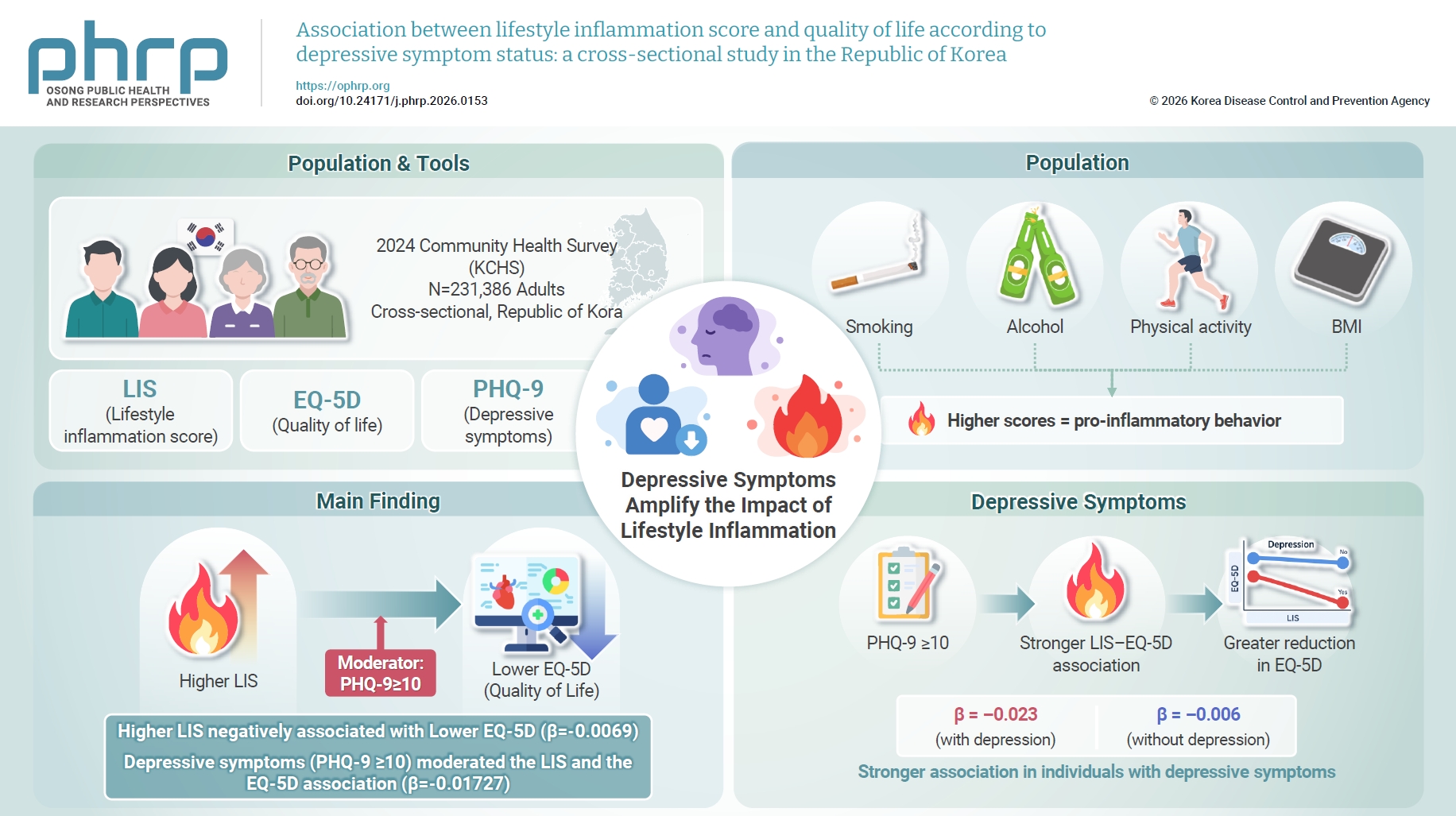
Objectives
This study examined the association between lifestyle inflammation score (LIS) and health-related quality of life, assessed using the EuroQol-5 Dimensions (EQ-5D) index, among adults in the Republic of Korea. It also evaluated whether depressive symptoms moderated this association. Methods: Data from the 2024 Community Health Survey were analyzed, and 231,386 adults were included. LIS was calculated by integrating smoking, alcohol consumption, physical activity, and body mass index. The dependent variable, quality of life, was assessed using the EQ-5D index. Depressive symptoms, the moderator variable, were assessed using the Patient Health Questionnaire-9, with a score of ≥10 indicating depressive symptoms. Data were analyzed using complex-sample multivariable linear regression to examine interaction effects according to depressive symptom status, followed by simple-slope analyses. Results: After adjustment for demographic and health-related variables, LIS was significantly and negatively associated with the EQ-5D index (β= –0.0069, p< 0.001), indicating that higher levels of inflammation-related lifestyle behaviors were associated with poorer quality of life. Depressive symptoms significantly moderated the association between LIS and the EQ5D index (β= –0.01727, p< 0.001). Simple-slope analyses showed that the adverse association between LIS and quality of life was stronger among individuals with depressive symptoms (β= –0.02349) than among those without depressive symptoms (β= –0.00621). Conclusion: Inflammation-related lifestyle behaviors were associated with reduced quality of life, and this negative association was stronger among individuals with depressive symptoms. These findings suggest that considering both lifestyle-related inflammatory burden and depressive symptoms may help explain population-level differences in quality of life.
  • 2,079 View
  • 37 Download
Child health problems and social determinants as predictors of postpartum depression: a cross-sectional study using 2023 Indonesia Health Survey data
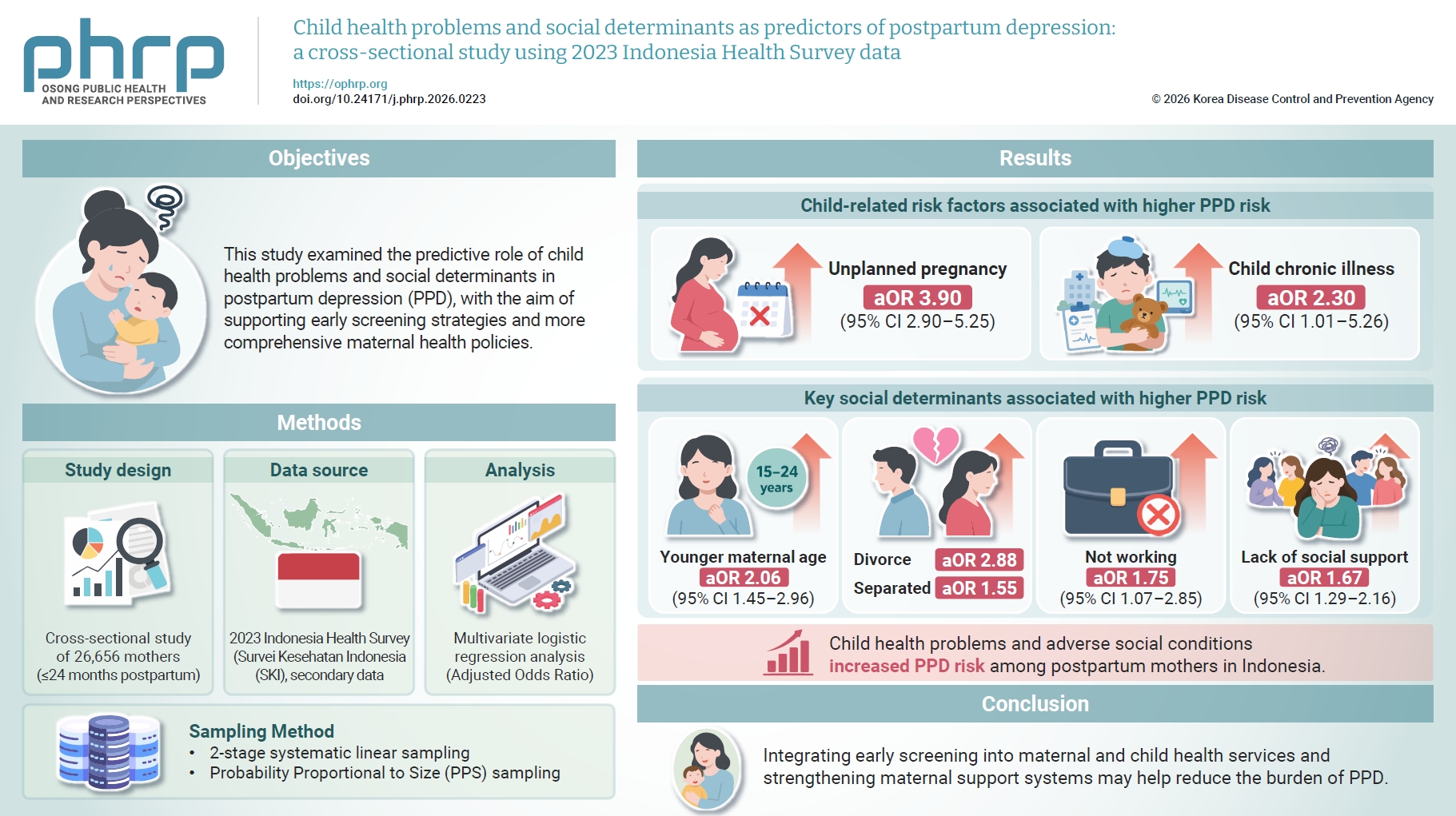
Objectives
This study examined the predictive role of child health problems and social determinants in postpartum depression (PPD), with the aim of supporting early screening strategies and more comprehensive maternal health policies. Methods: This cross-sectional study used secondary data from the 2023 Indonesia Health Survey, conducted by the Indonesian Ministry of Health. The analysis included 26,656 postpartum women aged at least 15 years who had given birth within the previous 24 months. PPD was assessed using the Mini International Neuropsychiatric Interview. Multiple logistic regression was used to analyze the data. Results: Child health problems were among the strongest factors associated with PPD in Indonesia. Having had an unplanned pregnancy was associated with higher odds of PPD (adjusted odds ratio [aOR], 3.90; 95% confidence interval [CI], 2.90–5.25; p < 0.001), as was having a child with chronic illness (aOR, 2.30; 95% CI, 1.01–5.26; p= 0.048). Social risk factors, including younger maternal age, divorce or separation from a partner, unemployment, and lack of social support, were also associated with PPD in Indonesia. Conclusion: Child health problems and adverse social conditions were significantly associated with postpartum mental health in Indonesia. Integrating early screening into maternal and child health services and strengthening maternal support systems may help reduce the burden of PPD.
  • 2,080 View
  • 101 Download
Modeling social and behavioral factors associated with community participation in community-based surveillance of communicable diseases: a cross-sectional study in Kelantan, Malaysia
Ahmed Azeez Hasan, Anis Kausar Ghazali, Norsa’adah Bachok, Najib Majdi Yaacob, Suhaily Mohd Hairon, Nur Amira Mohd Nadir, Fatimah Muhd Shukri
Osong Public Health Res Perspect 2026;17(3):229-241.
Published online May 11, 2026
DOI: https://doi.org/10.24171/j.phrp.2025.0447
Modeling social and behavioral factors associated with community participation in community-based surveillance of communicable diseases: a cross-sectional study in Kelantan, Malaysia
Objectives
This study examined the social and behavioral factors influencing community leaders’ participation in community-based surveillance (CBS) of infectious diseases. We hypothesized that knowledge, attitudes, and perceptions significantly predict the behavioral likelihood of engaging in CBS activities. Methods: A cross-sectional study was conducted among 470 schoolteachers in Kelantan, Malaysia, from March to June 2024. Participants were selected using multistage sampling, with random selection of schools followed by convenience sampling of teachers. Data were collected using the validated KAP-CBS-ID questionnaire, which was based on the Theory of Reasoned Action and Health Belief Model. Structural equation modeling was used to analyze relationships among the study variables with the maximum likelihood robust estimator. Results: The final model demonstrated good fit (comparative fit index, 0.921; standardized root mean square residual, 0.071; root mean square error of approximation, 0.040 [90% confidence interval, 0.036–0.044]). Ten significant path relationships were identified, explaining 46.1% of the variance in behavioral likelihood. Knowledge of infectious diseases (β=0.419, p<0.001), subjective norms (β=0.235, p=0.038), and negative attitudes (β=–0.432, p<0.001) significantly influenced intention. Behavioral likelihood was directly predicted by intention (β =0.347, p<0.001), perceived susceptibility (β=0.310, p<0.001), perceived benefits (β=0.198, p=0.001), and perceived barriers (β=–0.132, p=0.008). Self-efficacy showed significant indirect effects through perceived benefits (β=0.785, p<0.001) and perceived susceptibility (β=0.765, p<0.001). Conclusion: Knowledge and psychosocial factors significantly inf luence community engagement in CBS of infectious diseases. Public health interventions should address these interconnected determinants to strengthen early disease detection and reporting systems.
  • 1,425 View
  • 71 Download
Factor structure and measurement invariance of the EuroQol 5-dimensional questionnaire: a secondary analysis of the Korea Health Panel survey
Objectives
This study evaluated the EuroQol 5-dimensional questionnaire, 3-level version (EQ5D-3L), using Korea Health Panel (KHP) data by examining its factor structure, measurement invariance across gender and age groups, and longitudinal measurement invariance. Methods: Panel 1 data from the second survey year (2009), when the EQ-5D-3L was first introduced in the KHP, through the 12th year (2017) were analyzed, along with panel 2 data from 2019 to 2021. Confirmatory factor analysis and measurement invariance tests by gender and age groups were conducted within each period. Longitudinal measurement invariance was also evaluated for each period. Results: A 1-factor model demonstrated good fit for the EQ-5D-3L. In panel 1, full measurement invariance across gender and age groups was supported. In panel 2, partial invariance was achieved after relaxing constraints on item 5. Longitudinal measurement invariance was supported over 5- and 10-year intervals in panel 1 and over a 3-year interval in panel 2, indicating temporal stability of the measurement model. Conclusion: The EQ-5D-3L used in the KHP panel 1 and panel 2 datasets demonstrates a stable 1-factor structure and acceptable measurement invariance across key subgroups and over time. These findings support the use of the EQ-5D-3L as an appropriate instrument for assessing health-related quality of life among Korean adults and for longitudinal analyses within large-scale panel surveys.
  • 1,358 View
  • 37 Download

Brief Report

Current status of hepatitis C treatment and its barriers in Jeonbuk, Republic of Korea
Ji Hyeon Kang, You Jeong Moon, Ung-Gyu Kim, Jung-Im Park, Chang Hun Lee, In Hee Kim, Ju-Hyung Lee, Jin Gwack
Osong Public Health Res Perspect 2026;17(2):188-192.
Published online April 7, 2026
DOI: https://doi.org/10.24171/j.phrp.2025.0516
Current status of hepatitis C treatment and its barriers in Jeonbuk, Republic of Korea
Objectives
In alignment with the World Health Organization’s goal of eliminating hepatitis C, this study assessed the current treatment status and reasons for non-treatment among patients with hepatitis C in Jeonbuk State, Republic of Korea, to inform strategies for improving care engagement.
Methods
Among 311 individuals diagnosed with hepatitis C and reported through the National Notifiable Infectious Disease Surveillance system between January 2023 and June 2024, 208 patients were surveyed after excluding those who had died or could not be contacted. Statistical analyses included the chi-square test, the Cochran-Armitage test for trend, and logistic regression.
Results
Overall, 116 participants (55.8%) reported having received antiviral therapy. Among the 92 untreated individuals, the most common reason for non-treatment was the absence of symptoms (n=23; 25.0%), followed by the burden of drug costs (n=21; 22.8%).
Conclusion
These findings highlight suboptimal treatment uptake and key barriers that may hinder progress toward hepatitis C elimination. Expanding screening and strengthening linkage-to-care strategies, while addressing financial barriers, will be essential to achieving national elimination targets.
  • 1,755 View
  • 44 Download

Review Article

Collaborative networks, trends, and comparative analysis of artificial intelligence techniques in healthcare research: a narrative review
Objectives
Artificial intelligence (AI) is reshaping healthcare by improving diagnosis and treatment planning, increasing operational efficiency, and streamlining administrative workflows. This paper integrates findings from an extensive PubMed search (2015–2025) with bibliometric analysis using RStudio and VOSviewer to investigate the comparative applications of AI methods in healthcare, collaborative networks, and emerging trends.
Methods
A total of 1,243 records were identified through the PubMed search, and after removal of 143 duplicates, 1,100 records were screened. Following full-text assessment and exclusion of ineligible studies, 986 articles were included in the final bibliometric analysis.
Results
The main research areas included robotic-assisted surgery, predictive analytics, diagnostic imaging, and precision medicine, with particular emphasis on the prevalence of machine learning and deep learning in imaging and the increasing application of natural language processing to unstructured medical information.
Conclusion
The review emphasizes the need for greater budgetary allocation to scalable and pragmatic AI technologies and for interdisciplinary cooperation among researchers, industry, and healthcare providers. Despite this growth, challenges such as algorithmic bias, data integration, and ethical concerns persist. The paper also highlights the importance of equitable collaboration, accountable AI, and multinational partnerships in ensuring that AI can be used ethically and efficiently in healthcare over the long term to improve patient care and biomedical innovation. It does so by mapping international and regional trends, identifying the most influential authors, institutions, and funding sources, and evaluating methodological approaches.
  • 5,518 View
  • 71 Download

Original Articles

Barriers to treatment completion among drug-sensitive tuberculosis patients: evidence from Indonesia’s tuberculosis surveillance system
Mahalul Azam, Latifa Hanan, Muhammad Azinar, Amelia Fitra Khasanah, Arulita Ika Fibriana, Moch Yunus, Dewi Susanna, Martha Irene Kartasurya, Shabbir Syed-Abdul
Osong Public Health Res Perspect 2026;17(2):145-154.
Published online March 19, 2026
DOI: https://doi.org/10.24171/j.phrp.2025.0325
Barriers to treatment completion among drug-sensitive tuberculosis patients: evidence from Indonesia’s tuberculosis surveillance system
Objectives
This study aimed to estimate the prevalence of loss to follow-up (LTFU) among tuberculosis (TB) patients in Indonesia and to identify associated factors.
Methods
This study analyzed data from the 2022 Tuberculosis Information System in Indonesia. A total of 71,665 drug-sensitive TB patients were included in the analysis. Age, sex, employment status, diagnosis type, human immunodeficiency virus (HIV) status, diabetes mellitus, TB type, mode of treatment, treatment standard, referral status, and type of residence. Categorical variables were analyzed using chi-square tests, followed by multivariable logistic regression to identify confounder-adjusted independent predictors of LTFU.
Results
The prevalence of LTFU was 18.4%. A higher likelihood of LTFU was observed among older adults aged ≥65 years (adjusted-prevalence-odds-ratio [aPOR], 1.862), men (aPOR, 1.187), unemployed individuals (aPOR, 1.136), non-referred patients (aPOR, 1.547), patients with HIV (aPOR, 3.712), and those obtaining TB drugs out of pocket (aPOR, 4.998). The strongest predictor was receipt of non-standard treatment, which was associated with a markedly increased likelihood of LTFU (aPOR, 26.912). In contrast, rural residence demonstrated a protective association (aPOR, 0.610). All associations were statistically significant (p<0.001).
Conclusion
This study highlights a substantial burden of LTFU among TB patients in Indonesia, with nearly one in five patients discontinuing treatment. Multiple sociodemographic and clinical factors—particularly non-standard treatment, non-referral status, and HIV co-infection—were strongly associated with LTFU, underscoring gaps in the TB care continuum. These findings emphasize the need for targeted, patient-centered interventions, strengthened referral pathways, improved communication, and enhanced care coordination to reduce LTFU in high-risk groups.
  • 1,870 View
  • 125 Download
Correlates and co-occurrence of risk factors for non-communicable diseases among adolescents in schools in Karnataka, India: a cross-sectional study
Tejaswini Bangalore Darukaradhya, Krishnamurthy Jayanna, Shivaraj Nallur Somanna, Sony Sequeira, Shalini Chandrashekar Nooyi
Osong Public Health Res Perspect 2026;17(1):83-93.
Published online February 10, 2026
DOI: https://doi.org/10.24171/j.phrp.2025.0204
Correlates and co-occurrence of risk factors for non-communicable diseases among adolescents in schools in Karnataka, India: a cross-sectional study
Objectives
Non-communicable disease (NCD) risk among adolescents represents a growing concern due to modifiable, lifestyle-related behavioral risk factors. Early identification and control of these factors are essential for prevention. This study assessed the correlates and cooccurrence of NCD-related lifestyle risk factors among school-going adolescents in Karnataka, India, aiming to inform intervention development. Methods: Screening was conducted among 1,100 school adolescents aged 13–16 years from 8 randomly selected urban and rural schools in Karnataka. Data were collected using a validated self-administered questionnaire covering sociodemographic characteristics and social cognitive theory predictors of lifestyle practices. Descriptive statistics, chi-square tests, and logistic regression were employed. Results: Of the 1,100 adolescents surveyed, 552 and 548 were from urban and rural areas, respectively. Both groups reported high rates of insufficient fruit and vegetable (FV) intake (96.7% and 67.7%, respectively), inadequate physical activity (96.7% and 68.6%), tobacco use (5.6% and 11.5%), and alcohol consumption (5.6% and 10.8%). On logistic regression, urban adolescents were significantly more likely than rural peers to exhibit multiple behavioral risk factors, with 19-fold higher odds of having ≥1 factor (adjusted odds ratio [AOR], 19.04; p< 0.001) and 4-fold higher odds of having ≥2 (AOR, 4.06; p < 0.001). Parental (particularly maternal) education was associated with NCD risk (AOR, 1.82; p= 0.001). Physical inactivity significantly co-occurred with low FV intake (71.7%) and junk food consumption (72.8%). Conclusion: Unhealthy lifestyle behaviors among adolescents displayed significant cooccurrence, underscoring the critical need for comprehensive, theory-based school interventions to address multiple interconnected risk factors and mitigate the burden of NCDs.
  • 1,993 View
  • 107 Download

Review Article

Applying biotechnology to overcome cancer drug resistance and improve public health outcomes
Franklin Akwasi Adjei, Bernard Kwame Frempong, Augustine Afriyie
Osong Public Health Res Perspect 2026;17(1):4-16.
Published online February 4, 2026
DOI: https://doi.org/10.24171/j.phrp.2025.0336
Applying biotechnology to overcome cancer drug resistance and improve public health outcomes
This review examines how biotechnology advances (CRISPR/Cas9, next-generation targeted therapies, nanotechnology-based drug delivery, and immunotherapies) can be applied to address cancer drug resistance worldwide. It also considers the economic burden of resistance, inequities in access to biotechnology solutions, and ethical concerns surrounding rapid innovation, particularly in low-resource settings. A narrative review synthesized evidence from basic science studies, clinical trials, translational research, and policy analyses. Evidence was prioritized for 2015–2025 publications. The synthesis highlights resistance biology and evaluates how precision medicine, biomarker-guided treatment, and high-throughput drug screening can inform individualized regimens and rational combinations. Breakthroughs in gene editing, targeted inhibitors, nanocarriers, and immune engineering can counter key resistance mechanisms, including resistance-conferring mutations, altered drug transport, immune evasion, and tumor microenvironment–mediated protection. Despite progress, implementation barriers remain substantial: high drug and development costs, limited molecular diagnostics and manufacturing capacity, and regulatory and governance challenges that can delay adoption and widen disparities, particularly in low- and middle-income countries. Integrating biotechnology innovations within precision medicine frameworks may improve treatment selection and patient outcomes. Maximizing public health impact requires affordability and financing strategies, robust ethical oversight, timely regulatory pathways, and coordinated global collaboration to ensure access to effective therapies across health systems worldwide.
  • 3,316 View
  • 108 Download

Original Articles

Trends and risk factors for physical and psychological sequelae of induced abortion: a cross-sectional study of contemporary women in the Republic of Korea
Seung-Ah Choe, Juhyun Park, Eunsol Song, Eunja Park
Osong Public Health Res Perspect 2025;16(6):552-559.
Published online December 9, 2025
DOI: https://doi.org/10.24171/j.phrp.2025.0266
Trends and risk factors for physical and psychological sequelae of induced abortion: a cross-sectional study of contemporary women in the Republic of Korea
Objectives
This study aimed to examine trends and factors associated with severe physical and psychological consequences following induced abortion among women in the Republic of Korea.
Methods
An online survey was conducted of adolescent and adult Korean women aged 13 to 64 years, termed the 2022 Sex and Reproductive Health Survey. Respondents who reported a history of induced abortion were analyzed. Logistic regression models that accounted for individual risk factors were fitted to calculate adjusted odds ratios (aOR).
Results
The prevalence of induced abortion was 20.1% (914 of 4,552 respondents). The most frequent indications for abortion were social reasons, and across all periods, approximately half of the women or more reported non-medical challenges at the time of their most recent abortion. Severe physical and psychological sequelae after abortion increased 5-fold from 1980–1992 to 2013–2022. Among those whose most recent abortion occurred in 2003 or later, the risk of severe psychological sequelae was higher in 2013–2022, after the Korean Constitutional Court upheld the existing criminal codes, than in 2003–2012 (aOR, 2.31; 95% confidence interval, 1.09–4.91).
Conclusion
In the absence of institutionalized safe and respectful abortion services, severe physical and psychological sequelae among women who underwent induced abortion were more likely to occur. These findings highlight the importance of safe, affordable, nondiscriminatory, and respectful abortion care.
  • 3,574 View
  • 154 Download
The impact of digital literacy on older adults’ self-rated health, depression, and life satisfaction: a cross-sectional study using 2023 National Survey of Older Koreans
Objectives
This study examined the associations between digital literacy and self-rated health (SRH), depression, and life satisfaction among older adults in the Republic of Korea.
Methods
Data were obtained from the 2023 National Survey of Older Koreans (n=9,951). Digital literacy was evaluated based on participants’ ability to use 8 smartphone functions and their perceived difficulty adapting to a digital society. Dependent variables included SRH, depression (measured using the short form of Geriatric Depression Scale), and life satisfaction (assessed through a composite score across 7 domains). Multiple logistic regression was applied for SRH and depression, while linear regression was conducted for life satisfaction, adjusting for sociodemographic and health-related covariates.
Results
Higher digital literacy was significantly associated with better SRH and greater life satisfaction. Compared to participants with no digital skills, those with moderate or high digital literacy had higher odds of reporting good SRH and significantly higher life satisfaction scores. Older adults who reported difficulty adapting to a digital society demonstrated significantly lower SRH and life satisfaction. However, after adjusting for covariates, the association between digital literacy and depression was not statistically significant.
Conclusion
Higher digital literacy is linked to better SRH and greater life satisfaction. Moreover, digital literacy reduced the explanatory power of socioeconomic variables, suggesting that it serves as an important behavioral determinant. These findings underscore the importance of promoting digital literacy as a means of improving health equity and well-being in aging populations.

Citations

Citations to this article as recorded by  Crossref logo
  • The Effect of Digital Literacy on Depression Among Older Adults With Chronic Diseases: The Moderating Role of Self-Rated Health
    Hyein Seo, Subin Yu
    The International Journal of Aging and Human Devel.2026; 103(4): 480.     CrossRef
  • Digital device use and disparities in health literacy among older adults
    Heeran Chun, Cheong-Seok Kim, Il-Ho Kim
    Korean Journal of Health Education and Promotion.2026; 43(2): 87.     CrossRef
  • Impact of an Interaction-Oriented, Information and Communication Technology-Based Community Care Service on Nutritional Status and Dietary Behavior of Community-Dwelling Older Adults: A Quasi-Experimental Study
    Seojin Yun, Seulgi Lee, Eun Young Lee, Kirang Kim
    Preventive Nutrition and Food Science.2026;[Epub]     CrossRef
  • Predicting longitudinal depressive symptom trajectories among older Chinese adults with chronic health conditions: An interpretable machine learning study
    Zhan Yu, Anao Zhang, Kaipeng Wang, Qiuling An, Meiyan Chen, Yuting Wang, Zeqiang Wang
    International Psychogeriatrics.2026; : 100270.     CrossRef
  • Sustaining Social Connection in a Super-Aged Society: Changes in the Association Between Social Ties and Life Satisfaction Among Korean Older Adults, 2011–2023
    Seonmi Choi, Junghyun Kim
    Sustainability.2026; 18(18): 9449.     CrossRef
  • Digital Ageism and Ageism Among Middle-Aged and Older Adults and the Mediating Role of Expectations Regarding Aging: A Cross-Sectional Study
    Gahye Kim, Aeri Jung
    Research in Community and Public Health Nursing.2026; 37: 403.     CrossRef
  • Disaggregating Digital Competence: Social Activity Participation and Depressive Symptoms Among Korean Older Adults
    Young-Mi Jung, NakHyeok Choi
    Behavioral Sciences.2026; 16(10): 1742.     CrossRef
  • The impact of digitalisation on the development of physical activity of older people (through the example of European Union countries)
    Zhaxat Kenzhin, Tursynzada Kuangaliyeva, Assem Aitkaliyeva, Yerbol Myrzabossynov, Aigerim Zhunussova, Odiljon Dadabayev
    Frontiers in Public Health.2026;[Epub]     CrossRef
  • 3,977 View
  • 172 Download
  • 4 Web of Science
  • Crossref
Comparative effectiveness of construal-level messaging in the COVID-19 Vaccine Injury Compensation Program in the Republic of Korea: a randomized controlled trial
Jihyun Moon, Se-Hoon Jeong, Young June Choe, Cho Ryok Kang, Taemi Kim, Dooyoung Kim, Jong-Koo Lee
Osong Public Health Res Perspect 2025;16(5):486-497.
Published online September 12, 2025
DOI: https://doi.org/10.24171/j.phrp.2024.0354
Comparative effectiveness of construal-level messaging in the COVID-19 Vaccine Injury Compensation Program in the Republic of Korea: a randomized controlled trial
Objectives
This study aimed to assess the impact of high-level versus low-level construal messages about the coronavirus disease 2019 (COVID-19) Vaccine Injury Compensation Program (CVICP) on public attitudes toward the program and COVID-19 vaccination.
Methods
A randomized controlled experimental design was employed. Adults aged 18 to 64 residing in the Republic of Korea were randomly assigned to either an experimental group (high-level construal message) or a control group (low-level construal message). Both groups viewed a 2-minute video about the CVICP, with construal level as the sole variable. Pre- and post-intervention questionnaires evaluated attitudes toward the CVICP and COVID-19 vaccination, including satisfaction, perceived necessity, and perceived effectiveness in enhancing vaccine acceptance. Data were analyzed using the paired t-test, repeated measures 2-way analysis of variance, and multiple linear regression.
Results
The experimental group showed statistically significant improvements across all 6 attitude measures following exposure to the high-level construal message. By contrast, the control group demonstrated significant improvement in only 3 attitudes: satisfaction with the CVICP, willingness to recommend vaccination, and willingness for future vaccination. A significant difference between groups was observed for perceived effectiveness of the CVICP in enhancing vaccine acceptance (p=0.01), with high-level construal messaging being more impactful.
Conclusion
High-level construal messages are more effective than low-level messages in shaping public perceptions and addressing vaccine hesitancy. Policymakers and health authorities should incorporate high-level construal elements into communication strategies to build trust and support for vaccination programs.
  • 2,754 View
  • 53 Download
Assessment of healthcare workers’ knowledge and attitudes toward mpox and acceptance of its vaccine: a health belief model-based analysis in the Gulf region
Mona Gamal Mohamed, Eman Abdelaziz Ahmed Dabou, Fatma M. Ibrahim, Shaimaa Abdelsamad, Jibin Kunjavara, Kamaruddeen Mannethodi, Moayad Ahmad Wishah, Abdullah Y. Shihab, Khaled Mohammed Al-Sayaghi, Hammad Ali Fadlalmola, Mohammed Musaed Al-Jabri
Osong Public Health Res Perspect 2025;16(4):357-372.
Published online June 25, 2025
DOI: https://doi.org/10.24171/j.phrp.2025.0113
Assessment of healthcare workers’ knowledge and attitudes toward mpox and acceptance of its vaccine: a health belief model-based analysis in the Gulf region
Objectives
This study aimed to (1) assess healthcare workers’ (HCWs) knowledge and attitudes toward mpox across 3 Gulf countries, and (2) examine factors influencing their acceptance of the mpox vaccine using the health belief model (HBM). This model evaluated perceptions related to susceptibility, severity, benefits, barriers, cues to action, and self-efficacy. Additionally, the study explored the impact of prior coronavirus disease 2019 (COVID-19) vaccination history on mpox vaccine acceptance. Methods: A cross-sectional study was conducted among 764 HCWs from the United Arab Emirates (UAE), Saudi Arabia, and Qatar. Data were collected through a structured online questionnaire based on HBM constructs. Logistic regression and structural equation modeling were employed to analyze predictors of vaccine acceptance. Results: Knowledge levels varied across the countries, with the highest proportion of good knowledge reported in the UAE (59%). UAE HCWs also demonstrated higher perceived susceptibility, perceived benefits, and intention to vaccinate compared to those in Saudi Arabia and Qatar (p<0.001). Receiving 4 doses of the COVID-19 vaccine was associated with greater acceptance of the mpox vaccine. Among the HBM constructs, perceived benefits and self-efficacy were identified as the strongest predictors of vaccine acceptance. Perceived barriers, such as fear of side effects and concerns about vaccine safety, were more prominent among HCWs in Saudi Arabia and Qatar. Conclusion: The HBM effectively explains the factors influencing mpox vaccine acceptance among Gulf HCWs. Targeted interventions that improve perceived benefits, reduce barriers, and improve self-efficacy may facilitate greater vaccine uptake and preparedness for emerging infectious diseases.

Citations

Citations to this article as recorded by  Crossref logo
  • Determinants of Mpox vaccine uptake and hesitancy among healthcare workers in Port Harcourt, Nigeria
    Moore Ikechi Mike-Ogburia, Chiziyara Orluibna Obunwo, Elizabeth Efeelobari Letam, Ayebaemi Wilfred Dambo, Samuel Chima Agumagu, Tamunosaki Fubara-Manuel, Charles Henry Esukpa
    BMC Infectious Diseases.2026;[Epub]     CrossRef
  • Knowledge and attitudes toward mpox among the Lebanese population during the second wave and their attitudes toward vaccination
    Mohammad Tanashat, Nour Fakih, Nour El Bizri, Mohamed Saad Rakab, Mohamed Abouzid, Karen Sleiman, Hadi Hassan, Moetasem Al Sayed, Zahraa Zibara, Ahmad Afyouni, Pascale Salameh
    Scientific Reports.2026;[Epub]     CrossRef
  • Decoding Vaccine Hesitancy in Mpox Across Multiple Middle Eastern Countries: Public Knowledge, Attitudes, Worry, Conspiracy Beliefs, and Acceptance
    Mona Gamal Mohamed, Huda Mohamed Ali Rasheed, Manjula G. Bhagavathy, Moayad Ahmad Wishah, Dibbo Protim Ghosh, Md. Rabiul Islam, Ramya Kundayi Ravi
    Health Science Reports.2026;[Epub]     CrossRef
  • Mpox Awareness and Infection Control Practices Among Hospital Nurses and Healthcare Workers in Bangladesh
    Hemayet Hossain, Md. Abdur Nur Sakib, Mostafizor Rahman, Zerin Tasnim Romana, Md. Hasan Ali, Snigdha Sharmin Binte Sayeed, Khadiza Akter Brishty, Md. Shahidur Rahman Chowdhury, Md. Mahfujur Rahman
    Public Health Challenges.2026;[Epub]     CrossRef
  • Artificial intelligence and biohealth: the Republic of Korea’s emerging priorities in health care R&D
    Jong-Koo Lee
    Osong Public Health and Research Perspectives.2025; 16(4): 309.     CrossRef
  • Nursing Students’ Knowledge, Attitudes, and Practices Toward Monkeypox Virus: A Cross-Sectional Survey at the University of Palermo, 2022
    Barbara Ravazzolo, Francesco Leonforte, Letizia Cascio, Clara Ferrara, Federico Li Causi, Francesco Armetta, Maria Lampasona, Rinaldo Stefano Miceli, Carlo Fantini, Klara Komici, Alberto Firenze
    Zoonotic Diseases.2025; 6(1): 1.     CrossRef
  • 3,801 View
  • 145 Download
  • 6 Web of Science
  • Crossref
Analysis of influenza-like illness trends in Saudi Arabia: a comparative study of statistical and deep learning techniques
Fathelrhman EL Guma
Osong Public Health Res Perspect 2025;16(3):270-284.
Published online June 12, 2025
DOI: https://doi.org/10.24171/j.phrp.2025.0080
Analysis of influenza-like illness trends in Saudi Arabia: a comparative study of statistical and deep learning techniques
Objectives
To develop and evaluate forecasting models using the Holt-Winters statistical approach and the long short-term memory (LSTM) deep learning method for weekly seasonal influenza-like illness (ILI) incidences in Saudi Arabia. The study compares model performance and assesses the predictive value added by incorporating region-specific exogenous variables within Middle Eastern epidemiological modeling.
Methods
This study compared the performance of Holt-Winters and LSTM models in forecasting weekly ILI cases in Saudi Arabia, using data collected from 2017 to 2022. Time series analysis integrated exogenous variables including climatic conditions and population mobility trends. The Holt-Winters model employed both additive and multiplicative seasonal components. Model performance was evaluated using root mean squared error (RMSE), mean absolute percentage error, and R2.
Results
The best-performing model, LSTM with exogenous variables, achieved an RMSE of 28.55, mean absolute error (MAE) of 0.14, R2 of 0.96, and percent bias (PBIAS) of +2.1%, indicating negligible systematic error. The LSTM model without exogenous variables demonstrated slightly lower accuracy (RMSE of 34.07, MAE of 0.18, R2 of 0.93, PBIAS of +5.8%), indicating strong predictive capability but less precision in determining peak ILI cases. The Holt-Winters model effectively captured seasonal and long-term trends, but showed a moderate performance with an RMSE of 82.57, MAE of 0.38, R2 of 0.58, and a high PBIAS of +14.2%, revealing significant unexplained variability during periods of high incidence fluctuation.
Conclusion
This study highlights the respective strengths and limitations of statistical and machine learning approaches for ILI forecasting.

Citations

Citations to this article as recorded by  Crossref logo
  • Early-warning prediction of visceral leishmaniasis mortality using a multivariate STL–deep learning hybrid approach on 20 years of monthly time series
    Fathelrhman El Guma, Maaweya Awadalla, Halah Z. Al Rawi, Bashayer Saeed, Huda M. Alshanbari, Alshaikh A. Shokeralla, Bandar Alosaimi
    Frontiers in Public Health.2026;[Epub]     CrossRef
  • A hybrid STL–LightGBM framework with probabilistic forecasting for Influenza A incidence in the post-pandemic Saudi Arabia
    Reham M. Alahmadi, Maaweya Awadalla, Bashayer Saeed, Huda M. Alshanbari, Alshaikh A. Shokeralla, Ali Atif Yassin, Bandar Alosaimi, Fathelrhman El Guma
    Frontiers in Public Health.2026;[Epub]     CrossRef
  • Bayesian inference for modeling seasonal influenza transmission under control measures
    Rania Saadeh, Naseam Al-Kuleab, Fathelrhman EL Guma, Alshaikh A. Shokeralla, Suliman Jamiel M. Abdalla, Mohamed A. Abdoon, Mohamed Hafez
    Results in Control and Optimization.2026; 23: 100714.     CrossRef
  • Machine Learning-Based Prediction of Seasonal Influenza Trends in Saudi Arabia: A Tool for Regional Public Health Planning
    Alshaikh A. Shokeralla, Fathelrhman El Guma, Ali H. Abdalla, Amal E.Y. Hagsddig, Rahma AbuBakr Musa, M.A.M. Eltaweel, Abdelaziz H. Elawad, Ibrahim Elshamy
    International Journal of Statistics in Medical Res.2025; 14: 688.     CrossRef
  • 3,605 View
  • 93 Download
  • 4 Web of Science
  • Crossref

Data Profile

Synthetic data production for biomedical research
Yun Gyeong Lee, Mi-Sook Kwak, Jeong Eun Kim, Min Sun Kim, Dong Un No, Hee Youl Chai
Osong Public Health Res Perspect 2025;16(2):94-99.
Published online April 22, 2025
DOI: https://doi.org/10.24171/j.phrp.2024.0335
Synthetic data production for biomedical research
Synthetic data, generated using advanced artificial intelligence (AI) techniques, replicates the statistical properties of real-world datasets while excluding identifiable information. Although synthetic data does not consist of actual data points, it is derived from original datasets, thereby enabling analyses that yield results comparable to those obtained with real data. Synthetic datasets are evaluated based on their utility—a measure of how effectively they mirror real data for analytical purposes. This paper presents the generation of synthetic datasets through the Healthcare Big Data Showcase Project (2019–2023). The original dataset comprises comprehensive multi-omics data from 400 individuals, including cancer survivors, chronic disease patients, and healthy participants. Synthetic data facilitates efficient access and robust analyses, serving as a practical tool for research and education. It addresses privacy concerns, supports AI research, and provides a foundation for innovative applications across diverse fields, such as public health and precision medicine.

Citations

Citations to this article as recorded by  Crossref logo
  • MetaAcuPoint: MetaHuman-Generated Synthetic Data for Hand Acupoint Localization
    Kasunika Guruge, Prathiksha Padmanabha, H. M. K. K. M. B. Herath, Nuwan Madusanka, Hi-Joon Park, Chang-Su Na, Myunggi Yi, Byeong-il Lee
    Healthcare.2025; 13(23): 3093.     CrossRef
  • Synthetic data as a tool for prototyping early-stage periodontitis detection models
    Erdal Akin, Filip Kroon, Cassandra Windahl, Yutaka Sugihara, Aleksandar Milosavljevic, Magnus Falk
    Periodontal and Implant Research.2025;[Epub]     CrossRef
  • 3,929 View
  • 113 Download
  • Crossref

Short Communication

First report of human Mycobacterium bovis infection in a veterinary laboratory worker in the Republic of Korea
Ji-Yeon Lee, Seong Wook Pyo, Jieun Kim, Young-Joon Park
Osong Public Health Res Perspect 2025;16(3):292-299.
Published online April 16, 2025
DOI: https://doi.org/10.24171/j.phrp.2024.0343
First report of human Mycobacterium bovis infection in a veterinary laboratory worker in the Republic of Korea
Objectives
In the Republic of Korea, the previous surveillance system for zoonotic tuberculosis (TB) involved the X-ray testing of humans in contact with Mycobacterium bovis-infected livestock. In contrast, the updated surveillance system incorporates the genotyping of cultured Mycobacterium isolates for high-risk occupational groups. This study aimed to systematically document the detection, diagnosis, assessment, and response in the epidemic investigation of zoonotic TB in a laboratory worker in the Republic of Korea.
Methods
M. bovis was confirmed using spoligotyping and whole genome sequencing. Clinical characteristics were reviewed through epidemiological investigation and interviews with the affected individual. Transmission routes and secondary spread were assessed via field epidemiological investigations and contact evaluations using chest X-ray and interferon gamma release assay for latent TB infection.
Results
A 56-year-old laboratory worker presented with chest X-ray findings compatible with TB and subsequently tested positive for M. bovis. She had no clinical or family history of TB and remained asymptomatic. She completed a 6 month treatment regimen of isoniazid, rifampin, ethambutol, and pyrazinamide without hospitalization. Although no direct transmission pathways for zoonotic TB were identified, her work in a laboratory, processing specimens for zoonotic TB, indicated potential laboratory related exposure.
Conclusion
This case underscores the importance of stringent use of personal protective equipment among high-risk occupational groups and the implementation of an enhanced surveillance system to report zoonotic TB. These findings highlight the need for a One Health approach and proactive surveillance, emphasizing the necessity of refining and strengthening surveillance systems for precise monitoring and an effective response.

Citations

Citations to this article as recorded by  Crossref logo
  • Recombinant proteins expressed in Mycolicibacterium smegmatis enhance antibody-based detection of bovine tuberculosis
    Eomseob Jang, Kilhan Kwak, Norikazu Isoda, Kazuhiro Matsuo, Jeewan Thapa, Chie Nakajima, Yasuhiko Suzuki
    Veterinary Research.2026;[Epub]     CrossRef
  • 4,974 View
  • 199 Download
  • 1 Web of Science
  • Crossref

Original Articles

A comparison of health-related quality of life using the World Health Organization Quality of Life–BREF and 5-Level EuroQol-5 Dimensions in the Malaysian population
Andrian Liem, Hui Jun Chih, Vithya Velaithan, Richard Norman, Daniel Reidpath, Tin Tin Su
Osong Public Health Res Perspect 2025;16(2):126-140.
Published online March 31, 2025
DOI: https://doi.org/10.24171/j.phrp.2024.0076
A comparison of health-related quality of life using the World Health Organization Quality of Life–BREF and 5-Level EuroQol-5 Dimensions in the Malaysian population
Objectives
This study aimed to describe and compare health-related quality of life (QoL) as measured by the World Health Organization Quality of Life–BREF (WHOQoL-BREF) and the EuroQol-5 Dimensions (EQ-5D) among the Malaysian population, examining differences by sociodemographic characteristics including age, income, sex, ethnicity, educational level, and occupation. Methods: This cross-sectional study used data from 19,402 individuals collected as part of a health and demographic surveillance system survey conducted in the Segamat district of Malaysia in 2018–2019. Descriptive statistics and measures of central tendency were produced. Differences in QoL among demographic sub-groups were examined using the t-test and analysis of variance, while the correlations between the WHOQoL-BREF and EQ-5D were evaluated using Pearson correlation coefficients. Results: Based on complete case analysis (n=19,129), the average scores for the 4 WHOQoLBREF domains were 28.2 (physical), 24.1 (psychological), 12.0 (social relationships), and 30.4 (environment). The percentages of participants not in full health for each EQ-5D dimension were 12.8% (mobility), 3.1% (self-care), 6.9% (usual activities), 20.9% (pain/discomfort), and 6.8% (anxiety/depression). Correlations between the 4 WHOQoL-BREF domains and the 5 EQ-5D dimensions were relatively weak, ranging from –0.06 (social relationships with self-care and pain/discomfort; p<0.001) to –0.42 (physical with mobility; p<0.001). Conclusion: Although health-related QoL as measured by the WHOQoL-BREF and the EQ-5D are correlated, these 2 measures should not be considered interchangeable. The choice between them should be guided by the specific research questions and the intended use of the data.

Citations

Citations to this article as recorded by  Crossref logo
  • Promoting mental health among at-risk adolescents in Malaysia (MyHeRo): study protocol for a cluster randomised controlled trial to evaluate the effectiveness and cost-effectiveness of a school-based intervention compared with study skills condition for a
    Cecilia A. Essau, Suwaibah Zakaria, Chuong Hock Ting, Julia Ai Cheng Lee, Alejandro de la Torre-Luque, Alvin Lai Oon Ng, Hazreen Abdul Majid, Helen Dodd, Nik Daliana Nik Farid, Noor Azimah Muhammad, Suzaily Wahab
    Trials.2026;[Epub]     CrossRef
  • Sociodemographic, lifestyle and health factors associated with psychological health among adults in Malaysia: An ethnic comparison
    Yong Kang Cheah, Hamimatunnisa Johar, Tin Tin Su
    Archives of Psychiatric Nursing.2026; 61: 152081.     CrossRef
  • Validating cancer-specific and generic quality of life (QoL) instruments among patients with head and neck cancers: incorporating the European Organization for Research and Treatment of Cancer Quality of Life Questionnaire-Head and Neck Module with generi
    Mohsen Saffari, Tzu-Yen Chang, Musheer A. Aljaberi, Kah Ying Yap, An-Chi Li, Jung-Sheng Chen, Shi-Qing Wang, Mark D. Griffiths, Chung-Ying Lin
    Psicologia: Reflexão e Crítica.2026;[Epub]     CrossRef
  • AVALIAÇÃO INTEGRADA DO PERFIL SOCIODEMOGRÁFICO, ESTADO NUTRICIONAL, APTIDÃO FÍSICA E QUALIDADE DE VIDA DE IDOSOS ACOMPANHADOS NA ATENÇÃO PRIMÁRIA À SAÚDE
    Gustavo Bonfim Rocha, Luzia Vitória Sousa Brito, Maria Francidenes de Souza Melo, Edney Souto Pinto, Kathleen Nascimento Carvalho da Silva , Maryanne Marques de Sousa, Pedro Cicero de Sousa, Layza Karyne Farias Mendes, Aldaisa Pereira Lopes , Victor
    RECIMA21 - Revista Científica Multidisciplinar - .2026; 7(8): e788688.     CrossRef
  • A comparative analysis of structural equation modeling and traditional regression analysis in investigating factors affecting health-related quality of life in general Thai population
    Krittaphas Kangwanrattanakul, Apinya Ingard
    Health and Quality of Life Outcomes.2025;[Epub]     CrossRef
  • 5,444 View
  • 175 Download
  • 5 Web of Science
  • Crossref
Factors influencing satisfaction with medical services in medically underserved populations: an analytical cross-sectional study at a free medical clinic in the Republic of Korea
Joo Hyun Kim, Yeon Jeong Heo, Jae Bok Kwak, Samil Park, Curie Ahn, So Hee Ahn, Bumjo Oh, Jung Sik Lee, Jun Hyun Lee, Ho Young Lee
Osong Public Health Res Perspect 2025;16(2):181-191.
Published online March 17, 2025
DOI: https://doi.org/10.24171/j.phrp.2024.0325
Factors influencing satisfaction with medical services in medically underserved populations: an analytical cross-sectional study at a free medical clinic in the Republic of Korea
Objectives
This study aimed to explore factors influencing satisfaction with medical services among medically underserved populations at the free medical clinic, providing data to improve free medical services for these populations. Methods: We employed a descriptive correlational study design involving 112 individuals (aged 19 years and older) from medically underserved populations who visited the clinic. Data were collected through face-to-face surveys from September to October 2023, and statistical analyses (t-tests, analysis of variance, Pearson correlation, and hierarchical multiple regression) were used to identify key predictors of satisfaction. Results: Perceived support from healthcare providers emerged as the strongest predictor of satisfaction with medical services, demonstrating a significant positive association. While social support was positively correlated with perceived support from healthcare providers, it did not independently predict satisfaction. Conclusion: These findings underscore the importance of healthcare provider and social support in increasing satisfaction with medical services among medically underserved populations. Developing tailored healthcare programs and specialized healthcare provider training are essential strategies to improve healthcare access and outcomes for these vulnerable groups.

Citations

Citations to this article as recorded by  Crossref logo
  • How to enhance primary healthcare capacity? Evidence from Chinese provinces through a configurational lens
    Fang Wang, Yi Wang, Jiayi Yang, Liqing Li
    Frontiers in Public Health.2025;[Epub]     CrossRef
  • 4,260 View
  • 93 Download
  • 1 Web of Science
  • Crossref
SWOT strategy for future global health security: insights from Indonesia, Cambodia, Vietnam, Dominican Republic, Ghana, and the Republic of Korea using the World Health Organization International Health Regulations monitoring tool
Moonsoo Yoon, Nuha Fairusya, Thao Le Nhu Nguyen, Diomarys Ishaura Jimenez-Baez, Vichuta Prak, Osei Kuffour Afreh, Chaeshin Chu
Osong Public Health Res Perspect 2025;16(2):152-159.
Published online March 12, 2025
DOI: https://doi.org/10.24171/j.phrp.2024.0314
SWOT strategy for future global health security: insights from Indonesia, Cambodia, Vietnam, Dominican Republic, Ghana, and the Republic of Korea using the World Health Organization International Health Regulations monitoring tool
Objectives
The study aimed to analyze the core capacities to implement World Health Organization International Health Regulations (IHR) in 6 countries: Indonesia, Cambodia, Vietnam, the Dominican Republic, Ghana, and the Republic of Korea. Methods: Secondary data from relevant databases and reports, including the electronic State Party Self-Assessment Annual Reporting mechanism and global health security index, were used to assess health security in these countries. Descriptive statistics summarized the basic features of the scores, and a strengths, weaknesses, opportunities, and threats (SWOT) analysis was subsequently performed to identify factors affecting health security scores while highlighting key similarities and differences between countries. Results: Early warning and event management emerged as the primary strength in most countries. Common opportunities included international commitments and immunization programs. In contrast, many countries shared weaknesses related to the policy, legal, and normative frameworks for IHR implementation, as well as challenges in human resources, chemical event management, and radiation emergency preparedness. Recurring threats involved issues such as biosafety, biosecurity, dual-use research and the culture of responsible science, infection control practices, coordination between public health and security authorities, laboratory supply chain vulnerabilities, and communication with healthcare workers during public health emergencies. Conclusion: In order to counter future global health threats, countries should prioritize enhancing surveillance capacity (early warning and event management) as well as the immunization indicator (vaccination rates for human and animal diseases, including the national vaccine delivery system).

Citations

Citations to this article as recorded by  Crossref logo
  • Has the COVID-19 pandemic enhanced the capacity of rural public health emergency management? Evidence from Jiangsu Province of China
    Ming Cao, Yajing Zhang
    Frontiers in Public Health.2026;[Epub]     CrossRef
  • Building systems for preparedness: Global scoping studies on institutional governance and National Public Health Agencies
    Sileshi Demelash Sasie, Fantu Mamo Aragaw, Tigist Ali Gebeyehu, Sintayehu Abdella Shikur, Lensa Fekadu, Neima Zeynu Ali, Zenebech Mamo Argaw, Julia Robinson
    PLOS Global Public Health.2026; 6(2): e0005427.     CrossRef
  • Strengthening CBRN Preparedness through Military Medical Capabilities and Multisectoral Collaboration
    Moonsoo Yoon
    IGEE Proceedings.2026; 3(2): 89.     CrossRef
  • 5,951 View
  • 176 Download
  • 2 Web of Science
  • Crossref
Excess mortality in older adults and cumulative excess mortality across all ages during the COVID-19 pandemic in the 20 countries with the highest mortality rates worldwide
Chiranjib Chakraborty, Manojit Bhattacharya, Sang-Soo Lee
Osong Public Health Res Perspect 2025;16(1):42-58.
Published online February 13, 2025
DOI: https://doi.org/10.24171/j.phrp.2024.0186
Excess mortality in older adults and cumulative excess mortality across all ages during the COVID-19 pandemic in the 20 countries with the highest mortality rates worldwide
Objectives
Mortality statistics during the coronavirus disease 2019 (COVID-19) pandemic are crucial for the allocation of medical care resources and public health decision-making. This study was initiated to investigate the excess mortality among older adults during the pandemic. Our research focuses on 2 primary areas. First, we analyzed the cumulative excess mortality across all age groups to assess the global impact and specifically examined the top 20 countries with the highest mortality rates during the pandemic. Second, we explored excess deaths among older adults by categorizing data from the years 2020 and 2021 into age groups: 65–74, 75–84, and above 85.
Methods
We analyzed data from the top 20 countries with the highest mortality rates globally, focusing on 3 components: all-cause mortality means, expected deaths mean, and excess deaths mean for both older men and women.
Results
Although excess mortality is higher among older men and women across all 3 age groups (65–74, 75–84, and >85), the highest mean excess mortality was observed in women over the age of 85.
Conclusion
The results indicate that the severe acute respiratory syndrome coronavirus 2 virus had a disproportionately intense impact on older women. We developed 2 types of statistical models using the data: a binomial distribution model and a correlation coefficient model, both considering the mean excess deaths in older men and women across these 3 age groups. Estimating the excess mortality among older adults will aid in the formulation of healthcare policies for this demographic.

Citations

Citations to this article as recorded by  Crossref logo
  • Immunogenicity, reactogenicity, and safety to assess booster vaccinations with BNT162b2 or double-dose mRNA-1273 in adults ≥75 years (EU-COVAT-1-AGED)–final report
    Jannik Stemler, Lusine Yeghiazaryan, Christoph Stephan, Kristin Greve-Isdahl Mohn, Rebecca Jane Cox, Antonio Javier Carcas-Sansuan, Esperanza Romero Rodriguez, José Moltó, Itziar Vergara Mitxeltorena, Isabelle Pink, Tobias Welte, Birutė Zablockienė, Murat
    International Journal of Infectious Diseases.2026; 165: 108466.     CrossRef
  • Dynamics of changes in the quality of life and long-term care systems for older adults during the COVID-19 pandemic
    Vitalii Horovenko, Lenka Lachytová
    Health Problems of Civilization.2026;[Epub]     CrossRef
  • Reconstructing severe acute respiratory infection dynamics from ICD-10 hospital discharge data: a 10-year analysis of 11.2 million discharges in Ecuador, 2014–2023
    Jaime Angamarca-Iguago, Jaen Cagua-Ordónez, Juan Marcos Parise-Vasco, Natasha Bella Fuentes-Tumbaco, Mónica Escobar-Naranjo, Claudia Reytor-González, Daniel Simancas-Racines
    Frontiers in Public Health.2026;[Epub]     CrossRef
  • 9,051 View
  • 130 Download
  • 3 Web of Science
  • Crossref
Assessment of brucellosis-causing pathogens with an emphasis on the prevalence of Brucella melitensis in the Republic of Korea: insights from a decade of pathogen surveillance (2014–2023), a retrospective study
In-Sook Shin, Su-Gwon Roh, Byoung-Chul Gill, Young-Suk Kim, Kyung-Won Hwang
Osong Public Health Res Perspect 2024;15(6):489-496.
Published online November 19, 2024
DOI: https://doi.org/10.24171/j.phrp.2024.0134
Assessment of brucellosis-causing pathogens with an emphasis on the prevalence of Brucella melitensis in the Republic of Korea: insights from a decade of pathogen surveillance (2014–2023), a retrospective study
Objectives
The main Brucella species causing human infections in the Republic of Korea is Brucella abortus, which uses cattle as its host. However, since 2014, Brucella melitensis, which uses sheep and goats as hosts, has also been identified. This study investigated whether a shift has occurred in the predominant species of Brucella pathogens.
Methods
Brucellosis is a class 3 infectious disease requiring mandatory reporting and registration in the Korea Disease Control and Prevention Agency’s infectious disease surveillance system (http://is.kdca.go.kr). Cases from 2014 to 2023 were studied, and whole-genome sequencing analysis was conducted using BruMLSA21.
Results
Out of 51 patients, males (45 patients, 88.2%) were predominantly affected. Twenty-five patients (49%) came from the livestock industry, and within the livestock sector group, the route of infection occurred exclusively through contact (25/25, 100%), whereas in other occupations, it was split between contact (9/26 patients, 34.6%) and ingestion (8/26 patients, 30.8%). Among the 31 patients who underwent Brucella culture tests, B. melitensis was found to be more prevalent than B. abortus (14 patients, 45.2% vs. 11 patients, 35.5%). In all cases where B. melitensis was isolated, the infections were of foreign origin, consistent with the results of BruMLSA21.
Conclusion
Regular monitoring of the causative agent of brucellosis is necessary due to its varying host preferences and antibiotic resistance. Furthermore, given the increasing prevalence of B. melitensis worldwide, changes in dietary habits (e.g., increased lamb consumption), and the increase in foreign workers and Chinese immigrants, a multi-ministerial One Health response will be required.

Citations

Citations to this article as recorded by  Crossref logo
  • Peculiarities of Brucellosis Spread in Urban and Rural Areas of Jalal-Abad Region, Kyrgyz Republic
    Zholdoshev Saparbai Tezekbayevich, Temirov Nemat Moydunovich, Akzholtoeva Aizharkyn Akzholtoevna, Tashieva Gulbara Samidinovna, Sorombaeva Nadira Orozbekovna, Akhunbaeva Tattygul Raimzhanovna, Ali Munir Mirza
    World Journal of Environmental Biosciences.2026; 15(1): 8.     CrossRef
  • Epidemiology and zoonotic impact of brucellosis in ruminants from a one health perspective
    Arslan Khan Barozai Barozai, Rana Dawood Naseer, Ehsanullah ., Hafiz Mohammed Hamayun, Mahnoor Farrukh, Kashif Iqbal
    Forensic Insights and Health Sciences Bulletin.2026; : 69.     CrossRef
  • First report of a Brucella inopinata-like atypical Brucella strain isolated from a waxy monkey treefrog (Phyllomedusa bicolor) in the Republic of Korea: Case Report
    Myeongsu Kim, Zun Zun Wut Hmohn, Jae-Ik Han
    Frontiers in Veterinary Science.2026;[Epub]     CrossRef
  • Senility, defecation disorders, sleep disorders, and non-operative spinal infections: A single-center retrospective analysis
    Ling-Ling Guo, Hong-Kun Liu, Jin-Feng Cao, Hai-Xia Zhang, Bo Li, Tong Li, Liang Li
    World Journal of Orthopedics.2025;[Epub]     CrossRef
  • Unraveling brucellosis: advances in pathogenesis, diagnostic strategies, therapeutic innovations, and public health perspectives
    Abdulaziz M. Almuzaini, Ayman Elbehiry
    Frontiers in Medicine.2025;[Epub]     CrossRef
  • BRUCELLA ENFEKSİYONLARI VE ERADİKASYON
    Zübeyde Arslan
    Veteriner Farmakoloji ve Toksikoloji Derneği Bülte.2025; 16(3): 95.     CrossRef
  • 5,165 View
  • 130 Download
  • 3 Web of Science
  • Crossref
Associations of type and intensity of social participation with depression, self-rated health, and life satisfaction among community-dwelling older adults in the Republic of Korea: a nationwide cross-sectional study
Objectives
Social activities are important and influential factors for healthy aging. However, limited information is available regarding the associations of the type and intensity of social participation with health and well-being. This study aimed to investigate how various types of social activities are associated with several dimensions of health outcomes. Methods: This cross-sectional study utilized data from the Seventh Korean Longitudinal Study of Aging, which included 5,526 adults aged 60 years and older. Multivariate linear regression analysis was employed to analyze the associations of social activities with depression, self-rated health, and life satisfaction. Additionally, subgroup analyses by sex and age were performed. Results: Among the participants, 73.5% reported involvement in at least 1 of the 4 types of social engagement. After adjustment for all covariates, individuals who participated in any social activity reported better self-rated health and higher life satisfaction compared to those who did not participate. However, the intensity of engagement in different social activities had varying impacts on subjective health outcomes. An increased level of participation was associated with a lower rate of depression and improved self-rated health. However, no significant differences were observed in the relationship between the intensity of participation in activities (with the exception of alumni societies or family councils) and life satisfaction. Conclusion: This study suggests that to improve their health, older adults in the Republic of Korea should not only engage in social activities but also do so actively and regularly.

Citations

Citations to this article as recorded by  Crossref logo
  • Impact of Depression on Self-Rated Health Status among Community-Dwelling Older Adults: Moderating Effects of Subjective Social Status and Formal Social Participation Using Data from the Ninth Korean Longitudinal Study of Aging (2022)
    Sohee Jung, Eunhee Yang, Soyoung Cha, Wonhee Baek
    Journal of Fundamental Nursing Science.2026; 33(1): 147.     CrossRef
  • Disaggregating Digital Competence: Social Activity Participation and Depressive Symptoms Among Korean Older Adults
    Young-Mi Jung, NakHyeok Choi
    Behavioral Sciences.2026; 16(10): 1742.     CrossRef
  • Gender differences in advanced activities of daily living: evidence from the longitudinal study of health and aging in Mexico 2012–2018
    Martha A. Sánchez-Rodríguez, Mariano Zacarías-Flores, Lesly Estefanía Castañeda-Sánchez, Víctor Manuel Mendoza-Núñez
    Frontiers in Aging.2025;[Epub]     CrossRef
  • The Associations Between Physical Activity, Body Perception, and Self-Rated Health in Korean Adults: An Analysis of the 2023 Korean Community Health Survey
    Geun-Kook Kim, Su-Yeon Roh, Sung-Ho Hwang
    Medicina.2025; 61(11): 1898.     CrossRef
  • 6,354 View
  • 135 Download
  • 2 Web of Science
  • Crossref
Periodontitis and non-communicable diseases in a Brazilian population, a cross-sectional study, Vila Velha-ES, Brazil
Gustavo Vital de Mendonça, Crispim Cerutti Junior, Alfredo Carlos Rodrigues Feitosa, Brígida Franco Sampaio de Mendonça, Lucia Helena Sagrillo Pimassoni
Osong Public Health Res Perspect 2024;15(3):212-220.
Published online June 27, 2024
DOI: https://doi.org/10.24171/j.phrp.2024.0021
Periodontitis and non-communicable diseases in a Brazilian population, a cross-sectional study, Vila Velha-ES, Brazil
Objectives
The objective of this study was to examine the hypothesis that periodontal disease is associated with chronic non-communicable diseases. Methods: In this cross-sectional study, we evaluated the periodontal health condition of the population, based on the community periodontal index, as well as the number of missing teeth and the presence of systemic health conditions. We quantified the association between oral health and the presence of chronic diseases using simple logistic regression, adjusting for confounding factors including age, smoking, and overweight. Results: The study population consisted of 334 volunteers, aged between 19 and 81 years. In patients over 45 years old, periodontal disease was found to be significantly associated with hypertension and diabetes. Furthermore, in female patients, periodontal disease was significantly associated with hypertension, diabetes, and cancer. Conclusion: Our findings indicate that periodontal disease is positively and significantly associated with both arterial hypertension and diabetes, independent of potential confounding factors.

Citations

Citations to this article as recorded by  Crossref logo
  • Comparative Antimicrobial and Antibiofilm Activity of Antiseptics and Commercial Mouthwashes Against Porphyromonas gingivalis ATCC 33277
    Marzena Korbecka-Paczkowska, Tomasz M. Karpiński, Marcin Ożarowski
    Journal of Clinical Medicine.2025; 14(24): 8909.     CrossRef
  • 5,376 View
  • 99 Download
  • 1 Web of Science
  • Crossref

Data Profile

Establishment of a registry of clinical data and bioresources for rare nervous system diseases
Dayoung Kim, Sooyoung Kim, Jin Myoung Seok, Kyong Jin Shin, Eungseok Oh, Mi Young Jeon, Joungkyu Park, Hee Jin Chang, Jinyoung Youn, Jeeyoung Oh, Eunhee Sohn, Jinse Park, Jin Whan Cho, Byoung Joon Kim
Osong Public Health Res Perspect 2024;15(2):174-181.
Published online April 30, 2024
DOI: https://doi.org/10.24171/j.phrp.2023.0353
Establishment of a registry of clinical data and bioresources for rare nervous system diseases
Rare diseases are predominantly genetic or inherited, and patients with these conditions frequently exhibit neurological symptoms. Diagnosing and treating many rare diseases is a complex challenge, and their low prevalence complicates the performance of research, which in turn hinders the advancement of therapeutic options. One strategy to address this issue is the creation of national or international registries for rare diseases, which can help researchers monitor and investigate their natural progression. In the Republic of Korea, we established a registry across 5 centers that focuses on 3 rare diseases, all of which are characterized by gait disturbances resulting from motor system dysfunction. The registry will collect clinical information and human bioresources from patients with amyotrophic lateral sclerosis, spinocerebellar ataxia, and hereditary spastic paraplegia. These resources will be stored at ICreaT and the National Biobank of Korea. Once the registry is complete, the data will be made publicly available for further research. Through this registry, our research team is dedicated to identifying genetic variants that are specific to Korean patients, uncovering biomarkers that show a strong correlation with clinical symptoms, and leveraging this information for early diagnosis and the development of treatments.
  • 6,630 View
  • 114 Download

Original Articles

Factors associated with the timely diagnosis of malaria and the utilization of types of healthcare facilities: a retrospective study in the Republic of Korea
HyunJung Kim, Sangwoo Tak, So-dam Lee, Seongwoo Park, Kyungwon Hwang
Osong Public Health Res Perspect 2024;15(2):159-167.
Published online April 16, 2024
DOI: https://doi.org/10.24171/j.phrp.2023.0349
Factors associated with the timely diagnosis of malaria and the utilization of types of healthcare facilities:  a retrospective study in the Republic of Korea
Objectives
This study aimed to analyze trends in the timely diagnosis of malaria cases over the past 10 years in relation to the utilization of different types of healthcare facilities. Methods: The study included 3,697 confirmed and suspected cases of malaria reported between January 1, 2013, and December 31, 2022, in the national integrative disease and healthcare management system. Some cases lacking a case report or with information missing from the case report were excluded from the analysis. A generalized linear model with a Poisson distribution was constructed to estimate risk ratios and 95% confidence intervals adjusted for other variables, such as distance. Results: When cases involving diagnosis >5 days after symptom onset in confirmed patients (5DD) were examined according to the type of healthcare facility, the risk ratio of 5DD cases was found to be higher for tertiary hospitals than for public health facilities. Specifically, the risk ratio was higher when the diagnosis was established at a tertiary hospital, even after a participant had visited primary or secondary hospitals. In an analysis adjusted for the distance to each participant’s healthcare facility, the results did not differ substantially from the results of the crude analysis. Conclusion: It is imperative to improve the diagnostic capabilities of public facilities and raise awareness of malaria at primary healthcare facilities for effective prevention and control.
  • 3,794 View
  • 110 Download
Impact of long COVID-19 on posttraumatic stress disorder as modified by health literacy: an observational study in Vietnam
Han Thi Vo, Tien Duc Dao, Tuyen Van Duong, Tan Thanh Nguyen, Binh Nhu Do, Tinh Xuan Do, Khue Minh Pham, Vinh Hai Vu, Linh Van Pham, Lien Thi Hong Nguyen, Lan Thi Huong Le, Hoang Cong Nguyen, Nga Hoang Dang, Trung Huu Nguyen, Anh The Nguyen, Hoan Van Nguyen, Phuoc Ba Nguyen, Hoai Thi Thanh Nguyen, Thu Thi Minh Pham, Thuy Thi Le, Thao Thi Phuong Nguyen, Cuong Quoc Tran, Kien Trung Nguyen
Osong Public Health Res Perspect 2024;15(1):33-44.
Published online February 19, 2024
DOI: https://doi.org/10.24171/j.phrp.2023.0261
Impact of long COVID-19 on posttraumatic stress disorder as modified by health literacy: an observational study in Vietnam
Objectives
The prevalence of posttraumatic stress disorder (PTSD) has increased, particularly among individuals who have recovered from coronavirus disease 2019 (COVID-19) infection. Health literacy is considered a “social vaccine” that helps people respond effectively to the pandemic. We aimed to investigate the association between long COVID-19 and PTSD, and to examine the modifying role of health literacy in this association. Methods: A cross-sectional study was conducted at 18 hospitals and health centers in Vietnam from December 2021 to October 2022. We recruited 4,463 individuals who had recovered from COVID-19 infection for at least 4 weeks. Participants provided information about their sociodemographics, clinical parameters, health-related behaviors, health literacy (using the 12-item short-form health literacy scale), long COVID-19 symptoms and PTSD (Impact Event Scale-Revised score of 33 or higher). Logistic regression models were used to examine associations and interactions. Results: Out of the study sample, 55.9% had long COVID-19 symptoms, and 49.6% had PTSD. Individuals with long COVID-19 symptoms had a higher likelihood of PTSD (odds ratio [OR], 1.86; 95% confidence interval [CI], 1.63–2.12; p<0.001). Higher health literacy was associated with a lower likelihood of PTSD (OR, 0.98; 95% CI, 0.97–0.99; p=0.001). Compared to those without long COVID-19 symptoms and the lowest health literacy score, those with long COVID-19 symptoms and a 1-point health literacy increment had a 3% lower likelihood of PTSD (OR, 0.97; 95% CI, 0.96–0.99; p=0.001). Conclusion: Health literacy was found to be a protective factor against PTSD and modified the negative impact of long COVID-19 symptoms on PTSD.

Citations

Citations to this article as recorded by  Crossref logo
  • Prospective association between long COVID and COVID-related post-traumatic stress disorder among a population-based cohort of adults diagnosed with COVID-19 in Michigan
    Akash Patel, Soomin Ryu, Blair Whittington, Christine Chyu, Emma Chrzanowski, Sameera Ahmed, Elizabeth Slocum, Nancy L. Fleischer
    Journal of Affective Disorders.2026; 410: 122009.     CrossRef
  • Psychiatric symptoms of long COVID among adults: observational case–control study in Johannesburg, South Africa
    Andrew Wooyoung Kim, Someleze Swana, Simiso Sokhela, Samanta Lalla-Edward, Ncomeka Manentsa, Alexander C. Tsai, W. D. Francois Venter
    BJPsych Open.2026;[Epub]     CrossRef
  • Mental health and post-traumatic stress among unprivileged people in the aftermath of COVID-19 pandemic in Southwest Bangladesh: a cross-sectional study
    Md. Salauddin Khan, Maliha Mahazabin, Ishita Shahid Sams, Lasker Ershad Ali, Umama Khan
    Cogent Mental Health.2025;[Epub]     CrossRef
  • Exploring the psychological impact of long COVID: symptoms, mechanisms, and treatments
    Shi Shen, Xin Zhao, Jianxin Pei, Bijue Wang, Jingjing Hou, Ru Chai, Yiqiong Guo, Feiyu Li, Jian Hao, Zhonglan Wu
    Frontiers in Psychiatry.2025;[Epub]     CrossRef
  • Pathophysiological, Neuropsychological, and Psychosocial Influences on Neurological and Neuropsychiatric Symptoms of Post-Acute COVID-19 Syndrome: Impacts on Recovery and Symptom Persistence
    Alex Malioukis, R Sterling Snead, Julia Marczika, Radha Ambalavanan
    Biomedicines.2024; 12(12): 2831.     CrossRef
  • 8,013 View
  • 149 Download
  • 4 Web of Science
  • Crossref

Commentary

Activities of the Republic of Korea in the Global Health Security Agenda
Gang Lip Kim, Sookhyun Lee, So Yoon Kim
Osong Public Health Res Perspect 2024;15(1):90-93.
Published online February 19, 2024
DOI: https://doi.org/10.24171/j.phrp.2023.0157
Activities of the Republic of Korea in the Global Health Security Agenda

Citations

Citations to this article as recorded by  Crossref logo
  • Effect of the establishment of the Korea Centers for Disease Control and Prevention/Korea Disease Control and Prevention Agency from the perspective of global health security
    Chaeshin Chu
    Global Health & Medicine.2025; 7(2): 141.     CrossRef
  • 4,550 View
  • 207 Download
  • 1 Web of Science
  • Crossref

Original Articles

The effect of the COVID-19 pandemic on the trends and characteristics of natural and unnatural deaths in an urban Sri Lankan cohort viewed through retrospective analysis of forensic death investigations from 2019 to 2022
Sameera Anuruddha Gunawardena, Nishani Dassanayake, Buddhika Indeewarie Keerawelle, Shivasankarie Kanthasamy, Hasini Ranganatha, Jayani Wathsala Gunawardana
Osong Public Health Res Perspect 2023;14(6):468-482.
Published online November 23, 2023
DOI: https://doi.org/10.24171/j.phrp.2023.0175
The effect of the COVID-19 pandemic on the trends and characteristics of natural and unnatural deaths in an urban Sri Lankan cohort viewed through retrospective analysis of forensic death investigations from 2019 to 2022
Objectives
The coronavirus disease 2019 (COVID-19) pandemic has had a severe impact on global health. Apart from the disease itself, the strict restrictions and lockdowns enforced to minimize its spread have also substantially disrupted personal and public health. Methods: An analysis of forensic autopsy investigations was conducted between 2019 and 2022 on a selected urban population in Colombo, Sri Lanka, assessing the effects of the COVID-19 pandemic on mortality within these communities. Results: During the COVID-19 restrictions, there was a 2.5-fold increase in the total number of deaths, with a significantly higher percentage of female deaths than before. The majority of these deaths were due to cardiovascular causes, while COVID-19-related deaths ranked third overall. The highest proportion of COVID-19 deaths occurred among unvaccinated females. The monthly frequency of deaths from traffic accidents, poisoning, and asphyxiation decreased, while deaths from blunt trauma, sharp trauma, burns, and immersion increased. There was also a rise in blunt homicides and a greater number of femicides during the COVID-19 restrictions than in the pre-pandemic period. A significantly higher percentage of males who received the COVID-19 vaccine died from cardiovascular causes compared to those in the unvaccinated group. Conclusion: The significant changes in mortality demographics and causes of death within this community during the COVID-19 restrictions underscore the disruption in healthcare, healthseeking behavior, and social interactions during this period. The vulnerability of individuals residing in highly urbanized areas with lower socioeconomic status, particularly women, is brought into sharp focus.

Citations

Citations to this article as recorded by  Crossref logo
  • The impact of the COVID-19 pandemic on forensic pathology services in Limpopo province, South Africa
    Thakadu A. Mamashela, Samuel T. Ntuli
    South African Family Practice.2025;[Epub]     CrossRef
  • A nationwide forensic case-series of femicides in Italy – Part 1: Clues to the motives of the murder
    Rossana Cecchi, Anna Laura Santunione, Jessika Camatti, Alice Buzzelli, Alessandra De Martina, Alessandra Sannella, Marco Vinceti, Graziamaria Corbi, Carlo Pietro Campobasso, Matilde Sassani, Giovanna Laura De Fazio, Paolo Fais, Susi Pelotti, Arianna Gior
    Legal Medicine.2025; 78: 102703.     CrossRef
  • 6,860 View
  • 83 Download
  • 2 Web of Science
  • Crossref
Factors affecting depression and health-related quality of life in the elderly during the COVID-19 pandemic
Deok-Ju Kim
Osong Public Health Res Perspect 2023;14(6):520-529.
Published online November 16, 2023
DOI: https://doi.org/10.24171/j.phrp.2023.0166
Factors affecting depression and health-related quality of life in the elderly during the COVID-19 pandemic
Objectives
This study investigated changes in the health behaviors of the elderly due to coronavirus disease 2019 (COVID-19), concerns due to COVID-19, depression, and healthrelated quality of life (HRQOL), and aimed to identify factors that affect depression and HRQOL in the elderly. Methods: This study was conducted using data from the 2021 Community Health Survey of the Korea Disease Control and Prevention Agency. From a total sample size of 229,242 individuals, 74,376 elderly people aged 65 or older were selected as subjects, and changes in health behaviors, concerns due to COVID-19, depression, and HRQOL were measured and analyzed. Results: The level of depression associated with sleep and fatigue was high. The lowest HRQOL was related to physical pain and discomfort, while the most common concerns were related to economic difficulties. Factors influencing depression included worries about infection and economic harm, while factors impacting HRQOL encompassed concerns about infection, economic harm, and criticism from others. Conclusion: If an infectious disease situation such as COVID-19 reoccurs in the future, it will be necessary to encourage participation in hybrid online and offline programs at senior welfare centers. This should also extend to community counseling institutions like mental health welfare centers. Additionally, establishing connections with stable senior job projects can help to mitigate the effects of social interaction restrictions, physical and psychological health issues, and economic difficulties experienced by the elderly.

Citations

Citations to this article as recorded by  Crossref logo
  • A comparison of health-related quality of life using the World Health Organization Quality of Life–BREF and 5-Level EuroQol-5 Dimensions in the Malaysian population
    Andrian Liem, Hui Jun Chih, Vithya Velaithan, Richard Norman, Daniel Reidpath, Tin Tin Su
    Osong Public Health and Research Perspectives.2025; 16(2): 126.     CrossRef
  • The impact of urban agglomeration planning on depression in older adults
    Ya Liu, Li Yan, Yujue Wang, Xiaotang Tang, Ming Gao, Jiayu Yang, Zuoyan Liu, Xiuying Hu
    Frontiers in Public Health.2024;[Epub]     CrossRef
  • 5,136 View
  • 110 Download
  • 2 Web of Science
  • Crossref

Short Communications

Perceptions of older adults and generativity among older citizens in Japan: a descriptive cross-sectional study
Yuho Shimizu, Tomoya Takahashi, Kenichiro Sato, Susumu Ogawa, Daisuke Cho, Yoshifumi Takahashi, Daichi Yamashiro, Yan Li, Keigo Hinakura, Ai Iizuka, Tomoki Furuya, Hiroyuki Suzuki
Osong Public Health Res Perspect 2023;14(5):427-432.
Published online October 10, 2023
DOI: https://doi.org/10.24171/j.phrp.2023.0063
Perceptions of older adults and generativity among older citizens in Japan: a descriptive cross-sectional study
Objectives
As the population ages worldwide, including in Japan, there is a growing expectation for older adults to remain active participants in society. The act of sharing one’s experiences and knowledge with younger generations through social engagement not only enriches the lives of older individuals, but also holds significant value for our society. In this study, we examined both positive and negative perceptions of older adults and investigated the correlation between these perceptions and generativity among older citizens. Additionally, we evaluated the impact of life satisfaction on these factors. Methods: We conducted a survey of 100 older adults in Japan (mean age, 71.68 years) and utilized multiple regression analyses, using positive and negative perceptions of older adults, life satisfaction, and demographic factors as independent variables. The sub-categories of generativity—namely, generative action, concern, and accomplishment—were used as dependent variables. Results: Participants who held a more positive perception of older adults demonstrated a higher level of generative actions and concerns. Additionally, participants who reported higher levels of life satisfaction also exhibited more generative actions, concerns, and accomplishments. Conversely, those who held a more negative perception of older adults were found to have higher levels of generative actions. Conclusion: Enhancing positive perceptions of older adults among them can boost the sub-categories of generativity. This study, which was conducted from an exploratory perspective, has several limitations, including a potential sampling bias. A more comprehensive examination of the relationship between perceptions of older adults and generativity is anticipated in future research.

Citations

Citations to this article as recorded by  Crossref logo
  • How ageism may constrain generativity in later life: Introducing the ageism–generativity pathways model
    Yuho Shimizu
    Educational Gerontology.2026; : 1.     CrossRef
  • Revision and Reliability-Validity Test of the Loyola Generativity Scale (LGS) in Chinese Elderly
    义鑫 张
    Advances in Psychology.2025; 15(02): 123.     CrossRef
  • 6,331 View
  • 129 Download
  • 1 Web of Science
  • Crossref
Epidemiological characteristics of carbapenemase-producing Enterobacteriaceae outbreaks in the Republic of Korea between 2017 and 2022
Hyoseon Jeong, Junghee Hyun, Yeon-Kyeng Lee
Osong Public Health Res Perspect 2023;14(4):312-320.
Published online August 21, 2023
DOI: https://doi.org/10.24171/j.phrp.2023.0069
Epidemiological characteristics of carbapenemase-producing Enterobacteriaceae outbreaks in the Republic of Korea between 2017 and 2022
Objectives
We aimed to describe the epidemiological characteristics of carbapenemase-producing Enterobacteriaceae (CPE) outbreaks in healthcare settings in the Republic of Korea between 2017 and 2022.
Methods
Under the national notifiable disease surveillance system, we obtained annual descriptive statistics regarding the isolated species, carbapenemase genotype, healthcare facility type, outbreak location and duration, and number of patients affected and recommended interventions. We used epidemiological investigation reports on CPE outbreaks reported to Korea Disease Control and Prevention Agency from June 2017 to September 2022.
Results
Among the 168 reports analyzed, Klebsiella pneumoniae (85.1%) was the most frequently reported species, while K. pneumoniae carbapenemase (KPC, 82.7%) was the most common carbapenemase genotype. Both categories increased from 2017 to 2022 (p<0.01). General hospitals had the highest proportion (54.8%), while tertiary general hospitals demonstrated a decreasing trend (p<0.01). The largest proportion of outbreaks occurred exclusively in intensive care units (ICUs, 44.0%), and the frequency of concurrent outbreaks in ICUs and general wards increased over time (p<0.01). The median outbreak duration rose from 43.5 days before the coronavirus disease 2019 (COVID-19) pandemic (2017–2019) to 79.5 days during the pandemic (2020–2022) (p=0.01), and the median number of patients associated with each outbreak increased from 5.0 to 6.0 (p=0.03). Frequently recommended interventions included employee education (38.1%), and 3 or more measures were proposed for 45.2% of outbreaks.
Conclusion
In the Republic of Korea, CPE outbreaks have been consistently dominated by K. pneumoniae and KPC. The size of these outbreaks increased during the COVID-19 pandemic. Our findings highlight the need for continuing efforts to control CPE outbreaks using a multimodal approach, while considering their epidemiology.

Citations

Citations to this article as recorded by  Crossref logo
  • Microbiological and clinical impact of aminoglycosides on KPC-producing Klebsiella pneumoniae bacteraemia with aminoglycoside-modifying enzymes
    Jae Eun Seong, Sang Min Ahn, Min Han, Yong Seop Lee, Jung Ah Lee, Jae Hoon Kim, Jung Ho Kim, Jin Young Ahn, Su Jin Jeong, Nam Su Ku, Joon Sup Yeom, Hyukmin Lee, Jun Yong Choi
    Diagnostic Microbiology and Infectious Disease.2026; 114(1): 117111.     CrossRef
  • Early prediction of colonization by carbapenemase-producing enterobacterales at ICU admission using machine learning
    Ji Hun Kim, Eunmi Yang, Yun Woo Lee, Han-Sung Kim, Hyeonji Seo
    Scientific Reports.2026;[Epub]     CrossRef
  • Multidrug-resistant organism co-colonization in patients with discordant direct stool Xpert Carba-R and culture-based carbapenemase-producing Enterobacterales surveillance results
    Cheon-Hoo Jun, Si-Ho Kim, Hyoung Tae Kim, Yu Mi Wi
    Journal of Infection and Public Health.2026; 19(5): 103188.     CrossRef
  • Comparison of clinical outcomes of patients with serial negative surveillance cultures according to a subsequent polymerase chain reaction test for carbapenemase-producing Enterobacterales
    H. Seo, S. Kim, Y.W. Lee, H.S. Oh, H-S. Kim, Y.K. Kim
    Journal of Hospital Infection.2024; 146: 93.     CrossRef
  • Identifying Contact Time Required for Secondary Transmission ofClostridioides difficileInfections by Using Real-Time Locating System
    Min Hyung Kim, Jaewoong Kim, Heejin Ra, Sooyeon Jeong, Yoon Soo Park, Dongju Won, Hyukmin Lee, Heejung Kim
    Emerging Infectious Diseases.2024;[Epub]     CrossRef
  • Antimicrobial activity of ceftazidime-avibactam against KPC-2-producing Enterobacterales: a cross-combination and dose-escalation titration study with relebactam and vaborbactam
    Min Seo Kang, Jin Yang Baek, Jae-Hoon Ko, Sun Young Cho, Keon Young Lee, Young Ho Lee, Jinyoung Yang, Tae Yeul Kim, Hee Jae Huh, Nam Yong Lee, Kyungmin Huh, Cheol-In Kang, Doo Ryeon Chung, Kyong Ran Peck, Bobby G. Warren
    Microbiology Spectrum.2024;[Epub]     CrossRef
  • Performance comparison of BD Phoenix CPO detect panel with Cepheid Xpert Carba-R assay for the detection of carbapenemase-producing Klebsiella pneumoniae isolates
    Nazmiye Ülkü Tüzemen, Uğur Önal, Osman Merdan, Bekir Akca, Beyza Ener, Halis Akalın, Cüneyt Özakın
    BMC Microbiology.2024;[Epub]     CrossRef
  • 6,359 View
  • 233 Download
  • 6 Web of Science
  • Crossref

Review Articles

Public health agencies’ use of social media for communication during pandemics: a scoping review of the literature
Babatunde Abiodun Balogun, Anne Hogden, Nenagh Kemp, Lin Yang, Maria Agaliotis
Osong Public Health Res Perspect 2023;14(4):235-251.
Published online August 9, 2023
DOI: https://doi.org/10.24171/j.phrp.2023.0095
Public health agencies’ use of social media for communication during pandemics: a scoping review of the literature
Public health agencies (PHAs) have increasingly incorporated social media into their communication mix during successive pandemics in the 21st century. However, the quality, timing, and accuracy of their health messages have varied significantly, resulting in mixed outcomes for communication, audience engagement, and pandemic management. This study aimed to identify factors influencing the effectiveness of pandemic-related health messages shared by PHAs on social media and to report their impact on public engagement as documented in the literature. A scoping literature review was conducted following a predefined protocol. An electronic search of 7 relevant databases and 5 grey literature repositories yielded 9,714 papers published between January 2003 and November 2022. Seventy-three papers were deemed eligible and selected for review. The results underscored the insufficiency of social media guidance policies for PHAs. Six themes were identified: message source, message topic, message style, message timing, content credibility and reliability, and message recipient profile. These themes encompassed 20 variables that could inform PHAs’ social media public health communication during pandemics. Additionally, the findings revealed potential interconnectedness among the variables, and this study concluded by proposing a conceptual model that expands upon existing theoretical foundations for developing and evaluating pandemic-related health messaging.

Citations

Citations to this article as recorded by  Crossref logo
  • Dynamics of public health messaging and healthcare activity in children during the 2022 iGAS surge: an observational study in England
    Alexandra L Creavin, Ruth Kipping, Alastair D Hay
    Journal of Public Health.2026; 48(1): 281.     CrossRef
  • Using Humor to Promote Directives: Public Service Announcements During a Protracted Crisis
    Babatunde A. Balogun, Lin Yang, Nenagh Kemp, Maria Agaliotis, Anne Hogden
    Health Communication.2026; 41(11): 1941.     CrossRef
  • Citizen engagement with information when adapting to health crises: four distinctive profiles
    Marilla Kortesalmi, Harri Jalonen, Valdemar R. V. Kallunki
    International Journal of Public Sector Management.2026; 39(5): 579.     CrossRef
  • Ethnopharmacy of Medicinal Plants in the Production of Ma'jun as Traditional Medicine in Blang Dalam Village, Darul Hikmah District, Aceh Jaya Regency
    Vera Maulida, Muhammad Ridhwan, Rubiah, Husna, Cut Morina Zubainur
    Jurnal Penelitian Pendidikan IPA.2026; 12(3): 59.     CrossRef
  • Planning and Implementing Social Media Communication in a Public Health Crisis: An Analytical Perspective
    Babatunde A. Balogun, A. Hogden, L. Yang, M. Agaliotis, N. Kemp
    Health Promotion Journal of Australia.2026;[Epub]     CrossRef
  • Misinformation Through the Lens of Dutch News Media and Public Health Authorities: Content Analysis of Topics and Narratives Present in Pandemic-Related Misinformation During COVID-19
    David Blanco-Herrero, Bas van den Putte, Toni G L A van der Meer
    JMIR Infodemiology.2026; 6: e91743.     CrossRef
  • Mapping risk communication practices in public health emergencies: a scoping review and comparison with Italian regional pandemic plans
    Erica De Vita, Guglielmo Arzilli, Francesco Gesualdo, Virginia Casigliani, Milena Pasquale, Gianluca Cruschelli, Federico Tecchio, Filippo Tosi, Andrea Davide Porretta, Diana Romersi, Cesare Buquicchio, Caterina Rizzo
    BMC Public Health.2026;[Epub]     CrossRef
  • Co‐Designing a Framework for Social Media Health Communication to Young People: A Participatory Research Study
    Melody Taba, Julie Ayre, Kirsten McCaffery, Diana Vassilenko, Ivan C. K. Ma, Tara Haynes, Julie Leask, Andrew Wilson, Carissa Bonner
    Health Expectations.2025;[Epub]     CrossRef
  • Living health-promotion campaigns for communities in the United States: Decentralized content extraction and sharing through AI
    Man-pui Sally Chan, Haesung Jung, Alex Morales, Angela Zhang, Devlin O’Keefe, Sarah Joseph, Anthony Hron, Janet Davis, Tito Terry, Tiffany Peterson, Corey Herrman, Melissa Phillips, Jennifer Osborne, Kelley G McBride, Martin Hensley, Adriana Todorov, Alai
    PNAS Nexus.2025;[Epub]     CrossRef
  • Paid Social Media Advertising on Vaping in Australia: A Descriptive Study Using Meta Ad Library
    Xiao Li, Robyn Gillespie, Alberto Nettel‐Aguirre, Lisa Gaye Smithers
    Health Promotion Journal of Australia.2025;[Epub]     CrossRef
  • 11,736 View
  • 306 Download
  • 9 Web of Science
  • Crossref
Carbapenem resistance in critically important human pathogens isolated from companion animals: a systematic literature review
Angie Alexandra Rincón-Real, Martha Cecilia Suárez-Alfonso
Osong Public Health Res Perspect 2022;13(6):407-423.
Published online December 16, 2022
DOI: https://doi.org/10.24171/j.phrp.2022.0033
This study aimed to describe the presence and geographical distribution of Gram-negativebacteria considered critical on the priority list of antibiotic-resistant pathogens publishedby the World Health Organization, including carbapenem-resistant Enterobacteriaceae,carbapenem-resistant Acinetobacter spp., and carbapenem-resistant Pseudomonas aeruginosa.A systematic review of original studies published in 5 databases between 2010 and 2021 wasconducted, including genotypically confirmed carbapenem-resistant isolates obtained fromcanines, felines, and their settings. Fifty-one articles met the search criteria. Carbapenemresistant isolates were found in domestic canines and felines, pet food, and on veterinarymedical and household surfaces. The review found that the so-called “big five”—that is, the5 major carbapenemases identified worldwide in Enterobacterales (New Delhi metallo-βlactamase, active-on-imipenem, Verona integron-encoded metallo-β-lactamase, Klebsiellapneumoniae carbapenemase, and oxacillin [OXA]-48-like)—and the 3 most importantcarbapenemases from Acinetobacter spp. (OXA-23-like, OXA-40-like, and OXA-58-like) hadbeen detected in 8 species in the Enterobacteriaceae family and 5 species of glucose nonfermenting bacilli on 5 continents. Two publications used molecular analysis to confirmcarbapenem-resistant bacteria transmission between owners and dogs. Isolating criticallyimportant human carbapenem-resistant Gram-negative bacteria from domestic canines andfelines highlights the importance of including these animal species in surveillance programsand antimicrobial resistance containment plans as part of the One Health approach.

Citations

Citations to this article as recorded by  Crossref logo
  • Reducing carbapenemase-producing Gram-negative bacilli in high-risk veterinary hospital units through targeted infection prevention and control
    Chavin Leelapsawas, Chutirat Torsahakul, Nicole Sirisopit Mehl, Krishaporn Kradangnga, Parinya Sroithongkham, Rusmin Indra, Parnkaew Wannamala, Luksika Keerativitayanant, Rungtip Chuanchuen, Pattrarat Chanchaithong
    Research in Veterinary Science.2026; 204: 106120.     CrossRef
  • Monitoring antimicrobial resistance trends and emerging carbapenemases in Enterobacterales causing companion animal infections: a four-year study
    Laura Fernandes, Joana Moreira da Silva, Juliana Menezes, Cátia Marques, Cátia Caneiras, Constança Pomba
    Veterinary Microbiology.2026; 316: 110987.     CrossRef
  • Clinical audit on antimicrobial stewardship effectiveness in reducing antimicrobial‐resistant bacterial colonisation in hospitalised horses
    Karen Mazzola, Aliai Lanci, Silvia Piva, Viviana Schisa, Jole Mariella, Raffaele Scarpellini, Francesca Freccero, Erica De Carolis, Fabio Tumietto, Carolina Castagnetti
    Equine Veterinary Journal.2026;[Epub]     CrossRef
  • Beyond companionship: Current practices and future perspectives in antimicrobial resistance surveillance among companion animals
    Raffaele Scarpellini, Silvia Piva
    Research in Veterinary Science.2026; 209: 106275.     CrossRef
  • Epidemiology and characterization of carbapenemase gene alleles expressed by Enterobacterales recovered from Nairobi river surface water and local input sources in Nairobi, Kenya
    Rael J. Too, Briton M. Kavulavu, George C. Gitao, Lilly C. Bebora, Dixie F. Mollenkopf, Samuel Kariuki, Thomas E. Wittum
    Total Environment Microbiology.2026; 2(3): 100094.     CrossRef
  • Multilevel surveillance of antimicrobial resistance in Escherichia coli and Klebsiella pneumoniae from companion animals: Evidence from a Veterinary University Hospital before and after EU Regulation 2022/1255
    R. Scarpellini, M. Giunti, F. Dondi, C. Agnoli, L. Pisoni, S. Del Magno, A. Foglia, I. Magagnoli, E. Esposito, E. Mondo, F. Tumietto, S. Piva
    Veterinary Microbiology.2026; 319: 111081.     CrossRef
  • Survey-based risk factors and genomic characterization of oral and oropharyngeal Enterobacterales carriage in humans and companion animals: a One Health study
    W. Cooper Brookshire, K. Taylor Hellmann, D. Ashley Robinson, Keun Seok Seo
    Frontiers in Veterinary Science.2026;[Epub]     CrossRef
  • NDM-5-plasmid diversity in multiple international high-risk Escherichia coli clones associated with canine and feline extraintestinal infections
    Pattrarat Chanchaithong, Parinya Sroithongkham, Chavin Leelapsawas, Komkiew Pinpimai, Jitrapa Yindee, Alexandra Collaud, Vincent Perreten
    Veterinary Microbiology.2025; 301: 110338.     CrossRef
  • Staphylococcal skin infection isolates from dogs without recent antibiotic exposure are 100% susceptible to clindamycin
    W. Cooper Brookshire, Larry D. Ballard, Vernon C. Langston, Joo Youn Park, Keun-Seok Seo
    Frontiers in Veterinary Science.2025;[Epub]     CrossRef
  • The European Union summary report on antimicrobial resistance in zoonotic and indicator bacteria from humans, animals and food in 2022–2023

    EFSA Journal.2025;[Epub]     CrossRef
  • Zoonotic potential of uropathogenic Escherichia coli lineages from companion animals
    Nicolas Jousserand, Frédéric Auvray, Camille Chagneau, Laurent Cavalié, Christelle Maurey, Amandine Drut, Rachel Lavoué, Eric Oswald
    Veterinary Research.2025;[Epub]     CrossRef
  • Genomic analyses of Escherichia coli ST410 harbouring the blaOXA-181 carbapenemase gene from companion animals and humans in Switzerland
    Yvonne Spahr, Patrice Nordmann, Javier E Fernandez, Laurent Poirel, Andrea Endimiani, Vincent Perreten
    Journal of Applied Microbiology.2025;[Epub]     CrossRef
  • WGS-based characterization of trans-sectoral OXA-48-producing Escherichia coli in Switzerland
    Valentina Donà, Patrice Nordmann, Javier E. Fernandez, Laurent Poirel, Jacqueline Findlay, Simone Schuller, Sonja Kittl, Helene Rohrbach, Andrea Endimiani, Vincent Perreten
    One Health Advances.2025;[Epub]     CrossRef
  • Analysis of the Concordance Between the Use of Phenotypic Screening Tests with the β-Lactamase Gene Profile in Selected Gram-Negative Bacteria
    Patrycja Głowacka, Izabela Marczuk, Patrycja Wójcicka, Monika Ogórkiewicz, Marta Ciesielska, Dorota Żakowska, Paweł Rutyna, Anna Koszczyńska, Marta Łączyńska, Natalia Podsiadły, Emilia Paziewska, Beata Cieśluk-Olchowska
    Antibiotics.2025; 14(12): 1275.     CrossRef
  • First report of a blaNDM-5-carrying Escherichia coli sequence type 12 isolated from a dog with pyometra in Japan
    Kazuki Harada, Tadashi Miyamoto, Michiyo Sugiyama, Tetsuo Asai
    Journal of Infection and Chemotherapy.2024; 30(9): 938.     CrossRef
  • The European Union summary report on antimicrobial resistance in zoonotic and indicator bacteria from humans, animals and food in 2021–2022

    EFSA Journal.2024;[Epub]     CrossRef
  • Epidemiological analysis and prevention strategies in response to a shigellosis cluster outbreak: a retrospective case series in an alternative school in the Republic of Korea, 2023
    Yeongseo Ahn, Sunmi Jin, Gemma Park, Hye Young Lee, Hyungyong Lee, Eunkyung Shin, Junyoung Kim, Jaeil Yoo, Yuna Kim
    Osong Public Health and Research Perspectives.2024; 15(1): 68.     CrossRef
  • Carbapenem Resistance in Animal-Environment-Food from Africa: A Systematic Review, Recommendations and Perspectives
    Komla Dossouvi, Ayawovi Selom Ametepe
    Infection and Drug Resistance.2024; Volume 17: 1699.     CrossRef
  • Identification of blaOXA-23 gene in resistant Pseudomonas aeruginosa strains isolated from cows and humans in Basra province, Iraq
    Alyaa Sabti Jasim, Abeer Laily Mohammed, Wameedh Hashim Abbas, Hanaa Khaleel Ibraheim, Hasanain A.J. Gharban
    Veterinary World.2024; : 1629.     CrossRef
  • The European Union Summary Report on Antimicrobial Resistance in zoonotic and indicator bacteria from humans, animals and food in 2020/2021

    EFSA Journal.2023;[Epub]     CrossRef
  • Resistome-based surveillance identifies ESKAPE pathogens as the predominant gram-negative organisms circulating in veterinary hospitals
    Flavia Zendri, Cajsa M. Isgren, Jane Devaney, Vanessa Schmidt, Rachel Rankin, Dorina Timofte
    Frontiers in Microbiology.2023;[Epub]     CrossRef
  • Unveiling the emergence of multidrug-resistant pathogens in exotic pets from France: a comprehensive study (2017-2019)
    Sandro Cardoso, Aurélie Le Loc’h, Inês Marques, Anabela Almeida, Sérgio Sousa, Maria José Saavedra, Sofia Anastácio, Eduarda Silveira
    One Health & Implementation Research.2023; 3(4): 161.     CrossRef
  • 12,800 View
  • 261 Download
  • 22 Web of Science
  • Crossref

Original Articles

Menstrual hygiene management and its determinants among adolescent girls in low-income urban areas of Delhi, India: a community-based study
Suneela Garg, Nidhi Bhatnagar, Mongjam Meghachandra Singh, Saurav Basu, Amod Borle, Yamini Marimuthu, Falak Azmi, Yomri Dabi, Indu Bala
Osong Public Health Res Perspect 2022;13(4):273-281.
Published online August 31, 2022
DOI: https://doi.org/10.24171/j.phrp.2022.0127
Objectives
Menstrual hygiene management (MHM) in developing countries is linked to human rights, social justice, and the education and empowerment of young girls. The objective of this study was to assess menstrual hygiene practices and their determinants among adolescent girls, including school dropouts, and the effects of pad distribution programs in urban resettlement areas of Delhi, India.
Methods
A cross-sectional study was conducted from March 2019 to February 2020 in urban resettlement colonies and 2 villages of Delhi among 1,130 adolescent girls aged 10 to 19 years, who were interviewed face to face.
Results
In total, 954 participants (84.4%) used only disposable sanitary pads, 150 (13.3%) used both sanitary pads and cloths, and 26 (2.3%) used only cloths (n=1,130). Most school-going girls utilized the scheme for pad distribution, but only two-thirds of the girls who were out of school utilized the scheme. In the adjusted analysis, girls with lower educational status, those who had dropped out of school, and those from the Muslim religious community were more likely to use cloths for MHM.
Conclusion
More than 4 out of 5 adolescent girls in Delhi in low-income neighborhoods preferred sanitary pads for MHM. The government free pad scheme reached near-universal utilization among school-going girls (97%), but the subsidized pad scheme for girls who did not attend school was insufficiently utilized (75%).

Citations

Citations to this article as recorded by  Crossref logo
  • Advancements in Health Promotion within Schools: A Scoping Review and Bibliometric Analysis (2018–2023)
    Anujyoti Sonowal, Alaka Omprakash Chandak, Manesh Muraleedharan
    Journal of Indian Association for Child and Adoles.2026; 22(2): 106.     CrossRef
  • Menstruation physiology knowledge and hygiene practices among adolescent girls from rural and urban backgrounds: a comparative study
    Indu Khare, Ruchi Kalra
    International Journal of Reproduction, Contracepti.2026; 15(3): 891.     CrossRef
  • Challenges in menstrual health service delivery to girls and young women in Mumbai slums: provider perspectives
    Paramita Majumdar, Shireen J. Jejeebhoy, Aparajita Chattopadhyay
    Culture, Health & Sexuality.2026; : 1.     CrossRef
  • Shifting Preferences: Assessing Women’s Behavioral Intentions to Adopt Menstrual Cups
    Melisa Rudolph Menezes, Swathi K S, Pallavi Upadhyaya, Brayal D Souza
    Trends in Psychology.2026;[Epub]     CrossRef
  • Menstrual hygiene practices and WASH practices among women residing in an urban slum in Delhi: a community-based study
    Sahdev Santra, Nitin Panwar, Sahil Dhama, Abin K. Rajan, Parth Singhal, Anita Verma
    International Journal Of Community Medicine And Pu.2026; 13(9): 4984.     CrossRef
  • The combined role of education and wealth in menstrual health: Evidence from Bangladesh
    Mohammad Hridoy Patwary, Md Tazvir Amin, Sumaiya Nusrat, Md Mahabubur Rahman, Alison Parker
    PLOS One.2026; 21(10): e0346457.     CrossRef
  • Menstrual Hygiene in Adolescent Girls: Findings from a Survey in the Urban Government Schools, Visakhapatnam, India
    Vandana Valluri, Saivaishnavi Attili, Phani Krishna Chamarty, Tejaswi Prabhanjana, Murali Santosh
    Preventive Medicine: Research & Reviews.2025; 2(1): 20.     CrossRef
  • Understanding of menstruation among school going adolescent girls in Delhi: a cross-sectional study
    Divya P. Wangoo, Srishti Yadav, Sahil Goyal, Priya Kataria, Chandrika Agarwal
    International Journal Of Community Medicine And Pu.2025;[Epub]     CrossRef
  • Menstrual hygiene practices among rural adolescent girls in a north Karnataka village: a cross-sectional study
    Rachel Sushmita Daniel, Pooja Todalabagi
    International Journal Of Community Medicine And Pu.2025; 12(2): 857.     CrossRef
  • Period poverty: Menstrual information, product selection, and disposal among urban female nursing students in Bangladesh
    Md Nahid Uz Zaman, Risa Takashima, Akira Sai, Taro Yamauchi
    Health & Place.2025; 93: 103467.     CrossRef
  • Menstrual hygiene practices, determinants, and association with reproductive tract infection in India: a large repeated cross-sectional analysis (2015–2021)
    Mrunali Zode, Baani Sodhi, Saurav Basu
    Journal of Biosocial Science.2025; 57(3): 385.     CrossRef
  • “I know your problems; take your bag and go home”: a qualitative study using the social-ecological model to understand drivers of suboptimal school and social participation among secondary schoolgirls in Northwest Tanzania
    Yovitha Sedekia, Saidi Kapiga, Onike Mcharo, John Luwayi, Siwema Keya Sasi, Clare Tanton, Belen Torondel, Jennifer Rubli, Giulia Greco, Philip Ayieko, Elialilia Okello
    BMC Public Health.2025;[Epub]     CrossRef
  • Assessment of Menstrual Hygiene Practices and Their Determinants Among Adolescent Girls in Urban Slums of India: A Community-Based Cross-Sectional Study
    Shubhanshu Gupta, Anshika Agarwal, Amita Sharma, Puneet Agrawal
    Cureus.2025;[Epub]     CrossRef
  • Beyond the Bin: A critical review and strategic framework for sustainable menstrual waste management in India
    Hema Sudhakar
    Social Sciences & Humanities Open.2025; 12: 102226.     CrossRef
  • Age-based patterns of menstrual hygiene practices among domestic workers in Kolkata: a correspondence analysis
    Suparna Ghosh, Baidyanath Pal, Amit Kumar Kisku
    Discover Public Health.2025;[Epub]     CrossRef
  • Factors Associated with Exclusive Use of Hygienic Methods during Menstruation among Adolescent Girls (15–19 Years) in Urban India: Evidence from NFHS-5
    Doli Roy, Nuruzzaman Kasemi, Manik Halder, Malasree Majumder
    Heliyon.2024; 10(8): e29731.     CrossRef
  • Enhancement of Health-related Quality of Life among School-going Adolescent Girls with Improvement in Menstrual Hygiene Knowledge and Practices
    Akanksha Goyal, Sunita Agarwal
    Archives of Medicine and Health Sciences.2024; 12(1): 73.     CrossRef
  • Menstrual practice needs among college going women in Coimbatore district, India: an analytical cross-sectional study
    Vijayakumar Ramya, Mohan Kumar, Jeevithan Shanmugam, N. Seetharaman, Sushmitha Mahanshetty, Srihari Dhandapani, P. Aparnavi, Thavansree Durairaj, Ramesh Rathinamoorthy
    Discover Public Health.2024;[Epub]     CrossRef
  • Determination of menstrual hygiene management and genital hygiene behaviors of students: A university example from Turkey
    Aytül Hadımlı, Ayşenur Akan, Güzin Kardeş, Buket Akkurt, Birsen Karaca Saydam
    Revista da Escola de Enfermagem da USP.2024;[Epub]     CrossRef
  • Menstrual Hygiene Problems and Challenges Faced by Adolescent Females in Rural Areas: A Narrative Review
    Vijiya Kashyap, Sonali G Choudhari
    Cureus.2023;[Epub]     CrossRef
  • Perceived difficulties in maintaining menstrual hygiene practices among indigenous adolescents during seasonal water scarcity periods in Bandarban hill district of Bangladesh: A cross-sectional study
    Imdadul Haque Talukdar, M.A. Rifat, Plabon Sarkar, Nobonita Saha, Mesfin Kassaye Tessma, Md. Ibrahim Miah
    International Journal of Hygiene and Environmental.2023; 254: 114268.     CrossRef
  • Menstrual hygiene practices among adolescent women in rural India: a cross-sectional study
    Aditya Singh, Mahashweta Chakrabarty, Shivani Singh, Rakesh Chandra, Sourav Chowdhury, Anshika Singh
    BMC Public Health.2022;[Epub]     CrossRef
  • 16,272 View
  • 712 Download
  • 14 Web of Science
  • Crossref
Sex differences in factors associated with prediabetes in Korean adults
Jin Suk Ra
Osong Public Health Res Perspect 2022;13(2):142-152.
Published online April 22, 2022
DOI: https://doi.org/10.24171/j.phrp.2022.0053
Objectives
Identifying the factors associated with prediabetes is necessary for the early detection and management of high-risk individuals with prediabetes. The purpose of this study was to identify the factors associated with prediabetes according to sex in Korean adults. Methods: Using the Korean National Health and Nutrition Examination Survey from 2015 to 2019, a total of 13,595 adults (5,565 males and 8,030 females) aged ≥20 years were included in the data analysis. Logistic regression analysis was performed to identify the factors associated with prediabetes according to sex in Korean adults. Results: In both males and females, age and a family history of type 2 diabetes were associated with prediabetes. In males, current and past smoking habits were associated with increased prediabetes. In addition, low-intensity physical activity and prolonged sedentary behavior were associated with a higher prevalence of prediabetes. Females with a lower education level (less than middle school graduation) showed a higher risk of prediabetes. Conclusion: Sex-specific prevention strategies for prediabetes should be developed. In addition, older individuals and those with a family history of type 2 diabetes should be screened for prediabetes.

Citations

Citations to this article as recorded by  Crossref logo
  • The effect of a nutrition program based on the Health Behavior Interaction Model on primary school students’ nutritional attitudes and behaviors
    Ayşe Burcu Başçı, Oya Nuran Emiroğlu, Bilge Kalanlar
    Journal of Public Health.2025; 33(6): 1237.     CrossRef
  • The effects of interaction between smoking and abdominal obesity on pre-diabetes mellitus
    Huali Xiong, Peng Zhao, Fengxun Ma, Dayi Tang, Daiqiang Liu
    Scientific Reports.2025;[Epub]     CrossRef
  • Associations between leisure-time physical activity and the prevalence and incidence of osteoporosis disease: Cross-sectional and prospective findings from the UK biobank
    Yuanyuan Cao, Yulian Hu, Fang Lei, Xingyuan Zhang, Weifang Liu, Xuewei Huang, Tao Sun, Lijin Lin, Maolin Yi, Yuping Li, Jinpeng Zhang, Yaping Li, Guoping Wang, Zhonghua Cheng
    Bone.2024; 187: 117208.     CrossRef
  • Current evidence on gender-related risk factors for type 1 diabetes, type 2 diabetes and prediabetes: a reappraisal of the Italian study group on gender difference in endocrine diseases
    Giovanna Muscogiuri, Mariangela Caporusso, Paola Caruso, Chiara Delli Poggi, Martina Vitale, Annalisa Zurru, Annamaria Colao
    Journal of Endocrinological Investigation.2024; 48(3): 573.     CrossRef
  • Prevalence of Impaired Fasting Glucose and Diabetes in Adults Aged 20-59 Years: Based on the 2012 and 2022 Korea National Health and Nutrition Examination Surveys
    Suhee Kim, Ju-Yeon Uhm
    Journal of Korean Public Health Nursing.2024; 38(3): 344.     CrossRef
  • Factors associated with the combination of general and abdominal obesity in middle-aged and older Korean women: a cross-sectional study
    Jin Suk Ra
    Osong Public Health and Research Perspectives.2023; 14(5): 379.     CrossRef
  • 10,922 View
  • 97 Download
  • 6 Web of Science
  • Crossref
Neck circumference and incidence of cerebrovascular disease over 12 years among Korean adults
Jae-Seon Han, Yun-Hee Kim
Osong Public Health Res Perspect 2022;13(1):71-79.
Published online February 8, 2022
DOI: https://doi.org/10.24171/j.phrp.2021.0277
Objectives
Neck circumference is associated with a distinctive fat storage process that confers additional metabolic risk. Hence, this study aimed to investigate the correlation between baseline neck circumference and the incidence of cerebrovascular disease using a prospective community-based sample of Korean adults over 12 years of follow-up, after controlling for selected covariates. Methods: Participants with non-cerebrovascular disease were divided into 4 groups (Q1–Q4) based on their baseline neck circumference. Cox proportional hazards analysis was used to calculate hazard ratios and 95% confidence intervals (CIs) to evaluate the relationship between neck circumference and cerebrovascular disease incidence over a 12-year period. Results: Among this study’s 3,662 participants, 128 (3.50%) developed cerebrovascular disease. The incidence of cerebrovascular disease increased from 2.2% in Q1 to 4.3% in Q2, 2.5% in Q3, and 5.0% in Q4. When compared to Q1, the relative risks of cerebrovascular disease development were 0.57 (95% CI, 0.25–1.31), 0.86 (95% CI, 0.38–1.96), and 0.79 (95% CI, 0.30–2.07) in man and 1.86 (95% CI, 0.66–5.20), 3.50 (95% CI, 1.25–9.86), and 4.71 (95% CI, 1.50–14.77) in woman in Q2, Q3, and Q4, respectively, after adjusting for most risk factors related to cerebrovascular disease. Conclusion: The relationship between neck circumference and cerebrovascular disease was stronger in woman than in man, indicating potential differences between the sexes. These results are meaningful for evaluating and surveilling neck circumference as a promising tool for identifying subgroups of vulnerable and at-risk populations.

Citations

Citations to this article as recorded by  Crossref logo
  • Assessment of neck to height ratio as a predictive tool for metabolic dysfunction-associated steatotic liver disease in Korean adults: a cross-sectional analysis from the Korea National Health and Nutrition Examination Survey 2019–2021
    Minhong Kim, Yaeji Lee, Ji Yae Lee, Ji-Won Lee
    Korean Journal of Family Medicine.2026; 47(3): 201.     CrossRef
  • Neck circumference as a predictor of all-cause mortality in middle-aged and older adults in rural Ecuador
    Oscar H Del Brutto, Denisse A Rumbea, Maitri Patel, Robertino M Mera
    International Health.2024; 16(6): 664.     CrossRef
  • Adult obesity diagnostic tool: A narrative review
    Xiaolong Liu, Mengxiao He, Yi Li
    Medicine.2024; 103(17): e37946.     CrossRef
  • The association between physical activity and neck circumference with cardiovascular disease risk in older wheelchair users
    Jeonghyeon Kim, Inhwan Lee, Hyunsik Kang
    Journal of Rehabilitation Medicine.2024; 56: jrm35279.     CrossRef
  • The association of Carbohydrate Quality Index with cardiovascular disease risk factors among women with overweight and obesity: A cross-sectional study
    Darya Khosravinia, Farideh Shiraseb, Atieh Mirzababaei, Elnaz Daneshzad, Shahin Jamili, Cain C. T. Clark, Khadijeh Mirzaei
    Frontiers in Nutrition.2022;[Epub]     CrossRef
  • 9,561 View
  • 86 Download
  • 5 Web of Science
  • Crossref

Review Articles

Social determinants of adherence to COVID-19 preventive guidelines: a comprehensive review
Zahra Jorjoran Shushtari, Yahya Salimi, Sina Ahmadi, Nader Rajabi-Gilan, Marzieh Shirazikhah, Akbar Biglarian, Ali Almasi, Mohammad Ali Mohammadi Gharehghani
Osong Public Health Res Perspect 2021;12(6):346-360.
Published online December 21, 2021
DOI: https://doi.org/10.24171/j.phrp.2021.0180
Social determinants of adherence to COVID-19 preventive guidelines: a comprehensive review
Adherence to coronavirus disease 2019 (COVID-19) preventive guidelines (ACPG) is an important strategy to control the COVID-19 pandemic effectively. The present study aimed to identify and summarize the social determinants of ACPG among the general population. A comprehensive review was performed from December 2019 to February 2021 through searching electronic databases. Two independent reviewers assessed and selected relevant studies. Next, the characteristics and main findings of the included studies were summarized. Finally, the World Health Organization’s conceptual framework of social determinants of health was used to synthesize the identified social determinants of ACPG. Forty-one of 453 retrieved articles met the inclusion criteria. The study results showed different patterns of ACPG among various communities. Furthermore, 84 social determinants were identified and categorized into structural and intermediary determinants. ACPG is a set of complex behaviors associated with different individual sociodemographic and behavioral characteristics; living and working conditions; COVID-19 knowledge, attitudes, and risk perceptions; exposure to sources and information level; leisure activities; social support; trust; social norms; psychosocial well-being; socio-economic position; and the socio-economic and political context. Interventions to promote ACPG among the general population should consider the identified social determinants of ACPG.

Citations

Citations to this article as recorded by  Crossref logo
  • Health communication and social media: Asian perspective
    Subhan Afifi, Aris Yaman, I Gede Mahatma Yuda Bakti, Sik Sumaedi
    Global Knowledge, Memory and Communication.2026; 75(5-6): 2203.     CrossRef
  • Flattening the curve: Factors associated with engagement in health protective behaviors at the onset of the COVID-19 pandemic among Black individuals from predominantly low-income backgrounds
    Jennifer McDonald, Matthew Figueroa, Juliet Cushing, Austen McGuire, Yo Jackson
    Journal of Health Psychology.2026; 31(2): 832.     CrossRef
  • Microbial contamination of medicines, medical devices, cosmetics, child and personal care products: a comprehensive review of secondary contamination risks in home-use settings
    Katia Iskandar, Loïc Marchin, Christine Roques
    Frontiers in Microbiology.2026;[Epub]     CrossRef
  • The impact of COVID-19 infection experience on risk perception and preventive behaviour: a cohort study
    Michio Murakami, Mei Yamagata, Asako Miura
    Epidemiology and Infection.2026;[Epub]     CrossRef
  • Associations of health beliefs and worry with COVID-19 protective behaviors among lung cancer patients
    Marcia F Burns, Ellen Krueger, Nasser Hanna, Gregory A Durm, DuyKhanh P Ceppa, Shadia I Jalal, Thomas J Birdas, Kenneth A Kesler, Lawrence H Einhorn, Catherine E Mosher
    Journal of Health Psychology.2025; 30(11): 2927.     CrossRef
  • ISO 50001 based energy management system: a bibliometric perspective
    Marlina Pandin, Sik Sumaedi, Aris Yaman, Meilinda Ayundyahrini, Nina Konitat Supriatna, Nurry Widya Hesty
    International Journal of Energy Sector Management.2024; 18(6): 1938.     CrossRef
  • Impact of long COVID-19 on posttraumatic stress disorder as modified by health literacy: an observational study in Vietnam
    Han Thi Vo, Tien Duc Dao, Tuyen Van Duong, Tan Thanh Nguyen, Binh Nhu Do, Tinh Xuan Do, Khue Minh Pham, Vinh Hai Vu, Linh Van Pham, Lien Thi Hong Nguyen, Lan Thi Huong Le, Hoang Cong Nguyen, Nga Hoang Dang, Trung Huu Nguyen, Anh The Nguyen, Hoan Van Nguye
    Osong Public Health and Research Perspectives.2024; 15(1): 33.     CrossRef
  • Influence of Cognitive Factors on Adherence to Social Distancing and the Use of Masks during the COVID-19 Pandemic by Young Adults: A Systematic Review
    Marina Almeida-Silva, Graça Andrade, Tamara Luis, Margarida Santos, Ana Grilo
    Social Sciences.2024; 13(5): 275.     CrossRef
  • Effects of User Experience in Automated Information Processing on Perceived Usefulness of Digital Contact-Tracing Apps: Cross-Sectional Survey Study
    Tim Schrills, Lilian Kojan, Marthe Gruner, André Calero Valdez, Thomas Franke
    JMIR Human Factors.2024; 11: e53940.     CrossRef
  • Challenges faced by migrant populations in complying with public health measures during the COVID-19 pandemic in Malaysia: A qualitative study
    Tharani Loganathan, Amirah Zafirah Zaini, Watinee Kunpeuk, Rapeepong Suphanchaimat, Huso Yi, Aysha Farwin, Hazreen Abdul Majid
    BMJ Public Health.2024; 2(2): e000923.     CrossRef
  • The relationship between awareness, attitude and compliance with eight preventive behavior protocols of Covid-19 among students
    Roya Yavari, Farid Zayeri, Nastaran Keshavarz Mohammadi, Alireza Zali
    Payesh (Health Monitor) Journal.2024; 23(4): 615.     CrossRef
  • Sociodemographic differences in the response to changes in COVID-19 testing guidelines
    Shambhavi Sharma, Huiqi Li, Jesper Löve, Chioma Nwaru, Magnus Gisslén, Sara Byfors, Niklas Hammar, Anton Nilsson, Jonas Björk, Fredrik Nyberg, Carl Bonander
    European Journal of Public Health.2024; 34(6): 1066.     CrossRef
  • Change in prevalence of smoking during the first year of the COVID-19 pandemic among middle-aged and older adults in Canada: a cohort study of the Canadian Longitudinal Study on Aging
    Jayati Khattar, Urun Erbas Oz, Vanessa De Rubeis, Margaret de Groh, Ying Jiang, Lauren Griffith, Laura N Anderson
    BMJ Public Health.2024; 2(2): e001175.     CrossRef
  • Cognitive predictors of COVID-19 mitigation behaviors in vaccinated and unvaccinated general population members
    Anna Hudson, Peter A. Hall, Sara C. Hitchman, Gang Meng, Geoffrey T. Fong
    Vaccine.2023; 41(27): 4019.     CrossRef
  • Utilisation of rehabilitation due to mental disorders during the SARS-CoV-2 pandemic: a difference-in-differences analysis
    Matthias Bethge, David Fauser, Pia Zollmann, Marco Streibelt
    BMC Psychiatry.2023;[Epub]     CrossRef
  • Perceptions about COVID-19 preventive measures among Ghanaian women
    Frank Kyei-Arthur, Martin Wiredu Agyekum, Grace Frempong Afrifa-Anane, Reuben Tete Larbi, Peter Kisaakye, Dario Ummarino
    PLOS ONE.2023; 18(4): e0284362.     CrossRef
  • Cognitive and Emotional Motivation to Explain Infection-Prevention Behaviors with Social Support as a Mediator During the COVID-19 Pandemic: A Nationwide Cross-Sectional Study in Korea
    Myonghwa Park, Keunyeob Oh, Hyungjun Kim, Xing Fan, Thi-Thanh-Thnh Giap, Rhayun Song
    Patient Preference and Adherence.2023; Volume 17: 1063.     CrossRef
  • Factors Influencing COVID-19 Prevention Behavior: A Community-based Cross-sectional Study
    Ernawaty Ernawaty, Nabilla Belqys Dherindri
    Open Access Macedonian Journal of Medical Sciences.2023; 11(E): 191.     CrossRef
  • The Impact of the COVID-19 Pandemic on Outcomes in Acute Pancreatitis: A Propensity Score Matched Study Comparing before and during the Pandemic
    Patricia Mihaela Rădulescu, Elena Irina Căluianu, Emil Tiberius Traşcă, Dorin Mercuţ, Ion Georgescu, Eugen Florin Georgescu, Eleonora Daniela Ciupeanu-Călugăru, Maria Filoftea Mercuţ, Răzvan Mercuţ, Vlad Padureanu, Costin Teodor Streba, Cristina Călăraşu,
    Diagnostics.2023; 13(14): 2446.     CrossRef
  • COVID-19 in social networks: unravelling its impact on youth risk perception, motivations and protective behaviours during the initial stages of the pandemic
    Marta Anson, Ksenia Eritsyan
    International Journal of Adolescence and Youth.2023;[Epub]     CrossRef
  • Bi-directional associations between mask usage and beliefs about reasons for masking before and after the downgrading of the legal status of COVID-19 in Japan: A longitudinal study
    Michio Murakami
    International Journal of Disaster Risk Reduction.2023; 97: 104072.     CrossRef
  • Geoepidemiological perspective on COVID-19 pandemic review, an insight into the global impact
    Alexandre Vallée
    Frontiers in Public Health.2023;[Epub]     CrossRef
  • The Effect of COVID-19 Pandemic on Using CTS and MRI in Iran: Evidence from an Interrupted Time Series Analysis
    Monireh Mahmood Pour-Azari, Nasim Badiee, Ali Kazemi Karyani, Shahin Soltani, Satar Rezaei
    Journal of Health Reports and Technology.2023;[Epub]     CrossRef
  • Association between social isolation and loneliness with COVID-19 vaccine uptake in Japan: a nationwide cross-sectional internet survey
    Tomohiko Ukai, Takahiro Tabuchi
    BMJ Open.2023; 13(11): e073008.     CrossRef
  • Exploration of factors associated with mask-wearing and hand disinfection in Japan after the coronavirus disease outbreak: A longitudinal study
    Michio Murakami, Mei Yamagata, Asako Miura
    International Journal of Disaster Risk Reduction.2023; 98: 104107.     CrossRef
  • Social Determinants of Adherence to COVID-19 Preventive Guidelines in Iran: A Qualitative Study
    Sina Ahmadi, Zahra Jorjoran Shushtari, Marzieh Shirazikhah, Akbar Biglarian, Seyed Fahim Irandoost, Toktam Paykani, Ali Almasi, Nader Rajabi-Gilan, Nafiul Mehedi, Yahya Salimi
    INQUIRY: The Journal of Health Care Organization, .2022;[Epub]     CrossRef
  • Determinants of observing health protocols related to preventing COVID-19 in adult women: A qualitative study in Iran
    Javad Yoosefi Lebni, Saeede Pavee, Mandana Saki, Arash Ziapour, Ahmad Ahmadi, Mehdi Khezeli
    Frontiers in Public Health.2022;[Epub]     CrossRef
  • Adherence to Coronavirus Disease 2019 Preventive Measures in a Representative Sample of the Population of the Canton of Vaud, Switzerland
    Audrey Butty, Nolwenn Bühler, Jérôme Pasquier, Julien Dupraz, Vincent Faivre, Sandrine Estoppey, Cloé Rawlinson, Semira Gonseth Nusslé, Murielle Bochud, Valérie D’Acremont
    International Journal of Public Health.2022;[Epub]     CrossRef
  • Quarantine preparedness – the missing factor in COVID-19 behaviour change? Qualitative insights from Australia
    Angela Davis, Stephanie Munari, Joseph Doyle, Brett Sutton, Allen Cheng, Margaret Hellard, Lisa Gibbs
    BMC Public Health.2022;[Epub]     CrossRef
  • The impact of COVID-19 pandemic on hospital admissions for nine diseases in Iran: insight from an interrupted time series analysis
    Sina Ahmadi, Ali Kazemi-Karyani, Nasim Badiee, Sarah Byford, Ali Mohammadi, Bakhtiar Piroozi, Satar Rezaei
    Cost Effectiveness and Resource Allocation.2022;[Epub]     CrossRef
  • Psychosocial Determinants of Hand Hygiene, Facemask Wearing, and Physical Distancing During the COVID-19 Pandemic: A Systematic Review and Meta-analysis
    Wei Liang, Yanping Duan, Feifei Li, Ryan E Rhodes, Xiang Wang, Dehiwala Liyanage Ishanka Harshani Kusum Peiris, Lin Zhou, Borui Shang, Yide Yang, Julien S Baker, Jiao Jiao, Wei Han
    Annals of Behavioral Medicine.2022; 56(11): 1174.     CrossRef
  • 17,107 View
  • 208 Download
  • 32 Web of Science
  • Crossref
COVID-19 prediction models: a systematic literature review
Sheikh Muzaffar Shakeel, Nithya Sathya Kumar, Pranita Pandurang Madalli, Rashmi Srinivasaiah, Devappa Renuka Swamy
Osong Public Health Res Perspect 2021;12(4):215-229.
Published online August 13, 2021
DOI: https://doi.org/10.24171/j.phrp.2021.0100
As the world grapples with the problem of the coronavirus disease 2019 (COVID-19) pandemic and its devastating effects, scientific groups are working towards solutions to mitigate the effects of the virus. This paper aimed to collate information on COVID-19 prediction models. A systematic literature review is reported, based on a manual search of 1,196 papers published from January to December 2020. Various databases such as Google Scholar, Web of Science, and Scopus were searched. The search strategy was formulated and refined in terms of subject keywords, geographical purview, and time period according to a predefined protocol. Visualizations were created to present the data trends according to different parameters. The results of this systematic literature review show that the study findings are critically relevant for both healthcare managers and prediction model developers. Healthcare managers can choose the best prediction model output for their organization or process management. Meanwhile, prediction model developers and managers can identify the lacunae in their models and improve their data-driven approaches.

Citations

Citations to this article as recorded by  Crossref logo
  • Analytics for Resource Allocation in Pandemic Management
    Jarmo Haferkamp, Martin Bicher, Peiman Ghasemi, Marlin W. Ulmer, Nikolas Popper, Jan Fabian Ehmke
    INFORMS Journal on Applied Analytics.2026;[Epub]     CrossRef
  • A Hybrid EBM–ABM Framework for COVID-19 Modeling via Sequential SEIRD Calibration with Particle Swarm Optimization in Mexican Cities
    Alfredo-Israel Ramírez-Mejía, Joselito Medina-Marín, Norberto Hernández-Romero, Eduardo-Antonio Cendejas-Castro, Grettel Barceló-Alonso
    Systems.2026; 14(8): 925.     CrossRef
  • A simultaneous simulation of human behavior dynamics and epidemic spread: A multi-country study amidst the COVID-19 pandemic
    Ann Osi, Navid Ghaffarzadegan
    Mathematical Biosciences.2025; 380: 109368.     CrossRef
  • Hierarchical Time Series Forecasting of COVID-19 Cases Using County-Level Clustering Data
    Sonaxy Mohanty, Airi Shimamura, Charles D. Nicholson, Andrés D. González, Talayeh Razzaghi
    Operations Research Forum.2025;[Epub]     CrossRef
  • Detection of covid- 19 on GGO segmented CT image using stacking-based ensemble deep learning
    V. L. Nisha, D. Menaka
    Multimedia Tools and Applications.2025; 84(35): 43693.     CrossRef
  • Characterizing pandemic-related publications: a retrospective study using spatial citation network analysis
    Zhiyang Xiao, Lingyu Fan, Zidong Yu, Xintao Liu
    Computational Urban Science.2025;[Epub]     CrossRef
  • An overview of reviews on digital health interventions during COVID- 19 era: insights and lessons for future pandemics
    Foziye Tahmasbi, Esmaeel Toni, Zohreh Javanmard, Niloofar Kheradbin, Somayeh Nasiri, Farahnaz Sadoughi
    Archives of Public Health.2025;[Epub]     CrossRef
  • COVID-19 risk stratification among older adults: a machine learning approach to identify personal and health-related risk factors
    Arezoo Abasi, Seyed Abbas Motevalian, Haleh Ayatollahi
    BMC Public Health.2025;[Epub]     CrossRef
  • Artificial intelligence-based techniques for predicting outcomes in COVID-19 patients
    Victoria Moghildea, Cristina Trofimov, Ion Grabovschi, Ruslan Baltaga, Serghei Sandru, Sergiu Cobiletchi, Oleg Arnaut
    Moldovan Journal of Health Sciences.2025; 12(1): 61.     CrossRef
  • Forecasting Upper Bounds for Daily New COVID-19 Infections Using Tolerance Limits
    Hsiuying Wang
    Mathematics.2025; 13(18): 2908.     CrossRef
  • Bridging statistics and deep learning: a causal data-fusion framework for epidemic prediction
    Vasileios E. Papageorgiou, Georgios Petmezas, Aristeidis Georgakis, Nicos Maglaveras, George Tsaklidis
    Communications in Statistics - Simulation and Comp.2025; : 1.     CrossRef
  • The Telemedicine Demand Index and its Utility in Managing COVID-19 Case Surges
    Martin Yong Kwong Lee, Kie Beng Goh, Deanna Xiuting Koh, Si Jack Chong, Raymond Swee Boon Chua
    Telemedicine and e-Health.2024; 30(2): 545.     CrossRef
  • Vaccination compartmental epidemiological models for the delta and omicron SARS-CoV-2 variants
    J. Cuevas-Maraver, P.G. Kevrekidis, Q.Y. Chen, G.A. Kevrekidis, Y. Drossinos
    Mathematical Biosciences.2024; 367: 109109.     CrossRef
  • The reporting completeness and transparency of systematic reviews of prognostic prediction models for COVID-19 was poor: a methodological overview of systematic reviews
    Persefoni Talimtzi, Antonios Ntolkeras, Georgios Kostopoulos, Konstantinos I. Bougioukas, Eirini Pagkalidou, Andreas Ouranidis, Athanasia Pataka, Anna-Bettina Haidich
    Journal of Clinical Epidemiology.2024; 167: 111264.     CrossRef
  • A comprehensive benchmark for COVID-19 predictive modeling using electronic health records in intensive care
    Junyi Gao, Yinghao Zhu, Wenqing Wang, Zixiang Wang, Guiying Dong, Wen Tang, Hao Wang, Yasha Wang, Ewen M. Harrison, Liantao Ma
    Patterns.2024; 5(4): 100951.     CrossRef
  • A study of learning models for COVID-19 disease prediction
    Sakshi Jain, Pradeep Kumar Roy
    Journal of Ambient Intelligence and Humanized Comp.2024; 15(4): 2581.     CrossRef
  • AI-powered COVID-19 forecasting: a comprehensive comparison of advanced deep learning methods
    Muhammad Usman Tariq, Shuhaida Binti Ismail
    Osong Public Health and Research Perspectives.2024; 15(2): 115.     CrossRef
  • Climate change, its impact on emerging infectious diseases and new technologies to combat the challenge
    Hongyan Liao, Christopher J. Lyon, Binwu Ying, Tony Hu
    Emerging Microbes & Infections.2024;[Epub]     CrossRef
  • Digital Technology Ecotone to Revolutionize Health Sector
    Mario Coccia
    SSRN Electronic Journal.2024;[Epub]     CrossRef
  • Leveraging advances in data-driven deep learning methods for hybrid epidemic modeling
    Shi Chen, Daniel Janies, Rajib Paul, Jean-Claude Thill
    Epidemics.2024; 48: 100782.     CrossRef
  • Assessing the Utility of Prediction Scores PAINT, ISARIC4C, CHIS, and COVID-GRAM at Admission and Seven Days after Symptom Onset for COVID-19 Mortality
    Alina Doina Tanase, Oktrian FNU, Dan-Mihai Cristescu, Paula Irina Barata, Dana David, Emanuela-Lidia Petrescu, Daliana-Emanuela Bojoga, Teodora Hoinoiu, Alexandru Blidisel
    Journal of Personalized Medicine.2024; 14(9): 966.     CrossRef
  • An effective drift-diffusion model for pandemic propagation and uncertainty prediction
    Clara Bender, Abhimanyu Ghosh, Hamed Vakili, Preetam Ghosh, Avik W. Ghosh
    Biophysical Reports.2024; 4(4): 100182.     CrossRef
  • An epidemical model with nonlocal spatial infections
    Su Yang, Weiqi Chu, Panayotis Kevrekidis
    Proceedings of the European Academy of Sciences an.2024;[Epub]     CrossRef
  • Is It Possible to Predict COVID-19? Stochastic System Dynamic Model of Infection Spread in Kazakhstan
    Berik Koichubekov, Aliya Takuadina, Ilya Korshukov, Anar Turmukhambetova, Marina Sorokina
    Healthcare.2023; 11(5): 752.     CrossRef
  • Early triage echocardiography to predict outcomes in patients admitted with COVID‐19: a multicenter study
    Daniel Peck, Andrea Beaton, Maria Carmo Nunes, Nicholas Ollberding, Allison Hays, Pranoti Hiremath, Federico Asch, Nitin Malik, Christopher Fung, Craig Sable, Bruno Nascimento
    Echocardiography.2023; 40(5): 388.     CrossRef
  • Static Seeding and Clustering of LSTM Embeddings to Learn From Loosely Time-Decoupled Events
    Christian G. Manasseh, Razvan Veliche, Jared Bennett, Hamilton Scott Clouse
    IEEE Access.2023; 11: 64219.     CrossRef
  • Harnessing the power of AI: Advanced deep learning models optimization for accurate SARS-CoV-2 forecasting
    Muhammad Usman Tariq, Shuhaida Binti Ismail, Muhammad Babar, Ashir Ahmad, Lin Wang
    PLOS ONE.2023; 18(7): e0287755.     CrossRef
  • Development and validation of COEWS (COVID-19 Early Warning Score) for hospitalized COVID-19 with laboratory features: A multicontinental retrospective study
    Riku Klén, Ivan A Huespe, Felipe Aníbal Gregalio, Antonio Lalueza Lalueza Blanco, Miguel Pedrera Jimenez, Noelia Garcia Barrio, Pascual Ruben Valdez, Matias A Mirofsky, Bruno Boietti, Ricardo Gómez-Huelgas, José Manuel Casas-Rojo, Juan Miguel Antón-Santos
    eLife.2023;[Epub]     CrossRef
  • Dynamic transmission modeling of COVID-19 to support decision-making in Brazil: A scoping review in the pre-vaccine era
    Gabriel Berg de Almeida, Lorena Mendes Simon, Ângela Maria Bagattini, Michelle Quarti Machado da Rosa, Marcelo Eduardo Borges, José Alexandre Felizola Diniz Filho, Ricardo de Souza Kuchenbecker, Roberto André Kraenkel, Cláudia Pio Ferreira, Suzi Alves Cam
    PLOS Global Public Health.2023; 3(12): e0002679.     CrossRef
  • Predictive Models for Forecasting Public Health Scenarios: Practical Experiences Applied during the First Wave of the COVID-19 Pandemic
    Jose M. Martin-Moreno, Antoni Alegre-Martinez, Victor Martin-Gorgojo, Jose Luis Alfonso-Sanchez, Ferran Torres, Vicente Pallares-Carratala
    International Journal of Environmental Research an.2022; 19(9): 5546.     CrossRef
  • Artificial intelligence and clinical deterioration
    James Malycha, Stephen Bacchi, Oliver Redfern
    Current Opinion in Critical Care.2022; 28(3): 315.     CrossRef
  • 19,408 View
  • 274 Download
  • 30 Web of Science
  • Crossref
Scrutiny of COVID-19 response strategies among severely affected European nations
Shine Stephen, Alwin Issac, Rakesh Vadakkethil Radhakrishnan, Jaison Jacob, VR Vijay, Sam Jose, SM Azhar, Anoop S. Nair, Nadiya Krishnan, Rakesh Sharma, Manju Dhandapani
Osong Public Health Res Perspect 2021;12(4):203-214.
Published online July 29, 2021
DOI: https://doi.org/10.24171/j.phrp.2021.0068
Scrutiny of COVID-19 response strategies among severely affected European nations
Although the health care systems in Europe are considered the global benchmark, European nations were severely affected by the coronavirus disease 2019 (COVID-19) pandemic. This manuscript aimed to examine the strategies implemented to combat the COVID-19 pandemic by France, the United Kingdom, Spain, Italy, Germany, and Russia and their outcomes in terms of the number of cases, testing, and deaths. This is the first review of its kind that extensively analyzes the preparedness, mitigation, and response strategies against the COVID-19 pandemic adopted by these nations. This paper further suggests a strategic preparedness model for future pandemics. From the analysis, we found that a decentralized approach, prompt decision-making and timely execution, coordination between local health authorities, and public participation in the implementation of strategies could substantially reduce the case fatality rate. Nations with a high percentage of gross domestic product invested in the health sector, as well as more nurses, physicians, hospital beds, intensive care unit beds, and ventilators, better managed the pandemic. Instead, nations that postponed their pandemic response by delaying tracking, tracing, testing, quarantine, and lockdown were badly affected. The lessons learned from the present pandemic could be used as a guide to prepare for further pandemics.

Citations

Citations to this article as recorded by  Crossref logo
  • Facteurs protecteurs de la qualité de vie d’infirmières françaises durant la pandémie de COVID-19 : un devis descriptif-corrélationnel
    Emilie KORT, Philippe DELMAS, Jonathan JUBIN, Annie OULEVEY BACHMANN, Claudia ORTOLEVA BUCHER
    Recherche et Avancées en Sciences Infirmières.2025;[Epub]     CrossRef
  • Psychological impact and development of autistic traits in children during the COVID 19 Pandemic: A study through Guardian
    Waseem Iqbal, Mudassir Hassan, Parveez Ahmed Mir, Syed Kaiser
    IP International Journal of Medical Paediatrics an.2024; 9(4): 135.     CrossRef
  • The Safety of Covishield (ChAdOx1 nCoV-19) Vaccine after Three Doses Vaccination under Mass Vaccination Program of Government of India
    Narinder Singh, Jaswinder Singh, Vikram Bhandari, Rahat Kumar
    AMEI's Current Trends in Diagnosis & Treatment.2024; 7(2): 36.     CrossRef
  • A phenomenological experience of trainers in preparedness training during COVID-19 pandemic: Trainers perspective from tertiary care institute
    Rakesh Sharma, Prasuna Jelly, Kusum Kumari, Arun Varghese, K. Hemanthkumar, C. Vasantha Kalyani, Neha Singh, Shalinee Rao
    International Journal of Africa Nursing Sciences.2024; 20: 100711.     CrossRef
  • Antibody titre in infants of covid-19 infected mothers
    Shivani Sharma, Pushkar Lal Meena, Rameshwar Lal Suman, Jaya Ninama
    IP International Journal of Medical Paediatrics an.2023; 9(2): 68.     CrossRef
  • A study to assess the level of stress among nursing students of IUST during COVID-19 pandemic
    Javaid Ahmad Mir, Asmat Parveen, Suheel Rashid Wani, Tayyibah Nisar, Sakeena Majeed, Wahida Kausar, Basit Ul Islam
    IP International Journal of Medical Paediatrics an.2022; 8(1): 15.     CrossRef
  • Strategy to prevent infection from Covid-19 among security officers of tertiary care centre: A preexperimental study
    Rakesh Sharma, KusumK Rohilla, Lisa Chadha, Priyanka Malhotra, S Sharmila, Prasuna Jelly
    Journal of Family Medicine and Primary Care.2021; 10(9): 3257.     CrossRef
  • Post COVID-19 changes in the perception of the parents towards dentistry for their child
    Nahid Iftikhar, Shalini Dixit, Aditi Yadav
    IP International Journal of Medical Paediatrics an.2021; 7(3): 155.     CrossRef
  • A comparative study of attitudes towards COVID-19 vaccination in the rural and urban population of Uttarakhand, India
    Rakesh Sharma, Prasuna Jelly, Vishwas AS, Lisa Chadha, Vartika Saxena, Latika Mohan
    Journal of Global Health Economics and Policy.2021;[Epub]     CrossRef
  • A comparative study of attitudes towards COVID-19 vaccination in the rural and urban population of Uttarakhand, India
    Rakesh Sharma, Prasuna Jelly, Vishwas AS, Lisa Chadha, Vartika Saxena, Latika Mohan
    Journal of Global Health Economics and Policy.2021;[Epub]     CrossRef
  • 19,313 View
  • 167 Download
  • 2 Web of Science
  • Crossref
Original Articles
Perceptions of the COVID-19 vaccine and willingness to receive vaccination among health workers in Nigeria
Oluseyi Ademola Adejumo, Olorunfemi Akinbode Ogundele, Cynthia Roli Madubuko, Rosena Olubanke Oluwafemi, Ogochukwu Chinedum Okoye, Kenechukwu Chukwuemeka Okonkwo, Sunday Samson Owolade, Oladimeji Adedeji Junaid, Olutoyin Morenike Lawal, Adenike Christianah Enikuomehin, Maureen Iru Ntaji, Aisha Sokunbi, Aina Omodele Timothy, Olatunji Sunday Abolarin, Emmanuel Olalekan Ali, John Oghenevwirhe Ohaju-Obodo
Osong Public Health Res Perspect 2021;12(4):236-243.
Published online July 19, 2021
DOI: https://doi.org/10.24171/j.phrp.2021.0023
Perceptions of the COVID-19 vaccine and willingness to receive vaccination among health workers in Nigeria
Objectives
The study aimed to examine health workers’ perceptions of the coronavirus disease 2019 (COVID-19) vaccine in Nigeria and their willingness to receive the vaccine when it becomes available.
Methods
This multi-center cross-sectional study used non-probability convenience sampling to enroll 1,470 hospital workers aged 18 and above from 4 specialized hospitals. A structured and validated self-administered questionnaire was used for data collection. Data entry and analysis were conducted using IBM SPSS ver. 22.0.
Results
The mean age of respondents was 40±6 years. Only 53.5% of the health workers had positive perceptions of the COVID-19 vaccine, and only slightly more than half (55.5%) were willing to receive vaccination. Predictors of willingness to receive the COVID-19 vaccine included having a positive perception of the vaccine (adjusted odds ratio [AOR], 4.55; 95% confidence interval [CI], 3.50−5.69), perceiving a risk of contracting COVID-19 (AOR, 1.50; 95% CI, 1.25–3.98), having received tertiary education (AOR, 3.50; 95% CI, 1.40−6.86), and being a clinical health worker (AOR, 1.25; 95% CI, 1.01−1.68).
Conclusion
Perceptions of the COVID-19 vaccine and willingness to receive the vaccine were sub-optimal among this group. Educational interventions to improve health workers' perceptions and attitudes toward the COVID-19 vaccine are needed.

Citations

Citations to this article as recorded by  Crossref logo
  • Acceptance, hesitancy, and ethical challenges of the COVID-19 vaccine in sub-Saharan Africa: a systematic review and meta-analysis
    Denise P. Ilboudo, Abibou Simpore, Joseph Sawadogo, Abdoul Karim Ouattara, Alice R. Ouedraogo, Luc Zongo, Albert T. Yonli, Abdou Azaque Zouré, Théodora M. Zohoncon, Florencia W. Djigma, Dorcas Obiri-Yeboah, Charlemagne M. Ouedraogo, Jacques Simpore
    Vaccine.2026; 69: 127966.     CrossRef
  • Willingness to COVID-19 Vaccination: Empirical Evidence from EU
    Arslan Austin, Imran Ur Rahman, Naveed Nelson
    SSRN Electronic Journal.2025;[Epub]     CrossRef
  • Prevalence of COVID-19 Vaccine Hesitancy Among Healthcare Workers in Nigeria: A Systematic Review and Meta-Analysis
    Taagbara Jolly Abaate, Dabota Yvonne Buowari, Utchay A. Agiri, Tamunodiepiriye Inimgba, Vivian Ifeoma Ogbonna, Chizaram Onyeaghala, Glory Ovunda Worgu, Abiye Somiari, Emmanuella I. Ezebuiro, Ibe Arthur Onuah
    International Journal of Public Health.2025;[Epub]     CrossRef
  • Sağlık Algısı ve COVID-19 Aşısına Yönelik Tutumların İncelenmesi: Sağlık Çalışanları Örneği
    Melek Seyhan Demir, Ozcan Aygun
    Sağlık Akademisi Kastamonu.2025; 10(1): 27.     CrossRef
  • Lessons from COVID-19 vaccine hesitancy among healthcare workers in West Africa and strategies for future pandemic preparedness: a structured literature review
    Sunday Iphierohor Asasah, Emmanuel Edoghogho Imade, Ben Jesuorsemwen Enagbonma
    Journal of Public Health.2025; 47(3): 487.     CrossRef
  • How did health service utilization and delivery change during the COVID-19 pandemic? Frontline healthcare workers’ perceptions from the Central African Republic, the Democratic Republic of Congo, and Bangladesh
    Chiara Altare, Madison Bates, Hannah Crockett, Gbètoho Fortuné Gankpe, Md Abul Hasan, Linda Matadi Basadia, Jogie Abucejo Agbogan, Marie Petry, Abdoul Azizi Almoustapha Abaradine, Brigitte Tonon, Sophie Bruneau, Caroline Antoine, Paul Spiegel
    BMC Health Services Research.2025;[Epub]     CrossRef
  • COVID-19 vaccine hesitancy and its predictors among healthcare workers in a tertiary hospital in Ghana: A cross-sectional survey
    Israel Abebrese Sefah, Perry Ofori, Araba Hutton-Nyameaye, Peter Yamoah, Frank Baiden, Varsha Bangalee, Mubarick Nungbaso Asumah
    PLOS One.2025; 20(9): e0333412.     CrossRef
  • Nigerians’ attitudes and perceptions towards vaccine acceptance during and after the COVID-19 pandemic
    Jonas Lotanna Ibekwe, Victor Oluwafemi Femi-Lawal, Jolly Akor Thomas, Faith Uzoamaka Okei, Moses Ojomakpenen Ojile, Oluwatobiloba Oladipupo Akingbulugbe
    Journal of Medicine, Surgery, and Public Health.2024; 2: 100066.     CrossRef
  • Knowledge, attitudes, and factors determining the willingness for COVID-19 vaccination among students in Bangladesh: An online-based cross-sectional study
    Ashis Talukder, Soheli Sharmin, Chuton Deb Nath, Iqramul Haq, Md. Ismail Hossain, Md. Jakaria Habib, Sabiha Shirin Sara
    Journal of Public Health.2024; 32(4): 663.     CrossRef
  • Knowledge, attitude, and perception towards COVID-19 vaccinations among the adults in Rwanda: a cross-sectional study
    Abakundana Nsenga Ariston Gabriel, Xiao-Yang Wang, Laila Jamil, Mulugeta Shegaze Shimbre, Gerard Bikorimana, Lin Zhao, Wu-Chun Cao
    BMC Public Health.2024;[Epub]     CrossRef
  • Healthcare professionals’ perception and COVID-19 vaccination attitudes in North-Western Ghana: A multi-center analysis
    Augustine Ngmenemandel Balegha, Suburu Abdul-Aziz, Louis Mornah, Pracheth Raghuveer
    PLOS ONE.2024; 19(2): e0298810.     CrossRef
  • Behavioral Insights from Vaccine Adoption in Nigeria: Cross-Sectional Survey Findings
    Sohail Agha, Ifeanyi Nsofor, Drew Bernard, Sarah Francis, Nandan Rao
    Interactive Journal of Medical Research.2024; 13: e47817.     CrossRef
  • COVID-19 and COVID-19 vaccination experiences and perceptions among health workers during the pandemic in Ebonyi state, Nigeria: An analytical cross-sectional study
    Ugwu I. Omale, Cordis O. Ikegwuonu, Glory E. Nkwo, Ugochi I. A. Nwali, Olaedo O. Nnachi, Okechukwu O. Ukpabi, Ifeyinwa M. Okeke, Richard L. Ewah, Osarhiemen Iyare, Chidinma I. Amuzie, Onyinyechukwu U. Oka, Victor U. Uduma, Azuka S. Adeke, Ayi Vandi Kwaghe
    PLOS ONE.2024; 19(5): e0303172.     CrossRef
  • COVID-19 vaccination intention among internally displaced persons in complex humanitarian emergency context, Northeast Nigeria
    Saheed Gidado, Melton Musa, Ahmed Ibrahim Ba’aba, Lilian Akudo Okeke, Patrick M. Nguku, Isa Ali Hassan, Ibrahim Muhammad Bande, Rabi Usman, Gideon Ugbenyo, Idris Suleman Hadejia, J. Pekka Nuorti, Salla Atkins, Sylvester Maleghemi Maleghemi
    PLOS ONE.2024; 19(8): e0308139.     CrossRef
  • Predictors of the willingness to accept a free COVID-19 vaccine among households in Nigeria
    Oghenowede Eyawo, Uchechukwu Chidiebere Ugoji, Shenyi Pan, Patrick Oyibo, Amtull Rehman, Mishel Mahboob, Olapeju Adefunke Esimai
    Vaccine.2024; 42(23): 126225.     CrossRef
  • COVID-19 hand hygiene practices and its barriers among health care workers in a low-resource setting: a cross-sectional study in Nigeria
    Ezinne Chika Ekediegwu, Ogochukwu Kelechi Onyeso, Chiamaka Nwanne, Ifeoma Blessing Nwosu, Chiedozie James Alumona, Kelechi Mirabel Onyeso, Echezona Nelson Domnic Ekechukwu, Ebere Yvonne Ihegihu, Ifeoma Adaigwe Amaechi, Okwukweka Emmanuela Aruma, Adesola C
    Discover Social Science and Health.2024;[Epub]     CrossRef
  • COVID-19 Vaccination Uptake and Associated Factors in Selected Communities in Two Southwestern States in Nigeria
    Oluseye Ayodele Ajayi, Olabanjo Okunlola Ogunsola, Ajibola Idowu, Oluwaseun Kikelomo Ajayi, Kucheli Wudiri, Rita Ayoka-Ikechukwu, Prosper Okonkwo
    Advances in Infectious Diseases.2024; 14(01): 260.     CrossRef
  • COVID-19 vaccine hesitancy in Latin America and Africa: a scoping review
    Bruna Aparecida Gonçalves, Camila Carvalho de Souza Amorim Matos, Jonathan Vicente dos Santos Ferreira, Renata Fortes Itagyba, Vinicius Rocha Moço, Marcia Thereza Couto
    Cadernos de Saúde Pública.2023;[Epub]     CrossRef
  • Suspecting the Figures: What Church Leaders Think About Government’s Commitment to Combating COVID-19 in Nigeria
    Uchechukwu M. Agbo, George C. Nche
    Journal of Asian and African Studies.2023; 58(5): 725.     CrossRef
  • Access to COVID-19 vaccines and testing in Africa: the importance of COVAX - Nigeria as a case study
    Rafaella Fortini Queiroz Grenfell, Oyetunde Timothy Oyeyemi
    Pathogens and Global Health.2023; 117(2): 152.     CrossRef
  • COVID-19 vaccine acceptance prediction: The roles of students’ attitude towards science and mathematics and knowledge of COVID-19 pandemic
    Sunday Ogbu, Ogochukwu Ebere Emenike, Amaka Loretta Nwankwo
    Electronic Journal of Medical and Educational Tech.2023; 16(2): em2304.     CrossRef
  • Factors associated with COVID-19 vaccine hesitancy among healthcare workers in Cameroon and Nigeria: a web-based cross-sectional study
    Jerry Brown Aseneh, Valirie Ndip Agbor, Benjamin Momo Kadia, Elvis Anyaehiechukwu Okolie, Chinelo Janefrances Ofomata, Christie Linonge Etombi, Domin Sone M Ekaney, Yvonne Walburga Joko Fru
    International Health.2023; 15(6): 702.     CrossRef
  • Willingness to COVID-19 vaccination: Empirical evidence from EU
    Imran Ur Rahman, Arslan Austin, Naveed Nelson
    Heliyon.2023; 9(5): e15776.     CrossRef
  • Radiographers’ knowledge, attitude and adherence to standard COVID-19 precautions and the policy implications: a national cross-sectional study in Nigeria
    Charles Ikechukwu Ezema, Okechukwu Felix Erondu, Ogochukwu Kelechi Onyeso, Chiedozie James Alumona, Andrew Wueseter Ijever, Charity Ndidiamaka Amarachukwu, Amaeze Augustine Amaeze
    Annals of Medicine.2023;[Epub]     CrossRef
  • Declining trends in vaccine confidence across sub-Saharan Africa: A large-scale cross-sectional modeling study
    A. de Figueiredo, E. Temfack, R. Tajudeen, H. J. Larson
    Human Vaccines & Immunotherapeutics.2023;[Epub]     CrossRef
  • Knowledge and acceptance of COVID-19 vaccine among healthcare workers in Enugu metropolis, Enugu state, Nigeria
    Kelechi U. Imediegwu, Jude C. Abor, Chiamaka Q. Onyebuchukwu, Hilary I. Ugwu, Ogechi I. Ugwu, Udo Ego Anyaehie, Oluchi A. Onyia
    Frontiers in Public Health.2023;[Epub]     CrossRef
  • COVID-19 vaccination acceptance (uptake, hesitancy, intention to receive and timeliness of the intention to receive) and the determinants among health workers in Ebonyi state, Nigeria: an analytical cross-sectional study
    Ugwu I Omale, Onyinyechukwu U Oka, Chidinma I Amuzie, Victor U Uduma, Azuka S Adeke, Cordis O Ikegwuonu, Glory E Nkwo, Ugochi I A Nwali, Osarhiemen Iyare, Richard L Ewah, Olaedo O Nnachi, Okechukwu O Ukpabi, Ifeyinwa M Okeke
    BMJ Open.2023; 13(7): e068668.     CrossRef
  • Hesitação vacinal contra a COVID-19 na América Latina e África: uma revisão de escopo
    Bruna Aparecida Gonçalves, Camila Carvalho de Souza Amorim Matos, Jonathan Vicente dos Santos Ferreira, Renata Fortes Itagyba, Vinicius Rocha Moço, Marcia Thereza Couto
    Cadernos de Saúde Pública.2023;[Epub]     CrossRef
  • The Social Ecological Model: A Framework for Understanding COVID-19 Vaccine Uptake among Healthcare Workers—A Scoping Review
    Damian Naidoo, Anna Meyer-Weitz, Kaymarlin Govender
    Vaccines.2023; 11(9): 1491.     CrossRef
  • Health service factors affecting the COVID-19 vaccination campaign in a Ghanaian metropolis: A qualitative exploratory study
    Susanna Aba Aba Abraham, John Oti Amoah, Dorcas Frempomaa Agyare, Deogratias Kaheeru Sekimpi, Diana Bosomtwe-Duker, Andrews Adjei Druye, Gifty Osei Berchie, Dorcas Obiri-Yeboah
    BMJ Open.2023; 13(12): e076184.     CrossRef
  • Health workers’ knowledge, attitudes, and practices on reporting adverse events following immunization (AEFI) in Nigeria: a cross-sectional study
    Itse Olaoye, Fatiregun Akinola, Kyriaki Myrissa, Eirini Kelaiditi, Aniebet Ekong, Tsemaye Jacdonmi, Famokun Gboyega, Stephen Fagbemi
    Journal of Health Research.2023; 37(4): 224.     CrossRef
  • Evaluation of Knowledge, Attitude, and Satisfaction after COVID-19 Vaccination among Healthcare Workers at Mashhad University of Medical Sciences
    Kiavash Hushmandi, Seyed Saeed Tabatabaee, Sam Saghari, Khaled Samiee Roudi, Rasoul Raesi
    The Open Public Health Journal.2023;[Epub]     CrossRef
  • ‘Why Should I Take the COVID-19 Vaccine after Recovering from the Disease?’ A Mixed-methods Study of Correlates of COVID-19 Vaccine Acceptability among Health Workers in Northern Nigeria
    Zubairu Iliyasu, Muhammad R. Garba, Auwalu U. Gajida, Taiwo G. Amole, Amina A. Umar, Hadiza M. Abdullahi, Aminatu A. Kwaku, Hamisu M. Salihu, Muktar H. Aliyu
    Pathogens and Global Health.2022; 116(4): 254.     CrossRef
  • A Global Map of COVID-19 Vaccine Acceptance Rates per Country: An Updated Concise Narrative Review
    Malik Sallam, Mariam Al-Sanafi, Mohammed Sallam
    Journal of Multidisciplinary Healthcare.2022; Volume 15: 21.     CrossRef
  • Knowledge, Attitudes, and Perception towards COVID-19 Vaccination among the Adult Population: A Cross-Sectional Study in Turkey
    Meliha Cagla Sonmezer, Taha Koray Sahin, Enes Erul, Furkan Sacit Ceylan, Muhammed Yusuf Hamurcu, Nihal Morova, Ipek Rudvan Al, Serhat Unal
    Vaccines.2022; 10(2): 278.     CrossRef
  • Factors influencing COVID-19 vaccine uptake among adults in Nigeria
    Halimat Adedeji-Adenola, Olubusola A. Olugbake, Shakirat A. Adeosun, Ismaeel Yunusa
    PLOS ONE.2022; 17(2): e0264371.     CrossRef
  • Perception and Prevention Practices Relating to Covid 19 Infection Among Elderly in Ogun State, Nigeria
    Adenitire G., Agbede C.O.
    International Journal of Public Health and Pharmac.2022; 2(1): 29.     CrossRef
  • Predicting nursing students' intention to attend face‐to‐face classes on school reopening: A theory of planned behavior application
    Ryan Michael F. Oducado, Jerome V. Cleofas, Gil P. Soriano
    Nursing Forum.2022; 57(5): 733.     CrossRef
  • COVID-19 vaccination in Nigeria: A rapid review of vaccine acceptance rate and the associated factors
    Oluwatosin Olu-Abiodun, Olumide Abiodun, Ngozi Okafor, Nusirat Elelu
    PLOS ONE.2022; 17(5): e0267691.     CrossRef
  • COVID-19 vaccine acceptance among health care workers in Africa: A systematic review and meta-analysis
    Martin Ackah, Louise Ameyaw, Mohammed Gazali Salifu, Delali Pearl Afi Asubonteng, Cynthia Osei Yeboah, Eugene Narkotey Annor, Eunice Abena Kwartemaa Ankapong, Hosea Boakye, Muhammad Shahzad Aslam
    PLOS ONE.2022; 17(5): e0268711.     CrossRef
  • A national survey of COVID-19 vaccine acceptance in Nigeria
    Ahmad Ibrahim Al-Mustapha, Ochulor Okechukwu, Ademola Olayinka, Oyeniyi Rasheed Muhammed, Muftau Oyewo, Samuel A. Owoicho, Ahmed Tijani Abubakar, Abdulsalam Olabisi, Aliyu Jibril, Simon Ereh, Oluwatosin Enoch Fakayode, Oluwaseun Adeolu Ogundijo, Nusirat E
    Vaccine.2022; 40(33): 4726.     CrossRef
  • COVID-19 vaccine hesitancy in Africa: a scoping review
    Betty B. B. Ackah, Michael Woo, Lisa Stallwood, Zahra A. Fazal, Arnold Okpani, Ugochinyere Vivian Ukah, Prince A. Adu
    Global Health Research and Policy.2022;[Epub]     CrossRef
  • COVID-19 Vaccine Acceptance and Associated Factors Among College Students in Dessie City, Northeastern Ethiopia
    Gete Berihun, Zebader Walle, Daniel Teshome, Leykun Berhanu, Mohammed Derso
    Journal of Multidisciplinary Healthcare.2022; Volume 15: 1735.     CrossRef
  • Career Aspiration Fulfillment and COVID-19 Vaccination Intention among Nigerian Youth: An Instrumental Variable Approach
    Abayomi Samuel Oyekale
    International Journal of Environmental Research an.2022; 19(16): 9813.     CrossRef
  • COVID-19 Vaccine Attitude and Its Predictors Among People Living With Chronic Health Conditions in Ibadan, Nigeria
    Lucia Yetunde Ojewale, Rotimi Felix Afolabi, Adesola Ogunniyi
    International Journal of Public Health.2022;[Epub]     CrossRef
  • Associations between COVID-19 vaccine hesitancy and the experience of violence among women and girls living with and at risk of HIV in Nigeria
    Morenike Oluwatoyin Folayan, Olujide Arije, Amaka Enemo, Aaron Sunday, Amira Muhammad, Hasiya Yunusa Nyako, Rilwan Mohammed Abdullah, Henry Okiwu, Erik Lamontagne
    African Journal of AIDS Research.2022; 21(4): 306.     CrossRef
  • Willingness to receive COVID-19 vaccine: A survey among medical radiation workers in Nigeria
    Grace Ben Inah, Samuel Archibong Efanga, Ekaete Vincent Ukpong, Christiana Ifeyinwa Obiora
    Calabar Journal of Health Sciences.2022; 6: 80.     CrossRef
  • Acceptance of COVID-19 vaccine among healthcare workers in Africa, systematic review and meta-analysis
    Zerihun Figa, Tesfaye Temesgen, Addisu Getnet Zemeskel, Moges Ganta, Asrat Alemu, Mesfin Abebe, Zemachu Ashuro
    Public Health in Practice.2022; 4: 100343.     CrossRef
  • Perception and willingness to accept COVID-19 Vaccines: A cross-sectional survey of the general population of Sokoto State, Nigeria
    Oche Mansur Oche, Habibullah Adamu, Musa Yahaya, Hudu Garba Illo, Abdulaziz Mohammad Danmadami, Adamu Ijapa, Asmau Mohammad Wali, Hamza Yusuf, Hafsat Muhammad, Abba Aji, Harapan Harapan
    PLOS ONE.2022; 17(12): e0278332.     CrossRef
  • COVID-19 vaccination acceptance among community members and health workers in Ebonyi state, Nigeria: study protocol for a concurrent-independent mixed method analyses of intention to receive, timeliness of the intention to receive, uptake and hesitancy to
    Ugwu I Omale, Osarhiemen Iyare, Richard L Ewah, Chidinma I Amuzie, Onyinyechukwu U Oka, Victor U Uduma, Azuka S Adeke, Cordis O Ikegwuonu, Olaedo O Nnachi, Okechukwu O Ukpabi, Ifeyinwa M Okeke, Glory E Nkwo, Ugochi IA Nwali
    BMJ Open.2022; 12(12): e061732.     CrossRef
  • Drivers of COVID-19 Vaccine Uptake amongst Healthcare Workers (HCWs) in Nigeria
    Sohail Agha, Adaobi Chine, Mathias Lalika, Samikshya Pandey, Aparna Seth, Alison Wiyeh, Alyssa Seng, Nandan Rao, Akhtar Badshah
    Vaccines.2021; 9(10): 1162.     CrossRef
  • 18,137 View
  • 494 Download
  • 47 Web of Science
  • Crossref
Seroprevalence of antibodies to SARS-CoV-2 and predictors of seropositivity among employees of a teaching hospital in New Delhi, India
Pragya Sharma, Rohit Chawla, Ritika Bakshi, Sonal Saxena, Saurav Basu, Pradeep Kumar Bharti, Meera Dhuria, S. K. Singh, Panna Lal
Osong Public Health Res Perspect 2021;12(2):88-95.
Published online April 29, 2021
DOI: https://doi.org/10.24171/j.phrp.2021.12.2.06
Objectives
Healthcare workers (HCWs) are at a high risk of contracting severe acute respiratory syndrome coronavirus 2 (SARS-CoV-2) due to the increased likelihood of clinical exposure during patient management. The study objective was to determine the seroprevalence of antibodies to SARS-CoV-2 and its predictors among hospital employees.
Methods
The cross-sectional study was conducted at a teaching hospital from August 2020 to September 2020 among 1,401 employees, including 1,217 HCWs, in New Delhi, India. The serum samples were examined for immunoglobulin G (IgG) antibodies to SARS-CoV-2 using the COVID Kavach-Anti-SARS-CoV-2 IgG Antibody Detection enzyme-linked immunosorbent assay kit. Data were collected electronically using the EpiCollect mobile platform. A <italic>p</italic><0.05 was considered to indicate statistical significance.
Results
A total of 169 participants (12.1%) had detectable IgG antibodies to SARS-CoV-2. The highest seropositivity rate was observed in the administrative staff (20.1%), while it was lowest among medical doctors (5.5%, <italic>p</italic><0.001). Male sex and ever having lived in a containment zone were independently associated with past infection with SARS-CoV-2.
Conclusion
The seroprevalence of SARS-CoV-2 infection in health workers may be lower than in the general population in New Delhi. However, non-pharmaceutical interventions were not associated with a reduction in the risk of acquisition of SARS-CoV-2.

Citations

Citations to this article as recorded by  Crossref logo
  • SARS-CoV-2 infection rates and associated risk factors in healthcare workers: systematic review and meta-analysis
    Amit Bansal, Mai-Chi Trieu, Emily M. Eriksson, Fan Zhou, Jodie McVernon, Karl Albert Brokstad, Rebecca Jane Cox
    Scientific Reports.2025;[Epub]     CrossRef
  • Socio-demographic and behavioural risk factors of SARS- CoV-2 seropositivity in rural tribal population of Tripura: A population based cross-sectional study
    Subrata Baidya, Shampa Das, Biraj K. Kalita, Tapan Majumder, Puneet Misra
    Journal of Family Medicine and Primary Care.2025; 14(9): 4047.     CrossRef
  • Serosurveillance of COVID-19 amongst health care workers in a teaching institution – A prospective cohort study in Puducherry district
    Muhamed Kamaludeen, Pajanivel Ranganadin, Agieshkumar Balakrishna Pillai, Arun Sugumaran
    Journal of Family Medicine and Primary Care.2024; 13(5): 1917.     CrossRef
  • Assessment of potential risk factors for COVID-19 among health care workers in a health care setting in Delhi, India -a cohort study
    Mridu Dudeja, Aqsa Shaikh, Farzana Islam, Yasir Alvi, Mohammad Ahmad, Varun Kashyap, Vishal Singh, Anisur Rahman, Meely Panda, Neetu Shree, Shyamasree Nandy, Vineet Jain, Amitava Mukherjee
    PLOS ONE.2023; 18(1): e0265290.     CrossRef
  • Seroprevalence of IgG antibodies against SARS-CoV-2 in India, March 2020 to August 2021: a systematic review and meta-analysis
    Nuzrath Jahan, Adarsha Brahma, Muthusamy Santhosh Kumar, Bhavani Shankara Bagepally, Manickam Ponnaiah, Tarun Bhatnagar, Manoj V Murhekar
    International Journal of Infectious Diseases.2022; 116: 59.     CrossRef
  • Risk Factors for COVID-19 Infection Among Healthcare Workers. A First Report From a Living Systematic Review and meta-Analysis
    Tafadzwa Dzinamarira, Sphamandla Josias Nkambule, Mbuzeleni Hlongwa, Malizgani Mhango, Patrick Gad Iradukunda, Itai Chitungo, Mathias Dzobo, Munyaradzi Paul Mapingure, Innocent Chingombe, Moreblessing Mashora, Roda Madziva, Helena Herrera, Pelagia Makanda
    Safety and Health at Work.2022; 13(3): 263.     CrossRef
  • Seroprevalence of SARS-CoV-2 and Risk Assessment Among Healthcare Workers at a Dedicated Tertiary Care COVID-19 Hospital in Delhi, India: A Cohort Study
    Pragya Sharma, Rohit Chawla, Saurav Basu, Sonal Saxena, Warisha Mariam, Pradeep Kumar Bharti, Shivani Rao, Neha Tanwar, Anisur Rahman, Mohammad Ahmad
    Cureus.2021;[Epub]     CrossRef
  • Leading from the Forefront: Role of Indian Association of Preventive and Social Medicine during the COVID-19 Pandemic in India
    Suneela Garg, Bratati Banerjee, Neelam Anupama Toppo, Amiruddin Kadri
    Health and Population: Perspectives and Issues.2021; 44(3): 167.     CrossRef
  • 10,259 View
  • 125 Download
  • 8 Web of Science
  • Crossref
Global variation of COVID-19 mortality rates in the initial phase
Saman Hasan Siddiqui, Azza Sarfraz, Arjumand Rizvi, Fariha Shaheen, Mohammad Tahir Yousafzai, Syed Asad Ali
Osong Public Health Res Perspect 2021;12(2):64-72.
Published online April 29, 2021
DOI: https://doi.org/10.24171/j.phrp.2021.12.2.03
Objectives
Severe acute respiratory syndrome coronavirus 2 (SARS-CoV-2) has caused devastation in over 200 countries. Italy, Spain, and the United States (US) were most severely affected by the first wave of the pandemic. The reasons why some countries were more strongly affected than others remain unknown. We identified the most-affected and less-affected countries and states and explored environmental, host, and infrastructure risk factors that may explain differences in the SARS-CoV-2 mortality burden.
Methods
We identified the top 10 countries/US states with the highest deaths per population until May 2020. For each of these 10 case countries/states, we identified 6 control countries/states with a similar population size and at least 3 times fewer deaths per population. We extracted data for 30 risk factors from publicly available, trusted sources. We compared case and control countries/states using the non-parametric Wilcoxon rank-sum test, and conducted a secondary cluster analysis to explore the relationship between the number of cases per population and the number of deaths per population using a scalable EM (expectation–maximization) clustering algorithm.
Results
Statistically significant differences were found in 16 of 30 investigated risk factors, the most important of which were temperature, neonatal and under-5 mortality rates, the percentage of under-5 deaths due to acute respiratory infections (ARIs) and diarrhea, and tuberculosis incidence (<italic>p</italic><0.05)
Conclusion
Countries with a higher burden of baseline pediatric mortality rates, higher pediatric mortality from preventable diseases like diarrhea and ARI, and higher tuberculosis incidence had lower rates of coronavirus disease 2019-associated mortality, supporting the hygiene hypothesis.

Citations

Citations to this article as recorded by  Crossref logo
  • COVID-19 vaccination coverage and the effect on regional disparities in morbidity and mortality among older people in Sweden, 2021–2023
    Anton Nilsson, Dominik Dietler, Carl Bonander, Malin Inghammar, Jonas Björk
    Scandinavian Journal of Public Health.2026; 54(4): 388.     CrossRef
  • Isoniazid–rhodanine molecular hybrids: design, synthesis, antimycobacterial activity and computational validation
    Gobind Kumar, Sahil Mishra, Pule Seboletswe, Neha Manhas, Safiyah Ghumran, Françoise Roquet-Banères, Laurent Kremer, Gaurav Bhargava, Parvesh Singh
    RSC Advances.2025; 15(38): 31272.     CrossRef
  • Prediction models of COVID-19 fatality in nine Peruvian provinces: A secondary analysis of the national epidemiological surveillance system
    Wendy Nieto-Gutierrez, Jaid Campos-Chambergo, Enrique Gonzalez-Ayala, Oswaldo Oyola-Garcia, Alberti Alejandro-Mora, Eliana Luis-Aguirre, Roly Pasquel-Santillan, Juan Leiva-Aguirre, Cesar Ugarte-Gil, Steev Loyola, Sizulu Moyo
    PLOS Global Public Health.2024; 4(1): e0002854.     CrossRef
  • The effect of the urban exposome on COVID-19 health outcomes: A systematic review and meta-analysis
    Laura Houweling, Anke-Hilse Maitland-Van der Zee, Judith C.S. Holtjer, Somayeh Bazdar, Roel C.H. Vermeulen, George S. Downward, Lizan D. Bloemsma
    Environmental Research.2024; 240: 117351.     CrossRef
  • Isoniazid Hybrids As Potential Antitubercular Agents
    Sahil Mishra, Gobind Kumar, Parvesh Singh
    ChemistrySelect.2024;[Epub]     CrossRef
  • Comparison of Gene Polymorphisms of ACE1 and ACE2 and the Level of Total ACE Activity in the Blood of Afghans and Iranians with COVID-19 and Its Relationship with Disease Severity
    Amin Morshedi Shahrebabaki, Mahsa Nikseresht, Mehdi Mahmoodi, Sadegh Zarei, Reza Hosseiniara, Ozra Sadat Esmaeili, Mohammad Reza Mirzaei, Mahmood Kahnooji, Mohammad Reza Hajizadeh
    Viral Immunology.2024; 37(10): 470.     CrossRef
  • Mortality Predictors among COVID-19 Patients Admitted to the Intensive Care Unit in Sulaymaniyah City, Iraq: A Cross-Sectional Study
    Alyaa Amer Abdulla, Sherzad Ali Ismael
    Advanced Medical Journal.2024; 9(3): 98.     CrossRef
  • Demographic Characteristics and Status of Vaccinated Individuals with a History of COVID-19 Infection Pre- or Post-Vaccination: A Descriptive Study of a Nationally Representative Sample in Saudi Arabia
    Yazed AlRuthia, Haya F. Al-Salloum, Omar A. Almohammed, Amani S. Alqahtani, Hana A. Al-Abdulkarim, Yousef M. Alsofayan, Sami S. Almudarra, Sara H. AlQahtani, Abdullah Almutlaq, Khaled Alabdulkareem, Bander Balkhi, Hamoud T. Almutairi, Abdullah S. Alanazi,
    Vaccines.2022; 10(2): 323.     CrossRef
  • Temporal variation, socioeconomic status, and out‐of‐hospital deaths as factors that influence mortality rates among hospitalized COVID‐19 patients receiving ACEIs/ARBs
    Owais M. Aftab, Anurag Modak, Jai C. Patel
    The Journal of Clinical Hypertension.2022; 24(4): 519.     CrossRef
  • Coinfection of leptospirosis and coronavirus disease 2019: A retrospective case series from a coastal region in South India
    Nitin Gupta, William Wilson, Prithvishree Ravindra, Roshini Raghu, Kavitha Saravu
    Journal of Medical Virology.2022; 94(9): 4508.     CrossRef
  • Dietary, comorbidity, and geo-economic data fusion for explainable COVID-19 mortality prediction
    Milena Trajanoska, Risto Trajanov, Tome Eftimov
    Expert Systems with Applications.2022; 209: 118377.     CrossRef
  • Paraoxonase 1 rs662 polymorphism, its related variables, and COVID-19 intensity: Considering gender and post-COVID complications
    Zohreh-Al-Sadat Ghoreshi, Mojtaba Abbasi-jorjandi, Gholamreza Asadikaram, Mohsen Sharif-zak, Fatemeh Seyedi, Mohammad Khaksari Haddad, Mohammadreza Zangouey
    Experimental Biology and Medicine.2022; : 153537022211285.     CrossRef
  • Clinical Effect of Q192R Paraoxonase 1 Polymorphism and its Related Variables on the COVID-19 Intensity Considering Gender and Post-COVID Complications
    Zohreh-al-sadat Ghoreshi, Mojtaba abasi, Gholamreza Asadikaram, Mohsen sharif-zak, Mitra Rezazadeh-Jabalbarzi, Hamidreza rashidinejad, Mohammadreza Zangouey
    SSRN Electronic Journal .2022;[Epub]     CrossRef
  • Risk Factors and a Novel Score (CARI-65) Predicting Mortality in COVID-19 Patients
    Fayaz Ahmad Sofi, Umar Hafiz Khan, Sonaullah Shah, Nazia Mehfooz, Farhana Siraj, Afshan Shabir, Tajamul Hussain Shah, Muzaffar Bindroo, Mushtaq Ahmad, Rafi Ahmed Jan, Asma Shah, Faizan Wani
    Indian Journal of Respiratory Care.2022; 11(2): 154.     CrossRef
  • Variances in BCG protection against COVID-19 mortality: A global assessment
    Zouina Sarfraz, Azza Sarfraz, Krunal Pandav, Sarabjot Singh Makkar, Saman Hasan Siddiqui, Gaurav Patel, Tania Platero-Portillo, Bishnu Mohan Singh, Mohamed Iburahim Haja Maideen, Deepika Sarvepalli, Muzna Sarfraz, Jose Cardona-Guzman, Marcos A. Sanchez-Go
    Journal of Clinical Tuberculosis and Other Mycobac.2021; 24: 100249.     CrossRef
  • 12,042 View
  • 180 Download
  • 13 Web of Science
  • Crossref
Use of Menstrual Sanitary Products in Women of Reproductive Age: Korea Nurses’ Health Study
Hansol Choi, Nam-Kyoo Lim, Heeja Jung, Oksoo Kim, Hyun-Young Park
Osong Public Health Res Perspect 2021;12(1):20-28.
Published online February 1, 2021
DOI: https://doi.org/10.24171/j.phrp.2021.12.1.04
<sec> <title>Objectives</title> <p>The use of menstrual hygiene products and its effect on women’s health remains under studied. Patterns of menstrual hygiene product use and the rationale behind choices among Korean women aged 18–45 years were examined.</p></sec> <sec> <title>Methods</title> <p>This cross-sectional study was a part of the Korea Nurses’ Health Study. A total of 20,613 nurses participated, and 8,658 nurses participated in Module 7 which included a menstrual hygiene products-related survey. The data were collected through the mobile survey using a self-reported questionnaire. Participants’ use of menstrual hygiene products and related characteristics were analyzed using frequency (percentage) or mean (SD).</p></sec> <sec> <title>Results</title> <p>The most common types of menstrual hygiene products across all age groups were disposable menstrual pads (89.0%), followed by cloth menstrual pads (4.5%), tampons (4.2%), and only 1.6% used a menstrual cup. Disposable menstrual pads were the most common across all age groups, but in those aged under 30 years this was followed by tampon use (6%). The most important criteria when choosing a menstrual hygiene product was comfort for disposable menstrual pads (31.3%) and tampons (41.5%), natural ingredients or organic products for cloth menstrual pads (51.4%), and custom fit for the menstrual cup (50.7%). However, for all menstrual hygiene products (except cloth menstrual pads), there was a higher proportion of anxiety than perception of safety, and low awareness of toxic shock syndrome.</p></sec> <sec> <title>Conclusion</title> <p>It is important for women to use menstrual hygiene products with confidence. More research is needed to better understand potential health effects of menstrual hygiene products.</p></sec>

Citations

Citations to this article as recorded by  Crossref logo
  • Sanitation and hygiene practices of secondary school students from Mtwara town in Tanzania
    Obadia Kyetuza Bishoge, Ademola Kabir Aremu, Dickson Dare Ajayi, Sayoki Godfrey Mfinanga
    International Journal of Health Promotion and Educ.2026; 64(1): 55.     CrossRef
  • Prevalence of menstrual cup usage among reproductive-age women in asian countries: a systematic review and meta-analysis
    Surama Manjari Behera, Priyamadhaba Behera, Deb Kumar Pal, Vikas Yadav, Anjusha Ranjith, Venkatarao Epari, Binod Kumar Patro, Susmita Dora, Srikanta Kanungo, Jyotiranjan sahoo, Meena Som
    BMC Women's Health.2026;[Epub]     CrossRef
  • Comparison of menstrual blood and endometrial biopsy as specimens in the diagnosis of female genital tuberculosis: a systematic review
    Usha Nayak, Tejaswini Baral, Sonal Sekhar Miraj, Mohan K Manu, Muralidhar D Varma, Sandeep Samethadka Nayak, Jyothsna Manikkath
    BMC Infectious Diseases.2026;[Epub]     CrossRef
  • Measuring menstrual hygiene in high-income countries: A scoping review
    Mintesnot Tenkir Teni, Jamirah Abdul-Haqq, Edvanio Fernandes, Anne Sebert Kuhlmann
    Women's Health.2026;[Epub]     CrossRef
  • The relationship between women’s awareness of sustainable menstrual cups, their menstrual attitudes, and genital hygiene behaviors: a cross-sectional study
    Aynur Ataman Kufacı, Funda Erol, Tuba Yılmaz Bulut, Hurmus Kuzgun
    BMC Women's Health.2026;[Epub]     CrossRef
  • Integrating experimental data and mechanistic modeling to assess potential lead exposure from tampon use
    Corie A Ellison, Patrick R Doyle, Christina A Haven, Denise M McClenathan, Cindy M Obringer, Kara E Woeller
    Toxicological Sciences.2026;[Epub]     CrossRef
  • From Legal Recognition to Lived Reality: A Review of Transgender Healthcare in Post-2019 India
    Yadamala Sreenivasulu, Rachana S Pillai
    Journal of Social Inclusion Studies.2026; 12(1): 81.     CrossRef
  • A sustainable development of hygiene materials: innovations in bio-based materials, functional improvements and waste management systems
    Arunkumar Nallasamy, Monisha Periyasamy, Krithikadevi Paramasivam, Mohana Marimuthu, Murugan Veerapandian
    Journal of Material Cycles and Waste Management.2026; 28(5): 3902.     CrossRef
  • In vitro metal leaching from tampons under simulated vaginal and menstrual pH conditions
    Gillian S. Kaneshiro, Daysi Martinez, Heidi Hannoush, Marianthi Anna Kioumourtzoglou, Jenni A. Shearston, Nancy Reame, Kristen Upson, Kathrin Schilling
    AJOG Global Reports.2026; 6(4): 100686.     CrossRef
  • Health-driven choices: Brand equity, genital hygiene behavior, and menstrual product preferences among women
    Özen İnam, Belis Gülay, Tuğba Bozdemir
    Health Marketing Quarterly.2026; : 1.     CrossRef
  • Menstrual hygiene management among girls and women refugees in Africa: a scoping review
    Alexis Harerimana, Gugu Mchunu, Julian David Pillay
    Conflict and Health.2025;[Epub]     CrossRef
  • Cupping the future: highlighting the importance of menstrual cups and the prevailing challenges to its use in Pakistani women
    Yumna Khabir, Turba Naz, Mahnoor Rehan Hashmi, Nimrah Iqbal, Waseem Sajjad
    Discover Public Health.2025;[Epub]     CrossRef
  • Menstrual product use patterns in a large digital cohort in the United States: variations by sociodemographic, health, and menstrual characteristics
    Zifan Wang, Elizabeth Peebles, Donna D. Baird, Anne Marie Z. Jukic, Allen J. Wilcox, Christine L. Curry, Tyler Fischer-Colbrie, Jukka-Pekka Onnela, Michelle A. Williams, Russ Hauser, Brent A. Coull, Shruthi Mahalingaiah
    American Journal of Obstetrics and Gynecology.2025; 233(3): 184.e1.     CrossRef
  • Integrating demographic insights into menstrual product choices: a study through the lens of Engel–Kollat–Blackwell Model
    Anushka Mehar, Yamini
    Health Education.2025; 125(4): 409.     CrossRef
  • Pengaruh Environmental Knowledge, Green Advertising, dan Environmental Concern terhadap Green Purchase Intention pada Produk Pembalut Kain
    Rachela Putri Hanasti, ANDI MUHAMMAD SADAT, ANNISA LUTFIA
    JAE (JURNAL AKUNTANSI DAN EKONOMI).2025; 10(2): 204.     CrossRef
  • Sustainable Choices: Menstrual Cup Awareness and Acceptance among Rural Women in Dakshina Kannada, Karnataka: A Community-based Cross-sectional Study
    Pooja Devadiga, Mackwin Kenwood Dmello
    Journal of Datta Meghe Institute of Medical Scienc.2025; 20(3): 598.     CrossRef
  • Impactos ambientais e sanitários dos absorventes descartáveis: Uma revisão sistemática da literatura
    Heloísa Assami, Igor Matheus de Souza Fellipe, Maria Bianca Cabrera, Leonardo Miguel Guzzoni, Felipe Nakamura Bassani, Luciana Cristina Soto Herek
    Research, Society and Development.2025; 14(11): e116141150019.     CrossRef
  • Beyond the Bin: A critical review and strategic framework for sustainable menstrual waste management in India
    Hema Sudhakar
    Social Sciences & Humanities Open.2025; 12: 102226.     CrossRef
  • Menstrual hygiene management practices among girls aged 9 to 17 years in Mathioya Sub-County, Murang’a County
    Janet Nyarenchi, Mary Amatu, Josphiine Mutembei
    African Journal of Science, Technology and Social .2025; 4(2): 65.     CrossRef
  • From Convenience to Controversy: The Untold Stories of Feminine Hygiene Products
    Hina Samreen, Falak Shad Memon, Hira Mujahid
    Pakistan Journal of Gender Studies.2025; : 33.     CrossRef
  • MIMA 2.0 - Compact and portable Multifunctional IoT integrated Menstrual Aid
    Kumar J. Jyothish, Shreya Shivangi, Amish Bibhu, Subhankar Mishra, Sulagna Saha
    Internet of Things.2024; 25: 101075.     CrossRef
  • Knowledge, attitude, and practice of menstrual hygiene at a medical and health sciences university ‎
    Rajani Dube, Huma Zaidi, Shehla Shafi Khan
    Journal of Advanced Pharmacy Education and Researc.2024; 14(1): 63.     CrossRef
  • Gynecological and Obstetric Crisis in Gaza Conflict Area: A Call for Action
    Ibraheem Alkhawaldeh, Hamza Alsalhi, Mostafa Moawad, Yasmeen Jamal Alabdallat
    JAP Academy Journal.2024;[Epub]     CrossRef
  • Examining menstrual health experiences in Philadelphia, PA: A qualitative investigation
    Allison R Casola, Oriana Pando, Lynette Medley, Brianna Kunes, Nya McGlone, Olivia Rea
    Women's Health.2024;[Epub]     CrossRef
  • Exploring Menstrual Hygiene Practices and Awareness of Menstrual Cups Among Nursing Professionals: A Cross-Sectional Survey
    Medha Davile, Neha Gangane, Mubashshera F Khan, Shalini Dange, Shuchita Mundle
    Cureus.2024;[Epub]     CrossRef
  • Korea Nurses’ Health Study and the health of reproductive-aged women: a cohort profile
    Chiyoung Cha, Heeja Jung, Sue Kim, Jung Eun Lee, Kwang-Pil Ko, Eunyoung Cho, Hyun-Young Park, Joong-Yeon Lim, Bo Mi Song, Sihan Song, Soojin Park, Aram Cho
    Epidemiology and Health.2024; 46: e2024048.     CrossRef
  • Development and validation of a survey instrument for reusable sanitary products toward sustainable menstrual hygiene
    Vysakh Kani Kolil, Krishnashree Achuthan
    Scientific Reports.2024;[Epub]     CrossRef
  • Parental education, embarrassment, and sanitation facilities influence menstrual product choices among female nursing students in Bangladesh
    Md. Nahid Uz Zaman, Akira Sai, Sikopo Nyambe, Taro Yamauchi
    Journal of Water, Sanitation and Hygiene for Devel.2024; 14(10): 1003.     CrossRef
  • Reusable period products: use and perceptions among young people in Victoria, Australia
    Caitlin Ramsay, Julie Hennegan, Caitlin H. Douglass, Sarah Eddy, Alexandra Head, Megan S. C. Lim
    BMC Women's Health.2023;[Epub]     CrossRef
  • Exploratory systematic review and meta-analysis on period poverty
    Gayathri Delanerolle, Xiao-Jie Yang, Heitor Cavalini, Om P Kurmi, Camilla Mørk Røstvik, Ashish Shetty, Lucky Saraswat, Julie Taylor, Sana Sajid, Shanaya Rathod, Jian-Qing Shi, Peter Phiri
    World Journal of Meta-Analysis.2023; 11(5): 196.     CrossRef
  • Key findings on women’s reproductive health: the Korea Nurses’ Health Study
    Chiyoung Cha, Heeja Jung
    Korean Journal of Women Health Nursing.2023; 29(2): 81.     CrossRef
  • Nonconventional Menstrual Hygiene Products and its Usage among Reproductive age Group Women in India – A Cross-Sectional Study
    Dharmaraj Rock Britto, Neethu George, Abdul Malik Shagirunisha Rizvana, Josephin Shalini Ratchagar, Tamilarasan Muniyapillai, Karthikeyan Kulothungan
    Journal of Datta Meghe Institute of Medical Scienc.2023; 18(3): 357.     CrossRef
  • Assessment of knowledge, attitudes, and practices regarding menstruation and menstrual hygiene among early-reproductive aged women in Bangladesh: a cross-sectional survey
    Abu Bakkar Siddique, Sudipto Deb Nath, Mahfuza Mubarak, Amena Akter, Sanjida Mehrin, Mst Jemi Hkatun, Antara Parvine Liza, M. Ziaul Amin
    Frontiers in Public Health.2023;[Epub]     CrossRef
  • Uncovering the Influence of Marketing Strategies on Menstrual Health Management During Covid-19 in Indonesia
    Rosita Widjojo, Siska Purnama Manurung, Ayu Hidayah Aslamiah, Angelica Jolie
    Gazdaság és Társadalom.2023; 16(2): 101.     CrossRef
  • Use and perceptions on reusable and non-reusable menstrual products in Spain: A mixed-methods study
    Laura Medina-Perucha, Tomàs López-Jiménez, Anna Sofie Holst, Constanza Jacques-Aviñó, Jordina Munrós-Feliu, Cristina Martínez-Bueno, Carme Valls-Llobet, Diana Pinzón Sanabria, Mª Mercedes Vicente-Hernández, Anna Berenguera, Muhammad Shahzad Aslam
    PLOS ONE.2022; 17(3): e0265646.     CrossRef
  • Women’s attitudes toward certification logos, labels, and advertisements for organic disposable sanitary pads: results from a multi-city cross-sectional survey
    Hayeon Kim, Jinyoung Jung, Yun-Kyoung Song, Taegwon Chang, Sungmin Park, Jiwon Park, Kyungim Kim
    BMC Women's Health.2022;[Epub]     CrossRef
  • 21,613 View
  • 442 Download
  • 25 Web of Science
  • Crossref
Page of 3