Skip to contents Skip to Global Navigation Menu
  • KDCA
  • Contact us
  • E-Submission

PHRP : Osong Public Health and Research Perspectives

OPEN ACCESS. pISSN: 2210-9099. eISSN: 2233-6052

Page Path

43
results for

"analysis"

Article category

Keywords

Publication year

Authors

Funded articles

"analysis"

Original Articles

Economic effectiveness of training personnel for infectious disease response and improving information systems in Republic of Korea: a cost-benefit analysis
Sunung Moon, Sangwon Lee, Yunhyung Kwon, Chaeeun Lee, Nahyun Kwon
Received January 27, 2026  Accepted June 18, 2026  Published online August 14, 2026  
DOI: https://doi.org/10.24171/j.phrp.2026.0019    [Epub ahead of print]
Objectives
This study assessed the economic value of 2 major initiatives within the national infectious disease response system of the Korea Disease Control and Prevention Agency (KDCA): the Training Programs for Public Health Workforce (TPPHW) and the Infectious Disease Information System (IDIS). Methods: We developed a structured estimation model to quantify the economic benefits of pandemic preparedness investments and applied it to the KDCA’s TPPHW and IDIS. The model incorporated parameters elicited from 29 senior officials into a cost-benefit analysis (CBA) framework, from which we calculated the net present value (NPV) and benefit-cost ratio (BCR) over a 10-year period, with sensitivity analyses. Results: Both initiatives yielded positive net benefits under baseline assumptions, although the margin was substantially greater for workforce training than for the information system. At the assumed discount rate of 4.5%, the CBA yielded a BCR of 2.120 and an NPV of 27.2 billion Korean won (KRW) for TPPHW. For IDIS, the corresponding values were a BCR of 1.071 and an NPV of 2.7 billion KRW. Sensitivity analysis showed that workforce training remained economically justified across all scenarios, whereas the information system remained viable only under more favorable assumptions. Conclusion: This study contributes to the literature by systematically applying CBA to infectious disease preparedness in the Republic of Korea. The findings support continued investment in skilled workforce training and integrated information infrastructure for future pandemic preparedness. The study is limited by its reliance on expert-elicited parameters and its focus on monetary benefits, excluding health outcomes such as disability-adjusted life years and quality-of-life improvements.
  • 467 View
  • 11 Download
Factor structure and measurement invariance of the EuroQol 5-dimensional questionnaire: a secondary analysis of the Korea Health Panel survey
Objectives
This study evaluated the EuroQol 5-dimensional questionnaire, 3-level version (EQ5D-3L), using Korea Health Panel (KHP) data by examining its factor structure, measurement invariance across gender and age groups, and longitudinal measurement invariance. Methods: Panel 1 data from the second survey year (2009), when the EQ-5D-3L was first introduced in the KHP, through the 12th year (2017) were analyzed, along with panel 2 data from 2019 to 2021. Confirmatory factor analysis and measurement invariance tests by gender and age groups were conducted within each period. Longitudinal measurement invariance was also evaluated for each period. Results: A 1-factor model demonstrated good fit for the EQ-5D-3L. In panel 1, full measurement invariance across gender and age groups was supported. In panel 2, partial invariance was achieved after relaxing constraints on item 5. Longitudinal measurement invariance was supported over 5- and 10-year intervals in panel 1 and over a 3-year interval in panel 2, indicating temporal stability of the measurement model. Conclusion: The EQ-5D-3L used in the KHP panel 1 and panel 2 datasets demonstrates a stable 1-factor structure and acceptable measurement invariance across key subgroups and over time. These findings support the use of the EQ-5D-3L as an appropriate instrument for assessing health-related quality of life among Korean adults and for longitudinal analyses within large-scale panel surveys.
  • 1,358 View
  • 37 Download
Time-series decomposition and modeling of dengue cases in Malaysia, 2022–2024: a nationwide observational study
Mohamad Afiq Amsyar Hamedin, Kamarul Imran Musa, Mohd Rahim Sulong
Osong Public Health Res Perspect 2026;17(1):50-60.
Published online January 27, 2026
DOI: https://doi.org/10.24171/j.phrp.2025.0397
Time-series decomposition and modeling of dengue cases in Malaysia, 2022–2024: a nationwide observational study
Objectives
This study aimed to examine the temporal dynamics of dengue cases in Malaysia from 2022 to 2024 using seasonal-trend decomposition and time-series modeling. Methods: Weekly dengue case counts from the national registry were analyzed across all states using seasonal-trend decomposition using LOESS (STL) to separate trend, seasonal, and irregular components. Autoregressive integrated moving average (ARIMA) and seasonal ARIMA (SARIMA) models were fitted to validate temporal structures, with model selection based on the Akaike information criterion (AIC), corrected AIC, and Bayesian information criterion. Diagnostic checks, including residual analysis and Ljung-Box testing, were performed to ensure model adequacy. Results: Dengue incidence showed marked heterogeneity across states. STL decomposition indicated that long-term trends contributed more strongly to case dynamics than seasonality in most states, although seasonal influences were significant in the states of Kedah and Kelantan. Seasonal peak timing varied between states, highlighting differences in epidemic cycles. ARIMA and SARIMA modeling confirmed that no single temporal structure could adequately represent all states; while some series were well fitted by simple ARIMA models, others required seasonal adjustments. Residual diagnostics demonstrated that the selected models were statistically adequate. Conclusion: Dengue dynamics in Malaysia are shaped by both trend and seasonal components, with considerable variation across states. Combining STL decomposition with ARIMA/SARIMA modeling strengthens the evidence base for state-specific forecasting and proactive vector control. Tailoring surveillance systems and interventions to local temporal patterns
  • 2,536 View
  • 156 Download
Scrub typhus in the era of climate change: exploring lagged and cumulative effects of meteorological factors in the Republic of Korea, 2001–2024, a nationwide time-series study
Objectives
Scrub typhus, caused by Orientia tsutsugamushi, is a climate-sensitive vector-borne disease with high incidence in the Republic of Korea. This study examined long-term epidemiological trends and changing meteorological influences in the context of climate change.
Methods
A retrospective time-series study was conducted using national surveillance data on 149,289 scrub typhus cases (2001–2024) across 4 surveillance phases. Temporal trends in age-standardized incidence rates were evaluated using Joinpoint regression. Associations between monthly meteorological variables and incidence were assessed with Spearman correlation analysis and time-series regression analysis using distributed lag non-linear models.
Results
The national incidence increased until 2017 and has decreased since 2018, whereas the AAPC rebound to 4.32% during phase IV (2019–2024). The proportion of female cases decreased, while that of adults ≥70 years increased significantly. In phase IV, the average annual percent change increased in central and urban regions. The lag effect of meteorological factors lengthened from 4 to 6 months, with mean temperature (Tmean) and relative humidity (RH) representing the primary predictors. Phase III (2013–2018) displayed the highest cumulative relative risk (RR) for Tmean at 25.2 °C (RR, 5.86; 95% confidence interval [CI], 2.56–13.42), whereas in phase IV, only moderate RH (58%) remained significantly associated with incidence (RR, 1.68; 95% CI, 1.29–2.20).
Conclusion
Over the past 2 decades, the influence of meteorological factors on scrub typhus has shifted, with recent years marked by greater uncertainty under increasing climate variability and instability. For timely risk prediction and targeted prevention, adaptive surveillance systems that integrate dynamic climate indicators—capturing the intensity, frequency, and variability of extreme weather events—are needed.

Citations

Citations to this article as recorded by  Crossref logo
  • A Review of Domestic Research and Response Trends Regarding the Environmental and Health Impacts of Climate Change
    Young Sun Kwon, Junsuk Kang
    Journal of Environmental Health Sciences.2026; 52(1): 7.     CrossRef
  • Non-linear effects and lag patterns of eco-environmental factors on scrub typhus: a spatiotemporal analysis in Yunnan, China, 2015–2022
    Xiangnan Jing, Yuewei Ling, Ruonan Jing, Fuying Guo, Feifei Yin, Dongsheng Huang, Lijie Zhang, Xiangyu Yan, Tiejun Shui
    Parasites & Vectors.2026;[Epub]     CrossRef
  • 3,491 View
  • 145 Download
  • 1 Web of Science
  • Crossref
A confirmatory analysis of the knowledge, attitudes, and perceptions questionnaire for community-based surveillance of infectious diseases: a cross-sectional study in Malaysia
Ahmed Azeez Hasan, Anis Kausar Ghazali, Najib Majdi Yacoob, Norsa’adah Bachok, Suhaily Mohd Hairon, Nur Amira M. Nadir, Fatimah Muhd Shukri
Osong Public Health Res Perspect 2025;16(5):508-518.
Published online August 12, 2025
DOI: https://doi.org/10.24171/j.phrp.2025.0106
A confirmatory analysis of the knowledge, attitudes, and perceptions questionnaire for community-based surveillance of infectious diseases: a cross-sectional study in Malaysia
Objectives
This study aimed to validate the psychometric properties of the recently developed knowledge, attitudes, and perceptions questionnaire for community-based surveillance of infectious diseases (KAP-CBS-ID questionnaire), using confirmatory factor analysis (CFA) and item response theory (IRT).
Methods
A cross-sectional study using multistage sampling recruited 470 schoolteachers from Kelantan, Malaysia. The self-administered KAP-CBS-ID questionnaire consists of 3 domains: knowledge (31 items), attitudes (23 items), and perceptions (21-items). Two-parameter logistic (2-PL) IRT analysis and CFA were performed to validate the knowledge section. For attitudes and perceptions sections, CFA proceeded using a 4-factor model to evaluate both model fit and construct validity.
Results
Two-PL IRT analysis of the knowledge section resulted in elimination of 14 items due to inadequate discrimination or difficulty parameters. The 3-factor CFA model demonstrated good fit indices for knowledge (root mean square error of approximation [RMSEA], 0.028; comparative fit index [CFI], 0.945; Tucker-Lewis index [TLI], 0.941) without any modifications. The attitudes section required re-specification, ultimately yielding 21 items across 4 factors with acceptable fit indices (standardized root mean square residual [SRMR], 0.067; RMSEA, 0.055; CFI, 0.937; TLI, 0.927). Similarly, the perceptions section was refined to 17 items across 4 factors, showing good model fit (SRMR, 0.055; RMSEA, 0.059; CFI, 0.962; TLI, 0.954). Factor loadings ranged from 0.33 to 0.98, while Raykov’s rho reliability estimates ranged from 0.71 to 0.93. Factor determinacy exceeded 80% for all factors.
Conclusion
The KAP-CBS-ID is a valid and reliable instrument for assessing community representatives’ knowledge, attitudes, and perceptions regarding community-based surveillance of infectious diseases.

Citations

Citations to this article as recorded by  Crossref logo
  • Modeling social and behavioral factors associated with community participation in community-based surveillance of communicable diseases: a cross-sectional study in Kelantan, Malaysia
    Ahmed Azeez Hasan, Anis Kausar Ghazali, Norsa’adah Bachok, Najib Majdi Yaacob, Suhaily Mohd Hairon, Nur Amira Mohd Nadir, Fatimah Muhd Shukri
    Osong Public Health and Research Perspectives.2026; 17(3): 229.     CrossRef
  • 2,499 View
  • 92 Download
  • 1 Web of Science
  • Crossref

Review Article

Effectiveness of non-pharmacological school-based therapies for cigarette smoking cessation among adolescents in South and Southeast Asian countries: a systematic review and meta-analysis
Fahad Ali Mangrio, Penpaktr Uthis, Suwimon Rojnawee, Alicia K Matthews
Osong Public Health Res Perspect 2025;16(3):195-210.
Published online April 30, 2025
DOI: https://doi.org/10.24171/j.phrp.2024.0320
Effectiveness of non-pharmacological school-based therapies for cigarette smoking cessation among adolescents in South and Southeast Asian countries: a systematic review and meta-analysis
Objectives
This review and meta-analysis examined the effectiveness of non-pharmacological therapies delivered through school-based interventions for smoking cessation among adolescents in South and Southeast Asian countries.
Methods
A systematic search was conducted across PubMed, Scopus, Science Direct, BioMed Central, the Cochrane Library, and ProQuest Dissertations & Theses Global from inception to October 2024. Eligible studies comprised randomized controlled trials and quasi-experimental studies that compared non-pharmacological smoking cessation interventions delivered in schools or other educational institutions. Data on smoking abstinence outcomes were extracted from published studies, and odds ratios (ORs) with 95% confidence intervals (CIs) were pooled using a random-effects model via the Mantel-Haenszel estimator.
Results
Seven studies involving 1,260 participants were included. The meta-analysis demonstrated that non-pharmacological school-based therapies significantly increased smoking abstinence compared to controls (OR, 2.83; 95% CI, 1.83–4.40; p<0.001. Subgroup analyzes revealed benefits across both randomized controlled trials and quasi-experimental studies with varying abstinence rates. Studies utilizing biochemical verification showed significant positive effects despite substantial heterogeneity, and short-term (<3 months) abstinence was significantly higher in intervention groups compared to controls. Overall, no differences were found between subgroups regarding intervention effectiveness.
Conclusion
This meta-analysis indicates that non-pharmacological school-based interventions positively impact smoking abstinence rates, although effectiveness may vary based on study design, follow-up duration, and use of biochemical verification. The findings underscore the need for further research with larger sample sizes, extended follow-up periods, and improved methodological rigor in these regions.

Citations

Citations to this article as recorded by  Crossref logo
  • Global disease burden of laryngeal cancer attributable to smoking from 1990 to 2021
    Xiao Han, Shanchun Gong, Chao Wang, Yulin Zhang, Yufei Pan, Jing Li, Kai Liu, Zhenkun Yu
    European Journal of Cancer Prevention.2026; 35(4): 291.     CrossRef
  • Adapting and Implementing a School-Based “Implementation Intentions” Program Within FRESHAIR4Life to Prevent Smoking Initiation Among Adolescents in Greece: A Study Protocol
    Izolde Bouloukaki, Antonios Christodoulakis, Sevasti Peraki, Floor A. Van Den Brand, Faraz Siddiqui, Theodoros Krasanakis, Antonia Aravantinou-Karlatou, Purva Abhyankar, Siân Williams, Julia van Koeveringe, Rianne MJJ van der Kleij, Ioanna Tsiligianni
    Healthcare.2026; 14(7): 938.     CrossRef
  • 8,622 View
  • 214 Download
  • 3 Web of Science
  • Crossref

Original Article

Multilevel analysis of individual, household, and community factors influencing COVID-19 vaccination intention: evidence from the 2021 Korea Community Health Survey
Objectives
This study aimed to investigate the combined effects of individual, household, and community-level factors on coronavirus disease 2019 (COVID-19) vaccination intention using a multilevel analysis. Methods: This cross-sectional study analyzed raw data from the 2021 Korea Community Health Survey and regional statistics from 255 health centers, with a final sample of 229,216 individuals. Multilevel analysis was conducted, focusing on individual, household, and community-level factors. Individual-level factors included demographics, health status, and COVID-19 concerns; household-level factors included income and marital status; and community-level factors included city type and vaccination rates. Results: At the individual level, significant differences were observed across all variables. At the household level, higher vaccination intention was associated with households of 4 or more members and a monthly income of 4 million Korean won or more. At the community level, higher flu vaccination rates, greater concern about COVID-19 infection, and higher COVID-19 vaccination rates were linked to increased vaccination intention. Conclusion: This study highlights that COVID-19 vaccination intention is influenced by factors at the individual, household, and community levels. Vaccination strategies that integrate household and community-level approaches may be more effective. Policymakers should consider both individual and social health factors when designing vaccination policies.
  • 3,649 View
  • 81 Download

Review Article

The prevalence of tobacco, alcohol, stimulant, khat, and cannabis use among school-going students in African and Arab countries: a systematic review and meta-analysis
Chaimaa El Moubchiri, Mohamed Chahboune, Morad Guennouni, Abderraouf Hilali
Osong Public Health Res Perspect 2025;16(1):28-41.
Published online December 13, 2024
DOI: https://doi.org/10.24171/j.phrp.2024.0204
The prevalence of tobacco, alcohol, stimulant, khat, and cannabis use among school-going students in African and Arab countries: a systematic review and meta-analysis
Objectives
The objectives of this review and meta-analysis were twofold: first, to determine the prevalence of substance use among school-going children in Arab and African countries; and second, to highlight the considerable influence of variables such as the nation’s region and the timeframe of the study on the prevalence of substance use.
Methods
Research was sourced from Science Direct, Scopus, Web of Science, Google Scholar, and PubMed. Thirty-seven articles were incorporated in accordance with the PRISMA guidelines. This review included studies published from 2013 to 2023. The statistical meta-analysis was performed using Comprehensive Meta-Analysis ver. 3 software. Across 37 studies, the total number of study participants was 73,508.
Results
The meta-analysis revealed that tobacco was the most commonly used substance, with a prevalence of 16% (95% confidence interval [CI], 12.7%–20.02%). This was closely followed by alcohol, which had a prevalence of 15% (95% CI, 10.5%–22.8%), stimulants at 11.4% (95% CI, 7.4%–17%), khat at 10% (95% CI, 5.7%–15%), and cannabis at 8% (95% CI, 3.3%–18.4%). Notably, alcohol was the only substance that showed an increasing trend in prevalence from before to after 2019, rising from 13.3% (95% CI, 6.2%–26.1%) to 17% (95% CI, 10.2%–27%) (p<0.001). Additionally, the prevalence of substance use varied significantly between Arab and African countries (p<0.001).
Conclusion
Although the prevalence of substance use among school-going populations has significantly decreased over time, with the exception of alcohol, it is imperative that both African and Arab countries implement comprehensive measures and stringent laws to address the production and marketing of substances.

Citations

Citations to this article as recorded by  Crossref logo
  • Association of Substance Use Pattern and Family Factors With Use-Related Problems According to Arabic Drug Abuse Screening Test-10: A Cross-Sectional Study
    Hussam Aly Sayed Murad, Marwan Bakarman
    Substance Use: Research and Treatment.2026;[Epub]     CrossRef
  • 12,413 View
  • 234 Download
  • 1 Web of Science
  • Crossref

Original Articles

Individual and contextual factors associated with measles infection in Malaysia: a multilevel analysis
Mohd Rujhan Hadfi Mat Daud, Nor Azwany Yaacob, Wan Nor Arifin, Jamiatul Aida Md Sani, Wan Abdul Hannan Wan Ibadullah
Osong Public Health Res Perspect 2024;15(5):429-439.
Published online August 21, 2024
DOI: https://doi.org/10.24171/j.phrp.2024.0156
Individual and contextual factors associated with measles infection in Malaysia: a multilevel analysis
Objectives
Despite effective vaccination strategies, measles remains a global public health challenge. The study explored individual and contextual factors associated with measles infection in Malaysia from 2018 to 2022, informing the development of targeted public health interventions. Methods: This cross-sectional study utilised data from the Ministry of Health, the Department of Statistics, and the Department of Environment Malaysia. Multilevel logistic regression analysis was employed to examine individual-level factors, including age, sex, ethnicity, nationality, contact history, travel history, and vaccination status. Concurrently, contextual factors were assessed, encompassing district-level determinants such as population density, median household income, urbanisation, the number of health and rural clinics, vaccination rates, fine particulate matter less than 2.5 μm (PM2.5) levels, relative humidity, and temperature, to determine their impact on measles infection risk. Results: Measles infection was significantly associated with various individual factors. These included age (adjusted odds ratio [aOR], 1.02; 95% confidence interval [CI], 1.02–1.03), ethnicity, non-Malaysian nationality (aOR, 34.53; 95% CI, 8.42– 141.51), prior contact with a measles case (aOR, 2.36; 95% CI, 2.07–2.69), travel history (aOR, 2.30; 95% CI, 1.13–4.70), and vaccination status (aOR, 0.76; 95% CI, 0.72–0.79). Among contextual factors, urbanisation (aOR, 1.56; 95% CI, 1.16– 2.10) and the number of clinics (aOR, 0.98; 95% CI, 0.97–0.99) were significant determinants. Conclusion: This multilevel logistic regression analysis illuminates the complexities of measles transmission, advocating public health interventions tailored to individual and contextual vulnerabilities. The findings highlight the need for a synergistic approach that combines vaccination campaigns, healthcare accessibility improvements, and socioeconomic interventions to effectively combat measles.

Citations

Citations to this article as recorded by  Crossref logo
  • Age-stratified epidemiological and clinical predictors of laboratory-confirmed measles among suspected cases in Diyarbakır, Türkiye (2012–2024): a test-negative case–control study
    Derya Çağlayan, Ahmet Yusuf Çakırci̇, Hasip Kahraman, Çınar Demir Aktar, Ruken Turhan, Ömer Faruk Şeker, Mehmet Hakan Pamukçu, Murat Can, Hanife Hilal Andan
    BMC Infectious Diseases.2026;[Epub]     CrossRef
  • 9,507 View
  • 272 Download
  • 1 Web of Science
  • Crossref
Infectious disease research in the Association of Southeast Asian Nations region: a scientometric analysis
Joseph Christian Obnial, Catherine Joy Escuadra, Adriana Viola Miranda, Don Eliseo Lucero-Prisno, III
Osong Public Health Res Perspect 2024;15(4):329-339.
Published online August 2, 2024
DOI: https://doi.org/10.24171/j.phrp.2024.0058
Infectious disease research in the Association of Southeast Asian Nations region: a scientometric analysis
Objectives
This study compared the research output of Association of Southeast Asian Nations (ASEAN) countries to understand research trends and clarify past, present, and future patterns using scientometric techniques.
Methods
This scientometric study systematically mined health and social science publications from the Web of Science and Scopus databases using keywords associated with infectious disease. The analysis included only English-language articles and review articles by authors from any ASEAN country. Publication, citation, and text co-occurrence network analyses were performed. R Studio and VOSviewer enabled data management, analysis, and visualization.
Results
Searches identified 12,511 articles published between 1925 and 2022, with a notable increase in research publications since 2003. The leading journals on infectious disease were associated with established publishing houses, including BMC, BMJ, and The Lancet. The most-cited articles were primarily global burden of disease studies, with 7,367 citations. Among ASEAN countries, Thailand, Malaysia, and Singapore had the most publications and collaborative efforts on the topic. Analysis of keyword co-occurrence revealed clusters related to global health, dengue, bacterial studies, non-dengue viral topics, and diagnostics. Most early studies examined diagnostics, gene and sequencing methodologies, and virology; later, the focus shifted toward herbal and alternative medicine.
Conclusion
Recently, the research capacity of Southeast Asia has expanded dramatically, with substantial contributions from high-income countries. Intense cooperation between member states is essential, emphasizing the role of HICs in supporting their neighbors. Increased research efforts and collaboration must be dedicated to innovative approaches to combat persistent health conditions, along with emerging issues like climate change.

Citations

Citations to this article as recorded by  Crossref logo
  • Epidemiological Trends and Predictive Modeling of Dengue Fever in the Association of Southeast Asian Nations (ASEAN) Countries
    Qian Ren, Ruoxi Li, Xiaojun Liu, Wei Hao, Xiaojie Zhou, Meide Liu, Hongjiang Zhang, Xinying Feng, Xiaogui Li, Ziwen Zhao, Weiwei Hu, Jianjun Zhang, Zhenjiang Xin
    Tropical Medicine and Infectious Disease.2025; 10(12): 329.     CrossRef
  • Mangrove in Biodiversitas: A Systematic Review of Biodiversity, Blue Carbon, and Ecosystem Services in Southeast Asia (2020-2025)
    Rustam Anwar, Fitryane Lihawa, Dewi Wahyuni K Baderan, Marike Mahmud, Abdul Hafidz Olii, Hasim .
    International Journal of Research and Review.2020; : 51.     CrossRef
  • 5,367 View
  • 135 Download
  • 2 Web of Science
  • Crossref

Review Article

Predictors of outcomes 3 to 12 months after traumatic brain injury: a systematic review and meta-analysis
Younes Iderdar, Maryem Arraji, Nadia Al Wachami, Morad Guennouni, Karima Boumendil, Yassmine Mourajid, Noureddine Elkhoudri, Elmadani Saad, Mohamed Chahboune
Osong Public Health Res Perspect 2024;15(1):3-17.
Published online February 5, 2024
DOI: https://doi.org/10.24171/j.phrp.2023.0288
Predictors of outcomes 3 to 12 months after traumatic brain injury: a systematic review and meta-analysis
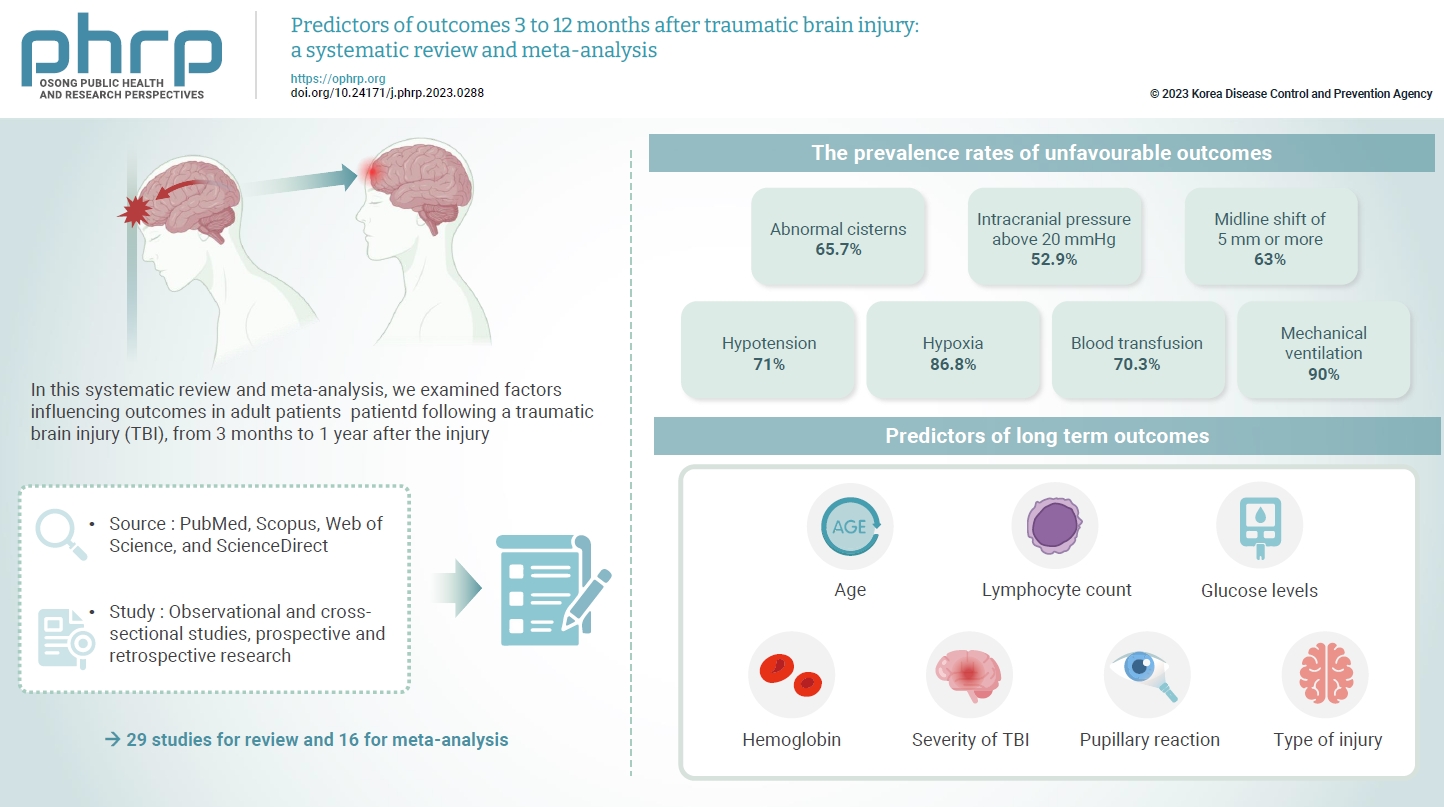
The exact factors predicting outcomes following traumatic brain injury (TBI) remain elusive. In this systematic review and meta-analysis, we examined factors influencing outcomes in adult patients with TBI, from 3 months to 1 year after injury. A search of four electronic databases—PubMed, Scopus, Web of Science, and ScienceDirect—yielded 29 studies for review and 16 for meta-analysis, in accordance with the Preferred Reporting Items for Systematic Reviews and Meta-Analysis guidelines. In patients with TBI of any severity, mean differences were observed in age (8.72 years; 95% confidence interval [CI], 4.77–12.66 years), lymphocyte count (−0.15 109/L; 95% CI, −0.18 to −0.11), glucose levels (1.20 mmol/L; 95% CI, 0.73–1.68), and haemoglobin levels (−0.91 g/dL; 95% CI, −1.49 to −0.33) between those with favourable and unfavourable outcomes. The prevalence rates of unfavourable outcomes were as follows: abnormal cisterns, 65.7%; intracranial pressure above 20 mmHg, 52.9%; midline shift of 5 mm or more, 63%; hypotension, 71%; hypoxia, 86.8%; blood transfusion, 70.3%; and mechanical ventilation, 90%. Several predictors were strongly associated with outcome. Specifically, age, lymphocyte count, glucose level, haemoglobin level, severity of TBI, pupillary reaction, and type of injury were identified as potential predictors of long-term outcomes.

Citations

Citations to this article as recorded by  Crossref logo
  • Premorbid physical activity and recovery following an isolated acute traumatic brain injury: an exploratory study
    Naomie Maltais, Elaine de Guise, Maude Laguë-Beauvais, Laurence Trépanier, Jehane H. Dagher
    Global Neurological Insights.2026; 1(1): 100003.     CrossRef
  • Association Between Sex and Mortality After Traumatic Brain Injury: A Systematic Review and Meta-Analysis
    Elise Beijer, Floor J. Mansvelder, Romein W. G. Dujardin, Nicole P. Juffermans, Linda J. Schoonmade, Leo M. G. Geeraedts, Frank W. Bloemers, Charissa E. van den Brom, Patrick Schober
    Neurocritical Care.2026; 45(1): 395.     CrossRef
  • The severity of traumatic brain injury impacts the response to non-pharmacological treatment for post-traumatic amnesia: A retrospective observational study
    Èlia Vilageliu-Jordà, Antonia Enseñat-Cantallops, Alberto García-Molina
    Applied Neuropsychology: Adult.2026; : 1.     CrossRef
  • Predictors of In-Hospital Mortality in Traumatic Acute Subdural Hematoma: The Role of Admission International Normalized Ratio, Imaging Parameters and Neurological Severity
    Serban Iancu Papacocea, Miruna Ioana Lazăr, Romica Cergan, Ioana Anca Badarau, Toma Marius Papacocea
    Biomedicines.2026; 14(6): 1388.     CrossRef
  • A Systematic Review of Clinical Outcome Trajectories from 3 to 12 Months Following Mild or Moderate Traumatic Brain Injury
    Carl Marincowitz, Fiona Lecky, Abdullah Pandor, Ruth Wong, Thomas Shanahan, Michael Tonkins, Rajiv Singh, James Piercy, Andrew Maas, Lindsay Wilson
    Journal of Neurotrauma.2026;[Epub]     CrossRef
  • Distinct Five-Year Latent Class Trajectories and Predictors of Functional Cognitive Independence Following Traumatic Brain Injury: A TBI Model Systems Study
    Evan D. Feigel, Charlotte B. Luster, Chris W. Lewis, Brenna Finegan, Michael J. Mastrodicasa, Maëlle-Marie Troadec, David Guo, Ben Olsen, Ignacio Fuentes, Joseph T. Giacino, Regina Barzilay, Daniel H. Daneshvar
    Neurotrauma Reports.2026;[Epub]     CrossRef
  • Traumatic Brain Injury and Artificial Intelligence: Shaping the Future of Neurorehabilitation—A Review
    Seun Orenuga, Philip Jordache, Daniel Mirzai, Tyler Monteros, Ernesto Gonzalez, Ahmed Madkoor, Rahim Hirani, Raj K. Tiwari, Mill Etienne
    Life.2025; 15(3): 424.     CrossRef
  • 10,574 View
  • 295 Download
  • 6 Web of Science
  • Crossref

Original Articles

Estimation of the onset time of diabetic complications in type 2 diabetes patients in Thailand: a survival analysis
Natthanicha Sauenram, Jutatip Sillabutra, Chukiat Viwatwongkasem, Pratana Satitvipawee
Osong Public Health Res Perspect 2023;14(6):508-519.
Published online November 23, 2023
DOI: https://doi.org/10.24171/j.phrp.2023.0084
Estimation of the onset time of diabetic complications in type 2 diabetes patients in Thailand: a survival analysis
Objectives
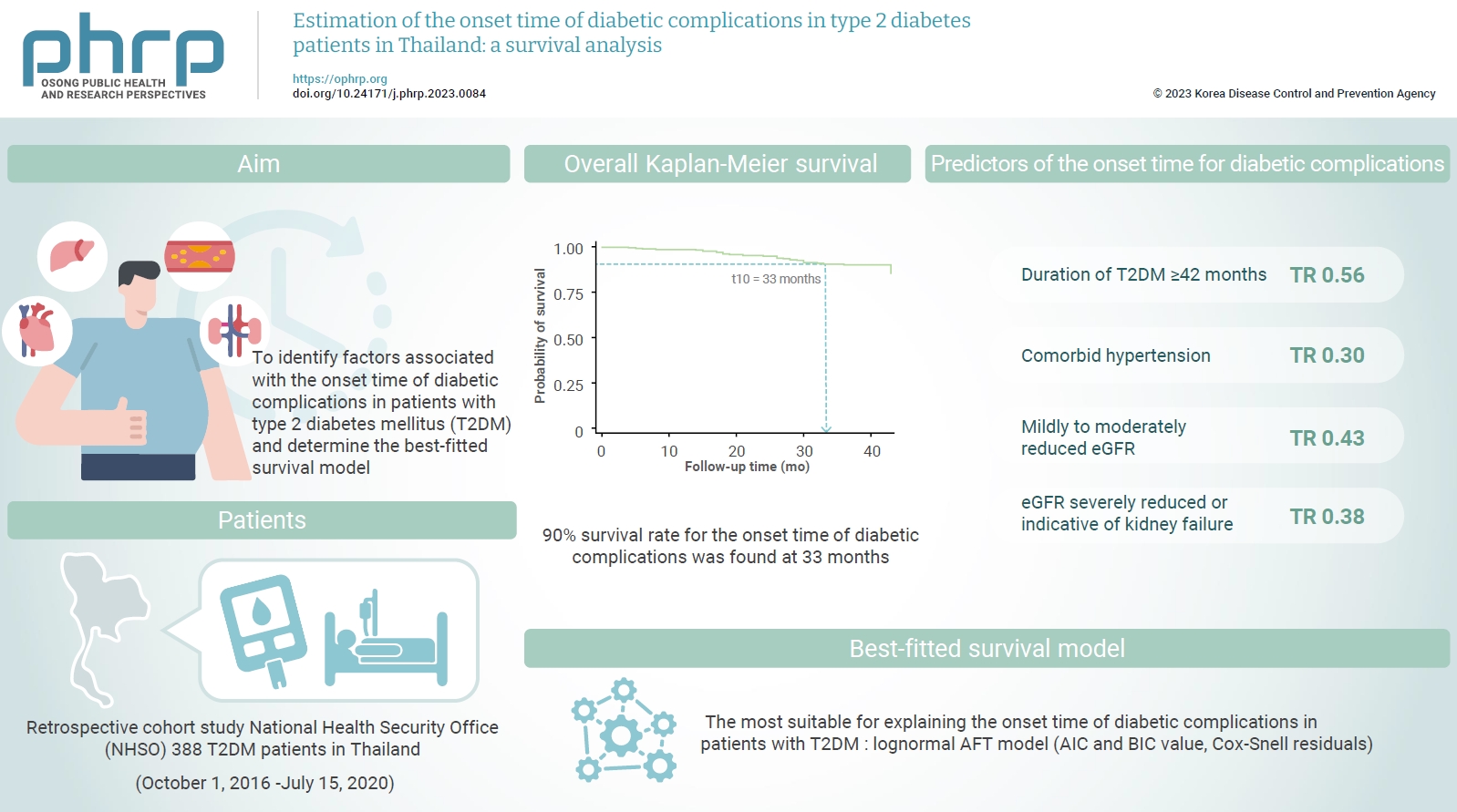
This study aimed to identify factors associated with the onset time of diabetic complications in patients with type 2 diabetes mellitus (T2DM) and determine the best-fitted survival model. Methods: A retrospective cohort study was conducted among T2DM patients enrolled from October 1, 2016 to July 15, 2020 at the National Health Security Office (NHSO). In total, 388 T2DM patients were included. Cox proportional-hazard and parametric models were used to identify factors related to the onset time of diabetic complications. The Akaike information criterion, Bayesian information criterion, and Cox-Snell residual were compared to determine the best-fitted survival model. Results: Thirty diabetic complication events were detected among the 388 patients (7.7%). A 90% survival rate for the onset time of diabetic complications was found at 33 months after the first T2DM diagnosis. According to multivariate analysis, a duration of T2DM ≥42 months (time ratio [TR], 0.56; 95% confidence interval [CI], 0.33–0.96; p=0.034), comorbid hypertension (TR, 0.30; 95% CI, 0.15–0.60; p=0.001), mildly to moderately reduced levels of the estimated glomerular filtration rate (eGFR) (TR, 0.43; 95% CI, 0.24–0.75; p=0.003) and an eGFR that was severely reduced or indicative of kidney failure (TR, 0.38; 95% CI, 0.16–0.88; p=0.025) were significantly associated with the onset time of diabetic complications (p<0.05). Conclusion: Patients with T2DM durations of more than 42 months, comorbid hypertension, and decreased eGFR were at risk of developing diabetic complications. The NHSO should be aware of these factors to establish a policy to prevent diabetic complications after the diagnosis of T2DM.

Citations

Citations to this article as recorded by  Crossref logo
  • Survival and predictors of mortality among adults with type 2 diabetes at a teaching hospital in Ghana: a retrospective cohort study
    Issah Haruna, Abdul-Rauf Sulemana, Emmanuel Kweku Nakua, Daniel Boateng
    BMC Public Health.2026;[Epub]     CrossRef
  • Survival analysis of patients with chronic diseases: a statistical approach to mortality risk factors
    Vladimiro Ibañez Quispe, Juan Reinaldo Paredes Quispe, Remo Choquejahua Acero, Teresa Paola Alvarez Rozas, Edgar Eloy Carpio Vargas, Godofredo Quispe Mamani, Percy Huata Panc
    Journal of Advanced Pharmacy Education and Researc.2026; 16(1): 211.     CrossRef
  • An elevated level of one-hour postprandial plasma glucose is an independent risk factor for developing chronic complications of type 2 diabetes mellitus
    Yanyan Jin, Jing Wei, Jie Yang, Hongxia Qian, Yan Wu, Mengmeng Liu
    Archives of Physiology and Biochemistry.2025; 131(6): 1025.     CrossRef
  • Advanced age and elevated cholesterol predict diabetic neuropathy in patients with type II diabetes mellitus in Southern Ethiopia
    Fasika Merid, Habtamu Esubalew, Tamirat Gezahegn Guyo, Firdawek Getahun
    Cardiovascular Diabetology – Endocrinology Reports.2025;[Epub]     CrossRef
  • 7,895 View
  • 229 Download
  • 4 Web of Science
  • Crossref
Risk factors for transmission in a COVID-19 cluster infection in a high school in the Republic of Korea
Jin-Hwan Jeon, Su Jin Kang, Se-Jin Jeong, Hyeon-Cheol Jang, Young-Joon Park, Sang-Eun Lee
Osong Public Health Res Perspect 2023;14(4):252-262.
Published online July 27, 2023
DOI: https://doi.org/10.24171/j.phrp.2023.0125
Risk factors for transmission in a COVID-19 cluster infection in a high school in the Republic of Korea
Objectives
This study aimed to examine the scale, characteristics, risk factors, and modes of transmission in a coronavirus disease 2019 (COVID-19) outbreak at a high school in Seoul, Republic of Korea.
Methods
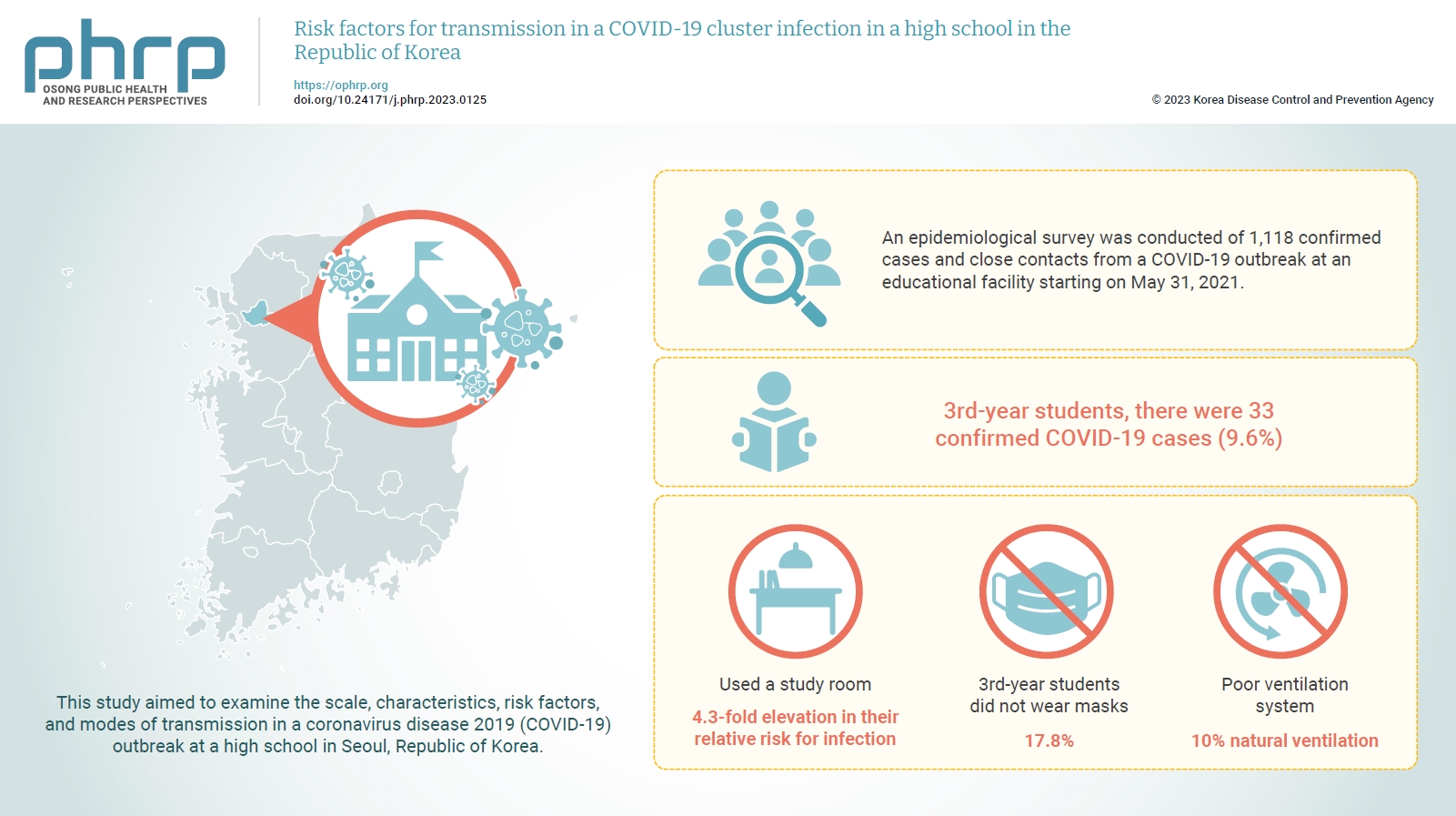
An epidemiological survey was conducted of 1,118 confirmed cases and close contacts from a COVID-19 outbreak at an educational facility starting on May 31, 2021. In-depth interviews, online questionnaires, flow evaluations, and CCTV analyses were used to devise infection prevention measures. Behavioral and spatial risk factors were identified, and statistical significance was tested.
Results
Among 3rd-year students, there were 33 confirmed COVID-19 cases (9.6%). Students who used a study room in the annex building showed a statistically significant 4.3-fold elevation in their relative risk for infection compared to those who did not use the study room. Moreover, CCTV facial recognition analysis confirmed that 17.8% of 3rd-year students did not wear masks and had the lowest percentage of mask-wearers by grade. The air epidemiological survey conducted in the study room in the annex, which met the 3 criteria for a closed space, confirmed that there was only 10% natural ventilation due to the poor ventilation system.
Conclusion
To prevent and manage the spread of COVID-19 in educational facilities, advance measures that consider the size, operation, and resources of each school are crucial. In addition, various survey methodologies should be used in future studies to quickly analyze a wider range of data that can inform an evidence-based quarantine response.

Citations

Citations to this article as recorded by  Crossref logo
  • Detection of a cluster of Omicron's BA.4 sublineage in Northern Senegal and identification of the first XAS recombinant variant in Senegal
    Martin Faye, Modeste Name Faye, Babacar Ndiaye, Moussa Moïse Diagne, Safietou Sankhe, Ndeye Marième Top, Amadou Diallo, Cheikh Loucoubar, Ndongo Dia, Amadou Alpha Sall, Ousmane Faye
    Virus Research.2024; 339: 199259.     CrossRef
  • 7,983 View
  • 237 Download
  • 1 Web of Science
  • Crossref
Time-series comparison of COVID-19 case fatality rates across 21 countries with adjustment for multiple covariates
Yongmoon Kim, Bryan Inho Kim, Sangwoo Tak
Osong Public Health Res Perspect 2022;13(6):424-434.
Published online November 28, 2022
DOI: https://doi.org/10.24171/j.phrp.2022.0212
Time-series comparison of COVID-19 case fatality rates across 21 countries with adjustment for multiple covariates
Objectives
Although it is widely used as a measure for mortality, the case fatality rate (CFR) ofcoronavirus disease 2019 (COVID-19) can vary over time and fluctuate for many reasons otherthan viral characteristics. To compare the CFRs of different countries in equal measure, weestimated comparable CFRs after adjusting for multiple covariates and examined the mainfactors that contributed to variability in the CFRs among 21 countries.Methods: For statistical analysis, time-series cross-sectional data were collected from OurWorld in Data, CoVariants.org, and GISAID. Biweekly CFRs of COVID-19 were estimated bypooled generalized linear squares regression models for the panel data. Covariates includedthe predominant virus variant, reproduction rate, vaccination, national economic status,hospital beds, diabetes prevalence, and population share of individuals older than age 65. Intotal, 21 countries were eligible for analysis.Results: Adjustment for covariates reduced variation in the CFRs of COVID-19 across countriesand over time. Regression results showed that the dominant spread of the Omicron variant,reproduction rate, and vaccination were associated with lower country-level CFRs, whereasage, the extreme poverty rate, and diabetes prevalence were associated with higher countrylevel CFRs.Conclusion: A direct comparison of crude CFRs among countries may be fallacious, especiallyin a cross-sectional analysis. Our study presents an adjusted comparison of CFRs over timefor a more proper comparison. In addition, our findings suggest that comparing CFRs amongdifferent countries without considering their context, such as the epidemic phase, medicalcapacity, surveillance strategy, and socio-demographic traits, should be avoided.

Citations

Citations to this article as recorded by  Crossref logo
  • Socioeconomic determinants of COVID-19 vaccination and mortality: a cross-national path analysis
    Fulya Ipek-Erdem, Esra Erpek, Volkan Genç, Aybars Bars, Sabri Erdem, Servet Akar
    BMC Public Health.2026;[Epub]     CrossRef
  • From mono to multi-causality: Towards a comprehensive perspective on understanding death
    Peter Harteloh
    Health Policy.2024; 147: 105121.     CrossRef
  • Comments on the article "Time-series comparison of COVID-19 case fatality rates across 21 countries with adjustment for multiple covariates"
    Gaetano Perone
    Osong Public Health and Research Perspectives.2023; 14(2): 146.     CrossRef
  • 11,035 View
  • 151 Download
  • 3 Web of Science
  • Crossref

Review Article

Effects of medication adherence interventions for older adults with chronic illnesses: a systematic review and meta-analysis
Hae Ok Jeon, Myung-Ock Chae, Ahrin Kim
Osong Public Health Res Perspect 2022;13(5):328-340.
Published online October 12, 2022
DOI: https://doi.org/10.24171/j.phrp.2022.0168
This systematic review and meta-analysis aimed to understand the characteristics of medication adherence interventions for older adults with chronic illnesses, and to investigate the average effect size by combining the individual effects of these interventions. Data from studies meeting the inclusion criteria were systematically collected in accordance with the Preferred Reporting Items for Systematic Reviews and Meta-Analysis guidelines. The results showed that the average effect size (Hedges’ g) of the finally selected medication adherence interventions for older adults with chronic illnesses calculated using a random-effects model was 0.500 (95% confidence interval [CI], 0.342−0.659). Of the medication adherence interventions, an implementation intention intervention (using face-to-face meetings and telephone monitoring with personalized behavioral strategies) and a health belief model–based educational program were found to be highly effective. Face-to-face counseling was a significantly effective method of implementing medication adherence interventions for older adults with chronic illnesses (Hedges’ g=0.531, 95% CI, 0.186−0.877), while medication adherence interventions through education and telehealth counseling were not effective. This study verified the effectiveness of personalized behavioral change strategies and cognitive behavioral therapy based on the health belief model, as well as face-to-face meetings, as medication adherence interventions for older adults with chronic illnesses.

Citations

Citations to this article as recorded by  Crossref logo
  • Impact of telemedicine on chronic disease patients: An overview of systematic reviews
    Kun Zhang, Yanhua Chen, Peicheng Wang, Yanrong He, Yanrong Du, Hailun Liang, Weiguo Zhu, Xiao Long, Leiyu Shi, Jiming Zhu
    Intelligent Medicine.2026; 6(2): 226.     CrossRef
  • Updating Interventions to Enhance Medication Adherence among Community-Dwelling Older Adults with Chronic Diseases
    Luu Thi Thuy, Nguyen Thi Yen Hoai, Diep Thi Tieu Mai
    Home Healthcare Now.2026; 44(1): 40.     CrossRef
  • Treatment Adherence and Persistence of Anti-Fibrotic Drugs in Real Life in Greece
    Georgia Kourlaba, Stylianos Ravanidis, Garyfallia Stefanou, Konstantinos Mathioudakis, Anastasios Tsolakidis, Dimitrios Zografopoulos
    Advances in Respiratory Medicine.2026; 94(1): 6.     CrossRef
  • Reasons for delayed medical treatment among cholelithiasis patients: a qualitative study based on the health belief model
    Min Jiang, Yajie Shi, Jiao Liu, Yan Liu, Yanzhang Tian, Fang He
    BMC Health Services Research.2026;[Epub]     CrossRef
  • Can We Predict Older Adults’ Long-Term Healthy Behavior Maintenance? Identifying the Optimal Machine Learning Model
    HeSen Li, WeiCheng Pan, Hong Chen, YiZhuo Hou
    International Journal of Human–Computer Interactio.2026; 42(20): 17782.     CrossRef
  • Medication adherence trajectories and association with risk factors and clinical outcomes in type 2 diabetes treatment
    Sara Mucherino, Valentina Orlando, Marcia Vervloet, Yvette Weesie, Liset van Dijk, Enrica Menditto, Yee Gary Ang
    PLOS One.2026; 21(2): e0342056.     CrossRef
  • Designing age-friendly interfaces and wearable–environment integrations to enhance medication adherence: a discrete choice experiment among older adults
    Jialin Qin, Zeyu Wu, Hao Zhang, Xiaopan Qi
    Frontiers in Medicine.2026;[Epub]     CrossRef
  • Psychosocial predictors of non-adherence to antihypertensive medication among Korean adults: A nationwide cross-sectional study
    Kunhee Han, Hwa Sun Kim, Young Lee, Chung-woo Lee, Muhammad Haroon Stanikzai
    PLOS One.2026; 21(3): e0345509.     CrossRef
  • Nurse-led interventions in enhancing outcomes for patients with tuberculosis: a scoping review
    Nita Arisanti Yulanda, Hidayat Arifin, Titan Ligita, Lestari Makmuriana, Alfi Syahri, Susanti Susanti, Komang Ardidhana Nugraha Putra, Andri Setiya Wahyudi, Somsak Thojampa, Tintin Sukartini
    Journal of Research in Nursing.2026;[Epub]     CrossRef
  • Bedside Cognitive Behavioral Therapy Techniques in Primary Care
    Meredith L.C. Williamson, Danielle L. Terry, Kaylee J. Jackson
    Primary Care: Clinics in Office Practice.2026; 53(2): 251.     CrossRef
  • Mobile health apps for older adults: real-world evidence on engagement and medication adherence
    Elyssa Wiecek, Scott Taylor, Hugo Rourke, Fiona Hammond, Noelia Amador-Fernandez
    Frontiers in Digital Health.2026;[Epub]     CrossRef
  • Medication adherence in older adults with chronic diseases: a scoping review of barriers, facilitators, and effective interventions
    Doris Cardona-Arango, Valeria Santacruz-Restrepo, Alejandra Rendón-Montoya, Juliana Madrigal-Cadavid, Alejandra Segura-Cardona, Jorge Iván Estrada-Acevedo
    Frontiers in Aging.2026;[Epub]     CrossRef
  • A pilot feasibility study of a tablet-based virtual community application with shared avatars for promoting health behavior change in older adult care facilities
    Kenji Nakamura, Keiichi Yamazaki, Akiko Yamazaki, Yoshiaki Ohyama
    Frontiers in Digital Health.2026;[Epub]     CrossRef
  • Chrono-modulated drug delivery systems for oncology: Mechanisms, translational evidence, and pharmaceutical innovations
    Santoshini Nayak, Rajat Kumar Kar, Prasanta Kumar Biswal, Ranjit Prasad Swain, Snehamayee Mohapatra
    Chronobiology International.2026; 43(11): 1728.     CrossRef
  • Medication Adherence Interventions for Older Adults: A National Mixed‐Methods Study of Implementation Across Italian Healthcare Settings
    Sara Mucherino, Luca Pasina, Manuela Casula, Monia Donati, Carlotta Lunghi, Elena Olmastroni, Valentina Orlando, Emanuel Raschi, Stefano Scotti, Marco Salluzzo, Elisabetta Poluzzi, Alessandro Nobili, Enrica Menditto
    Journal of the American Geriatrics Society.2026;[Epub]     CrossRef
  • Yaşlılarda ilaç uyumunun geliştirilmesine yönelik stratejiler
    Soner Mete, Kamuran Özdil
    Mersin Üniversitesi Sağlık Bilimleri Dergisi.2026; 19(2): 415.     CrossRef
  • Confronting finitude and treatment adherence in older adults with chronic diseases: a qualitative study
    Leovaldo Alcântara, Luís Midão, Elísio Costa, Constança Paúl
    BMC Geriatrics.2026;[Epub]     CrossRef
  • Adherencia terapéutica en pacientes con hipertensión arterial en segundo nivel de atención
    Vidal Marcelino Villanueva Pérez, Daniel Canaán Pérez, Diego Sánchez Rodríguez
    REDSA Revista Ecuatoriana de Desarrollo Social y A.2026; 1(3): 268.     CrossRef
  • Medication adherence in older people: Predictors and strategies for improvement
    Vladimir Petković, Jelena Horvat, Svitlica Brestovački
    Timocki medicinski glasnik.2025; 50(1-2): 32.     CrossRef
  • Educational intervention for mental health and health behaviors in elderly Iranian women randomized controlled trial
    Razieh Asadi, Mahin Nazari, Abdolrahim Asadollahi, Narges Mobasheri
    Scientific Reports.2025;[Epub]     CrossRef
  • Religious, Belief Medication, and Adherence Among Elderly with Chronic Diseases: A Multicenter Cross-Sectional Study in Papua, Indonesia
    AZ Izzah, DA Perwitasari, ES Sinaga, FE Appa, EI Sianturi
    Nigerian Journal of Clinical Practice.2025; 28(11): 1269.     CrossRef
  • EXAMINING PRESCRIPTION DRUG USE AND HEALTH CARE ACCESS AMONG OLDER ADULTS IN RURAL AREAS: A CROSS-SECTIONAL STUDY BASED ON THE HEALTH BELIEF MODEL
    Yağmur ÖZKAYA, Büşra DEMİR ÇETİNKAYA, Gülden HAKVERDİ, Eyüp Can POLAT, Gülbin ÖZÇELİKAY
    Turkish Journal of Geriatrics.2025;[Epub]     CrossRef
  • Health Behavior Change to Mitigate Dementia Risk: An Updated Review
    Victoria Sanborn, Jennifer D. Davis, Laura E. Korthauer
    Current Geriatrics Reports.2024; 13(3): 162.     CrossRef
  • Relationship Between Depression and Medication Adherence Among Chronic Disease Patients in the Middle East
    Abdulrahman O Alomar, Rakan H Khushaim, Shahad K Al-Ghanem, Abeer T Bin Jumaiah, Suhail M Albaqami, Lujain A Alleft, Eman A Abahussain
    Cureus.2024;[Epub]     CrossRef
  • Development and Preliminary Psychometric Testing of a Brief Tool to Measure Medication Adherence in Older Populations
    Paolo Iovino, Paola Obbia, Vincenzo De Luca, Clara Donnoli, Lola Patumi, Lisa Leonardini, Ernesto Palummeri, Manuela Ruatta, Anna Basso, Yari Longobucco, Laura Rasero, Giuseppe Liotta, Maddalena Illario
    Clinical Interventions in Aging.2024; Volume 19: 1765.     CrossRef
  • 29,628 View
  • 652 Download
  • 22 Web of Science
  • Crossref

Original Articles

Phylogenetic and genome-wide mutational analysis of SARS-CoV-2 strains circulating in Nigeria: no implications for attenuated COVID-19 outcomes
Daniel B. Kolawole, Malachy I. Okeke
Osong Public Health Res Perspect 2022;13(2):101-113.
Published online April 22, 2022
DOI: https://doi.org/10.24171/j.phrp.2021.0329
Phylogenetic and genome-wide mutational analysis of SARS-CoV-2 strains circulating in Nigeria: no 
implications for attenuated COVID-19 outcomes
Objectives
Severe acute respiratory syndrome coronavirus 2 (SARS-CoV-2) is the causative agent of coronavirus disease 2019 (COVID-19). The COVID-19 incidence and mortality rates are low in Nigeria compared to global trends. This research mapped the evolution of SARS-CoV-2 circulating in Nigeria and globally to determine whether the Nigerian isolates are genetically distinct from strains circulating in regions of the world with a high disease burden. Methods: Bayesian phylogenetics using BEAST 2.0, genetic similarity analyses, and genomewide mutational analyses were used to characterize the strains of SARS-CoV-2 isolated in Nigeria. Results: SARS-CoV-2 strains isolated in Nigeria showed multiple lineages and possible introductions from Europe and Asia. Phylogenetic clustering and sequence similarity analyses demonstrated that Nigerian isolates were not genetically distinct from strains isolated in other parts of the globe. Mutational analysis demonstrated that the D614G mutation in the spike protein, the P323L mutation in open reading frame 1b (and more specifically in NSP12), and the R203K/ G204R mutation pair in the nucleocapsid protein were most prevalent in the Nigerian isolates. Conclusion: The SARS-CoV-2 strains in Nigeria were neither phylogenetically nor genetically distinct from virus strains circulating in other countries of the world. Thus, differences in SARS-CoV-2 genomes are not a plausible explanation for the attenuated COVID-19 outcomes in Nigeria.

Citations

Citations to this article as recorded by  Crossref logo
  • COVID19 Sero-epidemiology and vaccine uptake in two Southern Nigerian clinics
    Chinedu A. Ugwu, Ooreofe Odebode, Israel O. Ajayi, Josiah Olubunmi, Bejide Ifeoluwa, Jolly A. Adole, Kazeem Akano, Johnson Okolie, Philomena Eromon, Imonikhe K. Kio, Judith Amadi, Precious F. Adebayo, Iheanyi Mgbeokwere, Akeem O. Lawal, Olayemisi A. Adego
    PLOS Global Public Health.2026; 6(3): e0006126.     CrossRef
  • A retrospective whole genome sequencing of SARS-CoV-2 isolate from respiratory sample of an individual from Ota – Ogun State, Nigeria
    Olajumoke Olufunmilayo Joseph, Samuel Olatunde Dahunsi, Anthony Okoh
    Gene Reports.2024; 37: 102032.     CrossRef
  • 8,380 View
  • 95 Download
  • 2 Web of Science
  • Crossref
Spatiotemporal analysis of environmental and physiographic factors related to malaria in Bareilly district, India
Shikhar Chaudhary, Biju Soman
Osong Public Health Res Perspect 2022;13(2):123-132.
Published online March 31, 2022
DOI: https://doi.org/10.24171/j.phrp.2021.0304
Spatiotemporal analysis of environmental and physiographic factors related to malaria in Bareilly district, India
Objectives
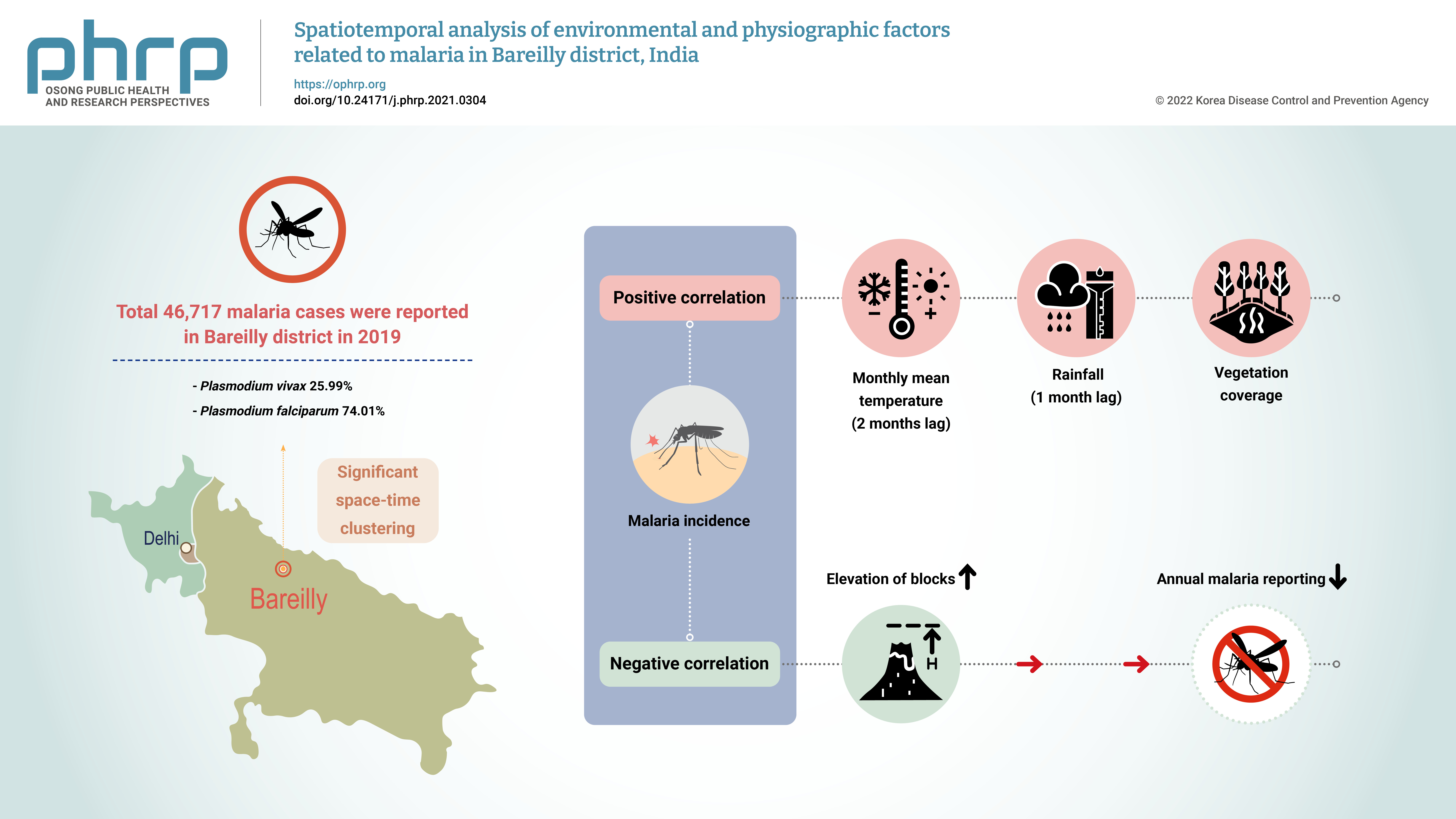
The aim of this study was to explore the spatiotemporal clustering of reported malaria cases and to study the effects of various environmental and physiographic factors on malaria incidence in Bareilly district, Uttar Pradesh, India. Methods: Malaria surveillance data were collected from the state health department and cleaned into an analyzable format. These data were analyzed along with meteorological, physiographic, and 2019 population data, which were obtained from the Indian Meteorological Department, National Aeronautics and Space Administration web portal, the Bhuvan platform of the Indian Space Research Organization, and the 2011 Census of India. Results: In total, 46,717 malaria cases were reported in Bareilly district in 2019, of which 25.99% were Plasmodium vivax cases and 74.01% were P. falciparum cases. The reported malaria cases in the district showed clustering, with significant spatial autocorrelation (Moran’s I value=0.63), and space-time clustering (p<0.01). A significant positive correlation was found between monthly malaria incidence and the monthly mean temperature (with a lag of 1−2 months) and rainfall (with a lag of 1 month). A significant negative correlation was detected between the elevation of blocks (i.e., intermediate-level administrative districts) and annual malaria reporting. Conclusion: The presence of space-time clustering of malaria cases and its correlation with meteorological and physiographic factors indicate that routine spatial analysis of the surveillance data could help control and manage malaria outbreaks in the district.

Citations

Citations to this article as recorded by  Crossref logo
  • Revisiting the impacts of geographical aspects on public health in the tropical-Asian countries: a review
    Arif Ashari, Muhamad Ervin, Grace Helena Amaranthois Kapisan, Muhammad Asrori Indra Wardoyo, Raisya Arzety Olivia, Bagus Tegar Sakti Prakosa
    Reviews on Environmental Health.2026; 41(2): 307.     CrossRef
  • Spatial Analysis of Malaria in Bangladesh: Insights from Bayesian Disease Mapping Models
    Ummehani Mimi, Md. Rezaul Karim, Sultana Begum, Khadiza Akter Eme, Denekew Bitew Belay
    PLOS One.2026; 21(8): e0353483.     CrossRef
  • Association between temperature and malaria (1959-2019): a systematic review and meta-analysis
    Yogesh Murugan, Vaibhavkumar Shrivastav
    Archives of Public Health.2025;[Epub]     CrossRef
  • Digital health: trends, opportunities and challenges in medical devices, pharma and bio-technology
    Naresh Kasoju, N. S. Remya, Renjith Sasi, S. Sujesh, Biju Soman, C. Kesavadas, C. V. Muraleedharan, P. R. Harikrishna Varma, Sanjay Behari
    CSI Transactions on ICT.2023; 11(1): 11.     CrossRef
  • 10,769 View
  • 145 Download
  • 3 Web of Science
  • Crossref

Review Article

Worldwide prevalence of fungal coinfections among COVID-19 patients: a comprehensive systematic review and meta-analysis
Saber Soltani, Milad Zandi, Samireh Faramarzi, Ramin Shahbahrami, Mohebat Vali, Sara Akhavan Rezayat, Reza Pakzad, Pooneh Malekifar, Iraj Pakzad, Neda Jahandoost, Jalal Moludi
Osong Public Health Res Perspect 2022;13(1):15-23.
Published online February 8, 2022
DOI: https://doi.org/10.24171/j.phrp.2021.0293
Microbial coinfections can increase the morbidity and mortality rates of viral respiratory diseases. Therefore, this study aimed to determine the pooled prevalence of fungal coinfections in coronavirus disease 2019 (COVID-19) patients. Web of Science, Medline, Scopus, and Embase were searched without language restrictions to identify the related research on COVID-19 patients with fungal coinfections from December 1, 2019, to December 30, 2020. A random-effects model was used for analysis. The sample size included 2,246 patients from 8 studies. The pooled prevalence of fungal coinfections was 12.60%. The frequency of fungal subtype coinfections was 3.71% for Aspergillus, 2.39% for Candida, and 0.39% for other. The World Health Organization’s Regional Office for Europe and Regional Office for Southeast Asia had the highest (23.28%) and lowest (4.53%) estimated prevalence of fungal coinfection, respectively. Our findings showed a high prevalence of fungal coinfections in COVID-19 cases, which is a likely contributor to mortality in COVID-19 patients. Early identification of fungal pathogens in the laboratory for COVID-19 patients can lead to timely treatment and prevention of further damage by this hidden infection.
  • 12,944 View
  • 158 Download
  • 16 Web of Science

Original Articles

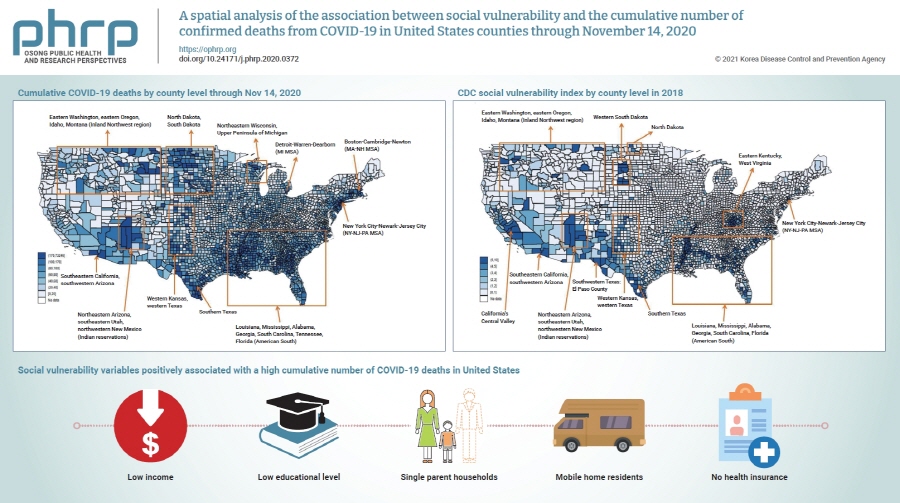
A spatial analysis of the association between social vulnerability and the cumulative number of confirmed deaths from COVID-19 in United States counties through November 14, 2020
Objectives
Coronavirus disease 2019 (COVID-19) is classified as a natural hazard, and social vulnerability describes the susceptibility of social groups to potential damages from natural hazards. Therefore, the objective of this study was to examine the association between social vulnerability and the cumulative number of confirmed COVID-19 deaths (per 100,000) in 3,141 United States counties.
Methods
The cumulative number of COVID-19 deaths was obtained from USA Facts. Variables related to social vulnerability were obtained from the Centers for Disease Control and Prevention Social Vulnerability Index and the 2018 5-Year American Community Survey. Data were analyzed using spatial autoregression models.
Results
Lowest income and educational level, as well as high proportions of single parent households, mobile home residents, and people without health insurance were positively associated with a high cumulative number of COVID-19 deaths.
Conclusion
In conclusion, there are regional differences in the cumulative number of COVID-19 deaths in United States counties, which are affected by various social vulnerabilities. Hence, these findings underscore the need to take social vulnerability into account when planning interventions to reduce COVID-19 deaths.

Citations

Citations to this article as recorded by  Crossref logo
  • Patterns of Homologous Repair Deficiency and BRCA1 / 2 Testing of Ovarian and Breast Cancers: A Real-World Study of Patients in Community Health Settings in the United States
    Rayna K. Matsuno, Adrienne F.O. Williams, Connor Sweetnam, Giovanna I. Cruz, Liz M. Toland, Anna B. Berry, Monika A. Izano, Liam C. Lee, Gieira Jones, Jagadeswara R. Earla, Thomas D. Brown, Smita Kothari, Arthur Sillah
    JCO Oncology Advances.2025;[Epub]     CrossRef
  • A low-rank Bayesian approach for geoadditive modeling
    Bryan Sumalinab, Oswaldo Gressani, Niel Hens, Christel Faes
    Spatial Statistics.2025; 68: 100907.     CrossRef
  • A retrospective assessment of COVID-19 vulnerability index indicators and mortality rates pre-COVID-19 (2018–2020) and during COVID-19 (2020–2022) in a health and demographic surveillance site, Soweto, South Africa
    Takwanisa Machemedze, Chodziwadziwa Whiteson Kabudula, Jean Juste Harrisson Bashingwa, Beth A. Tippett Barr, Nellie Myburgh, Sana Mahtab, Cleopas Hwinya, Stephen Tollman, Ziyaad Dangor, Shabir A. Madhi
    Population Health Metrics.2025;[Epub]     CrossRef
  • The Role of Testing and Vaccination in Mediating Social Vulnerability and COVID-19 Prevalence in Southern Nevada
    Andrea Lopez, Lung-Chang Chien, L.-W. Antony Chen, Courtney Coughenour, Erika Marquez, Szu-Ping Lee
    International Journal of Environmental Research an.2025; 22(7): 980.     CrossRef
  • Ecological comparison of six countries in two waves of COVID-19
    Meiheng Liu, Leiyu Shi, Manfei Yang, Jun Jiao, Junyan Yang, Mengyuan Ma, Wanzhen Xie, Gang Sun
    Frontiers in Public Health.2024;[Epub]     CrossRef
  • Social vulnerability and COVID-19 in Maringá, Brazil
    Matheus Pereira Libório, Oseias da Silva Martinuci, Patrícia Bernardes, Natália Cristina Alves Caetano Chav Krohling, Guilherme Castro, Henrique Leonardo Guerra, Eduardo Alcantara Ribeiro, Udelysses Janete Veltrini Fonzar, Ícaro da Costa Francisco
    Spatial Information Research.2023; 31(1): 51.     CrossRef
  • A county-level analysis of association between social vulnerability and COVID-19 cases in Khuzestan Province, Iran
    Mahmoud Arvin, Shahram Bazrafkan, Parisa Beiki, Ayyoob Sharifi
    International Journal of Disaster Risk Reduction.2023; 84: 103495.     CrossRef
  • Global mapping of epidemic risk assessment toolkits: A scoping review for COVID-19 and future epidemics preparedness implications
    Bach Xuan Tran, Long Hoang Nguyen, Linh Phuong Doan, Tham Thi Nguyen, Giang Thu Vu, Hoa Thi Do, Huong Thi Le, Carl A. Latkin, Cyrus S. H. Ho, Roger C. M. Ho, Md Nazirul Islam Sarker
    PLOS ONE.2022; 17(9): e0272037.     CrossRef
  • COVID-19 mortality and deprivation: pandemic, syndemic, and endemic health inequalities
    Victoria J McGowan, Clare Bambra
    The Lancet Public Health.2022; 7(11): e966.     CrossRef
  • 12,743 View
  • 201 Download
  • 5 Web of Science
  • Crossref
The 100 top-cited articles on scrub typhus: a bibliometric analysis
Taha Hussein Musa, Wei Li, Joseph Kawuki, Pingmin Wei
Osong Public Health Res Perspect 2021;12(2):126-135.
Published online April 29, 2021
DOI: https://doi.org/10.24171/j.phrp.2021.12.2.10
Objectives
The aims of this study were to analyze the characteristics of the 100 top-cited articles on scrub typhus (ST), and to assess the present research landscape and future research directions using bibliometric analysis.
Methods
Web of Science was used to conduct a bibliometric analysis of the 100 top-cited articles on ST. The articles were analyzed by publication year, number of citations, document type, journals, keywords, institutions, country of origin, and authorship.
Results
The top 100 articles on ST were published between 1945 to 2017. The number of citations ranges from 39 to 227 and the interquartile range was 35.5. The United States published the highest number (<italic>n</italic>=21) of articles. Mahidol University was the most prolific institution in terms of articles (<italic>n</italic>=14). The <italic>American Journal of Tropical Medicine and Hygiene</italic> was the journal with the most articles (<italic>n</italic>=14), and Paris DH was the most productive author in terms of the Hirsh-index, which was 10 for that author. The study revealed a significant correlation between the total number of citations and the number of authors (r=0.668, <italic>p</italic><0.001), number of institutions (r=0.692, <italic>p</italic><0.001), number of years since publication (r=0.869, <italic>p</italic><0.001), and number of countries involved (r=0.963, <italic>p</italic><0.001).
Conclusion
The findings of this study provide landmarks in the publication and citation frequency of the most influential articles on ST. In addition, this study provides useful information for readers and health policy-makers in evaluating the literature on ST.

Citations

Citations to this article as recorded by  Crossref logo
  • Pharmacovigilance Research: A Bibliometric Performance and Science Mapping Analysis Using the Scopus Database
    Kannan O. Ahmed, Alka Ahuja, Taha Hussein Musa, Iman Elmahdi Mohamed , Riad Mohammed Abdelrahman, Lukman O. Afolabi, Lovel Fornah
    Sudan Journal of Medical Sciences.2026; 21(1): 19.     CrossRef
  • Bibliometric Analysis of Malaria Research in Sudan Published in Scopus Database: Trends and Focus Areas (1956–2024)
    Riad Mohammed Abdelrahman, Taha Hussein Musa, Sahar Ibrahim Gasmallah, Eltieb Omer Ahmed, Mohammed Jalal
    Sudan Journal of Medical Sciences.2026; 21(1): 39.     CrossRef
  • Diagnostic heterogeneity in scrub typhus serology: A scoping review of IFA thresholds and regional standardisation needs (2005–2024)
    Khanh Kim Le, Kartika Saraswati, Jantana Wongsantichon, Nicholas P. J. Day, Stuart D. Blacksell, Yong Qi
    PLOS Neglected Tropical Diseases.2025; 19(10): e0013540.     CrossRef
  • Top-50 cited articles on cysticercosis and neurocysticercosis
    Gregorio Gonzalez-Alcaide, Nestor Sosa, Fatima Valero-Samper, Isabel Belinchon-Romero, Jose-Manuel Ramos-Rincon
    Medicine.2024; 103(9): e37268.     CrossRef
  • Policy citations of scientometric articles: an altmetric study
    Hashem Atapour, Robabeh Maddahi, Rasoul Zavaraqi
    Scientometrics.2024; 129(7): 4423.     CrossRef
  • Cancer and COVID-19 research studies with team science: a bibliometric study
    Arezoo Ghamgosar, Sirous Panahi, Leila Nemati-Anaraki
    Journal of Interprofessional Care.2023; 37(4): 568.     CrossRef
  • Investigating Empirical evidence on the Epidemiology, Diagnosis and Bibliometric analysis of the 100 topmost cited publications on Tuberculosis Disease
    Taha Hussein Musa, Lovel Fornah, Tosin Yinka Akintunde, Idriss Hussein Musa, Hassan Hussein Musa, Gabriel Maxwell Turay , Maram Abdulhakim Abdulkarem Al-sharai
    PAN AFRICA SCIENCE JOURNAL.2023;[Epub]     CrossRef
  • Gum: Sytamatic and thematic analysis of the top 100 most-cited articles indexed in the Scopus database
    Hassan Hussein Musa, Akintunde Tosin Yinka, Olayinka Oderinde, Taha Hussein Musa, Abdelkareem A. Ahmed, Jaafar Sulieman Fedail, Adriano Mollica, Azzurra Stefanucci, Demin Cai
    Bioactive Carbohydrates and Dietary Fibre.2023; 30: 100359.     CrossRef
  • Knowledge mapping and visualization of current sarcopenia and cancer research: a bibliometric analysis
    Marwa Mohammed, Jianan Li
    Beni-Suef University Journal of Basic and Applied .2023;[Epub]     CrossRef
  • The 100 top-cited articles on childhood obesity: a bibliometric analysis
    Joseph Kawuki, Taha Hussein Musa, Upama Ghimire, Nathan Obore, Shireen Salome Papabathini
    Global Health Journal.2022; 6(3): 136.     CrossRef
  • The associations between scientific collaborations of LIS research and its policy impact
    Zhihong Huang, Qianjin Zong, Xuerui Ji
    Scientometrics.2022; 127(11): 6453.     CrossRef
  • A systematic and thematic analysis of the top 100 cited articles on mRNA vaccine indexed in Scopus database
    Hassan H. Musa, Taha H. Musa
    Human Vaccines & Immunotherapeutics.2022;[Epub]     CrossRef
  • The 100 Most Cited Articles on Dental Anomalies: a bibliometric analysis
    Glenda VİEİRA DE SOUSA, Maria Eduarda FERREİRA DE SOUZA, Eloísa CESÁRİO, Patrícia SANTOS
    Cumhuriyet Dental Journal.2022; 25(4): 330.     CrossRef
  • 10,831 View
  • 167 Download
  • 10 Web of Science
  • Crossref

Review Article

<p>This review compared coronavirus disease 2019 (COVID-19) laboratory findings, comorbidities, and clinical outcomes in patients from the general population versus medical staff to aid diagnosis of COVID-19 in a more timely, efficient, and accurate way. Electronic databases were searched up to 23<sup>rd</sup> March, 2020. The initial search yielded 6,527 studies. Following screening, 24 studies were included [18 studies (11,564 cases) of confirmed COVID-19 cases in the general public, and 6 studies (394 cases) in medical staff] in this review. Significant differences were observed in white blood cell counts (<italic>p</italic> < 0.001), lymphocyte counts (<italic>p</italic> < 0.001), platelet counts (<italic>p</italic> = 0.04), procalcitonin levels (<italic>p</italic> < 0.001), lactate dehydrogenase levels (<italic>p</italic> < 0.001), and creatinine levels (<italic>p</italic> = 0.03) when comparing infected medical staff with the general public. The mortality rate was higher in the general population than in medical staff (8% versus 2%). This review showed that during the early stages of COVID-19, laboratory findings alone may not be significant predictors of infection and may just accompany increasing C-reactive protein levels, erythrocyte sedimentation rates, and lactate dehydrogenase levels. In the symptomatic stage, the lymphocyte and platelet counts tended to decrease. Elevated D-dimer fibrin degradation product was associated with poor prognosis.</p>

Citations

Citations to this article as recorded by  Crossref logo
  • Quality indicators for appropriate inpatient antibiotic use: results from two national surveys in Italy, 2016–2022
    C. Vicentini, A. Russotto, R. Bussolino, M. Castagnotto, C. Gastaldo, S. Bazzolo, D. Gamba, S. Corcione, F.G. De Rosa, F. D'Ancona, C.M. Zotti
    Journal of Hospital Infection.2025; 160: 34.     CrossRef
  • Efficacy and limitations of SARS-CoV-2 vaccines - A systematic review
    Muhammad Azeem, Patrizia Cancemi, Farwa Mukhtar, Sefora Marino, Emanuela Peri, Giulia Di Prima, Viviana De Caro
    Life Sciences.2025; 371: 123610.     CrossRef
  • A comprehensive review of recent advances in research on COVID in communication studies
    Barbara Cyrek, Jenna Peltonen
    Discover Public Health.2024;[Epub]     CrossRef
  • microRNA-185 Inhibits SARS-CoV-2 Infection through the Modulation of the Host’s Lipid Microenvironment
    Nadine Ahmed, Magen E. Francis, Noreen Ahmed, Alyson A. Kelvin, John Paul Pezacki
    Viruses.2023; 15(9): 1921.     CrossRef
  • Protective action of natural and induced immunization against the occurrence of delta or alpha variants of SARS-CoV-2 infection: a test-negative case-control study
    Giovanni Corrao, Matteo Franchi, Federico Rea, Danilo Cereda, Antonio Barone, Catia Rosanna Borriello, Petra Giulia Della Valle, Michele Ercolanoni, Ida Fortino, Jose Jara, Olivia Leoni, Francesco Mazziotta, Elisabetta Pierini, Giuseppe Preziosi, Marcello
    BMC Medicine.2022;[Epub]     CrossRef
  • Balancing Benefits and Harms of COVID-19 Vaccines: Lessons from the Ongoing Mass Vaccination Campaign in Lombardy, Italy
    Giovanni Corrao, Federico Rea, Matteo Franchi, Danilo Cereda, Antonio Barone, Catia Rosanna Borriello, Giulia Petra Della Valle, Michele Ercolanoni, Jose Jara, Giuseppe Preziosi, Manuel Maffeo, Francesco Mazziotta, Elisabetta Pierini, Francesco Lecis, Pie
    Vaccines.2022; 10(4): 623.     CrossRef
  • Vulnerability Predictors of Post-Vaccine SARS-CoV-2 Infection and Disease—Empirical Evidence from a Large Population-Based Italian Platform
    Giovanni Corrao, Matteo Franchi, Danilo Cereda, Francesco Bortolan, Olivia Leoni, Catia Rosanna Borriello, Petra Giulia Della Valle, Marcello Tirani, Giovanni Pavesi, Antonio Barone, Michele Ercolanoni, Jose Jara, Massimo Galli, Guido Bertolaso
    Vaccines.2022; 10(6): 845.     CrossRef
  • Factors associated with severe or fatal clinical manifestations of SARS‐CoV‐2 infection after receiving the third dose of vaccine
    Giovanni Corrao, Matteo Franchi, Danilo Cereda, Francesco Bortolan, Olivia Leoni, Jose Jara, Giuseppina Valenti, Giovanni Pavesi
    Journal of Internal Medicine.2022; 292(5): 829.     CrossRef
  • Role of multiresolution vulnerability indices in COVID-19 spread in India: a Bayesian model-based analysis
    Rupam Bhattacharyya, Anik Burman, Kalpana Singh, Sayantan Banerjee, Subha Maity, Arnab Auddy, Sarit Kumar Rout, Supriya Lahoti, Rajmohan Panda, Veerabhadran Baladandayuthapani
    BMJ Open.2022; 12(11): e056292.     CrossRef
  • A novel multi-omics-based highly accurate prediction of symptoms, comorbid conditions, and possible long-term complications of COVID-19
    Debmalya Barh, Sandeep Tiwari, Bruno Silva Andrade, Marianna E Weener, Aristóteles Góes-Neto, Vasco Azevedo, Preetam Ghosh, Kenneth Blum, Nirmal Kumar Ganguly
    Molecular Omics.2021; 17(2): 317.     CrossRef
  • Clinical and laboratory factors associated with coronavirus disease 2019 (Covid‐19): A systematic review and meta‐analysis
    Le Huu Nhat Minh, Ali Ahmed‐Fouad Abozaid, Nam Xuan Ha, Loc Le Quang, Abdelrahman Gamil Gad, Ranjit Tiwari, Tran Nhat‐Le, Dinh Kim Quyen, Balqees AL‐Manaseer, Nguyen Dang Kien, Nguyen Lam Vuong, Ahmad Helmy Zayan, Le Huu Hanh Nhi, Kadek Agus Surya Dila, J
    Reviews in Medical Virology.2021;[Epub]     CrossRef
  • Epidemiologic and Clinic Characteristics of the First Wave of the COVID-19 Pandemic in Hospitalized Patients from Galați County
    Mihaela-Camelia Vasile, Anca-Adriana Arbune, Gabriela Lupasteanu, Constantin-Marinel Vlase, George-Cosmin Popovici, Manuela Arbune
    Journal of Clinical Medicine.2021; 10(18): 4210.     CrossRef
  • Human Amniotic Fluid for the Treatment of Hospitalized, Symptomatic, and Laboratory-verified SARS-CoV-2 Patients
    Mojgan Barati, Fakher Rahim
    The Open Biology Journal.2021; 9(1): 36.     CrossRef
  • Stratification of the risk of developing severe or lethal Covid-19 using a new score from a large Italian population: a population-based cohort study
    Giovanni Corrao, Federico Rea, Flavia Carle, Salvatore Scondotto, Alessandra Allotta, Vito Lepore, Antonio D'Ettorre, Cinzia Tanzarella, Patrizia Vittori, Sabrina Abena, Marica Iommi, Liana Spazzafumo, Michele Ercolanoni, Roberto Blaco, Simona Carbone, Cr
    BMJ Open.2021; 11(11): e053281.     CrossRef
  • 14,307 View
  • 174 Download
  • 14 Web of Science
  • Crossref
Original Articles
Meta-Analysis of the Effects of Physical Modality Therapy and Exercise Therapy on Neck and Shoulder Myofascial Pain Syndrome
Chan-Myeong Kim, Ji-Won Park
Osong Public Health Res Perspect 2020;11(4):251-258.
Published online August 31, 2020
DOI: https://doi.org/10.24171/j.phrp.2020.11.4.15
<sec> <title>Objectives</title> <p>The main purpose of this study was to identify the effects of physical therapy modalities and exercise therapy on myofascial pain syndrome by assessing the degree of effect size (ES) and related variables.</p></sec> <sec> <title>Methods</title> <p>Related studies published between 1<sup>st</sup> January 2008 and 31<sup>st</sup> December 2019were retrieved from national [KCI, RISS, National Assembly Library and DBpia (<italic>n</italic> = 405)] and international [PubMed, Embase, Google Scholar and Cochrane library (<italic>n</italic> = 1,600)] databases. According to the selection criteria, 25 studies were selected for review.</p></sec> <sec> <title>Results</title> <p>The degree of ES in the physical therapy and exercise therapy combined group (1.83) showed the largest mean ES. The size of the effect according to the number of people to be treated was 41 or more (1.64), and showed the largest mean ES. The size of the effect according to treatment period was 16 to 30 days (1.41). The size of the effect for 6 to 10 treatments (1.51) showed the largest mean ES. Trim and fill results showed that the calibration ES was 0.67.</p></sec> <sec> <title>Conclusion</title> <p>Physical therapy modalities and exercise therapy had a great effect on myofascial pain syndrome in the neck and shoulders, and the effect differed according to the methods of intervention, and the methods of evaluation.</p></sec>

Citations

Citations to this article as recorded by  Crossref logo
  • Effectiveness of stratified blended physiotherapy versus usual physiotherapy for neck and shoulder pain: a cluster-randomized trial
    Mark L. van Tilburg, Corelien J.J. Kloek, Nadine E. Foster, J. Bart Staal, Ruben P.A. van Eijk, Raymond W.J.G. Ostelo, Martijn F. Pisters, Cindy Veenhof
    Annals of Physical and Rehabilitation Medicine.2026; 69(6): 102135.     CrossRef
  • Ultrasound-guided injection of platelet-rich plasma alleviated pain and improved function for individuals with myofascial pain syndrome: a retrospective case series study
    Shaolong Ai, Xiao-Na Xiang, Xi Yu, Yan Liu, Kaibo Zhang, Xuyang Zhang, Hongying Jiang, Qian Wang, Hong-Chen He
    BMC Musculoskeletal Disorders.2025;[Epub]     CrossRef
  • Manual therapy with exercise for neck pain
    Nejin Chacko, Anita R Gross, Jordan Miller, Pasqualina L Santaguida, Stephen J Burnie, Geoffrey M Gelley, Jean-Philippe Paquin, Mujeeb-Rehman Duranai, Pierre Langevin, Neha Chopra-Tandon, Nga Ting Chak, Jan L Hoving, Pavlos Bobos
    Cochrane Database of Systematic Reviews.2025;[Epub]     CrossRef
  • The impact of physical therapy assistants on rehabilitation clinical outcomes: a systematic review of the literature
    Anthony N. Baumann, Kyle J. Hitchman, Omkar S. Anaspure, Marc T. Crawford, Hudson Rogers, Samuel C. Ramsier, Philip D. Toal
    Physical Therapy Reviews.2024; 29(4): 177.     CrossRef
  • The Impact of Dry Needling With Electrical Stimulation on Pain and Disability in Patients With Musculoskeletal Shoulder Pain: A Systematic Review and Meta-Analysis of Randomized Controlled Trials
    Anthony N Baumann, Andrew Fiorentino, Caleb J Oleson, John Martin Leland
    Cureus.2023;[Epub]     CrossRef
  • Meta-Analysis of the Effects of Various Physical Therapy Method about Shoulder Adhesive Capsulitis: The Cases of Domestic Research
    Chan Myeong Kim
    The Journal of Korean Physical Therapy.2020; 32(5): 277.     CrossRef
  • 11,998 View
  • 202 Download
  • 5 Web of Science
  • Crossref
Neighborhood Deprivation and Unmet Health Care Needs: A Multilevel Analysis of Older Individuals in South Korea
Seung Eun Lee, Miyeon Yeon, Chul-Woung Kim, Tae-Ho Yoon, Dongjin Kim, Jihee Choi
Osong Public Health Res Perspect 2019;10(5):295-306.
Published online October 31, 2019
DOI: https://doi.org/10.24171/j.phrp.2019.10.5.06
<sec> <title>Objectives</title> <p>In this study the relationship between neighborhood deprivation and the unmet health care needs of elderly individuals (≥ 65 years) was examined. Some previous studies suggested that neighborhood characteristics affect access to health care, yet research on the unmet needs of older individuals is limited.</p></sec> <sec> <title>Methods</title> <p>Multilevel logistic regression analysis was used to assess the relationship of neighborhood-level factors with unmet health care needs due to costs, adjusting for individual-level factors, in individuals ≥ 65 years in the 2017 Korean Community Health Survey (<italic>n</italic> = 63,388).</p></sec> <sec> <title>Results</title> <p>There were 2.6% of elderly individuals who experienced unmet health care needs due to costs. Following adjustment for individual and neighborhood characteristics, the neighborhood deprivation in urban areas was found to have an inverse association with unmet needs (odds ratio = 0.50; 95% confidence interval = 0.24–1.06) for the most deprived quartile versus the least deprived quartile). However, in rural areas neighborhood deprivation was not a significant variable. Among the individual-level variables, household income was one of the strongest correlates with unmet needs in both urban and rural areas.</p></sec> <sec> <title>Conclusion</title> <p>The present findings suggest that targeted policy interventions reflecting both neighborhood and individual characteristics, should be implemented to reduce the unmet health care needs of elderly individuals.</p></sec>

Citations

Citations to this article as recorded by  Crossref logo
  • Unmet Healthcare Needs and Associated Factors Among Older Adults with Osteoporosis: A Cross-Sectional Analysis of the 2025 Korea Community Health Survey
    Eunjung Kim, Boyoung Kim, Hae Ran Kim
    Healthcare.2026; 14(12): 1670.     CrossRef
  • Effect of Regional Deprivation and Dental Care Resources on the Unmet Dental Care Needs due to Cost of Older Individuals in South Korea
    Ji‐Yeon Lim, Ju‐Mi Lee, Hae‐Sung Nam
    Gerodontology.2025; 42(4): 536.     CrossRef
  • Analysis of factors associated with unmet dental care needs using geographically weighted regression
    Ji-Yeon Lim, Sang-Hee Lee
    Journal of Korean Academy of Oral Health.2025; 49(2): 72.     CrossRef
  • Socioeconomic inequality in health-related quality of life among Korean adults with chronic disease: an analysis of the Korean Community Health Survey
    Thi Huyen Trang Nguyen, Thi Tra Bui, Jinhee Lee, Kui Son Choi, Hyunsoon Cho, Jin-Kyoung Oh
    Epidemiology and Health.2024; 46: e2024018.     CrossRef
  • What are the factors affecting older adults’ experience of unmet healthcare needs amid the COVID-19 pandemic in Korea?
    Sujin Kim, Jongnam Hwang
    BMC Geriatrics.2023;[Epub]     CrossRef
  • Linking neighbourhood safety and children's internalizing and externalizing problems: Mediating role of maternal depression
    Youngmin Cho
    Child & Family Social Work.2023; 28(4): 1089.     CrossRef
  • Urban-Rural Differences in the Prevalence of Depressive Symptoms in Korean Adults
    Ji-An Jeong, Sun A Kim, Jung Ho Yang, Min-Ho Shin
    Chonnam Medical Journal.2023; 59(2): 128.     CrossRef
  • PhaVIP: Phage VIrion Protein classification based on chaos game representation and Vision Transformer
    Jiayu Shang, Cheng Peng, Xubo Tang, Yanni Sun
    Bioinformatics.2023; 39(Supplement): i30.     CrossRef
  • Dashboard to analyze associations of socio-economic and environmental inequality of regions with health indicators. Guidelines
    A. A. Zelenina, S. A. Shalnova, S. A. Maksimov
    Cardiovascular Therapy and Prevention.2023; 22(7): 3652.     CrossRef
  • The Older Persons' Index of Multiple Deprivation: Measuring the deprivation circumstances of older populations in Aotearoa New Zealand
    Daniel J. Exeter, Michael Browne, Tommi Robinson-Chen, Jessie Colbert, Ngaire Kerse, Arier Lee
    Health & Place.2022; 76: 102850.     CrossRef
  • The Contribution of Material, Behavioral, Psychological, and Social-Relational Factors to Income-Related Disparities in Cardiovascular Risk Among Older Adults
    Chiyoung Lee, Qing Yang, Eun-Ok Im, Eleanor Schildwachter McConnell, Sin-Ho Jung, Hyeoneui Kim
    Journal of Cardiovascular Nursing.2021; 36(4): E38.     CrossRef
  • Association between community deprivation and practising health behaviours among South Korean adults: a survey-based cross-sectional study
    Bich Na Jang, Hin Moi Youn, Doo Woong Lee, Jae Hong Joo, Eun-Cheol Park
    BMJ Open.2021; 11(6): e047244.     CrossRef
  • 18,748 View
  • 114 Download
  • Crossref
<sec> <title>Objectives</title> <p>The aims of this meta-analysis were to examine intervention methods of qualitatively, well-designed studies from the past 10 years for treating visuo-spatial neglect (VSN) in patients who had suffered a stroke, and to evaluate the combined effects of intervention.</p></sec> <sec> <title>Methods</title> <p>Studies published between 2008 and 2017 on the theme of VSN were collected from PubMed, CINAHL, and MEDLINE, representative academic databases and search engines. The PEDro scale was used for evaluating the quality of methodology. The sample size, mean, and standard deviation of identified studies were used for meta-analysis.</p></sec> <sec> <title>Results</title> <p>Eight studies were selected for analysis. The PEDro scores of the selected studies were ≥ 7, with 237 subjects analyzed. The results of intervention were classified into “mental function” and “activity and participation” based on the International Classification of Functioning, Disability and Health. The analyzed effect sizes for combined outcomes, mental function and, activity and participation, were 0.728 (medium effect size), 0.850 (large effect size), and 0.536 (medium effect size), respectively.</p></sec> <sec> <title>Conclusion</title> <p>Intervention methods for treating VSN had a short-term effect on cognitive function (visual perception). In particular, non-invasive brain stimulation therapy showed a large effect size for VSN treatment.</p></sec>

Citations

Citations to this article as recorded by  Crossref logo
  • Non-pharmacological interventions for spatial neglect or inattention following stroke and other non-progressive brain injury
    Verity Longley, Christine Hazelton, Calvin Heal, Alex Pollock, Kate Woodward-Nutt, Claire Mitchell, Gorana Pobric, Andy Vail, Audrey Bowen
    Cochrane Database of Systematic Reviews.2021;[Epub]     CrossRef
  • Neural Mechanisms of Spatial Attention Deficits in Trauma
    Stefanie R. Russman Block, Daniel H. Weissman, Chandra Sripada, Mike Angstadt, Elizabeth R. Duval, Anthony P. King, Israel Liberzon
    Biological Psychiatry: Cognitive Neuroscience and .2020; 5(10): 991.     CrossRef
  • Updated Approach to Stroke Rehabilitation
    Leroy R. Lindsay, Diane A. Thompson, Michael W. O’Dell
    Medical Clinics of North America.2020; 104(2): 199.     CrossRef
  • Implementing a Rehabilitation Protocol for Spatial Neglect Assessment and Treatment in an Acute Care Hospital
    Kimberly Hreha, Peii Chen, Jennifer LaRosa, Christopher Santos, Cindy Gocon, A.M. Barrett
    Journal of Acute Care Physical Therapy.2020; 11(2): 59.     CrossRef
  • Alertness Training Improves Spatial Bias and Functional Ability in Spatial Neglect
    Thomas Van Vleet, Paolo Bonato, Eric Fabara, Sawsan Dabit, Sarah‐Jane Kim, Christopher Chiu, Antonio Luigi Bisogno, Michael Merzenich, Maurizio Corbetta, Joseph DeGutis
    Annals of Neurology.2020; 88(4): 747.     CrossRef
  • 11,130 View
  • 112 Download
  • Crossref
Associations between Social and Physical Environments, and Physical Activity in Adults from Urban and Rural Regions
Bongjeong Kim, Hye Sun Hyun
Osong Public Health Res Perspect 2018;9(1):16-24.
Published online December 31, 2017
DOI: https://doi.org/10.24171/j.phrp.2018.9.1.04
<sec> <title>Objectives</title> <p>This study investigates investigated the relationship between social and physical environments, and moderate to vigorous physical activity (MVPA) amongst adults in both rural and urban areas within Korea.</p></sec> <sec> <title>Methods</title> <p>A sample of 128,735 adults from the 2013 Community Health Survey (CHS) was analyzed using a multilevel logistic analysis.</p></sec> <sec> <title>Results</title> <p>Urban residents with higher satisfaction in public transportation satisfaction and rural residents with more access to sports parks, hiking trails, and bike cycle paths were more likely to be active. The MVPA of adults from rural areas correlated urban adults was uncorrelatedwith neighborhood factors, but that of rural adults was whereas no correlations were observed in adults from urban areas.</p></sec> <sec> <title>Conclusion</title> <p>These differences should be considered when developing interventions strategies to enhance adult physical activity in different communities.</p></sec>

Citations

Citations to this article as recorded by  Crossref logo
  • Quality of life trajectories among frail older adults in Korea: the role of social network factors
    Yeonsoo Shin, Giyeon Kim
    Aging & Mental Health.2026; : 1.     CrossRef
  • Multivariate analysis of frequency, duration and companionship in walking behaviors among adults over 50
    Hyunjun Hwang, Angela J. Haddad, Chandra R. Bhat
    Journal of Transport & Health.2025; 44: 102161.     CrossRef
  • The Associations Between Physical Activity, Body Perception, and Self-Rated Health in Korean Adults: An Analysis of the 2023 Korean Community Health Survey
    Geun-Kook Kim, Su-Yeon Roh, Sung-Ho Hwang
    Medicina.2025; 61(11): 1898.     CrossRef
  • 우리나라 성인 중강도 이상 신체활동 실천율의 변화 양상과 관련 요인
    윤실 고, 도현 박, 효정 배, 윤미 황, 은경 김, 찬수 박
    Public Health Weekly Report.2025; 18(43): 1652.     CrossRef
  • Associations Between the Built Environment and Physical Activity in Urban Asia: A Systematic Review
    Thitikorn Topothai, Chompoonut Topothai, Sarah Martine Edney, Shenglin Zheng, Zoey Tay, Viroj Tangcharoensathien, Falk Müller-Riemenschneider
    Journal of Physical Activity and Health.2025; : 1.     CrossRef
  • Built and natural environment correlates of physical activity of adults living in rural areas: a systematic review
    Christina Müller, Lisa Paulsen, Jens Bucksch, Birgit Wallmann-Sperlich
    International Journal of Behavioral Nutrition and .2024;[Epub]     CrossRef
  • Work till old age: an analysis of self-employment’s impact on depression among the older adults in China
    Li He, Jinxu Zhao, Man Li, Zhiyong Song, Yanling Ma, Zhixiong Yang
    Frontiers in Psychiatry.2024;[Epub]     CrossRef
  • Neighborhood Environmental Factors and Physical Activity Status among Rural Older Adults in Japan
    Kenta Okuyama, Takafumi Abe, Xinjun Li, Yuta Toyama, Kristina Sundquist, Toru Nabika
    International Journal of Environmental Research an.2021; 18(4): 1450.     CrossRef
  • Youth’s Physical Activity and Fitness from a Rural Environment of an Azores Island
    João Pedro Gouveia, Pedro Forte, Eduarda Coelho
    Social Sciences.2021; 10(3): 96.     CrossRef
  • The Changes in Obesity Prevalence and Dietary Habits in Korean Adults by Residential Area during the Last 10 Years — Based on the 4th (2007–2009) and the 7th (2016–2018) Korea National Health and Nutrition Examination Survey Data
    Da-Mee Kim, Kyung-Hee Kim
    Korean Journal of Community Nutrition.2021; 26(1): 37.     CrossRef
  • Regional Disparity in Adult Obesity Prevalence, and Its Determinants
    Bongjeong Kim
    Journal of Health Informatics and Statistics.2021; 46(4): 410.     CrossRef
  • Factors Affecting Activity Limitation in the Elderly: Data Processed from the Korea National Health and Nutrition Examination Survey, 2016
    Jong-Hoon Moon
    Osong Public Health and Research Perspectives.2019; 10(3): 117.     CrossRef
  • Corrigendum to “Associations between Social and Physical Environments, and Physical Activity in Adults from Urban and Rural Regions”[Osong Public Health Res Perspect 2018;9(1):16–24]
    Bongjeong Kim, Hye Sun Hyun
    Osong Public Health and Research Perspectives.2018; 9(5): 283.     CrossRef
  • 9,566 View
  • 82 Download
  • Crossref
Multilevel Analysis of the Risk Factors in High-Risk Health Behavior among Korean Adolescents
Eun Gyeong Kim
Osong Public Health Res Perspect 2018;9(1):3-8.
Published online December 31, 2017
DOI: https://doi.org/10.24171/j.phrp.2018.9.1.02
<sec> <title>Objectives</title> <p>To examine health behaviors among Korean adolescents with a focus on both individual and school-based factors, specifically in relation to predictors of high-risk groups.</p></sec> <sec> <title>Methods</title> <p>Secondary data analysis was conducted with data from the 8th Korea Youth Risk Behavior Web-Based Survey, using descriptive statistics, t tests, χ<sup>2</sup> test, and multilevel logistic regression analysis. Health Practice Index was calculated and a range of 0 to 2 was classified as a high-risk group.</p></sec> <sec> <title>Results</title> <p>The results revealed that the individual-level variables of sex, age, stress, depression, subjective health status, school performance, health education, father’s level of education, and living situation were significant predictors of high-risk behaviors. The risk was greater in girls, greater with higher age and higher stress scores, greater in adolescents with depression, greater with lower paternal educational level, and greater in adolescents who did not live with both parents, as were the school-level variables of school grade and school affluence score. The possibility of being in the high-risk group in health behavior was greater if a student attended a school where the Family Affluence Score (FAS) was lower.</p></sec> <sec> <title>Conclusion</title> <p>School health education should be expanded to manage students’ high-risk health behaviors, especially in schools that have many students from families with a low affluence status.</p></sec>

Citations

Citations to this article as recorded by  Crossref logo
  • Mental health and its determinants among adolescents living in families with separated or divorced parents in an urban area of Vietnam
    Binh Thang Tran, Minh Tu Nguyen, Minh Tam Nguyen, Thanh Gia Nguyen, Vo Nu Hong Duc, Thi Tra My Tran
    Osong Public Health and Research Perspectives.2023; 14(4): 300.     CrossRef
  • Prevalence of and Factors Associated with Club Drug Use among Secondary Vocational Students in China
    Jincong Yu, Qingfeng Wu, Yuqin Wu, Jiang Li, Qinxuan Wu, Huiping Cao, Zengzhen Wang
    International Journal of Environmental Research an.2021; 18(19): 10408.     CrossRef
  • Problematic Gaming Is Associated with Some Health-Related Behaviors Among Finnish Vocational School Students
    Niko Männikkö, Heidi Ruotsalainen, Asko Tolvanen, Maria Kääriäinen
    International Journal of Mental Health and Addicti.2020; 18(4): 993.     CrossRef
  • The relationship between social participation and self-rated health in persons with psychiatric disabilities: Is the health behavior mediation model useful
    Ji Hye Park, Sun Hae Lee
    Korean Journal of Health Education and Promotion.2020; 37(2): 69.     CrossRef
  • 9,187 View
  • 109 Download
  • Crossref
Cost of Tuberculosis Treatment: Evidence from Iran’s Health System
Vahid Bay, Payam Tabarsi, Aziz Rezapour, Sima Marzban, Ehsan Zarei
Osong Public Health Res Perspect 2017;8(5):351-357.
Published online October 31, 2017
DOI: https://doi.org/10.24171/j.phrp.2017.8.5.09
<sec><title>Objectives</title><p>This study aimed to estimate the cost of smear-positive drug-susceptible pulmonary tuberculosis (TB) treatment of the patients in the Azadshahr district, Golestan Province, Iran.</p></sec><sec><title>Methods</title><p>In this retrospective study, all new smear positive pulmonary TB patients who had been registered at the district’s health network between April, 2013 and December, 2015 and had successfully completed their treatment were entered into the study (45 patients). Treatment costs were estimated from the provider’s perspective using an activity-based costing (ABC) method.</p></sec><sec><title>Results</title><p>The cost of treating a new smear-positive pulmonary TB patient was US dollar (USD) 1,409.00 (Iranian Rial, 39,438,260), which can be divided into direct and indirect costs (USD 1,226.00 [87%] and USD 183.00 [13%], respectively). The highest cost (58.1%) was related to care and management of TB patients (including 46.1% human resources costs and 12% directly-observed treatment, short course implementation) and then respectively related to hospitalization (12.1%), supportive activity centers (11.4%), transportation (6.5%), medicines (5.3%), and laboratory tests and radiography (3.2%).</p></sec><sec><title>Conclusion</title><p>Using disease-specific cost studies can help the healthcare system management to have correct insight into the financial burden created by the disease. This can subsequently be used in prioritization, planning, operational budgeting, economic evaluation of programs, interventions, and ultimately in disease management.</p></sec>

Citations

Citations to this article as recorded by  Crossref logo
  • Measuring the catastrophic cost of diagnosis, treatment, care, and support on people and families affected by tuberculosis in Iran and Afghanistan
    Enayatollah Homaie Rad, Bilal Ahmad Rahimi, Minoo Alipouri-Sakha
    IJID Regions.2025; 15: 100601.     CrossRef
  • Costs and psychosocial burden of tuberculosis to the treatment supporters in Ghana
    Robert Bagngmen Bio, Patricia Akweongo, John Azaare, Francis Adane, Kasim Abdulai, Richard Ali Laar, Abraham Titiati
    Health Policy and Technology.2025; 14(5): 101060.     CrossRef
  • Changes in incidence and clinical features of tuberculosis with regard to the COVID-19 outbreak in Southern Iran
    Mohammad Javad Fallahi, Mohammad Nazemi, Ali Zeighami, Reza Shahriarirad
    BMC Infectious Diseases.2024;[Epub]     CrossRef
  • Costs of services and funding gap of the Bangladesh National Tuberculosis Control Programme 2016–2022: An ingredient based approach
    Md. Zahid Hasan, Sayem Ahmed, Zeenat Islam, Farzana Dorin, Md. Golam Rabbani, Gazi Golam Mehdi, Mohammad Wahid Ahmed, Tazeen Tahsina, Shehrin Shaila Mahmood, Ziaul Islam, Kevin Schwartzman
    PLOS ONE.2023; 18(6): e0286560.     CrossRef
  • Distribution incidence, mortality of tuberculosis and human development index in Iran: estimates from the global burden of disease study 2019
    Hossien Fallahzadeh, Zaher Khazaei, Moslem Lari Najafi, Sajjad Rahimi Pordanjani, Elham Goodarzi
    BMC Public Health.2023;[Epub]     CrossRef
  • Spatio-temporal epidemiology of the tuberculosis incidence rate in Iran 2008 to 2018
    Behzad Kiani, Amene Raouf Rahmati, Robert Bergquist, Soheil Hashtarkhani, Neda Firouraghi, Nasser Bagheri, Elham Moghaddas, Alireza Mohammadi
    BMC Public Health.2021;[Epub]     CrossRef
  • Healthcare utilization patterns and economic burden of animal bites
    Vahid Bay, Aziz Rezapour, Mehdi Jafari, Mohammad Reza Maleki, Irvan Masoudi Asl
    Journal of Acute Disease.2021; 10(4): 142.     CrossRef
  • An Analysis of the Survival Probability of Tuberculosis Patients with Right Censored and Interval Censored Observation in Zahedan during 2014 - 2016
    Mohammad Hossein Dehghan, Seyyed Mohammad Hashemi Shahri, Mojgan Salari
    Zahedan Journal of Research in Medical Sciences.2019;[Epub]     CrossRef
  • Extent and determinants of catastrophic health expenditure for tuberculosis care in Chongqing municipality, China: a cross-sectional study
    Weixia Duan, Wen Zhang, Chengguo Wu, Qingya Wang, Ya Yu, Hui Lin, Ying Liu, Daiyu Hu
    BMJ Open.2019; 9(4): e026638.     CrossRef
  • Demographic, socio-economic and behavior as risk factors of tuberculosis in Malaysia: a systematic review of the literature
    Nur Adibah Mohidem, Zailina Hashim, Malina Osman, Rafiza Shaharudin, Farrah Melissa Muharam, Punitha Makeswaran
    Reviews on Environmental Health.2018; 33(4): 407.     CrossRef
  • 9,592 View
  • 56 Download
  • Crossref
Genome Sequencing Analysis of Atypical Shigella flexneri Isolated in Korea
Nan-Ok Kim, Hae-young Na, Su-Mi Jung, Gyung Tae Chung, Hyo Sun Kawk, Sahyun Hong
Osong Public Health Res Perspect 2017;8(1):78-85.
Published online February 28, 2017
DOI: https://doi.org/10.24171/j.phrp.2017.8.1.11
<sec><title>Objectives</title><p>An atypical <italic>Shigella flexneri</italic> strain with a plural agglutination pattern [i.e., reacting not only with serum samples containing type antigen II but also with serum samples containing group antigens (3)4 and 7(8)] was selected for genome sequencing, with the aim of obtaining additional comparative information about such strains.</p></sec><sec><title>Methods</title><p>The genomic DNA of atypical <italic>S. flexneri</italic> strain NCCP 15744 was sequenced using an Ion Torrent PGM sequencing machine (Life Technologies, USA). The raw sequence data were preprocessed and reference-assembled in the CLC Assembly Cell software (version 4.0.6; CLC bio, USA).</p></sec><sec><title>Results</title><p>Ion Torrent sequencing produced 1,450,025 single reads with an average length of 144 bp, totaling ~209 Mbp. The NCCP 15744 genome is composed of one chromosome and four plasmids and contains a <italic>gtrX</italic> gene. Among the published genome sequences of <italic>S. flexneri</italic> strains, including 2457T, Sf301, and 2002017, strain NCCP 15744 showed high similarity with strain 2002017. The differences between NCCP 15744 and 2002017 are as follows: i) NCCP 15744 carries four plasmids whereas 2002017 carries five; ii) 19 genes (including <italic>CI</italic>, <italic>CII</italic>, and <italic>cro</italic>) were lost in the <italic>SHI-O</italic> genomic island of NCCP 15744 and six genes were gained as compared with strain 2002017.</p></sec><sec><title>Conclusion</title><p>Strain NCCP 15744 is genetically similar to 2002017, but these two strains have different multilocus sequence types and serotypes. The exact reason is unclear, but the 19 lost genes may be responsible for the atypical seroconversion of strain NCCP 15744.</p></sec>

Citations

Citations to this article as recorded by  Crossref logo
  • Genomic and proteomic characterization of two strains of Shigella flexneri 2 isolated from infants’ stool samples in Argentina
    Mónica F. Torrez Lamberti, Lucrecia C. Terán, Fabián E. Lopez, María de las Mercedes Pescaretti, Mónica A. Delgado
    BMC Genomics.2022;[Epub]     CrossRef
  • 7,733 View
  • 42 Download
  • Crossref
Estimating Tuberculin Skin Test Reactions among Children and Teenagers Who Received the Bacillus Calmette-Guerin Vaccination at Birth: A Meta-analysis
Mohammad Sadegh Rezai, Siavosh Abedi, Mahdi Afshari, Mahmood Moosazadeh
Osong Public Health Res Perspect 2017;8(1):3-10.
Published online February 28, 2017
DOI: https://doi.org/10.24171/j.phrp.2017.8.1.02
<sec><title>Objectives</title><p>Tuberculin skin reaction size is one indicator of bacillus Calmette-Guérin (BCG) vaccine efficacy and a way to diagnose latent infection. Several primary studies have examined this issue. Combining the results of these studies using a meta-analysis will provide reliable evidence regarding this indicator for policymakers. This study aimed to estimate the total frequency of different tuberculin skin test reactions among Iranian children and teenagers who received the BCG vaccination at birth.</p></sec><sec><title>Methods</title><p>National and international databanks were searched using relevant keywords. After the search strategy was restricted and duplicates were excluded, the titles and abstracts of the remaining papers were screened. All included studies included healthy children who received the BCG vaccine without confirmed tuberculosis exposure. Heterogeneity of the results was assessed using the Cochrane test and I<sup>2</sup> index showed the random effects model as the best model for estimating the pooled results.</p></sec><sec><title>Results</title><p>We combined the results of 14 primary studies including purified protein derivative reaction test measures of 26,281 Iranian children. The frequencies (95% confidence intervals) of the reactions were 8.5% (6.2–10.8) for patients with a reaction size ≥ 10 mm, 29.9% (22.3–37.4) for a reaction size of 5–9 mm, and 60% (48.9–71.1) for a reaction size < 5 mm.</p></sec><sec><title>Conclusion</title><p>Our study showed that large numbers of Iranian children and teens have no positive BCG vaccine reaction and a considerable number of children have been exposed to <italic>Mycobacterium tuberculosis</italic>.</p></sec>

Citations

Citations to this article as recorded by  Crossref logo
  • Comparison of Serum Immunoglobulin Levels and Lymphocyte Counts in Children with Lymphadenitis Following BCG Vaccination
    Leila Barati, Arash Kalantari, Jalaladdin Sheikh, Fateme-Sadat Tabatabaee, Farshid Kompani, Maryam Najafinejad, Ahmad Sohrabi, Fatemeh Cheraghali
    Iranian Journal of Pediatrics.2022;[Epub]     CrossRef
  • Is latent tuberculosis infection challenging in Iranian health care workers? A systematic review and meta-analysis
    Mohammad Hossein YektaKooshali, Farahnaz Movahedzadeh, Ali Alavi Foumani, Hoda Sabati, Alireza Jafari, HASNAIN SEYED EHTESHAM
    PLOS ONE.2019; 14(10): e0223335.     CrossRef
  • 8,380 View
  • 43 Download
  • Crossref
Epidemiological and Clinical Features of People with Malta Fever in Iran: A Systematic Review and Meta-Analysis
Mahmood Moosazadeh, Roja Nikaeen, Ghasem Abedi, Motahareh Kheradmand, Saeid Safiri
Osong Public Health Res Perspect 2016;7(3):157-167.
Published online June 30, 2016
DOI: https://doi.org/10.1016/j.phrp.2016.04.009
Objectives
Numerous studies have reported the epidemiological and clinical features of Malta fever incidence in Iran. Review and synthesis of the related literature through meta-analysis can provide an appropriate measurement for aforementioned indices. Therefore, the present study aimed to determine the epidemiological and clinical features of people with Malta fever in Iran.
Methods
The required documents were obtained through searching national and international databases. In each study, standard deviation of the indices was calculated using binomial distribution formulas. Finally, the heterogeneity index was determined between studies using Cochran (Q) and <i>I</i><sup>2</sup> tests.
Results
Combining the results of 47 articles in the meta-analysis indicated that 57.6% (55.02–60.1%) and 42.3% (49.8–44.9%) of the patients were male and female, respectively. Most of the patients lived in rural areas; 68.4% (63.6–73.2%) compared to 31.4% (26.7–36.3%). In addition, 20.8% (17.4–24.2%) of the patients were ranchers and farmers, 16.9% (14.5–19.4%) were students, and 31.6% (27–36.2%) were housewives. Of the patients studies, 50.5% (35.6–65.2%) experienced contact with animals and 57.1% (46.4–67.9%) used unpasteurized dairy products. Fever, joint pain, and sweating were detected among 65.7% (53.7–77.8%) and 55.3% (44.4–66.2%), respectively.
Conclusion
The present study revealed that the frequency of male patients with brucellosis was considerably more than that of female patients. The number of patients with Malta fever in rural areas was significantly more than in urban areas. High-risk behavior, unprotected contact with animals, and using unpasteurized dairy products were among the most significant factors affecting Malta fever incidence in Iran. Fever, joint pain, and sweating were detected among most of the patients with Malta fever.

Citations

Citations to this article as recorded by  Crossref logo
  • Epidemiological characteristics of brucellosis in non-occupational population in Zhejiang Province, China, 2018–2024: epidemic trend and infection analysis
    Xuguang Shi, Yong Yang, Ying Liu, Jiangping Ren, Rong Zhang, Song Guo, Huimin Ma, Jimin Sun
    One Health Outlook.2026;[Epub]     CrossRef
  • An ultrasensitive double-antigen sandwich time-resolved fluorescent immunochromatographic assay for quantification of Brucella antibodies
    Guanti Lai, Jinhui Lu, Enhui Zhang, Qi Wang, Yueyang Tian, Ling Zhang, Yuguang Li, Tingting Li, Wenjing Wang
    Microchimica Acta.2026;[Epub]     CrossRef
  • Comprehensive study on human brucellosis seroprevalence and Brucella species distribution in Iran (1970–2023)
    Maryam Dadar, Saeed Alamian, Esmail Zowghi
    Microbial Pathogenesis.2025; 198: 107137.     CrossRef
  • Differences analysis between spinal tuberculosis and brucella spondylitis with preoperative non-invasive differential diagnosis
    Zhong Ma, Xin Liu, Mingtao Zhang, Zuolong Wu, Xianxu Zhang, Shicheng Li, Jiangdong An, Zhiqiang Luo
    European Spine Journal.2025; 34(2): 675.     CrossRef
  • Protocol for a randomized controlled trial on the impact of a health action process approach model-based mobile health intervention via WeChat on health behaviors of brucellosis patients
    Jing Wang, Yang Jiang, Zhenjie Yu, Jiawei Chen
    Frontiers in Public Health.2025;[Epub]     CrossRef
  • Detection and differentiation of Brucella abortus and Brucella melitensis by multiplex real-time polymerase chain reaction in patients with pyrexia of unknown origin at a tertiary care centre in Northern India
    Renu Kumari, Raj Kumar Kalyan, Kamlesh Kumar Gupta, Sanjeev Kumar Verma
    International Journal of Research in Medical Scien.2025; 13(12): 5328.     CrossRef
  • A study of rural populations’ knowledge, attitude, and practice about brucellosis: a descriptive, cross-sectional, multicenter study
    Zahra Montaseri, Zahra Mohebi, Rahil Masoumi, Azizallah Dehghan, Mostafa Bijani
    BMC Research Notes.2024;[Epub]     CrossRef
  • Brucellosis infection complicated with myelitis: a case report and literature review
    Xiaoyu Ma, Ying Wang, Qiong Wu, Xiaomei Ma, Qiang Wang, Qinghong Guo
    Frontiers in Cellular and Infection Microbiology.2024;[Epub]     CrossRef
  • Investigated of Epidemiological and Incidence of Human Brucellosis in Southwest of Iran, a Retrospective Study from 2014 to 2021
    Parisa Asban, Fatemeh Kiani, Mohammad Javad Mohammadi, Saeed Ghanbari, Homayoon Amiri, Razieh Kazemi Bareh Bichast
    Archives of Clinical Infectious Diseases.2024;[Epub]     CrossRef
  • Diagnostic significance of hematological parameters in brucellosis
    Mehmet Çelik, Mehmet Reşat Ceylan, Deniz Altındağ, Nevin Güler Dinçer, Sevil Alkan
    Journal of Clinical Medicine of Kazakhstan.2023; 20(1): 50.     CrossRef
  • Presence of Brucella spp. in Milk and Dairy Products: A Comprehensive Review and Its Perspectives
    Md. Sadequl Islam, Md. Ariful Islam, Md. Moshiur Rahman, Khaleda Islam, Md. Mominul Islam, Md. Murtuza Kamal, Md. Nazrul Islam, Gianfranco Picone
    Journal of Food Quality.2023; 2023: 1.     CrossRef
  • Predicting of Bacteremia in Patients with Brucellosis Using Machine Learning Methods
    Mehmet ÇELİK, Mehmet Reşat CEYLAN, Deniz ALTINDAĞ, Sait Can YÜCEBAŞ, Nevin GÜLER DİNCER, Sevil ALKAN
    Journal of Contemporary Medicine.2023; 13(3): 459.     CrossRef
  • Toponyms in Dermatology
    Heera Ramesh, Sachin Somashekar
    Indian Journal of Dermatology.2022; 67(3): 279.     CrossRef
  • Brucella pleurisy: An extremely rare complication of brucellosis
    Ahmad Alikhani, Hamideh Abbaspour Kasgari, Haadi Majidi, Zahra Nekoukar
    Clinical Case Reports.2022;[Epub]     CrossRef
  • Design and validation of brucellosis prevention questionnaire focused on animal vaccination
    Farhad Bahadori, Fazlollah Ghofranipour, Saeideh Ghaffarifar, Reza Ziaei
    BMC Public Health.2021;[Epub]     CrossRef
  • Forecasting the monthly incidence rate of brucellosis in west of Iran using time series and data mining from 2010 to 2019
    Hadi Bagheri, Leili Tapak, Manoochehr Karami, Zahra Hosseinkhani, Hamidreza Najari, Safdar Karimi, Zahra Cheraghi, Esteban Tlelo-Cuautle
    PLOS ONE.2020; 15(5): e0232910.     CrossRef
  • Epidemiologically characteristics of human brucellosis and antimicrobial susceptibility pattern of Brucella melitensis in Hinggan League of the Inner Mongolia Autonomous Region, China
    Hai-Tao Yuan, Cheng-Ling Wang, Li-Na Liu, Dan Wang, Dan Li, Zhen-Jun Li, Zhi-Guo Liu
    Infectious Diseases of Poverty.2020;[Epub]     CrossRef
  • Brucellosis: Evaluation of Two Hundred and Ten Cases with Different Clinical Features
    Esma Eroglu, Bahar Kandemir
    Annals of the Academy of Medicine, Singapore.2020; 49(7): 462.     CrossRef
  • A comparison of three data mining time series models in prediction of monthly brucellosis surveillance data
    Nasrin Shirmohammadi‐Khorram, Leili Tapak, Omid Hamidi, Zohreh Maryanaji
    Zoonoses and Public Health.2019; 66(7): 759.     CrossRef
  • Human brucellosis caused by raw dairy products: A review on the occurrence, major risk factors and prevention
    Maryam Dadar, Youcef Shahali, Adrian M. Whatmore
    International Journal of Food Microbiology.2019; 292: 39.     CrossRef
  • Epidemiological, Clinical and Paraclinical Evaluation of Recorded Cases with Brucellosis in Kermanshah Province Health Center 2012 - 2016
    Hossein Hatami, Ali Ramezankhani, Farahnaz Shekarchi
    Journal of Kermanshah University of Medical Scienc.2019;[Epub]     CrossRef
  • Epidemiological, Risk Factors, Clinical, and Laboratory Features of Brucellosis in the Southwest of Iran within 2009–2015
    Mahmood Nabavi, Hossein Hatami, Hedayatollah Jamaliarand
    International Journal of Preventive Medicine.2019;[Epub]     CrossRef
  • Meta-Analysis of the Changes of Peripheral Blood T Cell Subsets in Patients with Brucellosis
    Rongjiong Zheng, Songsong Xie, Shaniya Niyazi, Xiaobo Lu, Lihua Sun, Yan Zhou, Yuexin Zhang, Kai Wang
    Journal of Immunology Research.2018; 2018: 1.     CrossRef
  • A Systematic Review and Meta-Analysis of Epidemiology and Clinical Manifestations of Human Brucellosis in China
    Rongjiong Zheng, Songsong Xie, Xiaobo Lu, Lihua Sun, Yan Zhou, Yuexin Zhang, Kai Wang
    BioMed Research International.2018; 2018: 1.     CrossRef
  • The clinical features of 590 patients with brucellosis in Xinjiang, China with the emphasis on the treatment of complications
    Bin Jia, Fengbo Zhang, Ying Lu, Wenbao Zhang, Jun Li, Yuexin Zhang, Jianbing Ding, Mazin Barry
    PLOS Neglected Tropical Diseases.2017; 11(5): e0005577.     CrossRef
  • 8,639 View
  • 40 Download
  • Crossref
Modeling the Spread of Ebola
Tae Sug Do, Young S. Lee
Osong Public Health Res Perspect 2016;7(1):43-48.
Published online February 28, 2016
DOI: https://doi.org/10.1016/j.phrp.2015.12.012
Objectives
This study aims to create a mathematical model to better understand the spread of Ebola, the mathematical dynamics of the disease, and preventative behaviors.
Methods
An epidemiological model is created with a system of nonlinear differential equations, and the model examines the disease transmission dynamics with isolation through stability analysis. All parameters are approximated, and results are also exploited by simulations. Sensitivity analysis is used to discuss the effect of intervention strategies.
Results
The system has only one equilibrium point, which is the disease-free state (<i>S</i>,<i>L</i>,<i>I</i>,<i>R</i>,<i>D</i>) = (<i>N</i>,0,0,0,0). If traditional burials of Ebola victims are allowed, the possible end state is never stable. Provided that safe burial practices with no traditional rituals are followed, the endemic-free state is stable if the basic reproductive number, <i>R</i><sub>0</sub>, is less than 1. Model behaviors correspond to empirical facts. The model simulation agrees with the data of the Nigeria outbreak in 2004: 12 recoveries, eight deaths, Ebola free in about 3 months, and an <i>R</i><sub>0</sub> value of about 2.6 initially, which signifies swift spread of the infection. The best way to reduce <i>R</i><sub>0</sub> is achieving the speedy net effect of intervention strategies. One day's delay in full compliance with building rings around the virus with isolation, close observation, and clear education may double the number of infected cases.
Conclusion
The model can predict the total number of infected cases, number of deaths, and duration of outbreaks among others. The model can be used to better understand the spread of Ebola, educate about prophylactic behaviors, and develop strategies that alter environment to achieve a disease-free state. A future work is to incorporate vaccination in the model when the vaccines are developed and the effects of vaccines are known better.

Citations

Citations to this article as recorded by  Crossref logo
  • Modeling the role of the environment and African tradition practices in the transmission dynamics of Ebola virus disease
    Ijuptil Kwajighu Joseph, Georg Bader, Nicholas Kwasi-Do Ohene Opoku
    Scientific African.2026; 32: e03392.     CrossRef
  • Data-driven fractional-order modeling and optimal control of Ebola virus dynamics with environmental transmission and memory effects
    Dipti Dolai, Mst Sebi Khatun, Palakshi Paul, Pritha Das, Dibakar Ghosh, Ranjit Kumar Upadhyay
    The European Physical Journal Special Topics.2026;[Epub]     CrossRef
  • A generalized multi-population model for Ebola virus transmission incorporating environmental reservoir dynamics
    Muhammad Farhan Hakeem, Shajar Abbas, Imran Siddique, Ilyas Khan, Mohsen Bakouri, Rashid Jan, Rakhmonjon Akhmadjonov, Rasul Turaev
    Infectious Medicine.2026; 5(3): 100278.     CrossRef
  • Psychological distress among healthcare professionals in Mbarara, following the 2022 Ebola Virus Disease outbreak in Uganda: a mixed methods study
    Joan Abaatyo, Godfrey Zari Rukundo, Margaret Twine, Dan Lutasingwa, Alain Favina, Novatus Nyemara, Rosemary Ricciardelli
    BMC Psychiatry.2024;[Epub]     CrossRef
  • Fractional–Order Modeling and Control of COVID-19 with Shedding Effect
    Isa A. Baba, Usa W. Humphries, Fathalla A. Rihan, J. E. N. Valdés
    Axioms.2023; 12(4): 321.     CrossRef
  • Projecting the impact of an ebola virus outbreak on endangered mountain gorillas
    Dawn M. Zimmerman, Emily Hardgrove, Sara Sullivan, Stephanie Mitchell, Eddy Kambale, Julius Nziza, Benard Ssebide, Chantal Shalukoma, Mike Cranfield, Pranav S. Pandit, Sean P. Troth, Taylor Callicrate, Philip Miller, Kirsten Gilardi, Robert C. Lacy
    Scientific Reports.2023;[Epub]     CrossRef
  • Mathematical Models for Typhoid Disease Transmission: A Systematic Literature Review
    Sanubari Tansah Tresna, Subiyanto, Sudradjat Supian
    Mathematics.2022; 10(14): 2506.     CrossRef
  • Fractional COVID-19 Modeling and Analysis on Successive Optimal Control Policies
    Mohammed Subhi Hadi, Bülent Bilgehan
    Fractal and Fractional.2022; 6(10): 533.     CrossRef
  • Analysis of a Covid-19 model: Optimal control, stability and simulations
    Seda İğret Araz
    Alexandria Engineering Journal.2021; 60(1): 647.     CrossRef
  • Modeling 2018 Ebola virus disease outbreak with Cholesky decomposition
    Lagès Nadège Mouanguissa, Abdul A. Kamara, Xiangjun Wang
    Mathematical Methods in the Applied Sciences.2021; 44(7): 5739.     CrossRef
  • Mitigation strategies and compliance in the COVID-19 fight; how much compliance is enough?
    Swati Mukerjee, Clifton M. Chow, Mingfei Li, Martin Chtolongo Simuunza
    PLOS ONE.2021; 16(8): e0239352.     CrossRef
  • A Generalized Mechanistic Model for Assessing and Forecasting the Spread of the COVID-19 Pandemic
    Hamdi Friji, Raby Hamadi, Hakim Ghazzai, Hichem Besbes, Yehia Massoud
    IEEE Access.2021; 9: 13266.     CrossRef
  • Analytical solution for post-death transmission model of Ebola epidemics
    Abdul A. Kamara, Xiangjun Wang, Lagès Nadège Mouanguissa
    Applied Mathematics and Computation.2020; 367: 124776.     CrossRef
  • Modelling the daily risk of Ebola in the presence and absence of a potential vaccine
    Stéphanie M.C. Abo, Robert Smith
    Infectious Disease Modelling.2020; 5: 905.     CrossRef
  • Data Fitting and Scenario Analysis of Vaccination in the 2014 Ebola Outbreak in Liberia
    Zhifu Xie
    Osong Public Health and Research Perspectives.2019; 10(3): 187.     CrossRef
  • Effect of sexual transmission on the West Africa Ebola outbreak in 2014: a mathematical modelling study
    Dongmei Luo, Rongjiong Zheng, Duolao Wang, Xueliang Zhang, Yi Yin, Kai Wang, Weiming Wang
    Scientific Reports.2019;[Epub]     CrossRef
  • Mathematical modeling of contact tracing as a control strategy of Ebola virus disease
    T. Berge, A. J. Ouemba Tassé, H. M. Tenkam, J. Lubuma
    International Journal of Biomathematics.2018; 11(07): 1850093.     CrossRef
  • Challenges of Designing and Implementing High Consequence Infectious Disease Response
    Joan M. King, Chetan Tiwari, Armin R. Mikler, Martin O’Neill
    Disaster Medicine and Public Health Preparedness.2018; 12(5): 563.     CrossRef
  • The potential impact of a prophylactic vaccine for Ebola in Sierra Leone
    Erin N. Bodine, Connor Cook, Mikayla Shorten
    Mathematical Biosciences and Engineering.2017; 15(2): 337.     CrossRef
  • 5,905 View
  • 34 Download
  • Crossref
Financial Analysis of National University Hospitals in Korea
Munjae Lee
Osong Public Health Res Perspect 2015;6(5):310-317.
Published online October 31, 2015
DOI: https://doi.org/10.1016/j.phrp.2015.10.007
Objectives
This paper provides information for decision making of the managers and the staff of national university hospitals.
Methods
In order to conduct a financial analysis of national university hospitals, this study uses reports on the final accounts of 10 university hospitals from 2008 to 2011.
Results
The results of comparing 2008 and 2011 showed that there was a general decrease in total assets, an increase in liabilities, and a decrease in total medical revenues, with a continuous deficit in many hospitals. Moreover, as national university hospitals have low debt dependence, their management conditions generally seem satisfactory. However, some individual hospitals suffer severe financial difficulties and thus depend on short-term debts, which generally aggravate the profit and loss structure. Various indicators show that the financial state and business performance of national university hospitals have been deteriorating.
Conclusion
These research findings will be used as important basic data for managers who make direct decisions in this uncertain business environment or by researchers who analyze the medical industry to enable informed decision-making and optimized execution. Furthermore, this study is expected to contribute to raising government awareness of the need to foster and support the national university hospital industry.

Citations

Citations to this article as recorded by  Crossref logo
  • HASTANE SEKTÖRÜNDE FİNANSAL PERFORMANSIN ORAN ANALİZİ VE FİNANSAL YAŞAM ENDEKSİ İLE ÖLÇÜLMESİ: TÜRKİYE CUMHURİYET MERKEZ BANKASI ÖRNEĞİ
    Osman Şahman
    Oğuzhan Sosyal Bilimler Dergisi.2026; 8(1): 1.     CrossRef
  • Türkiye’de 2009-2021 Yılları Arasında Sağlık İşletmelerinde Gerçekleşen Finansal Performans Analizi
    İzzet AYDEMİR
    MANAS Sosyal Araştırmalar Dergisi.2024; 13(1): 186.     CrossRef
  • Financial and non-financial determinants of the indebtedness of hospitals. The case of Poland
    Katarzyna Miszczyńska, Elżbieta Antczak
    Journal of Management Analytics.2024; 11(1): 26.     CrossRef
  • The Hospital Cost Reduction Strategies from the Managers’ Point of View: A Qualitative Study in Iran
    Hesam Seyedin, Mona Moghimi, Salime Goharinezhad, Mohamad Azmal, Rohollah Kalhor
    Health Scope.2024;[Epub]     CrossRef
  • Management and efficiency in highly complex public healthcare: an analysis of financial ratios and non-parametric statistic
    Robinson Dueñas Casallas , Cristina Crespo Soler, Vicente Mateo Ripoll Feliu, Carlos A. Álvarez Moreno
    Data and Metadata.2024;[Epub]     CrossRef
  • Sağlık İşletmelerinin Finansal Performanslarının İncelenmesi BIST’te Bir Uygulama
    Faruk Dayı
    Gümüşhane Üniversitesi Sağlık Bilimleri Dergisi.2024; 13(4): 1654.     CrossRef
  • Financial Performance and Profile of Brazilian Hospitals
    Mariana Guerra, Beatriz Fátima Morgan, Micael Conoring D’Assumpção Alves
    Journal of Health Management.2022; 24(2): 175.     CrossRef
  • Covid-19 Pandemisinin Sağlık İşletmelerine Finansal Etkisi: MLP Sağlık Grubu Örneği
    Aydın ŞENOL, Mehmet Halit METİN
    Bucak İşletme Fakültesi Dergisi.2022; 5(2): 233.     CrossRef
  • Debt, Ownership, and Size: The Case of Hospitals in Poland
    Katarzyna Miszczyńska, Piotr Miszczyński
    International Journal of Environmental Research an.2021; 18(9): 4596.     CrossRef
  • Financial Performance of Public Hospitals: A Cross-Sectional Study among Polish Providers
    Katarzyna Dubas-Jakóbczyk, Ewa Kocot, Anna Kozieł
    International Journal of Environmental Research an.2020; 17(7): 2188.     CrossRef
  • Social Responsibility, Communication and Financial Data of Hospitals: A Structural Modelling Approach in a Sustainability Scope
    Judit Creixans-Tenas, Dolores Gallardo-Vázquez, Núria Arimany-Serrat
    Sustainability.2020; 12(12): 4857.     CrossRef
  • The thinking process of the theory of constraints applied to public healthcare
    Jéssica Mariela Bauer, Andrea Vargas, Miguel Afonso Sellitto, Mariane Cásseres Souza, Guilherme Luís Vaccaro
    Business Process Management Journal.2019; 25(7): 1543.     CrossRef
  • Corporate social responsibility and financial profile of Spanish private hospitals
    J. Creixans-Tenas, G. Coenders, N. Arimany-Serrat
    Heliyon.2019; 5(10): e02623.     CrossRef
  • What Would Be a Better Strategy for National University Hospital Management?
    Hae-Wol Cho, Chaeshin Chu
    Osong Public Health and Research Perspectives.2016; 7(3): 139.     CrossRef
  • The impact of Value Incentive Program (VIP) on the quality of hospital care for acute stroke in Korea
    Ju Hyun Yang, Sun Min Kim, Seung Jin Han, Meredith Knaak, Gi Hwa Yang, Kyoo Duck Lee, Young Hee Yoo, Guja Ha, Eun Jung Kim, Myung Sook Yoo
    International Journal for Quality in Health Care.2016; 28(5): 580.     CrossRef
  • Competitive Strategy for Successful National University Hospital Management in the Republic of Korea
    Munjae Lee
    Osong Public Health and Research Perspectives.2016; 7(3): 149.     CrossRef
  • 6,163 View
  • 33 Download
  • Crossref
Objectives
To locate a plant with suitable phytochemicals for use as antimicrobial agents to control multidrug-resistant (MDR) bacteria as a complementary medicine, without host toxicity as monitored through cultured lymphocytes from human umbilical cord blood.
Methods
The methanol crude leaf extract of the plant <i>Woodfordia fruticosa</i> was subjected to antimicrobial assay <i>in vitro</i> with nine pathogenic MDR bacteria from clinical samples. This was followed by bioassay-guided fractionation with seven non-polar to polar solvents, gas chromatography–mass spectrometry analysis of the <i>n</i>-butanol fraction, and monitoring of the host toxicity of the leaf extract with <i>in vitro</i> grown lymphocytes from human umbilical cord blood.
Results
The leaf extract of <i>W</i>. <i>fruticosa</i> had a controlling capacity for MDR bacteria. The minimum inhibitory concentration and minimum bactericidal concentration of the <i>n</i>-butanol fraction were < 1.89 mg/mL extract and 9.63 mg/mL extract, respectively. The gas chromatography–mass spectrometry spectrum of the <i>n</i>-butanol fraction confirmed the presence of 13 peaks of different compounds with retention times of 9.11 minutes, 9.72 minutes, 10.13 minutes, 10.78 minutes, 12.37 minutes, 12.93 minutes, 18.16 minutes, 21.74 minutes, 21.84 minutes, 5.96 minutes, 12.93 minutes, 24.70 minutes, and 25.76 minutes. The six leading compounds were: diethyl phthalate: <bold>IUPAC name:</bold> diethyl benzene-1,2-dicarboxylate; 5-methyl-2-(1-methylethyl) phenol: <bold>IUPAC name:</bold> 5-methyl-2-propan-2-ylphenol; (E )-3,7-dimethylocta-2,6-diene-1-thiol: <bold>IUPAC name:</bold> (2Z)-3,7-dimethylocta-2,6-diene-1-thiol; 2,6,10-dodecatrien-1-ol, 3,7,11-trimethyl-, (E,E ): <bold>IUPAC name:</bold> 2,6,10-dodecatrien-1-ol; 3,7,11-trimethyl-, (E,E); 2-methoxy-4-(2-propenyl) phenol: <bold>IUPAC name:</bold> 2-methoxy-4-[(1E)-prop-1-en-1-yl]phenol; hexadecanoic acid: <bold>IUPAC name:</bold> hexadecanoic acid.
Conclusion
The presence of antimicrobial compounds that are therapeutically potent against MDR bacteria was confirmed in <i>W. fruticosa.</i> The crude leaf extract showed no host toxicity with human lymphocytes; the <i>n</i>-butanol fraction of the extract was the most suitable bioactive fraction. The terpenes isolated were: 5-methyl-2-(1-methylethyl) phenol, 2-methoxy-4-(2-propenyl) phenol, 2,6-octadien-1-ol, 3,7-dimethyl-(<i>E</i>)-2,6-octadienal, 3,7-dimethylcyclohexanol, and cyclohexanol, 2-methylene-5-(1-methylethenyl) which were reported to have specifically antimicrobial activity.

Citations

Citations to this article as recorded by  Crossref logo
  • Evaluation of Pharmacognostical, Phytochemical, Antioxidant activity, and Chemical composition emphasizing traditional uses of Blumea lanceolaria (Roxb.) Druce (Asteraceae)
    Priyanka Brahma, Junaki Mochahary, Sanjib Baruah
    Proceedings of the Indian National Science Academy.2026; 92(2): 490.     CrossRef
  • Comprehensive Review of Balarishta: A Polyherbal Fermented Formulation
    Asha Kumari, Kanchana Swami, Purva Pareek, Sakhitha K.S, Anupam Srivastava
    Asian Journal of Research in Chemistry.2026; 19(1): 43.     CrossRef
  • Phytochemical Analysis and Efficacy Determination of Sargassum cristaefolium Extract Against Aeromonas hydrophila Infection in Labeo rohita Through In Vivo and In Vitro
    Deepika Kurre, Mangesh M. Bhosale, Yagnesh B. Motivarash, Kiran Piyushbhai Modi, Ramesh Srinivasan
    Current Microbiology.2026;[Epub]     CrossRef
  • Assessment of emerging contaminants (ECs) in the marine environment of San Cristóbal Island, Galápagos
    Mai Am-Shalom, Rotem Kanfy-Weinberger, Esti Kramarsky-Winter, Ariel Kushmaro, Carlos Alegría, Gabriel Vaca-Medrano, Diana A. Pazmiño, Juan Pablo Muñoz-Pérez, Maryuri Yepez, Valeria Ochoa-Herrera
    Regional Studies in Marine Science.2026; 98: 105101.     CrossRef
  • Biogenic synthesis of ZnO nanoparticles using Woodfordia fruticosa extract for enhanced antibacterial and photocatalytic performance
    Sandeep Kumar, Deepika Kaushal
    Next Materials.2026; 13: 102629.     CrossRef
  • GC‐MS Profiling, Pharmacological Predictions, Molecular Docking, and ADME Studies of Different Parts of Thymus Linearis against Multiple Target Proteins in Wound Healing
    Sumaira Saleem, Aamir Mushtaq, Gulzar Muhammad, Muhammad Wajid, Farhan Siddique, Fahad M. Alshabrmi, Faris F. Aba Alkhayl, Eid A. Alatawi
    Chemistry & Biodiversity.2025;[Epub]     CrossRef
  • Antibiotic potential and metabolic modulation of Bacillus velezensis VTRNT 01 in response to bacterial elicitors
    Thanh-Dung Nguyen, Huu-Nghia Duong, Thi-Pha Nguyen, Phu-Tho Nguyen, Huu-Hiep Nguyen, Thi-Tho Nguyen, Ha-Giang Pham, Dieu-Hien Truong, Huu-Thanh Nguyen
    World Journal of Microbiology and Biotechnology.2025;[Epub]     CrossRef
  • Exploring the anticancer and antioxidant properties of Lagerstroemia speciosa bark extract via phytochemical and molecular docking analysis
    Shahnaz Parvin Sweety, Tahsin Ahmed Rupok, Mst. Shahnaj Parvin, Jaytirmoy Barmon, Mst. Sarmina Yeasmin, Md. Ekramul Islam
    Journal of Genetic Engineering and Biotechnology.2025; 23(3): 100553.     CrossRef
  • In vitro Antibacterial Activity and Secondary Metabolite Profiling of Endolichenic Fungi Isolated from Genus Parmotrema
    Jyotsna Chakarwarti, Vandana Anand, Sanjeeva Nayaka, Suchi Srivastava
    Current Microbiology.2024;[Epub]     CrossRef
  • Effect of salinity stress on antioxidant activity and secondary metabolites of Piper betle
    Abhaya Kumar Sahu, Preeti Priyadarshini, Bishakha Dash, Beda Saurav Behera, Sunil Kumar Gochhi, Dipransu Pradhan, Punam Kumari
    Journal of Experimental Biology and Agricultural S.2024; 12(5): 705.     CrossRef
  • Eradication of Biofilms on Catheters: Potentials of Tamarix ericoides Rottl. Bark Coating in Preventing Catheter-Associated Urinary Tract Infections (CAUTIs)
    Mohammed H. Karrar Alsharif, Muhammad Musthafa Poyil, Salman Bin Dayel, Mohammed Saad Alqahtani, Ahmed Abdullah Albadrani, Zainab Mohammed M. Omar, Abdullah MR. Arafah, Tarig Gasim Mohamed Alarabi, Reda M. Fayyad, Abd El-Lateef Saeed Abd El-Lateef
    Life.2024; 14(12): 1593.     CrossRef
  • Anti-Inflammatory Potential and Synergic Activities of Eclipta prostrata (L.) L. Leaf-Derived Ointment Formulation in Combination with the Non-Steroidal Anti-Inflammatory Drug Diclofenac in Suppressing Atopic Dermatitis (AD)
    Muhammad M. Poyil, Mohammed H. Karrar Alsharif, Mahmoud H. El-Bidawy, Salman Bin Dayel, Mohammed Sarosh Khan, Zainab Mohammed M. Omar, Alaaeldin Ahmed Mohamed, Reda M. Fayyad, Tarig Gasim Mohamed Alarabi, Hesham A. Khairy, Nasraddin Othman Bahakim, Mohame
    Life.2024; 15(1): 35.     CrossRef
  • Facile Synthesis of Benzimidazoles via Oxidative Cyclization of Acyclic Monoterpene Aldehyde with Diamines: Studies on Antimicrobial and in Vivo Evaluation of Zebrafish
    Mariyappan Vaithiyalingam, Ramasamy Mohan Kumar, Chinnaperumal Kamaraj, Vimal Sugumar, Nandhagopal Manivannan, Shine Kadaikunnan, Gajanan Ghodake
    Chemistry & Biodiversity.2023;[Epub]     CrossRef
  • Woodfordia fruticosa (L.) Kurz: in vitro biotechnological interventions and perspectives
    Mahender Aileni, Mallesham Bulle, Ramesh Naik Malavath, Satyamraj Thurpu, Kiranmayi Bandaram, Bhargavi Balkampeta, Meghana Marri, Vijaya Simha Reddy Singasani, E. N. Murthy
    Applied Microbiology and Biotechnology.2023; 107(19): 5855.     CrossRef
  • Antibacterial activity of essential oils for combating colistin-resistant bacteria
    Abdullah M. Foda, Mohamed H. Kalaba, Gamal M. El-Sherbiny, Saad A. Moghannem, Esmail M. El-Fakharany
    Expert Review of Anti-infective Therapy.2022; 20(10): 1351.     CrossRef
  • Woodfordia fruticosa extract nanoemulsion: Influence of processing treatment on droplet size and its assessment for in vitro antimicrobial and anti-inflammatory activity
    Agnieszka Najda, Aarti Bains, Joanna Klepacka, Prince Chawla
    Frontiers in Nutrition.2022;[Epub]     CrossRef
  • Estimation of Invitro Antifungal Activity of Ethanolic Crude Extract of Punicagranatum peel and Woodfordiafruticosa Leaves on Isolates of Candida Species
    Sujanamulk Bhavana, Kotya N. Maloth, Ramesh K Koothati, Rajalakshmi Chintamaneni, K. Navadeepak Kumar, Nayanala Venkata Anusha
    Journal of Indian Academy of Oral Medicine and Rad.2022; 34(1): 5.     CrossRef
  • Antioxidant-Rich Woodfordia fruticosa Leaf Extract Alleviates Depressive-Like Behaviors and Impede Hyperglycemia
    Mohammed Abu Tayab, Kazi Ashfak Ahmed Chowdhury, Md. Jabed, Syed Mohammed Tareq, A. T. M. Mostafa Kamal, Mohammad Nazmul Islam, A. M. Kafil Uddin, Mohammad Adil Hossain, Talha Bin Emran, Jesus Simal-Gandara
    Plants.2021; 10(2): 287.     CrossRef
  • Proteolytic enzyme arbitrated antagonization of helminthiasis by Cinnamomum cappara leaf extract in Pheretima posthuma
    Kayeen Vadakkan, Meena K Cheruvathur, Anu S Chulliparambil, Famy Francis, Anu P Abimannue
    Clinical Phytoscience.2021;[Epub]     CrossRef
  • Assessment of Anti-Inflammatory and Antimicrobial Potential of Ethanolic Extract of Woodfordia fruticosa Flowers: GC-MS Analysis
    Agnieszka Najda, Aarti Bains, Prince Chawla, Anil Kumar, Sebastian Balant, Magdalena Walasek-Janusz, Dariusz Wach, Ravinder Kaushik
    Molecules.2021; 26(23): 7193.     CrossRef
  • Plant-Based Phytochemicals as Possible Alternative to Antibiotics in Combating Bacterial Drug Resistance
    Hana Mohammed Al AlSheikh, Insha Sultan, Vijay Kumar, Irfan A. Rather, Hashem Al-Sheikh, Arif Tasleem Jan, Qazi Mohd Rizwanul Haq
    Antibiotics.2020; 9(8): 480.     CrossRef
  • Ethnomedicinal Uses of Plant Resources in the Machhapuchchhre Rural Municipality of Kaski District, Nepal
    Mahendra Adhikari, Rashmi Thapa, Ripu Mardhan Kunwar, Hari Prasad Devkota, Prakash Poudel
    Medicines.2019; 6(2): 69.     CrossRef
  • Screening of in vitro antimicrobial activity of plants used in traditional Indonesian medicine
    Andreas Romulo, Ervizal A. M. Zuhud, Johana Rondevaldova, Ladislav Kokoska
    Pharmaceutical Biology.2018; 56(1): 287.     CrossRef
  • GC MS Analysis of One Ayurvedic Preparation ‘Aswagandharishtam
    M. Kotteswari, M. R. K. Rao, Siva Kumar, K. Prabhu, R. Lakshmi Sundaram, Shruthi Dinakar
    Biomedical and Pharmacology Journal.2018; 11(2): 1061.     CrossRef
  • Phytochemical constituents, antioxidant and antibacterial activities of methanolic extract of Ardisia elliptica
    Nazeh M. Al-Abd, Zurainee Mohamed Nor, Marzida Mansor, Asdren Zajmi, Mohd Shahnaz Hasan, Fadzly Azhar, Mustafa Kassim
    Asian Pacific Journal of Tropical Biomedicine.2017; 7(6): 569.     CrossRef
  • In vitro antibacterial activity of crude extracts of 9 selected medicinal plants against UTI causing MDR bacteria
    Monali P. Mishra, Sibanarayan Rath, Shasank S. Swain, Goutam Ghosh, Debajyoti Das, Rabindra N. Padhy
    Journal of King Saud University - Science.2017; 29(1): 84.     CrossRef
  • Antiviral activity of selected medicinal plants and marine seaweeds on the grasserie infected larvae of silkworm, Bombyx mori
    Chitra Somu, Ramaraj Paulchamy, S. M. Moorthy, Janarthanan Sundaram
    Archives of Phytopathology and Plant Protection.2017; 50(17-18): 850.     CrossRef
  • Screening and antibacterial efficacy of selected Indian medicinal plants
    Suresh Mickymaray, Mohammad Saleh Al Aboody, Pradipta Kumar Rath, Panneerselvam Annamalai, Thajuddin Nooruddin
    Asian Pacific Journal of Tropical Biomedicine.2016; 6(3): 185.     CrossRef
  • Ellagic acid: Pharmacological activities and molecular mechanisms involved in liver protection
    Wylly Ramsés García-Niño, Cecilia Zazueta
    Pharmacological Research.2015; 97: 84.     CrossRef
  • 7,163 View
  • 48 Download
  • Crossref
A Differential Equation Model for the Dynamics of Youth Gambling
Tae Sug Do, Young S. Lee
Osong Public Health Res Perspect 2014;5(4):233-241.
Published online August 31, 2014
DOI: https://doi.org/10.1016/j.phrp.2014.06.008
Objectives
We examine the dynamics of gambling among young people aged 16–24 years, how prevalence rates of at-risk gambling and problem gambling change as adolescents enter young adulthood, and prevention and control strategies.
Methods
A simple epidemiological model is created using ordinary nonlinear differential equations, and a threshold condition that spreads gambling is identified through stability analysis. We estimate all the model parameters using a longitudinal prevalence study by Winters, Stinchfield, and Botzet to run numerical simulations. Parameters to which the system is most sensitive are isolated using sensitivity analysis.
Results
Problem gambling is endemic among young people, with a steady prevalence of approximately 4–5%. The prevalence of problem gambling is lower in young adults aged 18–24 years than in adolescents aged 16–18 years. At-risk gambling among young adults has increased. The parameters to which the system is most sensitive correspond to primary prevention.
Conclusion
Prevention and control strategies for gambling should involve school education. A mathematical model that includes the effect of early exposure to gambling would be helpful if a longitudinal study can provide data in the future.

Citations

Citations to this article as recorded by  Crossref logo
  • Epidemiological modeling of criminal gangs with multidelays persistence and intervention instability
    Oluwasegun M. Ibrahim, Daniel Okuonghae, Monday N. O. Ikhile
    Discover Psychology.2025;[Epub]     CrossRef
  • A mathematical model of criminal gang rivalry: Understanding the dynamics and implications
    Oluwasegun M. Ibrahim, Daniel Okuonghae, Monday N.O. Ikhile
    Results in Control and Optimization.2024; 14: 100398.     CrossRef
  • Optimal control model for criminal gang population in a limited-resource setting
    Oluwasegun M. Ibrahim, Daniel Okuonghae, Monday N. O. Ikhile
    International Journal of Dynamics and Control.2023; 11(2): 835.     CrossRef
  • Assessing the impact of escalating attacks on soft targets by criminal gang: A modelling viewpoint using bifurcation analysis
    Major Murtala Bello Aliyu, Ali Audu Baidu, Bala Ma’aji Abdulhamid, Mohammed Olanrewaju Ibrahim, Fu’ad Muhammad Mukhtar
    Mathematics and Computers in Simulation.2023; 212: 122.     CrossRef
  • Whose Responsibility Is It to Prevent or Reduce Gambling Harm? A Mapping Review of Current Empirical Research
    Murat Akçayır, Fiona Nicoll, David G. Baxter, Zachary S. Palmer
    International Journal of Mental Health and Addicti.2022; 20(3): 1516.     CrossRef
  • Mathematical Modeling of the Population Dynamics of Age-Structured Criminal Gangs with Correctional Intervention Measures
    Oluwasegun M. Ibrahim, Daniel Okuonghae, Monday N.O. Ikhile
    Applied Mathematical Modelling.2022; 107: 39.     CrossRef
  • Emerging Gambling Problems and Suggested Interventions: A Systematic Review of Empirical Research
    Murat Akçayır, Fiona Nicoll, David G. Baxter
    Journal of Gambling Studies.2022; 39(2): 857.     CrossRef
  • Roll the Dice
    Hae-Wol Cho, Chaeshin Chu
    Osong Public Health and Research Perspectives.2014; 5(5): 243.     CrossRef
  • Summing Up Again
    Hae-Wol Cho, Chaeshin Chu
    Osong Public Health and Research Perspectives.2014; 5(4): 177.     CrossRef
  • Optimal Implementation of Intervention Strategies for Elderly People with Ludomania
    Byul Nim Kim, M.A. Masud, Yongkuk Kim
    Osong Public Health and Research Perspectives.2014; 5(5): 266.     CrossRef
  • 6,287 View
  • 24 Download
  • Crossref
Objectives
<i>Mycobacterium intracellulare</i> is the major causative agent of nontuberculous mycobacteria-related pulmonary infections. The strain typing of <i>M. intracellulare</i> is important for the treatment and control of its infections. We compared the discrimination capacity and effective value of four different molecular typing methods.
Methods
Antibiotic susceptibility testing, <i>hsp65</i> and <i>rpoB</i> sequencing, pulsed-field gel electrophoresis (PFGE), multilocus sequence typing (MLST), mycobacteria interspersed repetitive-unit-variable-number tandem-repeat analysis (MIRU-VNTR), and VNTR assay targeting 44 <i>M. intracellulare</i> isolates obtained from patients with pulmonary infections were performed.
Results
All the antibiotic susceptibility patterns had no association with the molecular and sequence types tested in this study; however, the molecular and sequence types were related with each other. PFGE gave best results for discriminatory capacity, followed by VNTR, MLST, and MIRU-VNTR.
Conclusion
The high discriminatory power of PFGE, VNTR, and MLST is enough for differentiating between reinfection and relapse, as well as for other molecular epidemiological usages. The MLST could be regarded as a representative classification method, because it showed the clearest relation with the sequence types.

Citations

Citations to this article as recorded by  Crossref logo
  • Secreted Chorismate Mutase: A Novel Prognostic Factor in Mycobacterium intracellulare Pulmonary Disease
    Juye Bae, Ju-Young Lee, Hyejun Seo, Jake Whang, Joong-Yub Kim, Jae-Joon Yim, Bum-Joon Kim, Nakwon Kwak
    The Journal of Infectious Diseases.2025; 232(6): 1365.     CrossRef
  • Applications and advances in molecular diagnostics: revolutionizing non-tuberculous mycobacteria species and subspecies identification
    Haiyang Zhang, Maoting Tang, Deyuan Li, Min Xu, Yusen Ao, Liangkang Lin
    Frontiers in Public Health.2024;[Epub]     CrossRef
  • Differential Genotyping of Mycobacterium avium Complex and Its Implications in Clinical and Environmental Epidemiology
    Jeong-Ih Shin, Sung Jae Shin, Min-Kyoung Shin
    Microorganisms.2020; 8(1): 98.     CrossRef
  • A strategy based on Amplified Fragment Length Polymorphism (AFLP) for routine genotyping of nontuberculous mycobacteria at the clinical laboratory
    Sara Blanco-Conde, Carolina González-Cortés, Ramiro López-Medrano, Juan José Palacios-Gutiérrez, Cristina Diez-Tascón, Teresa Nebreda-Mayoral, María Josefa Sierra-García, Octavio Miguel Rivero-Lezcano
    Molecular Biology Reports.2020; 47(5): 3397.     CrossRef
  • Comparative Evaluation of Band-Based Genotyping Methods for Mycobacterium intracellulare and Its Application for Epidemiological Analysis
    Jeong-Ih Shin, Jong-Hun Ha, Dong-Hae Lee, Jeong-Gyu Choi, Kyu-Min Kim, Seung Jun Lee, Yi Yeong Jeong, Jong Deog Lee, Myunghwan Jung, Seung-Chul Baik, Woo Kon Lee, Hyung-Lyun Kang, Min-Kyoung Shin, Jung-Wan Yoo
    Microorganisms.2020; 8(9): 1315.     CrossRef
  • Pulsed Field Gel Electrophoresis: Past, present, and future
    Lilia Lopez-Canovas, Maximo B. Martinez Benitez, Jose A. Herrera Isidron, Eduardo Flores Soto
    Analytical Biochemistry.2019; 573: 17.     CrossRef
  • Molecular typing of Mycobacterium kansasii using pulsed-field gel electrophoresis and a newly designed variable-number tandem repeat analysis
    Zofia Bakuła, Anna Brzostek, Paulina Borówka, Anna Żaczek, Izabela Szulc-Kiełbik, Agata Podpora, Paweł Parniewski, Dominik Strapagiel, Jarosław Dziadek, Małgorzata Proboszcz, Jacek Bielecki, Jakko van Ingen, Tomasz Jagielski
    Scientific Reports.2018;[Epub]     CrossRef
  • Mycobacterium paraintracellulare sp. nov., for the genotype INT-1 of Mycobacterium intracellulare
    So-Young Lee, Byoung-Jun Kim, Hong Kim, Yu-Seop Won, Che Ok Jeon, Joseph Jeong, Seon Ho Lee, Ji-Hun Lim, Seung-Heon Lee, Chang Ki Kim, Yoon-Hoh Kook, Bum-Joon Kim
    International Journal of Systematic and Evolution.2016; 66(8): 3132.     CrossRef
  • Methodological and Clinical Aspects of the Molecular Epidemiology of Mycobacterium tuberculosis and Other Mycobacteria
    Tomasz Jagielski, Alina Minias, Jakko van Ingen, Nalin Rastogi, Anna Brzostek, Anna Żaczek, Jarosław Dziadek
    Clinical Microbiology Reviews.2016; 29(2): 239.     CrossRef
  • Genetic diversity of clinical Mycobacterium avium subsp. hominissuis and Mycobacterium intracellulare isolates causing pulmonary diseases recovered from different geographical regions
    Kazuya Ichikawa, Jakko van Ingen, Won-Jung Koh, Dirk Wagner, Max Salfinger, Takayuki Inagaki, Kei-ichi Uchiya, Taku Nakagawa, Kenji Ogawa, Kiyofumi Yamada, Tetsuya Yagi
    Infection, Genetics and Evolution.2015; 36: 250.     CrossRef
  • 6,721 View
  • 32 Download
  • Crossref
Exposure to Dichlorodiphenyltrichloroethane and the Risk of Breast Cancer: A Systematic Review and Meta-analysis
Jae-Hong Park, Eun Shil Cha, Yousun Ko, Myung-Sil Hwang, Jin-Hwan Hong, Won Jin Lee
Osong Public Health Res Perspect 2014;5(2):77-84.
Published online April 30, 2014
DOI: https://doi.org/10.1016/j.phrp.2014.02.001
Objectives
This study extended and updated a meta-analysis of the association between exposure to dichlorodiphenyltrichloroethane (DDT) and the risk of breast cancer.
Methods
We reviewed the published literature on exposure to DDE and breast cancer risk to update a meta-analysis from 2004. The total of 35 studies included 16 hospital-based case–control studies, 11 population-based case–control studies, and 10 nested case–control studies identified through keyword searches in the PubMed and EMBASE databases.
Results
The summary odds ratio (OR) for the identified studies was 1.03 (95% confidence interval 0.95–1.12) and the overall heterogeneity in the OR was observed (<i>I</i><sup>2</sup> = 40.9; <i>p</i> = 0.006). Subgroup meta-analyses indicated no significant association between exposure to DDE and breast cancer risk by the type of design, study years, biological specimen, and geographical region of the study, except from population-based case–control studies with estimated DDE levels in serum published in 1990s.
Conclusion
Existing studies do not support the view that DDE increases the risk of breast cancer in humans. However, further studies incorporating more detailed information on DDT exposure and other potential risk factors for breast cancer are needed.

Citations

Citations to this article as recorded by  Crossref logo
  • Organochlorines and breast cancer risk: revisiting evidence through a meta-analytic approach
    Priyanka Jena, Sakti P. Pattnayak, Aditya K. Panda, B. Anjan Kumar Prusty, B.D. Banerjee
    International Journal of Environmental Health Rese.2026; 36(7): 1940.     CrossRef
  • The impacts of organochlorine pesticides on adverse human health outcomes: A second-order synthesis of mean effects and heterogeneity
    Kyle Morrison, Lorenzo Ricolfi, Yefeng Yang, Ayumi Mizuno, Pietro Pollo, Malgorzata Lagisz, Shinichi Nakagawa
    Journal of Hazardous Materials.2026; 509: 141794.     CrossRef
  • Bisphenol A and DDT disrupt adipocyte function in the mammary gland: implications for breast cancer risk and progression
    Sarah M. Bernhardt, Carrie D. House
    Frontiers in Oncology.2025;[Epub]     CrossRef
  • Biological concentrations of DDT metabolites and breast cancer risk: an updated systematic review and meta-analysis
    Rodrigo Ugalde-Resano, Brenda Gamboa-Loira, Ángel Mérida-Ortega, Alma Rincón-Rubio, Gisela Flores-Collado, Maricela Piña-Pozas, Lizbeth López-Carrillo
    Reviews on Environmental Health.2025; 40(1): 225.     CrossRef
  • Breast adipose tissue level of organochlorine pesticides as a risk factor in breast cancer: A cross sectional study in North Indian females
    Krishna Latha Thammineni, Gaurav K. Thakur, Basu Dev Banerjee, Navneet Kaur
    Chemosphere.2025; 377: 144339.     CrossRef
  • Endocrine disrupting chemicals exposure and health: An umbrella review
    Junhao Chen, Pan Song, Chao Li, Hengjia Liu, Lei Zhang, Yi Zhou, Zhien Zhou, Weigang Yan
    Ecotoxicology and Environmental Safety.2025; 302: 118574.     CrossRef
  • Risk factors for breast cancer: an umbrella review of observational cohort studies and causal relationship analysis
    Zhuo Wang, Lei Feng, Yuqing Xia, Zheming Zhu, Lina Wu, Song Gao
    Frontiers in Oncology.2025;[Epub]     CrossRef
  • Isolation and Characterization of Propoxur-Degrading Bacteria, Brucella pseudintermedia LED 6 from a Pineapple Plantation in Lampung
    Taufiq Hidayat, Rahayu Widyastuti, Gunawan Djajakirana, Sarjiya Antonius, Tirta Kumala Dewi
    Jurnal Ilmu Pertanian Indonesia.2025; 30(4): 725.     CrossRef
  • Mapping meta-analyses on organochlorine pesticides reveals low methodological quality
    Kyle Morrison, Yefeng Yang, Coralie Williams, Lorenzo Ricolfi, Malgorzata Lagisz, Shinichi Nakagawa
    Nature Sustainability.2025; 8(11): 1270.     CrossRef
  • Causes and Risk Factors of Breast Cancer, What Do We Know for Sure? An Evidence Synthesis of Systematic Reviews and Meta-Analyses
    Borghild Løyland, Ida Hellum Sandbekken, Ellen Karine Grov, Inger Utne
    Cancers.2024; 16(8): 1583.     CrossRef
  • Breast cancer immunophenotypes and serum organochlorine pesticides in Mexican women: Mixture exposure approach
    Rodrigo Ugalde-Resano, Ángel Mérida-Ortega, Mariano E. Cebrián, Lizbeth López-Carrillo
    Environmental Pollution.2024; 358: 124495.     CrossRef
  • Non-genetic factors and breast cancer: an umbrella review of meta-analyses
    Anneza Yiallourou, Katerina Pantavou, Georgios Markozannes, Antonis Pilavas, Andrea Georgiou, Andria Hadjikou, Mary Economou, Neophytos Christodoulou, Konstantinos Letsos, Elina Khattab, Chrystalleni Kossyva, Maria Constantinou, Melanie Theodoridou, Danie
    BMC Cancer.2024;[Epub]     CrossRef
  • Validation and green profile assessment of a binary solvent liquid phase microextraction method for the determination of chlorbenside and fenobucarb in lake and wastewater samples by GC–MS
    Dotse Selali Chormey
    Environmental Science and Pollution Research.2023; 30(15): 44697.     CrossRef
  • Putative interactions between transthyretin and endosulfan II and its relevance in breast cancer
    Saurabh Sharma, Lakshay Malhotra, Paromita Mukherjee, Navneet Kaur, Thammineni Krishanlata, Chittur V. Srikanth, Vandana Mishra, Basu Dev Banerjee, Abdul Samath Ethayathulla, Radhey Shyam Sharma
    International Journal of Biological Macromolecules.2023; 235: 123670.     CrossRef
  • Exposure to Organochlorine Pesticides and Female Breast Cancer Risk According to Molecular Receptors Expression: a Systematic Review and Meta-analysis of Epidemiological Evidence
    Rodrigo Ugalde-Resano, Brenda Gamboa-Loira, Ángel Mérida-Ortega, Alma Rincón-Rubio, Gisela Flores-Collado, Maricela Piña-Pozas, Lizbeth López-Carrillo
    Current Environmental Health Reports.2023; 10(4): 442.     CrossRef
  • Mosquito control exposures and breast cancer risk: analysis of 1071 cases and 2096 controls from the Ghana Breast Health Study
    Naomie Olivos, Jim E. Banta, Rhonda Spencer-Hwang, Daniel Ansong, Laura E. Beane Freeman, Joe-Nat Clegg-Lamptey, Beatrice Wiafe-Addai, Lawrence Edusei, Ernest Adjei, Nicholas Titiloye, Florence Dedey, Francis Aitpillah, Joseph Oppong, Verna Vanderpuye, Er
    Breast Cancer Research.2023;[Epub]     CrossRef
  • Endocrine disrupting chemicals and breast cancer: a systematic review of epidemiological studies
    Murphy Lam Yim Wan, Vanessa Anna Co, Hani El-Nezami
    Critical Reviews in Food Science and Nutrition.2022; 62(24): 6549.     CrossRef
  • Epidemiology beyond its limits
    Lauren E. McCullough, Maret L. Maliniak, Avnika B. Amin, Julia M. Baker, Davit Baliashvili, Julie Barberio, Chloe M. Barrera, Carolyn A. Brown, Lindsay J. Collin, Alexa A. Freedman, David C. Gibbs, Maryam B. Haddad, Eric W. Hall, Sarah Hamid, Kristin R. V
    Science Advances.2022;[Epub]     CrossRef
  • Plasma concentrations of chlorinated persistent organic pollutants and their predictors in the general population of Algiers, Algeria
    El Hadia Mansouri, Mohamed Reggabi
    Emerging Contaminants.2021; 7: 35.     CrossRef
  • Association between type 2 diabetes and exposure to chlorinated persistent organic pollutants in Algeria: A case-control study
    El Hadia Mansouri, Mohamed Reggabi
    Chemosphere.2021; 264: 128596.     CrossRef
  • Extraction of Chlorobenzenes and PCBs from Water by ZnO Nanoparticles
    Yuntao Zhang, Ran Chen, Jim E. Riviere, Jeffrey Comer
    Processes.2021; 9(10): 1764.     CrossRef
  • Two Cases of Possible Familial Chronic Myeloid Leukemia in a Family with Extensive History of Cancer
    Marisa J.L. Aitken, Christopher B. Benton, Ghayas C. Issa, Koji Sasaki, Musa Yilmaz, Nicholas J. Short
    Acta Haematologica.2021; 144(5): 585.     CrossRef
  • In utero DDT exposure and breast density before age 50
    Nickilou Y. Krigbaum, Piera M. Cirillo, Julie D. Flom, Jasmine A. McDonald, Mary Beth Terry, Barbara A. Cohn
    Reproductive Toxicology.2020; 92: 85.     CrossRef
  • DDT exposure during pregnancy and DNA methylation alterations in female offspring in the Child Health and Development Study
    Hui-Chen Wu, Barbara A. Cohn, Piera M. Cirillo, Regina M. Santella, Mary Beth Terry
    Reproductive Toxicology.2020; 92: 138.     CrossRef
  • Prediagnostic serum concentrations of organochlorine pesticides and non-Hodgkin lymphoma: A nested case–control study in the Norwegian Janus Serum Bank Cohort
    Dazhe Chen, Tom K. Grimsrud, Hilde Langseth, Dana B. Barr, Bryan A. Bassig, Aaron Blair, Kenneth P. Cantor, Marilie D. Gammon, Qing Lan, Nathaniel Rothman, Lawrence S. Engel
    Environmental Research.2020; 187: 109515.     CrossRef
  • Global trends in pesticides: A looming threat and viable alternatives
    Akanksha Sharma, Ananya Shukla, Kriti Attri, Megha Kumar, Puneet Kumar, Ashish Suttee, Gurpal Singh, Ravi Pratap Barnwal, Neha Singla
    Ecotoxicology and Environmental Safety.2020; 201: 110812.     CrossRef
  • Exposure to Endocrine Disrupting Chemicals and Risk of Breast Cancer
    Louisane Eve, Béatrice Fervers, Muriel Le Romancer, Nelly Etienne-Selloum
    International Journal of Molecular Sciences.2020; 21(23): 9139.     CrossRef
  • Breast Cancer and Exposure to Organochlorines in the CECILE Study: Associations with Plasma Levels Measured at the Time of Diagnosis and Estimated during Adolescence
    Delphine Bachelet, Marc-André Verner, Monica Neri, Émilie Cordina Duverger, Corinne Charlier, Patrick Arveux, Sami Haddad, Pascal Guénel
    International Journal of Environmental Research an.2019; 16(2): 271.     CrossRef
  • Risk of breast cancer and adipose tissue concentrations of polychlorinated biphenyls and organochlorine pesticides: a hospital-based case-control study in Chinese women
    Wenlong Huang, Yuanfang He, Jiefeng Xiao, Yuanni Huang, Anna Li, Meirong He, Kusheng Wu
    Environmental Science and Pollution Research.2019; 26(31): 32128.     CrossRef
  • Serum levels of Organochlorine Pesticides and Breast Cancer Risk in Iranian Women
    Parisa Paydar, Gholamreza Asadikaram, Hossein Fallah, Hamid Zeynali Nejad, Hamed Akbari, Moslem Abolhassani, Vahid Moazed, Payam Khazaeli, Mahmoud Reza Heidari
    Archives of Environmental Contamination and Toxico.2019; 77(4): 480.     CrossRef
  • DDT exposure in early childhood and female breast cancer: Evidence from an ecological study in Taiwan
    Simon Chang, Sonia El-Zaemey, Jane Heyworth, Meng-chi Tang
    Environment International.2018; 121: 1106.     CrossRef
  • Chiral pharmaceuticals: Environment sources, potential human health impacts, remediation technologies and future perspective
    Yaoyu Zhou, Shikang Wu, Hao Zhou, Hongli Huang, Jia Zhao, Yaocheng Deng, Hua Wang, Yuan Yang, Jian Yang, Lin Luo
    Environment International.2018; 121: 523.     CrossRef
  • Organochlorine pesticides accumulation and breast cancer: A hospital-based case–control study
    Ting-Ting He, An-Jun Zuo, Ji-Gang Wang, Peng Zhao
    Tumor Biology.2017; 39(5): 101042831769911.     CrossRef
  • Correlation between toxic organochlorine pesticides and breast cancer
    SA Eldakroory, DA El Morsi, RH Abdel-Rahman, S Roshdy, MS Gouida, EO Khashaba
    Human & Experimental Toxicology.2017; 36(12): 1326.     CrossRef
  • Breast cancer and persistent organic pollutants (excluding DDT): a systematic literature review
    Tafzila Akter Mouly, Leisa-Maree Leontjew Toms
    Environmental Science and Pollution Research.2016; 23(22): 22385.     CrossRef
  • 8,100 View
  • 42 Download
  • Crossref
Forecasting the Number of Human Immunodeficiency Virus Infections in the Korean Population Using the Autoregressive Integrated Moving Average Model
Hye-Kyung Yu, Na-Young Kim, Sung Soon Kim, Chaeshin Chu, Mee-Kyung Kee
Osong Public Health Res Perspect 2013;4(6):358-362.
Published online December 31, 2013
DOI: https://doi.org/10.1016/j.phrp.2013.10.009
Objectives
From the introduction of HIV into the Republic of Korea in 1985 through 2012, 9,410 HIV-infected Koreans have been identified. Since 2000, there has been a sharp increase in newly diagnosed HIV-infected Koreans. It is necessary to estimate the changes in HIV infection to plan budgets and to modify HIV/AIDS prevention policy. We constructed autoregressive integrated moving average (ARIMA) models to forecast the number of HIV infections from 2013 to 2017.
Methods
HIV infection data from 1985 to 2012 were used to fit ARIMA models. Akaike Information Criterion and Schwartz Bayesian Criterion statistics were used to evaluate the constructed models. Estimation was via the maximum likelihood method. To assess the validity of the proposed models, the mean absolute percentage error (MAPE) between the number of observed and fitted HIV infections from 1985 to 2012 was calculated. Finally, the fitted ARIMA models were used to forecast the number of HIV infections from 2013 to 2017.
Results
The fitted number of HIV infections was calculated by optimum ARIMA (2,2,1) model from 1985–2012. The fitted number was similar to the observed number of HIV infections, with a MAPE of 13.7%. The forecasted number of new HIV infections in 2013 was 962 (95% confidence interval (CI): 889–1,036) and in 2017 was 1,111 (95% CI: 805–1,418). The forecasted cumulative number of HIV infections in 2013 was 10,372 (95% CI: 10,308–10,437) and in 2017 was14,724 (95% CI: 13,893–15,555) by ARIMA (1,2,3).
Conclusion
Based on the forecast of the number of newly diagnosed HIV infections and the current cumulative number of HIV infections, the cumulative number of HIV-infected Koreans in 2017 would reach about 15,000.

Citations

Citations to this article as recorded by  Crossref logo
  • Multidimensional Trends and AI-Based Forecasts of HIV Incidence in Korea, 1985–2024
    Seungho Baek, Haneol Cho, Chansoo Kim, Yeonju Kim
    Journal of Epidemiology and Global Health.2026;[Epub]     CrossRef
  • Evaluating Performance of Mathematical Models to Generate Short-Term Forecasts of Chlamydia and Gonorrhea in Georgia, 2017 to 2019
    Radhika Prakash-Asrani, Amanda Bleichrodt, Kevin M. Maloney, Gerardo Chowell-Puente
    Sexually Transmitted Diseases.2026; 53(7): 419.     CrossRef
  • A Detailed Study of ABC‐Type Fractal–Fractional Dynamical Model of HIV/AIDS
    Mansour A. Abdulwasaa, Esam Y. Salah, Mohammed S. Abdo, Bhausaheb Sontakke, Sahar Ahmed Idris, Mohammed Amood Al-Kamarany, Kuo Shou Chiu
    Computational and Mathematical Methods.2025;[Epub]     CrossRef
  • CONSIDERATIONS ON THE EFFICIENCY OF TIME SERIES ANALYSIS IN FORECASTING NEW INFLUENZA CASES IN THE 2024-2025 SEASON
    Cristina-Gena Dascălu, Doriana Agop Forna , Magda Ecaterina Antohe
    Romanian Journal of Oral Rehabilitation.2025; 17(1): 923.     CrossRef
  • Intelligent Health Care and Diseases Management System: Multi-Day-Ahead Predictions of COVID-19
    Ahed Abugabah, Farah Shahid
    Mathematics.2023; 11(4): 1051.     CrossRef
  • Prevalence of HIV in Kazakhstan 2010–2020 and Its Forecasting for the Next 10 Years
    Kamilla Mussina, Shirali Kadyrov, Ardak Kashkynbayev, Sauran Yerdessov, Gulnur Zhakhina, Yesbolat Sakko, Amin Zollanvari, Abduzhappar Gaipov
    HIV/AIDS - Research and Palliative Care.2023; Volume 15: 387.     CrossRef
  • Integration models of demand forecasting and inventory control for coconut sugar using the ARIMA and EOQ modification methods
    Siti Wardah, Nunung Nurhasanah, Wiwik Sudarwati
    Jurnal Sistem dan Manajemen Industri.2023; 7(2): 127.     CrossRef
  • Deep learning-based forecasting model for COVID-19 outbreak in Saudi Arabia
    Ammar H. Elsheikh, Amal I. Saba, Mohamed Abd Elaziz, Songfeng Lu, S. Shanmugan, T. Muthuramalingam, Ravinder Kumar, Ahmed O. Mosleh, F.A. Essa, Taher A. Shehabeldeen
    Process Safety and Environmental Protection.2021; 149: 223.     CrossRef
  • Forecasting future HIV infection cases: evidence from Indonesia
    Maria Dyah Kurniasari, Andrian Dolfriandra Huruta, Hsiu Ting Tsai, Cheng-Wen Lee
    Social Work in Public Health.2021; 36(1): 12.     CrossRef
  • Forecasting Confirmed Malaria Cases in Northwestern Province of Zambia: A Time Series Analysis Using 2014–2020 Routine Data
    Dhally M. Menda, Mukumbuta Nawa, Rosemary K. Zimba, Catherine M. Mulikita, Jim Mwandia, Henry Mwaba, Karen Sichinga, Hamidreza Karimi-Sari
    Advances in Public Health.2021; 2021: 1.     CrossRef
  • An Adaptive Variational Mode Decomposition Technique with Differential Evolution Algorithm and Its Application Analysis
    Yuanxin Wang, Chaoqun Duan
    Shock and Vibration.2021;[Epub]     CrossRef
  • A comparative study on the prediction of the BP artificial neural network model and the ARIMA model in the incidence of AIDS
    Zeming Li, Yanning Li
    BMC Medical Informatics and Decision Making.2020;[Epub]     CrossRef
  • Forecasting the Monthly Reported Cases of Human Immunodeficiency Virus (HIV) at Minna Niger State, Nigeria
    Nwanne Christiana Umunna, Samuel Olayemi Olanrewaju
    Open Journal of Statistics.2020; 10(03): 494.     CrossRef
  • Hybrid Decomposition Time-Series Forecasting by DirRec Strategy: Electric Load Forecasting Using Machine-Learning
    Branislav Vuksanovic, Davoud Rahimi Ardali
    International Journal of Computer and Electrical E.2019; 11(1): 1.     CrossRef
  • Exploring an Ensemble of Methods that Combines Fuzzy Cognitive Maps and Neural Networks in Solving the Time Series Prediction Problem of Gas Consumption in Greece
    Konstantinos I. Papageorgiou, Katarzyna Poczeta, Elpiniki Papageorgiou, Vassilis C. Gerogiannis, George Stamoulis
    Algorithms.2019; 12(11): 235.     CrossRef
  • APLIKASI METODE DOUBLE EXPONENTIAL SMOOTHING HOLT DAN ARIMA UNTUK MERAMALKAN VOLUNTARY COUNSELING AND TESTING (VCT) ODHA DI PROVINSI JAWA TIMUR
    Suci Retno Ningtiyas
    The Indonesian Journal of Public Health.2019; 13(2): 158.     CrossRef
  • Research into the high-precision marine integrated navigation method using INS and star sensors based on time series forecasting BPNN
    Qiu Ying Wang, Kaiyue Liu, Zhiguo Sun, Minghui Zhang
    Optik.2018; 172: 494.     CrossRef
  • Real-time predictive seasonal influenza model in Catalonia, Spain
    Luca Basile, Manuel Oviedo de la Fuente, Nuria Torner, Ana Martínez, Mireia Jané, Jeffrey Shaman
    PLOS ONE.2018; 13(3): e0193651.     CrossRef
  • Using an Autoregressive Integrated Moving Average Model to Predict the Incidence of Hemorrhagic Fever with Renal Syndrome in Zibo, China, 2004–2014
    Tao Wang, Yunping Zhou, Ling Wang, Zhenshui Huang, Feng Cui, Shenyong Zhai
    Japanese Journal of Infectious Diseases.2016; 69(4): 279.     CrossRef
  • Time series analysis of influenza incidence in Chinese provinces from 2004 to 2011
    Xin Song, Jun Xiao, Jiang Deng, Qiong Kang, Yanyu Zhang, Jinbo Xu
    Medicine.2016; 95(26): e3929.     CrossRef
  • Modelling the prevalence of hepatitis C virus amongst blood donors in Libya: An investigation of providing a preventive strategy
    Mohamed A Daw
    World Journal of Virology.2016; 5(1): 14.     CrossRef
  • Forecast analysis of any opportunistic infection among HIV positive individuals on antiretroviral therapy in Uganda
    John Rubaihayo, Nazarius M. Tumwesigye, Joseph Konde-Lule, Fredrick Makumbi
    BMC Public Health.2016;[Epub]     CrossRef
  • The Use of an Autoregressive Integrated Moving Average Model for Prediction of the Incidence of Dysentery in Jiangsu, China
    Kewei Wang, Wentao Song, Jinping Li, Wu Lu, Jiangang Yu, Xiaofeng Han
    Asia Pacific Journal of Public Health.2016; 28(4): 336.     CrossRef
  • Prevalence of hemorrhagic fever with renal syndrome in Yiyuan County, China, 2005–2014
    Tao Wang, Jie Liu, Yunping Zhou, Feng Cui, Zhenshui Huang, Ling Wang, Shenyong Zhai
    BMC Infectious Diseases.2015;[Epub]     CrossRef
  • Application of an autoregressive integrated moving average model for predicting injury mortality in Xiamen, China
    Yilan Lin, Min Chen, Guowei Chen, Xiaoqing Wu, Tianquan Lin
    BMJ Open.2015; 5(12): e008491.     CrossRef
  • Back propagation neural network with adaptive differential evolution algorithm for time series forecasting
    Lin Wang, Yi Zeng, Tao Chen
    Expert Systems with Applications.2015; 42(2): 855.     CrossRef
  • Direct Medical Costs of Hospitalizations for Cardiovascular Diseases in Shanghai, China
    Shengnan Wang, Max Petzold, Junshan Cao, Yue Zhang, Weibing Wang
    Medicine.2015; 94(20): e837.     CrossRef
  • Changing Patterns of HIV Epidemic in 30 Years in East Asia
    S. Pilar Suguimoto, Teeranee Techasrivichien, Patou Masika Musumari, Christina El-saaidi, Bhekumusa Wellington Lukhele, Masako Ono-Kihara, Masahiro Kihara
    Current HIV/AIDS Reports.2014; 11(2): 134.     CrossRef
  • What is Next for HIV/AIDS in Korea?
    Hae-Wol Cho, Chaeshin Chu
    Osong Public Health and Research Perspectives.2013; 4(6): 291.     CrossRef
  • 5,757 View
  • 31 Download
  • Crossref
Proteomic Analysis of Intracellular and Membrane Proteins From Voriconazole-Resistant Candida glabrata
Jae Il Yoo, Hwa Su Kim, Chi Won Choi, Jung Sik Yoo, Jae Yon Yu, Yeong Seon Lee
Osong Public Health Res Perspect 2013;4(6):293-300.
Published online December 31, 2013
DOI: https://doi.org/10.1016/j.phrp.2013.10.001
Objectives
The proteomic analysis of voriconazole resistant <i>Candida glabrata</i> strain has not yet been investigated. In this study, differentially expressed proteins of intracellular and membrane fraction from voriconazole-susceptible, susceptible dose-dependent (S-DD), resistant <i>C. glabrata</i> strains were compared with each other and several proteins were identified.
Methods
The proteins of intracellular and membrane were isolated by disrupting cells with glass bead and centrifugation from voriconazole susceptible, S-DD, and resistant <i>C. glabrata</i> strains. The abundance of expressed proteins was compared using two-dimensional sodium dodecyl sulfate polyacrylamide gel electrophoresis and proteins showing continuous twofold or more increase or reduction of expression in resistant strains compared to susceptible and S-DD strain were analyzed by liquid chromatography/mass spectrometry-mass spectrometry method.
Results
Of 34 intracellular proteins, 15 proteins showed expression increase or reduction (twofold or more). The identified proteins included regulation, energy production, carbohydrate transport, amino acid transport, and various metabolism related proteins. The increase of expression of heat shock protein 70 was found. Among membrane proteins, 12, 31 proteins showed expression increase or decrease in the order of susceptible, S-DD, and resistant strains. This expression included carbohydrate metabolism, amino acid synthesis, and response to stress-related proteins. In membrane fractions, the change of expression of 10 heat shock proteins was observed, and 9 heat shock protein 70 (Hsp70) showed the reduction of expression.
Conclusion
The expression of Hsp70 protein in membrane fraction is related to voriconazole resistant <i>C. glabrata</i> strains.

Citations

Citations to this article as recorded by  Crossref logo
  • What ‘Omics can tell us about antifungal adaptation
    Gabriela Fior Ribeiro, Eszter Denes, Helen Heaney, Delma S Childers
    FEMS Yeast Research.2022;[Epub]     CrossRef
  • Effects of antifungal agents on the fungal proteome: informing on mechanisms of sensitivity and resistance
    Rebecca A. Owens, Sean Doyle
    Expert Review of Proteomics.2021; 18(3): 185.     CrossRef
  • HPLC-MS identification and expression of Candida drug-resistance proteins from African HIV-infected patients
    Pedro M D S Abrantes, Randall Fisher, Patrick J D Bouic, Carole P McArthur, Burtram C Fielding, Charlene W J Africa
    AIMS Microbiology.2021; 7(3): 320.     CrossRef
  • 6,048 View
  • 35 Download
  • Crossref
Evaluation and Selection of Multilocus Variable-Number Tandem-Repeat Analysis Primers for Genotyping Brucella abortus Biovar 1 Isolated from Human Patients
Subok Lee, Kyu-Jam Hwang, Mi-Yeoun Park, Seon-Do Hwang, Hee-Youl Chai, Hyuk Chu, Sang-Hee Park
Osong Public Health Res Perspect 2013;4(5):265-270.
Published online October 31, 2013
DOI: https://doi.org/10.1016/j.phrp.2013.09.005
Objectives
Brucellosis is the most common bacterial zoonosis in the world. Multilocus variable-number tandem-repeat (VNTR) analysis (MLVA) is a molecular method for genotyping bacterial species. <i>Brucella abortus</i> biovar I was isolated from most of the brucellosis-suspected patients in Korea. This study was conducted to investigate the ability of various MLVA primers that are used for molecular typing <i>B. abortus</i> isolates and for analyzing their epidemiological data.
Methods
A total of 80 human isolates of <i>B. abortus</i> biovar I isolated from human patients and the reference strain were used for MLVA. Genetic diversity was determined by calculating the Simpson's diversity index (DI) of each VNTR locus. The <i>Brucella</i> strains were subcultured 30 times to determine the stability of each locus. The DNA of the strains cultivated in each passage was extracted and subjected to MLVA for further investigation.
Results
The 15 VNTR loci were selected based on high DI values. The DIs of the 15 VNTR loci showed considerable discrimination power ranging from 59% for Bruce 43 to 87% for Bruce 22. Bruce 09, Bruce 11, Bruce 16, Bruce 42, and Bruce 43 were confirmed to remain stable <i>in vitro</i> among the 15 VNTR loci selected.
Conclusion
The results of this study suggest that the five loci subsets may be a useful epidemiological tool for investigating <i>B. abortus</i> biovar 1 outbreak.

Citations

Citations to this article as recorded by  Crossref logo
  • Brucella abortus: Current Research and Future Trends
    Tariq Jamil, Falk Melzer, John Njeru, Hosny El-Adawy, Heinrich Neubauer, Gamal Wareth
    Current Clinical Microbiology Reports.2017; 4(1): 1.     CrossRef
  • 5,868 View
  • 31 Download
  • Crossref
Spatial Distribution Analysis of Scrub Typhus in Korea
Hong Sung Jin, Chaeshin Chu, Dong Yeob Han
Osong Public Health Res Perspect 2013;4(1):4-15.
Published online February 28, 2013
DOI: https://doi.org/10.1016/j.phrp.2012.12.007
Objective
This study analyzes the spatial distribution of scrub typhus in Korea.
Methods
A spatial distribution of <i>Orientia tsutsugamushi</i> occurrence using a geographic information system (GIS) is presented, and analyzed by means of spatial clustering and correlations.
Results
The provinces of Gangwon-do and Gyeongsangbuk-do show a low incidence throughout the year. Some districts have almost identical environmental conditions of scrub typhus incidence. The land use change of districts does not directly affect the incidence rate.
Conclusion
GIS analysis shows the spatial characteristics of scrub typhus. This research can be used to construct a spatial-temporal model to understand the epidemic tsutsugamushi.

Citations

Citations to this article as recorded by  Crossref logo
  • Detection and molecular identification of scrub typhus vectors and pathogens from rice field rats, a traditional food item of Mizo tribes in Mizoram, Northeast India
    Hun Ropuia, Van Ramliana, Lalfakzuala Pautu, Gabriel Rosangkima, Ralte Vanlalawmpuii, Zo Ramdinthara
    BMC Veterinary Research.2025;[Epub]     CrossRef
  • Epidemiological Characteristics and Spatiotemporal Cluster Analysis of Scrub Typhus — China, 2006–2023
    Yao Qin, Shijian Zhou, Qi Wang, Huijie Qin, Junyuan Chen, Sihan Li, Yanping Zhang, Qiulan Chen
    China CDC Weekly.2025; 7(26): 882.     CrossRef
  • Distribution and Risk Factors of Scrub Typhus in South Korea, From 2013 to 2019: Bayesian Spatiotemporal Analysis
    Jeehyun Kim, Penelope Vounatsou, Byung Chul Chun
    JMIR Public Health and Surveillance.2025; 11: e68437.     CrossRef
  • Environmental Conditions and Mite Vectors Shape the Spatiotemporal Patterns of Scrub Typhus in Guangdong Province, Mainland China
    Peiwei Fan, Tian Ma, Ze Meng, Fangyu Ding, Shuai Chen, Mengmeng Hao, Jiaqi Li, Jun Zhuo, Jiping Dong, Wenqi Xie, Qian Wang, Tingting Kang, Kai Sun, Genan Wu, Yongqing Bai, Canjun Zheng, Dong Jiang
    Tropical Medicine and Infectious Disease.2025; 10(11): 326.     CrossRef
  • Identification of Bacteria and Viruses Associated with Patients with Acute Febrile Illness in Khon Kaen Province, Thailand
    Rungrat Jitvaropas, Vorthon Sawaswong, Yong Poovorawan, Nutthanun Auysawasdi, Viboonsak Vuthitanachot, Sirima Wongwairot, Wuttikon Rodkvamtook, Erica Lindroth, Sunchai Payungporn, Piyada Linsuwanon
    Viruses.2024; 16(4): 630.     CrossRef
  • Emergence of “Urban Scrub Typhus” during Monsoon Season in an Urban Pocket and Biodiversity Hotspot of New Delhi, India
    Inam Danish Khan, Pradeep Bahal, Bhagwat Singh, Pallawi Priya, Rahul Pandey, Anuradha Makkar, Ashok Kumar Jindal
    Journal of Marine Medical Society.2022; 24(2): 124.     CrossRef
  • Scrub typhus and antibiotic-resistant Orientia tsutsugamushi
    Chin-Te Lu, Lih-Shinn Wang, Po-Ren Hsueh
    Expert Review of Anti-infective Therapy.2021; 19(12): 1519.     CrossRef
  • Three‐year surveillance (2016–2018) of chigger mites vector for tsutsugamushi disease in the Hwaseong‐Si area of Gyeonggi‐Do, Republic of Korea
    Hojong Jun, Seung Jegal, Myung‐Deok Kim‐Jeon, Jong Yul Roh, Wook‐Gyo Lee, Seo Hye Park, Seong Kyu Ahn, Jinyoung Lee, Young Woo Gong, Mun Ju Kwon, Young Yil Bahk, Tong‐Soo Kim
    Entomological Research.2020; 50(2): 63.     CrossRef
  • Surveillance of Chigger Mite Vectors for Tsutsugamushi Disease in the Hwaseong Area, Gyeonggi-do, Republic of Korea, 2015
    Young Yil Bahk, Hojong Jun, Seo Hye Park, Haneul Jung, Seung Jegal, Myung-Deok Kim-Jeon, Jong Yul Roh, Wook-Gyo Lee, Seong Kyu Ahn, Jinyoung Lee, Kwangsig Joo, Young Woo Gong, Mun Ju Kwon, Tong-Soo Kim
    The Korean Journal of Parasitology.2020; 58(3): 301.     CrossRef
  • Scrub Typhus in a Tertiary Care Hospital in Visakhapatnam
    Vandana Shankar, Mandarapu Roopalatha, Sudha Lakshmi
    Journal of Evolution of Medical and Dental Science.2019; 8(40): 3028.     CrossRef
  • Imported scrub typhus: first case in South America and review of the literature
    Thomas Weitzel, Mabel Aylwin, Constanza Martínez-Valdebenito, Ju Jiang, Jose Manuel Munita, Luis Thompson, Katia Abarca, Allen L. Richards
    Tropical Diseases, Travel Medicine and Vaccines.2018;[Epub]     CrossRef
  • Geographical Distribution and Seasonal Indices of Chigger Mites on Small Mammals Collected on the East Coast of the Republic of Korea
    Gab-Man Park, Ho-Sung Shin
    Journal of Parasitology.2016; 102(2): 193.     CrossRef
  • Severe Fever with Thrombocytopenia Syndrome in South Korea, 2013-2015
    Seong Jin Choi, Sang-Won Park, In-Gyu Bae, Sung-Han Kim, Seong Yeol Ryu, Hyun Ah Kim, Hee-Chang Jang, Jian Hur, Jae-Bum Jun, Younghee Jung, Hyun-Ha Chang, Young Keun Kim, Jongyoun Yi, Kye-Hyung Kim, Jeong-Hwan Hwang, Yeon-Sook Kim, Hye Won Jeong, Kyoung-H
    PLOS Neglected Tropical Diseases.2016; 10(12): e0005264.     CrossRef
  • Urbanization of Scrub Typhus Disease in South Korea
    Sang-Won Park, Na-Young Ha, Boyeong Ryu, Ji Hwan Bang, Hoyeon Song, Yuri Kim, Gwanghun Kim, Myoung-don Oh, Nam-Hyuk Cho, Jong-koo Lee, Darren J. Gray
    PLOS Neglected Tropical Diseases.2015; 9(5): e0003814.     CrossRef
  • Seroconversions to Rickettsiae in US Military Personnel in South Korea
    Ju Jiang, Todd E. Myers, Patrick J. Rozmajzl, Paul C.F. Graf, Jean-Paul Chretien, Joel C. Gaydos, Allen L. Richards
    Emerging Infectious Diseases.2015; 21(6): 1073.     CrossRef
  • Scrub Typhus Incidence Modeling with Meteorological Factors in South Korea
    Jaewon Kwak, Soojun Kim, Gilho Kim, Vijay Singh, Seungjin Hong, Hung Kim
    International Journal of Environmental Research an.2015; 12(7): 7254.     CrossRef
  • Predictors of scrub typhus: a study from a tertiary care center
    Vijay Kumar Agarwal, Gangireddy Krishna Mohan Reddy, Malla Rama Krishna, Garalapati Ramareddy, Prusti Saroj, Venkata Chandra Sekher Srinivasarao Bandaru
    Asian Pacific Journal of Tropical Disease.2014; 4: S666.     CrossRef
  • The Geographical and Economical Impact of Scrub Typus, the Fastest-growing Vector-borne Disease in Korea
    Hae-Wol Cho, Chaeshin Chu
    Osong Public Health and Research Perspectives.2013; 4(1): 1.     CrossRef
  • 6,259 View
  • 45 Download
  • Crossref
Phylogenetic Analysis of the Rotavirus Genotypes Originated from Children < 5 Years of Age in 16 Cities in South Korea, between 2000 and 2004
Ho-Kyung Oh, Seung-Hwa Hong, Byung-Yoon Ahn, Hye-Kyoung Min
Osong Public Health Res Perspect 2012;3(1):36-42.
Published online December 31, 2011
DOI: https://doi.org/10.1016/j.phrp.2012.01.006
Objectives
The purpose of this study was to examine the diversity of the <i>G</i> and <i>P</i> types of human rotavirus strains isolated in South Korea during 2000 to 2004.
Methods
We selected 38 Group A rotavirus isolates among 652 fecal samples, which were collected from infants and children < 5 years of age with acute gastroenteritis or diarrhea admitted in 8 hospitals representative of five provinces of South Korea between 2000 and 2004. Rotavirus <i>P</i>- and <i>G</i>-genotypes were determined by nucleotide sequencing and phylogenetic analysis was performed.
Results
One <i>G1P[4]</i> consisted <i>G1-Id-P[4]-V</i>; one <i>G1P[6]</i> consisted <i>G1-Id-P[6]-Ia</i>; nine <i>G1P[8]</i> consisted <i>G1-Ib-P[8]-Ia</i> (<i>n</i>=3), <i>G1-Ic-P[8]-Ia</i> (<i>n</i>=1), and <i>G1-Id-P[8]-Ia</i> (<i>n</i>=5); 13 <i>G2P[4]</i> consisted <i>G2-V-P[4]-V</i>; two <i>G3P[4]</i> consisted <i>G3-IIId-P[4]-V</i>; five <i>G3P[8]</i> consisted <i>G3-IIId-P[8]-Ia</i>; four <i>G4P[6]</i> consisted <i>G4-Ie-P[6]-Ia</i>; two <i>G4P[8]</i> consisted <i>G4-Ie-P[8]-II</i>; one <i>G9P[6]</i> consisted <i>G9-III-P[6]-Ia</i>.
Conclusions
A considerable amount of rotavirus genotypic diversity was detected in South Korea from 2000 to 2004. These findings are important to develop the effective vaccines and to undertake epidemiologic studies.

Citations

Citations to this article as recorded by  Crossref logo
  • Molecular typing of rotaviruses in gastroenteritis cases detected in foreign-born children aged 0–5 years
    Salam Charbak, Mustafa Sağlam, Tekin Karsligil, Christopher Aaron Rice
    Microbiology Spectrum.2026;[Epub]     CrossRef
  • Long-term monitoring of G1P[8] rotaviruses circulating without vaccine pressure in Nizhny Novgorod, Russia, 1984-2019
    N. A. Novikova, T. A. Sashina, N. V. Epifanova, A. U. Kashnikov, O. V. Morozova
    Archives of Virology.2020; 165(4): 865.     CrossRef
  • Prevalence, risk factors, and clinical characteristics of rotavirus and adenovirus among Lebanese hospitalized children with acute gastroenteritis
    Rasha Zaraket, Ali Salami, Marwan Bahmad, Ali El Roz, Batoul Khalaf, Ghassan Ghssein, Hisham F. Bahmad
    Heliyon.2020; 6(6): e04248.     CrossRef
  • Prevalence and Genotypic Distribution of Rotavirus in Thailand: A Multicenter Study
    Pimmada Sakpaisal, Sasikorn Silapong, Amara Yowang, Gaysorn Boonyasakyothin, Boonyaorn Yuttayong, Umaporn Suksawad, Siriporn Sornsakrin, Paphavee Lertsethtakarn, Ladaporn Bodhidatta, John M. Crawford, Carl J. Mason
    The American Journal of Tropical Medicine and Hygi.2019; 100(5): 1258.     CrossRef
  • Monitoring Shedding of Five Genotypes of RotaTeq Vaccine Viruses by Genotype-Specific Real-Time Reverse Transcription-PCR Assays
    Yuki Higashimoto, Masaru Ihira, Yu Miyazaki, Ayumi Kuboshiki, Sayaka Yoshinaga, Hiroyuki Hiramatsu, Ryota Suzuki, Masafumi Miyata, Hiroki Miura, Satoshi Komoto, Jun Yukitake, Koki Taniguchi, Yoshiki Kawamura, Tetsushi Yoshikawa, Yi-Wei Tang
    Journal of Clinical Microbiology.2018;[Epub]     CrossRef
  • Molecular analysis of group A rotaviruses detected in hospitalized children from Rawalpindi, Pakistan during 2014
    Massab Umair, Bilal Haider Abbasi, Nadia Nisar, Muhammad Masroor Alam, Salmaan Sharif, Shahzad Shaukat, Muhammad Suleman Rana, Adnan Khurshid, Ghulam Mujtaba, Uzma Bashir Aamir, Syed Sohail Zahoor Zaidi
    Infection, Genetics and Evolution.2017; 53: 160.     CrossRef
  • Analysis of rotavirus genotypes in Korea during 2013: An increase in the G2P[4] genotype after the introduction of rotavirus vaccines
    Jae-Seok Kim, Hyun Soo Kim, Jungwon Hyun, Han-Sung Kim, Wonkeun Song, Kyu Man Lee, Seon-Hee Shin
    Vaccine.2014; 32(48): 6396.     CrossRef
  • 5,892 View
  • 31 Download
  • Crossref
Sensitivity Analysis of the Parameters of Korea’s Pandemic Influenza Preparedness Plan
Chaeshin Chu, Junehawk Lee, Dong Hoon Choi, Seung-Ki Youn, Jong-Koo Lee
Osong Public Health Res Perspect 2011;2(3):210-215.
Published online December 31, 2011
DOI: https://doi.org/10.1016/j.phrp.2011.11.048
Objectives
Our aim was to evaluate Korea’s Pandemic Influenza Preparedness Plan.
Methods
We conducted a sensitivity analysis on the expected number of outpatients and hospital bed occupancy, with 1,000,000 parameter combinations, in a situation of pandemic influenza, using the mathematical simulation program InfluSim.
Results
Given the available resources in Korea, antiviral treatment and social distancing must be combined to reduce the number of outpatients and hospitalizations sufficiently; any single intervention is not enough. The antiviral stockpile of 4–6% is sufficient for the expected eligible number of cases to be treated. However, the eligible number assumed (30% for severe cases and 26% for extremely severe cases) is very low compared to the corresponding number in European countries, where up to 90% of the population are assumed to be eligible for antiviral treatment.
Conclusions
A combination of antiviral treatment and social distancing can mitigate a pandemic, but will only bring it under control for the most optimistic parameter combinations.

Citations

Citations to this article as recorded by  Crossref logo
  • Insights on Influenza Control Through Vaccination for the 2023-2024 Season in the USA: Mathematical Modeling, Optimal Control, and Sensitivity Analysis
    Ana-Maria Croicu
    Bulletin of Mathematical Biology.2025;[Epub]     CrossRef
  • A systematic literature review on public health and healthcare resources for pandemic preparedness planning
    Berend H. H. Beishuizen, Mart L. Stein, Joeri S. Buis, Alma Tostmann, Caroline Green, Jim Duggan, Máire A. Connolly, Chantal P. Rovers, Aura Timen
    BMC Public Health.2024;[Epub]     CrossRef
  • Working memory capacity predicts individual differences in social-distancing compliance during the COVID-19 pandemic in the United States
    Weizhen Xie, Stephen Campbell, Weiwei Zhang
    Proceedings of the National Academy of Sciences.2020; 117(30): 17667.     CrossRef
  • Assessment of Intensive Vaccination and Antiviral Treatment in 2009 Influenza Pandemic in Korea
    Chaeshin Chu, Sunmi Lee
    Osong Public Health and Research Perspectives.2015; 6(1): 47.     CrossRef
  • Doing Mathematics with Aftermath of Pandemic Influenza 2009
    Hae-Wol Cho, Chaeshin Chu
    Osong Public Health and Research Perspectives.2015; 6(1): 1.     CrossRef
  • Roll the Dice
    Hae-Wol Cho, Chaeshin Chu
    Osong Public Health and Research Perspectives.2014; 5(5): 243.     CrossRef
  • Journal Publishing: Never Ending Saga
    Hae-Wol Cho, Chaeshin Chu
    Osong Public Health and Research Perspectives.2014; 5(1): 1.     CrossRef
  • Summing Up Again
    Hae-Wol Cho, Chaeshin Chu
    Osong Public Health and Research Perspectives.2014; 5(4): 177.     CrossRef
  • Years of Epidemics (2009–2011): Pandemic Influenza and Foot-and-Mouth Disease Epidemic in Korea
    Hae-Wol Cho, Chaeshin Chu
    Osong Public Health and Research Perspectives.2013; 4(3): 125.     CrossRef
  • Public Health Crisis Preparedness and Response in Korea
    Hye-Young Lee, Mi-Na Oh, Yong-Shik Park, Chaeshin Chu, Tae-Jong Son
    Osong Public Health and Research Perspectives.2013; 4(5): 278.     CrossRef
  • Was the Mass Vaccination Effective During the Influenza Pandemic 2009–2010 in Korea?
    Hae-Wol Cho, Chaeshin Chu
    Osong Public Health and Research Perspectives.2013; 4(4): 177.     CrossRef
  • How to Manage a Public Health Crisis and Bioterrorism in Korea
    Hae-Wol Cho, Chaeshin Chu
    Osong Public Health and Research Perspectives.2013; 4(5): 223.     CrossRef
  • 5,885 View
  • 33 Download
  • Crossref
The Influence of Dietary Patterns on the Nutritional Profile in a Korean Child Cohort Study
Hyeon-Jeong Choi, Hyojee Joung, Hye-Ja Lee, Han Byul Jang, Jae-Heon Kang, Jihyun Song
Osong Public Health Res Perspect 2011;2(1):59-64.
Published online June 30, 2011
DOI: https://doi.org/10.1016/j.phrp.2011.04.007
Objectives
The aim of the present study was to identify the major dietary patterns of seven- and eight-year-old Korean children and to examine the relationship between dietary patterns and obesity, nutrient intake, and diet quality.
Methods
The subjects were 284 seven- and eight-year-old children who participated in the Gwacheon child cohort study. Three dietary patterns emerged from the factor analysis: Korean, modified Western, and Western. Cluster analysis was used to classify the subjects into two dietary groups: Korean and Western diet patterns.
Results
The two different dietary patterns were closely related to dietary quality which in turn was related to health risks. The Western diet group had a lower fiber intake, a higher intake of energy, fat and calcium and a higher dietary diversity score (DDS) than the Korean diet group. The number of days when fruit, milk and dairy products were omitted from the diet was higher for the Korean diet group than for the Western group.
Conclusions
Dietary patterns and related diet quality should be considered when designing nutrition policy and intervention programs for children.

Citations

Citations to this article as recorded by  Crossref logo
  • Dietary patterns and their associations with obesity among 4–9-year-old children in the United Arab Emirates: A cross-sectional study
    Farah Naja, Nada Abbas, Leila Itani, Fatima Al Zahraa Chokor, Leila Cheikh Ismail, Ayesha S. Al Dhaheri, Lynda O’Neill, Samer Kharroubi, Habiba I. Ali, Maysm N. Mohamad, Nahla Hwalla, Lara Nasreddine, Nour Amin Elsahoryi
    PLOS One.2026; 21(7): e0352032.     CrossRef
  • The effect of a nutrition program based on the Health Behavior Interaction Model on primary school students’ nutritional attitudes and behaviors
    Ayşe Burcu Başçı, Oya Nuran Emiroğlu, Bilge Kalanlar
    Journal of Public Health.2025; 33(6): 1237.     CrossRef
  • Profiling the socioeconomic characteristics, dietary intake, and health status of Korean older adults for nutrition plan customization: a comparison of principal component, factor, and cluster analyses
    Kyungsook Woo, Kirang Kim
    Epidemiology and Health.2024; 46: e2024043.     CrossRef
  • Factors Associated with Dietary Patterns of Schoolchildren: A Systematic Review
    Laura Rangel Drummond de Menezes, Rafaela Cristina Vieira e Souza, Pollyanna Costa Cardoso, Luana Caroline dos Santos
    Nutrients.2023; 15(11): 2450.     CrossRef
  • Dietary patterns of 5-year-old children and their correlates: findings from a multi-ethnic Asian cohort
    Ray Sugianto, Shu Fang Wong, Jia Ying Toh, Mya Thway Tint, Marjorelee T. Colega, Yung Seng Lee, Fabian Kok Peng Yap, Lynette Pei-Chi Shek, Kok Hian Tan, Keith M. Godfrey, Yap Seng Chong, Bee Choo Tai, Mary Foong-Fong Chong
    British Journal of Nutrition.2022; 127(5): 763.     CrossRef
  • Association of Dietary Patterns with Weight Status and Metabolic Risk Factors among Children and Adolescents
    Seulki Oh, So Yeong Lee, Do-Yeon Kim, Sarah Woo, YoonMyung Kim, Hye-Ja Lee, Han Byul Jang, Sang Ick Park, Kyung Hee Park, Hyunjung Lim
    Nutrients.2021; 13(4): 1153.     CrossRef
  • Dairy protein intake is inversely related to development of non-alcoholic fatty liver disease
    Jun-Hyuk Lee, Hye Sun Lee, Sang Bong Ahn, Yu-Jin Kwon
    Clinical Nutrition.2021; 40(10): 5252.     CrossRef
  • Traditional v. modern dietary patterns among a population in western Austria: associations with body composition and nutrient profile
    Sabrina Egg, Judith Erler, Bernhard Perktold, Verena Hasenegger, Petra Rust, Reinhold Ramoner, Jürgen König, Anna Elisabeth Purtscher
    Public Health Nutrition.2019; 22(3): 455.     CrossRef
  • Associations of Dietary Riboflavin, Niacin, and Retinol with Age-related Hearing Loss: An Analysis of Korean National Health and Nutrition Examination Survey Data
    Tae Su Kim, Jong Woo Chung
    Nutrients.2019; 11(4): 896.     CrossRef
  • Relationship between Obesity and Korean and Mediterranean Dietary Patterns: A Review of the Literature
    Eunhee Choi, Seong-Ah Kim, Hyojee Joung
    Journal of Obesity & Metabolic Syndrome.2019; 28(1): 30.     CrossRef
  • Sociodemographic, anthropometric and behavioural risk factors for ultra-processed food consumption in a sample of 2–9-year-olds in Brazil
    Laís Amaral Mais, Sarah Warkentin, Juliana Bergamo Vega, Maria do Rosário Dias de Oliveira Latorre, Susan Carnell, José Augusto de Aguiar Carrazedo Taddei
    Public Health Nutrition.2018; 21(1): 77.     CrossRef
  • Effects of total fat intake on bodyweight in children
    Celeste E Naude, Marianne E Visser, Kim A Nguyen, Solange Durao, Anel Schoonees
    Cochrane Database of Systematic Reviews.2018;[Epub]     CrossRef
  • Effects of total fat intake on bodyweight in children
    Celeste E Naude, Marianne E Visser, Kim A Nguyen, Solange Durao, Anel Schoonees
    Cochrane Database of Systematic Reviews.2018;[Epub]     CrossRef
  • What are Asian-American Youth Consuming? A Systematic Literature Review
    Cassandra S. Diep, Margaret J. Foster, E. Lisako J. McKyer, Patricia Goodson, Jeffrey J. Guidry, Jeffrey Liew
    Journal of Immigrant and Minority Health.2015; 17(2): 591.     CrossRef
  • School and Neighborhood Nutrition Environment and Their Association With Students' Nutrition Behaviors and Weight Status in Seoul, South Korea
    Sohyun Park, Bo Youl Choi, Youfa Wang, Elizabeth Colantuoni, Joel Gittelsohn
    Journal of Adolescent Health.2013; 53(5): 655.     CrossRef
  • The Road Less Traveled
    Chaeshin Chu
    Osong Public Health and Research Perspectives.2011; 2(1): 1.     CrossRef
  • 6,669 View
  • 28 Download
  • Crossref
Page of 1