Skip to contents Skip to Global Navigation Menu
  • KDCA
  • Contact us
  • E-Submission

PHRP : Osong Public Health and Research Perspectives

OPEN ACCESS. pISSN: 2210-9099. eISSN: 2233-6052

Page Path

34
results for

"outbreak"

Article category

Keywords

Publication year

Authors

Funded articles

"outbreak"

Brief Report

Genomic insight into a festival-linked foodborne outbreak caused by enterotoxigenic Staphylococcus aureus ST1-t321 in the Republic of Korea
Yu-Jin Park, Joohyun Han, Wooju Kang, Yeongeun Seo, Mooneui Hong, Soo Young Lee, Jaeil Yoo, Junyoung Kim, Eunkyung Shin
Received January 9, 2026  Accepted May 21, 2026  Published online July 23, 2026  
DOI: https://doi.org/10.24171/j.phrp.2026.0022    [Epub ahead of print]
Objectives
This study investigated a large-scale foodborne outbreak caused by Staphylococcus aureus during a local festival in the Republic of Korea and performed genomic and molecular epidemiological analyses using whole-genome sequencing (WGS).
Methods
Microbiological identification was performed using clinical, food, and environmental samples. Molecular characterization included pulsed-field gel electrophoresis (PFGE), multilocus sequence typing, and spa typing. WGS was conducted to evaluate clonal relatedness, virulence factors, and antimicrobial resistance genes.
Results
A total of 141 suspected cases and 18 laboratory-confirmed cases were identified, and 24 S. aureus isolates were recovered (18 from patients, 3 from food samples, and 3 from environmental samples). All 17 isolates included in the genomic analysis carried the sea and sec genes and belonged to ST1-t321, with pairwise differences of 8–33 SNPs, supporting a clonal origin. These isolates exhibited a previously unreported PFGE pattern (STAS16.170) in the Republic of Korea. Virulence profiling identified hemolysin genes (hlgA, hlgB, hlgC), leukocidin genes (lukD, lukE), and immune evasion genes (sak, scn). In addition, all isolates were methicillin-susceptible and lacked mecA and mecC.
Conclusion
This large-scale foodborne outbreak demonstrated that a single contaminated food source can result in widespread illness during mass gatherings. Genomic analysis clarified the clonal relatedness of the outbreak strains and highlighted the value of genomic surveillance for the early detection and prevention of S. aureus outbreaks.
  • 874 View
  • 8 Download

Review Article

Rethinking mpox: epidemiology, clinical variants, diagnosis, and response
Renu Thakur, Devendra Pratap Singh Rajput, Nikunj Rajkumar Agrawal, Abhimanyu Agrawal
Osong Public Health Res Perspect 2026;17(4):290-299.
Published online May 27, 2026
DOI: https://doi.org/10.24171/j.phrp.2025.0402
Rethinking mpox: epidemiology, clinical variants, diagnosis, and response
Monkeypox disease, now commonly referred to as mpox, was once considered a geographically restricted zoonotic disease but has emerged as a global public health concern. The 2022 multinational outbreak marked a turning point, with notable shifts in transmission dynamics, affected populations, and clinical manifestations. Classical cases typically involve fever, lymphadenopathy, and a centrifugal vesiculopustular rash; however, recent outbreaks have revealed atypical presentations, including genital and perianal lesions, minimal or absent prodromal symptoms, and asynchronous rash evolution. These variations have complicated early clinical recognition and may contribute to delayed diagnosis and onward transmission. This review synthesizes current evidence on the evolving epidemiology of mpox, highlights differences between endemic and non-endemic outbreaks, and describes the full spectrum of typical and atypical clinical features. It also assesses diagnostic approaches, including molecular and point-of-care techniques, and evaluates the efficacy and limitations of current and emerging vaccines, such as JYNNEOS and ACAM2000. Future priorities include improving global surveillance, refining case definitions, expanding diagnostic access, and ensuring equitable vaccine distribution. Understanding the expanding clinical and epidemiological profile of mpox is essential for timely diagnosis, containment, and preparedness against future outbreaks.
  • 3,203 View
  • 81 Download

Original Articles

Molecular and genetic characterization of Kudoa septempunctata from foodborne outbreaks in the Republic of Korea, 2016–2024: a retrospective public-health surveillance investigation
Jong-Hoon Choi, Sung-Hee Hong, Cha-Yoon Kim, Ji-Young Kwon, Ji Ye Seo, Se-Jin Jeong, Tae Yun Kim, Jung-Won Ju, Hee-Il Lee
Osong Public Health Res Perspect 2026;17(4):300-309.
Published online May 14, 2026
DOI: https://doi.org/10.24171/j.phrp.2025.0426
Molecular and genetic characterization of Kudoa septempunctata from foodborne outbreaks in the Republic of Korea, 2016–2024: a retrospective public-health surveillance investigation
Objectives
Kudoa septempunctata is a marine myxosporean parasite implicated in seafood-borne acute gastroenteritis, predominantly associated with the consumption of raw olive flounder. This study aimed to characterize the molecular and genetic features of K. septempunctata-associated with foodborne outbreaks in the Republic of Korea from 2016 to 2024. Methods: We reviewed 415 suspected foodborne outbreaks reported through national surveillance between 2016 and 2024. Among these, 37 outbreaks with complete clinical, epidemiological, and laboratory data from 2020 to 2024—including K. septempunctata testing and genotyping—were analyzed in detail. Results: Diarrhea (88.8%) and vomiting (61.2%) were the most common symptoms. The detection rate of K. septempunctata was significantly higher in specimens collected ≤24 hours after raw fish consumption (69.8%) than in those collected > 24 hours after consumption (35.9%). Outbreak occurrence was higher during warmer months (May–October) than during other periods, although this difference was not statistically significant. All sequences obtained from patient specimens belonged to sequence type 3 (ST3) of K. septempunctata. Conclusion: Since 2020, the proportion of reported outbreaks associated with Kudoa has increased, indicating its continued public health relevance. The timing of specimen collection is a key determinant of K. septempunctata detection, as diagnostic yield declines significantly when specimens are collected more than 24 hours after exposure. These findings highlight the need for standardized rapid investigation protocols and an integrated surveillance system linking clinical data with seafood supply-chain information.
  • 1,775 View
  • 67 Download
A multi-city outbreak of Salmonella Enteritidis infections linked to bakery products, Republic of Korea
Da Seul Kim, Soon-Young Seo, Dong Hwi Kim, Yeon Hee Woo, Deborah Lee, Se Jeong Yang, Junyoung Kim, Eunkyung Shin, Byungsun Jung, Eunmi Lee, Min Jung Lee, Young-Joon Park
Osong Public Health Res Perspect 2026;17(1):61-71.
Published online February 10, 2026
DOI: https://doi.org/10.24171/j.phrp.2025.0467
A multi-city outbreak of Salmonella Enteritidis infections linked to bakery products, Republic of Korea
Objectives
In May 2025, clusters of salmonellosis were identified in 7 cities in the Republic of Korea, all associated with consumption of identical bakery products. This investigation aimed to characterize the outbreak, identify potential contributing factors, and inform strategies for preventing similar multi-facility foodborne outbreaks. Methods: A case series study was conducted among individuals who consumed Manufacturer H’s Product I and Product II on May 15–16, 2025 at 7 facilities (n= 1,235). Clinical specimens from symptomatic individuals, retained food samples, and environmental samples were collected and tested. Food-exposure histories were assessed, and active case finding was implemented across all supplied facilities. Traceback investigations were conducted at the manufacturer, distributor, and egg farms. Human and food isolates underwent pulsed-field gel electrophoresis (PFGE) and whole-genome sequencing (WGS). Results: A total of 323 cases met the outbreak case definition (attack rate, 26.2%), of which 48 were laboratory-confirmed. Salmonella Enteritidis was isolated from both clinical specimens and retained bakery products. PFGE patterns were indistinguishable between human and food isolates, and WGS demonstrated high genetic relatedness. These findings confirmed a common-source outbreak linked to the implicated bakery products. Conclusion: This outbreak underscores the value of integrating epidemiological investigation, active case finding, and molecular typing to identify common food vehicles in outbreaks involving widely distributed manufactured foods. Coordinated collaboration between public health and food safety authorities is essential for the effective detection, response, and prevention of multi-facility foodborne outbreaks.

Citations

Citations to this article as recorded by  Crossref logo
  • Salmonella Enteritidis Outbreak at a Remote Mining Camp, Omnogovi Province, Mongolia, March 2025
    Ariungerel Dashtseren, Seonghui Cho, Chiara Achangwa, Yeongseon Ko, Bryan Inho Kim, Sukhyun Ryu, Joon Sup Yeom
    Journal of Food Protection.2026; 89(11): 100923.     CrossRef
  • 2,932 View
  • 126 Download
  • 1 Web of Science
  • Crossref
Development and evaluation of the Korea Disease Control and Prevention Agency’s scenario-based training program for effective response to emerging infectious disease outbreaks
Mi Yu, Eun Kyoung Kim, Kyungnam Kim, Jin Lee, Jin Hwan Jeon, Soyeon Kim, Sangwon Lee, Yunhyung Kwon
Osong Public Health Res Perspect 2025;16(4):373-380.
Published online July 9, 2025
DOI: https://doi.org/10.24171/j.phrp.2025.0103
Development and evaluation of the Korea Disease Control and Prevention Agency’s scenario-based training program for effective response to emerging infectious disease outbreaks
Objectives
This study aimed to strengthen the core capabilities of epidemiological investigation and response teams (ERTs) at the Korea Disease Control and Prevention Agency, drawing on lessons learned from the Middle East respiratory syndrome and coronavirus disease 2019 pandemics. The primary objectives were to facilitate rapid and accurate data collection and analysis, improve communication skills, and simulate real-world on-site responses. Methods: The training program was developed using a scenario involving a novel infectious disease from the World Health Organization priority list entering a community. ERTs collected and analyzed epidemiological data and implemented control measures as they addressed the missions of the scenario. Improvement in competencies was assessed through self-evaluation surveys completed before and after training. Results: A total of 49 participants, including disease control officers, epidemiological investigation officers, researchers, and administrative officials, attended the training. Participant satisfaction with the training was high, scoring 6.4 out of 7, and the improvement in competency was statistically significant (pre-training score, 5.2; post-training score, 6.2; p<0.001). Conclusion: Scenario-based training can effectively enhance the capabilities of ERTs. Such training is essential, as emerging and re-emerging infectious diseases can exhibit unpredictable spread and potentially severe impacts. Therefore, developing diverse scenarios and conducting regular training sessions are necessary to improve the capacities of ERTs.

Citations

Citations to this article as recorded by  Crossref logo
  • 중앙 및 지자체역학조사반의 현장 역학조사 훈련 수요 조사
    유연 김, 미 유, 진 이, 호경 송, 은경 김
    Public Health Weekly Report.2026; 19(31): 1324.     CrossRef
  • 2,194 View
  • 83 Download
  • 1 Web of Science
  • Crossref

Short Communication

Subacute sclerosing panencephalitis incidence following measles elimination efforts in the Republic of Korea
Young Hwa Lee, Jung Hye Byeon, Cho Ryok Kang, Young June Choe, Jong-Koo Lee
Osong Public Health Res Perspect 2025;16(3):285-291.
Published online June 9, 2025
DOI: https://doi.org/10.24171/j.phrp.2025.0067
Subacute sclerosing panencephalitis incidence following measles elimination efforts in the Republic of Korea
Objectives
Subacute sclerosing panencephalitis (SSPE) is a rare but fatal neurodegenerative disease caused by persistent measles virus infection. After a significant measles outbreak in 2000–2001, the Republic of Korea implemented a nationwide measles elimination program, which led to a dramatic reduction in measles incidence. This study aimed to evaluate the impact of these measles elimination efforts on the incidence of SSPE in the Republic of Korea.
Methods
This nationwide, population-based retrospective cohort study identified patients newly diagnosed with measles and SSPE between 2007 and 2022, registered in the Health Insurance Review and Assessment Service (HIRA) and Korea Disease Control and Prevention Agency (KDCA) databases. Population-based incidence rates of measles and SSPE were calculated and compared annually.
Results
A total of 236 measles cases (HIRA data) and 1,168 measles cases (KDCA data), along with 2,736 SSPE cases, were diagnosed during the study period. Measles incidence significantly declined, reaching zero cases in 2021, while SSPE incidence displayed an upward trend, peaking in 2014. The mean age at SSPE onset was 21.2 years, with a marked male-to-female ratio of 13.0:1.
Conclusion
SSPE incidence was remarkably low in the post-outbreak period, likely attributable to successful measles control. This study underscores the critical importance of maintaining low measles incidence through sustained vaccination efforts, preventing SSPE and other measles-related complications.

Citations

Citations to this article as recorded by  Crossref logo
  • Measles subacute sclerosing panencephalitis in children: past and present
    G. P. Ivanova, N. V. Skripchenko, E. Yu. Skripchenk, O. V. Goleva, A. V. Astapova
    Rossiyskiy Vestnik Perinatologii i Pediatrii (Russ.2026; 71(4): 14.     CrossRef
  • Long-term survival (≥2 years) in subacute sclerosing panencephalitis: a systematic review of prolonged survivors
    Ravindra Kumar Garg, Shweta Pandey, Imran Rizvi, Sanjay Singhal
    encephalitis.2026; 6(4): 91.     CrossRef
  • The Republic of Korea’s health system at a turning point: from infectious disease threats to comprehensive reform
    Jong-Koo Lee
    Osong Public Health and Research Perspectives.2025; 16(3): 193.     CrossRef
  • Pan-Immune Inflammation Value and Clinical Outcomes in Subacute Sclerosing Panencephalitis: A Retrospective Study
    Bilge Özgör, Murat Çağlar Şahin, Işınsu Bıçakcıoğlu, Gül Yücel, Meral Karadağ, Serdal Güngör
    Viruses.2025; 18(1): 18.     CrossRef
  • 3,860 View
  • 81 Download
  • 2 Web of Science
  • Crossref

Original Articles

Identifying risk factors for COVID-19 cluster infections in schools in the Republic of Korea: a case-control study
Jihyun Choi, Seongju Choi, Baigu Lee, Young-Joon Park, Sang Eun Lee
Osong Public Health Res Perspect 2024;15(4):375-382.
Published online July 11, 2024
DOI: https://doi.org/10.24171/j.phrp.2023.0351
Identifying risk factors for COVID-19 cluster infections in schools in the Republic of Korea: a case-control study
Objectives
No study has yet analyzed risk factors to determine whether students with confirmed coronavirus disease 2019 (COVID-19) infections may affect students at neighboring schools. Therefore, this study aimed to determine risk factors for COVID-19 transmission among schools within a community in the Republic of Korea.
Methods
An epidemiological investigation was conducted among 696 students and school staff members at 3 schools where COVID-19 clusters began on October 15, 2021. Interviews, visit history surveys, a facility risk assessment, and closed-circuit television were used to identify risk factors. The statistical significance of risk factors was also evaluated.
Results
We confirmed 129 cases (18.5%) among the individuals exposed to COVID-19 at the 3 schools, many of whom had a history of visiting the same multi-use facilities. The odds ratio of having visited multi-use facilities such as karaoke rooms was 1.90 (95% confidence interval, 1.03–3.50); the number of visits to a karaoke room and the visit durations were significantly higher among confirmed cases than non-confirmed cases (p=0.02 and p=0.03, respectively).
Conclusion
Having a history of visiting karaoke rooms often and spending a long time there were risk factors for COVID-19 infection and inter-school transmission. Thus, it is necessary to investigate the status of multi-use facilities frequently visited by adolescents and consider incorporating them into the scope of school quarantine to prevent infectious diseases at schools in a community.
  • 5,122 View
  • 88 Download
Epidemiological analysis and prevention strategies in response to a shigellosis cluster outbreak: a retrospective case series in an alternative school in the Republic of Korea, 2023
Yeongseo Ahn, Sunmi Jin, Gemma Park, Hye Young Lee, Hyungyong Lee, Eunkyung Shin, Junyoung Kim, Jaeil Yoo, Yuna Kim
Osong Public Health Res Perspect 2024;15(1):68-76.
Published online February 7, 2024
DOI: https://doi.org/10.24171/j.phrp.2023.0298
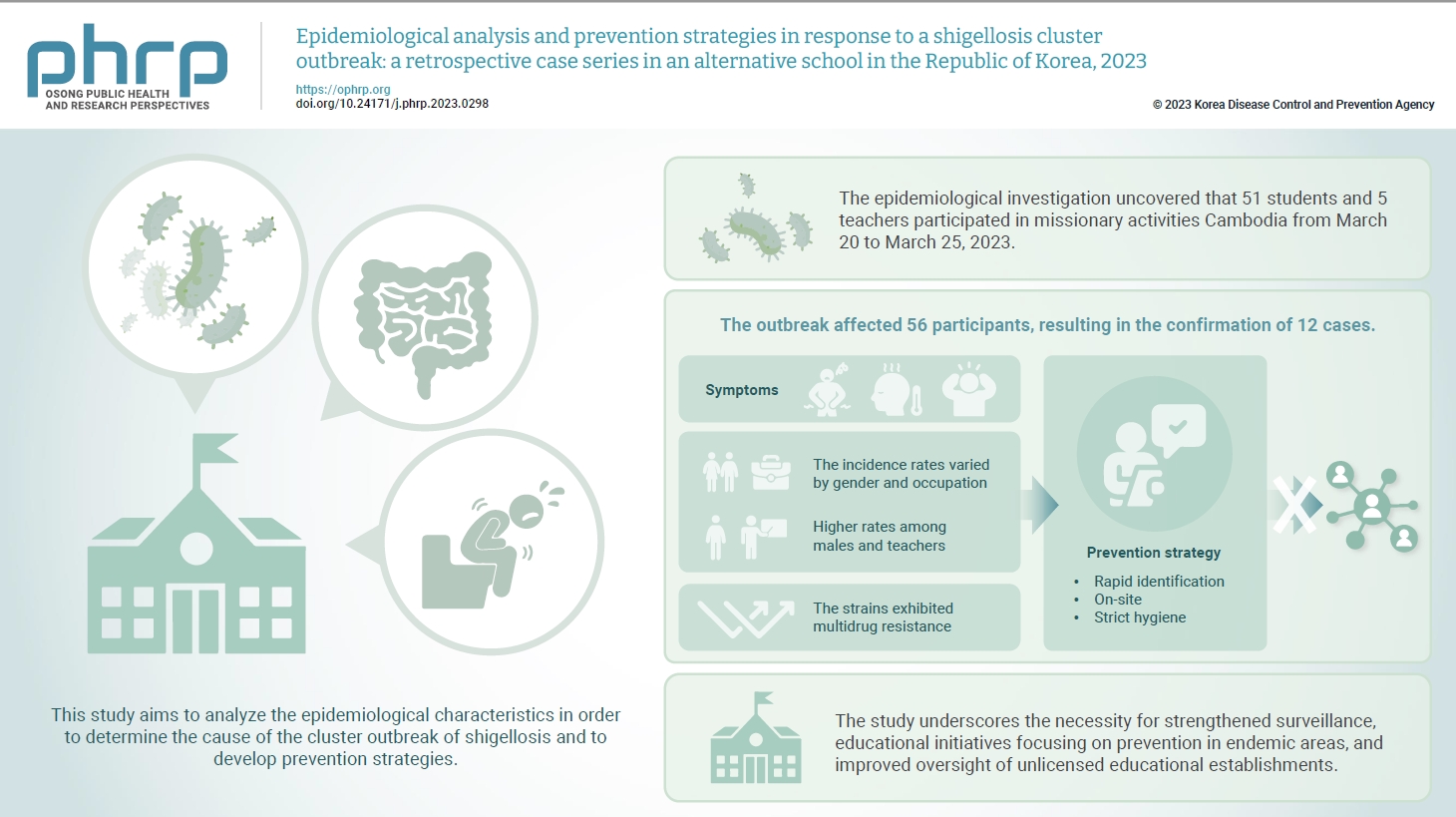
Epidemiological analysis and prevention strategies in response to a shigellosis cluster outbreak: a retrospective case series in an alternative school in the Republic of Korea, 2023
Objectives
In March 2023, an alternative school in the Republic of Korea reported 12 cases of shigellosis. This study aims to analyze the epidemiological characteristics in order to determine the cause of the cluster outbreak of shigellosis and to develop prevention strategies. Methods: This study focused on 12 patients with confirmed Shigella infection and investigated their demographics, clinical features, epidemiology, diagnostics, and antimicrobial susceptibility. Following the identification of Shigella, we conducted follow-up rectal smear cultures to manage patients, implementing isolation and control measures. Results: This study investigated the emergence of multidrug-resistant Shigella following missionary activities in Cambodia, documenting a cluster infection within an alternative school in Daejeon, the Republic of Korea. The outbreak affected 56 participants, resulting in the confirmation of 12 cases. The incidence rates varied by gender and occupation, with higher rates among males and teachers. All 12 cases demonstrated multidrug resistance. Challenges included delayed pathogen confirmation and suboptimal adherence to isolation criteria. The incident prompted revisions in the criteria for isolation release, focusing on symptom resolution. The study underscores the necessity for strengthened surveillance, educational initiatives focusing on prevention in endemic areas, and improved oversight of unlicensed educational establishments. Conclusion: Successful response strategies included swift situation assessment, collaborative efforts, effective infection control measures, and modified criteria for isolation release. Continued surveillance of multidrug-resistant strains is recommended, especially in regions with a high prevalence.

Citations

Citations to this article as recorded by  Crossref logo
  • A One Health Scoping Review of Antimicrobial Resistance in Cambodia: Evidence Mapping and Insights into Klebsiella pneumoniae
    Sao Puth, Chanroth Chhoung, Limmuy Hav, Chandy Rin, Kennarey Seang, Luis Sagaon-Teyssier, Vonthanak Saphonn
    Microorganisms.2026; 14(10): 2161.     CrossRef
  • Shigella flexneri Outbreak at a Rehabilitation Center: First Report from Saudi Arabia
    Khalifa Binkhamis, Sarah Alangari, Fatema Juma, Sahar Althawadi, Ahmed A. Al-Qahtani, Marie Fe F. Bohol, Fatimah S. Alshahrani, Fawzia Alotaibi
    Healthcare.2025; 13(9): 971.     CrossRef
  • 5,456 View
  • 127 Download
  • 1 Web of Science
  • Crossref

Short Communication

Characteristics of a large outbreak arising from a school field trip after COVID-19 restrictions were eased in 2022
Sueng-Jin Kim, Eun-Young Kim, Jeonghee Yu
Osong Public Health Res Perspect 2024;15(1):83-89.
Published online February 5, 2024
DOI: https://doi.org/10.24171/j.phrp.2023.0264
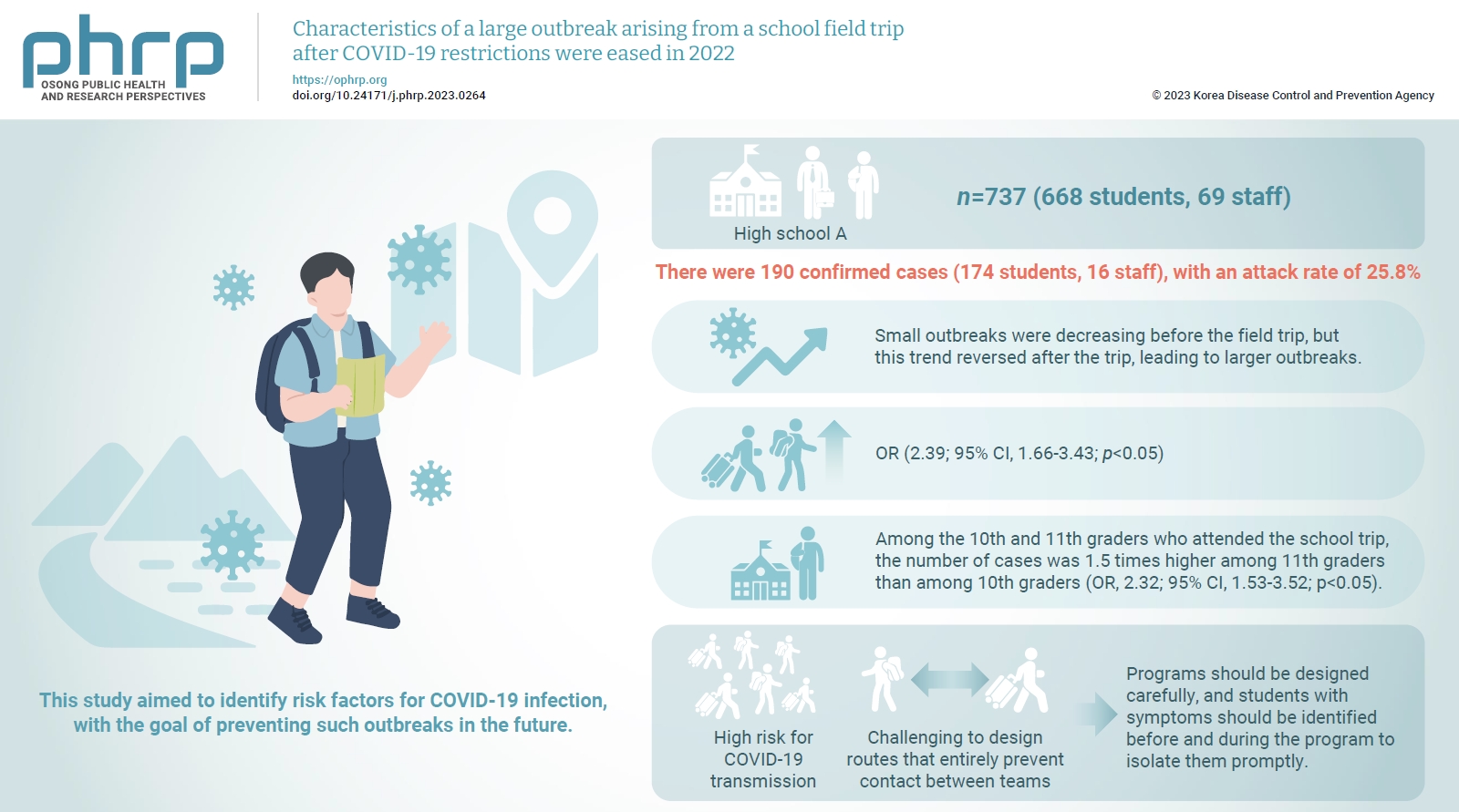
Characteristics of a large outbreak arising from a school field trip after COVID-19 restrictions were eased in 2022
Objectives
This study analyzed a large outbreak of coronavirus disease 2019 (COVID-19) that occurred during a high school field trip in the Jeonbuk region and aimed to identify risk factors for COVID-19 infection, with the goal of preventing such outbreaks in the future. Methods: A retrospective cohort study of 737 participants, including 668 students and 69 staff at High School A, was designed to describe the epidemiological characteristics of this large COVID-19 outbreak. Logistic regression analysis was performed to calculate relative risks (odds ratios [ORs]) and 95% confidence intervals (CIs). Results: There were 190 confirmed cases (174 students, 16 staff), with an attack rate of 25.8%. Small outbreaks were decreasing before the field trip, but this trend reversed after the trip, leading to larger outbreaks. Logistic regression showed an OR of 2.39 (95% CI, 1.66–3.43; p<0.05) for COVID-19 infection among field trip participants. Among them, 11th graders had an OR of 2.32 (95% CI, 1.53–3.52; p<0.05) compared to 10th graders, while no significant risk difference was found within same-grade teams. Conclusion: There was a high risk for COVID-19 transmission during extracurricular activities with a large number of participants, such as field trips, even after the nationwide Omicron variant epidemic subsided. Even when students are separated into teams and follow different routes, it is challenging to design routes that entirely prevent contact between teams. Thus, programs should be designed carefully, and students with symptoms should be identified before and during the program to isolate them promptly.

Citations

Citations to this article as recorded by  Crossref logo
  • Uncommon pathogen, common activity: Streptococcus pneumoniae conjunctivitis outbreak traced to a primary school field trip
    Xiaojian Duan, Xiaobin Ren, Kai Song, Jiayun Wang, Yi Wang, Yuanming Zhang, Li Ren, Liangliang Huo, Jing Wang
    Frontiers in Public Health.2026;[Epub]     CrossRef
  • 3,742 View
  • 67 Download
  • 1 Web of Science
  • Crossref

Original Articles

Risk factors for SARS-CoV-2 transmission during a movie theater outbreak in Incheon in the Republic of Korea, November 2021: a retrospective study
Hye Young Lee, Young-Joon Park, Sang-Eun Lee, Han-Na Yoo, Il-Hwan Kim, Jin Sun No, Eun-Jin Kim, Jungyeon Yu, Sanghwan Bae, Mi Yu
Osong Public Health Res Perspect 2024;15(1):45-55.
Published online January 31, 2024
DOI: https://doi.org/10.24171/j.phrp.2023.0269
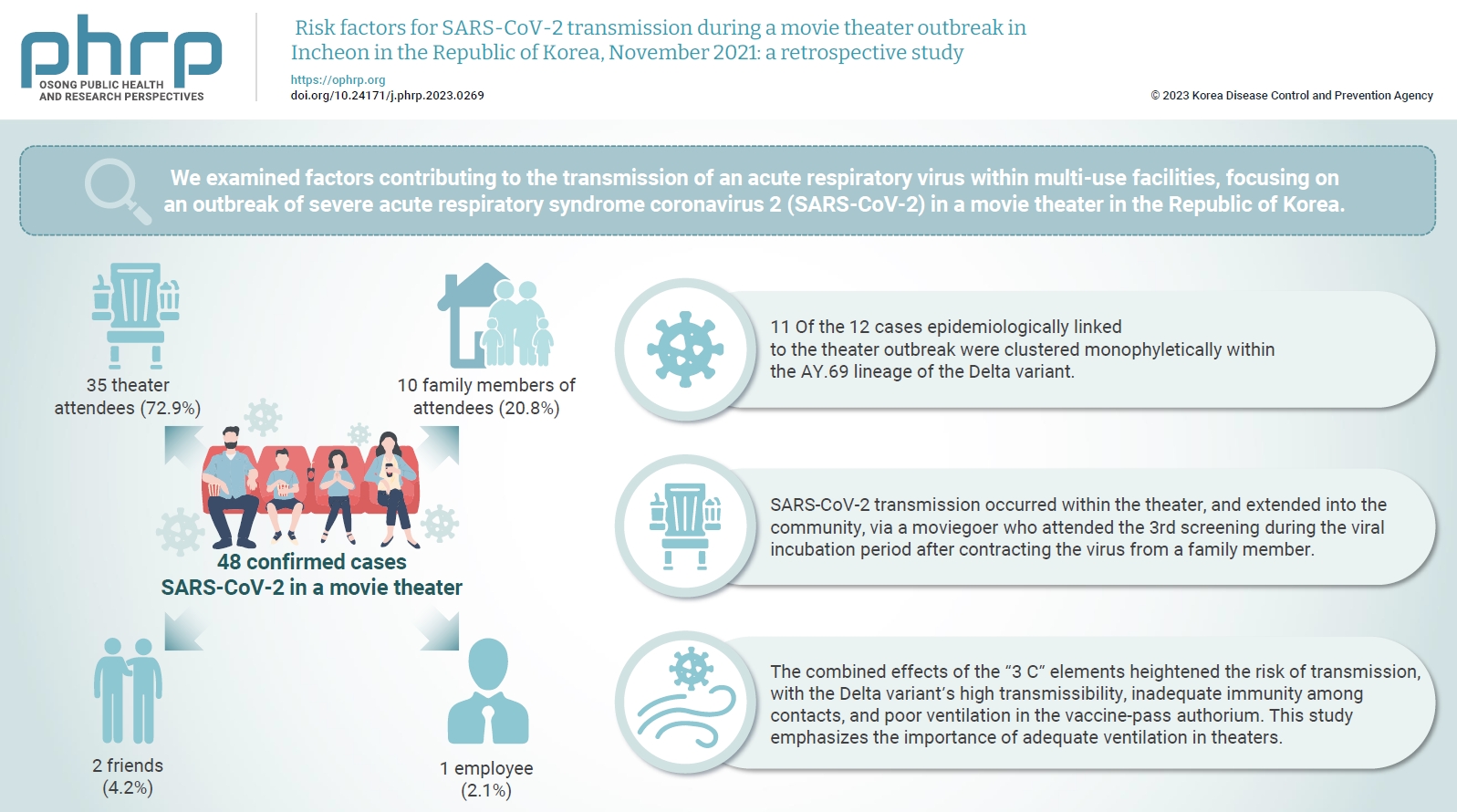
Risk factors for SARS-CoV-2 transmission during a movie theater outbreak in Incheon in the Republic of Korea, November 2021: a retrospective study
Objectives
We examined factors contributing to the transmission of an acute respiratory virus within multi-use facilities, focusing on an outbreak of severe acute respiratory syndrome coronavirus 2 (SARS-CoV-2) in a movie theater in the Republic of Korea. Methods: This retrospective cohort study involved a descriptive analysis of 48 confirmed cases. Logistic regression was applied to a cohort of 80 theater attendees to identify risk factors for infection. The infection source and transmission route were determined through gene sequencing data analysis. Results: Of the 48 confirmed cases, 35 were theater attendees (72.9%), 10 were family members of attendees (20.8%), 2 were friends (4.2%), and 1 was an employee (2.1%). Among the 80 individuals who attended the 3rd to 5th screenings of the day, 35 became infected, representing a 43.8% attack rate. Specifically, 28 of the 33 third-screening attendees developed confirmed SARSCoV-2, constituting an 84.8% attack rate. Furthermore, 11 of the 12 cases epidemiologically linked to the theater outbreak were clustered monophyletically within the AY.69 lineage. At the time of the screening, 35 individuals (72.9%) had received 2 vaccine doses. However, vaccination status did not significantly influence infection risk. Multivariate analysis revealed that close contacts had a 15.9-fold higher risk of infection (95% confidence interval, 4.37–78.39) than casual contacts. Conclusion: SARS-CoV-2 transmission occurred within the theater, and extended into the community, via a moviegoer who attended the 3rd screening during the viral incubation period after contracting the virus from a family member. This study emphasizes the importance of adequate ventilation in theaters.

Citations

Citations to this article as recorded by  Crossref logo
  • Indoor air quality (IAQ) and ventilation efficiency in after-school educational centers in Athens during the post-COVID-19 era
    Constantinos Karamalis, Georgia Maria Markopoulou, Marianna Foteini Dafni, Georgia Kyriakopoulou, Theodora Skreka, Sofia Giannakopoulou, Constantinos Delezos
    Journal of Public Health.2026;[Epub]     CrossRef
  • 18,599 View
  • 418 Download
  • 1 Web of Science
  • Crossref
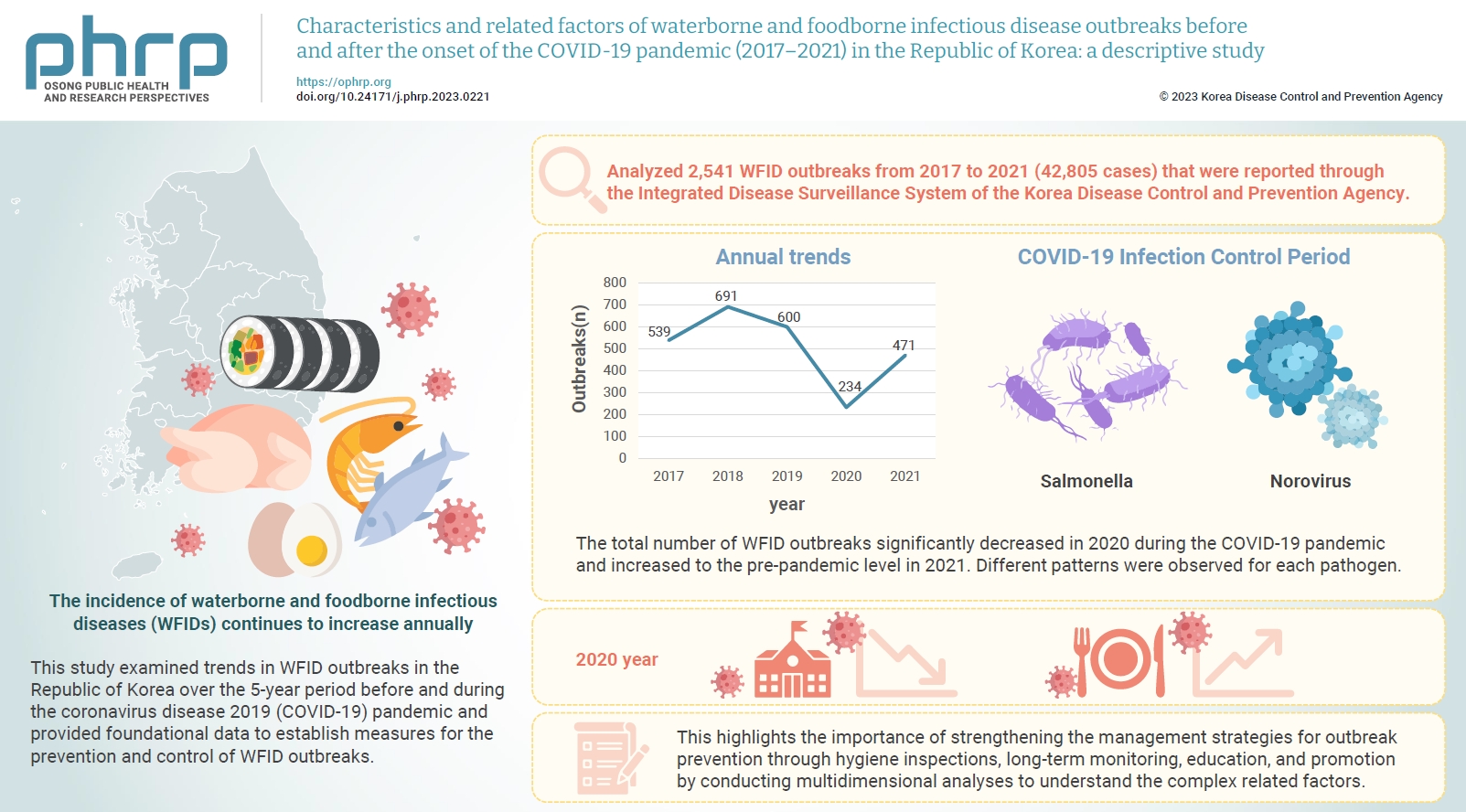
Characteristics and related factors of waterborne and foodborne infectious disease outbreaks before and after the onset of the COVID-19 pandemic (2017–2021) in the Republic of Korea: a descriptive study
Objectives
The incidence of waterborne and foodborne infectious diseases (WFIDs) continues to increase annually, attracting significant global attention. This study examined trends in WFID outbreaks in the Republic of Korea over the 5-year period before and during the coronavirus disease 2019 (COVID-19) pandemic and provided foundational data to establish measures for the prevention and control of WFID outbreaks. Methods: We analyzed 2,541 WFID outbreaks from 2017 to 2021 (42,805 cases) that were reported through the Integrated Disease Surveillance System of the Korea Disease Control and Prevention Agency. Outbreaks were defined as the occurrence of gastrointestinal symptoms in ≥2 individuals within a group with temporal and regional epidemiological associations. The related factors associated with WFID outbreaks during the observation period were statistically analyzed. Results: The total number of WFID outbreaks significantly decreased in 2020 during the COVID-19 pandemic and increased to the pre-pandemic level in 2021. Different patterns were observed for each pathogen. The incidence of Salmonella outbreaks more than doubled, while norovirus outbreaks decreased significantly. Conclusion: WFID outbreaks in the Republic of Korea showed different patterns before and during the COVID-19 pandemic, influenced by infection control measures and changes in dietary consumption patterns. Outbreaks of some diseases increased, but the infection control measures applied during the pandemic resulted in a significant decrease in the overall number of WFID outbreaks. This highlights the importance of strengthening the management strategies for outbreak prevention through hygiene inspections, long-term monitoring, education, and promotion by conducting multidimensional analyses to understand the complex related factors.

Citations

Citations to this article as recorded by  Crossref logo
  • Characteristics of Foodborne Outbreaks and Pathogen Distribution in Busan, 2025
    Sohyun Park
    Journal of Food Hygiene and Safety.2026; 41(3): 199.     CrossRef
  • Foodborne Illness-Related Diagnostic Coding and Healthcare-Utilization Patterns in South Korea, 2023: A Nationwide Claims-Based Descriptive Study
    Seeun Choi, Junjoeng Hwang, Min Sik Choi, Su-Jin Kang, Kiyon Rhew
    Healthcare.2026; 14(16): 2466.     CrossRef
  • Changes in the Epidemiological Trends of Waterborne and Foodborne Bacterial Pathogens in the Republic of Korea: Before and After the COVID-19 Pandemic, 2017–2025
    Mooneui Hong, Eunkyung Shin, Hyun Ju Jeong, Wooju Kang, Yeongeun Seo, Yu-Jin Park, Suyeon Kim, Junyoung Kim
    Journal of Infection and Public Health.2026; : 103402.     CrossRef
  • Advancing Toward a Data-Driven Food Risk Prediction System: Strategic Directions for Preventive Risk Management
    Jun-Hyeok Ham, Yeon-Jung Lee, Yu Jin Na, Soyoung Gwon, Mun-Gi Sohn, Hae-Yeong Kim
    Journal of Food Hygiene and Safety.2025; 40(3): 183.     CrossRef
  • Foodborne disease outbreaks before and during the COVID-19 pandemic in Jiangsu Province, China
    Qianrang Zhu, Wenqi Zong, Yucheng Wu, Ping Fu, Yue Dai
    One Health.2025; 21: 101154.     CrossRef
  • Clinical Characteristics and Antimicrobial Resistance Patterns of Salmonella typhimurium Enteritis in 81 Hospitalized Children: A Single-Center Retrospective Study
    Yaqing Liu, Lihua Xiao, Hangyu Zhu, Sunhe Hu, Yan Peng
    Jundishapur Journal of Microbiology.2025;[Epub]     CrossRef
  • Serotypes and antimicrobial resistance patterns of food-borne Salmonella isolates in the Jiaxing Region, China, from 2020 to 2024
    Xiaoqin Niu, Liping Tu, Qinlong Yu, Binbin Lu, Junhua Tian, Wei Wang, Bailong Hou, Weifeng Shen
    Journal of Global Antimicrobial Resistance.2025; 45: 294.     CrossRef
  • The One Health aspect of climate events with impact on foodborne pathogens transmission
    Igori Balta, Joanne Lemon, Ciara Murnane, Ioan Pet, Teodor Vintila, David McCleery, Todd Callaway, Alastair Douglas, Lavinia Stef, Nicolae Corcionivoschi
    One Health.2024; 19: 100926.     CrossRef
  • 5,402 View
  • 128 Download
  • 7 Web of Science
  • Crossref

Short Communication

Epidemiological characteristics of carbapenemase-producing Enterobacteriaceae outbreaks in the Republic of Korea between 2017 and 2022
Hyoseon Jeong, Junghee Hyun, Yeon-Kyeng Lee
Osong Public Health Res Perspect 2023;14(4):312-320.
Published online August 21, 2023
DOI: https://doi.org/10.24171/j.phrp.2023.0069
Epidemiological characteristics of carbapenemase-producing Enterobacteriaceae outbreaks in the Republic of Korea between 2017 and 2022
Objectives
We aimed to describe the epidemiological characteristics of carbapenemase-producing Enterobacteriaceae (CPE) outbreaks in healthcare settings in the Republic of Korea between 2017 and 2022.
Methods
Under the national notifiable disease surveillance system, we obtained annual descriptive statistics regarding the isolated species, carbapenemase genotype, healthcare facility type, outbreak location and duration, and number of patients affected and recommended interventions. We used epidemiological investigation reports on CPE outbreaks reported to Korea Disease Control and Prevention Agency from June 2017 to September 2022.
Results
Among the 168 reports analyzed, Klebsiella pneumoniae (85.1%) was the most frequently reported species, while K. pneumoniae carbapenemase (KPC, 82.7%) was the most common carbapenemase genotype. Both categories increased from 2017 to 2022 (p<0.01). General hospitals had the highest proportion (54.8%), while tertiary general hospitals demonstrated a decreasing trend (p<0.01). The largest proportion of outbreaks occurred exclusively in intensive care units (ICUs, 44.0%), and the frequency of concurrent outbreaks in ICUs and general wards increased over time (p<0.01). The median outbreak duration rose from 43.5 days before the coronavirus disease 2019 (COVID-19) pandemic (2017–2019) to 79.5 days during the pandemic (2020–2022) (p=0.01), and the median number of patients associated with each outbreak increased from 5.0 to 6.0 (p=0.03). Frequently recommended interventions included employee education (38.1%), and 3 or more measures were proposed for 45.2% of outbreaks.
Conclusion
In the Republic of Korea, CPE outbreaks have been consistently dominated by K. pneumoniae and KPC. The size of these outbreaks increased during the COVID-19 pandemic. Our findings highlight the need for continuing efforts to control CPE outbreaks using a multimodal approach, while considering their epidemiology.

Citations

Citations to this article as recorded by  Crossref logo
  • Microbiological and clinical impact of aminoglycosides on KPC-producing Klebsiella pneumoniae bacteraemia with aminoglycoside-modifying enzymes
    Jae Eun Seong, Sang Min Ahn, Min Han, Yong Seop Lee, Jung Ah Lee, Jae Hoon Kim, Jung Ho Kim, Jin Young Ahn, Su Jin Jeong, Nam Su Ku, Joon Sup Yeom, Hyukmin Lee, Jun Yong Choi
    Diagnostic Microbiology and Infectious Disease.2026; 114(1): 117111.     CrossRef
  • Early prediction of colonization by carbapenemase-producing enterobacterales at ICU admission using machine learning
    Ji Hun Kim, Eunmi Yang, Yun Woo Lee, Han-Sung Kim, Hyeonji Seo
    Scientific Reports.2026;[Epub]     CrossRef
  • Multidrug-resistant organism co-colonization in patients with discordant direct stool Xpert Carba-R and culture-based carbapenemase-producing Enterobacterales surveillance results
    Cheon-Hoo Jun, Si-Ho Kim, Hyoung Tae Kim, Yu Mi Wi
    Journal of Infection and Public Health.2026; 19(5): 103188.     CrossRef
  • Comparison of clinical outcomes of patients with serial negative surveillance cultures according to a subsequent polymerase chain reaction test for carbapenemase-producing Enterobacterales
    H. Seo, S. Kim, Y.W. Lee, H.S. Oh, H-S. Kim, Y.K. Kim
    Journal of Hospital Infection.2024; 146: 93.     CrossRef
  • Identifying Contact Time Required for Secondary Transmission ofClostridioides difficileInfections by Using Real-Time Locating System
    Min Hyung Kim, Jaewoong Kim, Heejin Ra, Sooyeon Jeong, Yoon Soo Park, Dongju Won, Hyukmin Lee, Heejung Kim
    Emerging Infectious Diseases.2024;[Epub]     CrossRef
  • Antimicrobial activity of ceftazidime-avibactam against KPC-2-producing Enterobacterales: a cross-combination and dose-escalation titration study with relebactam and vaborbactam
    Min Seo Kang, Jin Yang Baek, Jae-Hoon Ko, Sun Young Cho, Keon Young Lee, Young Ho Lee, Jinyoung Yang, Tae Yeul Kim, Hee Jae Huh, Nam Yong Lee, Kyungmin Huh, Cheol-In Kang, Doo Ryeon Chung, Kyong Ran Peck, Bobby G. Warren
    Microbiology Spectrum.2024;[Epub]     CrossRef
  • Performance comparison of BD Phoenix CPO detect panel with Cepheid Xpert Carba-R assay for the detection of carbapenemase-producing Klebsiella pneumoniae isolates
    Nazmiye Ülkü Tüzemen, Uğur Önal, Osman Merdan, Bekir Akca, Beyza Ener, Halis Akalın, Cüneyt Özakın
    BMC Microbiology.2024;[Epub]     CrossRef
  • 6,359 View
  • 233 Download
  • 6 Web of Science
  • Crossref

Original Articles

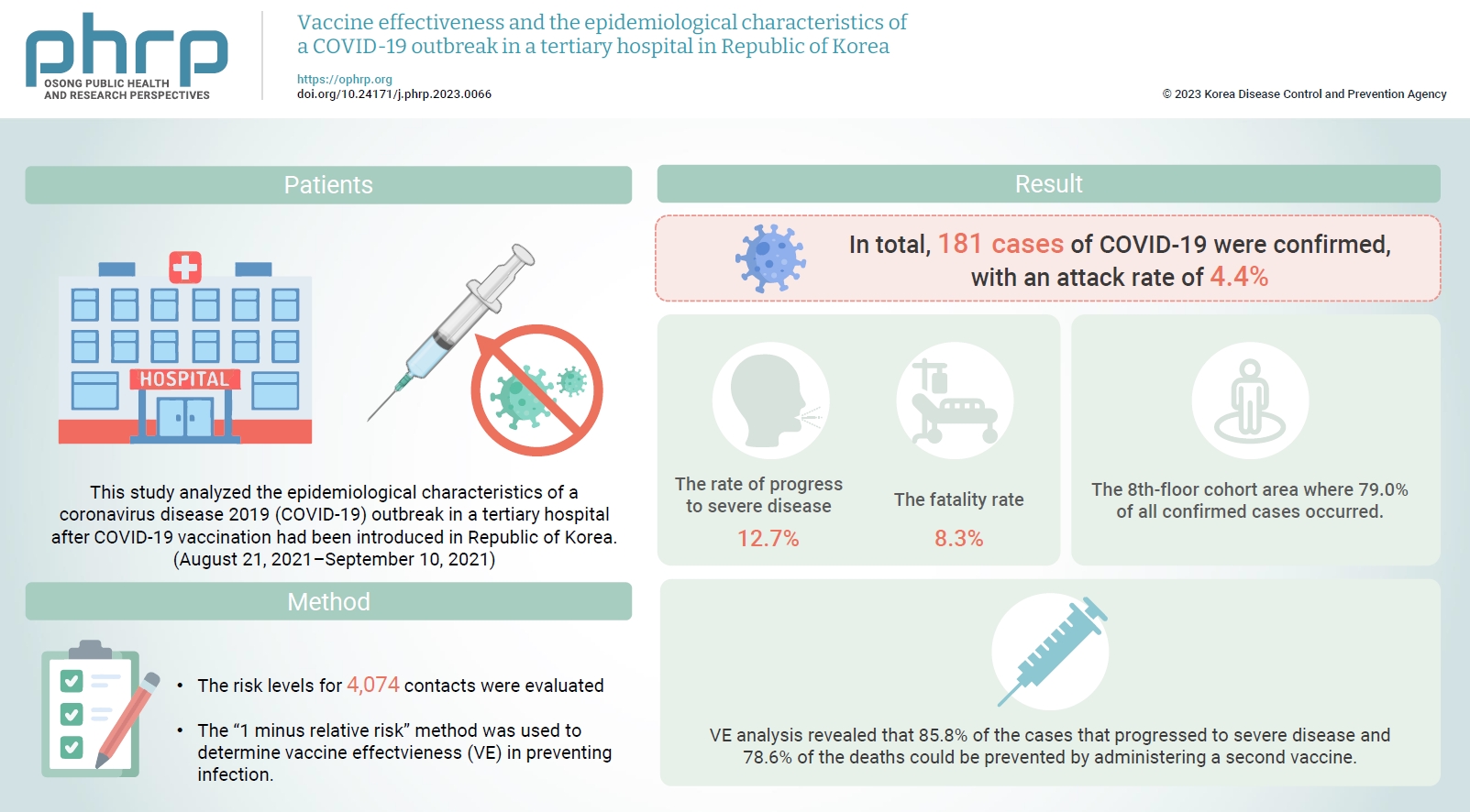
Vaccine effectiveness and the epidemiological characteristics of a COVID-19 outbreak in a tertiary hospital in Republic of Korea
Seonhee Ahn, Tae Jong Son, Yoonsuk Jang, Jihyun Choi, Young Joon Park, Jiseon Seong, Hyun Hee Kwon, Muk Ju Kim, Donghyok Kwon
Osong Public Health Res Perspect 2023;14(3):188-196.
Published online June 8, 2023
DOI: https://doi.org/10.24171/j.phrp.2023.0066
Vaccine effectiveness and the epidemiological characteristics of a COVID-19 outbreak in a tertiary hospital in Republic of Korea
Objectives
Healthcare facilities are high-risk sites for infection. This study analyzed the epidemiological characteristics of a coronavirus disease 2019 (COVID-19) outbreak in a tertiary hospital after COVID-19 vaccination had been introduced in Republic of Korea. Vaccine effectiveness (VE) and shared anti-infection strategies are also assessed.
Methods
The risk levels for 4,074 contacts were evaluated. The epidemiological characteristics of confirmed cases were evaluated using the chi-square test. The “1 minus relative risk” method was used to determine VE in preventing infection, progression to severe disease, and death. In the largest affected area (the 8th floor), a separate relative risk analysis was conducted. A multivariate logistic regression analysis (with 95% confidence interval [CIs]) was used to identify transmission risk factors with a significance level <10% via the backward elimination method.
Results
In total, 181 cases of COVID-19 were confirmed, with an attack rate of 4.4%. Of those cases, 12.7% progressed to severe disease, and 8.3% died. In the cohort isolation area on the 8th floor, where 79.0% of the confirmed cases occurred, the adjusted odds ratio was 6.55 (95% CI, 2.99–14.33) and 2.19 (95% CI, 1.24–3.88) for caregivers and the unvaccinated group, respectively. VE analysis revealed that 85.8% of the cases that progressed to severe disease and 78.6% of the deaths could be prevented by administering a second vaccine.
Conclusion
Caregiver training for infection prevention and control is necessary to reduce infection risk. Vaccination is an important intervention to reduce the risk of progression to severe disease and death.
  • 4,931 View
  • 118 Download
Risk factors for COVID-19 outbreaks in livestock slaughtering and processing facilities in Republic of Korea
Seongju Choi, Tae Jong Son, Yeon-Kyung Lee
Osong Public Health Res Perspect 2023;14(3):207-218.
Published online June 8, 2023
DOI: https://doi.org/10.24171/j.phrp.2023.0035
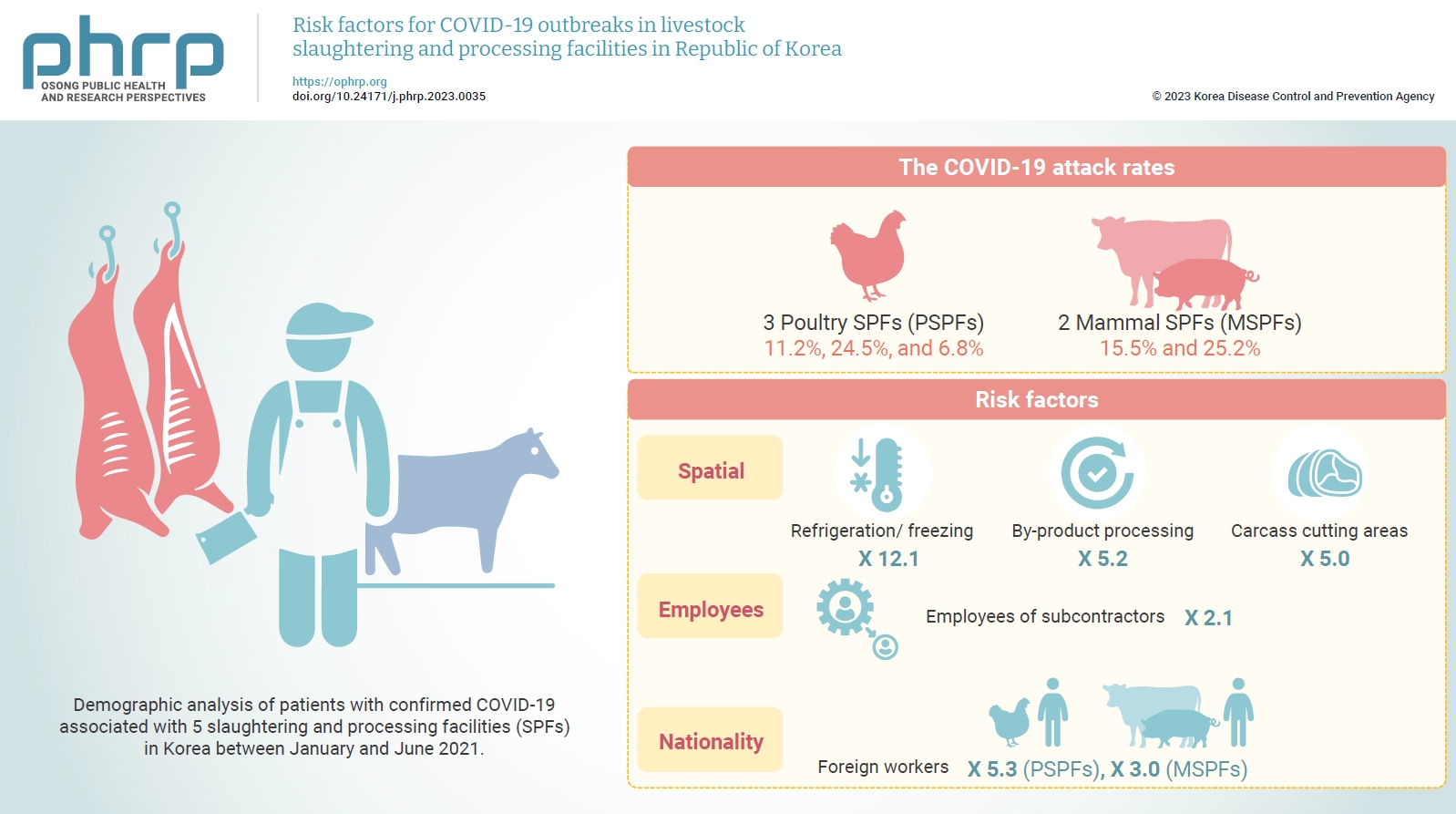
Risk factors for COVID-19 outbreaks in livestock slaughtering and processing facilities in Republic of Korea
Objectives
The goal of this study was to help prevent and control the spread of coronavirus disease 2019 (COVID-19) by identifying transmission routes and risk factors in livestock slaughtering and processing facilities (SPFs) and establishing an optimal intervention strategy for outbreaks.
Methods
This case series study was a demographic analysis of patients with confirmed COVID-19 associated with 5 SPFs in Korea between January and June 2021. Additionally, in a retrospective cohort study, the association between COVID-19 infection and risk factors was analyzed for SPFs at which outbreaks occurred.
Results
The COVID-19 attack rates were 11.2%, 24.5%, and 6.8% at 3 poultry SPFs (PSPFs) and 15.5% and 25.2% at 2 mammal SPFs (MSPFs). Regarding spatial risk factors, the COVID-19 risk levels were 12.1-, 5.2-, and 5.0-fold higher in the refrigeration/ freezing, by-product processing, and carcass cutting areas, respectively, than in the office area. The risk of COVID-19 infection was 2.1 times higher among employees of subcontractors than among employees of contractors. The COVID-19 risk levels were 5.3- and 3.0-fold higher in foreign workers than in native Korean workers in the PSPFs and MSPFs, respectively.
Conclusion
As the COVID-19 pandemic continues, a detailed policy for infectious disease prevention and control intervention is needed, without interrupting economic activities. Thus, we propose an ideal intervention plan to prevent COVID-19 through disinfection and preemptive testing and to block its transmission through effective contact management during outbreaks at SPFs.

Citations

Citations to this article as recorded by  Crossref logo
  • Mitigating COVID-19 in meat processing plants: what have we learned from cluster investigations?
    Pauline Kooh, Yvonnick Guillois, Michel Federighi, Mathilde Pivette, Anne-Laure Maillard, Ngoc-Du Martin Luong, Estelle Chaix
    Frontiers in Public Health.2024;[Epub]     CrossRef
  • 5,495 View
  • 79 Download
  • 1 Web of Science
  • Crossref
COVID-19 outbreak in a religious village community in Republic of Korea and risk factors for transmission
Jiae Shim, Eunju Lee, Eunyoung Kim, Yeonhwa Choi, Giseok Kang, Bryan Inho Kim
Osong Public Health Res Perspect 2023;14(2):110-118.
Published online April 5, 2023
DOI: https://doi.org/10.24171/j.phrp.2023.0002
COVID-19 outbreak in a religious village community in Republic of Korea  and risk factors for transmission
Objectives
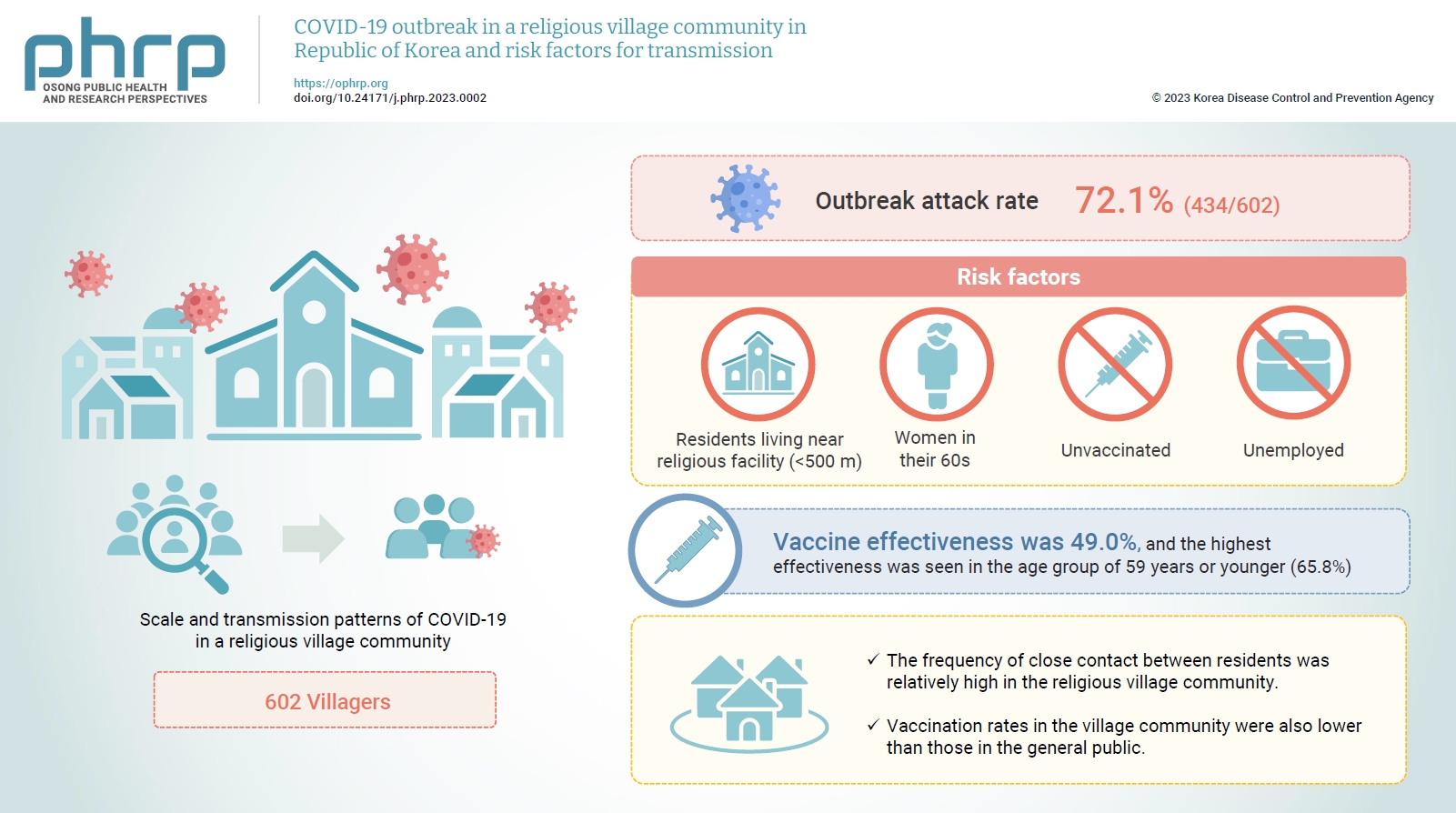
This study aimed to assess the scale and transmission patterns of coronavirus disease 2019 (COVID-19) in a religious village community in South Korea, to determine the risk factors of transmission, and to evaluate vaccine effectiveness.
Methods
An epidemiological survey was conducted, and data were collected and analyzed from 602 villagers in the religious village community. Multivariate logistic regression analysis was used to identify the risk factors for COVID-19 transmission and to evaluate vaccine effectiveness.
Results
The outbreak attack rate was 72.1% (434/602). The attack rate was high among women in their 60s, the unemployed, residents living near religious facility (<500 m), and the unvaccinated. Age, the distance between religious facility and residences, and the absence of vaccination were identified as risk factors for transmission. Vaccine effectiveness was 49.0%, and the highest effectiveness was seen in the age group of 59 years or younger (65.8%).
Conclusion
This village community was isolated, with little communication with the outside world. However, the frequency of close contact between residents was relatively high, contributing to the spread of COVID-19 in the village even with relatively short exposure. Vaccination rates in the village community were also lower than those in the general public. Public health authorities should consider the potential impact of cultural factors, including religion, that could lead to the exponential spread of COVID-19 in closed village communities.

Citations

Citations to this article as recorded by  Crossref logo
  • Impact of disease severity, age, sex, comorbidity, and vaccination on secondary attack rates of SARS-CoV-2: a global systematic review and meta-analysis
    Dewan Md. Sumsuzzman, Yang Ye, Zhen Wang, Abhishek Pandey, Joanne M. Langley, Alison P. Galvani, Seyed M. Moghadas
    BMC Infectious Diseases.2025;[Epub]     CrossRef
  • Quantitative analysis of self-reporting and contact tracing in heterogeneous risk groups: a stochastic modeling study of the COVID-19 outbreak in Daegu, Korea
    Jiwon Han, Eunok Jung
    BMC Public Health.2025;[Epub]     CrossRef
  • Trends of fear and anger on YouTube during the initial stage of the COVID-19 outbreak in South Korea
    Jae-Joon Lee, Jongwoo Kim, Soo-Kyoung Lee
    BMC Public Health.2024;[Epub]     CrossRef
  • 6,238 View
  • 104 Download
  • 3 Web of Science
  • Crossref
The first reported hepatitis E outbreak in a food manufacturing factory: Korea, 2022
Hansol Yeom, Soonryu Seo, Youngsil Yoon, Jaeeun Lee, Myung-Guk Han, Deog-Yong Lee, Sun-Whan Park, Song A Park, Sook-Hyang Jeong, Jin Gwack
Osong Public Health Res Perspect 2023;14(1):15-22.
Published online February 22, 2023
DOI: https://doi.org/10.24171/j.phrp.2022.0305
The first reported hepatitis E outbreak in a food manufacturing factory: Korea, 2022
Objectives
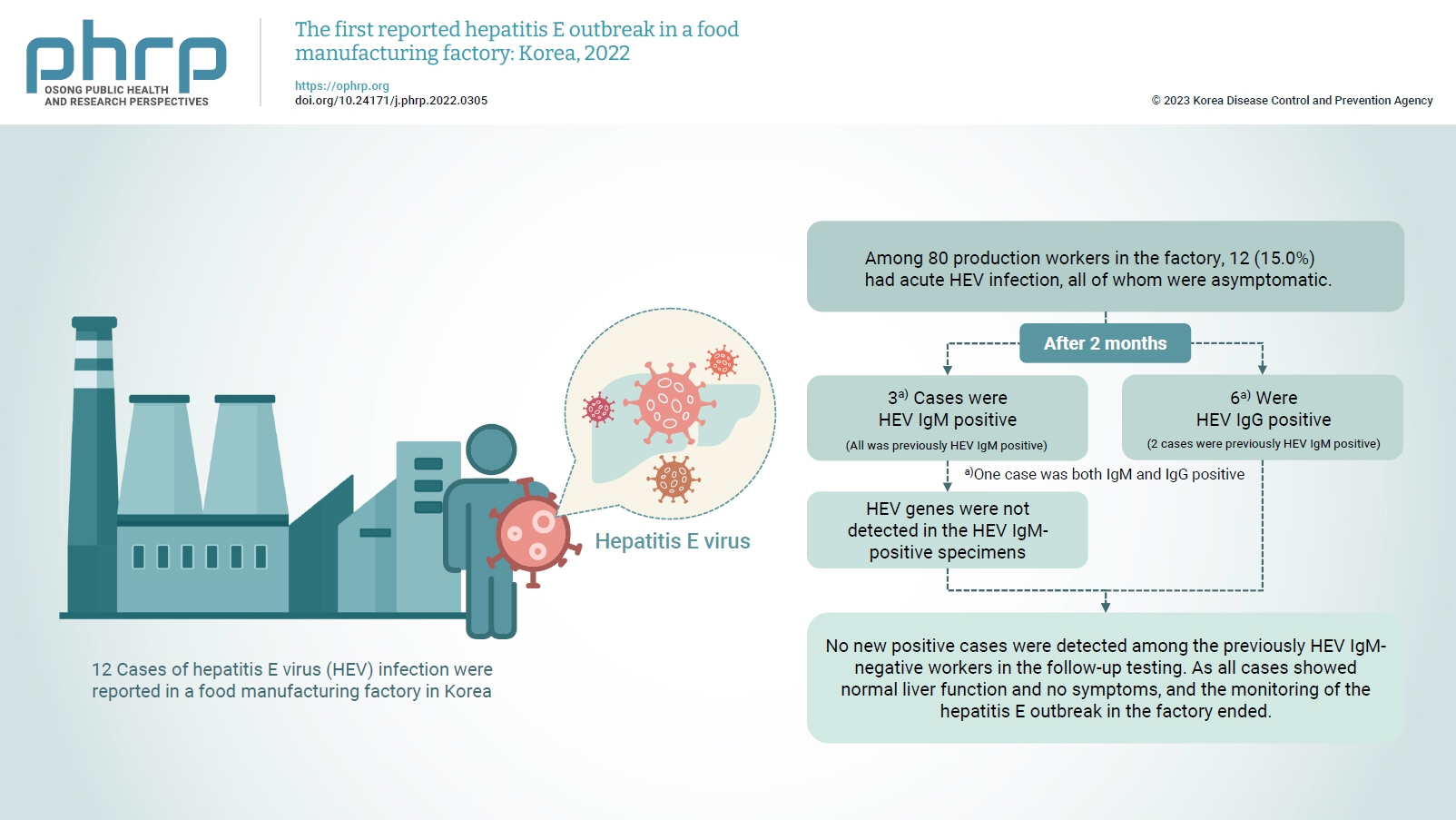
On February 16, 2022, 12 cases of hepatitis E virus (HEV) infection were reported in a food manufacturing factory in Korea. The aim of this study was to identify additional cases and to determine the source of this HEV outbreak. Methods: This study was an in-depth investigation of 12 HEV immunoglobulin M (IgM)-positive cases and their demographic, clinical, and epidemiological characteristics. On-site specimens were collected from the environment and from humans, and a follow-up investigation was conducted 2 to 3 months after the outbreak. Results: Among 80 production workers in the factory, 12 (15.0%) had acute HEV infection, all of whom were asymptomatic. The follow-up investigation showed that 3 cases were HEV IgMpositive, while 6 were HEV IgG-positive. HEV genes were not detected in the HEV IgM-positive specimens. HEV genes were not detected in the food products or environmental specimens collected on-site. HEV was presumed to be the causative pathogen. However, it could not be confirmed that the source of infection was common consumption inside the factory. Conclusion: This was the first domestic case of an HEV infection outbreak in a food manufacturing factory in Korea. Our results provide information for the future control of outbreaks and for the preparation of measures to prevent domestic outbreaks of HEV infection.

Citations

Citations to this article as recorded by  Crossref logo
  • Current global estimates, risk factors, and knowledge gaps for Hepatitis E virus (HEV): A scoping review
    Md Koushik Ahmed, Hanna Maroofi, Madeleine Blunt, Alain Labrique, Carl Kirkwood, Kirsten Vannice, Kawsar R. Talaat, Julia Lynch, Brittany L. Kmush, David Safronetz
    PLOS Neglected Tropical Diseases.2026; 20(3): e0013980.     CrossRef
  • 4,919 View
  • 192 Download
  • 1 Web of Science
  • Crossref

Review Article

SARS-CoV-2 in brief: from virus to prevention
Hassan Karami, Zeinab Karimi, Negin Karami
Osong Public Health Res Perspect 2022;13(6):394-406.
Published online November 28, 2022
DOI: https://doi.org/10.24171/j.phrp.2022.0155
The recent outbreak of severe acute respiratory syndrome coronavirus 2 (SARS-CoV-2), ahighly transmissible virus with a likely animal origin, has posed major and unprecedentedchallenges to millions of lives across the affected nations of the world. This outbreak firstoccurred in China, and despite massive regional and global attempts shortly thereafter, itspread to other countries and caused millions of deaths worldwide. This review presents keyinformation about the characteristics of SARS-CoV-2 and its associated disease (namely,coronavirus disease 2019) and briefly discusses the origin of the virus. Herein, we also brieflysummarize the strategies used against viral spread and transmission.

Citations

Citations to this article as recorded by  Crossref logo
  • Epidemiological surveillance of emerging infectious diseases in sub-Saharan Africa and priorities for strengthening
    Naima Ibrahim Ahmed, Yakub Burhan Abdullahi, Sharmake Gaiye Bashir, Mohamed Sharif Abdi, Marian Muse Osman, Mustafa Yusuf Ahmed, Yusuf Hared Abdi
    Discover Public Health.2026;[Epub]     CrossRef
  • Cytomegalovirus and pneumocystis jirovecii co-infection pneumonia as an initial presentation of HIV infection
    Sharare Noruzi, Sobhan Mehdipourrabori, Zeynab Yassin
    Journal of Medicine, Surgery, and Public Health.2025; 5: 100174.     CrossRef
  • Mpox virus (MPXV): comprehensive analysis of pandemic risks, pathophysiology, treatments, and mRNA vaccine development
    Sajjad Eslamkhah, Elif Sibel Aslan, Cuneyd Yavas, Nermin Akcalı, Lutfiye Karcıoglu Batur, Asmaa Abuaisha, Erva Esma Yildirim, Mustafa Solak, Kenneth N. White
    Naunyn-Schmiedeberg's Archives of Pharmacology.2025; 398(6): 6143.     CrossRef
  • Monkeypox: a re-emergent virus with global health implications – a comprehensive review
    Nourhan G. Naga, Enas A. Nawar, A’laa A. Mobarak, Aya G. Faramawy, Hend M. H. Al-Kordy
    Tropical Diseases, Travel Medicine and Vaccines.2025;[Epub]     CrossRef
  • Marburg Virus Disease: A Narrative Review
    Arash Letafati, Somayeh Sadat Hosseini Fakhr, Ali Qaraee Najafabadi, Negin Karami, Hassan Karami
    Health Science Reports.2025;[Epub]     CrossRef
  • Exploring monkeypox virus antibody levels: insights from human immunological research
    Jing Wu, Xiaomin Zhang
    Virology Journal.2025;[Epub]     CrossRef
  • Novel agents inhibiting the Marburg nucleoprotein using molecular docking, ADMET, MD, and quantum DFT methods
    Haiwang Djefoulna Victorien Hermann, Fifen Jean Jules, Conradie Jeanet
    Discover Applied Sciences.2025;[Epub]     CrossRef
  • Investigating the impact of the number of COVID-19 reinfections, vaccination status, risk factors, and reinfection interval on long COVID symptomatology
    Björn Nicolay, Raquel Gómez Bravo, Djenna Hutmacher, Charles Benoy, Claus Vögele
    Discover Public Health.2025;[Epub]     CrossRef
  • Polysaccharides and Lectins: A Natural Complementary Approach against the SARS-CoV-2 Pandemic
    Radu Lefter, Prairna Balyan, Ioana-Miruna Balmus, Abdellah Ech-Chahad, Ahmad Ali, Alin Ciobica, Antoneta Dacia Petroaie, Gabriela Halitchi, Bogdan Novac, Catalina Ionescu, Fatima Zahra Kamal
    Microbiology Research.2024; 15(2): 525.     CrossRef
  • Risk of COVID-19 transmission on long-haul flights: During the COVID-19 pandemic
    Jiyun Park, Gye jeong Yeom, Poowin Bunyavejchewin
    PLOS ONE.2024; 19(8): e0309044.     CrossRef
  • Effectiveness of donning and doffing personal protective equipment education using video debriefing among Korean undergraduate nursing students
    GyeJeong Yeom, Jiyun Park
    BMC Nursing.2024;[Epub]     CrossRef
  • A Narrative Review on the Pandemic Zoonotic RNA Virus Infections Occurred During the Last 25 Years
    Gobena Ameni, Aboma Zewude, Begna Tulu, Milky Derara, Berecha Bayissa, Temesgen Mohammed, Berhanu Adenew Degefa, Mohamed Elfatih Hamad, Markos Tibbo, Robert Barigye
    Journal of Epidemiology and Global Health.2024; 14(4): 1397.     CrossRef
  • The next viral pandemic: A call for global preparedness
    Hassan Karami, Mina Soleimani, Negar Nayerain Jazi, Kiana Navi, Rojina Sajadi, Mohammad Mehdi Fazeli, Golara Pagheh, Samane Ostadhadi Dehkordi
    Journal of Medicine, Surgery, and Public Health.2024; 4: 100150.     CrossRef
  • Surveillance of endemic coronaviruses during the COVID‐19 pandemic in Iran, 2021–2022
    Hassan Karami, Kaveh Sadeghi, Sevrin Zadheidar, Fatemeh Saadatmand, Negar Mirsalehi, Nima Hoveidi Ardestani, Shirin Kalantari, Mohammad Farahmand, Jila Yavarian, Talat Mokhtari‐Azad
    Influenza and Other Respiratory Viruses.2023;[Epub]     CrossRef
  • 9,965 View
  • 142 Download
  • 12 Web of Science
  • Crossref

Original Articles

A case-control study of acute hepatitis A in South Korea, 2019
Jung Hee Hyun, Ju Young Yoon, Sang Hyuk Lee
Osong Public Health Res Perspect 2022;13(5):352-359.
Published online October 12, 2022
DOI: https://doi.org/10.24171/j.phrp.2022.0141
A case-control study of acute hepatitis A in South Korea, 2019
Objectives
We aimed to reconfirm the source of hepatitis A virus (HAV) infection through epidemiological and genotype investigations of individual cases in a 2019 outbreak in South Korea. Methods: We investigated food intake histories, associations with hepatitis A, and genotypes of HAV in 31 patients with hepatitis aged 20 to 49 years registered in the integrated disease and health management system during December 1–7, 2019 (case group) and in 35 sex- and agematched people without a history of HAV vaccination or infection among patients’ families and colleagues (control group). Results: The consumption of salted clams was a significant factor (odds ratio, 4.33; 95% confidence interval, 1.32–14.18) in the risk factor analysis of food intake history. HAV genotypes were analyzed in 24 of 31 patients. Type IA and type IIIA were found in 23 and 1 cases, respectively. Conclusion: Salted clams are considered to have been the source of HAV infection at 49 weeks of the HAV outbreak in 2019; this result was consistent with that of a previous epidemiological investigation conducted by the Korea Disease Control and Prevention Agency in September 2019. Therefore, monitoring of the production and distribution of salted clams needs to be continued.

Citations

Citations to this article as recorded by  Crossref logo
  • Surto de hepatite A associado ao consumo de alimentos e práticas sexuais: estudo caso-controle, Curitiba, Paraná, 2024
    Janilza Silveira Silva, Renata Barbosa Vilaça Marques de Carvalho, Alcides Souto de Oliveira, Liza Regina Bueno Rosso, Diego Spinoza dos Santos, Leia Regina Silva, Cláudia Weingaertner Palm, Clea Elisa Ribeiro, Katiuska Ferraz Jansen Negrello, Dirlene Pac
    Epidemiologia e Serviços de Saúde.2026;[Epub]     CrossRef
  • Hepatitis A outbreak associated with food consumption and sexual practices: a case-control study, Curitiba, Paraná, 2024
    Janilza Silveira Silva, Renata Barbosa Vilaça Marques de Carvalho, Alcides Souto de Oliveira, Liza Regina Bueno Rosso, Diego Spinoza dos Santos, Leia Regina Silva, Cláudia Weingaertner Palm, Clea Elisa Ribeiro, Katiuska Ferraz Jansen Negrello, Dirlene Pac
    Epidemiologia e Serviços de Saúde.2026;[Epub]     CrossRef
  • Development of a direct whole genome sequencing for hepatitis A virus from serum and analysis of genetic characteristics
    Daseul Yeo, Soontag Jung, Danbi Yoon, Seongwon Hwang, Dong Jae Lim, Songfeng Jin, Jinho Choi, Ki Ho Hong, Changsun Choi
    Scientific Reports.2025;[Epub]     CrossRef
  • Infectious Diseases in an Era of Climate Crisis: Emergence and Resurgence
    Gui Nam Wee, Sunju Kim, Kyuwon Shim, Soojin Jang
    Journal of Environmental Health Sciences.2025; 51(6): 353.     CrossRef
  • Monitoring viruses and beta-lactam resistance genes through wastewater surveillance during a COVID-19 surge in Suwon, South Korea
    Rajendra Singh, Jaewon Ryu, Sung Soo Park, Sungpyo Kim, Keugtae Kim
    Science of The Total Environment.2024; 922: 171223.     CrossRef
  • Prevalence of Enteric Viruses in Raw Seafood Collected from the Retail Shops in Tehran, Iran, 2022–2023
    Golshid Javdani Shahedin, Maryam Yazdanizad, Seyed Davood Mousavi Nasab, Delaram Doroud, Rahman Shokri, Ramin Mazaheri Nezhad Fard
    Iranian Journal of Medical Microbiology.2024; 18(3): 190.     CrossRef
  • Prevalence of foodborne viruses and influenza A virus from poultry processing plants to retailed chickens
    Daseul Yeo, Mengxiao Song, Md. Iqbal Hossain, Soontag Jung, Zhaoqi Wang, Dong Joo Seo, Min Suk Rhee, Changsun Choi
    Frontiers in Sustainable Food Systems.2023;[Epub]     CrossRef
  • A Study on the Detection Rate of Hepatitis A from Gastroenteritis Patients and the Genotype Analysis of Hepatitis A Virus in Busan
    Sun Hee Park, Chanhee Kim, Summi Lee, Jihye Jeong, Junghye Choi, Seung Ju Lee
    Journal of Bacteriology and Virology.2023; 53(2): 74.     CrossRef
  • A Study on the Detection Rate of Hepatitis A from Gastroenteritis Patients and the Genotype Analysis of Hepatitis A Virus in Busan
    Sun Hee Park, Chanhee Kim, Summi Lee, Jihye Jeong, Junghye Choi, Seung Ju Lee
    Journal of Bacteriology and Virology.2023; 53(2): 74.     CrossRef
  • 8,260 View
  • 178 Download
  • 4 Web of Science
  • Crossref
Epidemiological characteristics of varicella outbreaks in the Republic of Korea, 2016–2020
Eun-Young Kim, Chungmin Park, Gyehee Lee, Suyeon Jeong, Jeongsuk Song, Dong-Han Lee
Osong Public Health Res Perspect 2022;13(2):133-141.
Published online April 26, 2022
DOI: https://doi.org/10.24171/j.phrp.2022.0087
Objectives
We described the trends and epidemiological characteristics of varicella outbreaks from 2016 to 2020 in the Republic of Korea. Methods: We investigated variables such as the outbreak setting, age of patients, vaccination status, and lesion count. The collected data were analyzed with the Cochrane-Armitage trend test and Kruskal-Wallis test. These statistical tests were performed using R ver. 4.0.3. Results: The number of varicella outbreaks increased from 2016 to 2018; however, after a slight decrease in the number of outbreaks in 2019, the number fell sharply in 2020. The median size of outbreaks decreased from 8 to 9 cases during 2016−2019 to 6 cases in 2020. The median duration of outbreaks was 18 days during 2016−2017, 28 days in 2018, 29 days in 2019, and 15 days in 2020. Varicella outbreaks occurred most frequently in elementary schools, and vaccination coverage of patients increased from 89.4% in 2016 to 97.2% in 2019. The median age of patients with outbreak-related varicella decreased from 8 years in 2016 to 6 years in 2020. Conclusion: Significant changes were observed in the age of patients with outbreak-related varicella. Ongoing monitoring of varicella outbreaks should be conducted. Further research will be needed to measure the disease burden of varicella and enable evidence-based policy decisions.

Citations

Citations to this article as recorded by  Crossref logo
  • Seasonal Trends of Major Respiratory, Gastrointestinal, and Other Viral Infections in Korea: An Analysis Before, During, and After the Coronavirus Disease 2019 Pandemic
    Su-Kyung Lee, Ji Hyun Kim, Hyun Soo Kim
    Annals of Laboratory Medicine.2026; 46(2): 124.     CrossRef
  • Epidemiological Characteristics and Spatiotemporal Clustering of Varicella in the Border City of Baise, Southwest China, 2010–2024
    Hongyan Tian, Danjie Liang, Zhi Nong, Siyi Huang, Yang Li, Guangzi Qi
    Infection and Drug Resistance.2026; Volume 19: 1.     CrossRef
  • Impacts of relaxed mask policies on COVID-19 epidemics: a modeling study in South Korea
    Jungmi Park, Jaeyoung Ha, Soyeon Chu, Asaph Young Chun, Kyung-Duk Min
    BMC Infectious Diseases.2026;[Epub]     CrossRef
  • Incidence and Risk of Common Vaccine Preventable Diseases among Transplant Recipients in Korea: A Nationwide Population-Based Study (2009–2020)
    Sung Min Lim, Myeongjee Lee, Min Young Kim, Jong Gyun Ahn, Eun Hwa Kim, Seung Min Hahn, Kyong Ihn, Yu Ri Kim, JongHoon Hyun, Su Jin Jeong, Inkyung Jung, Ji-Man Kang
    Infection & Chemotherapy.2026; 58(2): 151.     CrossRef
  • Waning immunity, an age shift, and rising adult burden of varicella after two decades of single-dose vaccination in South Korea
    Seong Yeon Park, Hee Jin Huh, Sungim Choi, Jae-Woo Chung, Yun Jung Chang, Yun Mo Kang
    Vaccine.2026; 94: 129240.     CrossRef
  • Changes in Sero-immunological Status for Infectious Diseases in Solid Organ Transplantation: A 20-Year Single-Center Study in Korea
    Jinyoung Yang, Jae-Hoon Ko, Sanghoon Lee, Dong Hyun Sinn, Jongman Kim, Kyeongman Jeon, Jae Berm Park, Jin-Oh Choi, Wooseong Huh, Yae-Jean Kim, Eun-Suk Kang, Seung Hoo Lee, Min Seo Kang, Kyungmin Huh, Sun Young Cho, Cheol-In Kang, Doo Ryeon Chung, Kyong Ra
    Annals of Laboratory Medicine.2026; 46(6): 721.     CrossRef
  • Epidemiologic Investigation of a Varicella Outbreak in an Elementary School in Gyeonggi Province, Republic of Korea
    Gipyo Sung, Jieun Jang, Kwan Lee
    Children.2025; 12(7): 949.     CrossRef
  • Characteristics of Varicella Breakthrough Cases in Jinhua City, 2016–2024
    Zhi-ping Du, Zhi-ping Long, Meng-an Chen, Wei Sheng, Yao He, Guang-ming Zhang, Xiao-hong Wu, Zhi-feng Pang
    Vaccines.2025; 13(8): 842.     CrossRef
  • Computational exploration of nigerian bioactive compounds as potential inhibitors of septic shock
    Yemisi Elizabeth Asibor, Dayo Felix Latona, Banjo Semire
    Universitas Scientiarum.2025; : 224.     CrossRef
  • A cost benefit analysis of varicella vaccination in South Korea
    Young Hwa Lee, Young June Choe
    Vaccine: X.2024; 19: 100521.     CrossRef
  • The Protective Effectiveness of 2-Dose Varicella Vaccination in Children in Korea: A Case-control Study
    Young Hwa Lee, Young June Choe, Kwan Hong, Yoonsun Yoon, Yun-Kyung Kim
    Pediatric Infectious Disease Journal.2023; 42(8): 719.     CrossRef
  • Epidemiological Characteristics of Varicella Outbreaks — China, 2006–2022
    Miaomiao Wang, Xudong Li, Meiying You, Yuanyuan Wang, Xinyu Liu, Zihan Li, Wenjia Zhao, Zhuojun Jiang, Yuehua Hu, Dapeng Yin
    China CDC Weekly.2023; 5(52): 1161.     CrossRef
  • 9,105 View
  • 149 Download
  • 9 Web of Science
  • Crossref
Objectives
We descriptively reviewed a coronavirus disease 2019 (COVID-19) outbreak at a nursing hospital in Gyeonggi Province (South Korea) and assessed the effectiveness of the first dose of the Oxford-AstraZeneca vaccine in a real-world population. Methods: The general process of the epidemiological investigation included a public health intervention. The relative risk (RR) of vaccinated and unvaccinated groups was calculated and compared to confirm the risk of severe acute respiratory syndrome coronavirus-2 (SARSCoV-2) infection, and vaccine effectiveness was evaluated based on the calculated RR. Results: The population at risk was confined to ward E among 8 wards of Hospital X, where the outbreak occurred. This population comprised 55 people, including 39 patients, 12 nurses, and 4 caregivers, and 19 cases were identified. The RR between the vaccinated and unvaccinated groups was 0.04, resulting in a vaccine effectiveness of 95.3%. The vaccination rate of the nonpatients in ward E was the lowest in the entire hospital, whereas the overall vaccination rate of the combined patient and non-patient groups in ward E was the third lowest. Conclusion: The first dose of the Oxford-AstraZeneca vaccine (ChAdOx1-S) was effective in preventing SARS-CoV-2 infection. To prevent COVID-19 outbreaks in medical facilities, it is important to prioritize the vaccination of healthcare providers.

Citations

Citations to this article as recorded by  Crossref logo
  • Preparing for Future Pandemics: Vaccine Effectiveness Against SARS-CoV-2 Variant in a High-Risk Hospital Environment—A Case Study From Vietnam
    Hien Thi Nguyen, Luong Huy Duong, Thai Quang Pham, Than Huu Dao, Kieu-Anh Thi Nguyen, Huyen Thi Nguyen, Nghia Duy Ngu, Duong Nhu Tran, Kim-Nhung Thi Le, Tung Son Trinh, H. Rogier van Doorn, Florian Vogt, Khanh Cong Nguyen
    Asia Pacific Journal of Public Health.2025; 37(8): 681.     CrossRef
  • COVID-19 Vaccination in Korea: Past, Present, and the Way Forward
    Eliel Nham, Joon Young Song, Ji Yun Noh, Hee Jin Cheong, Woo Joo Kim
    Journal of Korean Medical Science.2022;[Epub]     CrossRef
  • 9,448 View
  • 119 Download
  • 2 Web of Science
  • Crossref

Short Communication

COVID-19 outbreak and risk factors for infection in a taekwondo gym in the Republic of Korea
Seung Hwan Shin, Eonjoo Park, Sookhyun Kim, Minji Jang, Subin Park, Dong-Hwi Kim, Tae Jong Son, Ji-Hyuk Park
Osong Public Health Res Perspect 2022;13(2):162-170.
Published online March 31, 2022
DOI: https://doi.org/10.24171/j.phrp.2021.0295
Objectives
Relatively few studies have assessed risk factors for coronavirus disease 2019 (COVID-19) in public facilities used by children and adolescents. This study presents an analysis of a COVID-19 outbreak that occurred in a taekwondo gym in Korea, predominantly among children and adolescents, with the aim of providing insights on managing COVID-19 outbreaks in similar facilities. Methods: All 108 taekwondo gym students and staff received COVID-19 tests. A survey and closed-circuit television analyses were used to identify risk factors. A univariate analysis was conducted, followed by multivariate logistic regression analysis with backward elimination for variables with a significance level <0.10 in the univariate analysis. Results: COVID-19 was confirmed in 30 of 108 subjects at the taekwondo gym (attack rate, 27.8%). The outbreak started in an adult class student. This student transmitted the virus to the staff, who consequently transmitted the virus to adolescent students. In the univariate analysis, the relative risk for younger age (≤9 years) was 2.14 (95% confidence interval [CI], 1.01–4.54; p=0.054), and that for food consumption inside the gym was 2.12 (95% CI, 1.04–4.30; p=0.048). In the multivariate logistic regression analysis, the odds ratio for younger age was 2.96 (95% CI, 1.07–8.20; p=0.036), and that for food consumption inside the gym was 3.00 (95% CI, 1.10–8.17; p=0.032). Conclusion: Food consumption inside the facility and young age were significant risk factors for COVID-19 transmission in this taekwondo gym. Food consumption should be prohibited in sports facilities, and infection prevention education for young students is also required.

Citations

Citations to this article as recorded by  Crossref logo
  • Causes of COVID-19 Outbreaks During Sports and Exercise: A Systematic Review
    Masaki Machida, Koichi Dai, Itaru Nakamura, Shigeru Inoue
    Sports Medicine.2025; 55(3): 713.     CrossRef
  • The First Outbreak of Novel Coronavirus Disease 2019 (COVID-19) at an Outdoor Camping Site in South Korea, 2020
    Na-Young Kim, Seonhee Ahn, GwangJin Kim, Donghyok Kwon, Young-Joon Park, Sang-Eun Lee
    Journal of Epidemiology.2024; 34(4): 203.     CrossRef
  • Risk evaluation of venue types and human behaviors of COVID-19 outbreaks in public indoor environments: A systematic review and meta-analysis
    Weiwei Huang, Caroline X. Gao, Danting Luo, Yong Wang, Xiaohong Zheng, Cong Liu, Ying Wang, Yuguo Li, Hua Qian
    Environmental Pollution.2024; 341: 122970.     CrossRef
  • Investigating Factors Contributing to the Occurrence of COVID-19 Outbreaks in Athletes in a Scoping Review
    Shuichi KASAMA, Haruyo SAKAKI, Eiko ENDO
    Taiikugaku kenkyu (Japan Journal of Physical Educa.2024; 69: 151.     CrossRef
  • The Risk of SARS-CoV-2 Transmission in Community Indoor Settings: A Systematic Review and Meta-analysis
    Mark Rohit Francis, Saheed Gidado, J Pekka Nuorti
    The Journal of Infectious Diseases.2024;[Epub]     CrossRef
  • Identifying risk factors for COVID-19 cluster infections in schools in the Republic of Korea: a case-control study
    Jihyun Choi, Seongju Choi, Baigu Lee, Young-Joon Park, Sang Eun Lee
    Osong Public Health and Research Perspectives.2024; 15(4): 375.     CrossRef
  • SARS-CoV-2 transmission modes: Why and how contamination occurs around shared meals and drinks?
    Aure Saulnier, Jean-Michel Wendling, Benoit Hermant, Didier Lepelletier
    Food Microbiology.2023; 114: 104297.     CrossRef
  • Risk factors for COVID-19 outbreaks in livestock slaughtering and processing facilities in Republic of Korea
    Seongju Choi, Tae Jong Son, Yeon-Kyung Lee
    Osong Public Health and Research Perspectives.2023; 14(3): 207.     CrossRef
  • Protective facemask-induced facial thermal stress and breathing burden during exercise in gyms
    Qilong Zhong, Jiyun Song, Dachuan Shi, Chung-Hin Dung
    Building and Environment.2023; 244: 110840.     CrossRef
  • 9,208 View
  • 141 Download
  • 10 Web of Science
  • Crossref

Original Articles

Delays in the diagnosis and treatment of tuberculosis during the COVID-19 outbreak in the Republic of Korea in 2020
Jiyeon Yang, Yunhyung Kwon, Jaetae Kim, Yoojin Jang, Jiyeon Han, Daae Kim, Hyeran Jeong, Hyekyung Park, Eunhye Shim
Osong Public Health Res Perspect 2021;12(5):293-303.
Published online September 23, 2021
DOI: https://doi.org/10.24171/j.phrp.2021.0063
Delays in the diagnosis and treatment of tuberculosis during the COVID-19 outbreak in the Republic of Korea in 2020
Objectives
We investigated the impact of the coronavirus disease 2019 (COVID-19) pandemic on tuberculosis (TB) management in the Republic of Korea (ROK).
Methods
This retrospective cross-sectional study used nationwide ROK TB notification data (98,346 cases) from 2017 to 2020. The median time from the onset of TB symptoms to treatment initiation and the compliance rates with the required timing for notification and individual case investigations were measured and compared across periods and regions affected by the COVID-19 epidemic.
Results
TB diagnosis during the COVID-19 pandemic was delayed. The median time to TB treatment initiation (25 days) in 2020 increased by 3 days compared to that of the previous 3 years (22 days) (p<0.0001). In the outbreak in Seoul, Incheon, and Gyeonggi province during August, the time to TB diagnosis was 4 days longer than in the previous 3 years (p=0.0303). In the outbreak in Daegu and Gyeongbuk province from February to March 2020, the compliance rate with the required timing for individual case investigations was 2.2%p points lower than in other areas in 2020 (p=0.0148). For public health centers, the rate was 13%p lower than in other areas (80.3% vs. 93.3%, p=0.0003).
Conclusion
TB diagnoses during the COVID-19 pandemic in the ROK were delayed nationwide, especially for patients notified by public-private mix TB control hospitals. TB individual case investigations were delayed in regional COVID-19 outbreak areas (Daegu and Gyeongbuk province), especially in public health centers. Developing strategies to address this issue will be helpful for sustainable TB management during future outbreaks.

Citations

Citations to this article as recorded by  Crossref logo
  • Risk Factors Associated With Tuberculosis Diagnostic Delay in the Jiangsu Province, China (2011-2021): Spatiotemporal Database Analysis Study
    Yifan Tang, Cheng Chen, Mingming Chen, Kai Wang, Sifan Wang, Yi Lin, Qiao Liu, Chengxiu Ling, Tenglong Li, Limei Zhu
    JMIR Public Health and Surveillance.2026; 12: e80052.     CrossRef
  • Exploring the impact of the COVID-19 pandemic on the social determinants of tuberculosis in Addis Ababa, Ethiopia: a qualitative study
    Yeshewas Abaynew, Ahmed Ali, Girma Taye
    Discover Social Science and Health.2025;[Epub]     CrossRef
  • Trends in epidemiological characteristics of pulmonary tuberculosis among children and youth in Chinese mainland from 2019 to 2024: analysis of national surveillance data
    Eryong Liu, Yun Wang, Fang Yuan, Xichao Ou, Tao Li, Qinglin Meng, Yanlin Zhao
    BMC Public Health.2025;[Epub]     CrossRef
  • Managing Pulmonary Injury in Older Adults with Tuberculosis: The Role of Nursing Interventions
    Qin Zhang, Jing Guo, Haiying Lei, Qingfen Zhang
    Journal of Multidisciplinary Healthcare.2025; Volume 18: 7511.     CrossRef
  • A Review of the Impact of Patent Medicine Vendors in Driving Community Tuberculosis Case Finding in the COVID-19 Pandemic in Nigeria
    Arinze Emmanuel Ajogwu, Onwubiko Iheanyichukwu Samuel, Nnanyelugo Longinus Ochike, Uzoma Chidinma Ajegbo, Chinedu Paschal Maduka
    Matrix Science Medica.2024; 8(2): 33.     CrossRef
  • Tuberculosis: Republic of Korea, 2021
    Jinsoo Min, Hyung Woo Kim, Ju Sang Kim
    Tuberculosis and Respiratory Diseases.2023; 86(1): 67.     CrossRef
  • Prevalence and associated factors of diabetes mellitus among patients with tuberculosis in South Korea from 2011 to 2018: a nationwide cohort study
    Dawoon Jeong, Jeongha Mok, Doosoo Jeon, Hee-Yeon Kang, Hee Jin Kim, Hee-Sun Kim, Jeong Mi Seo, Hongjo Choi, Young Ae Kang
    BMJ Open.2023; 13(3): e069642.     CrossRef
  • Increased Healthcare Delays in Tuberculosis Patients During the First Wave of COVID-19 Pandemic in Korea: A Nationwide Cross-Sectional Study
    Jinsoo Min, Yousang Ko, Hyung Woo Kim, Hyeon-Kyoung Koo, Jee Youn Oh, Yun-Jeong Jeong, Hyeon Hui Kang, Kwang Joo Park, Yong Il Hwang, Jin Woo Kim, Joong Hyun Ahn, Yangjin Jegal, Ji Young Kang, Sung-Soon Lee, Jae Seuk Park, Ju Sang Kim
    Journal of Korean Medical Science.2022;[Epub]     CrossRef
  • Time trend prediction and spatial–temporal analysis of multidrug-resistant tuberculosis in Guizhou Province, China, during 2014–2020
    Wang Yun, Chen Huijuan, Liao Long, Lu Xiaolong, Zhang Aihua
    BMC Infectious Diseases.2022;[Epub]     CrossRef
  • Real-world association of adherence with outcomes and economic burden in patients with tuberculosis from South Korea claims data
    Sun-Hong Kwon, Jin Hyun Nam, Hye-Lin Kim, Hae-Young Park, Jin-Won Kwon
    Frontiers in Pharmacology.2022;[Epub]     CrossRef
  • The Impact of the COVID-19 Pandemic on Tuberculosis Case Notification and Treatment Outcomes in Eswatini
    Hloniphile Victory Masina, I-Feng Lin, Li-Yin Chien
    International Journal of Public Health.2022;[Epub]     CrossRef
  • Trends in incidences of newly notified tuberculosis in Jeju Province, Korea, 2017-2021
    Jinhee Kim, Nam-Hun Kang, Jong-Myon Bae
    Journal of Medicine and Life Science.2022; 19(3): 103.     CrossRef
  • 12,979 View
  • 245 Download
  • 14 Web of Science
  • Crossref
Trends in recent waterborne and foodborne disease outbreaks in South Korea, 2015–2019
Sang Hyuk Lee, Jae-Won Yun, Ji Hee Lee, Yeon Haw Jung, Dong Han Lee
Osong Public Health Res Perspect 2021;12(2):73-79.
Published online April 29, 2021
DOI: https://doi.org/10.24171/j.phrp.2021.12.2.04
Objectives
This study analyzed trends in foodborne and waterborne diseases in South Korea between 2015 and 2019.
Methods
The data consisted of information on outbreaks of waterborne and foodborne infectious diseases reported through the Korea Centers for Disease Control and Prevention (KCDC) system. We analyzed the trends and epidemiological aspects of outbreaks by month, place of occurrence, and causative pathogens in this observational study.
Results
The number of outbreaks has steadily increased over the last 5 years, but the number of cases per outbreak has followed a decreasing trend. Incidence at daycare centers and preschools has been steadily increasing over consecutive years.
Conclusion
The steady number of patients and decreasing number of cases per outbreak, even as the number of outbreaks has been increasing, suggest that the KCDC’s professional management system is operating effectively. It is necessary to continue improving the objectivity and efficiency of the management system and to carefully examine the increasing number of outbreaks in smaller-scale group catering facilities, such as daycare centers and preschools. Outbreaks can be prevented by closely examining those caused by unidentified pathogens and group outbreaks caused by other diseases, identifying problems, and supplementing the management system.

Citations

Citations to this article as recorded by  Crossref logo
  • An epidemiological investigation of foodborne and waterborne disease outbreaks in Fars Province in Iran from 2020 to 2023
    Fatemeh Jafari, Mohammad Mohammadi Abnavi, Yahya Manoochehri, Masoud Ghanbarian, Hamed Karami
    One Health Bulletin.2026; 6(2): 89.     CrossRef
  • Waterborne Diseases in Algeria (2000–2023): Spatiotemporal Trends Analysis and Public Health Determinants
    Aissa Benikdes, Abdelkrim Hazzab, Khaled Korichi, Belaid Fatmi
    Water Environment Research.2026;[Epub]     CrossRef
  • Foodborne Illness-Related Diagnostic Coding and Healthcare-Utilization Patterns in South Korea, 2023: A Nationwide Claims-Based Descriptive Study
    Seeun Choi, Junjoeng Hwang, Min Sik Choi, Su-Jin Kang, Kiyon Rhew
    Healthcare.2026; 14(16): 2466.     CrossRef
  • Epidemiology Study of the Outbreak of Diseases Transmitted through Water and Food in Ardabil Province during the Years 2013-2022
    Abdollah Dargahi, Hamed Zandian, Arezoo Ghayeghi, Helia Gholizadeh, Saeed Amini, Mohammad Jafarzadeh
    The Open Public Health Journal.2025;[Epub]     CrossRef
  • Infectious foodborne disease outbreaks and sporadic cases in Saudi Arabia: A 2017–2023 trend analysis
    Amjad Alfaleh, Abdullah Alkattan, Abrar Alzaher, Khlood Sagor, Saud Almarshoud, Mona H. Ibrahim
    Infectious Diseases Now.2025; 55(5): 105079.     CrossRef
  • 2023–2024년 대구ㆍ경북 수인성 및 식품매개감염병 유행 현황
    슬 구, 숙현 김, 명재 황, 소영 박, 유경 김, 상연 조
    Public Health Weekly Report.2025; 18(24): 875.     CrossRef
  • Characteristics of Gastroenteritis Outbreaks Investigated in Singapore: 2018–2021
    Muhd Tarmidzi Fua’di, Benjamin Er, Sylvester Lee, Pei Pei Chan, Joanna Khoo, Desmond Tan, Huilin Li, Imran Roshan Muhammad, Pream Raj, Lalitha Kurupatham, Vernon Lee, Li Kiang Tan, Joanne Sheot Harn Chan, Angela Li, Kyaw Thu Aung
    International Journal of Environmental Research an.2024; 21(1): 64.     CrossRef
  • 2023년 하절기 수인성ㆍ식품매개감염병 비상방역 체계 운영 결과
    성찬 양, 소연 박, 선경 박, 지수 원, 형준 김, 진선 양
    Public Health Weekly Report.2024; 17(4): 149.     CrossRef
  • Prevalence of Salmonella spp. and Escherichia coli in the feces of free-roaming wildlife throughout South Korea
    Rahman M. Mafizur, Lim Sangjin, Park Y. Chul, Csaba Varga
    PLOS ONE.2024; 19(2): e0281006.     CrossRef
  • Characterization of Salmonella species from poultry slaughterhouses in South Korea: carry-over transmission of Salmonella Thompson ST292 in slaughtering process
    Yewon Cheong, Jun Bong Lee, Se Kye Kim, Jang Won Yoon
    Journal of Veterinary Science.2024;[Epub]     CrossRef
  • Ultrasensitive quantification of pathogens in milliliters of beverage by filtration-based digital LAMP
    Yuhua Yan, Tao Yang, Zisheng Luo, Dong Li, Li Li, Xingyu Lin
    Food Chemistry.2023; 408: 135226.     CrossRef
  • 2022년 하절기 수인성 및 식품매개감염병 비상방역체계 운영결과
    다슬 김, 인호 김, 형준 김, 지애 심, 지수 원, 진 곽
    Public Health Weekly Report.2023; 16(2): 36.     CrossRef
  • The Epidemiological and Clinical Characteristics of the Largest Outbreak of Enterohemorrhagic Escherichia coli in Korea
    Namwoo Heo, Jihee Lee, Yeonkyung Kim, Donghan Lee, Seok-Jae Heo, Yoon Soo Park, Jae-Won Yun, Yong Chan Kim
    Journal of Korean Medical Science.2023;[Epub]     CrossRef
  • Novel next generation sequencing panel method for the multiple detection and identification of foodborne pathogens in agricultural wastewater
    Dong-Geun Park, Joon-Gi Kwon, Eun-Su Ha, Byungcheol Kang, Iseul Choi, Jeong-Eun Kwak, Jinho Choi, Woojung Lee, Seung Hwan Kim, Soon Han Kim, Jeongwoong Park, Ju-Hoon Lee
    Frontiers in Microbiology.2023;[Epub]     CrossRef
  • Survival of murine norovirus and hepatitis A virus in bottled drinking water, strawberries, and oysters
    Ziwei Zhao, Md Iqbal Hossain, Soontag Jung, Zhaoqi Wang, Daseul Yeo, Mengxiao Song, Ae Min, Sunho Park, Changsun Choi
    Food Control.2022; 133: 108623.     CrossRef
  • Trends in gastrointestinal infections before and during non-pharmaceutical interventions in Korea in comparison with the United States
    Soyeoun Kim, Jinhyun Kim, Bo Youl Choi, Boyoung Park
    Epidemiology and Health.2022; 44: e2022011.     CrossRef
  • Molecular Identification of Bacillus Isolated from Korean Water Deer (Hydropotes inermis argyropus) and Striped Field Mouse (Apodemus agrarius) Feces by Using an SNP-Based 16S Ribosomal Marker
    Md-Mafizur Rahman, Sang-Jin Lim, Yung-Chul Park
    Animals.2022; 12(8): 979.     CrossRef
  • Trends in Acute Gastroenteritis through the Pathogen Surveillance System in Incheon Metropolitan City, 2018-2021
    Jung Hee Kim, Sung Min Song, Ju Hee Kim, Soo Min Lim, Su Jin Park, Hwa Jung Nam, Young Woo Gong, Mun Ju Kwon
    Journal of Bacteriology and Virology.2022; 52(2): 54.     CrossRef
  • 11,684 View
  • 238 Download
  • 14 Web of Science
  • Crossref
Alarm Thresholds for Pertussis Outbreaks in Iran: National Data Analysis
Yousef Alimohamadi, Seyed Mohsen Zahraei, Manoochehr Karami, Mehdi Yaseri, Mojtaba Lotfizad, Kourosh Holakouie-Naieni
Osong Public Health Res Perspect 2020;11(5):309-318.
Published online October 22, 2020
DOI: https://doi.org/10.24171/j.phrp.2020.11.5.07
<sec> <title>Objectives</title> <p>The purpose of the current study was to determine the upper threshold number of cases for which pertussis infection would reach an outbreak level nationally in Iran.</p></sec> <sec> <title>Methods</title> <p>Data on suspected cases of pertussis from the 25<sup>th</sup> February 2012 to the 23<sup>rd</sup> March 2018 from the Center for Disease Control and Prevention in Iran was used. The national upper threshold level was estimated using the exponentially weighted moving average (EWMA) method and the Poisson regression method.</p></sec> <sec> <title>Results</title> <p>In total, 2,577 (33.6%) and 1,714 (22.3%) cases were reported in the Spring and Summer respectively. There were 1,417 (18.5%) and 1,971 (25.6%) cases reported in the Autumn and Winter, respectively. The overall upper threshold using the EWMA and the Poisson regression methods, was estimated as a daily occurrence of 8 (7.55) and 7.50 (4.48–11.06) suspected cases per 10,000,000 people, respectively. The daily seasonal thresholds estimated by the EWMA and the Poisson regression methods were 10, 7, 6, 8 cases and 10, 7, 7, 9 cases for the Spring, Summer, Autumn, and Winter, respectively.</p></sec> <sec> <title>Conclusion</title> <p>The overall and seasonal estimated thresholds by the 2 methods were similar. Therefore, the estimated thresholds of 6–10 cases in a day, per 10,000,000 people could be used to detect pertussis outbreaks and epidemics by health policymakers.</p></sec>

Citations

Citations to this article as recorded by  Crossref logo
  • Characteristics, clinical manifestations, and severe disease risk of Bordetella pertussis infection in children: a tNGS-based retrospective study
    Jiangyang Zhao, Lishai Mo, Xiaoying Chen, Junming Lu, Jielin Chen, Guangbing Liu, Cuihong Lu, Xuehua Hu, Qiang Huang, Wenting Tang, Jie Tan, Chunyun Fu
    International Journal of Infectious Diseases.2026; 170: 108941.     CrossRef
  • Burden of pertussis in infants in the Eastern Mediterranean Region and the impact of maternal vaccination: a systematic review
    Randa K. Saad, Yousef Khader, Flor M. Munoz, Faris Lami, Ezzeddine Mohsni, Nadine Haddad
    BMC Public Health.2025;[Epub]     CrossRef
  • Pertussis resurgence in iran: A systematic review and meta-analysis of seroimmunity and diagnostic evidence
    Parvaneh Sadeghimoghadam, Reza Sattarpour, Maryam Noori, Nasim Sattarpour, Ali Afkhaminia, Zeinab Sinaeifar, Amir Naddaf, Zahra Omidi
    BMC Infectious Diseases.2025;[Epub]     CrossRef
  • Immunogenicity and Safety of a Newly Developed Tetanus-Diphtheria Toxoid (Td) in Healthy Korean Adolescents: a Multi-center, Randomized, Double-blind, Active-Controlled Phase 3 Trial
    Ui Yoon Choi, Ki Hwan Kim, Jin Lee, Byung Wook Eun, Hwang Min Kim, Kyung-Yil Lee, Dong Ho Kim, Sang Hyuk Ma, Jina Lee, Jong-Hyun Kim
    Journal of Korean Medical Science.2021;[Epub]     CrossRef
  • 10,648 View
  • 100 Download
  • 4 Web of Science
  • Crossref
2019 Tabletop Exercise for Laboratory Diagnosis and Analyses of Unknown Disease Outbreaks by the Korea Centers for Disease Control and Prevention
Il-Hwan Kim, Jun Hyeong Jang, Su-Kyoung Jo, Jin Sun No, Seung-Hee Seo, Jun-Young Kim, Sang-Oun Jung, Jeong-Min Kim, Sang-Eun Lee, Hye-Kyung Park, Eun-Jin Kim, Jun Ho Jeon, Myung-Min Choi, Boyeong Ryu, Yoon Suk Jang, Hwami Kim, Jin Lee, Seung-Hwan Shin, Hee Kyoung Kim, Eun-Kyoung Kim, Ye Eun Park, Cheon-Kwon Yoo, Sang-Won Lee, Myung-Guk Han, Gi-Eun Rhie, Byung Hak Kang
Osong Public Health Res Perspect 2020;11(5):280-285.
Published online October 22, 2020
DOI: https://doi.org/10.24171/j.phrp.2020.11.5.03
<sec> <title>Objectives</title> <p>The Korea Centers for Disease Control and Prevention has published “A Guideline for Unknown Disease Outbreaks (UDO).” The aim of this report was to introduce tabletop exercises (TTX) to prepare for UDO in the future.</p></sec> <sec> <title>Methods</title> <p>The UDO Laboratory Analyses Task Force in Korea Centers for Disease Control and Prevention in April 2018, assigned unknown diseases into 5 syndromes, designed an algorithm for diagnosis, and made a panel list for diagnosis by exclusion. Using the guidelines and laboratory analyses for UDO, TTX were introduced.</p></sec> <sec> <title>Results</title> <p>Since September 9<sup>th</sup>, 2018, the UDO Laboratory Analyses Task Force has been preparing TTX based on a scenario of an outbreak caused by a novel coronavirus. In December 2019, through TTX, individual missions, epidemiological investigations, sample treatments, diagnosis by exclusions, and next generation sequencing analysis were discussed, and a novel coronavirus was identified as the causal pathogen.</p></sec> <sec> <title>Conclusion</title> <p>Guideline and laboratory analyses for UDO successfully applied in TTX. Conclusions drawn from TTX could be applied effectively in the analyses for the initial response to COVID-19, an ongoing epidemic of 2019 – 2020. Therefore, TTX should continuously be conducted for the response and preparation against UDO.</p></sec>

Citations

Citations to this article as recorded by  Crossref logo
  • Use of a pathogen X tabletop exercise to assess the operational response preparedness of an emerging infectious diseases research network
    Rachael Lee, Jennifer Hemingway-Foday, Nefer Batsuli, L. Danielle Wagner, Aaron Macoubray, Robert F. Garry, Christine K. Johnson, Kathryn A. Hanley, Nikos Vasilakis, Souleymane Mboup, Hongying Li, Cecilia A. Sánchez, Peter M. Rabinowitz, Robert F. Breiman
    Frontiers in Public Health.2025;[Epub]     CrossRef
  • Development and evaluation of the Korea Disease Control and Prevention Agency’s scenario-based training program for effective response to emerging infectious disease outbreaks
    Mi Yu, Eun Kyoung Kim, Kyungnam Kim, Jin Lee, Jin Hwan Jeon, Soyeon Kim, Sangwon Lee, Yunhyung Kwon
    Osong Public Health and Research Perspectives.2025; 16(4): 373.     CrossRef
  • Development and evaluation of a hybrid capture-based NGS panel for comprehensive detection of respiratory pathogens
    Jeong-Ah Kim, Jeong-Min Kim, Chaeyoung Lee, Il-Hwan Kim, Daehwan Lee, Heesoo Lee, Jaehwan Jeong, Eun-Jin Kim
    Scientific Reports.2025;[Epub]     CrossRef
  • Education Needs for Public Health Crisis Using an Importance-Performance Analysis and Borich Needs Assessment Model: Focused on Aircraft Quarantine Officials
    Jiyun Park, Gye Joung Yeom, Seok Hwan Kim
    Research in Community and Public Health Nursing.2025; 36: 361.     CrossRef
  • 10,758 View
  • 153 Download
  • 3 Web of Science
  • Crossref

Brief Reports

Enhancing ‘Whole-of-Government’ Response to Biological Events in Korea: Able Response 2014
Sangwoo Tak, Anton Jareb, Suon Choi, Marvin Sikes, Yeon Hwa Choi, Hyeong-wook Boo
Osong Public Health Res Perspect 2018;9(1):32-35.
Published online December 31, 2017
DOI: https://doi.org/10.24171/j.phrp.2018.9.1.06
<p>Since 2011, the Republic of Korea (ROK) and United States (U.S.) have been collaborating to conduct inter- and intra-governmental exercises to jointly respond to biological events in Korea. These exercises highlight U.S. interest in increasing its global biosurveillance capability and the ROK’s interest in improving cooperation among ministries to respond to crises. With Able Response (AR) exercises, the ROK and U.S. have improved coordination among US and ROK government and defense agencies responding to potential bio-threats and identified additional areas on which to apply refinements in policies and practices. In 2014, the AR exercise employed a Biosurveillance Portal (BSP) to facilitate more effective communication among participating agencies and countries including Australia. In the present paper, we seek to provide a comprehensive assessment of the AR 2014 (AR14) exercise and make recommendations for future improvements. Incorporating a more realistic response in future scenarios by integrating a tactical response episode in the exercise is recommended.</p>

Citations

Citations to this article as recorded by  Crossref logo
  • Artificial intelligence in public health: the potential of epidemic early warning systems
    Chandini Raina MacIntyre, Xin Chen, Mohana Kunasekaran, Ashley Quigley, Samsung Lim, Haley Stone, Hye-young Paik, Lina Yao, David Heslop, Wenzhao Wei, Ines Sarmiento, Deepti Gurdasani
    Journal of International Medical Research.2023;[Epub]     CrossRef
  • Whole of government and whole of society approaches: call for further research to improve population health and health equity
    Flaminia Ortenzi, Robert Marten, Nicole B Valentine, Aku Kwamie, Kumanan Rasanathan
    BMJ Global Health.2022; 7(7): e009972.     CrossRef
  • Biodefence research two decades on: worth the investment?
    Carrie M Long, Andrea Marzi
    The Lancet Infectious Diseases.2021; 21(8): e222.     CrossRef
  • 8,905 View
  • 63 Download
  • Crossref
Emergence of Norovirus GII.17-associated Outbreak and Sporadic Cases in Korea from 2014 to 2015
Sunyoung Jung, Bo-Mi Hwang, HyunJu Jung, GyungTae Chung, Cheon-Kwon Yoo, Deog-Yong Lee
Osong Public Health Res Perspect 2017;8(1):86-90.
Published online February 28, 2017
DOI: https://doi.org/10.24171/j.phrp.2017.8.1.12
<p>Human norovirus are major causative agent of nonbacterial acute gastroenteritis. In general, genogroup (G) II.4 is the most prominent major genotype that circulate in human population and the environment. However, a shift in genotypic trends was observed in Korea in December 2014. In this study, we investigated the trend of norovirus genotype in detail using the database of Acute Diarrhea Laboratory Surveillance (K-EnterNet) in Korea. GII.17 has since become a major contributor to outbreaks of norovirus-related infections and sporadic cases in Korea, although the reason for this shift remain unknown.</p>

Citations

Citations to this article as recorded by  Crossref logo
  • Monitoring of foodborne viruses in pre- and post-washed root vegetables in the Republic of Korea
    Sunho Park, Md Iqbal Hossain, Soontag Jung, Zhaoqi Wang, Daseul Yeo, Seoyoung Woo, Yeeun Seo, Myeong-In Jeong, Changsun Choi
    Food Control.2023; 154: 109982.     CrossRef
  • Epidemiology of Norovirus Outbreaks Reported to the Public Health Emergency Event Surveillance System, China, 2014–2017
    Yiyao Lian, Shuyu Wu, Li Luo, Bin Lv, Qiaohong Liao, Zhongjie Li, Jeanette J. Rainey, Aron J. Hall, Lu Ran
    Viruses.2019; 11(4): 342.     CrossRef
  • Nearly Complete Genome Sequence of a Human Norovirus GII.P17-GII.17 Strain Isolated from Brazil in 2015
    Cristina Santiso-Bellón, Azahara Fuentes-Trillo, Juliana da Silva Ribeiro de Andrade, Carolina Monzó, Susana Vila-Vicent, Roberto Gozalbo Rovira, Javier Buesa, Felipe J. Chaves, Marize Pereira Miagostovich, Jesús Rodríguez-Díaz, Jelle Matthijnssens
    Microbiology Resource Announcements.2019;[Epub]     CrossRef
  • Development of SNP Markers for Norovirus Related FUT2 Gene in Oyster
    守泉 闫
    Hans Journal of Biomedicine.2019; 09(03): 135.     CrossRef
  • Research on the contamination levels of norovirus in food facilities using groundwater in South Korea, 2015–2016
    Jeong Su Lee, In Sun Joo, Si Yeon Ju, Min Hee Jeong, Yun-Hee Song, Hyo Sun Kwak
    International Journal of Food Microbiology.2018; 280: 35.     CrossRef
  • Norovirus GII.17 Associated with a Foodborne Acute Gastroenteritis Outbreak in Brazil, 2016
    Juliana da Silva Ribeiro de Andrade, Tulio Machado Fumian, José Paulo Gagliardi Leite, Matheus Ribeiro de Assis, Alexandre Madi Fialho, Sergio Mouta, Cristiane Mendes Pereira Santiago, Marize Pereira Miagostovich
    Food and Environmental Virology.2018; 10(2): 212.     CrossRef
  • Phylogenetic characterization of norovirus strains detected from sporadic gastroenteritis in Seoul during 2014–2016
    Young Eun Kim, Miok Song, Jaein Lee, Hyun Jung Seung, Eun-Young Kwon, Jinkyung Yu, Youngok Hwang, Taeho Yoon, Tae Jun Park, In Kyoung Lim
    Gut Pathogens.2018;[Epub]     CrossRef
  • The prevalence of non-GII.4 norovirus genotypes in acute gastroenteritis outbreaks in Jinan, China
    Lanzheng Liu, Hengyun Guan, Ying Zhang, Chunrong Wang, Guoliang Yang, Shiman Ruan, Huailong Zhao, Xiuyun Han, Adriana Calderaro
    PLOS ONE.2018; 13(12): e0209245.     CrossRef
  • 7,546 View
  • 52 Download
  • Crossref
Occurrence of Norovirus GII.4 Sydney Variant-related Outbreaks in Korea
Sunyoung Jung, Bo-Mi Hwang, Hyun Ju Jeong, Gyung Tae Chung, Cheon-Kwon Yoo, Yeon-Ho Kang, Deog-Yong Lee
Osong Public Health Res Perspect 2015;6(5):322-326.
Published online October 31, 2015
DOI: https://doi.org/10.1016/j.phrp.2015.10.004
Human noroviruses are major causative agents of food and waterborne outbreaks of nonbacterial acute gastroenteritis. In this study, we report the epidemiological features of three outbreak cases of norovirus in Korea, and we describe the clinical symptoms and distribution of the causative genotypes. The incidence rates of the three outbreaks were 16.24% (326/2,007), 4.1% (27/656), and 16.8% (36/214), respectively. The patients in these three outbreaks were affected by acute gastroenteritis. These schools were provided unheated food from the same manufacturing company. Two genotypes (GII.3 and GII.4) of the norovirus were detected in these cases. Among them, major causative strains of GII.4 (Hu-jeju-47-2007KR-like) were identified in patients, food handlers, and groundwater from the manufacturing company of the unheated food. In the GII.4 (Hu-jeju-47-2007KR-like) strain of the norovirus, the nucleotide sequences were identical and identified as the GII.4 Sydney variant. Our data suggests that the combined epidemiological and laboratory results were closely related, and the causative pathogen was the GII.4 Sydney variant strain from contaminated groundwater.

Citations

Citations to this article as recorded by  Crossref logo
  • A systematic review and meta-analysis indicates a substantial burden of human noroviruses in shellfish worldwide, with GII.4 and GII.2 being the predominant genotypes
    Yijing Li, Liang Xue, Junshan Gao, Weicheng Cai, Zilei Zhang, Luobing Meng, Shuidi Miao, Xiaojing Hong, Mingfang Xu, Qingping Wu, Jumei Zhang
    Food Microbiology.2023; 109: 104140.     CrossRef
  • Molecular epidemiology of norovirus infections in children with acute gastroenteritis in 2017–2019 in Tianjin, China
    Yulian Fang, Yanzhi Zhang, Hong Wang, Ouyan Shi, Wei Wang, Mengzhu Hou, Lu Wang, Jinying Wu, Yu Zhao
    Journal of Medical Virology.2022; 94(2): 616.     CrossRef
  • Assessment of potential infectivity of human norovirus in the traditional Korean salted clam product “Jogaejeotgal” by floating electrode-dielectric barrier discharge plasma
    Eun Bi Jeon, Man-Seok Choi, Ji Yoon Kim, Eun Ha Choi, Jun Sup Lim, Jinsung Choi, Kwang Soo Ha, Ji Young Kwon, Sang Hyeon Jeong, Shin Young Park
    Food Research International.2021; 141: 110107.     CrossRef
  • Characterizing the effects of thermal treatment on human norovirus GII.4 viability using propidium monoazide combined with RT-qPCR and quality assessments in mussels
    Eun Bi Jeon, Man-Seok Choi, Ji Yoon Kim, Kwang Soo Ha, Ji Young Kwon, Sung Hyeon Jeong, Hee Jung Lee, Yeoun Joong Jung, Ji-Hyoung Ha, Shin Young Park
    Food Control.2020; 109: 106954.     CrossRef
  • Molecular epidemiology of genogroup II norovirus infections in acute gastroenteritis patients during 2014–2016 in Pudong New Area, Shanghai, China
    Caoyi Xue, Lifeng Pan, Weiping Zhu, Yuanping Wang, Huiqin Fu, Chang Cui, Lan Lu, Sun Qiao, Biao Xu
    Gut Pathogens.2018;[Epub]     CrossRef
  • Review: Epidemiological evidence of groundwater contribution to global enteric disease, 1948–2015
    Heather M. Murphy, Morgan D. Prioleau, Mark A. Borchardt, Paul D. Hynds
    Hydrogeology Journal.2017; 25(4): 981.     CrossRef
  • Change in Concentrations of Human Norovirus and Male-Specific Coliphage under Various Temperatures, Salinities, and pH Levels in Seawater
    Poong Ho Kim, Yong Soo Park, Kunbawui Park, Ji Young Kwon, Hong Sik Yu, Hee Jung Lee, Ji Hoe Kim, Tae Seek Lee
    Korean Journal of Fisheries and Aquatic Sciences.2016; 49(4): 454.     CrossRef
  • Norovirus outbreaks occurred in different settings in the Republic of Korea
    Hae-Wol Cho, Chaeshin Chu
    Osong Public Health and Research Perspectives.2015; 6(5): 281.     CrossRef
  • 6,037 View
  • 31 Download
  • Crossref
Ebola Hemorrhagic Fever and the Current State of Vaccine Development
Joo Eun Hong, Kee-Jong Hong, Woo Young Choi, Won-Ja Lee, Yeon Hwa Choi, Chung-Hyeon Jeong, Kwang-il Cho
Osong Public Health Res Perspect 2014;5(6):378-382.
Published online December 31, 2014
DOI: https://doi.org/10.1016/j.phrp.2014.09.006
Current Ebola virus outbreak in West Africa already reached the total number of 1,323 including 729 deaths by July 31st. the fatality is around 55% in the southeastern area of Guinea, Sierra Leone, Liberia, and Nigeria. The number of patients with Ebola Hemorrhagic Fever (EHF) was continuously increasing even though the any effective therapeutics or vaccines has not been developed yet. The Ebola virus in Guinea showed 98% homology with Zaire Ebola Virus.Study of the pathogenesis of Ebola virus infection and assess of the various candidates of vaccine have been tried for a long time, especially in United States and some European countries. Even though the attenuated live vaccine and DNA vaccine containing Ebola viral genes were tested and showed efficacy in chimpanzees, those candidates still need clinical tests requiring much longer time than the preclinical development to be approved for the practical treatment.It can be expected to eradicate Ebola virus by a safe and efficient vaccine development similar to the case of smallpox virus which was extinguished from the world by the variola vaccine.

Citations

Citations to this article as recorded by  Crossref logo
  • Recent developments and strategies of Ebola virus vaccines
    Ashish Ranjan Sharma, Yeon-Hee Lee, Sudarshini Nath, Sang-Soo Lee
    Current Opinion in Pharmacology.2021; 60: 46.     CrossRef
  • Predictive Effects of Novelty Measured by Temporal Embeddings on the Growth of Scientific Literature
    Jiangen He, Chaomei Chen
    Frontiers in Research Metrics and Analytics.2018;[Epub]     CrossRef
  • Social network analysis and modeling of cellphone-based syndromic surveillance data for Ebola in Sierra Leone
    Jia B. Kangbai
    Asian Pacific Journal of Tropical Medicine.2016; 9(9): 851.     CrossRef
  • El desarrollo de nuevas vacunas
    Fernando González-Romo, Juan J. Picazo
    Enfermedades Infecciosas y Microbiología Clínica.2015; 33(8): 557.     CrossRef
  • Out of Africa, Into Global Health Security Agenda
    Hae-Wol Cho, Chaeshin Chu
    Osong Public Health and Research Perspectives.2014; 5(6): 313.     CrossRef
  • 6,838 View
  • 30 Download
  • Crossref
Original Articles
Emerging Pathogens and Vehicles of Food- and Water-borne Disease Outbreaks in Korea, 2007–2012
Shinje Moon, Il-Woong Sohn, Yeongseon Hong, Hyungmin Lee, Ji-Hyuk Park, Geun-Yong Kwon, Sangwon Lee, Seung-Ki Youn
Osong Public Health Res Perspect 2014;5(1):34-39.
Published online February 28, 2014
DOI: https://doi.org/10.1016/j.phrp.2013.12.004
Objectives
Food- and water-borne disease outbreaks (FBDOs) are an important public health problem worldwide. This study investigated the trends in FBDOs in Korea and established emerging causal pathogens and causal vehicles.
Methods
We analyzed FBDOs in Korea by year, location, causal pathogens, and causal vehicles from 2007 to 2012. Information was collected from the FBDOs database in the Korean Centers for Disease Control and Prevention.
Results
During 2007–2012, a total of 1794 FBDOs and 48,897 patients were reported. After 2007, FBDOs and patient numbers steadily decreased over the next 2 years and then plateaued until 2011. However, in 2012, FBDOs increased slightly accompanied by a large increase in the number of affected patients. Our results highlight the emergence of norovirus and pathogenic <i>Escherichia coli</i> other than enterohemorrhagic <i>E. coli</i> (EHEC) in schools in 2012. We found that pickled vegetables is an emerging causal vehicle responsible for this problem.
Conclusion
On the basis of this study we recommend intensified inspections of pickled vegetable manufacturers and the strengthening of laboratory surveillance of relevant pathogens.

Citations

Citations to this article as recorded by  Crossref logo
  • Exploring Foodborne Disease Outbreaks in Iran (2000-2023): Trends, Pathogens, and the Impact of Animal-Origin Foods
    Zahra Qadiry, Mohammadreza Mohammadian, Mohammadreza Rezaeigolestani
    Journal of Human Environment and Health Promotion.2025; 11(4): 201.     CrossRef
  • Measures for preventing norovirus outbreaks on campus in economically underdeveloped areas and countries: evidence from rural areas in Western China
    Huali Xiong, Fengxun Ma, Dayi Tang, Daiqiang Liu
    Frontiers in Public Health.2024;[Epub]     CrossRef
  • Phage biocontrol of zoonotic food-borne pathogen Vibrio parahaemolyticus for seafood safety
    Jung Hyen Lee, Minjin Oh, Byoung Sik Kim
    Food Control.2023; 144: 109334.     CrossRef
  • Vibrio-infecting bacteriophages and their potential to control biofilm
    Ana Cevallos-Urena, Jeong Yeon Kim, Byoung Sik Kim
    Food Science and Biotechnology.2023; 32(12): 1719.     CrossRef
  • Antibiotic Resistance Profiles of Bacteria Isolated from Hotspot Environments in Bahir Dar City, Northwestern Ethiopia
    Kindu Geta, Mulugeta Kibret
    Journal of Multidisciplinary Healthcare.2022; Volume 15: 1403.     CrossRef
  • Inhibitory Effects of Crude Fucoidan Extract from Hizikia fusiformis against Norovirus Causing Foodborne Disease
    Hyojin Kim, Mi Sook Chung
    Korean Journal of Food and Cookery Science.2018; 34(5): 519.     CrossRef
  • High level of drug resistance by gram-negative bacteria from selected sewage polluted urban rivers in Addis Ababa, Ethiopia
    Teshome Belachew, Amete Mihret, Tesfaye Legesse, Yihenew Million, Kassu Desta
    BMC Research Notes.2018;[Epub]     CrossRef
  • Inhibitory Effects of Allium chinense and Its Dimethyl Disulfide against Murine Norovirus as a Surrogate for Foodborne Virus
    Mi Sook Chung
    Korean Journal of Food and Cookery Science.2018; 34(2): 222.     CrossRef
  • Inactivation of norovirus surrogates by kimchi fermentation in the presence of black raspberry
    Garam Bae, Jeongwon Kim, Hyojin Kim, Jong Hyeon Seok, Dan Bi Lee, Kyung Hyun Kim, Mi Sook Chung
    Food Control.2018; 91: 390.     CrossRef
  • Metagenomic Sequencing for Surveillance of Food- and Waterborne Viral Diseases
    David F. Nieuwenhuijse, Marion P. G. Koopmans
    Frontiers in Microbiology.2017;[Epub]     CrossRef
  • Prevalence, antimicrobial resistance and multiple-locus variable-number tandem-repeat analysis profiles of diarrheagenic Escherichia coli isolated from different retail foods
    Lili Wang, Hiromi Nakamura, Eriko Kage-Nakadai, Yukiko Hara-Kudo, Yoshikazu Nishikawa
    International Journal of Food Microbiology.2017; 249: 44.     CrossRef
  • Complete genome sequence ofVibrio parahaemolyticusFORC_023 isolated from raw fish storage water
    Han Young Chung, Eun Jung Na, Kyu-Ho Lee, Sangryeol Ryu, Hyunjin Yoon, Ju-Hoon Lee, Hyeun Bum Kim, Heebal Kim, Sang Ho Choi, Bong-Soo Kim, David Rasko
    Pathogens and Disease.2016; 74(4): ftw032.     CrossRef
  • An outbreak of norovirus infection associated with fermented oyster consumption in South Korea, 2013
    H. G. CHO, S. G. LEE, M. Y. LEE, E. S. HUR, J. S. LEE, P. H. PARK, Y. B. PARK, M. H. YOON, S. Y. PAIK
    Epidemiology and Infection.2016; 144(13): 2759.     CrossRef
  • Molecular epidemiology of norovirus in South Korea
    Sung-Geun Lee, Han-Gil Cho, Soon-Young Paik
    BMB Reports .2015; 48(2): 61.     CrossRef
  • Three Gastroenteritis Outbreaks in South Korea Caused by the Consumption of Kimchi Tainted by Norovirus GI.4
    Ji-Hyuk Park, Sunyoung Jung, Jaeseung Shin, Jeong Su Lee, In Sun Joo, Deog-Yong Lee
    Foodborne Pathogens and Disease.2015; 12(3): 221.     CrossRef
  • Environmental monitoring of bacterial contamination and antibiotic resistance patterns of the fecal coliforms isolated from Cauvery River, a major drinking water source in Karnataka, India
    Sinosh Skariyachan, Arpitha Badarinath Mahajanakatti, Nisha Jayaprakash Grandhi, Akshatha Prasanna, Ballari Sen, Narasimha Sharma, Kiran S Vasist, Rajeswari Narayanappa
    Environmental Monitoring and Assessment.2015;[Epub]     CrossRef
  • Detection of viable murine norovirus using the plaque assay and propidium-monoazide-combined real-time reverse transcription-polymerase chain reaction
    Minhwa Lee, Dong Joo Seo, Jina Seo, Hyejin Oh, Su Been Jeon, Sang-Do Ha, Jinjong Myoung, In-Soo Choi, Changsun Choi
    Journal of Virological Methods.2015; 221: 57.     CrossRef
  • Emergence of Norovirus GII.4 variants in acute gastroenteritis outbreaks in South Korea between 2006 and 2013
    Han-Gil Cho, Po-Hyun Park, Sung-Geun Lee, Ju-Eun Kim, Kyung-A Kim, Hyeun-Kyong Lee, Eun-Mi Park, Myong-Ki Park, Sun-Young Jung, Deog-Yong Lee, Mi-hye Yoon, Jong-Bok Lee, Soon-Young Paik
    Journal of Clinical Virology.2015; 72: 11.     CrossRef
  • 5,986 View
  • 40 Download
  • Crossref
The First Outbreak of Giardiasis with Drinking Water in Korea
Hyeng-Il Cheun, Cheon-Hyeon Kim, Shin-Hyeong Cho, Da-Won Ma, Bo-La Goo, Mun-Su Na, Seung-Ki Youn, Won-Ja Lee
Osong Public Health Res Perspect 2013;4(2):89-92.
Published online April 30, 2013
DOI: https://doi.org/10.1016/j.phrp.2013.03.003
Objectives
To identify the pathogen of the diarrhea outbreak in a village in Jeollabuk province in Korea in April 2010.
Methods
DNA extraction was performed from the 120 L of collected water, which was centrifuged at 10,000 x g for 30 min. PCR reactions were conducted in a total of 25 ul, which included PCR premix (GenDEPOT, Barker, TX, USA), 2 ul (∼100 ng) of extracted DNA, and 10 pmol of each primer.
Results
Nine people out of 25 had a symptom of abdominal pain accompanied by diarrhea after they used stored valley water in a water tank as a provisional water supply source without chlorine sterilization. Among them <i>Giardia lamblia</i> was detected in fecal samples of 7 people using the polymerase chain reaction method. Although <i>G. lamblia</i> was also detected from water provided by the provisional water supply system stored in the water tank and used as drinking water, it was not detected in the water tank itself. This water-borne outbreak is considered to have occurred when the provisional water supply tube was destroyed under a building construction and contaminated by <i>G. lamblia</i>, but its precise cause has not been clarified.
Conclusion
This outbreak resulting from <i>G. lamblia</i> is very meaningful as the first outbreak of an infection by a water-borne parasite in Korea.

Citations

Citations to this article as recorded by  Crossref logo
  • Prevalence and assemblage distribution of Giardia intestinalis in farmed mink, foxes, and raccoon dogs in northern China
    Shuo Liu, Miao Zhang, Nian-Yu Xue, Hai-Tao Wang, Zhong-Yuan Li, Ya Qin, Xue-Min Li, Qing-Yu Hou, Jing Jiang, Xing Yang, Hong-Bo Ni, Jian-Xin Wen
    Frontiers in Veterinary Science.2025;[Epub]     CrossRef
  • Waterborne Cryptosporidium species and Giardia duodenalis in resources of MENA: A systematic review and meta-analysis
    Layla Ben Ayed, Shahira Abdelaziz Ali Ahmed, Sonia Boughattas, Panagiotis Karanis
    Journal of Water and Health.2024; 22(8): 1491.     CrossRef
  • Molecular detection and assemblage analysis of the intestinal protozoan Giardia duodenalis in wild boars in Korea
    Haeseung Lee, Dongmi Kwak
    Frontiers in Veterinary Science.2023;[Epub]     CrossRef
  • A scoping review of risk factors and transmission routes associated with human giardiasis outbreaks in high-income settings
    Sarah Krumrie, Paul Capewell, Alison Smith-Palmer, Dominic Mellor, Willie Weir, Claire L. Alexander
    Current Research in Parasitology & Vector-Borne Di.2022; 2: 100084.     CrossRef
  • Prevalence and molecular characterization of Giardia duodenalis in small ruminants of Shiraz, southwestern Iran: A zoonotic concern
    Ali Asghari, Farzad Mahdavi, Laya Shamsi, Mohammad Hossein Motazedian, Qasem Asgari, Saeed Shahabi, Behnam Mohammadi-Ghalehbin, Alireza Sadrebazzaz
    Comparative Immunology, Microbiology and Infectiou.2022; 86: 101819.     CrossRef
  • Genotypic and Epidemiologic Profiles of Giardia duodenalis in Four Brazilian Biogeographic Regions
    Deiviane A. Calegar, Beatriz C. Nunes, Kerla J. L. Monteiro, Polyanna A. A. Bacelar, Brenda B. C. Evangelista, Mayron M. Almeida, Jurecir Silva, Jéssica P. Santos, Márcio N. Boia, Lauren H. Jaeger, Filipe A. Carvalho-Costa
    Microorganisms.2022; 10(5): 940.     CrossRef
  • Molecular Identification of Parasitic Protozoa Sarcocystis in Water Samples
    Živilė Strazdaitė-Žielienė, Agnė Baranauskaitė, Dalius Butkauskas, Elena Servienė, Petras Prakas
    Veterinary Sciences.2022; 9(8): 412.     CrossRef
  • Assessment microbial risks for the presence of Cryptosporidium spp. and Giardia spp. based on the surveillance of the water supply systems in Colombia, 2014–2018
    Blanca Lisseth Guzmán Barragán, Marcelo de Souza Lauretto, Maria Tereza Pepe Razzolini, Adelaide Cássia Nardocci, Karen Vanessa Marimón Sibaja
    Water Environment Research.2022;[Epub]     CrossRef
  • A Giardiasis Case Diagnosed by Wright’s Stain and BioFire FilmArray Gastrointestinal Panel Assay Using Stool Sample
    Kui Hyun Yoon
    Laboratory Medicine Online.2022; 12(4): 315.     CrossRef
  • Diarrhoea among Children Aged 5 Years and Microbial Drinking Water Quality Compliance: Trends Analysis Study in South Africa (2008–2018)
    Mohora Feida Malebatja, Mpata Mathildah Mokgatle
    International Journal of Environmental Research an.2022; 20(1): 598.     CrossRef
  • DNA-based detection of Leptospira wolffii, Giardia intestinalis and Toxoplasma gondii in environmental feces of wild animals in Korea
    Priyanka KUMARI, Kyung Yeon EO, Woo-Shin LEE, Junpei KIMURA, Naomichi YAMAMOTO
    Journal of Veterinary Medical Science.2021; 83(5): 850.     CrossRef
  • Multilocus Genotyping of Giardia duodenalis Occurring in Korean Native Calves
    Sang-Ik Oh, Suk-Han Jung, Han-Kyoung Lee, Changyong Choe, Tai-Young Hur, Kyoung-Min So
    Veterinary Sciences.2021; 8(7): 118.     CrossRef
  • Development of a simple, rapid multiplex PCR tool kit by using the 16S rRNA gene for the identification of faecal and non-faecal coliforms in drinking water
    A. Shiva Shanker, N. Rajesh, Pavan Kumar Pindi
    Water Supply.2021; 21(7): 3319.     CrossRef
  • Use of the bivalve Dreissena polymorpha as a biomonitoring tool to reflect the protozoan load in freshwater bodies
    Elodie Géba, Dominique Aubert, Loïc Durand, Sandy Escotte, Stéphanie La Carbona, Catherine Cazeaux, Isabelle Bonnard, Fanny Bastien, Mélissa Palos Ladeiro, Jitender P. Dubey, Isabelle Villena, Alain Geffard, Aurélie Bigot-Clivot
    Water Research.2020; 170: 115297.     CrossRef
  • Multilocus genotyping of Giardia duodenalis from pigs in Korea
    Haeseung Lee, ByeongYeal Jung, Jun-Sik Lim, Min-Goo Seo, Seung-Hun Lee, Kwang-Ho Choi, Mi-Hye Hwang, Tae-Hwan Kim, Oh-Deog Kwon, Dongmi Kwak
    Parasitology International.2020; 78: 102154.     CrossRef
  • Multilocus genotyping and risk factor analysis of Giardia duodenalis in dogs in Korea
    Ha-Young Kim, Haeseung Lee, Seung-Hun Lee, Min-Goo Seo, Seonju Yi, Jong Wan Kim, Chung Hyun Kim, Yu-Ran Lee, ByungJae So, Oh-Deog Kwon, Dongmi Kwak
    Acta Tropica.2019; 199: 105113.     CrossRef
  • Molecular Prevalence and Genotypes of Cryptosporidium parvum and Giardia duodenalis in Patients with Acute Diarrhea in Korea, 2013-2016
    Da-Won Ma, Myoung-Ro Lee, Sung-Hee Hong, Shin-Hyeong Cho, Sang-Eun Lee
    The Korean Journal of Parasitology.2019; 57(5): 531.     CrossRef
  • The effect of water source and soil supplementation on parasite contamination in organic vegetable gardens
    Fernanda Pinto Ferreira, Eloiza Teles Caldart, Roberta Lemos Freire, Regina Mitsuka-Breganó, Felipe Machado de Freitas, Ana Carolina Miura, Marcelle Mareze, Felippe Danyel Cardoso Martins, Mariana Ragassi Urbano, Adilson Luiz Seifert, Italmar Teodorico Na
    Revista Brasileira de Parasitologia Veterinária.2018;[Epub]     CrossRef
  • Identification of zoonotic Giardia duodenalis in Korean native calves with normal feces
    Yoon-Joo Lee, Du-Gyeong Han, Ji-Hyoung Ryu, Jeong-Byoung Chae, Joon-Seok Chae, Do-Hyeon Yu, Jinho Park, Bae-Keun Park, Hyeon-Cheol Kim, Kyoung-Seong Choi
    Parasitology Research.2018; 117(6): 1969.     CrossRef
  • Waterborne transmission of protozoan parasites: Review of worldwide outbreaks - An update 2011–2016
    Artemis Efstratiou, Jerry E. Ongerth, Panagiotis Karanis
    Water Research.2017; 114: 14.     CrossRef
  • Prevalence and molecular characterisation of Giardia duodenalis in calves with diarrhoea
    S. H. Lee, D. VanBik, H. Y. Kim, A. Cho, J. W. Kim, J. W. Byun, J. K. Oem, S. I. Oh, D. Kwak
    Veterinary Record.2016; 178(25): 633.     CrossRef
  • Occurrence of Cryptosporidium spp. and Giardia spp. in a public water-treatment system, Paraná, Southern Brazil
    Jonatas Campos Almeida, Felippe Danyel Cardoso Martins, José Maurício Ferreira Neto, Maíra Moreira dos Santos, João Luis Garcia, Italmar Teodorico Navarro, Emília Kiyomi Kuroda, Roberta Lemos Freire
    Revista Brasileira de Parasitologia Veterinária.2015; 24(3): 303.     CrossRef
  • A Case of Colitis by <i>Giardia lamblia</i> Infection with Atypical Presentation
    Soo Kyoung Choi, Youn Hee Lee, Jinhee Lee, Seon Ho Park, Mi Hee Kim, Ok-Ran Shin, Young-Seok Cho
    The Korean Journal of Medicine.2015; 89(3): 312.     CrossRef
  • On the track for an efficient detection of Escherichia coli in water: A review on PCR-based methods
    Diana Mendes Silva, Lucília Domingues
    Ecotoxicology and Environmental Safety.2015; 113: 400.     CrossRef
  • Genotyping and subtyping Cryptosporidium parvum and Giardia duodenalis carried by flies on dairy farms in Henan, China
    Zifang Zhao, Haiju Dong, Rongjun Wang, Wei Zhao, Gongyi Chen, Shouyi Li, Meng Qi, Sumei Zhang, Fuchun Jian, Jinfeng Zhao, Longxian Zhang, Haiyan Wang, Aiqin Liu
    Parasites & Vectors.2014;[Epub]     CrossRef
  • Consistency of direct microscopic examination and ELISA in detection of Giardia in stool specimen among children
    Zohreh Torabi, Ali Niksirat, Saeideh Mazloomzadeh, Akefeh Ahmadiafshar
    Asian Pacific Journal of Tropical Disease.2014; 4: S725.     CrossRef
  • 6,085 View
  • 33 Download
  • Crossref
Early Detection of Nosocomial Outbreaks Caused by Rare Pathogens: A Case Study Employing Score Prediction Interval
Hiroshi Nishiura
Osong Public Health Res Perspect 2012;3(3):121-127.
Published online June 30, 2012
DOI: https://doi.org/10.1016/j.phrp.2012.07.010
Objectives
Nosocomial outbreaks involve only a small number of cases and limited baseline data. The present study proposes a method to detect the nosocomial outbreaks caused by rare pathogens, exploiting score prediction interval of a Poisson distribution.
Methods
The proposed method was applied to three empirical datasets of nosocomial outbreaks in Japan: outbreaks of (1) multidrug-resistant <i>Acinetobacter baumannii</i> (<i>n</i> = 46) from 2009 to 2010, (2) multidrug-resistant <i>Pseudomonas aerginosa</i> (<i>n</i> = 18) from 2009 to 2010, and (3) <i>Serratia marcescens</i> (<i>n</i> = 226) from 1999 to 2000.
Results
The proposed method successfully detected all three outbreaks during the first 2 months. Both the model-based and empirically derived threshold values indicated that the nosocomial outbreak of rare infectious disease may be declared upon diagnosis of index case(s), although the sensitivity and specificity were highly variable.
Conclusion
The findings support the practical notion that, upon diagnosis of index patient(s), one should immediately start the outbreak investigation of nosocomial outbreak caused by a rare pathogen. The proposed score prediction interval can permit easy computation of outbreak threshold in hospital settings among healthcare experts.

Citations

Citations to this article as recorded by  Crossref logo
  • Towards data-driven refinement of an automated cluster alert system: assessing the concordance of epidemiological expert assessment and genotyping
    Darius Ferenc Ruether, Marco Paul, Sandra Jendrossek, Nicholas Jakob Böhm, Brar Piening, Friederike Maechler, Anna Weber, Selin Saydan, Luis Alberto Peña Diaz, Michael Behnke, Christine Geffers, Seven Johannes Sam Aghdassi
    Infection Control & Hospital Epidemiology.2026; : 1.     CrossRef
  • Lean back and wait for the alarm? Testing an automated alarm system for nosocomial outbreaks to provide support for infection control professionals
    Christin Schröder, Luis Alberto Peña Diaz, Anna Maria Rohde, Brar Piening, Seven Johannes Sam Aghdassi, Georg Pilarski, Norbert Thoma, Petra Gastmeier, Rasmus Leistner, Michael Behnke, Surbhi Leekha
    PLOS ONE.2020; 15(1): e0227955.     CrossRef
  • Time series non-Gaussian Bayesian bivariate model applied to data on HMPV and RSV: a case of Dadaab in Kenya
    Raymond Nyoka, Thomas N. O. Achia, Jimmy Omony, Samuel M. Musili, Anthony Gichangi, Henry Mwambi
    BMC Public Health.2019;[Epub]     CrossRef
  • Neural Network-Based Uncertainty Quantification: A Survey of Methodologies and Applications
    H. M. Dipu Kabir, Abbas Khosravi, Mohammad Anwar Hosen, Saeid Nahavandi
    IEEE Access.2018; 6: 36218.     CrossRef
  • Automated detection of hospital outbreaks: A systematic review of methods
    Brice Leclère, David L. Buckeridge, Pierre-Yves Boëlle, Pascal Astagneau, Didier Lepelletier, Andre Scherag
    PLOS ONE.2017; 12(4): e0176438.     CrossRef
  • Journal Publishing: Never Ending Saga
    Hae-Wol Cho, Chaeshin Chu
    Osong Public Health and Research Perspectives.2014; 5(1): 1.     CrossRef
  • Roll the Dice
    Hae-Wol Cho, Chaeshin Chu
    Osong Public Health and Research Perspectives.2014; 5(5): 243.     CrossRef
  • Summing Up Again
    Hae-Wol Cho, Chaeshin Chu
    Osong Public Health and Research Perspectives.2014; 5(4): 177.     CrossRef
  • Sample Size Considerations for One-to-One Animal Transmission Studies of the Influenza A Viruses
    Hiroshi Nishiura, Hui-Ling Yen, Benjamin J. Cowling, Maciej F. Boni
    PLoS ONE.2013; 8(1): e55358.     CrossRef
  • 5,992 View
  • 31 Download
  • Crossref
Enteropathogenic Escherichia coli Outbreak and its Incubation Period: Is it Short or Long?
Dong-Woo Lee, Jin Gwack, Seun-Ki Youn
Osong Public Health Res Perspect 2012;3(1):43-47.
Published online December 31, 2011
DOI: https://doi.org/10.1016/j.phrp.2012.01.007
Objectives
The aim of this study is to determine the incubation period of enteropathogenic <i>Escherichia coli</i> (EPEC), which creates several outbreaks in a year in South Korea.
Methods
We reviewed all water and food-borne outbreaks data reported to the Korea Centers for Disease Control and Prevention (KCDC) from 2009 to 2010 and determined their characteristics. Through this process, we can presume the incubation period of EPEC among outbreaks in South Korea.
Results
A total of 497 water and food-borne outbreaks were reported to KCDC and 66 (13.28%) are defined as <i>E coli</i>-origin outbreaks. EPEC was the most common subtype of <i>E coli</i>, being confirmed as a causative organism in 26 outbreaks. Overall attack rate was 15.85% (range 0.9–100). The subjects were eight outbreaks that have a clear history of single exposure and we can estimate the incubation time of EPEC as minimum 0.5 hours to maximum 34.0 hours with a mean 12.9 hours (range 4.5–24.0). The cases of those cannot completely rule out the chance of multiple exposure from same source or place have minimum 1.0 hour, to a maximum of 195.5 hours and a mean 30.5 (range 22.7–61.0) hours of incubation period.
Conclusions
This serial analysis suggests that EPEC has actually shorter mean incubation period as much as 12 hours. When this period is longer than 1 day or over, then the epidemiologic investigator should consider the chance of repeated or continuous exposure by making it clear whether there is any chance of any other exposure in common.

Citations

Citations to this article as recorded by  Crossref logo
  • Incidence of the Extra-intestinal Pathogenic Escherichia coli (ExPEC) Infections within University Hospital Population
    Mariko Nishikitani, Shoji Tokunaga, Tasuku Okui, Yasunobu Nohara, Makiko Kiyosuke, Takanori Yamashita, Atsushi Takada, Dongchon Kang, Atsushi Momose, Yoshikazu Nakayama, Naoki Nakashima
    Japanese Journal of Infectious Diseases.2026; 79(5): 173.     CrossRef
  • Effects of Social Pairing on Measurable Disease Outcomes in Hospitalized Rhesus Macaques (Macaca mulatta)
    Madeline C. Burke, Andrew J. Haertel, Allison Heagerty, Brandy L. Dozier
    American Journal of Primatology.2026;[Epub]     CrossRef
  • Surveillance of enteropathogenic Escherichia coli in England, 2011–2024
    Jennifer N. Christopher, Ella V. Rodwell, Satheesh Nair, Marie Anne Chattaway, Claire Jenkins
    Journal of Medical Microbiology .2026;[Epub]     CrossRef
  • Acute gastroenteritis outbreak linked to Escherichia coli contamination in a swimming pool during a state-level school sports championship
    Mohd Faiz Ibrahim, Md Faizul Abd Razak, Noor Adillah Dawad, Meruwan Amin Shoib, Yong Xiang Cheah, Haidar Rizal Toha
    IJID Regions.2025; 15: 100643.     CrossRef
  • Chemical Composition of Plectranthus amboinicus Leaf Essential Oil from Phetchabun, Thailand, and Its Potential to Combat Enteropathogenic Bacteria and Regulate Blood Pressure
    Wansuda Sutinan, Nanthawan Reuk-ngam, Panita Khlaychan, Nitirat Chimnoi, Phonchanok Reuk-ngam, Supanna Techasakul
    Tropical Journal of Natural Product Research.2025;[Epub]     CrossRef
  • Different Types of Co-Infection by Contagious Ecthyma Virus, Enteropathogenic Escherichia coli, Mycoplasma conjunctivae, Ecto- and Endo-Parasites in Four Young Alpine Ibex (Capra ibex)
    Lorenzo Domenis, Raffaella Spedicato, Cristina Guidetti, Emanuele Carella, Serena Robetto
    Animals.2024; 14(24): 3666.     CrossRef
  • Pathophysiology of enteropathogenic Escherichia coli during a host infection
    Jun Bong Lee, Se Kye Kim, Jang Won Yoon
    Journal of Veterinary Science.2022;[Epub]     CrossRef
  • Quantitative microbial risk assessment of pathogenic Escherichia coli in commercial kimchi in South Korea
    Gun Woo Nam, Myeongkyo Jeong, Eun Jeong Heo, Oun Ki Chang, Mi-Gyeong Kim, Hyo-Sun Kwak, Soo Hwan Suh
    Food Science and Biotechnology.2021; 30(11): 1455.     CrossRef
  • Phenolic profiling and antibacterial potential of Saudi Arabian native date palm (Phoenix dactylifera) cultivars
    Hussah Abdullah Alshwyeh
    International Journal of Food Properties.2020; 23(1): 627.     CrossRef
  • Diarrheal Outbreak Caused by Atypical EnteropathogenicEscherichia coliO157:H45 in South Korea
    Ji-Hyuk Park, Sung-Suk Oh, Kyung-Hwan Oh, Jaeseung Shin, Eun Jung Jang, Byung-Yool Jun, Seung-Ki Youn, Seung-Hak Cho
    Foodborne Pathogens and Disease.2014; 11(10): 775.     CrossRef
  • Control of planktonic and sessile bacterial cells by essential oils
    Maíra Maciel Mattos de Oliveira, Danilo Florisvaldo Brugnera, Josianne Arantes do Nascimento, Roberta Hilsdorf Piccoli
    Food and Bioproducts Processing.2012; 90(4): 809.     CrossRef
  • 5,896 View
  • 35 Download
  • Crossref
Incubation Period of Ebola Hemorrhagic Virus Subtype Zaire
Martin Eichner, Scott F. Dowell, Nina Firese
Osong Public Health Res Perspect 2011;2(1):3-7.
Published online June 30, 2011
DOI: https://doi.org/10.1016/j.phrp.2011.04.001
Objectives
Ebola hemorrhagic fever has killed over 1300 people, mostly in equatorial Africa. There is still uncertainty about the natural reservoir of the virus and about some of the factors involved in disease transmission. Until now, a maximum incubation period of 21 days has been assumed.
Methods
We analyzed data collected during the Ebola outbreak (subtype Zaire) in Kikwit, Democratic Republic of the Congo, in 1995 using maximum likelihood inference and assuming a log-normally distributed incubation period.
Results
The mean incubation period was estimated to be 12.7 days (standard deviation 4.31 days), indicating that about 4.1% of patients may have incubation periods longer than 21 days.
Conclusion
If the risk of new cases is to be reduced to 1% then 25 days should be used when investigating the source of an outbreak, when determining the duration of surveillance for contacts, and when declaring the end of an outbreak.

Citations

Citations to this article as recorded by  Crossref logo
  • Risk behaviour associated with contracting the Ebola virus at funerals: a study of Liberians attending the funerals of individuals deceased from Ebola
    Moses Tende Stephens, Arunrat Tangmunkongvorakul, Natthapol Kosashunhanan, Mosoka Fallah, Julius S. M. Gilayeneh, Timothy Kie, Kriengkrai Srithanaviboonchai
    Frontiers in Public Health.2026;[Epub]     CrossRef
  • Physico-chemical properties analysis from the docking of some imidazole derivatives with the Ebola-viral matrix protein (VP40)
    Magdalena Álvarez-Ramírez, Marcela Rosas-Nexticapa, Enrique Bonilla-Zavaleta, Montserrat Alheli Melgarejo-Gutiérrez, Martha Paola Rascón-Díaz, Abril Ramírez-Higuera
    Brazilian Journal of Science.2026; 6(3): 32.     CrossRef
  • Estimation of end-of-outbreak probabilities in the presence of delayed and incomplete case reporting
    M. J. Plank, W. S. Hart, J. Polonsky, M. Keita, S. Ahuka-Mundeke, R. N. Thompson
    Proceedings of the Royal Society B: Biological Sci.2025;[Epub]     CrossRef
  • Prevention and post-exposure management of occupational exposure to Ebola virus
    Michael A Moso, Chuan K Lim, Eloise Williams, Caroline Marshall, James McCarthy, Deborah A Williamson
    The Lancet Infectious Diseases.2024; 24(2): e93.     CrossRef
  • Systems immunology of transcriptional responses to viral infection identifies conserved antiviral pathways across macaques and humans
    Kalani Ratnasiri, Hong Zheng, Jiaying Toh, Zhiyuan Yao, Veronica Duran, Michele Donato, Mario Roederer, Megha Kamath, John-Paul M. Todd, Matthew Gagne, Kathryn E. Foulds, Joseph R. Francica, Kizzmekia S. Corbett, Daniel C. Douek, Robert A. Seder, Shirit E
    Cell Reports.2024; 43(2): 113706.     CrossRef
  • A comprehensive analysis of non-pharmaceutical interventions and vaccination on Ebolavirus disease outbreak: Stochastic modeling approach
    Youngsuk Ko, Jacob Lee, Yubin Seo, Eunok Jung, Aleksandra Inic-Kanada
    PLOS Neglected Tropical Diseases.2024; 18(6): e0011955.     CrossRef
  • Isothermal nucleic acid amplification technology for rapid detection of virus
    Zhenting Wei, Xiaowen Wang, Huhu Feng, Fanpu Ji, Dan Bai, Xiaoping Dong, Wei Huang
    Critical Reviews in Biotechnology.2023; 43(3): 415.     CrossRef
  • Predicting the combined effects of case isolation, safe funeral practices, and contact tracing during Ebola virus disease outbreaks
    Aliou Bouba, Kristina Barbara Helle, Kristan Alexander Schneider, Jan Rychtář
    PLOS ONE.2023; 18(1): e0276351.     CrossRef
  • Stability analysis of an SIR epidemic model with homestead-isolation on the susceptible and infectious, immunity, relapse and general incidence rate
    Amine Bernoussi
    International Journal of Biomathematics.2023;[Epub]     CrossRef
  • Path analysis method in an epidemic model and stability analysis
    Yong Zhou, Yiming Ding, Minrui Guo
    Frontiers in Physics.2023;[Epub]     CrossRef
  • Tradeoff between speed and reproductive number in pathogen evolution
    Andreas Eilersen, Bjarke Frost Nielsen, Kim Sneppen
    Physical Review Research.2023;[Epub]     CrossRef
  • A Reinforcement Learning Based Decision Support Tool for Epidemic Control: Validation Study for COVID-19
    Mohamed-Amine Chadi, Hajar Mousannif
    Applied Artificial Intelligence.2022;[Epub]     CrossRef
  • Spatially-heterogeneous embedded stochastic SEIR models for the 2014–2016 Ebola outbreak in West Africa
    Kaitlyn Martinez, Grant Brown, Stephen Pankavich
    Spatial and Spatio-temporal Epidemiology.2022; 41: 100505.     CrossRef
  • Staff Scheduling During a Pandemic: The Case of Radiation Therapy Department
    Hossein Abouee Mehrizi, Arian Aminoleslami, Johnson Darko, Ernest Osei, Houra Mahmoudzadeh
    SSRN Electronic Journal .2022;[Epub]     CrossRef
  • Review of Ebola virus disease in children – how far have we come?
    Devika Dixit, Kasereka Masumbuko Claude, Lindsey Kjaldgaard, Michael T. Hawkes
    Paediatrics and International Child Health.2021; 41(1): 12.     CrossRef
  • Multi-population stochastic modeling of Ebola in Sierra Leone: Investigation of spatial heterogeneity
    Rachid Muleia, Marc Aerts, Christel Faes, Maria Vittoria Barbarossa
    PLOS ONE.2021; 16(5): e0250765.     CrossRef
  • Detecting Pathogen Exposure During the Non-symptomatic Incubation Period Using Physiological Data: Proof of Concept in Non-human Primates
    Shakti Davis, Lauren Milechin, Tejash Patel, Mark Hernandez, Greg Ciccarelli, Siddharth Samsi, Lisa Hensley, Arthur Goff, John Trefry, Sara Johnston, Bret Purcell, Catherine Cabrera, Jack Fleischman, Albert Reuther, Kajal Claypool, Franco Rossi, Anna Honk
    Frontiers in Physiology.2021;[Epub]     CrossRef
  • Advances and insights in the diagnosis of viral infections
    Julija Dronina, Urte Samukaite-Bubniene, Arunas Ramanavicius
    Journal of Nanobiotechnology.2021;[Epub]     CrossRef
  • Treatment of Ebola-related critical illness
    Peter Kiiza, S. Mullin, K. Teo, N. K. J. Adhikari, R. A. Fowler
    Intensive Care Medicine.2020; 46(2): 285.     CrossRef
  • AAV Vectored Immunoprophylaxis for Filovirus Infections
    Amira D. Rghei, Laura P. van Lieshout, Lisa A. Santry, Matthew M. Guilleman, Sylvia P. Thomas, Leonardo Susta, Khalil Karimi, Byram W. Bridle, Sarah K. Wootton
    Tropical Medicine and Infectious Disease.2020; 5(4): 169.     CrossRef
  • Vaccination strategies to control Ebola epidemics in the context of variable household inaccessibility levels
    Gerardo Chowell, Amna Tariq, Maria Kiskowski, Benjamin Althouse
    PLOS Neglected Tropical Diseases.2019; 13(11): e0007814.     CrossRef
  • Application of the CDC EbolaResponse Modeling tool to disease predictions
    Robert H. Gaffey, Cécile Viboud
    Epidemics.2018; 22: 22.     CrossRef
  • A mathematical model with isolation for the dynamics of Ebola virus
    Amira Rachah
    Journal of Physics: Conference Series.2018; 1132: 012058.     CrossRef
  • Multiscale model for pedestrian and infection dynamics during air travel
    Sirish Namilae, Pierrot Derjany, Anuj Mubayi, Mathew Scotch, Ashok Srinivasan
    Physical Review E.2017;[Epub]     CrossRef
  • Modeling ebola virus disease transmissions with reservoir in a complex virus life ecology
    Tsanou Berge, Samuel Bowong, Jean Lubuma, Martin Luther Mann Manyombe
    Mathematical Biosciences and Engineering.2017; 15(1): 21.     CrossRef
  • Application of a quantitative entry assessment model to compare the relative risk of incursion of zoonotic bat-borne viruses into European Union Member States
    Verity Horigan, Paul Gale, Rowena D. Kosmider, Christopher Minnis, Emma L. Snary, Andrew C. Breed, Robin R.L. Simons
    Microbial Risk Analysis.2017; 7: 8.     CrossRef
  • Multigroup deterministic and stochastic SEIRI epidemic models with nonlinear incidence rates and distributed delays: A stability analysis
    Hong Zhang, Juan Xia, Paul Georgescu
    Mathematical Methods in the Applied Sciences.2017; 40(18): 6254.     CrossRef
  • Modeling spatial invasion of Ebola in West Africa
    Jeremy P. D’Silva, Marisa C. Eisenberg
    Journal of Theoretical Biology.2017; 428: 65.     CrossRef
  • The potential impact of a prophylactic vaccine for Ebola in Sierra Leone
    Erin N. Bodine, Connor Cook, Mikayla Shorten
    Mathematical Biosciences and Engineering.2017; 15(2): 337.     CrossRef
  • Ebola virus – from neglected threat to global emergency state
    Daniela Alexandra de Meneses Rocha Aguiar Pacheco, Acácio Agostinho Gonçalves Rodrigues, Carmen Maria Lisboa da Silva
    Revista da Associação Médica Brasileira.2016; 62(5): 458.     CrossRef
  • Neglected filoviruses
    Robin Burk, Laura Bollinger, Joshua C. Johnson, Jiro Wada, Sheli R. Radoshitzky, Gustavo Palacios, Sina Bavari, Peter B. Jahrling, Jens H. Kuhn, Urs Greber
    FEMS Microbiology Reviews.2016; 40(4): 494.     CrossRef
  • Treatment–donation-stockpile dynamics in ebola convalescent blood transfusion therapy
    Xi Huo, Xiaodan Sun, Kunquan Lan, Jianhong Wu
    Journal of Theoretical Biology.2016; 392: 53.     CrossRef
  • Updates in diagnosis and management of Ebola hemorrhagic fever
    Salah Mohamed El Sayed, Ali A. Abdelrahman, Hani Adnan Ozbak, Hassan Abdullah Hemeg, Ali Mohammed Kheyami, Nasser Rezk, Mohamed Baioumy El-Ghoul, Manal Mohamed Helmy Nabo, Yasser Mohamed Fathy
    Journal of Research in Medical Sciences.2016;[Epub]     CrossRef
  • Ebola virus disease in nonendemic countries
    Samson Sai-Yin Wong, Sally Cheuk-Ying Wong
    Journal of the Formosan Medical Association.2015; 114(5): 384.     CrossRef
  • Ebola Hemorrhagic Fever
    Maryam Keshtkar Jahromi, Batool Sharifi Mood
    International Journal of Infection.2015;[Epub]     CrossRef
  • Tactics and Strategies for Managing Ebola Outbreaks and the Salience of Immunization
    Wayne M. Getz, Jean-Paul Gonzalez, Richard Salter, James Bangura, Colin Carlson, Moinya Coomber, Eric Dougherty, David Kargbo, Nathan D. Wolfe, Nadia Wauquier
    Computational and Mathematical Methods in Medicine.2015; 2015: 1.     CrossRef
  • What is Ebola?
    R. A. Stein
    International Journal of Clinical Practice.2015; 69(1): 49.     CrossRef
  • Ebola virus disease outbreak in Nigeria: Transmission dynamics and rapid control
    C.L. Althaus, N. Low, E.O. Musa, F. Shuaib, S. Gsteiger
    Epidemics.2015; 11: 80.     CrossRef
  • A review of epidemiological parameters from Ebola outbreaks to inform early public health decision-making
    Maria D. Van Kerkhove, Ana I. Bento, Harriet L. Mills, Neil M. Ferguson, Christl A. Donnelly
    Scientific Data.2015;[Epub]     CrossRef
  • Modeling Post-death Transmission of Ebola: Challenges for Inference and Opportunities for Control
    Joshua S. Weitz, Jonathan Dushoff
    Scientific Reports.2015;[Epub]     CrossRef
  • Transmission Models of Historical Ebola Outbreaks
    John M. Drake, Iurii Bakach, Matthew R. Just, Suzanne M. O’Regan, Manoj Gambhir, Isaac Chun-Hai Fung
    Emerging Infectious Diseases.2015; 21(8): 1447.     CrossRef
  • Theoretical perspectives on the infectiousness of Ebola virus disease
    Hiroshi Nishiura, Gerardo Chowell
    Theoretical Biology and Medical Modelling.2015;[Epub]     CrossRef
  • Effect of Ebola Progression on Transmission and Control in Liberia
    Dan Yamin, Shai Gertler, Martial L. Ndeffo-Mbah, Laura A. Skrip, Mosoka Fallah, Tolbert G. Nyenswah, Frederick L. Altice, Alison P. Galvani
    Annals of Internal Medicine.2015; 162(1): 11.     CrossRef
  • Transmission dynamics and control of Ebola virus disease (EVD): a review
    Gerardo Chowell, Hiroshi Nishiura
    BMC Medicine.2014;[Epub]     CrossRef
  • Analysis of Ebolavirus with Decision Tree and Apriori algorithm
    Eunby Go, Seungmin Lee, Taeseon Yoon
    International Journal of Machine Learning and Comp.2014; 4(6): 543.     CrossRef
  • Calculation of incubation period and serial interval from multiple outbreaks of Marburg virus disease
    Boris I Pavlin
    BMC Research Notes.2014; 7(1): 906.     CrossRef
  • Outbreaks of Ebola virus disease in Africa: the beginnings of a tragic saga
    Jean-Philippe Chippaux
    Journal of Venomous Animals and Toxins including T.2014; 20(1): 44.     CrossRef
  • Association between temperature, humidity and ebolavirus disease outbreaks in Africa, 1976 to 2014
    S Ng, B J Cowling
    Eurosurveillance.2014;[Epub]     CrossRef
  • Early transmission dynamics of Ebola virus disease (EVD), West Africa, March to August 2014
    H Nishiura, G Chowell
    Eurosurveillance.2014;[Epub]     CrossRef
  • Transmission dynamics and control of Ebola virus disease outbreak in Nigeria, July to September 2014
    F O Fasina, A Shittu, D Lazarus, O Tomori, L Simonsen, C Viboud, G Chowell
    Eurosurveillance.2014;[Epub]     CrossRef
  • The Road Less Traveled
    Chaeshin Chu
    Osong Public Health and Research Perspectives.2011; 2(1): 1.     CrossRef
  • 10,849 View
  • 34 Download
  • Crossref
Page of 1