
Objectives This systematic review aimed to identify perinatal risk factors associated with obesity in children aged ≤5 years.
Methods This studyfollowed the Preferred Reporting Items for Systematic Reviews and Meta-Analyses guidelines. Medline (via PubMed), Embase, and Cochrane CENTRAL were searched from inception, without language or date restrictions. In addition, gray literature sources, including LILACS and CNKI, were screened for comprehensive evidence synthesis. Meta-analyses were conducted to estimate pooled risk ratios. Study quality was independently assessed by 2 reviewers using the Joanna Briggs Institute critical appraisal tool.
Results A total of 24,643 articles were screened, and 39 cohort studies were included in the final analysis. Sample sizes ranged from 169 to 333,353 participants. Meta-analysis results indicated that high gestational weight gain (adjusted risk ratio [aRR], 1.46; 95% confidence interval [CI], 1.17–1.82), history of cesarean section (aRR, 1.25; 95% CI, 1.17–1.33), macrosomia (aRR, 1.88; 95% CI, 1.55–2.27), antibiotic use (aRR, 1.31; 95% CI, 1.14–1.51), pre-pregnancy obesity (aRR, 1.82; 95% CI, 1.21–2.73), and female sex (aRR, 1.46; 95% CI, 1.32–1.61) were associated with an increased risk of obesity in children aged ≤5 years. Exclusive breastfeeding (aRR, 0.74; 95% CI, 0.64–0.85) was identified as a protective factor..
Conclusion Perinatal factors and pre-pregnancy obesity played important roles in increasing the risk of obesity in children aged ≤5 years. Breastfeeding was associated with a protective effect against childhood obesity. Therefore, obesity prevention efforts should begin during pregnancy, and maintaining appropriate maternal weight before conception is equally essential.
Citations
Citations to this article as recorded by
Multi-class urinary antibiotic exposure, dietary sources, and childhood overweight and obesity risk through lipid metabolic disruption: evidence from multicenter cohorts in China Xinli Song, Jieyu Liu, Li Chen, Yi Zhang, Ruolin Wang, Jianuo Jiang, Lan Zhang, Yanle Xiong, Jingyang Su, Ziqi Dong, Yang Qin, Dengcheng Zhang, Zhenting Lu, Zhiying Song, Jinghong Liang, Jun Ma, Yanhui Dong Environmental Pollution.2026; 408: 128907. CrossRef
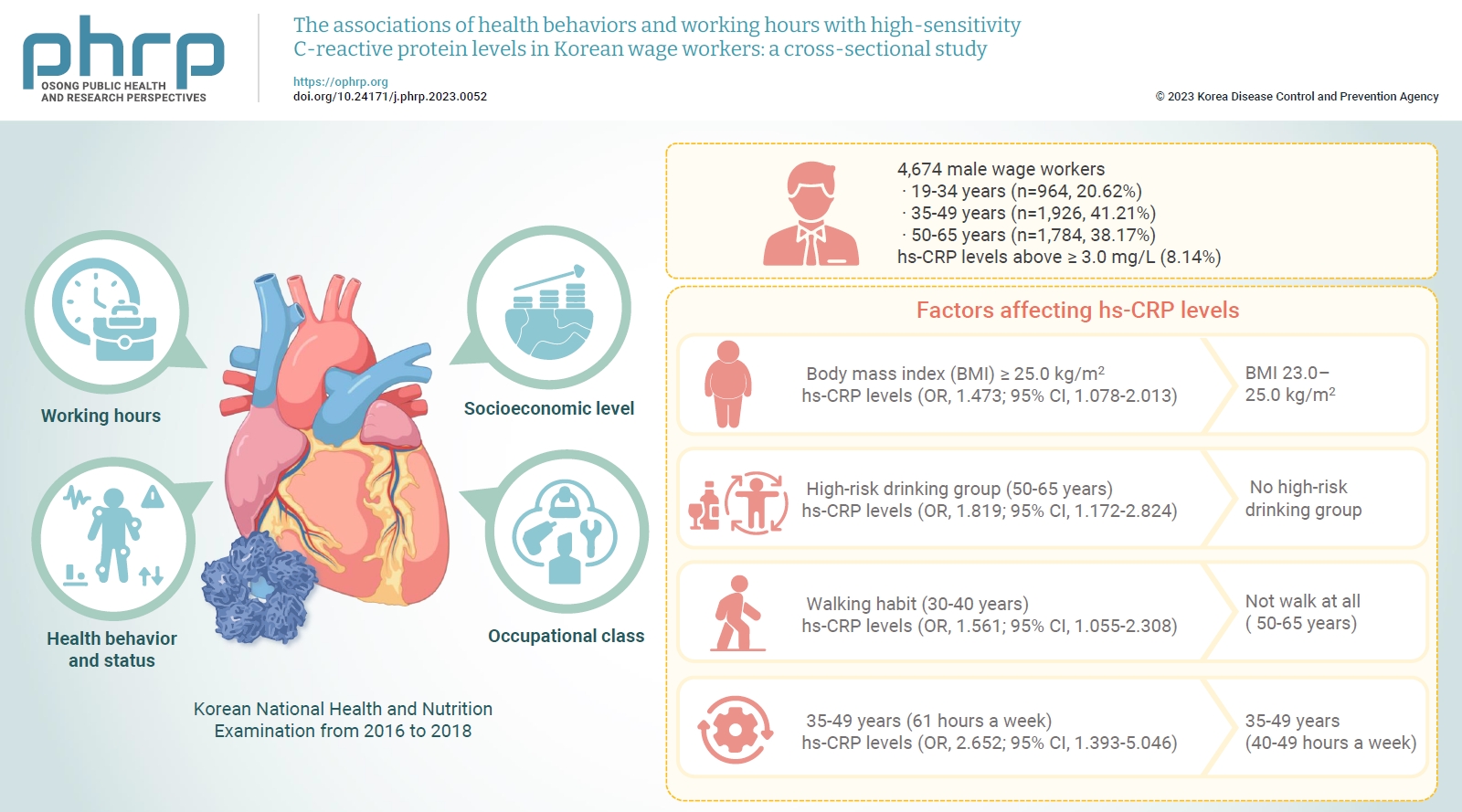
Objectives We investigated differences in high-sensitivity C-reactive protein (hs-CRP) levels by age group according to working hours, socioeconomic level, health behavior and status, and occupational class, and aimed to identify factors affecting hs-CRP levels in various age groups using data from the Korean National Health and Nutrition Examination from 2016 to 2018. Methods: The study included a total of 4,786 male wage workers across the nation, aged between 19 and 65. Data from 4,674 workers were analyzed using multiple logistic regression analysis. Results: Obesity, metabolic syndrome, and weekly working hours were associated with hs-CRP, a biomarker of inflammation. Participants with a body mass index (BMI) ≥25.0 kg/m2 showed significantly higher hs-CRP levels than those with a BMI 23.0 to 25.0 kg/m2. Workers with high-risk drinking and metabolic syndrome showed significantly higher hs-CRP levels in the 50 to 65 years group. Obesity, walking 0 to 149 min/wk, and working ≥61 hours a week were associated with significantly higher hs-CRP levels in the 35 to 49 years group. The factors that significantly affected hs-CRP levels were different among age groups. Conclusion: Plans to adjust working hours should be considered health behaviors, such as drinking and physical activity, and health conditions, such as metabolic syndrome and obesity, according to workers’ age.
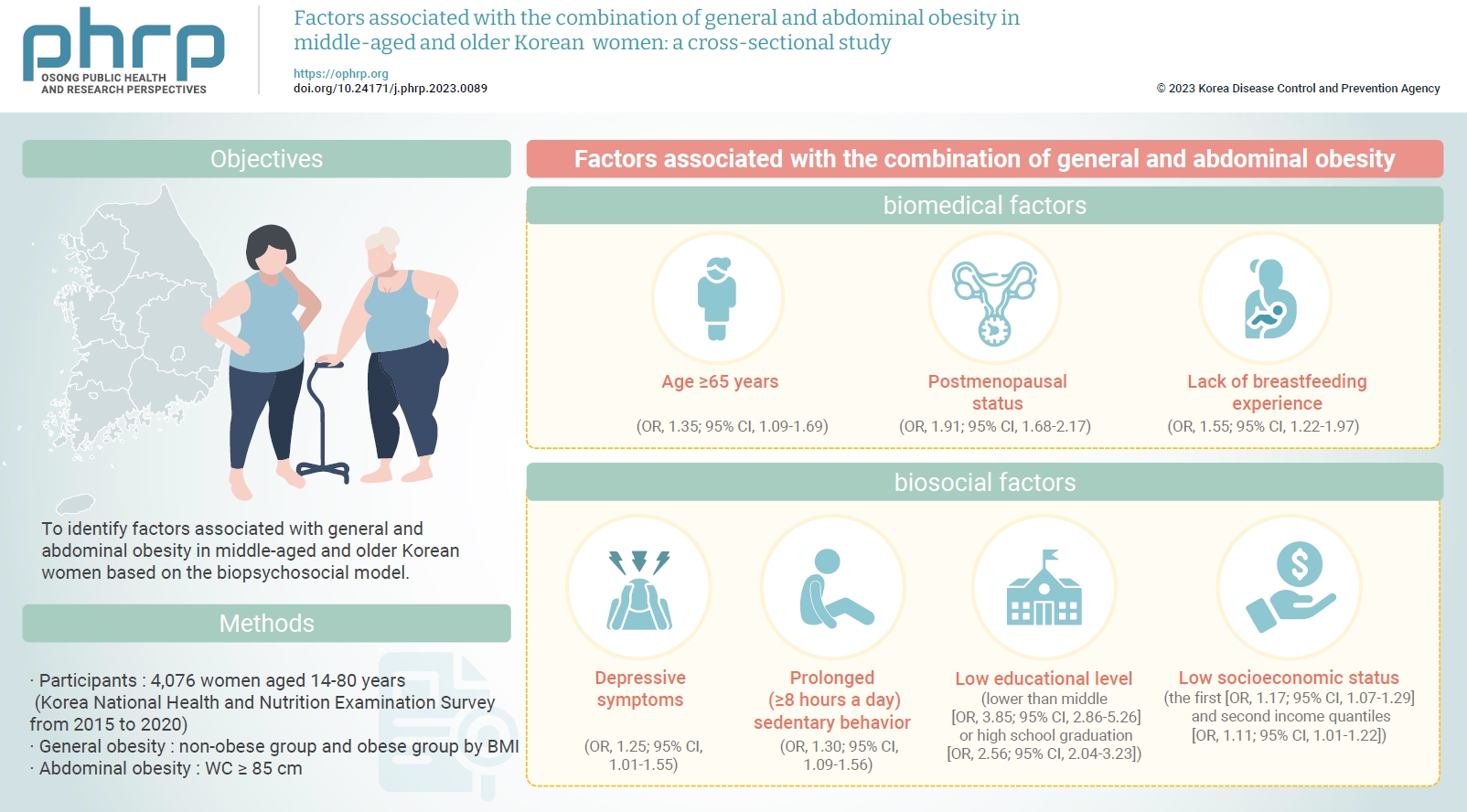
Objectives To identify factors associated with general and abdominal obesity in middle-aged and older Korean women based on the biopsychosocial model. Methods: Data from 4,076 women aged ≥45 years who participated in the Korea National Health and Nutrition Examination Survey from 2015 to 2020 were analyzed. Complex sampling analysis was performed using IBM SPSS ver. 26.0. Results: The combination of general and abdominal obesity was positively associated with age ≥65 years, postmenopausal status, and without breastfeeding experience among biomedical factors; depressive symptoms and prolonged (≥8 hours a day) sedentary behavior among psychosocial factors; and an educational level lower than middle or high school graduation and the first and second income quantiles among biosocial factors. Conclusion: Healthcare providers in communities and public societies should screen for risk factors for the combination of general and abdominal obesity while considering non-modifiable biomedical (e.g., age) and biosocial factors (e.g., educational level). In addition, intervention strategies should be developed by considering modifiable psychosocial factors such as sedentary behavior.
Citations
Citations to this article as recorded by
Relationship between anthropometric risk variables for chronic diseases in users of a primary care center José Ander Asenjo-Alarcón Población y Salud en Mesoamérica.2025;[Epub] CrossRef
Objectives
The aims of this study were to examine the prevalence of overweight/obesity and to explore sex differences in body weight perceptions and correlates of weight gain among Black students at 2 historically Black colleges and universities (HBCUs) in the USA.
Methods
Participants completed a paper-based survey, and their height and weight were measured (67% completion rate).
Results
The overweight and obesity rates were 33.8% and 26.9%, respectively. More females than males accurately assessed their weight (<italic>p</italic><0.05). Body weight underestimation was associated with male sex, excellent/very good perceived overall health, and not being informed by a doctor of having overweight or obesity (<italic>p</italic><0.01). Higher odds of ≥5% weight gain were related to female sex, living on campus, and not being informed by a doctor of having overweight or obesity (<italic>p</italic><0.05).
Conclusion
Given the high overweight and obesity rates among Black students, HBCUs in the USA should develop intervention strategies for the prevention and management of overweight and obesity. College health educators at HBCUs need to provide regular check-ups or health screenings that help male students perceive their weight accurately and prevent weight underestimation. It is important for HBCUs to monitor and address weight gain among Black students as early as possible.
Citations
Citations to this article as recorded by
Relationships between nutritional intake, appetite regulation, and mental health with body composition among female college students with overweight and obesity Qiang Wang, Soh Kim Geok, Mahmoud Danaee, Wan Ying Gan, Wang Li Zhu, Yi Qiang Mai, Sheng Yao Luo Frontiers in Psychology.2025;[Epub] CrossRef
Sociodemographic factors associated with weight perception of adolescents: A systematic review and meta‐analysis Kaihan Yang, Anqi Zhao, Yujie Xie, Zhanyi Xu, Yubinxin Peng, Haiyang Tang Journal of Child and Adolescent Psychiatric Nursin.2023; 36(2): 95. CrossRef
Análisis de la relación entre el Índice de Masa Corporal y la somnolencia diurna en universitarios mexicanos. Candelario Rodríguez-Pérez, Santa Dolores Carreño-Ruíz, Rosa Felicitas Ortiz Ojeda, Abisag Antonieta Avalos Lázaro Revista Española de Nutrición Humana y Dietética.2023; 27(3): 205. CrossRef
<sec>
<title>Objectives</title>
<p>The present study addressed the risk factors in early life for Korean preschool children that are associated with being overweight or obese.</p></sec>
<sec>
<title>Methods</title>
<p>A descriptive cross-sectional design was used to conduct this study, which included 507 mothers with preschool children aged 3–5 years, who attended daycare centers. Data were acquired via a self-administered questionnaire completed by the mothers. Of the 650 questionnaires that were distributed, 507 (78%) were completed and sent back. Multivariate logistic regression analyses were used to identify risk factors in early life, which may contribute to being overweight or obese in preschool children.</p></sec>
<sec>
<title>Results</title>
<p>Fifty-eight (11.4%) preschool children were overweight and 41 (8.1%) were obese. Multivariate logistic regression analysis with adjustment for covariates, revealed a significant association with the introduction of solid foods before 4 months of age [adjusted odds ratio (aOR) = 9.49, <italic>p</italic> = 0.029] and a nonresponsive feeding style (aOR = 2.80, <italic>p</italic> = 0.043) with being overweight or obese in preschool children.</p></sec>
<sec>
<title>Conclusion</title>
<p>The findings of this study highlighted the need for parenting education programs on feeding practices to increase their understanding of hunger and satiety cues in infants, and appropriate timing for the introduction of solid foods.</p></sec>
Citations
Citations to this article as recorded by
Trajectory of Obesity and the Impact of Eating Behaviors on Obesity in Preschool Children: A Nationwide Population-Based Cohort Study in Korea Kyeong Hun Lee, Baek Seung Kim, Gitae Seo, Hyeon-Jong Yang, Kyunghoon Kim, Eun-Ae Yang Children.2024; 11(11): 1297. CrossRef
Systematic review and meta‐analysis of breastfeeding and later overweight or obesity expands on previous study for World Health Organization Bernardo Lessa Horta, Nigel Rollins, Mariane S. Dias, Valquiria Garcez, Rafael Pérez‐Escamilla Acta Paediatrica.2023; 112(1): 34. CrossRef
<sec>
<title>Objectives</title>
<p>The objective of this study was to examine the socio-demographic disparities in obesity among US adults across 130 metropolitan and micropolitan statistical areas.</p></sec>
<sec>
<title>Methods</title>
<p>This study used data from the 2015 Behavioral Risk Factor Surveillance System and Selected Metropolitan/Micropolitan Area Risk Trend of 159,827 US adults aged 18 years and older. Data were analyzed using the multilevel linear regression models.</p></sec>
<sec>
<title>Results</title>
<p>According to individual level analyses, socio-demographic disparities in obesity exist in the United States. Individuals with low socioeconomic status were associated with a higher body mass index. The participants from the Midwest United States tend to have higher body mass index than those who from the South. According to metropolitan and micropolitan statistical area level analyses, secondly, there were significant differences in obesity status between different areas and the relation of obesity with 5 socio-demographic factors varied across different areas. According to geospatial mapping analyses, even though obesity status by metropolitan and micropolitan statistical area level has improved overtime, differences in body mass index between United States regions are increasing from 2007 to 2015.</p></sec>
<sec>
<title>Conclusion</title>
<p>Socio-demographic and regional disparities in obesity status persist among US adults. Hence, these findings underscore the need to take socio-environmental factors into account when planning obesity prevention on vulnerable populations and areas.</p></sec>
Citations
Citations to this article as recorded by
Established and Emerging Biomarkers to Characterize Persons at Risk for Obesity—Paving the Way for Targeted Clinical Intervention Trials—A Comprehensive Position Paper Farhad Vahid, Victoria Stopa, Laurent Malisoux, Yvan Devaux, Elsa Lamy, Fernando Capela e Silva, Sarah Forberger, Tiziana de Magistris, Antoni Sureda, Margalida Monserrat‐Mesquida, Maria Pérez‐Jiménez, Rajini Nagrani, Maria Giovanna Onorati, Michele Filip Obesity Reviews.2026;[Epub] CrossRef
Body mass index and colorectal cancer screening among cancer survivors: the role of sociodemographic characteristics Tsai Meng-Han, Pollard Elinita, Vernon Marlo, Chen Jie Cancer Causes & Control.2025; 36(7): 641. CrossRef
Burden of diseases attributable to excess body weight in 204 countries and territories, 1990–2019 Saeid Safiri, Jessica A. Grieger, Amir Ghaffari Jolfayi, Seyed Ehsan Mousavi, Seyed Aria Nejadghaderi, Asra Fazlollahi, Mark J. M. Sullman, Nahid Karamzad, Fikrettin Sahin, Kuljit Singh, Gary S. Collins, Ali-Asghar Kolahi Nutrition Journal.2025;[Epub] CrossRef
Adolescent health behavior patterns and weight status: a cross-sectional analysis Jiayan Gui, Hui Zhang, Jingyou Miao, Xinyao Liu, Lilu Ding, Qiuli Wang Frontiers in Public Health.2025;[Epub] CrossRef
Mapping Obesity Coverage in Florida Counties Using Interactive Web‐Based Mapping Tools to Support Targeted Policy and Intervention Efforts Justice Moses K. Aheto, Ovie A. Utuama, Getachew A. Dagne, Aron Weller Journal of Obesity.2025;[Epub] CrossRef
County‐level socio‐environmental factors and obesity prevalence in the United States Pedro R. V. O. Salerno, Alice Qian, Weichuan Dong, Salil Deo, Khurram Nasir, Sanjay Rajagopalan, Sadeer Al‐Kindi Diabetes, Obesity and Metabolism.2024; 26(5): 1766. CrossRef
The impact of overweight and obesity on health outcomes in the United States from 1990 to 2021 Omar Al Ta'ani, Yazan A. Al‐Ajlouni, Wesam Aleyadeh, Farah Al‐Bitar, Saqr Alsakarneh, Aseel Saadeh, Laith Alhuneafat, Basile Njei Diabetes, Obesity and Metabolism.2024; 26(11): 5455. CrossRef
Application of Machine Learning and Deep Neural Visual Features for Predicting Adult Obesity Prevalence in Missouri Butros M. Dahu, Carlos I. Martinez-Villar, Imad Eddine Toubal, Mariam Alshehri, Anes Ouadou, Solaiman Khan, Lincoln R. Sheets, Grant J. Scott International Journal of Environmental Research an.2024; 21(11): 1534. CrossRef
Supplemental Nutrition Assistance Program (SNAP)-Authorized Grocery, Convenience, Dollar, and Restaurant or Delivery Service Settings Are Associated With Increased Obesity Prevalence in Virginia Bailey Houghtaling, David Kniola, Sarah Misyak American Journal of Health Promotion.2021; 35(1): 127. CrossRef
The effects of the built environment on the general health, physical activity and obesity of adults in Queensland, Australia Siqin Wang, Yan Liu, Jack Lam, Mei-Po Kwan Spatial and Spatio-temporal Epidemiology.2021; 39: 100456. CrossRef
Exposure to air pollutants and the gut microbiota: a potential link between exposure, obesity, and type 2 diabetes Maximillian J. Bailey, Noopur N. Naik, Laura E. Wild, William B. Patterson, Tanya L. Alderete Gut Microbes.2020; 11(5): 1188. CrossRef
<sec>
<title>Objectives</title>
<p>To identify trends in percentage body fat (PBF) in adolescents to determine gender-specific classification thresholds for being overweight and obese.</p></sec>
<sec>
<title>Methods</title>
<p>A cross-sectional study of 899 adolescents (11 to 14.5 years) from Hanoi and Nam Dinh was conducted in Vietnam. PBF, subcutaneous fat and percentage of lean mass were measured directly using OMRON HBF 375 scales to measure bioelectrical impedance.</p></sec>
<sec>
<title>Results</title>
<p>PBF decreased in boys with increasing age (<italic>p</italic> < 0.001). The difference in PBF between boys and girls, significantly increased with age after 12.5 years (<italic>p</italic> < 0.001). There was a stronger correlation between PBF and fat content (Pearson’s <italic>r</italic> = <italic>0.860</italic>, <italic>p</italic> < <italic>0.0001</italic>) than that between (BMI) and fat content (Pearson’s <italic>r</italic> = <italic>0.521</italic>, <italic>p</italic> < <italic>0.0001</italic>). The prevalence of being overweight or obese in girls was similar when determined by PBF or BMI. Hanoi had higher rates of adolescents being overweight or obese compared with Nam Dinh.</p></sec>
<sec>
<title>Conclusion</title>
<p>PBF provides a more accurate body assessment for being overweight or obese in adolescents compared with BMI.</p></sec>
Citations
Citations to this article as recorded by
Effectiveness of school-based intervention in obese children Sanket Satish Nagrale, Mariya Jiandani Journal of Family Medicine and Primary Care.2026; 15(2): 824. CrossRef
Body Image Perception and Nutritional Status Among Schoolchildren in Ghana: A Cross‐Sectional Study Sarah Twum, Justina S. Owusu, Agartha N. Ohemeng, Hannah Wesley Advances in Public Health.2026;[Epub] CrossRef
Predictive Modeling of Work-Rest Schedule for Agricultural Workers Using Heat Stress and Physiological Data Subhabrata Basu, Thaneswer Patel, Priyam Goswami, Bishorjit Ningthoujam IISE Transactions on Occupational Ergonomics and H.2026; 14(4): 416. CrossRef
Correlations and consistency of body composition measurement indicators and BMI: a systematic review Ruohan Yang, Jinxia Yu, Chunyan Luo, Wenjuan Qi, Dongling Yang, Hui Xue, Xiaoyan Ni, Shuxin Yu, Wei Du, Fengyun Zhang International Journal of Obesity.2025; 49(1): 4. CrossRef
Changes in body composition (muscle mass and adipose tissue) among adolescents aged 11–15 from Kraków during the COVID-19 pandemic Paulina Artymiak, Magdalena Żegleń, Łukasz Kryst Anthropological Review.2025; 87(4): 55. CrossRef
Transforming personalized weight forecasting: From the Personalized Metabolic Avatar to the Generalized Metabolic Avatar A. Abeltino, C. Serantoni, A. Riente, M. De Giulio, S. Capezzone, R. Esposito, M. De Spirito, G. Maulucci Computers in Biology and Medicine.2025; 188: 109879. CrossRef
Relationship Between Body Mass Index and Fat Mass Percentage with Proprioception in Children Eduardo Guzmán-Muñoz, Yeny Concha-Cisternas, Guillermo Méndez-Rebolledo, Manuel Vásquez-Muñoz, Pablo Valdés-Badilla, Tomás Herrera-Valenzuela, Cristian Núñez-Espinosa, Jordan Hernández-Martínez Journal of Functional Morphology and Kinesiology.2025; 10(1): 59. CrossRef
Prediction of hand grip strength using anthropometric indicators among older adults: Evidence from LASI data Biswajit Mahapatra, Bharathi Karri Journal of Bodywork and Movement Therapies.2025; 43: 284. CrossRef
Obesity impact on leukocyte telomere shortening and immune aging assessed by Mendelian randomization and transcriptomics analysis Zhijun Feng, Jiacheng Li, Huimin Zhang, Shupeng Liu, Yinghui Wang, Meijuan Zhou, Zhenhua Ding, Lin Xiao Scientific Reports.2025;[Epub] CrossRef
Delayed activation of ankle muscles in young adults with excess adiposity Eduardo Guzmán-Muñoz, Yeny Concha Cisternas, Franco Herrera-Meza, Ignacio Luna-Jara, Pablo Valdés-Badilla, Jordan Hernández-Martínez, Rodrigo Yáñez-Sepúlveda, Felipe Montalva-Valenzuela Nutrición Hospitalaria.2025;[Epub] CrossRef
Excess Body Fat and Associated Factors in 7‐ to 10‐Year‐Old Schoolchildren in Florianópolis, Santa Catarina, Brazil: Trend Analysis of Four Cross‐Sectional Surveys, 2002–2019 Francisca Maria Carvalho Nascimento, Patrícia de Fragas Hinnig, Mayara Luiza Vermohlem Garcia, Francisco de Assis Guedes de Vasconcelos, Cristine Garcia Gabriel American Journal of Human Biology.2025;[Epub] CrossRef
Quadriceps muscle reaction time in obese children Eduardo Guzmán-Muñoz, Guillermo Mendez-Rebolledo, Sergio Sazo-Rodriguez, Joaquín Salazar-Méndez, Pablo Valdes-Badilla, Cristian Nuñez-Espinosa, Tomas Herrera-Valenzuela PeerJ.2024; 12: e17050. CrossRef
Blood Concentration of Macro- and Microelements in Women Who Are Overweight/Obesity and Their Associations with Serum Biochemistry Zuzana Knazicka, Maros Bihari, Ivona Janco, Lubos Harangozo, Julius Arvay, Anton Kovacik, Peter Massanyi, Branislav Galik, Jorge M. A. Saraiva, Marta Habanova Life.2024; 14(4): 465. CrossRef
Association of Anthropometric Adiposity Indices and Hand Grip Strength among Male Industrial Workers in Chennai, Tamil Nadu, India: A Cross-Sectional Study R. Durga Priyadarshini, D. Annette Beatrice Indian Journal of Occupational and Environmental M.2024; 28(1): 56. CrossRef
Anti-obesity effects of a standardized ethanol extract of Eisenia bicyclis by regulating the AMPK signaling pathway in 3T3-L1 cells and HFD-induced mice Young-Seo Yoon, Kyung-Sook Chung, Su-Yeon Lee, So-Won Heo, Ye-Rin Kim, Jong Kil Lee, Hyunjae Kim, Soyoon Park, Yu-Kyong Shin, Kyung-Tae Lee Food & Function.2024; 15(12): 6424. CrossRef
Change of health-related fitness with respect to age for adolescent boys Asif Iqbal, Farjana Akter Boby, Hannan Mia, Mohammad Sohel Journal of Human Sport and Exercise.2024; 19(4): 1009. CrossRef
Changes in the prevalence of underweight, overweight, obesity and excessive adiposity among adolescents from Kraków (Poland) in the years 1983–2020 Paulina Artymiak, Magdalena Żegleń, Małgorzata Kowal, Agnieszka Woronkowicz, Łukasz Kryst American Journal of Human Biology.2023;[Epub] CrossRef
Tri-ponderal mass index as a screening tool for obesity prediction in children aged 6–9 years Yang Niu, Yajie Zhang, Jinye Sheng, Wenyi Lu, Ji Li, Xiaomeng Mao, Wei Cai, Qingya Tang, Xiuhua Shen, Yi Feng Frontiers in Endocrinology.2023;[Epub] CrossRef
Associations Between Body Composition, Leptin, and Vitamin D Varied by the Body Fat Percentage in Adolescents Rapheeporn Khwanchuea, Chuchard Punsawad Frontiers in Endocrinology.2022;[Epub] CrossRef
Psychiatric symptoms are not associated with circulating CRP concentrations after controlling for medical, social, and demographic factors Leandra K. Figueroa-Hall, Bohan Xu, Rayus Kuplicki, Bart N. Ford, Kaiping Burrows, T. Kent Teague, Sandip Sen, Hung-Wen Yeh, Michael R. Irwin, Jonathan Savitz, Martin P. Paulus Translational Psychiatry.2022;[Epub] CrossRef
Effects of School-Based Physical Activity Programs on Health-Related Physical Fitness of Korean Adolescents: A Preliminary Study Eui-Jae Lee, Wi-Young So, Hyun-Su Youn, Jooyoung Kim International Journal of Environmental Research an.2021; 18(6): 2976. CrossRef
Bone Health and Its Positive Relationships with Body Composition in Malaysian Schoolchildren: Findings from a Cross-Sectional Study Hui Chin Koo, Geok Pei Lim, Satvinder Kaur, Kai Quin Chan, Keh En Chan, Casey Chung, Michelle Wong, Ugunesh Danaselvam Children.2021; 8(7): 569. CrossRef
Obesity parameters in relation to lung function levels in a large Chinese rural adult population Xiang Zeng, Dongling Liu, Zhen An, Huijun Li, Jie Song, Weidong Wu Epidemiology and Health.2021; 43: e2021047. CrossRef
Современные подходы к оценке физического развития детей и подростков Zh.V. Sotnikova-Meleshkina, O.H. Zinchuk, O.Ya. Mikhalchuk CHILD`S HEALTH.2021; 16(1): 33. CrossRef
Changes to cardiovascular risk factors over 7 years: a prospective cohort study of in situ urbanised residents in the Chaoyang District of Beijing Zhe Li, Shicheng Yu, Xiaoyan Han, Jianjun Liu, Hongyan Yao BMJ Open.2020; 10(3): e033548. CrossRef
Effect of Body Fat Percentage on Muscle Damage Induced by High-Intensity Eccentric Exercise Eun-Jung Yoon, Jooyoung Kim International Journal of Environmental Research an.2020; 17(10): 3476. CrossRef
Body mass index and waist-to-hip ratio misclassification of overweight and obesity in Chinese military personnel Qingqing Zhu, Binbin Huang, Qiaoli Li, Liqian Huang, Wenbo Shu, Lin Xu, Qiongying Deng, Ziliang Ye, Chunyan Li, Peng Liu Journal of Physiological Anthropology.2020;[Epub] CrossRef
Identification of the most appropriate existing anthropometric index for home-based obesity screening in children and adolescents X.F. Ye, W. Dong, L.L. Tan, Z.R. Zhang, Y.L. Qiu, J. Zhang Public Health.2020; 189: 20. CrossRef
<sec>
<title>Objectives</title>
<p>This study compared foot arch height, plantar fascia thickness, a range of motion assessments of the ankle joint, strength of the ankle joint, plantar pressure, and balance between obese and normal weight young adults.</p></sec>
<sec>
<title>Methods</title>
<p>Fifty-two participants were required for the present study design to achieve 80% power, 0.8 effect size (η2), and an alpha level of 0.05. The participants were categorized to normal weight or obese groups based on BMI (≤ 24 kg/m<sup>2</sup> and ≥ 25 kg/m<sup>2</sup>, respectively). The foot and ankle disability index and Sport survey were completed by the participants before the measurements. Foot arch height was measured using the navicular drop test, and plantar fascia thickness was measured using ultrasound. Plantar pressure and balance tests were also conducted, followed by ankle joint range of motion and strength tests.</p></sec>
<sec>
<title>Results</title>
<p>Foot arch height and plantar fascia thickness was significantly higher in the obese group compared with the normal weight group (<italic>p</italic> < 0.01). There were significant differences in eversion of ankle strength, plantar pressure in the big toe and heel and anterior-posterior balance between normal and obese weight groups (<italic>p</italic> < 0.05).</p></sec>
<sec>
<title>Conclusion</title>
<p>Obese young adults had more abnormalities in the medial longitudinal arch, plantar fascia, and plantar pressure as well as weakened ankle eversion strength and balance problems compared with the normal weight group.</p></sec>
Citations
Citations to this article as recorded by
Foot arch morphology and lower-limb biomechanical characteristics in university students: a cross-sectional multifactorial analysis of 1,078 participants Zhiyi Xu, Yu Lin, Yiquan Chen, Jie Lu, Yihui Jiang, Jiahao He, Liyuan Yu, Wensheng Miao, Jinhui Yan, Xiangdong Wang Scientific Reports.2026;[Epub] CrossRef
Body Mass Index Predicts Function in Individuals With Plantar Fasciopathy: A Longitudinal Observational Study Fernanda Colen Milagres Brandão, Ana Paula Coelho Figueira Freire, Daniel Barreto Rabelo, Sabrina Oliveira Melo, Mario Efraín Recinos Mastahinich, Roberto Zambelli, Thales R. Souza, Rafael Z. Pinto Journal of Sport Rehabilitation.2025; 34(4): 380. CrossRef
RETRACTED: Infrared thermal radiation sensing based on image enhancement for simulating athletes’ balance ability: Thermal analysis of sports cells Lei Ma Thermal Science and Engineering Progress.2025; 59: 103274. CrossRef
Effectiveness of Core Exercises in Improving Foot Pressure Distribution and Postural Stability in Overweight Children: A Feasibility Trial
Kanu Goyal, Asir John Samuel, Aditi Popli, Manu Goyal Critical Reviews in Physical and Rehabilitation Me.2025; 37(2): 59. CrossRef
Effects of Instability Resistance Training on the Lower Limbs Biomechanical Response due to Arch Heights Xiaoyan YANG, Datao XU, Meizi WANG, Julien S. BAKER, Yuwei LIU, Huiyu ZHOU, Yaodong GU Advanced Biomedical Engineering.2025; 14: 260. CrossRef
TurkerNeXtV2: An Innovative CNN Model for Knee Osteoarthritis Pressure Image Classification Omer Esmez, Gulnihal Deniz, Furkan Bilek, Murat Gurger, Prabal Datta Barua, Sengul Dogan, Mehmet Baygin, Turker Tuncer Diagnostics.2025; 15(19): 2478. CrossRef
Immediate effect of the use of toe separators on dynamic balance and ankle range of motion: a pilot study Daniel González-Devesa, Alberto Hermo-Argibay, Nerea Blanco-Martínez, Carlos Ayán-Pérez The Physician and Sportsmedicine.2024; 52(4): 374. CrossRef
Altered gait patterns during arch important development period in children with persistent obesity: An experimental longitudinal study Luming Yang, Xinye Liu, Yuan Liu, Wenxiao Zheng, Wei Wang, Shiyang Yan Gait & Posture.2024; 111: 143. CrossRef
Foot health and physical fitness: investigating the interplay among flat feet, body balance, and performance in junior high school students Irma Febriyanti, Hari Setijono, Fransisca Januarumi Marhaendra Wijaya, I Dewa Made Aryananda Wijaya Kusuma Pedagogy of Physical Culture and Sports.2024; 28(3): 168. CrossRef
Arch-related alteration in foot loading patterns affected by the increasing extent of body mass index in children: A follow-up study Shiyang Yan, Yihong Zhao, Longbin Zhang, Luming Yang Gait & Posture.2023; 100: 247. CrossRef
Understanding foot conditions, morphologies and functions in children: a current review Hanhui Jiang, Qichang Mei, Yuan Wang, Junhao He, Enze Shao, Justin Fernandez, Yaodong Gu Frontiers in Bioengineering and Biotechnology.2023;[Epub] CrossRef
Analysis of Static and Dynamic Baropedographic Parameters in Post COVID-19 Patients Zofia Dzięcioł-Anikiej, Agnieszka Dakowicz, Monika Pociene, Janusz Dzięcioł, Anna Kuryliszyn-Moskal, Amanda Maria Kostro Acta Balneologica.2023; 65(5): 276. CrossRef
Correlation of Body Mass Index with Ankle Joint Range of Motion in Young Adults Rachna Rohatgi, Aditi Bhatnagar, Nirupma Gupta, Manjari Jain Journal of the Anatomical Society of India.2023; 72(3): 262. CrossRef
Characteristics of Plantar Pressure with Foot Postures and Lower Limb Pain Profiles in Taiwanese College Elite Rugby League Athletes Tong-Hsien Chow, Yih-Shyuan Chen, Chin-Chia Hsu, Chin-Hsien Hsu International Journal of Environmental Research an.2022; 19(3): 1158. CrossRef
Traceable Features of Static Plantar Pressure Characteristics and Foot Postures in College Students with Hemiplegic Cerebral Palsy Tong-Hsien Chow Journal of Personalized Medicine.2022; 12(3): 394. CrossRef
Elite Tennis Players Experiencing High-Arched Supination and Cuboids Dropped Foot Syndromes in Daily Normal Gait Tong-Hsien Chow, Chin-Chia Hsu International Journal of Environmental Research an.2022; 19(15): 8897. CrossRef
Association between flat foot prevalence and nutritional status in schoolchildren Sonja Susnjevic, Dragana Milijasevic, Dusica Maric, Olja Niciforovic-Surkovic, Vesna Mijatovic-Jovanovic, Snezana Ukropina Srpski arhiv za celokupno lekarstvo.2022; 150(1-2): 59. CrossRef
Comparison of Foot Posture, Joint Position Sense, Dynamic Balance,
and Plantar Pressure between Young Adults with and without
Obesity Min-Hyeok Kang, Dong-Chul Moon, Du-Jin Park Journal of Musculoskeletal Science and Technology.2022; 6(2): 58. CrossRef
Relationship between total weight-bearing response of the navicular and talus bones and weight-bearing response of hindfoot valgus in normal foot arch Masafumi Maruyama, Arito Yozu, Yoshikazu Okamoto, Hitoshi Shiraki The Journal of Physical Fitness and Sports Medicin.2021; 10(2): 75. CrossRef
Effects of Two Foot-Ankle Interventions on Foot Structure, Function, and Balance Ability in Obese People with Pes Planus Du-Jin Park, Kyung-Sun Lee, Se-Yeon Park Healthcare.2021; 9(6): 667. CrossRef
An Investigation of Regional Plantar Soft Tissue Hardness and Its Potential Correlation with Plantar Pressure Distribution in Healthy Adults Maimaitirexiati Helili, Xiang Geng, Xin Ma, Wenming Chen, Chao Zhang, Jiazhang Huang, Xu Wang, Estefanía Peña Applied Bionics and Biomechanics.2021; 2021: 1. CrossRef
Relationships between Plantar Pressure Distribution and Rearfoot Alignment in the Taiwanese College Athletes with Plantar Fasciopathy during Static Standing and Walking Tong-Hsien Chow, Yih-Shyuan Chen, Chin-Chia Hsu International Journal of Environmental Research an.2021; 18(24): 12942. CrossRef
Three-Dimensional Ankle Exercise with Combined Isotonic Technique for an Obese Subject with Plantar Fasciitis: A Case Study Kyung-Sun Lee, Du-Jin Park Medicina.2020; 56(4): 190. CrossRef
Mixed factors affecting plantar pressures and center of pressure in obese children: Obesity and flatfoot Shiyang Yan, Ruoyi Li, Bi Shi, Ruoli Wang, Luming Yang Gait & Posture.2020; 80: 7. CrossRef
Body weight-dependent foot loads, assessed in terms of BMI and adiposity, in school-aged children: a cross sectional study Beata Szczepanowska-Wolowiec, Paulina Sztandera, Ireneusz Kotela, Marek Zak Scientific Reports.2020;[Epub] CrossRef
The Impact of Overweight and Obesity on Plantar Pressure in Children and Adolescents: A Systematic Review Liliana Catan, Elena Amaricai, Roxana Ramona Onofrei, Calin Marius Popoiu, Emil Radu Iacob, Corina Maria Stanciulescu, Simona Cerbu, Delia Ioana Horhat, Oana Suciu International Journal of Environmental Research an.2020; 17(18): 6600. CrossRef
Standard reference values of weight and maximum pressure distribution in healthy adults aged 18–65 years in Germany D. Ohlendorf, K. Kerth, W. Osiander, F. Holzgreve, L. Fraeulin, H. Ackermann, D. A. Groneberg Journal of Physiological Anthropology.2020;[Epub] CrossRef
<sec>
<title>Objectives</title>
<p>To describe the distribution of social factors, lifestyle habits and anthropometric measurements according to hypertension and Type-2 diabetes.</p></sec>
<sec>
<title>Methods</title>
<p>A cross-sectional study was conducted in Gaza City, Palestine that included 379 patients (20–60 years) who had hypertension and/or diabetes. Three groups of patients were involved; 106 hypertensive (HT), 109 diabetic (T2DM) and 164 hypertensive diabetics (HT + T2DM).</p></sec>
<sec>
<title>Results</title>
<p>The HT + T2DM group were older and had a higher body mass index compared to HT and T2DM groups. There were 62.3% patients who were female, 49.2% were highly educated HT patients, and 49.3% patients had a low level of education and were HT + T2DM. There were 55.8% patients who lived in large families. Patients who were passive smokers or never smoked before were mostly HT + T2DM, while active smokers and past smokers had T2DM. There were 48.2% patients who were highly physically active who had HT, 40.9% whom were moderately active had T2DM, and 53.8% of patients who had a low level of activity were HT + T2DM. Multivariate linear regression showed that having a diseased mother, living in a large family, being a past or passive smoker, or never having smoked, having a low or moderate level of activity, and having HT or HT + T2DM, were significantly associated with an increased body mass index.</p></sec>
<sec>
<title>Conclusion</title>
<p>Parental health/disease conditions and environmental factors (social network and lifestyle habits) played the greatest role in the development of obesity and disease.</p></sec>
Citations
Citations to this article as recorded by
Barriers and facilitators of lifestyle management among diabetic patients in palestine: a qualitative exploration of physician perspectives Alzahra Hamdan, Fatima Al Hanini, Therese Zink, Beesan Maraqa Discover Health Systems.2025;[Epub] CrossRef
Continuity of Chronic Disease Care in Gaza: a Commentary on Health System Collapse and Humanitarian Imperatives Mohd Sharique Katchhi, Long Chiau Ming Journal of Epidemiology and Global Health.2025;[Epub] CrossRef
Second brain: reviewing the gut microbiome’s role in lifestyle diseases Hindol Ray, Janatum Khatum, Srijan Haldar, Priyanka Bhowmik BioTechnologia.2025; 106(1): 103. CrossRef
Factors associated with physical inactivity among Palestinians with type 2 diabetes mellitus treated in resource-limited settings Ramzi Shawahna, Mohammad Jaber, Arob Zmiro, Sewar Kashkoush Scientific Reports.2024;[Epub] CrossRef
Time trends in Alzheimer’s disease mortality attributable to metabolic risks and smoking in China from 1990 to 2019: an age-period-cohort analysis Simeng Sun, Ting Zhang, Hao Yu, Ting Xia, Yunan Yao, Mengting Sun, Hongmei Liang, Qiaoyu Huang, Weiwei Wang, Huafeng Yang, Xin Hong Frontiers in Aging Neuroscience.2024;[Epub] CrossRef
Prevalence of hypertension and its associated factors among healthcare workers in the Gaza Strip, Palestine: a cross-sectional study Joma Younis, Lina Wang, Kejing Zhang, Majed Jebril, Hong Jiang, Yahui Fan, Zhaofang Li, Mei Ma, Le Ma, Zhaozhao Hui, Mao Ma, Wei Zhang BMJ Open.2024; 14(12): e076577. CrossRef
Analysis of the nutritional status in the Palestinian territory: a review study Enas A. Assaf, Haleama Al Sabbah, Ayoub Al-Jawadleh Frontiers in Nutrition.2023;[Epub] CrossRef
The hypertension cascade of care in the midst of conflict: the case of the Gaza Strip Bassam A. Abu Hamad, Zeina Jamaluddine, Gloria Safadi, Marie-Elizabeth Ragi, Raeda El Sayed Ahmad, Eszter P. Vamos, Sanjay Basu, John S. Yudkin, Mohammed Jawad, Christopher Millett, Hala Ghattas Journal of Human Hypertension.2022; 37(10): 957. CrossRef
Association between endothelial nitric oxide synthase and the renin-angiotensin-aldosterone system polymorphisms, blood pressure and training status in normotensive/pre-hypertension and hypertensive older adults: a pilot study Roberta Fernanda da Silva, Riccardo Lacchini, Lucas Cezar Pinheiro, Letícia Perticarrara Ferezin, José Eduardo Tanus-Santos, Marcelo Rizzatti Luizon, Thiago José Dionísio, Carlos Ferreira Santos, Thaís Amanda Reia, André Mourão Jacomini, Ana Maria Guilmo Clinical and Experimental Hypertension.2021; 43(7): 661. CrossRef
Breakfast characteristics, perception, and reasons of skipping among 8th and 9th-grade students at governmental schools, Jenin governance, West Bank Manal Badrasawi, Ola Anabtawi, Yaqout Al-Zain BMC Nutrition.2021;[Epub] CrossRef
Advanced Molecular Imaging (MRI/MRS/1H NMR) for Metabolic Information in Young Adults with Health Risk Obesity Khin Thandar Htun, Jie Pan, Duanghathai Pasanta, Montree Tungjai, Chatchanok Udomtanakunchai, Thanaporn Petcharoen, Nattacha Chamta, Supak Kosicharoen, Kiattisak Chukua, Christopher Lai, Suchart Kothan Life.2021; 11(10): 1035. CrossRef
Prevalence and Predictors of Co-occurring Hypertension and Depression Among Community-Dwelling Older Adults Cicily A. Gray, Omar T. Sims, Hyejung Oh Journal of Racial and Ethnic Health Disparities.2020; 7(2): 365. CrossRef
Prevalence of Type 2 Diabetes and Its Association with Added Sugar Intake in Citizens and Refugees Aged 40 or Older in the Gaza Strip, Palestine Majed Jebril, Xin Liu, Zumin Shi, Mohsen Mazidi, Akram Altaher, Youfa Wang International Journal of Environmental Research an.2020; 17(22): 8594. CrossRef
<sec>
<title>Objectives</title>
<p>There is evidence to suggest that sedentary behavior is associated with a higher risk of metabolic disease. The aim of this study was to investigate cross-sectional joint associations of physical activity (PA) and screen time (ST), with the risk of obesity in Korean adults.</p></sec>
<sec>
<title>Methods</title>
<p>The Korea Media Panel Study consisted of a household interview and a self-administered diary survey on media usage over 3 days. ST (hours/day) was defined as the reported daily average hours spent watching television, computing (i.e., desktop, notebook, netbook, tablets), smartphone and video game console use. Cross-sectional associations of obesity (BMI ≥ 25 kg/m<sup>2</sup>) and the amount of daily ST and PA were examined by logistic regression models adjusting for other possible confounders including alcohol consumption, smoking, depressive symptoms and demographic information. There were 7,808 participants included in the analyses.</p></sec>
<sec>
<title>Results</title>
<p>Increased ST was significantly associated with the risk of obesity (controlling for other possible confounders), but PA level was not found to be significantly linked. Participants who engaged in screen time > 6 hours per day had a higher incidence of obesity.</p></sec>
<sec>
<title>Conclusion</title>
<p>This study provides evidence of the association between ST and the increased incidence of obesity measured by BMI, independent of PA amongst Korean adults.</p></sec>
Citations
Citations to this article as recorded by
The economic burden of adolescent internet addiction: A Korean health cost case study Robert W. Mead, Edward Nall The Social Science Journal.2026; 63(3): 974. CrossRef
Association of physical activity levels on cardiovascular and respiratory indicators in BMI-matched Middle-aged Chinese men Yanjia Xu, Yang Lu, Mingyang Liu, Hyun-Min Choi, Sukwon Kim, Zhe Hu Critical Public Health.2026;[Epub] CrossRef
Screen exposure and health behaviors in Saudi adults: cross-sectional associations with physical activity and BMI Sara K. Alnasser, Narmeen Shaikh, Noara Alhusseini International Journal Of Community Medicine And Pu.2026; 13(2): 586. CrossRef
Electronic cigarette use linked to poor sleep quality: a cross-sectional nationwide population-based study in Korea Wonseok Jeong, Min Ji Song, Ji Hye Shin, Ji Hyun Kim Sleep and Breathing.2026;[Epub] CrossRef
What is the connection between screen time and lifestyle factors important for bone health? Findings from the Hertfordshire Intergenerational Study Leo Westbury, Gregorio Bevilacqua, Faidra Laskou, Fiona Kirkham-Wilson, Nicholas Fuggle, Elaine Dennison Archives of Osteoporosis.2026;[Epub] CrossRef
Associations among hedonic hunger, digital obesity, and type 2 diabetes self-management Ayşe Çamli, Aylin Acikgoz Pinar, Merve Terzi Frontiers in Nutrition.2026;[Epub] CrossRef
Posture–environment design promotes executive function and gaming performance during esports play Takashi Matsui, Yuji Mine, Shion Takahashi, Daisuke Funabashi, Seiji Yoshitake, Hiroki Matsuoka, Takafumi Yamaguchi, Yukina Tachibana, Shohei Dobashi, Yosuke Sakairi, Hisashi Yoshimoto, Hideki Takagi, Mai Morita, Akiyoshi Shiodera, Ayumi Mineno, Haruyuki Computers in Human Behavior Reports.2026; 24: 101325. CrossRef
A Descriptive Study on Body Composition and Physical Activity Among Adolescent Esports Players Dmitry Onishchenko, Viktor Bolshakov, Yan Bravyy, Alexander Kirsanov, Maxim Baltin, Dmitry Savin Journal of Electronic Gaming and Esports.2025;[Epub] CrossRef
Association between screen time and overweight/obesity: A meta-analysis of 393,743 women from 36 low- and middle-income countries Abdur Rahman, Khorshed Alam, Benojir Ahammed Public Health.2025; 248: 105955. CrossRef
BODY COMPOSITION OF CYBERSPORTS PLAYERS, IT SPECIALISTS AND UNTRAINED PERSONS Yu. P. Luts, S. V. Fedorchuk, T. M. Oliinyk, T. V. Kutsenko Bulletin of Problems Biology and Medicine.2025; 1(1): 507. CrossRef
Digital dilemmas and existing recommendations for healthy screen time use for children and adolescents Ashwini Tadpatrikar, Manoj Kumar Sharma, Pratima Murthy Asian Journal of Psychiatry.2024; 99: 104154. CrossRef
The global burden of overweight-obesity and its association with economic status, benefiting from STEPs survey of WHO member states: A meta-analysis A.N.M. Shamsul Islam, Hafiza Sultana, Md. Nazmul Hassan Refat, Zaki Farhana, Anton Abdulbasah Kamil, Mohammad Meshbahur Rahman Preventive Medicine Reports.2024; 46: 102882. CrossRef
Relationship of work-related and leisure-based screen time with obesity: a cross-sectional study on adults including older adults Hana Wakasa, Takashi Kimura, Takumi Hirata, Akiko Tamakoshi Endocrine.2024; 87(1): 170. CrossRef
The Egyptian 24-h movement guidelines for children and adolescents: an integration of physical activity, sedentary behaviour, sleep and eating habits—by the Egyptian Academy of Bone and Muscle health Y. El Miedany, Hala Lotfy, Laila A.G. Hegazy, Maha Elgaafary, Safaa Mahran, Susan Plummer, Walaa Elwakil Egyptian Rheumatology and Rehabilitation.2024;[Epub] CrossRef
Toward an Integrated Consideration of 24 h Movement Guidelines and Nutritional Recommendations Elora Fournier, Edyta Łuszczki, Laurie Isacco, Emilie Chanséaume-Bussiere, Céline Gryson, Claire Chambrier, Vicky Drapeau, Jean-Philippe Chaput, David Thivel Nutrients.2023; 15(9): 2109. CrossRef
Relación entre actividad física, sedentarismo y obesidad en adultos, Colombia, 2015 Ana Yibby Forero , Gina Emely Morales , Luis Carlos Forero Biomédica.2023; 43(Sp. 3): 99. CrossRef
Assessment of the Lifestyle Changes Experienced by Dental Professionals before and during COVID-19 Lockdown: A Comparative Pilot Study Baby John, Vinola Duraisamy, Diana Prem, Balamanikandasrinivasan Chandrasekaran World Journal of Dentistry.2022; 13(6): 658. CrossRef
Demographic, Anthropometric and Food Behavior Data towards Healthy Eating in Romania Anca Bacârea, Vladimir Constantin Bacârea, Cristina Cînpeanu, Claudiu Teodorescu, Ana Gabriela Seni, Raquel P. F. Guiné, Monica Tarcea Foods.2021; 10(3): 487. CrossRef
Some eating habits and physical activity of players performing in e-sports D. B. Nikitjuk, I. V. Kobelkova, M. M. Korosteleva Sports medicine: research and practice.2021; 11(3): 57. CrossRef
Association of total sedentary behaviour and television viewing with risk of overweight/obesity, type 2 diabetes and hypertension: A dose–response meta‐analysis Chunmei Guo, Qionggui Zhou, Dongdong Zhang, Pei Qin, Quanman Li, Gang Tian, Dechen Liu, Xu Chen, Leilei Liu, Feiyan Liu, Cheng Cheng, Ranran Qie, Minghui Han, Shengbing Huang, Xiaoyan Wu, Yang Zhao, Yongcheng Ren, Ming Zhang, Yu Liu, Dongsheng Hu Diabetes, Obesity and Metabolism.2020; 22(1): 79. CrossRef
Dietary and Lifestyle Changes During COVID-19 and the Subsequent Lockdowns among Polish Adults: A Cross-Sectional Online Survey PLifeCOVID-19 Study Magdalena Górnicka, Małgorzata Ewa Drywień, Monika A. Zielinska, Jadwiga Hamułka Nutrients.2020; 12(8): 2324. CrossRef
The Association between Esports Participation, Health and Physical Activity Behaviour Michael G Trotter, Tristan J. Coulter, Paul A Davis, Dylan R Poulus, Remco Polman International Journal of Environmental Research an.2020; 17(19): 7329. CrossRef
Associations of Meal Timing and Frequency with Obesity and Metabolic Syndrome among Korean Adults Kyungho Ha, YoonJu Song Nutrients.2019; 11(10): 2437. CrossRef
<sec>
<title>Objectives</title>
<p>The increase in the obesity rate in adult males in Korea is higher than countries in the Organization for Economic Co-operation and Development and other Asian countries. We examined the trends and prevalence of major risk factors for cardiovascular disease by evaluating the weight status amongst adults from 2007 to 2015.</p></sec>
<sec>
<title>Methods</title>
<p>The study included 37,402 adults, who participated in the Korea National Health and Nutrition Examination Survey. The prevalence trends of cardiovascular disease risk factors were estimated for each body mass index group.</p></sec>
<sec>
<title>Results</title>
<p>From 2007 to 2015, significant increases in the prevalence of hypertension, diabetes, and hypercholesterolemia were observed in normal weight adults (0.03 percentage point (%p), 0.06%p, and 0.13%p, respectively). Amongst the overweight and obese adults, a significant increase in the prevalence of hypercholesterolemia was observed, During this period, the prevalence of smoking decreased amongst obese adults and no significant changes in drinking habits and physical activity were noted across all body mass index groups.</p></sec>
<sec>
<title>Conclusion</title>
<p>The prevalence of obesity in Korean adults is increasing, and it is necessary to implement interventions to prevent further weight gain and obesity-associated cardiovascular disease.</p></sec>
Citations
Citations to this article as recorded by
Metabolic traits in obesity and normal BMI in industrialised countries: a multi-country analysis of national population-based studies
The effect of a nutrition program based on the Health Behavior Interaction Model on primary school students’ nutritional attitudes and behaviors Ayşe Burcu Başçı, Oya Nuran Emiroğlu, Bilge Kalanlar Journal of Public Health.2025; 33(6): 1237. CrossRef
Epidemiological trends and burden of gallbladder and biliary tract cancer in Belt and Road Initiative countries: A comprehensive analysis from the Global Burden of Disease 2021 database Hao Wu, Qian-Qian Feng, Jian-Hui Li, Hai-Yang Xie, Shi-Gui Yang, Shu-Sen Zheng Hepatobiliary & Pancreatic Diseases International.2025; 24(6): 666. CrossRef
Influence of Varied Dietary Cholesterol Levels on Lipid Metabolism in Hamsters Chung-Hsiung Huang, Hung-Sheng Hsu, Meng-Tsan Chiang Nutrients.2024; 16(15): 2472. CrossRef
Prevalence of cardiovascular risk factors in middle-aged Lithuanian women in different body mass index and waist circumference groups Egidija Rinkūnienė, Emilija Petrulionytė, Vilma Dženkevičiūtė, Žaneta Petrulionienė, Augustė Senulytė, Roma Puronaitė, Aleksandras Laucevičius Primary Care Diabetes.2023; 17(1): 27. CrossRef
Thirty-six Year Trends in Mortality from Diseases of Circulatory System in Korea Jongmin Baek, Hokyou Lee, Hyeok-Hee Lee, Ji Eun Heo, So Mi Jemma Cho, Hyeon Chang Kim Korean Circulation Journal.2021; 51(4): 320. CrossRef
The identification of established modifiable mid-life risk factors for cardiovascular disease which contribute to cognitive decline: Korean Longitudinal Study of Aging (KLoSA) Yebeen Ysabelle Boo, Otto-Emil Jutila, Meghan A. Cupp, Logan Manikam, Sung-Il Cho Aging Clinical and Experimental Research.2021; 33(9): 2573. CrossRef
A Healthy Diet Rich in Calcium and Vitamin C Is Inversely Associated with Metabolic Syndrome Risk in Korean Adults from the KNHANES 2013–2017 Sunmin Park, Kyungjin Kim, Byung-Kook Lee, Jaeouk Ahn Nutrients.2021; 13(4): 1312. CrossRef
Classification and Prediction on the Effects of Nutritional Intake on Overweight/Obesity, Dyslipidemia, Hypertension and Type 2 Diabetes Mellitus Using Deep Learning Model: 4–7th Korea National Health and Nutrition Examination Survey Hyerim Kim, Dong Hoon Lim, Yoona Kim International Journal of Environmental Research an.2021; 18(11): 5597. CrossRef
Trends in cardiovascular disease risk factors by BMI category among adults in England, 2003‐2018 Shaun Scholes, Linda Ng Fat, Jennifer S. Mindell Obesity.2021; 29(8): 1347. CrossRef
Precision Medicine and Cardiovascular Health: Insights from Mendelian Randomization Analyses Wes Spiller, Keum Ji Jung, Ji-Young Lee, Sun Ha Jee Korean Circulation Journal.2020; 50(2): 91. CrossRef
Association of the Healthy Eating Index with Estimated Cardiovascular Age in Adults from the KNHANES 2013–2017 Sunmin Park, Kyungjin Kim, Byung-Kook Lee, Jaeouk Ahn Nutrients.2020; 12(10): 2912. CrossRef
<sec>
<title>Objectives</title>
<p>To investigate the effect of smoking upon cardiopulmonary function, maximal oxygen uptake, and obesity index, in middle-aged and older workers to propose guidelines on healthcare for these age groups.</p></sec>
<sec>
<title>Methods</title>
<p>This study analyzed medical data from 2,753 white-collar workers aged 50 years or older from workplaces located in Seoul, South Korea. Blood pressure (BP), resting heart rate, maximal oxygen uptake (VO<sub>2</sub>max), and body mass index (BMI) of each subject were measured. The collected data were analyzed using SPSS 21.0.</p></sec>
<sec>
<title>Results</title>
<p>In the smoking group BP and resting heart rate were significantly higher than in the non-smoking and smoking-cessation groups (<italic>p</italic> < 0.05). In addition, VO<sub>2</sub>max was lower in the smoking group compared to the other 2 groups. BP closely correlated with resting heart rate, abdominal fat ratio, and BMI. BMI was the highest in the group that stopped smoking and, BMI and abdominal fat ratio negatively correlated with VO<sub>2</sub>max.</p></sec>
<sec>
<title>Conclusion</title>
<p>Smoking increases the risk of cardiopulmonary disease but obesity may be caused by stopping smoking. Therefore, healthcare guidelines on smoking cessation should also include nutritional advice.</p></sec>
Citations
Citations to this article as recorded by
Body mass index and vital lung capacity as determinants of maximum oxygen volume (VO2 max): assessing fitness in a sedentary population Mulyati Sri Rahayu, Nora Maulina, Cut Sidrah Nadira, Siti Syifa, Oktaduta Muhammad Physical Activity and Nutrition.2026; 30(2): 72. CrossRef
Improved aerobic capacity in a randomized controlled trial of noncombustible nicotine and tobacco products Lucia Spicuzza, Francesco Pennisi, Grazia Caci, Fabio Cibella, Davide Campagna, Yusuff A. Adebisi, Claudio Saitta, Jacob George, Giulio Geraci, Riccardo Polosa Scientific Reports.2025;[Epub] CrossRef
Smoking Status on Bone Health and Osteoporosis Prevalence Vu H. Nguyen Osong Public Health and Research Perspectives.2018; 9(4): 213. CrossRef
<sec><title>Objectives</title><p>Our study aims to provide basic scientific data on the importance of obesity management in middle-aged Korean women by analyzing its effects on blood pressure and arterial stiffness. In addition, we examined the correlations of these two parameters.</p></sec><sec><title>Methods</title><p>The study participants were 40 middle-aged female volunteers, who were classified into obesity group (n = 20) and normal weight group (n = 20). Statistical analysis was performed using independent <italic>t</italic>-test and the Pearson correlation coefficient was used to correlate blood pressure and arterial stiffness.</p></sec><sec><title>Results</title><p>This study evaluated the systolic blood pressure, diastolic blood pressure, and pulse wave velocity (PWV). These results were higher in the obesity group than the normal weight group. Furthermore, blood pressure and arterial stiffness (PWV, augmentation pressure) were static correlated.</p></sec><sec><title>Conclusion</title><p>Obesity is closely related to blood pressure and arterial stiffness. Therefore, indices for blood pressure and arterial stiffness may play a vital role in predicting and preventing obesity and its sequelae.</p></sec>
Citations
Citations to this article as recorded by
Markers of Vascular Function and Future Coronary Artery Disease Risk Among Malaysians with Individual Cardiovascular Risk Factors Amilia Aminuddin, Nina Diyana Rusanuar, Md Rizman Md Lazin Md Lazim, Azizah Ugusman, Izzat Zulhilmi Abd Rahman, Kalaivani Chellappan, Mohd Shawal Faizal Mohamad, Wan Amir Nizam Wan Ahmad, Wan Yus Haniff Wan Isa Biomedicines.2025; 13(4): 899. CrossRef
Physical activity and cardiovascular risk in obese older Korean women: effects on obesity, hypertension, and arterial stiffness Woo-Hyeon Son, Yi-Sub Kwak, Min-Seong Ha Frontiers in Public Health.2025;[Epub] CrossRef
Obesity awareness reduces food craving and improves metabolic parameters: A study on adults with overweight and obesity Kevser Tari Selcuk, Ramazan Mert Atan, Nursel Dal, Sedat Arslan Mediterranean Journal of Nutrition and Metabolism.2025; 18(3): 184. CrossRef
Food readjustment plus exercise training improves cardiovascular autonomic control and baroreflex sensitivity in high‐fat diet‐fed ovariectomized mice Bruno Nascimento‐Carvalho, Adriano Dos‐Santos, Nicolas Da Costa‐Santos, Sabrina L. Carvalho, Oscar A. de Moraes, Camila P. Santos, Katia De Angelis, Erico C. Caperuto, Maria‐Claudia Irigoyen, Katia B. Scapini, Iris C. Sanches Physiological Reports.2023;[Epub] CrossRef
Associations between body composition and cardiovascular disease risk in pre- and postmenopausal women Nirmala Rathnayake, Gayani Alwis, Janaka Lenora, Sarath Lekamwasam Journal of Health, Population and Nutrition.2023;[Epub] CrossRef
Comparison of Vascular Function, Cardiometabolic Parameters, Hemorheological Function, and Cardiorespiratory Fitness Between Middle-Aged Korean Women With and Without Obesity—A Pilot Study Hun-Young Park, Won-Sang Jung, Sung-Woo Kim, Kyounghwa Jung, Kiwon Lim Frontiers in Physiology.2022;[Epub] CrossRef
Comparison of femoral and carotid arteries in terms of pulse check in cardiopulmonary resuscitation: A prospective observational study Gökhan Yılmaz, Oğuzhan Bol Resuscitation.2021; 162: 56. CrossRef
Effect of yoga on pulse rate and blood pressure among women G. Kaleeswari, C. Vasantha Kalyani, J. S. Jayarani, Kusum K. Rohilla Journal of Family Medicine and Primary Care.2021; 10(10): 3670. CrossRef
Association of obesity with arterial stiffness: The Multi-Ethnic Study of Atherosclerosis (MESA) Jeongok G. Logan, Hyojung Kang, Soyoun Kim, Daniel Duprez, Younghoon Kwon, David R. Jacobs, Nketi Forbang, Jennifer Mason Lobo, Min-Woong Sohn Vascular Medicine.2020; 25(4): 309. CrossRef
The Feasibility and Applications of Non-invasive Cardiac Monitoring in Obese Patients Undergoing Day-case Surgery: Results of a Prospective Observational Study P. Sansone, L.G. Giaccari, U. Colella, F. Coppolino, M.C. Pace, M.B. Passavanti, V. Pota, C. Aurilio The Open Anesthesia Journal.2020; 14(1): 80. CrossRef
The Impact of Obesity on Nighttime Blood Pressure Dipping Beata Moczulska, Maciej Zechowicz, Sylwia Leśniewska, Karolina Osowiecka, Leszek Gromadziński Medicina.2020; 56(12): 700. CrossRef
Greater Adherence to Life’s Simple 7 Is Associated With Less Arterial Stiffness: the Atherosclerosis Risk in Communities (ARIC) Study Abayomi O Oyenuga, Aaron R Folsom, Susan Cheng, Hirofumi Tanaka, Michelle L Meyer American Journal of Hypertension.2019; 32(8): 769. CrossRef
<sec><title>Objectives</title><p>To investigate the relationship between dyslipidemia and obesity status among Viet-namese adolescents.</p></sec><sec><title>Methods</title><p>In this case-control study, 282 adolescents (6–11 years), including 88 obese cases and 194 normal-weight controls, were recruited from a population-based cross-sectional study from two provinces in Vietnam. The anthropometric, blood lipid, and other laboratory test results of the study subjects were analyzed.</p></sec><sec><title>Results</title><p>Obese children tended to have more visceral fat (Pearson’s <italic>r</italic> = 0.795, <italic>p</italic> < 0.0001) than subcutaneous fat (Pearson’s <italic>r</italic> = 0.754, <italic>p</italic> < 0.0001), and this difference was associated with an increase in blood triglyceride level (Pearson’s <italic>r</italic> = 0.232, <italic>p</italic> < 0.05) and a strikingly high rate of hypertriglyceridemia (38.6%). We also found that birth weight and parental body mass index were related to the status of obesity among the study subjects. However, only birth weight was significantly higher in the obese group than in the normal weight group. These findings indicate the effect of prenatal nutrition on childhood obesity. Furthermore, high-birth weight children had a surprisingly high rate of obesity.</p></sec><sec><title>Conclusion</title><p>Together, our data suggest that obesity increased the risk for hypertriglyceridemia, which was, at least partially, due to prenatal nutrition.</p></sec>
Citations
Citations to this article as recorded by
Rapid weight gain in first 2 years of life and BMI trajectories from 3 to <10 years: a population-based longitudinal study of 1.7 million Brazilian children Carolina Santiago-Vieira, Leah Li, Rita de Cássia Ribeiro Silva, Juliana Freitas de Mello e Silva, Enny S. Paixão, Maurício L. Barreto, Gustavo Velasquez-Melendez The Lancet Regional Health - Americas.2026; 54: 101326. CrossRef
Associations Between Nutritional Status, Cognitive Performance, and Surrogate Metabolic Profiles in School-Aged Children Jessica Jazmín Gordillo-Castañeda, Karen Sinaí Xicotencatl-Quintero, Eunice D. Farfán-García, Betsabé Jiménez Ceballos, Dulce María Meneses-Ruiz, Erick Martínez-Herrera, Paola Berenice Zárate-Segura, Arely Vergara-Castañeda, Claudia Erika Fuentes-Venado, Nutrients.2026; 18(13): 2040. CrossRef
Nutritional status and related factors in Vietnamese students in 2022 Thu Nguyen Thi, Nhat-Le Bui, Hue Vu Thi, Suong Mai Vu Ngoc, Anh Dao Ngo, Toan Nguyen Truong, Khanh-Huyen Nguyen, Viet Hoa Nguyen, Ngoc Minh Nguyen, Kien Trinh, Dinh-Toi Chu Clinical Nutrition Open Science.2024; 54: 140. CrossRef
Associations between dietary copper intake and hypertriglyceridemia among children and adolescents in the US Yumeng Shi, Huan Hu, Zuxiang Wu, Ji Wu, Zhiqiang Chen, Xiaoshu Cheng, Ping Li Nutrition, Metabolism and Cardiovascular Diseases.2023; 33(4): 809. CrossRef
Association of Platelet-Monocyte Ratio with Dyslipidemia in Saudi Arabia: A Large, Population-Based Study Mohammad A. Alfhili, Ghada A. Alotaibi, Mohammed Alfaifi, Yousef Almoghrabi, Jawaher Alsughayyir Life.2023; 13(8): 1685. CrossRef
Patterns of Dyslipidemia in the Anemic and Nonanemic Hypertensive Saudi Population: A Cross-Sectional Study Mohammad A Alfhili, Jawaher Alsughayyir, Ahmed M Basudan, Hazem K Ghneim, Mohammed Alfaifi, Hassan S Alamri, Zuhier A Awan, Mohammed R Algethami International Journal of General Medicine.2022; Volume 15: 7895. CrossRef
Eating Behaviors in Relation to Child Weight Status and Maternal Education Priscilla Ayine, Vaithinathan Selvaraju, Chandra M. K. Venkatapoorna, Yida Bao, Philippe Gaillard, Thangiah Geetha Children.2021; 8(1): 32. CrossRef
Ranking of a wide multidomain set of predictor variables of children obesity by machine learning variable importance techniques Helena Marcos-Pasero, Gonzalo Colmenarejo, Elena Aguilar-Aguilar, Ana Ramírez de Molina, Guillermo Reglero, Viviana Loria-Kohen Scientific Reports.2021;[Epub] CrossRef
Early childhood factors associated with obesity at age 8 in Vietnamese children: The Young Lives Cohort Study Tuyen Nguyen, Karen Sokal-Gutierrez, Maureen Lahiff, Lia Fernald, Susan L. Ivey BMC Public Health.2021;[Epub] CrossRef
Changes in the prevalence of obesity and hypertension and demographic risk factor profiles in China over 10 years: two national cross-sectional surveys Yongze Li, Di Teng, Xiaoguang Shi, Xiaochun Teng, Weiping Teng, Zhongyan Shan, Yaxin Lai The Lancet Regional Health - Western Pacific.2021; 15: 100227. CrossRef
Hypertension in a mountainous province of Vietnam: prevalence and risk factors Khanh Do Nam, Nhon Bui Van, Long Vo Hoang, Toan Pham Duc, Thu Tran Thi Ha, Viet Tran Tuan, Phong Phan Dinh, Huong Trinh Thi Thu, Pau Loke Show, Vu Thi Nga, Le Bui Minh, Dinh-Toi Chu Heliyon.2020; 6(2): e03383. CrossRef
The APOA5‐rs662799 Polymorphism Is a Determinant of Dyslipidemia in Vietnamese Primary School Children Nguyen T. H. Hanh, Bui T. Nhung, Le T. Hop, Le T. Tuyet, Duong T. A. Dao, Nguyen T. T. Thu, Tran Quang Binh Lipids.2020; 55(6): 683. CrossRef
An update on obesity: Mental consequences and psychological interventions Dinh-Toi Chu, Nguyen Thi Minh Nguyet, Vu Thi Nga, Nguyen Vu Thai Lien, Duc Duy Vo, Nguyen Lien, Vo Truong Nhu Ngoc, Le Hoang Son, Duc-Hau Le, Vu Bich Nga, Pham Van Tu, Ta Van To, Luu Song Ha, Yang Tao, Van-Huy Pham Diabetes & Metabolic Syndrome: Clinical Research &.2019; 13(1): 155. CrossRef
Prevalence and Risk Factors of Hypertension in the Vietnamese Elderly Nhon Bui Van, Long Vo Hoang, Tung Bui Van, Hao Nguyen Si Anh, Hien Tran Minh, Khanh Do Nam, Tuan Ngo Tri, Pau Loke Show, Vu Thi Nga, Deepak B. Thimiri Govinda Raj, Dinh-Toi Chu High Blood Pressure & Cardiovascular Prevention.2019; 26(3): 239. CrossRef
Association between salivary amylase enzyme activity and obesity in Saudi Arabia Norah Mubarak Aldossari, Eman E. El Gabry, Gihan E.H. Gawish Medicine.2019; 98(23): e15878. CrossRef
Obesity consequences from the people's perspective living in Kurdish regions of Iran: A qualitative content analysis Seyed Fahim Irandoost, Mohammad Hosein Taghdisi, Tahereh Dehdari, Bahman Bayangani, Nammam Ali Azadi Journal of Education and Health Promotion.2019;[Epub] CrossRef
An update on physical health and economic consequences of overweight and obesity Dinh-Toi Chu, Nguyen Thi Minh Nguyet, Thien Chu Dinh, Nguyen Vu Thai Lien, Khanh-Hoang Nguyen, Vo Truong Nhu Ngoc, Yang Tao, Le Hoang Son, Duc-Hau Le, Vu Bich Nga, Adam Jurgoński, Quoc-Hung Tran, Pham Van Tu, Van-Huy Pham Diabetes & Metabolic Syndrome: Clinical Research &.2018; 12(6): 1095. CrossRef
Objectives
The purpose of this study was to determine whether obesity is associated with less postural stability in young adults, and whether it is influenced by anterior pelvic tilt angle and sensory dysfunction. Methods
Center of gravity (COG) velocity and total sway distance with eyes open or eyes closed on firm or foam floors were determined in 12 obese individuals and 12 individuals with normal weight. Results
On firm and foam floors with eyes closed, center of gravity velocity and total sway distance were significantly greater in the obese group than in the normal-weight group. However, on firm and foam floors with eyes open, center of gravity velocity and total sway distance were not significantly different in the two groups. Conclusion
The clinical implication of our findings is that obese young adults exhibit poor postural stability. Our findings also suggested that postural instability in obese individuals is associated with increased lordosis due to abdominal fat and poor integration of plantar somatosensory input.
Citations
Citations to this article as recorded by
Normal Global Sagittal Alignment Radiographic Parameters in Patients Without Spinal Deformity Akiro H. Duey, Timothy Hoang, Yash S. Lahoti, Mark Kurapatti, Alexander Yu, Kareem S. Mohamed, Ryan Hoang, Junho Song, Ula N. Isleem, Samuel Q. Li, Jun S. Kim, Samuel K. Cho Global Spine Journal.2026; 16(4): 1736. CrossRef
Assessment of forward head posture in individuals with and without chronic neck pain: A cross-sectional study Isabel Tunas-Maceiras, Fernando Ramos-Gómez, Beatriz Rodríguez-Romero Gait & Posture.2026; 125: 110093. CrossRef
A study on the impact of childhood obesity on health-related physical fitness through motor coordination–related functional pathways Deqiang Zhao, Xiaoxiao Chen, Xiang Pan, Shuwan Wang, Jiameng Wang, Haixia Hu, Yanfeng Zhang Frontiers in Nutrition.2026;[Epub] CrossRef
Changes in spinopelvic alignment and back muscle structure following bariatric surgery: A retrospective study Isam Sami Moghamis, Amgad M. El shoeibi, Sama Abdulrazzaq, Jawad Derbas, Mohd Alamlih, Jawher Baazaoui, Leyan El Akhal, Abdul Moeen Baco Journal of Orthopaedic Reports.2026; 5(4): 100994. CrossRef
Overweight and obesity: A second functional burden that amplifies gait vulnerability in early multiple sclerosis David Péron, Sébastien Leteneur, Béatrice Degraeve, Franck Barbier, Cécile Donzé, Caroline Massot Multiple Sclerosis and Related Disorders.2026; 113: 107384. CrossRef
When the body changes faster than the brain: a narrative and theoretical review of body schema updating after bariatric surgery Beatrice Fava, Chiara Spiezia, Claudia Di Rosa, Laura Dalla Ragione, Yeganeh Manon Khazrai Frontiers in Nutrition.2026;[Epub] CrossRef
Effect of dual-task training on postural stability in obese individuals: a randomised controlled trial Sidra Khan, Chhavi Arora Sehgal, Majumi M. Noohu, Sarah Parveen, Muhammad Azharuddin, Khurshida Bano Physiotherapy Quarterly.2026;[Epub] CrossRef
Effects of Overweight on Static Balance Ability, Muscle Activity, and Postural Control Strategies During External Perturbations Cheol-Jin Kang, Se-Hee Park, Sung-Min Son Journal of Applied Biomechanics.2026; : 1. CrossRef
Association between lower extremity function and standing balance among obese older adult population with osteoarthritis of the knee joint residing in the community: A cross-sectional study Payal Pankaj Sancheti, Shyam D. Ganvir Sri Ramachandra Journal of Health Sciences.2026; 0: 1. CrossRef
A wireless instrumented insole for monitoring plantar pressure during human locomotion Mariana Alegria, Mariana Ballesteros, David Cruz-Ortiz Sensing and Bio-Sensing Research.2025; 47: 100752. CrossRef
Biomechanical changes in females with poly cystic ovarian syndrome: a case–control study Eman E. Kamal, Hamada A. Hamada, Reda Sayed Ashour, Amel M. Yousef, Rovan M. Elbesh Scientific Reports.2025;[Epub] CrossRef
Investigation of body awareness, perceived stress level, postural awareness and habits and musculoskeletal pain in people living with overweight and obesity: A comparative study Aziz Dengiz, Fatma Nur Altin Physiology & Behavior.2025; 301: 115043. CrossRef
Concussion history's impact on stability evaluation test scores in male division I lacrosse and football players Theresa MIYASHITA, Brett HOLLAND, Eleni DIAKOGEORGIOU, Kristen COCHRANE-SNYMAN The Journal of Sports Medicine and Physical Fitnes.2025;[Epub] CrossRef
Biomechanical assessment of upright birthing positions using marker-based and markerless motion capture systems Lauren Haworth, Inderjeet Kaur, Maimoona Ahmed, Anastasia Topalidou, Mariam Ahmad Abu Alim PLOS One.2025; 20(12): e0322970. CrossRef
General Nutrition Knowledge and Physical Fitness as Predictors of Body Mass Index (BMI) Among Senior High School Students Aprilyn Galela, Gelsa Dragon Psychology and Education: A Multidisciplinary Jour.2025; 50(1): 175. CrossRef
Obesity, Physical Performance, Balance Confidence, and Falls in Community-Dwelling Older Adults: Results from the Korean Frailty and Aging Cohort Study Ga Yang Shim, Myung Chul Yoo, Yunsoo Soh, Jinmann Chon, Chang Won Won Nutrients.2024; 16(5): 614. CrossRef
Epidemiology of work-related injuries, musculoskeletal disorders and dermatitis among hospital food service workers in a tertiary hospital in Asia Kenneth Bao Ren Leong, Qin Xiang Ng, Wee Hoe Gan, Wee Tong Ng, John Wah Lim Journal of Occupational Medicine and Toxicology.2024;[Epub] CrossRef
Postural balance and functional mobility in relation to BMI and body composition among female students at a College of Applied Medical Sciences: A cross-sectional study Muneera Mohammed Almurdi Clinics.2024; 79: 100401. CrossRef
Examining the influence of body fat distribution on standing balance and functional performance in overweight female patients with degenerative lumbar disease Jung-Hsuan Chen, Po-Jung Chen, Phunsuk Kantha, Yi-Ching Tsai, Dar-Ming Lai, Wei-Li Hsu Frontiers in Bioengineering and Biotechnology.2024;[Epub] CrossRef
Association of Body Mass Index and Central Obesity with Spinopelvic Alignment Parameters in a Chinese Population: A Prospective Study Hao Qi, Zenghui Zhao, Feiyu Zu, Chenxi Wang, Chenchen Wang, Zuzhuo Zhang, Xiaonan Tian, Dan Su, Zhaoxuan Wang, Rui Xue, Zhiyong Hou, Wei Chen, Di Zhang World Neurosurgery.2024; 189: e153. CrossRef
A Novel Unsupervised Machine Learning Approach to Assess Postural Dynamics in Euthymic Bipolar Disorder Ramzi Halabi, Christina Gonzalez-Torres, Stephane MacLean, M. Ishrat Husain, Abhishek Pratap, Martin Alda, Benoit H. Mulsant, Abigail Ortiz IEEE Journal of Biomedical and Health Informatics.2024; 28(8): 4903. CrossRef
The Medical Burden of Obesity and Overweight in the US Military: Association of BMI with Clinically Diagnosed Medical Conditions in United States Military Service Members Joseph J. Knapik, Emily K. Farina, Ryan A. Steelman, Daniel W. Trone, Harris R. Lieberman The Journal of Nutrition.2023; 153(10): 2951. CrossRef
The effect of modified optic flow gain on quiet stance Lisa K. Lavalle, Taylor W. Cleworth Neuroscience Letters.2023; 797: 137068. CrossRef
Does Obesity Affect Neuromuscular and Cardiovascular Adaptations after a 3-Month Combined Exercise Program in Untrained Premenopausal Middle-Aged Women? Konstantina Karatrantou, Vassilis Gerodimos Sports.2023; 11(4): 82. CrossRef
Body Weight Distribution and Body Sway in Healthy Female Adults Aged between 51 and 60 Years in Germany—Standard Values Daniela Ohlendorf, Julia Keller, Polyna Sosnov, Hanns Ackermann, Fee Keil, Christian Maurer-Grubinger, Fabian Holzgreve, Gerhard Oremek, David A. Groneberg Applied Sciences.2022; 12(19): 9591. CrossRef
Bariatric surgery and exercise: A pilot study on postural stability in obese individuals Natálie Cibulková, Klára Daďová, Kateřina Mašková, Andrew Busch, Alena Kobesová, Jitka Vařeková, Marcela Hašpicová, Martin Matoulek, Alessandro de Sire PLOS ONE.2022; 17(1): e0262651. CrossRef
Are multimorbidity patterns associated with fear of falling in community-dwelling older adults? Jaquelini Betta Canever, Bruno de Souza Moreira, Ana Lúcia Danielewicz, Núbia Carelli Pereira de Avelar BMC Geriatrics.2022;[Epub] CrossRef
Ability of Wearable Accelerometers-Based Measures to Assess the Stability of Working Postures Liangjie Guo, Junhui Kou, Mingyu Wu International Journal of Environmental Research an.2022; 19(8): 4695. CrossRef
Defining age-adjusted spinopelvic alignment thresholds: should we integrate BMI? Peter G. Passias, Frank A. Segreto, Bailey Imbo, Tyler Williamson, Rachel Joujon-Roche, Peter Tretiakov, Oscar Krol, Sara Naessig, Cole A. Bortz, Samantha R. Horn, Waleed Ahmad, Katherine Pierce, Yael U. Ihejirika, Virginie Lafage Spine Deformity.2022; 10(5): 1077. CrossRef
Added body mass alters plantar shear stresses, postural control, and gait kinetics: Implications for obesity Hwigeum Jeong, A. Wayne Johnson, J. Brent Feland, Spencer R. Petersen, Jared M. Staten, Dustin A. Bruening, Bijan Najafi PLOS ONE.2021; 16(2): e0246605. CrossRef
Validity and reliability of smartphone-based application for chronic ankle instability Taelim Yoon, Jihyun Lee International Journal of Therapy and Rehabilitatio.2021; 28(9): 1. CrossRef
Investigation of Relationship Between Body Mass Index and Neck Biomechanics in Healty Young Adults: A Cross-Sectional Study in a Single Center Hasan Erkan KILINÇ, Aynur Ayşe KARADUMAN Turkish Journal of Diabetes and Obesity.2021; 5(2): 173. CrossRef
Understanding rider:horse bodyweight ratio trends, weight management practices and rider weight perceptions within leisure and amateur riders in the UK C.L. Challinor, H. Randle, J.M. Williams Comparative Exercise Physiology.2021; 17(5): 403. CrossRef
Examination of Factors Related to Sway Angle in Young College Students: Focus on Sedentary Behavior Tetsuya KAGEYAMA, Masahiro SAWADA, Makoto NEJISHIMA Rigakuryoho Kagaku.2021; 36(5): 733. CrossRef
Relationships between Height, Mass, Body Mass Index, and Trunk Muscle Activation during Seated Whole-Body Vibration Exposure Megan Govers, Alexander Nolan, Marwan Hassan, Michele Oliver Vibration.2021; 4(4): 822. CrossRef
Correlational study of the center of pressure measures of postural steadiness on five different standing tasks in overweight adults Thunyanoot Prasertsakul, Panya Kaimuk, Wipawee Chinjenpradit, Warakorn Charoensuk Biomedical Engineering / Biomedizinische Technik.2020; 65(3): 367. CrossRef
Influence of Obesity and Impact of a Physical Activity Program on Postural Control and Functional and Physical Capacities in Institutionalized Older Adults: A Pilot Study Wael Maktouf, Sylvain Durand, Bruno Beaune, Sébastien Boyas Journal of Physical Activity and Health.2020; 17(2): 169. CrossRef
Balance Control in Obese Subjects during Quiet Stance: A State-of-the Art Veronica Cimolin, Nicola Cau, Manuela Galli, Paolo Capodaglio Applied Sciences.2020; 10(5): 1842. CrossRef
Effect of Adding Proprioceptive Exercise to Balance Training in Older Adults with Diabetes: A Systematic Review Ayman A. Mohamed, Yih-Kuen Jan Current Diabetes Reviews.2020; 16(4): 327. CrossRef
Determination of Postural Control Mechanism in Overweight Adults Using The Artificial Neural Networks System and Nonlinear Autoregressive Moving Average Model Thunyanoot Prasertsakul, Warakorn Charoensuk Advanced Biomedical Engineering.2020; 9: 154. CrossRef
Effect of different lumbar lordotic angles on dynamic postural stability in young adults Mostafa Gomaa Mahmoud Ali, Neveen Abdel Latif Abdel Raoof, Magda Gaid Sedhom, Nesma Ahmed Helmy, Hossam Eddien Fawaz Fizjoterapia Polska.2020; 20(2): 142. CrossRef
Validation of the two-minute step test in obese with comorbibities and morbidly obese patients P.A. Ricci, R. Cabiddu, S.P. Jürgensen, L.D. André, C.R. Oliveira, L. Di Thommazo-Luporini, F.P. Ortega, A. Borghi-Silva Brazilian Journal of Medical and Biological Resear.2019;[Epub] CrossRef
Obesity and postural stability in women after mastectomy Magdalena M. Kabała, Jacek Wilczyński Medical Studies.2019; 35(1): 48. CrossRef
Combined effects of aging and obesity on postural control, muscle activity and maximal voluntary force of muscles mobilizing ankle joint Wael Maktouf, Sylvain Durand, Sébastien Boyas, Camille Pouliquen, Bruno Beaune Journal of Biomechanics.2018; 79: 198. CrossRef
The effect of age on balancing behavior: complexity analysis of mediolateral force trajectories A L Hilbun, I Karsai Physiological Measurement.2018; 39(1): 015002. CrossRef
Objectives
Health status and health behaviors are associated with academic achievement in children and adolescents. The purpose of this study was to investigate whether skipping breakfast and being overweight are related to academic achievement of Korean adolescents. Methods
Cross-sectional data on a sample of 1,652 high-school seniors (942 males and 710 females) drawn from the 2004 Korea Education Employment Panel were analyzed. Results
A higher proportion of males (15.3%) than females (6.1%) was overweight (<i>p</i> < 0.001); 37% of males and 41% of females reported skipping breakfast. Overall test scores were significantly higher for females than males (<i>p</i> < 0.05), and in language and foreign language subjects. However, both males and females who reported skipping breakfast had significantly lower scores in language, mathematics, and foreign language than those who did not report skipping breakfast. Overweight males had a lower probability than normal-weight males of having the highest language scores (OR = 0.52, <i>p</i> < 0.05), but there was no difference among females. Females who skipped breakfast had a lower probability of having the highest scores in language (OR = 0.41, <i>p</i> < 0.05), mathematics (OR = 0.24, <i>p</i> < 0.01), or foreign language (OR = 0.18, <i>p</i> < 0.01), while males had a lower probability of having the highest scores in language only (OR = 0.46, <i>p</i> < 0.05). Conclusion
Skipping breakfast and being overweight are associated with poor academic achievement in Korean adolescents. Eating breakfast and weight control is being discussed as the overlooked factors that may influence better academic achievement.
Citations
Citations to this article as recorded by
Obesity Was Associated With Learning Disabilities in Children and Adolescents Living in the USA Hong Gao, Qiang Fu, Qian Gao Acta Paediatrica.2025; 114(12): 3342. CrossRef
The Impact of Skipping Breakfast on Academic Performance in Youths: A Meta-Analysis of Observational Studies Takahiro SEURA, Riko NAGAI, Sara YAMAZAKI, Kenichi BANDO, Misako SOGAWA Journal of Nutritional Science and Vitaminology.2025; 71(4): 339. CrossRef
İstanbul ili Silivri ilçesi lise öğrencilerinde depresyon sıklığı ve ilişkili risk faktörleri Gülver GÜLEN, Ethem ERGİNÖZ, Cemal KOÇAK Türkiye Halk Sağlığı Dergisi.2022; 20(1): 90. CrossRef
Predicting the academic performance of middle- and high-school students using machine learning algorithms Suchithra Rajendran, S Chamundeswari, Akhouri Amitanand Sinha Social Sciences & Humanities Open.2022; 6(1): 100357. CrossRef
Predicting the Academic Performance of Middle- and High-School Students Using Machine Learning Algorithms Suchithra Rajendran, Akhouri Sinha, Chamundeswari Rajendran SSRN Electronic Journal .2022;[Epub] CrossRef
Sociodemographic and clinical factors associated with breakfast skipping among high school students Ju‐Yeon Lee, Dahye Ban, Honey Kim, Seon‐Young Kim, Jae‐Min Kim, Il‐Seon Shin, Sung‐Wan Kim Nutrition & Dietetics.2021; 78(4): 442. CrossRef
Effect of a nutritional education intervention on breakfast consumption among preparatory school students in Egypt Omnia S. Elseifi, Doaa M. Abdelrahman, Eman M. Mortada International Journal of Public Health.2020; 65(6): 893. CrossRef
Impact of Dietary Patterns and Nutritional Status on the Academic Performance of Omani School Students Laila S. Al-Saadi , Amanat Ali , Mostafa I. Waly , K.M. Al-Zuhaibi Journal of Pharmacy and Nutrition Sciences .2020; 10(3): 74. CrossRef
Predictors of breakfast skipping among 14 to 16 years old adolescents in Jordan: The influential role of mothers Reem A. Ali, Nadin M. Abdel Razeq, Manal I. Al‐Kloub, Fatmeh A. Alzoubi International Journal of Nursing Practice.2019;[Epub] CrossRef
Association among Executive Function, Physical Activity, and Weight Status in Youth Vaida Borkertienė, Arvydas Stasiulis, Birutė Zacharienė, Laura Kyguolienė, Rasa Bacevičienė Medicina.2019; 55(10): 677. CrossRef
SOCIAL SUPPORT TO TEENAGER BREAKFAST BEHAVIOR (Study at Sidoarjo Islamic State Senior High School) Angga Satria Prayogo, Muji Sulistyowati Jurnal PROMKES.2019; 7(1): 105. CrossRef
The association between obesity and academic performance in youth: a systematic review C. C. A. Santana, J. O. Hill, L. B. Azevedo, T. Gunnarsdottir, W. L. Prado Obesity Reviews.2017; 18(10): 1191. CrossRef
Effects of Reading a Picture Leaflet on Rhythm for Enhancement of Morning-Typed Life in Japanese Infants Misako Kawamata, Ryota Kawasumi, Fujiko Tsuji, Nozomi Taniwaki, Takahiro Kawada, Teruki Noji, Milada Krejci, Miyo Nakade, Hitomi Takeuchi, Tetsuo Harada Psychology.2017; 08(11): 1621. CrossRef
Study on Skipping Breakfast in Adolescents Classified by Household Type Jaehong Park, Soye You The Korean Journal of Community Living Science.2017; 28(2): 329. CrossRef
Objectives
The purpose of this study was to identify the perception of childhood obesity in mothers of preschool children using Q methodology. Methods
A total of 38 Q statements about childhood obesity were obtained from 41 participants. The QUANL PC program was used to analyze the results. Results
There were three types of perception toward obesity in mothers of preschool children: the “authoritative discipline type,” the “generous home meal focused type,” and the “home meal based on household financial situation type.” Conclusion
The perception of mothers toward childhood obesity can affect the extent of maternal interaction with children or meal preparation for the family. Based on these results, it is necessary to plan specific programs according to the types of maternal perception toward childhood obesity.
Citations
Citations to this article as recorded by
The social ecology of health promotion within war-effected refugee preschool children Nilufer Kuru, Nilgun Kuru Alici, Berrin Akman International Journal of Intercultural Relations.2023; 94: 101788. CrossRef
The correlation between maternal mealtime behaviors and children’s body mass index Nevin Uslu, Fahriye Pazarcıkcı Adıyaman Üniversitesi Sağlık Bilimleri Dergisi.2020; 6(2): 223. CrossRef
Anxious Mothers Need Support to Avoid Emotional Feeding of Infants Alexandre A Ferraro The Journal of Nutrition.2019; 149(5): 703. CrossRef
Do mothers accurately identify their child’s overweight/obesity status during early childhood? Evidence from a nationally representative cohort study Michelle Queally, Edel Doherty, Karen Matvienko-Sikar, Elaine Toomey, John Cullinan, Janas M. Harrington, Patricia M. Kearney International Journal of Behavioral Nutrition and .2018;[Epub] CrossRef
Association between maternal lifestyle and preschool nutrition Érica Bezerra Nobre, Alexandra Valéria Maria Brentani, Alexandre Archanjo Ferraro Revista da Associação Médica Brasileira.2016; 62(6): 494. CrossRef
Mothers' conceptions about excess weight in infancy and the nutritional status of their children Janaína Paula Costa da Silva, Vicente Sarubbi Junior, Viviane Gabriela Nascimento, Ciro João Bertoli, Paulo Rogério Gallo, Claudio Leone Clinics.2016; 71(9): 500. CrossRef
Depression among Korean Adults with Type 2 Diabetes Mellitus: Ansan-Community-Based Epidemiological Study Chan Young Park, So Young Kim, Jong Won Gil, Min Hee Park, Jong-Hyock Park, Yeonjung Kim Osong Public Health and Research Perspectives.2015; 6(4): 224. CrossRef
Objectives
The purpose of this study was to describe and understand experiences of healthy dieting in male college students with obesity. Methods
The interview data were collected from nine male students and analyzed by using descriptive phenomenology of Colaizzi. The procedural steps described the phenomenon of interest, collected participants' descriptions of the phenomenon, extracted the meaning of significant statements, organized the meanings into clusters, wrote exhaustive descriptions, and then incorporated data into an exhaustive description. Results
The findings in 246 restatements, 47 constructed meanings, 31 themes, eight theme clusters, and four categories were deduced. The four categories were “Uneasiness at interpersonal relationships”, “Developing durability in dieting strategies”, “Practicing healthy diets based on information”, and “Perceived on healthy diets as a whole health support strategies”. Conclusion
This study described experiences in healthy dieting of male college students who were discharged from military services. These findings have important implications for understanding healthy dieting in young men and must be considered in developing health promotion in youth.
Citations
Citations to this article as recorded by
The relationship between social media use, eating attitude and body mass index among nutrition and dietetic female students: A cross-sectional study Şule Aktaç, Dicle Kargin, Fatma Esra Güneş Revista Española de Nutrición Humana y Dietética.2021; 25(1): 78. CrossRef
Objectives
Obesity is one of the most serious health problems in the world today. Asian Americans are usually less overweight and obese than African Americans and Hispanic Americans, but the rate of obesity in Asian Americans is still increasing, especially in younger generations. This research examines Asian American obesity using existing research, as a means of finding the need for greater emphasis on Asian American obesity intervention research. Methods
In this research literature review, Asian American obesity using existing research as a means of finding the need for greater emphasis on Asian American obesity intervention research is examined. A systematic review is done in order to find Asian American obesity research, due to the minimal amount of existing studies. In total, there were only nine papers which were not duplicates and which still met the criteria for inclusion, from an initial 106 papers. Results
There is very little research on obesity in Asian Americans. Although the rate of obesity among Asian Americans is increasing, there are few related articles, projects, and surveys, and there is little information. There is a need for more specific and in-depth analysis of Asian American obesity. Asian Americans are associated with a lower waist circumference (WC) and BMI, while Hawaiian/Pacific Islanders are associated with a higher WC and BMI. Typically, Asian Americans who were born in the United States (US) tend to be overweight and more obese than those born in foreign countries. Conclusion
Based on this literature review, it is concluded that there is a shortage of Asian American obesity research, even though there is an evident need for particular obesity intervention programs that target Asian Americans.
Citations
Citations to this article as recorded by
Turning the Health Equity Lens to Diversity in Asian American Health Profiles Lan N. Ðoàn, Michelle M. Chau, Naheed Ahmed, Jiepin Cao, Sze Wan Celine Chan, Stella S. Yi
Annual Review of Public Health
.2024; 45(1): 169. CrossRef
Southern California Asian Americans and the Obesity Epidemic: A Qualitative Study to Improve Understanding and Cultural Competence Alyssa Mae Carlos, Kathleen Doll American Journal of Health Education.2023; 54(6): 463. CrossRef
The posterior tibial artery free flap for head and neck reconstruction Alexandra E. Kejner Current Opinion in Otolaryngology & Head & Neck Su.2022; 30(5): 358. CrossRef
Heterogeneity in Obesity Prevalence Among Asian American Adults Nilay S. Shah, Cecily Luncheon, Namratha R. Kandula, Sadiya S. Khan, Liping Pan, Cathleen Gillespie, Fleetwood Loustalot, Jing Fang Annals of Internal Medicine.2022; 175(11): 1493. CrossRef
Fruit and Vegetable Consumption Behavior Among Asian Americans: A Thematic Analysis Chia-Liang Dai, Manoj Sharma, Taj Haider, Hema Sunchu Journal of Primary Care & Community Health.2021;[Epub] CrossRef
The effect of racial discrimination on mental and physical health: A propensity score weighting approach Shanting Chen, Allen B. Mallory Social Science & Medicine.2021; 285: 114308. CrossRef
Ethnic Enclaves and Pregnancy and Behavior Outcomes Among Asian/Pacific Islanders in the USA Andrew D. Williams, Lynne C. Messer, Jenna Kanner, Sandie Ha, Katherine L. Grantz, Pauline Mendola Journal of Racial and Ethnic Health Disparities.2020; 7(2): 224. CrossRef
Developing a Socioculturally Nuanced Systems Model of Childhood Obesity in Manhattan’s Chinese American Community via Group Model Building Ewelina Swierad, Terry T.-K. Huang, Ellis Ballard, Karen Flórez, Sheng Li Journal of Obesity.2020; 2020: 1. CrossRef
Healthy Living Behaviors Among Chinese–American Preschool-Aged Children: Results of a Parent Survey Virginia Rall Chomitz, Alison Brown, Victoria Lee, Aviva Must, Kenneth Kwan Ho Chui Journal of Immigrant and Minority Health.2018; 20(4): 926. CrossRef
Obesity Prevention Behaviors in Asian Indian Adolescent Girls: A Pilot Study Annie Thomas, Linda Janusek Journal of Pediatric Nursing.2018; 42: 9. CrossRef
RETRACTED: Filipinos Fit and Trim - A feasible and efficacious DPP-based intervention trial Melinda S. Bender, Bruce A. Cooper, Elena Flowers, Raymond Ma, Shoshana Arai Contemporary Clinical Trials Communications.2018; 12: 76. CrossRef
The neighborhood environment and obesity: Understanding variation by race/ethnicity Michelle S. Wong, Kitty S. Chan, Jessica C. Jones-Smith, Elizabeth Colantuoni, Roland J. Thorpe, Sara N. Bleich Preventive Medicine.2018; 111: 371. CrossRef
STRIVE, San Diego! Methodology of a Community-Based Participatory Intervention to Enhance Healthy Dining at Asian and Pacific Islander Restaurants Sarah Oropeza, Mary Grace Sadile, Chantine Nguyen Phung, Moana Cabiles, Sandy Spackman, Myleen Abuan, Fe Seligman, Maria Rosario Araneta Journal of Nutrition Education and Behavior.2018; 50(3): 297. CrossRef
Geographic differences in obesity prevalence and its risk factors among Asian Americans: findings from the 2013–2014 California Health Interview Survey Shaoqing Gong, Kesheng Wang, Ying Li, Arsham Alamian Scientific Reports.2018;[Epub] CrossRef
American Heart Association’s Ideal Cardiovascular Health Metrics in Under-Represented Asian Americans Freda Patterson, Guo Zhang, Adam Davey, Yin Tan, Grace X. Ma Journal of Community Health.2016; 41(6): 1282. CrossRef
Genes and the intergenerational transmission of BMI and obesity Timothy J. Classen, Owen Thompson Economics & Human Biology.2016; 23: 121. CrossRef
Objectives
The objectives of this paper are to examine the effects of religion and obesity on health and determine how the relationship varies by racial/ethnic groups with data from the Panel Study of American Race and Ethnicity (PS-ARE). Methods
Using ordinal logistic regression, the effects of religion and obesity on self-rated health and how the relationship varies by racial/ethnic groups are investigated. Additionally, to determine whether certain ethnic groups are more impacted by the frequency of religious attendance and obesity, whites, blacks, and Hispanics are analyzed separately with ordinal logistic regression. Results
When obesity was added in focal relationship between religious services attendance and self-rated health strengthened this focal relationship which is a suppression effect between religious services attending and self-rated health adding obesity. For BMI is also significantly associated with decreased odds of reporting better health–normal weight (OR = 2.99; 95% CI = 2.43–3.67) and overweight (OR = 2.19; 95% CI = 1.79–2.68) compared to obese. Subjects who attend religious services 1–2 time a year (OR = 1.30; 95% CI = 1.04–1.62) and 1–3 times a month (OR = 1.28; 95% CI = 1.05–1.57) are associated with increased odds of reporting better health. In whites, attending religious services 1–2 times a year are associated with increased odds of reporting better health (OR = 1.48; 95% CI = 1.09–2.00) and 1–3 times a month are also associated with increased odds of reporting health (OR = 1.34; 95% CI = 1.02–1.78) compared to never attending religious attendance. The frequency of religious services attendance of blacks and Hispanics are not associated with self-rated health. For BMI, being white is more positively associated with increased odds of reporting better health than black and Hispanic subjects. Although white subjects are less likely to attend religious services more frequently than black and Hispanic subjects, the influence on self-rated health in white subjects is more evidenced than other racial/ethnic groups. Conclusions
Although it was not proven that the association between participation in religious services and self-rated health is mediated by obesity, the research shows the suppression effect of obesity between participation in religious services and self-rated health.
Citations
Citations to this article as recorded by
The Role of Community Organisation, Religion, Spirituality and Cultural Beliefs on Diabetes Social Support and Self-Management in Sub-Saharan Africa: Integrative Literature Review Israel Bekele Molla, Virginia Hagger, Mette Juel Rothmann, Bodil Rasmussen Journal of Religion and Health.2025; 64(4): 2407. CrossRef
Metabolically Healthy Obesity: Are Interventions Useful? Bryan J. Mathis, Kiyoji Tanaka, Yuji Hiramatsu Current Obesity Reports.2023; 12(1): 36. CrossRef
Racial/ethnic differences in the beneficial effect of social support on sleep duration Dayna A. Johnson, Radhika Prakash-Asrani, Billye D. Lewis, Donald L. Bliwise, Tené T. Lewis Journal of Clinical Sleep Medicine.2023; 19(7): 1231. CrossRef
The Effect of Hajj Trip on Mental Health: A Longitudinal Study Mansooreh Fateh, Seyed Abbas Mousavi, Mohammad Bagher Sohrabi, Mohsen Arabi, Mohammad Hassan Emamian Journal of Religion and Health.2020; 59(3): 1319. CrossRef
The Role of Religious Behavior in Health Self-Management: A Community-Based Participatory Research Study Jane Pfeiffer, Hong Li, Maybelline Martez, Tim Gillespie Religions.2018; 9(11): 357. CrossRef
Impact of religious attendance on psychosocial outcomes for individuals with traumatic brain injury: A NIDILRR funded TBI Model Systems study Angela Philippus, David Mellick, Therese O’Neil-Pirozzi, Thomas Bergquist, Yelena Guller Bodien, Angelle M. Sander, Laura E. Dreer, Joseph Giacino, Thomas Novack Brain Injury.2016; 30(13-14): 1605. CrossRef
Objective
To analyze the incidence of obesity in adults aged 19–59 years in Korea and predict its trend in the future. Methods
We considered a two-compartmental deterministic mathematical model Susceptible-Infected-Susceptible (SIS), a system of difference equations, to predict the evolution of obesity in the population and to propose strategies to reduce its incidence. Results
The prevention strategy on normal-weight individuals produced a greater improvement than that produced by treatment strategies. Conclusions
Mathematical model sensitivity analysis suggests that obesity prevention strategies are more effective than obesity treatment strategies in controlling the increase of adult obesity in Korea.
Citations
Citations to this article as recorded by
Quality Attributes of Fat-free Sausage Made of Chicken Breast and Liquid Egg White Hyun Jung Lee, Cheorun Jo, Ki Chang Nam, Kyung Haeng Lee The Korean Journal of Food And Nutrition.2016; 29(4): 449. CrossRef
Optimal Intervention Strategies for the Spread of Obesity Chunyoung Oh, Masud M A Journal of Applied Mathematics.2015; 2015: 1. CrossRef
Summing Up Again Hae-Wol Cho, Chaeshin Chu Osong Public Health and Research Perspectives.2014; 5(4): 177. CrossRef
Optimal Implementation of Intervention to Control the Self-harm Epidemic Byul Nim Kim, M.A. Masud, Yongkuk Kim Osong Public Health and Research Perspectives.2014; 5(6): 315. CrossRef
A NOTE ON THE OBESITY AS AN EPIDEMIC Chunyoung Oh Honam Mathematical Journal.2014; 36(1): 131. CrossRef
Journal Publishing: Never Ending Saga Hae-Wol Cho, Chaeshin Chu Osong Public Health and Research Perspectives.2014; 5(1): 1. CrossRef
Roll the Dice Hae-Wol Cho, Chaeshin Chu Osong Public Health and Research Perspectives.2014; 5(5): 243. CrossRef
Years of Epidemics (2009–2011): Pandemic Influenza and Foot-and-Mouth Disease Epidemic in Korea Hae-Wol Cho, Chaeshin Chu Osong Public Health and Research Perspectives.2013; 4(3): 125. CrossRef
A Tale of Two Fields: Mathematical and Statistical Modeling of Infectious Diseases Hae-Wol Cho, Chaeshin Chu Osong Public Health and Research Perspectives.2011; 2(2): 73. CrossRef