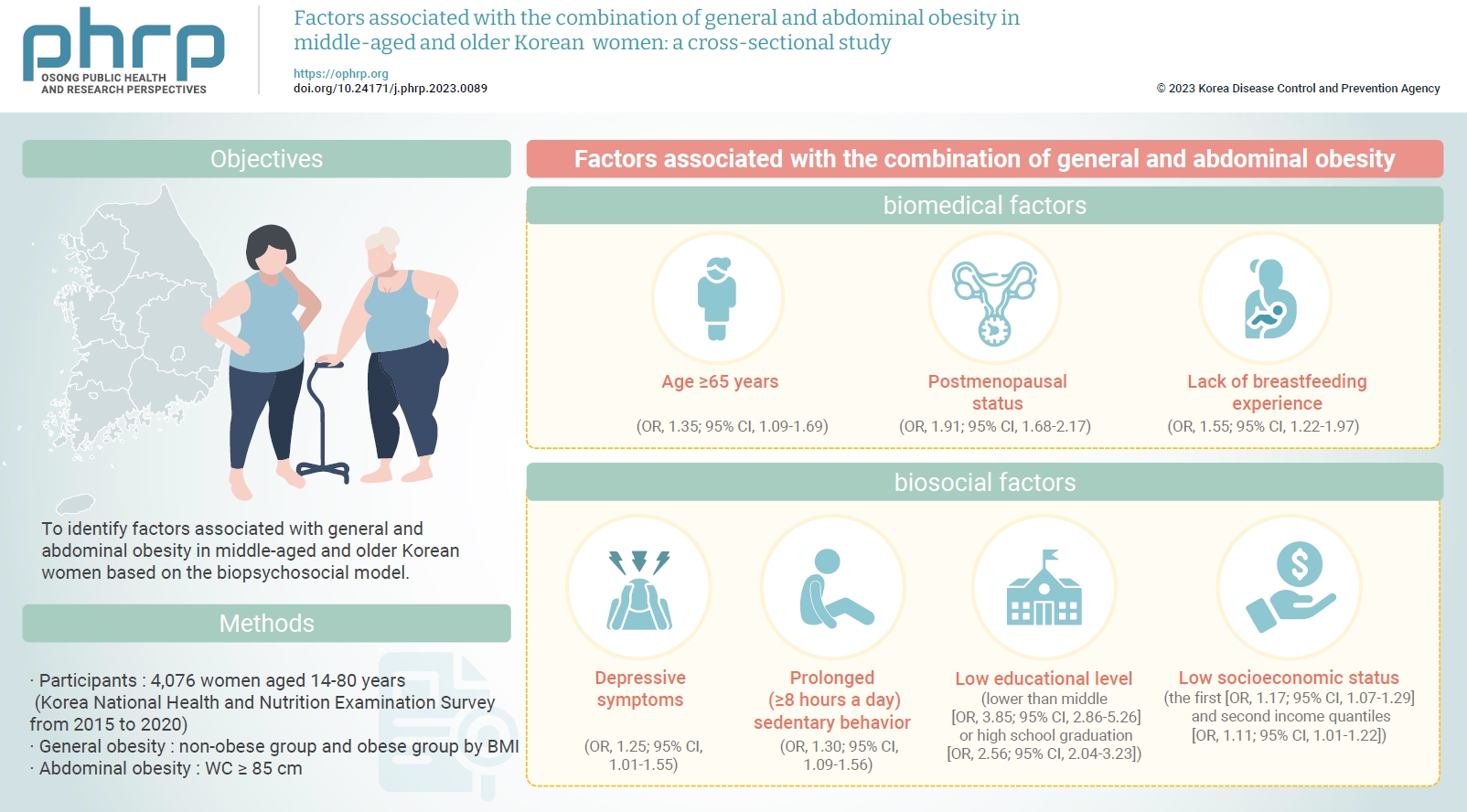
Objectives To identify factors associated with general and abdominal obesity in middle-aged and older Korean women based on the biopsychosocial model. Methods: Data from 4,076 women aged ≥45 years who participated in the Korea National Health and Nutrition Examination Survey from 2015 to 2020 were analyzed. Complex sampling analysis was performed using IBM SPSS ver. 26.0. Results: The combination of general and abdominal obesity was positively associated with age ≥65 years, postmenopausal status, and without breastfeeding experience among biomedical factors; depressive symptoms and prolonged (≥8 hours a day) sedentary behavior among psychosocial factors; and an educational level lower than middle or high school graduation and the first and second income quantiles among biosocial factors. Conclusion: Healthcare providers in communities and public societies should screen for risk factors for the combination of general and abdominal obesity while considering non-modifiable biomedical (e.g., age) and biosocial factors (e.g., educational level). In addition, intervention strategies should be developed by considering modifiable psychosocial factors such as sedentary behavior.
Citations
Citations to this article as recorded by
Relationship between anthropometric risk variables for chronic diseases in users of a primary care center José Ander Asenjo-Alarcón Población y Salud en Mesoamérica.2025;[Epub] CrossRef
Objectives This study investigated whether weight was managed appropriately in pregnant women with gestational diabetes mellitus (GDM) and examined the association between insufficient gestational weight gain (GWG) and adverse pregnancy outcomes.
Methods The study included 235 pregnant women with GDM from the Korean Pregnancy Outcome Study. GWG from the second to the third trimester (kg/wk) and total GWG (kg) were classified as insufficient, appropriate, or excessive according to the 2009 Institute of Medicine guidelines. Adverse pregnancy outcomes included maternal (hypertensive disorders of pregnancy, preterm birth, cesarean delivery, and delivery complications) and infant (low birth weight, high birth weight, neonatal intensive care unit admission, and congenital anomalies) outcomes.
Results The proportion of pregnant women with GDM who had insufficient GWG from the second to the third trimester was 52.3%, and that of participants with total insufficient GWG was 48.1%. There were no significant associations between insufficient GWG from the second to the third trimester and adverse pregnancy outcomes. Participants with total insufficient GWG had a significantly lower risk of preterm birth (odds ratio [OR], 0.17; 95% confidence interval [CI], 0.05–0.60) and high birth weight (OR, 0.23; 95% CI, 0.07–0.80).
Conclusion Our findings suggest the importance of appropriate weight management and the need for GWG guidelines for pregnant women with GDM.
Citations
Citations to this article as recorded by
Impact of gestational weight gain on adverse pregnancy outcomes in women with gestational diabetes: a retrospective cohort study Amin Moradi, Mehdi Norouzi, Ehsan Mosa Farkhani BMC Pediatrics.2026;[Epub] CrossRef
Risk factors and prediction model for low-birth-weight infants born to women with gestational diabetes mellitus Yu-qing Pan, Xin-xin Huang, Xiu-min Jiang Frontiers in Public Health.2024;[Epub] CrossRef
Objectives
The objective of this study was to analyze the psychological outcomes of pregnant women during the coronavirus disease 2019 (COVID-19) pandemic in several areas that are epicenters for the spread of the severe acute respiratory syndrome coronavirus 2 (SARS-CoV-2) in Indonesia.
Methods
This cross-sectional study used data obtained from an online survey administered to 120 women who were pregnant and gave birth during the COVID-19 pandemic in Indonesia. The psychological condition of pregnant women was measured using the Depression, Anxiety, and Stress Scale-21 questionnaire which was modified for conditions experienced during the COVID-19 pandemic. We classified pregnant women into 2 groups according to their psychological condition: pregnant women who experienced anxiety and pregnant women who did not experience anxiety or felt normal. Receiver operating characteristic (ROC) analysis was undertaken for the 2 groups. This study also used univariate analysis and bivariate analysis.
Results
The results of the ROC analysis resulted in a cutoff score of 3.56. The proportion of respondents who felt anxious was 53.3% and the proportion of respondents who did not feel anxious or felt normal was 46.7%. Anxiety was most common among pregnant women with high education levels, gestational age <19 weeks, and working pregnant women.
Conclusion
Maternal health services need to be performed with strict health protocols, complemented by pregnancy counseling services. This will provide a feeling of comfort and safety as pregnant women receive health services and give birth.
Citations
Citations to this article as recorded by
Nutrition and non-nutrition determinants of maternal mental disorders, stress and depression in pregnancy amidst a global pandemic: findings from Action against Stunting Hub Indonesia Umi Fahmida, Min Kyaw Htet, Amanda Safiera Ameline, Tiffany Cornelia Angelin, Risatianti Kolopaking, Hilary Davies-Kershaw, Elaine L. Ferguson British Journal of Nutrition.2026; 135(6): 653. CrossRef
Lessons of practices of community-based maternal and child health surveillance system during and post COVID-19 in Indonesia Wahyu Septiono, Ferdinand Pangihutan Siagian, Lutfan Lazuardi, Samsriyaningsih Handayani, Sabarinah Prasetyo Global Health Action.2025;[Epub] CrossRef
Validation of the pregnancy-related anxiety scale (PrAS) for pregnant women in Indonesia Wiwit Kurniawati, Wai Tong Chien, Nurlela Lantu, Neni Fidya Santi, Yunita Laila Astuti, Fayna Faradiena, Arie Kusumaningrum BMC Pregnancy and Childbirth.2025;[Epub] CrossRef
Recomendações para educação em saúde de gestantes e puérperas no contexto da Covid-19 Michelle Leane Santana da Silva, Claudete Ferreira de Sousa Monteiro, Ana Paula Cardoso Costa, Fernando José Guedes da Silva Júnior Physis: Revista de Saúde Coletiva.2024;[Epub] CrossRef
The prevalence of mental ill-health in women during pregnancy and after childbirth during the Covid-19 pandemic: a systematic review and Meta-analysis Gayathri Delanerolle, Mary McCauley, Martin Hirsch, Yutian Zeng, Xu Cong, Heitor Cavalini, Sana Sajid, Ashish Shetty, Shanaya Rathod, Jian Qing Shi, Dharani K. Hapangama, Peter Phiri BMC Pregnancy and Childbirth.2023;[Epub] CrossRef
The effect of COVID-19 on women’s experiences of pregnancy, birth and postpartum in Indonesia: a rapid online survey Linda McGowan, Andari Astuti, Firdaus Hafidz, Cesa Pratiwi, Vinami Yulian, Elizabeth Hughes, Arum Pratiwi, Emi Nurjasmi Indomo, Yu Fu BMC Pregnancy and Childbirth.2023;[Epub] CrossRef
Risk factors for depression and anxiety in pregnant women during the COVID-19 pandemic: Evidence from meta-analysis Yupeng Luo, Kui Zhang, Mengxue Huang, Changjian Qiu, Ali Rostami PLOS ONE.2022; 17(3): e0265021. CrossRef
<sec>
<title>Objectives</title>
<p>The use of menstrual hygiene products and its effect on women’s health remains under studied. Patterns of menstrual hygiene product use and the rationale behind choices among Korean women aged 18–45 years were examined.</p></sec>
<sec>
<title>Methods</title>
<p>This cross-sectional study was a part of the Korea Nurses’ Health Study. A total of 20,613 nurses participated, and 8,658 nurses participated in Module 7 which included a menstrual hygiene products-related survey. The data were collected through the mobile survey using a self-reported questionnaire. Participants’ use of menstrual hygiene products and related characteristics were analyzed using frequency (percentage) or mean (SD).</p></sec>
<sec>
<title>Results</title>
<p>The most common types of menstrual hygiene products across all age groups were disposable menstrual pads (89.0%), followed by cloth menstrual pads (4.5%), tampons (4.2%), and only 1.6% used a menstrual cup. Disposable menstrual pads were the most common across all age groups, but in those aged under 30 years this was followed by tampon use (6%). The most important criteria when choosing a menstrual hygiene product was comfort for disposable menstrual pads (31.3%) and tampons (41.5%), natural ingredients or organic products for cloth menstrual pads (51.4%), and custom fit for the menstrual cup (50.7%). However, for all menstrual hygiene products (except cloth menstrual pads), there was a higher proportion of anxiety than perception of safety, and low awareness of toxic shock syndrome.</p></sec>
<sec>
<title>Conclusion</title>
<p>It is important for women to use menstrual hygiene products with confidence. More research is needed to better understand potential health effects of menstrual hygiene products.</p></sec>
Citations
Citations to this article as recorded by
Sanitation and hygiene practices of secondary school students from Mtwara town in Tanzania Obadia Kyetuza Bishoge, Ademola Kabir Aremu, Dickson Dare Ajayi, Sayoki Godfrey Mfinanga International Journal of Health Promotion and Educ.2026; 64(1): 55. CrossRef
Prevalence of menstrual cup usage among reproductive-age women in asian countries: a systematic review and meta-analysis Surama Manjari Behera, Priyamadhaba Behera, Deb Kumar Pal, Vikas Yadav, Anjusha Ranjith, Venkatarao Epari, Binod Kumar Patro, Susmita Dora, Srikanta Kanungo, Jyotiranjan sahoo, Meena Som BMC Women's Health.2026;[Epub] CrossRef
Comparison of menstrual blood and endometrial biopsy as specimens in the diagnosis of female genital tuberculosis: a systematic review Usha Nayak, Tejaswini Baral, Sonal Sekhar Miraj, Mohan K Manu, Muralidhar D Varma, Sandeep Samethadka Nayak, Jyothsna Manikkath BMC Infectious Diseases.2026;[Epub] CrossRef
Measuring menstrual hygiene in high-income countries: A scoping review Mintesnot Tenkir Teni, Jamirah Abdul-Haqq, Edvanio Fernandes, Anne Sebert Kuhlmann Women's Health.2026;[Epub] CrossRef
The relationship between women’s awareness of sustainable menstrual cups, their menstrual attitudes, and genital hygiene behaviors: a cross-sectional study Aynur Ataman Kufacı, Funda Erol, Tuba Yılmaz Bulut, Hurmus Kuzgun BMC Women's Health.2026;[Epub] CrossRef
Integrating experimental data and mechanistic modeling to assess potential lead exposure from tampon use Corie A Ellison, Patrick R Doyle, Christina A Haven, Denise M McClenathan, Cindy M Obringer, Kara E Woeller Toxicological Sciences.2026;[Epub] CrossRef
From Legal Recognition to Lived Reality: A Review of Transgender Healthcare in Post-2019 India Yadamala Sreenivasulu, Rachana S Pillai Journal of Social Inclusion Studies.2026; 12(1): 81. CrossRef
A sustainable development of hygiene materials: innovations in bio-based materials, functional improvements and waste management systems Arunkumar Nallasamy, Monisha Periyasamy, Krithikadevi Paramasivam, Mohana Marimuthu, Murugan Veerapandian Journal of Material Cycles and Waste Management.2026; 28(5): 3902. CrossRef
In vitro metal leaching from tampons under simulated vaginal and menstrual pH conditions Gillian S. Kaneshiro, Daysi Martinez, Heidi Hannoush, Marianthi Anna Kioumourtzoglou, Jenni A. Shearston, Nancy Reame, Kristen Upson, Kathrin Schilling AJOG Global Reports.2026; 6(4): 100686. CrossRef
Health-driven choices: Brand equity, genital hygiene behavior, and menstrual product preferences among women Özen İnam, Belis Gülay, Tuğba Bozdemir Health Marketing Quarterly.2026; : 1. CrossRef
Menstrual hygiene management among girls and women refugees in Africa: a scoping review Alexis Harerimana, Gugu Mchunu, Julian David Pillay Conflict and Health.2025;[Epub] CrossRef
Cupping the future: highlighting the importance of menstrual cups and the prevailing challenges to its use in Pakistani women Yumna Khabir, Turba Naz, Mahnoor Rehan Hashmi, Nimrah Iqbal, Waseem Sajjad Discover Public Health.2025;[Epub] CrossRef
Menstrual product use patterns in a large digital cohort in the United States: variations by sociodemographic, health, and menstrual characteristics Zifan Wang, Elizabeth Peebles, Donna D. Baird, Anne Marie Z. Jukic, Allen J. Wilcox, Christine L. Curry, Tyler Fischer-Colbrie, Jukka-Pekka Onnela, Michelle A. Williams, Russ Hauser, Brent A. Coull, Shruthi Mahalingaiah American Journal of Obstetrics and Gynecology.2025; 233(3): 184.e1. CrossRef
Integrating demographic insights into menstrual product choices: a study through the lens of Engel–Kollat–Blackwell Model Anushka Mehar, Yamini Health Education.2025; 125(4): 409. CrossRef
Pengaruh Environmental Knowledge, Green Advertising, dan Environmental Concern terhadap Green Purchase Intention pada Produk Pembalut Kain Rachela Putri Hanasti, ANDI MUHAMMAD SADAT, ANNISA LUTFIA JAE (JURNAL AKUNTANSI DAN EKONOMI).2025; 10(2): 204. CrossRef
Sustainable Choices: Menstrual Cup Awareness and Acceptance among Rural Women in Dakshina Kannada, Karnataka: A Community-based Cross-sectional Study Pooja Devadiga, Mackwin Kenwood Dmello Journal of Datta Meghe Institute of Medical Scienc.2025; 20(3): 598. CrossRef
Impactos ambientais e sanitários dos absorventes descartáveis: Uma revisão sistemática da literatura Heloísa Assami, Igor Matheus de Souza Fellipe, Maria Bianca Cabrera, Leonardo Miguel Guzzoni, Felipe Nakamura Bassani, Luciana Cristina Soto Herek Research, Society and Development.2025; 14(11): e116141150019. CrossRef
Beyond the Bin: A critical review and strategic framework for sustainable menstrual waste management in India Hema Sudhakar Social Sciences & Humanities Open.2025; 12: 102226. CrossRef
Menstrual hygiene management practices among girls aged 9 to 17 years in Mathioya Sub-County, Murang’a County Janet Nyarenchi, Mary Amatu, Josphiine Mutembei African Journal of Science, Technology and Social .2025; 4(2): 65. CrossRef
From Convenience to Controversy: The Untold Stories of Feminine Hygiene Products Hina Samreen, Falak Shad Memon, Hira Mujahid Pakistan Journal of Gender Studies.2025; : 33. CrossRef
MIMA 2.0 - Compact and portable Multifunctional IoT integrated Menstrual Aid Kumar J. Jyothish, Shreya Shivangi, Amish Bibhu, Subhankar Mishra, Sulagna Saha Internet of Things.2024; 25: 101075. CrossRef
Knowledge, attitude, and practice of menstrual hygiene at a medical and health sciences university Rajani Dube, Huma Zaidi, Shehla Shafi Khan Journal of Advanced Pharmacy Education and Researc.2024; 14(1): 63. CrossRef
Gynecological and Obstetric Crisis in Gaza Conflict Area: A Call for Action Ibraheem Alkhawaldeh, Hamza Alsalhi, Mostafa Moawad, Yasmeen Jamal Alabdallat JAP Academy Journal.2024;[Epub] CrossRef
Examining menstrual health experiences in Philadelphia, PA: A qualitative investigation Allison R Casola, Oriana Pando, Lynette Medley, Brianna Kunes, Nya McGlone, Olivia Rea Women's Health.2024;[Epub] CrossRef
Exploring Menstrual Hygiene Practices and Awareness of Menstrual Cups Among Nursing Professionals: A Cross-Sectional Survey Medha Davile, Neha Gangane, Mubashshera F Khan, Shalini Dange, Shuchita Mundle Cureus.2024;[Epub] CrossRef
Korea Nurses’ Health Study and the health of reproductive-aged women: a cohort profile Chiyoung Cha, Heeja Jung, Sue Kim, Jung Eun Lee, Kwang-Pil Ko, Eunyoung Cho, Hyun-Young Park, Joong-Yeon Lim, Bo Mi Song, Sihan Song, Soojin Park, Aram Cho Epidemiology and Health.2024; 46: e2024048. CrossRef
Development and validation of a survey instrument for reusable sanitary products toward sustainable menstrual hygiene Vysakh Kani Kolil, Krishnashree Achuthan Scientific Reports.2024;[Epub] CrossRef
Parental education, embarrassment, and sanitation facilities influence menstrual product choices among female nursing students in Bangladesh Md. Nahid Uz Zaman, Akira Sai, Sikopo Nyambe, Taro Yamauchi Journal of Water, Sanitation and Hygiene for Devel.2024; 14(10): 1003. CrossRef
Reusable period products: use and perceptions among young people in Victoria, Australia Caitlin Ramsay, Julie Hennegan, Caitlin H. Douglass, Sarah Eddy, Alexandra Head, Megan S. C. Lim BMC Women's Health.2023;[Epub] CrossRef
Exploratory systematic review and meta-analysis on period poverty Gayathri Delanerolle, Xiao-Jie Yang, Heitor Cavalini, Om P Kurmi, Camilla Mørk Røstvik, Ashish Shetty, Lucky Saraswat, Julie Taylor, Sana Sajid, Shanaya Rathod, Jian-Qing Shi, Peter Phiri World Journal of Meta-Analysis.2023; 11(5): 196. CrossRef
Key findings on women’s reproductive health: the Korea Nurses’ Health Study Chiyoung Cha, Heeja Jung Korean Journal of Women Health Nursing.2023; 29(2): 81. CrossRef
Nonconventional Menstrual Hygiene Products and its Usage among Reproductive age Group Women in India – A Cross-Sectional Study Dharmaraj Rock Britto, Neethu George, Abdul Malik Shagirunisha Rizvana, Josephin Shalini Ratchagar, Tamilarasan Muniyapillai, Karthikeyan Kulothungan Journal of Datta Meghe Institute of Medical Scienc.2023; 18(3): 357. CrossRef
Assessment of knowledge, attitudes, and practices regarding menstruation and menstrual hygiene among early-reproductive aged women in Bangladesh: a cross-sectional survey Abu Bakkar Siddique, Sudipto Deb Nath, Mahfuza Mubarak, Amena Akter, Sanjida Mehrin, Mst Jemi Hkatun, Antara Parvine Liza, M. Ziaul Amin Frontiers in Public Health.2023;[Epub] CrossRef
Uncovering the Influence of Marketing Strategies on Menstrual Health Management During Covid-19 in Indonesia Rosita Widjojo, Siska Purnama Manurung, Ayu Hidayah Aslamiah, Angelica Jolie Gazdaság és Társadalom.2023; 16(2): 101. CrossRef
Use and perceptions on reusable and non-reusable menstrual products in Spain: A mixed-methods study Laura Medina-Perucha, Tomàs López-Jiménez, Anna Sofie Holst, Constanza Jacques-Aviñó, Jordina Munrós-Feliu, Cristina Martínez-Bueno, Carme Valls-Llobet, Diana Pinzón Sanabria, Mª Mercedes Vicente-Hernández, Anna Berenguera, Muhammad Shahzad Aslam PLOS ONE.2022; 17(3): e0265646. CrossRef
Women’s attitudes toward certification logos, labels, and advertisements for organic disposable sanitary pads: results from a multi-city cross-sectional survey Hayeon Kim, Jinyoung Jung, Yun-Kyoung Song, Taegwon Chang, Sungmin Park, Jiwon Park, Kyungim Kim BMC Women's Health.2022;[Epub] CrossRef
<sec>
<title>Objectives</title>
<p>This research aimed to understand the popularity of topics in the field of women’s health through analysis of online news articles which were chronologically classified and examined to determine how women’s health and diseases had changed over time.</p></sec>
<sec>
<title>Methods</title>
<p>Women’s health and disease news articles were collated from a popular news website between 1993 to 2015 and preprocessed using gynecological medical terminology, Korean words and nouns (excluding general nouns not related to women’s healthcare topics). The resultant articles (N = 7,710) were analyzed using the Latent Dirichlet Allocation algorithm and major topics were extracted. Topic trends were analyzed by year and period for women’s health.</p></sec>
<sec>
<title>Results</title>
<p>It was observed that most of the women’s health articles were focused on “Healthcare”, and 9 other topics were identified that represented a relatively small proportion in 1993–2000. In 2001–2005, most of the articles were focused on “Medical Services” and “Dietary Supplements” with some specific topics that peaked people’s interest, as compared to those focused on “Healthcare” in the 1990s. It was also observed that differences in the proportion of each topic was small after 2011.</p></sec>
<sec>
<title>Conclusion</title>
<p>Changes in topics related to women’s disease were not clearly distinguished in the 1990s but this changed from 2001where articles related to “women disease” appeared as articles on the topics of various diseases.</p></sec>
Citations
Citations to this article as recorded by
Harnessing Latent Dirichlet Allocation-based topic modeling to unveil the focus areas in Ayush healthcare in India Tina Dutta, Abhinav Kumar Journal of Ayurveda and Integrative Medicine.2026; 17(4): 101356. CrossRef
Representation of drug addiction in Pakistani print media: A Latent Dirichlet Allocation analysis Saad Zahid, Muhammad Nawaz, Kanwal Zahra, Farshid Danesh PLOS One.2026; 21(9): e0356760. CrossRef
Review on News About Midwifery and Fertility Covered on Newspapers in Turkey Sümeyye ALTIPARMAK, Emel GÜÇLÜ CİHAN, Hatice Gül ÖZTAŞ, Hülya KAMALAK Medical Records.2021; 3(2): 118. CrossRef
<sec>
<title>Objectives</title>
<p>This study identifies associated factors of ischemic heart disease (IHD) among post-menopausal Korean women at the biomedical (age, family history of hypertension, dyslipidemia, type 2 diabetes mellitus, or cerebro-cardiovascular disease, body mass index, and metabolic syndrome), biosocial (socioeconomic status and educational level), and psychosocial levels (stress, depression, smoking, binge alcohol consumption, and physical activity).</p></sec>
<sec>
<title>Methods</title>
<p>This study used a cross-sectional design with secondary data analysis of the 2013–2016 Korean National Health and Nutrition Examination Survey. Data from 3,636 women were analyzed by logistic regression analysis using a complex sample procedure.</p></sec>
<sec>
<title>Results</title>
<p>Of the biomedical factors, older age [odds ratio (OR): 2.99, 95% confidence interval (CI): 1.87–4.80, <italic>p</italic> < 0.001], family history (OR: 2.29, 95% CI: 1.44–3.65, <italic>p</italic> = 0.001), and metabolic syndrome (OR: 1.93, 95% CI: 1.27–2.95, <italic>p</italic> = 0.002) were associated with IHD in post-menopausal women. Of the psychosocial factors, depression (OR: 2.56, 95% CI: 1.66–3.96, <italic>p</italic> < 0.001) and smoking (OR: 1.92, CI: 1.04–3.55, <italic>p</italic> = 0.038) were associated with IHD in post-menopausal women.</p></sec>
<sec>
<title>Conclusion</title>
<p>These findings suggest that healthcare providers need to consider the contributing adverse effects of older age, family history, metabolic syndrome, depression and smoking when evaluating risk factors for IHD in post-menopausal women.</p></sec>
Citations
Citations to this article as recorded by
Vasomotor symptoms, cardiovascular risk factors, and cardiovascular disease risk among Chinese postmenopausal women in Hong Kong Sek Ying Chair, Sally Wai Sze Lo, Ho Yu Cheung, Janet Wing Hung Sit, Qun Wang, Huijing Zou Women & Health.2022; 62(7): 621. CrossRef
Association of rheumatoid arthritis and high sodium intake with major adverse cardiovascular events: a cross-sectional study from the seventh Korean National Health and Nutrition Examination Survey Jeong-Hyeon Bae, Min-Young Shin, Eun Ha Kang, Yun Jong Lee, You-Jung Ha BMJ Open.2021; 11(12): e056255. CrossRef
Comparison of early cardiovascular risk among Brazilian and African university students Ederson Laurindo Holanda de Sousa, Jânio Emanuel Andrade Cavalcante, Daniel Freire de Sousa, Jamile Magalhães Ferreira, Richard Rarison Cavalcante Meneses, Duaran Lopes Sousa, Allyson Jordan Xavier da Silva, Raimundo Rigoberto Barbosa Xavier Filho, Elias Clinical Biochemistry.2020; 75: 7. CrossRef
Beneficial Effects of Breastfeeding on the Prevention of Metabolic Syndrome Among Postmenopausal Women Jin Suk Ra, Soon Ok Kim Asian Nursing Research.2020; 14(3): 173. CrossRef
<sec><title>Objectives</title><p>Our study aims to provide basic scientific data on the importance of obesity management in middle-aged Korean women by analyzing its effects on blood pressure and arterial stiffness. In addition, we examined the correlations of these two parameters.</p></sec><sec><title>Methods</title><p>The study participants were 40 middle-aged female volunteers, who were classified into obesity group (n = 20) and normal weight group (n = 20). Statistical analysis was performed using independent <italic>t</italic>-test and the Pearson correlation coefficient was used to correlate blood pressure and arterial stiffness.</p></sec><sec><title>Results</title><p>This study evaluated the systolic blood pressure, diastolic blood pressure, and pulse wave velocity (PWV). These results were higher in the obesity group than the normal weight group. Furthermore, blood pressure and arterial stiffness (PWV, augmentation pressure) were static correlated.</p></sec><sec><title>Conclusion</title><p>Obesity is closely related to blood pressure and arterial stiffness. Therefore, indices for blood pressure and arterial stiffness may play a vital role in predicting and preventing obesity and its sequelae.</p></sec>
Citations
Citations to this article as recorded by
Markers of Vascular Function and Future Coronary Artery Disease Risk Among Malaysians with Individual Cardiovascular Risk Factors Amilia Aminuddin, Nina Diyana Rusanuar, Md Rizman Md Lazin Md Lazim, Azizah Ugusman, Izzat Zulhilmi Abd Rahman, Kalaivani Chellappan, Mohd Shawal Faizal Mohamad, Wan Amir Nizam Wan Ahmad, Wan Yus Haniff Wan Isa Biomedicines.2025; 13(4): 899. CrossRef
Physical activity and cardiovascular risk in obese older Korean women: effects on obesity, hypertension, and arterial stiffness Woo-Hyeon Son, Yi-Sub Kwak, Min-Seong Ha Frontiers in Public Health.2025;[Epub] CrossRef
Obesity awareness reduces food craving and improves metabolic parameters: A study on adults with overweight and obesity Kevser Tari Selcuk, Ramazan Mert Atan, Nursel Dal, Sedat Arslan Mediterranean Journal of Nutrition and Metabolism.2025; 18(3): 184. CrossRef
Food readjustment plus exercise training improves cardiovascular autonomic control and baroreflex sensitivity in high‐fat diet‐fed ovariectomized mice Bruno Nascimento‐Carvalho, Adriano Dos‐Santos, Nicolas Da Costa‐Santos, Sabrina L. Carvalho, Oscar A. de Moraes, Camila P. Santos, Katia De Angelis, Erico C. Caperuto, Maria‐Claudia Irigoyen, Katia B. Scapini, Iris C. Sanches Physiological Reports.2023;[Epub] CrossRef
Associations between body composition and cardiovascular disease risk in pre- and postmenopausal women Nirmala Rathnayake, Gayani Alwis, Janaka Lenora, Sarath Lekamwasam Journal of Health, Population and Nutrition.2023;[Epub] CrossRef
Comparison of Vascular Function, Cardiometabolic Parameters, Hemorheological Function, and Cardiorespiratory Fitness Between Middle-Aged Korean Women With and Without Obesity—A Pilot Study Hun-Young Park, Won-Sang Jung, Sung-Woo Kim, Kyounghwa Jung, Kiwon Lim Frontiers in Physiology.2022;[Epub] CrossRef
Comparison of femoral and carotid arteries in terms of pulse check in cardiopulmonary resuscitation: A prospective observational study Gökhan Yılmaz, Oğuzhan Bol Resuscitation.2021; 162: 56. CrossRef
Effect of yoga on pulse rate and blood pressure among women G. Kaleeswari, C. Vasantha Kalyani, J. S. Jayarani, Kusum K. Rohilla Journal of Family Medicine and Primary Care.2021; 10(10): 3670. CrossRef
Association of obesity with arterial stiffness: The Multi-Ethnic Study of Atherosclerosis (MESA) Jeongok G. Logan, Hyojung Kang, Soyoun Kim, Daniel Duprez, Younghoon Kwon, David R. Jacobs, Nketi Forbang, Jennifer Mason Lobo, Min-Woong Sohn Vascular Medicine.2020; 25(4): 309. CrossRef
The Feasibility and Applications of Non-invasive Cardiac Monitoring in Obese Patients Undergoing Day-case Surgery: Results of a Prospective Observational Study P. Sansone, L.G. Giaccari, U. Colella, F. Coppolino, M.C. Pace, M.B. Passavanti, V. Pota, C. Aurilio The Open Anesthesia Journal.2020; 14(1): 80. CrossRef
The Impact of Obesity on Nighttime Blood Pressure Dipping Beata Moczulska, Maciej Zechowicz, Sylwia Leśniewska, Karolina Osowiecka, Leszek Gromadziński Medicina.2020; 56(12): 700. CrossRef
Greater Adherence to Life’s Simple 7 Is Associated With Less Arterial Stiffness: the Atherosclerosis Risk in Communities (ARIC) Study Abayomi O Oyenuga, Aaron R Folsom, Susan Cheng, Hirofumi Tanaka, Michelle L Meyer American Journal of Hypertension.2019; 32(8): 769. CrossRef
Objectives
<i>Mycoplasma genitalium</i> infections are suggested as causes of a number of pathological outcomes in pregnant women. The aim of this study was to evaluate the frequency of <i>M. genitalium</i> infections among pregnant women and its association with spontaneous abortion. Methods
In this case–control study we included 109 women with spontaneous abortion with a gestational age of 10–20 weeks (patients), and 109 women with normal pregnancy with a gestational age of 20–37 weeks (controls) in Sanandaj, Iran. Using specific primers and extracted DNA from endocervical swabs, a polymerase chain reaction was conducted for the detection of <i>M. genitalium</i> infection in both groups. Results
The frequency of <i>M. genitalium</i> infection in patient and control groups was one (0.91%) and three (2.75%), respectively. In both control and patient groups using Fisher test, no association between mycoplasma infection and spontaneous abortion was seen. Conclusion
<i>M. genitalium</i> may be positive in the genital tract of some pregnant women but was not associated with spontaneous abortion. Further powerful studies with larger sample sizes are needed for the determination of a possible role of <i>M. genitalium</i> in pregnancy outcomes and spontaneous abortion.
Citations
Citations to this article as recorded by
The role of bacterial genital infections in spontaneous preterm delivery: a case-control study Amjad Ahmadi, Mohammad Bagher Khadem Erfan, Daem Roshani, Safoura Derakhshan, Rashid Ramazanzadeh, Fariba Farhadifar, Behzad Mohsenpour, Sholeh Shahgheibi, Mozhdeh Zarei, Himen Salimizand, Bahram Nikkhoo Frontiers in Cellular and Infection Microbiology.2024;[Epub] CrossRef
Relationship between Vaginal Bacterial Infections and Pregnancy Outcomes: A Systematic Review and Meta-Analysis Hojjat Rokni, Amjad Ahmadi, Yousef Moradi, Bijan Nouri, Daem Roshani Iranian Journal of Nursing and Midwifery Research.2024; 29(1): 1. CrossRef
The association between genital mycoplasma infection and spontaneous abortion: A systematic review and meta-analysis Wei Chen, Shimin Xiong, Xubo Shen, Ting Qiu, Caidie He, Songlin An, Yuanzhong Zhou Reproductive Toxicology.2023; 116: 108334. CrossRef
Latest Advances in Laboratory Detection of Mycoplasma genitalium Ken B. Waites, Donna M. Crabb, Amy E. Ratliff, William M. Geisler, T. Prescott Atkinson, Li Xiao, Romney M. Humphries Journal of Clinical Microbiology.2023;[Epub] CrossRef
Weighing Potential Benefits and Harms of Mycoplasma genitalium Testing and Treatment Approaches Lisa E. Manhart, William M. Geisler, Catriona S. Bradshaw, Jørgen S. Jensen, David H. Martin Emerging Infectious Diseases.2022;[Epub] CrossRef
Bacteriospermia and its association with seminal fluid parameters and infertility in infertile men, Kerman, Iran: A cross-sectional study Parastou Heidari Pebdeni, Fereshteh Saffari, Toraj Reza Mirshekari, Sareh Ashourzadeh, Moslem Taheri Soodejani, Roya Ahmadrajabi International Journal of Reproductive BioMedicine .2022; 20(3): 203. CrossRef
The Associations of Genital Mycoplasmas with Female Infertility and Adverse Pregnancy Outcomes: a Systematic Review and Meta-analysis Caifeng Ma, Jikun Du, Yuhong Dou, Rui Chen, Yuxia Li, Lijun Zhao, Helu Liu, Kebin Zhang Reproductive Sciences.2021; 28(11): 3013. CrossRef
Mollicutes antibiotic resistance profile and presence of genital abnormalities in couples attending an infertility clinic Brenda Maldonado-Arriaga, Noé Escobar-Escamilla, Juan Carlos Pérez-Razo, Sofia Lizeth Alcaráz-Estrada, Ignacio Flores-Sánchez, Daniel Moreno-García, Rebeca Pérez-Cabeza de Vaca, Paul Mondragón-Terán, Jonathan Shaw, Cecilia Hernandez-Cortez, Graciela Castr Journal of International Medical Research.2020;[Epub] CrossRef
Association of spontaneous abortion and Ureaplasma parvum detected in placental tissue C. N. T. Oliveira, M. T. S. Oliveira, H. B. M. Oliveira, L. S. C. Silva, R. S. Freire, M. N. Santos Júnior, M. V. Oliveira, J. Timenetsky, G. B. Campos, L. M. Marques Epidemiology and Infection.2020;[Epub] CrossRef
Epidemiology of genital infections caused by Mycoplasma hominis, M. genitalium and Ureaplasma urealyticum in Iran; a systematic review and meta-analysis study (2000–2019) Khadijeh Moridi, Mohammad Hemmaty, Amir Azimian, Mohammad Hosein Fallah, Hamid Khaneghahi Abyaneh, Kiarash Ghazvini BMC Public Health.2020;[Epub] CrossRef
Prevalence and incidence ofMycoplasma genitaliumin a cohort of HIV-infected and HIV-uninfected pregnant women in Cape Town, South Africa Carolyn P Smullin, Hunter Green, Remco Peters, Dorothy Nyemba, Yamkela Qayiya, Landon Myer, Jeffrey Klausner, Dvora Joseph Davey Sexually Transmitted Infections.2020; 96(7): 501. CrossRef
Frequency of Chlamydia trachomatis, Mycoplasma genitalium, and Ureaplasma urealyticum Isolated From Vaginal Samples of Women in Kerman, Iran Zahra Zahirnia, Shahla Mansouri, Fereshteh Saffari, Ghazal Mansouri Archives of Clinical Infectious Diseases.2018;[Epub] CrossRef
High Prevalence of Leptotrichia amnionii, Atopobium vaginae, Sneathia sanguinegens, and Factor 1 Microbes and Association of Spontaneous Abortion among Korean Women Sang Soo Seo, Selvaraj Arokiyaraj, Mi Kyung Kim, Hea Young Oh, Minji Kwon, Ji Sook Kong, Moon Kyung Shin, Ye Lee Yu, Jae Kwan Lee BioMed Research International.2017; 2017: 1. CrossRef
Objectives
This study aims to determine prevalence of gender-based violence among pregnant women attending an antenatal care (ANC) clinic. Methods
Between September 2014 and December 2014, a cross-sectional study was conducted among 202 pregnant women attending the antenatal ward of the Primary Healthcare Centre (PHC) of Syangja district, Nepal. The data were collected using semistructure questionnaires with face-to-face interviews. SPSS software (IBM Corp, Armonk, NY, USA) was used for analysis the data. Results
The prevalence rate of gender-based violence was found to be 91.1% (184). Most of the respondents (87%) faced economic violence followed by psychological (53.8%), sexual (41.8%), and physical (4.3%) violence. Women experienced: (1) psychological violence with most complaining of angry looks followed by jealousy or anger while talking with other men, insults using abusive language and neglect; (2) economic violence with most complaining of financial hardship, denial of basic needs and an insistence on knowing where respondents were and restricting them to parents' home or friends/relatives' houses (jealousy); (3) physical violence by slapping, pushing, shaking, or throwing something at her, twisting arm or pulling hair, and punching and kicking; and (4) sexual violence by physically forcing her to have sexual intercourse without consent, and hurting or causing injury to private parts. Most (100%) of the perpetrators were found to be husbands and mothers-in-law (10.7%) who violated them rarely. Conclusion
The prevalence of gender-based violence (GBV) among pregnant women attending the ANC clinic was greater in the Syangja district of Nepal. Women's empowerment, economic autonomy, sensitization, informal or formal training regarding GBV for men and women, and the need for large-scale population-based surveys are the major recommendations of this study.
Citations
Citations to this article as recorded by
Prevalence of Violence in Iranian Pregnant Women: A Systematic Review and Meta-Analysis Shohreh Shafiei, Maryam Chegeni, Sima Afrashteh, Hamid Reza Shoraka, Azam Bazrafshan, Zohreh Bagherinezhad, Masumeh Ghazanfarpour, Hamid Sharifi Maternal and Child Health Journal.2022; 26(10): 1983. CrossRef
Gendered consequences of social changes in Nepal: rich possibilities Radha Adhikari, Jeevan R Sharma European Bulletin of Himalayan Research.2022;[Epub] CrossRef
Gebelikte aile içi şiddete maruz kalmanın postpartum depresyon ve maternal bağlanmaya etkisi Ayten TAŞPINAR, Seher SARIKAYA KARABUDAK, Ayden ÇOBAN, Filiz ADANA Adıyaman Üniversitesi Sağlık Bilimleri Dergisi.2021; : 94. CrossRef
Is there an association between fertility and domestic violence in Nepal? Sarah Raifman, Mahesh Puri, Jennet Arcara, Nadia Diamond-Smith AJOG Global Reports.2021; 1(2): 100011. CrossRef
Intimate partner violence among pregnant women attending antenatal care services in the rural Gambia Joseph W. Jatta, Ararso Baru, Olufunmilayo I. Fawole, Oladosu A. Ojengbede, Yong-hui Dang PLOS ONE.2021; 16(8): e0255723. CrossRef
Factors associated with contraceptive use in rural Nepal: Gender and decision-making Preeti K. Mahato, Zoë A. Sheppard, Edwin van Teijlingen, Nisa De Souza Sexual & Reproductive Healthcare.2020; 24: 100507. CrossRef
Experiences and Perceptions of Abused Turkish Women Regarding Violence Against Women Emel Bahadir-Yilmaz, Fatma Oz Community Mental Health Journal.2019; 55(4): 686. CrossRef
Intimate Partner Violence in Relation to Husband Characteristics and Women Empowerment: Evidence from Nepal Sujan Gautam, Hyoung-Sun Jeong International Journal of Environmental Research an.2019; 16(5): 709. CrossRef
Criticality as Ideological Becoming: Developing English Teachers for Critical Pedagogy in Nepal Bal Krishna Sharma, Prem Phyak Critical Inquiry in Language Studies.2017; 14(2-3): 210. CrossRef
In Bangla There Is No Word for Vagina <br>—Reflections on Language, Sexual Health, and Women’s Access to Healthcare in Resource-Limited Countries Annekathryn Goodman, Mithila Faruque, Rachel M. Clark Health.2016; 08(12): 1244. CrossRef
Objectives
The purpose of this study is to search the inner world of postmenopausal women in late-middle age who are facing senescence and live in small and medium-sized cities. Methods
The methods of the study were the investigation and classification of answers to questions according to a declarative ethnography analysis. The questions asked to late–middle-aged women living in small and medium-sized cities were “How do you interpret and recognize the changes in the body after menopause?” and “Which methods do you choose and practice to maintain your health in relation to aging during middle age?”. Results
Four positive topics and two negative topics were drawn from the study. The four positive themes were: ambition; completion of a great mission; life with a sense of affection; and gratitude for maintaining health. The negative themes were: undulating emotion; and filling the emptiness. Conclusion
The recognition of changes in the body after menopause in late–middle-aged women in small and medium-sized cities can affect their preparation processes towards senescence. It is critical to find the means to manage emergency health cases from early adulthood to middle age, based on the outcomes of the study. The study also emphasizes the importance of the woman's family's alternative strategies and supportive systems, which can fit into the cultural context of the community.
Citations
Citations to this article as recorded by
The Impact of Long-Term Chinese Dialect Use on Mandarin Tone Production and Perception: Evidence from Late Middle-Aged Puxian Min Speakers Mingjun Ji, Jinwei Lan, Jianhan Lei, Can Zhang, Jin Fang, Boquan Liu Language and Speech.2026;[Epub] CrossRef
Trend of Women’s Health Research in Korea, 2012–2020: Topic and Text Network Analysis Ji Eun Park, Saerom Kim, Myoung-Hee Kim, Taemi Kim, Seung-Ah Choe, Hye Sook Min Journal of Korean Medical Science.2023;[Epub] CrossRef
The experiences and needs of Asian women experiencing menopausal symptoms: a meta-synthesis Shefaly Shorey, Esperanza D. Ng Menopause.2019; 26(5): 557. CrossRef
Effects of Aromatherapy on Menopausal Symptoms, Perceived Stress and Depression in Middle-aged Women: A Systematic Review Shinmi Kim, Ji-Ah Song, Mi-Eun Kim, Myung-Haeng Hur Journal of Korean Academy of Nursing.2016; 46(5): 619. CrossRef
Patrício Fernando Lemes dos Santos, Poliana Rodrigues dos Santos, Graziele Souza Lira Ferrari, Gisele Almeida Amaral Fonseca, Carlos Kusano Bucalen Ferrari
Osong Public Health Res Perspect 2014;5(4):199-203. Published online August 31, 2014
Objective
Diabetes mellitus (DM) is a chronic disease considered an important public health problem. In recent years, its prevalence has been exponentially rising in many developing countries. Chronic complications of DM are important causes of morbidity and mortality among patients, which impair their health and quality of life. Knowledge on disease prevention, etiology, and management is essential to deal with parents, patients, and caregivers. The aim of this study was to evaluate the knowledge regarding DM in an adult population from a Middle-western Brazilian city. Methods
This was a cross-sectional study covering 178 adults, aged 18–64 years, who answered a diabetes knowledge questionnaire. In order to identify the difference between groups, analysis of variance was used. Results
Higher knowledge scores were found regarding the role of sugars on DM causality, diabetic foot care, and the effects of DM on patients (blindness, impaired wound healing, and male sexual dysfunction). However, lower scores were found amongst types of DM, hyperglycemic symptoms, and normal blood glucose levels. Females tended to achieve better knowledge scores than males. Conclusion
Women had better knowledge regarding types of DM, normal blood glucose values, and consequences of hyperglycemia revealed that diabetes education should be improved.
Citations
Citations to this article as recorded by
Public Awareness of Type 1 Diabetes and the New Italian Childhood Screening Program: Results From a Cross-Sectional Survey in Italy Ilen Lucia Guerrero Almeida, Alice Fachin, Eulalia Catamo, Antonietta Robino, Paolo Dalena, Gianluca Tamaro, Cinzia Braida, Gianluca Tornese Endocrine Practice.2026; 32(5): 728. CrossRef
Assessment of prediabetes knowledge among adults in Al-Madinah, Saudi Arabia Ameerah Almaski, Manal Almughamisi Nutrition and Health.2025; 31(1): 133. CrossRef
Diabetes knowledge and behaviour: a cross-sectional study of Jordanian adults Rula A. Amr, Ahmed M. Al-Smadi, Rand T. Akasheh Diabetologia.2025; 68(2): 320. CrossRef
Assessment of the Awareness of Risk Factors and Current Behavior Among Individuals With Type 2 Diabetes Mellitus in India: A Cross-Sectional Study S S Dariya, Anuj Maheshwari, Vijay Viswanathan, Anil Kumar Virmani, Mohsin Aslam, Alok Modi, Ajoy Kumar Tewari, Ashutosh Chaturvedi, Arun Kumar Kedia, G D Ramchandani, Rajnish Saxena, Jayant K Panda, Ashish Saxena, Akash N Singh, Bijay Patni, Ashish S Den Cureus.2025;[Epub] CrossRef
Health-related quality of life and influencing factors of patients with paroxysmal nocturnal hemoglobinuria in China Huaxin Yu, Shengnan Duan, Pei Wang, Rong Fu, Zixuan Lv, Yuchi Yu, Pu Miao, Junwei Shi, Niekun Zhuang, Huiying Hu, Ni Yuan, Sijia Che Orphanet Journal of Rare Diseases.2024;[Epub] CrossRef
The interplay of social support and education on diabetes knowledge: a focus on Korean American women Young Ji Yoon, Soonok An, Y. Joon Choi, Hee Yun Lee Ethnicity & Health.2024; 29(7): 793. CrossRef
Assessment of diabetes related-knowledge and practice among Algerian university students: a cross-sectional survey Mohamed Lounis Discover Public Health.2024;[Epub] CrossRef
Knowledge and Awareness of Type 2 Diabetes Complications in Conflict-Affected Regions: A Cross-Sectional Study in Homs, Syria Noor Albawab, Batol Junbolat, Aya Almohamad, Kefah Albawab, Sedra Mando, Rama Asaad, Shahd Alhayek, Adel Habib, Mohammed Ahmed Albakoush, Mosa Shibani, Yaser Abas, Abdullah Alhouri Cureus.2024;[Epub] CrossRef
Factores asociados con niveles adecuados de conocimientos sobre diabetes mellitus tipo 2 en pacientes de redes de servicios de salud en Bogotá D.C., Colombia Skarlet Marcell Vásquez, Juan Carlos Villar, Luz Ángela Torres-López, Edgar Camilo Barrera, Angela Manuela Balcázar-Muñoz Revista de la Facultad de Medicina.2024; 72(2): e112118. CrossRef
The Relationship Between Diabetes Knowledge Level, Physical Activity, and Quality of Life in Older Adults Burçin AKÇAY, Tuğba KURU ÇOLAK, Sultan İĞREK, Bahar ÖZGÜL, Adnan APTI Bandırma Onyedi Eylül Üniversitesi Sağlık Bilimler.2023; 5(2): 162. CrossRef
Knowledge, Attitude, and Practices Related to Foot Care Among Diabetic Patients in Tabuk City, Saudi Arabia Tariq M Shaqran, Saud N Alqahtani, Abdullah F Alhalafi , Norah M Alsabeelah, Rafaa A Algethmi, Ammar S Azhari, Abdulrahman Y Alhashmi, Abdullah N Almaghrabi, Hibah A Alshammari, Mohammed Saeed Alshahrani Cureus.2023;[Epub] CrossRef
Psychometric properties of the revised Diabetes Knowledge Test using Rasch analysis Eun-Hyun Lee, Young Whee Lee, Hyun-Jung Kang Patient Education and Counseling.2022; 105(4): 851. CrossRef
Recognition of diabetes and sociodemographic predictors: results of a cross-sectional nationwide population-based survey in Singapore Kumarasan Roystonn, Jue Hua Lau, PV AshaRani, Fiona Devi Siva Kumar, Peizhi Wang, Chee Fang Sum, Eng Sing Lee, Siow Ann Chong, Mythily Subramaniam BMJ Open.2022; 12(3): e050425. CrossRef
Public knowledge and awareness of diabetes mellitus, its risk factors, complications, and prevention methods among adults in Poland—A 2022 nationwide cross-sectional survey Kuba Sękowski, Justyna Grudziąż-Sękowska, Jarosław Pinkas, Mateusz Jankowski Frontiers in Public Health.2022;[Epub] CrossRef
Physical Comorbidity According to Diagnoses and Sex among Psychiatric Inpatients in South Korea Suin Park, Go-Un Kim, Hyunlye Kim International Journal of Environmental Research an.2021; 18(8): 4187. CrossRef
Diabetes knowledge, risk perception, and quality of life among South Asian caregivers in young adulthood Angela Koipuram, Sandra Carroll, Zubin Punthakee, Diana Sherifali BMJ Open Diabetes Research & Care.2020; 8(2): e001268. CrossRef
Small molecule IVQ, as a prodrug of gluconeogenesis inhibitor QVO, efficiently ameliorates glucose homeostasis in type 2 diabetic mice Ting-ting Zhou, Tong Zhao, Fei Ma, Yi-nan Zhang, Jing Jiang, Yuan Ruan, Qiu-ying Yan, Gai-hong Wang, Jin Ren, Xiao-wei Guan, Jun Guo, Yong-hua Zhao, Ji-ming Ye, Li-hong Hu, Jing Chen, Xu Shen Acta Pharmacologica Sinica.2019; 40(9): 1193. CrossRef
Problematic drinking in the old and its association with muscle mass and muscle function in type II diabetes Nikolaus Buchmann, Dominik Spira, Maximilian König, Kristina Norman, Ilja Demuth, Elisabeth Steinhagen-Thiessen Scientific Reports.2019;[Epub] CrossRef
A survey to validate the traditional Siddha perception of diabetes mellitus Amulya Vijay, Priyadharshan Ranganathan, Balachandar Vellingiri Journal of Public Health.2019; 27(5): 581. CrossRef
Knowledge and self-care management of the uncontrolled diabetes patients Somsak Thojampa International Journal of Africa Nursing Sciences.2019; 10: 1. CrossRef
Acculturation and Dietary Intakes by Gender Among Mongolians in South Korea: Nutrition Education Implication for Multicultural Families Hae Ryun Park, Zuunnast Tserendejid, Joung Hee Lee, Young Suk Lim Asia Pacific Journal of Public Health.2017; 29(7): 608. CrossRef
Knowledge of type 2 diabetic patients about their condition in Kimpese Hospital diabetic clinic, Democratic Republic of the Congo Patrick N. Ntontolo, Philippe N. Lukanu, Gboyega A. Ogunbanjo, Jean-Pierre L. Fina, Léon N.M. Kintaudi African Journal of Primary Health Care & Family Me.2017;[Epub] CrossRef
Assessment of Knowledge of Diabetes Mellitus in the Urban Areas of Klang District, Malaysia Sasikala Chinnappan, Palanisamy Sivanandy, Rajenthina Sagaran, Nagashekhara Molugulu Pharmacy.2017; 5(1): 11. CrossRef
Affective Bond, Loneliness and Socioeconomic Aspects of an Elderly Population in Midwest, Brazil CKB Ferrari, GSL Ferrari, LD Nery, DF dos Santos, NS Pereira Archives of Nursing Practice and Care.2016; 2(1): 024. CrossRef




 First
 Prev


