Objectives In alignment with the World Health Organization’s goal of eliminating hepatitis C, this study assessed the current treatment status and reasons for non-treatment among patients with hepatitis C in Jeonbuk State, Republic of Korea, to inform strategies for improving care engagement.
Methods Among 311 individuals diagnosed with hepatitis C and reported through the National Notifiable Infectious Disease Surveillance system between January 2023 and June 2024, 208 patients were surveyed after excluding those who had died or could not be contacted. Statistical analyses included the chi-square test, the Cochran-Armitage test for trend, and logistic regression.
Results Overall, 116 participants (55.8%) reported having received antiviral therapy. Among the 92 untreated individuals, the most common reason for non-treatment was the absence of symptoms (n=23; 25.0%), followed by the burden of drug costs (n=21; 22.8%).
Conclusion These findings highlight suboptimal treatment uptake and key barriers that may hinder progress toward hepatitis C elimination. Expanding screening and strengthening linkage-to-care strategies, while addressing financial barriers, will be essential to achieving national elimination targets.
Objectives Patients receiving hemodialysis (HD) are at increased risk of acquiring hepatitis B virus (HBV) and hepatitis C virus (HCV) due to repeated blood exposure, vascular access procedures, and blood transfusions. The study aimed to determine the seroconversion rates of HBV and HCV among patients undergoing dialysis and to identify associated risk factors.
Methods A total of 220 adult patients receiving dialysis who were seronegative for hepatitis B surface antigen (HBsAg) and anti-HCV antibodies at baseline were enrolled. Serologic testing was repeated at 6 months.
Results Sixteen patients (7.3%) seroconverted to HBsAg positivity, and 23 (10.5%) seroconverted to anti-HCV positivity. HBV seroconversion was significantly associated with multiple dialysis center visits. HCV seroconversion was significantly associated with dialyzer reuse, multiple dialysis center visits, and dialysis duration ≥2 years. Elevated liver enzyme levels were strongly correlated with seroconversion for both viruses.
Conclusion HBV and HCV seroconversion remain concerns in HD units. Standardized infection control practices, minimization of patient transfers, and strict adherence to national guidelines are essential to reducing risk.
Objectives The prevalence of hepatitis B in the Republic of Korea has declined, yet the disease burden persists. After various changes in targets and methods, the national hepatitis B surveillance system now exclusively monitors acute cases. We aimed to assess the alignment of this system with its intended purpose and to recommend improvements supporting the national strategic plan for viral hepatitis management.
Methods This study assessed acute hepatitis B cases reported to the Korean Disease Control and Prevention Agency’s mandatory surveillance system over a 10-year period (2013–2022). It evaluated 5 factors from the Centers for Disease Control and Prevention’s Updated Guidelines for Evaluating Public Health Surveillance Systems: simplicity, positive predictive value, data quality, timeliness, and usefulness.
Results The nonspecific nature of acute hepatitis B symptoms, along with the complexity of diagnostic criteria, indicated a high potential for misreporting. The surveillance system demonstrated a high positive predictive value (94.4%), with data quality and timeliness also rated high. However, data following the onset of the coronavirus disease 2019 pandemic indicate the need for improvement. Moreover, given the relative importance of specific characteristics of chronic infectious diseases, only limited interventions are implementable through the current surveillance system.
Conclusion The evaluation of the Republic of Korea’s acute hepatitis B surveillance system revealed high positive predictive value, data quality, and timeliness. However, improvements can be made in the misreporting of chronic cases and the system’s usefulness. More accurate reflection of the characteristics of acute hepatitis B cases is essential for better management of viral hepatitis.
Citations
Citations to this article as recorded by
International Infectious Disease Surveillance Systems and Implications for Korea: Case of Bacterial Gastroenteritis Minsol Jo, Yerin Heo, Dong-Sook Kim, Inmyung Song Journal of Health Informatics and Statistics.2026; 51(1): 1. CrossRef
The burden of chronic hepatitis B and C in 2022 and progress towards elimination: a global report Fuqiang Cui, Diana Faini, Devin Razavi-Shearer, Homie Razavi, Casimir Manzengo Mingiedi, Monica Alonso Gonzalez, Ahmed Sabry Alaama, Antons Mozalevskis, Polin Chan, Kiyohiko Izumi, Mohamed Amine Ghrabi, Meg Doherty, Lesi Olufunmilayo, Niklas Luhmann, Cath The Lancet Gastroenterology & Hepatology.2026; 11(6): 509. CrossRef
HepPlus: Protocol for a prospective multicenter observational study of a web-based platform to support Hepatitis B and C management in Thailand Pitchaya Chairuengjitjaras, Ketsarapohn Sudchit, Nattapat Boonsiripiyachok, Pisit Tangkijvanich Sage Open Chronic Disease.2026;[Epub] CrossRef
Identifying Gaps and Challenges in Acute Hepatitis B Surveillance in the Country of Georgia: Comprehensive Surveillance System Evaluation Lika Karichashvili, Ketevan Galdavadze, Khatuna Zakhashvili, Maia Tsereteli, Ekaterine Ruadze, Sophia Surguladze, Pawel Stefanoff JMIR Public Health and Surveillance.2025; 11: e72888. CrossRef
From Paper to Digital: Performance and Challenges of the Electronic Hepatitis B Surveillance System in Ninh Binh, Northern Vietnam (2017–2022) Hien T. Nguyen, Thai Q. Pham, Duc M. Hoang, Quang D. Tran, Giang T. Chu, Thuong T. Nguyen, Nam H. Le, Huyen T. Nguyen, Khanh C. Nguyen, Florian Vogt Tropical Medicine and Infectious Disease.2024; 9(12): 299. CrossRef
Effects of SARS-CoV-2 Spike S1 Subunit on the Interplay Between Hepatitis B and Hepatocellular Carcinoma Related Molecular Processes in Human Liver Giovanni Colonna Livers.2024; 5(1): 1. CrossRef
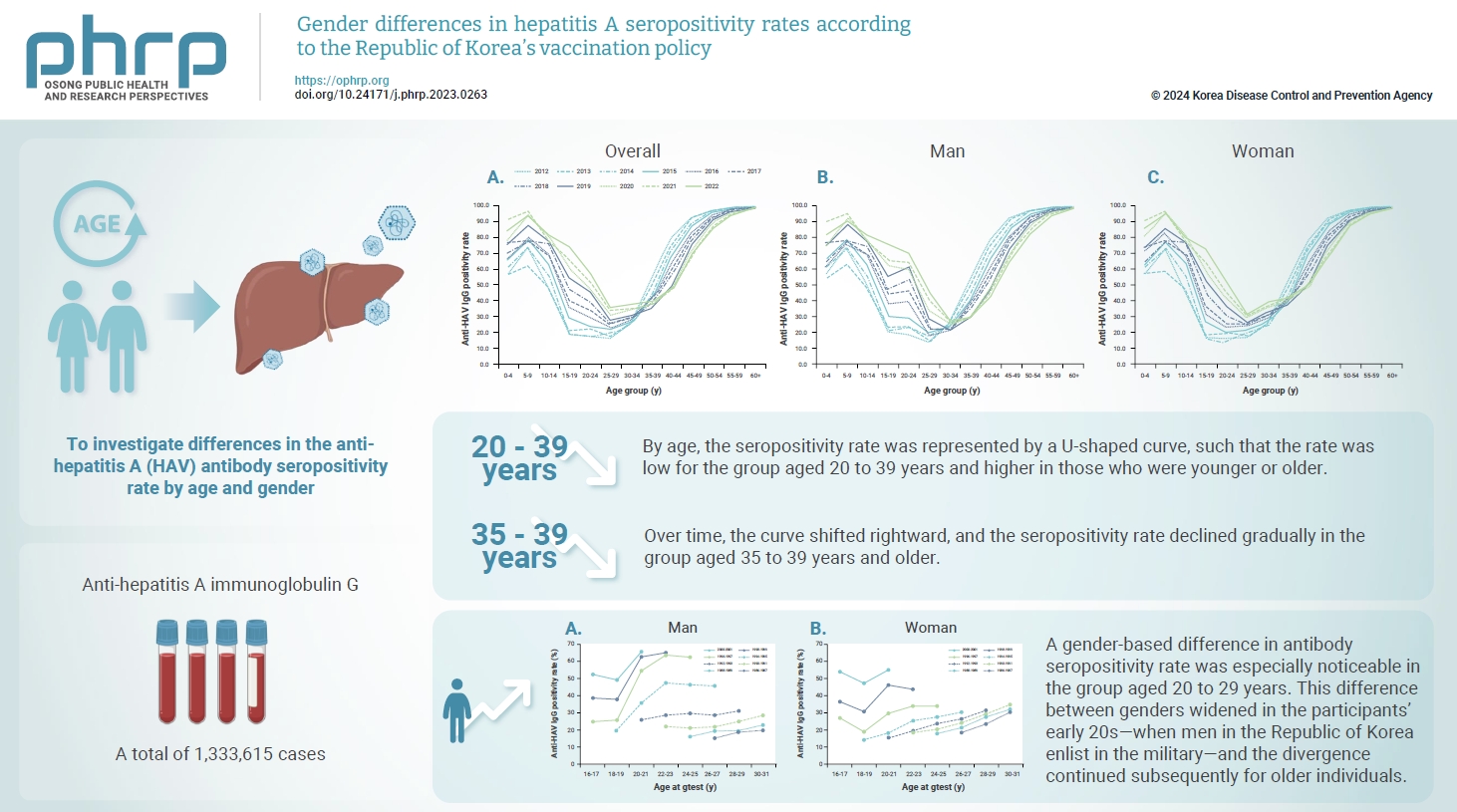
Objectives This study aimed to investigate differences in the anti-hepatitis A virus (HAV) antibody seropositivity rate by age and gender. Methods: We collected information on anti-HAV immunoglobulin G and immunoglobulin M status from samples submitted for HAV antibody testing in 2012–2022. A total of 1,333,615 cases were included in the analysis. Results: By age, the seropositivity rate was represented by a U-shaped curve, such that the rate was low for the group aged 20 to 39 years and higher in those who were younger or older. Over time, the curve shifted rightward, and the seropositivity rate declined gradually in the group aged 35 to 39 years and older. A gender-based difference in antibody seropositivity rate was especially noticeable in the group aged 20 to 29 years. This difference between genders widened in the participants’ early 20s—when men in the Republic of Korea enlist in the military—and the divergence continued subsequently for older individuals. Conclusion: These results indicate a higher risk of severe infection among older individuals and a gender-based difference in seroprevalence. Therefore, it is necessary to implement policies to promote vaccination in adults.
Citations
Citations to this article as recorded by
Infectious Diseases in an Era of Climate Crisis: Emergence and Resurgence Gui Nam Wee, Sunju Kim, Kyuwon Shim, Soojin Jang Journal of Environmental Health Sciences.2025; 51(6): 353. CrossRef
Examining the changes in the prevalence of Hepatitis a in Türkiye: systematic review and metaanalysis Özge Karakaya Suzan, Murat Bektaş, Mustafa Altındiş, Özge Kaya, Ayşe Eroğlu, Serap Çetinkaya Özdemir, Seda Tecik, Ahmet Naci Emecen, Nursan Çınar BMC Public Health.2024;[Epub] CrossRef
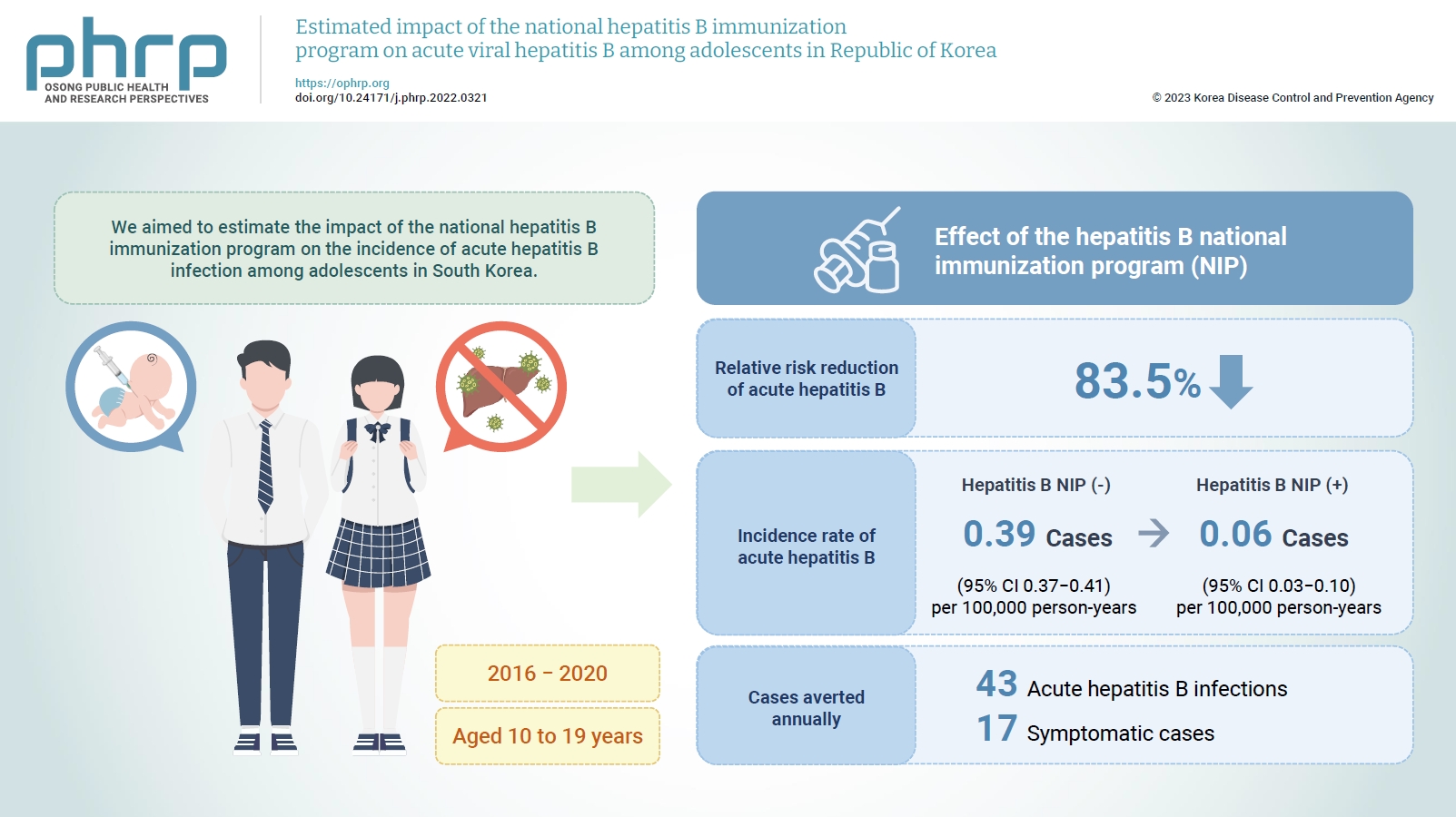
Objectives We aimed to estimate the impact of the national hepatitis B immunization program on the incidence of acute hepatitis B infection among adolescents in South Korea.
Methods We estimated the counterfactual incidence rate of reported acute hepatitis B among adolescents from 2016 to 2020 compared to the assumption that the national hepatitis B immunization program for children had not been implemented since 1995. The impact of the national hepatitis B immunization program for adolescents was measured by estimating the absolute risk reduction and averted acute hepatitis B infections among adolescents from 2016 to 2020 attributed to the national immunization program.
Results The relative risk reduction of acute hepatitis B among adolescents was estimated to be 83.5% after implementing the national hepatitis B immunization program. The incidence rate of reported acute hepatitis B infections among adolescents decreased from 0.39 to 0.06 per 100,000 person-years, and 43 acute hepatitis B infections, including 17 symptomatic cases, were averted annually from 2016 to 2020 by the national hepatitis B immunization program.
Conclusion The national hepatitis B immunization program for children was effective in preventing acute hepatitis B infection among adolescents in South Korea.
Citations
Citations to this article as recorded by
Modeling HBV transmission dynamics in Indonesia (2024–2030) using a SIVRM model: Evaluating optimal control strategies for elimination by 2030 Hashem S. Arkok, Tri Yunis Miko Wahyono, Dipo Aldila, Nurhayati Adnan Prihartono, Yury E Khudyakov PLOS One.2026; 21(2): e0341120. CrossRef
Seroprotection following hepatitis B vaccination in health care workers at a dental teaching hospital in south India Shobha Rodrigues, Jyoti Suvarna, Shivani Suvarna, Srikant Natarajan, Sandipan Mukherjee, Sowmya Narayan, Shivani Shetty Brazilian Journal of Oral Sciences.2026; 25: e266219. CrossRef
Reprogramming cancer immunity with next-generation combination therapies Nikolaos C. Kyriakidis, Carolina E. Echeverría, Jhommara Bautista, Sebastián Rivera-Orellana, María José Ramos-Medina, Camila Salazar-Santoliva, Juan S. Izquierdo-Condoy, Esteban Ortiz-Prado, Santiago Guerrero, Andrés López-Cortés Frontiers in Cell and Developmental Biology.2025;[Epub] CrossRef
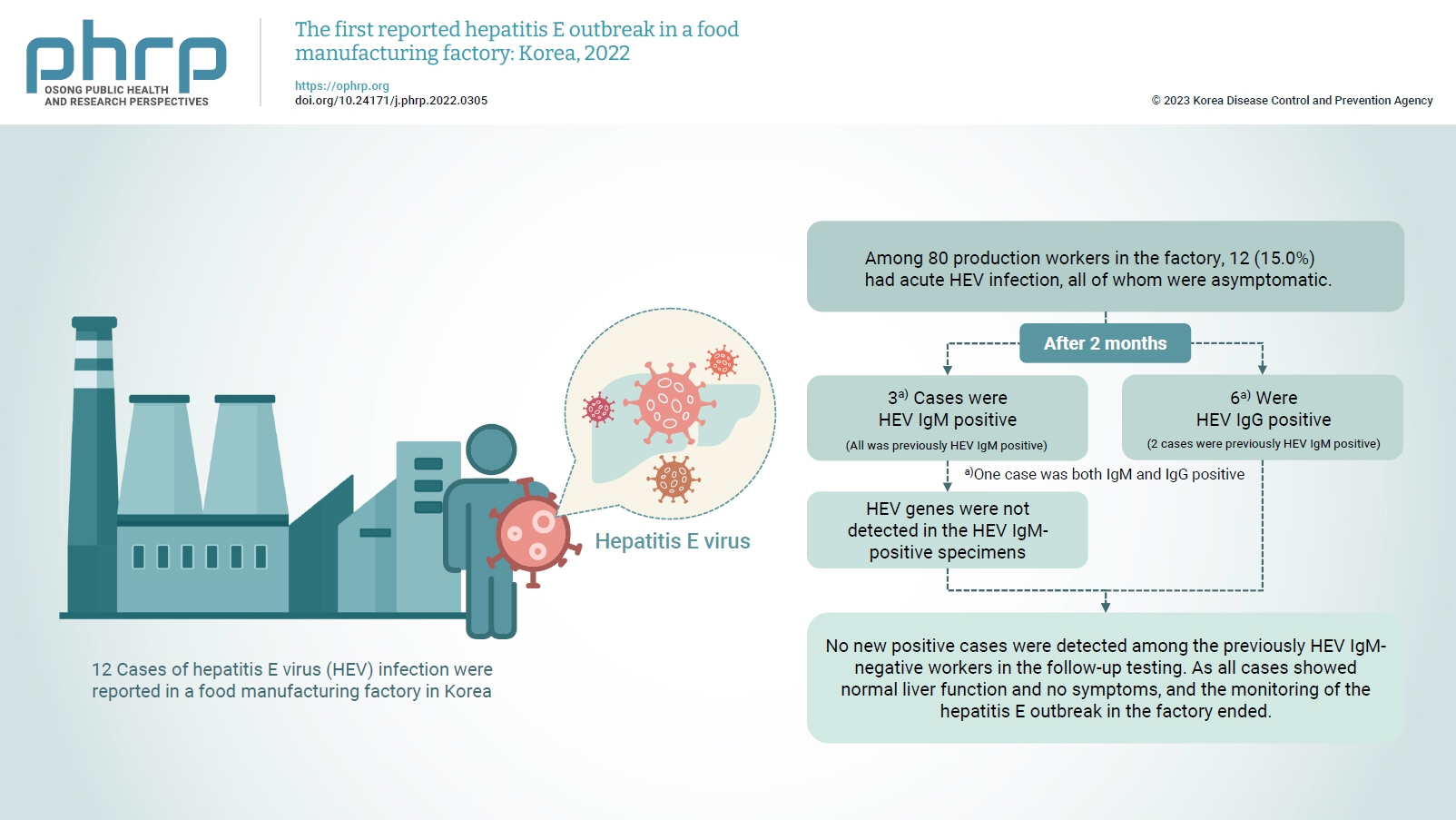
Objectives On February 16, 2022, 12 cases of hepatitis E virus (HEV) infection were reported in a food manufacturing factory in Korea. The aim of this study was to identify additional cases and to determine the source of this HEV outbreak. Methods: This study was an in-depth investigation of 12 HEV immunoglobulin M (IgM)-positive cases and their demographic, clinical, and epidemiological characteristics. On-site specimens were collected from the environment and from humans, and a follow-up investigation was conducted 2 to 3 months after the outbreak. Results: Among 80 production workers in the factory, 12 (15.0%) had acute HEV infection, all of whom were asymptomatic. The follow-up investigation showed that 3 cases were HEV IgMpositive, while 6 were HEV IgG-positive. HEV genes were not detected in the HEV IgM-positive specimens. HEV genes were not detected in the food products or environmental specimens collected on-site. HEV was presumed to be the causative pathogen. However, it could not be confirmed that the source of infection was common consumption inside the factory. Conclusion: This was the first domestic case of an HEV infection outbreak in a food manufacturing factory in Korea. Our results provide information for the future control of outbreaks and for the preparation of measures to prevent domestic outbreaks of HEV infection.
Citations
Citations to this article as recorded by
Current global estimates, risk factors, and knowledge gaps for Hepatitis E virus (HEV): A scoping review Md Koushik Ahmed, Hanna Maroofi, Madeleine Blunt, Alain Labrique, Carl Kirkwood, Kirsten Vannice, Kawsar R. Talaat, Julia Lynch, Brittany L. Kmush, David Safronetz PLOS Neglected Tropical Diseases.2026; 20(3): e0013980. CrossRef
Objectives We aimed to reconfirm the source of hepatitis A virus (HAV) infection through epidemiological and genotype investigations of individual cases in a 2019 outbreak in South Korea. Methods: We investigated food intake histories, associations with hepatitis A, and genotypes of HAV in 31 patients with hepatitis aged 20 to 49 years registered in the integrated disease and health management system during December 1–7, 2019 (case group) and in 35 sex- and agematched people without a history of HAV vaccination or infection among patients’ families and colleagues (control group). Results: The consumption of salted clams was a significant factor (odds ratio, 4.33; 95% confidence interval, 1.32–14.18) in the risk factor analysis of food intake history. HAV genotypes were analyzed in 24 of 31 patients. Type IA and type IIIA were found in 23 and 1 cases, respectively. Conclusion: Salted clams are considered to have been the source of HAV infection at 49 weeks of the HAV outbreak in 2019; this result was consistent with that of a previous epidemiological investigation conducted by the Korea Disease Control and Prevention Agency in September 2019. Therefore, monitoring of the production and distribution of salted clams needs to be continued.
Citations
Citations to this article as recorded by
Surto de hepatite A associado ao consumo de alimentos e práticas sexuais: estudo caso-controle, Curitiba, Paraná, 2024 Janilza Silveira Silva, Renata Barbosa Vilaça Marques de Carvalho, Alcides Souto de Oliveira, Liza Regina Bueno Rosso, Diego Spinoza dos Santos, Leia Regina Silva, Cláudia Weingaertner Palm, Clea Elisa Ribeiro, Katiuska Ferraz Jansen Negrello, Dirlene Pac Epidemiologia e Serviços de Saúde.2026;[Epub] CrossRef
Hepatitis A outbreak associated with food consumption and sexual practices: a case-control study, Curitiba, Paraná, 2024 Janilza Silveira Silva, Renata Barbosa Vilaça Marques de Carvalho, Alcides Souto de Oliveira, Liza Regina Bueno Rosso, Diego Spinoza dos Santos, Leia Regina Silva, Cláudia Weingaertner Palm, Clea Elisa Ribeiro, Katiuska Ferraz Jansen Negrello, Dirlene Pac Epidemiologia e Serviços de Saúde.2026;[Epub] CrossRef
Development of a direct whole genome sequencing for hepatitis A virus from serum and analysis of genetic characteristics Daseul Yeo, Soontag Jung, Danbi Yoon, Seongwon Hwang, Dong Jae Lim, Songfeng Jin, Jinho Choi, Ki Ho Hong, Changsun Choi Scientific Reports.2025;[Epub] CrossRef
Infectious Diseases in an Era of Climate Crisis: Emergence and Resurgence Gui Nam Wee, Sunju Kim, Kyuwon Shim, Soojin Jang Journal of Environmental Health Sciences.2025; 51(6): 353. CrossRef
Monitoring viruses and beta-lactam resistance genes through wastewater surveillance during a COVID-19 surge in Suwon, South Korea Rajendra Singh, Jaewon Ryu, Sung Soo Park, Sungpyo Kim, Keugtae Kim Science of The Total Environment.2024; 922: 171223. CrossRef
Prevalence of Enteric Viruses in Raw Seafood Collected from the Retail Shops in Tehran, Iran, 2022–2023 Golshid Javdani Shahedin, Maryam Yazdanizad, Seyed Davood Mousavi Nasab, Delaram Doroud, Rahman Shokri, Ramin Mazaheri Nezhad Fard Iranian Journal of Medical Microbiology.2024; 18(3): 190. CrossRef
Prevalence of foodborne viruses and influenza A virus from poultry processing plants to retailed chickens Daseul Yeo, Mengxiao Song, Md. Iqbal Hossain, Soontag Jung, Zhaoqi Wang, Dong Joo Seo, Min Suk Rhee, Changsun Choi Frontiers in Sustainable Food Systems.2023;[Epub] CrossRef
A Study on the Detection Rate of Hepatitis A from Gastroenteritis Patients and the Genotype Analysis of Hepatitis A Virus in Busan Sun Hee Park, Chanhee Kim, Summi Lee, Jihye Jeong, Junghye Choi, Seung Ju Lee Journal of Bacteriology and Virology.2023; 53(2): 74. CrossRef
A Study on the Detection Rate of Hepatitis A from Gastroenteritis Patients and the Genotype Analysis of Hepatitis A Virus in Busan Sun Hee Park, Chanhee Kim, Summi Lee, Jihye Jeong, Junghye Choi, Seung Ju Lee Journal of Bacteriology and Virology.2023; 53(2): 74. CrossRef
<sec>
<title>Objectives</title>
<p>An epidemiological investigation was conducted into a hepatitis C virus (HCV) outbreak at an outpatients clinic in Seoul (2011–2012). The aim of the study was to analyze the scale of infection, identify the source of infection, and route of transmission to prevent hepatitis C transmission in the future.</p></sec>
<sec>
<title>Methods</title>
<p>A retrospective study of the outpatients and health care workers (<italic>n</italic> = 7,285) in the target outpatient clinic during 2011–2012 was conducted. The history of the study population infection with hepatitis C, electronic medical records, field visits, and health care worker interviews were examined for the period between March 1<sup>st</sup>, 2006 and March 25<sup>th</sup>, 2016. The blood samples were collected and tested for anti-HCV antibodies, HCV RNA and HCV gene in 2016.</p></sec>
<sec>
<title>Results</title>
<p>The rate of anti-HCV positive results was 4.4% in the study population. The risk factors associated with an anti-HCV positive result were ≥ 10 clinic visits, and receiving an invasive procedure including a nerve block and a block of the peripheral branch of the spinal nerve (<italic>p</italic> < 0.05). There were 112 HCV RNA positive cases out of 320 anti-HCV positive test result cases, amongst which 100 cases had the dominant HCV genotype 2a which formed either 1 cluster (<italic>n</italic> = 56) or 2 clusters (<italic>n</italic> = 25). This result indicated exposure to a high-association infection source.</p></sec>
<sec>
<title>Conclusion</title>
<p>Anti-HCV antibodies and genotypic analysis showed an epidemiological association between the outbreak of HCV and invasive procedures performed (2011–2012) at an outpatients clinic in Seoul.</p></sec>
<sec>
<title>Objectives</title>
<p>The purpose of this study was to examine the relationship between self-care agency and health self-efficacy measures, in patients with viral hepatitis.</p></sec>
<sec>
<title>Methods</title>
<p>Data were collected from 116 outpatients over the age of 19 years who were diagnosed with viral hepatitis between February 20, 2019 and April 30, 2019. This study used the Appraisal of Self-care Agency Scale-Revised and the Health Self-Efficacy measures. Descriptive statistics, Pearson’s correlation coefficients, and canonical correlations were used during data analysis [SPSS version 25.0 for Windows (SPSS, Chicago, IL, USA)].</p></sec>
<sec>
<title>Results</title>
<p>The first canonical correlation coefficient was 0.65 (Wilks’ λ = 0.44, F = 5.63, <italic>p</italic> < 0.001) and the second was 0.42 (Wilks’ λ = 0.76, F = 3.08, <italic>p</italic> = .001). The first variate indicated a higher perception of having power for self-care (0.85) and developing power for self-care (0.92), and this was related to exercise (0.66), illness (0.76), emotion (0.75), nutrition (0.81), stress (0.60), and health practice (0.85). The second variate indicated a higher perception of having power for self-care (0.42), whilst lacking power for self-care (−0.82), was related to illness (0.35) and stress (0.72).</p></sec>
<sec>
<title>Conclusion</title>
<p>Nursing interventions and education aimed at enhancing the self-care of viral hepatitis patients are needed to assist patients to improve their health care behaviors.</p></sec>
Citations
Citations to this article as recorded by
Development of the Japanese version of the Appraisal of Self-Care Agency Scale–Revised (ASAS-R-JP) Takashi Kondo Journal of Health Psychology Research.2026; 38(2): 97. CrossRef
The Effects of Health-Promoting Behavior, Health Self-Efficacy, and Health Literacy on Aging Anxiety among Late Middle-Aged Adults: A Cross-Sectional Descriptive Study Hye Su Jung, So Young Shin Research in Community and Public Health Nursing.2026; 37: 200. CrossRef
Depremzede Kadınlarda Genital Hijyen Davranışları ve Öz Bakım Gücü Arasındaki İlişki Gülnaz Erdi, Emine Aksüt Akçay, Hatice Gül Öztaş Ege Üniversitesi Hemşirelik Fakültesi Dergisi.2025; 41(1): 68. CrossRef
Factors Associated with Self-Care Capacity of People with Chronic Conditions Hospitalized in a Clinical Ward Jennifer de Mello Derigge, Andressa Rueda de Lima, Cristina Mara Zamarioli, Aline Helena Appoloni Eduardo Aquichan.2025; 25(2): 1. CrossRef
Effects of different intervention methods on psychological flexibility, negative emotions and sleep quality in chronic hepatitis B Ying Zheng, Xiao-Wei Wang, Chen-Xi Xia World Journal of Psychiatry.2023; 13(10): 753. CrossRef
Orem’s Self-Care Deficit Nursing Theory: Relevance and Need for Refinement Donna L. Hartweg, Sharie A. Metcalfe Nursing Science Quarterly.2022; 35(1): 70. CrossRef
<sec>
<title>Objectives</title>
<p>To evaluate the impact of 3 treatment regimens upon health-related quality of life and work productivity using patient-reported outcomes (PROs) in chronic hepatitis C infected patients: sofosbuvir (SOF) + daclatasvir (DCV); SOF + DCV + ribavirin (RBV); SOF + simeprevir (SMV).</p></sec>
<sec>
<title>Methods</title>
<p>4 questionnaires were used to evaluate PROs before, during and after treatment: Short Form-36 (SF-36), Chronic Liver Disease Questionnaire (CLDQ) - hepatitis C virus (HCV), Work Productivity and Activity Index, Functional Assessment of Chronic Illness Therapy-Fatigue (FACIT-F).</p></sec>
<sec>
<title>Results</title>
<p>Of the global sample of 55 patients included in this study; SOF + DCV (<italic>n</italic> = 10); SOF + DCV + RBV (<italic>n</italic> = 29); SOF + SMV (<italic>n</italic> = 16) all had a statistically significant improvement in SF-36, CLDQ and FACIT-F scores during and post-treatment. No statistically significant differences in the PRO questionnaire values were observed between the distinct treatment regimens. The SOF and SMV patient groups presented higher mean PRO variations during and post-treatment, compared to the other groups: SF-36 functional capacity (16.1); SF-36 mental health (21.4); CLDQ activity (1.8); CLDQ emotional function (1.2); FACIT-F physical well-being (8.0); Total FACIT-F (21.6).</p></sec>
<sec>
<title>Conclusion</title>
<p>Treatment with SOF + DCV, with or without RBV, results in an improved PRO similar to treatment with SOF + SMV in chronic hepatitis C patients.</p></sec>
Citations
Citations to this article as recorded by
Health-related quality of life in people receiving opioid agonist treatment and treatment for hepatitis C virus infection Olav Dalgard, Alain H. Litwin, Oren Shibolet, Jason Grebely, Ronald Nahass, Frederick L. Altice, Brian Conway, Edward J. Gane, Anne F. Luetkemeyer, Cheng-Yuan Peng, David Iser, Isaias Noel Gendrano, Michelle M. Kelly, Barbara A. Haber, Heather Platt, Amy Journal of Addictive Diseases.2023; 41(3): 213. CrossRef
Impact of sofosbuvir and daclastavir on health-related quality of life in patients co-infected with hepatitis C and human immunodeficiency virus Evy Yunihastuti, Fhadilla Amelia, Arini Ika Hapsari, Bramantya Wicaksana, Veritea Natali, Alvina Widhani, Andri Sanityoso Sulaiman, Teguh Harjono Karjadi Health and Quality of Life Outcomes.2021;[Epub] CrossRef
Health-related quality of life and fatigue in patients with chronic hepatitis C with therapy with direct-acting antivirals agents interferon-free Raíssa Neves Fagundes, Lincoln Eduardo Villela Vieira de Castro Ferreira, Fábio Heleno de Lima Pace, Yury E. Khudyakov PLOS ONE.2020; 15(8): e0237005. CrossRef
Efficacy and safety of sofosbuvir-based pangenotypic direct-acting antiviral agents for chronic hepatitis C patients without genotype determination Juan Li, Dong-Bo Wu, Wei Jiang, Xue-Bin Chen, Gui-Bao Xiao, Yong-Hong Wang, Meng-Lan Wang, Ya-Chao Tao, En-Qiang Chen Medicine.2020; 99(43): e22726. CrossRef
<sec><title>Objectives</title><p>This study aimed to investigate the factors affecting the health-related quality of life (HRQOL) of patients with chronic hepatitis C (CHC).</p></sec><sec><title>Methods</title><p>This study is based on a descriptive survey and involved 125 gastroenterology outpatients visiting a university hospital in South Korea as the participants. HRQOL was assessed using the Liver Disease Quality of Life 1.0, which consisted of Short Form-36 (SF-36) and the Liver Disease Targeted Scale. Data were collected from December 2015 to April 2016, which were then analyzed through multiple regression analysis.</p></sec><sec><title>Results</title><p>HRQOL had a statistically significant correlation with age, sex, educational level, living type, employment status, monthly income level, and comorbidity status. This study showed that age > 51 years, female sex, high educational level, living alone, unemployment status, low monthly income, and presence of comorbidity had negative effects on the HRQOL of patients with CHC (R<sup>2</sup> = 8.7%–34.6%).</p></sec><sec><title>Conclusion</title><p>Based on the result of this study, intervention for patients with CHC needs to be developed to enhance their HRQOL. The findings can serve as a useful reference for nursing personnel in the development of therapeutic plans to upgrade the care of CHC patients.</p></sec>
Citations
Citations to this article as recorded by
The Impact of Hepatitis C and Socio‐Demographic Variables on Health‐Related Quality of Life in Pakistan: Cross‐Sectional Study Siwaporn Niyomsri, Aaron G. Lim, Ambreen Arif, Muhammad Asim, Auj Chaudhry, Naheed Choudhry, Aliya Hasnain, Polychronis Kemos, Chris Metcalfe, Asad Choudhry, Saeed Sadiq Hamid, Saad Niaz, Huma Qureshi, Graham R. Foster, Peter Vickerman, Josephine G. Walke Journal of Viral Hepatitis.2026;[Epub] CrossRef
Factors Affecting Health-related Quality of Life in Patients with Chronic Viral Hepatitis in Kazakhstan Tatyana Vasiliyevna Polukchi, Yelena Alekseevna Slavko Journal of Nature and Science of Medicine.2024;[Epub] CrossRef
Clinical and individual factors of quality of life of chronic liver disease patients at University of Gondar comprehensive specialized hospital, Northwest Ethiopia 2022 Eliud Teshome, Workagegnehu Hailu, Aynishet Adane, Endalkachew Belayneh Melese, Dessie Abebaw Angaw, Gebrekidan Ewnetu Tarekegn Medicine.2023; 102(45): e35425. CrossRef
Risk factors of severe hepatotoxicity among HIV-1 infected individuals initiated on highly active antiretroviral therapy in the Northwest Region of Cameroon Lem Edith Abongwa, Anthony Kebira Nyamache, Fokunang Charles, Judith Torimiro, Nshom Emmanuel, Irénée Domkam, Mbu Eyongetah, Beriyuy Jude, Fung Holgar Mua, Sama Bella, Tankou Colman Tamboh, Erna Charlene Moungang, Victorine Ngum, Paul Okemo BMC Gastroenterology.2022;[Epub] CrossRef
Cathepsin B and Plasma Kallikrein Are Reliable Biomarkers to Discriminate Clinically Significant Hepatic Fibrosis in Patients with Chronic Hepatitis-C Infection Alexia de Cassia Oliveira Zanelatto, Gilmar de Souza Lacerda, Camila de Melo Accardo, Natalia Fonseca do Rosário, Andréa Alice da Silva, Guacyara Motta, Ivarne Luis dos Santos Tersariol, Analucia Rampazzo Xavier Microorganisms.2022; 10(9): 1769. CrossRef
Impact of newer direct-acting antiviral drugs based on quality-adjusted life years Bhavya H. Vyas, Nishita H. Darji, Devang A. Rana, Kaushal Y. Vyas, Supriya D. Malhotra Perspectives in Clinical Research.2021; 12(2): 76. CrossRef
Exploring Perception of Chronic Hepatitis C: An Idiographic Case Study Hana Arshad, Subha Malik Pakistan Journal of Psychological Research.2020; 34(4): 735. CrossRef
Changes in Quality of Life of Chronic Hepatitis C Patients Participating in Clinical Trial Hoo-Jeung CHO, Euna PARK JOURNAL OF FISHRIES AND MARINE SCIENCES EDUCATION.2018; 30(5): 1725. CrossRef
Treatment with Sofosbuvir and Daclatasvir (with or without Ribavirin) Improves Patient Reported Outcomes in Hepatitis C Lucas Pereira Jorge de Medeiros, Mario Barreto Correa Lima, Marcia Maria Amêndola Pires, Alessandra Mendonça Almeida Maciel, Renata Barboza Vianna Medeiros, Mariana Dermínio Donadel, Isabela Martins Becattini Pereira, Fábio Marchon Leão, Luiz Eduardo Amor Osong Public Health and Research Perspectives.2018; 9(2): 50. CrossRef
Quality of life in Brazilian patients with treated or untreated chronic hepatitis C Cássio Marques Perlin, Vinicius Lins Ferreira, Helena Hiemisch Lobo Borba, Astrid Wiens, Cláudia Alexandra Pontes Ivantes, Luana Lenzi, Roberto Pontarolo Revista do Instituto de Medicina Tropical de São P.2017;[Epub] CrossRef
Objectives
To understand the illness experience of patients with chronic hepatitis C participating in clinical trials in the sociocultural context of Korea in an in-depth and comprehensive manner. Methods
A focused ethnography approach was used to discover the pattern of illness experience of patients with chronic hepatitis C in the cultural background of Korea. Interviews were conducted with 11 patients with chronic hepatitis C participating in clinical trials and the collected data were analyzed with the domain analysis, taxonomical analysis, componential analysis, and theme analysis proposed by Spradley. Results
With the cultural theme of “less-known illness, less-familiar illness,” four categories were derived: “my illness discovered by accident,” “shaken life,” “scary but inevitable treatment method,” and “precious life that can't be wasted,” along with 12 properties. Conclusion
Public campaigns or education programs are needed to meet the needs for information on the disease for patients with chronic hepatitis C participating in clinical trials and help the general public acquire knowledge or change view on this disease.
Citations
Citations to this article as recorded by
Relationship between cirrhosis patients’ social support and post-traumatic stress symptoms Jintao Cheng, Huiqiong Gui, Suyun Guo, Yihua Yang, Yun Ran Medicine.2026; 105(36): e50156. CrossRef
Impact of Hepatitis C Virus Cure on Depressive Symptoms in the Human Immunodeficiency Virus-Hepatitis C Virus Coinfected Population in Canada Gayatri Marathe, Erica E M Moodie, Marie-Josée Brouillette, Charlotte Lanièce Delaunay, Joseph Cox, Valérie Martel-Laferrière, John Gill, Curtis Cooper, Neora Pick, Marie-Louise Vachon, Sharon Walmsley, Marina B Klein, Lisa Barrett, Jeff Cohen, Brian Conw Clinical Infectious Diseases.2023; 76(3): e702. CrossRef
“There are many fevers”: Communities’ perception and management of Febrile illness and its relationship with human animal interactions in South-Western Uganda Michael Wandanje Mahero, Katherine M. Pelican, Jacinta M. Waila, Shamilah Namusisi, Innocent B. Rwego, Charles Kajura, Christopher Nyatuna, David R. Boulware, Joel Hartter, Lawrence Mugisha, Cheryl Robertson, Dominic A. Travis, Kate Zinszer PLOS Neglected Tropical Diseases.2022; 16(2): e0010125. CrossRef
Effect of Disease-related Knowledge and Health Enhancement Lifestyle on Self-management Behavior among Chronic Hepatitis C Patients Hoo Jeung CHO, Euna PARK THE JOURNAL OF FISHERIES AND MARINE SCIENCES EDUCA.2022; 34(2): 219. CrossRef
Assessing potential cures: are there distinctive elements of value beyond health gain? Saskia Hendriks, Steven D Pearson Journal of Comparative Effectiveness Research.2021; 10(4): 255. CrossRef
Depression in patients with chronic hepatitis-C treated with direct-acting antivirals: A real-world prospective observational study Mohamed A. Khalil, Hend Ibrahim Shousha, Saeed M. El-Nahaas, Mohamed Ibrahim Negm, Kariman Kamal, Nagwan Mohamed Madbouly Journal of Affective Disorders.2021; 282: 126. CrossRef
Objectives
This study aimed to evaluate the specificity, sensitivity, cost, and turn-around time of three methods of gene polymorphism analysis and to study the relationship between IL28B rs12979860 and SVR rate to pegIFN-α/RVB therapy among patients with chronic hepatitis C. Methods
A total of 100 samples from chronic hepatitis C patients were analyzed in parallel using the three methods: direct sequencing, real-time polymerase chain reaction (PCR), amplification refractory mutation system (ARMS)-PCR. Results
The different profiles for IL28B rs12979860 alleles (CC, CT, and TT) obtained with PCR-RFLP, ARMS-PCR, and direct sequencing were consistent among the three methods. Prevalence of rs12979860 genotypes CC, CT and TT in HCV genotype 1a was 10(19.6%), 35(68.6%), and six (11.8%), respectively, and in HCV genotype 31, it was 13(26.5%), 31(63.3%), and five (10.2%), respectively. No significant difference was seen between rs12979860 genotype and HCV genotype (<i>p</i> = 0.710). Conclusion
Screening by ARMS – PCR SNOP detection represents the most efficient and reliable method to determine HCV polymorphisms in routine clinical practice.
Citations
Citations to this article as recorded by
Multiplex Snapshot Minisequencing for the Detection of Common PAH Gene Mutations in Iranian Patients with Phenylketonuria Pegah Namdar Aligoodarzi, Golale Rostami, Seyed Reza Kazemi Nezhad, Mohammad Hamid Iranian Biomedical Journal.2023; 27(1): 46. CrossRef
Expression of
TRIM56
Gene in SARS-CoV-2 Variants and its Relationship with Progression of COVID-19
Rezvan Tavakoli, Pooneh Rahimi, Mojtaba Hamidi-Fard, Sana Eybpoosh, Delaram Doroud, Iraj Ahmadi, Enayat Anvari, Mohammadreza Aghasadeghi, Abolfazl Fateh Future Virology.2023; 18(9): 563. CrossRef
Performance of the tetra-primer PCR technique compared to PCR-RFLP in the search for rs12979860 (C/T) and rs8099917 (T/G) single nucleotide polymorphisms (SNPs) in the IFNL4 gene Ellen Hochleitner Souza Kindermann, Karoline Rodrigues Campos, Adele Caterino-de-Araujo Revista do Instituto Adolfo Lutz.2023; 82: 1. CrossRef
Glioblastoma as a Novel Drug Repositioning Target: Updated State Hamed Hosseinalizadeh, Ammar Ebrahimi, Ahmad Tavakoli, Seyed Hamidreza Monavari Anti-Cancer Agents in Medicinal Chemistry.2023; 23(11): 1253. CrossRef
Prevalence of Human Cytomegalovirus Infection in Iranian Prostate Cancer Patients Ehsan Alborzi, Ahmad Tavakoli, Seyed Jalal Kiani, Saied Ghorbani, Davod Javanmard, Milad Sabaei, Maryam Fatemipour, Seyed Hamidreza Monavari Iranian Journal of Medical Microbiology.2023; 17(4): 379. CrossRef
Performance of the tetra-primer PCR technique compared to PCR-RFLP in the search for rs12979860 (C/T) and rs8099917 (T/G) single nucleotide polymorphisms (SNPs) in the IFNL4 gene Ellen Hochleitner Souza Kindermann, Karoline Rodrigues Campos, Adele Caterino-de-Araujo Revista do Instituto Adolfo Lutz.2023; 82: 1. CrossRef
MicroRNAs Profiling in HIV, HCV, and HIV/HCV Co-Infected Patients Mohsen Moghoofei, Sohrab Najafipour, Shayan Mostafaei , Ahmad Tavakoli , Farah Bokharaei-Salim , Saied Ghorbani, Davod Javanmard, Hadi Ghaffari , Seyed Hamidreza Monavari Current HIV Research.2021; 19(1): 27. CrossRef
Occult hepatitis C virus infection in hemophilia patients and its correlation with interferon lambda 3 and 4 polymorphisms Amir Hossein Nafari, Ahmad Ayadi, Zahra Noormohamadi, Fatemeh Sakhaee, Farzam Vaziri, Seyed Davar Siadat, Abolfazl Fateh Infection, Genetics and Evolution.2020; 79: 104144. CrossRef
Polymerase Chain Reaction Assay Using the Restriction Fragment Length Polymorphism Technique in the Detection of Prosthetic Joint Infections: A Multi-Centered Study Ataollah Moshirabadi, Mohammad Razi, Peyman Arasteh, Mohammad Mahdi Sarzaeem, Saman Ghaffari, Saied Aminiafshar, Kami Hosseinian Khosroshahy, Fatemeh Maryam Sheikholeslami The Journal of Arthroplasty.2019; 34(2): 359. CrossRef
One-Step ARMS-PCR for the Detection of SNPs—Using the Example of the PADI4 Gene Sabrina Ehnert, Caren Linnemann, Bianca Braun, Josephine Botsch, Karolin Leibiger, Philipp Hemmann, Andreas K. Nussler Methods and Protocols.2019; 2(3): 63. CrossRef
Epstein–Barr Virus and Risk of Breast Cancer: A Systematic Review and Meta-Analysis Mohammad Farahmand, Seyed Hamidreza Monavari, Zabihollah Shoja, Hadi Ghaffari, Mehdi Tavakoli, Ahmad Tavakoli Future Oncology.2019; 15(24): 2873. CrossRef
Modeling suggests that microliter volumes of contaminated blood caused an outbreak of hepatitis C during computerized tomography Eyal Shteyer, Louis Shekhtman, Tal Zinger, Sheri Harari, Inna Gafanovich, Dana Wolf, Hefziba Ivgi, Rima Barsuk, Ilana Dery, Daniela Armoni, Mila Rivkin, Rahul Pipalia, Michal Cohen Eliav, Yizhak Skorochod, Gabriel S. Breuer, Ran Tur-kaspa, Yonit Weil Wien PLOS ONE.2019; 14(1): e0210173. CrossRef
Correlation of CD81 and SCARB1 polymorphisms on virological responses in Iranian patients with chronic hepatitis C virus genotype 1 Milad Nafari, Shiva Irani, Farzam Vaziri, Safoora Gharibzadeh, Fatemeh Sakhaee, Mohammad Khazeni, Naser Kalhor, Fatemeh Rahimi Jamnani, Seyed Davar Siadat, Abolfazl Fateh Infection, Genetics and Evolution.2018; 62: 296. CrossRef
First detection of human hepegivirus-1 (HHpgV-1) in Iranian patients with hemophilia Yazdan Bijvand, Mohammad Reza Aghasadeghi, Fatemeh Sakhaee, Parviz Pakzad, Farzam Vaziri, Alireza Azizi Saraji, Fatemeh Rahimi Jamnani, Seyed Davar Siadat, Abolfazl Fateh Scientific Reports.2018;[Epub] CrossRef
Evaluation of TRIM5 and TRIM22 polymorphisms on treatment responses in Iranian patients with chronic hepatitis C virus infection Setareh Mobasheri, Nazanin Irani, Abbas Akhavan Sepahi, Fatemeh Sakhaee, Fatemeh Rahimi Jamnani, Farzam Vaziri, Seyed Davar Siadat, Abolfazl Fateh Gene.2018; 676: 95. CrossRef
Data Mining and Machine Learning Algorithms Using IL28B Genotype and Biochemical Markers Best Predicted Advanced Liver Fibrosis in Chronic Hepatitis C Hend Ibrahim Shousha, Abubakr Hussein Awad, Dalia Abdelhamid Omran, Mayada Mohamed Elnegouly, Mahasen Mabrouk Japanese Journal of Infectious Diseases.2018; 71(1): 51. CrossRef
IL28B rs12980275 and HLA rs4273729 genotypes as a powerful predictor factor for rapid, early, and sustained virologic response in patients with chronic hepatitis C Parvaneh Sedighimehr, Shiva Irani, Fatemeh Sakhaee, Farzam Vaziri, Mohammadreza Aghasadeghi, Seyed Mehdi Sadat, Fatemeh Rahimi Jamnani, Abolfazl Fateh, Seyed Davar Siadat Archives of Virology.2017; 162(1): 181. CrossRef
Comparison of Direct Sequencing, Real-Time PCR-High Resolution Melt (PCR-HRM) and PCR-Restriction Fragment Length Polymorphism (PCR-RFLP) Analysis for Genotyping of Common Thiopurine Intolerant Variant Alleles NUDT15 c.415C>T and TPMT c.719A>G (TPMT*3C) Wai-Ying Fong, Chi-Chun Ho, Wing-Tat Poon Diagnostics.2017; 7(2): 27. CrossRef
Effect of IL15 rs10833 and SCARB1 rs10846744 on virologic responses in chronic hepatitis C patients treated with pegylated interferon-α and ribavirin Sahar Sadeghi, Mehdi Davari, Esmaeil Asli, Safoora Gharibzadeh, Farzam Vaziri, Fatemeh Rahimi Jamnani, Abolfazl Fateh, Seyed Davar Siadat Gene.2017; 630: 28. CrossRef
High platelet count and high probability of CALR detection in myeloproliferative neoplasms Reza Shirzad, Zari Tahan-nejad, Javad Mohamadi-asl, Mohammad Seghatoleslami, Ahmad Ahmadzadeh, Amal Saki Malehi, Najmaldin Saki Comparative Clinical Pathology.2017; 26(1): 25. CrossRef
A comparative study of various methods for detection ofIL28Brs12979860 in chronic hepatitis C Seyed Hamidreza Monavari, Roohollah Fateh, Farzam Vaziri, Fatemeh Rahimi Jamnani, Enayat Anvari, Farzin Sadeghi, Parviz Afrough, Ava Behrouzi, Fatemeh Sakhaee, Sepideh Meidaninikjeh, Hamidreza Mollaie, Alireza Hadizadeh Tasbiti, Shamsi Yari, Maryam Sadegh Scandinavian Journal of Clinical and Laboratory In.2017; 77(4): 247. CrossRef
EGFR rs11506105 and IFNL3 SNPs but not rs8099917 are strongly associated with treatment responses in Iranian patients with chronic hepatitis C M Asnavandi, M Zargar, F Vaziri, F R Jamnani, S Gharibzadeh, A Fateh, S D Siadat Genes & Immunity.2017; 18(3): 144. CrossRef
Genetic Variation in Interleukin-28B and Response to Peg-IFNα-2a/RBV Combination Therapy in Patients with Hepatitis C Virus Infection Farah Bokharaei-Salim, Mostafa Salehi-Vaziri, Farzin Sadeghi, Khadijeh Khanaliha, Maryam Esghaei, Seyed Hamidreza Monavari, Seyed Moayed Alavian, Shahin Fakhim, Hossein Keyvani Jundishapur Journal of Microbiology.2016;[Epub] CrossRef
This study was designed to identify factors associated with hepatitis A immunization status and seropositivity in Korean children. In-person interviews, reviewing their vaccination cards and testing hepatitis A antibody were conducted with 389 children aged 1–3 years and 544 children aged 6–8 years. In all age groups, earlier birth order was the only significant factor in children receiving either single or both doses of the vaccination. And completion of the second dose of vaccination was a prerequisite for increased seropositivity. Additionally, household income had a positive impact on seropositivity only in children aged 6–8 years. Our findings suggest that presence of an economic barrier is the underlying cause of the decreased hepatitis A vaccination services in Korea. Therefore, hepatitis A vaccine should be included in the essential National Immunization Program.
Citations
Citations to this article as recorded by
Vaccine Uptake to Prevent Meningitis and Encephalitis in Shanghai, China Hairenguli Maimaiti, Jia Lu, Xiang Guo, Lu Zhou, Linjie Hu, Yihan Lu Vaccines.2022; 10(12): 2054. CrossRef
Changing sero-epidemiology of hepatitis A in Asia Pacific countries: A systematic review Marissa Gripenberg, Naveena Aloysia D’Cor, Maïna L’Azou, Grenville Marsh, Sophie Druelles, Joshua Nealon International Journal of Infectious Diseases.2018; 68: 13. CrossRef
Objectives
Hepatitis B virus (HBV) is a member of the hepadnavirus family. The HBV genome contains four genes designated as S, C, P, and X. The HBV X (HBx) gene encodes for a 16.5-kDa regulatory protein that enhances HBV replication and exerts multifunctional activities. The aim of this study is to describe the rapid and easy purification of HBx using ELP (elastin-like polypeptide) fusion protein. Methods
The ELP–HBx fusion protein was overexpressed in <i>Escherichia coli</i>. Environmental sensitivity was demonstrated via turbidity and dynamic light scattering as a function of temperature. HBx was purified as an ELP fusion protein. ELPs are biopolymers of the pentapeptide repeat Val-Pro-Gly-Xaa-Gly that undergo an inverse temperature phase transition. ELP follows in temperature and salt consistency, precipitation, and solution repetition (inverse transition cycling) with polypeptide, where it purifies the protein in a simple manner. Results
Fusion proteins underwent supramolecular aggregation at 40 ℃ in 1 M NaCl and slowly resolubilized at subphysiologic temperatures. ELP domain proteolysis liberated a peptide of comparable size and immunoreactivity to the commercial HBx. Conclusion
This study suggests that HBx can be purified rapidly and easily using inverse transition cycling, and that this method can be applied in determination of HBx 3D structures and HBx stability study.
Citations
Citations to this article as recorded by
Evaluation of machine learning algorithms to predict the hydrodynamic radii and transition temperatures of chemo-biologically synthesized copolymers Jared S. Cobb, Maria A. Seale, Amol V. Janorkar Computers in Biology and Medicine.2021; 128: 104134. CrossRef
Machine learning to determine optimal conditions for controlling the size of elastin-based particles Jared S. Cobb, Alexandra Engel, Maria A. Seale, Amol V. Janorkar Scientific Reports.2021;[Epub] CrossRef
Influence of miR‐520e‐mediated MAPK signalling pathway on HBV replication and regulation of hepatocellular carcinoma cells via targeting EphA2 Jing‐hui Tian, Wen‐dong Liu, Zhi‐yong Zhang, Li‐hua Tang, Dong Li, Zhao‐ju Tian, Shao‐wei Lin, Ying‐jie Li Journal of Viral Hepatitis.2019; 26(4): 496. CrossRef
Elastin‐like polypeptides: A strategic fusion partner for biologics Agnes Yeboah, Rick I. Cohen, Charles Rabolli, Martin L. Yarmush, Francois Berthiaume Biotechnology and Bioengineering.2016; 113(8): 1617. CrossRef
Elastin-like polypeptides as a promising family of genetically-engineered protein based polymers Tomasz Kowalczyk, Katarzyna Hnatuszko-Konka, Aneta Gerszberg, Andrzej K. Kononowicz World Journal of Microbiology and Biotechnology.2014; 30(8): 2141. CrossRef
Objectives
The epidemiological patterns of endemic hepatitis A virus (HAV) are unclear in northeastern Asia depending on the ethnicity of the country in question. The purpose of this study was to investigate the seroprevalence of HAV in northeastern China, South Korea, and Japan. Methods
A total of 1,500 serum samples were collected from five groups of inhabitants (300 each) who were over 40 years of age (Korean Chinese, indigenous Chinese, South Korean, Korean living in Japan, and indigenous Japanese). The samples were screened for antibodies to HAV using an enzyme-linked immunosorbent assay. Results
Positivity for HAV antibodies was 93.7% (95% confidence interval [CI]: 90.9–96.4) in Koreans living in northeastern China, 99.7% (95% CI: 99.0–100.3) in indigenous Chinese, 98.0% (95% CI: 96.4–99.6) in indigenous Koreans, 33.3% (95% CI: 28.0–38.7) in Koreans living in Japan, and 20.4% (95% CI: 15.8–25.0) in indigenous Japanese persons. The overall anti-HAV prevalence was not significantly different between northeastern China and South Korea, but it was different in Japan. Conclusions
These results indicate that differences in seroprevalence can be attributed to geological, environmental, and socioeconomic conditions rather than ethnicity.
Citations
Citations to this article as recorded by
Prevalence of Anti-Hav IgG Antibodies in the Population of the Łódź Macroregion by Age Group Gabriela Henrykowska, Kornelia Kotecka, Aleksandra Jabłkowska, Andrzej Buczyński, Joanna Woźny Polish Hyperbaric Research.2021; 76(3): 67. CrossRef
Sero-prevalence of viral hepatitis A in a district of Sri Lanka: a community based cross-sectional study Nalin Ariyarathna, Chrishantha Abeysena BMC Infectious Diseases.2019;[Epub] CrossRef
Seroprevalence of Hepatitis A among Children and Young Adults Residing in Tehran, Iran: Implication for HAV Vaccination Amitis Ramezani, Mohammad Reza Aghasadeghi, Setareh Mamishi, Shahram Sabeti, Farahnaz Bidari - Zerehpoosh, Mohammad Banifazl, Anahita Bavand, Sahar Shadanlou, Arezoo Aghakhani Hepatitis Monthly.2018;[Epub] CrossRef
Seroepidemiology of Hepatitis Viruses and Hepatitis B Genotypes of Female Marriage Immigrants in Korea Jae-Cheol Kwon, Hye Young Chang, Oh Young Kwon, Ji Hoon Park, In Soo Oh, Hyung Joon Kim, Jun Hyung Lee, Ha-Jung Roh, Hyun Woong Lee Yonsei Medical Journal.2018; 59(9): 1072. CrossRef
Seroprevalence of Helicobacter pylori and Hepatitis A Virus among Children in Rural Central Taiwan Meng-Che Wu, Chia-Hsing Sung, Yu-Chuan Chang, Chi-Lin Ho, Chih-Chiang Wu, Kuei-Hua Wu, Chun-Yi Lee, Kuen-Der Yang Japanese Journal of Infectious Diseases.2015; 68(6): 494. CrossRef
Objectives
The purpose of this study was to investigate the seroprevalence of hepatitis A virus (HAV) and hepatitis E virus (HEV) in Korea during 2005. Methods
Study subjects were selected from across Korea using a stratified multistage probability sampling design, and HAV and HEV seroprevalence was compared on the basis of sex, age, and residency. A total of 497 rural and urban people aged 10–99 years of age (mean ± SD age = 28.87 ± 17.63 years) were selected by two-stage cluster sampling and tested serologically for anti-HAV and anti-HEV IgG using an enzyme-linked immunosorbent assay. Results
Among this population, the overall seroprevalence of HAV was 63.80% (55.21% aged in their 20s and 95.92% in their 30s, <i>p</i> < 0.01) and that of HEV was 9.40% (5.21% aged in their 20s and 7.14% in their 30s, <i>p</i> < 0.01). Seroprevalence also varied according to area of residence. HEV prevalence in rural areas was higher than that of urban regions based on the anti-HEV antibody, odds ratio 3.22 (95% confidence interval: 1.46–7.10, <i>p</i> < 0.01). There were no significant differences between male and female against anti-HAV/HEV antibodies. Conclusion
Our study suggested that the seropositive rates of HAV and HEV might be related to age and environmental conditions.
Citations
Citations to this article as recorded by
A Silent Outbreak of Hepatitis E Virus (HEV) Infection or False-Positive Reaction of Anti-HEV IgM after COVID-19 Vaccination? Epidemiological Investigation of an Outbreak in a Korean Factory Complex in 2022 Jeonghyeon Oh, Gwang Hyeon Choi, Yeonhwa Chang, Jina Kim, Kunhee Park, Hansol Yeom, Soonryu Seo, Jin Gwack, Sook-Hyang Jeong Gut and Liver.2024; 18(3): 531. CrossRef
A Report on a Nationwide Surveillance System for Pediatric Acute Hepatitis of Unknown Etiology in Korea Kyung Jae Lee, Jae Sung Ko, Kie Young Park, Ki Soo Kang, Kunsong Lee, Jeana Hong, Soon Chul Kim, Yoon Lee, Ben Kang, Yu Bin Kim, Hyun Jin Kim, Byung Wook Eun, Hye-Kyung Cho, Yae-Jean Kim, Mi Jin Kim, Jin Lee, Taek-Jin Lee, Seak Hee Oh, Sowon Park, Eun Ha Journal of Korean Medical Science.2023;[Epub] CrossRef
Factors associated with anti-hepatitis A virus immunoglobulin G seropositivity among Korean workers: a cross-sectional study Eunchan Mun, Yesung Lee, Byungseong Suh, Wonsul Kim, Jinsook Jeong, Hwanjin Park, Woncheol Lee, Boksoon Han, Soyoung Park, Changhwan Lee BMJ Open.2020; 10(6): e036727. CrossRef
Seroprevalence and risk factors of hepatitis E virus infection among the Korean, Manchu, Mongol, and Han ethnic groups in Eastern and Northeastern China Yanan Cai, Si-Yuan Qin, Aidong Qian, Peng Xu, Ying-Tian Xu, Lin-Hong Xie, Quan Zhao, Xiao-Xuan Zhang Journal of Medical Virology.2017; 89(11): 1988. CrossRef
Hepatitis E virus exposure in pregnant women in rural Durango, Mexico Cosme Alvarado-Esquivel, Luis F. Sánchez-Anguiano, Jesús Hernández-Tinoco Annals of Hepatology.2014; 13(5): 510. CrossRef
Epidemiologic Study on Hepatitis A Virus Seroprevalence in Busan Kyung-Soon Cho, So-Hyun Park Korean Journal of Clinical Laboratory Science.2014; 46(1): 17. CrossRef
A Systematic Review of Hepatitis E Virus Infection in Children V. P. Verghese, J. L. Robinson Clinical Infectious Diseases.2014; 59(5): 689. CrossRef
Hepatitis E Virus (HEV) Seroprevalence in the general population of the Republic of Korea in 2007–2009: a nationwide cross-sectional study Youngsil Yoon, Hye Sook Jeong, Haesun Yun, Hyeokjin Lee, Yoo-Sung Hwang, Bohyun Park, Chae Jin Lee, Sangwon Lee, Ji-Yeon Hyeon BMC Infectious Diseases.2014;[Epub] CrossRef
The Road Less Traveled Chaeshin Chu Osong Public Health and Research Perspectives.2011; 2(1): 1. CrossRef




 First
 Prev


