Objectives Adequate physical activity is essential for promoting healthy life expectancy among older adults. Park accessibility is an important environmental determinant of physical activity and may support multimorbidity management in this population. However, evidence on the association between park accessibility and multimorbidity remains limited, particularly in nationally representative Korean samples. This study examined the association between park accessibility and multimorbidity among older Korean adults.
Methods This cross-sectional study analyzed data from 10,078 individuals aged ≥65 years who participated in the 2023 National Survey of Older Koreans. Multiple logistic regression was used to examine the association between park accessibility and multimorbidity after adjustment for covariates. Stratified analyses assessed this association by physical activity level, and additional logistic regression analyses evaluated associations between park accessibility and common chronic diseases.
Results The prevalence of multimorbidity among older adults was 64.8%. After adjustment for all covariates, older adults living 30–59 minutes’ walking distance from a park had higher odds of multimorbidity than those living <15 minutes from a park (adjusted odds ratio, 1.33; 95% confidence interval, 1.12–1.59). Among the common chronic diseases examined, hypertension was significantly associated with park accessibility.
Conclusion Greater park accessibility may support physical activity and green-space exposure and may thereby contribute to multimorbidity management and healthy life expectancy among older adults.
Objectives Mild cognitive impairment (MCI) is prevalent among older adults and may progress to dementia. This study evaluated the effectiveness of a game-based brain exercise program in reducing MCI among older adults.
Methods A quasi-experimental study was conducted with 2 groups of older participants in Pathum Thani Province, Thailand. A total of 96 individuals with Thai mental state examination (TMSE) scores between 12 to 23, indicating MCI but no dementia diagnosis, were recruited. Using multi-stage sampling, participants were divided into an intervention group (n=48) and a control group (n=48). The intervention group participated in a 6-week game-based brain exercise program, while the control group received a self-administered brain exercise manual. Face-to-face interviews assessed outcomes at baseline, post-intervention, and 3-month follow-up. Data were analyzed using descriptive statistics and repeated-measures analysis of variance.
Results Significant differences were observed in mean TMSE scores and MCI knowledge between the intervention and control groups at the 3-month follow-up (p<0.001). The intervention group showed significant increases in TMSE scores and MCI knowledge post-intervention and at 3-month follow-up (p<0.001).
Conclusion The findings suggest that a game-based brain exercise program can improve cognitive function in older adults. Healthcare professionals can implement such programs to reduce MCI by addressing planning, management, and related issues in the future.
Citations
Citations to this article as recorded by
The Effect of Combined Physical Activity and Cognitive Training on Quality of Life in Older Adults Marwa Sobhy Abd EL Naby Amer, Eman Shokry Abd Allah, Samia Farouk Mahmoud Cuestiones de Fisioterapia.2024; 53(02): 3997. CrossRef
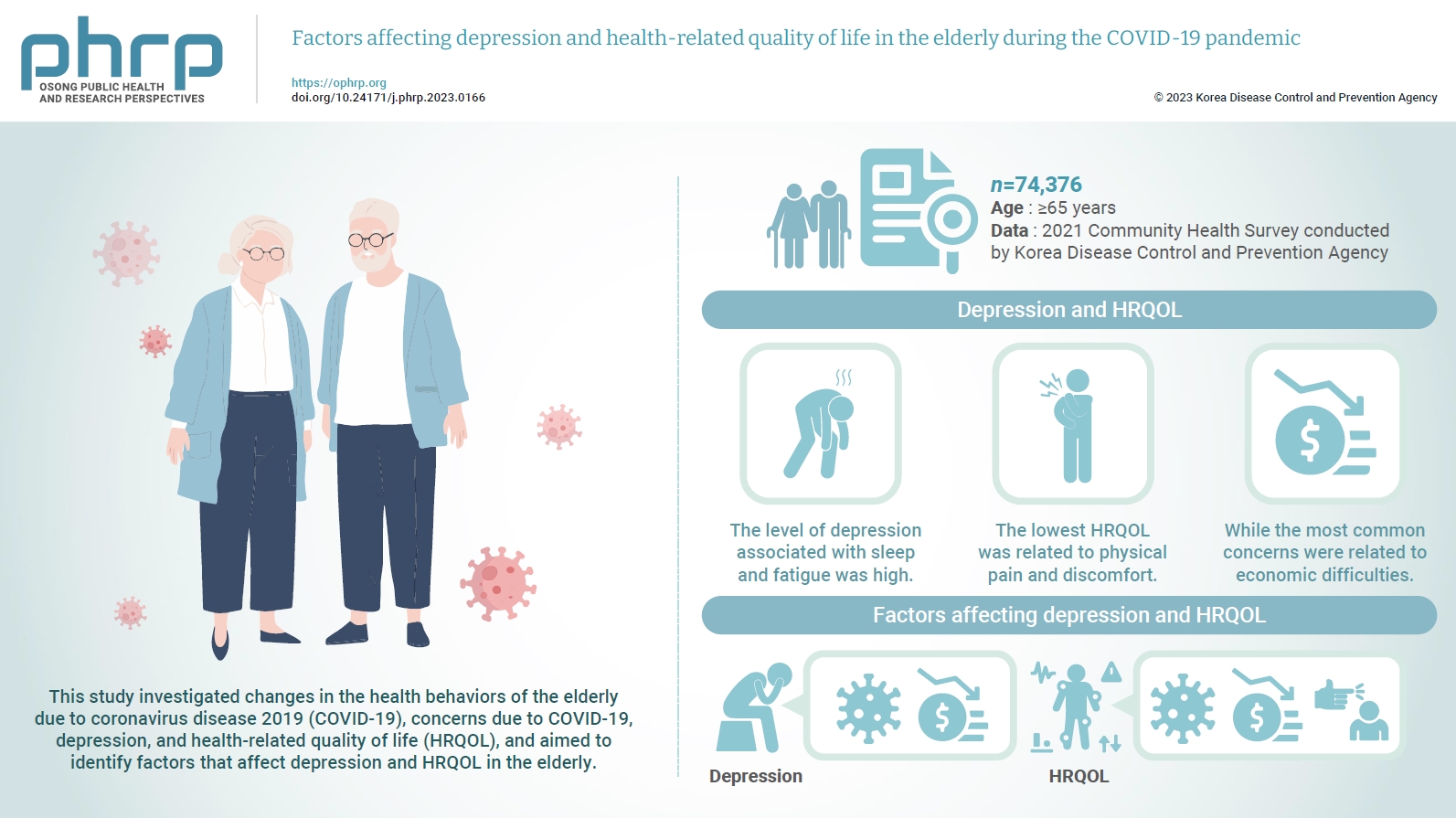
Objectives This study investigated changes in the health behaviors of the elderly due to coronavirus disease 2019 (COVID-19), concerns due to COVID-19, depression, and healthrelated quality of life (HRQOL), and aimed to identify factors that affect depression and HRQOL in the elderly. Methods: This study was conducted using data from the 2021 Community Health Survey of the Korea Disease Control and Prevention Agency. From a total sample size of 229,242 individuals, 74,376 elderly people aged 65 or older were selected as subjects, and changes in health behaviors, concerns due to COVID-19, depression, and HRQOL were measured and analyzed. Results: The level of depression associated with sleep and fatigue was high. The lowest HRQOL was related to physical pain and discomfort, while the most common concerns were related to economic difficulties. Factors influencing depression included worries about infection and economic harm, while factors impacting HRQOL encompassed concerns about infection, economic harm, and criticism from others. Conclusion: If an infectious disease situation such as COVID-19 reoccurs in the future, it will be necessary to encourage participation in hybrid online and offline programs at senior welfare centers. This should also extend to community counseling institutions like mental health welfare centers. Additionally, establishing connections with stable senior job projects can help to mitigate the effects of social interaction restrictions, physical and psychological health issues, and economic difficulties experienced by the elderly.
Citations
Citations to this article as recorded by
A comparison of health-related quality of life using the World Health Organization Quality of Life–BREF and 5-Level EuroQol-5 Dimensions in the Malaysian population Andrian Liem, Hui Jun Chih, Vithya Velaithan, Richard Norman, Daniel Reidpath, Tin Tin Su Osong Public Health and Research Perspectives.2025; 16(2): 126. CrossRef
The impact of urban agglomeration planning on depression in older adults Ya Liu, Li Yan, Yujue Wang, Xiaotang Tang, Ming Gao, Jiayu Yang, Zuoyan Liu, Xiuying Hu Frontiers in Public Health.2024;[Epub] CrossRef
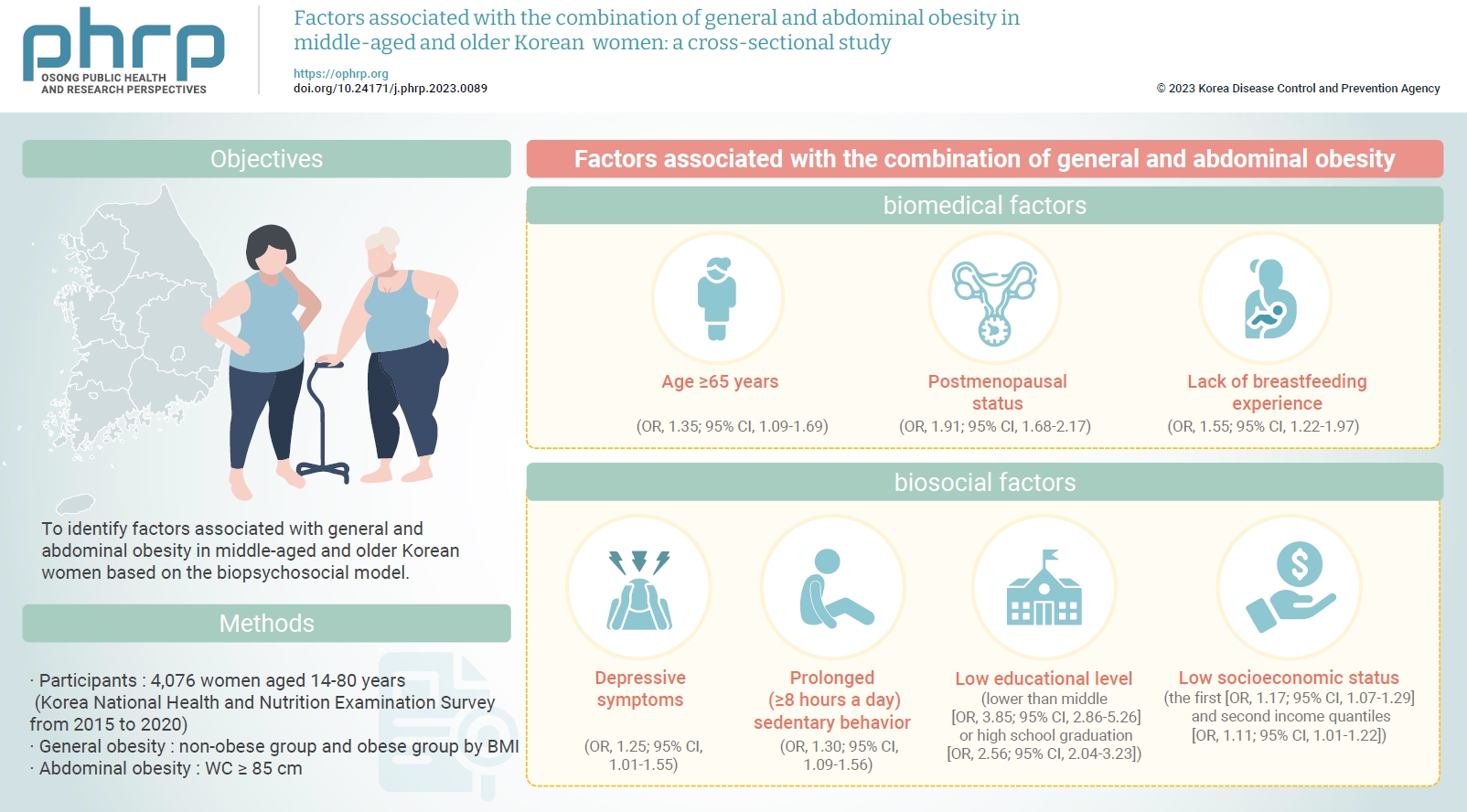
Objectives To identify factors associated with general and abdominal obesity in middle-aged and older Korean women based on the biopsychosocial model. Methods: Data from 4,076 women aged ≥45 years who participated in the Korea National Health and Nutrition Examination Survey from 2015 to 2020 were analyzed. Complex sampling analysis was performed using IBM SPSS ver. 26.0. Results: The combination of general and abdominal obesity was positively associated with age ≥65 years, postmenopausal status, and without breastfeeding experience among biomedical factors; depressive symptoms and prolonged (≥8 hours a day) sedentary behavior among psychosocial factors; and an educational level lower than middle or high school graduation and the first and second income quantiles among biosocial factors. Conclusion: Healthcare providers in communities and public societies should screen for risk factors for the combination of general and abdominal obesity while considering non-modifiable biomedical (e.g., age) and biosocial factors (e.g., educational level). In addition, intervention strategies should be developed by considering modifiable psychosocial factors such as sedentary behavior.
Citations
Citations to this article as recorded by
Relationship between anthropometric risk variables for chronic diseases in users of a primary care center José Ander Asenjo-Alarcón Población y Salud en Mesoamérica.2025;[Epub] CrossRef
This systematic review and meta-analysis aimed to understand the characteristics of medication adherence interventions for older adults with chronic illnesses, and to investigate the average effect size by combining the individual effects of these interventions. Data from studies meeting the inclusion criteria were systematically collected in accordance with the Preferred Reporting Items for Systematic Reviews and Meta-Analysis guidelines. The results showed that the average effect size (Hedges’ g) of the finally selected medication adherence interventions for older adults with chronic illnesses calculated using a random-effects model was 0.500 (95% confidence interval [CI], 0.342−0.659). Of the medication adherence interventions, an implementation intention intervention (using face-to-face meetings and telephone monitoring with personalized behavioral strategies) and a health belief model–based educational program were found to be highly effective. Face-to-face counseling was a significantly effective method of implementing medication adherence interventions for older adults with chronic illnesses (Hedges’ g=0.531, 95% CI, 0.186−0.877), while medication adherence interventions through education and telehealth counseling were not effective. This study verified the effectiveness of personalized behavioral change strategies and cognitive behavioral therapy based on the health belief model, as well as face-to-face meetings, as medication adherence interventions for older adults with chronic illnesses.
Citations
Citations to this article as recorded by
Impact of telemedicine on chronic disease patients: An overview of systematic reviews Kun Zhang, Yanhua Chen, Peicheng Wang, Yanrong He, Yanrong Du, Hailun Liang, Weiguo Zhu, Xiao Long, Leiyu Shi, Jiming Zhu Intelligent Medicine.2026; 6(2): 226. CrossRef
Updating Interventions to Enhance Medication Adherence among Community-Dwelling Older Adults with Chronic Diseases Luu Thi Thuy, Nguyen Thi Yen Hoai, Diep Thi Tieu Mai Home Healthcare Now.2026; 44(1): 40. CrossRef
Treatment Adherence and Persistence of Anti-Fibrotic Drugs in Real Life in Greece Georgia Kourlaba, Stylianos Ravanidis, Garyfallia Stefanou, Konstantinos Mathioudakis, Anastasios Tsolakidis, Dimitrios Zografopoulos Advances in Respiratory Medicine.2026; 94(1): 6. CrossRef
Reasons for delayed medical treatment among cholelithiasis patients: a qualitative study based on the health belief model Min Jiang, Yajie Shi, Jiao Liu, Yan Liu, Yanzhang Tian, Fang He BMC Health Services Research.2026;[Epub] CrossRef
Can We Predict Older Adults’ Long-Term Healthy Behavior Maintenance? Identifying the Optimal Machine Learning Model HeSen Li, WeiCheng Pan, Hong Chen, YiZhuo Hou International Journal of Human–Computer Interactio.2026; 42(20): 17782. CrossRef
Medication adherence trajectories and association with risk factors and clinical outcomes in type 2 diabetes treatment Sara Mucherino, Valentina Orlando, Marcia Vervloet, Yvette Weesie, Liset van Dijk, Enrica Menditto, Yee Gary Ang PLOS One.2026; 21(2): e0342056. CrossRef
Designing age-friendly interfaces and wearable–environment integrations to enhance medication adherence: a discrete choice experiment among older adults Jialin Qin, Zeyu Wu, Hao Zhang, Xiaopan Qi Frontiers in Medicine.2026;[Epub] CrossRef
Psychosocial predictors of non-adherence to antihypertensive medication among Korean adults: A nationwide cross-sectional study Kunhee Han, Hwa Sun Kim, Young Lee, Chung-woo Lee, Muhammad Haroon Stanikzai PLOS One.2026; 21(3): e0345509. CrossRef
Nurse-led interventions in enhancing outcomes for patients with tuberculosis: a scoping review Nita Arisanti Yulanda, Hidayat Arifin, Titan Ligita, Lestari Makmuriana, Alfi Syahri, Susanti Susanti, Komang Ardidhana Nugraha Putra, Andri Setiya Wahyudi, Somsak Thojampa, Tintin Sukartini Journal of Research in Nursing.2026;[Epub] CrossRef
Bedside Cognitive Behavioral Therapy Techniques in Primary Care Meredith L.C. Williamson, Danielle L. Terry, Kaylee J. Jackson Primary Care: Clinics in Office Practice.2026; 53(2): 251. CrossRef
Mobile health apps for older adults: real-world evidence on engagement and medication adherence Elyssa Wiecek, Scott Taylor, Hugo Rourke, Fiona Hammond, Noelia Amador-Fernandez Frontiers in Digital Health.2026;[Epub] CrossRef
Medication adherence in older adults with chronic diseases: a scoping review of barriers, facilitators, and effective interventions Doris Cardona-Arango, Valeria Santacruz-Restrepo, Alejandra Rendón-Montoya, Juliana Madrigal-Cadavid, Alejandra Segura-Cardona, Jorge Iván Estrada-Acevedo Frontiers in Aging.2026;[Epub] CrossRef
A pilot feasibility study of a tablet-based virtual community application with shared avatars for promoting health behavior change in older adult care facilities Kenji Nakamura, Keiichi Yamazaki, Akiko Yamazaki, Yoshiaki Ohyama Frontiers in Digital Health.2026;[Epub] CrossRef
Chrono-modulated drug delivery systems for oncology: Mechanisms, translational evidence, and pharmaceutical innovations Santoshini Nayak, Rajat Kumar Kar, Prasanta Kumar Biswal, Ranjit Prasad Swain, Snehamayee Mohapatra Chronobiology International.2026; 43(11): 1728. CrossRef
Medication Adherence Interventions for Older Adults: A National Mixed‐Methods Study of Implementation Across Italian Healthcare Settings Sara Mucherino, Luca Pasina, Manuela Casula, Monia Donati, Carlotta Lunghi, Elena Olmastroni, Valentina Orlando, Emanuel Raschi, Stefano Scotti, Marco Salluzzo, Elisabetta Poluzzi, Alessandro Nobili, Enrica Menditto Journal of the American Geriatrics Society.2026;[Epub] CrossRef
Yaşlılarda ilaç uyumunun geliştirilmesine yönelik stratejiler Soner Mete, Kamuran Özdil Mersin Üniversitesi Sağlık Bilimleri Dergisi.2026; 19(2): 415. CrossRef
Confronting finitude and treatment adherence in older adults with chronic diseases: a qualitative study Leovaldo Alcântara, Luís Midão, Elísio Costa, Constança Paúl BMC Geriatrics.2026;[Epub] CrossRef
Adherencia terapéutica en pacientes con hipertensión arterial en segundo nivel de atención Vidal Marcelino Villanueva Pérez, Daniel Canaán Pérez, Diego Sánchez Rodríguez REDSA Revista Ecuatoriana de Desarrollo Social y A.2026; 1(3): 268. CrossRef
Medication adherence in older people: Predictors and strategies for improvement Vladimir Petković, Jelena Horvat, Svitlica Brestovački Timocki medicinski glasnik.2025; 50(1-2): 32. CrossRef
Educational intervention for mental health and health behaviors in elderly Iranian women randomized controlled trial Razieh Asadi, Mahin Nazari, Abdolrahim Asadollahi, Narges Mobasheri Scientific Reports.2025;[Epub] CrossRef
Religious, Belief Medication, and Adherence Among Elderly with Chronic Diseases: A Multicenter Cross-Sectional Study in Papua, Indonesia AZ Izzah, DA Perwitasari, ES Sinaga, FE Appa, EI Sianturi Nigerian Journal of Clinical Practice.2025; 28(11): 1269. CrossRef
EXAMINING PRESCRIPTION DRUG USE AND HEALTH CARE ACCESS AMONG OLDER ADULTS IN RURAL AREAS: A CROSS-SECTIONAL STUDY BASED ON THE HEALTH BELIEF MODEL Yağmur ÖZKAYA, Büşra DEMİR ÇETİNKAYA, Gülden HAKVERDİ, Eyüp Can POLAT, Gülbin ÖZÇELİKAY Turkish Journal of Geriatrics.2025;[Epub] CrossRef
Health Behavior Change to Mitigate Dementia Risk: An Updated Review Victoria Sanborn, Jennifer D. Davis, Laura E. Korthauer Current Geriatrics Reports.2024; 13(3): 162. CrossRef
Relationship Between Depression and Medication Adherence Among Chronic Disease Patients in the Middle East Abdulrahman O Alomar, Rakan H Khushaim, Shahad K Al-Ghanem, Abeer T Bin Jumaiah, Suhail M Albaqami, Lujain A Alleft, Eman A Abahussain Cureus.2024;[Epub] CrossRef
Development and Preliminary Psychometric Testing of a Brief Tool to Measure Medication Adherence in Older Populations Paolo Iovino, Paola Obbia, Vincenzo De Luca, Clara Donnoli, Lola Patumi, Lisa Leonardini, Ernesto Palummeri, Manuela Ruatta, Anna Basso, Yari Longobucco, Laura Rasero, Giuseppe Liotta, Maddalena Illario Clinical Interventions in Aging.2024; Volume 19: 1765. CrossRef
<sec>
<title>Objectives</title>
<p>The aim of this study was to examine the factors influencing perceived oral health in elderly individuals residing in the community.</p></sec>
<sec>
<title>Methods</title>
<p>This study used raw data from the Korea community health survey, 2016. Of the 64,223 participants that were elderly (aged ≥ 65 years), 61,280 (95.4%) were included for analysis. Self-rated oral health was the dependent variable and 6 independent variables including age, gender, type of area of residence (metropolitan or provincial), educational level, income, and living status with spouse were assessed. Oral function was studied based on mastication, pronunciation, and use of dentures, and oral health behavior included brushing teeth after breakfast, after lunch, after dinner, and before sleep). The EQ-5D questionnaire measured health-related quality of life (mobility, self-care, usual activities, pain/discomfort and anxiety/depression).</p></sec>
<sec>
<title>Results</title>
<p>Among the general characteristics, age, gender, educational level, income, and living status with spouse were the factors that affected self-rated oral health. Mastication, pronunciation, use of dentures, and brushing after lunch, dinner, and before sleep were the factors that influenced self-rated oral function. All domains of the EQ-5D (pain/discomfort, mobility, self-care, usual activities, and anxiety/depression) were factors that affected self-rated oral health.</p></sec>
<sec>
<title>Conclusion</title>
<p>The results of the current investigation suggest that the development of management and education strategies for oral health promotion in the elderly, should focus on improving oral function and oral health behavior, taking into account the socio-economic and demographic characteristics that have been shown to be associated with poor self-rated oral function.</p></sec>
Citations
Citations to this article as recorded by
Exploring the link between depression, anxiety, and oral health-related quality of life: A cross-sectional study in 2 Arab countries Mohammed I. Alsaif, Abdullah S. Bin Rahmah, Abdallah Y. Naser Medicine.2026; 105(1): e46968. CrossRef
Validity of a Combined General and Oral Health Indicator for Vulnerability Han-Nah Kim, Shiho Kino, Nam-Hee Kim International Dental Journal.2026; 76(5): 109729. CrossRef
Association between oral health care behaviors and subjective oral health status among Korean older adults: a national study using community health survey data Hee-Jung Hong, Ju-Dong Jang Frontiers in Public Health.2026;[Epub] CrossRef
Physical Activity as a Mediator in the Relationship Between Oral health status and Depression Prevalence in Older Adults Min-Jun Kim, Taewan Kim, Yoonhwan Kim, Donghyun Kim Exercise Science.2025; 34(2): 188. CrossRef
The Complex Interplay Between Dental Anxiety, Generalized Anxiety, and Dental Neglect and Oral Health Quality of Life in the General Public Abdullah S. Bin Rahmah, Mohammed I. Alsaif, Abdallah Y. Naser Healthcare.2025; 13(12): 1382. CrossRef
Evaluation of Oral Health Status and Factors Affecting it in the Elderly Rana Nalçacı, Ebru Olgun Erdemir, Ilgi Baran Turkish journal of Dental Hygiene.2025; 5(1): 9. CrossRef
Predicting the oral health-related behaviors of the Iranian elderly based on the extended theory of planned behavior Saeid Bashirian, Sahar Khoshravesh, Erfan Ayubi, Mahrokh Amiri, Akram Karimi-Shahanjarini, Majid Barati, Parshang Faghih Solaymani BMC Oral Health.2025;[Epub] CrossRef
Predicting negative self-rated oral health in adults using machine learning: A longitudinal study in Southern Brazil Cinthia Fonseca Araujo, Felipe Mendes Delpino, Lílian Munhoz Figueiredo, Alexandre Dias Porto Chiavegatto Filho, Bruno Pereira Nunes, Helena Silveira Schuch, Flavio Fernando Demarco Journal of Dentistry.2025; 163: 106164. CrossRef
Oral Health Care for Institutionalized Elderly in Romania: Needs, Barriers, and Legislative Gaps Raluca Mioara Cosoroabă, Şerban Talpoş, Ştefania Dinu, Sergio Liga, Alina Doina Tănase Dentistry Journal.2025; 13(11): 527. CrossRef
Older adults’ perceptions of oral health and its influence on general health: A deductive direct content analysis Maria Snogren, Irene Eriksson, Maria Browall, Kristina Ek Nordic Journal of Nursing Research.2023;[Epub] CrossRef
Oral health status and behavior in elderly Koreans with periodontal disease Sae‐Rom Lee, Mi Ah Han, Jong Park, So Yeon Ryu, So Yeong Kim Journal of Public Health Dentistry.2022; 82(4): 378. CrossRef
Oral health-related quality of life, probable depression and probable anxiety: evidence from a representative survey in Germany André Hajek, Hans-Helmut König BMC Oral Health.2022;[Epub] CrossRef
Factors Associated with Self‐reported Oral Health Among Community-Dwelling Older Adults in a Rural Province of Thailand Yaowapa Chantaraboot, Nithimar Sermsuti-anuwat Journal of Multidisciplinary Healthcare.2022; Volume 15: 2111. CrossRef
Self-rated oral health among elderly patients attending a university dental hospital in Thailand: a telephone-based cross-sectional survey study Nithimar Sermsuti-anuwat, Narongrit Nampikul, Rawitsara Suwannimit, Weerachon Panthueng PeerJ.2022; 10: e14191. CrossRef
<sec>
<title>Objectives</title>
<p>Coronavirus disease 2019 (COVID-19) outbreaks in nursing facilities can easily lead to a high rate of infection and fatality. A surge in newly infected cases in the first quarter of 2020 in Gyeongsan-si, in the Republic of Korea, was followed by several outbreaks in nursing facilities in the same area. The aim of this study is to report on the epidemiological investigation and the management to reduce the infection rate in nursing facilities for older adults.</p></sec>
<sec>
<title>Methods</title>
<p>The municipal government and the Korea Centers for Disease Control and Prevention performed an epidemiological investigation into 5 nursing facilities that reported a high number of COVID-19 infection cases from February to May 2020. COVID-19 infected cases in the facilities were investigated to identify the infection routes, and the fatality rate of the 5 facilities.</p></sec>
<sec>
<title>Results</title>
<p>The 5 facilities had a combined fatality rate of 12.2% (9 deceased among the 74 infected cases). The median age of the deceased was 87 years old (range: 82–91). The infection was first identified on February 27<sup>th</sup>, 2020, peaked on March 6<sup>th</sup>, and was last detected on March 24<sup>th</sup>, 2020.</p></sec>
<sec>
<title>Conclusion</title>
<p>Difficulties specific to such facilities included the delay in the recognition of symptoms and limitation in distancing. Tailored strategies such as daily monitoring of symptoms and proactive COVID-19 screening of quarantined residents, contributed to a decline in the infections in the facilities.</p></sec>
Citations
Citations to this article as recorded by
Factors influencing long-term care facility performance during the COVID-19 pandemic: a scoping review Eric Nguemeleu Tchouaket, Katya Kruglova, Josiane Létourneau, Emilie Bélanger, Stephanie Robins, Maripier Jubinville, Fatima El-Mousawi, Shiyang Shen, Idrissa Beogo, Drissa Sia BMC Health Services Research.2024;[Epub] CrossRef
Impact of the COVID-19 pandemic and corresponding control measures on long-term care facilities: a systematic review and meta-analysis Jun Zhang, Yushan Yu, Mirko Petrovic, Xiaomei Pei, Qing-Bao Tian, Lei Zhang, Wei-Hong Zhang Age and Ageing.2023;[Epub] CrossRef
Risk factors for COVID-19 outbreaks in livestock slaughtering and processing facilities in Republic of Korea Seongju Choi, Tae Jong Son, Yeon-Kyung Lee Osong Public Health and Research Perspectives.2023; 14(3): 207. CrossRef
Using Non-Pharmaceutical Interventions and High Isolation of Asymptomatic Carriers to Contain the Spread of SARS-CoV-2 in Nursing Homes Alec J. Schmidt, Yury García, Diego Pinheiro, Thomas A. Reichert, Miriam Nuño Life.2022; 12(2): 180. CrossRef
An Experience of the Early Stage of COVID-19 Outbreak in Nursing Homes in Gyeonggi Province, Korea Gawon Choi, Na-young Kim, Seon-young Lee, Hae Deun Noh, Heeyoung Lee Korean Journal of Clinical Geriatrics.2022; 23(1): 27. CrossRef
Promising Best Practices Implemented in Long- Term Care Facilities During the COVID-19 Pandemic to Address Social Isolation and Loneliness: A Scoping Review Idrissa Beogo, Nebila Jean-Claude Bationo, Stephanie Collin, Diane Tapp, Jean Ramdé, Marie-Pierre Gagnon, Eric Nguemeleu Tchouaket, Drissa Sia Journal of Long-Term Care.2022; 0(2022): 298. CrossRef
Epidemiology and clinical features of COVID-19 outbreaks in aged care facilities: A systematic review and meta-analysis Mohammad Rashidul Hashan, Nicolas Smoll, Catherine King, Hannah Ockenden-Muldoon, Jacina Walker, Andre Wattiaux, Julieanne Graham, Robert Booy, Gulam Khandaker EClinicalMedicine.2021; 33: 100771. CrossRef
The experience of executing preventive measures to protect a nursing home in Taiwan from a COVID-19 outbreak Chia-Yu Huang, Yu-Hung Kuo, Shu-Ting Chuang, Hung-Rong Yen, Sio-Ian Tou European Geriatric Medicine.2021; 12(3): 609. CrossRef
Everyday life in a Swedish nursing home during the COVID-19 pandemic: a qualitative interview study with persons 85 to 100 years Qarin Lood, Maria Haak, Synneve Dahlin-Ivanoff BMJ Open.2021; 11(6): e048503. CrossRef
<sec><title>Objectives</title><p>Our study aims to provide basic scientific data on the importance of obesity management in middle-aged Korean women by analyzing its effects on blood pressure and arterial stiffness. In addition, we examined the correlations of these two parameters.</p></sec><sec><title>Methods</title><p>The study participants were 40 middle-aged female volunteers, who were classified into obesity group (n = 20) and normal weight group (n = 20). Statistical analysis was performed using independent <italic>t</italic>-test and the Pearson correlation coefficient was used to correlate blood pressure and arterial stiffness.</p></sec><sec><title>Results</title><p>This study evaluated the systolic blood pressure, diastolic blood pressure, and pulse wave velocity (PWV). These results were higher in the obesity group than the normal weight group. Furthermore, blood pressure and arterial stiffness (PWV, augmentation pressure) were static correlated.</p></sec><sec><title>Conclusion</title><p>Obesity is closely related to blood pressure and arterial stiffness. Therefore, indices for blood pressure and arterial stiffness may play a vital role in predicting and preventing obesity and its sequelae.</p></sec>
Citations
Citations to this article as recorded by
Markers of Vascular Function and Future Coronary Artery Disease Risk Among Malaysians with Individual Cardiovascular Risk Factors Amilia Aminuddin, Nina Diyana Rusanuar, Md Rizman Md Lazin Md Lazim, Azizah Ugusman, Izzat Zulhilmi Abd Rahman, Kalaivani Chellappan, Mohd Shawal Faizal Mohamad, Wan Amir Nizam Wan Ahmad, Wan Yus Haniff Wan Isa Biomedicines.2025; 13(4): 899. CrossRef
Physical activity and cardiovascular risk in obese older Korean women: effects on obesity, hypertension, and arterial stiffness Woo-Hyeon Son, Yi-Sub Kwak, Min-Seong Ha Frontiers in Public Health.2025;[Epub] CrossRef
Obesity awareness reduces food craving and improves metabolic parameters: A study on adults with overweight and obesity Kevser Tari Selcuk, Ramazan Mert Atan, Nursel Dal, Sedat Arslan Mediterranean Journal of Nutrition and Metabolism.2025; 18(3): 184. CrossRef
Food readjustment plus exercise training improves cardiovascular autonomic control and baroreflex sensitivity in high‐fat diet‐fed ovariectomized mice Bruno Nascimento‐Carvalho, Adriano Dos‐Santos, Nicolas Da Costa‐Santos, Sabrina L. Carvalho, Oscar A. de Moraes, Camila P. Santos, Katia De Angelis, Erico C. Caperuto, Maria‐Claudia Irigoyen, Katia B. Scapini, Iris C. Sanches Physiological Reports.2023;[Epub] CrossRef
Associations between body composition and cardiovascular disease risk in pre- and postmenopausal women Nirmala Rathnayake, Gayani Alwis, Janaka Lenora, Sarath Lekamwasam Journal of Health, Population and Nutrition.2023;[Epub] CrossRef
Comparison of Vascular Function, Cardiometabolic Parameters, Hemorheological Function, and Cardiorespiratory Fitness Between Middle-Aged Korean Women With and Without Obesity—A Pilot Study Hun-Young Park, Won-Sang Jung, Sung-Woo Kim, Kyounghwa Jung, Kiwon Lim Frontiers in Physiology.2022;[Epub] CrossRef
Comparison of femoral and carotid arteries in terms of pulse check in cardiopulmonary resuscitation: A prospective observational study Gökhan Yılmaz, Oğuzhan Bol Resuscitation.2021; 162: 56. CrossRef
Effect of yoga on pulse rate and blood pressure among women G. Kaleeswari, C. Vasantha Kalyani, J. S. Jayarani, Kusum K. Rohilla Journal of Family Medicine and Primary Care.2021; 10(10): 3670. CrossRef
Association of obesity with arterial stiffness: The Multi-Ethnic Study of Atherosclerosis (MESA) Jeongok G. Logan, Hyojung Kang, Soyoun Kim, Daniel Duprez, Younghoon Kwon, David R. Jacobs, Nketi Forbang, Jennifer Mason Lobo, Min-Woong Sohn Vascular Medicine.2020; 25(4): 309. CrossRef
The Feasibility and Applications of Non-invasive Cardiac Monitoring in Obese Patients Undergoing Day-case Surgery: Results of a Prospective Observational Study P. Sansone, L.G. Giaccari, U. Colella, F. Coppolino, M.C. Pace, M.B. Passavanti, V. Pota, C. Aurilio The Open Anesthesia Journal.2020; 14(1): 80. CrossRef
The Impact of Obesity on Nighttime Blood Pressure Dipping Beata Moczulska, Maciej Zechowicz, Sylwia Leśniewska, Karolina Osowiecka, Leszek Gromadziński Medicina.2020; 56(12): 700. CrossRef
Greater Adherence to Life’s Simple 7 Is Associated With Less Arterial Stiffness: the Atherosclerosis Risk in Communities (ARIC) Study Abayomi O Oyenuga, Aaron R Folsom, Susan Cheng, Hirofumi Tanaka, Michelle L Meyer American Journal of Hypertension.2019; 32(8): 769. CrossRef
<sec><title>Objectives</title><p>We aimed to examine the effects of various leisure activities on cognitive impairment in young-old (aged 65–74 years) and old-old (aged ≥ 75 years) adults.</p></sec><sec><title>Methods</title><p>In total, 10,279 elderly Korean individuals from the 2014 Korean National Survey on Older Adults’ cohort were enrolled in our study. Cognitive impairment was assessed using the standardized score of the Mini-Mental State Examination for Dementia Screening, whereas leisure activities were recorded via self-reporting of the extent and type of leisure activity the subjects involved in over the past year. Multivariate logistic regression was used to assess the effect of leisure activities on cognitive impairment, while controlling for potential covariates.</p></sec><sec><title>Results</title><p>The subjects were more likely to participate in cognitive activities than in non-exercise physical activities. After controlling for selected covariates, involvement in cognitive activities was found to be a significant predictor of cognitive impairment in both the groups, whereas involvement in non-exercise physical activities was not a predictor of cognitive impairment in individuals aged ≥ 75 years. Moreover, depressive symptoms, rural residence, and hearing difficulties were common predictors of cognitive impairment among elderly-Korean-individuals.</p></sec><sec><title>Conclusion</title><p>Leisure activity involvement may help delay cognitive impairment, which is often concomitant with aging. Hence, an early intervention service may significantly benefit both young-old and old-old individuals.</p></sec>
Citations
Citations to this article as recorded by
Association of intrinsic capacity with leisure activities in community-dwelling older adults: a cross-sectional analysis Ji Shen, Yuting Kang, Chi Zhang, Jing Pang, Jing Li, Hong Shi, Jie Zhang BMC Geriatrics.2025;[Epub] CrossRef
The relationship between leisure activity participation and cognitive function among older Chinese adults: the differences across gender and age Xi-Ru Guo, Tao-Zhu Cheng, Jing Guo Archives of Public Health.2024;[Epub] CrossRef
The Effect of Levels of Leisure-Time Physical Activity on Cognitive Functions Among Older Adults with Mild Cognitive Impairment: A Longitudinal Analysis Jaehyun Kim, JungJoo Lee, Junhyoung Kim, Bomi Woo Gerontology and Geriatric Medicine.2024;[Epub] CrossRef
Leisure activity and cognitive function among Chinese old adults: The multiple mediation effect of anxiety and loneliness Wenjun Li, Haiyan Sun, Wen Xu, Wenyuan Ma, Xin Yuan, Hao Wu, Changgui Kou Journal of Affective Disorders.2021; 294: 137. CrossRef
Hearing Screening for Residents in Long-Term Care Homes Who Live with Dementia: A Scoping Review Fiona Höbler, Katherine S. McGilton, Walter Wittich, Kate Dupuis, Marilyn Reed, Shirley Dumassais, Paul Mick, M. Kathleen Pichora-Fuller Journal of Alzheimer’s Disease.2021; 84(3): 1115. CrossRef
Effects of non‐pharmacological therapies for people with mild cognitive impairment. A Bayesian network meta‐analysis Ying‐quan Wang, Rui‐xia Jia, Jing‐hong Liang, Jing Li, Sheng Qian, Jia‐yu Li, Yong Xu International Journal of Geriatric Psychiatry.2020; 35(6): 591. CrossRef
Do Musicians Have Better Mnemonic and Executive Performance Than Actors? Influence of Regular Musical or Theater Practice in Adults and in the Elderly Mathilde Groussard, Renaud Coppalle, Thomas Hinault, Hervé Platel Frontiers in Human Neuroscience.2020;[Epub] CrossRef
Television Viewing and Cognitive Dysfunction of Korean Older Adults Mi Sook Jung, Eunyoung Chung Healthcare.2020; 8(4): 547. CrossRef
Associated factors for cognition of physically independent elderly people living in residential care facilities for the aged in Sri Lanka Madushika Wishvanie Kodagoda Gamage, Chandana Hewage, Kithsiri Dedduwa Pathirana BMC Psychiatry.2019;[Epub] CrossRef
<sec><title>Objectives</title><p>This study aimed to determine the prevalence of suicidal ideation among young and middle-aged adults, and explore the risk factors that affect suicidal ideation.</p></sec><sec><title>Methods</title><p>A descriptive study design was used for secondary data analysis. A total sample of 5,214 was drawn from two waves (2012–2013) of the 7th Korea Health Panel (KHP) survey. The KHP data were collected by a well-trained interviewer using the face-to-face method during home visits as well as self-report method. Descriptive statistics of frequency, percentage, chi-square test, and logistic regression analysis were performed using SPSS 22.0.</p></sec><sec><title>Results</title><p>The prevalence of suicidal ideation in young and middle-aged adults was 4.4% and 5.6%, respectively. For young adults, suicidal ideation risk was higher among those with low income or heavy drinking habits. In middle-aged adults, low income, poor perceived health status, negative perception of peer-compared health status, and negative social perspective were the major risk factors.</p></sec><sec><title>Conclusion</title><p>There is considerable risk of suicidal ideation in adulthood. Opportunities for increased income, avoidance of heavy drinking, and the construction of positive subjective health status and social perspective should be considered in suicide prevention interventions for Korean young and middle-aged adults.</p></sec>
Citations
Citations to this article as recorded by
Socioeconomic Inequalities in the Continuum of Suicidal Ideation Minjae Choi, Yeaseul Yoon, Yo Han Lee, Hyun-Hee Heo, Myung Ki Crisis.2026; 47(3): 129. CrossRef
Psychosocial risk factors of youth suicide in the Western Pacific: a scoping review Mohammad Izzat Morshidi, Peter K. H. Chew, Lidia Suárez Social Psychiatry and Psychiatric Epidemiology.2024; 59(2): 201. CrossRef
Hospitalizations for Suicidal Events: Reiteration Risk—The Experience in the Veneto Region, Italy Silvia Cocchio, Giulia Tremolada, Nicola Cogo, Claudia Cozzolino, Mario Saia, Michele Tonon, Francesca Russo, Patrizia Furlan, Marco Fonzo, Vincenzo Baldo Psychiatry International.2024; 5(3): 434. CrossRef
Predictors of Suicidal Behavior in Young Adults: An Analysis of Korea National Health and Nutrition Examination Survey Data Using Propensity Score Matching Young Hwa Lee, Seon Young Hwang Journal of Korean Academy of psychiatric and Menta.2024; 33(4): 413. CrossRef
Spatial and temporal trends and risk factors for intentional carbon monoxide poisoning hospitalizations in England between 2002 and 2016 Aina Roca-Barceló, Helen Crabbe, Rebecca Close, Helena Fahie, Giovanni S. Leonardi, Frédéric B. Piel Journal of Affective Disorders.2023; 329: 168. CrossRef
Impact of COVID-19 pandemic on intensive care
admissions and mortality due to self-poisoning:
A retrospective comparative study from a tertiary care
hospital Aneela Α. Kidwai, Komal Fareed, Jamal Ara, Mahnoor Khalil, Shaista Ahmed, Syeda Urooj Riaz, Yumna Ahmed Public Health and Toxicology.2023; 3(3): 1. CrossRef
Spectrum and predictors of suicidal risk among incarcerated youth in a correctional facility in Kaduna, Northern Nigeria Marufah Dupe Lasisi, Folorunsho Tajudeen Nuhu, Femi Adebayo, Edwin Ehi Eseigbe, Taiwo Lateef Sheikh Vulnerable Children and Youth Studies.2022; 17(2): 147. CrossRef
Alcohol use and its association with suicide attempt, suicidal thoughts and non-suicidal self-harm in two successive, nationally representative English household samples Sarah Ledden, Paul Moran, David Osborn, Alexandra Pitman BJPsych Open.2022;[Epub] CrossRef
Associations between Suicidal Ideation and Relatives’ Physical and Mental Health among Community Residents: Differences between Family Members and Lineal Consanguinity Caifeng Li, Zhen Wei, Yifan Wang, Long Sun International Journal of Environmental Research an.2022; 19(23): 15997. CrossRef
Factors affecting suicidal ideation among premenopausal and postmenopausal women Go‐Un Kim, Hae Kyoung Son, Mi‐Young Kim Journal of Psychiatric and Mental Health Nursing.2021; 28(3): 356. CrossRef
Depression and suicidal ideation among HIV seropositive patients attending the special treatment clinic of the University of Calabar Teaching Hospital, Calabar, Nigeria Elvis Mbu Bisong, Chidi John Okafor, Agam Ebaji Ayuk, Udeme Essien Asibong, Henry Ohem Okpa Calabar Journal of Health Sciences.2021; 4: 64. CrossRef
The role of ageing in the wish to be dead: disentangling age, period and cohort effects in suicide ideation in European population M. Cabello, L. A. Rico-Uribe, J. C. Martinez-Ávila, A. Sánchez-Niubò, F. F. Caballero, G. Borges, B. Mellor-Marsá, J. M. Haro, M. Prina, S. Koskinen, J. L. Ayuso-Mateos Epidemiology and Psychiatric Sciences.2021;[Epub] CrossRef
Association Between Suicide Risk and Comorbidity of Mood Disorder and Alcohol Use Disorder: Using Common Data Model in Psychiatry Yong Hyuk Cho, Eunyoung Lee, Eun Sil Her, Gyubeom Hwang, Ki-Young Lim, Jai Sung Noh, Yunmi Shin, Chang Hyung Hong, Hyun Woong Roh, Dongyun Lee, Heirim Lee, Doyeop Kim, Rae Woong Park, Bumhee Park, Sang Joon Son Journal of Korean Neuropsychiatric Association.2021; 60(3): 232. CrossRef
Analysis of risk factors affecting suicidal ideation in South Korea by life cycle stage Ji-Young Hwang, Il-Su Park Osong Public Health and Research Perspectives.2021; 12(5): 314. CrossRef
Association of chronic diseases and lifestyle factors with suicidal ideation among adults aged 18–69 years in Eswatini: evidence from a population-based survey Mfundi President Sebenele Motsa, Hung-Yi Chiou, Yi-Hua Chen BMC Public Health.2021;[Epub] CrossRef
Cross-national prevalence and factors associated with suicide ideation and attempts in older and young-and-middle age people Maria Cabello, Marta Miret, José Luis Ayuso-Mateos, Felix Feliz Caballero, Somnath Chatterji, Beata Tobiasz-Adamczyk, Josep Maria Haro, Seppo Koskinen, Matilde Leonardi, Guilherme Borges Aging & Mental Health.2020; 24(9): 1533. CrossRef
Characteristics, causality, and suicidal behavior: a qualitative study of family members with suicide history in Wonogiri, Indonesia Susana Nurtanti, Sri Handayani, Nita Yunianti Ratnasari, Putri Halimu Husna, Tantut Susanto Frontiers of Nursing.2020; 7(2): 169. CrossRef
Risk Factors for Suicidal Ideation among Middle Class Korean: Focusing on Psychosocial Comparison - An Analysis of a Nationwide Survey of the 8th Korea Health Panel Data Ahra Jo, Bora Kang, Youngju Seo, Eunha Gil, Heeyoung Oh Journal of Korean Academy of Community Health Nurs.2018; 29(1): 1. CrossRef
The Function of Personality in Suicidal Ideation from the Perspective of the Interpersonal-Psychological Theory of Suicide Marc Baertschi, Alessandra Costanza, Alessandra Canuto, Kerstin Weber International Journal of Environmental Research an.2018; 15(4): 636. CrossRef
To Be or Not to Be Hae-Wol Cho, Chaeshin Chu Osong Public Health and Research Perspectives.2017; 8(3): 157. CrossRef
Objectives
The purpose of this study is to search the inner world of postmenopausal women in late-middle age who are facing senescence and live in small and medium-sized cities. Methods
The methods of the study were the investigation and classification of answers to questions according to a declarative ethnography analysis. The questions asked to late–middle-aged women living in small and medium-sized cities were “How do you interpret and recognize the changes in the body after menopause?” and “Which methods do you choose and practice to maintain your health in relation to aging during middle age?”. Results
Four positive topics and two negative topics were drawn from the study. The four positive themes were: ambition; completion of a great mission; life with a sense of affection; and gratitude for maintaining health. The negative themes were: undulating emotion; and filling the emptiness. Conclusion
The recognition of changes in the body after menopause in late–middle-aged women in small and medium-sized cities can affect their preparation processes towards senescence. It is critical to find the means to manage emergency health cases from early adulthood to middle age, based on the outcomes of the study. The study also emphasizes the importance of the woman's family's alternative strategies and supportive systems, which can fit into the cultural context of the community.
Citations
Citations to this article as recorded by
The Impact of Long-Term Chinese Dialect Use on Mandarin Tone Production and Perception: Evidence from Late Middle-Aged Puxian Min Speakers Mingjun Ji, Jinwei Lan, Jianhan Lei, Can Zhang, Jin Fang, Boquan Liu Language and Speech.2026;[Epub] CrossRef
Trend of Women’s Health Research in Korea, 2012–2020: Topic and Text Network Analysis Ji Eun Park, Saerom Kim, Myoung-Hee Kim, Taemi Kim, Seung-Ah Choe, Hye Sook Min Journal of Korean Medical Science.2023;[Epub] CrossRef
The experiences and needs of Asian women experiencing menopausal symptoms: a meta-synthesis Shefaly Shorey, Esperanza D. Ng Menopause.2019; 26(5): 557. CrossRef
Effects of Aromatherapy on Menopausal Symptoms, Perceived Stress and Depression in Middle-aged Women: A Systematic Review Shinmi Kim, Ji-Ah Song, Mi-Eun Kim, Myung-Haeng Hur Journal of Korean Academy of Nursing.2016; 46(5): 619. CrossRef
Objectives
A hierarchical generalized linear model (HGLM) was applied to estimate the transmission pattern of scrub typhus from 2001 to 2011 in the Republic of Korea, based on spatial and temporal correlation. Methods
Based on the descriptive statistics of scrub typhus incidence from 2001 to 2011 reported to the Korean Centers for Disease Control and Prevention, the spatial and temporal correlations were estimated by HGLM. Incidences according to age, sex, and year were also estimated by the best-fit model out of nine HGLMs. A disease map was drawn to view the annual regional spread of the disease. Results
The total number of scrub typhus cases reported from 2001 to 2011 was 51,136: male, 18,628 (36.4%); female, 32,508 (63.6%). The best-fit model selected was a combination of the spatial model (Markov random-field model) and temporal model (first order autoregressive model) of scrub typhus transmission. The peak incidence was 28.80 per 100,000 persons in early October and the peak incidence was 40.17 per 100,000 persons in those aged 63.3 years old by the best-fit HGLM. The disease map showed the spread of disease from the southern central area to a nationwide area, excepting Gangwon-do (province), Gyeongsangbuk-do (province), and Seoul. Conclusion
In the transmission of scrub typhus in Korea, there was a correlation to the incidence of adjacent areas, as well as that of the previous year. According to the disease map, we are unlikely to see any decrease in the incidence in the near future, unless ongoing aggressive measures to prevent the exposure to the vector, chigger mites, in rural areas, are put into place.
Citations
Citations to this article as recorded by
2024년 털진드기 밀도 감시 결과 현승 이, 정원 주, 희일 이 Public Health Weekly Report.2025; 18(49): 1969. CrossRef
Prevalence of chigger mites and Orientia tsutsugamushi strains in northern regions of Gangwon-do, Korea Soojin Kim, In Yong Lee, Sezim Monoldorova, Jiro Kim, Jang Hoon Seo, Tai-Soon Yong, Bo Young Jeon Parasites, Hosts and Diseases.2023; 61(3): 263. CrossRef
Urine Metabolite of Mice with Orientia tsutsugamushi Infection Sangho Choi, Do-Hwan Ahn, Min-Gyu Yoo, Hye-Ja Lee, Seong Beom Cho, Hee-Bin Park, Sung Soon Kim, Hyuk Chu The American Journal of Tropical Medicine and Hygi.2023; 108(2): 296. CrossRef
Spatiotemporal dynamics and environmental determinants of scrub typhus in Anhui Province, China, 2010–2020 Xianyu Wei, Junyu He, Wenwu Yin, Ricardo J. Soares Magalhaes, Yanding Wang, Yuanyong Xu, Liang Wen, Yehuan Sun, Wenyi Zhang, Hailong Sun Scientific Reports.2023;[Epub] CrossRef
Epidemiological characteristics of cases with scrub typhus and their correlation with chigger mite occurrence (2019–2021): A focus on case occupation and activity locations Se‐Jin Jeong, Jin‐Hwan Jeon, Kyung won Hwang Entomological Research.2023; 53(7): 247. CrossRef
Epidemiological characteristics and spatiotemporal patterns of scrub typhus in Yunnan Province from 2006 to 2017 Pei-Ying Peng, Lei Xu, Gu-Xian Wang, Wen-Yuan He, Ting-Liang Yan, Xian-Guo Guo Scientific Reports.2022;[Epub] CrossRef
Clinical and Laboratory Predictors associated with Complicated Scrub Typhus Mi-Hee Kim, Si-Hyun Kim, Jung-Hyun Choi, Seong-Heon Wie Infection & Chemotherapy.2019; 51(2): 161. CrossRef
Awareness and Work-Related Factors Associated with Scrub Typhus: A Case-Control Study from South Korea Dong-Seob Kim, Dilaram Acharya, Kwan Lee, Seok-Ju Yoo, Ji-Hyuk Park, Hyun-Sul Lim International Journal of Environmental Research an.2018; 15(6): 1143. CrossRef
Estimating the burden of scrub typhus: A systematic review Ana Bonell, Yoel Lubell, Paul N. Newton, John A. Crump, Daniel H. Paris, Janet Foley PLOS Neglected Tropical Diseases.2017; 11(9): e0005838. CrossRef
Spatiotemporal Dynamics of Scrub Typhus Transmission in Mainland China, 2006-2014 Yi-Cheng Wu, Quan Qian, Ricardo J. Soares Magalhaes, Zhi-Hai Han, Wen-Biao Hu, Ubydul Haque, Thomas A. Weppelmann, Yong Wang, Yun-Xi Liu, Xin-Lou Li, Hai-Long Sun, Yan-Song Sun, Archie C. A. Clements, Shen-Long Li, Wen-Yi Zhang, Mathieu Picardeau PLOS Neglected Tropical Diseases.2016; 10(8): e0004875. CrossRef
Larval Chigger Mites Collected from Small Mammals in 3 Provinces, Korea In-Yong Lee, Hyeon-Je Song, Yeon-Joo Choi, Sun-Hye Shin, Min-Kyung Choi, So-Hyun Kwon, E-Hyun Shin, Chan Park, Heung-Chul Kim, Terry A. Klein, Kyung-Hee Park, Won-Jong Jang The Korean Journal of Parasitology.2014; 52(2): 225. CrossRef



 First
 Prev


