Objectives This study assessed the economic value of 2 major initiatives within the national infectious disease response system of the Korea Disease Control and Prevention Agency (KDCA): the Training Programs for Public Health Workforce (TPPHW) and the Infectious Disease Information System (IDIS). Methods: We developed a structured estimation model to quantify the economic benefits of pandemic preparedness investments and applied it to the KDCA’s TPPHW and IDIS. The model incorporated parameters elicited from 29 senior officials into a cost-benefit analysis (CBA) framework, from which we calculated the net present value (NPV) and benefit-cost ratio (BCR) over a 10-year period, with sensitivity analyses. Results: Both initiatives yielded positive net benefits under baseline assumptions, although the margin was substantially greater for workforce training than for the information system. At the assumed discount rate of 4.5%, the CBA yielded a BCR of 2.120 and an NPV of 27.2 billion Korean won (KRW) for TPPHW. For IDIS, the corresponding values were a BCR of 1.071 and an NPV of 2.7 billion KRW. Sensitivity analysis showed that workforce training remained economically justified across all scenarios, whereas the information system remained viable only under more favorable assumptions. Conclusion: This study contributes to the literature by systematically applying CBA to infectious disease preparedness in the Republic of Korea. The findings support continued investment in skilled workforce training and integrated information infrastructure for future pandemic preparedness. The study is limited by its reliance on expert-elicited parameters and its focus on monetary benefits, excluding health outcomes such as disability-adjusted life years and quality-of-life improvements.
Determining exactly what the next pandemic will be is complex, However, by studying some common characteristics of previous viral pandemics, we can predict the general characteristics of the next pandemic. Here, we will explore next pandemic features, reviewing the past pandemics that have afflicted humanity and the factors that might make one viral pathogen more likely than others to cause a future pandemic. There are many factors that accelerate the occurrence of pandemics, including climate change, intensive human interaction in our modern world, and the threat to natural environments of viral reservoirs. By studying a set of requirements, the most important of which is that the virus be transmitted through respiration and air, and that it be able to be transmitted between humans, as well as its ability to undergo genetic mutations, we have identified a specific set of viruses that could potentially turn into future pandemics.
Objectives This study evaluated the effectiveness of government epidemic control policies centered on diagnostic testing and examined their impact on the in vitro diagnostics (IVD) industry. It also analyzed the complex interplay among policy interventions, epidemic dynamics, and the IVD industry’s value chain to identify key leverage points for managing future public health crises. Methods: A system dynamics (SD) model calibrated using national data from the Republic of Korea simulated the interactions between epidemic progression and the IVD value chain. We conducted a scenario analysis encompassing 6 policy interventions: research and development (R&D) investment, public–private collaboration, regulatory easing, diagnostic test performance, testing intensity, and social distancing. Results: Policies promoting investment, public–private collaboration, and regulatory easing accelerated the market entry of diagnostics, thereby reducing infections and deaths. However, these interventions were associated with lower overall industry revenue, attributable to increased market competition and a reduced patient population. A critical trade-off was noted: although regulatory speed is advantageous, using low-sensitivity diagnostics substantially worsened public health outcomes. Aggressive testing strategies and stringent social distancing were also confirmed to be effective in reducing both infections and mortality. Conclusion: This study provides a strategic framework for understanding interactions between pandemic control policies and the IVD industry. Sustained pre-crisis investment in R&D, public–private networks, and public health infrastructure is essential for effective pandemic preparedness. During a crisis, policymakers must carefully manage the critical trade-off between regulatory speed and diagnostic quality to ensure that rapid responses do not compromise public health outcomes.
Objectives Mortality statistics during the coronavirus disease 2019 (COVID-19) pandemic are crucial for the allocation of medical care resources and public health decision-making. This study was initiated to investigate the excess mortality among older adults during the pandemic. Our research focuses on 2 primary areas. First, we analyzed the cumulative excess mortality across all age groups to assess the global impact and specifically examined the top 20 countries with the highest mortality rates during the pandemic. Second, we explored excess deaths among older adults by categorizing data from the years 2020 and 2021 into age groups: 65–74, 75–84, and above 85.
Methods We analyzed data from the top 20 countries with the highest mortality rates globally, focusing on 3 components: all-cause mortality means, expected deaths mean, and excess deaths mean for both older men and women.
Results Although excess mortality is higher among older men and women across all 3 age groups (65–74, 75–84, and >85), the highest mean excess mortality was observed in women over the age of 85.
Conclusion The results indicate that the severe acute respiratory syndrome coronavirus 2 virus had a disproportionately intense impact on older women. We developed 2 types of statistical models using the data: a binomial distribution model and a correlation coefficient model, both considering the mean excess deaths in older men and women across these 3 age groups. Estimating the excess mortality among older adults will aid in the formulation of healthcare policies for this demographic.
Citations
Citations to this article as recorded by
Immunogenicity, reactogenicity, and safety to assess booster vaccinations with BNT162b2 or double-dose mRNA-1273 in adults ≥75 years (EU-COVAT-1-AGED)–final report Jannik Stemler, Lusine Yeghiazaryan, Christoph Stephan, Kristin Greve-Isdahl Mohn, Rebecca Jane Cox, Antonio Javier Carcas-Sansuan, Esperanza Romero Rodriguez, José Moltó, Itziar Vergara Mitxeltorena, Isabelle Pink, Tobias Welte, Birutė Zablockienė, Murat International Journal of Infectious Diseases.2026; 165: 108466. CrossRef
Dynamics of changes in the quality of life and long-term care systems for older adults during the COVID-19 pandemic Vitalii Horovenko, Lenka Lachytová Health Problems of Civilization.2026;[Epub] CrossRef
Reconstructing severe acute respiratory infection dynamics from ICD-10 hospital discharge data: a 10-year analysis of 11.2 million discharges in Ecuador, 2014–2023 Jaime Angamarca-Iguago, Jaen Cagua-Ordónez, Juan Marcos Parise-Vasco, Natasha Bella Fuentes-Tumbaco, Mónica Escobar-Naranjo, Claudia Reytor-González, Daniel Simancas-Racines Frontiers in Public Health.2026;[Epub] CrossRef
The extensive history of pandemics has spanned many centuries, profoundly impacting societies, economies, and public health, and thereby shaping the course of history in various ways. Advances in medicine, science, and public health practices have played a pivotal role in mitigating the effects of pandemics over time. This review explores the scientific landscape of contemporary pandemics, examining their diverse and complex nature. It goes beyond the biological aspects of pandemics to consider socioeconomic, environmental, and technological factors. Through a scientific lens, this study aims to understand the complexities of pandemics and contribute to the expanding knowledge base that helps humanity strengthen its defenses against global health threats. By elucidating the enigmas of pandemics, the study hopes to foster a more resilient and prepared global health environment. Highlighting the importance of a multidisciplinary, cross-disciplinary, and transdisciplinary approach, this exploration emphasizes the critical need to integrate biological, socioeconomic, environmental, and technological domains to develop more robust defenses against these global health challenges.
Citations
Citations to this article as recorded by
Transdisciplinarity in water management: A systematic review of concepts, practices, and challenges Ana Paula de Carvalho Silva, Margarida Ribau Teixeira, Luís Miguel Nunes Environmental Science & Policy.2026; 176: 104317. CrossRef
Proactive postgraduate education in disaster medicine and preparedness for enhanced disaster management Jonas Zimmerman, Amir Khorram-Manesh, Yohan Robinson, Diana Swolin-Eide, Viktor Glantz, Eric Carlström, Joakim Björås BMC Medical Education.2026;[Epub] CrossRef
Spatial-Temporal Patterns and Influencing Factors of Epidemics in Gansu Province During the Qing Dynasty (1644–1911) Haili Zhao, Yamei Yao International Journal of Social Sciences and Publi.2026; 10(3): 77. CrossRef
The environmental impacts and remediation strategies of microplastics in aquatic sediments Abdulrazaq Izuafa, Oluwafemi Adebayo Oyewole, Josephine Nathaniel, Priscilla Oluwaseyi Obi, Saadatu Muhammad Integrated Environmental Assessment and Management.2026; 22(5): 1376. CrossRef
E-collaboration effectiveness in Iraqi healthcare organisations: a multilevel study of groupware usage and trust to enhance sustainable performance Ahmed Z. Tawfeeq, Rabee Ali Zaker, Huda Abdulrahem Hussein Ali International Journal of Productivity and Performa.2026; : 1. CrossRef
Beyond command and control: a leadership model for complex healthcare environments Ricky Wallace, Muhammad Asif, Yasmeen Muhammad Din Javeed Quality & Quantity.2026;[Epub] CrossRef
Taking stock of intersectionality-informed policy guidance for post-pandemic recovery: a scoping review Gemma Hunting, Olena Hankivsky, Ashlee Christoffersen International Journal for Equity in Health.2026;[Epub] CrossRef
Conflicts of interest as a barrier to the development of health technology assessment in Iran: a qualitative study Meysam Behzadifar, Saeed Shahabi, Ahad Bakhtiari, Mariano Martini, Masoud Behzadifar Journal of Health, Population and Nutrition.2026;[Epub] CrossRef
Transforming global public health: Climate collaboration, political challenges, and systemic change Krzysztof Goniewicz, Frederick M. Burkle, Amir Khorram-Manesh Journal of Infection and Public Health.2025; 18(1): 102615. CrossRef
The role of artificial intelligence and machine learning in predicting and combating antimicrobial resistance Hazrat Bilal, Muhammad Nadeem Khan, Sabir Khan, Muhammad Shafiq, Wenjie Fang, Rahat Ullah Khan, Mujeeb Ur Rahman, Xiaohui Li, Qiao-Li Lv, Bin Xu Computational and Structural Biotechnology Journal.2025; 27: 423. CrossRef
Innovative Diagnostic Approaches and Challenges in the Management of HIV: Bridging Basic Science and Clinical Practice Mohd Afzal, Shagun Agarwal, Rabab H. Elshaikh, Asaad M. A. Babker, Einas Awad Ibrahim Osman, Ranjay Kumar Choudhary, Suresh Jaiswal, Farhana Zahir, Pranav Kumar Prabhakar, Anass M. Abbas, Manar G. Shalabi, Ashok Kumar Sah Life.2025; 15(2): 209. CrossRef
BIOSURFACTANT PROPERTIES AND ITS APPLICATION IN CHROMIUM REMOVAL: A REVIEW Usman Ali Bukar, Abdullahi Hassan Kawo, Sani Yahaya, Sani Yahaya, Abdullahi Balarabe Inuwa, Aminu Yusuf Fardami FUDMA JOURNAL OF SCIENCES.2025; 9(1): 273. CrossRef
Tracking the Threat, 50 Years of Laboratory-Acquired Infections: A Systematic Review Esteban Zavaleta-Monestel, Carolina Rojas-Chinchilla, Adriana Anchía-Alfaro, Diego Quesada-Loría, Jonathan García-Montero, Sebastián Arguedas-Chacón, Georgia Hanley-Vargas Acta Microbiologica Hellenica.2025; 70(2): 11. CrossRef
Artificial Intelligence in Cardiology: Insights From a Multidisciplinary Perspective Kalynn Niroda, Cristian Drudi, Joseph Byers, Jasmine Johnson, Gabrielle Cozzi, Leo Anthony Celi, Haitham Khraishah Journal of the Society for Cardiovascular Angiogra.2025; 4(3): 102612. CrossRef
Examining criticism of WHO’s COVID-19 response: a scoping review Magde Mohamed Nour, Sezer Kisa, Adnan Kisa Humanities and Social Sciences Communications.2025;[Epub] CrossRef
Precision Medicine in Liver and Lung Transplantation: Integrating Immunology, Regenerative Therapies, and Computational Advances Tamer A. Addissouky OBM Transplantation.2025; 09(03): 1. CrossRef
Harnessing Occupational and Environmental Medicine Expertise to Transform Medical Care: A Catalyst for Mitigating the Human Health Impacts of Climate Change Robert K. McLellan, Manijeh Berenji, Ada Egbuji, Kathleen Fagan, Ismail Nabeel, William Brett Perkison, Peter Rabinowitz, Romero Santiago, Patthrarawalai Sirinara, Emily Stoneman, Hannah Thompson Journal of Occupational & Environmental Medicine.2025; 67(10): e743. CrossRef
Impact of Rapid Emergency Medical Services Response Times on Patient Outcomes in Saudi Arabia Mousa Abdullah Alhajji Ahmed, Hassan Abdulrahman T, Abdullah Ali Al Kishi, Ahmad Amer Hussain Alamer, Hussain Salem Alali, Abbas Ali Alhajji, Abdulaziz Hussain Ahmed Alabdullah, Mohammed Abbs Ali Aloqili, Reda mohammad Ali Alnahawi, Saleh Mohamm International Journal of Computational and Experim.2025;[Epub] CrossRef
Effective Strategies in Disease Control and Prevention: A Systematic Review Salman Daneshi, Mehran Nikvarz, Rasoul Raesi, Ali Kamali, Eshagh Barfar, Kiavash Hushmandi Infectious Disorders - Drug Targets.2025;[Epub] CrossRef
Shaping Safety: Unveiling the Dynamics of Incident Reporting and Safety Culture in Saudi Arabian Healthcare Hind Alsahli, Ahmed Al-Wathinani, Tariq Althobaiti, Mohammed Abahussain, Krzysztof Goniewicz Journal of Multidisciplinary Healthcare.2024; Volume 17: 3775. CrossRef
The Impacts of Narcissistic Leadership on Achieving the United Nations’ Sustainable Development Goals—A Scoping Review Amir Khorram-Manesh, Krzysztof Goniewicz, Frederick M. Burkle Challenges.2024; 15(3): 37. CrossRef
Global Health Emergencies of Extreme Drought Events: Historical Impacts and Future Preparedness Zakaria A. Mani, Amir Khorram-Manesh, Krzysztof Goniewicz Atmosphere.2024; 15(9): 1137. CrossRef
The Effectiveness and Benefits of Disaster Simulation Training for Undergraduate Medical Students in Saudi Arabia [Letter] Ahmed Al-Wathinani, Krzysztof Goniewicz Advances in Medical Education and Practice.2024; Volume 15: 1173. CrossRef
Evaluating the efficacy of full-scale and tabletop exercises in enhancing paramedic preparedness for external disasters: A quasi-experimental study Ghadeer A. Alakrawi, Ahmed M. Al-Wathinani, Juan Gómez-Salgado, Abdullah M. Alobaid, Mohammed Abahussian, Riyadh Alhazmi, Abdulmajeed Mobrad, Albaraa Jebreel, Saqar Althunayyan, Krzysztof Goniewicz Medicine.2024; 103(49): e40777. CrossRef
Public health agencies (PHAs) have increasingly incorporated social media into their communication mix during successive pandemics in the 21st century. However, the quality, timing, and accuracy of their health messages have varied significantly, resulting in mixed outcomes for communication, audience engagement, and pandemic management. This study aimed to identify factors influencing the effectiveness of pandemic-related health messages shared by PHAs on social media and to report their impact on public engagement as documented in the literature. A scoping literature review was conducted following a predefined protocol. An electronic search of 7 relevant databases and 5 grey literature repositories yielded 9,714 papers published between January 2003 and November 2022. Seventy-three papers were deemed eligible and selected for review. The results underscored the insufficiency of social media guidance policies for PHAs. Six themes were identified: message source, message topic, message style, message timing, content credibility and reliability, and message recipient profile. These themes encompassed 20 variables that could inform PHAs’ social media public health communication during pandemics. Additionally, the findings revealed potential interconnectedness among the variables, and this study concluded by proposing a conceptual model that expands upon existing theoretical foundations for developing and evaluating pandemic-related health messaging.
Citations
Citations to this article as recorded by
Dynamics of public health messaging and healthcare activity in children during the 2022 iGAS surge: an observational study in England Alexandra L Creavin, Ruth Kipping, Alastair D Hay Journal of Public Health.2026; 48(1): 281. CrossRef
Using Humor to Promote Directives: Public Service Announcements During a Protracted Crisis Babatunde A. Balogun, Lin Yang, Nenagh Kemp, Maria Agaliotis, Anne Hogden Health Communication.2026; 41(11): 1941. CrossRef
Citizen engagement with information when adapting to health crises: four distinctive profiles Marilla Kortesalmi, Harri Jalonen, Valdemar R. V. Kallunki International Journal of Public Sector Management.2026; 39(5): 579. CrossRef
Ethnopharmacy of Medicinal Plants in the Production of Ma'jun as Traditional Medicine in Blang Dalam Village, Darul Hikmah District, Aceh Jaya Regency Vera Maulida, Muhammad Ridhwan, Rubiah, Husna, Cut Morina Zubainur Jurnal Penelitian Pendidikan IPA.2026; 12(3): 59. CrossRef
Planning and Implementing Social Media Communication in a Public Health Crisis: An Analytical Perspective Babatunde A. Balogun, A. Hogden, L. Yang, M. Agaliotis, N. Kemp Health Promotion Journal of Australia.2026;[Epub] CrossRef
Misinformation Through the Lens of Dutch News Media and Public Health Authorities: Content Analysis of Topics and Narratives Present in Pandemic-Related Misinformation During COVID-19 David Blanco-Herrero, Bas van den Putte, Toni G L A van der Meer JMIR Infodemiology.2026; 6: e91743. CrossRef
Mapping risk communication practices in public health emergencies: a scoping review and comparison with Italian regional pandemic plans Erica De Vita, Guglielmo Arzilli, Francesco Gesualdo, Virginia Casigliani, Milena Pasquale, Gianluca Cruschelli, Federico Tecchio, Filippo Tosi, Andrea Davide Porretta, Diana Romersi, Cesare Buquicchio, Caterina Rizzo BMC Public Health.2026;[Epub] CrossRef
Co‐Designing a Framework for Social Media Health Communication to Young People: A Participatory Research Study Melody Taba, Julie Ayre, Kirsten McCaffery, Diana Vassilenko, Ivan C. K. Ma, Tara Haynes, Julie Leask, Andrew Wilson, Carissa Bonner Health Expectations.2025;[Epub] CrossRef
Living health-promotion campaigns for communities in the United States: Decentralized content extraction and sharing through AI Man-pui Sally Chan, Haesung Jung, Alex Morales, Angela Zhang, Devlin O’Keefe, Sarah Joseph, Anthony Hron, Janet Davis, Tito Terry, Tiffany Peterson, Corey Herrman, Melissa Phillips, Jennifer Osborne, Kelley G McBride, Martin Hensley, Adriana Todorov, Alai PNAS Nexus.2025;[Epub] CrossRef
Paid Social Media Advertising on Vaping in Australia: A Descriptive Study Using Meta Ad Library Xiao Li, Robyn Gillespie, Alberto Nettel‐Aguirre, Lisa Gaye Smithers Health Promotion Journal of Australia.2025;[Epub] CrossRef
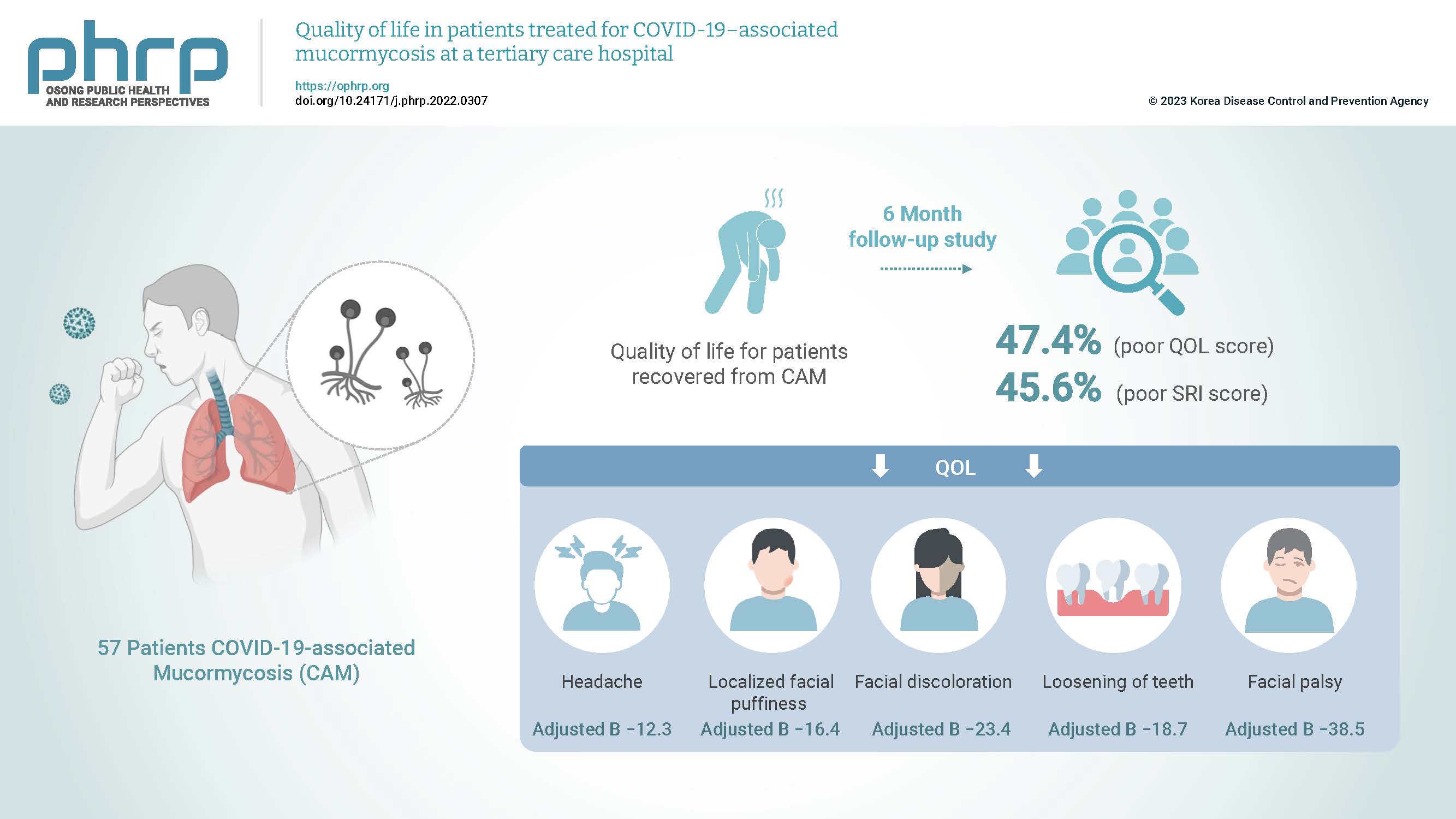
Objectives Coronavirus disease 2019 (COVID-19)–associated mucormycosis (CAM) has emerged as a formidable infection in patients with COVID-19. The aggressive management of CAM affects quality of life (QOL); thus, this study was designed to assess the QOL in patients with CAM at a tertiary healthcare institution.
Methods This cross-sectional study of 57 patients with CAM was conducted over 6 months using a semi-structured standard questionnaire (the abbreviated World Health Organization Quality of Life questionnaire [WHO-BREF]) and a self-rated improvement (SRI) scale ranging from 0 to 9. Cut-off values of ≤52 and <7 were considered to indicate poor QOL and poor improvement, respectively. The correlations of QOL and SRI scores were evaluated using Spearman rho values.
Results In total, 27 patients (47.4%; 95% confidence interval [CI], 34.9%–60.1%) and 26 patients (45.6%; 95% CI, 33.4%–58.4%) had poor QOL and poor SRI scores, respectively. The overall median (interquartile range) QOL score was 52 (41–63). Headache (adjusted B, −12.3), localized facial puffiness (adjusted B , −16.4), facial discoloration (adjusted B, −23.4), loosening of teeth (adjusted B, −18.7), and facial palsy (adjusted B, −38.5) wer e significantly associated with the QOL score in patients with CAM.
Conclusion Approximately 1 in 2 patients with CAM had poor QOL and poor improvement. Various CAM symptoms were associated with QOL in these patients. Early recognition is the key to optimal treatment, improved outcomes, and improved QOL in patients with CAM.
Citations
Citations to this article as recorded by
Health-related quality of life after orbital exenteration for COVID-19–associated rhino-orbital-cerebral mucormycosis in South India: a cross-sectional SF-36 study and systematic review Ashel Chelsea Dsouza, Jasleen Kaur, Swathi M, K. Md. Shoyaib Khazi, Aster Chelson Dsouza, Anudeep Sathyanarayan, Chinmayee J. T Orbit.2026; : 1. CrossRef
WHO BREF Quality of Life Score as a Prognostic Indicator of Survival in Patients recovered from COVID-19 Associated Rhino-Orbito-Cerebral Mucormycosis K. Nidhin Das, Vidhu Sharma, Vishudh Mohan, Kapil Soni, Ankita Chugh, Bikram Choudhury, Amit Goyal Indian Journal of Otolaryngology and Head & Neck S.2024; 76(4): 3441. CrossRef
Impact of prosthodontic rehabilitation on psychological status and quality of life in maxillectomy patients of coronavirus disease 2019-associated mucormycosis at a tertiary care center: A prospective clinical study P. Vijayabharathi, Surabhi Rambhau Somkuwar, Santhosh Rao, Virat Galhotra, Uvashri Selvaraj The Journal of Indian Prosthodontic Society.2024; 24(4): 351. CrossRef
The recent outbreak of severe acute respiratory syndrome coronavirus 2 (SARS-CoV-2), ahighly transmissible virus with a likely animal origin, has posed major and unprecedentedchallenges to millions of lives across the affected nations of the world. This outbreak firstoccurred in China, and despite massive regional and global attempts shortly thereafter, itspread to other countries and caused millions of deaths worldwide. This review presents keyinformation about the characteristics of SARS-CoV-2 and its associated disease (namely,coronavirus disease 2019) and briefly discusses the origin of the virus. Herein, we also brieflysummarize the strategies used against viral spread and transmission.
Citations
Citations to this article as recorded by
Epidemiological surveillance of emerging infectious diseases in sub-Saharan Africa and priorities for strengthening Naima Ibrahim Ahmed, Yakub Burhan Abdullahi, Sharmake Gaiye Bashir, Mohamed Sharif Abdi, Marian Muse Osman, Mustafa Yusuf Ahmed, Yusuf Hared Abdi Discover Public Health.2026;[Epub] CrossRef
Cytomegalovirus and pneumocystis jirovecii co-infection pneumonia as an initial presentation of HIV infection Sharare Noruzi, Sobhan Mehdipourrabori, Zeynab Yassin Journal of Medicine, Surgery, and Public Health.2025; 5: 100174. CrossRef
Mpox virus (MPXV): comprehensive analysis of pandemic risks, pathophysiology, treatments, and mRNA vaccine development Sajjad Eslamkhah, Elif Sibel Aslan, Cuneyd Yavas, Nermin Akcalı, Lutfiye Karcıoglu Batur, Asmaa Abuaisha, Erva Esma Yildirim, Mustafa Solak, Kenneth N. White Naunyn-Schmiedeberg's Archives of Pharmacology.2025; 398(6): 6143. CrossRef
Monkeypox: a re-emergent virus with global health implications – a comprehensive review Nourhan G. Naga, Enas A. Nawar, A’laa A. Mobarak, Aya G. Faramawy, Hend M. H. Al-Kordy Tropical Diseases, Travel Medicine and Vaccines.2025;[Epub] CrossRef
Marburg Virus Disease: A Narrative Review Arash Letafati, Somayeh Sadat Hosseini Fakhr, Ali Qaraee Najafabadi, Negin Karami, Hassan Karami Health Science Reports.2025;[Epub] CrossRef
Exploring monkeypox virus antibody levels: insights from human immunological research Jing Wu, Xiaomin Zhang Virology Journal.2025;[Epub] CrossRef
Novel agents inhibiting the Marburg nucleoprotein using molecular docking, ADMET, MD, and quantum DFT methods Haiwang Djefoulna Victorien Hermann, Fifen Jean Jules, Conradie Jeanet Discover Applied Sciences.2025;[Epub] CrossRef
Investigating the impact of the number of COVID-19 reinfections, vaccination status, risk factors, and reinfection interval on long COVID symptomatology Björn Nicolay, Raquel Gómez Bravo, Djenna Hutmacher, Charles Benoy, Claus Vögele Discover Public Health.2025;[Epub] CrossRef
Polysaccharides and Lectins: A Natural Complementary Approach against the SARS-CoV-2 Pandemic Radu Lefter, Prairna Balyan, Ioana-Miruna Balmus, Abdellah Ech-Chahad, Ahmad Ali, Alin Ciobica, Antoneta Dacia Petroaie, Gabriela Halitchi, Bogdan Novac, Catalina Ionescu, Fatima Zahra Kamal Microbiology Research.2024; 15(2): 525. CrossRef
Risk of COVID-19 transmission on long-haul flights: During the COVID-19 pandemic Jiyun Park, Gye jeong Yeom, Poowin Bunyavejchewin PLOS ONE.2024; 19(8): e0309044. CrossRef
Effectiveness of donning and doffing personal protective equipment education using video debriefing among Korean undergraduate nursing students GyeJeong Yeom, Jiyun Park BMC Nursing.2024;[Epub] CrossRef
A Narrative Review on the Pandemic Zoonotic RNA Virus Infections Occurred During the Last 25 Years Gobena Ameni, Aboma Zewude, Begna Tulu, Milky Derara, Berecha Bayissa, Temesgen Mohammed, Berhanu Adenew Degefa, Mohamed Elfatih Hamad, Markos Tibbo, Robert Barigye Journal of Epidemiology and Global Health.2024; 14(4): 1397. CrossRef
The next viral pandemic: A call for global preparedness Hassan Karami, Mina Soleimani, Negar Nayerain Jazi, Kiana Navi, Rojina Sajadi, Mohammad Mehdi Fazeli, Golara Pagheh, Samane Ostadhadi Dehkordi Journal of Medicine, Surgery, and Public Health.2024; 4: 100150. CrossRef
Surveillance of endemic coronaviruses during the COVID‐19 pandemic in Iran, 2021–2022 Hassan Karami, Kaveh Sadeghi, Sevrin Zadheidar, Fatemeh Saadatmand, Negar Mirsalehi, Nima Hoveidi Ardestani, Shirin Kalantari, Mohammad Farahmand, Jila Yavarian, Talat Mokhtari‐Azad Influenza and Other Respiratory Viruses.2023;[Epub] CrossRef
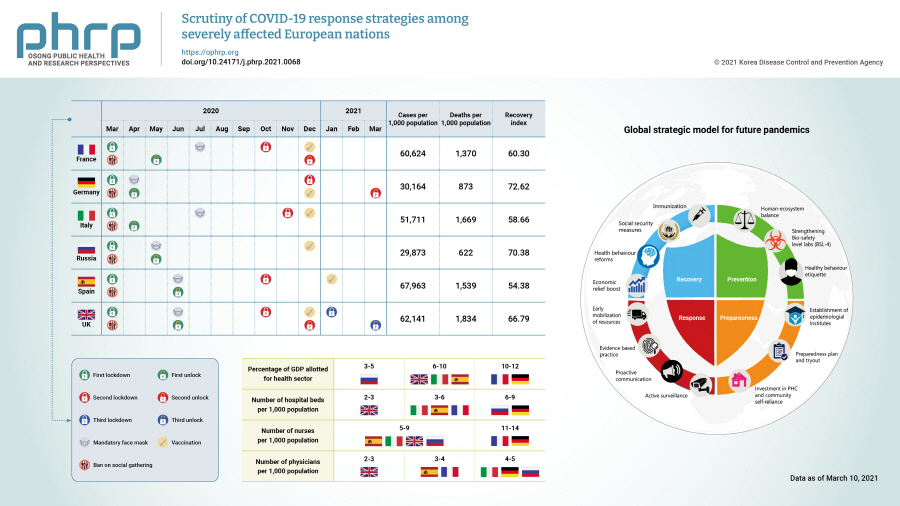
Although the health care systems in Europe are considered the global benchmark, European nations were severely affected by the coronavirus disease 2019 (COVID-19) pandemic. This manuscript aimed to examine the strategies implemented to combat the COVID-19 pandemic by France, the United Kingdom, Spain, Italy, Germany, and Russia and their outcomes in terms of the number of cases, testing, and deaths. This is the first review of its kind that extensively analyzes the preparedness, mitigation, and response strategies against the COVID-19 pandemic adopted by these nations. This paper further suggests a strategic preparedness model for future pandemics. From the analysis, we found that a decentralized approach, prompt decision-making and timely execution, coordination between local health authorities, and public participation in the implementation of strategies could substantially reduce the case fatality rate. Nations with a high percentage of gross domestic product invested in the health sector, as well as more nurses, physicians, hospital beds, intensive care unit beds, and ventilators, better managed the pandemic. Instead, nations that postponed their pandemic response by delaying tracking, tracing, testing, quarantine, and lockdown were badly affected. The lessons learned from the present pandemic could be used as a guide to prepare for further pandemics.
Citations
Citations to this article as recorded by
Facteurs protecteurs de la qualité de vie d’infirmières françaises durant la pandémie de COVID-19 : un devis descriptif-corrélationnel Emilie KORT, Philippe DELMAS, Jonathan JUBIN, Annie OULEVEY BACHMANN, Claudia ORTOLEVA BUCHER Recherche et Avancées en Sciences Infirmières.2025;[Epub] CrossRef
Psychological impact and development of autistic traits in children during the COVID 19 Pandemic: A study through Guardian Waseem Iqbal, Mudassir Hassan, Parveez Ahmed Mir, Syed Kaiser IP International Journal of Medical Paediatrics an.2024; 9(4): 135. CrossRef
The Safety of Covishield (ChAdOx1 nCoV-19) Vaccine after Three Doses Vaccination under Mass Vaccination Program of Government of India Narinder Singh, Jaswinder Singh, Vikram Bhandari, Rahat Kumar AMEI's Current Trends in Diagnosis & Treatment.2024; 7(2): 36. CrossRef
A phenomenological experience of trainers in preparedness training during COVID-19 pandemic: Trainers perspective from tertiary care institute Rakesh Sharma, Prasuna Jelly, Kusum Kumari, Arun Varghese, K. Hemanthkumar, C. Vasantha Kalyani, Neha Singh, Shalinee Rao International Journal of Africa Nursing Sciences.2024; 20: 100711. CrossRef
Antibody titre in infants of covid-19 infected mothers Shivani Sharma, Pushkar Lal Meena, Rameshwar Lal Suman, Jaya Ninama IP International Journal of Medical Paediatrics an.2023; 9(2): 68. CrossRef
A study to assess the level of stress among nursing students of IUST during COVID-19 pandemic Javaid Ahmad Mir, Asmat Parveen, Suheel Rashid Wani, Tayyibah Nisar, Sakeena Majeed, Wahida Kausar, Basit Ul Islam IP International Journal of Medical Paediatrics an.2022; 8(1): 15. CrossRef
Strategy to prevent infection from Covid-19 among security officers of tertiary care centre: A preexperimental study Rakesh Sharma, KusumK Rohilla, Lisa Chadha, Priyanka Malhotra, S Sharmila, Prasuna Jelly Journal of Family Medicine and Primary Care.2021; 10(9): 3257. CrossRef
Post COVID-19 changes in the perception of the parents towards dentistry for their child Nahid Iftikhar, Shalini Dixit, Aditi Yadav IP International Journal of Medical Paediatrics an.2021; 7(3): 155. CrossRef
A comparative study of attitudes towards COVID-19 vaccination in the rural and urban population of Uttarakhand, India Rakesh Sharma, Prasuna Jelly, Vishwas AS, Lisa Chadha, Vartika Saxena, Latika Mohan Journal of Global Health Economics and Policy.2021;[Epub] CrossRef
A comparative study of attitudes towards COVID-19 vaccination in the rural and urban population of Uttarakhand, India Rakesh Sharma, Prasuna Jelly, Vishwas AS, Lisa Chadha, Vartika Saxena, Latika Mohan Journal of Global Health Economics and Policy.2021;[Epub] CrossRef



 First
 Prev


