Objectives Social activities are important and influential factors for healthy aging. However, limited information is available regarding the associations of the type and intensity of social participation with health and well-being. This study aimed to investigate how various types of social activities are associated with several dimensions of health outcomes. Methods: This cross-sectional study utilized data from the Seventh Korean Longitudinal Study of Aging, which included 5,526 adults aged 60 years and older. Multivariate linear regression analysis was employed to analyze the associations of social activities with depression, self-rated health, and life satisfaction. Additionally, subgroup analyses by sex and age were performed. Results: Among the participants, 73.5% reported involvement in at least 1 of the 4 types of social engagement. After adjustment for all covariates, individuals who participated in any social activity reported better self-rated health and higher life satisfaction compared to those who did not participate. However, the intensity of engagement in different social activities had varying impacts on subjective health outcomes. An increased level of participation was associated with a lower rate of depression and improved self-rated health. However, no significant differences were observed in the relationship between the intensity of participation in activities (with the exception of alumni societies or family councils) and life satisfaction. Conclusion: This study suggests that to improve their health, older adults in the Republic of Korea should not only engage in social activities but also do so actively and regularly.
Citations
Citations to this article as recorded by
Impact of Depression on Self-Rated Health Status among Community-Dwelling Older Adults: Moderating Effects of Subjective Social Status and Formal Social Participation Using Data from the Ninth Korean Longitudinal Study of Aging (2022) Sohee Jung, Eunhee Yang, Soyoung Cha, Wonhee Baek Journal of Fundamental Nursing Science.2026; 33(1): 147. CrossRef
Disaggregating Digital Competence: Social Activity Participation and Depressive Symptoms Among Korean Older Adults Young-Mi Jung, NakHyeok Choi Behavioral Sciences.2026; 16(10): 1742. CrossRef
Gender differences in advanced activities of daily living: evidence from the longitudinal study of health and aging in Mexico 2012–2018 Martha A. Sánchez-Rodríguez, Mariano Zacarías-Flores, Lesly Estefanía Castañeda-Sánchez, Víctor Manuel Mendoza-Núñez Frontiers in Aging.2025;[Epub] CrossRef
The Associations Between Physical Activity, Body Perception, and Self-Rated Health in Korean Adults: An Analysis of the 2023 Korean Community Health Survey Geun-Kook Kim, Su-Yeon Roh, Sung-Ho Hwang Medicina.2025; 61(11): 1898. CrossRef
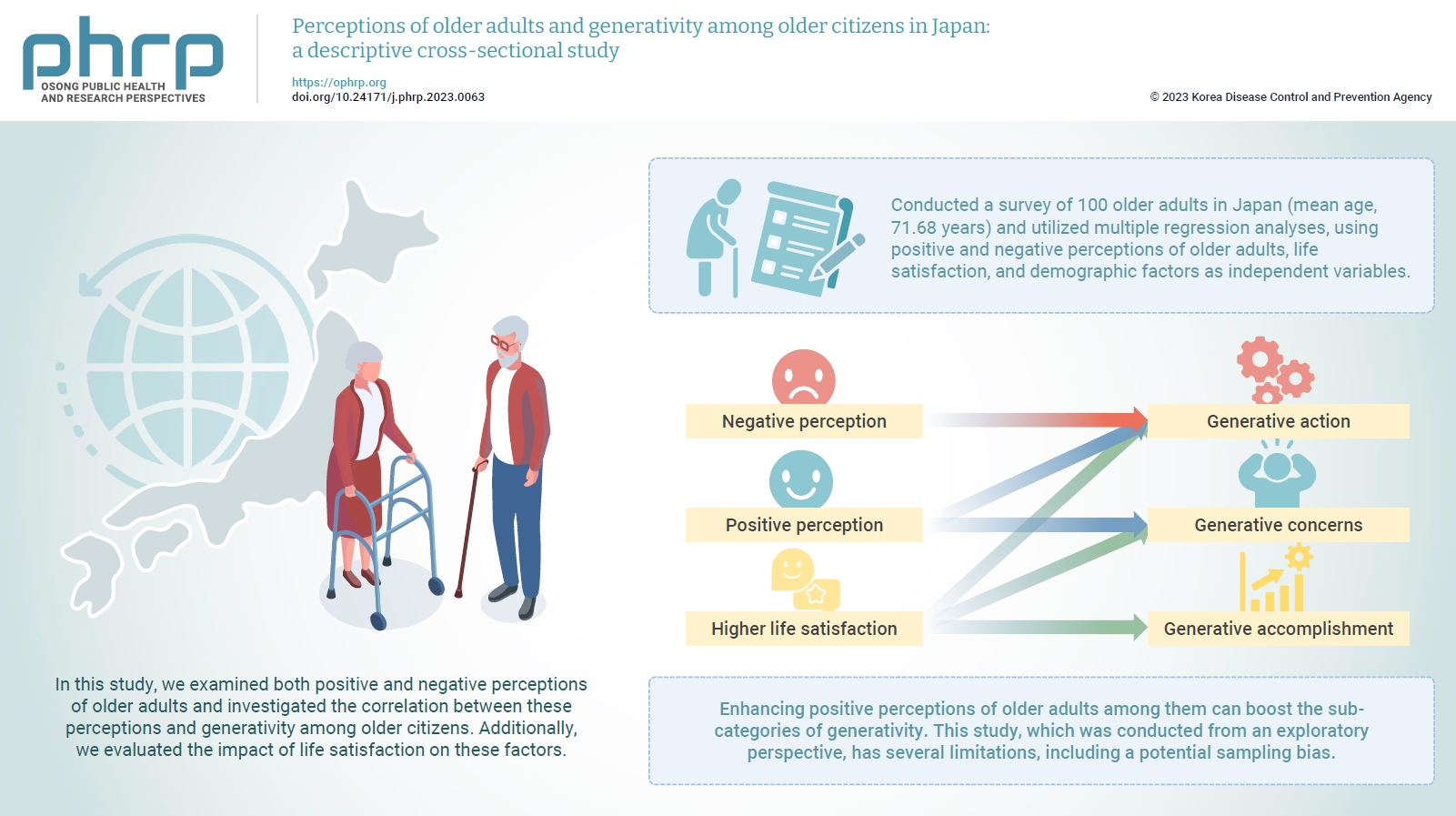
Objectives As the population ages worldwide, including in Japan, there is a growing expectation for older adults to remain active participants in society. The act of sharing one’s experiences and knowledge with younger generations through social engagement not only enriches the lives of older individuals, but also holds significant value for our society. In this study, we examined both positive and negative perceptions of older adults and investigated the correlation between these perceptions and generativity among older citizens. Additionally, we evaluated the impact of life satisfaction on these factors. Methods: We conducted a survey of 100 older adults in Japan (mean age, 71.68 years) and utilized multiple regression analyses, using positive and negative perceptions of older adults, life satisfaction, and demographic factors as independent variables. The sub-categories of generativity—namely, generative action, concern, and accomplishment—were used as dependent variables. Results: Participants who held a more positive perception of older adults demonstrated a higher level of generative actions and concerns. Additionally, participants who reported higher levels of life satisfaction also exhibited more generative actions, concerns, and accomplishments. Conversely, those who held a more negative perception of older adults were found to have higher levels of generative actions. Conclusion: Enhancing positive perceptions of older adults among them can boost the sub-categories of generativity. This study, which was conducted from an exploratory perspective, has several limitations, including a potential sampling bias. A more comprehensive examination of the relationship between perceptions of older adults and generativity is anticipated in future research.
Citations
Citations to this article as recorded by
How ageism may constrain generativity in later life: Introducing the ageism–generativity pathways model Yuho Shimizu Educational Gerontology.2026; : 1. CrossRef
Revision and Reliability-Validity Test of the Loyola Generativity Scale (LGS) in Chinese Elderly 义鑫 张 Advances in Psychology.2025; 15(02): 123. CrossRef
<sec>
<title>Objectives</title>
<p>This study aimed to examine how social activity (SA) moderates the relationship between age norms (AN) and subjective health status (SHS) among older adults in Korea. Based on the theories of age-integrated structure and active aging, the proposed hypotheses were that SHS has a positive association with attitudes towards AN, and with the interactions between different types of AN and SA.</p></sec>
<sec>
<title>Methods</title>
<p>Cross-sectional data from a Korean national survey of older adults were analyzed. Participants were older adults <italic>N</italic> = 10,451, of whom 10,280 were used in the study sample. Multivariate linear regression including interaction terms, was used to examine the associations among SHS, AN, and SA.</p></sec>
<sec>
<title>Results</title>
<p>The results of multivariate linear regression examining learning (ß = 0.066, <italic>p</italic> < 0.001), working (ß = 0.063, <italic>p</italic> < 0.001), and remarriage (ß = 0.036, <italic>p</italic> < 0.001) showed that those who perceived AN more positively, were more likely to have a high SHS. With interaction terms, those who had a positive attitude towards AN for learning and volunteering (ß = 0.025, <italic>p</italic> < 0.05), and remarriage and engaged in friendship groups (ß = 0.032, <italic>p</italic> < 0.05) were more likely to have a high SHS.</p></sec>
<sec>
<title>Conclusion</title>
<p>SA serves as a great moderator between AN and SHS.</p></sec>
Citations
Citations to this article as recorded by
Social engagement and subjective health among older adults in South Korea: Evidence from the Korean Longitudinal Study of Aging (2006–2018) Bo Zhao, Ji Eon Kim, Jiyoung Moon, Eun Woo Nam SSM - Population Health.2023; 21: 101341. CrossRef
<sec>
<title>Objectives</title>
<p>Self-rated health is a comprehensive measure of health. As gender difference in self-rated health is found, identifying gender-specific factors related to self-rated health is important. Poor executive functioning negatively affects an individual’s independence and healthy lifestyle, but it is unknown relationships between executive function and self-rated health and gender differences in these relationships. Therefore, gender differences were examined in the relationship between executive function and self-rated health in the community.</p></sec>
<sec>
<title>Methods</title>
<p>Individuals completed questionnaires about their health status and subjective decline in executive function. Neuropsychological tests were also performed to assess objective executive functioning. Two separate multivariable linear regression analyses were conducted by gender.</p></sec>
<sec>
<title>Results</title>
<p>Better objective executive function was related to greater self-rated health scores (better self-rated health) in men alone (βs = 0.341), while better subjective executive function was significantly associated with greater self-rated health scores in both men and women (βs = 0.385 and 0.443, respectively).</p></sec>
<sec>
<title>Conclusion</title>
<p>Gender differences are important when reporting perceived health status, in particular the different effects of subjective and objective executive function on self-rated health across genders. Clinicians need to be aware of the potential value of subjective executive function complaints when evaluating health status.</p></sec>
Citations
Citations to this article as recorded by
Borderline personality mediates the link between attachment insecurities and subjective working memory deficits: The role of pre‐emptive and post‐emptive strategies Emrullah Ecer, Agata Gasiorowska British Journal of Psychology.2026; 117(4): 1241. CrossRef
Cognitive training at home for clinically defined insomnia: effects on sleep and psychological functioning Jose L. Tapia, Jon Andoni Duñabeitia, F. Javier Puertas Frontiers in Digital Health.2026;[Epub] CrossRef
The Scale Assessment of Executive Functions-Adult (SAEF-A): Construction of a valid ecological instrument Farah El houari, Ibtissam El Harch, Abdelkrim Janati Idrissi, Samira El fakir, Benaissa Zarhbouch, Zouhayr Souirti Applied Neuropsychology: Adult.2025; 32(6): 1654. CrossRef
Psychometric properties of the Teenage Executive Functioning Inventory (TEXI): A confirmatory factor analysis and measurement invariance by gender in Bangladeshi adolescents Bijon Baroi, Samsad Afrin Himi Applied Neuropsychology: Child.2025; 14(4): 422. CrossRef
Screen time exposure and executive functions in preschool children Nemanja Lakicevic, Marko Manojlovic, Elena Chichinina, Patrik Drid, Yury Zinchenko Scientific Reports.2025;[Epub] CrossRef
The Relationship Between Metabolic Syndrome Awareness and Perception of Health in Exercise Participants: A Cross-Sectional Study Gökçe Avcu, Taner Akbulut, Emsal Çağla Avcu, Gian Mario Migliaccio Medicina.2025; 61(3): 501. CrossRef
The complex relationship between treatment burden of multimorbidity and self-care in multimorbid patients with hypertension Kyoung Suk Lee, Jihyang Lee BMC Primary Care.2025;[Epub] CrossRef
Self-rated flexibility significantly reflects the hip flexibility, but not the ankle flexibility Wootaek Lim Isokinetics and Exercise Science.2024; 32(2): 171. CrossRef
Educational Attainment and Perceived Need for Future ADL Assistance Julia M. Finan, Scott D. Landes Journal of Applied Gerontology.2024; 43(7): 922. CrossRef
The impact of epidemic infectious diseases on the relationship between subjective well-being and social class identity in older adults: The mediating role of Self-rated health Qianxi Feng, Yan Li, Miao Wan, Wei Li, Roghieh Nooripour PLOS ONE.2024; 19(3): e0301289. CrossRef
Current state, equality level and trends of self-rated health among old adults with intact physical condition Weicun Ren, Clifford Silver Tarimo, Zhang Liang BMC Public Health.2023;[Epub] CrossRef
Gender features of awareness and attitude towards a healthy lifestyle among users of medical Internet resources A.N. Korobeynikova, M.V. Bezzubtseva, A.E. Demkina, A.D. Yuldasheva, S.V. Popova, A.L. Pivenshtein, A.V. Isaeva, V.G. Starosvetskaya, Z.G. Akaeva, E.L. Kolesnik Russian Journal of Preventive Medicine.2023; 26(10): 62. CrossRef
Validation of a proxy‐reported SARC‐F questionnaire for current and retrospective screening of sarcopenia‐related functional impairments Johannes Maurus, Tobias Terzer, Axel Benner, Sabine Goisser, Annette Eidam, Anja Roth, Maike Janssen, Sonia Jaramillo, Hannes Martin Lorenz, William Micol, Klaus Hauer, Carsten Müller‐Tidow, Jürgen M. Bauer, Karin Jordan, Nina Rosa Neuendorff Journal of Cachexia, Sarcopenia and Muscle.2022; 13(1): 264. CrossRef
Association between Hippocampal Volume and Working Memory in 10,000+ 9–10-Year-Old Children: Sex Differences Shervin Assari, Shanika Boyce, Tanja Jovanovic Children.2021; 8(5): 411. CrossRef
Social Capital and Self-Rated Health: Empirical Evidence from China Jiafeng Gu, Ruiyu Zhu International Journal of Environmental Research an.2020; 17(23): 9108. CrossRef
Effect of self-rated health status on functioning difficulties among older adults in Ghana: Coarsened exact matching method of analysis of the World Health Organization’s study on global AGEing and adult health, Wave 2 John Tetteh, Robert Kogi, Anita Ohenewa Yawson, George Mensah, Richard Biritwum, Alfred Edwin Yawson, Heidi H. Ewen PLOS ONE.2019; 14(11): e0224327. CrossRef
Objectives
Even though Philippines is widely known as exporters of health workers in the world, the Occidental Mindoro province suffers from a lack of health workers compared with the total population of each municipality. The aim of this study was to observe, identify, and understand the persisting health status, knowledge, and practices among the three selected communities in Occidental Mindoro, Philippines. Methods
The study applied a survey using basic questions with three key topics, with relevance to the health condition of the villagers, such as demographics (social capital and regional characteristics), lifestyle (healthy living, and healthy lifestyle and behavior), and status or position in the society (general demographics, and personal behavior and attitudes), with a random sample of 256 adult respondents. Results
Only about 54.3% rated themselves as fair/moderately healthy, and a total of 17.2% suffered from chronic diseases such as diabetes mellitus, cancers, chronic obstructive pulmonary disease, and cardiovascular disease, while 9% have been diagnosed with tuberculosis in the past 6 months. Respondents mostly have low income and low education. Conclusion
The majority of the respondents have only primary and secondary education, and a very low average income; these suggest that respondents were afflicted with poverty and low educational attainment. Respondents who are deprived of their rights to obtain a higher education also have a higher chance of having less knowledge on their well-being. Health programs do not guarantee a healthy individual and a healthy society, but a combination of health programs and socioeconomic support can help in creating a healthy community.
Citations
Citations to this article as recorded by
Observation records of the Bangon Monitor Lizard, Varanus bangonorum (Squamata, Varanidae), with emphasis on behaviour and local threats, from the Municipality of Abra de Ilog, Occidental Mindoro, Philippines Przemysław Zdunek, Michaela S. Webb Herpetozoa.2023; 36: 1. CrossRef
Objectives
The aim of the present study is to investigate the relationship between health behavior and general health status. Methods
We used data from the 2011 Korea National Health and Nutrition Examination Survey. Mental health was measured by stress recognition and depression. Dietary habit was measured by mixed grain diet. Life pattern was measured by sleeping time and working pattern. Physical activity was measured by walking and exercise. We defined general health status as Euro Quality of Life-5 Dimension (EQ-5D<sub>index</sub>), Euro Quality of Life Visual Analogue Scale (EQ-5D<sub>vas</sub>), number of people experienced lying in a sickbed for the last one month, number of days lying in a sickbed for the last one month, and activity limitations. Results
Mental health, dietary habit, life pattern, and physical activity have seven factors. Most of the factors have a significant correlation with EQ-5D<sub>index</sub>, EQ-5D<sub>vas</sub>, number of people experienced lying in a sickbed for the last one month, number of days lying in a sickbed for the last one month, and activity limitations. Conclusion
Health behavior and general health status have a positive correlation.
Citations
Citations to this article as recorded by
Association between US Residents’ Health Behavior and Good Health Status at the City Level Bojung Seo, Hongmei Nan, Patrick O. Monahan, Thomas J. Duszynski, Walter R. Thompson, Terrell W. Zollinger, Jiali Han Translational Journal of the American College of S.2024;[Epub] CrossRef
Clustering of Health-Related Behavior Patterns and Demographics. Results From the Population-Based KORA S4/F4 Cohort Study Matthias Rabel, Michael Laxy, Barbara Thorand, Annette Peters, Lars Schwettmann, Filip Mess Frontiers in Public Health.2019;[Epub] CrossRef
Patients with Chronic Musculoskeletal Pain of 3–6-Month Duration Already Have Low Levels of Health-Related Quality of Life and Physical Activity Javid Majlesi Current Pain and Headache Reports.2019;[Epub] CrossRef



 First
 Prev


