

| Jin Gwack | 16 Articles |

Objectives
In alignment with the World Health Organization’s goal of eliminating hepatitis C, this study assessed the current treatment status and reasons for non-treatment among patients with hepatitis C in Jeonbuk State, Republic of Korea, to inform strategies for improving care engagement. Methods Among 311 individuals diagnosed with hepatitis C and reported through the National Notifiable Infectious Disease Surveillance system between January 2023 and June 2024, 208 patients were surveyed after excluding those who had died or could not be contacted. Statistical analyses included the chi-square test, the Cochran-Armitage test for trend, and logistic regression. Results Overall, 116 participants (55.8%) reported having received antiviral therapy. Among the 92 untreated individuals, the most common reason for non-treatment was the absence of symptoms (n=23; 25.0%), followed by the burden of drug costs (n=21; 22.8%). Conclusion These findings highlight suboptimal treatment uptake and key barriers that may hinder progress toward hepatitis C elimination. Expanding screening and strengthening linkage-to-care strategies, while addressing financial barriers, will be essential to achieving national elimination targets.
Objectives
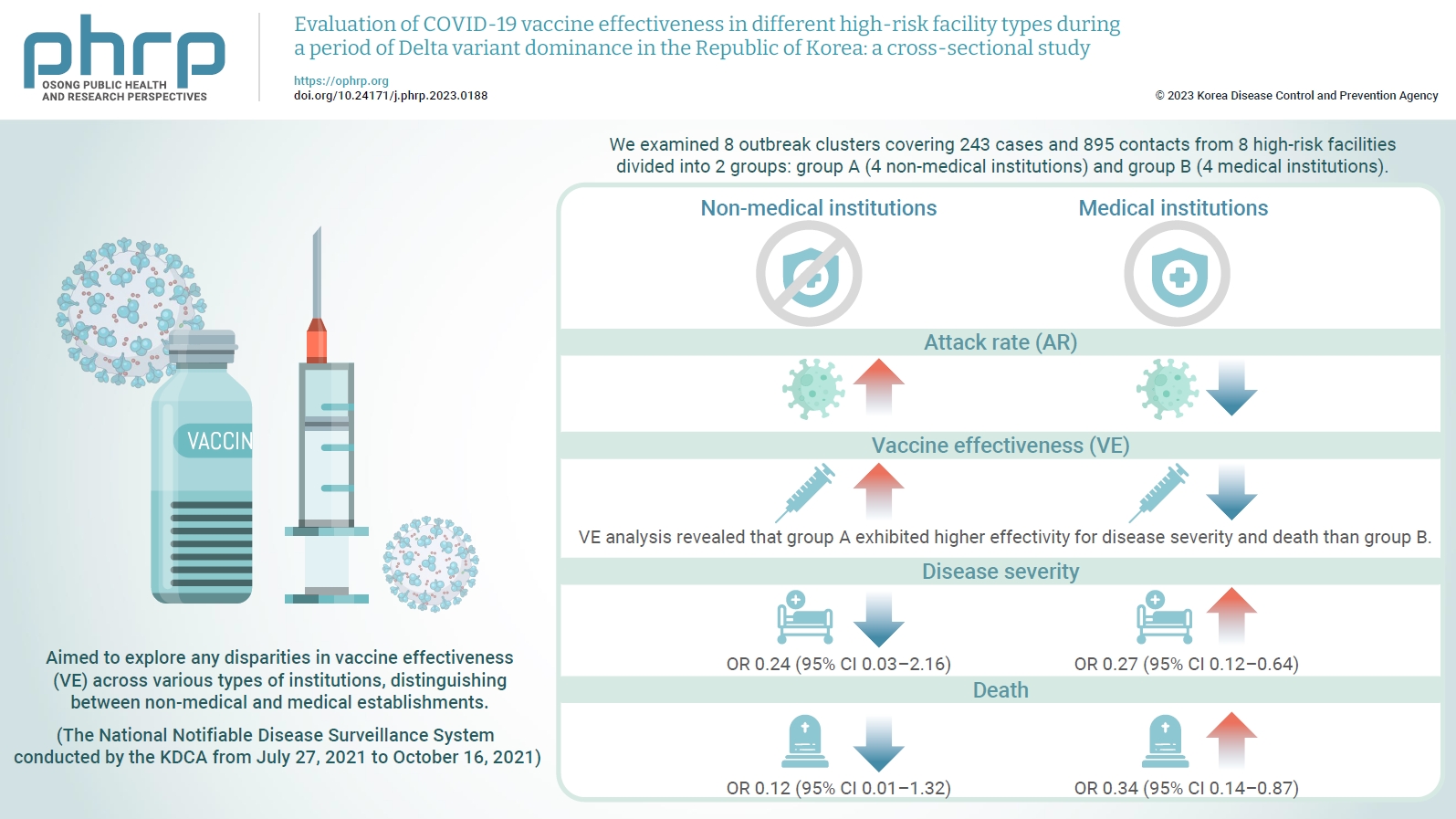
We evaluated the effectiveness of coronavirus disease 2019 vaccination in high-risk facilities in the Republic of Korea during the period when the highly transmissible Delta variant was prevalent. Additionally, we aimed to explore any disparities in vaccine effectiveness (VE) across various types of institutions, specifically distinguishing between non-medical and medical establishments. Methods: We examined 8 outbreak clusters covering 243 cases and 895 contacts from 8 high-risk facilities divided into 2 groups: group A (4 non-medical institutions) and group B (4 medical institutions). These clusters were observed from July 27, 2021 to October 16, 2021 for the attack rate (AR) and VE with respect to disease severity. A generalized linear model with a binomial distribution was used to determine the odds ratio (OR) for disease severity and death. Results: AR was notably lower in group B (medical institutions). Furthermore, VE analysis revealed that group A exhibited higher effectivity for disease severity and death than group B. The OR for disease severity was 0.24 (95% confidence interval [CI], 0.03–2.16) for group A and 0.27 (95% CI, 0.12–0.64) for group B, with the OR for death at 0.12 (95% CI, 0.01–1.32) in group A and 0.34 (95% CI, 0.14–0.87) in group B. Conclusion: Although VE may vary across institutions, our findings underscore the importance of implementing vaccinations in high-risk facilities. Customized vaccination programs, tailored response plans, and competent management personnel are essential for effectively addressing and mitigating public health challenges.
Objectives
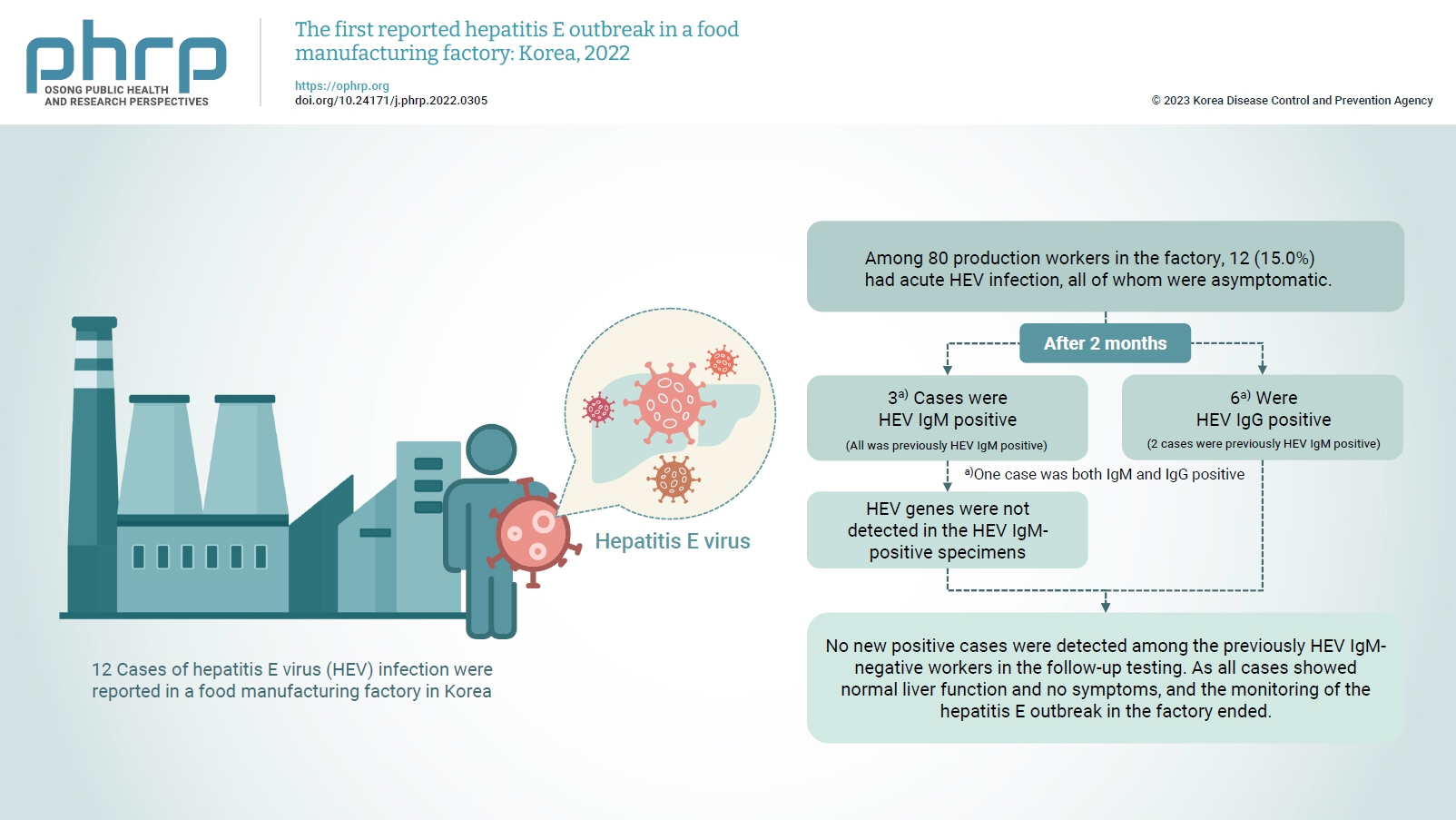
On February 16, 2022, 12 cases of hepatitis E virus (HEV) infection were reported in a food manufacturing factory in Korea. The aim of this study was to identify additional cases and to determine the source of this HEV outbreak. Methods: This study was an in-depth investigation of 12 HEV immunoglobulin M (IgM)-positive cases and their demographic, clinical, and epidemiological characteristics. On-site specimens were collected from the environment and from humans, and a follow-up investigation was conducted 2 to 3 months after the outbreak. Results: Among 80 production workers in the factory, 12 (15.0%) had acute HEV infection, all of whom were asymptomatic. The follow-up investigation showed that 3 cases were HEV IgMpositive, while 6 were HEV IgG-positive. HEV genes were not detected in the HEV IgM-positive specimens. HEV genes were not detected in the food products or environmental specimens collected on-site. HEV was presumed to be the causative pathogen. However, it could not be confirmed that the source of infection was common consumption inside the factory. Conclusion: This was the first domestic case of an HEV infection outbreak in a food manufacturing factory in Korea. Our results provide information for the future control of outbreaks and for the preparation of measures to prevent domestic outbreaks of HEV infection. Citations
Citations to this article as recorded by

Objectives
This study analyzed the clinical outcomes of remdesivir treatment in coronavirus disease 2019 (COVID-19) patients in South Korea. Methods This retrospective cohort study involved the secondary analysis of epidemiological data. Among patients diagnosed with COVID-19 from July 2, 2020 to March 23, 2021 (12 AM), 4,868 who received oxygen therapy and were released from isolation after receiving remdesivir treatment were assigned to the treatment group, and 6,068 patients who received oxygen therapy but not remdesivir were assigned to the untreated group. The study subjects included children under the age of 19. The general characteristics and severity were compared between the groups. Differences in the time to death and mortality were also compared. Results In the untreated group, the hazard ratio [HR] for mortality was 1.59 among patients aged ≥70 years and 2.32 in patients with severe disease in comparison to the treatment group. In a comparison of survival time among patients with severe disease aged ≥70 years, the HR for mortality before 50 days was 2.09 in the untreated group compared to the treatment group. Conclusion Patients with remdesivir treatment showed better clinical outcomes in this study, but these results should be interpreted with caution since this study was not a fully controlled clinical trial. Citations
Citations to this article as recorded by

Objectives
Real-time polymerase chain reaction is currently used as a confirmatory test for coronavirus disease 2019 (COVID-19). The test results are interpreted as positive, negative, or inconclusive, and are used only for a qualitative classification of patients. However, the test results can be quantitated using threshold count (Ct) values to determine the amount of virus present in the sample. Therefore, this study investigated the diagnostic usefulness of Ct results through various quantitative analyzes, along with an analysis of clinical and epidemiological characteristics. Methods Clinical and epidemiological data from 4,642 COVID-19 patients in April 2021 were analyzed, including the Ct values of the RNA-dependent RNA polymerase (RdRp), envelope (E), and nucleocapsid (N) genes. Clinical and epidemiological data (sex, age, underlying diseases, and early symptoms) were collected through a structured questionnaire. A correlation analysis was used to examine the relationships between variables. Results All 3 genes showed statistically significant relationships with symptoms and severity levels. The Ct values of the RdRp gene decreased as the severity of the patients increased. Moreover, statistical significance was observed for the presence of underlying diseases and dyspnea. Conclusion Ct values were found to be related to patients’ clinical and epidemiological characteristics. In particular, since these factors are closely related to symptoms and severity, Ct values can be used as primary data for predicting patients’ disease prognosis despite the limitations of this method. Conducting follow-up studies to validate this approach might enable using the data from this study to establish policies for preventing COVID-19 infection and spread. Citations
Citations to this article as recorded by
<p>Since a novel beta-coronavirus, severe acute respiratory syndrome coronavirus 2 (SARS-CoV-2) was first reported in December 2019, there has been a rapid global spread of the virus. Genomic surveillance was conducted on samples isolated from infected individuals to monitor the spread of genetic variants of SARS-CoV-2 in Korea. The Korea Disease Control and Prevention Agency performed whole genome sequencing of SARS-CoV-2 in Korea for 1 year (January 2020 to January 2021). A total of 2,488 SARS-CoV-2 cases were sequenced (including 648 cases from abroad). Initially, the prevalent clades of SARS-CoV-2 were the S and V clades, however, by March 2020, GH clade was the most dominant. Only international travelers were identified as having G or GR clades, and since the first variant 501Y.V1 was identified (from a traveler from the United Kingdom on December 22<sup>nd</sup>, 2020), a total of 27 variants of 501Y.V1, 501Y.V2, and 484K.V2 have been classified (as of January 25<sup>th</sup>, 2021). The results in this study indicated that quarantining of travelers entering Korea successfully prevented dissemination of the SARS-CoV-2 variants in Korea.</p>
Citations
Citations to this article as recorded by
<p>This study describes the epidemiological characteristics of coronavirus disease 2019 (COVID-19) based on reported cases from long-term care facilities. As of April 20<sup>th</sup>, 2020, 3 long-term care facilities in a metropolitan area of South Korea had reported cases of COVID-19. These facilities’ employees were presumed to be the sources of infection. There were 2 nursing hospitals that did not report any additional cases. One nursing home had a total of 25 cases, with an attack rate of 51.4% (95% CI 35.6–67.0), and a fatality rate of 38.9% (95% CI 20.3–61.4) among residents. The results from this study suggest that early detection and maintenance of infection control minimizes the risk of rapid transmission.</p>
Citations
Citations to this article as recorded by
Korea has adopted Epidemic Intelligence Service (EIS) officers through the Field Epidemiology Training Program (FETP) since 1999 for systematic control of emerging and re-emerging infectious diseases. Graduates of medical schools in Korea are selected and serve as public health doctors (PHDs) for their mandatory military service. The duration of service is 3 years and PHDs comprise general practitioners and specialists. Some PHDs are selected as EIS officers with 3 weeks basic FETP training and work for central and provincial public health authorities to conduct epidemiological investigations. The total number of EIS officers is 31 as of 2012. The Korea Centers for Disease Control and Prevention (KCDC) has 12 specialists, whereas specialists and each province has one or two EIS officers to administer local epidemiological investigations in 253 public health centers. The Korean EIS officers have successfully responded and prevented infectious diseases, but there is a unique limitation: the number of PHDs in Korea is decreasing and PHDs are not allowed to stay outside Korea, which makes it difficult to cope with overseas infectious diseases. Furthermore, after 3 years service, they quit and their experiences are not accumulated. KCDC has hired full-time EIS officers since 2012 to overcome this limitation.
Citations
Citations to this article as recorded by
Objectives
A hierarchical generalized linear model (HGLM) was applied to estimate the transmission pattern of scrub typhus from 2001 to 2011 in the Republic of Korea, based on spatial and temporal correlation. Methods Based on the descriptive statistics of scrub typhus incidence from 2001 to 2011 reported to the Korean Centers for Disease Control and Prevention, the spatial and temporal correlations were estimated by HGLM. Incidences according to age, sex, and year were also estimated by the best-fit model out of nine HGLMs. A disease map was drawn to view the annual regional spread of the disease. Results The total number of scrub typhus cases reported from 2001 to 2011 was 51,136: male, 18,628 (36.4%); female, 32,508 (63.6%). The best-fit model selected was a combination of the spatial model (Markov random-field model) and temporal model (first order autoregressive model) of scrub typhus transmission. The peak incidence was 28.80 per 100,000 persons in early October and the peak incidence was 40.17 per 100,000 persons in those aged 63.3 years old by the best-fit HGLM. The disease map showed the spread of disease from the southern central area to a nationwide area, excepting Gangwon-do (province), Gyeongsangbuk-do (province), and Seoul. Conclusion In the transmission of scrub typhus in Korea, there was a correlation to the incidence of adjacent areas, as well as that of the previous year. According to the disease map, we are unlikely to see any decrease in the incidence in the near future, unless ongoing aggressive measures to prevent the exposure to the vector, chigger mites, in rural areas, are put into place. Citations
Citations to this article as recorded by
Objective
This study aimed at finding epidemiological and clinical features of autochthonous Lyme borreliosis in humans through epidemiological investigations and identifying its vectors and pathogens through analysis of ticks. Method Epidemiological investigations, including review of the retrospective medical records and patient interviews, were conducted in two cases that occurred in 2012. To identify the vectors and pathogens, ticks were collected between September 23 and October 6, 2012 from the area where the tick bite in the first patient occurred. The ticks were classified, and polymerase chain reaction (PCR) tests and cultures were performed. Results The first patient, a 46-year-old female, visited a forest in Gangwon province, which was 900 m above sea level, where the tick bite occurred. Two weeks after the tick bite, erythema migrans (12 × 6 cm<sup>2</sup> in size) appeared on the site of tick bite, along with fever, chill, fatigue, myalgia, and arthralgia on shoulders, knees, and hips. The second patient, a 44-year-old male, visited a mountain in Gangwon province, which was 1200 m above sea level, where a tick bite occurred. One month after the tick bite, erythema migrans appeared at the site of the tick bite, along with fatigue, myalgia, and arthralgia on the right shoulder and temporomandibular joint. Indirect fluorescent antibody testing and Western blotting were carried out in these two cases for diagnosis, and positive findings were obtained. As a result, Lyme borreliosis could be confirmed. To estimate the pathogens and vectors, the ticks were collected. A total of 122 ticks were collected and only two species, <i>Haemaphysalis japonica</i> and <i>Haemaphysalis flava</i>, were identified. PCR and culture were performed on ticks. However, <i>Borrelia burgdo rferi</i> sensu lato was not isolated from any collected ticks. Conclusions This study is significant to confirm Lyme borreliosis officially at first by the national surveillance system, although identification of the mites and pathogens failed. Citations
Citations to this article as recorded by
Objectives
Q fever has been reported worldwide; however, there was almost no official report of Q fever in Korea. In this study, we describe the current status of human Q fever occurrence in Korea. Methods Demographic data of Q fever patients were collected from the National Notifiable Diseases Surveillance System from 2006 to 2011. Case investigation reports from regional public health departments were used for additional information, like risk factors and clinical manifestation, of the patients since 2008. Results There were 65 serologically confirmed cases during the study period. The annual notification rate of Q fever was 0.22 cases per million persons. The majority of cases were men (87.7%), adults (98.5%), and urban inhabitants (67.7%). Relevant exposures to risk factors were identified in 45.7% of patients. The most common symptoms of acute Q fever were fever (89.3%), myalgia (67.9%) and asthenia (53.6%). Two cases with endocarditis were identified in chronic Q fever. Conclusion This study suggests that Q fever has a low endemicity in Korea. However, management and research at national level is required for prevention of a future epidemic. Citations
Citations to this article as recorded by
Objectives
The spatial and temporal correlations were estimated to determine <i>Plasmodium vivax</i> malarial transmission pattern in Korea from 2001–2011 with the hierarchical generalized linear model. Methods Malaria cases reported to the Korea Centers for Disease Control and Prevention from 2001 to 2011 were analyzed with descriptive statistics and the incidence was estimated according to age, sex, and year by the hierarchical generalized linear model. Spatial and temporal correlation was estimated and the best model was selected from nine models. Results were presented as diseases map according to age and sex. Results The incidence according to age was highest in the 20–25-year-old group (244.52 infections/100,000). Mean ages of infected males and females were 31.0 years and 45.3 years with incidences 7.8 infections/100,000 and 7.1 infections/100,000 after estimation. The mean month for infection was mid-July with incidence 10.4 infections/100,000. The best-fit model showed that there was a spatial and temporal correlation in the malarial transmission. Incidence was very low or negligible in areas distant from the demilitarized zone between Republic of Korea and Democratic People’s Republic of Korea (North Korea) if the 20–29-year-old male group was omitted in the diseases map. Conclusion Malarial transmission in a region in Korea was influenced by the incidence in adjacent regions in recent years. Since malaria in Korea mainly originates from mosquitoes from North Korea, there will be continuous decrease if there is no further outbreak in North Korea. Citations
Citations to this article as recorded by
Objectives
This study was conducted to investigate acute health effects and its related factors among military personnel participating in the cleanup of the 2007 <i>Hebei Spirit</i> oil spill accident in Taean county, Korea. Methods We collected data on acute symptoms during the cleanup and their predictors using a self-administered questionnaire to 2624 military personnel. Selfreported symptoms included six neurologic symptoms, five respiratory symptoms, two dermatologic symptoms, three ophthalmic symptoms, and three general symptoms. Independent variables were demographic factors (gender, age, education level, and rank), health behavioral factors (smoking history and usage of the personal protective equipment such as masks and gloves), and occupational history such as where and for how long individuals participated in cleanup. Results The duration of work days was significantly associated with 17 acute symptoms except for itchiness and red skin.Working in Taean county also increased the risk of most acute symptoms except headache and back pain. In regard to personal protective equipment, wearing masks was mainly related to the development of respiratory symptoms such as sore throat and wearing other protective equipment was related to the development of sore throat, back pain, headache, and cough. Military personnel younger than 25 years reported 4.66 times more hot flushing and 5.39 times more itchiness than those older than 25 years. Conclusion It should be emphasized that for early-stage cleanup the number of workers should be minimized, sufficient personal protective equipment with approved quality for blocking noxious gas should be supplied, and systematic health care for the workers should be provided. Health effects could be diminished by providing adequate education regarding the appropriate use of protective equipment, especially to nonprofessionals such as residents and volunteers. To make disaster response expeditious, a national and regional preparedness plans and a professional response team for emergency environmental assessment and emergency action should be established beforehand to make prompt decisions. Citations
Citations to this article as recorded by
Objectives
The aim of this study is to determine the incubation period of enteropathogenic <i>Escherichia coli</i> (EPEC), which creates several outbreaks in a year in South Korea. Methods We reviewed all water and food-borne outbreaks data reported to the Korea Centers for Disease Control and Prevention (KCDC) from 2009 to 2010 and determined their characteristics. Through this process, we can presume the incubation period of EPEC among outbreaks in South Korea. Results A total of 497 water and food-borne outbreaks were reported to KCDC and 66 (13.28%) are defined as <i>E coli</i>-origin outbreaks. EPEC was the most common subtype of <i>E coli</i>, being confirmed as a causative organism in 26 outbreaks. Overall attack rate was 15.85% (range 0.9–100). The subjects were eight outbreaks that have a clear history of single exposure and we can estimate the incubation time of EPEC as minimum 0.5 hours to maximum 34.0 hours with a mean 12.9 hours (range 4.5–24.0). The cases of those cannot completely rule out the chance of multiple exposure from same source or place have minimum 1.0 hour, to a maximum of 195.5 hours and a mean 30.5 (range 22.7–61.0) hours of incubation period. Conclusions This serial analysis suggests that EPEC has actually shorter mean incubation period as much as 12 hours. When this period is longer than 1 day or over, then the epidemiologic investigator should consider the chance of repeated or continuous exposure by making it clear whether there is any chance of any other exposure in common. Citations
Citations to this article as recorded by
Objectives
In Korea, every outbreak of acute gastroenteritis in two or more patients who are epidemiologically related is investigated by local public health centres to determine causative agents and control the outbreak with the support of the Korean Centers for Disease Control and Prevention. The findings and conclusions of each outbreak investigation have been summarized annually since 2007 to make reports and statistics of water- and foodborne disease outbreaks. Methods All outbreaks reported to Korean Centers for Disease Control and Prevention from 2007 to 2009 were included in the study. We analysed the trends and epidemiologic aspects of outbreaks by month, year, and location. Results The total number of outbreaks decreased steadily each year for the period the study covered, whereas the number of patients per outbreak continued to increase resulting from a dramatic increase in the number of patients per outbreak in food service establishments. The outbreaks occurred in the period of June to September, when temperature and humidity are relatively high, which accounted for 44.3% of total outbreaks. The monthly number of outbreaks decreased steadily until November after peaking in May 2009. The most common causative agent was norovirus (16.5%) followed by pathogenic <i>Escherichia coli</i>. The rate of causative agent identification was 60.1%, with higher identification rates in larger outbreaks. Conclusions Although a decreasing trend of outbreaks by year was observed in the study, the food services in schools and companies require more attention to hygiene and sanitation to prevent large outbreaks. The ability to establish the cause of an outbreak should be further improved. Citations
Citations to this article as recorded by
|
|


