Skip to contents Skip to Global Navigation Menu
  • KDCA
  • Contact us
  • E-Submission

PHRP : Osong Public Health and Research Perspectives

OPEN ACCESS. pISSN: 2210-9099. eISSN: 2233-6052

Page Path

26
results for

"TEM"

Article category

Keywords

Publication year

Authors

Funded articles

"TEM"

Original Articles

Economic effectiveness of training personnel for infectious disease response and improving information systems in Republic of Korea: a cost-benefit analysis
Sunung Moon, Sangwon Lee, Yunhyung Kwon, Chaeeun Lee, Nahyun Kwon
Received January 27, 2026  Accepted June 18, 2026  Published online August 14, 2026  
DOI: https://doi.org/10.24171/j.phrp.2026.0019    [Epub ahead of print]
Objectives
This study assessed the economic value of 2 major initiatives within the national infectious disease response system of the Korea Disease Control and Prevention Agency (KDCA): the Training Programs for Public Health Workforce (TPPHW) and the Infectious Disease Information System (IDIS). Methods: We developed a structured estimation model to quantify the economic benefits of pandemic preparedness investments and applied it to the KDCA’s TPPHW and IDIS. The model incorporated parameters elicited from 29 senior officials into a cost-benefit analysis (CBA) framework, from which we calculated the net present value (NPV) and benefit-cost ratio (BCR) over a 10-year period, with sensitivity analyses. Results: Both initiatives yielded positive net benefits under baseline assumptions, although the margin was substantially greater for workforce training than for the information system. At the assumed discount rate of 4.5%, the CBA yielded a BCR of 2.120 and an NPV of 27.2 billion Korean won (KRW) for TPPHW. For IDIS, the corresponding values were a BCR of 1.071 and an NPV of 2.7 billion KRW. Sensitivity analysis showed that workforce training remained economically justified across all scenarios, whereas the information system remained viable only under more favorable assumptions. Conclusion: This study contributes to the literature by systematically applying CBA to infectious disease preparedness in the Republic of Korea. The findings support continued investment in skilled workforce training and integrated information infrastructure for future pandemic preparedness. The study is limited by its reliance on expert-elicited parameters and its focus on monetary benefits, excluding health outcomes such as disability-adjusted life years and quality-of-life improvements.
  • 467 View
  • 11 Download
Environmental emergence and dissemination of clinically relevant multidrug-resistant bacteria and resistance genes in sewage and aquatic ecosystems
Smita Atara, Komal Antaliya, Nilam Vaghamshi, Ashaka Vansia, Anjana Ghelani, Rajesh Patel, Pravin Dudhagara
Received February 19, 2026  Accepted May 28, 2026  Published online July 23, 2026  
DOI: https://doi.org/10.24171/j.phrp.2026.0186    [Epub ahead of print]
Objectives
This study characterized multidrug-resistant (MDR) bacteria in sewage, river, and marine ecosystems in South Gujarat, India.
Methods
Water samples were collected from 25 hospital drainage, sewage treatment/pumping, Tapi River, and coastal marine sites at multiple time points. From 270 screened colonies, 166 morphologically and biochemically distinct nonduplicate isolates were retained. Antimicrobial susceptibility was assessed, and isolates were classified as MDR, extensively drug-resistant (XDR), or pan-drug-resistant (PDR). Biofilm formation, metabolic activity, extracellular polymeric substance protein, heavy metal tolerance, extended-spectrum β-lactamase production, carbapenemase production, and metallo-β-lactamase activity were assessed phenotypically. Tapi River estuary water was used for taxonomic profiling and antibiotic resistance gene (ARG) detection.
Results
The 166 isolates comprised 45 bacterial species, with clinically significant Gram-negative pathogens predominating, including Pseudomonas aeruginosa (n=24, 14.5%), Ochrobactrum intermedium (n=16, 9.6%), Stenotrophomonas maltophilia (n=15, 9.0%), and Escherichia coli (n=12, 7.2%). MDR phenotypes were detected in 80.1% of isolates; 18.1% were XDR, and 1.8% were PDR, with PDR isolates confined to river water samples. Biofilm formation was observed in 86.1% (n=143) of isolates, including 28.3% (n=47) strong, 24.7% (n=41) moderate, and 32.5% (n=54) weak producers. Extended-spectrum β-lactamase production was confirmed in 13.4% of Gram-negative isolates, and carbapenemase activity was detected in 11 isolates. Zinc and copper tolerance were significantly higher in XDR than in MDR isolates (p<0.05). Metagenomics identified efflux pumps as the dominant ARG class (36.2%), followed by target-site mutations (21.3%) and β-lactamases (14.9%), and detected blaCTX-M-15, blaTEM-207, gyrA, and parC.
Conclusion
These interconnected aquatic systems represent important reservoirs for community-level antimicrobial resistance transmission.
  • 1,030 View
  • 53 Download
Association between ambient temperature and blood pressure in hypertensive adults in Bogor City, Indonesia: a 6-year longitudinal cohort study
Puti Sari Hidayangsih, Woro Riyadina, Ika Dharmayanti, Pandji Wibawa Dhewantara, Ning Sulistiyowati, Noor Edi Widya Sukoco, Yuda Turana
Osong Public Health Res Perspect 2026;17(4):326-336.
Published online May 14, 2026
DOI: https://doi.org/10.24171/j.phrp.2025.0226
Association between ambient temperature and blood pressure in hypertensive adults in Bogor City, Indonesia: a 6-year longitudinal cohort study
Objectives
Climate variability, particularly ambient air temperature, is an emerging environmental determinant of blood pressure (BP); however, evidence from tropical lowand middle-income countries (LMICs) remains limited. We examined associations between monthly average ambient temperature with systolic BP (SBP) and diastolic BP (DBP) among adults in Bogor City, Indonesia. Methods: This longitudinal cohort analysis used secondary data collected between 2011 and 2018 from 1,648 participants with repeated BP measurements (19 assessments over 6 years). Average ambient temperature data were matched to the month of BP measurement. Generalized estimating equations models were used to assess the association between temperature and BP after adjustment for age, sex, education, and socioeconomic status. Results: Mean ambient temperature ranged from 24.6 °C to 28.9 °C. SBP varied more than DBP and tended to increase as ambient temperature decreased. The overall main effect of temperature on BP was not statistically significant. However, several visit-specific temperature–time interactions were negative and significant, suggesting inverse patterns between lower temperatures and higher SBP or DBP. Marginal effects plots demonstrated time-varying associations, with predicted SBP and DBP differences of approximately −4 to + 3 mmHg across follow-up visits at representative temperatures. Socioeconomic status and education were associated with SBP, whereas age and female sex were associated with DBP. Conclusion: Temperature variations were associated with time-varying BP changes among adults with hypertension in Bogor City during 2011–2018. Although the main temperature effect was non-significant, temperature–time interactions suggested modest inverse patterns within clinically plausible ranges. These findings support the need for updated, multi-site studies in tropical LMIC settings.
  • 2,246 View
  • 69 Download

Review Article

The role of artificial intelligence in managing COVID-19 and long COVID: a narrative review
Bikash Kanti Sarkar, Ambuj Kumar
Osong Public Health Res Perspect 2026;17(1):17-31.
Published online February 4, 2026
DOI: https://doi.org/10.24171/j.phrp.2025.0347
The role of artificial intelligence in managing COVID-19 and long COVID: a narrative review
The coronavirus disease 2019 (COVID-19) pandemic had an unprecedented global impact, resulting in both positive and negative consequences. The virus not only affected millions of lives worldwide but also caused long-term harm to multiple organ systems in many survivors, thereby substantially impairing quality of life. This persistent condition is now referred to as long COVID (LC). The aim of this study is to raise awareness of LC-related organ system impacts and to highlight the key role of artificial intelligence (AI) in mitigating these effects. The present research conducts a narrative review focusing on LC-related impacts. In this context, unstructured searches were conducted to identify a total of 69 relevant studies indexed in Embase, PubMed, Web of Science, or Scopus, each of which was reviewed by at least 2 experts with sufficient domain knowledge in health sciences. Based on the authors’ perspectives and insights, the review narratively examines damage to human organ systems attributable to LC and explores the role of AI in addressing LC-related challenges. Significant ethical, practical, and societal concerns arising from the extensive use of AI, particularly major issues such as data privacy and algorithmic bias, are also discussed. LC has caused lasting impacts on human organ systems, while AI is offering substantial potential for LC-related care.
  • 2,949 View
  • 98 Download

Original Article

Crisis-driven innovation in the Republic of Korea's in vitro diagnostics industry: a pandemic case study
Minjoon Kim, Harry Jeong, Kwangsoo Shin
Osong Public Health Res Perspect 2026;17(1):33-49.
Published online January 28, 2026
DOI: https://doi.org/10.24171/j.phrp.2025.0313
Crisis-driven innovation in the Republic of Korea's in vitro diagnostics industry: a pandemic case study
Objectives
This study evaluated the effectiveness of government epidemic control policies centered on diagnostic testing and examined their impact on the in vitro diagnostics (IVD) industry. It also analyzed the complex interplay among policy interventions, epidemic dynamics, and the IVD industry’s value chain to identify key leverage points for managing future public health crises. Methods: A system dynamics (SD) model calibrated using national data from the Republic of Korea simulated the interactions between epidemic progression and the IVD value chain. We conducted a scenario analysis encompassing 6 policy interventions: research and development (R&D) investment, public–private collaboration, regulatory easing, diagnostic test performance, testing intensity, and social distancing. Results: Policies promoting investment, public–private collaboration, and regulatory easing accelerated the market entry of diagnostics, thereby reducing infections and deaths. However, these interventions were associated with lower overall industry revenue, attributable to increased market competition and a reduced patient population. A critical trade-off was noted: although regulatory speed is advantageous, using low-sensitivity diagnostics substantially worsened public health outcomes. Aggressive testing strategies and stringent social distancing were also confirmed to be effective in reducing both infections and mortality. Conclusion: This study provides a strategic framework for understanding interactions between pandemic control policies and the IVD industry. Sustained pre-crisis investment in R&D, public–private networks, and public health infrastructure is essential for effective pandemic preparedness. During a crisis, policymakers must carefully manage the critical trade-off between regulatory speed and diagnostic quality to ensure that rapid responses do not compromise public health outcomes.
  • 4,949 View
  • 70 Download

Review Article

Effectiveness of non-pharmacological school-based therapies for cigarette smoking cessation among adolescents in South and Southeast Asian countries: a systematic review and meta-analysis
Fahad Ali Mangrio, Penpaktr Uthis, Suwimon Rojnawee, Alicia K Matthews
Osong Public Health Res Perspect 2025;16(3):195-210.
Published online April 30, 2025
DOI: https://doi.org/10.24171/j.phrp.2024.0320
Effectiveness of non-pharmacological school-based therapies for cigarette smoking cessation among adolescents in South and Southeast Asian countries: a systematic review and meta-analysis
Objectives
This review and meta-analysis examined the effectiveness of non-pharmacological therapies delivered through school-based interventions for smoking cessation among adolescents in South and Southeast Asian countries.
Methods
A systematic search was conducted across PubMed, Scopus, Science Direct, BioMed Central, the Cochrane Library, and ProQuest Dissertations & Theses Global from inception to October 2024. Eligible studies comprised randomized controlled trials and quasi-experimental studies that compared non-pharmacological smoking cessation interventions delivered in schools or other educational institutions. Data on smoking abstinence outcomes were extracted from published studies, and odds ratios (ORs) with 95% confidence intervals (CIs) were pooled using a random-effects model via the Mantel-Haenszel estimator.
Results
Seven studies involving 1,260 participants were included. The meta-analysis demonstrated that non-pharmacological school-based therapies significantly increased smoking abstinence compared to controls (OR, 2.83; 95% CI, 1.83–4.40; p<0.001. Subgroup analyzes revealed benefits across both randomized controlled trials and quasi-experimental studies with varying abstinence rates. Studies utilizing biochemical verification showed significant positive effects despite substantial heterogeneity, and short-term (<3 months) abstinence was significantly higher in intervention groups compared to controls. Overall, no differences were found between subgroups regarding intervention effectiveness.
Conclusion
This meta-analysis indicates that non-pharmacological school-based interventions positively impact smoking abstinence rates, although effectiveness may vary based on study design, follow-up duration, and use of biochemical verification. The findings underscore the need for further research with larger sample sizes, extended follow-up periods, and improved methodological rigor in these regions.

Citations

Citations to this article as recorded by  Crossref logo
  • Global disease burden of laryngeal cancer attributable to smoking from 1990 to 2021
    Xiao Han, Shanchun Gong, Chao Wang, Yulin Zhang, Yufei Pan, Jing Li, Kai Liu, Zhenkun Yu
    European Journal of Cancer Prevention.2026; 35(4): 291.     CrossRef
  • Adapting and Implementing a School-Based “Implementation Intentions” Program Within FRESHAIR4Life to Prevent Smoking Initiation Among Adolescents in Greece: A Study Protocol
    Izolde Bouloukaki, Antonios Christodoulakis, Sevasti Peraki, Floor A. Van Den Brand, Faraz Siddiqui, Theodoros Krasanakis, Antonia Aravantinou-Karlatou, Purva Abhyankar, Siân Williams, Julia van Koeveringe, Rianne MJJ van der Kleij, Ioanna Tsiligianni
    Healthcare.2026; 14(7): 938.     CrossRef
  • 8,622 View
  • 214 Download
  • 3 Web of Science
  • Crossref

Original Article

Methodology of comparative studies on the relative effectiveness of COVID-19 vaccines: a systematic review
Erdenetuya Bolormaa, Jiae Shim, Young-Sook Choi, Donghyok Kwon, Young June Choe, Seung-Ah Choe
Osong Public Health Res Perspect 2024;15(5):395-408.
Published online October 15, 2024
DOI: https://doi.org/10.24171/j.phrp.2024.0063
Methodology of comparative studies on the relative effectiveness of COVID-19 vaccines: a systematic review
Objectives
This study aimed to comprehensively outline the methodological approaches used in published research comparing the vaccine effectiveness (VE) of coronavirus disease 2019 (COVID-19) vaccines.
Methods
A systematic search was conducted on June 13, 2024, to identify comparative studies evaluating the effectiveness of mRNA versus non-mRNA and monovalent versus bivalent COVID-19 vaccines. We screened titles, abstracts, and full texts, collecting data on publication year, country, sample size, study population composition, study design, VE estimates, outcomes, and covariates. Studies that reported relative VE (rVE) were analyzed separately from those that did not.
Results
We identified 25 articles comparing rVE between mRNA and non-mRNA COVID-19 vaccines, as well as between monovalent and bivalent formulations. Among the studies assessing VE by vaccine type, 126 did not provide rVE estimates. Comparative VE studies frequently employed retrospective cohort designs. Among the definitions of rVE used, the most common were hazard ratio and absolute VE, calculated as (1−odds ratio)×100. Studies were most frequently conducted in the United Kingdom and the United States, and the most common outcome was infection. Most targeted the general population and assessed the VE of mRNA vaccines using the AstraZeneca vaccine as a reference. A small proportion, 7.3% (n=11), did not adjust for any variables. Only 3 studies (2.0%) adjusted for all core confounding variables recommended by the World Health Organization.
Conclusion
Few comparative studies of COVID-19 vaccines have incorporated rVE methodologies. Reporting rVE and employing a consistent set of covariates can broaden our understanding of COVID-19 vaccines.

Citations

Citations to this article as recorded by  Crossref logo
  • Protection from second booster vaccines and natural immunity against SARS-CoV-2 infections, 2022–2023
    Dritan Bejko, Anne Vergison, Saverio Stranges, Joël Mossong, Maurice Zeegers
    Epidemiology and Infection.2026;[Epub]     CrossRef
  • 8,871 View
  • 92 Download
  • 1 Web of Science
  • Crossref

Data Profile

Establishment of a registry of clinical data and bioresources for rare nervous system diseases
Dayoung Kim, Sooyoung Kim, Jin Myoung Seok, Kyong Jin Shin, Eungseok Oh, Mi Young Jeon, Joungkyu Park, Hee Jin Chang, Jinyoung Youn, Jeeyoung Oh, Eunhee Sohn, Jinse Park, Jin Whan Cho, Byoung Joon Kim
Osong Public Health Res Perspect 2024;15(2):174-181.
Published online April 30, 2024
DOI: https://doi.org/10.24171/j.phrp.2023.0353
Establishment of a registry of clinical data and bioresources for rare nervous system diseases
Rare diseases are predominantly genetic or inherited, and patients with these conditions frequently exhibit neurological symptoms. Diagnosing and treating many rare diseases is a complex challenge, and their low prevalence complicates the performance of research, which in turn hinders the advancement of therapeutic options. One strategy to address this issue is the creation of national or international registries for rare diseases, which can help researchers monitor and investigate their natural progression. In the Republic of Korea, we established a registry across 5 centers that focuses on 3 rare diseases, all of which are characterized by gait disturbances resulting from motor system dysfunction. The registry will collect clinical information and human bioresources from patients with amyotrophic lateral sclerosis, spinocerebellar ataxia, and hereditary spastic paraplegia. These resources will be stored at ICreaT and the National Biobank of Korea. Once the registry is complete, the data will be made publicly available for further research. Through this registry, our research team is dedicated to identifying genetic variants that are specific to Korean patients, uncovering biomarkers that show a strong correlation with clinical symptoms, and leveraging this information for early diagnosis and the development of treatments.
  • 6,630 View
  • 114 Download

Review Articles

Psychiatric adverse events associated with the COVID-19 vaccines approved in the Republic of Korea: a systematic review
Seungeun Ryoo, Miyoung Choi, Nam-Kyong Choi, Hyoung-Shik Shin, Jun Hee Woo, Byung-Joo Park, Sanghoon Oh
Osong Public Health Res Perspect 2024;15(2):107-114.
Published online March 28, 2024
DOI: https://doi.org/10.24171/j.phrp.2023.0325
Psychiatric adverse events associated with the COVID-19 vaccines approved in the Republic of Korea:  a systematic review
This systematic review evaluated psychiatric adverse events (AEs) following vaccination against coronavirus disease 2019 (COVID-19). We included studies that reported or investigated psychiatric AEs in individuals who had received an approved COVID-19 vaccine in the Republic of Korea. Systematic electronic searches of Ovid-Medline, Embase, CENTRAL, and KoreaMed databases were conducted on March 22, 2023. Risk of bias was assessed using the Risk of Bias Assessment Tool for Non-randomized Studies 2.0. The study protocol was registered in the International Prospective Register of Systematic Reviews (CRD42023449422). Of the 301 articles initially selected, 7 were included in the final analysis. All studies reported on sleep disturbances, and 2 highlighted anxiety-related AEs. Sleep disorders like insomnia and narcolepsy were the most prevalent AEs, while depression was not reported. Our review suggests that these AEs may have been influenced by biological mechanisms as well as the broader psychosocial context of the COVID-19 pandemic. Although this study had limitations, such as a primary focus on the BNT162b2 vaccine and an observational study design, it offered a systematic, multi-vaccine analysis that fills a critical gap in the existing literature. This review underscores the need for continued surveillance of psychiatric AEs and guides future research to investigate underlying mechanisms, identify risk factors, and inform clinical management.

Citations

Citations to this article as recorded by  Crossref logo
  • Risk of anxiety disorders and insomnia following COVID-19 vaccination
    Haerin Cho, Joon Hyung Jung, Hwoyeon Seo, Won Chul Shin, Jung-Ick Byun, Suvin Park, Na-Young Jeong, Sanghoon Oh, Nam-Kyong Choi
    Journal of Psychiatric Research.2026; 192: 109.     CrossRef
  • A review of the scientific literature on experimental toxicity studies of COVID-19 vaccines, with special attention to publications in toxicology journals
    Jose L. Domingo
    Archives of Toxicology.2024; 98(11): 3603.     CrossRef
  • 25,973 View
  • 209 Download
  • 4 Web of Science
  • Crossref
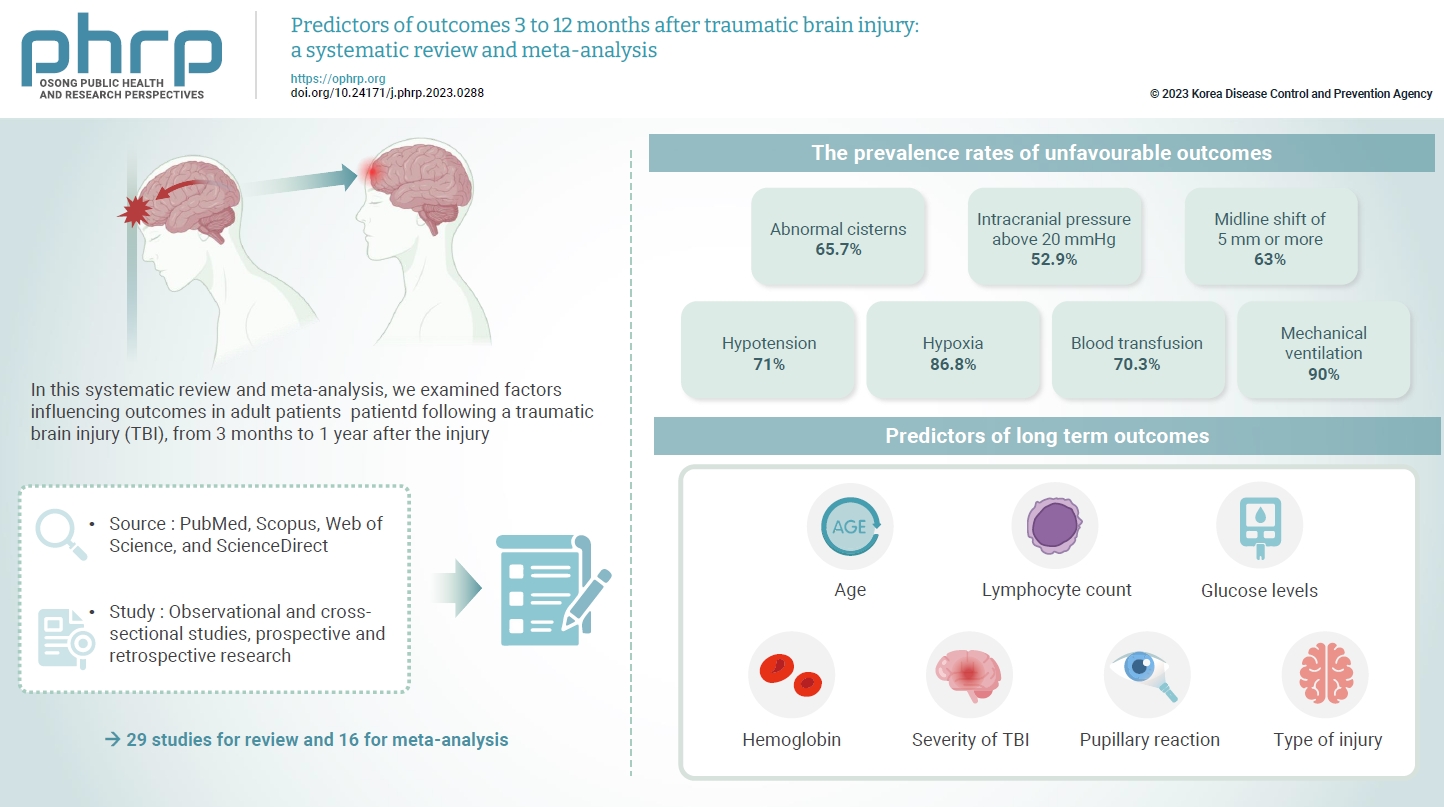
Predictors of outcomes 3 to 12 months after traumatic brain injury: a systematic review and meta-analysis
Younes Iderdar, Maryem Arraji, Nadia Al Wachami, Morad Guennouni, Karima Boumendil, Yassmine Mourajid, Noureddine Elkhoudri, Elmadani Saad, Mohamed Chahboune
Osong Public Health Res Perspect 2024;15(1):3-17.
Published online February 5, 2024
DOI: https://doi.org/10.24171/j.phrp.2023.0288
Predictors of outcomes 3 to 12 months after traumatic brain injury: a systematic review and meta-analysis
The exact factors predicting outcomes following traumatic brain injury (TBI) remain elusive. In this systematic review and meta-analysis, we examined factors influencing outcomes in adult patients with TBI, from 3 months to 1 year after injury. A search of four electronic databases—PubMed, Scopus, Web of Science, and ScienceDirect—yielded 29 studies for review and 16 for meta-analysis, in accordance with the Preferred Reporting Items for Systematic Reviews and Meta-Analysis guidelines. In patients with TBI of any severity, mean differences were observed in age (8.72 years; 95% confidence interval [CI], 4.77–12.66 years), lymphocyte count (−0.15 109/L; 95% CI, −0.18 to −0.11), glucose levels (1.20 mmol/L; 95% CI, 0.73–1.68), and haemoglobin levels (−0.91 g/dL; 95% CI, −1.49 to −0.33) between those with favourable and unfavourable outcomes. The prevalence rates of unfavourable outcomes were as follows: abnormal cisterns, 65.7%; intracranial pressure above 20 mmHg, 52.9%; midline shift of 5 mm or more, 63%; hypotension, 71%; hypoxia, 86.8%; blood transfusion, 70.3%; and mechanical ventilation, 90%. Several predictors were strongly associated with outcome. Specifically, age, lymphocyte count, glucose level, haemoglobin level, severity of TBI, pupillary reaction, and type of injury were identified as potential predictors of long-term outcomes.

Citations

Citations to this article as recorded by  Crossref logo
  • Premorbid physical activity and recovery following an isolated acute traumatic brain injury: an exploratory study
    Naomie Maltais, Elaine de Guise, Maude Laguë-Beauvais, Laurence Trépanier, Jehane H. Dagher
    Global Neurological Insights.2026; 1(1): 100003.     CrossRef
  • Association Between Sex and Mortality After Traumatic Brain Injury: A Systematic Review and Meta-Analysis
    Elise Beijer, Floor J. Mansvelder, Romein W. G. Dujardin, Nicole P. Juffermans, Linda J. Schoonmade, Leo M. G. Geeraedts, Frank W. Bloemers, Charissa E. van den Brom, Patrick Schober
    Neurocritical Care.2026; 45(1): 395.     CrossRef
  • The severity of traumatic brain injury impacts the response to non-pharmacological treatment for post-traumatic amnesia: A retrospective observational study
    Èlia Vilageliu-Jordà, Antonia Enseñat-Cantallops, Alberto García-Molina
    Applied Neuropsychology: Adult.2026; : 1.     CrossRef
  • Predictors of In-Hospital Mortality in Traumatic Acute Subdural Hematoma: The Role of Admission International Normalized Ratio, Imaging Parameters and Neurological Severity
    Serban Iancu Papacocea, Miruna Ioana Lazăr, Romica Cergan, Ioana Anca Badarau, Toma Marius Papacocea
    Biomedicines.2026; 14(6): 1388.     CrossRef
  • A Systematic Review of Clinical Outcome Trajectories from 3 to 12 Months Following Mild or Moderate Traumatic Brain Injury
    Carl Marincowitz, Fiona Lecky, Abdullah Pandor, Ruth Wong, Thomas Shanahan, Michael Tonkins, Rajiv Singh, James Piercy, Andrew Maas, Lindsay Wilson
    Journal of Neurotrauma.2026;[Epub]     CrossRef
  • Distinct Five-Year Latent Class Trajectories and Predictors of Functional Cognitive Independence Following Traumatic Brain Injury: A TBI Model Systems Study
    Evan D. Feigel, Charlotte B. Luster, Chris W. Lewis, Brenna Finegan, Michael J. Mastrodicasa, Maëlle-Marie Troadec, David Guo, Ben Olsen, Ignacio Fuentes, Joseph T. Giacino, Regina Barzilay, Daniel H. Daneshvar
    Neurotrauma Reports.2026;[Epub]     CrossRef
  • Traumatic Brain Injury and Artificial Intelligence: Shaping the Future of Neurorehabilitation—A Review
    Seun Orenuga, Philip Jordache, Daniel Mirzai, Tyler Monteros, Ernesto Gonzalez, Ahmed Madkoor, Rahim Hirani, Raj K. Tiwari, Mill Etienne
    Life.2025; 15(3): 424.     CrossRef
  • 10,574 View
  • 295 Download
  • 6 Web of Science
  • Crossref

Original Articles

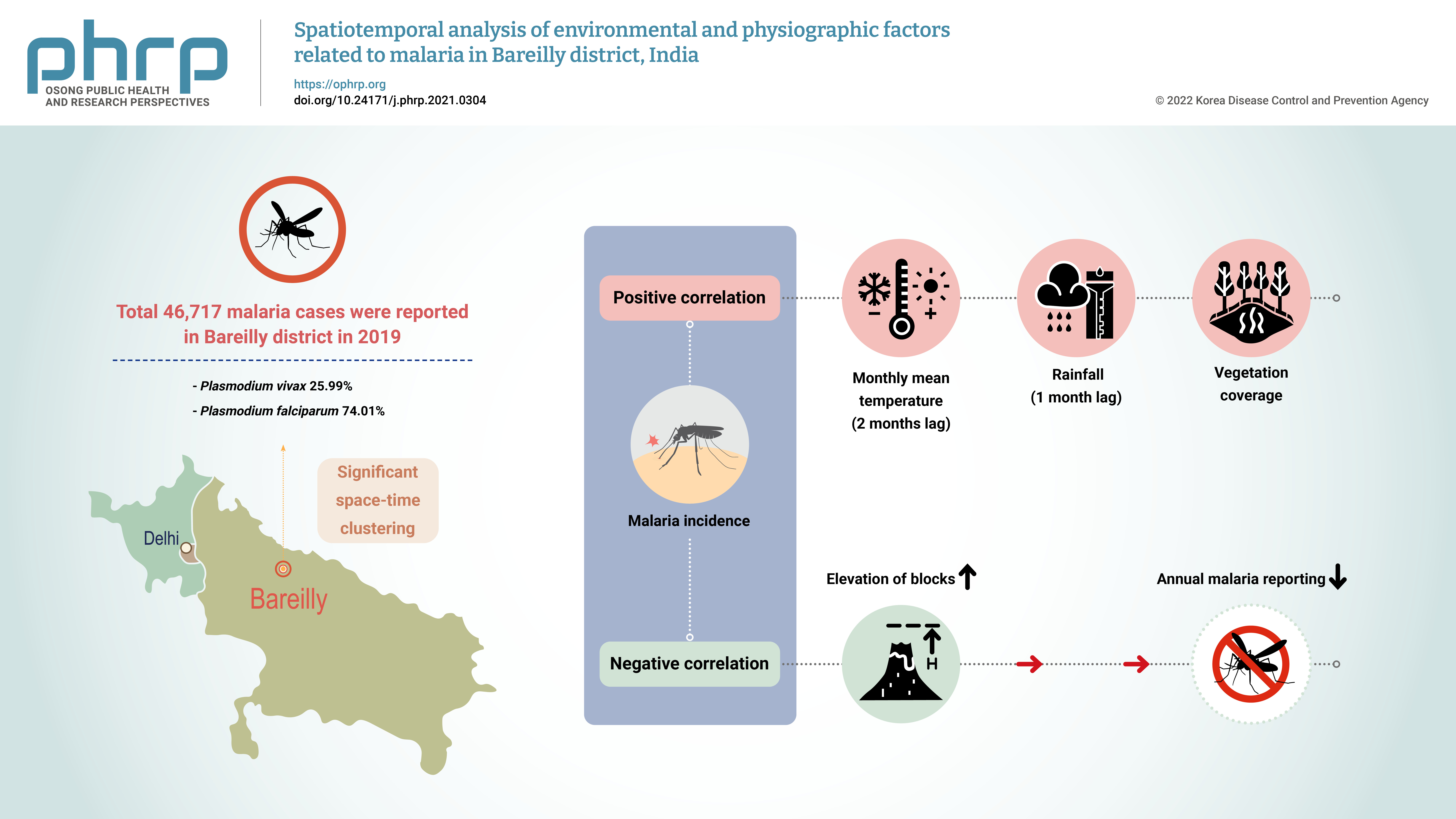
Spatiotemporal analysis of environmental and physiographic factors related to malaria in Bareilly district, India
Shikhar Chaudhary, Biju Soman
Osong Public Health Res Perspect 2022;13(2):123-132.
Published online March 31, 2022
DOI: https://doi.org/10.24171/j.phrp.2021.0304
Spatiotemporal analysis of environmental and physiographic factors related to malaria in Bareilly district, India
Objectives
The aim of this study was to explore the spatiotemporal clustering of reported malaria cases and to study the effects of various environmental and physiographic factors on malaria incidence in Bareilly district, Uttar Pradesh, India. Methods: Malaria surveillance data were collected from the state health department and cleaned into an analyzable format. These data were analyzed along with meteorological, physiographic, and 2019 population data, which were obtained from the Indian Meteorological Department, National Aeronautics and Space Administration web portal, the Bhuvan platform of the Indian Space Research Organization, and the 2011 Census of India. Results: In total, 46,717 malaria cases were reported in Bareilly district in 2019, of which 25.99% were Plasmodium vivax cases and 74.01% were P. falciparum cases. The reported malaria cases in the district showed clustering, with significant spatial autocorrelation (Moran’s I value=0.63), and space-time clustering (p<0.01). A significant positive correlation was found between monthly malaria incidence and the monthly mean temperature (with a lag of 1−2 months) and rainfall (with a lag of 1 month). A significant negative correlation was detected between the elevation of blocks (i.e., intermediate-level administrative districts) and annual malaria reporting. Conclusion: The presence of space-time clustering of malaria cases and its correlation with meteorological and physiographic factors indicate that routine spatial analysis of the surveillance data could help control and manage malaria outbreaks in the district.

Citations

Citations to this article as recorded by  Crossref logo
  • Revisiting the impacts of geographical aspects on public health in the tropical-Asian countries: a review
    Arif Ashari, Muhamad Ervin, Grace Helena Amaranthois Kapisan, Muhammad Asrori Indra Wardoyo, Raisya Arzety Olivia, Bagus Tegar Sakti Prakosa
    Reviews on Environmental Health.2026; 41(2): 307.     CrossRef
  • Spatial Analysis of Malaria in Bangladesh: Insights from Bayesian Disease Mapping Models
    Ummehani Mimi, Md. Rezaul Karim, Sultana Begum, Khadiza Akter Eme, Denekew Bitew Belay
    PLOS One.2026; 21(8): e0353483.     CrossRef
  • Association between temperature and malaria (1959-2019): a systematic review and meta-analysis
    Yogesh Murugan, Vaibhavkumar Shrivastav
    Archives of Public Health.2025;[Epub]     CrossRef
  • Digital health: trends, opportunities and challenges in medical devices, pharma and bio-technology
    Naresh Kasoju, N. S. Remya, Renjith Sasi, S. Sujesh, Biju Soman, C. Kesavadas, C. V. Muraleedharan, P. R. Harikrishna Varma, Sanjay Behari
    CSI Transactions on ICT.2023; 11(1): 11.     CrossRef
  • 10,769 View
  • 145 Download
  • 3 Web of Science
  • Crossref
Behavioral interventions for smoking cessation among adolescents: a rapid review and meta-analysis for the Korea Preventive Services Task Force
Younglee Choi, Cheol Min Lee, Belong Cho, Eon Sook Lee, Seung-Won Oh, Naae Lee, Jae Moon Yun
Osong Public Health Res Perspect 2021;12(3):177-186.
Published online June 2, 2021
DOI: https://doi.org/10.24171/j.phrp.2021.0018
Objectives
The aim of this study was to evaluate the effectiveness of behavioral smoking cessation interventions among adolescents.
Methods
MEDLINE, CENTRAL, Embase, CINAHL, KoreaMed, and KMbase were searched from inception to June 2020. Systematic reviews (SRs) or meta-analyses of randomized controlled trials (RCTs) were initially searched to perform a rapid SR. After selecting the final SR, RCTs after the publication year of the selected SR were searched. The primary outcome was smoking status after at least 6 months of follow-up, and the secondary outcome was smoking status at 4 weeks. Two reviewers independently assessed the selected studies’ quality using the Cochrane risk of bias tool. The meta-analysis utilized a Mantel-Haenszel fixed-effect model reporting the relative risk (RR) and 95% confidence interval (CI). The subgroup analysis utilized Cochrane’s Q.
Results
Thirty-two RCTs (11,637 participants) from a single SR were meta-analyzed. After 6 months of follow-up, the intervention group had significantly higher abstinence rates (RR, 1.30; 95% CI, 1.20−1.41; I2=26.46%). At 4 weeks of follow-up, the intervention group also had significantly higher abstinence rates (RR, 1.92; 95% CI, 1.49–2.47; I2=0.00%). The subgroup analysis indicated a significant difference in the abstinence rate according to the study setting and the period between intervention completion and follow-up.
Conclusion
This review showed that adolescent behavioral smoking cessation intervention programs significantly increased abstinence rates compared to the usual care.

Citations

Citations to this article as recorded by  Crossref logo
  • Adapting and Implementing a School-Based “Implementation Intentions” Program Within FRESHAIR4Life to Prevent Smoking Initiation Among Adolescents in Greece: A Study Protocol
    Izolde Bouloukaki, Antonios Christodoulakis, Sevasti Peraki, Floor A. Van Den Brand, Faraz Siddiqui, Theodoros Krasanakis, Antonia Aravantinou-Karlatou, Purva Abhyankar, Siân Williams, Julia van Koeveringe, Rianne MJJ van der Kleij, Ioanna Tsiligianni
    Healthcare.2026; 14(7): 938.     CrossRef
  • Helping teens quit: A systematic review and network meta-analysis of smoking cessation interventions
    Kansak Boonpattharatthiti, Kanchana Mueangfa, Natchaya Aiumtanaporn, Chanchanok Koomsri, Junpen Chantara, Teerapon Dhippayom
    Public Health in Practice.2026; 11: 100789.     CrossRef
  • The transtheoretical model and smoking cessation: findings from a youth-friendly clinic
    Alkim Oden Akman, Furkan Kalayci, Serap Karakus, Eda Özaydın, Demet Tas
    BMC Public Health.2026;[Epub]     CrossRef
  • Effectiveness of non-pharmacological school-based therapies for cigarette smoking cessation among adolescents in South and Southeast Asian countries: a systematic review and meta-analysis
    Fahad Ali Mangrio, Penpaktr Uthis, Suwimon Rojnawee, Alicia K Matthews
    Osong Public Health and Research Perspectives.2025; 16(3): 195.     CrossRef
  • Effectiveness of Healthcare Interventions on Smoking Cessation in Adolescents in Low- and Middle-Income Countries: A Narrative Review
    Janhvi Thakur, Sonali G Choudhari
    Cureus.2024;[Epub]     CrossRef
  • Non-combustible nicotine product cessation interventions in adolescents and young adults: A systematic review
    Sofie K. Bergman Rasmussen, Charlotta Pisinger
    Tobacco Use Insights.2024;[Epub]     CrossRef
  • Non-pharmacological interventions for smoking cessation: analysis of systematic reviews and meta-analyses
    Tao Nian, Kangle Guo, Wendi Liu, Xinxin Deng, Xiaoye Hu, Meng Xu, Fenfen E, Ziyi Wang, Guihang Song, Kehu Yang, Xiuxia Li, Wenru Shang
    BMC Medicine.2023;[Epub]     CrossRef
  • Behavioral Interventions for Smoking Cessation in Adolescents: Korea Preventive Services Task Force Guidance
    Younglee Choi, Cheol Min Lee, Jae Moon Yun, Eon Sook Lee, Seung-Won Oh, Naae Lee, Belong Cho
    Journal of the Korean Society for Research on Nico.2021; 12(1): 1.     CrossRef
  • Tobacco Control Policy in Period of Epidemic “COVID 19”
    Eon Sook Lee
    Journal of the Korean Society for Research on Nico.2021; 12(1): 34.     CrossRef
  • 15,435 View
  • 246 Download
  • 8 Web of Science
  • Crossref

Review Article

<p>This review compared coronavirus disease 2019 (COVID-19) laboratory findings, comorbidities, and clinical outcomes in patients from the general population versus medical staff to aid diagnosis of COVID-19 in a more timely, efficient, and accurate way. Electronic databases were searched up to 23<sup>rd</sup> March, 2020. The initial search yielded 6,527 studies. Following screening, 24 studies were included [18 studies (11,564 cases) of confirmed COVID-19 cases in the general public, and 6 studies (394 cases) in medical staff] in this review. Significant differences were observed in white blood cell counts (<italic>p</italic> < 0.001), lymphocyte counts (<italic>p</italic> < 0.001), platelet counts (<italic>p</italic> = 0.04), procalcitonin levels (<italic>p</italic> < 0.001), lactate dehydrogenase levels (<italic>p</italic> < 0.001), and creatinine levels (<italic>p</italic> = 0.03) when comparing infected medical staff with the general public. The mortality rate was higher in the general population than in medical staff (8% versus 2%). This review showed that during the early stages of COVID-19, laboratory findings alone may not be significant predictors of infection and may just accompany increasing C-reactive protein levels, erythrocyte sedimentation rates, and lactate dehydrogenase levels. In the symptomatic stage, the lymphocyte and platelet counts tended to decrease. Elevated D-dimer fibrin degradation product was associated with poor prognosis.</p>

Citations

Citations to this article as recorded by  Crossref logo
  • Quality indicators for appropriate inpatient antibiotic use: results from two national surveys in Italy, 2016–2022
    C. Vicentini, A. Russotto, R. Bussolino, M. Castagnotto, C. Gastaldo, S. Bazzolo, D. Gamba, S. Corcione, F.G. De Rosa, F. D'Ancona, C.M. Zotti
    Journal of Hospital Infection.2025; 160: 34.     CrossRef
  • Efficacy and limitations of SARS-CoV-2 vaccines - A systematic review
    Muhammad Azeem, Patrizia Cancemi, Farwa Mukhtar, Sefora Marino, Emanuela Peri, Giulia Di Prima, Viviana De Caro
    Life Sciences.2025; 371: 123610.     CrossRef
  • A comprehensive review of recent advances in research on COVID in communication studies
    Barbara Cyrek, Jenna Peltonen
    Discover Public Health.2024;[Epub]     CrossRef
  • microRNA-185 Inhibits SARS-CoV-2 Infection through the Modulation of the Host’s Lipid Microenvironment
    Nadine Ahmed, Magen E. Francis, Noreen Ahmed, Alyson A. Kelvin, John Paul Pezacki
    Viruses.2023; 15(9): 1921.     CrossRef
  • Protective action of natural and induced immunization against the occurrence of delta or alpha variants of SARS-CoV-2 infection: a test-negative case-control study
    Giovanni Corrao, Matteo Franchi, Federico Rea, Danilo Cereda, Antonio Barone, Catia Rosanna Borriello, Petra Giulia Della Valle, Michele Ercolanoni, Ida Fortino, Jose Jara, Olivia Leoni, Francesco Mazziotta, Elisabetta Pierini, Giuseppe Preziosi, Marcello
    BMC Medicine.2022;[Epub]     CrossRef
  • Balancing Benefits and Harms of COVID-19 Vaccines: Lessons from the Ongoing Mass Vaccination Campaign in Lombardy, Italy
    Giovanni Corrao, Federico Rea, Matteo Franchi, Danilo Cereda, Antonio Barone, Catia Rosanna Borriello, Giulia Petra Della Valle, Michele Ercolanoni, Jose Jara, Giuseppe Preziosi, Manuel Maffeo, Francesco Mazziotta, Elisabetta Pierini, Francesco Lecis, Pie
    Vaccines.2022; 10(4): 623.     CrossRef
  • Vulnerability Predictors of Post-Vaccine SARS-CoV-2 Infection and Disease—Empirical Evidence from a Large Population-Based Italian Platform
    Giovanni Corrao, Matteo Franchi, Danilo Cereda, Francesco Bortolan, Olivia Leoni, Catia Rosanna Borriello, Petra Giulia Della Valle, Marcello Tirani, Giovanni Pavesi, Antonio Barone, Michele Ercolanoni, Jose Jara, Massimo Galli, Guido Bertolaso
    Vaccines.2022; 10(6): 845.     CrossRef
  • Factors associated with severe or fatal clinical manifestations of SARS‐CoV‐2 infection after receiving the third dose of vaccine
    Giovanni Corrao, Matteo Franchi, Danilo Cereda, Francesco Bortolan, Olivia Leoni, Jose Jara, Giuseppina Valenti, Giovanni Pavesi
    Journal of Internal Medicine.2022; 292(5): 829.     CrossRef
  • Role of multiresolution vulnerability indices in COVID-19 spread in India: a Bayesian model-based analysis
    Rupam Bhattacharyya, Anik Burman, Kalpana Singh, Sayantan Banerjee, Subha Maity, Arnab Auddy, Sarit Kumar Rout, Supriya Lahoti, Rajmohan Panda, Veerabhadran Baladandayuthapani
    BMJ Open.2022; 12(11): e056292.     CrossRef
  • A novel multi-omics-based highly accurate prediction of symptoms, comorbid conditions, and possible long-term complications of COVID-19
    Debmalya Barh, Sandeep Tiwari, Bruno Silva Andrade, Marianna E Weener, Aristóteles Góes-Neto, Vasco Azevedo, Preetam Ghosh, Kenneth Blum, Nirmal Kumar Ganguly
    Molecular Omics.2021; 17(2): 317.     CrossRef
  • Clinical and laboratory factors associated with coronavirus disease 2019 (Covid‐19): A systematic review and meta‐analysis
    Le Huu Nhat Minh, Ali Ahmed‐Fouad Abozaid, Nam Xuan Ha, Loc Le Quang, Abdelrahman Gamil Gad, Ranjit Tiwari, Tran Nhat‐Le, Dinh Kim Quyen, Balqees AL‐Manaseer, Nguyen Dang Kien, Nguyen Lam Vuong, Ahmad Helmy Zayan, Le Huu Hanh Nhi, Kadek Agus Surya Dila, J
    Reviews in Medical Virology.2021;[Epub]     CrossRef
  • Epidemiologic and Clinic Characteristics of the First Wave of the COVID-19 Pandemic in Hospitalized Patients from Galați County
    Mihaela-Camelia Vasile, Anca-Adriana Arbune, Gabriela Lupasteanu, Constantin-Marinel Vlase, George-Cosmin Popovici, Manuela Arbune
    Journal of Clinical Medicine.2021; 10(18): 4210.     CrossRef
  • Human Amniotic Fluid for the Treatment of Hospitalized, Symptomatic, and Laboratory-verified SARS-CoV-2 Patients
    Mojgan Barati, Fakher Rahim
    The Open Biology Journal.2021; 9(1): 36.     CrossRef
  • Stratification of the risk of developing severe or lethal Covid-19 using a new score from a large Italian population: a population-based cohort study
    Giovanni Corrao, Federico Rea, Flavia Carle, Salvatore Scondotto, Alessandra Allotta, Vito Lepore, Antonio D'Ettorre, Cinzia Tanzarella, Patrizia Vittori, Sabrina Abena, Marica Iommi, Liana Spazzafumo, Michele Ercolanoni, Roberto Blaco, Simona Carbone, Cr
    BMJ Open.2021; 11(11): e053281.     CrossRef
  • 14,307 View
  • 174 Download
  • 14 Web of Science
  • Crossref

Short Communication

Contact Transmission of COVID-19 in South Korea: Novel Investigation Techniques for Tracing Contacts
COVID-19 National Emergency Response Center, Epidemiology & Case Management Team, Korea Centers for Disease Control & Prevention
Osong Public Health Res Perspect 2020;11(1):60-63.
Published online February 28, 2020
DOI: https://doi.org/10.24171/j.phrp.2020.11.1.09
<p>In the epidemiological investigation of an infectious disease, investigating, classifying, tracking, and managing contacts by identifying the patient’s route are important for preventing further transmission of the disease. However, omissions and errors in previous activities can occur when the investigation is performed through only a proxy interview with the patient. To overcome these limitations, methods that can objectively verify the patient’s claims (medical facility records, Global Positioning System, card transactions, and closed-circuit television) were used for the recent ongoing coronavirus disease 2019 contact investigations in South Korea.</p>

Citations

Citations to this article as recorded by  Crossref logo
  • Pathways to strengthening the epidemic intelligence workforce
    Barbara Tornimbene, Zoila Beatriz Leiva Rioja, Olaolu Aderinola, Zulma M. Cucunubá, Catalina González-Uribe, Danil Mihailov, Steven Riley, Sang-woo Tak, Oliver Morgan
    BMC Proceedings.2025;[Epub]     CrossRef
  • Effect of the establishment of the Korea Centers for Disease Control and Prevention/Korea Disease Control and Prevention Agency from the perspective of global health security
    Chaeshin Chu
    Global Health & Medicine.2025; 7(2): 141.     CrossRef
  • Healthcare-Associated Infections: The Role of Microbial and Environmental Factors in Infection Control—A Narrative Review
    Andreea M. Sandu, Mariana C. Chifiriuc, Corneliu O. Vrancianu, Roxana-E. Cristian, Cristina F. Alistar, Marian Constantin, Mihaela Paun, Alexandru Alistar, Loredana G. Popa, Mircea I. Popa, Ana C. Tantu, Manuela E. Sidoroff, Mara M. Mihai, Andreea Marcu,
    Infectious Diseases and Therapy.2025; 14(5): 933.     CrossRef
  • Contact tracing strategies for infectious diseases: A systematic literature review
    Danielle Guy, Petya Kodjamanova, Lena Woldmann, Jyoti Sahota, Melanie Bannister-Tyrrell, Yajna Elouard, Marie-Amélie Degail, Bashar Haruna Gulumbe
    PLOS Global Public Health.2025; 5(5): e0004579.     CrossRef
  • Critical Human Security, State Capacity, and Post-Pandemic Policy Challenges in Europe and East Asia
    Noemi Lendvai-Bainton, Huck-ju Kwon, Patricia Kennett
    Social Policy and Society.2025; 24(3): 449.     CrossRef
  • Quantitative analysis of self-reporting and contact tracing in heterogeneous risk groups: a stochastic modeling study of the COVID-19 outbreak in Daegu, Korea
    Jiwon Han, Eunok Jung
    BMC Public Health.2025;[Epub]     CrossRef
  • A Qualitative Study on the Centralized Quarantine Experiences of COVID‐19 Patients With No or Mild Symptoms in South Korea
    Min Ah Kim, Mansoo Yu, Seong Young Lee, Jimin Sung, Heejin Kim, Sohini Basu Roy
    Health & Social Care in the Community.2025;[Epub]     CrossRef
  • Impact of the coronavirus disease 2019 pandemic on the incidence of other infectious diseases in the hematology hospital in Korea
    Seohee Oh, Yu-Sun Sung, Mihee Jang, Yong-Jin Kim, Hyun-Wook Park, Dukhee Nho, Dong-Gun Lee, Hyeon Woo Yim, Sung-Yeon Cho
    The Korean Journal of Internal Medicine.2024; 39(3): 513.     CrossRef
  • Comparison of the efficacy of COVID-19 responses in South Korea and the United States
    Oliver Choi, Sunjoo Kim
    Global Health Action.2024;[Epub]     CrossRef
  • Privacy risk in contact tracing systems
    Janine L. Spears, Ali Padyab
    Behaviour & Information Technology.2023; 42(2): 174.     CrossRef
  • The role of data platforms in COVID-19 crisis: a smart city perspective
    Laura-Diana Radu, Daniela Popescul
    Aslib Journal of Information Management.2023; 75(6): 1033.     CrossRef
  • Feasibility of digital contact tracing in low-income settings – pilot trial for a location-based DCT app
    Eric Handmann, Sia Wata Camanor, Mosoka P. Fallah, Neima Candy, Davidetta Parker, André Gries, Thomas Grünewald
    BMC Public Health.2023;[Epub]     CrossRef
  • Incidence of rheumatic diseases during the COVID-19 pandemic in South Korea
    Soo Min Ahn, Seongho Eun, Sunghwan Ji, Seokchan Hong, Chang-Keun Lee, Bin Yoo, Ji Seon Oh, Yong-Gil Kim
    The Korean Journal of Internal Medicine.2023; 38(2): 248.     CrossRef
  • SARS-CoV-2 molecular diagnostic point-of-care testing based on loop-mediated isothermal amplification: A prospective, single-center validation study
    Sung Hun Moon, Sang-Chul Kim, Byung Woo Kim, Gwan-Jin Park, Hyun-Seok Chai, Young Min Kim, Hee Sung Kim, Hee Sue Park
    Heliyon.2023; 9(3): e14564.     CrossRef
  • Contact Tracing With District-Based Trajectories
    Kiki Adhinugraha, Wenny Rahayu, Nasser Allheeib
    International Journal of Data Warehousing and Mini.2023; 19(1): 1.     CrossRef
  • La pandemia de COVID-19 en Brasil: epidemiología e impactos del negacionismo
    Pedro Rodrigues Curi Hallal, Bruno Pereira Nunes
    Revista de Estudios Brasileños.2023; 9(19): 15.     CrossRef
  • Identification and comparison of pandemic-to-symptom networks of South Korea and the United States
    Mijeong Park, Deachul Seo, Ji Geun Kim, Gayeon Lee, Larkin S. McReynolds, Lawrence Amsel, Hyunjung Yang, Young-Hoon Kim, Sanghoon Han, Soo Hyun Park, Juyoen Hur
    Frontiers in Psychiatry.2023;[Epub]     CrossRef
  • Detecting mpox infection in the early epidemic: an epidemiologic investigation of the third and fourth cases in Korea
    Taeyoung Kim, Eonjoo Park, Jun Suk Eun, Eun-young Lee, Ji Won Mun, Yunsang Choi, Shinyoung Lee, Hansol Yeom, Eunkyoung Kim, Jongmu Kim, Jihyun Choi, Jinho Ha, Sookkyung Park
    Epidemiology and Health.2023; 45: e2023040.     CrossRef
  • Contact tracing of staff in the emergency department during the COVID-19 pandemic
    Chengjie Lee, Annitha Annathurai, Jen Heng Pek
    Singapore Medical Journal.2023; 64(2): 132.     CrossRef
  • Contact Tracing for COVID-19 in a Healthcare Institution in India: Our Experience and Lessons Learned
    Mahalakshmy Thulasingam
    International Journal of Health & Allied Sciences.2023; 12(4): 16.     CrossRef
  • COVID-19 conscience tracing: mapping the moral distances of coronavirus
    David Shaw
    Journal of Medical Ethics.2022; 48(8): 530.     CrossRef
  • Bio-safety and bio-security: A major global concern for ongoing COVID-19 pandemic
    Saud Ali Al Shehri, AM Al-Sulaiman, Sarfuddin Azmi, Sultan S. Alshehri
    Saudi Journal of Biological Sciences.2022; 29(1): 132.     CrossRef
  • Perceived sources of occupational burn-out and embitterment among front-line health workers for COVID-19 control in Gyeonggi province, South Korea: a qualitative study
    Bee-Ah Kang, Sijoung Kwon, Myoungsoon You, Heeyoung Lee
    Occupational and Environmental Medicine.2022; 79(4): 245.     CrossRef
  • COVID-19 vaccine willingness and hesitancy among residents in Qatar: a quantitative analysis based on machine learning
    Muhammad Hafizh, Yousif Badri, Sakib Mahmud, Amir Hafez, Pilsung Choe
    Journal of Human Behavior in the Social Environmen.2022; 32(7): 899.     CrossRef
  • A resposta da Coreia do Sul à pandemia de COVID-19: lições aprendidas e recomendações a gestores
    Thais Regis Aranha Rossi, Catharina Leite Matos Soares, Gerluce Alves Silva, Jairnilson Silva Paim, Lígia Maria Vieira-da-Silva
    Cadernos de Saúde Pública.2022;[Epub]     CrossRef
  • Self-Injurious Behavior Rate in the Short-Term Period of the COVID-19 Pandemic in Korea
    Se Jin Park, Soo Jung Rim, Minkyung Jo, Min Geu Lee, Gyurin Kim, Subin Park
    Journal of Korean Medical Science.2022;[Epub]     CrossRef
  • Cost-effectiveness of interventions for the prevention and control of COVID-19: Systematic review of 85 modelling studies
    Lihui Zhou, Wenxin Yan, Shu Li, Hongxi Yang, Xinyu Zhang, Wenli Lu, Jue Liu, Yaogang Wang
    Journal of Global Health.2022;[Epub]     CrossRef
  • Artificial Intelligence and Internet of Things (AI-IoT) Technologies in Response to COVID-19 Pandemic: A Systematic Review
    Junaid Iqbal Khan, Jebran Khan, Furqan Ali, Farman Ullah, Jamshid Bacha, Sungchang Lee
    IEEE Access.2022; 10: 62613.     CrossRef
  • An Experience of the Early Stage of COVID-19 Outbreak in Nursing Homes in Gyeonggi Province, Korea
    Gawon Choi, Na-young Kim, Seon-young Lee, Hae Deun Noh, Heeyoung Lee
    Korean Journal of Clinical Geriatrics.2022; 23(1): 27.     CrossRef
  • Likely community transmission of COVID-19 infections between neighboring, persistent hotspots in Ontario, Canada
    Eliseos J. Mucaki, Ben C. Shirley, Peter K. Rogan
    F1000Research.2022; 10: 1312.     CrossRef
  • Unwillingness to cooperate with COVID-19 contact tracing in Japan
    M. Machida, H. Kikuchi, T. Kojima, I. Nakamura, R. Saito, T. Nakaya, T. Hanibuchi, T. Takamiya, Y. Odagiri, N. Fukushima, S. Amagasa, H. Watanabe, S. Inoue
    Public Health.2022; 210: 34.     CrossRef
  • The effectiveness of COVID-19 testing and contact tracing in a US city
    Xutong Wang, Zhanwei Du, Emily James, Spencer J. Fox, Michael Lachmann, Lauren Ancel Meyers, Darlene Bhavnani
    Proceedings of the National Academy of Sciences.2022;[Epub]     CrossRef
  • Contact Tracing Strategies for COVID-19 Prevention and Containment: A Scoping Review
    Bolanle Adefowoke Ojokoh, Benjamin Aribisala, Oluwafemi A. Sarumi, Arome Junior Gabriel, Olatunji Omisore, Abiola Ezekiel Taiwo, Tobore Igbe, Uchechukwu Madukaku Chukwuocha, Tunde Yusuf, Abimbola Afolayan, Olusola Babalola, Tolulope Adebayo, Olaitan Afola
    Big Data and Cognitive Computing.2022; 6(4): 111.     CrossRef
  • Epidemiology and Outcome of Out-of-Hospital Cardiac Arrests during the COVID-19 Pandemic in South Korea: A Systematic Review and Meta-Analyses
    Jae Hwan Kim, Chiwon Ahn, Myeong Namgung
    Yonsei Medical Journal.2022; 63(12): 1121.     CrossRef
  • Perceived barriers to the process of COVID-19 control among frontline healthcare workers in South Korea: a qualitative study
    Sijoung Kwon, Bee-Ah Kang, Myoungsoon You, Heeyoung Lee
    BMJ Open.2022; 12(12): e063899.     CrossRef
  • Response System for and Epidemiological Features of COVID-19 in Gyeongsangnam-do Province in South Korea
    Yu Mi Wi, Su Jin Lim, Si-Ho Kim, Seungjin Lim, Su Jin Lee, Byung-Han Ryu, Sun In Hong, Oh-Hyun Cho, Kyunglan Moon, Kyung-Wook Hong, Sunjoo Kim, In-Gyu Bae
    Clinical Infectious Diseases.2021; 72(4): 661.     CrossRef
  • Impact of Public Health Interventions on Seasonal Influenza Activity During the COVID-19 Outbreak in Korea
    Hyunju Lee, Heeyoung Lee, Kyoung-Ho Song, Eu Suk Kim, Jeong Su Park, Jongtak Jung, Soyeon Ahn, Eun Kyeong Jeong, Hyekyung Park, Hong Bin Kim
    Clinical Infectious Diseases.2021; 73(1): e132.     CrossRef
  • The utility of video technology and enhanced infection control in reducing COVID-19 disease burden in a custodial setting
    Larissa H Unruh, Sadhana Dharmapuri, Kenneth Soyemi
    American Journal of Infection Control.2021; 49(6): 852.     CrossRef
  • Will the COVID-19 pandemic boost access to personal health care records? Smartphone data access to tackle the modern pandemic
    Charles Edmund Breeze, Charlotte Murkin, Matt Lechner
    BMJ Innovations.2021; 7(1): 243.     CrossRef
  • Spatial variability in reproduction number and doubling time across two waves of the COVID-19 pandemic in South Korea, February to July, 2020
    Eunha Shim, Amna Tariq, Gerardo Chowell
    International Journal of Infectious Diseases.2021; 102: 1.     CrossRef
  • The experience of contact tracing in Singapore in the control of COVID-19: highlighting the use of digital technology
    Sean Han Sheng Lai, Camelia Qian Ying Tang, Asok Kurup, Gowreeson Thevendran
    International Orthopaedics.2021; 45(1): 65.     CrossRef
  • Structural Racism in the COVID-19 Pandemic: Moving Forward
    Maya Sabatello, Mary Jackson Scroggins, Greta Goto, Alicia Santiago, Alma McCormick, Kimberly Jacoby Morris, Christina R. Daulton, Carla L. Easter, Gwen Darien
    The American Journal of Bioethics.2021; 21(3): 56.     CrossRef
  • Privacy concerns can explain unwillingness to download and use contact tracing apps when COVID-19 concerns are high
    Eugene Y. Chan, Najam U. Saqib
    Computers in Human Behavior.2021; 119: 106718.     CrossRef
  • Reduction in mobility and COVID-19 transmission
    Pierre Nouvellet, Sangeeta Bhatia, Anne Cori, Kylie E. C. Ainslie, Marc Baguelin, Samir Bhatt, Adhiratha Boonyasiri, Nicholas F. Brazeau, Lorenzo Cattarino, Laura V. Cooper, Helen Coupland, Zulma M. Cucunuba, Gina Cuomo-Dannenburg, Amy Dighe, Bimandra A.
    Nature Communications.2021;[Epub]     CrossRef
  • State of the Art in Adoption of Contact Tracing Apps and Recommendations Regarding Privacy Protection and Public Health: Systematic Review
    Katarzyna Kolasa, Francesca Mazzi, Ewa Leszczuk-Czubkowska, Zsombor Zrubka, Márta Péntek
    JMIR mHealth and uHealth.2021; 9(6): e23250.     CrossRef
  • Genomic investigation of the coronavirus disease-2019 outbreak in the Republic of Korea
    Jeong-Min Kim, Sung Yong Park, Daesang Lee, Jun-Sub Kim, Youngjoon Park, Jin Gwack, Mi Young Kim, Dong Hyun Song, Seong Tae Jeong, Yoon-Seok Chung, Cheon Kwon Yoo, Ha Youn Lee, Myung-Guk Han
    Scientific Reports.2021;[Epub]     CrossRef
  • Test, Trace, and Put on the Blockchain?: A Viewpoint Evaluating the Use of Decentralized Systems for Algorithmic Contact Tracing to Combat a Global Pandemic
    Moritz Platt, Anton Hasselgren, Juan Manuel Román-Belmonte, Marcela Tuler de Oliveira, Hortensia De la Corte-Rodríguez, Sílvia Delgado Olabarriaga, E Carlos Rodríguez-Merchán, Tim Ken Mackey
    JMIR Public Health and Surveillance.2021; 7(4): e26460.     CrossRef
  • Decrease in hospital admissions for respiratory diseases during the COVID-19 pandemic: a nationwide claims study
    Kyungmin Huh, Young-Eun Kim, Wonjun Ji, Dong Wook Kim, Eun-Joo Lee, Jong-Hun Kim, Ji-Man Kang, Jaehun Jung
    Thorax.2021; 76(9): 939.     CrossRef
  • A simple model for the total number of SARS-CoV-2 infections on a national level
    N. Blanco, K. A. Stafford, M. C. Lavoie, A. Brandenburg, M. W. Górna, M. Merski
    Epidemiology and Infection.2021;[Epub]     CrossRef
  • Malaysia’s Health Systems Response to COVID-19
    Zen Yang Ang, Kit Yee Cheah, Md. Sharif Shakirah, Weng Hong Fun, Jailani Anis-Syakira, Yuke-Lin Kong, Sondi Sararaks
    International Journal of Environmental Research an.2021; 18(21): 11109.     CrossRef
  • Managing Pandemics with Health Informatics: Successes and Challenges
    Mujeeb A. Basit, Christoph U. Lehmann, Richard J. Medford
    Yearbook of Medical Informatics.2021; 30(01): 017.     CrossRef
  • When robots contribute to eradicate the COVID-19 spread in a context of containment
    Naila Aziza Houacine, Habiba Drias
    Progress in Artificial Intelligence.2021; 10(4): 391.     CrossRef
  • Best Practice Guidance for Digital Contact Tracing Apps: A Cross-disciplinary Review of the Literature
    James O'Connell, Manzar Abbas, Sarah Beecham, Jim Buckley, Muslim Chochlov, Brian Fitzgerald, Liam Glynn, Kevin Johnson, John Laffey, Bairbre McNicholas, Bashar Nuseibeh, Michael O'Callaghan, Ian O'Keeffe, Abdul Razzaq, Kaavya Rekanar, Ita Richardson, And
    JMIR mHealth and uHealth.2021; 9(6): e27753.     CrossRef
  • Implementing Public Health Strategies—The Need for Educational Initiatives: A Systematic Review
    Amir Khorram-Manesh, Maxim A. Dulebenets, Krzysztof Goniewicz
    International Journal of Environmental Research an.2021; 18(11): 5888.     CrossRef
  • Lessons from non-pharmaceutical interventions on the first wave of COVID-19 in the Asia Pacific region
    Dongil Ahn
    Journal of Global Health Science.2021;[Epub]     CrossRef
  • Modeling the early temporal dynamics of viral load in respiratory tract specimens of COVID-19 patients in Incheon, the Republic of Korea
    Ah-Young Lim, Hae-Kwan Cheong, Yoon Ju Oh, Jae Kap Lee, Jae Bum So, Hyun Jin Kim, Boram Han, Sung Won Park, Yongsun Jang, Chang Yong Yoon, Yun Ok Park, Jong-Hun Kim, Jin Yong Kim
    International Journal of Infectious Diseases.2021; 108: 428.     CrossRef
  • Contact Tracing Apps: Lessons Learned on Privacy, Autonomy, and the Need for Detailed and Thoughtful Implementation
    Katie Hogan, Briana Macedo, Venkata Macha, Arko Barman, Xiaoqian Jiang
    JMIR Medical Informatics.2021; 9(7): e27449.     CrossRef
  • Using Mobile Phone Data to Estimate the Relationship between Population Flow and Influenza Infection Pathways
    Qiushi Chen, Michiko Tsubaki, Yasuhiro Minami, Kazutoshi Fujibayashi, Tetsuro Yumoto, Junzo Kamei, Yuka Yamada, Hidenori Kominato, Hideki Oono, Toshio Naito
    International Journal of Environmental Research an.2021; 18(14): 7439.     CrossRef
  • Effective COVID-19 Control: A Comparative Analysis of the Stringency and Timeliness of Government Responses in Asia
    Shu Chen, Lei Guo, Taghred Alghaith, Di Dong, Mohammed Alluhidan, Mariam M. Hamza, Christopher H. Herbst, Xinqi Zhang, Gabrielle Charis Alano Tagtag, Yi Zhang, Nahar Alazemi, Rana Saber, Reem Alsukait, Shenglan Tang
    International Journal of Environmental Research an.2021; 18(16): 8686.     CrossRef
  • Analysis of the factors affecting the adoption and compliance of the NHS COVID-19 mobile application: a national cross-sectional survey in England
    Marcus Panchal, Sukhpreet Singh, Esther Rodriguez-Villegas
    BMJ Open.2021; 11(8): e053395.     CrossRef
  • Management of the COVID-19 Pandemic in the Republic of Korea from the Perspective of Governance and Public-Private Partnership
    Woojin Kim, Tae Yong Jung, Susann Roth, Woochong Um, Changsoo Kim
    Yonsei Medical Journal.2021; 62(9): 777.     CrossRef
  • Pilot Evaluations of Two Bluetooth Contact Tracing Approaches on a University Campus: Mixed Methods Study
    Tyler Shelby, Tyler Caruthers, Oren Y Kanner, Rebecca Schneider, Dana Lipnickas, Lauretta E Grau, Rajit Manohar, Linda Niccolai
    JMIR Formative Research.2021; 5(10): e31086.     CrossRef
  • Efficient Contact Tracing for pandemics using blockchain
    Nida Bari, Usman Qamar, Ayesha Khalid
    Informatics in Medicine Unlocked.2021; 26: 100742.     CrossRef
  • Policy Review and Modeling Analysis of Mitigation Measures for Coronavirus Disease Epidemic Control, Health System, and Disease Burden, South Korea
    Hae-Young Kim, In-Hwan Oh, Jacob Lee, Jeong-Yeon Seon, Woo-Hwi Jeon, Jae Seok Park, Sung-Il Nam, Niket Thakkar, Prashanth Selvaraj, Jessica McGillen, Daniel Klein, Scott Braithwaite, Anna Bershteyn, Seung Heon Lee
    Emerging Infectious Diseases.2021;[Epub]     CrossRef
  • Experiences and Lessons Learned from COVID-19 Pandemic Management in South Korea and the V4 Countries
    Gergő Túri, Attila Virág
    Tropical Medicine and Infectious Disease.2021; 6(4): 201.     CrossRef
  • Likely community transmission of COVID-19 infections between neighboring, persistent hotspots in Ontario, Canada
    Eliseos J. Mucaki, Ben C. Shirley, Peter K. Rogan
    F1000Research.2021; 10: 1312.     CrossRef
  • Cost-Effectiveness of Interventions for the Prevention and Control of COVID-19: A Systematic Review and Meta-Analysis
    Lihui Zhou, Wenxin Yan, Shu Li, Hongxi Yang, Xinyu Zhang, Wenli Lu, Jue Liu, Yaogang WANG
    SSRN Electronic Journal .2021;[Epub]     CrossRef
  • Harnessing the potential of the primary healthcare facilities in India to respond COVID-19 pandemic: A scoping evidence-based research synthesis
    Abhishek Royal, Marcelo Amaral Mali, Vaibhav Kumar, Indrani Alhad Wagh, Shashi Bhushan, Avishkar Nitin Mokal, Kedar Mehta, Sudip Bhattacharya
    Journal of Family Medicine and Primary Care.2021; 10(1): 116.     CrossRef
  • Quarantine practices and COVID-19 transmission in a low-resource setting: Experience of Kerala, India
    Raman Swathy Vaman, Mathew J. Valamparampil, Basil Varghese, Elezebeth Mathews, Muhammed Anwar Valiyapurayilmundakundil, Ramya K Abraham, Ramdas A V, Manoj A T, Anish T S
    Journal of Family Medicine and Primary Care.2021; 10(2): 1003.     CrossRef
  • Effectiveness for the Response to COVID-19: The MERS Outbreak Containment Procedures
    Hae-Wol Cho
    Osong Public Health and Research Perspectives.2020; 11(1): 1.     CrossRef
  • COVID-19, Australia: Epidemiology Report 5: Reporting week ending 19:00 AEDT 29 February 2020
    Olivia Williams
    Communicable Diseases Intelligence.2020;[Epub]     CrossRef
  • The global community needs to swiftly ramp up the response to contain COVID-19
    Dale Fisher, Annelies Wilder-Smith
    The Lancet.2020; 395(10230): 1109.     CrossRef
  • Experts’ request to the Spanish Government: move Spain towards complete lockdown
    Oriol Mitjà, Àlex Arenas, Xavier Rodó, Aurelio Tobias, Joe Brew, José M Benlloch
    The Lancet.2020; 395(10231): 1193.     CrossRef
  • Maximizing the Calm before the Storm: Tiered Surgical Response Plan for Novel Coronavirus (COVID-19)
    Samuel Wade Ross, Cynthia W. Lauer, William S. Miles, John M. Green, Britton A Christmas, Addison K. May, Brent D. Matthews
    Journal of the American College of Surgeons.2020; 230(6): 1080.     CrossRef
  • Coronavirus Disease-19: Summary of 2,370 Contact Investigations of the First 30 Cases in the Republic of Korea

    Osong Public Health and Research Perspectives.2020; 11(2): 81.     CrossRef
  • Only strict quarantine measures can curb the coronavirus disease (COVID-19) outbreak in Italy, 2020
    Henrik Sjödin, Annelies Wilder-Smith, Sarah Osman, Zia Farooq, Joacim Rocklöv
    Eurosurveillance.2020;[Epub]     CrossRef
  • Governance, technology and citizen behavior in pandemic: Lessons from COVID-19 in East Asia
    Rajib Shaw, Yong-kyun Kim, Jinling Hua
    Progress in Disaster Science.2020; 6: 100090.     CrossRef
  • Sub-National Allocation of COVID-19 Tests: An Efficiency Criterion with an Application to Italian Regions
    Christelle Baunez, Mickael Degoulet, Stephane Luchini, Patrick Pintus, Miriam Teschl
    SSRN Electronic Journal .2020;[Epub]     CrossRef
  • The COVID-19 pandemic: a moment for exposure science
    Nicole C. Deziel, Joseph G. Allen, Paul T. J. Scheepers, Jonathan I. Levy
    Journal of Exposure Science & Environmental Epidem.2020; 30(4): 591.     CrossRef
  • National Response to COVID-19 in the Republic of Korea and Lessons Learned for Other Countries
    Juhwan Oh, Jong-Koo Lee, Dan Schwarz, Hannah L. Ratcliffe, Jeffrey F. Markuns, Lisa R. Hirschhorn
    Health Systems & Reform.2020;[Epub]     CrossRef
  • Containing COVID-19 Among 627,386 Persons in Contact With the Diamond Princess Cruise Ship Passengers Who Disembarked in Taiwan: Big Data Analytics
    Chi-Mai Chen, Hong-Wei Jyan, Shih-Chieh Chien, Hsiao-Hsuan Jen, Chen-Yang Hsu, Po-Chang Lee, Chun-Fu Lee, Yi-Ting Yang, Meng-Yu Chen, Li-Sheng Chen, Hsiu-Hsi Chen, Chang-Chuan Chan
    Journal of Medical Internet Research.2020; 22(5): e19540.     CrossRef
  • COVID-19 and MERS Infections in Healthcare Workers in Korea
    Seong-Kyu Kang
    Safety and Health at Work.2020; 11(2): 125.     CrossRef
  • How we should respond to the Coronavirus SARS-CoV-2 outbreak: A German perspective
    F. Jung, V. Krieger, F.T. Hufert, J.-H. Küpper
    Clinical Hemorheology and Microcirculation.2020; 74(4): 363.     CrossRef
  • WHAT HAS THE COVID-19 PANDEMIC TAUGHT US ABOUT ADOPTING PREVENTIVE MEASURES?
    Adriana Cristina de Oliveira, Thabata Coaglio Lucas, Robert Aldo Iquiapaza
    Texto & Contexto - Enfermagem.2020;[Epub]     CrossRef
  • COVID-19: when should quarantine be enforced?
    Chris T Bauch, Madhur Anand
    The Lancet Infectious Diseases.2020; 20(9): 994.     CrossRef
  • COVID-19–We urgently need to start developing an exit strategy
    Eskild Petersen, Sean Wasserman, Shui-Shan Lee, Unyeong Go, Allison H. Holmes, Seif Al-Abri, Susan McLellan, Lucille Blumberg, Paul Tambyah
    International Journal of Infectious Diseases.2020; 96: 233.     CrossRef
  • COVID-19: the virus in the control of culture?
    Lincoln Lopes Ferreira, Antonio Carlos P. Chagas, Wanderley M. Bernardo
    Revista da Associação Médica Brasileira.2020; 66(3): 242.     CrossRef
  • Evaluating How Smartphone Contact Tracing Technology Can Reduce the Spread of Infectious Diseases: The Case of COVID-19
    Enrique Hernandez-Orallo, Pietro Manzoni, Carlos Tavares Calafate, Juan-Carlos Cano
    IEEE Access.2020; 8: 99083.     CrossRef
  • Development and Utilization of a Rapid and Accurate Epidemic Investigation Support System for COVID-19
    Young Joon Park, Sang Yun Cho, Jin Lee, Ikjin Lee, Won-Ho Park, Seungmyeong Jeong, Seongyun Kim, Seokjun Lee, Jaeho Kim, Ok Park
    Osong Public Health and Research Perspectives.2020; 11(3): 118.     CrossRef
  • How could we improve the national projects in health and demography after coronavirus pandemic?
    N. A. Avxentyev, V. S. Nazarov, N. N. Sisigina
    Voprosy Ekonomiki.2020; (6): 22.     CrossRef
  • Public Health Emergency and Crisis Management: Case Study of SARS-CoV-2 Outbreak
    Hemin Choi, Wonhyuk Cho, Min-Hyu Kim, Joon-Young Hur
    International Journal of Environmental Research an.2020; 17(11): 3984.     CrossRef
  • COVID-19 data sources: evaluation of map applications and analysis of behavior changes in Europe’s population
    Vít Pászto, Jaroslav Burian, Karel Macků
    Geografie.2020; 125(2): 171.     CrossRef
  • The impact of COVID-19 and strategies for mitigation and suppression in low- and middle-income countries
    Patrick G. T. Walker, Charles Whittaker, Oliver J. Watson, Marc Baguelin, Peter Winskill, Arran Hamlet, Bimandra A. Djafaara, Zulma Cucunubá, Daniela Olivera Mesa, Will Green, Hayley Thompson, Shevanthi Nayagam, Kylie E. C. Ainslie, Sangeeta Bhatia, Samir
    Science.2020; 369(6502): 413.     CrossRef
  • Public health initiatives from hospitalized patients with COVID-19, China
    Chenkai Zhao, Yueqin Xu, Xu Zhang, Yaping Zhong, Li Long, Wenzhi Zhan, Tingting Xu, Chen Zhan, Yuehan Chen, Jinghai Zhu, Wei Xiao, Miao He
    Journal of Infection and Public Health.2020; 13(9): 1229.     CrossRef
  • COVID-19 in South Korea
    Jun Yong Choi
    Postgraduate Medical Journal.2020; 96(1137): 399.     CrossRef
  • COVID-19 Pandemic and Burden of Non-Communicable Diseases: An Ecological Study on Data of 185 Countries
    M. Reza Azarpazhooh, Negar Morovatdar, Abolfazl Avan, Thanh G Phan, Afshin A. Divani, Nawaf Yassi, Saverio Stranges, Brian Silver, José Biller, Masoud Tokazebani Belasi, Sepideh Kazemi Neya, Bita Khorram, Asher Frydman, Yongchai Nilanont, Elisa Onorati, M
    Journal of Stroke and Cerebrovascular Diseases.2020; 29(9): 105089.     CrossRef
  • Effect of Underlying Comorbidities on the Infection and Severity of COVID-19 in Korea: a Nationwide Case-Control Study
    Wonjun Ji, Kyungmin Huh, Minsun Kang, Jinwook Hong, Gi Hwan Bae, Rugyeom Lee, Yewon Na, Hyoseon Choi, Seon Yeong Gong, Yoon-Hyeong Choi, Kwang-Pil Ko, Jeong-Soo Im, Jaehun Jung
    Journal of Korean Medical Science.2020;[Epub]     CrossRef
  • Innovative countermeasures can maintain cancer care continuity during the coronavirus disease-2019 pandemic in Korea
    Soohyeon Lee, Ah-reum Lim, Min Ja Kim, Yoon Ji Choi, Ju Won Kim, Kyong Hwa Park, Sang Won Shin, Yeul Hong Kim
    European Journal of Cancer.2020; 136: 69.     CrossRef
  • Role of Chest CT in Resource-Driven Healthcare Systems
    Natalie L. Demirjian, Brandon K. K. Fields, Ali Gholamrezanezhad
    American Journal of Roentgenology.2020; 215(3): W36.     CrossRef
  • Contact Tracing during Coronavirus Disease Outbreak, South Korea, 2020
    Young Joon Park, Young June Choe, Ok Park, Shin Young Park, Young-Man Kim, Jieun Kim, Sanghui Kweon, Yeonhee Woo, Jin Gwack, Seong Sun Kim, Jin Lee, Junghee Hyun, Boyeong Ryu, Yoon Suk Jang, Hwami Kim, Seung Hwan Shin, Seonju Yi, Sangeun Lee, Hee Kyoung K
    Emerging Infectious Diseases.2020; 26(10): 2465.     CrossRef
  • Health policy and leadership models during the COVID-19 pandemic: A review
    Maria Nicola, Catrin Sohrabi, Ginimol Mathew, Ahmed Kerwan, Ahmed Al-Jabir, Michelle Griffin, Maliha Agha, Riaz Agha
    International Journal of Surgery.2020; 81: 122.     CrossRef
  • Lessons From South Korea’s Covid-19 Policy Response
    Jongeun You
    The American Review of Public Administration.2020; 50(6-7): 801.     CrossRef
  • Nationwide Results of COVID-19 Contact Tracing in South Korea: Individual Participant Data From an Epidemiological Survey
    Seung Won Lee, Woon Tak Yuh, Jee Myung Yang, Yoon-Sik Cho, In Kyung Yoo, Hyun Yong Koh, Dominic Marshall, Donghwan Oh, Eun Kyo Ha, Man Yong Han, Dong Keon Yon
    JMIR Medical Informatics.2020; 8(8): e20992.     CrossRef
  • The COVID-19 pandemic: critical issues and perspectives for infectious disease prevention in Africa
    Ayodele Oluwaseun Ajayi
    Infection Ecology & Epidemiology.2020;[Epub]     CrossRef
  • COVID-19
    Osakpolor Ogbebor, Zaw Min, Tariq Cheema, Nitin Bhanot
    Critical Care Nursing Quarterly.2020; 43(4): 343.     CrossRef
  • Awareness of Health Professionals on COVID-19 and Factors Affecting It Before and During Index Case in North Shoa Zone, Ethiopia, 2020


    Ayele Abebe, Abinet Mekuria, Awraris Balchut
    Infection and Drug Resistance.2020; Volume 13: 2979.     CrossRef
  • COVID-19: Weighing the Endeavors of Nations, with Time to Event Analysis
    Shine Stephen, Alwin Issac, Jaison Jacob, VR Vijay, Rakesh Vadakkethil Radhakrishnan, Nadiya Krishnan
    Osong Public Health and Research Perspectives.2020; 11(4): 149.     CrossRef
  • Coronavirus Disease 2019 (COVID-19) diagnostic technologies: A country-based retrospective analysis of screening and containment procedures during the first wave of the pandemic
    Brandon K.K. Fields, Natalie L. Demirjian, Ali Gholamrezanezhad
    Clinical Imaging.2020; 67: 219.     CrossRef
  • Journey to the East: COVID-19 Lessons From the East
    Samuel S. Y. Wang
    Asia Pacific Journal of Public Health.2020; 32(8): 513.     CrossRef
  • COVID-19 healthcare demand and mortality in Sweden in response to non-pharmaceutical mitigation and suppression scenarios
    Henrik Sjödin, Anders F Johansson, Åke Brännström, Zia Farooq, Hedi Katre Kriit, Annelies Wilder-Smith, Christofer Åström, Johan Thunberg, Mårten Söderquist, Joacim Rocklöv
    International Journal of Epidemiology.2020; 49(5): 1443.     CrossRef
  • Lessons learnt from easing COVID-19 restrictions: an analysis of countries and regions in Asia Pacific and Europe
    Emeline Han, Melisa Mei Jin Tan, Eva Turk, Devi Sridhar, Gabriel M Leung, Kenji Shibuya, Nima Asgari, Juhwan Oh, Alberto L García-Basteiro, Johanna Hanefeld, Alex R Cook, Li Yang Hsu, Yik Ying Teo, David Heymann, Helen Clark, Martin McKee, Helena Legido-Q
    The Lancet.2020; 396(10261): 1525.     CrossRef
  • Natural outbreaks and bioterrorism: How to deal with the two sides of the same coin?
    Lionel Koch, Anne-Aurelie Lopes, Avelina Maiguy, Sophie Guillier, Laurent Guillier, Jean-Nicolas Tournier, Fabrice Biot
    Journal of Global Health.2020;[Epub]     CrossRef
  • Retour d’expérience sur Covisan : un dispositif médicosocial pour casser les chaînes de transmission de la Covid-19
    J. Pernet, H. de Bonnières, C. Breton, V. Hirsch, J.S. Molitor, D. Boutolleau, R. Piarroux, P. Hausfater
    Annales françaises de médecine d’urgence.2020; 10(4-5): 306.     CrossRef
  • Retour d’expérience sur la réorganisation d’un service d’urgence de centre hospitalo-universitaire en réponse à l’épidémie de Covid-19
    M. Drogrey, J. Pernet, P. Hausfater
    Annales françaises de médecine d’urgence.2020; 10(4-5): 233.     CrossRef
  • Evaluating the Effectiveness of COVID-19 Bluetooth-Based Smartphone Contact Tracing Applications
    Enrique Hernández-Orallo, Carlos T. Calafate, Juan-Carlos Cano, Pietro Manzoni
    Applied Sciences.2020; 10(20): 7113.     CrossRef
  • COVID-19 testing and infection surveillance: Is a combined digital contact-tracing and mass-testing solution feasible in the United States?
    Devin Skoll, Jennifer C. Miller, Leslie A. Saxon
    Cardiovascular Digital Health Journal.2020; 1(3): 149.     CrossRef
  • Delay-adjusted age- and sex-specific case fatality rates for COVID-19 in South Korea: Evolution in the estimated risk of mortality throughout the epidemic
    A.T. Newall, R.N.F. Leong, A. Nazareno, D.J. Muscatello, J.G. Wood, W.J. Kim
    International Journal of Infectious Diseases.2020; 101: 306.     CrossRef
  • Heralding the Digitalization of Life in Post-Pandemic East Asian Societies
    Calvin Wai-Loon Ho, Karel Caals, Haihong Zhang
    Journal of Bioethical Inquiry.2020; 17(4): 657.     CrossRef
  • Intensive Care Unit Capacity and Its Associated Risk Factors During the COVID-19 Surge in the Republic of Korea: Analysis Using Nationwide Health Claims Data


    Seung Heon Lee, So-Youn Park, Jeong-Yeon Seon, Woo-Hwi Jeon, Sung Il Nam, Jong-Hak Park, Jae Seok Park, Hae-Young Kim, Niket Thakkar, Prashanth Selvaraj, Anna Bershteyn, In-Hwan Oh
    Risk Management and Healthcare Policy.2020; Volume 13: 2571.     CrossRef
  • The Facts, Fallacies and Uncertainties about Coronavirus Disease 2019 (COVID-19)
    Tow Keang Lim
    Annals of the Academy of Medicine, Singapore.2020; 49(6): 343.     CrossRef
  • Digital contact tracing technologies in epidemics: a rapid review
    Andrew Anglemyer, Theresa HM Moore, Lisa Parker, Timothy Chambers, Alice Grady, Kellia Chiu, Matthew Parry, Magdalena Wilczynska, Ella Flemyng, Lisa Bero
    Cochrane Database of Systematic Reviews.2020;[Epub]     CrossRef
  • Initial estimates of COVID-19 infections in hospital workers in the United States during the first wave of pandemic
    Junaid A. Razzak, Junaid A. Bhatti, Muhammad Ramzan Tahir, Omrana Pasha-Razzak, Oathokwa Nkomazana
    PLOS ONE.2020; 15(12): e0242589.     CrossRef
  • Effective Control of COVID-19 in South Korea: Cross-Sectional Study of Epidemiological Data
    Gwang Hun Jeong, Hyo Jeong Lee, Jinhee Lee, Jun Young Lee, Keum Hwa Lee, Young Joo Han, Sojung Yoon, Seohyun Ryu, Da Kyung Kim, Myung Bae Park, Jae Won Yang, Maria Effenberger, Michael Eisenhut, Sung Hwi Hong, Andreas Kronbichler, Ramy Abou Ghayda, Jae Il
    Journal of Medical Internet Research.2020; 22(12): e22103.     CrossRef
  • Evidence of Long-Distance Droplet Transmission of SARS-CoV-2 by Direct Air Flow in a Restaurant in Korea
    Keun-Sang Kwon, Jung-Im Park, Young Joon Park, Don-Myung Jung, Ki-Wahn Ryu, Ju-Hyung Lee
    Journal of Korean Medical Science.2020;[Epub]     CrossRef
  • Why many countries failed at COVID contact-tracing — but some got it right
    Dyani Lewis
    Nature.2020; 588(7838): 384.     CrossRef
  • The Serial Interval of COVID-19 in Korea: 1,567 Pairs of Symptomatic Cases from Contact Tracing
    Kwan Hong, Sujin Yum, Jeehyun Kim, Byung Chul Chun
    Journal of Korean Medical Science.2020;[Epub]     CrossRef
  • A Public Platform for Virtual IoT-Based Monitoring and Tracking of COVID-19
    Younchan Jung, Ronnel Agulto
    Electronics.2020; 10(1): 12.     CrossRef
  • The feasibility of organ transplantation during the COVID-19 outbreak: experiences from South Korea
    Juhan Lee, Eun Jin Kim, Kyong Ihn, Jae Geun Lee, Dong Jin Joo, Myoung Soo Kim, Soon Il Kim, Yu Seun Kim, Kyu Ha Huh
    Korean Journal of Transplantation.2020; 34(4): 257.     CrossRef
  • DO “STAY HOME” AO “LOCKDOWN” O IMPACTO DAS MEDIDAS DE DISTANCIAMENTO NO BRASIL E NO MUNDO
    Adriane Garcel, José Laurindo De Souza Netto
    Revista de Teorias da Democracia e Direitos Políti.2020; 6(2): 98.     CrossRef
  • Detecting Suspected Epidemic Cases Using Trajectory Big Data
    Chuansai Zhou, Wen Yuan, Jun Wang, Haiyong Xu, Yong Jiang, Xinmin Wang, Qiuzi Han Wen, Pingwen Zhang
    CSIAM Transactions on Applied Mathematics.2020; 1(1): 186.     CrossRef
  • 65,535 View
  • 1,110 Download
  • 131 Web of Science
  • Crossref

Original Articles

Natural Infection with Rabies Virus: A Histopathological and Immunohistochemical Study of Human Brains
Firouzeh Farahtaj, Leila Alizadeh, Alireza Gholami, Alireza Tahamtan, Sadegh Shirian, Maryam Fazeli, Amir Sasan Mozaffari Nejad, Ali Gorji, Hamid Mahmoudzadeh Niknam, Amir Ghaemi
Osong Public Health Res Perspect 2019;10(1):6-11.
Published online February 28, 2019
DOI: https://doi.org/10.24171/j.phrp.2019.10.1.03
<sec> <title>Objectives</title> <p>Despite all the efforts and increased knowledge of rabies, the exact mechanisms of infection and mortality from the rabies virus are not well understood. To understand the mechanisms underlying the pathogenicity of rabies virus infection, it is crucial to study the tissue that the rabies virus naturally infects in humans.</p></sec> <sec> <title>Methods</title> <p>Cerebellum brain tissue from 9 human post mortem cases from Iran, who had been infected with rabies virus, were examined histopathologically and immunohistochemically to evaluate the innate immune responses against the rabies virus.</p></sec> <sec> <title>Results</title> <p>Histopathological examination revealed inflammation of the infected cerebellum and immunohistochemical analyses showed an increased immunoreactivity of heat shock protein 70, interleukin-6, interleukin-1, tumor necrosis factor-alpha, caspase-3, caspase-9, toll-like receptor3 and toll-like receptor4 in the infected brain tissue.</p></sec> <sec> <title>Conclusion</title> <p>These results indicated the involvement of innate immunity in rabies infected human brain tissue, which may aggravate the progression of this deadly disease.</p></sec>

Citations

Citations to this article as recorded by  Crossref logo
  • Evaluation of the effectiveness of cerium nanoparticles as a potential adjuvant in veterinary rabies vaccine
    Milad Zandi, Javad Malakootikhah, Mohammad Sadeq Khosravy, Shohreh Shahmahmoudi, Abbas Mirshafiey, Rouzbeh Bashar, Behzad Pourhossein, Firouzeh Farahtaj, Reza Ahangari Cohan, Maryam Fazeli
    Microbial Pathogenesis.2026; 213: 108366.     CrossRef
  • The Critical Role of Rabies Prevention in Public Health
    Nazanin Shabansalmani, Maryam Fazeli, Hesamoddin Ahmadi Afzadi, Behzad Pourhossein, Rouzbeh Bashar
    International Journal of Environmental Health Engi.2026;[Epub]     CrossRef
  • Peripheral human mAb therapy yields modulation of neuroinflammation and long-term functional recovery from lyssavirus infection
    Celeste Huaman, Yan Xu, Nathaniel M. Lott, Elise M. Santorella, Madeline Rader, Allison M. Strazzella, Caitlyn Clouse, Jocelyn M. King, Mattie Melnyk, Junping Hong, Lianying Yan, Adrian C. Paskey, Andrea E. Luquette, Francisco Malagon, Regina Z. Cer, Kimb
    Emerging Microbes & Infections.2026;[Epub]     CrossRef
  • Knowledge, attitudes, and preventive behaviors toward rabies among urban residents in Bangkok, Thailand: Implications for targeted One Health rabies elimination strategies
    Kittithat Luenglertamorn, Taksaporn Borvornpadungkitti, Rapee Luangyawee, Siwat Choksuchat, Atithan Paoya, Anisa Techakunpongkorn, Seema Vijay Medhe, Manoj Tukaram Kamble, Saharuetai Jeamsripong
    Veterinary World.2026; : 4159.     CrossRef
  • Morphological features of central and peripheral nervous system involvement in rabies with perivascular changes
    L.V. Moroz, A.M. Berezovskyi, O.S. Androsova, S.M. Kulias, O.O. Popovych, I.Yu. Bondaruk, V.S. Sherstiuk
    Reports of Morphology.2026; 32(3): 24.     CrossRef
  • A comparative analysis of the dendritic cell response upon exposure to different rabies virus strains
    Keshia Kroh, Merel R. te Marvelde, Lars W. van Greuningen, Brigitta M. Laksono, Marion P. G. Koopmans, Thijs Kuiken, Corine H. GeurtsvanKessel, Carmen W. E. Embregts, Husain Poonawala
    PLOS Neglected Tropical Diseases.2025; 19(4): e0012994.     CrossRef
  • Postmortem diagnosis of human rabies viral encephalitis: Insights into pathogenesis through the vigilant lens of the forensic pathologist!
    Ravi H Phulware, Akash Dhiman, Yashpal Sindhu, Ravi P Meshram, Salu Chandran, Arvind Kumar
    Medico-Legal Journal.2025; 93(4): 244.     CrossRef
  • Molecular Mechanisms Associated with Neurodegeneration of Neurotropic Viral Infection
    Prapimpun Wongchitrat, Theerawut Chanmee, Piyarat Govitrapong
    Molecular Neurobiology.2024; 61(5): 2881.     CrossRef
  • Systematic development of immunohistochemistry protocol for large cryosections-specific to non-perfused fetal brain
    Karthika Pandurangan, Jaikishan Jayakumar, Stephen Savoia, Reetuparna Nanda, S. Lata, E. Harish Kumar, Suresh S., Sudha Vasudevan, Chitra Srinivasan, Jayaraj Joseph, Mohanasankar Sivaprakasam, Richa Verma
    Journal of Neuroscience Methods.2024; 405: 110085.     CrossRef
  • Biosensor as an alternative diagnostic method for rabies virus detection: A literature review
    Milad Zandi, Sajad Zandi, Ramin Mohammadi, Parastoo Hosseini, Samane Teymouri, Saber Soltani, Azadeh Rasouli
    Biotechnology and Applied Biochemistry.2022; 69(4): 1348.     CrossRef
  • Immunohistochemical diagnosis of human infectious diseases: a review
    Hamadou Oumarou Hama, Gérard Aboudharam, Rémi Barbieri, Hubert Lepidi, Michel Drancourt
    Diagnostic Pathology.2022;[Epub]     CrossRef
  • Mitochondrial Dysfunction in Rabies Virus-Infected Human and Canine Brains
    Pulleri Kandi Harsha, Sathyanarayanan Ranganayaki, Gowri Yale, Gourav Dey, Kiran K. Mangalaparthi, Anusha Yarlagadda, B. K. Chandrasekhar Sagar, Anita Mahadevan, M. M. Srinivas Bharath, Reeta S. Mani
    Neurochemical Research.2022; 47(6): 1610.     CrossRef
  • A rare fatal case of rabies coexisting with COVID-19
    Rabi Narayan Hota, Shalendra Singh, Rakesh Sharma, Pallavi Khandare
    Journal of Acute Disease.2022; 11(3): 129.     CrossRef
  • Enhancement of immune responses by co-stimulation of TLR3 - TLR7 agonists as a potential therapeutics against rabies in mouse model
    Firouzeh Farahtaj, Alireza Gholami, Mohammad Sadeq Khosravy, Safoora Gharibzadeh, Hamid Mahmoudzadeh Niknam, Amir Ghaemi
    Microbial Pathogenesis.2021; 157: 104971.     CrossRef
  • Establishment of Human-Induced Pluripotent Stem Cell-Derived Neurons—A Promising In Vitro Model for a Molecular Study of Rabies Virus and Host Interaction
    Thanathom Chailangkarn, Nathiphat Tanwattana, Thanakorn Jaemthaworn, Sira Sriswasdi, Nanchaya Wanasen, Sithichoke Tangphatsornruang, Kantinan Leetanasaksakul, Yuparat Jantraphakorn, Wanapinun Nawae, Penpicha Chankeeree, Porntippa Lekcharoensuk, Boonlert L
    International Journal of Molecular Sciences.2021; 22(21): 11986.     CrossRef
  • Beneficial and Detrimental Effects of Regulatory T Cells in Neurotropic Virus Infections
    Malgorzata Ciurkiewicz, Vanessa Herder, Andreas Beineke
    International Journal of Molecular Sciences.2020; 21(5): 1705.     CrossRef
  • Characterization of the Th17 profile immune response in cases of human rabies transmitted by dogs and its interference in the disease pathogenesis.
    L.B. Santos, F. Guedes, S.M. Achkar, M.I.S. Duarte, I.S.S. Katz, S.R. Silva, E.R. Fernandes
    Journal of Neuroimmunology.2020; 344: 577263.     CrossRef
  • Quantitative proteomics leads to identify dog brain proteins involved in rabies virus infection: implication in understanding viral pathophysiology
    Suchismita Behera, Rajesh Raghunath Pharande, R. Rajendra Reddy, Sharmila B. Majee, Sandeepan Mukherjee, Amol Ratnakar Suryawanshi
    Journal of Proteins and Proteomics.2020; 11(4): 241.     CrossRef
  • Feral dog bite causing paralytic rabies: Difficult diagnosis and failure of prevention
    Hussein Algahtani, Bader Shirah, Emna Chtourou, Osama Abuhawi, Nawal Abdelghaffar, Mohammad Alshehri
    Saudi Journal for Health Sciences.2020; 9(3): 260.     CrossRef
  • 16,039 View
  • 340 Download
  • Crossref
The Prevalence of CYP2B6 Gene Polymorphisms in Malaria-endemic Population of Timor in East Nusa Tenggara Indonesia
Linawati Hananta, Indwiani Astuti, Ahmad Hamim Sadewa, Josephine Alice, Jontari Hutagalung, Mustofa
Osong Public Health Res Perspect 2018;9(4):192-196.
Published online August 31, 2018
DOI: https://doi.org/10.24171/j.phrp.2018.9.4.08
<sec> <title>Objectives</title> <p>The <italic>CYP2B6</italic> is one of the most polymorphic <italic>CYP</italic> genes in humans that has the potential to modify the pharmacological and toxicological responses to clinically important drugs such as antimalarial artemisinin and its derivatives. The aim of the study was to determine the frequency of <italic>CYP2B6</italic> polymorphisms in Timor malaria endemic area, East Nusa Tenggara, Indonesia where Artemisin-based Combination Therapy (ACT) has been used to treat uncomplicated malaria.</p></sec> <sec> <title>Methods</title> <p>A total of 109 healthy subjects were participated in this study. <italic>CYP2B6*4, *6</italic> and <italic>*9</italic> polymorphisms were analyzed using PCR-RFLP to confirm the SNPs prevalence of 516G>T and 785A>G in exon 4 and 5.</p></sec> <sec> <title>Results</title> <p>There were 96 subjects included in the analysis. In the exon 4 of <italic>CYP2B6</italic> 516G>T, the frequency of the T mutation was 37.5% (39/96), and the wildtype 27.1% (26/96). In the exon 5, <italic>CYP2B6</italic> 785A>G mutant was detected in 29.2% (28/96) of individuals, and the wildtype allele in 35.4% (34/96). The frequency of <italic>CYP2B6*9</italic> (516G>T), <italic>CYP2B6*4</italic> (785A>G) and <italic>CYP2B6*6</italic> (516G>T and 785A>G) were 40.6%, 29.2% and 22.9%, respectively. The prevalence of these <italic>CYP2B6</italic> gene polymorphisms in Timorian ethnic were higher than that in Malay, Han Chinese, Indian, and Egyptian populations.</p></sec> <sec> <title>Conclusion</title> <p>The prevalence of these <italic>CYP2B6</italic> 516G>T and 785A>G polymorphisms in Timorian ethnic is higher than that in other populations. These polymorphisms may affect the metabolism of artemisinin and its derivatives.</p></sec>

Citations

Citations to this article as recorded by  Crossref logo
  • Neuroprotective Effect of Artemisinin in an Animal Model of Alzheimer’s Disease
    Susanna Tiratsuyan, Yelena Hambardzumyan, Michael Poghosyan, Margarita Danielyan, Ashkhen Hovhannisyan
    Current Medicinal Chemistry.2025; 32(29): 6290.     CrossRef
  • Allelic variants of CYP2B6 gene expression and its implication on the pathogenesis of malaria among a cohort of outpatients in North-Central Nigeria
    Olalere Shittu, Mobolanle Oladipo Oniya, Titus Adeniyi Olusi
    Open Health.2023;[Epub]     CrossRef
  • Leveraging Mann–Whitney U test on large-scale genetic variation data for analysing malaria genetic markers
    Kah Yee Tai, Jasbir Dhaliwal, Vinod Balasubramaniam
    Malaria Journal.2022;[Epub]     CrossRef
  • Frequency of CYP2B6 Alleles in Major Iranian Ethnicities, Affecting Response to Efavirenz
    Parham Mardi, Bahareh Tavakoli-Far, Samira Sheibani Nia, Roshanak Jazayeri, Massoud Houshmand, Nadeem Sheikh
    Genetics Research.2022; 2022: 1.     CrossRef
  • Phenotyping Study of Cyclophosphamide 4-Hydroxylation in Malay Cancer Patients
    Yesi Ihdina Fityatal Hasanah, Yahdiana Harahap, Denni Joko Purwanto
    Drug Design, Development and Therapy.2021; Volume 15: 305.     CrossRef
  • CYP2B6 Functional Variability in Drug Metabolism and Exposure Across Populations—Implication for Drug Safety, Dosing, and Individualized Therapy
    Immaculate M. Langmia, Katja S. Just, Sabrina Yamoune, Jürgen Brockmöller, Collen Masimirembwa, Julia C. Stingl
    Frontiers in Genetics.2021;[Epub]     CrossRef
  • The correlation between the level of 3-hydroxypropyl mercapturic acid, CYP2B6 polymorphisms, and hematuria occurrences after cyclophosphamide administration and its bioanalytical methods: A systematic review
    Yahdiana Harahap, Farhan Nurahman, Denni Joko Purwanto, Arry Yanuar
    Heliyon.2021; 7(10): e08126.     CrossRef
  • Frequencies of CYP2B6∗4,∗5, and ∗6 Alleles within an Iranian Population (Mazandaran)
    Mohammad Bagher Hashemi-Soteh, Elaheh Hosseini, Shokoufeh Fazelnia, Faramarz Ghasemian-Sorbeni, Sara Madahian, Mohammad Reza Shiran, Hafiz Ishfaq Ahmad
    Genetics Research.2021; 2021: 1.     CrossRef
  • In vitro and in silico Determination of the Interaction of Artemisinin with Human Serum Albumin
    S. Ginosyan, H. Grabski, S. Tiratsuyan
    Molecular Biology.2020; 54(4): 586.     CrossRef
  • A Review of Danshen Combined with Clopidogrel in the Treatment of Coronary Heart Disease
    Zhaojian Zhang, Yu Wang, Wangxiao Tan, Siwei Wang, Jinghua Liu, Xiao Liu, Xiaoying Wang, Xiumei Gao
    Evidence-Based Complementary and Alternative Medic.2019; 2019: 1.     CrossRef
  • 9,719 View
  • 71 Download
  • Crossref
Objectives
This study investigated the status of sexual identity, perceived stigma, stress, depression, and suicidal ideation and attempts. It also examined how sexual identity and “coming out” affect stress, depression, and suicidal ideation and attempts.
Methods
Suicidal ideation, psychological health status, and health-related behaviors were assessed using the Internet to maximize the confidentiality of the participants, men who have sex with men (MSM). The data were collected from a total of 873 MSM aged between 19 years and 59 years in 2014.
Results
Only 20.9% of the MSM had come out (18.0% voluntarily and 2.9% by others). The prevalences of perceived stress and depression among MSM were 46.7% and 42.7%, respectively, compared with 20.1% and 7.4% among general men. Approximately 32% of the MSM reported any suicidal ideation, and 3.3% had attempted suicide in the past year. The likelihood of suicidal ideation was significantly associated with being age 30–39 years [odds ratio (OR) = 1.8], high school or less (OR = 1.6), having been outed (OR = 5.2), feeling stressed (OR = 1.8), and feeling depressed (OR = 12.4) after sociodemographic factors and other perceptions were controlled for.
Conclusion
The present study provides evidence that MSM are at an elevated risk for suicidal ideation and attempts with high stress and depression. Some risk factors were specific to being gay or bisexual in a hostile environment.

Citations

Citations to this article as recorded by  Crossref logo
  • Sexual orientation, coming out and suicidal ideation in young French LGBP people
    Paul Martins, Baptiste Lignier, Thibault Chiarabini, Bénédicte Gohier, Catherine Potard
    L'Encéphale.2026; 52(2): 181.     CrossRef
  • Queer Aesthetics, Straight Markets: Disneyfication in the Korean Musical Dorian Gray: A New Musical (2016)
    Di Cotofan Wu
    The Journal of Popular Culture.2026; 59(2): 71.     CrossRef
  • Individualistic and Collectivistic Self-Esteem as Cultural Psychological Processes: Linking Cyberbullying Victimization, Internalized Homophobia, and Hopelessness
    Yeon Jae Hwang
    Journal of Cross-Cultural Psychology.2026;[Epub]     CrossRef
  • Exploring Socio-Political Factors and Quality of Life Among LGBT Individuals in India
    Archana Bhattacharyya, Koteshwar Ramesh Rakesh
    Journal of Homosexuality.2025; 72(13): 2702.     CrossRef
  • Building Trust and Inclusivity: Navigating Layered Stigma and Risk Communication for LGBTQ+ Individuals During COVID‐19 Outbreaks
    JungKyu Rhys Lim, Hyoyeun Jun, Victoria Ledford
    Journal of Contingencies and Crisis Management.2025;[Epub]     CrossRef
  • Mental health of sexual and gender minorities and its association with outings in Japan: A web‐based cross‐sectional study
    Yusuke Kanakubo, Yoshifumi Sugiyama, Eriko Yoshida, Takuya Aoki, Rieko Mutai, Takahiro Tabuchi, Masato Matsushima
    Psychiatry and Clinical Neurosciences.2025; 79(9): 572.     CrossRef
  • Stress of being outed to parents, LGBTQ family support, and depressive symptoms among sexual and gender diverse youth
    Peter S. McCauley, Alexander J. Del Farno, Antonia E. Caba, Benton M. Renley, Shaylynne Shuler, Lisa A. Eaton, Ryan J. Watson
    Journal of Research on Adolescence.2024; 34(1): 205.     CrossRef
  • High Interest in the Use of mHealth Platform for HIV Prevention among Men Who Have Sex with Men in Nepal
    Kamal Gautam, Kiran Paudel, Ali Ahmed, Manisha Dhakal, Jeffrey A Wickersham, Krishna C Poudel, Sherry Pagoto, Bibhav Acharya, Keshab Deuba, Pablo K Valente, Roman Shrestha
    Journal of Community Health.2024; 49(4): 575.     CrossRef
  • Health of Korean sexual and gender minorities: a narrative review of quantitative studies
    Heesung So, Ssirai Kim, Sun Young Lee
    The Ewha Medical Journal.2024;[Epub]     CrossRef
  • Age Differences in the Associations Between Outness and Suicidality Among LGBTQ+ Youth
    Brian A. Feinstein, Ethan H. Mereish, Mary Rose Mamey, Cindy J. Chang, Jeremy T. Goldbach
    Archives of Suicide Research.2023; 27(2): 734.     CrossRef
  • Psychological Status of Men Who Have Sex with Men during COVID-19: An Online Cross-Sectional Study in Western China
    Bing Lin, Jiaxiu Liu, Wei He, Haiying Pan, Xiaoni Zhong
    International Journal of Environmental Research an.2023; 20(2): 1333.     CrossRef
  • Social capital, perceived stress, and mental health of men who have sex with men in China: A cross-sectional study
    Xiaoyue Zhang, Ying Zhou, Kaili Zhang
    Frontiers in Psychology.2023;[Epub]     CrossRef
  • HIV-related stigma, depression and suicidal ideation among HIV-positive MSM in China: a moderated mediation model
    Jiaqi Fu, Xu Chen, Zhenwei Dai, Yiman Huang, Weijun Xiao, Hao Wang, Mingyu Si, Yijin Wu, Ling Zhang, Shu Jing, Xin Liu, Fei Yu, Guodong Mi, Xiao-You Su
    BMC Public Health.2023;[Epub]     CrossRef
  • Trends in Human Immunodeficiency Virus-Related Knowledge and Stigma among Men Who Have Sex with Men in the Republic of Korea from 2012 to 2022
    Aeree Sohn
    Healthcare.2023; 11(24): 3135.     CrossRef
  • HIV-Related Stigma, Sexual Identity, and Depressive Symptoms Among MSM Living With HIV in China: A Moderated Mediation Modeling Analysis
    Tianyue Mi, Guanghua Lan, Xueying Yang, Xiaoming Li, Shan Qiao, Zhiyong Shen, Yuejiao Zhou
    American Journal of Men's Health.2022;[Epub]     CrossRef
  • Sexual Minority Stigma, Sexual Orientation Concealment, Social Support and Depressive Symptoms Among Men Who have Sex with Men in China: A Moderated Mediation Modeling Analysis
    Changmian Ding, Xiangfan Chen, Wei Wang, Bin Yu, Huimin Yang, Xiaoyan Li, Shumin Deng, Hong Yan, Shiyue Li
    AIDS and Behavior.2020; 24(1): 8.     CrossRef
  • TRANSNATIONAL INTEREST CONVERGENCE AND GLOBAL KOREA AT THE EDGE OF RACE AND QUEER EXPERIENCES
    Patrick S. Thomsen
    Du Bois Review: Social Science Research on Race.2020; 17(2): 411.     CrossRef
  • Is Perceived Stigma in Clinical Settings Associated With Poor Health Status Among New York City’s Residents of Color?
    Prabal De, Alexis Pozen, Henna Budhwani
    Medical Care.2019; 57(12): 960.     CrossRef
  • Comparison of depression and anxiety between HIV-negative men who have sex with men and women (MSMW) and men who have sex with men only (MSMO): a cross-sectional study in Western China
    Ying Hu, Xiao-ni Zhong, Bin Peng, Yan Zhang, Hao Liang, Jiang-hong Dai, Juying Zhang, Xiao-hua Zhong, Ai-long Huang
    BMJ Open.2019; 9(1): e023498.     CrossRef
  • Transgender Women's Experiences with Stigma, Trauma, and Attempted Suicide in the Dominican Republic
    Henna Budhwani, Kristine R. Hearld, Adrienne N. Milner, Rebecca Charow, Elaine M. McGlaughlin, Mayra Rodriguez‐Lauzurique, Santo Rosario, Robert Paulino‐Ramirez
    Suicide and Life-Threatening Behavior.2018; 48(6): 788.     CrossRef
  • The Reciprocal Relationship between Suicidality and Stigma
    Bernardo Carpiniello, Federica Pinna
    Frontiers in Psychiatry.2017;[Epub]     CrossRef
  • Fallen Flowers
    Hae-Wol Cho, Chaeshin Chu
    Osong Public Health and Research Perspectives.2016; 7(5): 279.     CrossRef
  • 6,718 View
  • 42 Download
  • Crossref
Epidemiological and Clinical Features of People with Malta Fever in Iran: A Systematic Review and Meta-Analysis
Mahmood Moosazadeh, Roja Nikaeen, Ghasem Abedi, Motahareh Kheradmand, Saeid Safiri
Osong Public Health Res Perspect 2016;7(3):157-167.
Published online June 30, 2016
DOI: https://doi.org/10.1016/j.phrp.2016.04.009
Objectives
Numerous studies have reported the epidemiological and clinical features of Malta fever incidence in Iran. Review and synthesis of the related literature through meta-analysis can provide an appropriate measurement for aforementioned indices. Therefore, the present study aimed to determine the epidemiological and clinical features of people with Malta fever in Iran.
Methods
The required documents were obtained through searching national and international databases. In each study, standard deviation of the indices was calculated using binomial distribution formulas. Finally, the heterogeneity index was determined between studies using Cochran (Q) and <i>I</i><sup>2</sup> tests.
Results
Combining the results of 47 articles in the meta-analysis indicated that 57.6% (55.02–60.1%) and 42.3% (49.8–44.9%) of the patients were male and female, respectively. Most of the patients lived in rural areas; 68.4% (63.6–73.2%) compared to 31.4% (26.7–36.3%). In addition, 20.8% (17.4–24.2%) of the patients were ranchers and farmers, 16.9% (14.5–19.4%) were students, and 31.6% (27–36.2%) were housewives. Of the patients studies, 50.5% (35.6–65.2%) experienced contact with animals and 57.1% (46.4–67.9%) used unpasteurized dairy products. Fever, joint pain, and sweating were detected among 65.7% (53.7–77.8%) and 55.3% (44.4–66.2%), respectively.
Conclusion
The present study revealed that the frequency of male patients with brucellosis was considerably more than that of female patients. The number of patients with Malta fever in rural areas was significantly more than in urban areas. High-risk behavior, unprotected contact with animals, and using unpasteurized dairy products were among the most significant factors affecting Malta fever incidence in Iran. Fever, joint pain, and sweating were detected among most of the patients with Malta fever.

Citations

Citations to this article as recorded by  Crossref logo
  • Epidemiological characteristics of brucellosis in non-occupational population in Zhejiang Province, China, 2018–2024: epidemic trend and infection analysis
    Xuguang Shi, Yong Yang, Ying Liu, Jiangping Ren, Rong Zhang, Song Guo, Huimin Ma, Jimin Sun
    One Health Outlook.2026;[Epub]     CrossRef
  • An ultrasensitive double-antigen sandwich time-resolved fluorescent immunochromatographic assay for quantification of Brucella antibodies
    Guanti Lai, Jinhui Lu, Enhui Zhang, Qi Wang, Yueyang Tian, Ling Zhang, Yuguang Li, Tingting Li, Wenjing Wang
    Microchimica Acta.2026;[Epub]     CrossRef
  • Comprehensive study on human brucellosis seroprevalence and Brucella species distribution in Iran (1970–2023)
    Maryam Dadar, Saeed Alamian, Esmail Zowghi
    Microbial Pathogenesis.2025; 198: 107137.     CrossRef
  • Differences analysis between spinal tuberculosis and brucella spondylitis with preoperative non-invasive differential diagnosis
    Zhong Ma, Xin Liu, Mingtao Zhang, Zuolong Wu, Xianxu Zhang, Shicheng Li, Jiangdong An, Zhiqiang Luo
    European Spine Journal.2025; 34(2): 675.     CrossRef
  • Protocol for a randomized controlled trial on the impact of a health action process approach model-based mobile health intervention via WeChat on health behaviors of brucellosis patients
    Jing Wang, Yang Jiang, Zhenjie Yu, Jiawei Chen
    Frontiers in Public Health.2025;[Epub]     CrossRef
  • Detection and differentiation of Brucella abortus and Brucella melitensis by multiplex real-time polymerase chain reaction in patients with pyrexia of unknown origin at a tertiary care centre in Northern India
    Renu Kumari, Raj Kumar Kalyan, Kamlesh Kumar Gupta, Sanjeev Kumar Verma
    International Journal of Research in Medical Scien.2025; 13(12): 5328.     CrossRef
  • A study of rural populations’ knowledge, attitude, and practice about brucellosis: a descriptive, cross-sectional, multicenter study
    Zahra Montaseri, Zahra Mohebi, Rahil Masoumi, Azizallah Dehghan, Mostafa Bijani
    BMC Research Notes.2024;[Epub]     CrossRef
  • Brucellosis infection complicated with myelitis: a case report and literature review
    Xiaoyu Ma, Ying Wang, Qiong Wu, Xiaomei Ma, Qiang Wang, Qinghong Guo
    Frontiers in Cellular and Infection Microbiology.2024;[Epub]     CrossRef
  • Investigated of Epidemiological and Incidence of Human Brucellosis in Southwest of Iran, a Retrospective Study from 2014 to 2021
    Parisa Asban, Fatemeh Kiani, Mohammad Javad Mohammadi, Saeed Ghanbari, Homayoon Amiri, Razieh Kazemi Bareh Bichast
    Archives of Clinical Infectious Diseases.2024;[Epub]     CrossRef
  • Diagnostic significance of hematological parameters in brucellosis
    Mehmet Çelik, Mehmet Reşat Ceylan, Deniz Altındağ, Nevin Güler Dinçer, Sevil Alkan
    Journal of Clinical Medicine of Kazakhstan.2023; 20(1): 50.     CrossRef
  • Presence of Brucella spp. in Milk and Dairy Products: A Comprehensive Review and Its Perspectives
    Md. Sadequl Islam, Md. Ariful Islam, Md. Moshiur Rahman, Khaleda Islam, Md. Mominul Islam, Md. Murtuza Kamal, Md. Nazrul Islam, Gianfranco Picone
    Journal of Food Quality.2023; 2023: 1.     CrossRef
  • Predicting of Bacteremia in Patients with Brucellosis Using Machine Learning Methods
    Mehmet ÇELİK, Mehmet Reşat CEYLAN, Deniz ALTINDAĞ, Sait Can YÜCEBAŞ, Nevin GÜLER DİNCER, Sevil ALKAN
    Journal of Contemporary Medicine.2023; 13(3): 459.     CrossRef
  • Toponyms in Dermatology
    Heera Ramesh, Sachin Somashekar
    Indian Journal of Dermatology.2022; 67(3): 279.     CrossRef
  • Brucella pleurisy: An extremely rare complication of brucellosis
    Ahmad Alikhani, Hamideh Abbaspour Kasgari, Haadi Majidi, Zahra Nekoukar
    Clinical Case Reports.2022;[Epub]     CrossRef
  • Design and validation of brucellosis prevention questionnaire focused on animal vaccination
    Farhad Bahadori, Fazlollah Ghofranipour, Saeideh Ghaffarifar, Reza Ziaei
    BMC Public Health.2021;[Epub]     CrossRef
  • Forecasting the monthly incidence rate of brucellosis in west of Iran using time series and data mining from 2010 to 2019
    Hadi Bagheri, Leili Tapak, Manoochehr Karami, Zahra Hosseinkhani, Hamidreza Najari, Safdar Karimi, Zahra Cheraghi, Esteban Tlelo-Cuautle
    PLOS ONE.2020; 15(5): e0232910.     CrossRef
  • Epidemiologically characteristics of human brucellosis and antimicrobial susceptibility pattern of Brucella melitensis in Hinggan League of the Inner Mongolia Autonomous Region, China
    Hai-Tao Yuan, Cheng-Ling Wang, Li-Na Liu, Dan Wang, Dan Li, Zhen-Jun Li, Zhi-Guo Liu
    Infectious Diseases of Poverty.2020;[Epub]     CrossRef
  • Brucellosis: Evaluation of Two Hundred and Ten Cases with Different Clinical Features
    Esma Eroglu, Bahar Kandemir
    Annals of the Academy of Medicine, Singapore.2020; 49(7): 462.     CrossRef
  • A comparison of three data mining time series models in prediction of monthly brucellosis surveillance data
    Nasrin Shirmohammadi‐Khorram, Leili Tapak, Omid Hamidi, Zohreh Maryanaji
    Zoonoses and Public Health.2019; 66(7): 759.     CrossRef
  • Human brucellosis caused by raw dairy products: A review on the occurrence, major risk factors and prevention
    Maryam Dadar, Youcef Shahali, Adrian M. Whatmore
    International Journal of Food Microbiology.2019; 292: 39.     CrossRef
  • Epidemiological, Clinical and Paraclinical Evaluation of Recorded Cases with Brucellosis in Kermanshah Province Health Center 2012 - 2016
    Hossein Hatami, Ali Ramezankhani, Farahnaz Shekarchi
    Journal of Kermanshah University of Medical Scienc.2019;[Epub]     CrossRef
  • Epidemiological, Risk Factors, Clinical, and Laboratory Features of Brucellosis in the Southwest of Iran within 2009–2015
    Mahmood Nabavi, Hossein Hatami, Hedayatollah Jamaliarand
    International Journal of Preventive Medicine.2019;[Epub]     CrossRef
  • Meta-Analysis of the Changes of Peripheral Blood T Cell Subsets in Patients with Brucellosis
    Rongjiong Zheng, Songsong Xie, Shaniya Niyazi, Xiaobo Lu, Lihua Sun, Yan Zhou, Yuexin Zhang, Kai Wang
    Journal of Immunology Research.2018; 2018: 1.     CrossRef
  • A Systematic Review and Meta-Analysis of Epidemiology and Clinical Manifestations of Human Brucellosis in China
    Rongjiong Zheng, Songsong Xie, Xiaobo Lu, Lihua Sun, Yan Zhou, Yuexin Zhang, Kai Wang
    BioMed Research International.2018; 2018: 1.     CrossRef
  • The clinical features of 590 patients with brucellosis in Xinjiang, China with the emphasis on the treatment of complications
    Bin Jia, Fengbo Zhang, Ying Lu, Wenbao Zhang, Jun Li, Yuexin Zhang, Jianbing Ding, Mazin Barry
    PLOS Neglected Tropical Diseases.2017; 11(5): e0005577.     CrossRef
  • 8,639 View
  • 40 Download
  • Crossref
Comparison of Three Different Methods for Detection of IL28 rs12979860 Polymorphisms as a Predictor of Treatment Outcome in Patients with Hepatitis C Virus
Abolfazl Fateh, Mohammadreza Aghasadeghi, Seyed D. Siadat, Farzam Vaziri, Farzin Sadeghi, Roohollah Fateh, Hossein Keyvani, Alireza H. Tasbiti, Shamsi Yari, Angila Ataei-Pirkooh, Seyed H. Monavari
Osong Public Health Res Perspect 2016;7(2):83-89.
Published online April 30, 2016
DOI: https://doi.org/10.1016/j.phrp.2015.11.004
Objectives
This study aimed to evaluate the specificity, sensitivity, cost, and turn-around time of three methods of gene polymorphism analysis and to study the relationship between IL28B rs12979860 and SVR rate to pegIFN-α/RVB therapy among patients with chronic hepatitis C.
Methods
A total of 100 samples from chronic hepatitis C patients were analyzed in parallel using the three methods: direct sequencing, real-time polymerase chain reaction (PCR), amplification refractory mutation system (ARMS)-PCR.
Results
The different profiles for IL28B rs12979860 alleles (CC, CT, and TT) obtained with PCR-RFLP, ARMS-PCR, and direct sequencing were consistent among the three methods. Prevalence of rs12979860 genotypes CC, CT and TT in HCV genotype 1a was 10(19.6%), 35(68.6%), and six (11.8%), respectively, and in HCV genotype 31, it was 13(26.5%), 31(63.3%), and five (10.2%), respectively. No significant difference was seen between rs12979860 genotype and HCV genotype (<i>p</i> = 0.710).
Conclusion
Screening by ARMS – PCR SNOP detection represents the most efficient and reliable method to determine HCV polymorphisms in routine clinical practice.

Citations

Citations to this article as recorded by  Crossref logo
  • Multiplex Snapshot Minisequencing for the Detection of Common PAH Gene Mutations in Iranian Patients with Phenylketonuria
    Pegah Namdar Aligoodarzi, Golale Rostami, Seyed Reza Kazemi Nezhad, Mohammad Hamid
    Iranian Biomedical Journal.2023; 27(1): 46.     CrossRef
  • Expression of TRIM56 Gene in SARS-CoV-2 Variants and its Relationship with Progression of COVID-19
    Rezvan Tavakoli, Pooneh Rahimi, Mojtaba Hamidi-Fard, Sana Eybpoosh, Delaram Doroud, Iraj Ahmadi, Enayat Anvari, Mohammadreza Aghasadeghi, Abolfazl Fateh
    Future Virology.2023; 18(9): 563.     CrossRef
  • Performance of the tetra-primer PCR technique compared to PCR-RFLP in the search for rs12979860 (C/T) and rs8099917 (T/G) single nucleotide polymorphisms (SNPs) in the IFNL4 gene
    Ellen Hochleitner Souza Kindermann, Karoline Rodrigues Campos, Adele Caterino-de-Araujo
    Revista do Instituto Adolfo Lutz.2023; 82: 1.     CrossRef
  • Glioblastoma as a Novel Drug Repositioning Target: Updated State
    Hamed Hosseinalizadeh, Ammar Ebrahimi, Ahmad Tavakoli, Seyed Hamidreza Monavari
    Anti-Cancer Agents in Medicinal Chemistry.2023; 23(11): 1253.     CrossRef
  • Prevalence of Human Cytomegalovirus Infection in Iranian Prostate Cancer Patients
    Ehsan Alborzi, Ahmad Tavakoli, Seyed Jalal Kiani, Saied Ghorbani, Davod Javanmard, Milad Sabaei, Maryam Fatemipour, Seyed Hamidreza Monavari
    Iranian Journal of Medical Microbiology.2023; 17(4): 379.     CrossRef
  • Performance of the tetra-primer PCR technique compared to PCR-RFLP in the search for rs12979860 (C/T) and rs8099917 (T/G) single nucleotide polymorphisms (SNPs) in the IFNL4 gene
    Ellen Hochleitner Souza Kindermann, Karoline Rodrigues Campos, Adele Caterino-de-Araujo
    Revista do Instituto Adolfo Lutz.2023; 82: 1.     CrossRef
  • MicroRNAs Profiling in HIV, HCV, and HIV/HCV Co-Infected Patients
    Mohsen Moghoofei, Sohrab Najafipour, Shayan Mostafaei , Ahmad Tavakoli , Farah Bokharaei-Salim , Saied Ghorbani, Davod Javanmard, Hadi Ghaffari , Seyed Hamidreza Monavari
    Current HIV Research.2021; 19(1): 27.     CrossRef
  • Occult hepatitis C virus infection in hemophilia patients and its correlation with interferon lambda 3 and 4 polymorphisms
    Amir Hossein Nafari, Ahmad Ayadi, Zahra Noormohamadi, Fatemeh Sakhaee, Farzam Vaziri, Seyed Davar Siadat, Abolfazl Fateh
    Infection, Genetics and Evolution.2020; 79: 104144.     CrossRef
  • Polymerase Chain Reaction Assay Using the Restriction Fragment Length Polymorphism Technique in the Detection of Prosthetic Joint Infections: A Multi-Centered Study
    Ataollah Moshirabadi, Mohammad Razi, Peyman Arasteh, Mohammad Mahdi Sarzaeem, Saman Ghaffari, Saied Aminiafshar, Kami Hosseinian Khosroshahy, Fatemeh Maryam Sheikholeslami
    The Journal of Arthroplasty.2019; 34(2): 359.     CrossRef
  • One-Step ARMS-PCR for the Detection of SNPs—Using the Example of the PADI4 Gene
    Sabrina Ehnert, Caren Linnemann, Bianca Braun, Josephine Botsch, Karolin Leibiger, Philipp Hemmann, Andreas K. Nussler
    Methods and Protocols.2019; 2(3): 63.     CrossRef
  • Epstein–Barr Virus and Risk of Breast Cancer: A Systematic Review and Meta-Analysis
    Mohammad Farahmand, Seyed Hamidreza Monavari, Zabihollah Shoja, Hadi Ghaffari, Mehdi Tavakoli, Ahmad Tavakoli
    Future Oncology.2019; 15(24): 2873.     CrossRef
  • Modeling suggests that microliter volumes of contaminated blood caused an outbreak of hepatitis C during computerized tomography
    Eyal Shteyer, Louis Shekhtman, Tal Zinger, Sheri Harari, Inna Gafanovich, Dana Wolf, Hefziba Ivgi, Rima Barsuk, Ilana Dery, Daniela Armoni, Mila Rivkin, Rahul Pipalia, Michal Cohen Eliav, Yizhak Skorochod, Gabriel S. Breuer, Ran Tur-kaspa, Yonit Weil Wien
    PLOS ONE.2019; 14(1): e0210173.     CrossRef
  • Correlation of CD81 and SCARB1 polymorphisms on virological responses in Iranian patients with chronic hepatitis C virus genotype 1
    Milad Nafari, Shiva Irani, Farzam Vaziri, Safoora Gharibzadeh, Fatemeh Sakhaee, Mohammad Khazeni, Naser Kalhor, Fatemeh Rahimi Jamnani, Seyed Davar Siadat, Abolfazl Fateh
    Infection, Genetics and Evolution.2018; 62: 296.     CrossRef
  • First detection of human hepegivirus-1 (HHpgV-1) in Iranian patients with hemophilia
    Yazdan Bijvand, Mohammad Reza Aghasadeghi, Fatemeh Sakhaee, Parviz Pakzad, Farzam Vaziri, Alireza Azizi Saraji, Fatemeh Rahimi Jamnani, Seyed Davar Siadat, Abolfazl Fateh
    Scientific Reports.2018;[Epub]     CrossRef
  • Evaluation of TRIM5 and TRIM22 polymorphisms on treatment responses in Iranian patients with chronic hepatitis C virus infection
    Setareh Mobasheri, Nazanin Irani, Abbas Akhavan Sepahi, Fatemeh Sakhaee, Fatemeh Rahimi Jamnani, Farzam Vaziri, Seyed Davar Siadat, Abolfazl Fateh
    Gene.2018; 676: 95.     CrossRef
  • Data Mining and Machine Learning Algorithms Using IL28B Genotype and Biochemical Markers Best Predicted Advanced Liver Fibrosis in Chronic Hepatitis C
    Hend Ibrahim Shousha, Abubakr Hussein Awad, Dalia Abdelhamid Omran, Mayada Mohamed Elnegouly, Mahasen Mabrouk
    Japanese Journal of Infectious Diseases.2018; 71(1): 51.     CrossRef
  • IL28B rs12980275 and HLA rs4273729 genotypes as a powerful predictor factor for rapid, early, and sustained virologic response in patients with chronic hepatitis C
    Parvaneh Sedighimehr, Shiva Irani, Fatemeh Sakhaee, Farzam Vaziri, Mohammadreza Aghasadeghi, Seyed Mehdi Sadat, Fatemeh Rahimi Jamnani, Abolfazl Fateh, Seyed Davar Siadat
    Archives of Virology.2017; 162(1): 181.     CrossRef
  • Comparison of Direct Sequencing, Real-Time PCR-High Resolution Melt (PCR-HRM) and PCR-Restriction Fragment Length Polymorphism (PCR-RFLP) Analysis for Genotyping of Common Thiopurine Intolerant Variant Alleles NUDT15 c.415C>T and TPMT c.719A>G (TPMT*3C)
    Wai-Ying Fong, Chi-Chun Ho, Wing-Tat Poon
    Diagnostics.2017; 7(2): 27.     CrossRef
  • Effect of IL15 rs10833 and SCARB1 rs10846744 on virologic responses in chronic hepatitis C patients treated with pegylated interferon-α and ribavirin
    Sahar Sadeghi, Mehdi Davari, Esmaeil Asli, Safoora Gharibzadeh, Farzam Vaziri, Fatemeh Rahimi Jamnani, Abolfazl Fateh, Seyed Davar Siadat
    Gene.2017; 630: 28.     CrossRef
  • High platelet count and high probability of CALR detection in myeloproliferative neoplasms
    Reza Shirzad, Zari Tahan-nejad, Javad Mohamadi-asl, Mohammad Seghatoleslami, Ahmad Ahmadzadeh, Amal Saki Malehi, Najmaldin Saki
    Comparative Clinical Pathology.2017; 26(1): 25.     CrossRef
  • A comparative study of various methods for detection ofIL28Brs12979860 in chronic hepatitis C
    Seyed Hamidreza Monavari, Roohollah Fateh, Farzam Vaziri, Fatemeh Rahimi Jamnani, Enayat Anvari, Farzin Sadeghi, Parviz Afrough, Ava Behrouzi, Fatemeh Sakhaee, Sepideh Meidaninikjeh, Hamidreza Mollaie, Alireza Hadizadeh Tasbiti, Shamsi Yari, Maryam Sadegh
    Scandinavian Journal of Clinical and Laboratory In.2017; 77(4): 247.     CrossRef
  • EGFR rs11506105 and IFNL3 SNPs but not rs8099917 are strongly associated with treatment responses in Iranian patients with chronic hepatitis C
    M Asnavandi, M Zargar, F Vaziri, F R Jamnani, S Gharibzadeh, A Fateh, S D Siadat
    Genes & Immunity.2017; 18(3): 144.     CrossRef
  • Genetic Variation in Interleukin-28B and Response to Peg-IFNα-2a/RBV Combination Therapy in Patients with Hepatitis C Virus Infection
    Farah Bokharaei-Salim, Mostafa Salehi-Vaziri, Farzin Sadeghi, Khadijeh Khanaliha, Maryam Esghaei, Seyed Hamidreza Monavari, Seyed Moayed Alavian, Shahin Fakhim, Hossein Keyvani
    Jundishapur Journal of Microbiology.2016;[Epub]     CrossRef
  • 6,199 View
  • 34 Download
  • Crossref
Modeling Chagas Disease at Population Level to Explain Venezuela's Real Data
Gilberto González-Parra, Benito M. Chen-Charpentier, Moises Bermúdez
Osong Public Health Res Perspect 2015;6(5):288-301.
Published online October 31, 2015
DOI: https://doi.org/10.1016/j.phrp.2015.09.001
Objectives
In this paper we present an age-structured epidemiological model for Chagas disease. This model includes the interactions between human and vector populations that transmit Chagas disease.
Methods
The human population is divided into age groups since the proportion of infected individuals in this population changes with age as shown by real prevalence data. Moreover, the age-structured model allows more accurate information regarding the prevalence, which can help to design more specific control programs. We apply this proposed model to data from the country of Venezuela for two periods, 1961–1971, and 1961–1991 taking into account real demographic data for these periods.
Results
Numerical computer simulations are presented to show the suitability of the age-structured model to explain the real data regarding prevalence of Chagas disease in each of the age groups. In addition, a numerical simulation varying the death rate of the vector is done to illustrate prevention and control strategies against Chagas disease.
Conclusion
The proposed model can be used to determine the effect of control strategies in different age groups.

Citations

Citations to this article as recorded by  Crossref logo
  • A description of the epidemiological dynamics of Chagas disease via mathematical modeling
    Rafael Lozada-Yavina, Carolina Marchant, Beatriz Cancino-Faure, Erix W. Hernández-Rodríguez, Fernando Córdova-Lepe
    Acta Tropica.2023; 243: 106930.     CrossRef
  • Mathematical modeling and numerical simulations of Zika in Colombia considering mutation
    Diego F. Aranda L., Gilberto González-Parra, Tommaso Benincasa
    Mathematics and Computers in Simulation.2019; 163: 1.     CrossRef
  • Modeling Chagas disease in Chile: From vector to congenital transmission
    Mauricio Canals, Dante Cáceres, Sergio Alvarado, Andrea Canals, Pedro E. Cattan
    Biosystems.2017; 156-157: 63.     CrossRef
  • 6,164 View
  • 26 Download
  • Crossref
TEM and SHV Genes in Klebsiella pneumoniae Isolated from Cockroaches and Their Antimicrobial Resistance Pattern
Abbas Doosti, Mohammad Pourabbas, Asghar Arshi, Mohammad Chehelgerdi, Hamidreza Kabiri
Osong Public Health Res Perspect 2015;6(1):3-8.
Published online February 28, 2015
DOI: https://doi.org/10.1016/j.phrp.2014.10.011
Objectives
<i>Klebsiella pneumoniae</i> is a gram-negative rod bacterium, a known cause of community-acquired bacterial pneumonia and is an important hospital-acquired pathogen that causes severe morbidity and mortality. The aim of this study was to identify the TEM and SHV genes in <i>K. pneumoniae</i> isolated from cockroaches obtained from hospitals.
Methods
In this study, 250 cockroaches were collected from different hospitals in the province of Chaharmahal Va Bakhtiari, which is located in southwest Iran. The samples were examined for the presence of <i>K. pneumoniae</i> by plating onto a combination of culture media, and the antimicrobial susceptibility patterns of isolated <i>K. pneumoniae</i> from samples were evaluated using the disk diffusion test. In addition, from the culture, genomic bacterial DNA was extracted, and sequence-specific targets (TEM and SHV genes) were amplified using the polymerase chain reaction (PCR) method.
Results
Out of 250 cockroach samples collected from various hospitals, 179 samples (71.60%) were positive for <i>K. pneumoniae</i>. PCR reaction was performed using specific oligonucleotide primers (TEM-F, TEM-R and SHV-F, SHV-R) for the amplification of each gene, and amplified products were visualized on 1% agarose gel electrophoresis. Of all the specimens amplified by PCR in this research, 32 samples (17.87%) were positive for TEM and 15 samples (8.37%) were positive for SHV.
Conclusion
Detection of TEM and SHV genes using molecular methods and their pattern of antimicrobial resistance can provide useful information about the epidemiology of and risk factors associated with <i>K. pneumoniae</i> infection.

Citations

Citations to this article as recorded by  Crossref logo
  • Combatting multidrug resistance in Klebsiella pneumoniae : mechanisms, global trends, and innovative therapeutic strategies
    Mahavir Joshi, Smile Sharma, Babita Thakur, Sukhminderjit Kaur, Hippolyte Tene Mouafo
    Future Microbiology.2026; 21(3): 329.     CrossRef
  • Antimicrobial Resistance, Virulence, and Genomic Characteristics of Klebsiella pneumoniae Isolated From Four Host Sources in Northeast China
    Qiu Xu, Cuilong Fan, Yaowei Liu, Xiaofeng Lu, Wei Song, Susu Du, Yao Zhu, Fang Xie, Wanjiang Zhang, Zhong Peng
    Transboundary and Emerging Diseases.2026;[Epub]     CrossRef
  • Microbiological quality assessment of potential pathogenic bacteria and multidrug resistance patterns in commercial electrolyte drinks in Dhaka, Bangladesh
    Sananda Saha, Ayesha Maliha Khan, Fahim Kabir Monjurul Haque, Mengistu Hailemariam Zenebe
    PLOS One.2026; 21(6): e0336888.     CrossRef
  • Whole -genome sequencing and comparative genomics analysis of Klebsiella pneumoniae isolates from animal source foods
    Mufeeda Beegum, P.T. Waseem Mirsab, Bilal Ahmad Malla, Dharavath Premkumar, Zunjar Baburao Dubal, Obli Rajendran VinodhKumar
    The Microbe.2025; 6: 100274.     CrossRef
  • Antibacterial and antibiofilm activity of methanolic Indian propolis extract against ESBL Pseudomonas isolated from buffalo mastitis
    ASHOK BOORA, SARITA YADAV, SUNITA YADAV, ASHOK BALHARA, SUNESH BALHARA, NISHU DHAKA, NISHA VERMA, ANIL KUMAR, RAJESH KUMAR LOHCHAB
    The Indian Journal of Animal Sciences.2025; 95(6): 497.     CrossRef
  • Review: Antimicrobial resistance of Klebsiella pneumoniae isolated from poultry, cattle and pigs
    B. Kot, M. Witeska
    animal.2024; 18(11): 101345.     CrossRef
  • Is It Time to Start Worrying? A Comprehensive Report on the Three-Year Prevalence of ESBL-Producing Bacteria and Their Trends in Antibiotic Resistance from the Largest University Hospital in Slovakia
    Yashar Jalali, Andrea Kološová, Adriána Liptáková, Ján Kyselovič, Anna Oleárová, Monika Jalali, Juraj Payer
    Pharmaceuticals.2024; 17(11): 1517.     CrossRef
  • RETRACTED ARTICLE: Novel adjuvant nano-vaccine induced immune response against Acinetobacter baumannii
    Tohid Piri-Gharaghie, Abbas Doosti, Seyed Abbas Mirzaei
    AMB Express.2023;[Epub]     CrossRef
  • Virulence factors, antibiotic resistance patterns, and molecular types of clinical isolates of Klebsiella Pneumoniae
    Mitra Ahmadi, Reza Ranjbar, Payam Behzadi, Taher Mohammadian
    Expert Review of Anti-infective Therapy.2022; 20(3): 463.     CrossRef
  • Detection of Klebsiella pneumoniae antibiotic-resistant genes: An impending source of multidrug resistance dissemination through raw food
    Kashaf Junaid, Hasan Ejaz, Sonia Younas, Awadh Alanazi, Humaira Yasmeen, Abdul Rehman
    Saudi Journal of Biological Sciences.2022; 29(5): 3347.     CrossRef
  • First Report of Extended-Spectrum β-Lactamase ( bla CTX-M1 ) and Colistin Resistance Gene mcr-1 in E. coli of Lineage ST648 from Cockroaches in Tunisia
    Sarrah Landolsi, Rachid Selmi, Linda Hadjadj, Asma Ben Haj Yahia, Kaouther Ben Romdhane, Lilia Messadi, Jean Marc Rolain, Courtney J. Robinson
    Microbiology Spectrum.2022;[Epub]     CrossRef
  • Phenotypic and genotypic detection of extended spectrum beta lactamase enzyme in Klebsiella pneumoniae
    Aso Bakr Mohammed, Khanda Abdullateef Anwar, Monica Cartelle Gestal
    PLOS ONE.2022; 17(9): e0267221.     CrossRef
  • Virulence factors and antibiotic resistance properties of Streptococcus species isolated from hospital cockroaches
    Mohammad Chehelgerdi, Reza Ranjbar
    3 Biotech.2021;[Epub]     CrossRef
  • Putative novel B-cell vaccine candidates identified by reverse vaccinology and genomics approaches to control Acinetobacter baumannii serotypes
    Sheida Beiranvand, Abbas Doosti, Seyed Abbas Mirzaei
    Infection, Genetics and Evolution.2021; 96: 105138.     CrossRef
  • Molecular epidemiology of Carbapenem-resistant Klebsiella pneumoniae in a paediatric hospital in China
    Bingjie Wang, Fen Pan, Chun Wang, Wantong Zhao, Yan Sun, Tiandong Zhang, Yingying Shi, Hong Zhang
    International Journal of Infectious Diseases.2020; 93: 311.     CrossRef
  • Fecal Carriage and Molecular Epidemiology of Carbapenem-Resistant Enterobacteriaceae from Inpatient Children in a Pediatric Hospital of Shanghai


    Qi Xu, Fen Pan, Yan Sun, Chun Wang, Yingying Shi, Tiandong Zhang, Fangyuan Yu, Hong Zhang
    Infection and Drug Resistance.2020; Volume 13: 4405.     CrossRef
  • Contamination of Cockroaches (Insecta: Blattaria) by Medically Important Bacteriae: A Systematic Review and Meta-analysis
    Hassan Nasirian, Michael Rust
    Journal of Medical Entomology.2019; 56(6): 1534.     CrossRef
  • Competition assays between ESBL-producing E. coli and K. pneumoniae isolates collected from Lebanese elderly: An additional cost on fitness
    Nourhane Hafza, Caren Challita, Iman Dandachi, Mounir Bousaab, Elias Dahdouh, Ziad Daoud
    Journal of Infection and Public Health.2018; 11(3): 393.     CrossRef
  • Synthesis, characterization, antiproliferative, and antimicrobial activity of osmium(II) half-sandwich complexes
    Joel M. Gichumbi, Holger B. Friedrich, Bernard Omondi, Kovashnee Naicker, Moganavelli Singh, Hafizah Y. Chenia
    Journal of Coordination Chemistry.2018; 71(2): 342.     CrossRef
  • Relationship between β-lactamase production and resistance phenotype in Klebsiella pneumoniae strains
    Jeongjin Kim, Tian Ding, Juhee Ahn
    FEMS Microbiology Letters.2017;[Epub]     CrossRef
  • First Report of German Cockroaches (Blattella germanica) as Reservoirs of CTX-M-15 Extended-Spectrum-β-Lactamase- and OXA-48 Carbapenemase-Producing Enterobacteriaceae in Batna University Hospital, Algeria
    Lotfi Loucif, Djamila Gacemi-Kirane, Zineb Cherak, Naima Chamlal, Nadia Grainat, Jean-Marc Rolain
    Antimicrobial Agents and Chemotherapy.2016; 60(10): 6377.     CrossRef
  • 6,434 View
  • 66 Download
  • Crossref
Exposure to Dichlorodiphenyltrichloroethane and the Risk of Breast Cancer: A Systematic Review and Meta-analysis
Jae-Hong Park, Eun Shil Cha, Yousun Ko, Myung-Sil Hwang, Jin-Hwan Hong, Won Jin Lee
Osong Public Health Res Perspect 2014;5(2):77-84.
Published online April 30, 2014
DOI: https://doi.org/10.1016/j.phrp.2014.02.001
Objectives
This study extended and updated a meta-analysis of the association between exposure to dichlorodiphenyltrichloroethane (DDT) and the risk of breast cancer.
Methods
We reviewed the published literature on exposure to DDE and breast cancer risk to update a meta-analysis from 2004. The total of 35 studies included 16 hospital-based case–control studies, 11 population-based case–control studies, and 10 nested case–control studies identified through keyword searches in the PubMed and EMBASE databases.
Results
The summary odds ratio (OR) for the identified studies was 1.03 (95% confidence interval 0.95–1.12) and the overall heterogeneity in the OR was observed (<i>I</i><sup>2</sup> = 40.9; <i>p</i> = 0.006). Subgroup meta-analyses indicated no significant association between exposure to DDE and breast cancer risk by the type of design, study years, biological specimen, and geographical region of the study, except from population-based case–control studies with estimated DDE levels in serum published in 1990s.
Conclusion
Existing studies do not support the view that DDE increases the risk of breast cancer in humans. However, further studies incorporating more detailed information on DDT exposure and other potential risk factors for breast cancer are needed.

Citations

Citations to this article as recorded by  Crossref logo
  • Organochlorines and breast cancer risk: revisiting evidence through a meta-analytic approach
    Priyanka Jena, Sakti P. Pattnayak, Aditya K. Panda, B. Anjan Kumar Prusty, B.D. Banerjee
    International Journal of Environmental Health Rese.2026; 36(7): 1940.     CrossRef
  • The impacts of organochlorine pesticides on adverse human health outcomes: A second-order synthesis of mean effects and heterogeneity
    Kyle Morrison, Lorenzo Ricolfi, Yefeng Yang, Ayumi Mizuno, Pietro Pollo, Malgorzata Lagisz, Shinichi Nakagawa
    Journal of Hazardous Materials.2026; 509: 141794.     CrossRef
  • Bisphenol A and DDT disrupt adipocyte function in the mammary gland: implications for breast cancer risk and progression
    Sarah M. Bernhardt, Carrie D. House
    Frontiers in Oncology.2025;[Epub]     CrossRef
  • Biological concentrations of DDT metabolites and breast cancer risk: an updated systematic review and meta-analysis
    Rodrigo Ugalde-Resano, Brenda Gamboa-Loira, Ángel Mérida-Ortega, Alma Rincón-Rubio, Gisela Flores-Collado, Maricela Piña-Pozas, Lizbeth López-Carrillo
    Reviews on Environmental Health.2025; 40(1): 225.     CrossRef
  • Breast adipose tissue level of organochlorine pesticides as a risk factor in breast cancer: A cross sectional study in North Indian females
    Krishna Latha Thammineni, Gaurav K. Thakur, Basu Dev Banerjee, Navneet Kaur
    Chemosphere.2025; 377: 144339.     CrossRef
  • Endocrine disrupting chemicals exposure and health: An umbrella review
    Junhao Chen, Pan Song, Chao Li, Hengjia Liu, Lei Zhang, Yi Zhou, Zhien Zhou, Weigang Yan
    Ecotoxicology and Environmental Safety.2025; 302: 118574.     CrossRef
  • Risk factors for breast cancer: an umbrella review of observational cohort studies and causal relationship analysis
    Zhuo Wang, Lei Feng, Yuqing Xia, Zheming Zhu, Lina Wu, Song Gao
    Frontiers in Oncology.2025;[Epub]     CrossRef
  • Isolation and Characterization of Propoxur-Degrading Bacteria, Brucella pseudintermedia LED 6 from a Pineapple Plantation in Lampung
    Taufiq Hidayat, Rahayu Widyastuti, Gunawan Djajakirana, Sarjiya Antonius, Tirta Kumala Dewi
    Jurnal Ilmu Pertanian Indonesia.2025; 30(4): 725.     CrossRef
  • Mapping meta-analyses on organochlorine pesticides reveals low methodological quality
    Kyle Morrison, Yefeng Yang, Coralie Williams, Lorenzo Ricolfi, Malgorzata Lagisz, Shinichi Nakagawa
    Nature Sustainability.2025; 8(11): 1270.     CrossRef
  • Causes and Risk Factors of Breast Cancer, What Do We Know for Sure? An Evidence Synthesis of Systematic Reviews and Meta-Analyses
    Borghild Løyland, Ida Hellum Sandbekken, Ellen Karine Grov, Inger Utne
    Cancers.2024; 16(8): 1583.     CrossRef
  • Breast cancer immunophenotypes and serum organochlorine pesticides in Mexican women: Mixture exposure approach
    Rodrigo Ugalde-Resano, Ángel Mérida-Ortega, Mariano E. Cebrián, Lizbeth López-Carrillo
    Environmental Pollution.2024; 358: 124495.     CrossRef
  • Non-genetic factors and breast cancer: an umbrella review of meta-analyses
    Anneza Yiallourou, Katerina Pantavou, Georgios Markozannes, Antonis Pilavas, Andrea Georgiou, Andria Hadjikou, Mary Economou, Neophytos Christodoulou, Konstantinos Letsos, Elina Khattab, Chrystalleni Kossyva, Maria Constantinou, Melanie Theodoridou, Danie
    BMC Cancer.2024;[Epub]     CrossRef
  • Validation and green profile assessment of a binary solvent liquid phase microextraction method for the determination of chlorbenside and fenobucarb in lake and wastewater samples by GC–MS
    Dotse Selali Chormey
    Environmental Science and Pollution Research.2023; 30(15): 44697.     CrossRef
  • Putative interactions between transthyretin and endosulfan II and its relevance in breast cancer
    Saurabh Sharma, Lakshay Malhotra, Paromita Mukherjee, Navneet Kaur, Thammineni Krishanlata, Chittur V. Srikanth, Vandana Mishra, Basu Dev Banerjee, Abdul Samath Ethayathulla, Radhey Shyam Sharma
    International Journal of Biological Macromolecules.2023; 235: 123670.     CrossRef
  • Exposure to Organochlorine Pesticides and Female Breast Cancer Risk According to Molecular Receptors Expression: a Systematic Review and Meta-analysis of Epidemiological Evidence
    Rodrigo Ugalde-Resano, Brenda Gamboa-Loira, Ángel Mérida-Ortega, Alma Rincón-Rubio, Gisela Flores-Collado, Maricela Piña-Pozas, Lizbeth López-Carrillo
    Current Environmental Health Reports.2023; 10(4): 442.     CrossRef
  • Mosquito control exposures and breast cancer risk: analysis of 1071 cases and 2096 controls from the Ghana Breast Health Study
    Naomie Olivos, Jim E. Banta, Rhonda Spencer-Hwang, Daniel Ansong, Laura E. Beane Freeman, Joe-Nat Clegg-Lamptey, Beatrice Wiafe-Addai, Lawrence Edusei, Ernest Adjei, Nicholas Titiloye, Florence Dedey, Francis Aitpillah, Joseph Oppong, Verna Vanderpuye, Er
    Breast Cancer Research.2023;[Epub]     CrossRef
  • Endocrine disrupting chemicals and breast cancer: a systematic review of epidemiological studies
    Murphy Lam Yim Wan, Vanessa Anna Co, Hani El-Nezami
    Critical Reviews in Food Science and Nutrition.2022; 62(24): 6549.     CrossRef
  • Epidemiology beyond its limits
    Lauren E. McCullough, Maret L. Maliniak, Avnika B. Amin, Julia M. Baker, Davit Baliashvili, Julie Barberio, Chloe M. Barrera, Carolyn A. Brown, Lindsay J. Collin, Alexa A. Freedman, David C. Gibbs, Maryam B. Haddad, Eric W. Hall, Sarah Hamid, Kristin R. V
    Science Advances.2022;[Epub]     CrossRef
  • Plasma concentrations of chlorinated persistent organic pollutants and their predictors in the general population of Algiers, Algeria
    El Hadia Mansouri, Mohamed Reggabi
    Emerging Contaminants.2021; 7: 35.     CrossRef
  • Association between type 2 diabetes and exposure to chlorinated persistent organic pollutants in Algeria: A case-control study
    El Hadia Mansouri, Mohamed Reggabi
    Chemosphere.2021; 264: 128596.     CrossRef
  • Extraction of Chlorobenzenes and PCBs from Water by ZnO Nanoparticles
    Yuntao Zhang, Ran Chen, Jim E. Riviere, Jeffrey Comer
    Processes.2021; 9(10): 1764.     CrossRef
  • Two Cases of Possible Familial Chronic Myeloid Leukemia in a Family with Extensive History of Cancer
    Marisa J.L. Aitken, Christopher B. Benton, Ghayas C. Issa, Koji Sasaki, Musa Yilmaz, Nicholas J. Short
    Acta Haematologica.2021; 144(5): 585.     CrossRef
  • In utero DDT exposure and breast density before age 50
    Nickilou Y. Krigbaum, Piera M. Cirillo, Julie D. Flom, Jasmine A. McDonald, Mary Beth Terry, Barbara A. Cohn
    Reproductive Toxicology.2020; 92: 85.     CrossRef
  • DDT exposure during pregnancy and DNA methylation alterations in female offspring in the Child Health and Development Study
    Hui-Chen Wu, Barbara A. Cohn, Piera M. Cirillo, Regina M. Santella, Mary Beth Terry
    Reproductive Toxicology.2020; 92: 138.     CrossRef
  • Prediagnostic serum concentrations of organochlorine pesticides and non-Hodgkin lymphoma: A nested case–control study in the Norwegian Janus Serum Bank Cohort
    Dazhe Chen, Tom K. Grimsrud, Hilde Langseth, Dana B. Barr, Bryan A. Bassig, Aaron Blair, Kenneth P. Cantor, Marilie D. Gammon, Qing Lan, Nathaniel Rothman, Lawrence S. Engel
    Environmental Research.2020; 187: 109515.     CrossRef
  • Global trends in pesticides: A looming threat and viable alternatives
    Akanksha Sharma, Ananya Shukla, Kriti Attri, Megha Kumar, Puneet Kumar, Ashish Suttee, Gurpal Singh, Ravi Pratap Barnwal, Neha Singla
    Ecotoxicology and Environmental Safety.2020; 201: 110812.     CrossRef
  • Exposure to Endocrine Disrupting Chemicals and Risk of Breast Cancer
    Louisane Eve, Béatrice Fervers, Muriel Le Romancer, Nelly Etienne-Selloum
    International Journal of Molecular Sciences.2020; 21(23): 9139.     CrossRef
  • Breast Cancer and Exposure to Organochlorines in the CECILE Study: Associations with Plasma Levels Measured at the Time of Diagnosis and Estimated during Adolescence
    Delphine Bachelet, Marc-André Verner, Monica Neri, Émilie Cordina Duverger, Corinne Charlier, Patrick Arveux, Sami Haddad, Pascal Guénel
    International Journal of Environmental Research an.2019; 16(2): 271.     CrossRef
  • Risk of breast cancer and adipose tissue concentrations of polychlorinated biphenyls and organochlorine pesticides: a hospital-based case-control study in Chinese women
    Wenlong Huang, Yuanfang He, Jiefeng Xiao, Yuanni Huang, Anna Li, Meirong He, Kusheng Wu
    Environmental Science and Pollution Research.2019; 26(31): 32128.     CrossRef
  • Serum levels of Organochlorine Pesticides and Breast Cancer Risk in Iranian Women
    Parisa Paydar, Gholamreza Asadikaram, Hossein Fallah, Hamid Zeynali Nejad, Hamed Akbari, Moslem Abolhassani, Vahid Moazed, Payam Khazaeli, Mahmoud Reza Heidari
    Archives of Environmental Contamination and Toxico.2019; 77(4): 480.     CrossRef
  • DDT exposure in early childhood and female breast cancer: Evidence from an ecological study in Taiwan
    Simon Chang, Sonia El-Zaemey, Jane Heyworth, Meng-chi Tang
    Environment International.2018; 121: 1106.     CrossRef
  • Chiral pharmaceuticals: Environment sources, potential human health impacts, remediation technologies and future perspective
    Yaoyu Zhou, Shikang Wu, Hao Zhou, Hongli Huang, Jia Zhao, Yaocheng Deng, Hua Wang, Yuan Yang, Jian Yang, Lin Luo
    Environment International.2018; 121: 523.     CrossRef
  • Organochlorine pesticides accumulation and breast cancer: A hospital-based case–control study
    Ting-Ting He, An-Jun Zuo, Ji-Gang Wang, Peng Zhao
    Tumor Biology.2017; 39(5): 101042831769911.     CrossRef
  • Correlation between toxic organochlorine pesticides and breast cancer
    SA Eldakroory, DA El Morsi, RH Abdel-Rahman, S Roshdy, MS Gouida, EO Khashaba
    Human & Experimental Toxicology.2017; 36(12): 1326.     CrossRef
  • Breast cancer and persistent organic pollutants (excluding DDT): a systematic literature review
    Tafzila Akter Mouly, Leisa-Maree Leontjew Toms
    Environmental Science and Pollution Research.2016; 23(22): 22385.     CrossRef
  • 8,100 View
  • 42 Download
  • Crossref
Obesity and Asian Americans in the United States: Systematic Literature Review
Sanggon Nam
Osong Public Health Res Perspect 2013;4(4):187-193.
Published online August 31, 2013
DOI: https://doi.org/10.1016/j.phrp.2013.06.001
Objectives
Obesity is one of the most serious health problems in the world today. Asian Americans are usually less overweight and obese than African Americans and Hispanic Americans, but the rate of obesity in Asian Americans is still increasing, especially in younger generations. This research examines Asian American obesity using existing research, as a means of finding the need for greater emphasis on Asian American obesity intervention research.
Methods
In this research literature review, Asian American obesity using existing research as a means of finding the need for greater emphasis on Asian American obesity intervention research is examined. A systematic review is done in order to find Asian American obesity research, due to the minimal amount of existing studies. In total, there were only nine papers which were not duplicates and which still met the criteria for inclusion, from an initial 106 papers.
Results
There is very little research on obesity in Asian Americans. Although the rate of obesity among Asian Americans is increasing, there are few related articles, projects, and surveys, and there is little information. There is a need for more specific and in-depth analysis of Asian American obesity. Asian Americans are associated with a lower waist circumference (WC) and BMI, while Hawaiian/Pacific Islanders are associated with a higher WC and BMI. Typically, Asian Americans who were born in the United States (US) tend to be overweight and more obese than those born in foreign countries.
Conclusion
Based on this literature review, it is concluded that there is a shortage of Asian American obesity research, even though there is an evident need for particular obesity intervention programs that target Asian Americans.

Citations

Citations to this article as recorded by  Crossref logo
  • Turning the Health Equity Lens to Diversity in Asian American Health Profiles
    Lan N. Ðoàn, Michelle M. Chau, Naheed Ahmed, Jiepin Cao, Sze Wan Celine Chan, Stella S. Yi
    Annual Review of Public Health .2024; 45(1): 169.     CrossRef
  • Southern California Asian Americans and the Obesity Epidemic: A Qualitative Study to Improve Understanding and Cultural Competence
    Alyssa Mae Carlos, Kathleen Doll
    American Journal of Health Education.2023; 54(6): 463.     CrossRef
  • The posterior tibial artery free flap for head and neck reconstruction
    Alexandra E. Kejner
    Current Opinion in Otolaryngology & Head & Neck Su.2022; 30(5): 358.     CrossRef
  • Heterogeneity in Obesity Prevalence Among Asian American Adults
    Nilay S. Shah, Cecily Luncheon, Namratha R. Kandula, Sadiya S. Khan, Liping Pan, Cathleen Gillespie, Fleetwood Loustalot, Jing Fang
    Annals of Internal Medicine.2022; 175(11): 1493.     CrossRef
  • Fruit and Vegetable Consumption Behavior Among Asian Americans: A Thematic Analysis
    Chia-Liang Dai, Manoj Sharma, Taj Haider, Hema Sunchu
    Journal of Primary Care & Community Health.2021;[Epub]     CrossRef
  • The effect of racial discrimination on mental and physical health: A propensity score weighting approach
    Shanting Chen, Allen B. Mallory
    Social Science & Medicine.2021; 285: 114308.     CrossRef
  • Ethnic Enclaves and Pregnancy and Behavior Outcomes Among Asian/Pacific Islanders in the USA
    Andrew D. Williams, Lynne C. Messer, Jenna Kanner, Sandie Ha, Katherine L. Grantz, Pauline Mendola
    Journal of Racial and Ethnic Health Disparities.2020; 7(2): 224.     CrossRef
  • Developing a Socioculturally Nuanced Systems Model of Childhood Obesity in Manhattan’s Chinese American Community via Group Model Building
    Ewelina Swierad, Terry T.-K. Huang, Ellis Ballard, Karen Flórez, Sheng Li
    Journal of Obesity.2020; 2020: 1.     CrossRef
  • Healthy Living Behaviors Among Chinese–American Preschool-Aged Children: Results of a Parent Survey
    Virginia Rall Chomitz, Alison Brown, Victoria Lee, Aviva Must, Kenneth Kwan Ho Chui
    Journal of Immigrant and Minority Health.2018; 20(4): 926.     CrossRef
  • Obesity Prevention Behaviors in Asian Indian Adolescent Girls: A Pilot Study
    Annie Thomas, Linda Janusek
    Journal of Pediatric Nursing.2018; 42: 9.     CrossRef
  • RETRACTED: Filipinos Fit and Trim - A feasible and efficacious DPP-based intervention trial
    Melinda S. Bender, Bruce A. Cooper, Elena Flowers, Raymond Ma, Shoshana Arai
    Contemporary Clinical Trials Communications.2018; 12: 76.     CrossRef
  • The neighborhood environment and obesity: Understanding variation by race/ethnicity
    Michelle S. Wong, Kitty S. Chan, Jessica C. Jones-Smith, Elizabeth Colantuoni, Roland J. Thorpe, Sara N. Bleich
    Preventive Medicine.2018; 111: 371.     CrossRef
  • STRIVE, San Diego! Methodology of a Community-Based Participatory Intervention to Enhance Healthy Dining at Asian and Pacific Islander Restaurants
    Sarah Oropeza, Mary Grace Sadile, Chantine Nguyen Phung, Moana Cabiles, Sandy Spackman, Myleen Abuan, Fe Seligman, Maria Rosario Araneta
    Journal of Nutrition Education and Behavior.2018; 50(3): 297.     CrossRef
  • Geographic differences in obesity prevalence and its risk factors among Asian Americans: findings from the 2013–2014 California Health Interview Survey
    Shaoqing Gong, Kesheng Wang, Ying Li, Arsham Alamian
    Scientific Reports.2018;[Epub]     CrossRef
  • American Heart Association’s Ideal Cardiovascular Health Metrics in Under-Represented Asian Americans
    Freda Patterson, Guo Zhang, Adam Davey, Yin Tan, Grace X. Ma
    Journal of Community Health.2016; 41(6): 1282.     CrossRef
  • Genes and the intergenerational transmission of BMI and obesity
    Timothy J. Classen, Owen Thompson
    Economics & Human Biology.2016; 23: 121.     CrossRef
  • 6,609 View
  • 38 Download
  • Crossref
Modeling for Estimating Influenza Patients from ILI Surveillance Data in Korea
Joo-Sun Lee, Sun-Hee Park, Jin-Woong Moon, Jacob Lee, Yong Gyu Park, Yong Kyun Roh
Osong Public Health Res Perspect 2011;2(2):89-93.
Published online June 30, 2011
DOI: https://doi.org/10.1016/j.phrp.2011.08.001
Objective
Prediction of influenza incidence among outpatients from an influenza surveillance system is important for public influenza strategy.
Methods
We developed two influenza prediction models through influenza surveillance data of the Korea Centers for Disease Control and Prevention (each year, each province and metropolitan city; total reported patients with influenza-like illness stratified by age) for 6 years from 2005 to 2010 and disease-specific data (influenza code J09-J11, monthly number of influenza patients, total number of outpatients and hospital visits) from the Health Insurance Review and Assessment service.
Results
Incidence of influenza in each area, year, and month was estimated from our prediction models, which were validated by simulation processes. For example, in November 2009, Seoul and Joenbuk, the final number of influenza patients calculated by prediction models A and B underestimated actual reported cases by 64 and 833 patients, respectively, in Seoul and 6 and 9 patients, respectively, in Joenbuk. R-square demonstrated that prediction model A was more suitable than model B for estimating the number of influenza patients.
Conclusion
Our prediction models from the influenza surveillance system could estimate the nationwide incidence of influenza. This prediction will provide important basic data for national quarantine activities and distributing medical resources in future pandemics.

Citations

Citations to this article as recorded by  Crossref logo
  • Statistical Machine and Deep Learning Methods for Forecasting of Covid-19
    Mamta Juneja, Sumindar Kaur Saini, Harleen Kaur, Prashant Jindal
    Wireless Personal Communications.2024; 138(1): 497.     CrossRef
  • Assessment of Intensive Vaccination and Antiviral Treatment in 2009 Influenza Pandemic in Korea
    Chaeshin Chu, Sunmi Lee
    Osong Public Health and Research Perspectives.2015; 6(1): 47.     CrossRef
  • Doing Mathematics with Aftermath of Pandemic Influenza 2009
    Hae-Wol Cho, Chaeshin Chu
    Osong Public Health and Research Perspectives.2015; 6(1): 1.     CrossRef
  • Antiviral treatment of influenza in South Korea
    Young June Choe, Hyunju Lee, Hoan Jong Lee, Eun Hwa Choi
    Expert Review of Anti-infective Therapy.2015; 13(6): 741.     CrossRef
  • Years of Epidemics (2009–2011): Pandemic Influenza and Foot-and-Mouth Disease Epidemic in Korea
    Hae-Wol Cho, Chaeshin Chu
    Osong Public Health and Research Perspectives.2013; 4(3): 125.     CrossRef
  • How to Manage a Public Health Crisis and Bioterrorism in Korea
    Hae-Wol Cho, Chaeshin Chu
    Osong Public Health and Research Perspectives.2013; 4(5): 223.     CrossRef
  • Was the Mass Vaccination Effective During the Influenza Pandemic 2009–2010 in Korea?
    Hae-Wol Cho, Chaeshin Chu
    Osong Public Health and Research Perspectives.2013; 4(4): 177.     CrossRef
  • A Tale of Two Fields: Mathematical and Statistical Modeling of Infectious Diseases
    Hae-Wol Cho, Chaeshin Chu
    Osong Public Health and Research Perspectives.2011; 2(2): 73.     CrossRef
  • 6,273 View
  • 34 Download
  • Crossref

Brief Report

Registration of Human Embryonic Stem Cell Lines: Korea, 2010
Ji-Yoon Lee, Dae-Yeon Lee, Young-Sil Choi, Kyoung-Jae Lee, Yong-Ou Kim
Osong Public Health Res Perspect 2011;2(2):141-147.
Published online June 30, 2011
DOI: https://doi.org/10.1016/j.phrp.2011.07.002
In an effort to increase the credibility of human embryonic stem cell (hESC) lines established in Korea, obligatory registration was introduced by the Bioethics and Safety Act 2008, effective as of January 1, 2010.The DNA fingerprint, chromosome stability, expression of pluripotency markers, and contamination of mycoplasma of the submitted lines were analyzed by Korea Centers for Disease Control and Prevention (KCDC). The characterization data and ethical aspects, such as informed consent for donation of surplus embryos, were reviewed by a 10-member advisory review committee for stem cell registry.A total of 55 domestic hESC lines were submitted for registration in 2010; among them 51 were registered. Among these submitted lines, 26 were additionally characterized by KCDC, while 25 lines previously characterized by the Ministry of Education, Science and Technology were not additionally analyzed by KCDC.Registration completed an oversight system for embryo research by registering the products of licensed embryo research projects, making embryo research more transparent in Korea. Information about hESC lines is available at the website of the Korea Stem Cell Registry (kscr.nih.go.kr).

Citations

Citations to this article as recorded by  Crossref logo
  • Guidelines for managing and using the digital phenotypes of pluripotent stem cell lines
    Christine A. Wells, Anke Guhr, Amos Bairoch, Ying Chen, Mengqi Hu, Peter Löser, Tenneille E. Ludwig, Nancy Mah, Sabine C. Mueller, Andrea E.M. Seiler Wulczyn, Stefanie Seltmann, Bella Rossbach, Andreas Kurtz
    Stem Cell Reports.2024; 19(10): 1369.     CrossRef
  • DUSP6 is a memory retention feedback regulator of ERK signaling for cellular resilience of human pluripotent stem cells in response to dissociation
    Dae Hoon Yoo, Young Sam Im, Ji Young Oh, Dayeon Gil, Yong-Ou Kim
    Scientific Reports.2023;[Epub]     CrossRef
  • Role of heat shock protein 60 in primed and naïve states of human pluripotent stem cells
    Hong Seo Choi, Hyun Min Lee, Min Kyu Kim, Chun Jeih Ryu, Johnson Rajasingh
    PLOS ONE.2022; 17(6): e0269547.     CrossRef
  • Stem Cells in Cardiovascular Medicine: Historical Overview and Future Prospects
    Mostafa Samak, Rabea Hinkel
    Cells.2019; 8(12): 1530.     CrossRef
  • Progesterone Receptor Membrane Component 1 suppresses the p53 and Wnt/β-catenin pathways to promote human pluripotent stem cell self-renewal
    Ji Yea Kim, So Young Kim, Hong Seo Choi, Min Kyu Kim, Hyun Min Lee, Young-Joo Jang, Chun Jeih Ryu
    Scientific Reports.2018;[Epub]     CrossRef
  • hPSCreg—the human pluripotent stem cell registry
    Stefanie Seltmann, Fritz Lekschas, Robert Müller, Harald Stachelscheid, Marie-Sophie Bittner, Weiping Zhang, Luam Kidane, Anna Seriola, Anna Veiga, Glyn Stacey, Andreas Kurtz
    Nucleic Acids Research.2016; 44(D1): D757.     CrossRef
  • 6,141 View
  • 22 Download
  • Crossref
Original Article
Mathematical Modeling of Vibrio vulnificus Infection in Korea and the Influence of Global Warming
Chaeshin Chu, Younghae Do, Yongkuk Kim, Yasuhisa Saito, Sun-Dong Lee, Haemo Park, Jong-Koo Lee
Osong Public Health Res Perspect 2011;2(1):51-58.
Published online June 30, 2011
DOI: https://doi.org/10.1016/j.phrp.2011.05.002
Objectives
To investigate the possible link between <i>Vibrio vulnificus</i> population size in seawater and water temperature.
Methods
We collected incidence and water temperature data in coastal regions of Korea and constructed a mathematical model that consisted of three classes; susceptible fish, infected fish available to humans, and infected humans.
Results
We developed a mathematical model to connect <i>V. vulnificus</i> incidence with water temperature using estimated bacterial population sizes and actual coastal water temperatures.
Conclusion
Increased <i>V. vulnificus</i> population sizes in marine environments may increase the risk of infection in people who eat at coastal restaurants in Korea. Furthermore, we estimated the near-future number of infected patients using our model, which will help to establish a public-health policy to reduce the disease burden.

Citations

Citations to this article as recorded by  Crossref logo
  • Predicting the Global Distribution of Vibrio vulnificus Under Changing Climate Scenarios
    Jan Andrew L. Bautista, Christine R. Hernaez, Jose Carlos L. Nicdao, Jed Miguel P. Santos, Loida M. Recopuerto-Medina, Nikki Heherson A. Dagamac
    EcoHealth.2026; 23(3): 556.     CrossRef
  • mGem: A perfect storm in the era of global warming—the convergence between thermotolerant fungi and altered immunity
    Frederic Lamoth, Dimitrios P. Kontoyiannis, Anuradha Chowdhary
    mBio.2026;[Epub]     CrossRef
  • Simulating Vibrio vulnificus in the Ala Wai Canal using a coupled microbial-hydrodynamic numerical model
    Emma S. Nuss, Brian Powell, Conor Jerolmon, Olivia D. Nigro, Andrian P. Gajigan, Shaun Giancaterino, Grieg F. Steward
    Estuarine, Coastal and Shelf Science.2025; 313: 109113.     CrossRef
  • Impact of the future coastal water temperature scenarios on the risk of potential growth of pathogenic Vibrio marine bacteria
    Habiba Ferchichi, André St-Hilaire, Taha B.M.J. Ouarda, Benoît Lévesque
    Estuarine, Coastal and Shelf Science.2021; 250: 107094.     CrossRef
  • Effect of Seawater Temperature Increase on the Occurrence of Coastal Vibrio vulnificus Cases: Korean National Surveillance Data from 2003 to 2016
    Jungsook Kim, Byung Chul Chun
    International Journal of Environmental Research an.2021; 18(9): 4439.     CrossRef
  • Spatiotemporal Dynamics of Vibrio spp. within the Sydney Harbour Estuary
    Nachshon Siboni, Varunan Balaraju, Richard Carney, Maurizio Labbate, Justin R. Seymour
    Frontiers in Microbiology.2016;[Epub]     CrossRef
  • Genotypic Diversity and Population Structure of Vibrio vulnificus Strains Isolated in Taiwan and Korea as Determined by Multilocus Sequence Typing
    Hye-Jin Kim, Jae-Chang Cho, Paul J Planet
    PLOS ONE.2015; 10(11): e0142657.     CrossRef
  • From canonical to non-canonical cyclic nucleotides as second messengers: Pharmacological implications
    Roland Seifert, Erich H. Schneider, Heike Bähre
    Pharmacology & Therapeutics.2015; 148: 154.     CrossRef
  • Journal Publishing: Never Ending Saga
    Hae-Wol Cho, Chaeshin Chu
    Osong Public Health and Research Perspectives.2014; 5(1): 1.     CrossRef
  • Roll the Dice
    Hae-Wol Cho, Chaeshin Chu
    Osong Public Health and Research Perspectives.2014; 5(5): 243.     CrossRef
  • Summing Up Again
    Hae-Wol Cho, Chaeshin Chu
    Osong Public Health and Research Perspectives.2014; 5(4): 177.     CrossRef
  • Years of Epidemics (2009–2011): Pandemic Influenza and Foot-and-Mouth Disease Epidemic in Korea
    Hae-Wol Cho, Chaeshin Chu
    Osong Public Health and Research Perspectives.2013; 4(3): 125.     CrossRef
  • The Road Less Traveled
    Chaeshin Chu
    Osong Public Health and Research Perspectives.2011; 2(1): 1.     CrossRef
  • 6,226 View
  • 31 Download
  • Crossref
Page of 1