

| Se-Jin Jeong | 4 Articles |

Objectives
Kudoa septempunctata is a marine myxosporean parasite implicated in seafood-borne acute gastroenteritis, predominantly associated with the consumption of raw olive flounder. This study aimed to characterize the molecular and genetic features of K. septempunctata-associated with foodborne outbreaks in the Republic of Korea from 2016 to 2024. Methods: We reviewed 415 suspected foodborne outbreaks reported through national surveillance between 2016 and 2024. Among these, 37 outbreaks with complete clinical, epidemiological, and laboratory data from 2020 to 2024—including K. septempunctata testing and genotyping—were analyzed in detail. Results: Diarrhea (88.8%) and vomiting (61.2%) were the most common symptoms. The detection rate of K. septempunctata was significantly higher in specimens collected ≤24 hours after raw fish consumption (69.8%) than in those collected > 24 hours after consumption (35.9%). Outbreak occurrence was higher during warmer months (May–October) than during other periods, although this difference was not statistically significant. All sequences obtained from patient specimens belonged to sequence type 3 (ST3) of K. septempunctata. Conclusion: Since 2020, the proportion of reported outbreaks associated with Kudoa has increased, indicating its continued public health relevance. The timing of specimen collection is a key determinant of K. septempunctata detection, as diagnostic yield declines significantly when specimens are collected more than 24 hours after exposure. These findings highlight the need for standardized rapid investigation protocols and an integrated surveillance system linking clinical data with seafood supply-chain information.

Objectives
We analyzed the demographic and clinical characteristics of patients diagnosed with coronavirus disease 2019 (COVID-19), focusing specifically on severe/critical cases, and assessed the trends and rates of severity and fatality among these patients in the Republic of Korea. Methods Clinical data on patients with COVID-19 from January 20, 2020 to August 30, 2023 were collected from the Korea Disease Control and Prevention Agency’s database. We identified patients who progressed to severe/critical conditions and analyzed their demographic and clinical profiles. Severity and fatality rates were calculated and compared annually to track the disease progression over time. Results During the surveillance period, 34,572,554 COVID-19 cases were confirmed, among whom 38,112 (0.11%) progressed to severe/critical conditions. Most severe/critical cases occurred in individuals aged ≥60 years, with a notable increase in patients aged ≥80 years from 2022. The overall severity rate was 0.19%, with a fatality rate of 0.10%. However, the severity of cases gradually diminished during the study period. In 2022, the severity and fatality rates decreased to 0.14% and 0.09%, respectively. In 2023, while the severity rate remained stable at 0.15%, the fatality rate further decreased to 0.06%. Notably, throughout the study period, individuals aged ≥80 years had a significantly higher severity rate (2.44%), with a fatality rate of 1.75%. Conclusion These findings underscore the importance of prioritizing protection and management strategies for older adults and high-risk groups to mitigate the impact of COVID-19. Continued surveillance and analysis are essential to effectively control COVID-19 and minimize its burden on public health.
Objectives
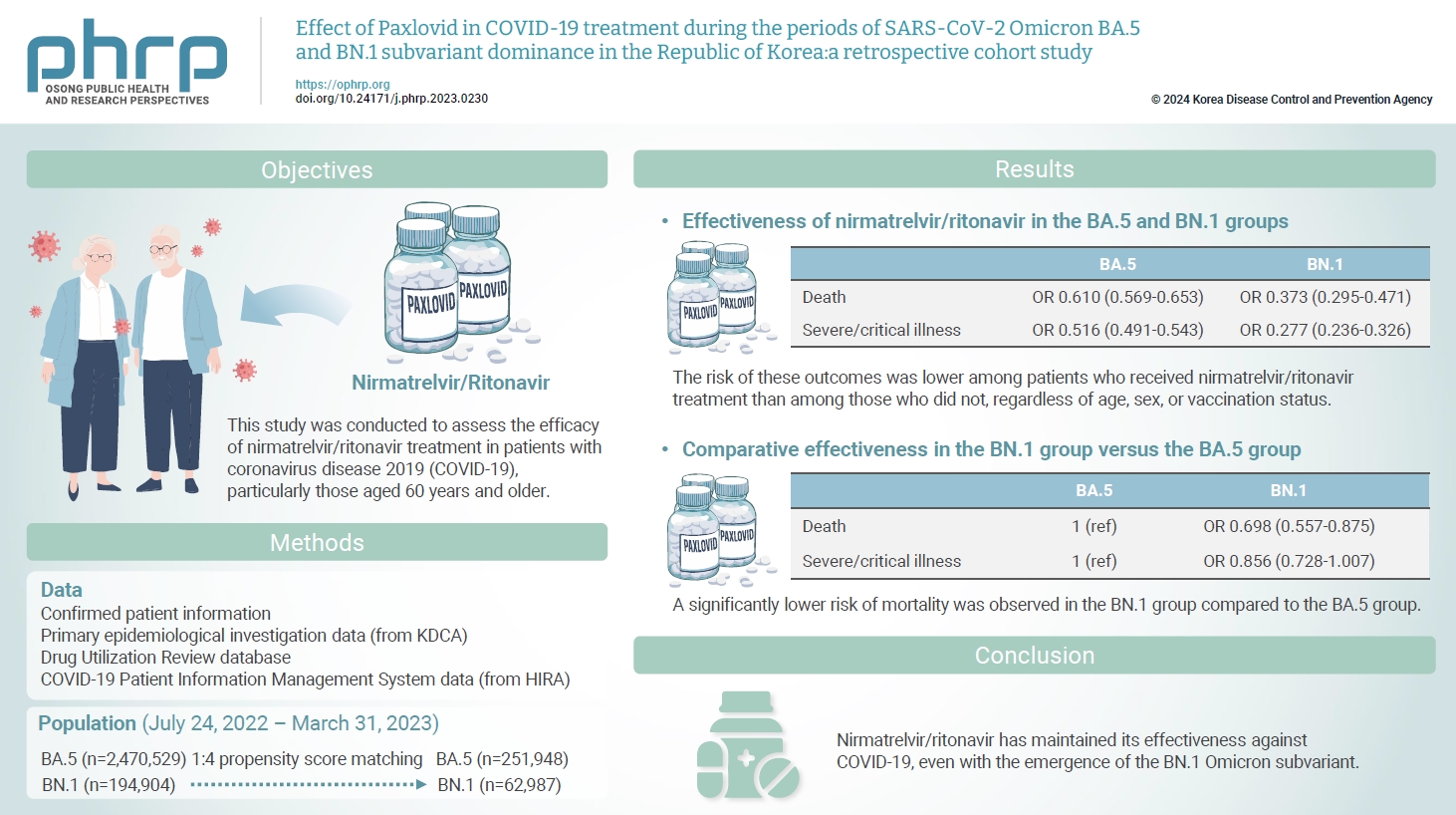
This study was conducted to assess the efficacy of nirmatrelvir/ritonavir treatment in patients with coronavirus disease 2019 (COVID-19), particularly those aged 60 years and older. Using real-world data, the period during which the BN.1 Omicron variant was dominant was compared to the period dominated by the BA.5 variant. Methods: In this retrospective cohort study, data were collected regarding 2,665,281 patients infected with severe acute respiratory syndrome coronavirus 2 between July 24, 2022, and March 31, 2023. Propensity score matching was utilized to match patients who received nirmatrelvir/ ritonavir in a 1:4 ratio between BN.1 and BA.5 variant groups. Multivariable logistic regression analysis was employed to assess the effects of nirmatrelvir/ritonavir within these groups. Results: Compared to the prior period, the efficacy of nirmatrelvir/ritonavir did not significantly differ during the interval of Omicron BN.1 variant dominance in the Republic of Korea. Among patients treated with nirmatrelvir/ritonavir, a significantly lower risk of mortality was observed in the BN.1 group (odds ratio [OR], 0.698; 95% confidence interval [CI], 0.557–0.875) compared to the BA.5 group. However, this treatment did not significantly reduce the risk of severe or critical illness, including death, for those in the BN.1 group (OR, 0.856; 95% CI, 0.728–1.007). Conclusion: Nirmatrelvir/ritonavir has maintained its effectiveness against COVID-19, even with the emergence of the BN.1 Omicron subvariant. Consequently, we strongly recommend the administration of nirmatrelvir/ritonavir to patients exhibiting COVID-19-related symptoms, irrespective of the dominant Omicron variant or their vaccination status, to mitigate disease severity and decrease the risk of mortality. Citations
Citations to this article as recorded by

Objectives
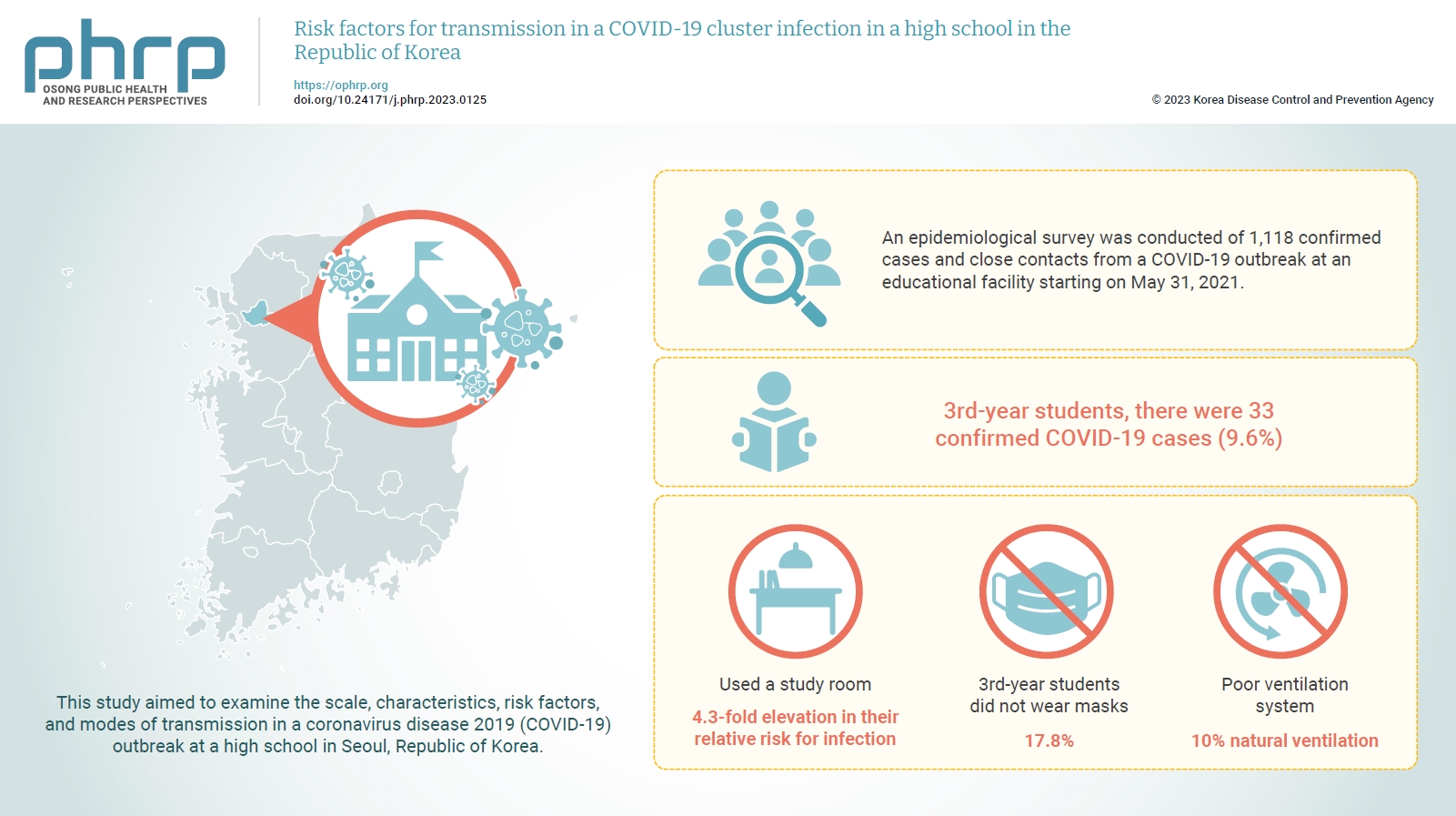
This study aimed to examine the scale, characteristics, risk factors, and modes of transmission in a coronavirus disease 2019 (COVID-19) outbreak at a high school in Seoul, Republic of Korea. Methods An epidemiological survey was conducted of 1,118 confirmed cases and close contacts from a COVID-19 outbreak at an educational facility starting on May 31, 2021. In-depth interviews, online questionnaires, flow evaluations, and CCTV analyses were used to devise infection prevention measures. Behavioral and spatial risk factors were identified, and statistical significance was tested. Results Among 3rd-year students, there were 33 confirmed COVID-19 cases (9.6%). Students who used a study room in the annex building showed a statistically significant 4.3-fold elevation in their relative risk for infection compared to those who did not use the study room. Moreover, CCTV facial recognition analysis confirmed that 17.8% of 3rd-year students did not wear masks and had the lowest percentage of mask-wearers by grade. The air epidemiological survey conducted in the study room in the annex, which met the 3 criteria for a closed space, confirmed that there was only 10% natural ventilation due to the poor ventilation system. Conclusion To prevent and manage the spread of COVID-19 in educational facilities, advance measures that consider the size, operation, and resources of each school are crucial. In addition, various survey methodologies should be used in future studies to quickly analyze a wider range of data that can inform an evidence-based quarantine response. Citations
Citations to this article as recorded by
|
|


