

| Eun-Jin Kim | 8 Articles |

Objectives
We analyzed the correlation between the infectivity and transmissibility of the severe acute respiratory syndrome coronavirus 2 Omicron sublineages BA.1, BA. 2, BA.4, and BA.5. Methods: We assessed viral replication kinetics and infectivity at the cellular level. Nasopharyngeal and oropharyngeal specimens were obtained from patients with coronavirus disease 2019, confirmed using whole-genome sequencing to be caused by the Omicron sublineages BA.1, BA.2, BA.4, or BA.5. These specimens were used to infect Vero E6 cells, derived from monkey kidneys, for the purpose of viral isolation. Viral stocks were then passaged in Vero E6 cells at a multiplicity of infection of 0.01, and culture supernatants were harvested at 12-hour intervals for 72 hours. To evaluate viral replication kinetics, we determined the cycle threshold values of the supernatants using real-time reverse transcription polymerase chain reaction and converted these values to genome copy numbers. Results: The viral load was comparable between BA.2, BA.4, and BA.5, whereas BA.1 exhibited a lower value. The peak infectious load of BA.4 was approximately 3 times lower than that of BA.2 and BA.5, while the peak load of BA.2 and BA.5 was about 7 times higher than that of BA.1. Notably, BA.1 demonstrated the lowest infectivity over the entire study period. Conclusion: Our results suggest that the global BA.5 wave may have been amplified by the higher viral replication and infectivity of BA.5 compared to other Omicron sublineages. These analyses could support the rapid assessment of the impact of novel variants on case incidence. Citations
Citations to this article as recorded by

Objectives
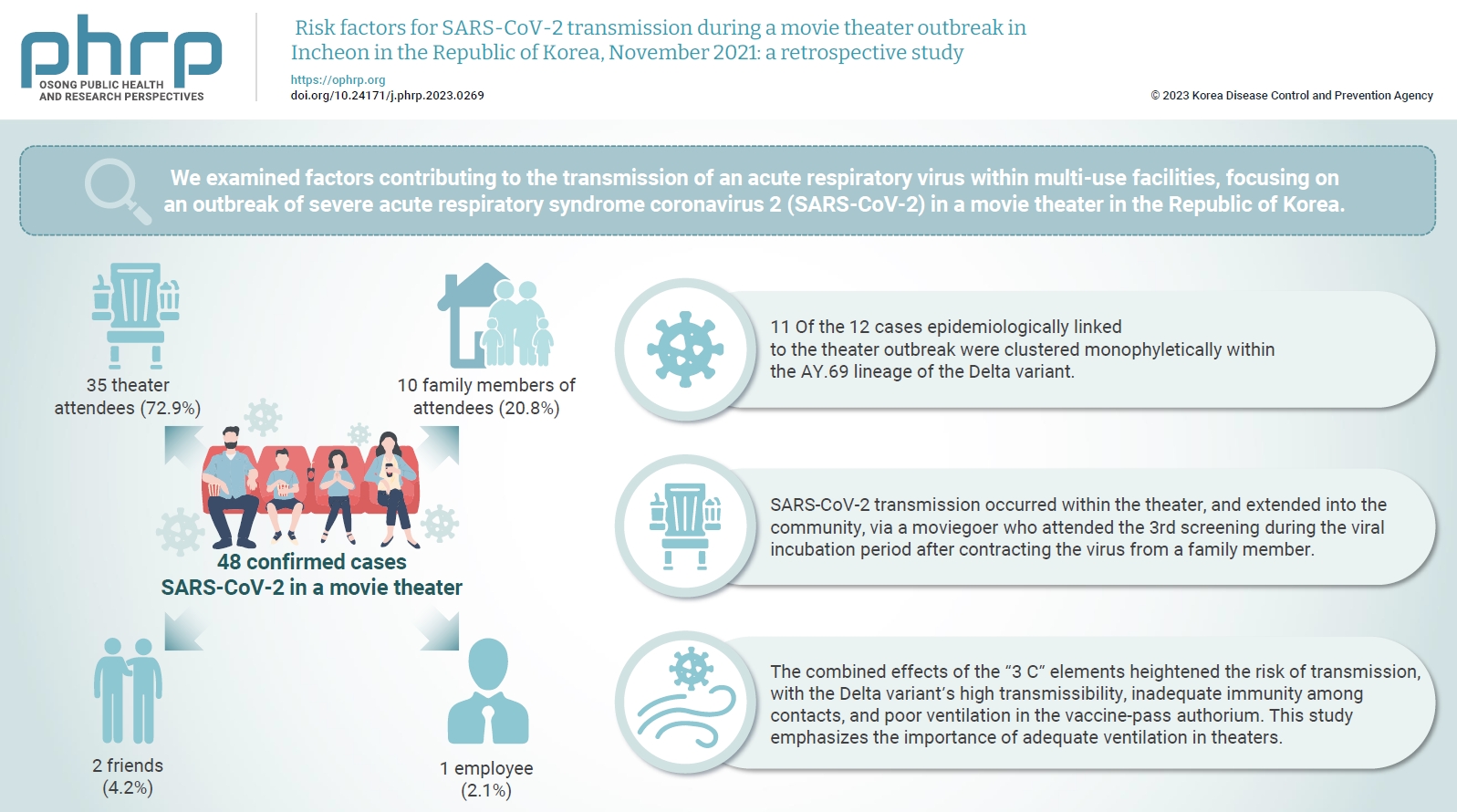
We examined factors contributing to the transmission of an acute respiratory virus within multi-use facilities, focusing on an outbreak of severe acute respiratory syndrome coronavirus 2 (SARS-CoV-2) in a movie theater in the Republic of Korea. Methods: This retrospective cohort study involved a descriptive analysis of 48 confirmed cases. Logistic regression was applied to a cohort of 80 theater attendees to identify risk factors for infection. The infection source and transmission route were determined through gene sequencing data analysis. Results: Of the 48 confirmed cases, 35 were theater attendees (72.9%), 10 were family members of attendees (20.8%), 2 were friends (4.2%), and 1 was an employee (2.1%). Among the 80 individuals who attended the 3rd to 5th screenings of the day, 35 became infected, representing a 43.8% attack rate. Specifically, 28 of the 33 third-screening attendees developed confirmed SARSCoV-2, constituting an 84.8% attack rate. Furthermore, 11 of the 12 cases epidemiologically linked to the theater outbreak were clustered monophyletically within the AY.69 lineage. At the time of the screening, 35 individuals (72.9%) had received 2 vaccine doses. However, vaccination status did not significantly influence infection risk. Multivariate analysis revealed that close contacts had a 15.9-fold higher risk of infection (95% confidence interval, 4.37–78.39) than casual contacts. Conclusion: SARS-CoV-2 transmission occurred within the theater, and extended into the community, via a moviegoer who attended the 3rd screening during the viral incubation period after contracting the virus from a family member. This study emphasizes the importance of adequate ventilation in theaters. Citations
Citations to this article as recorded by
Objectives
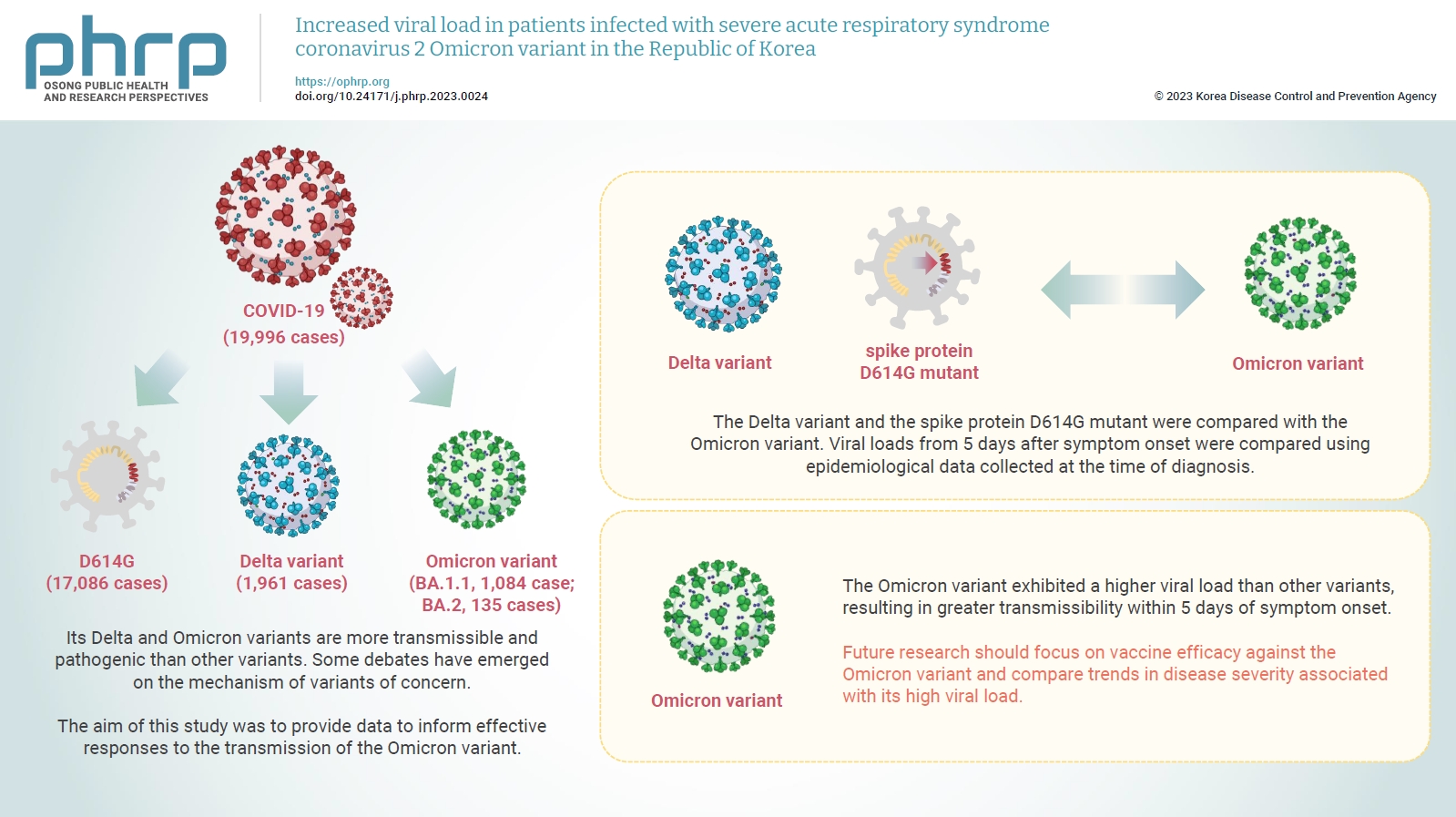
Coronavirus disease 2019 (COVID-19) has been declared a global pandemic owing to the rapid spread of the causative agent, severe acute respiratory syndrome coronavirus 2. Its Delta and Omicron variants are more transmissible and pathogenic than other variants. Some debates have emerged on the mechanism of variants of concern. In the COVID-19 wave that began in December 2021, the Omicron variant, first reported in South Africa, became identifiable in most cases globally. The aim of this study was to provide data to inform effective responses to the transmission of the Omicron variant. Methods The Delta variant and the spike protein D614G mutant were compared with the Omicron variant. Viral loads from 5 days after symptom onset were compared using epidemiological data collected at the time of diagnosis. Results The Omicron variant exhibited a higher viral load than other variants, resulting in greater transmissibility within 5 days of symptom onset. Conclusion Future research should focus on vaccine efficacy against the Omicron variant and compare trends in disease severity associated with its high viral load. Citations
Citations to this article as recorded by

Objectives
This study aimed to assess the contact tracing outcomes of severe acute respiratory syndrome coronavirus 2 (SARS-CoV-2) Omicron sub-lineages BA.4, BA.5, and BA.2.75 within Republic of Korea, and to generate foundational data for responding to future novel variants. Methods We conducted investigations and contact tracing for 79 confirmed BA.4 cases, 396 confirmed BA.5 cases, and 152 confirmed BA.2.75 cases. These cases were identified through random sampling of both domestically confirmed and imported cases, with the goal of evaluating the pattern of occurrence and transmissibility. Results We detected 79 instances of Omicron sub-lineage BA.4 across a span of 46 days, 396 instances of Omicron sub-lineage BA.5 in 46 days, and 152 instances of Omicron sub-lineage BA.2.75 over 62 days. One patient with severe illness was confirmed among the BA.5 cases; however, there were no reports of severe illness in the confirmed BA.4 and BA.2.75 cases. The secondary attack risk among household contacts were 19.6% for BA.4, 27.8% for BA.5, and 24.3% for BA.2.75. No statistically significant difference was found between the Omicron sub-lineages. Conclusion BA.2.75 did not demonstrate a higher tendency for transmissibility, disease severity, or secondary attack risk within households when compared to BA.4 and BA.5. We will continue to monitor major SARS-CoV-2 variants, and we plan to enhance the disease control and response systems. Citations
Citations to this article as recorded by
The variant B.1.1.7 of severe acute respiratory syndrome coronavirus 2 (SARS-CoV-2), the RNA virus causing the pandemic more than a year worldwide, was reported from United Kingdom (UK) in late December 2020. It was reported that mortality increases by 65% and transmissibility increases by 70%, which may result in an increase of reproduction number to 1.13−1.55 from 0.75−0.85. To analyze the global increasing trend of the variant B.1.1.7, we extracted results of B.1.1.7 from GISAID on May 11 and May 12, 2021, and conducted a doseresponse regression. It took 47 days to reach 20% and 121 days to reach 50% among the sequence submitted from UK. In Korea, cases of B.1.1.7 have increased since the first report of three cases on December 28, 2020. Positive rate of B.1.1.7 in Korea was 21.6% in the week from May 9 to May 15, 2021. Detection rate of the variants is expected to increase further and new variants of SARS-CoV-2 are emerging, so a close monitoring and control would be maintained for months.
Citations
Citations to this article as recorded by
<p>Since a novel beta-coronavirus, severe acute respiratory syndrome coronavirus 2 (SARS-CoV-2) was first reported in December 2019, there has been a rapid global spread of the virus. Genomic surveillance was conducted on samples isolated from infected individuals to monitor the spread of genetic variants of SARS-CoV-2 in Korea. The Korea Disease Control and Prevention Agency performed whole genome sequencing of SARS-CoV-2 in Korea for 1 year (January 2020 to January 2021). A total of 2,488 SARS-CoV-2 cases were sequenced (including 648 cases from abroad). Initially, the prevalent clades of SARS-CoV-2 were the S and V clades, however, by March 2020, GH clade was the most dominant. Only international travelers were identified as having G or GR clades, and since the first variant 501Y.V1 was identified (from a traveler from the United Kingdom on December 22<sup>nd</sup>, 2020), a total of 27 variants of 501Y.V1, 501Y.V2, and 484K.V2 have been classified (as of January 25<sup>th</sup>, 2021). The results in this study indicated that quarantining of travelers entering Korea successfully prevented dissemination of the SARS-CoV-2 variants in Korea.</p>
Citations
Citations to this article as recorded by
<sec>
<title>Objectives</title>
<p>The Korea Centers for Disease Control and Prevention has published “A Guideline for Unknown Disease Outbreaks (UDO).” The aim of this report was to introduce tabletop exercises (TTX) to prepare for UDO in the future.</p></sec>
<sec>
<title>Methods</title>
<p>The UDO Laboratory Analyses Task Force in Korea Centers for Disease Control and Prevention in April 2018, assigned unknown diseases into 5 syndromes, designed an algorithm for diagnosis, and made a panel list for diagnosis by exclusion. Using the guidelines and laboratory analyses for UDO, TTX were introduced.</p></sec>
<sec>
<title>Results</title>
<p>Since September 9<sup>th</sup>, 2018, the UDO Laboratory Analyses Task Force has been preparing TTX based on a scenario of an outbreak caused by a novel coronavirus. In December 2019, through TTX, individual missions, epidemiological investigations, sample treatments, diagnosis by exclusions, and next generation sequencing analysis were discussed, and a novel coronavirus was identified as the causal pathogen.</p></sec>
<sec>
<title>Conclusion</title>
<p>Guideline and laboratory analyses for UDO successfully applied in TTX. Conclusions drawn from TTX could be applied effectively in the analyses for the initial response to COVID-19, an ongoing epidemic of 2019 – 2020. Therefore, TTX should continuously be conducted for the response and preparation against UDO.</p></sec>
Citations
Citations to this article as recorded by
Objectives
In this study, the viral fitness of pseudo-viruses with a drug-resistant site in the reverse transcriptase (RT) region of the genome was investigated. The pseudo-viruses were derived from highly active antiretroviral therapy (HAART)-experienced HIV/AIDS patients. Methods HIV-1 RNA was extracted from the plasma of HAART-experienced (KRB9149, KRB7021, KRC1097) and HAART-naïve (KRC5180, KRC5123) HIV-1 patients. The RT gene from the extracted viral RNA was amplified and the polymerase chain reaction product was cloned from the pHXB2Δ2-261 RT vector. C8166 and TZM-bl cell lines were used as the HIV-1 replication capacity measurement system. To quantify the infectivity of homologous recombinant HIV-1, the infectivity derived from each pseudo-virus was compared with the infectivity of the reference strain HXB2. Results Patient-derived HIV-1 was cotransfected into C8166 cells and the expression level of the p24 antigen was measured. The expression was high in the HIV-1 isolates from patients KRC5180 and KRB9149 and low in patients KRB7021, KRC5123, and KRC1097, when compared with the reference strain. The infectivity of the pseudo-virus measured in TZM-bl cells decreased in the order, reference strain HXB2 > KRC5180 > KRC5123 > KRB9149 > KRB7021 > KRC1097. Conclusion In this study, HIV-1 infectivity of the drug-resistant strain isolated from HAART-experienced patients with HIV/AIDS was found to be lower than the infectivity of the reference strain HXB2. This study provides useful data for the phenotypic susceptibility assay in HAART-experienced patients infected with HIV-1. Citations
Citations to this article as recorded by
|
|


