Determining exactly what the next pandemic will be is complex, However, by studying some common characteristics of previous viral pandemics, we can predict the general characteristics of the next pandemic. Here, we will explore next pandemic features, reviewing the past pandemics that have afflicted humanity and the factors that might make one viral pathogen more likely than others to cause a future pandemic. There are many factors that accelerate the occurrence of pandemics, including climate change, intensive human interaction in our modern world, and the threat to natural environments of viral reservoirs. By studying a set of requirements, the most important of which is that the virus be transmitted through respiration and air, and that it be able to be transmitted between humans, as well as its ability to undergo genetic mutations, we have identified a specific set of viruses that could potentially turn into future pandemics.
Objectives Climate variability, particularly ambient air temperature, is an emerging environmental determinant of blood pressure (BP); however, evidence from tropical lowand middle-income countries (LMICs) remains limited. We examined associations between monthly average ambient temperature with systolic BP (SBP) and diastolic BP (DBP) among adults in Bogor City, Indonesia. Methods: This longitudinal cohort analysis used secondary data collected between 2011 and 2018 from 1,648 participants with repeated BP measurements (19 assessments over 6 years). Average ambient temperature data were matched to the month of BP measurement. Generalized estimating equations models were used to assess the association between temperature and BP after adjustment for age, sex, education, and socioeconomic status. Results: Mean ambient temperature ranged from 24.6 °C to 28.9 °C. SBP varied more than DBP and tended to increase as ambient temperature decreased. The overall main effect of temperature on BP was not statistically significant. However, several visit-specific temperature–time interactions were negative and significant, suggesting inverse patterns between lower temperatures and higher SBP or DBP. Marginal effects plots demonstrated time-varying associations, with predicted SBP and DBP differences of approximately −4 to + 3 mmHg across follow-up visits at representative temperatures. Socioeconomic status and education were associated with SBP, whereas age and female sex were associated with DBP. Conclusion: Temperature variations were associated with time-varying BP changes among adults with hypertension in Bogor City during 2011–2018. Although the main temperature effect was non-significant, temperature–time interactions suggested modest inverse patterns within clinically plausible ranges. These findings support the need for updated, multi-site studies in tropical LMIC settings.
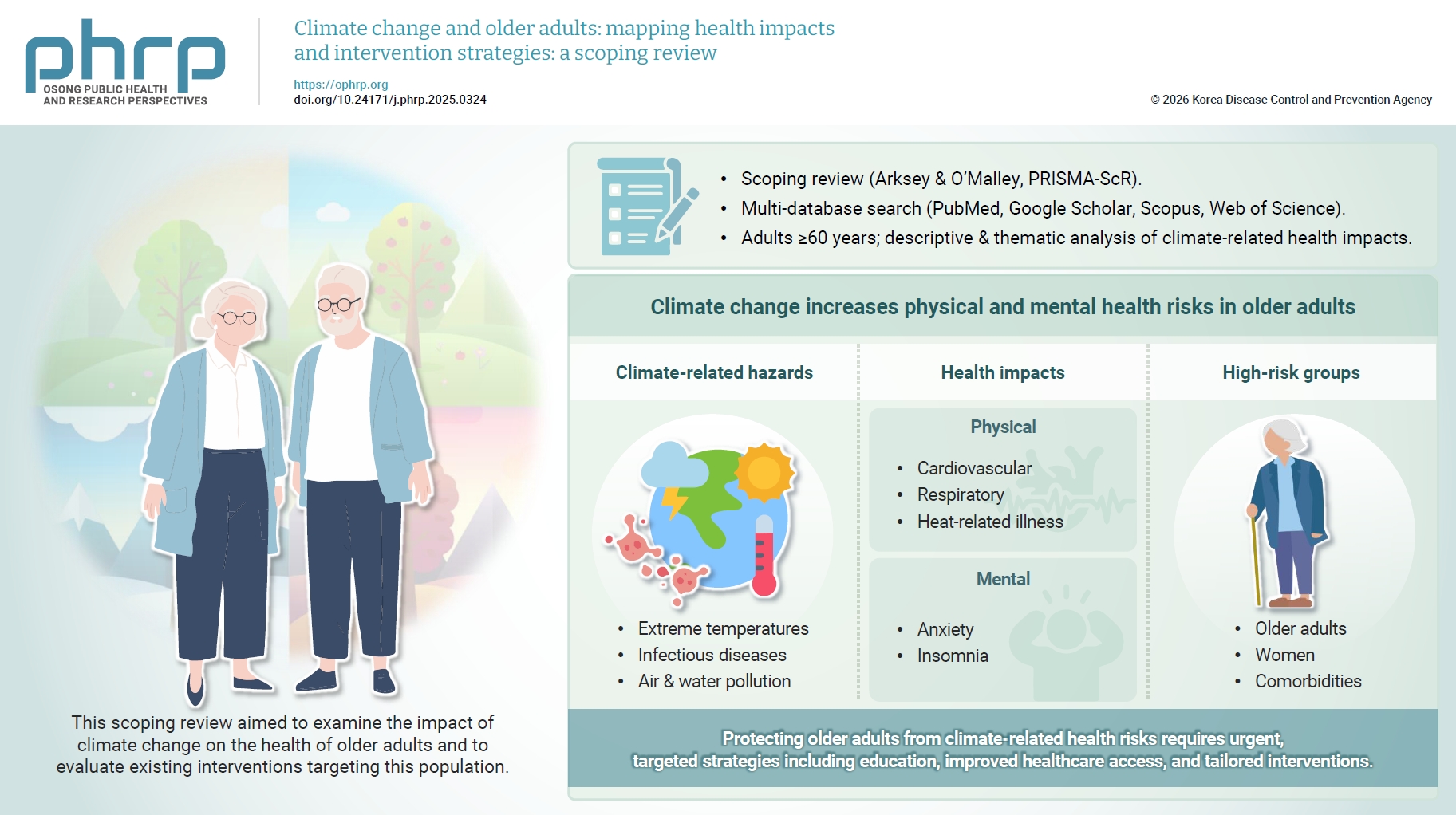
Objectives This scoping review aimed to examine the impact of climate change on the health of older adults and to evaluate existing interventions targeting this population. Methods: The review followed Arksey and O’Malley’s framework and the PRISMA-ScR guidelines. A comprehensive search was conducted across PubMed, Google Scholar, Scopus, and Web of Science. Eligible studies included those focusing on adults aged 60 years and older that examined the physical and mental health impacts of climate change across any geographic setting or level of care. Descriptive and thematic analyses were performed to identify key findings and knowledge gaps. Results: Climate change adversely affects the physical and mental health of older adults through increased exposure to infectious diseases, extreme temperatures, and poor air and water quality. Older adults are particularly vulnerable to heat-related illnesses, cardiovascular events, and respiratory conditions, with women and individuals with comorbidities at higher risk. Climate change is also associated with increased anxiety, insomnia, and other mental health concerns in this population. Social support and targeted interventions—such as community awareness programs and subsidized cooling costs—are associated with reduced risk. Community-based initiatives have demonstrated potential in reducing mortality and enhancing resilience among older adults during extreme weather events. Conclusion: Healthcare professionals should be educated about climate-related health outcomes affecting older adults. Protecting this vulnerable population requires urgent, inclusive, and targeted strategies, including education, improved healthcare access, and tailored interventions.
Objectives Scrub typhus, caused by Orientia tsutsugamushi, is a climate-sensitive vector-borne disease with high incidence in the Republic of Korea. This study examined long-term epidemiological trends and changing meteorological influences in the context of climate change.
Methods A retrospective time-series study was conducted using national surveillance data on 149,289 scrub typhus cases (2001–2024) across 4 surveillance phases. Temporal trends in age-standardized incidence rates were evaluated using Joinpoint regression. Associations between monthly meteorological variables and incidence were assessed with Spearman correlation analysis and time-series regression analysis using distributed lag non-linear models.
Results The national incidence increased until 2017 and has decreased since 2018, whereas the AAPC rebound to 4.32% during phase IV (2019–2024). The proportion of female cases decreased, while that of adults ≥70 years increased significantly. In phase IV, the average annual percent change increased in central and urban regions. The lag effect of meteorological factors lengthened from 4 to 6 months, with mean temperature (Tmean) and relative humidity (RH) representing the primary predictors. Phase III (2013–2018) displayed the highest cumulative relative risk (RR) for Tmean at 25.2 °C (RR, 5.86; 95% confidence interval [CI], 2.56–13.42), whereas in phase IV, only moderate RH (58%) remained significantly associated with incidence (RR, 1.68; 95% CI, 1.29–2.20).
Conclusion Over the past 2 decades, the influence of meteorological factors on scrub typhus has shifted, with recent years marked by greater uncertainty under increasing climate variability and instability. For timely risk prediction and targeted prevention, adaptive surveillance systems that integrate dynamic climate indicators—capturing the intensity, frequency, and variability of extreme weather events—are needed.
Citations
Citations to this article as recorded by
A Review of Domestic Research and Response Trends Regarding the Environmental and Health Impacts of Climate Change Young Sun Kwon, Junsuk Kang Journal of Environmental Health Sciences.2026; 52(1): 7. CrossRef
Non-linear effects and lag patterns of eco-environmental factors on scrub typhus: a spatiotemporal analysis in Yunnan, China, 2015–2022 Xiangnan Jing, Yuewei Ling, Ruonan Jing, Fuying Guo, Feifei Yin, Dongsheng Huang, Lijie Zhang, Xiangyu Yan, Tiejun Shui Parasites & Vectors.2026;[Epub] CrossRef
Global health security threats in the post-coronavirus disease 2019 era include dense urban populations, increased human–animal proximity, migration driven by political or economic instability, climate change, humanitarian crises, antimicrobial resistance (AMR), and the misuse of biological research—including the accidental or intentional release of high-risk pathogens. The foundational preparation for these threats is to establish a robust, resilient public health system based on universal health coverage. The World Health Organization’s International Health Regulations must continue to promote global solidarity by maintaining core capacities such as surveillance, national laboratories, and epidemiological investigations of emerging infectious diseases, with timely reporting and information sharing within the global health security community. A One Health approach is essential for addressing AMR. Infection prevention and control must be enhanced to reduce healthcare-associated infections in medical facilities. Additionally, regulations concerning biosafety and biosecurity should address dual-use research of concern as well as the accidental or intentional release of highrisk pathogens from laboratories. Global health security is a collective responsibility because these threats know no borders and require coordinated action.
Citations
Citations to this article as recorded by
The Role of Environmental and Climatic Factors in Accelerating Antibiotic Resistance in the Mediterranean Region Nikolaos P. Tzavellas, Natalia Atzemoglou, Petros Bozidis, Konstantina Gartzonika Acta Microbiologica Hellenica.2026; 71(1): 1. CrossRef
Global health preparedness for biosecurity threats: a review of emerging technologies and solutions Omotade Adebimpe Ijarotimi, Adeyemi Akeem Amuda, Christopher Oluwatosin Omokanye, Mariam Amuda Frontiers in Public Health.2026;[Epub] CrossRef
Objectives
Allergic disease may be increased by climate change. Recent reports have shown that typhoon and heavy rain increase allergic disease locally by concentration of airborne allergens of pollen, ozone, and fungus, which are causes of allergic disease. The objective of this study was to determine whether typhoon and heavy rain increase allergic disease in Korea. Methods
This study included allergic disease patients of the area declared as a special disaster zone due to storms and heavy rains from 2003 to 2009. The study used information from the Korea Meteorological Administration, and from the National Health Insurance Service for allergic diseases (asthma, allergic rhinitis, and atopic dermatitis). Results
During a storm period, the numbers of allergy rhinitis and atopic dermatitis outpatients increased [rate ratio (RR) = 1.191; range, 1.150–1.232] on the sixth lag day. However, the number of asthma outpatients decreased (RR = 0.900; range, 0.862–0.937) on the sixth lag day after a disaster period. During a storm period, the numbers of allergic rhinitis outpatients (RR = 1.075; range, 1.018–1.132) and atopy outpatients increased (RR = 1.134; range, 1.113–1.155) on the seventh lag day. However, the number of asthma outpatients decreased to RR value of 0.968 (range, 0.902–1.035) on the fifth lag day. Conclusion
This study suggests that typhoon and heavy rain increase allergic disease apart from asthma. More study is needed to explain the decrease in asthma.
Citations
Citations to this article as recorded by
Influence of Climate on Atopic Dermatitis Kristen Fernandez, Maya Mundada, Alexandra So, Maria L. Wei Dermatologic Clinics.2026; 44(1): 27. CrossRef
Current status and challenges in climate change and chronic disease research in the Republic of Korea: A scoping review Sungeun Woo, Hansol Lee, Yuri Lee Journal of Climate Change Research.2026; 17(2): 341. CrossRef
The Dermatologic Burden of Flooding: A Systematic Review of Epidemiology, Clinical Manifestations, and Management in a Warming World Jenny Belén Altamirano‐Jara, Jaime David Acosta‐España, Lysien I. Zambrano, Alfonso J. Rodriguez‐Morales International Journal of Dermatology.2026;[Epub] CrossRef
The dual challenge of climate change in otolaryngology: Environmental impacts on airway diseases and emission reduction strategies in surgical care Nuray Bayar Muluk International Journal of Biometeorology.2026;[Epub] CrossRef
Climate Change-Mediated Temperature Extremes: Effects on the Immune System and Associations with Immune-Related Diseases Shengjie Li, Wenqu Tian, Yang Zheng, Yachun Li, Ismail Ogulur, Can Zeyneloglu, Huseyn Babayev, Mohamed Shamji, Kari Nadeau, Cezmi A. Akdis, Yadong Gao Clinical Reviews in Allergy & Immunology.2026;[Epub] CrossRef
Impact of 2018 Japan floods on allergic rhinitis prescriptions Hanae Konishi, Hiroshi Iwamoto, Shuhei Yoshida, Yasushi Horimasu, Shinichiro Ohshimo, Kota Takemoto, Noboru Hattori, Sachio Takeno, Masatoshi Matsumoto World Allergy Organization Journal.2025; 18(5): 101051. CrossRef
How Climate Change Is Impacting Allergic Rhinitis: A Scoping Review Alisha R. Pershad, Reethu Krishnan, Esther Lee, Lauren Gardiner, Evan Hughes, Neelima Tummala The Laryngoscope.2025; 135(8): 2670. CrossRef
Climate Conditions, Weather Changes, and Air Pollutants and Atopic Dermatitis Megan Park, Samiha T. Mohsen, Talia Katz, Siddhartha Sood, Sheena Maureen T. Sy, Bram Rochwerg, Aaron M. Drucker JAMA Dermatology.2025; 161(8): 828. CrossRef
Impact of climate change on atopic dermatitis: A review by the International Eczema Council Sheng‐Pei Wang, Nicholas Stefanovic, Raquel L. Orfali, Valeria Aoki, Sara J. Brown, Sandipan Dhar, Lawrence F. Eichenfield, Carsten Flohr, Alex Ha, Camilo Mora, Jenny E. Murase, Misha Rosenbach, Sahana M. Srinivas, Jacob P. Thyssen, Maria L. Wei, Alan D. Allergy.2024; 79(6): 1455. CrossRef
Ayurvedic clinical decision-making methods to predict, prevent and manage childhood allergic disorders K.P. Karthik, Aparna Dileep, S. Rajagopala, Mahapatra Arun Kumar, Prasanth Dharmarajan, Jessica Vellela Journal of Ayurveda and Integrative Medicine.2024; 15(1): 100857. CrossRef
Association between exposure to ambient air pollution, meteorological factors and atopic dermatitis consultations in Singapore—a stratified nationwide time-series analysis Diyar Mailepessov, Janet Ong, Muhammad Zafir Mohamad Nasir, Joel Aik, Maye Woo, Xiahong Zhao, Hong Liang Tey, Yik Weng Yew Scientific Reports.2024;[Epub] CrossRef
Changes in Healthcare Utilization After the 2022 Seoul Metropolitan Flood: Applying a Generalized Synthetic Control Approach Marnpyung Jang, Jaeyoung Yoon, Yeseul Yun, Jaiyong Kim, Hoyeon Jang, Tarik Benmarhnia, Changwoo Han GeoHealth.2024;[Epub] CrossRef
Projecting future excess deaths associated with extreme precipitation events in China under changing climate: an integrated modelling study Jie Ban, Kailai Lu, Yuanyuan Liu, Jiawei Zang, Zhen Zhou, Can Zhang, Zhao Liu, Jianbin Huang, Yidan Chen, Xuejie Gao, Ying Xu, Can Wang, Wenjia Cai, Peng Gong, Yong Luo, Tiantian Li The Lancet Planetary Health.2024; 8(10): e723. CrossRef
Potential Dermatological Effects of Climate Change in Africa L Pillay, AR Sema-Ramashala, S Jessop, N Raboobee, R Lehloenya, L Moosa, A Mosam Wits Journal of Clinical Medicine.2023;[Epub] CrossRef
Tropical cyclone and daily respiratory mortality across East Asia: a time series study Cheng He, Renjie Chen, Ho Kim, Masahiro Hashizume, Whanhee Lee, Yasushi Honda, Satbyul Estella Kim, Yue Leon Guo, Alexandra Schneider, Wenzhen Ge, Yixiang Zhu, Lu Zhou, Haidong Kan European Respiratory Journal.2023; 62(1): 2300546. CrossRef
Temporal Variation and Factors Associated with Allergic Rhinitis in a Cohort of Rural Preschool Children from Sri Lanka Shashanka Rajapakse, Lakmali Amarasiri, Duminda Yasaratne, Janith Warnasekara, Suneth Agampodi Journal of Tropical Pediatrics.2022;[Epub] CrossRef
Effects of mite allergen avoidance in children in two distant towns in Japan C. Oshikata, M. Watanabe, K. Hashimoto, A. Yamazaki, N. Kobayashi, R. Konuma, M. Ishida, S. Kobayashi, T. Shimada, T. Kaneko, Y. Kamata, S. Kuriyama, S. Kure, M. Yanai, N. Tsurikisawa Revue Française d'Allergologie.2022; 62(8): 661. CrossRef
Emergency room visits for childhood atopic dermatitis are associated with floods? Nai-Tzu Chen, Mu-Jean Chen, Chih-Da Wu, Yue Leon Guo Science of The Total Environment.2021; 773: 145435. CrossRef
Emergency department visits associated with satellite observed flooding during and following Hurricane Harvey Balaji Ramesh, Meredith A. Jagger, Benjamin Zaitchik, Korine N. Kolivras, Samarth Swarup, Lauren Deanes, Julia M. Gohlke Journal of Exposure Science & Environmental Epidem.2021; 31(5): 832. CrossRef
Emergency management of reservoirs and water treatment plants in typhoon season: a case study of Ningbo Wei Chen, Xiaozhong Zhang, Zhengxie Zhou, Jianrong He, Hui Tao, Zhigang Liu Chinese Journal of Population Resources and Enviro.2018; 16(4): 364. CrossRef
Eco-Health linkages: assessing the role of ecosystem goods and services on human health using causal criteria analysis Rebeca de Jesus Crespo, Richard Fulford International Journal of Public Health.2018; 63(1): 81. CrossRef
No Calm After the Storm: A Systematic Review of Human Health Following Flood and Storm Disasters Dell D. Saulnier, Kim Brolin Ribacke, Johan von Schreeb Prehospital and Disaster Medicine.2017; 32(5): 568. CrossRef
Exposure to ambient bioaerosols is associated with allergic skin diseases in Greater Taipei residents Kraiwuth Kallawicha, Ying-Chih Chuang, Shih-Chun Candice Lung, Bor-Cheng Han, Yi-Fang Ting, Hsing Jasmine Chao Environmental Pollution.2016; 216: 845. CrossRef
A preliminary study on mortality attributed to tropical cyclones in Taiwan 2000–2014 Chiung-Ting Chang Environmental Hazards.2016; 15(2): 178. CrossRef
Impacts of Different Grades of Tropical Cyclones on Infectious Diarrhea in Guangdong, 2005-2011 Ruihua Kang, Huanmiao Xun, Ying Zhang, Wei Wang, Xin Wang, Baofa Jiang, Wei Ma, Yongchang Cao PLOS ONE.2015; 10(6): e0131423. CrossRef
The Correlation between the Blood Sugar and Allergy of the Trauma Patient Jeong Soo Lee, Sung Hee Hyun, Ji-Sook Lee, In Sik Kim Korean Journal of Clinical Laboratory Science.2014; 46(1): 22. CrossRef
Objectives
As the prevalence of tsutsugamushi disease has tripled over the past decade to affect 8307 people in October 2012, this study is conducted to estimate the willingness to pay (WTP) to avoid infection of tsutsugamushi disease in order to analyze the loss of value caused by climate change diseases. Methods
The double-bounded dichotomous choice of contingent valuation method was used to estimate the WTP to avoid infection of tsutsugamushi disease, through surveys conducted in the patient group (<i>n</i> = 120) and the control group (<i>n</i> = 240). Results
More young people in the family, higher level of awareness of risks caused by climate change, more male members (as opposed to female), higher income, lower suggested bid, and greater WTP, is better positioned to avoid infection of disease. The mean of the amount of WTP has been estimated to be 3689 Kwon per month. Conclusion
As people have become increasingly aware of climate change diseases, WTP to avoid infection of tsutsugamushi disease has increased accordingly. The implicit loss of value due to climate change diseases is becoming increasingly higher. Therefore, there should be stronger and more aggressive promotional activities to prevent people from being infected with tsutsugamushi disease and to build a healthier society free from climate change diseases.
Citations
Citations to this article as recorded by
Consumers's willingness to pay for avoiding Salmonella infection Á. Vajda, Cs. Mohácsi-Farkas, L. Ózsvári, Gy. Kasza Acta Alimentaria.2020; 49(1): 76. CrossRef
A Case of Scrub Typhus Related Encephalopathy Presenting as Rapidly Progressive Dementia Jeong Hoon Park, Jae-Won Jang, Seung-Hwan Lee, Won Sup Oh, Sam Soo Kim Dementia and Neurocognitive Disorders.2017; 16(3): 83. CrossRef
Geographical Distribution and Seasonal Indices of Chigger Mites on Small Mammals Collected on the East Coast of the Republic of Korea Gab-Man Park, Ho-Sung Shin Journal of Parasitology.2016; 102(2): 193. CrossRef
Integrated framework for the external cost assessment of nuclear power plant accident considering risk aversion: The Korean case Sang Hun Lee, Hyun Gook Kang Energy Policy.2016; 92: 111. CrossRef
Scrub typhus in hilly regions of north east India Siraj A. Khan, Vinotsole Khamo, Helen J. Uriah, Trishna Bora, Prafulla Dutta Indian Journal of Medical Research.2016; 144(1): 138. CrossRef
The Geographical and Economical Impact of Scrub Typus, the Fastest-growing Vector-borne Disease in Korea Hae-Wol Cho, Chaeshin Chu Osong Public Health and Research Perspectives.2013; 4(1): 1. CrossRef





 First
 Prev


