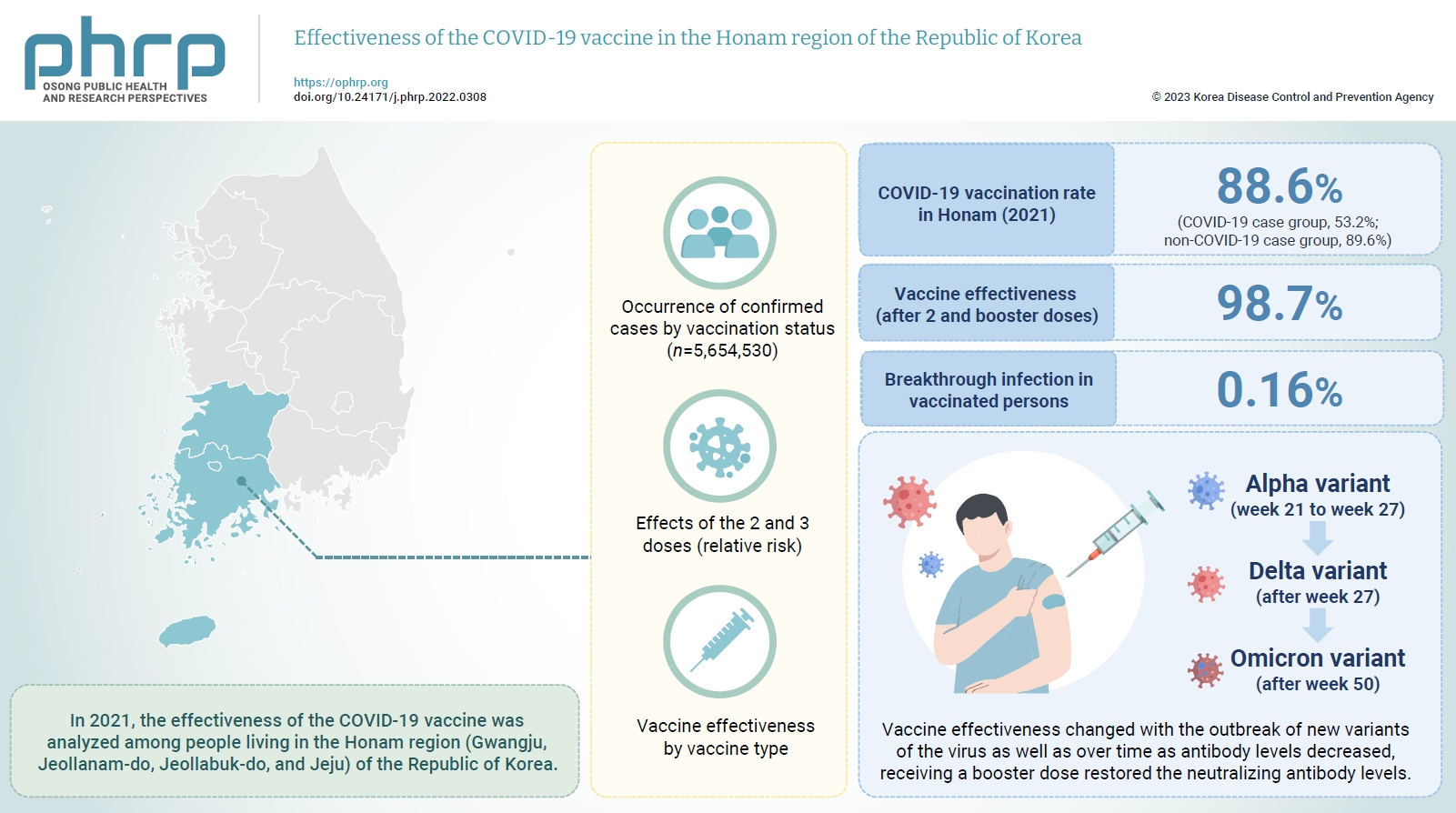
Objectives In 2021, the effectiveness of the COVID-19 vaccine was analyzed among people living in the Honam region (Gwangju, Jeollanam-do, Jeollabuk-do, and Jeju) of the Republic of Korea. And we investigated changes in the dominant virus strain.
Methods This study used the data provided by the Korean Ministry of the Interior and Safety for individuals ≥12 years old in the Honam region, and the Integrated Disease and Health Management System of the Korea Centers for Disease Control and Prevention for COVID-19-vaccinated individuals as of December 31, 2021. Statistical analyzes were performed using IBM SPSS ver. 23.0. The occurrence of confirmed cases by vaccination status, the relative risk, and vaccine effectiveness by vaccine type were calculated.
Results In 2021, the COVID-19 vaccination rate in Honam was 88.6%. The overall vaccine effectiveness (after 2 and 3 doses) was 98.7% (p<0.001). and the breakthrough infection rate was 0.16%. From week 21 to week 27 of 2021 (June 27 to July 3), the genome sequencing results were mostly alpha variants. The Delta variant emerged as the dominant variant after 27 weeks and the Omicron variant was found at 50 weeks (December 5–11).
Conclusion Vaccine effectiveness changed with the outbreak of new variants of the virus as well as over time as antibody levels decreased. that the prevention effectiveness of vaccination in Honam was >98%, and the effect among persons who received 2 doses was >90% regardless of the vaccine type. Although vaccine effectiveness decreased because of reduced antibody levels over time (as observed in breakthrough infections), receiving a booster dose restored the neutralizing antibody levels.
Objectives
Our previous longitudinal multicenter-based carriage study showed that the average carriage rate of <i>Streptococcus pneumoniae</i> was 16.8% in 582 healthy children attending kindergarten or elementary school in Seoul, Korea. We assessed serotype-specific prevalence and antimicrobial resistance among colonizing pneumococcal isolates from young children in the era of low use of the seven-valent pneumococcal conjugate vaccine (PCV7). Methods
Serotypes were determined by an agglutination test with specific antisera or by a multiplex polymerase chain reaction (PCR) assay. An antimicrobial susceptibility test was performed with broth microdilution in Korean 96-well panels from Dade-MicroScan (Sacramento, CA, USA). Results
Pneumococcal colonization patterns were dynamic and longterm persistent carriage was rare, which indicated a sequential turnover of pneumococcal strains. Of the 369 pneumococci (except for 23 killed isolates), 129 (34.9%) isolates were PCV7 vaccine serotypes (VTs); 213 (57.8%) isolates were nonvaccine serotypes (NVTs); and the remaining 27 (7.2%) isolates were nontypable (NT). The highest rates of multidrug resistance (MDR) were observed in VTs (86.0%; 111/129 isolates) and NVTs (70.0%; 149/213 isolates). Conclusion
This study overall showed the frequent carriage of VTs and NVTs with MDR in healthy children attending kindergarten or elementary school. Efforts should be directed toward reducing the extensive prescription of antibiotics and using new broader vaccines to reduce the expansion of MDR strains of NVTs in our community.
Citations
Citations to this article as recorded by
Characterization of Pneumococcal Colonization Dynamics and Antimicrobial Resistance Using Shotgun Metagenomic Sequencing in Intensively Sampled South African Infants Rendani I. Manenzhe, Felix S. Dube, Meredith Wright, Katie Lennard, Stephanie Mounaud, Stephanie W. Lo, Heather J. Zar, William C. Nierman, Mark P. Nicol, Clinton Moodley Frontiers in Public Health.2020;[Epub] CrossRef
Encouraging rational antibiotic use in childhood pneumonia: a focus on Vietnam and the Western Pacific Region Nguyen T. K. Phuong, Tran T. Hoang, Pham H. Van, Lolyta Tu, Stephen M. Graham, Ben J. Marais Pneumonia.2017;[Epub] CrossRef
Burden of bacterial upper respiratory tract pathogens in school children of Nepal Sangita Thapa, Shishir Gokhale, Annavarapu Laxminarasimha Sharma, Lokendra Bahadur Sapkota, Shamshul Ansari, Rajendra Gautam, Sony Shrestha, Puja Neopane BMJ Open Respiratory Research.2017; 4(1): e000203. CrossRef
Bacterial Density, Serotype Distribution and Antibiotic Resistance of Pneumococcal Strains from the Nasopharynx of Peruvian Children Before and After Pneumococcal Conjugate Vaccine 7 Christiane R. Hanke, Carlos G. Grijalva, Sopio Chochua, Mathias W. Pletz, Claudia Hornberg, Kathryn M. Edwards, Marie R. Griffin, Hector Verastegui, Ana I. Gil, Claudio F. Lanata, Keith P. Klugman, Jorge E. Vidal Pediatric Infectious Disease Journal.2016; 35(4): 432. CrossRef



 First
 Prev


