Jeong-Min Kim, Dongju Kim, Nam-Joo Lee, Sang Hee Woo, Jaehee Lee, Hyeokjin Lee, Ae Kyung Park, Jeong-Ah Kim, Chae Young Lee, Il-Hwan Kim, Cheon Kwon Yoo, Eun-Jin Kim
Osong Public Health Res Perspect 2023;14(4):272-278. Published online July 27, 2023
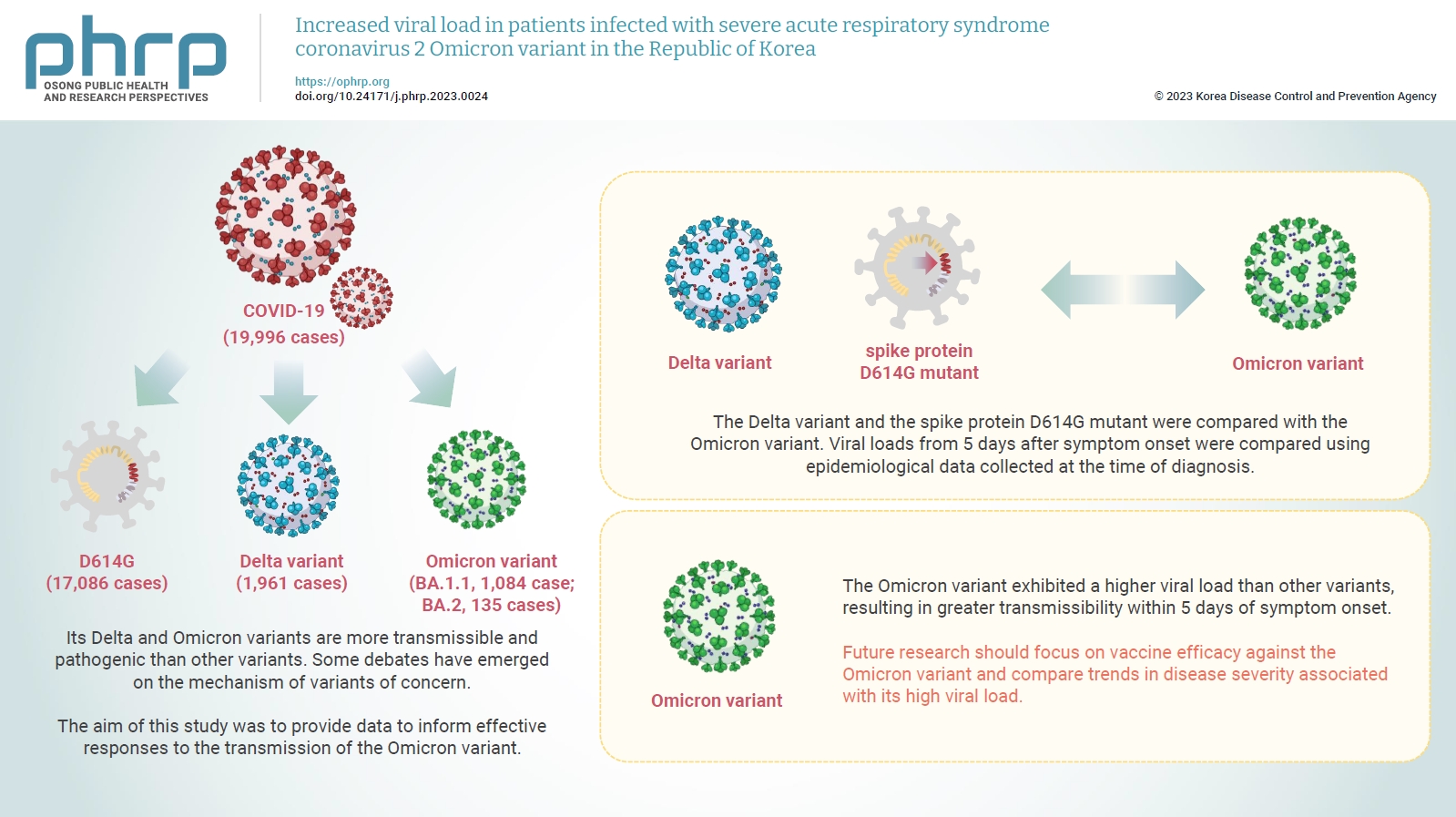
Objectives Coronavirus disease 2019 (COVID-19) has been declared a global pandemic owing to the rapid spread of the causative agent, severe acute respiratory syndrome coronavirus 2. Its Delta and Omicron variants are more transmissible and pathogenic than other variants. Some debates have emerged on the mechanism of variants of concern. In the COVID-19 wave that began in December 2021, the Omicron variant, first reported in South Africa, became identifiable in most cases globally. The aim of this study was to provide data to inform effective responses to the transmission of the Omicron variant.
Methods The Delta variant and the spike protein D614G mutant were compared with the Omicron variant. Viral loads from 5 days after symptom onset were compared using epidemiological data collected at the time of diagnosis.
Results The Omicron variant exhibited a higher viral load than other variants, resulting in greater transmissibility within 5 days of symptom onset.
Conclusion Future research should focus on vaccine efficacy against the Omicron variant and compare trends in disease severity associated with its high viral load.
Citations
Citations to this article as recorded by
Replication kinetics and infectivity of SARS-CoV-2 Omicron variant sublineages recovered in the Republic of Korea Jeong-Min Kim, Dongju Kim, Jee Eun Rhee, Cheon Kwon Yoo, Eun-Jin Kim Osong Public Health and Research Perspectives.2024; 15(3): 260. CrossRef
Diagnostic Accuracy of the Abbott BinaxNOW COVID‐19 Antigen Card Test, Puerto Rico Zachary J. Madewell, Chelsea G. Major, Nathan Graff, Cameron Adams, Dania M. Rodriguez, Tatiana Morales, Nicole A. Medina Lopes, Rafael Tosado, Liliana Sánchez‐González, Janice Perez‐Padilla, Hannah R. Volkman, Jorge Bertrán‐Pasarell, Diego Sainz de la Pe Influenza and Other Respiratory Viruses.2024;[Epub] CrossRef
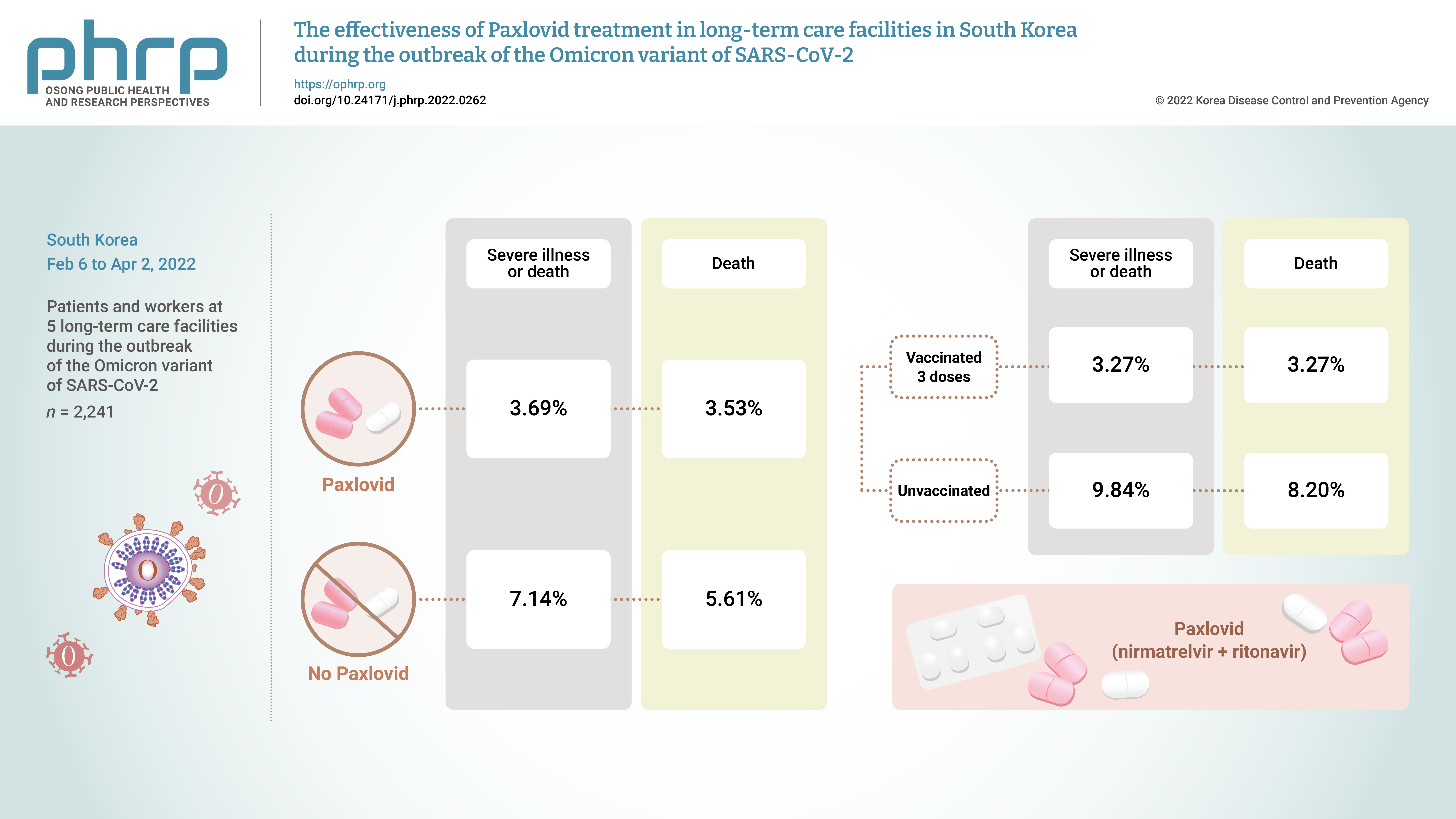
Objectives On November 5, 2021, Pfizer Inc. announced Paxlovid (nirmatrelvir +ritonavir) asa treatment method that could reduce the risk of hospitalization or death for patients withconfirmed coronavirus disease 2019 (COVID-19).Methods: From February 6, 2022 to April 2, 2022, the incidence of COVID-19 and the effectsof treatment with Paxlovid were analyzed in 2,241 patients and workers at 5 long-term carefacilities during the outbreak of the Omicron variant of severe acute respiratory syndromecoronavirus 2 in South Korea.Results: The rate of severe illness or death in the group given Paxlovid was 51% lower thanthat of the non-Paxlovid group (adjusted risk ratio [aRR], 0.49; 95% confidence interval [CI],0.24−0.98). Compared to unvaccinated patients, patients who had completed 3 doses of thevaccine had a 71% reduced rate of severe illness or death (aRR, 0.29; 95% CI, 0.13−0.64) and a65% reduced death rate (aRR, 0.35; 95% CI, 0.15−0.79).Conclusion: Patients given Paxlovid showed a lower rate of severe illness or death and alower fatality rate than those who did not receive Paxlovid. Patients who received 3 dosesof the vaccine had a lower rate of severe illness or death and a lower fatality rate than theunvaccinated group.
Citations
Citations to this article as recorded by
Effectiveness of Nirmatrelvir/Ritonavir for Outpatients in the Era of Omicron, Vaccination, and Previous Infection: A Meta-analysis Mark Ebell, Peter Kurotschka Journal of General Internal Medicine.2026; 41(12): 3516. CrossRef
Direct and indirect effects of the COVID-19 pandemic on mortality and critical care utilization in South Korea Mindong Sung, Hye Jin Jang, Soyul Han, Sungho Won, Bora Lee, Young Sam Kim Acute and Critical Care.2026; 41(2): 315. CrossRef
Evaluating the Effectiveness of Antivirals for COVID-19 in the Post-vaccine, Omicron Era: A Systematic Review and Meta-analysis Laura J Edwards, Bette Liu, James G Wood, Nicola Stephens, Allen C Cheng Open Forum Infectious Diseases.2026;[Epub] CrossRef
Tracking SARS-CoV-2 RNA in the air: Lessons from a COVID-19 outbreak in an infirmary unit Shuk-Ching Wong, Jonathan Hon-Kwan Chen, Pui-Hing Chau, Wai-On Tam, Germaine Kit-Ming Lam, Lithia Lai-Ha Yuen, Wan-Mui Chan, Allen Wing-Ho Chu, Jonathan Daniel Ip, Hoi-Wah Tsoi, Simon Yung-Chun So, Kelvin Hei-Yeung Chiu, Kwok-Yung Yuen, Kelvin Kai-Wang To American Journal of Infection Control.2025; 53(3): 348. CrossRef
Efficacy and safety of antiviral treatments for symptomatic COVID-19 outpatients: Systematic review and network meta-analysis Meital Zur, Thalia Peselev, Stav Yanko, Victoria Rotshild, Ilan Matok Antiviral Research.2024; 221: 105768. CrossRef
Clinical Effectiveness of Ritonavir-Boosted Nirmatrelvir—A Literature Review Sydney Paltra, Tim O. F. Conrad Advances in Respiratory Medicine.2024; 92(1): 66. CrossRef
Effectiveness of nirmatrelvir‐ritonavir on severe outcomes of COVID‐19 in the era of vaccination and Omicron: An updated meta‐analysis Sien Ombelet, Diego Castanares‐Zapatero, Fabian Desimpel, Frank Hulstaert, Sabine Stordeur, Dominique Roberfroid Journal of Medical Virology.2024;[Epub] CrossRef
Epidemiological evolution and economic impact of the COVID-19 pandemic in the European Union and worldwide and effects of control strategies on them: An ecological study J.A. Caylà, J.M. Bellmunt, J.M. Jansà, A. Marco, J.P. Millet Medicina de Familia. SEMERGEN.2024; 50(6): 102274. CrossRef
Clinical real-world effectiveness of nirmatrelvir/ritonavir for the treatment of SARS-CoV-2 infection: A meta-analysis Chienhsiu Huang, Sufang Kuo, Lichen Lin Tungs' Medical Journal.2024; 18(Suppl 1): S35. CrossRef
Comparing the effectiveness of molnupiravir and nirmatrelvir‐ritonavir in non‐hospitalized and hospitalized COVID‐19 patients with type 2 diabetes: A target trial emulation study Eric Y. F. Wan, Zoey C. T. Wong, Vincent K. C. Yan, Celine S. L. Chui, Francisco T. T. Lai, Xue Li, Ian C. K. Wong, Esther W. Y. Chan Diabetes, Obesity and Metabolism.2024; 26(10): 4653. CrossRef
COVID‐19 infection in patients with haematological malignancies: A single‐centre survey in the latest Omicron wave in China Xiaolu Zhu, Qian Jiang, Jin Lu, Yuqian Sun, Xiaosu Zhao, Shenmiao Yang, Feifei Tang, Wenjing Yu, Ting Zhao, Xiaohong Liu, Jinsong Jia, Wenbing Duan, Lijuan Hu, Jing Wang, Yang Liu, Nan Peng, Xuelin Dou, Rui Ma, Qiang Fu, Huifang Wang, Kaiyan Liu, Xiaojun British Journal of Haematology.2023; 202(1): 31. CrossRef
The association mental health of adolescents with economic impact during the COVID-19 pandemic: a 2020 Korean nationally representative survey Hanul Park, Kang-Sook Lee BMC Public Health.2023;[Epub] CrossRef
Efficacy and safety of paxlovid (nirmatrelvir/ritonavir) in the treatment of COVID‐19: An updated meta‐analysis and trial sequential analysis Haokun Tian, Changsen Yang, Tiangang Song, Kechen Zhou, Lequan Wen, Ye Tian, Lirui Tang, Weikai Xu, Xinyuan Zhang Reviews in Medical Virology.2023;[Epub] CrossRef
Real-World Effectiveness of Nirmatrelvir-Ritonavir and Its Acceptability in High-Risk COVID-19 Patients Min-Kyung Kim, Kyung-Shin Lee, Sin Young Ham, Youn Young Choi, Eunyoung Lee, Seungjae Lee, Bora Lee, Jaehyun Jeon, BumSik Chin, Yeonjae Kim, Gayeon Kim, Hee-Chang Jang, Jae-Phil Choi, Sang-Won Park Journal of Korean Medical Science.2023;[Epub] CrossRef
Effectiveness of Molnupiravir Treatment in Patients with COVID-19 in Korea: A Propensity Score Matched Study Hye Rim Park, Min-Gyu Yoo, Jong Mu Kim, Soon Jong Bae, Hyungmin Lee, Jungyeon Kim Infection & Chemotherapy.2023; 55(4): 490. CrossRef
Nirmatrelvir combined with ritonavir for preventing and treating COVID-19 Stefanie Reis, Maria-Inti Metzendorf, Rebecca Kuehn, Maria Popp, Ildiko Gagyor, Peter Kranke, Patrick Meybohm, Nicole Skoetz, Stephanie Weibel Cochrane Database of Systematic Reviews.2023;[Epub] CrossRef
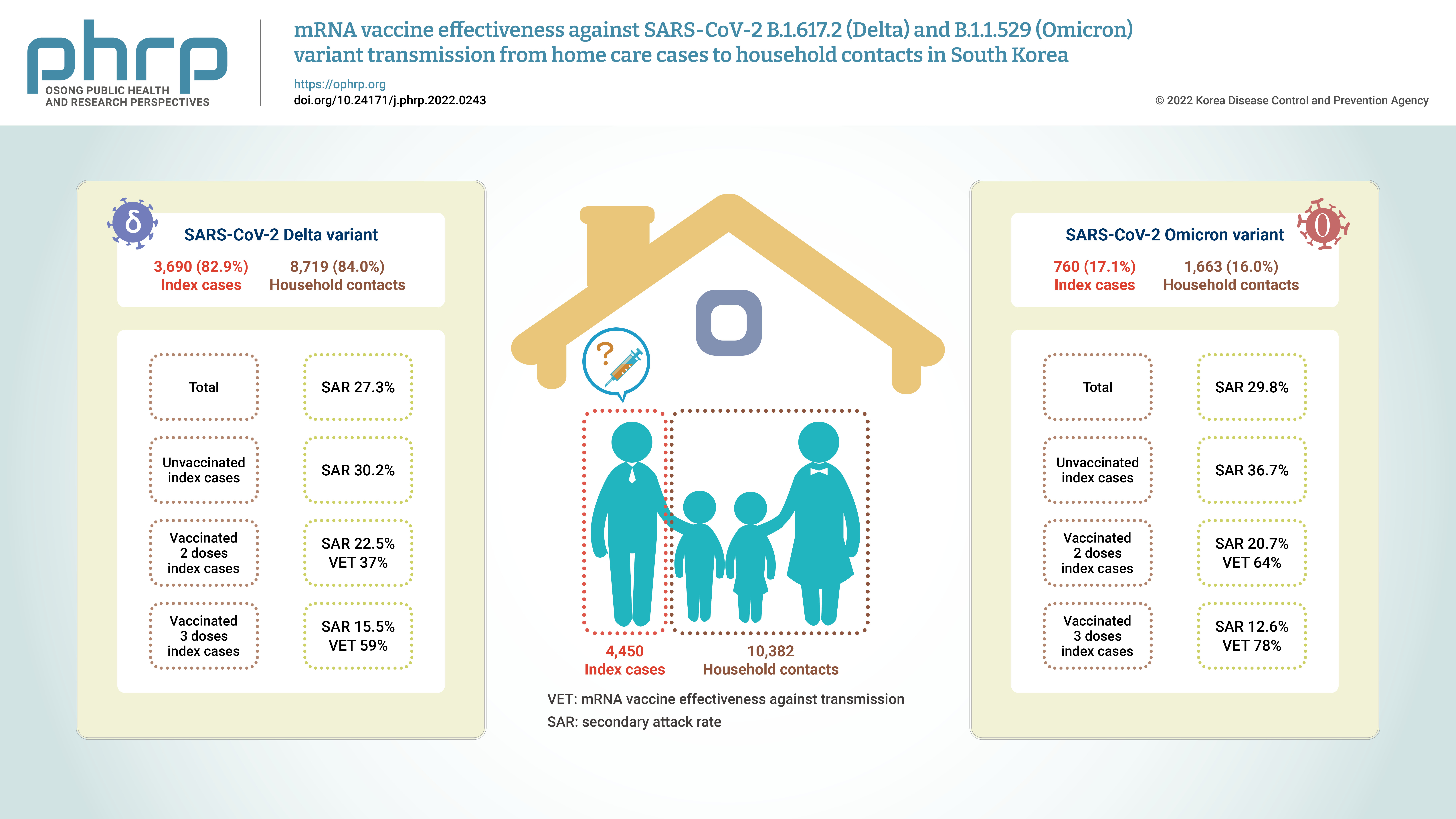
Objectives Household contacts of confirmed cases of coronavirus disease 2019 (COVID-19) areexposed to a high risk of viral transmission, and secondary incidence is an important indicatorof community transmission. This study analyzed the secondary attack rate and mRNA vaccineeffectiveness against transmission (VET) for index cases (patients treated at home) confirmedto be infected with the Delta and Omicron variants.Methods: The subjects of the study were 4,450 index cases and 10,382 household contacts.Logistic regression analysis was performed to compare the secondary attack rate byvaccination status, and adjusted relative risk and 95% confidence intervals were identified.Results: The secondary attack rate of the Delta variant was 27.3%, while the secondary attackrate of the Omicron variant was 29.8%. For the Delta variant, groups with less than 90 daysand more than 90 days after 2 doses of mRNA vaccination both showed a VET of 37%. For theOmicron variant, a 64% VET was found among those with less than 90 days after 2 doses ofmRNA vaccination.Conclusion: This study provides useful data on the secondary attack rate and VET of mRNAvaccines for household contacts of COVID-19 cases in South Korea.
Citations
Citations to this article as recorded by
Impact of disease severity, age, sex, comorbidity, and vaccination on secondary attack rates of SARS-CoV-2: a global systematic review and meta-analysis Dewan Md. Sumsuzzman, Yang Ye, Zhen Wang, Abhishek Pandey, Joanne M. Langley, Alison P. Galvani, Seyed M. Moghadas BMC Infectious Diseases.2025;[Epub] CrossRef
Child Transmission of SARS-CoV-2 Throughout the Pandemic: An Updated Systematic Review and Meta-analysis Eugene Kwon, Gabriel Blank, Samantha Starkey, Cassidy Chapman, Conné Lategan, Hennady Shulha, Vanessa Kitchin, Sarah Silverberg, Laura Sauvé, Manish Sadarangani Pediatric Infectious Disease Journal.2025; 44(7): 696. CrossRef
Household secondary attack rates and risk factors during periods of SARS-CoV-2 Delta and Omicron variant predominance in the Republic of Korea Jin Lee, Mijeong Ko, Seontae Kim, Dosang Lim, Gemma Park, Sang-Eun Lee Osong Public Health and Research Perspectives.2023; 14(4): 263. CrossRef
Objectives Despite the introduction of vaccines, treatments, and massive diagnostic testing, the evolution of severe acute respiratory syndrome coronavirus 2 (SARS-CoV-2) has continued to overcome barriers that had slowed its previous spread. As the virus evolves towards increasing fitness, it is critical to continue monitoring the occurrence of new mutations that could evade human efforts to control them. Methods: We performed whole-genome sequencing using Oxford Nanopore MinION sequencing on 58 SARS-CoV-2 isolates collected during the ongoing coronavirus disease 2019 pandemic at a tertiary hospital in South Korea and tracked the emergence of mutations responsible for massive spikes in South Korea. Results: The differences among lineages were more pronounced in the spike gene, especially in the receptor-binding domain (RBD), than in other genes. Those RBD mutations could compromise neutralization by antibodies elicited by vaccination or previous infections. We also reported multiple incidences of Omicron variants carrying mutations that could impair the diagnostic sensitivity of reverse transcription-polymerase chain reaction-based testing. Conclusion: These results provide an understanding of the temporal changes of variants and mutations that have been circulating in South Korea and their potential impacts on antigenicity, therapeutics, and diagnostic escape of the virus. We also showed that the utilization of the nanopore sequencing platform and the ARTIC workf low can provide convenient and accurate SARS-CoV-2 genomic surveillance even at a single hospital.
Citations
Citations to this article as recorded by
Understanding large scale sequencing datasets through changes to protein folding David Shorthouse, Harris Lister, Gemma S Freeman, Benjamin A Hall Briefings in Functional Genomics.2024; 23(5): 517. CrossRef
Molecular epidemiology of SARS‐CoV‐2 in Mongolia, first experience with nanopore sequencing in lower‐ and middle‐income countries setting Munkhtuya Erendereg, Suvd Tumurbaatar, Otgonjargal Byambaa, Gerelmaa Enebish, Natsagdorj Burged, Tungalag Khurelsukh, Nomin‐Erdene Baatar, Badmaarag Munkhjin, Jargaltulga Ulziijargal, Anuujin Gantumur, Oyunbaatar Altanbayar, Ochbadrakh Batjargal, Delgermu Immunity, Inflammation and Disease.2023;[Epub] CrossRef



 First
 Prev


