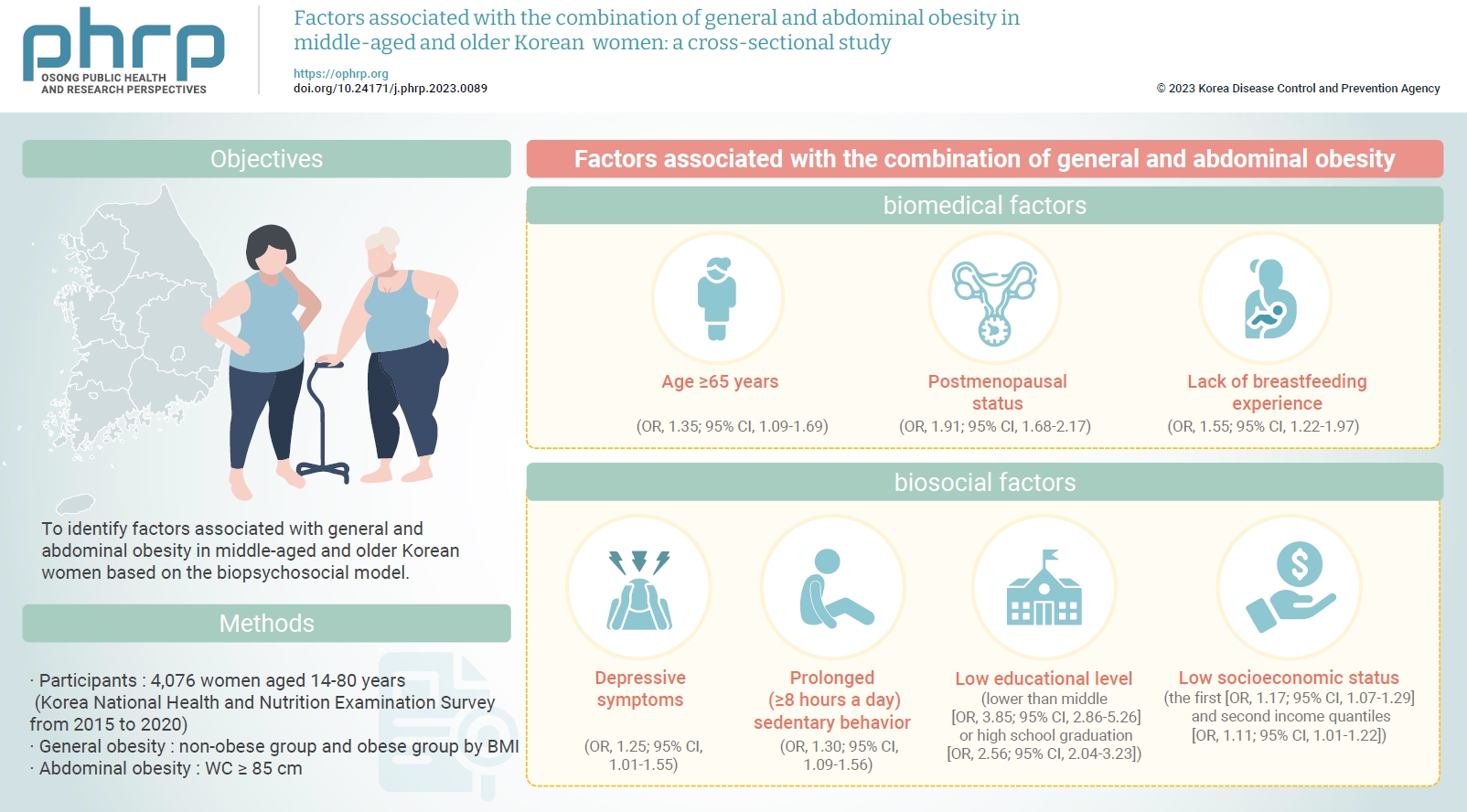
Objectives To identify factors associated with general and abdominal obesity in middle-aged and older Korean women based on the biopsychosocial model. Methods: Data from 4,076 women aged ≥45 years who participated in the Korea National Health and Nutrition Examination Survey from 2015 to 2020 were analyzed. Complex sampling analysis was performed using IBM SPSS ver. 26.0. Results: The combination of general and abdominal obesity was positively associated with age ≥65 years, postmenopausal status, and without breastfeeding experience among biomedical factors; depressive symptoms and prolonged (≥8 hours a day) sedentary behavior among psychosocial factors; and an educational level lower than middle or high school graduation and the first and second income quantiles among biosocial factors. Conclusion: Healthcare providers in communities and public societies should screen for risk factors for the combination of general and abdominal obesity while considering non-modifiable biomedical (e.g., age) and biosocial factors (e.g., educational level). In addition, intervention strategies should be developed by considering modifiable psychosocial factors such as sedentary behavior.
Citations
Citations to this article as recorded by
Relationship between anthropometric risk variables for chronic diseases in users of a primary care center José Ander Asenjo-Alarcón Población y Salud en Mesoamérica.2025;[Epub] CrossRef
<sec><title>Objectives</title><p>Our study aims to provide basic scientific data on the importance of obesity management in middle-aged Korean women by analyzing its effects on blood pressure and arterial stiffness. In addition, we examined the correlations of these two parameters.</p></sec><sec><title>Methods</title><p>The study participants were 40 middle-aged female volunteers, who were classified into obesity group (n = 20) and normal weight group (n = 20). Statistical analysis was performed using independent <italic>t</italic>-test and the Pearson correlation coefficient was used to correlate blood pressure and arterial stiffness.</p></sec><sec><title>Results</title><p>This study evaluated the systolic blood pressure, diastolic blood pressure, and pulse wave velocity (PWV). These results were higher in the obesity group than the normal weight group. Furthermore, blood pressure and arterial stiffness (PWV, augmentation pressure) were static correlated.</p></sec><sec><title>Conclusion</title><p>Obesity is closely related to blood pressure and arterial stiffness. Therefore, indices for blood pressure and arterial stiffness may play a vital role in predicting and preventing obesity and its sequelae.</p></sec>
Citations
Citations to this article as recorded by
Markers of Vascular Function and Future Coronary Artery Disease Risk Among Malaysians with Individual Cardiovascular Risk Factors Amilia Aminuddin, Nina Diyana Rusanuar, Md Rizman Md Lazin Md Lazim, Azizah Ugusman, Izzat Zulhilmi Abd Rahman, Kalaivani Chellappan, Mohd Shawal Faizal Mohamad, Wan Amir Nizam Wan Ahmad, Wan Yus Haniff Wan Isa Biomedicines.2025; 13(4): 899. CrossRef
Physical activity and cardiovascular risk in obese older Korean women: effects on obesity, hypertension, and arterial stiffness Woo-Hyeon Son, Yi-Sub Kwak, Min-Seong Ha Frontiers in Public Health.2025;[Epub] CrossRef
Obesity awareness reduces food craving and improves metabolic parameters: A study on adults with overweight and obesity Kevser Tari Selcuk, Ramazan Mert Atan, Nursel Dal, Sedat Arslan Mediterranean Journal of Nutrition and Metabolism.2025; 18(3): 184. CrossRef
Food readjustment plus exercise training improves cardiovascular autonomic control and baroreflex sensitivity in high‐fat diet‐fed ovariectomized mice Bruno Nascimento‐Carvalho, Adriano Dos‐Santos, Nicolas Da Costa‐Santos, Sabrina L. Carvalho, Oscar A. de Moraes, Camila P. Santos, Katia De Angelis, Erico C. Caperuto, Maria‐Claudia Irigoyen, Katia B. Scapini, Iris C. Sanches Physiological Reports.2023;[Epub] CrossRef
Associations between body composition and cardiovascular disease risk in pre- and postmenopausal women Nirmala Rathnayake, Gayani Alwis, Janaka Lenora, Sarath Lekamwasam Journal of Health, Population and Nutrition.2023;[Epub] CrossRef
Comparison of Vascular Function, Cardiometabolic Parameters, Hemorheological Function, and Cardiorespiratory Fitness Between Middle-Aged Korean Women With and Without Obesity—A Pilot Study Hun-Young Park, Won-Sang Jung, Sung-Woo Kim, Kyounghwa Jung, Kiwon Lim Frontiers in Physiology.2022;[Epub] CrossRef
Comparison of femoral and carotid arteries in terms of pulse check in cardiopulmonary resuscitation: A prospective observational study Gökhan Yılmaz, Oğuzhan Bol Resuscitation.2021; 162: 56. CrossRef
Effect of yoga on pulse rate and blood pressure among women G. Kaleeswari, C. Vasantha Kalyani, J. S. Jayarani, Kusum K. Rohilla Journal of Family Medicine and Primary Care.2021; 10(10): 3670. CrossRef
Association of obesity with arterial stiffness: The Multi-Ethnic Study of Atherosclerosis (MESA) Jeongok G. Logan, Hyojung Kang, Soyoun Kim, Daniel Duprez, Younghoon Kwon, David R. Jacobs, Nketi Forbang, Jennifer Mason Lobo, Min-Woong Sohn Vascular Medicine.2020; 25(4): 309. CrossRef
The Feasibility and Applications of Non-invasive Cardiac Monitoring in Obese Patients Undergoing Day-case Surgery: Results of a Prospective Observational Study P. Sansone, L.G. Giaccari, U. Colella, F. Coppolino, M.C. Pace, M.B. Passavanti, V. Pota, C. Aurilio The Open Anesthesia Journal.2020; 14(1): 80. CrossRef
The Impact of Obesity on Nighttime Blood Pressure Dipping Beata Moczulska, Maciej Zechowicz, Sylwia Leśniewska, Karolina Osowiecka, Leszek Gromadziński Medicina.2020; 56(12): 700. CrossRef
Greater Adherence to Life’s Simple 7 Is Associated With Less Arterial Stiffness: the Atherosclerosis Risk in Communities (ARIC) Study Abayomi O Oyenuga, Aaron R Folsom, Susan Cheng, Hirofumi Tanaka, Michelle L Meyer American Journal of Hypertension.2019; 32(8): 769. CrossRef
<sec><title>Objectives</title><p>This study aimed to determine the prevalence of suicidal ideation among young and middle-aged adults, and explore the risk factors that affect suicidal ideation.</p></sec><sec><title>Methods</title><p>A descriptive study design was used for secondary data analysis. A total sample of 5,214 was drawn from two waves (2012–2013) of the 7th Korea Health Panel (KHP) survey. The KHP data were collected by a well-trained interviewer using the face-to-face method during home visits as well as self-report method. Descriptive statistics of frequency, percentage, chi-square test, and logistic regression analysis were performed using SPSS 22.0.</p></sec><sec><title>Results</title><p>The prevalence of suicidal ideation in young and middle-aged adults was 4.4% and 5.6%, respectively. For young adults, suicidal ideation risk was higher among those with low income or heavy drinking habits. In middle-aged adults, low income, poor perceived health status, negative perception of peer-compared health status, and negative social perspective were the major risk factors.</p></sec><sec><title>Conclusion</title><p>There is considerable risk of suicidal ideation in adulthood. Opportunities for increased income, avoidance of heavy drinking, and the construction of positive subjective health status and social perspective should be considered in suicide prevention interventions for Korean young and middle-aged adults.</p></sec>
Citations
Citations to this article as recorded by
Socioeconomic Inequalities in the Continuum of Suicidal Ideation Minjae Choi, Yeaseul Yoon, Yo Han Lee, Hyun-Hee Heo, Myung Ki Crisis.2026; 47(3): 129. CrossRef
Psychosocial risk factors of youth suicide in the Western Pacific: a scoping review Mohammad Izzat Morshidi, Peter K. H. Chew, Lidia Suárez Social Psychiatry and Psychiatric Epidemiology.2024; 59(2): 201. CrossRef
Hospitalizations for Suicidal Events: Reiteration Risk—The Experience in the Veneto Region, Italy Silvia Cocchio, Giulia Tremolada, Nicola Cogo, Claudia Cozzolino, Mario Saia, Michele Tonon, Francesca Russo, Patrizia Furlan, Marco Fonzo, Vincenzo Baldo Psychiatry International.2024; 5(3): 434. CrossRef
Predictors of Suicidal Behavior in Young Adults: An Analysis of Korea National Health and Nutrition Examination Survey Data Using Propensity Score Matching Young Hwa Lee, Seon Young Hwang Journal of Korean Academy of psychiatric and Menta.2024; 33(4): 413. CrossRef
Spatial and temporal trends and risk factors for intentional carbon monoxide poisoning hospitalizations in England between 2002 and 2016 Aina Roca-Barceló, Helen Crabbe, Rebecca Close, Helena Fahie, Giovanni S. Leonardi, Frédéric B. Piel Journal of Affective Disorders.2023; 329: 168. CrossRef
Impact of COVID-19 pandemic on intensive care
admissions and mortality due to self-poisoning:
A retrospective comparative study from a tertiary care
hospital Aneela Α. Kidwai, Komal Fareed, Jamal Ara, Mahnoor Khalil, Shaista Ahmed, Syeda Urooj Riaz, Yumna Ahmed Public Health and Toxicology.2023; 3(3): 1. CrossRef
Spectrum and predictors of suicidal risk among incarcerated youth in a correctional facility in Kaduna, Northern Nigeria Marufah Dupe Lasisi, Folorunsho Tajudeen Nuhu, Femi Adebayo, Edwin Ehi Eseigbe, Taiwo Lateef Sheikh Vulnerable Children and Youth Studies.2022; 17(2): 147. CrossRef
Alcohol use and its association with suicide attempt, suicidal thoughts and non-suicidal self-harm in two successive, nationally representative English household samples Sarah Ledden, Paul Moran, David Osborn, Alexandra Pitman BJPsych Open.2022;[Epub] CrossRef
Associations between Suicidal Ideation and Relatives’ Physical and Mental Health among Community Residents: Differences between Family Members and Lineal Consanguinity Caifeng Li, Zhen Wei, Yifan Wang, Long Sun International Journal of Environmental Research an.2022; 19(23): 15997. CrossRef
Factors affecting suicidal ideation among premenopausal and postmenopausal women Go‐Un Kim, Hae Kyoung Son, Mi‐Young Kim Journal of Psychiatric and Mental Health Nursing.2021; 28(3): 356. CrossRef
Depression and suicidal ideation among HIV seropositive patients attending the special treatment clinic of the University of Calabar Teaching Hospital, Calabar, Nigeria Elvis Mbu Bisong, Chidi John Okafor, Agam Ebaji Ayuk, Udeme Essien Asibong, Henry Ohem Okpa Calabar Journal of Health Sciences.2021; 4: 64. CrossRef
The role of ageing in the wish to be dead: disentangling age, period and cohort effects in suicide ideation in European population M. Cabello, L. A. Rico-Uribe, J. C. Martinez-Ávila, A. Sánchez-Niubò, F. F. Caballero, G. Borges, B. Mellor-Marsá, J. M. Haro, M. Prina, S. Koskinen, J. L. Ayuso-Mateos Epidemiology and Psychiatric Sciences.2021;[Epub] CrossRef
Association Between Suicide Risk and Comorbidity of Mood Disorder and Alcohol Use Disorder: Using Common Data Model in Psychiatry Yong Hyuk Cho, Eunyoung Lee, Eun Sil Her, Gyubeom Hwang, Ki-Young Lim, Jai Sung Noh, Yunmi Shin, Chang Hyung Hong, Hyun Woong Roh, Dongyun Lee, Heirim Lee, Doyeop Kim, Rae Woong Park, Bumhee Park, Sang Joon Son Journal of Korean Neuropsychiatric Association.2021; 60(3): 232. CrossRef
Analysis of risk factors affecting suicidal ideation in South Korea by life cycle stage Ji-Young Hwang, Il-Su Park Osong Public Health and Research Perspectives.2021; 12(5): 314. CrossRef
Association of chronic diseases and lifestyle factors with suicidal ideation among adults aged 18–69 years in Eswatini: evidence from a population-based survey Mfundi President Sebenele Motsa, Hung-Yi Chiou, Yi-Hua Chen BMC Public Health.2021;[Epub] CrossRef
Cross-national prevalence and factors associated with suicide ideation and attempts in older and young-and-middle age people Maria Cabello, Marta Miret, José Luis Ayuso-Mateos, Felix Feliz Caballero, Somnath Chatterji, Beata Tobiasz-Adamczyk, Josep Maria Haro, Seppo Koskinen, Matilde Leonardi, Guilherme Borges Aging & Mental Health.2020; 24(9): 1533. CrossRef
Characteristics, causality, and suicidal behavior: a qualitative study of family members with suicide history in Wonogiri, Indonesia Susana Nurtanti, Sri Handayani, Nita Yunianti Ratnasari, Putri Halimu Husna, Tantut Susanto Frontiers of Nursing.2020; 7(2): 169. CrossRef
Risk Factors for Suicidal Ideation among Middle Class Korean: Focusing on Psychosocial Comparison - An Analysis of a Nationwide Survey of the 8th Korea Health Panel Data Ahra Jo, Bora Kang, Youngju Seo, Eunha Gil, Heeyoung Oh Journal of Korean Academy of Community Health Nurs.2018; 29(1): 1. CrossRef
The Function of Personality in Suicidal Ideation from the Perspective of the Interpersonal-Psychological Theory of Suicide Marc Baertschi, Alessandra Costanza, Alessandra Canuto, Kerstin Weber International Journal of Environmental Research an.2018; 15(4): 636. CrossRef
To Be or Not to Be Hae-Wol Cho, Chaeshin Chu Osong Public Health and Research Perspectives.2017; 8(3): 157. CrossRef



 First
 Prev


