Objectives
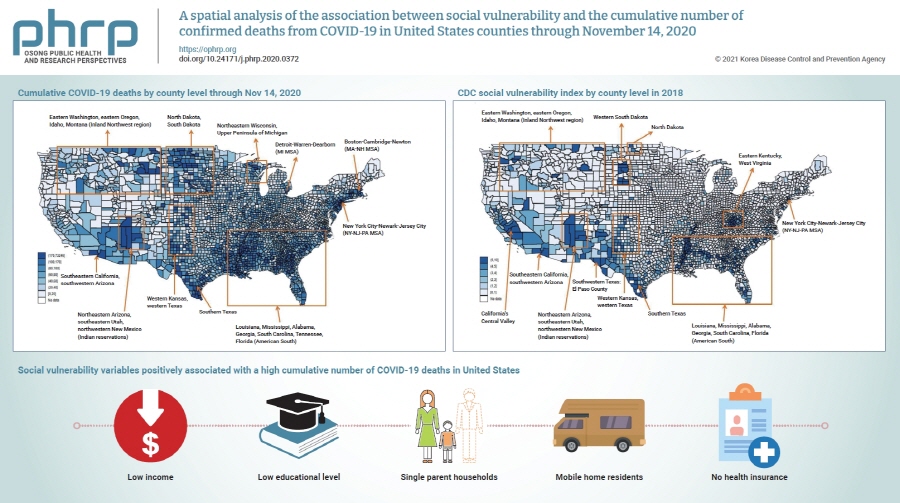
Coronavirus disease 2019 (COVID-19) is classified as a natural hazard, and social vulnerability describes the susceptibility of social groups to potential damages from natural hazards. Therefore, the objective of this study was to examine the association between social vulnerability and the cumulative number of confirmed COVID-19 deaths (per 100,000) in 3,141 United States counties.
Methods
The cumulative number of COVID-19 deaths was obtained from USA Facts. Variables related to social vulnerability were obtained from the Centers for Disease Control and Prevention Social Vulnerability Index and the 2018 5-Year American Community Survey. Data were analyzed using spatial autoregression models.
Results
Lowest income and educational level, as well as high proportions of single parent households, mobile home residents, and people without health insurance were positively associated with a high cumulative number of COVID-19 deaths.
Conclusion
In conclusion, there are regional differences in the cumulative number of COVID-19 deaths in United States counties, which are affected by various social vulnerabilities. Hence, these findings underscore the need to take social vulnerability into account when planning interventions to reduce COVID-19 deaths.
Citations
Citations to this article as recorded by
Patterns of Homologous Repair Deficiency and
BRCA1
/
2
Testing of Ovarian and Breast Cancers: A Real-World Study of Patients in Community Health Settings in the United States
Rayna K. Matsuno, Adrienne F.O. Williams, Connor Sweetnam, Giovanna I. Cruz, Liz M. Toland, Anna B. Berry, Monika A. Izano, Liam C. Lee, Gieira Jones, Jagadeswara R. Earla, Thomas D. Brown, Smita Kothari, Arthur Sillah JCO Oncology Advances.2025;[Epub] CrossRef
A low-rank Bayesian approach for geoadditive modeling Bryan Sumalinab, Oswaldo Gressani, Niel Hens, Christel Faes Spatial Statistics.2025; 68: 100907. CrossRef
A retrospective assessment of COVID-19 vulnerability index indicators and mortality rates pre-COVID-19 (2018–2020) and during COVID-19 (2020–2022) in a health and demographic surveillance site, Soweto, South Africa Takwanisa Machemedze, Chodziwadziwa Whiteson Kabudula, Jean Juste Harrisson Bashingwa, Beth A. Tippett Barr, Nellie Myburgh, Sana Mahtab, Cleopas Hwinya, Stephen Tollman, Ziyaad Dangor, Shabir A. Madhi Population Health Metrics.2025;[Epub] CrossRef
The Role of Testing and Vaccination in Mediating Social Vulnerability and COVID-19 Prevalence in Southern Nevada Andrea Lopez, Lung-Chang Chien, L.-W. Antony Chen, Courtney Coughenour, Erika Marquez, Szu-Ping Lee International Journal of Environmental Research an.2025; 22(7): 980. CrossRef
Ecological comparison of six countries in two waves of COVID-19 Meiheng Liu, Leiyu Shi, Manfei Yang, Jun Jiao, Junyan Yang, Mengyuan Ma, Wanzhen Xie, Gang Sun Frontiers in Public Health.2024;[Epub] CrossRef
Social vulnerability and COVID-19 in Maringá, Brazil Matheus Pereira Libório, Oseias da Silva Martinuci, Patrícia Bernardes, Natália Cristina Alves Caetano Chav Krohling, Guilherme Castro, Henrique Leonardo Guerra, Eduardo Alcantara Ribeiro, Udelysses Janete Veltrini Fonzar, Ícaro da Costa Francisco Spatial Information Research.2023; 31(1): 51. CrossRef
A county-level analysis of association between social vulnerability and COVID-19 cases in Khuzestan Province, Iran Mahmoud Arvin, Shahram Bazrafkan, Parisa Beiki, Ayyoob Sharifi International Journal of Disaster Risk Reduction.2023; 84: 103495. CrossRef
Global mapping of epidemic risk assessment toolkits: A scoping review for COVID-19 and future epidemics preparedness implications Bach Xuan Tran, Long Hoang Nguyen, Linh Phuong Doan, Tham Thi Nguyen, Giang Thu Vu, Hoa Thi Do, Huong Thi Le, Carl A. Latkin, Cyrus S. H. Ho, Roger C. M. Ho, Md Nazirul Islam Sarker PLOS ONE.2022; 17(9): e0272037. CrossRef
COVID-19 mortality and deprivation: pandemic, syndemic, and endemic health inequalities Victoria J McGowan, Clare Bambra The Lancet Public Health.2022; 7(11): e966. CrossRef
<sec>
<title>Objectives</title>
<p>The objective of this study was to determine the association between e-cigarette use and depression and examine how this association is different by gender among US adults.</p></sec>
<sec>
<title>Methods</title>
<p>Data from the 2017 Behavioral Risk Factor Surveillance System and Selected Metropolitan/Micropolitan Area Risk Trends was used, and included 174,351 of 230,875 US adults aged 18 years and older. Data were analyzed using the multivariate logistic regression models.</p></sec>
<sec>
<title>Results</title>
<p>After adjusting for age, race, education, income, marital status, employment status, smoking status, and physical activity, firstly, “current daily e-cigarette users” (AOR = 2.487, <italic>p</italic> < 0.001), “current non-daily e-cigarette users” (AOR = 1.623, <italic>p</italic> < 0.001), and “former e-cigarette users” (AOR = 1.573, <italic>p</italic> < 0.001) were associated with increased odds of depression compared with “never e-cigarette users.” Secondly, women were associated with increased odds of depression compared with men (AOR = 1.797, <italic>p</italic> < 0.001). Finally, male “current daily e-cigarette users” (AOR = 1.366, <italic>p</italic> < 0.01) were associated with increased odds of depression compared with female “never e-cigarette users.”</p></sec>
<sec>
<title>Conclusion</title>
<p>Thus, even though women tend to be more vulnerable to depression compared with men, e-cigarette use was positively associated with depression among both men and women.</p></sec>
Citations
Citations to this article as recorded by
Smoking, vaping, and mental health: impacts on anxiety, depression, and impulsivity Abdelrahman A. Assaf, Osama I. Younes Tanta Medical Journal.2026; 54(1): 32. CrossRef
Oral Health Perceptions and Self-reported Oral Problems among E-cigarette, Conventional, and Dual Smokers in Riyadh, Saudi Arabia Rasha Nesha Alotaibi, Sarah Abdulaziz Alsalamah, Haya Nasser Bin Tuwaim, Shaimaa Murdhi Alenezi Letters in Medical Sciences.2026;[Epub] CrossRef
Associations Between E-Cigarette Use and Psychiatric Symptoms in Adults: Systematic Review and Meta-Analysis Mateus Rodrigues Alessi, Heitor Augusto Gomes, Martin Kotochinsky, Gustavo Hayasaki Vieira, Leticia Miyashiro, Gabriela Aloe Prilip, Marsal Sanches, Nima Norbu Sherpa Current Addiction Reports.2026;[Epub] CrossRef
Patterns of Alcohol, Cannabis, and E-Cigarette Use/Co-Use and Mental Health Among U.S. College Students Camillia K. Lui, Wura Jacobs, Joshua S. Yang Substance Use & Misuse.2025; 60(1): 108. CrossRef
THE IMPACT OF ELECTRONIC NICOTINE DELIVERY DEVICES ON PHYSICAL, MENTAL AND SOCIAL WELL-BEING OF THE YOUNG POPULATION Sokolova P.V., Olsufieva A.V., Orliuk M.A., Boronikhina T.V., Vodolagin M.V., Polukhin N.V. "Medical & pharmaceutical journal "Pulse".2025; : 60. CrossRef
Association between e-cigarette use behaviors and perceived harmfulness of e-cigarettes and anxiety/depression symptoms among Black/African American Adults David Adzrago, Kayo Fujimoto, Melissa B. Harrell, Antwan Jones, J. Michael Wilkerson Preventive Medicine Reports.2023; 31: 102080. CrossRef
Association between E-Cigarette Use Behaviors and Anxiety/Depression among Black/African American Adults Based on Sexual Identity David Adzrago, Melissa B. Harrell, Kayo Fujimoto, Antwan Jones, J. Michael Wilkerson International Journal of Environmental Research an.2023; 20(3): 2078. CrossRef
The Association Between Nicotine Dependence and Mental Health in the General Population of Saudi Arabia: A Cross-Sectional Analytical Study Danah Abdullah Albarrak, Abdulrahman Bandar Alotaibi, Roaa Faisal Alotaibi, Sara Hussain Alramadhan, Alhanouf Ibrahim Bin Muhanna, Abdulrahman Mohammed Aldehan, Khalid A Bin Abdulrahman International Journal of General Medicine.2023; Volume 16: 5801. CrossRef
Use of electronic vaping products and mental health among adolescent high school students in the United States: The moderating effect of sex Philip Baiden, Hannah S. Szlyk, Patricia Cavazos-Rehg, Henry K. Onyeaka, JaNiene E. Peoples, Erin Kasson Journal of Psychiatric Research.2022; 147: 24. CrossRef
<sec>
<title>Objectives</title>
<p>The objective of this study was to examine the socio-demographic disparities in obesity among US adults across 130 metropolitan and micropolitan statistical areas.</p></sec>
<sec>
<title>Methods</title>
<p>This study used data from the 2015 Behavioral Risk Factor Surveillance System and Selected Metropolitan/Micropolitan Area Risk Trend of 159,827 US adults aged 18 years and older. Data were analyzed using the multilevel linear regression models.</p></sec>
<sec>
<title>Results</title>
<p>According to individual level analyses, socio-demographic disparities in obesity exist in the United States. Individuals with low socioeconomic status were associated with a higher body mass index. The participants from the Midwest United States tend to have higher body mass index than those who from the South. According to metropolitan and micropolitan statistical area level analyses, secondly, there were significant differences in obesity status between different areas and the relation of obesity with 5 socio-demographic factors varied across different areas. According to geospatial mapping analyses, even though obesity status by metropolitan and micropolitan statistical area level has improved overtime, differences in body mass index between United States regions are increasing from 2007 to 2015.</p></sec>
<sec>
<title>Conclusion</title>
<p>Socio-demographic and regional disparities in obesity status persist among US adults. Hence, these findings underscore the need to take socio-environmental factors into account when planning obesity prevention on vulnerable populations and areas.</p></sec>
Citations
Citations to this article as recorded by
Established and Emerging Biomarkers to Characterize Persons at Risk for Obesity—Paving the Way for Targeted Clinical Intervention Trials—A Comprehensive Position Paper Farhad Vahid, Victoria Stopa, Laurent Malisoux, Yvan Devaux, Elsa Lamy, Fernando Capela e Silva, Sarah Forberger, Tiziana de Magistris, Antoni Sureda, Margalida Monserrat‐Mesquida, Maria Pérez‐Jiménez, Rajini Nagrani, Maria Giovanna Onorati, Michele Filip Obesity Reviews.2026;[Epub] CrossRef
Body mass index and colorectal cancer screening among cancer survivors: the role of sociodemographic characteristics Tsai Meng-Han, Pollard Elinita, Vernon Marlo, Chen Jie Cancer Causes & Control.2025; 36(7): 641. CrossRef
Burden of diseases attributable to excess body weight in 204 countries and territories, 1990–2019 Saeid Safiri, Jessica A. Grieger, Amir Ghaffari Jolfayi, Seyed Ehsan Mousavi, Seyed Aria Nejadghaderi, Asra Fazlollahi, Mark J. M. Sullman, Nahid Karamzad, Fikrettin Sahin, Kuljit Singh, Gary S. Collins, Ali-Asghar Kolahi Nutrition Journal.2025;[Epub] CrossRef
Adolescent health behavior patterns and weight status: a cross-sectional analysis Jiayan Gui, Hui Zhang, Jingyou Miao, Xinyao Liu, Lilu Ding, Qiuli Wang Frontiers in Public Health.2025;[Epub] CrossRef
Mapping Obesity Coverage in Florida Counties Using Interactive Web‐Based Mapping Tools to Support Targeted Policy and Intervention Efforts Justice Moses K. Aheto, Ovie A. Utuama, Getachew A. Dagne, Aron Weller Journal of Obesity.2025;[Epub] CrossRef
County‐level socio‐environmental factors and obesity prevalence in the United States Pedro R. V. O. Salerno, Alice Qian, Weichuan Dong, Salil Deo, Khurram Nasir, Sanjay Rajagopalan, Sadeer Al‐Kindi Diabetes, Obesity and Metabolism.2024; 26(5): 1766. CrossRef
The impact of overweight and obesity on health outcomes in the United States from 1990 to 2021 Omar Al Ta'ani, Yazan A. Al‐Ajlouni, Wesam Aleyadeh, Farah Al‐Bitar, Saqr Alsakarneh, Aseel Saadeh, Laith Alhuneafat, Basile Njei Diabetes, Obesity and Metabolism.2024; 26(11): 5455. CrossRef
Application of Machine Learning and Deep Neural Visual Features for Predicting Adult Obesity Prevalence in Missouri Butros M. Dahu, Carlos I. Martinez-Villar, Imad Eddine Toubal, Mariam Alshehri, Anes Ouadou, Solaiman Khan, Lincoln R. Sheets, Grant J. Scott International Journal of Environmental Research an.2024; 21(11): 1534. CrossRef
Supplemental Nutrition Assistance Program (SNAP)-Authorized Grocery, Convenience, Dollar, and Restaurant or Delivery Service Settings Are Associated With Increased Obesity Prevalence in Virginia Bailey Houghtaling, David Kniola, Sarah Misyak American Journal of Health Promotion.2021; 35(1): 127. CrossRef
The effects of the built environment on the general health, physical activity and obesity of adults in Queensland, Australia Siqin Wang, Yan Liu, Jack Lam, Mei-Po Kwan Spatial and Spatio-temporal Epidemiology.2021; 39: 100456. CrossRef
Exposure to air pollutants and the gut microbiota: a potential link between exposure, obesity, and type 2 diabetes Maximillian J. Bailey, Noopur N. Naik, Laura E. Wild, William B. Patterson, Tanya L. Alderete Gut Microbes.2020; 11(5): 1188. CrossRef



 First
 Prev


