

| Yunhyung Kwon | 8 Articles |

Objectives
This study aimed to strengthen the core capabilities of epidemiological investigation and response teams (ERTs) at the Korea Disease Control and Prevention Agency, drawing on lessons learned from the Middle East respiratory syndrome and coronavirus disease 2019 pandemics. The primary objectives were to facilitate rapid and accurate data collection and analysis, improve communication skills, and simulate real-world on-site responses. Methods: The training program was developed using a scenario involving a novel infectious disease from the World Health Organization priority list entering a community. ERTs collected and analyzed epidemiological data and implemented control measures as they addressed the missions of the scenario. Improvement in competencies was assessed through self-evaluation surveys completed before and after training. Results: A total of 49 participants, including disease control officers, epidemiological investigation officers, researchers, and administrative officials, attended the training. Participant satisfaction with the training was high, scoring 6.4 out of 7, and the improvement in competency was statistically significant (pre-training score, 5.2; post-training score, 6.2; p<0.001). Conclusion: Scenario-based training can effectively enhance the capabilities of ERTs. Such training is essential, as emerging and re-emerging infectious diseases can exhibit unpredictable spread and potentially severe impacts. Therefore, developing diverse scenarios and conducting regular training sessions are necessary to improve the capacities of ERTs. Citations
Citations to this article as recorded by


Objectives
This study analyzed the safety of coronavirus disease 2019 (COVID-19) bivalent and monovalent booster vaccines, including the frequency of adverse events (AEs) such as myocarditis and pericarditis, in adolescents aged 12 to 17 years in the Republic of Korea. We aimed to share the safety profile of the COVID-19 bivalent vaccine booster doses. Methods We analyzed the frequencies of AEs reported to the COVID-19 vaccination management system (CVMS) or self-reported through the text message survey (TMS). Diagnostic eligibility and causality with vaccines were compared using odds ratios (ORs) by vaccine type, and incidence rates per 100,000 person-days were calculated for confirmed cases of myocarditis and pericarditis following monovalent and bivalent booster doses. Results In the CVMS, the AE reporting rate (per 100,000 doses) was lower after the bivalent booster (66.5) than after the monovalent booster (264.6). Among the AEs reported for both monovalent and bivalent vaccines 98.3% were non-serious and 1.7% were serious. According to the TMS, both local and systemic AEs were reported less frequently after the bivalent vaccination than after the monovalent vaccination in adolescents aged 12 to 17 years (p<0.001). The incidence rates per 100,000 person-days for confirmed myocarditis/pericarditis following monovalent and bivalent booster doses were 0.03 and 0.05, respectively; this difference was not statistically significant (OR, 1.797; 95% confidence interval, 0.210–15.386). Conclusion AEs in 12- to 17-year-olds following the bivalent booster were less frequent than those following the monovalent booster in the Republic of Korea, and no major safety issues were identified. However, the reporting rates for AEs were low. Citations
Citations to this article as recorded by

Objectives
Between July 2, 2021, and September 20, 2022, a Mycobacterium bovis outbreak occurred among exhibition animals at a zoo in the Republic of Korea. This study was conducted to assess the likelihood of M. bovis transmission to human contacts through a contact investigation and to implement preventive treatment for latent tuberculosis infection (LTBI). Methods: In this descriptive study, the Korea Disease Control and Prevention Agency conducted a contact investigation, which included interviews, interferon-gamma release assay (IGRA) tests, and chest X-rays. Contacts underwent IGRA testing on 2 occasions: initial testing of 29 contacts (15 in the first cluster of infection and 14 in the second cluster) and follow-up testing of the 15 contacts in the first cluster. Results: The study included 29 participants, 18 of whom were male (62.1%) and 11 female (37.9%). The mean participant age was 37.3 years (standard deviation, 9.6 years). In the initial IGRA tests, 6 of the 29 participants tested positive, indicating a prevalence of 20.7%. Following prolonged exposure, 1 additional positive case was detected in follow-up testing, raising the prevalence of LTBI to 24.1%. None of the contacts had active tuberculosis. Among the 7 individuals with positive results, 2 (28.6%) underwent treatment for LTBI. Conclusion: This study faced challenges in confirming the transmission of M. bovis infection from infected animals to humans in the Republic of Korea. Nevertheless, adopting a One Health approach necessitates the implementation of surveillance systems and infection control protocols, particularly for occupational groups at high risk of exposure. Citations
Citations to this article as recorded by
Objectives
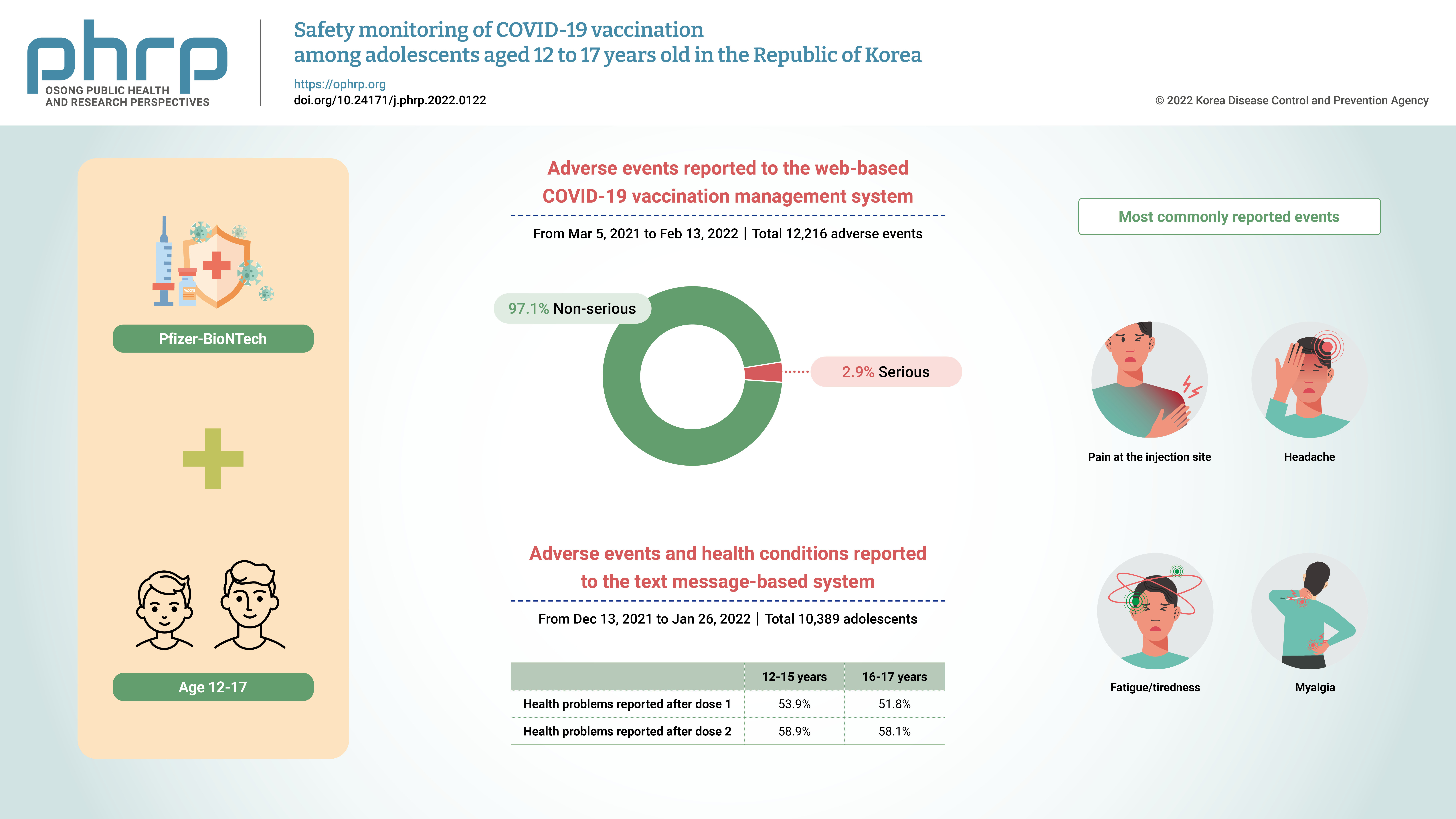
This study aimed to disseminate information on coronavirus disease 2019 (COVID-19) vaccine safety among adolescents aged 12 to 17 years in the Republic of Korea. Methods: Two databases were used to assess COVID-19 vaccine safety in adolescents aged 12 to 17 years who completed the primary Pfizer-BioNTech vaccination series. Adverse events reported to the web-based COVID-19 vaccination management system (CVMS) and collected in the text message-based system were analyzed. Results: From March 5, 2021 to February 13, 2022, 12,216 adverse events among 12- to 17-yearolds were reported to the CVMS, of which 97.1% were non-serious adverse events and 2.9% were serious adverse events, including 85 suspected cases of anaphylaxis, 74 suspected cases of myocarditis and/or pericarditis, and 2 deaths. From December 13, 2021 to January 26, 2022, 10,389 adolescents responded to a text message survey, and local/systemic adverse events were more common after dose 2 than after dose 1. The most commonly reported events following either vaccine dose were pain at the injection site, headache, fatigue/tiredness, and myalgia. Conclusion: The overall results are consistent with previous findings; the great majority of adverse events were non-serious, and serious adverse events were rare among adolescents aged 12 to 17 years following Pfizer-BioNTech COVID-19 vaccination. Citations
Citations to this article as recorded by

Objectives
This study aimed to present data on reported adverse events following coronavirus disease 2019 (COVID-19) vaccination in Republic of Korea from February 26 to October 31, 2021, and to determine whether any significant patterns emerged from an analysis of the characteristics of suspected adverse event cases for each type of vaccine. Methods Adverse events following COVID-19 vaccination reported by medical doctors and forensic pathologists were analyzed. Cases of suspected anaphylaxis were classified using the Brighton Collaboration definition. Results By October 31, 2021, a total of 353,535 (0.45%) adverse events were reported after 78,416,802 COVID-19 vaccine doses. Of the adverse events, 96.4% were non-serious and 3.6% were serious. The most frequently reported adverse events were headache, myalgia, and dizziness. Of the 835 reported deaths after COVID-19 vaccination, 2 vaccine-related deaths were confirmed. Suspected anaphylaxis was confirmed in 454 cases using the Brighton Collaboration definition. Conclusion The commonly reported symptoms were similar to those described in clinical trials. Most reported adverse events were non-serious, and the reporting rate of adverse events following COVID-19 vaccination was higher in women than in men (581 vs. 315 per 100,000 vaccinations). Confirmed anaphylaxis was reported in 5.8 cases per 1,000,000 vaccinations. Citations
Citations to this article as recorded by

Objectives
We investigated the impact of the coronavirus disease 2019 (COVID-19) pandemic on tuberculosis (TB) management in the Republic of Korea (ROK). Methods This retrospective cross-sectional study used nationwide ROK TB notification data (98,346 cases) from 2017 to 2020. The median time from the onset of TB symptoms to treatment initiation and the compliance rates with the required timing for notification and individual case investigations were measured and compared across periods and regions affected by the COVID-19 epidemic. Results TB diagnosis during the COVID-19 pandemic was delayed. The median time to TB treatment initiation (25 days) in 2020 increased by 3 days compared to that of the previous 3 years (22 days) (p<0.0001). In the outbreak in Seoul, Incheon, and Gyeonggi province during August, the time to TB diagnosis was 4 days longer than in the previous 3 years (p=0.0303). In the outbreak in Daegu and Gyeongbuk province from February to March 2020, the compliance rate with the required timing for individual case investigations was 2.2%p points lower than in other areas in 2020 (p=0.0148). For public health centers, the rate was 13%p lower than in other areas (80.3% vs. 93.3%, p=0.0003). Conclusion TB diagnoses during the COVID-19 pandemic in the ROK were delayed nationwide, especially for patients notified by public-private mix TB control hospitals. TB individual case investigations were delayed in regional COVID-19 outbreak areas (Daegu and Gyeongbuk province), especially in public health centers. Developing strategies to address this issue will be helpful for sustainable TB management during future outbreaks. Citations
Citations to this article as recorded by
Objectives
This study aimed to check the status of the contact investigation in congregate settings to eradicate tuberculosis (TB) in the Republic of Korea. Methods The “Integrated System for Disease and Public Health Management” is used for care and follow-up for patients and contacts of TB. We downloaded data for contact investigations conducted from January to December 2013. Results A total of 1,200 contact investigations in congregate settings were carried out by 25 field investigators in 2013. We performed the status of contact investigation, TB, and LTBI rate by age, accept rate of LTBI treatment, and complete rate of LTBI treatment during 2013. A total of 1,547 index TB patients, 149,166 contacts, and 259 additional TB patients were found through the investigation. Kindergartens showed the highest LTBI rate, 19.8%, among educational facilities. The second highest was in elementary schools and the subtotal LTBI rate of educational facilities was 7.8%. Social welfare/correctional facilities and workplaces showed relatively high LTBI rates of 23.8% and 23.6%, respectively. By age, individuals >35 years showed the highest LTBI rate, followed by those aged 0–4 years, 30–34 years, and 5–9 years, with rates of 18.1%, 16.4%, and 15.4% respectively. When comparing the tuberculin skin test (TST) positive conversion ratio by facility, middle school and high school were relatively high compared to the others. The accept rate of LTBI treatment in the workplace was lowest at 63% and the complete rate in elementary schools was lowest at 76.5%. Conclusion TB contact investigation is considered as a meaningful strategy for preventing TB outbreaks in congregate settings and decreasing the prevalence of TB in young people. Results of this study could be used to establish the LTBI management policy. Citations
Citations to this article as recorded by
Objectives
This study assessed the economic value of 2 major initiatives within the national infectious disease response system of the Korea Disease Control and Prevention Agency (KDCA): the Training Programs for Public Health Workforce (TPPHW) and the Infectious Disease Information System (IDIS). Methods: We developed a structured estimation model to quantify the economic benefits of pandemic preparedness investments and applied it to the KDCA’s TPPHW and IDIS. The model incorporated parameters elicited from 29 senior officials into a cost-benefit analysis (CBA) framework, from which we calculated the net present value (NPV) and benefit-cost ratio (BCR) over a 10-year period, with sensitivity analyses. Results: Both initiatives yielded positive net benefits under baseline assumptions, although the margin was substantially greater for workforce training than for the information system. At the assumed discount rate of 4.5%, the CBA yielded a BCR of 2.120 and an NPV of 27.2 billion Korean won (KRW) for TPPHW. For IDIS, the corresponding values were a BCR of 1.071 and an NPV of 2.7 billion KRW. Sensitivity analysis showed that workforce training remained economically justified across all scenarios, whereas the information system remained viable only under more favorable assumptions. Conclusion: This study contributes to the literature by systematically applying CBA to infectious disease preparedness in the Republic of Korea. The findings support continued investment in skilled workforce training and integrated information infrastructure for future pandemic preparedness. The study is limited by its reliance on expert-elicited parameters and its focus on monetary benefits, excluding health outcomes such as disability-adjusted life years and quality-of-life improvements.
|
|


