

| Sangwon Lee | 7 Articles |

Objectives
This study aimed to strengthen the core capabilities of epidemiological investigation and response teams (ERTs) at the Korea Disease Control and Prevention Agency, drawing on lessons learned from the Middle East respiratory syndrome and coronavirus disease 2019 pandemics. The primary objectives were to facilitate rapid and accurate data collection and analysis, improve communication skills, and simulate real-world on-site responses. Methods: The training program was developed using a scenario involving a novel infectious disease from the World Health Organization priority list entering a community. ERTs collected and analyzed epidemiological data and implemented control measures as they addressed the missions of the scenario. Improvement in competencies was assessed through self-evaluation surveys completed before and after training. Results: A total of 49 participants, including disease control officers, epidemiological investigation officers, researchers, and administrative officials, attended the training. Participant satisfaction with the training was high, scoring 6.4 out of 7, and the improvement in competency was statistically significant (pre-training score, 5.2; post-training score, 6.2; p<0.001). Conclusion: Scenario-based training can effectively enhance the capabilities of ERTs. Such training is essential, as emerging and re-emerging infectious diseases can exhibit unpredictable spread and potentially severe impacts. Therefore, developing diverse scenarios and conducting regular training sessions are necessary to improve the capacities of ERTs. Citations
Citations to this article as recorded by

Objectives
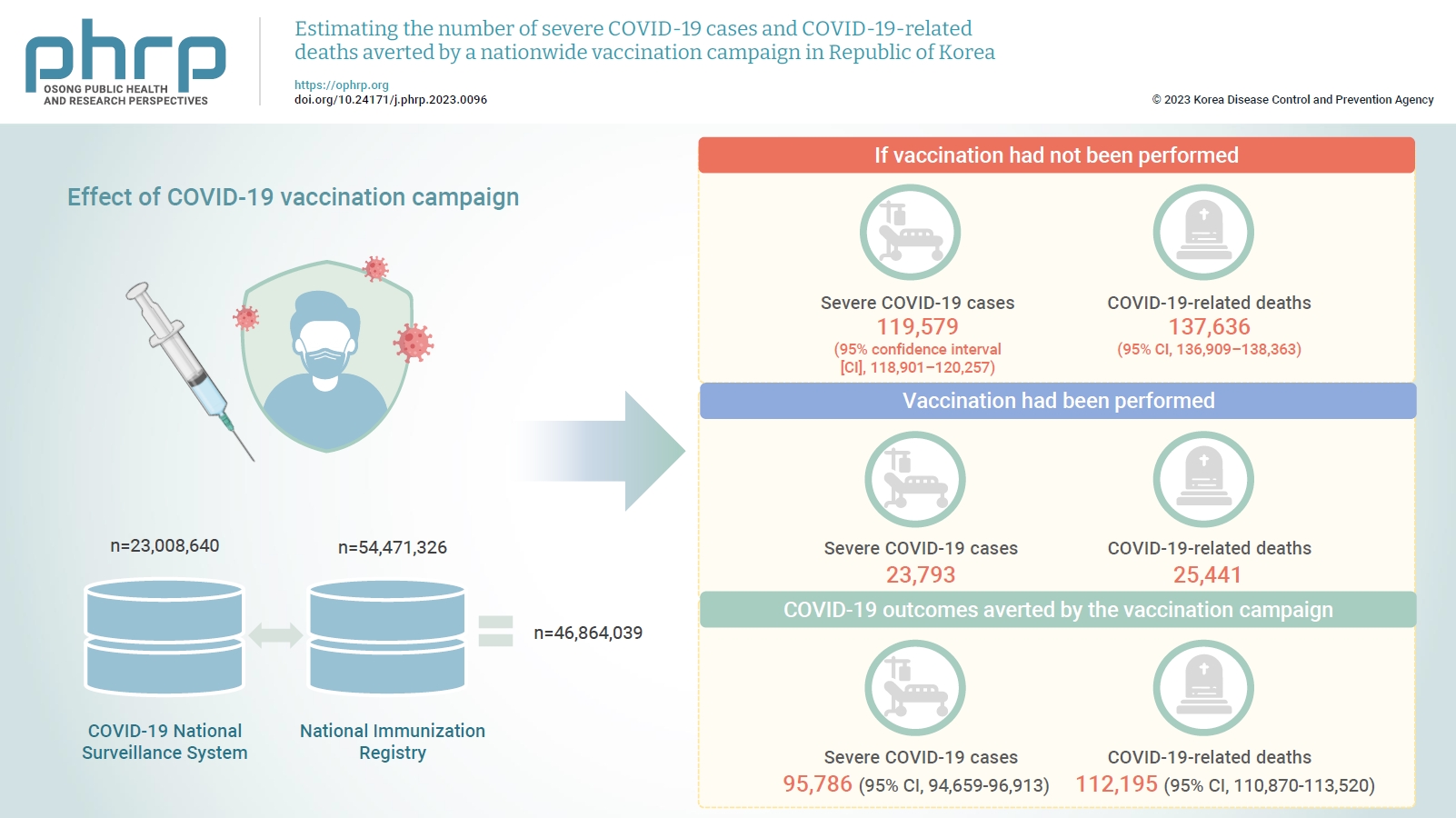
The Korea Disease Control and Prevention Agency promotes vaccination by regularly providing information on its benefits for reducing the severity of coronavirus disease 2019 (COVID-19). This study aimed to analyze the number of averted severe COVID-19 cases and COVID-19-related deaths by age group and quantify the impact of Republic of Korea’s nationwide vaccination campaign. Methods We analyzed an integrated database from the beginning of the vaccination campaign on February 26, 2021 to October 15, 2022. We estimated the cumulative number of severe cases and COVID-19-related deaths over time by comparing observed and estimated cases among unvaccinated and vaccinated groups using statistical modeling. We compared daily age-adjusted rates of severe cases and deaths in the unvaccinated group to those in the vaccinated group and calculated the susceptible population and proportion of vaccinated people by age. Results There were 23,793 severe cases and 25,441 deaths related to COVID-19. We estimated that 119,579 (95% confidence interval [CI], 118,901–120,257) severe COVID-19 cases and 137,636 (95% CI, 136,909–138,363) COVID-19-related deaths would have occurred if vaccination had not been performed. Therefore, 95,786 (95% CI, 94,659–96,913) severe cases and 112,195 (95% CI, 110,870–113,520) deaths were prevented as a result of the vaccination campaign. Conclusion We found that, if the nationwide COVID-19 vaccination campaign had not been implemented, the number of severe cases and deaths would have been at least 4 times higher. These findings suggest that Republic of Korea’s nationwide vaccination campaign reduced the number of severe cases and COVID-19 deaths. Citations
Citations to this article as recorded by
Objectives
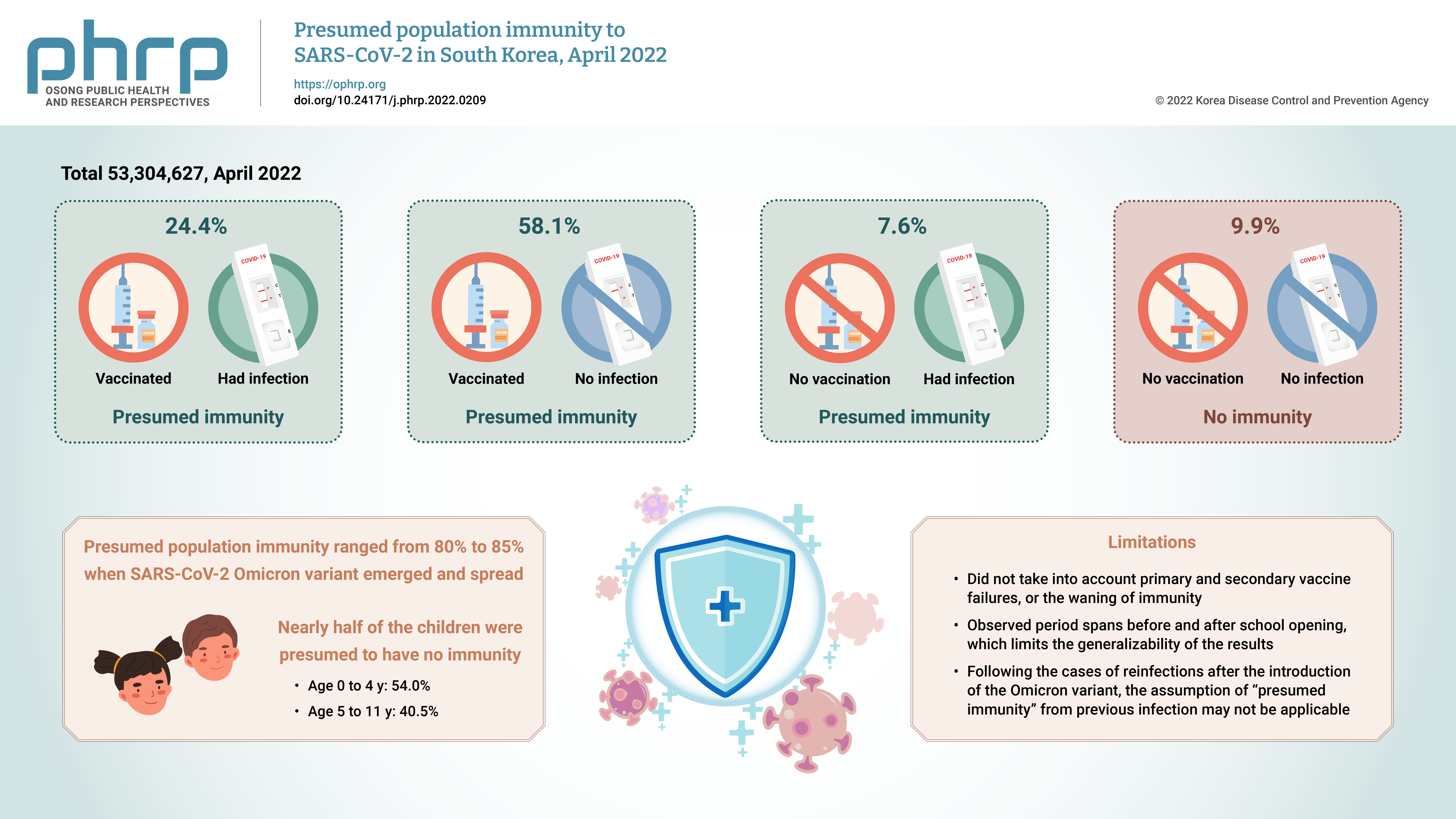
We estimated the overall and age-specific percentages of the Korean population with presumed immunity against severe acute respiratory syndrome coronavirus 2 (SARSCoV-2) as of April 2022 using the national registry. Methods We used the national coronavirus disease 2019 (COVID-19) infection and vaccination registry from South Korea, as described to define individuals with a previous history of COVID-19 infection, vaccination, or both, as persons with presumed immunity. Results Of a total of 53,304,627 observed persons, 24.4% had vaccination and infection, 58.1% had vaccination and no infection, 7.6% had infection and no vaccination, and 9.9% had no immunity. The SARS-CoV-2 Omicron variant emerged at a time when the presumed population immunity ranged from 80% to 85%; however, nearly half of the children were presumed to have no immunity. Conclusion We report a gap in population immunity, with lower presumed protection in children than in adults. The approach presented in this work can provide valuable informed tools to assist vaccine policy-making at a national level. Citations
Citations to this article as recorded by
Objectives
Food- and water-borne disease outbreaks (FBDOs) are an important public health problem worldwide. This study investigated the trends in FBDOs in Korea and established emerging causal pathogens and causal vehicles. Methods We analyzed FBDOs in Korea by year, location, causal pathogens, and causal vehicles from 2007 to 2012. Information was collected from the FBDOs database in the Korean Centers for Disease Control and Prevention. Results During 2007–2012, a total of 1794 FBDOs and 48,897 patients were reported. After 2007, FBDOs and patient numbers steadily decreased over the next 2 years and then plateaued until 2011. However, in 2012, FBDOs increased slightly accompanied by a large increase in the number of affected patients. Our results highlight the emergence of norovirus and pathogenic <i>Escherichia coli</i> other than enterohemorrhagic <i>E. coli</i> (EHEC) in schools in 2012. We found that pickled vegetables is an emerging causal vehicle responsible for this problem. Conclusion On the basis of this study we recommend intensified inspections of pickled vegetable manufacturers and the strengthening of laboratory surveillance of relevant pathogens. Citations
Citations to this article as recorded by
Shigellosis is a global disease as food poisoning by infection of <i>Shigella</i> spp (<i>S. dysenteriae</i>, <i>S. flexneri</i>, <i>S. boydii</i> and <i>S. sonnei</i>). In Korea, approximately 500 cases of shigellosis have reported every year since 2004, and imported shigellosis is increasing gradually from 2006 in particular. According to increase of numbers of overseas travelers, the numbers of patients diseased with imported shigellosis is also increasing. We need continuous surveillance studies network (SSN) for control of imported shigellosis. We studied epidemiological characteristic of imported shigellosis by using database of Korea Centers for Disease Control and Prevention (KCDC) from 2010 to 2011. The imported shigellosis is analyzed on correlation with variable factors such as sex, age, symptom, visited country as well as <i>Shigella</i> spp in the database. Total 399 patients diseased with shigellosis have been reported between 2010 and 2011, The 212 patients (53.1%) among them were disease with imported shigellosis and the 205 patients (96.7%) were diagnosed as definite shigellosis. <i>Shigella</i> sonnei (65.6%) and <i>Shigella flexneri</i> (20.3%) were isolated in order. Clinical symptoms of the shigellosis were diarrhea (96.5%), abdominal pain (54.7%), fever (52.8%), chill (31.6%), and weakness (21.7% etc) in order. Duration of diarrhea was 1 to 5 days, the number of diarrhea was mostly more than 10 times, and type of stool was almost yellow stool. Almost shigellosis was occurred in the travelers visited to Asia (98.1%). Particularly, the occurrence rate of shigellosis was highest in traveler visited to Southeast Asia which is India (21.7%), Cambodia (19.8%), Philippines (17.9%), and Vietnam (9.0%) in order. According to increase of traveler to Southeast Asia, imported Shigellosis also increased. We need to strengthen the public health and hygiene, which is infection prevention rules, eating properly-cook food, washing hands, drinking boiled water, for traveler to Asia. The quarantine and surveillance system to control imported shigellosis is need continually in Korea.
Citations
Citations to this article as recorded by
Objectives
This study investigated associations between building structure and managers’ knowledge, attitudes, and practices (KAP) regarding indoor air quality in welfare facilities for persons with disabilities, comparing facilities with and without coronavirus disease 2019 (COVID-19) cluster outbreaks. Methods: A web-based survey was conducted among managers of 242 welfare facilities for persons with disabilities in the Republic of Korea. Facilities were recruited from a national sampling frame of approximately 3,000 facilities, yielding a response rate of 8.1%. The 80-item questionnaire assessed building characteristics and air quality-related KAP scores. Logistic regression was used to identify factors associated with cluster outbreaks. Results: Of the 242 facilities, 50.8% had experienced cluster outbreaks. Facilities in complex/multi-use buildings had higher odds of outbreaks than those in detached buildings did (adjusted odds ratio, 2.21; 95% confidence interval, 1.25–3.91; p=0.006). For managerial factors, facilities with outbreaks tended to have lower attitude scores (p=0.02); however, this association did not remain statistically significant after Bonferroni correction (adjusted α=0.0083). No significant differences were observed in knowledge or practice scores. Conclusion: Building structure, particularly complex/multi-use configuration, was associated with COVID-19 cluster outbreaks. Managerial KAP scores were not definitively associated with outbreaks under the conservative significance threshold, but the observed trends suggest that institutional support, ventilation guidance, and practical training for facility managers may help strengthen future infection-prevention efforts.
Objectives
This study assessed the economic value of 2 major initiatives within the national infectious disease response system of the Korea Disease Control and Prevention Agency (KDCA): the Training Programs for Public Health Workforce (TPPHW) and the Infectious Disease Information System (IDIS). Methods: We developed a structured estimation model to quantify the economic benefits of pandemic preparedness investments and applied it to the KDCA’s TPPHW and IDIS. The model incorporated parameters elicited from 29 senior officials into a cost-benefit analysis (CBA) framework, from which we calculated the net present value (NPV) and benefit-cost ratio (BCR) over a 10-year period, with sensitivity analyses. Results: Both initiatives yielded positive net benefits under baseline assumptions, although the margin was substantially greater for workforce training than for the information system. At the assumed discount rate of 4.5%, the CBA yielded a BCR of 2.120 and an NPV of 27.2 billion Korean won (KRW) for TPPHW. For IDIS, the corresponding values were a BCR of 1.071 and an NPV of 2.7 billion KRW. Sensitivity analysis showed that workforce training remained economically justified across all scenarios, whereas the information system remained viable only under more favorable assumptions. Conclusion: This study contributes to the literature by systematically applying CBA to infectious disease preparedness in the Republic of Korea. The findings support continued investment in skilled workforce training and integrated information infrastructure for future pandemic preparedness. The study is limited by its reliance on expert-elicited parameters and its focus on monetary benefits, excluding health outcomes such as disability-adjusted life years and quality-of-life improvements.
|
|


