

| Na-young Kim | 6 Articles |
Objectives
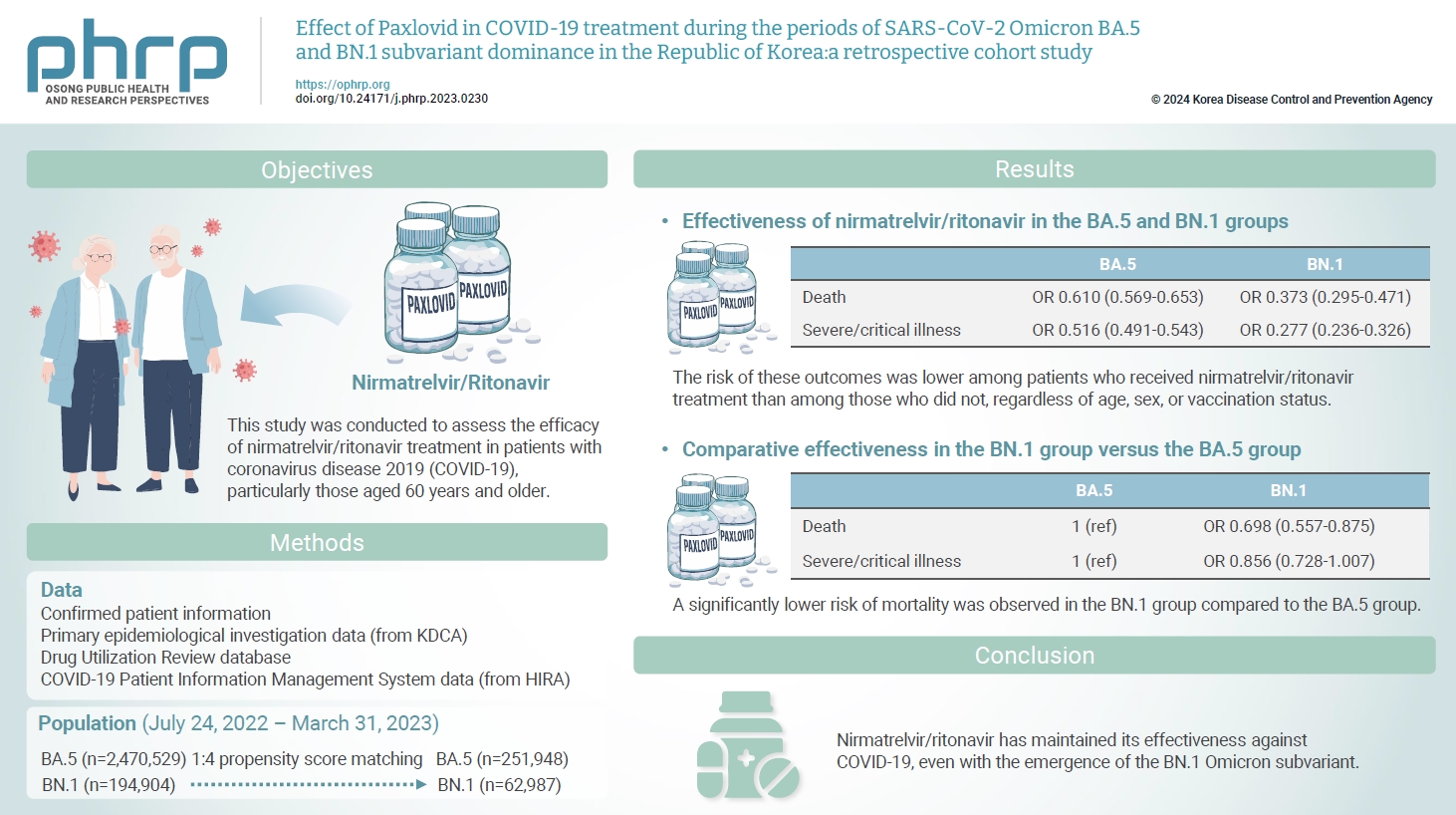
This study was conducted to assess the efficacy of nirmatrelvir/ritonavir treatment in patients with coronavirus disease 2019 (COVID-19), particularly those aged 60 years and older. Using real-world data, the period during which the BN.1 Omicron variant was dominant was compared to the period dominated by the BA.5 variant. Methods: In this retrospective cohort study, data were collected regarding 2,665,281 patients infected with severe acute respiratory syndrome coronavirus 2 between July 24, 2022, and March 31, 2023. Propensity score matching was utilized to match patients who received nirmatrelvir/ ritonavir in a 1:4 ratio between BN.1 and BA.5 variant groups. Multivariable logistic regression analysis was employed to assess the effects of nirmatrelvir/ritonavir within these groups. Results: Compared to the prior period, the efficacy of nirmatrelvir/ritonavir did not significantly differ during the interval of Omicron BN.1 variant dominance in the Republic of Korea. Among patients treated with nirmatrelvir/ritonavir, a significantly lower risk of mortality was observed in the BN.1 group (odds ratio [OR], 0.698; 95% confidence interval [CI], 0.557–0.875) compared to the BA.5 group. However, this treatment did not significantly reduce the risk of severe or critical illness, including death, for those in the BN.1 group (OR, 0.856; 95% CI, 0.728–1.007). Conclusion: Nirmatrelvir/ritonavir has maintained its effectiveness against COVID-19, even with the emergence of the BN.1 Omicron subvariant. Consequently, we strongly recommend the administration of nirmatrelvir/ritonavir to patients exhibiting COVID-19-related symptoms, irrespective of the dominant Omicron variant or their vaccination status, to mitigate disease severity and decrease the risk of mortality. Citations
Citations to this article as recorded by


Objectives
This study aimed to classify coronavirus disease 2019 (COVID-19)-related deaths according to whether COVID-19 was listed as the cause of death, and to investigate the differences in demographic characteristics and risk factors for COVID-19 death classifications. Methods A total of 5,625 deaths in South Korea among patients with confirmed COVID-19 from January 20, 2020 to December 31, 2021 were selected. Excluding false reports and unnatural deaths, 5,597 deaths were analyzed. Based on death report data, deaths were classified according to whether the cause of death was listed as COVID-19 (CD) or not (NCD). The epidemiological characteristics and causes of deaths were investigated using descriptive, univariate, and multivariate statistical analyses. Odds ratios (ORs) and 95% confidence intervals (CIs) were calculated to analyze the risk factors. Results The case fatality ratio was 0.89% and increased with age. Additionally, 96.4% of the subjects had an underlying disease, and 53.4% died in winter. The proportion of NCDs was 9.3%, of whom 19.1% died at home and 39.0% were confirmed to have COVID-19 after death. Malignant neoplasms (102/416 vs. 637/4,442; OR, 1.71; 95% CI, 1.36−2.16; p<0.001) were significantly associated with NCD. Conclusion This is the first study to analyze risk factors by cause of death using COVID-19 death report data in South Korea. These results are expected to be used as evidence for establishing a death monitoring system that can collect timely information in a new infectious disease pandemic. Citations
Citations to this article as recorded by
<p>This study describes the epidemiological characteristics of coronavirus disease 2019 (COVID-19) based on reported cases from long-term care facilities. As of April 20<sup>th</sup>, 2020, 3 long-term care facilities in a metropolitan area of South Korea had reported cases of COVID-19. These facilities’ employees were presumed to be the sources of infection. There were 2 nursing hospitals that did not report any additional cases. One nursing home had a total of 25 cases, with an attack rate of 51.4% (95% CI 35.6–67.0), and a fatality rate of 38.9% (95% CI 20.3–61.4) among residents. The results from this study suggest that early detection and maintenance of infection control minimizes the risk of rapid transmission.</p>
Citations
Citations to this article as recorded by
Objectives
Measurement of the incidence of the human immunodeficiency virus (HIV) is very important for epidemiological studies. Here, we determined the recency period with the AxSYM avidity assay and the BED-capture enzyme immunoassay (BED-CEIA) in Korean seroconverters. Methods Two hundred longitudinal specimens from 81 seroconverters with incident HIV infections that had been collected at the Korea National Institute of Health were subjected to the AxSYM avidity assay (cutoff = 0.8) and BED-CEIA (cutoff = 0.8). The statistical method used to estimate the recency period in recent HIV infections was nonparametric survival analyses. Sensitivity and specificity were calculated for 10-day increments from 120 days to 230 days to determine the recency period. Results The mean recency period of the avidity assay and BED-CEIA using a survival method was 158 days [95% confidence interval (CI), 135–181 days] and 189 days (95% CI, 170–208 days), respectively. Based on the use of sensitivity and specificity, the mean recency period for the avidity assay and BED-CEIA was 150 days and 200 days, respectively. Conclusion We determined the recency period to estimate HIV incidence in Korea. These data showed that the nonparametric survival analysis often led to shorter recency periods than analysis of sensitivity and specificity as a new method. These findings suggest that more data from seroconverters and other methodologies are needed to determine the recency period for estimating HIV incidence. Citations
Citations to this article as recorded by
Objectives
From the introduction of HIV into the Republic of Korea in 1985 through 2012, 9,410 HIV-infected Koreans have been identified. Since 2000, there has been a sharp increase in newly diagnosed HIV-infected Koreans. It is necessary to estimate the changes in HIV infection to plan budgets and to modify HIV/AIDS prevention policy. We constructed autoregressive integrated moving average (ARIMA) models to forecast the number of HIV infections from 2013 to 2017. Methods HIV infection data from 1985 to 2012 were used to fit ARIMA models. Akaike Information Criterion and Schwartz Bayesian Criterion statistics were used to evaluate the constructed models. Estimation was via the maximum likelihood method. To assess the validity of the proposed models, the mean absolute percentage error (MAPE) between the number of observed and fitted HIV infections from 1985 to 2012 was calculated. Finally, the fitted ARIMA models were used to forecast the number of HIV infections from 2013 to 2017. Results The fitted number of HIV infections was calculated by optimum ARIMA (2,2,1) model from 1985–2012. The fitted number was similar to the observed number of HIV infections, with a MAPE of 13.7%. The forecasted number of new HIV infections in 2013 was 962 (95% confidence interval (CI): 889–1,036) and in 2017 was 1,111 (95% CI: 805–1,418). The forecasted cumulative number of HIV infections in 2013 was 10,372 (95% CI: 10,308–10,437) and in 2017 was14,724 (95% CI: 13,893–15,555) by ARIMA (1,2,3). Conclusion Based on the forecast of the number of newly diagnosed HIV infections and the current cumulative number of HIV infections, the cumulative number of HIV-infected Koreans in 2017 would reach about 15,000. Citations
Citations to this article as recorded by
Objectives
The detection of HIV seroconverters increased annually since HIV antigen/antibody testing kits have been available widely in South Korea. This study aimed to identify the epidemiological characteristics of HIV seroconverters and their immune level at HIV diagnosis. Method We analyzed the epidemiological and immunological characteristics of 341 HIV seroconverters among 6,008 HIV-diagnosed individuals from 1999 and 2009. The analysis of immune level and epidemiological factors of HIV seroconverters was conducted by using chi-square test on SAS version 9.1. Results The seroconverters among newly-identified HIV cases each year increased from 0.5% in 1999 to over 5% or in 2009. The sex ratio of seroconverters was 18:1 (male:female), and 33% were in their 30s, and 28% were in their 20s. Reasons for HIV testing were involvement in voluntary test due to risky behaviors (43%), and health check-up (36%). Discovery of HIV infection occurred primarily in hospitals (84%). Among seroconverters, 55 percent had a CD4 T-cell count of more than 350/μl. Conclusion Korean HIV seroconverters tended to be younger at diagnosis, diagnosed during a voluntary test, and their CD4+ T-cell counts at HIV diagnosis were higher than those of non-seroconverters aall HIV-infected individuals. This study of HIV seroconverters will be important foundational in future studies on HIV incidence, disease progress, and survival rate. Citations
Citations to this article as recorded by
|
|


