

| Junyoung Kim | 5 Articles |

Objectives
In May 2025, clusters of salmonellosis were identified in 7 cities in the Republic of Korea, all associated with consumption of identical bakery products. This investigation aimed to characterize the outbreak, identify potential contributing factors, and inform strategies for preventing similar multi-facility foodborne outbreaks. Methods: A case series study was conducted among individuals who consumed Manufacturer H’s Product I and Product II on May 15–16, 2025 at 7 facilities (n= 1,235). Clinical specimens from symptomatic individuals, retained food samples, and environmental samples were collected and tested. Food-exposure histories were assessed, and active case finding was implemented across all supplied facilities. Traceback investigations were conducted at the manufacturer, distributor, and egg farms. Human and food isolates underwent pulsed-field gel electrophoresis (PFGE) and whole-genome sequencing (WGS). Results: A total of 323 cases met the outbreak case definition (attack rate, 26.2%), of which 48 were laboratory-confirmed. Salmonella Enteritidis was isolated from both clinical specimens and retained bakery products. PFGE patterns were indistinguishable between human and food isolates, and WGS demonstrated high genetic relatedness. These findings confirmed a common-source outbreak linked to the implicated bakery products. Conclusion: This outbreak underscores the value of integrating epidemiological investigation, active case finding, and molecular typing to identify common food vehicles in outbreaks involving widely distributed manufactured foods. Coordinated collaboration between public health and food safety authorities is essential for the effective detection, response, and prevention of multi-facility foodborne outbreaks. Citations
Citations to this article as recorded by

Objectives
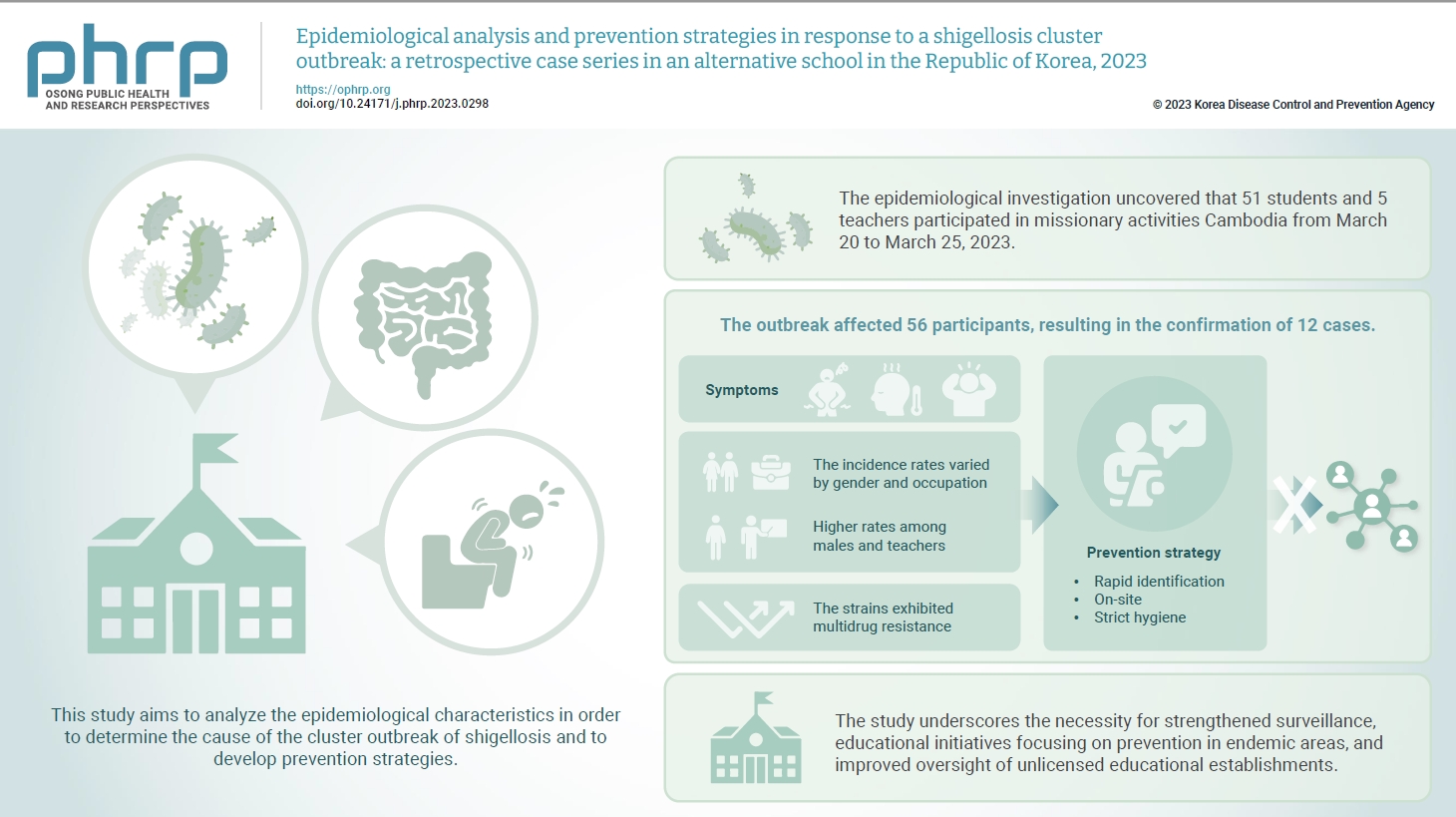
In March 2023, an alternative school in the Republic of Korea reported 12 cases of shigellosis. This study aims to analyze the epidemiological characteristics in order to determine the cause of the cluster outbreak of shigellosis and to develop prevention strategies. Methods: This study focused on 12 patients with confirmed Shigella infection and investigated their demographics, clinical features, epidemiology, diagnostics, and antimicrobial susceptibility. Following the identification of Shigella, we conducted follow-up rectal smear cultures to manage patients, implementing isolation and control measures. Results: This study investigated the emergence of multidrug-resistant Shigella following missionary activities in Cambodia, documenting a cluster infection within an alternative school in Daejeon, the Republic of Korea. The outbreak affected 56 participants, resulting in the confirmation of 12 cases. The incidence rates varied by gender and occupation, with higher rates among males and teachers. All 12 cases demonstrated multidrug resistance. Challenges included delayed pathogen confirmation and suboptimal adherence to isolation criteria. The incident prompted revisions in the criteria for isolation release, focusing on symptom resolution. The study underscores the necessity for strengthened surveillance, educational initiatives focusing on prevention in endemic areas, and improved oversight of unlicensed educational establishments. Conclusion: Successful response strategies included swift situation assessment, collaborative efforts, effective infection control measures, and modified criteria for isolation release. Continued surveillance of multidrug-resistant strains is recommended, especially in regions with a high prevalence. Citations
Citations to this article as recorded by
<p>Since a novel beta-coronavirus, severe acute respiratory syndrome coronavirus 2 (SARS-CoV-2) was first reported in December 2019, there has been a rapid global spread of the virus. Genomic surveillance was conducted on samples isolated from infected individuals to monitor the spread of genetic variants of SARS-CoV-2 in Korea. The Korea Disease Control and Prevention Agency performed whole genome sequencing of SARS-CoV-2 in Korea for 1 year (January 2020 to January 2021). A total of 2,488 SARS-CoV-2 cases were sequenced (including 648 cases from abroad). Initially, the prevalent clades of SARS-CoV-2 were the S and V clades, however, by March 2020, GH clade was the most dominant. Only international travelers were identified as having G or GR clades, and since the first variant 501Y.V1 was identified (from a traveler from the United Kingdom on December 22<sup>nd</sup>, 2020), a total of 27 variants of 501Y.V1, 501Y.V2, and 484K.V2 have been classified (as of January 25<sup>th</sup>, 2021). The results in this study indicated that quarantining of travelers entering Korea successfully prevented dissemination of the SARS-CoV-2 variants in Korea.</p>
Citations
Citations to this article as recorded by
Two real-time polymerase chain reaction assays were developed to detect mutations in codons 83 and 87 in <i>gyrA</i> and in codons 80 and 91 in <i>parC</i>, the main sites that causes quinolone resistance in pathogenic <i>Escherichia coli </i>and <i>Shigella</i> spp. isolates. These assays can be employed as a useful method for controlling infections caused by quinolone-resistant <i>E coli </i>and <i>Shigella</i> isolates.
Citations
Citations to this article as recorded by
Objectives
This study investigated a large-scale foodborne outbreak caused by Staphylococcus aureus during a local festival in the Republic of Korea and performed genomic and molecular epidemiological analyses using whole-genome sequencing (WGS). Methods Microbiological identification was performed using clinical, food, and environmental samples. Molecular characterization included pulsed-field gel electrophoresis (PFGE), multilocus sequence typing, and spa typing. WGS was conducted to evaluate clonal relatedness, virulence factors, and antimicrobial resistance genes. Results A total of 141 suspected cases and 18 laboratory-confirmed cases were identified, and 24 S. aureus isolates were recovered (18 from patients, 3 from food samples, and 3 from environmental samples). All 17 isolates included in the genomic analysis carried the sea and sec genes and belonged to ST1-t321, with pairwise differences of 8–33 SNPs, supporting a clonal origin. These isolates exhibited a previously unreported PFGE pattern (STAS16.170) in the Republic of Korea. Virulence profiling identified hemolysin genes (hlgA, hlgB, hlgC), leukocidin genes (lukD, lukE), and immune evasion genes (sak, scn). In addition, all isolates were methicillin-susceptible and lacked mecA and mecC. Conclusion This large-scale foodborne outbreak demonstrated that a single contaminated food source can result in widespread illness during mass gatherings. Genomic analysis clarified the clonal relatedness of the outbreak strains and highlighted the value of genomic surveillance for the early detection and prevention of S. aureus outbreaks.
|
|


