

| Donghyok Kwon | 9 Articles |

Objectives
This study aimed to comprehensively outline the methodological approaches used in published research comparing the vaccine effectiveness (VE) of coronavirus disease 2019 (COVID-19) vaccines. Methods A systematic search was conducted on June 13, 2024, to identify comparative studies evaluating the effectiveness of mRNA versus non-mRNA and monovalent versus bivalent COVID-19 vaccines. We screened titles, abstracts, and full texts, collecting data on publication year, country, sample size, study population composition, study design, VE estimates, outcomes, and covariates. Studies that reported relative VE (rVE) were analyzed separately from those that did not. Results We identified 25 articles comparing rVE between mRNA and non-mRNA COVID-19 vaccines, as well as between monovalent and bivalent formulations. Among the studies assessing VE by vaccine type, 126 did not provide rVE estimates. Comparative VE studies frequently employed retrospective cohort designs. Among the definitions of rVE used, the most common were hazard ratio and absolute VE, calculated as (1−odds ratio)×100. Studies were most frequently conducted in the United Kingdom and the United States, and the most common outcome was infection. Most targeted the general population and assessed the VE of mRNA vaccines using the AstraZeneca vaccine as a reference. A small proportion, 7.3% (n=11), did not adjust for any variables. Only 3 studies (2.0%) adjusted for all core confounding variables recommended by the World Health Organization. Conclusion Few comparative studies of COVID-19 vaccines have incorporated rVE methodologies. Reporting rVE and employing a consistent set of covariates can broaden our understanding of COVID-19 vaccines. Citations
Citations to this article as recorded by

Objectives
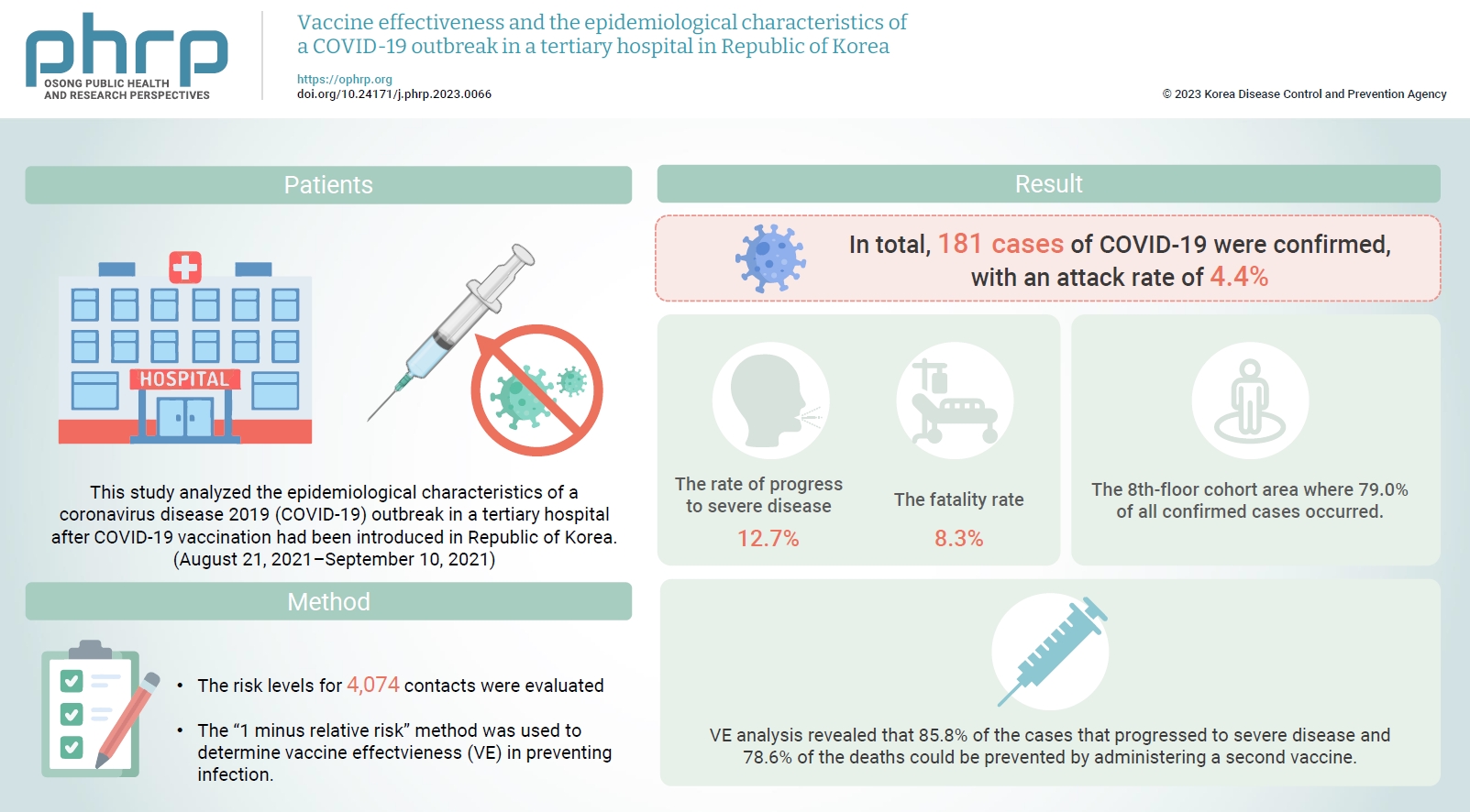
Healthcare facilities are high-risk sites for infection. This study analyzed the epidemiological characteristics of a coronavirus disease 2019 (COVID-19) outbreak in a tertiary hospital after COVID-19 vaccination had been introduced in Republic of Korea. Vaccine effectiveness (VE) and shared anti-infection strategies are also assessed. Methods The risk levels for 4,074 contacts were evaluated. The epidemiological characteristics of confirmed cases were evaluated using the chi-square test. The “1 minus relative risk” method was used to determine VE in preventing infection, progression to severe disease, and death. In the largest affected area (the 8th floor), a separate relative risk analysis was conducted. A multivariate logistic regression analysis (with 95% confidence interval [CIs]) was used to identify transmission risk factors with a significance level <10% via the backward elimination method. Results In total, 181 cases of COVID-19 were confirmed, with an attack rate of 4.4%. Of those cases, 12.7% progressed to severe disease, and 8.3% died. In the cohort isolation area on the 8th floor, where 79.0% of the confirmed cases occurred, the adjusted odds ratio was 6.55 (95% CI, 2.99–14.33) and 2.19 (95% CI, 1.24–3.88) for caregivers and the unvaccinated group, respectively. VE analysis revealed that 85.8% of the cases that progressed to severe disease and 78.6% of the deaths could be prevented by administering a second vaccine. Conclusion Caregiver training for infection prevention and control is necessary to reduce infection risk. Vaccination is an important intervention to reduce the risk of progression to severe disease and death.
Objectives
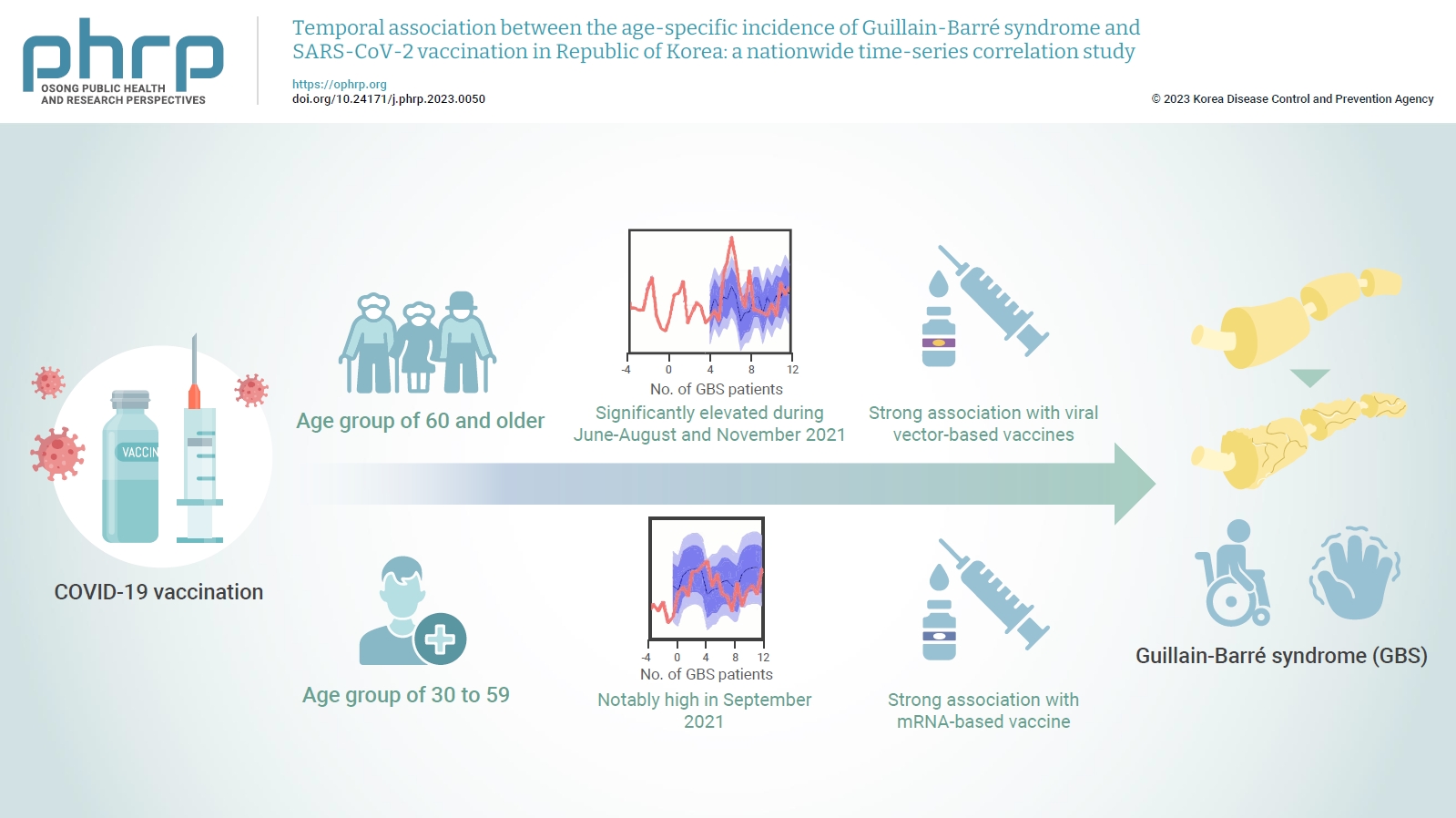
The incidence of Guillain-Barré syndrome (GBS) changed significantly during the coronavirus disease 2019 (COVID-19) pandemic. Emerging reports suggest that viral vector-based vaccines may be associated with an elevated risk of GBS. Methods In this nationwide time-series correlation study, we examined the age-specific incidence of GBS from January 2011 to August 2022, as well as data on severe acute respiratory syndrome coronavirus 2 (SARS-CoV-2) vaccinations and infections from February 2021 to August 2022. We compared the forecasted estimates of age-specific GBS incidence, using the pre-SARS-CoV-2 period as a benchmark, with the actual incidence observed during the post-vaccination period of the pandemic. Furthermore, we assessed the temporal association between GBS, SARS-CoV-2 vaccinations, and COVID-19 for different age groups. Results In the age group of 60 and older, the rate ratio was significantly elevated during June-August and November 2021. A significant, strong positive association was observed between viral vector-based vaccines and GBS incidence trends in this age group (r=0.52, p=0.022). For the 30 to 59 years age group, the rate ratio was notably high in September 2021. A statistically significant, strong positive association was found between mRNA-based vaccines and GBS incidence in this age group (r=0.61, p=0.006). Conclusion Viral vector-based SARS-CoV-2 vaccines were found to be temporally associated with an increased risk of GBS, particularly in older adults. To minimize age-specific and biological mechanism-specific adverse events, future vaccination campaigns should adopt a more personalized approach, such as recommending homologous mRNA-based SARS-CoV-2 vaccines for older adults to reduce the heightened risk of GBS. Citations
Citations to this article as recorded by

Objectives
This study aimed to classify coronavirus disease 2019 (COVID-19)-related deaths according to whether COVID-19 was listed as the cause of death, and to investigate the differences in demographic characteristics and risk factors for COVID-19 death classifications. Methods A total of 5,625 deaths in South Korea among patients with confirmed COVID-19 from January 20, 2020 to December 31, 2021 were selected. Excluding false reports and unnatural deaths, 5,597 deaths were analyzed. Based on death report data, deaths were classified according to whether the cause of death was listed as COVID-19 (CD) or not (NCD). The epidemiological characteristics and causes of deaths were investigated using descriptive, univariate, and multivariate statistical analyses. Odds ratios (ORs) and 95% confidence intervals (CIs) were calculated to analyze the risk factors. Results The case fatality ratio was 0.89% and increased with age. Additionally, 96.4% of the subjects had an underlying disease, and 53.4% died in winter. The proportion of NCDs was 9.3%, of whom 19.1% died at home and 39.0% were confirmed to have COVID-19 after death. Malignant neoplasms (102/416 vs. 637/4,442; OR, 1.71; 95% CI, 1.36−2.16; p<0.001) were significantly associated with NCD. Conclusion This is the first study to analyze risk factors by cause of death using COVID-19 death report data in South Korea. These results are expected to be used as evidence for establishing a death monitoring system that can collect timely information in a new infectious disease pandemic. Citations
Citations to this article as recorded by
The variant B.1.1.7 of severe acute respiratory syndrome coronavirus 2 (SARS-CoV-2), the RNA virus causing the pandemic more than a year worldwide, was reported from United Kingdom (UK) in late December 2020. It was reported that mortality increases by 65% and transmissibility increases by 70%, which may result in an increase of reproduction number to 1.13−1.55 from 0.75−0.85. To analyze the global increasing trend of the variant B.1.1.7, we extracted results of B.1.1.7 from GISAID on May 11 and May 12, 2021, and conducted a doseresponse regression. It took 47 days to reach 20% and 121 days to reach 50% among the sequence submitted from UK. In Korea, cases of B.1.1.7 have increased since the first report of three cases on December 28, 2020. Positive rate of B.1.1.7 in Korea was 21.6% in the week from May 9 to May 15, 2021. Detection rate of the variants is expected to increase further and new variants of SARS-CoV-2 are emerging, so a close monitoring and control would be maintained for months.
Citations
Citations to this article as recorded by
<p>Since a novel beta-coronavirus, severe acute respiratory syndrome coronavirus 2 (SARS-CoV-2) was first reported in December 2019, there has been a rapid global spread of the virus. Genomic surveillance was conducted on samples isolated from infected individuals to monitor the spread of genetic variants of SARS-CoV-2 in Korea. The Korea Disease Control and Prevention Agency performed whole genome sequencing of SARS-CoV-2 in Korea for 1 year (January 2020 to January 2021). A total of 2,488 SARS-CoV-2 cases were sequenced (including 648 cases from abroad). Initially, the prevalent clades of SARS-CoV-2 were the S and V clades, however, by March 2020, GH clade was the most dominant. Only international travelers were identified as having G or GR clades, and since the first variant 501Y.V1 was identified (from a traveler from the United Kingdom on December 22<sup>nd</sup>, 2020), a total of 27 variants of 501Y.V1, 501Y.V2, and 484K.V2 have been classified (as of January 25<sup>th</sup>, 2021). The results in this study indicated that quarantining of travelers entering Korea successfully prevented dissemination of the SARS-CoV-2 variants in Korea.</p>
Citations
Citations to this article as recorded by
Objectives
Melioidosis is a potentially fatal infectious disease caused by the environmental anaerobic Gram-negative bacillus <i>Burkholderia pseudomallei</i>. Melioidosis is endemic to areas of northern Australia and Southeast Asia. With increasing international travel and migration, imported cases of melioidosis are being reported regularly. Here, we summarize the 11 cases of melioidosis reported in South Korea from 2003 to 2014. Methods Tracing epidemiological investigations were performed on every patient reported to the National Surveillance System since 2011. A systematic literature search was performed to identify melioidosis cases that occurred prior to 2011. Results The overall fatality rate was 36.4%. All the patients had visited Southeast Asia where melioidosis is endemic. The stay in the endemic region ranged from 4 days to 20 years. Of the seven patients who developed initial symptoms after returning to South Korea, the time interval between returning to South Korea and symptom onset ranged from 1 day to 3 years. The remaining four patients developed symptoms during their stay in the endemic region and were diagnosed with melioidosis in South Korea. Seven (63.6%) patients possessed at least one risk factor, all of whom were diabetic. Pneumonia was the most frequent clinical manifestation, but the patients showed a wide spectrum of clinical features, including internal organ abscesses, a mycotic aneurysm of the aorta, and coinfection with tuberculosis. Conclusion An early diagnosis and initiation of the appropriate antibiotics can reduce the mortality of melioidosis. Consequently, increased awareness of the risk factors and clinical features of melioidosis is required. Citations
Citations to this article as recorded by
Objectives
The aim of this study was to develop an immunochromatographic assay (ICA) for the detection of influenza A (H1N1) pdm09 virus infection. Materials and methods Several monoclonal antibodies against influenza A (H1N1) pdm09 virus were generated and an ICA (pdm09-ICA) was developed for the rapid and specific detection of influenza A (H1N1) pdm09 virus infection. The specificity and sensitivity of the developed assay were compared with that of hemagglutination assay and real-time reverse-transcription polymerase chain reaction (rRT-PCR). Results The detection limit was estimated to be 1/2 (8) hemagglutinating unit; the sensitivity and specificity rates of pdm09-ICA were 75.86% (110/145) and 100% (43/43), respectively, compared with rRT-PCR. The cross-reactivity for 20 influenza viruses, including seasonal H1N1 viruses, was found to be negative except for the H1N1 virus (A/Swine/Korea/GC0503/2005). Conclusion These results indicate that the proposed method can be easily used for rapid and specific detection of the pdm09 infection. The assay developed in this study would be a useful tool for distinguishing the pdm09 infection from seasonal influenza A and B infections. Citations
Citations to this article as recorded by
Objectives
We aimed to evaluate the pathogenesis and chronologic localization of human influenza A (H1N1) virus in experimentally infected cotton rats. Methods The animals were intranasally inoculated with 10<sup>7</sup> plaque-forming units of A/Solomon Islands/3/2006 (H1N1) influenza virus and evaluated for pathogenicity for a period of 28 days. Virus replication kinetics and pathological properties were assessed chronologically. Acute antiviral responses were evaluated by mean of real-time polymerase chain reaction. Results Cotton rats infected with A/Solomon Islands/3/2006 virus lost weight until 6 days post-inoculation (DPI) and showed decreased activity until 3 DPI. At necropsy, focal areas of redness and consolidation of lungs were evident at 1, 2, and 3 DPI. Lung histopathology showed moderate to severe interstitial pneumonia, alveolitis and bronchiolitis. Influenza A specific viral protein was detected in bronchiolar epithelial cells, alveolar septa and pneumocytes. Influenza viruses were recovered from the lungs during the early period of infection and the titer peaked at 1 DPI. Viral proteins were detected from 4 hours to 6 hours DPI. These trends correlate with the up-regulation of mRNA expression of the IFN-α, Mx1, and Mx2 genes that play critical roles in the anti-influenza response at the early stage of infection. Conclusion Our results provide evidence that supports the use of cotton rats for the study of influenza virus pathogenesis and the immune response. Citations
Citations to this article as recorded by
|
|


