

| Cheon-Kwon Yoo | 8 Articles |
Objectives
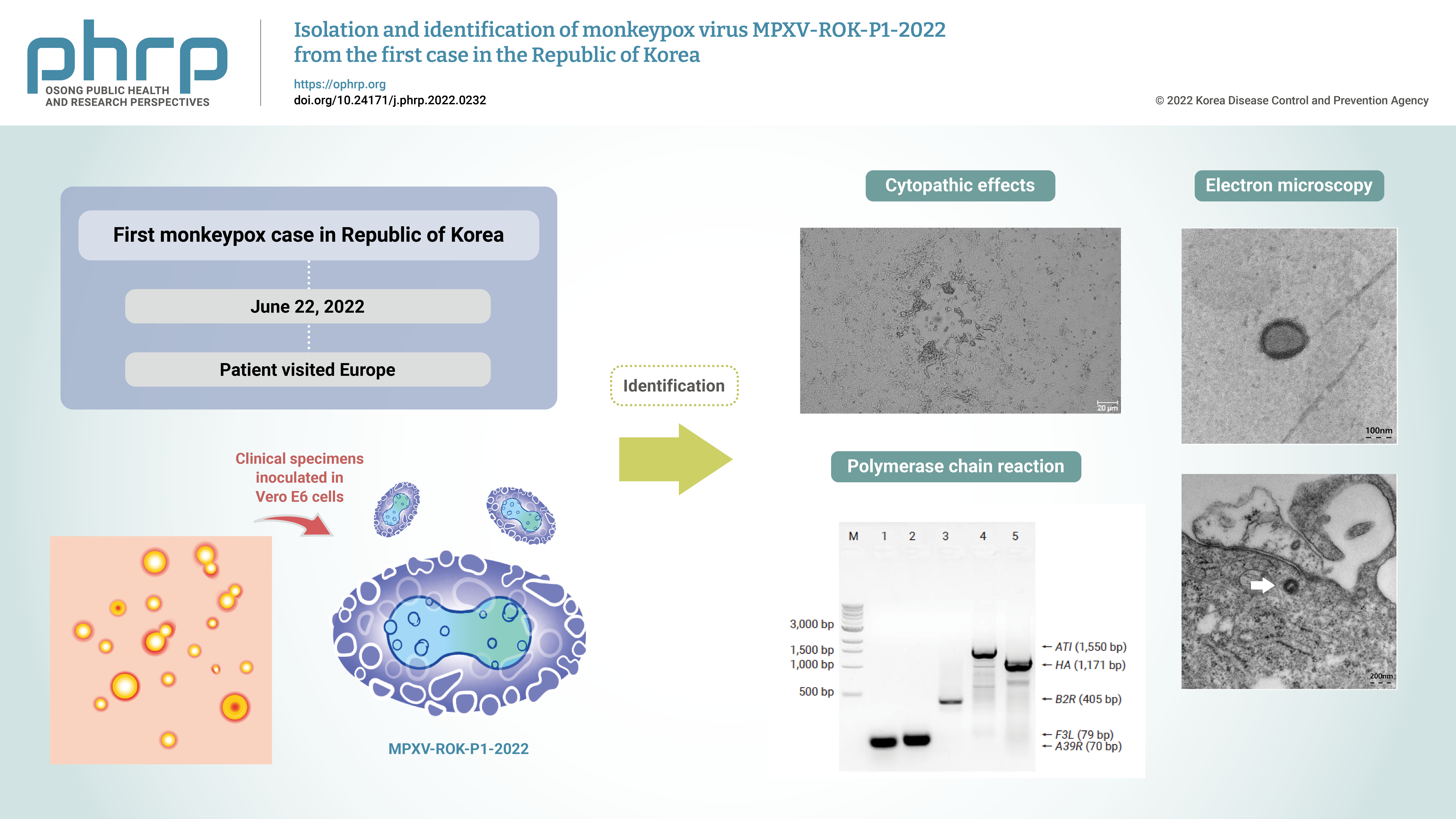
Monkeypox outbreaks in nonendemic countries have been reported since early May 2022. The first case of monkeypox in the Republic of Korea was confirmed in a patient who traveled to Europe in June 2022, and an attempt was made to isolate and identify the monkeypox virus (MPXV) from the patient’s specimens. Methods Clinical specimens from the patient were inoculated in Vero E6 cells. The isolated virus was identified as MPXV by the observation of cytopathic effects on Vero E6 cells, transmission electron microscopy, conventional polymerase chain reaction (PCR), and sequencing of PCR products. Results Cytopathic effects were observed in Vero E6 cells that were inoculated with skin lesion swab eluates. After multiple passages from the primary culture, orthopoxvirus morphology was observed using transmission electron microscopy. In addition, both MPXV-specific (F3L and ATI) and orthopoxvirus-specific genes (A39R, B2R, and HA) were confirmed by conventional PCR and Sanger sequencing. Conclusion These results indicate the successful isolation and identification of MPXV from the first patient in the Republic of Korea. The isolated virus was named MPXV-ROK-P1-2022. Citations
Citations to this article as recorded by

<p>Since a novel beta-coronavirus, severe acute respiratory syndrome coronavirus 2 (SARS-CoV-2) was first reported in December 2019, there has been a rapid global spread of the virus. Genomic surveillance was conducted on samples isolated from infected individuals to monitor the spread of genetic variants of SARS-CoV-2 in Korea. The Korea Disease Control and Prevention Agency performed whole genome sequencing of SARS-CoV-2 in Korea for 1 year (January 2020 to January 2021). A total of 2,488 SARS-CoV-2 cases were sequenced (including 648 cases from abroad). Initially, the prevalent clades of SARS-CoV-2 were the S and V clades, however, by March 2020, GH clade was the most dominant. Only international travelers were identified as having G or GR clades, and since the first variant 501Y.V1 was identified (from a traveler from the United Kingdom on December 22<sup>nd</sup>, 2020), a total of 27 variants of 501Y.V1, 501Y.V2, and 484K.V2 have been classified (as of January 25<sup>th</sup>, 2021). The results in this study indicated that quarantining of travelers entering Korea successfully prevented dissemination of the SARS-CoV-2 variants in Korea.</p>
Citations
Citations to this article as recorded by
<sec>
<title>Objectives</title>
<p>The Korea Centers for Disease Control and Prevention has published “A Guideline for Unknown Disease Outbreaks (UDO).” The aim of this report was to introduce tabletop exercises (TTX) to prepare for UDO in the future.</p></sec>
<sec>
<title>Methods</title>
<p>The UDO Laboratory Analyses Task Force in Korea Centers for Disease Control and Prevention in April 2018, assigned unknown diseases into 5 syndromes, designed an algorithm for diagnosis, and made a panel list for diagnosis by exclusion. Using the guidelines and laboratory analyses for UDO, TTX were introduced.</p></sec>
<sec>
<title>Results</title>
<p>Since September 9<sup>th</sup>, 2018, the UDO Laboratory Analyses Task Force has been preparing TTX based on a scenario of an outbreak caused by a novel coronavirus. In December 2019, through TTX, individual missions, epidemiological investigations, sample treatments, diagnosis by exclusions, and next generation sequencing analysis were discussed, and a novel coronavirus was identified as the causal pathogen.</p></sec>
<sec>
<title>Conclusion</title>
<p>Guideline and laboratory analyses for UDO successfully applied in TTX. Conclusions drawn from TTX could be applied effectively in the analyses for the initial response to COVID-19, an ongoing epidemic of 2019 – 2020. Therefore, TTX should continuously be conducted for the response and preparation against UDO.</p></sec>
Citations
Citations to this article as recorded by
<sec><title>Objectives</title>
<p>Severe acute respiratory syndrome coronavirus 2 (SARS-CoV-2) emerged in Wuhan, China, in December 2019 and has been rapidly spreading worldwide. Although the causal relationship among mutations and the features of SARS-CoV-2 such as rapid transmission, pathogenicity, and tropism, remains unclear, our results of genomic mutations in SARS-CoV-2 may help to interpret the interaction between genomic characterization in SARS-CoV-2 and infectivity with the host.</p></sec>
<sec><title>Methods</title>
<p>A total of 4,254 genomic sequences of SARS-CoV-2 were collected from the Global Initiative on Sharing all Influenza Data (GISAID). Multiple sequence alignment for phylogenetic analysis and comparative genomic approach for mutation analysis were conducted using Molecular Evolutionary Genetics Analysis (MEGA), and an in-house program based on Perl language, respectively.</p></sec>
<sec><title>Results</title>
<p>Phylogenetic analysis of SARS-CoV-2 strains indicated that there were 3 major clades including S, V, and G, and 2 subclades (G.1 and G.2). There were 767 types of synonymous and 1,352 types of non-synonymous mutation. ORF1a, ORF1b, S, and N genes were detected at high frequency, whereas ORF7b and E genes exhibited low frequency. In the receptor-binding domain (RBD) of the S gene, 11 non-synonymous mutations were observed in the region adjacent to the angiotensin converting enzyme 2 (ACE2) binding site.</p></sec>
<sec><title>Conclusion</title>
<p>It has been reported that the rapid infectivity and transmission of SARS-CoV-2 associated with host receptor affinity are derived from several mutations in its genes. Without these genetic mutations to enhance evolutionary adaptation, species recognition, host receptor affinity, and pathogenicity, it would not survive. It is expected that our results could provide an important clue in understanding the genomic characteristics of SARS-CoV-2.</p></sec>
Citations
Citations to this article as recorded by
<p>Human norovirus are major causative agent of nonbacterial acute gastroenteritis. In general, genogroup (G) II.4 is the most prominent major genotype that circulate in human population and the environment. However, a shift in genotypic trends was observed in Korea in December 2014. In this study, we investigated the trend of norovirus genotype in detail using the database of Acute Diarrhea Laboratory Surveillance (K-EnterNet) in Korea. GII.17 has since become a major contributor to outbreaks of norovirus-related infections and sporadic cases in Korea, although the reason for this shift remain unknown.</p>
Citations
Citations to this article as recorded by
Human noroviruses are major causative agents of food and waterborne outbreaks of nonbacterial acute gastroenteritis. In this study, we report the epidemiological features of three outbreak cases of norovirus in Korea, and we describe the clinical symptoms and distribution of the causative genotypes. The incidence rates of the three outbreaks were 16.24% (326/2,007), 4.1% (27/656), and 16.8% (36/214), respectively. The patients in these three outbreaks were affected by acute gastroenteritis. These schools were provided unheated food from the same manufacturing company. Two genotypes (GII.3 and GII.4) of the norovirus were detected in these cases. Among them, major causative strains of GII.4 (Hu-jeju-47-2007KR-like) were identified in patients, food handlers, and groundwater from the manufacturing company of the unheated food. In the GII.4 (Hu-jeju-47-2007KR-like) strain of the norovirus, the nucleotide sequences were identical and identified as the GII.4 Sydney variant. Our data suggests that the combined epidemiological and laboratory results were closely related, and the causative pathogen was the GII.4 Sydney variant strain from contaminated groundwater.
Citations
Citations to this article as recorded by
Norovirus GII.4 is recognized as a worldwide cause of nonbacterial outbreaks. In particular, the GII.4 variant occurs every 2–3 years according to antigenic variation. The aim of our study was to identify GII.4 variants in outbreaks in Korea during 2004–2012. Partial VP1 sequence of norovirus GII.4-related outbreaks during 2004–2012 was analyzed. The partial VP1 sequence was detected with reverse transcription-polymerase chain reaction, seminested polymerase chain reaction, and nucleotide sequence of 312-314 base pairs for phylogenetic comparison. Nine variants emerged in outbreaks, with the Sydney variant showing predominance recently. This predominance may persist for at least 3 years, although new variants may appear in Korea.
Citations
Citations to this article as recorded by
Objectives
The aim of this study was to characterize the pathogens responsible for causing diarrhea according to season, region of isolation, patient age, and sex as well as to provide useful data for the prevention of diarrheal disease. Methods Stool specimens from 14,886 patients with diarrhea were collected to identify pathogenic bacteria from January 2014 to December 2014 in Korea. A total of 3,526 pathogenic bacteria were isolated and analyzed according to season, region of isolation, and the age and sex of the patient. Results The breakdown of the isolated pathogenic bacteria were as follows: <i>Salmonella</i> spp. 476 (13.5%), pathogenic <i>Escherichia coli</i> 777 (22.0%), <i>Vibrio parahaemolyticus</i> 26 (0.74%), <i>Shigella</i> spp. 13 (0.37%), <i>Campylobacter</i> spp. 215 (6.10%), <i>Clostridium perfringens</i> 508 (14.4%), <i>Staphylococcus aureus</i> 1,144 (32.4%), <i>Bacillus cereus</i> 356 (10.1%), <i>Listeria monocytogenes</i> 1 (0.03%), and <i>Yersinia enterocolitica</i> 10 (0.3%). The isolation rate trend showed the highest ratio in the summer season from June to September for most of the pathogenic bacteria except the Gram-positive bacteria. The isolation rate of most of the pathogenic bacteria by patient age showed highest ratio in the 0–19 year age range. For isolation rate by region, 56.2% were isolated from cities and 43.8% were isolated from provinces. Conclusion Hygiene education should be addressed for diarrheal disease-susceptible groups, such as those younger than 10 years, aged 10–19 years, and older than 70 years, and monitoring for the pathogens is still required. In addition, an efficient laboratory surveillance system for infection control should be continued. Citations
Citations to this article as recorded by
|
|


