Introduction
Malaria remains a significant public health concern in Southeast Asia despite notable progress in reducing disease burden over the past 2 decades. The region experienced a marked decline in cases, from 22.8 million in 2000 to 5.2 million in 2022; however, it still accounted for more than 8,000 malaria-related deaths and 18% of the global burden in 2022. Although countries such as Vietnam and Cambodia have achieved substantial reductions in transmission, others, including Myanmar, Laos, and Indonesia, continue to experience high disease prevalence and persistent transmission [
1,
2]. Malaria is a vector-borne infectious disease transmitted by female Anopheles mosquitoes and caused by
Plasmodium parasites [
3–
5]. Five species are known to infect humans:
Plasmodium falciparum,
Plasmodium vivax,
Plasmodium malariae,
Plasmodium ovale, and the zoonotic
Plasmodium knowlesi. Among these,
P. falciparum and
P. vivax are the primary drivers of morbidity [
6].
According to the 2024 World Health Organization report, the Southeast Asia Region recorded approximately 4 million malaria cases across 8 endemic countries. Although decreases were observed in Bangladesh, India, Indonesia, and Nepal, substantial increases were reported in Myanmar (45.1%) and Thailand (46.4%). Notably, the number of reported indigenous cases in Thailand more than tripled between 2021 and 2023, largely driven by cross-border transmission and displaced populations from Myanmar, necessitating increased resources for diagnosis and treatment [
7].
Understanding the genetic diversity and population structure of malaria parasites is essential for guiding and evaluating elimination strategies. Central to molecular surveillance is multiplicity of infection (MOI), defined as the number of genetically distinct parasite strains co-infecting a single host. Multiclonal infections increase the likelihood of genetic recombination during the sexual cycle in mosquitoes, generating sporozoites with novel genotypes and contributing to parasite diversification [
8]. These infections may arise through cotransmission of multiple clones in a single mosquito bite or through superinfection following repeated exposure to infectious bites [
9–
11]. Consequently, MOI has been widely used as a surrogate marker of transmission intensity, whereas the presence of polyclonal infections reflects ongoing exposure to genetically diverse parasite populations. In endemic settings, frequent polyclonal infections are often accompanied by higher MOI values, together indicating sustained transmission and a large parasite reservoir [
12,
13].
Beyond serving as indicators of transmission intensity, polyclonal infections also have broader epidemiological and clinical relevance. They reflect ongoing exposure to genetically diverse parasite populations and are commonly observed in endemic settings in which individuals experience repeated infectious mosquito bites [
11–
13]. Importantly, minority clones within polyclonal infections may be preferentially transmitted to mosquitoes, including drug-resistant strains, thereby potentially facilitating the spread of resistance and complicating malaria control efforts [
14]. Moreover, measures of genetic diversity derived from multiclonal infections can be used to assess geographic differentiation, infer parasite movement, and support surveillance efforts aimed at identifying the origin of infections in elimination settings [
15]. From a clinical perspective, greater infection complexity has also been associated with increased disease severity, as patients with severe or cerebral malaria often harbor a greater number of genetically distinct parasite clones than those with uncomplicated infections [
16].
Several population genetic studies from Southeast Asia have shown that
P. vivax often maintains high genetic diversity even in low-transmission settings, with expected heterozygosity (He) frequently exceeding 0.7 and substantial proportions of polyclonal infections despite intensive control efforts [
17–
20]. In contrast,
P. falciparum populations in the same areas tend to show more pronounced reductions in diversity and stronger linkage disequilibrium as incidence declines [
21]. Recent studies have also begun to characterize
P. knowlesi populations in Malaysia and Indonesia, suggesting relatively low infection complexity in humans but important reservoirs in macaques [
22,
23]. However, these studies remain scattered, use heterogeneous molecular markers and analytical approaches, and typically focus on single species and localized settings.
Understanding how genetic diversity and MOI vary by species, host population, and epidemiological context is therefore critical for interpreting molecular surveillance data during the malaria elimination phase. Accordingly, this scoping review aims to synthesize the available evidence on genetic diversity and MOI across 4 human-infecting Plasmodium species and to examine how these metrics vary in relation to transmission intensity across Southeast Asia.
Materials and Methods
Scoping Review Approach
We conducted a scoping review to identify studies relevant to our research question. Scoping review methodology is a structured approach to evidence synthesis that aims to systematically map the breadth and depth of the literature on a given topic and to identify key concepts, types of evidence, and research gaps [
24]. We followed the Preferred Reporting Items for Systematic Reviews and Meta-Analyses Extension for Scoping Reviews (PRISMA-ScR) guidelines [
25]. The review protocol was defined a priori, and the eligibility criteria, search strategy, and data extraction items were specified before study selection. The review questions were framed using the Population, Concept, and Context (PCC) structure (
Table 1).
Eligibility Criteria
Inclusion criteria
The review considered (1) reported original research with primary data; (2) included human participants with laboratory-confirmed malaria (microscopy and/or polymerase chain reaction [PCR]), regardless of age, sex, or clinical severity; (3) used molecular genotyping to determine Plasmodium spp. genetic diversity and MOI, including mean expected He, allele frequencies, and mean MOI or percentage of multiple infections; (4) employed observational (cross sectional/survey, case–control, cohort); (5) were published in English and available as full‑text open‑access articles; and (6) were published in the last 10 years.
Exclusion criteria
(1) Experimental studies using only animal models or in vitro cultures; (2) review papers, case reports, case series, comments, or editorials; (3) studies from non‑Southeast Asian settings; (4) studies without any relevant keywords related to Plasmodium genetic diversity or MOI in the title or abstract; and (5) studies using unclear or inappropriate molecular methods that did not allow reliable estimation of MOI or genetic diversity.
Information Sources and Search Strategy
We searched major electronic databases, including PubMed, Scopus, ProQuest, and EBSCO, from January 1, 2015, to October 11, 2025. The search strategy combined controlled vocabulary and free-text terms related to Plasmodium species, genetic diversity, and MOI. The search string used in the database search engines was as follows: (“Plasmodium falciparum” OR “Plasmodium vivax” OR “Plasmodium malariae” OR “Plasmodium ovale” OR “Plasmodium knowlesi” OR “malaria”) AND (“genetic variation” OR “genetic diversity”) AND (“multiplicity of infection” OR “multiple infection” OR “MOI”).
Searches were limited to English-language publications from the previous decade. Duplicate records were removed.
Selection Process
All records retrieved from the database searches were imported into Mendeley Reference Manager (
https://www.mendeley.com/). Duplicate records were identified and removed manually by the reviewer. Titles and abstracts were then screened against the predefined inclusion and exclusion criteria. Studies that clearly did not meet the eligibility criteria, such as those conducted outside Southeast Asia, involving non-human hosts, lacking genetic diversity or MOI outcomes, consisting of review articles, or lacking accessible full texts, were excluded at this stage. Potentially relevant studies were retrieved in full and assessed in detail for eligibility. Full-text screening also led to the exclusion of studies that, on closer inspection, did not contain appropriate molecular genetic data, were conducted outside Southeast Asia, or did not report the required outcome measures. Only studies that fully met all PCC-based criteria were included in the data extraction.
Data Collection Process
Data extraction was conducted by a single reviewer using a predesigned and piloted Excel extraction template. For each included study, the reviewer extracted information on study characteristics, the number of genotyped samples, species investigated, molecular markers used, measures of genetic diversity (e.g., expected He and allele frequencies), and indicators of MOI (e.g., mean MOI and the prevalence of polyclonal infections). No automation tools were used during data extraction. All data were extracted directly from the published reports, and no contact was made with study authors or investigators to obtain missing information. To minimize errors and bias, the extracted data were cross-checked by the co-authors for internal consistency before synthesis.
Data Items
All included articles were charted in a prepiloted Excel extraction form with separate sheets for each species (P. falciparum, P. vivax, P. malariae, P. ovale, and P. knowlesi). For each study, we extracted (1) first author and publication year; (2) country or border region; (3) malaria clinical category (symptomatic, asymptomatic, mixed, severe/cerebral); (4) number of infections genotyped; (5) molecular markers used; (6) measures of genetic diversity; (7) measures of MOI; (8) any notable stratifications.
Data extraction was done separately by Plasmodium species, which allowed cross‑comparison of marker choice, diversity and MOI patterns within and between species.
Synthesis Methods
Data were synthesized narratively in accordance with the aims of a scoping review. No meta-analysis or quantitative pooling was performed because of substantial heterogeneity in study designs, molecular markers, genotyping methods, and outcome definitions across the included studies. Extracted data were organized by Plasmodium species and summarized descriptively in terms of the number of genotyped infections, types of molecular markers used, measures of genetic diversity, and MOI indices. Patterns were described across countries, transmission settings, and species, and no statistical comparisons or effect estimates were generated.
Results
Study Selection
The database search identified 198 records. After removal of 33 duplicates and screening of 165 titles and abstracts, 29 full-text articles were sought for retrieval. Before eligibility assessment, 3 articles could not be retrieved, leaving 26 articles for full-text review. Ten articles that appeared eligible based on title and abstract were excluded during full-text review because they lacked MOI or multilocus genetic diversity outcomes, used inadequate molecular markers, focused on non-human hosts, or were conducted outside Southeast Asia without epidemiological relevance to the China-Myanmar border or Greater Mekong Subregion. Sixteen studies met the inclusion criteria and were included in the review. Among studies that appeared eligible at the abstract stage but were excluded after full-text review, the most common reasons were the absence of MOI outcomes and insufficient genotyping detail. A PRISMA-style flow diagram is shown in
Figure 1.
Study Characteristics
Most included studies were cross-sectional, facility-based surveys that primarily enrolled patients presenting with symptomatic malaria. Several studies also included asymptomatic or mixed symptomatic/asymptomatic populations to capture broader transmission patterns. Notably, 1
P. knowlesi study conducted in Malaysia genotyped isolates from both humans and long-tailed macaques, providing insight into zoonotic transmission dynamics [
23].
The geographic distribution of the included studies reflected major malaria-endemic zones in Southeast Asia. Most datasets originated from Indonesia, Thailand, Myanmar, Malaysia, and Vietnam. Additional studies were conducted in epidemiologically important border regions, including the China-Myanmar and Thailand-Myanmar borders.
Across all studies, a total of 1,609
P. falciparum and 1,526
P. vivax infections were successfully genotyped using established polymorphic markers, including msp1, msp2, glurp, pvmsp-3α/β, pvcsp, and microsatellites. In addition, 37
P. malariae infections and 188 human
P. knowlesi infections (41 from Indonesia and 147 from Malaysia) were included. The characteristics of the included studies are summarized in
Table 2 [
10,
16–
23,
26–
32].
Cross-Setting Pattern Synthesis
Across the included studies, greater infection complexity tended to be reported in border and high-mobility settings, particularly along the China-Myanmar and Thailand-Myanmar borders, than in more localized non-border sites, consistent with the concentration of datasets from epidemiologically important border zones [
20,
21,
26]. However, direct quantitative comparisons remained limited because sampling frames and genotyping approaches differed across studies. Mixed clinical cohorts indicated that multiclonality was not confined to symptomatic cases. Because heterogeneous marker systems were used, results are presented by species and study context, with emphasis on within-study patterns rather than direct cross-study comparisons.
Results for P. falciparum
Nine studies from Indonesia, Malaysia, Thailand, Myanmar, Vietnam, and the China-Myanmar border assessed genetic variation and MOI using msp1, msp2, glurp, or microsatellite markers (
Table 3). All 3 classical msp1 allele families (K1, MAD20, and RO33) and both msp2 families (FC27 and 3D7) were reported.
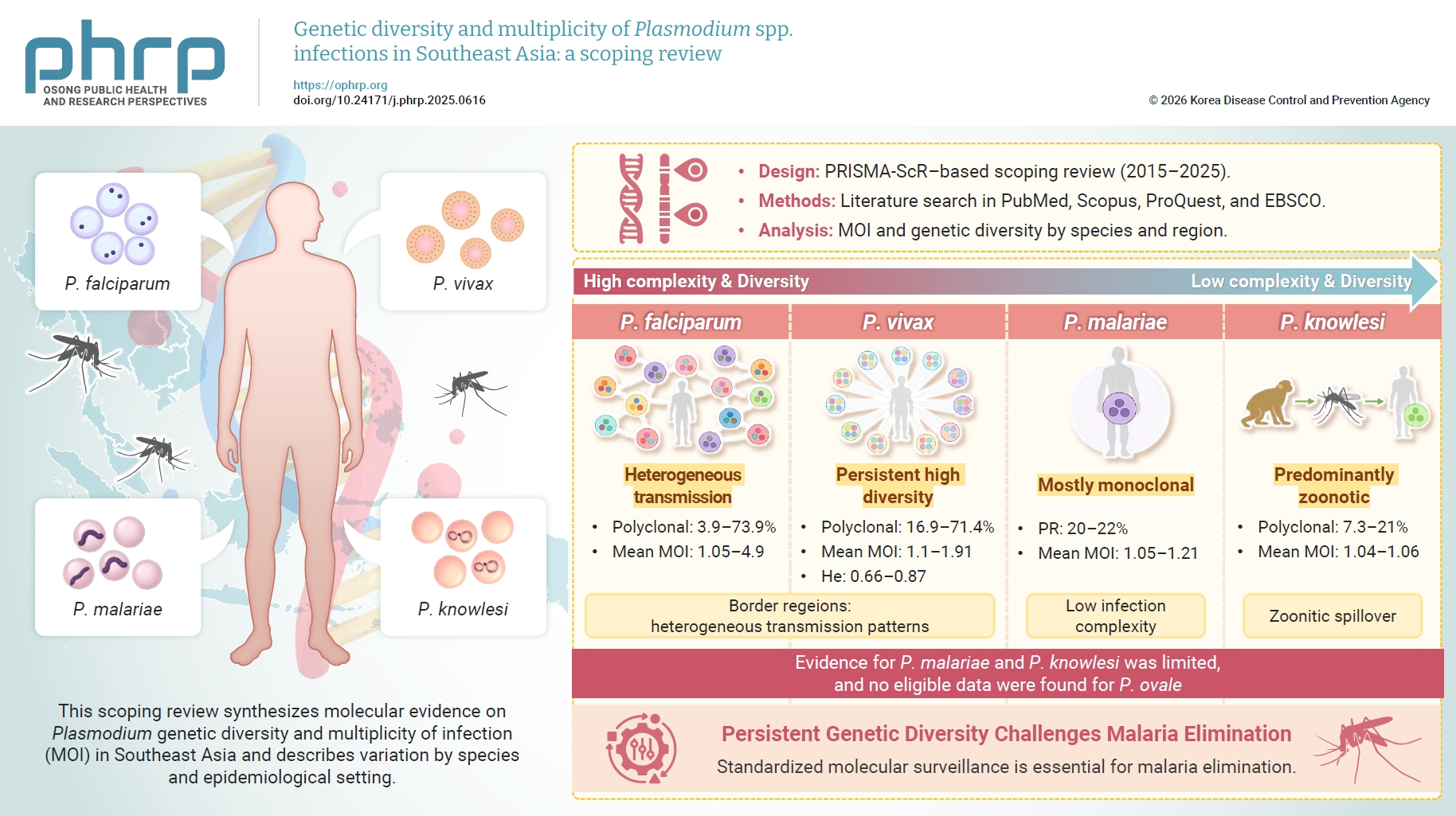
Allelic distributions indicated substantial genetic variation, with several studies reporting dominant alleles such as MAD20 or K1 in Indonesia and Malaysia. High allelic richness was observed in border regions, particularly along the China-Myanmar border, where 38 msp1 alleles and 52 msp2 alleles were identified. The prevalence of polyclonal infections ranged from 3.9% to 73.9%, whereas mean MOI ranged from 1.05 to 4.9, with the highest values reported in Myanmar and at China-Myanmar border sites (
Table 3) [
10,
16,
21,
26–
31].
Results for P. vivax
Five studies demonstrated consistently high allelic diversity in
P. vivax, characterized by multiple alleles per locus for pvmsp-3α/β, pvmsp1-F3, pvcsp, and microsatellite markers (
Table 4) [
10,
17–
20].
Allelic richness was particularly high along the China-Myanmar border, with 19–26 alleles reported for pvmsp3α/β. The reported prevalence of polyclonal infections ranged from 16.9% to 71.4%, with the highest values observed in Vietnam. Mean MOI ranged from 1.1 to 1.91, confirming that P. vivax infections frequently contained multiple clones and often showed greater complexity than co-endemic P. falciparum infections. Multiple studies reported high expected He estimates, ranging from 0.66 to 0.86 in the Greater Mekong Subregion and reaching 0.867 in Indonesia.
Results for P. malariae
Only 1 eligible study from Myanmar reported multilocus diversity for
P. malariae, genotyping 37 symptomatic infections (
Table 5). Polyclonal infections accounted for 20%–22% of cases, with mean MOI values ranging from 1.05 to 1.21, indicating that most infections were monoclonal and that multiclonal infections were relatively uncommon.
Results for P. knowlesi
Two studies reported human
P. knowlesi infections in Indonesia and Malaysia (
Table 5) [
22,
23,
32]. Allelic variation was moderate, consistent with limited human-to-human transmission and predominantly zoonotic spillover. In humans, the prevalence of polyclonal infections ranged from 7.3% to 21%, with mean MOI values between 1.04 and 1.06, indicating that most infections were monoclonal. In contrast, substantially higher complexity, with polyclonal infections of up to 54%, was documented in macaques, suggesting that parasite diversity was maintained primarily within the reservoir host.
Absence of data for P. ovale
No eligible studies from Southeast Asia or the Greater Mekong Subregion reported MOI and genetic diversity data for P. ovale. This represents a clear gap in the regional molecular epidemiology of malaria.
Discussion
Genetic diversity and MOI are widely used molecular indicators of
P. falciparum transmission intensity and parasite population structure. However, findings from this scoping review indicate that their epidemiological interpretation in Southeast Asia and the Greater Mekong Subregion is highly context-dependent and shaped by transmission heterogeneity, population movement, and methodological variation. In high-transmission settings, elevated MOI, high He, and frequent polyclonal infections are commonly observed [
33–
35], whereas low-transmission and elimination settings exhibit more variable and focal patterns. In Southeast Asia and the Greater Mekong Subregion, malaria transmission occurs across highly heterogeneous ecological, socioeconomic, and programmatic contexts. These range from low-transmission elimination settings to persistent foci concentrated along international borders and in forested areas, despite overall regional declines in incidence. The epidemiology is further complicated by the coexistence of
P. falciparum and
P. vivax, with
P. vivax showing notable resilience to control efforts, alongside the emergence and spread of artemisinin-resistant
P. falciparum strains that threaten treatment efficacy [
36,
37]. Consequently, substantial variation in parasite genetic diversity and infection complexity is expected both between countries and within subnational settings.
This scoping review synthesizes the available evidence and shows that
P. falciparum exhibits wide variation in the prevalence of polyclonal infections. Across studies, polyclonal infection prevalence ranged from 7% to 74%, and mean MOI ranged from 1.05 to 4.9, reflecting differences in transmission intensity, population movement, and study setting across countries and border regions. Notably, the China-Myanmar border dataset reported high polyclonal infection rates, ranging from 64.19% to 72.09%, and mean MOI values from 1.76 to 2.21, consistent with intensified parasite mixing and genetic diversity in this border setting [
26]. Evidence from the Malaysia-Thailand border further illustrates moderate infection complexity in certain
P. falciparum-endemic settings, where MAD20 (53.2%) and RO33 (38.7%) were the dominant msp1 allelic families and the reported prevalence of polyclonal infection was 13.3%, with mean MOI ranging from 1.1 to 1.2 [
21].
This pattern contrasts with the higher MOI and polyclonal infection rates reported in some studies from Myanmar and the China-Myanmar border, highlighting substantial spatial heterogeneity in P. falciparum transmission intensity across Southeast Asia. Overall, these findings indicate that P. falciparum transmission in Southeast Asia is highly focal and spatially heterogeneous, with border regions consistently showing greater infection complexity than non-border settings. This focality has important implications for elimination strategies, as residual transmission in border areas may sustain parasite diversity and undermine national-level gains achieved in lower-transmission non-border settings.
For
P. vivax, multiple studies consistently reported high allelic diversity and frequent multiclonality across settings including the China-Myanmar border, the Greater Mekong Subregion, Indonesia, the Thailand-Myanmar border, and Vietnam. Polyclonal infection prevalence ranged from 16.9% to 71.4%, with mean MOI values of 1.1–1.91 and expected He estimates of approximately 0.66–0.87. Multiple infections with genetically distinct parasite clones are common in many malaria-endemic settings, and MOI has been widely used as a proxy for transmission intensity, with higher MOI more frequently observed in areas of intense transmission [
20]. Analyses of
P. falciparum populations similarly indicate that MOI is broadly correlated with transmission intensity [
19]. In border areas, proximity to regions with higher malaria endemicity, such as Myanmar relative to neighboring Thailand, likely contributes to increased parasite diversity through frequent cross-border population movement, resulting in the continual introduction of genetically distinct parasite strains [
20]. Importantly, the consistently high genetic diversity and multiclonality observed in
P. vivax across diverse countries and marker systems indicate that substantial infection complexity is a common feature of
P. vivax in the reviewed literature. However, because most estimates were derived from different studies and settings, these findings should not be interpreted as direct within-site comparisons with
P. falciparum, but rather as evidence that
P. vivax frequently maintains high infection complexity across a range of epidemiological contexts. Collectively, these observations suggest that high genetic diversity and multiclonality are intrinsic features of
P. vivax populations in Southeast Asia and may persist even in settings with declining transmission and ongoing elimination efforts. In contrast with
P. falciparum, which tends to show marked reductions in diversity as transmission declines,
P. vivax appears to maintain high genetic diversity and multiclonality even in settings approaching elimination, highlighting fundamental differences in transmission biology and resilience to control.
Compared with
P. falciparum and
P. vivax, molecular epidemiological data on other
Plasmodium species are far more limited. Only 1 study assessed
P. malariae, reporting predominantly monoclonal infections, mean MOI values of 1.05–1.21, and moderate genetic diversity. Human
P. knowlesi infections in Indonesia and Malaysia showed low mean MOI values (1.04–1.06) and low prevalence of polyclonal infections (7.3%–21%), consistent with limited human-to-human transmission. In contrast, the higher complexity reported in macaques suggests that parasite diversity is maintained primarily within the reservoir host, with important implications for surveillance strategies in zoonotic malaria [
23]. These findings highlight the need to interpret human MOI estimates for zoonotic malaria cautiously and underscore the importance of incorporating reservoir host data into molecular surveillance frameworks.
Interpretation of findings across studies is constrained by methodological heterogeneity, particularly variation in the molecular markers used to assess genetic diversity and MOI. Antigenic markers such as msp1, msp2, and glurp are commonly used to estimate MOI and genetic diversity, whereas microsatellite markers provide complementary insights into population structure and gene flow relevant to malaria control and elimination efforts [
27,
38–
43].
Crucially, MOI estimates derived from antigenic markers and microsatellites are not directly comparable because they differ substantially in genomic coverage, resolution, sensitivity to minority clones, and allele-calling thresholds. Antigenic markers are typically under strong immune selection, which may maintain higher allelic diversity than neutral markers, whereas microsatellites offer higher resolution for detecting fine-scale population structure but may use different thresholds for distinguishing true additional clones from PCR artifacts. Consequently, a substantial proportion of the observed between-study variability in MOI and polyclonality likely reflects these methodological differences rather than true epidemiological shifts. Therefore, comparisons of MOI and genetic diversity metrics should be interpreted primarily within studies rather than across settings [
35,
44].
However, variation in marker selection, allele-calling thresholds, and analytical approaches produces MOI and He estimates that are not directly comparable across studies. Genetic diversity is commonly quantified using polymorphic markers such as msp1, msp2, and glurp, with He reflecting the degree of allelic variation, where higher values indicate greater diversity [
34,
45]. Despite these methodological differences and the limited comparability across studies, metrics such as MOI and He remain critical for understanding malaria epidemiology. They provide essential information for monitoring transmission dynamics, evaluating the impact of control interventions, and supporting molecular surveillance in settings characterized by residual transmission or imported malaria [
12,
45-
47].
Several gaps were identified in the molecular epidemiology literature across Southeast Asia and the Greater Mekong Subregion. Evidence remains unevenly distributed across countries, transmission settings, and Plasmodium species, with a predominance of cross-sectional studies and limited longitudinal data to assess temporal changes in genetic diversity and MOI in response to interventions. In addition, substantial variability in molecular marker selection, analytical approaches, and reporting practices limits cross-study comparability and constrains regional-level synthesis. Addressing these gaps will require more standardized molecular surveillance frameworks, including harmonized marker panels and reporting guidelines, as well as closer integration of genetic diversity and MOI metrics with routine epidemiological, entomological, and mobility data. Such approaches are particularly relevant in border and forest-associated transmission settings, where parasite importation and population mixing may undermine elimination efforts despite declining incidence.
The absence of eligible molecular epidemiology data for
P. ovale represents a notable surveillance gap in Southeast Asia.
P. ovale infections are frequently underdetected or misclassified as
P. vivax because of morphological similarity and shared relapse patterns, which may obscure residual transmission in settings approaching elimination [
28,
29,
48]. Without enhanced molecular surveillance, the true burden and transmission dynamics of
P. ovale in the region will remain poorly understood, posing challenges for malaria control and elimination strategies.
Strengths and Limitations of the Study
A primary limitation of this review is the methodological heterogeneity across the included studies. MOI estimates derived from antigenic markers (msp1/msp2/glurp) and microsatellites are not directly comparable because they differ in genomic coverage, sensitivity to minority clones, and analytical thresholds. Consequently, observed variation in genetic diversity may partly reflect these methodological differences rather than true epidemiological shifts. Furthermore, the restriction to open-access articles may have introduced selection bias by excluding relevant data published in subscription-based journals.