
Introduction
Brucellosis is an important zoonotic disease affecting many mammalian species, and it can be transmitted to humans
[1]. Brucellosis is caused by
Brucella species, which are small, gram-negative coccobacilli, and this facultative intracellular bacterial pathogen is capable of causing abortion and male infertility in animals.
Brucella abortus causes abortion in cattle and chronic infections in humans, and symptoms include undulant fever, endocarditis, and arthritis
[2]. Prevention of brucellosis in livestock is achieved using a laboratory-derived vaccine strain, which induces the production of antibodies to
Brucella. There is no available human vaccine
[3].
The cell-mediated immune response to brucellosis includes the production of cytokines that activate macrophages for antibrucella activities. However the mechanisms by which these cytokines lead to macrophage activation are complex
[4]. Macrophages are particularly important for the survival and spread of
Brucella during infection. Among the key activities of cytokines, gamma interferon has been shown to induce antimicrobial activities against a variety of intracellular pathogens, and tumor necrosis factor (TNF) can elevate macrophage stimulating factor and increases H
2O
2 production and nitrite release
[5].
B. abortus avoids stimulation of the host immune system, permitting the establishment of chronic infection. Some
Brucella species inhibit host cell apoptosis, similar to
Chlamydia, Bartonella henselae, and
Mycobacterium bovis. Generally,
B. abortus infection induces minimal levels of cytokines
[6,7].
Lon protease contributes to the degradation of short-lived, misfolded, or damaged proteins by environmental changes, and seems to play an important role as a chaperone
[8]. In
Escherichia coli, lon is responsible for adenosine triphosphate-dependent proteolysis and is thought to play a major role in the response to environmental stress by downregulating
SulA, an inhibitor of cell division, and by modulating the activity of the transcriptional activator
RcsA
[9,10]. In previous research, a
lon mutant of
Brucella was studied for its response to environmental stress conditions and the role of
lon in the maintenance of chronic infection was investigated in the mouse model. Although the biochemical functions of
B. abortus lon mutant and its effect on
Brucella pathogenesis both
in vivo and
in vitro were investigated more than 10 years ago, the induction of TNF-α in macrophages infected by
Brucella lon mutant has not yet been reported
[11]. TNF-α is an important player in the apoptotic pathway and may be involved in directing cell death toward apoptotic or necrotic pathways. Furthermore, TNF-α mRNA expression peaks at early infection times with
E. coli K12 or heat-killed
Brucella-infected cells. However, there is no expression of mRNAs encoding TNF-α in live
Brucella infected cells. For example,
Brucella suis infected macrophages express interleukin (IL)-1, IL-6, IL-10, IL-8, but do not express TNF-α
[12]. The viability of the
B. lon mutant during infection and its effect on the immune response are largely unknown.
Materials and methods
2.1 Bacteria growth conditions
The characteristics of
Brucella strains were confirmed by using AMOS (
B. abortus-Brucella melitensis-Brucella ovis-B. suis) polymerase chain reactions (PCRs). The bacterial strains used were
B. abortus 2308, wild-type strain of
B. abortus (parent strain of
lon mutant) and
lon mutant. We isolated the wild-type strain of
B. abortus from the blood sample of the patient and seeded in
Brucella agar plate. Briefly, this wild-type strain of
B. abortus was isolated from blood cultures of a 33-year-old man with acute brucellosis, who presented with fever
[13]. To confirm bacterial species, genomic DNA was isolated from samples of
B. abortus, wild-type
Brucella strain and
lon mutant, and PCR amplification of 16S ribosomal RNA (rRNA) was performed.
Brucella strains were cultured in tryptic soy broth (TSB; Difco, Detroit, MI, USA) medium at 37 °C in an atmosphere containing 5% CO
2. Kanamycin was added at a concentration of 50 μg/mL unless otherwise indicated.
E. coli strains were cultured at 37 °C in Luria-Bertani (LB) medium. All work with live
B. abortus was performed at biosafety level 3. The J774.A1 macrophage cell line was purchased from the American Type Culture Collection (Manassas, VA, USA). The cells were cultured at 37 °C with 5% CO
2 in Dulbecco's Modified Eagle's Medium (DMEM) supplemented with 10% heat-inactivated fetal bovine serum (Atlanta Biologicals, Norcross, GA, USA). During
Brucella infection, cell viability was evaluated by trypan blue exclusion assay. Apoptotic and necrotic cells were analyzed by flow cytometry (FAScan, BD Bioscience, San Jose, CA, USA) using Annexin V-FITC/propidium iodide (PI) detection kit (ApoScan, BioBud, Seoul, Korea).
2.2 Construction of Brucella mutant library
The mini-Tn5Km2-bearing plasmid pUT mini-Tn5Km2 was introduced into wild-type B. abortus isolate from an E. coli K-12 derivative, SM17λpir, by conjugation. The pUT vector containing mini-Tn5Km2 was kindly provided by Professor S. Kim, College of Veterinary Medicine, Gyeongsang National University, Korea. The obtained mutants were isolated from Brucella agar plates containing kanamycin (30 μg/mL). The chromosomal DNA from mutants was digested with EcoRI, cloned to plasmid pBluescript II KS(+), transformed into E. coli DH5α, and plated onto LB agar plate containing ampicillin (100 μg/mL) and kanamycin (30 μg/mL). Plasmid DNA from colony was extracted by using the plasmid Mini Kit (Qiagen, Valencia, CA, USA), and the chromosomal DNA sequence was analyzed by using the mini-Tn5Km2 transposon O'-end primer (5'-CCTCTAGAGTCGACCTGCAG-3').
2.3 RNA isolation, reverse transcriptase-polymerase chain reaction, and microarray analysis
Brucella cultures derived from different
Brucella colonies were used to infect different groups of macrophage cells to obtain independent infections. Following 1.5-hour incubation at 37 °C in 5% CO
2, the cells were washed three times with phosphate buffered saline (PBS). At 0 hours (no
Brucella infection) and at 30 minutes, 1 hour, and 24 hours postinfection, 7.5 mL of TRIzol reagent (Invitrogen Corporation Carlsbad, CA, USA) was added to each flask in a group. Uninfected J774.A1 cells were counted to determine the value for 0 hours postinfection. The homogenized samples were incubated for 5 minutes at room temperature. All RNA samples were further purified using the RNeasy mini kit (Qiagen) according to the manufacturer's instructions and resuspended in RNase-free water. Prior to use, the integrity and concentration of each RNA sample was checked using an Agilent 2100 BioAnalyzer and NanoDrop instrument. RNA samples had a total RNA profile exhibiting a 28S band approximately two times more intense than the 18S ribosomal band and an A260/A280 ratio of 1.9. Primers were designed using the Primer software and were purchased from Bioneer (Daejeon, Korea). To confirm microarray data, the same triplicate biological RNA samples were used for reverse transcriptase-polymerase chain reaction (RT-PCR) experiment. To determine if the changes in cell growth and cell density influenced the macrophage gene expression profiles, only DMEM was added to uninfected J774.A1 cell cultures at 0 hours, 6 hours, 12 hours, and 24 hours with 0 hours defined as it was for the microarray experiment. Twenty nanograms of RNA was used for reverse transcription reaction (Superscript reverse transcription kit, Invitrogen). The primer pair for β2 microglobulin was used for internal housekeeping gene control (
Table 1). The PCR conditions were as follows: initial denaturation at 95 °C for 3 minutes, followed by 35 cycles at 95 °C for 1 minute, at 55 °C for 1 minute, and at 72 °C for 1 minute. PCR products were separated on 1.2% agarose gel and photographed. Band intensities were quantified using Chemi analysis (Amersham Pharmacia, Piscataway, USA). For test RNAs, synthesis of target complementary DNA (cDNA) probes and hybridization were performed using Agilent's Low RNA Input Linear Amplification kit (Agilent Technology, Palo Alto, CA, USA) according to the manufacturer's instructions. Briefly, cDNA master mix was prepared and added to the reaction mixer. The hybridized images were scanned using Agilent's DNA microarray scanner and quantified with Feature Extraction Software (Agilent Technology). All data normalization and selection of fold-changed genes were performed using GeneSpringGX 7.3 (Agilent Technology). The averages of normalized ratios were calculated by dividing the average of normalized signal channel intensity by the average of normalized control channel intensity. Functional annotation of genes was performed according to Gene Ontology Consortium (
http://www.geneontology.org/index.shtml) by GeneSpringGX 7.3.
2.4 Infection of J774A.1 murine macrophages and analysis of cytokines secretion
J774.A1 macrophage cells were plated in 24-well plates in DMEM. The J774.A1 cells were then infected with
B. abortus strains in triplicate wells of a 24-well plate at a multiplicity of infection (MOI) of 50:1. Following 1.5 hours of incubation at 37 °C in atmosphere containing 5% CO
2, the cells were washed three times with phosphate-buffered saline. Infected cells were lysed with distilled water at 0, 6, 12, and 24 hours postinfection. In addition, supernatants from
Brucella infected J774.A1 were collected and analyzed for IL-2, IL-4, IL-5, IL-10, IL-12(P70), granulocyte-macrophage colony-stimulating factor (GM-CSF), IFN-γ, and TNF-α by Bio-Plex Cytokine Assay (Mouse Th1/Th2 Panel, Bio-Rad Laboratories, Hercules, CA, USA) according to the manufacturer's instructions. Bacterial infection and intracellular survival assay were done by modified Kim et al's method
[14]. Briefly,
B. abortus strains were inoculated in J774.A macrophage grown on a 96-well plate with DMEM with 10% fetal bovine serum. After 1.5 hours incubation, cells were washed twice with 0.2 μL of sterile PBS and incubated with DMEM containing 10% FBS. At each time point, cells were washed three times with PBS and were lysed with distilled water. The colony formation unit (CFU) was measured by serial dilutions on
Brucella agar plates.
2.5 Statistical analysis
The nonparametric trend test was used for comparison of replication rate in host cell between the Brucella lon mutant, B. abortus 2308, and B. abortus wild-type strain. The analysis was performed using the SAS version 9.1 software packages (SAS Institute Inc., Cary, NC, USA). Differences were considered statistically significant at ⤳ < 0.05.
Results
3.1 Construction and culture of B. abortus lon mutant
In order to select a
B. abortus lon mutant from mutant library, primary screening was performed using genomic DNA digestion. Genomic
EcoRI fragments containing the Tn5 insertion were isolated and identified by sequencing analysis. The results from the cloning revealed that Tn5 was inserted into a gene whose putative protein product has homology to the lon protein. Sequence of the open reading frame of the
lon gene confirmed that Tn5 was inserted to its C-terminal region (409
th amino acid). We studied the
B. lon mutant for
in vitro phenotypes that might differentiate it from the wild-type. Comparisons of the growth characteristics of the
lon mutant versus wild-type
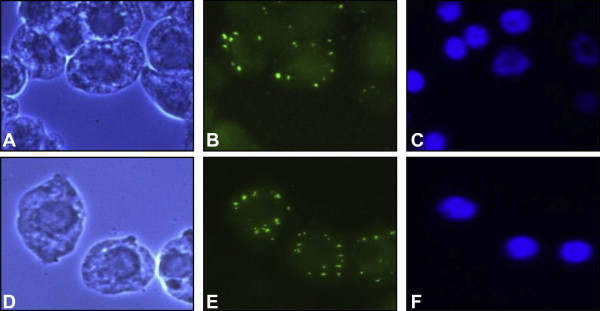
Brucella revealed that their exponential growth rates in rich medium and intracellular growth within J774A.1 macrophage cells were the same (
Figure 1).
3.2 Cytokine response of macrophage during lon mutant infection
To clarify the macrophage cytokine response during
B. lon mutant infection, a time course of microarray analysis was performed at 0 hours, 6 hours, 12 hours, and 24 hours postinfection. The mRNAs whose levels changed more than twofold compared with the levels in the controls were considered in the microarray results. The expressed genes in J774.A1 macrophages were calculated as the normalized fold change during
lon mutant infection. The gene encoding Cxcl10 was the most significantly overexpressed in J774A.1 by
B. lon mutant postinfection. Upregulated TNF-α was observed after infection with
Brucella (
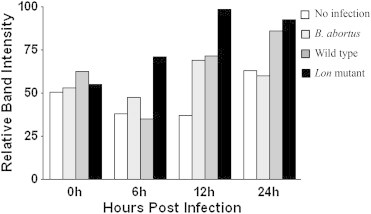
Table 2). By Kyoto Encyclopedia of Genes and Genomes pathway analysis, we confirmed that genes encoding proteins involved in TNF signaling were more expressed in the cytokine microarray results. The gene encoding TNF-α was significantly upregulated (6.61-fold) by 6 hours, and TNF receptor was also upregulated (7.78-fold) at later infection times. To validate this upregulation we analyzed TNF-α mRNA (446 bp) transcription by RT-PCR. TNF-α expression was detected in the early stage of
lon mutant infection at 6 hours postinfection. TNF-α transcription was not increased in the control groups (no infection,
B. abortus, and wild-type
Brucella) until 12 hours postinfection (
Figure 2).
3.3 TNF-α response
To examine the expression of TNF-α protein, the supernatants of uninfected and
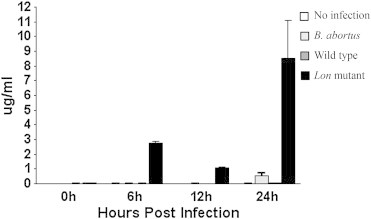
Brucella infected J774.A1 macrophages were collected at different time points, and the concentrations of cytokines released from macrophages were determined. Secretion of TNF-α after 6 hours of cell culture in J774.A1 ranged from 8.5 ng/mL up to very high levels of 1,068 ng/mL after 1 day of infection (
Figure 3). In addition, the expression of IL-12b, IL-10, and GM-CSF were detected at only a very low level (1-36 pg/mL) in culture media under all conditions. IL-10 expression was also increased (20 pg/mL) during infection at the 24-hour time point.
3.4 Growth of lon mutant
We wanted to exclude the hypothesis that the effect of Brucella proliferation in infected J774.A1 cells is due to a difference in growth rate. We confirmed the doubling time in broth medium and also performed intracellular replication assays in J774A.1 macrophage cells using the B. lon mutant, B. abortus 2308, and B. abortus wild-type strain. J774.A1 cells were infected with B. lon mutant, B. abortus 2308, or B. abortus wild-type strain. After that, numbers of viable CFU were determined at 1 hour, 6 hours, 12 hours, 24 hours, and 48 hours postinfection (data not shown). Viability assays showed that the lon mutant gave similar number of CFUs as its parent strain at 6 hours postinfection. In infected J774A.1 cells, the replication of wild-type Brucella (p = 0.0392) and lon mutant (p = 0.0157) increased significantly in a time dependent manner, which is consistent with the results obtained with a CFU measurement. The replication of B. abortus (p = 0.0517) also increased but the increase was not significant statistically.
Discussion
Brucella alters the expression of many genes to adapt to harsh conditions in the host cell and to survive against the host immune system. The intracellular survival of
B. abortus has been documented, and it is incorporated into phagosomes and localized to ER like structures in J774.A1 macrophages
[15,16]. The macrophage is a central means of defense against microbial pathogens that kill microorganisms by ingestion. Based on previous studies, it is clear that macrophages play a major role in killing
Brucella. In acute infection of
B. abortus, the early immune response is critical to controlling infection. For examples, the activation of neutrophil was accomplished in 60 minutes and early neutrophil activation is followed by IL-8 induction. Mature neutrophil survival and apoptosis are influenced by the inflammatory cytokines
[17].
In this study, the transcription and expression of TNF-α was analyzed in the J774.A1 cell line using both RT-PCR on extracted RNA and cytokine assays on supernatant culture media. A significant increase in TNF-α was detected at many time points. The transcript level for TNF-α was dramatically elevated as early as 6 hours after infection with the
B. lon mutant in this study. The
B. lon mutant may be involved in TNF-α mediated cell death toward an apoptotic or necrotic pathway. TNF-α is one of the products of macrophage response directly involved in the killing of
Brucella and the mechanism regulating the TNF-α production in target cells has not yet been clearly defined. The concentration of TNF-α was measured in infected cell media in the amount of 0.5–30 ng/mL during 1 day postinfection based on previous studies
[18,19]. This suggests that apoptosis or macrophage cell death occurs in J774.A1 cells infected with
lon mutant in this study.
Brucella requires enough time for the preparation of growth avoiding the host immune system and space for the
Brucella replication to be a successful infection
[20,21]. It has been shown that the replication rate of
Brucella in macrophages decreases during the first 12 hours of infection. This decrease seems to be necessary for intracellular adaptation of
lon mutant from media culture condition. Recently, other groups have reported similar findings in virulent
Brucella strain
[22,23]. The recovery mechanisms and metabolic pathway proteins to establish intracellular
Brucella adaptation were elucidated by a comprehensive analysis of its proteomes. Because survival and replication in host cells is important when determining whether mutated gene influences the virulence of
Brucella, we examined the intracellular replication of
Brucella strains in J774.A1 macrophage cells. We cannot rule out that the decreased viability of the
lon mutants is a result of the host macrophages rapidly killing of cells during early infection. The ability of the
lon mutant to proliferate is similar to wild-type
B. abortus and
B. abortus 2308 in J774A.1 macrophage cells at 24 hours postinfection. By contrast, the majority of
Brucella cells were killed during the first 24 hours, whereas the surviving bacteria began to replicate 24 hours postinfection. This type of mutant survival pattern is consistent with one report
[24].
In Brucella lon mutants, our microarray study is the first to show that macrophage cytokine gene expression changes occur at an early infection stage. The most significant finding of this work is the identification of the host cell response during B. lon mutant infection and secondly is the correlation between the virulence of the lon mutant and macrophage viability. To better understand the role lon plays in Brucella's ability to evade host immune mechanisms and establish chronic infection, we compared transcriptional profiles of the host cytokine response to infection with wild-type and lon mutant Brucella strains.