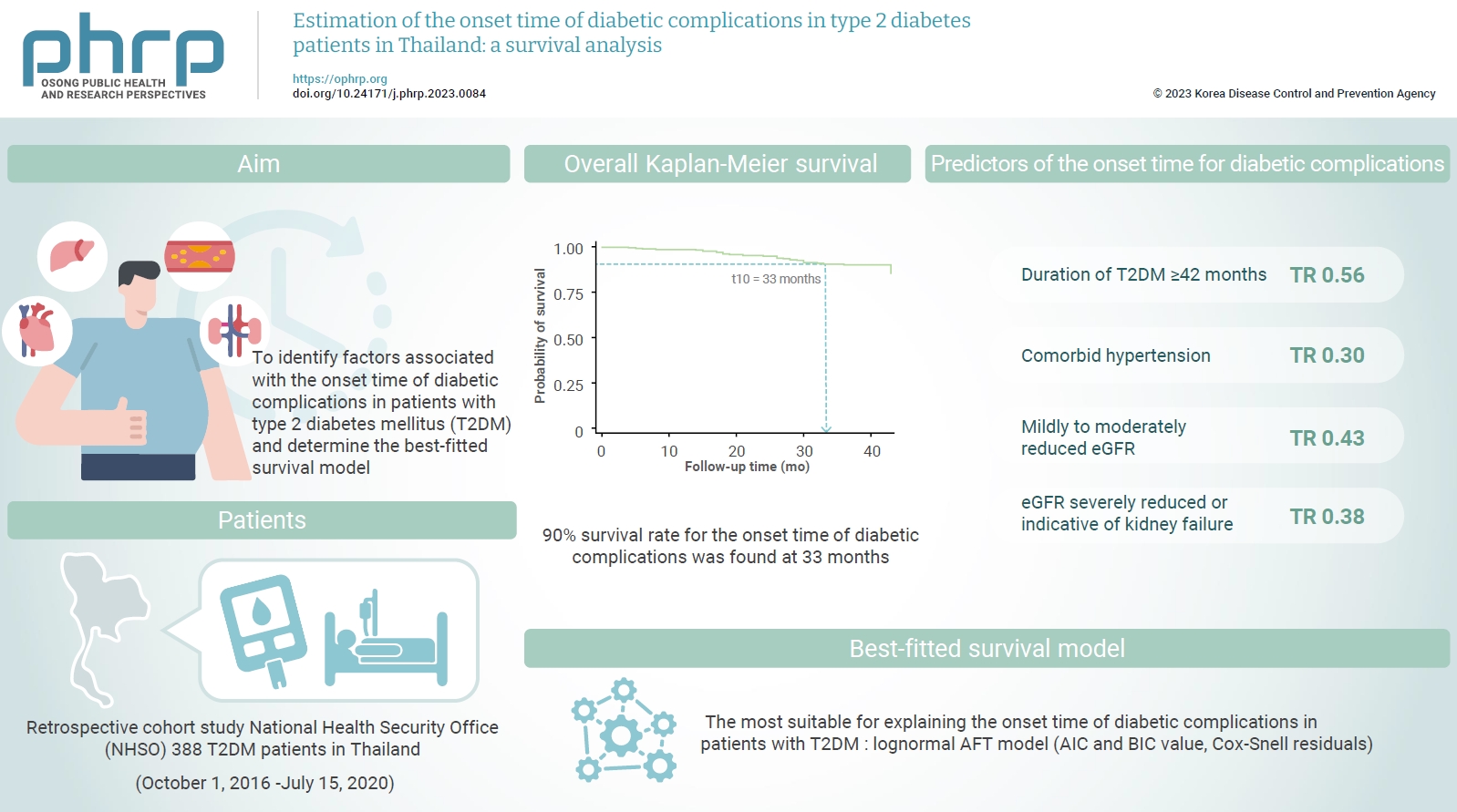
Objectives This study aimed to identify factors associated with the onset time of diabetic complications in patients with type 2 diabetes mellitus (T2DM) and determine the best-fitted survival model. Methods: A retrospective cohort study was conducted among T2DM patients enrolled from October 1, 2016 to July 15, 2020 at the National Health Security Office (NHSO). In total, 388 T2DM patients were included. Cox proportional-hazard and parametric models were used to identify factors related to the onset time of diabetic complications. The Akaike information criterion, Bayesian information criterion, and Cox-Snell residual were compared to determine the best-fitted survival model. Results: Thirty diabetic complication events were detected among the 388 patients (7.7%). A 90% survival rate for the onset time of diabetic complications was found at 33 months after the first T2DM diagnosis. According to multivariate analysis, a duration of T2DM ≥42 months (time ratio [TR], 0.56; 95% confidence interval [CI], 0.33–0.96; p=0.034), comorbid hypertension (TR, 0.30; 95% CI, 0.15–0.60; p=0.001), mildly to moderately reduced levels of the estimated glomerular filtration rate (eGFR) (TR, 0.43; 95% CI, 0.24–0.75; p=0.003) and an eGFR that was severely reduced or indicative of kidney failure (TR, 0.38; 95% CI, 0.16–0.88; p=0.025) were significantly associated with the onset time of diabetic complications (p<0.05). Conclusion: Patients with T2DM durations of more than 42 months, comorbid hypertension, and decreased eGFR were at risk of developing diabetic complications. The NHSO should be aware of these factors to establish a policy to prevent diabetic complications after the diagnosis of T2DM.
Citations
Citations to this article as recorded by
Survival and predictors of mortality among adults with type 2 diabetes at a teaching hospital in Ghana: a retrospective cohort study Issah Haruna, Abdul-Rauf Sulemana, Emmanuel Kweku Nakua, Daniel Boateng BMC Public Health.2026;[Epub] CrossRef
Survival analysis of patients with chronic diseases: a statistical approach to mortality risk factors Vladimiro Ibañez Quispe, Juan Reinaldo Paredes Quispe, Remo Choquejahua Acero, Teresa Paola Alvarez Rozas, Edgar Eloy Carpio Vargas, Godofredo Quispe Mamani, Percy Huata Panc Journal of Advanced Pharmacy Education and Researc.2026; 16(1): 211. CrossRef
An elevated level of one-hour postprandial plasma glucose is an independent risk factor for developing chronic complications of type 2 diabetes mellitus Yanyan Jin, Jing Wei, Jie Yang, Hongxia Qian, Yan Wu, Mengmeng Liu Archives of Physiology and Biochemistry.2025; 131(6): 1025. CrossRef
Advanced age and elevated cholesterol predict diabetic neuropathy in patients with type II diabetes mellitus in Southern Ethiopia Fasika Merid, Habtamu Esubalew, Tamirat Gezahegn Guyo, Firdawek Getahun Cardiovascular Diabetology – Endocrinology Reports.2025;[Epub] CrossRef
<sec>
<title>Objectives</title>
<p>The purpose of this study was to analyze the characteristics and factors affecting the survival of inpatients admitted following a suicide attempt.</p></sec>
<sec>
<title>Methods</title>
<p>A total of 3,095 cases retrieved from the Korean National Hospital Discharge In-depth Injury Survey data (from 2011 to 2015) were grouped according to survival and death and analyzed using descriptive statistics chi-square and logistic regression analysis.</p></sec>
<sec>
<title>Results</title>
<p>The following factors had statistically significant risks on reducing survival: female (OR = 2.352, <italic>p</italic> < 0.001), 40–59 years old (OR = 0.606, <italic>p</italic> = 0.014), over 60 years old (OR = 0.186, <italic>p</italic> < 0.001), poisoning (OR = 0.474, <italic>p</italic> = 0.009), hanging (OR = 0.031, <italic>p</italic> < 0.001), jumping (OR = 0.144, <italic>p</italic> < 0.001), conflicts with family (OR = 2.851, <italic>p</italic> < 0.001), physical diseases (OR = 1.687, <italic>p</italic> = 0.046), mental health problems (OR = 2.693, <italic>p</italic> < 0.001), financial problems (OR = 3.314, <italic>p</italic> = 0.002), 2014 (OR = 2.498, <italic>p</italic> = < 0.001) and 2015 (OR = 2.942, <italic>p</italic> = 0.005).</p></sec>
<sec>
<title>Conclusion</title>
<p>The survival group that had a history of attempted suicide (high-risk suicide group), should be further characterized. It is necessary to identify the suicide methods and risk factors for suicide prevention management policies and to continuously expand the management policy according to these characteristics.</p></sec>
Citations
Citations to this article as recorded by
The economic burden of adolescent internet addiction: A Korean health cost case study Robert W. Mead, Edward Nall The Social Science Journal.2026; 63(3): 974. CrossRef
Patterns and characteristics of visits to psychiatric emergency departments: a three-year data study in China Youping Wang, Xida Wang, Mingfeng Bi, Penglin Mou, Ruizhi Zhang, Cuiling Zhang, Shuyun Li, Miaoling Jiang, Lin Mi, Zezhi Li European Archives of Psychiatry and Clinical Neuro.2025; 275(8): 2349. CrossRef
Factors Affecting Inpatients’ Mortality through Intentional Self-Harm at In-Hospitals in South Korea Sulki Choi, Sangmi Kim, Hyunsook Lee International Journal of Environmental Research an.2023; 20(4): 3095. CrossRef
Loss to follow-up in a population-wide brief contact intervention to prevent suicide attempts - The VigilanS program, France Larissa Djembi Fossi, Christophe Debien, Anne-Laure Demarty, Guillaume Vaiva, Antoine Messiah, Xenia Gonda PLOS ONE.2022; 17(3): e0263379. CrossRef



 First
 Prev


