Objectives This study evaluated the EuroQol 5-dimensional questionnaire, 3-level version (EQ5D-3L), using Korea Health Panel (KHP) data by examining its factor structure, measurement invariance across gender and age groups, and longitudinal measurement invariance. Methods: Panel 1 data from the second survey year (2009), when the EQ-5D-3L was first introduced in the KHP, through the 12th year (2017) were analyzed, along with panel 2 data from 2019 to 2021. Confirmatory factor analysis and measurement invariance tests by gender and age groups were conducted within each period. Longitudinal measurement invariance was also evaluated for each period. Results: A 1-factor model demonstrated good fit for the EQ-5D-3L. In panel 1, full measurement invariance across gender and age groups was supported. In panel 2, partial invariance was achieved after relaxing constraints on item 5. Longitudinal measurement invariance was supported over 5- and 10-year intervals in panel 1 and over a 3-year interval in panel 2, indicating temporal stability of the measurement model. Conclusion: The EQ-5D-3L used in the KHP panel 1 and panel 2 datasets demonstrates a stable 1-factor structure and acceptable measurement invariance across key subgroups and over time. These findings support the use of the EQ-5D-3L as an appropriate instrument for assessing health-related quality of life among Korean adults and for longitudinal analyses within large-scale panel surveys.
Objectives
This study aimed to validate the psychometric properties of the recently developed knowledge, attitudes, and perceptions questionnaire for community-based surveillance of infectious diseases (KAP-CBS-ID questionnaire), using confirmatory factor analysis (CFA) and item response theory (IRT).
Methods
A cross-sectional study using multistage sampling recruited 470 schoolteachers from Kelantan, Malaysia. The self-administered KAP-CBS-ID questionnaire consists of 3 domains: knowledge (31 items), attitudes (23 items), and perceptions (21-items). Two-parameter logistic (2-PL) IRT analysis and CFA were performed to validate the knowledge section. For attitudes and perceptions sections, CFA proceeded using a 4-factor model to evaluate both model fit and construct validity.
Results
Two-PL IRT analysis of the knowledge section resulted in elimination of 14 items due to inadequate discrimination or difficulty parameters. The 3-factor CFA model demonstrated good fit indices for knowledge (root mean square error of approximation [RMSEA], 0.028; comparative fit index [CFI], 0.945; Tucker-Lewis index [TLI], 0.941) without any modifications. The attitudes section required re-specification, ultimately yielding 21 items across 4 factors with acceptable fit indices (standardized root mean square residual [SRMR], 0.067; RMSEA, 0.055; CFI, 0.937; TLI, 0.927). Similarly, the perceptions section was refined to 17 items across 4 factors, showing good model fit (SRMR, 0.055; RMSEA, 0.059; CFI, 0.962; TLI, 0.954). Factor loadings ranged from 0.33 to 0.98, while Raykov’s rho reliability estimates ranged from 0.71 to 0.93. Factor determinacy exceeded 80% for all factors.
Conclusion
The KAP-CBS-ID is a valid and reliable instrument for assessing community representatives’ knowledge, attitudes, and perceptions regarding community-based surveillance of infectious diseases.
Citations
Citations to this article as recorded by
Modeling social and behavioral factors associated with community participation in community-based surveillance of communicable diseases: a cross-sectional study in Kelantan, Malaysia Ahmed Azeez Hasan, Anis Kausar Ghazali, Norsa’adah Bachok, Najib Majdi Yaacob, Suhaily Mohd Hairon, Nur Amira Mohd Nadir, Fatimah Muhd Shukri Osong Public Health and Research Perspectives.2026; 17(3): 229. CrossRef
Objectives This study aimed to describe and compare health-related quality of life (QoL) as measured by the World Health Organization Quality of Life–BREF (WHOQoL-BREF) and the EuroQol-5 Dimensions (EQ-5D) among the Malaysian population, examining differences by sociodemographic characteristics including age, income, sex, ethnicity, educational level, and occupation. Methods: This cross-sectional study used data from 19,402 individuals collected as part of a health and demographic surveillance system survey conducted in the Segamat district of Malaysia in 2018–2019. Descriptive statistics and measures of central tendency were produced. Differences in QoL among demographic sub-groups were examined using the t-test and analysis of variance, while the correlations between the WHOQoL-BREF and EQ-5D were evaluated using Pearson correlation coefficients. Results: Based on complete case analysis (n=19,129), the average scores for the 4 WHOQoLBREF domains were 28.2 (physical), 24.1 (psychological), 12.0 (social relationships), and 30.4 (environment). The percentages of participants not in full health for each EQ-5D dimension were 12.8% (mobility), 3.1% (self-care), 6.9% (usual activities), 20.9% (pain/discomfort), and 6.8% (anxiety/depression). Correlations between the 4 WHOQoL-BREF domains and the 5 EQ-5D dimensions were relatively weak, ranging from –0.06 (social relationships with self-care and pain/discomfort; p<0.001) to –0.42 (physical with mobility; p<0.001). Conclusion: Although health-related QoL as measured by the WHOQoL-BREF and the EQ-5D are correlated, these 2 measures should not be considered interchangeable. The choice between them should be guided by the specific research questions and the intended use of the data.
Citations
Citations to this article as recorded by
Promoting mental health among at-risk adolescents in Malaysia (MyHeRo): study protocol for a cluster randomised controlled trial to evaluate the effectiveness and cost-effectiveness of a school-based intervention compared with study skills condition for a Cecilia A. Essau, Suwaibah Zakaria, Chuong Hock Ting, Julia Ai Cheng Lee, Alejandro de la Torre-Luque, Alvin Lai Oon Ng, Hazreen Abdul Majid, Helen Dodd, Nik Daliana Nik Farid, Noor Azimah Muhammad, Suzaily Wahab Trials.2026;[Epub] CrossRef
Sociodemographic, lifestyle and health factors associated with psychological health among adults in Malaysia: An ethnic comparison Yong Kang Cheah, Hamimatunnisa Johar, Tin Tin Su Archives of Psychiatric Nursing.2026; 61: 152081. CrossRef
Validating cancer-specific and generic quality of life (QoL) instruments among patients with head and neck cancers: incorporating the European Organization for Research and Treatment of Cancer Quality of Life Questionnaire-Head and Neck Module with generi Mohsen Saffari, Tzu-Yen Chang, Musheer A. Aljaberi, Kah Ying Yap, An-Chi Li, Jung-Sheng Chen, Shi-Qing Wang, Mark D. Griffiths, Chung-Ying Lin Psicologia: Reflexão e Crítica.2026;[Epub] CrossRef
AVALIAÇÃO INTEGRADA DO PERFIL SOCIODEMOGRÁFICO, ESTADO NUTRICIONAL, APTIDÃO FÍSICA E QUALIDADE DE VIDA DE IDOSOS ACOMPANHADOS NA ATENÇÃO PRIMÁRIA À SAÚDE Gustavo Bonfim Rocha, Luzia Vitória Sousa Brito, Maria Francidenes de Souza Melo, Edney Souto Pinto, Kathleen Nascimento Carvalho da Silva , Maryanne Marques de Sousa, Pedro Cicero de Sousa, Layza Karyne Farias Mendes, Aldaisa Pereira Lopes , Victor RECIMA21 - Revista Científica Multidisciplinar - .2026; 7(8): e788688. CrossRef
A comparative analysis of structural equation modeling and traditional regression analysis in investigating factors affecting health-related quality of life in general Thai population Krittaphas Kangwanrattanakul, Apinya Ingard Health and Quality of Life Outcomes.2025;[Epub] CrossRef
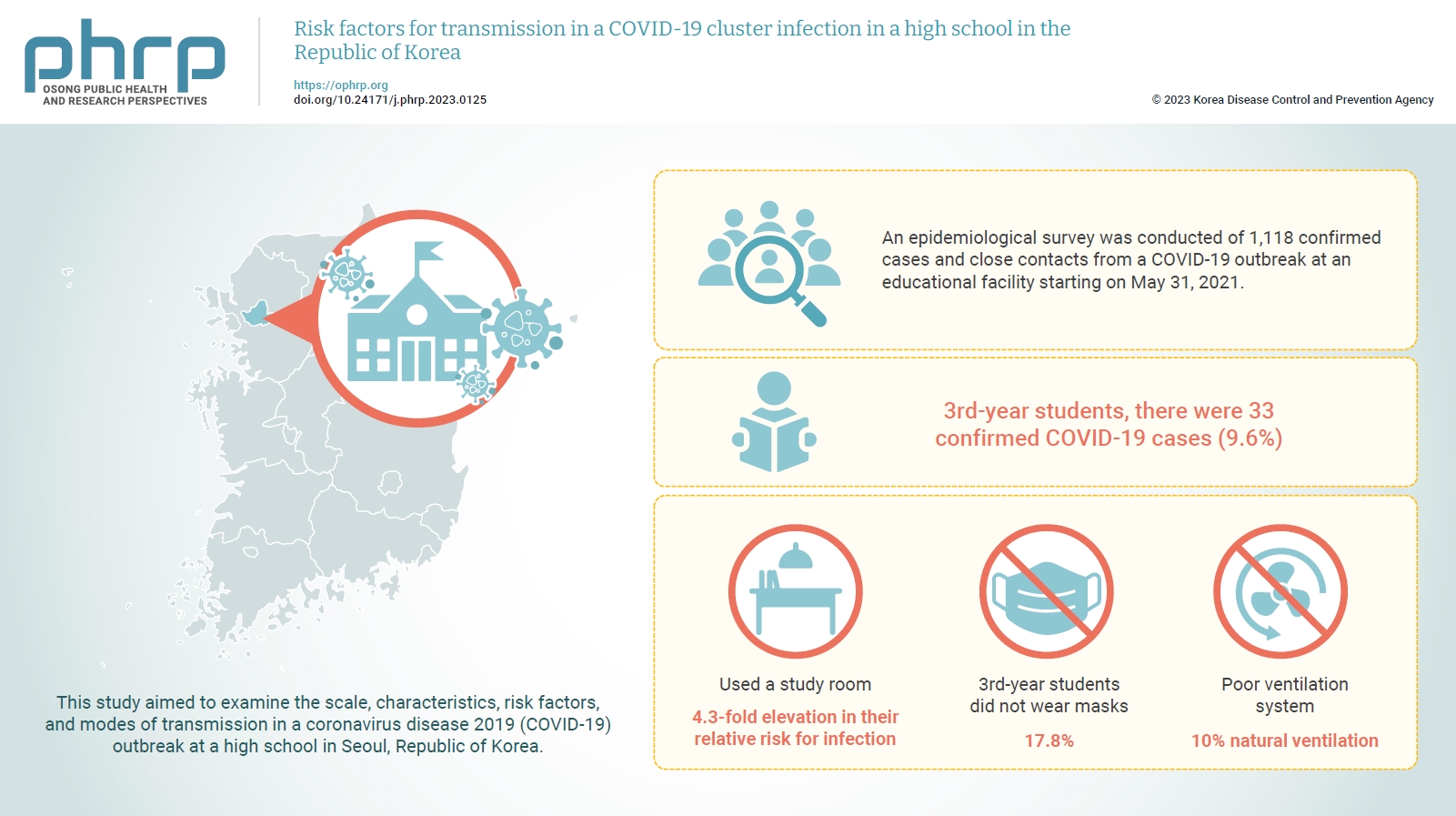
Objectives This study aimed to examine the scale, characteristics, risk factors, and modes of transmission in a coronavirus disease 2019 (COVID-19) outbreak at a high school in Seoul, Republic of Korea.
Methods An epidemiological survey was conducted of 1,118 confirmed cases and close contacts from a COVID-19 outbreak at an educational facility starting on May 31, 2021. In-depth interviews, online questionnaires, flow evaluations, and CCTV analyses were used to devise infection prevention measures. Behavioral and spatial risk factors were identified, and statistical significance was tested.
Results Among 3rd-year students, there were 33 confirmed COVID-19 cases (9.6%). Students who used a study room in the annex building showed a statistically significant 4.3-fold elevation in their relative risk for infection compared to those who did not use the study room. Moreover, CCTV facial recognition analysis confirmed that 17.8% of 3rd-year students did not wear masks and had the lowest percentage of mask-wearers by grade. The air epidemiological survey conducted in the study room in the annex, which met the 3 criteria for a closed space, confirmed that there was only 10% natural ventilation due to the poor ventilation system.
Conclusion To prevent and manage the spread of COVID-19 in educational facilities, advance measures that consider the size, operation, and resources of each school are crucial. In addition, various survey methodologies should be used in future studies to quickly analyze a wider range of data that can inform an evidence-based quarantine response.
Citations
Citations to this article as recorded by
Detection of a cluster of Omicron's BA.4 sublineage in Northern Senegal and identification of the first XAS recombinant variant in Senegal Martin Faye, Modeste Name Faye, Babacar Ndiaye, Moussa Moïse Diagne, Safietou Sankhe, Ndeye Marième Top, Amadou Diallo, Cheikh Loucoubar, Ndongo Dia, Amadou Alpha Sall, Ousmane Faye Virus Research.2024; 339: 199259. CrossRef
Objectives The coronavirus disease 2019 (COVID-19) pandemic has set a precedent for the fastest-produced vaccine as a result of global collaboration and outreach. This study explored Malaysians’ acceptance of the COVID-19 vaccine and its associated factors.
Methods A cross-sectional anonymous web-based survey was disseminated to Malaysian adults aged ≥18 years old via social media platforms between July 10, 2020 and August 31, 2020.
Results In the analysis of 4,164 complete responses, 93.2% of participants indicated that they would accept the COVID-19 vaccine if it was offered for free by the Malaysian government. The median out-of-pocket cost that participants were willing to pay for a COVID-19 vaccine was Malaysian ringgit (MYR) 100 (interquartile range [IQR], 100) if it was readily available and MYR 150 (IQR, 200) if the supply was limited. Respondents with a low likelihood of vaccine hesitancy had 13 times higher odds of accepting the COVID-19 vaccine (95% confidence interval [CI], 8.69 to 19.13). High perceived risk and severity were also associated with willingness to be vaccinated, with adjusted odds ratios of 2.22 (95% CI, 1.44 to 3.41) and 2.76 (95% CI, 1.87 to 4.09), respectively. Age and ethnicity were the only independent demographic characteristics that predicted vaccine uptake.
Conclusion Public health strategies targeting perceived risk, perceived susceptibility and vaccine hesitancy could be effective in enhancing vaccine uptake.
Citations
Citations to this article as recorded by
Longitudinal Analysis of Antibody Dynamics in Post-COVID-19 Patients following CoronaVac-Based Hybrid Immunity Akmal Shukri Amir Muhaimin, Muhammad Amin Ibrahim, Mohammed Fauzi Abdul Rani, Mariam Mohamad, Seok Mui Wang, Ariza Adnan, Madyhah Abd. Monir, Fatmawati Kamal, Siti Farah Alwani Mohd Nawi Journal of Pure and Applied Microbiology.2026; 20(2): 1278. CrossRef
Impact of confidence in scientific community, manufacturers, and regulatory authorities on acceptance of locally manufactured mRNA vaccines Li Ping Wong, Haridah Alias, Hai Yen Lee Vaccine.2026; 88: 128792. CrossRef
Factors Affecting Reluctance to Malaysian Adults’ COVID-19 Vaccine Booster Doses Nadhiah Abd Rahman, Hemaloshinee Vasudevan, Heinko Dona Madon, Noorseha Ayob Buletin Ilmu Kebidanan dan Keperawatan.2026; 5(02): 116. CrossRef
Does the messenger make the difference? Perceived reliability of health information sources during the COVID-19 pandemic in multi-ethnic Malaysia Nicholas Yee Liang Hing, Yew Kong Lee, Hyung Joon Kim, Nurhyikmah M. Lothfi, Elizabeth Wong, Joan Costa-Font, Theingi Maung Maung PLOS Global Public Health.2026; 6(10): e0007397. CrossRef
From infodemic to resilience: Exploring COVID‐19 protective measures in armed‐conflict zone Mona Salim, Jiuchang Wei Risk Analysis.2025; 45(6): 1453. CrossRef
Development and validation of COVID-19 vaccination perception (CoVaP) instrument among healthcare workers in Malaysia Siti Nur Aisyah Zaid, Azidah Abdul Kadir, Mohd Noor Norhayati, Basaruddin Ahmad, Muhamad Saiful Bahri Yusoff, Anis Safura Ramli, Jasy Suet Yan Liew PeerJ.2025; 13: e19318. CrossRef
Assessing the Determinants of Influenza Vaccine Uptake in Malaysia: Strategies to Improve Public Health and Service Delivery Prebha Manickam, Tina Varghese, Suwarna Senthilvasan, Rubithra Ramesh, Suveitra Balanei Balasubramaniam Cureus.2025;[Epub] CrossRef
Enablers and Barriers of COVID-19 Vaccination in the Philippines Evalyn Roxas, Paulyn Jean Acacio-Claro, Maria Margarita Lota, Alvin Abeleda, Soledad Natalia Dalisay, Madilene Landicho, Yoshiki Fujimori, Jan Zarlyn Rosuello, Jessica Kaufman, Margaret Danchin, Vicente Belizario, Florian Vogt Vaccines.2025; 13(7): 719. CrossRef
Assessment of Allergic Reaction of Covid-19 Vaccination among Malaysian Adults: A Cross-sectional Study Abdah Md Akim, Nurhazwani Abd Rauf, Yazan Ranneh, Gul-e-Saba Chaudhry Malaysian Journal of Medicine and Health Sciences.2025;[Epub] CrossRef
Awareness, knowledge, disease prevention practices, and immunization attitude of hepatitis E virus among food handlers in Klang Valley, Malaysia Sakshaleni Rajendiran, Wong Li Ping, Yuvaneswary Veloo, Syahidiah Syed Abu Thahir Human Vaccines & Immunotherapeutics.2024;[Epub] CrossRef
Acceptability of COVID-19 booster vaccine in malaysia: a cross-sectional study Cheryl Minn Jee Khoo, Eve Zhi Qing Dea, Li Yeow Law, Sharon Siew Tong Wong, Khuen Yen Ng, Athirah Bakhtiar Scientific Reports.2024;[Epub] CrossRef
To Vaccinate or Not? Perceived Benefits and Social Media Exposure as Predictors of COVID-19 Booster Jab Vaccination Practices with Self-Efficacy as Moderator Tak Jie Chan, Pei Xin Chong, Sheh Chin Foo, Yang Tian, Riki Arswendi Journal of Communication, Language and Culture.2024; 4(2): 142. CrossRef
COVID-19 vaccine uptake and its determinants among teenagers and their parents in Zhejiang, China Yu Huang, Qingqing Wu, Shuiyang Xu, Xiang Zhao, Lei Wang, Qiaohong Lv, Suxian Wu, Xuehai Zhang Asian Pacific Journal of Tropical Medicine.2023; 16(4): 176. CrossRef
Factors influencing parents’ hesitancy to vaccinate their children aged 5–11 years old against COVID-19: results from a cross-sectional study in Malaysia Roy Rillera Marzo, Ritankar Chakraborty, Shean Yih Soh, Hui Zhu Thew, Collins Chong, Ching Sin Siau, Khairuddin Bin Abdul Wahab, Indang Ariati Binti Ariffin, Shekhar Chauhan, Ken Brackstone, Bijaya Kumar Padhi, Petra Heidler Frontiers in Public Health.2023;[Epub] CrossRef
A survey on Malaysian’s acceptance and perceptions towards COVID-19 booster dose Suresh Rajakumar, Noorasyikin Shamsuddin, Mohammed Abdullah Alshawsh, Sutha Rajakumar, Hasniza Zaman Huri Saudi Pharmaceutical Journal.2023; 31(11): 101797. CrossRef
Cross-sectional assessment of predictors for COVID-19 vaccine uptake: an online survey in Greece Petros Galanis, Irene Vraka, Olga Siskou, Olympia Konstantakopoulou, Aglaia Katsiroumpa, Ioannis Moisoglou, Daphne Kaitelidou Vacunas.2022; 23: S60. CrossRef
Key predictors of COVID-19 vaccine hesitancy in Malaysia: An integrated framework Jason Wei Jian Ng, Santha Vaithilingam, Mahendhiran Nair, Li-Ann Hwang, Kamarul Imran Musa, Anat Gesser-Edelsburg PLOS ONE.2022; 17(5): e0268926. CrossRef
Intention to receive a COVID-19 vaccine booster dose and associated factors in Malaysia Li Ping Wong, Haridah Alias, Yan-Li Siaw, Mustakiza Muslimin, Lee Lee Lai, Yulan Lin, Zhijian Hu Human Vaccines & Immunotherapeutics.2022;[Epub] CrossRef
Determinants of COVID-19 vaccine acceptance in Ethiopia: A systematic review and meta-analysis Ayenew Mose, Abebaw Wasie, Solomon Shitu, Kassahun Haile, Abebe Timerga, Tamirat Melis, Tadesse Sahle, Amare Zewdie, Dong Keon Yon PLOS ONE.2022; 17(6): e0269273. CrossRef
When do persuasive messages on vaccine safety steer COVID-19 vaccine acceptance and recommendations? Behavioural insights from a randomised controlled experiment in Malaysia Nicholas Yee Liang Hing, Yuan Liang Woon, Yew Kong Lee, Hyung Joon Kim, Nurhyikmah M Lothfi, Elizabeth Wong, Komathi Perialathan, Nor Haryati Ahmad Sanusi, Affendi Isa, Chin Tho Leong, Joan Costa-Font BMJ Global Health.2022; 7(7): e009250. CrossRef
COVID-19 vaccine acceptance rate and its predictors in Ethiopia: A systematic review and meta-analysis Getaneh Mulualem Belay, Tewodros Getaneh Alemu, Masresha Asmare Techane, Chalachew Adugna Wubneh, Nega Tezera Assimamaw, Tadesse Tarik Tamir, Addis Bilal Muhye, Destaye Guadie Kassie, Amare Wondim, Bewuketu Terefe, Bethlehem Tigabu Tarekegn, Mohammed Seid Human Vaccines & Immunotherapeutics.2022;[Epub] CrossRef
Cross-sectional assessment of predictors for COVID-19 vaccine uptake: an online survey in Greece Petros Galanis, Irene Vraka, Olga Siskou, Olympia Konstantakopoulou, Aglaia Katsiroumpa, Ioannis Moisoglou, Daphne Kaitelidou Vacunas (English Edition).2022; 23: S60. CrossRef
<sec>
<title>Objectives</title>
<p>A questionnaire was designed to determine public understanding of early and late complications of Type 2 diabetes mellitus (T2DM).</p></sec>
<sec>
<title>Methods</title>
<p>A cross-sectional study was performed in participants who were selected using a multi-stage sampling method and a standard questionnaire of 67 questions was proposed. An expert panel selected 53 closed-ended questions for content validity to be included in the questionnaire. The reliability of the questionnaire was tested using Cronbach’s alpha coefficient giving a score of 0.84.</p></sec>
<sec>
<title>Results</title>
<p>Of the 825 participants, 443 (57.6%) were male, and 322 (41.87%) were 40 years or more. The proportion of low-, moderate- and high- awareness about T2DM and its complications was 29.26%, 62.68%, and 8.06%, respectively. Friends (56.31%) and internet and social networks (20.55%) were the 2 major sources of awareness, respectively. The medical staff (e.g., physicians) had the lowest share in the level of public awareness (3.64%) compared to other sources.</p></sec>
<sec>
<title>Conclusion</title>
<p>These results present data that shows the general population awareness of T2DM is low. Healthcare policymakers need to be effective at raising awarenes of diabetes and it should be through improved education.</p></sec>
Citations
Citations to this article as recorded by
Psychosomatic symptom profiles identified by latent profile analysis and their psychosocial and clinical correlates in patients with type 2 diabetes mellitus: A cross-sectional study He Yin, Haixia Ma, Xiaoju Zhang, Chao Li, Chunguang Wang, Qingqing Li Medicine.2026; 105(16): e48153. CrossRef
Polycytosine RNA-binding protein 1 regulates osteoblast function via a ferroptosis pathway in type 2 diabetic osteoporosis Hong-Dong Ma, Lei Shi, Hai-Tian Li, Xin-Dong Wang, Mao-Wei Yang World Journal of Diabetes.2024; 15(5): 977. CrossRef
Global burden of type 2 diabetes mellitus from 1990 to 2021, with projections of prevalence to 2044: a systematic analysis across SDI levels for the global burden of disease study 2021 Ke-Jie He, Haitao Wang, Jianguang Xu, Guoyu Gong, Xu Liu, Huiting Guan Frontiers in Endocrinology.2024;[Epub] CrossRef
Healthcare Practitioners' Perspective of Prevailing Awareness on Diabetes Complications: A Questionnaire-Based Pan-India Study Nikhil Tandon, Piya Ballani Thakkar, Jubbin Jacob, Pramila Kalra, Nanditha Arun, Alok Kanungo, Ashish Birla, Ashish Prasad, Mayuri Talathi Cureus.2023;[Epub] CrossRef
What Is the Optimal Cut-Off Point of the 10-Item Center for Epidemiologic Studies Depression Scale for Screening Depression Among Chinese Individuals Aged 45 and Over? An Exploration Using Latent Profile Analysis Hanlin Fu, Lulu Si, Ruixia Guo Frontiers in Psychiatry.2022;[Epub] CrossRef
Classification of probable online social networking addiction: A latent profile analysis from a large-scale survey among Chinese adolescents Ji-Bin Li, Anise M.S. Wu, Li-Fen Feng, Yang Deng, Jing-Hua Li, Yu-Xia Chen, Jin-Chen Mai, Phoenix K.H. Mo, Joseph T.F. Lau Journal of Behavioral Addictions.2020; 9(3): 698. CrossRef
Objectives
The incidence of anal disease is higher among persons with human immunodeficiency virus (HIV) infection than among the general population. We surveyed the status of seroprevalence in colorectal hospitals in Korea. Methods
The survey was conducted in colorectal hospitals in Korea from November to December 2008. The questionnaire was comprised of six topics about the status of HIV testing in colorectal hospitals. We gathered the data by website (<ext-link ext-link-type="uri" xlink:href="http://hivqa.nih.go.kr/risk">http://hivqa.nih.go.kr/risk</ext-link>) or fax. Results
Among 774 colorectal hospitals contacted, 109 (14%) hospitals participated in the survey. Among these, 48 hospitals (44%) performed HIV tests in their own hospitals and 11 (23%) took HIV testing by rapid method. The main reason for recommending an HIV test was surgical operation (54%) followed by endoscope (11%) and health checkup (9%). The annual number of HIV tests increased from 58,647 (at 21 hospitals) in 2002 to 246,709 (at 58 hospitals) in 2007. HIV seroprevalence was >3.0 per 10,000 individuals during 2002–2005, decreased to 2.2 per 10,000 individuals in 2006 and rose to 2.8 per 10,000 individuals in 2007. Conclusions
HIV seroprevalence of colorectal hospitals was more than twice that of general hospitals in Korea. HIV surveillance systems based on colorectal hospitals for HIV/AIDS transmission prevention by early HIV diagnosis are needed.
Citations
Citations to this article as recorded by
Discrimination and Stigma Hae-Wol Cho, Chaeshin Chu Osong Public Health and Research Perspectives.2015; 6(3): 141. CrossRef
Hospital-based HIV/HSV-2 seroprevalence among male patients with anal disease in Korea: cross sectional study Jin-Sook Wang, Do Yeon Hwang, Hye-Kyung Yu, Sung Soon Kim, Jong Kyun Lee, Mee-Kyung Kee BMC Infectious Diseases.2014;[Epub] CrossRef
Years of Epidemics (2009–2011): Pandemic Influenza and Foot-and-Mouth Disease Epidemic in Korea Hae-Wol Cho, Chaeshin Chu Osong Public Health and Research Perspectives.2013; 4(3): 125. CrossRef
What is Next for HIV/AIDS in Korea? Hae-Wol Cho, Chaeshin Chu Osong Public Health and Research Perspectives.2013; 4(6): 291. CrossRef



 First
 Prev


