Objectives This study described 10-year trends in the prevalence of 5 metabolic syndrome (MetS) components and examined age- and sex-specific patterns in the Republic of Korea using aggregated national health screening statistics from 2014 to 2023.
Methods This repeated cross-sectional study used publicly available aggregated data from the National Health Screening Statistical Yearbook of the National Health Insurance Service. Annual prevalence estimates were summarized overall and by age group and sex. Linear regression descriptively summarized temporal trends. Because of a marked reduction in examinees in 2018 and a discontinuity around the 2018–2019 transition, sensitivity analyses excluding 2018 were performed.
Results From 2014 to 2023, the prevalence of abdominal obesity increased from 21.0% to 25.5%, hyperglycemia from 34.7% to 40.1%, and hypertension from 42.3% to 45.1%. Hypertriglyceridemia and low high-density lipoprotein (HDL) cholesterol appeared to decrease over the same period but showed a marked discontinuity between 2018 and 2019. Prevalence generally increased across older age groups, particularly for hypertension and hyperglycemia. Men had a higher prevalence of 4 MetS components, whereas women had a higher prevalence of low HDL cholesterol.
Conclusion MetS components showed heterogeneous temporal, age-specific, and sex-specific patterns in Korean national health screening statistics. Increases in abdominal obesity and hyperglycemia support the need for earlier age- and sex-tailored cardiometabolic prevention, whereas apparent declines in lipid-related indicators should be interpreted cautiously due to the 2018–2019 discontinuity. Because this study used aggregated repeated cross-sectional data, individual-level longitudinal studies are needed to clarify cardiometabolic risk trends in the Republic of Korea.
Objectives Mild cognitive impairment (MCI) is prevalent among older adults and may progress to dementia. This study evaluated the effectiveness of a game-based brain exercise program in reducing MCI among older adults.
Methods A quasi-experimental study was conducted with 2 groups of older participants in Pathum Thani Province, Thailand. A total of 96 individuals with Thai mental state examination (TMSE) scores between 12 to 23, indicating MCI but no dementia diagnosis, were recruited. Using multi-stage sampling, participants were divided into an intervention group (n=48) and a control group (n=48). The intervention group participated in a 6-week game-based brain exercise program, while the control group received a self-administered brain exercise manual. Face-to-face interviews assessed outcomes at baseline, post-intervention, and 3-month follow-up. Data were analyzed using descriptive statistics and repeated-measures analysis of variance.
Results Significant differences were observed in mean TMSE scores and MCI knowledge between the intervention and control groups at the 3-month follow-up (p<0.001). The intervention group showed significant increases in TMSE scores and MCI knowledge post-intervention and at 3-month follow-up (p<0.001).
Conclusion The findings suggest that a game-based brain exercise program can improve cognitive function in older adults. Healthcare professionals can implement such programs to reduce MCI by addressing planning, management, and related issues in the future.
Citations
Citations to this article as recorded by
The Effect of Combined Physical Activity and Cognitive Training on Quality of Life in Older Adults Marwa Sobhy Abd EL Naby Amer, Eman Shokry Abd Allah, Samia Farouk Mahmoud Cuestiones de Fisioterapia.2024; 53(02): 3997. CrossRef
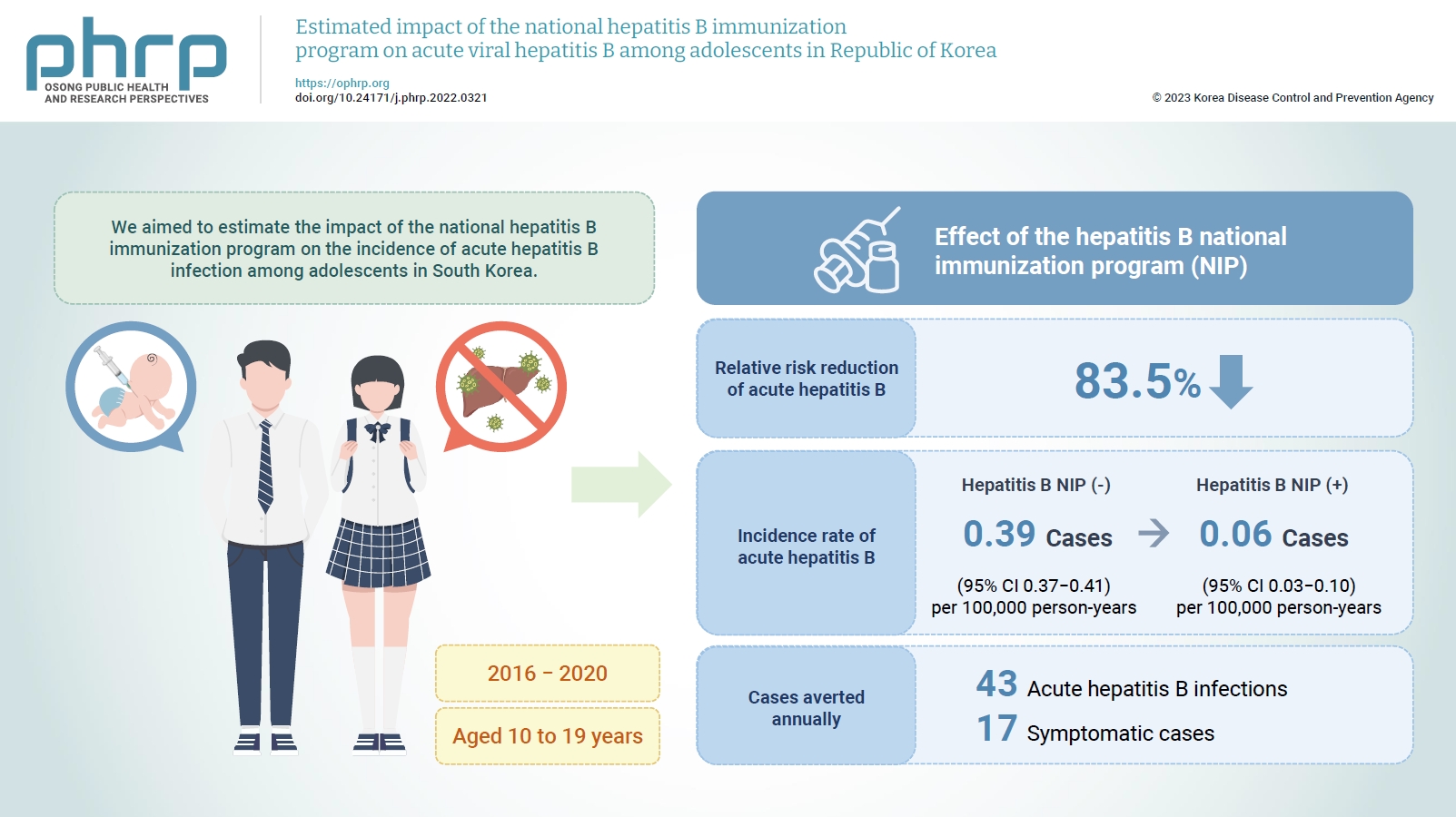
Objectives We aimed to estimate the impact of the national hepatitis B immunization program on the incidence of acute hepatitis B infection among adolescents in South Korea.
Methods We estimated the counterfactual incidence rate of reported acute hepatitis B among adolescents from 2016 to 2020 compared to the assumption that the national hepatitis B immunization program for children had not been implemented since 1995. The impact of the national hepatitis B immunization program for adolescents was measured by estimating the absolute risk reduction and averted acute hepatitis B infections among adolescents from 2016 to 2020 attributed to the national immunization program.
Results The relative risk reduction of acute hepatitis B among adolescents was estimated to be 83.5% after implementing the national hepatitis B immunization program. The incidence rate of reported acute hepatitis B infections among adolescents decreased from 0.39 to 0.06 per 100,000 person-years, and 43 acute hepatitis B infections, including 17 symptomatic cases, were averted annually from 2016 to 2020 by the national hepatitis B immunization program.
Conclusion The national hepatitis B immunization program for children was effective in preventing acute hepatitis B infection among adolescents in South Korea.
Citations
Citations to this article as recorded by
Modeling HBV transmission dynamics in Indonesia (2024–2030) using a SIVRM model: Evaluating optimal control strategies for elimination by 2030 Hashem S. Arkok, Tri Yunis Miko Wahyono, Dipo Aldila, Nurhayati Adnan Prihartono, Yury E Khudyakov PLOS One.2026; 21(2): e0341120. CrossRef
Seroprotection following hepatitis B vaccination in health care workers at a dental teaching hospital in south India Shobha Rodrigues, Jyoti Suvarna, Shivani Suvarna, Srikant Natarajan, Sandipan Mukherjee, Sowmya Narayan, Shivani Shetty Brazilian Journal of Oral Sciences.2026; 25: e266219. CrossRef
Reprogramming cancer immunity with next-generation combination therapies Nikolaos C. Kyriakidis, Carolina E. Echeverría, Jhommara Bautista, Sebastián Rivera-Orellana, María José Ramos-Medina, Camila Salazar-Santoliva, Juan S. Izquierdo-Condoy, Esteban Ortiz-Prado, Santiago Guerrero, Andrés López-Cortés Frontiers in Cell and Developmental Biology.2025;[Epub] CrossRef
<sec>
<title>Objectives</title>
<p>This study aimed to identify the educational needs of people with type 2 diabetes according to risk perceptions and the level of severity of complications.</p></sec>
<sec>
<title>Methods</title>
<p>There were 177 study participants who were outpatients of the internal medicine department at a university hospital located in the Republic of Korea, who consented to participate in the survey from December 10, 2016 to February 10, 2017. The data were analyzed using descriptive statistics, Pearson correlation, ANOVA with post-hoc comparison, and multiple regression analysis. Type 2 diabetes complications were classified into 3 groups: no complications, common complications, and severe complications.</p></sec>
<sec>
<title>Results</title>
<p>There were statistically significant positive correlations between educational needs and comparative risk perceptions, and the level of complication and comparative risk perception. Multiple regression analysis revealed that the factor predicting educational needs of type 2 diabetes people was their comparative risk perceptions, rather than the severity of diabetes complications or sociodemographic variables.</p></sec>
<sec>
<title>Conclusion</title>
<p>Since risk perception is the factor that indicates the educational needs of people with type 2 diabetes, there is a need to explore factors which increase risk perception, in order to meet educational needs. The findings suggest that a more specific and individualized educational program, which focuses on each person's risk perceptions, should be developed.</p></sec>
Citations
Citations to this article as recorded by
Fear of Complications Among Patients with Type 2 Diabetes: A Latent Profile Analysis Yuqing Liang, Ya’ning Yang, Xingruo Zhang, Lili Chen, Dan Su Patient Preference and Adherence.2026; Volume 20: 1. CrossRef
Added value of an online education intervention among patients with type 2 diabetes mellitus in Acapulco, Mexico: a non-randomised parallel group comparison Guadalupe Aguilar-Hernández, Sergio Paredes-Juárez, Baltazar Joanico-Morales, Janet Saldaña-Almazán, Claudia Erika Rios-Rivera, Miguel Flores-Moreno, Sergio Paredes-Solís, Neil Andersson IJQHC Communications.2026;[Epub] CrossRef
Assessment tools for disease risk perception in chronic patients: theoretical frameworks, psychometric properties, and clinical applications Fei Yang, Jiaojian Lv, Qiaoling Ye, Lihong Jin, Yuanliang Gu, Jinxiang Wu Frontiers in Public Health.2026;[Epub] CrossRef
Associations between Diabetes Self-Management and Microvascular Complications among Patients Living in Rural Areas, in Kenya Rachael Ireri, Gideon Kikuvi, Susan Mambo, Betsy C. Rono Cheriro Open Journal of Epidemiology.2025; 15(01): 88. CrossRef
Determinants of Complications of Diabetic Among Adult with Type 2 Diabetic Patients at Hubaal Specialist Hospital and Libaan Hospital in Mogadishu: Case Control Study Ahmed Mohamed, Ali Mohamed, Ahmed Guled, Mohamed Fuji, Abdullahi Qoryoley, Abdirahman Hassan American Journal of Internal Medicine.2024; 12(5): 82. CrossRef
<sec><title>Objectives</title><p>Many economically advanced countries have attempted to minimize public expenditures and pursue privatization based on the principles of neo-liberalism. However, Korea has moved contrary to this global trend. This study examines why and how the Korean health care system was formed, developed, and transformed into an integrated, single-insurer, National Health Insurance (NHI) system.</p></sec><sec><title>Methods</title><p>We describe the transition in the Korean health care system using an analytical framework that incorporates such critical variables as government economic development strategies and the relationships among social forces, state autonomy, and state power. This study focuses on how the relationships among social forces can change as a nation’s economic development or governing strategy changes in response to changes in international circumstances such as globalization.</p></sec><sec><title>Results</title><p>The corporatist Social Health Insurance (SHI) system (multiple insurers) introduced in 1977 was transformed into the single-insurer NHI in July 2000. These changes were influenced externally by globalization and internally by political democratization, keeping Korea’s private-dominant health care provision system unchanged over several decades.</p></sec><sec><title>Conclusion</title><p>Major changes such as integration reform occurred, when high levels of state autonomy were ensured. The state’s power (its policy capability), based on health care infrastructures, acts to limit the direction of any change in the health care system because it is very difficult to build the infrastructure for a health care system in a short timeframe.</p></sec>
Citations
Citations to this article as recorded by
Estimation of the benefit from pre‐emptive genotyping based on the nationwide cohort data in South Korea Ki Young Huh, Sejung Hwang, Joo Young Na, Kyung‐Sang Yu, In‐Jin Jang, Jae‐Yong Chung, Seonghae Yoon Clinical and Translational Science.2024;[Epub] CrossRef
ASSESSMENT OF TÜRKİYE'S PROVINCES WITH HEALTH INFRASTRUCTURE INDICATORS USING DESCRIPTIVE ANALYSIS AND HEALTH INDEX Ahmet Bahadır Şimşek Hacettepe Sağlık İdaresi Dergisi.2024; 27(3): 363. CrossRef
Lessons from health insurance responses in counteracting COVID-19: a qualitative comparative analysis of South Korea and three influential countries Hey Jin Ko, Eunji Yun, Boryung Ahn, Hyejin Lee, Won Mo Jang, Jin Yong Lee Archives of Public Health.2023;[Epub] CrossRef
Role of Primary Care and Challenges for Public–Private Cooperation during the Coronavirus Disease 2019 Pandemic: An Expert Delphi Study in South Korea Woo-young Shin, Changsoo Kim, Sei Young Lee, Won Lee, Jung-ha Kim Yonsei Medical Journal.2021; 62(7): 660. CrossRef
The sociopolitical context of the COVID-19 response in South Korea Hani Kim BMJ Global Health.2020; 5(5): e002714. CrossRef
Post-COVID healthcare reform in India: What to expect? Soham D. Bhaduri Journal of Family Medicine and Primary Care.2020; 9(11): 5427. CrossRef
The Story of Korean Health Insurance System Hae-Wol Cho, Chaeshin Chu Osong Public Health and Research Perspectives.2017; 8(4): 235. CrossRef
Korea has adopted Epidemic Intelligence Service (EIS) officers through the Field Epidemiology Training Program (FETP) since 1999 for systematic control of emerging and re-emerging infectious diseases. Graduates of medical schools in Korea are selected and serve as public health doctors (PHDs) for their mandatory military service. The duration of service is 3 years and PHDs comprise general practitioners and specialists. Some PHDs are selected as EIS officers with 3 weeks basic FETP training and work for central and provincial public health authorities to conduct epidemiological investigations. The total number of EIS officers is 31 as of 2012. The Korea Centers for Disease Control and Prevention (KCDC) has 12 specialists, whereas specialists and each province has one or two EIS officers to administer local epidemiological investigations in 253 public health centers. The Korean EIS officers have successfully responded and prevented infectious diseases, but there is a unique limitation: the number of PHDs in Korea is decreasing and PHDs are not allowed to stay outside Korea, which makes it difficult to cope with overseas infectious diseases. Furthermore, after 3 years service, they quit and their experiences are not accumulated. KCDC has hired full-time EIS officers since 2012 to overcome this limitation.
Citations
Citations to this article as recorded by
A resposta da Coreia do Sul à pandemia de COVID-19: lições aprendidas e recomendações a gestores Thais Regis Aranha Rossi, Catharina Leite Matos Soares, Gerluce Alves Silva, Jairnilson Silva Paim, Lígia Maria Vieira-da-Silva Cadernos de Saúde Pública.2022;[Epub] CrossRef
Turnover Intention among Field Epidemiologists in South Korea Sukhyun Ryu International Journal of Environmental Research an.2020; 17(3): 949. CrossRef
National Response to COVID-19 in the Republic of Korea and Lessons Learned for Other Countries Juhwan Oh, Jong-Koo Lee, Dan Schwarz, Hannah L. Ratcliffe, Jeffrey F. Markuns, Lisa R. Hirschhorn Health Systems & Reform.2020;[Epub] CrossRef
Steering the Private Sector in COVID-19 Diagnostic Test Kit Development in South Korea Sora Lee Frontiers in Public Health.2020;[Epub] CrossRef
Experience of 16 years and its associated challenges in the Field Epidemiology Training Program in Korea Moo-Sik Lee, Eun-Young Kim, Sang-Won Lee Epidemiology and Health.2017; 39: e2017058. CrossRef
The direction of restructuring of a Korea field epidemiology training program through questionnaire survey among communicable disease response staff in Korea Moo Sik Lee, Kwan Lee, Jee-Hyuk Park, Jee-Young Hong, Min-Young Jang, Byoung-Hak Jeon, Sang-Yun Cho, Sun-Ja Choi, JeongIk Hong Epidemiology and Health.2017; 39: e2017032. CrossRef
Review for the Korean Health Professionals and International Cooperation Doctors Dispatched to Peru by the Korea International Cooperation Agency (KOICA) Bongyoung Kim Osong Public Health and Research Perspectives.2015; 6(2): 133. CrossRef
From Seoul to Lima: Korean Doctors in Peru Hae-Wol Cho, Chaeshin Chu Osong Public Health and Research Perspectives.2015; 6(2): 71. CrossRef
Emerging Pathogens and Vehicles of Food- and Water-borne Disease Outbreaks in Korea, 2007–2012 Shinje Moon, Il-Woong Sohn, Yeongseon Hong, Hyungmin Lee, Ji-Hyuk Park, Geun-Yong Kwon, Sangwon Lee, Seung-Ki Youn Osong Public Health and Research Perspectives.2014; 5(1): 34. CrossRef




 First
 Prev


