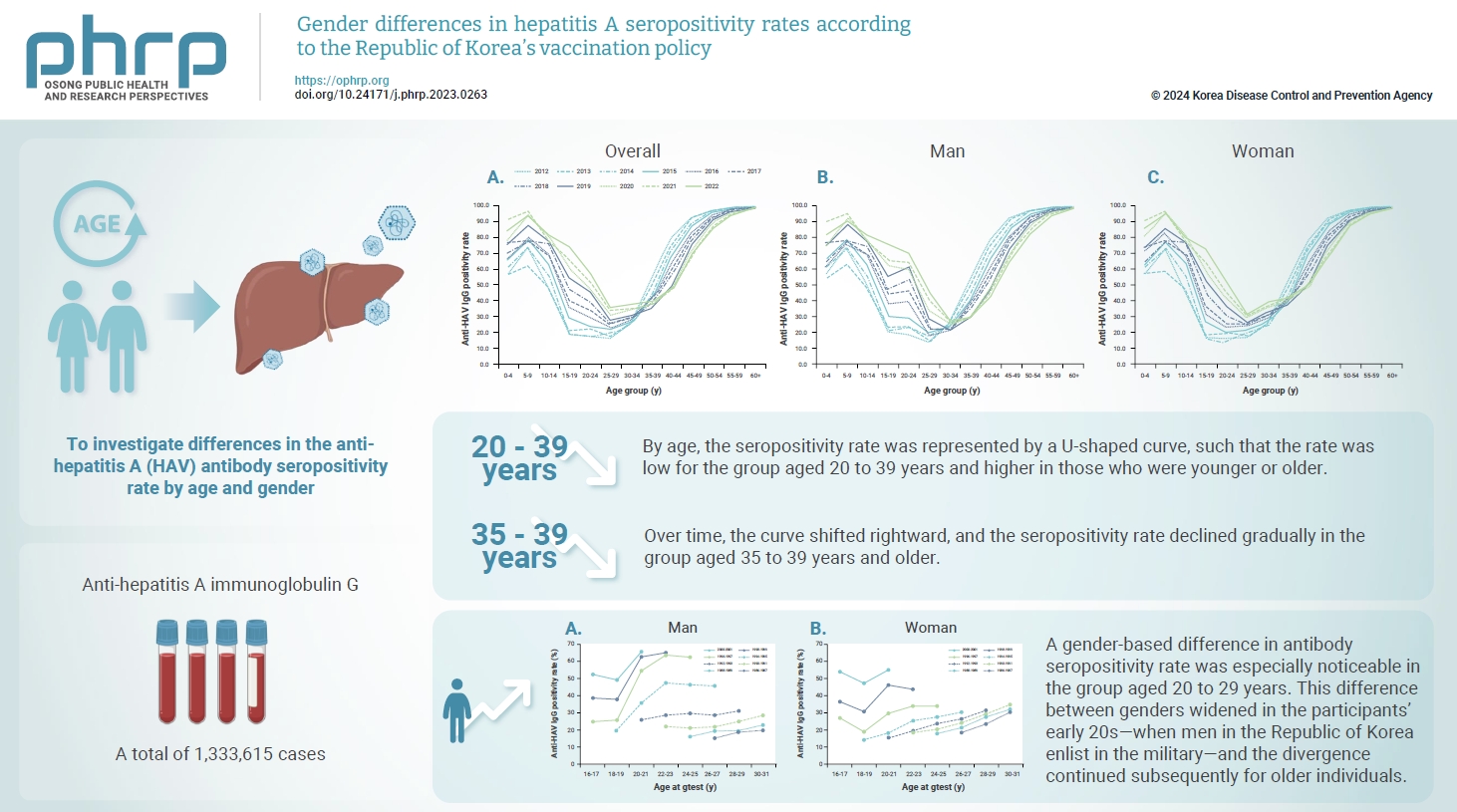
Objectives This study aimed to investigate differences in the anti-hepatitis A virus (HAV) antibody seropositivity rate by age and gender. Methods: We collected information on anti-HAV immunoglobulin G and immunoglobulin M status from samples submitted for HAV antibody testing in 2012–2022. A total of 1,333,615 cases were included in the analysis. Results: By age, the seropositivity rate was represented by a U-shaped curve, such that the rate was low for the group aged 20 to 39 years and higher in those who were younger or older. Over time, the curve shifted rightward, and the seropositivity rate declined gradually in the group aged 35 to 39 years and older. A gender-based difference in antibody seropositivity rate was especially noticeable in the group aged 20 to 29 years. This difference between genders widened in the participants’ early 20s—when men in the Republic of Korea enlist in the military—and the divergence continued subsequently for older individuals. Conclusion: These results indicate a higher risk of severe infection among older individuals and a gender-based difference in seroprevalence. Therefore, it is necessary to implement policies to promote vaccination in adults.
Citations
Citations to this article as recorded by
Infectious Diseases in an Era of Climate Crisis: Emergence and Resurgence Gui Nam Wee, Sunju Kim, Kyuwon Shim, Soojin Jang Journal of Environmental Health Sciences.2025; 51(6): 353. CrossRef
Examining the changes in the prevalence of Hepatitis a in Türkiye: systematic review and metaanalysis Özge Karakaya Suzan, Murat Bektaş, Mustafa Altındiş, Özge Kaya, Ayşe Eroğlu, Serap Çetinkaya Özdemir, Seda Tecik, Ahmet Naci Emecen, Nursan Çınar BMC Public Health.2024;[Epub] CrossRef
<p>The Second Meeting of the National Control Laboratories for Vaccines and Biologicals in the Western Pacific, was jointly organized by the National Institute of Food and Drug Safety Evaluation of the Ministry of Food and Drug Safety in the Republic of Korea, and by the World Health Organization Regional Office for the Western Pacific.</p>
<p>In the National Lot Release Systems session countries including Canada, China, Japan, Malaysia, Vietnam, and the Republic of Korea, all shared information on their current Lot Release Systems, including current practices and developments in risk-based official lot release of vaccines.</p>
<p>In the session on Quality Control of Blood Products, experts from the National Institute for Biological Standards and Control shared quality control and research results for; blood coagulation factor VIII products, and the measurement of procoagulant activity in immunoglobulin products. Representatives from Japan proposed a regional collaborative study to test aggregated immunoglobulin free from complement activity. A cell-based Japanese encephalitis vaccine potency assay was proposed by representatives from Korea and they also called for voluntary participation of other National Control Laboratories in a collaborative study, on the first Korean <italic>Gloydius</italic> anti-venom standard. Participants agreed in general to continue communicating, and coordinate presentation of the study results.</p>
Citations
Citations to this article as recorded by
A collaborative study to establish the second national standard for hepatitis B immunoglobulin in Korea Chan Woong Choi, Su Kyoung Seong, Ki Won Han, Hyun Jeong Kim, Kyung Hee Sohn, Sun Bo Shim, Yun Su Bang, JungHwan Cho, In Soo Shin Biologicals.2023; 82: 101679. CrossRef
Report on the seventh meeting of national control laboratories for vaccines and biologicals of the WHO Western Pacific and South-East Asia member states Sun Bo Shim, Chan Woong Choi, Jin Ho Shin, Jong Won Kim, Silke Schepelmann, Jae Ho Jung, Harish Chander, Ratih Pujilestari, Madoka Kuramitsu, Masaki Ochiai, Nee Yuan Qi, Geraldine N. Dimapilis, Luu Thi Dung, Hyung Sil Moon, In Soo Shin Biologicals.2023; 84: 101712. CrossRef
Objectives
To develop and optimize quantitative HPLC method using 2,3-naphthalenedicarboxaldehyde (NDA) after simple and efficient solid phase extraction to determine the histamine in a biopharmaceutical (Histobulin™). Methods
The HPLC method was established using NDA-induced Histobulin and compared with the recently reported HPLC method using o-phthaldehyde (OPA). The validated NDA-applied HPLC method was adjusted to 15 lots of Histobulin and compared by the current lot-release-test method using fluorimetry in recovery of histamine and reproducibility. Results
Analyses of six HPLC chromatograms using NDA and OPA each were compared. NDA produced a more stable chromatogram baseline than OPA, and showed better stability. The HPLC analysis was validated in accuracy (91–103%), precision (interday/intraday assay CV ≤2.30%), and linearity of dose–response curve (R<sup>2</sup> ≥ 0.9919). The detection limit was 0.0076 μg/mL and the quantitative limit was 0.0229 μg/mL. The amount of histamine per 12 mg of immunoglobulin was determined to be 0.17 ± 0.016 μg by the HPLC and 0.025 ± 0.013 μg by the current lot-release-test method using fluorimetry. Conclusion
NDA derivatization showed better stability compared with the OPA method. Therefore the newly established NDA-derivatizated HPLC method may be more suitable than the fluorimetric method in lot-release-tests of biopharmaceuticals.
Citations
Citations to this article as recorded by
Nociceptive pain as a clinical presentation of chronic urticaria and disappearance with immunoglobulin/histamine complex therapy: a case report Hyuk Soon Kim, Dae Hwan Kim, Yunyoung Nam, Jeong Eun Sohn, Geunwoong Noh Ewha Medical Journal.2026; 49(2): e14. CrossRef
Improvement of Fibromyalgia by Immunoglobulin/Histamine Complex Therapy for Chronic Urticaria and Allergic Rhinitis: A Case Report Hyuk Soon Kim, Yunyoung Nam, Jeong Eun Sohn, Geunwoong Noh Clinical Case Reports.2026;[Epub] CrossRef
Efficacy of Histaglobulin in Allergic Diseases: A Systematic Review and Meta-Analysis with Implications for Allergic Rhinitis Jayoung Oh, Ji Ho Choi International Journal of Molecular Sciences.2026; 27(17): 7753. CrossRef
DNAzyme-based and smartphone-assisted colorimetric biosensor for ultrasensitive and highly selective detection of histamine in meats Junjun Wang, Yue Tang, Jia Zheng, Zhengmin Xie, Jianli Zhou, Yuangen Wu Food Chemistry.2024; 435: 137526. CrossRef
Solid-State synthesis of transition nanometal oxides (MnO2, Co3O4, NiO, and ZnO) for catalytic and electrochemical applications Prabha Devi Balakrishnan, Chinnathambi Sekar, Rajendran Ramesh, Thathan Premkumar, Ponnusamy Kanchana Journal of Industrial and Engineering Chemistry.2024; 140: 434. CrossRef
Ultrasonic-driven chemical reduction synthesis of alizarin complexone-modified gold nanoparticles for dual-signal colorimetric and fluorometric sensing of histamine in seafood products Ampika Phoungsiri, Natee Lerdpiriyaskulkij, Arjnarong Mathaweesansurn, Ekarat Detsri Talanta.2024; 280: 126703. CrossRef
Effects of the immunoglobulin/histamine complex on panic disorder concurrent with chronic spontaneous urticaria: a case report Hyuk Soon Kim, Geunwoong Noh Journal of Medical Case Reports.2023;[Epub] CrossRef
Rapid detection of histamine in fish based on the fluorescence characteristics of carbon nitride Xiaobin Lin, Chengyi Hong, Zhengzhong Lin, Zhiyong Huang Journal of Food Composition and Analysis.2022; 112: 104659. CrossRef
Immunotherapy using Histobulin™ in psoriasis: A case report Hyuk Soon Kim, Geunwoong Noh Clinical Case Reports.2022;[Epub] CrossRef
Histobulin as a complementary but essential therapeutic for Intravenous Immune Globulin Therapy of Pfeiffer‐Weber‐Christian disease with multiple allergic diseases and its effects on allergic disease: A case report Geunwoong Noh Clinical Case Reports.2021; 9(2): 966. CrossRef
Immunotherapy using Histobulin in atopic dermatitis Geunwoong Noh Clinical Case Reports.2021; 9(1): 113. CrossRef
Colorimetric sensing of histamine in aqueous solution by a system composed of alizarin complexone and Ni2+ complex via indicator displacement approach Yasumasa Fukushima, Shunichi Aikawa Tetrahedron Letters.2021; 72: 153088. CrossRef
Induction of remission in chronic urticaria by immunotherapy using immunoglobulin/histamine complex (Histobulin™): a case report Hyuk Soon Kim, Geunwoong Noh Allergy, Asthma & Clinical Immunology.2021;[Epub] CrossRef
Intravenous Immune Globulin (IVIG) Therapy After Unsuccessful Treatment with Corticosteroid and Cyclosporine A in Pfeifer-Weber-Christian Disease: A Case Report Geunwoong Noh, Chi Wha Han American Journal of Case Reports.2021;[Epub] CrossRef
Motion sickness-relieving effects of Tamzin, a herbal formulation: In vitro and in vivo studies N. Ilaiyaraja, Dongzagin Singsit, Mahantesh M Patil, S. Priyadharshini, V. Rashmi, Farhath Khanum Food Bioscience.2020; 35: 100595. CrossRef
Trends in the Analysis of Biopharmaceuticals by HPLC Angela Tartaglia, Marcello Locatelli, Victoria Samanidou Current Analytical Chemistry.2020; 16(1): 52. CrossRef
Validation of HPLC Method for Determination of Histamine in Human Immunoglobulin Formulations Michikazu Tanio, Toru Nakamura, Hideki Kusunoki, Kyohei Ideguchi, Kazuyuki Nakashima, Isao Hamaguchi Journal of AOAC INTERNATIONAL.2020; 103(5): 1223. CrossRef
4-Methoxy-ortho-phthalaldehyde: a promising derivatizing agent for the fluorimetric evaluation of histamine in seafood Clémence Moitessier, Khémesse Kital, Pierre-Edouard Danjou, Francine Cazier-Dennin Talanta Open.2020; 2: 100014. CrossRef
A novel biomimetic immunoassay method based on Pt nanozyme and molecularly imprinted polymer for the detection of histamine in foods Xiaofeng Wang, Xiaoqing Song, Lin Si, Longhua Xu, Zhixiang Xu Food and Agricultural Immunology.2020; 31(1): 1036. CrossRef
Development of a Rapid and Eco-Friendly UHPLC Analytical Method for the Detection of Histamine in Fish Products Antonello Cicero, Francesco Giuseppe Galluzzo, Gaetano Cammilleri, Andrea Pulvirenti, Giuseppe Giangrosso, Andrea Macaluso, Antonio Vella, Vincenzo Ferrantelli International Journal of Environmental Research an.2020; 17(20): 7453. CrossRef
Silver nanoparticles decorated graphene nanoribbon modified pyrolytic graphite sensor for determination of histamine Neeraj Kumar, Rajendra N. Goyal Sensors and Actuators B: Chemical.2018; 268: 383. CrossRef
Amperometric Biosensor Based on Diamine Oxidase/Platinum Nanoparticles/Graphene/Chitosan Modified Screen-Printed Carbon Electrode for Histamine Detection Irina Apetrei, Constantin Apetrei Sensors.2016; 16(4): 422. CrossRef
Comparison of Methods for Measuring Histamine by ELISA and HPLC-MS Assay In Vitro In Hee Lee, Yoo Hyun Kim Korean Journal of Clinical Laboratory Science.2015; 47(4): 306. CrossRef
UPLC versus HPLC on Drug Analysis: Advantageous, Applications and Their Validation Parameters Mehmet Gumustas, Sevinc Kurbanoglu, Bengi Uslu, Sibel A. Ozkan Chromatographia.2013; 76(21-22): 1365. CrossRef



 First
 Prev


