Objectives
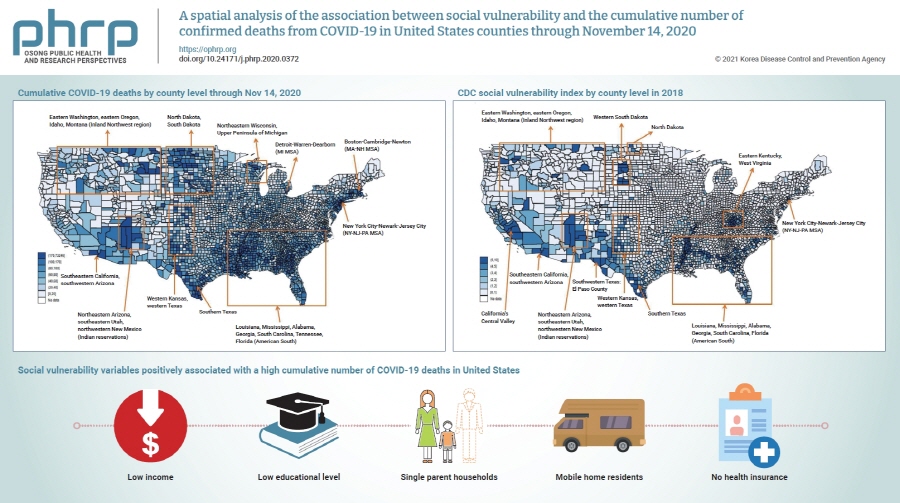
Coronavirus disease 2019 (COVID-19) is classified as a natural hazard, and social vulnerability describes the susceptibility of social groups to potential damages from natural hazards. Therefore, the objective of this study was to examine the association between social vulnerability and the cumulative number of confirmed COVID-19 deaths (per 100,000) in 3,141 United States counties.
Methods
The cumulative number of COVID-19 deaths was obtained from USA Facts. Variables related to social vulnerability were obtained from the Centers for Disease Control and Prevention Social Vulnerability Index and the 2018 5-Year American Community Survey. Data were analyzed using spatial autoregression models.
Results
Lowest income and educational level, as well as high proportions of single parent households, mobile home residents, and people without health insurance were positively associated with a high cumulative number of COVID-19 deaths.
Conclusion
In conclusion, there are regional differences in the cumulative number of COVID-19 deaths in United States counties, which are affected by various social vulnerabilities. Hence, these findings underscore the need to take social vulnerability into account when planning interventions to reduce COVID-19 deaths.
Citations
Citations to this article as recorded by
Patterns of Homologous Repair Deficiency and
BRCA1
/
2
Testing of Ovarian and Breast Cancers: A Real-World Study of Patients in Community Health Settings in the United States
Rayna K. Matsuno, Adrienne F.O. Williams, Connor Sweetnam, Giovanna I. Cruz, Liz M. Toland, Anna B. Berry, Monika A. Izano, Liam C. Lee, Gieira Jones, Jagadeswara R. Earla, Thomas D. Brown, Smita Kothari, Arthur Sillah JCO Oncology Advances.2025;[Epub] CrossRef
A low-rank Bayesian approach for geoadditive modeling Bryan Sumalinab, Oswaldo Gressani, Niel Hens, Christel Faes Spatial Statistics.2025; 68: 100907. CrossRef
A retrospective assessment of COVID-19 vulnerability index indicators and mortality rates pre-COVID-19 (2018–2020) and during COVID-19 (2020–2022) in a health and demographic surveillance site, Soweto, South Africa Takwanisa Machemedze, Chodziwadziwa Whiteson Kabudula, Jean Juste Harrisson Bashingwa, Beth A. Tippett Barr, Nellie Myburgh, Sana Mahtab, Cleopas Hwinya, Stephen Tollman, Ziyaad Dangor, Shabir A. Madhi Population Health Metrics.2025;[Epub] CrossRef
The Role of Testing and Vaccination in Mediating Social Vulnerability and COVID-19 Prevalence in Southern Nevada Andrea Lopez, Lung-Chang Chien, L.-W. Antony Chen, Courtney Coughenour, Erika Marquez, Szu-Ping Lee International Journal of Environmental Research an.2025; 22(7): 980. CrossRef
Ecological comparison of six countries in two waves of COVID-19 Meiheng Liu, Leiyu Shi, Manfei Yang, Jun Jiao, Junyan Yang, Mengyuan Ma, Wanzhen Xie, Gang Sun Frontiers in Public Health.2024;[Epub] CrossRef
Social vulnerability and COVID-19 in Maringá, Brazil Matheus Pereira Libório, Oseias da Silva Martinuci, Patrícia Bernardes, Natália Cristina Alves Caetano Chav Krohling, Guilherme Castro, Henrique Leonardo Guerra, Eduardo Alcantara Ribeiro, Udelysses Janete Veltrini Fonzar, Ícaro da Costa Francisco Spatial Information Research.2023; 31(1): 51. CrossRef
A county-level analysis of association between social vulnerability and COVID-19 cases in Khuzestan Province, Iran Mahmoud Arvin, Shahram Bazrafkan, Parisa Beiki, Ayyoob Sharifi International Journal of Disaster Risk Reduction.2023; 84: 103495. CrossRef
Global mapping of epidemic risk assessment toolkits: A scoping review for COVID-19 and future epidemics preparedness implications Bach Xuan Tran, Long Hoang Nguyen, Linh Phuong Doan, Tham Thi Nguyen, Giang Thu Vu, Hoa Thi Do, Huong Thi Le, Carl A. Latkin, Cyrus S. H. Ho, Roger C. M. Ho, Md Nazirul Islam Sarker PLOS ONE.2022; 17(9): e0272037. CrossRef
COVID-19 mortality and deprivation: pandemic, syndemic, and endemic health inequalities Victoria J McGowan, Clare Bambra The Lancet Public Health.2022; 7(11): e966. CrossRef



 First
 Prev


