Objectives This study investigated a cluster of secondary human-to-human transmission of severe fever with thrombocytopenia syndrome (SFTS) in a hospital setting, focusing on infection risk factors and the role of personal protective equipment (PPE).
Methods A descriptive epidemiological investigation was conducted following the death of an index patient with laboratory-confirmed SFTS. A total of 27 close contacts, including healthcare workers and a funeral director, were monitored for symptoms. Suspected cases underwent real-time reverse transcription polymerase chain reaction testing. Clinical features, PPE use, and exposure histories were analyzed. The Fisher exact test was used to assess associations between PPE use and infection. Viral genotyping and sequence analyses were performed to evaluate transmission routes.
Results The index patient deteriorated rapidly and died after repeated cardiopulmonary resuscitation (CPR), during which 8 secondary cases occurred. Most infections were identified among individuals involved in CPR or postmortem care without adequate PPE. Although not statistically significant, infection rates were higher among those who did not wear masks or who used low-filtration masks. Proper use of gloves, gowns, and goggles was associated with lower infection rates. Cycle threshold values in secondary cases (range, 34–39) were higher than in the index case (14.07), suggesting lower viral loads. Sequence analysis demonstrated 99.6%–100% homology between the index and secondary cases; all isolates were genotype B, indicating direct transmission.
Conclusion This study provides molecular and epidemiological evidence of nosocomial SFTS transmission. Inadequate PPE use during aerosol-generating procedures likely facilitated infection, underscoring the importance of strict adherence to PPE protocols and reinforced infection control practices.
Citations
Citations to this article as recorded by
Severe fever with thrombocytopenia syndrome complicated by invasive pulmonary aspergillosis and septic shock: a case report highlighting the role of mNGS Bolin Wang, Mingyue Zhao, Qingfeng Chen, Feihu Zhang, Mingzhi Fan, Xinbao Lian Frontiers in Medicine.2026;[Epub] CrossRef
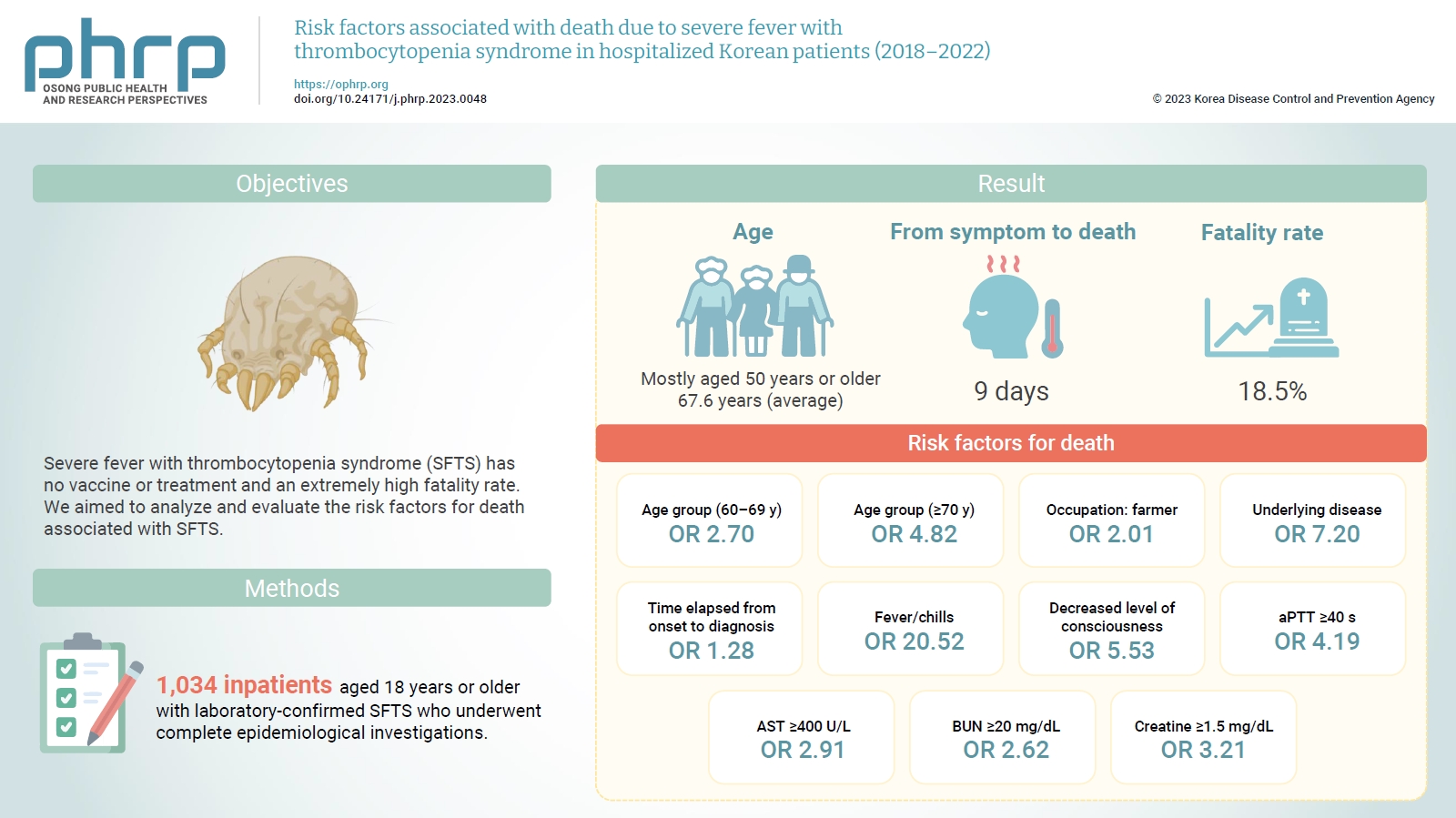
Objectives Severe fever with thrombocytopenia syndrome (SFTS) has no vaccine or treatment and an extremely high fatality rate. We aimed to analyze and evaluate the risk factors for death associated with SFTS.
Methods Among reports from 2018 to 2022, we compared and analyzed 1,034 inpatients aged 18 years or older with laboratory-confirmed SFTS who underwent complete epidemiological investigations.
Results Most of the inpatients with SFTS were aged 50 years or older (average age, 67.6 years). The median time from symptom onset to death was 9 days, and the average case fatality rate was 18.5%. Risk factors for death included age of 70 years or older (odds ratio [OR], 4.82); agriculture-related occupation (OR, 2.01); underlying disease (OR, 7.20); delayed diagnosis (OR, 1.28 per day); decreased level of consciousness (OR, 5.53); fever/chills (OR, 20.52); prolonged activated partial thromboplastin time (OR, 4.19); and elevated levels of aspartate aminotransferase (OR, 2.91), blood urea nitrogen (OR, 2.62), and creatine (OR, 3.21).
Conclusion The risk factors for death in patients with SFTS were old age; agriculture-related occupation; underlying disease; delayed clinical suspicion; fever/chills; decreased level of consciousness; and elevated activated partial thromboplastin time, aspartate aminotransferase, blood urea nitrogen, and creatine levels.
Citations
Citations to this article as recorded by
Seroprevalence and Epidemiological Characteristics of Severe Fever with Thrombocytopenia Syndrome in Patients with Chronic Diseases in Korea Jongyoun Yi, Ahreum Kim, Maeng Seok Noh, Changhoon Kim, Hyun Jin Son, Mee Kyung Ko, Kye-Hyung Kim Viruses.2026; 18(2): 217. CrossRef
Overwintering Ticks as a Reservoir for Severe Fever With Thrombocytopenia Syndrome Virus in the Republic of Korea Hyunyoung Yoon, Hee Il Lee, Seong Yoon Kim Entomological Research.2026;[Epub] CrossRef
Ecological signature on the epidemiological dynamics of severe fever with thrombocytopenia syndrome Zhe Lou, Jing Lu, Shuyi Liang, Wei Zhao, Ling Huang, Haowei Wang, Xiang Li, Jianli Hu, Ruiyun Li, Bo Zhang PLOS Neglected Tropical Diseases.2026; 20(6): e0014408. CrossRef
Clinical Predictors of Mortality in Severe Fever with Thrombocytopenia Syndrome: An Updated Systematic Review and Meta-Analysis Ke-Xin Wang, Guo-Mei Xia, Yu-Han Liu, Shuai-Ru Jiao, Yu-Feng Gao, Sheng-Qun Deng Pathogens.2026; 15(7): 767. CrossRef
Commentary on “Low Thoracic Muscle Mass: A Novel Indicator of Poor Prognosis in Patients With Severe Fever With Thrombocytopenia Syndrome” Mohammad Barary, Mostafa Javanian, Mohammad Golparvar Azizi, Mehran Shokri, Soheil Ebrahimpour Immunity, Inflammation and Disease.2026;[Epub] CrossRef
Identification of early prognostic biomarkers in Severe Fever with Thrombocytopenia Syndrome using machine learning algorithms Jie Zhu, Jianmei Zhou, Chunhui Tao, Guomei Xia, Bingyan Liu, Xiaowei Zheng, Xu Li, Zhenhua Zhang Annals of Medicine.2025;[Epub] CrossRef
The immunogenicity and protection efficacy evaluation of mRNA vaccine candidate for severe fever with thrombocytopenia syndrome in mice Da-Eun Jeong, Jack Yoon, Baek Kim, Jun-Gu Kang, Abdallah M. Samy PLOS Neglected Tropical Diseases.2025; 19(4): e0012999. CrossRef
Retrospective Analysis of Severe Fever With Thrombocytopenia Syndrome and Construction of a Nomogram Prediction Model for Mortality Risk Factors Gang Chen, Yuchen Du, Xiuchang Ma, Yaowen Liang, Apeng Chen, Jie Wei, Jinhuan Wu, Wenxian Qian, Shuqin Xie, Yi Yan, Zheng Hu, Yishan Zheng, Man Tian, Changhua Yi Open Forum Infectious Diseases.2025;[Epub] CrossRef
Deciphering the evolutionary landscape of severe fever with thrombocytopenia syndrome virus across East Asia Dongbin Park, Kwan Woo Kim, Young-Il Kim, Mark Anthony B Casel, Hyunwoo Jang, Woohyun Kwon, Kanghee Kim, Se-Mi Kim, Monford Paul Abishek N, Eun-Ha Kim, Hobin Jang, Suhee Hwang, Seok-Min Yun, Joo-Yeon Lee, Hye Won Jeong, Su-Jin Park, Young Ki Choi Virus Evolution.2024;[Epub] CrossRef
Acute kidney injury as a prognostic marker in severe fever with thrombocytopenia syndrome Jin Mi Lee, Hae Lee Kim, Myoung-nam Lim, Changhyup Kim, Yeon Ju La, Yong Duk Jeon, Won Sup Oh, Seongmin Son, Sunhwa Lee, Hyunjeong Baek, Daniel Duck-Jin Hwang, Ji In Park Scientific Reports.2024;[Epub] CrossRef
Double-Stranded RNA-Based Method for Diagnosing Severe Fever with Thrombocytopenia Jung Wan Park, Jaemin Jeon, Yoosik Kim, Min Hyok Jeon Journal of Clinical Medicine.2024; 14(1): 105. CrossRef



 First
 Prev


