Objectives Cervical cancer remains a major public health challenge in India despite advances in prevention through human papillomavirus (HPV) vaccination and screening. Although national estimates indicate gradual declines, marked regional disparities persist, and coronavirus disease 2019–related disruptions may have affected recent disease trajectories. This study assessed long-term trends, post-pandemic deviations, and progress toward World Health Organization (WHO) elimination targets in South India.
Methods This population-based observational analysis used Global Burden of Disease Study 2023 estimates for women aged 30–69 years in South India from 1990 to 2023. Pre-pandemic trends and counterfactual projections were evaluated, and age-standardized incidence rates (ASRs) were descriptively compared with the WHO elimination threshold of ≤4 cases per 100,000 woman-years.
Results Age-standardized cervical cancer incidence and mortality declined until the early 2010s but remained above national and global rates. Thereafter, declines stagnated and reversed. In 2023, incidence ranged from 26.1 per 100,000 women in Kerala to 65.8 in Telangana; all states exceeded the WHO threshold based on these ASRs. Observed rates exceeded counterfactual projections, but uncertainty envelopes included zero for every location and outcome. Thus, the findings are consistent with possible post-pandemic disruption to cervical cancer services rather than statistically demonstrated excess burden, and this ecological comparison cannot establish causality. Disability-adjusted life-year rates were highest among women aged 50–69 years.
Conclusion South India appears to have experienced a recent loss of momentum in cervical cancer control. Strengthening HPV vaccination coverage, expanding screening, and improving the resilience of cancer prevention services are essential for accelerating progress toward elimination targets.
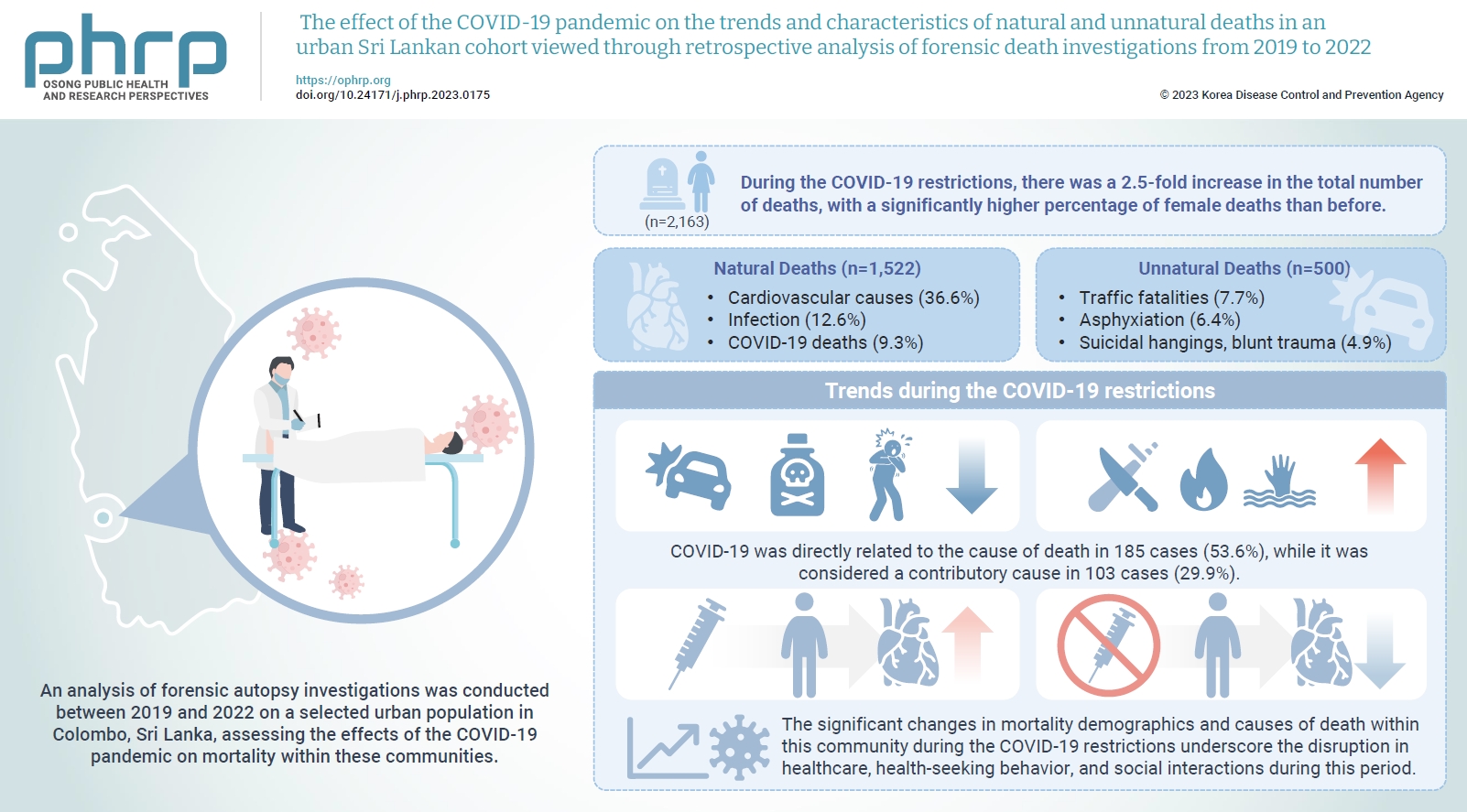
Objectives The coronavirus disease 2019 (COVID-19) pandemic has had a severe impact on global health. Apart from the disease itself, the strict restrictions and lockdowns enforced to minimize its spread have also substantially disrupted personal and public health. Methods: An analysis of forensic autopsy investigations was conducted between 2019 and 2022 on a selected urban population in Colombo, Sri Lanka, assessing the effects of the COVID-19 pandemic on mortality within these communities. Results: During the COVID-19 restrictions, there was a 2.5-fold increase in the total number of deaths, with a significantly higher percentage of female deaths than before. The majority of these deaths were due to cardiovascular causes, while COVID-19-related deaths ranked third overall. The highest proportion of COVID-19 deaths occurred among unvaccinated females. The monthly frequency of deaths from traffic accidents, poisoning, and asphyxiation decreased, while deaths from blunt trauma, sharp trauma, burns, and immersion increased. There was also a rise in blunt homicides and a greater number of femicides during the COVID-19 restrictions than in the pre-pandemic period. A significantly higher percentage of males who received the COVID-19 vaccine died from cardiovascular causes compared to those in the unvaccinated group. Conclusion: The significant changes in mortality demographics and causes of death within this community during the COVID-19 restrictions underscore the disruption in healthcare, healthseeking behavior, and social interactions during this period. The vulnerability of individuals residing in highly urbanized areas with lower socioeconomic status, particularly women, is brought into sharp focus.
Citations
Citations to this article as recorded by
The impact of the COVID-19 pandemic on forensic pathology services in Limpopo province, South Africa Thakadu A. Mamashela, Samuel T. Ntuli South African Family Practice.2025;[Epub] CrossRef
A nationwide forensic case-series of femicides in Italy – Part 1: Clues to the motives of the murder Rossana Cecchi, Anna Laura Santunione, Jessika Camatti, Alice Buzzelli, Alessandra De Martina, Alessandra Sannella, Marco Vinceti, Graziamaria Corbi, Carlo Pietro Campobasso, Matilde Sassani, Giovanna Laura De Fazio, Paolo Fais, Susi Pelotti, Arianna Gior Legal Medicine.2025; 78: 102703. CrossRef



 First
 Prev


