Objectives This study investigated the association between living arrangements and healthrelated quality of life (HRQoL) in older people. Methods: A secondary analysis was conducted of 6,153 participants (aged ≥60 years) from the seventh Korean National Health and Nutrition Examination Survey (2016 to 2018). HRQoL was measured using the 3-level version of the EuroQol 5-dimensional questionnaire. The chi-square test, t-test, and multiple regression were used, applying sampling weights for the analysis. Results: The proportion of respondents living alone was 18.0%, with a higher prevalence among women and older age groups (p<0.001). The overall HRQoL was lower in groups living alone than in groups living with others (p<0.001). Older people living alone showed higher impairments in all dimensions of the 3-level version of the European Quality of Life 5-Dimensional Questionnaire (EQ-5D-3L) than those living with others, including mobility (p<0.001), self-care (p<0.001), usual activities (p<0.001), pain/discomfort (p<0.001), and depression/anxiety (p<0.001). Problems with mobility were most prevalent (42.8%), followed by pain/ discomfort (41.9%) in respondents living alone. Living alone was significantly associated with a lower HRQoL index score (b=–0.048, p<0.001) after adjusting for age, gender, education, exercise, perceived stress, and perceived health status. Conclusion: Living alone was negatively associated with HRQoL. Based on this study, future care planning for older people should consider their living arrangements. The need to strengthen and expand care programs targeting those living alone should also be addressed.
Citations
Citations to this article as recorded by
Quality of life in later years: A comprehensive review of elderly well-being in India Sandhya Bharathi Shanmugasundaram, Pitchaimani Govindharaj, Srihari Ramamoorthy, Vijayalakshmi Purusothaman International Journal of Noncommunicable Diseases.2026; 11(2): 82. CrossRef
Factors Related to Quality of Life Among Older Adults with Family Care Vulnerability in Semi-Urban Areas of Thailand Arun Boonsang, Laksanee Boonkhao, Nittaya Chakhamrun, Aree Butsorn, Sanga Tubtimhin, Pongsak Rattanachaikunsopon, Sanguansin Ratanalert Journal of Multidisciplinary Healthcare.2026; Volume 19: 1. CrossRef
Occupational Balance, Quality of Life, and Recovery Among Older Mental Health Service Users—A Cross-Sectional Study Carina Tordai, Steven M. Schmidt, Elisabeth Argentzell, Mona Eklund Occupational Therapy In Health Care.2026; : 1. CrossRef
Association between health-related quality of life and noncommunicable diseases in South Korea Seungjae Byun, Kyeongeun Kim, Min Seong Kim, Guillaume Fond, Laurent Boyer, Guillermo F. López Sánchez, Jiseung Kang, Dong Keon Yon Medicine.2026; 105(37): e50564. CrossRef
Preventing depression in older adults with chronic illnesses through the SMART Elderly Program: a quasi-experimental study in Central Thailand Phongsakorn Toopboochakorn, Nanthawan Nilpayak, Phornphimon Hotarat, Wanida Jaroensuk, Phannathat Tanthanapanyakorn Korean Journal of Family Medicine.2026; 47(5): 405. CrossRef
Convergent validity, reliability and responsiveness of the AP-7D and EQ-5D-5L based on the survey for the general people in five countries: a new cultural-specific preference-based measure developed in east and southeast asia Yuta Suzuki, Takeru Shiroiwa, Tatsunori Murata, Emi Kamono, Yasuhiro Morii, Takashi Fukuda Health and Quality of Life Outcomes.2025;[Epub] CrossRef
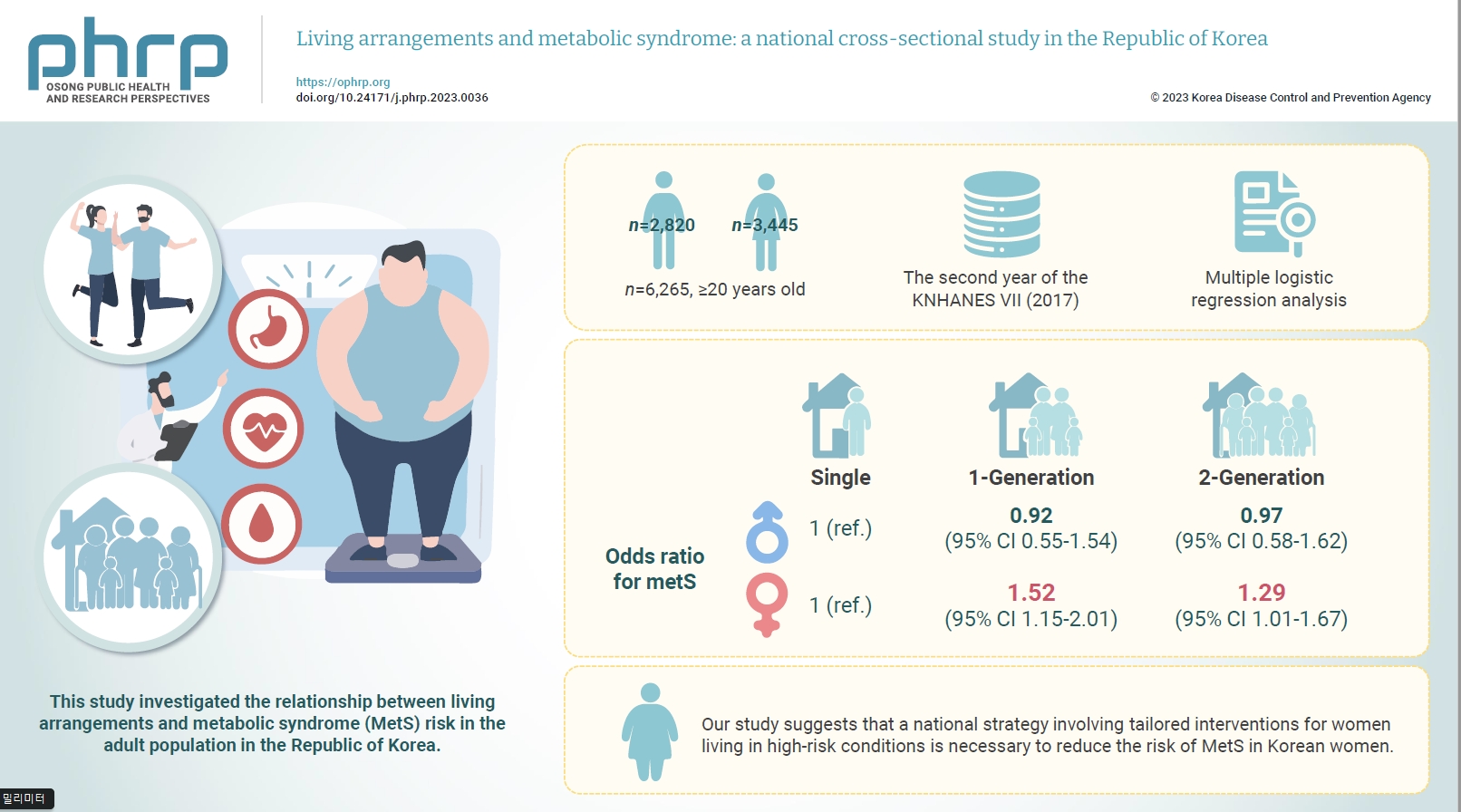
Objectives This study investigated the relationship between living arrangements and metabolic syndrome (MetS) risk in the adult population in the Republic of Korea. Methods: The samples were derived from the data collected during the second year of the seventh Korea National Health and Nutrition Examination Survey. The study targeted a total of 6,265 adults who were aged 20 years and above, and multiple logistic regression analysis was conducted. Living arrangements were classified into 4 categories: single-person households, 1-generation households, 2-generation households, and other family types. MetS was identified by the presence of at least 3 out of the 5 National Cholesterol Education Program Adult Treatment Panel III criteria. Results: For men, the odds ratio (ORs) for MetS in 1- and 2-generation households, compared to single-person households, were 0.92 (95% confidence interval [CI], 0.55–1.54) and 0.97 (95% CI, 0.58–1.62), respectively. The OR for other types of households was 0.96 (95% CI, 0.79–1.17). For women, the OR for MetS in 1- and 2-generation households, compared to single-person households, were 1.52 (95% CI, 1.15–2.01) and 1.29 (95% CI, 1.01–1.67), respectively. Conclusion: Our study suggests that a national strategy involving tailored interventions for women living in high-risk conditions is necessary to reduce the risk of MetS in Korean women.



 First
 Prev


