Objectives This study investigated the relationship between metabolic factors (blood lipids and glucose) and inflammatory indicators (tumor necrosis factor-alpha [TNF-α] and high-sensitivity C-reactive protein [hs-CRP]), disease activity, and the rheumatoid arthritis (RA) risk.
Methods Serum fasting blood glucose (FBG) and lipid profiles—including total cholesterol (Chol), triglycerides (TG), high-density lipoprotein (HDL), and low-density lipoprotein—were measured in 100 RA patients and 100 healthy individuals. Disease severity was assessed using the disease activity score 28. Inflammatory indicators (TNF-α and hs-CRP) were measured using the enzyme-linked immunosorbent assay method.
Results In RA patients, serum FBG, TG, Chol/HDL, and TG/HDL were significantly elevated, whereas HDL levels reduced compared to healthy individuals. Multivariate analysis indicated that each unit increase in serum FBG, HDL, Chol/HDL, and TG/HDL was associated with a 64% increase (p<0.001), a 7% reduction (p=0.001), a 52% increase (p=0.007), and a 54% increase (p=0.001) in the odds of RA, respectively. Disease activity showed no correlation with metabolic factors (p>0.05). Among all metabolic factors studied, FBG had the largest area under the curve (0.981) (p<0.0001) for predicting RA. Across the total participant group, FBG, TG, and TG/HDL were positively associated with hs-CRP and TNF-α (p<0.05). HDL showed an inverse association with hs-CRP (p=0.008). Among RA patients specifically, TNF-α positively correlated with TG and TG/HDL, while hs-CRP correlated only with TG/HDL.
Conclusion These findings indicate that increased FBG and Chol/HDL and decreased HDL may elevate RA risk by promoting systemic inflammation. Among these, elevated FBG may serve as the strongest predictor of RA risk.
Citations
Citations to this article as recorded by
Roles of immune cell metabolism in rheumatoid arthritis Rui Xie, Zeping Chen, Shufang Deng, Xiaofeng Jiang, Yue Feng, Wei Zhao Frontiers in Immunology.2026;[Epub] CrossRef
Rheumatoid Factor Beyond Rheumatoid Arthritis: A Potential Marker of Cardiometabolic and Hepatic Risk Simeon Egba, Innocent Orhonigbe, Ngozi Achi, Gavin Ikechukwu, Charles Chukwu, Chukwudi Omeoga Biologics: Targets and Therapy.2026; Volume 20: 1. CrossRef
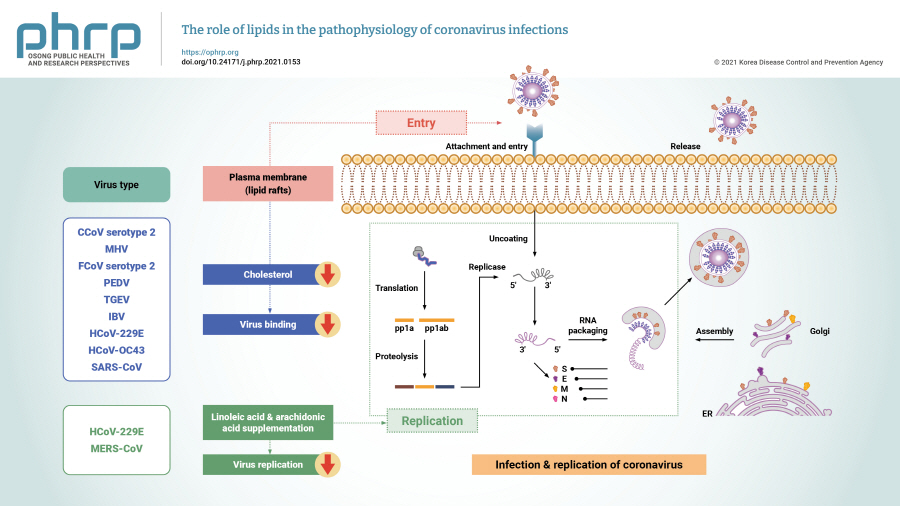
Coronaviruses, which have been known to cause diseases in animals since the 1930s, utilize cellular components during their replication cycle. Lipids play important roles in viral infection, as coronaviruses target cellular lipids and lipid metabolism to modify their host cells to become an optimal environment for viral replication. Therefore, lipids can be considered as potential targets for the development of antiviral agents. This review provides an overview of the roles of cellular lipids in different stages of the life cycle of coronaviruses.
Citations
Citations to this article as recorded by
The Enigmatic Conserved Q134-F135-N137 Triad in SARS-CoV-2 Spike Protein: A Conformational Transducer? Marine Lefebvre, Henri Chahinian, Nouara Yahi, Jacques Fantini Biomolecules.2026; 16(1): 111. CrossRef
The role of lipid molecules in the pathogenesis of viral gastroenteritis Nastaran Khodadad, Milad Zandi, Shokufeh Akbarinia, Mona Fani, Shokrollah Salmanzadeh, Samaneh Abbasi Future Virology.2026; 21(3): 219. CrossRef
Divergent lipid utilization strategies of SARS-CoV-2 and MERS-CoV revealed by comparative multi-omics profiling of infected mouse lung tissues Yeonseo Jang, Hyeran Kim, Yufei Li, Jae-Seung Lee, Jaehoon Lee, Han-Woong Lee, Nam-Hyuk Cho, Joo-Youn Cho Frontiers in Immunology.2026;[Epub] CrossRef
Homeostasis of Calnexin Is Essential for the Growth, Virulence, and Hypovirus RNA Accumulation in the Chestnut Blight Fungus Tao Huang, Xiaoling Ma, Ziqi Zhao, Danna Qin, Weiye Qin, Jinzi Wang, Baoshan Chen, Xipu He Molecular Microbiology.2025; 123(5): 393. CrossRef
Understanding the Molecular Actions of Spike Glycoprotein in SARS-CoV-2 and Issues of a Novel Therapeutic Strategy for the COVID-19 Vaccine Yasunari Matsuzaka, Ryu Yashiro BioMedInformatics.2024; 4(2): 1531. CrossRef
Orsay Virus Infection of Caenorhabditis elegans Is Modulated by Zinc and Dependent on Lipids Luis Alberto Casorla-Perez, Ranya Guennoun, Ciro Cubillas, Bo Peng, Kerry Kornfeld, David Wang, Rebecca Ellis Dutch Journal of Virology.2022;[Epub] CrossRef
<sec>
<title>Objectives</title>
<p>Different factors are responsible for the silent epidemic of diabetes mellitus in developing and developed countries. This study aimed to determine the role of demographic factors, lipid profile, family history (the estimation of genetic association) and anthropometric factors on diabetes onset.</p></sec>
<sec>
<title>Methods</title>
<p>Data from the enrolment phase of the Tabari Cohort study was applied for this study and included 10,255 participants aged between 35–70 years. Anthropometric variables were measured by trained staff using standard tools. Blood specimens were collected for lipid profile and blood glucose measurements. Data analyses were performed using SPSS version 24, with univariate and multivariate logistic regression.</p></sec>
<sec>
<title>Results</title>
<p>The prevalence of diabetes mellitus was estimated to be 17.2% in the cohort population, 15.6% in men, and 18.3% in women. The adjusted odds ratios (95% confidence intervals) for age groups 40–49, 50–59 and over 60 were 2.58 (2.20–3.69), 5.80 (4.51–7.48) and 8.72 (6.67–11.39), respectively. In addition, the odds ratios (95% confidence intervals) for 2 (or more), and 1 affected family member were 4.12 (3.55–4.90) and 2.34 (2.07–2.65), respectively. Triglyceride concentrations more than 500, and abnormal high-density lipoprotein levels increased the odds of diabetes mellitus by 3.29- and 1.18-fold, respectively.</p></sec>
<sec>
<title>Conclusion</title>
<p>The current study showed that old age and a family history were strong predictors for diabetes mellitus.</p></sec>
The association between smoking profile, leukocyte count, and inflammatory indices in males: a cross-sectional analysis of the TABARI cohort study at enrollment phase Erfan Ghadirzadeh, Mahmood Moosazadeh, Motahareh Kheradmand, Masoumeh Bagheri-Nesami, Sajad Ghafari-Cherati, Mobina Gheibi, Amirsaeed Hosseini Inhalation Toxicology.2025; 37(3): 146. CrossRef
Application of generalized linear mixed effects random forest for identifying risk factors of prediabetes in Tehran Lipid and Glucose Study Maryam Karimi Ghahfarokhi, Farid Zayeri, Davood Khalili, Chiara Masci, Ali Sheidaei, Yaser Mehrali, Fatemeh Masaebi, Yadollah Mehrabi Scientific Reports.2025;[Epub] CrossRef
The prevalence and determinants of diabetes mellitus and thyroid disorder comorbidity in Tabari cohort population Mahmood Moosazadeh, Saeedeh Khakhki, Adele Bahar, Akbar Hedayatizadeh-Omran, Motahareh Kheradmand, Reza Alizadeh-Navaei, Erfan Ghadirzadeh Scientific Reports.2024;[Epub] CrossRef
The relationship between spiritual intelligence and self-management in patients with diabetes type 1 Sima Rafiei, Saber Souri, Zahra Nejatifar, Mohammad Amerzadeh BMC Endocrine Disorders.2023;[Epub] CrossRef
Prevalence and determinants of diabetes and prediabetes in southwestern Iran: the Khuzestan comprehensive health study (KCHS) Sanam Hariri, Zahra Rahimi, Nahid Hashemi-Madani, Seyyed Ali Mard, Farnaz Hashemi, Zahra Mohammadi, Leila Danehchin, Farhad Abolnezhadian, Aliasghar Valipour, Yousef Paridar, Mohammad Mahdi Mir-Nasseri, Alireza Khajavi, Sahar Masoudi, Saba Alvand, Bahman BMC Endocrine Disorders.2021;[Epub] CrossRef



 First
 Prev


