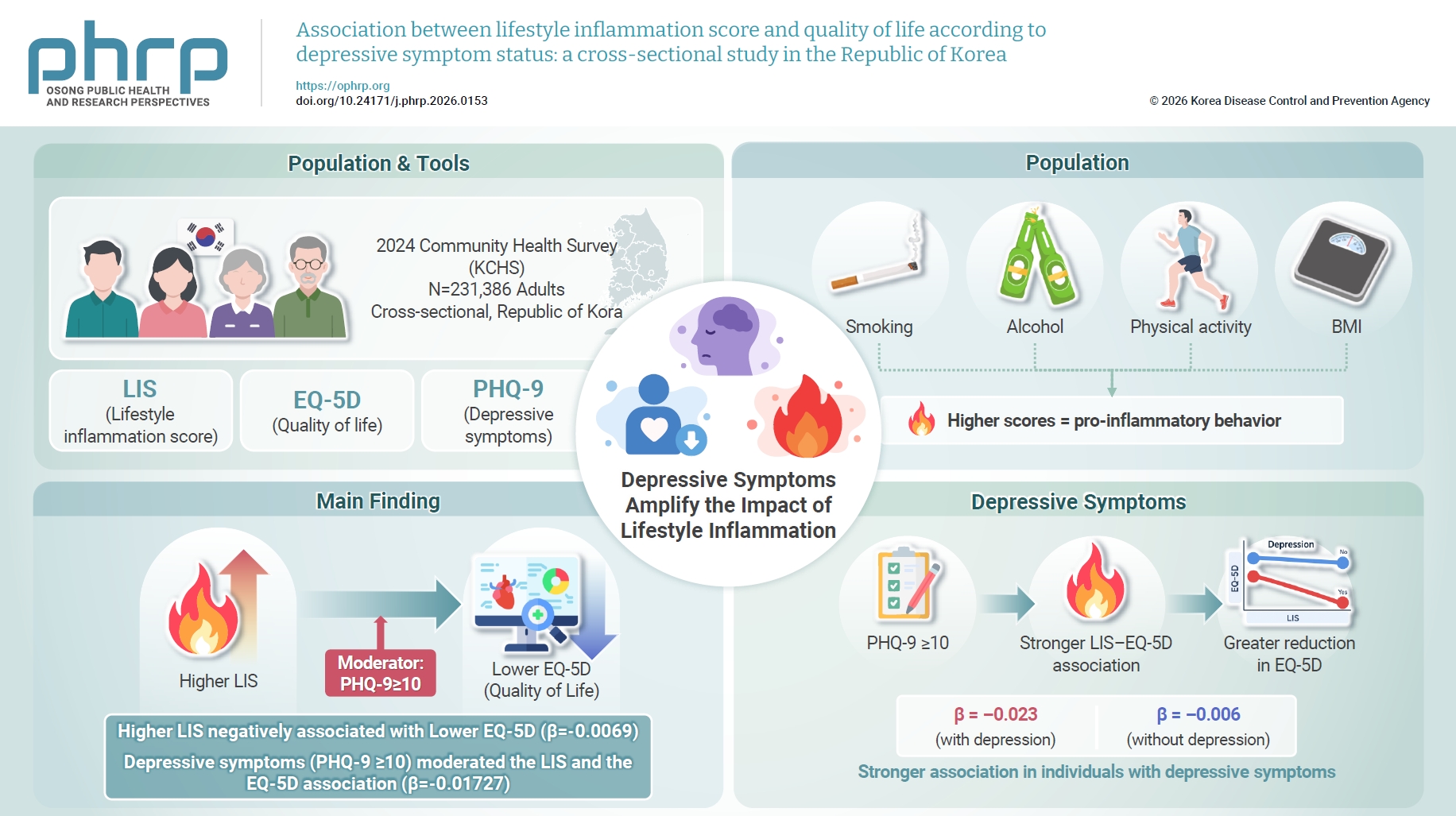
Objectives This study examined the association between lifestyle inflammation score (LIS) and health-related quality of life, assessed using the EuroQol-5 Dimensions (EQ-5D) index, among adults in the Republic of Korea. It also evaluated whether depressive symptoms moderated this association. Methods: Data from the 2024 Community Health Survey were analyzed, and 231,386 adults were included. LIS was calculated by integrating smoking, alcohol consumption, physical activity, and body mass index. The dependent variable, quality of life, was assessed using the EQ-5D index. Depressive symptoms, the moderator variable, were assessed using the Patient Health Questionnaire-9, with a score of ≥10 indicating depressive symptoms. Data were analyzed using complex-sample multivariable linear regression to examine interaction effects according to depressive symptom status, followed by simple-slope analyses. Results: After adjustment for demographic and health-related variables, LIS was significantly and negatively associated with the EQ-5D index (β= –0.0069, p< 0.001), indicating that higher levels of inflammation-related lifestyle behaviors were associated with poorer quality of life. Depressive symptoms significantly moderated the association between LIS and the EQ5D index (β= –0.01727, p< 0.001). Simple-slope analyses showed that the adverse association between LIS and quality of life was stronger among individuals with depressive symptoms (β= –0.02349) than among those without depressive symptoms (β= –0.00621). Conclusion: Inflammation-related lifestyle behaviors were associated with reduced quality of life, and this negative association was stronger among individuals with depressive symptoms. These findings suggest that considering both lifestyle-related inflammatory burden and depressive symptoms may help explain population-level differences in quality of life.
Objectives This study investigated the relationship between metabolic factors (blood lipids and glucose) and inflammatory indicators (tumor necrosis factor-alpha [TNF-α] and high-sensitivity C-reactive protein [hs-CRP]), disease activity, and the rheumatoid arthritis (RA) risk.
Methods Serum fasting blood glucose (FBG) and lipid profiles—including total cholesterol (Chol), triglycerides (TG), high-density lipoprotein (HDL), and low-density lipoprotein—were measured in 100 RA patients and 100 healthy individuals. Disease severity was assessed using the disease activity score 28. Inflammatory indicators (TNF-α and hs-CRP) were measured using the enzyme-linked immunosorbent assay method.
Results In RA patients, serum FBG, TG, Chol/HDL, and TG/HDL were significantly elevated, whereas HDL levels reduced compared to healthy individuals. Multivariate analysis indicated that each unit increase in serum FBG, HDL, Chol/HDL, and TG/HDL was associated with a 64% increase (p<0.001), a 7% reduction (p=0.001), a 52% increase (p=0.007), and a 54% increase (p=0.001) in the odds of RA, respectively. Disease activity showed no correlation with metabolic factors (p>0.05). Among all metabolic factors studied, FBG had the largest area under the curve (0.981) (p<0.0001) for predicting RA. Across the total participant group, FBG, TG, and TG/HDL were positively associated with hs-CRP and TNF-α (p<0.05). HDL showed an inverse association with hs-CRP (p=0.008). Among RA patients specifically, TNF-α positively correlated with TG and TG/HDL, while hs-CRP correlated only with TG/HDL.
Conclusion These findings indicate that increased FBG and Chol/HDL and decreased HDL may elevate RA risk by promoting systemic inflammation. Among these, elevated FBG may serve as the strongest predictor of RA risk.
Citations
Citations to this article as recorded by
Roles of immune cell metabolism in rheumatoid arthritis Rui Xie, Zeping Chen, Shufang Deng, Xiaofeng Jiang, Yue Feng, Wei Zhao Frontiers in Immunology.2026;[Epub] CrossRef
Rheumatoid Factor Beyond Rheumatoid Arthritis: A Potential Marker of Cardiometabolic and Hepatic Risk Simeon Egba, Innocent Orhonigbe, Ngozi Achi, Gavin Ikechukwu, Charles Chukwu, Chukwudi Omeoga Biologics: Targets and Therapy.2026; Volume 20: 1. CrossRef
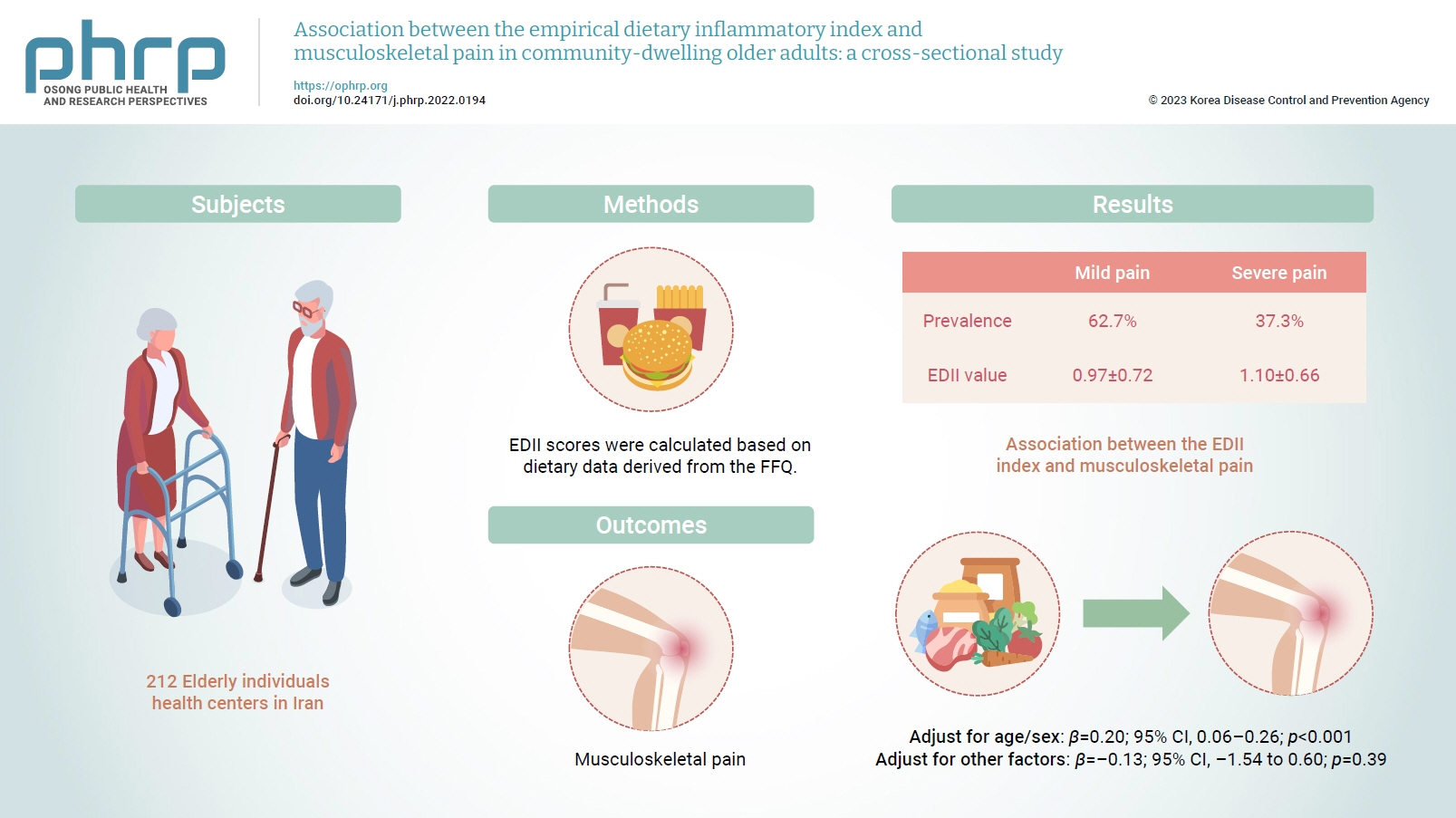
Objectives Inflammation has been proposed to be one of the main causes of musculoskeletal pain. Diet is a lifestyle factor that plays an important role in managing inflammation; thus, we assessed the inflammatory potential of diets using the empirical dietary inflammatory index (EDII) to investigate the relationship between diet and musculoskeletal pain.
Methods This cross-sectional study included 212 elderly individuals who were selected from health centers in Tehran, Iran. Dietary intake was evaluated using a valid and reliable 147-item food frequency questionnaire. To measure the intensity of pain, a visual analogue scale was used. Multiple linear regression was applied to assess the association between the EDII and musculoskeletal pain.
Results In total, 62.7% and 37.3% of participants had mild and severe pain, respectively. The EDII values were 0.97±0.72 and 1.10±0.66, respectively, in those with mild and severe pain. A higher EDII score was associated with more intense musculoskeletal pain after adjusting for age and sex (β=0.20; 95% confidence interval [CI], 0.06–0.26; p<0.001), but not after adjustment for other confounders (β=–0.13; 95% CI, –1.54 to 0.60; p=0.39).
Conclusion Our findings indicated that higher dietary inflammation might not be associated with musculoskeletal pain in older adults. However, further investigations are required to confirm these findings.
Citations
Citations to this article as recorded by
Skeletal Muscle Disorders: Navigating Management and Natural Products Hesham M. El‐Sayed, Khaled Hussien, Heba R. Ghaiad, Mai A. Abd‐Elmawla, Nourhan M. Abdelmaksoud, Asmaa Ramadan, Riham A. El‐Shiekh, Mohamed Bakr Zaki Chemistry & Biodiversity.2026;[Epub] CrossRef
Proinflammatory diet is associated with higher pain, disease severity and biochemical parameters associated with inflammation in fibromyalgia Nursena Ersoy Söke, Hansa İnceöz, İlker Solmaz, Hülya Yardımcı Pain Medicine.2025; 26(3): 131. CrossRef
Exploring the association between dietary Inflammatory Index and chronic pain in US adults using NHANES 1999–2004 Lunxue Qing, Yingying Zhu, Changhe Yu, Yang Zhang, Jinxia Ni Scientific Reports.2024;[Epub] CrossRef
The dietary inflammatory index and cardiometabolic parameters in US firefighters Andria Christodoulou, Costas A. Christophi, Mercedes Sotos-Prieto, Steven Moffatt, Longgang Zhao, Stefanos N. Kales, James R. Hébert Frontiers in Nutrition.2024;[Epub] CrossRef
Association between dietary inflammatory index and musculoskeletal disorders in adults Firoozeh Khamoushi, Davood Soleimani, Farid Najafi, Neshat Ahmadi, Neda Heidarzadeh-Esfahani, Bita Anvari, Ebrahim Shakiba, Yahya Pasdar Scientific Reports.2023;[Epub] CrossRef




 First
 Prev


