Objectives The main Brucella species causing human infections in the Republic of Korea is Brucella abortus, which uses cattle as its host. However, since 2014, Brucella melitensis, which uses sheep and goats as hosts, has also been identified. This study investigated whether a shift has occurred in the predominant species of Brucella pathogens.
Methods Brucellosis is a class 3 infectious disease requiring mandatory reporting and registration in the Korea Disease Control and Prevention Agency’s infectious disease surveillance system (http://is.kdca.go.kr). Cases from 2014 to 2023 were studied, and whole-genome sequencing analysis was conducted using BruMLSA21.
Results Out of 51 patients, males (45 patients, 88.2%) were predominantly affected. Twenty-five patients (49%) came from the livestock industry, and within the livestock sector group, the route of infection occurred exclusively through contact (25/25, 100%), whereas in other occupations, it was split between contact (9/26 patients, 34.6%) and ingestion (8/26 patients, 30.8%). Among the 31 patients who underwent Brucella culture tests, B. melitensis was found to be more prevalent than B. abortus (14 patients, 45.2% vs. 11 patients, 35.5%). In all cases where B. melitensis was isolated, the infections were of foreign origin, consistent with the results of BruMLSA21.
Conclusion Regular monitoring of the causative agent of brucellosis is necessary due to its varying host preferences and antibiotic resistance. Furthermore, given the increasing prevalence of B. melitensis worldwide, changes in dietary habits (e.g., increased lamb consumption), and the increase in foreign workers and Chinese immigrants, a multi-ministerial One Health response will be required.
Citations
Citations to this article as recorded by
Peculiarities of Brucellosis Spread in Urban and Rural Areas of Jalal-Abad Region, Kyrgyz Republic Zholdoshev Saparbai Tezekbayevich, Temirov Nemat Moydunovich, Akzholtoeva Aizharkyn Akzholtoevna, Tashieva Gulbara Samidinovna, Sorombaeva Nadira Orozbekovna, Akhunbaeva Tattygul Raimzhanovna, Ali Munir Mirza World Journal of Environmental Biosciences.2026; 15(1): 8. CrossRef
Epidemiology and zoonotic impact of brucellosis in ruminants from a one health perspective Arslan Khan Barozai Barozai, Rana Dawood Naseer, Ehsanullah ., Hafiz Mohammed Hamayun, Mahnoor Farrukh, Kashif Iqbal Forensic Insights and Health Sciences Bulletin.2026; : 69. CrossRef
First report of a Brucella inopinata-like atypical Brucella strain isolated from a waxy monkey treefrog (Phyllomedusa bicolor) in the Republic of Korea: Case Report Myeongsu Kim, Zun Zun Wut Hmohn, Jae-Ik Han Frontiers in Veterinary Science.2026;[Epub] CrossRef
Senility, defecation disorders, sleep disorders, and non-operative spinal infections: A single-center retrospective analysis Ling-Ling Guo, Hong-Kun Liu, Jin-Feng Cao, Hai-Xia Zhang, Bo Li, Tong Li, Liang Li World Journal of Orthopedics.2025;[Epub] CrossRef
Unraveling brucellosis: advances in pathogenesis, diagnostic strategies, therapeutic innovations, and public health perspectives Abdulaziz M. Almuzaini, Ayman Elbehiry Frontiers in Medicine.2025;[Epub] CrossRef
BRUCELLA ENFEKSİYONLARI VE ERADİKASYON Zübeyde Arslan Veteriner Farmakoloji ve Toksikoloji Derneği Bülte.2025; 16(3): 95. CrossRef
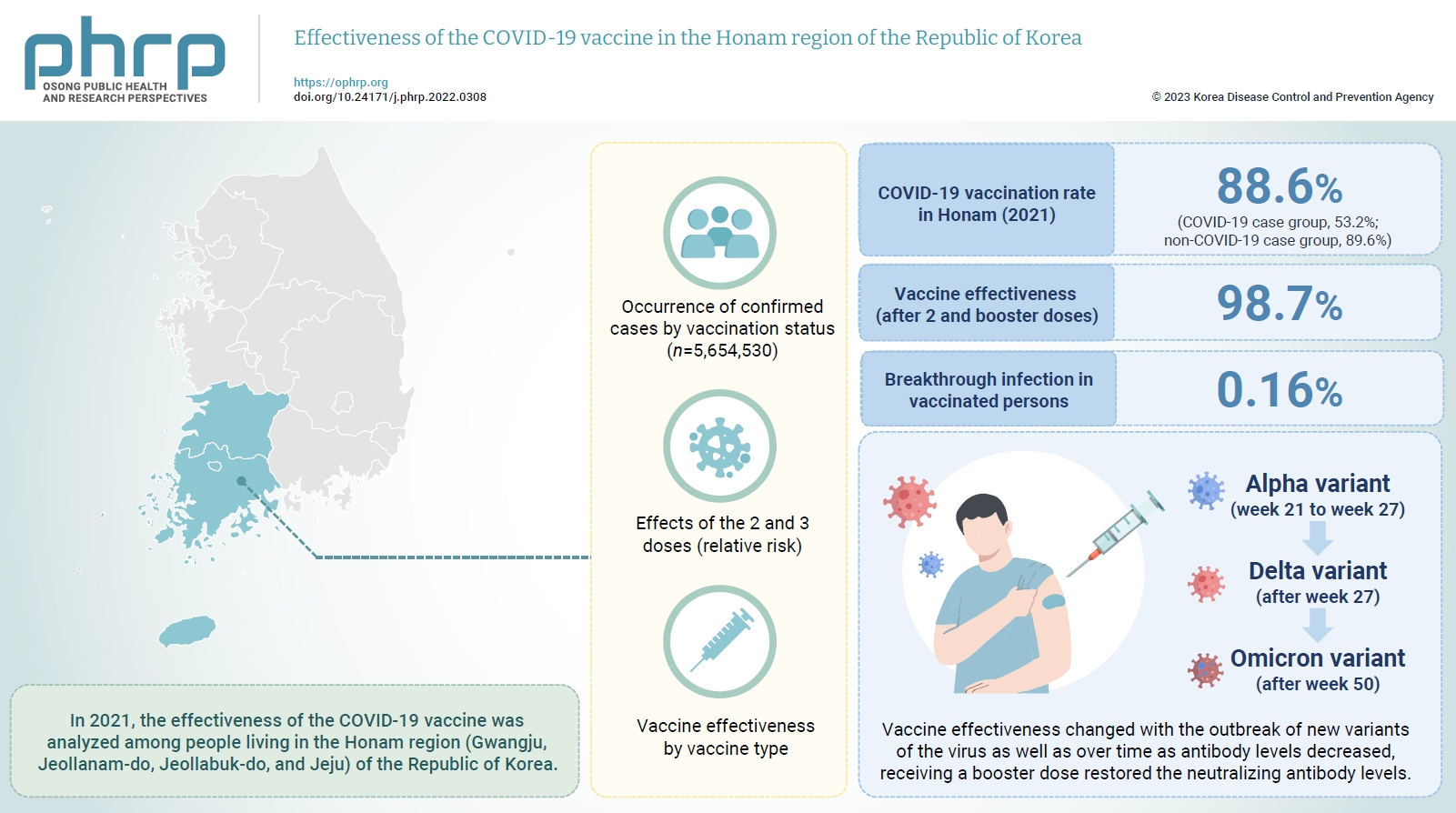
Objectives In 2021, the effectiveness of the COVID-19 vaccine was analyzed among people living in the Honam region (Gwangju, Jeollanam-do, Jeollabuk-do, and Jeju) of the Republic of Korea. And we investigated changes in the dominant virus strain.
Methods This study used the data provided by the Korean Ministry of the Interior and Safety for individuals ≥12 years old in the Honam region, and the Integrated Disease and Health Management System of the Korea Centers for Disease Control and Prevention for COVID-19-vaccinated individuals as of December 31, 2021. Statistical analyzes were performed using IBM SPSS ver. 23.0. The occurrence of confirmed cases by vaccination status, the relative risk, and vaccine effectiveness by vaccine type were calculated.
Results In 2021, the COVID-19 vaccination rate in Honam was 88.6%. The overall vaccine effectiveness (after 2 and 3 doses) was 98.7% (p<0.001). and the breakthrough infection rate was 0.16%. From week 21 to week 27 of 2021 (June 27 to July 3), the genome sequencing results were mostly alpha variants. The Delta variant emerged as the dominant variant after 27 weeks and the Omicron variant was found at 50 weeks (December 5–11).
Conclusion Vaccine effectiveness changed with the outbreak of new variants of the virus as well as over time as antibody levels decreased. that the prevention effectiveness of vaccination in Honam was >98%, and the effect among persons who received 2 doses was >90% regardless of the vaccine type. Although vaccine effectiveness decreased because of reduced antibody levels over time (as observed in breakthrough infections), receiving a booster dose restored the neutralizing antibody levels.



 First
 Prev


