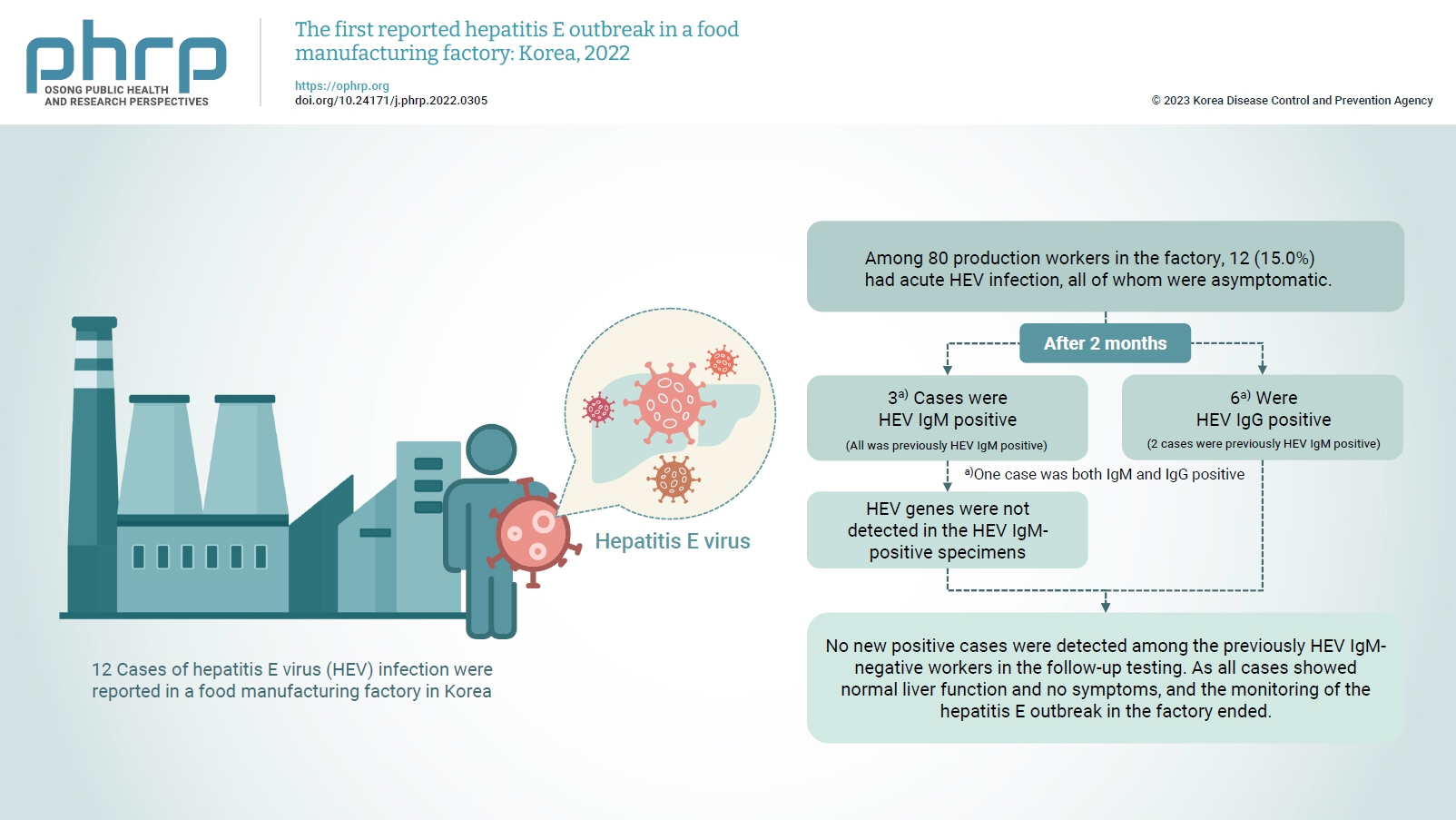
Objectives On February 16, 2022, 12 cases of hepatitis E virus (HEV) infection were reported in a food manufacturing factory in Korea. The aim of this study was to identify additional cases and to determine the source of this HEV outbreak. Methods: This study was an in-depth investigation of 12 HEV immunoglobulin M (IgM)-positive cases and their demographic, clinical, and epidemiological characteristics. On-site specimens were collected from the environment and from humans, and a follow-up investigation was conducted 2 to 3 months after the outbreak. Results: Among 80 production workers in the factory, 12 (15.0%) had acute HEV infection, all of whom were asymptomatic. The follow-up investigation showed that 3 cases were HEV IgMpositive, while 6 were HEV IgG-positive. HEV genes were not detected in the HEV IgM-positive specimens. HEV genes were not detected in the food products or environmental specimens collected on-site. HEV was presumed to be the causative pathogen. However, it could not be confirmed that the source of infection was common consumption inside the factory. Conclusion: This was the first domestic case of an HEV infection outbreak in a food manufacturing factory in Korea. Our results provide information for the future control of outbreaks and for the preparation of measures to prevent domestic outbreaks of HEV infection.
Citations
Citations to this article as recorded by
Current global estimates, risk factors, and knowledge gaps for Hepatitis E virus (HEV): A scoping review Md Koushik Ahmed, Hanna Maroofi, Madeleine Blunt, Alain Labrique, Carl Kirkwood, Kirsten Vannice, Kawsar R. Talaat, Julia Lynch, Brittany L. Kmush, David Safronetz PLOS Neglected Tropical Diseases.2026; 20(3): e0013980. CrossRef
<sec>
<title>Objectives</title>
<p>The purpose of this study was to investigate the factors involved in the success of smoking cessation in heavy smokers enrolled in an intensive care smoking cessation camp program.</p></sec>
<sec>
<title>Methods</title>
<p>Heavy smokers enrolled in the program were classified into a success (<italic>n</italic> = 69) or failure (<italic>n</italic> = 29) group, according to whether they maintained smoking cessation for 6 months after the end of the program. Demographics, smoking behaviors, and smoking cessation-related characteristics were analyzed.</p></sec>
<sec>
<title>Results</title>
<p>Statistically significantly more participants in the success group had a spouse (98.6%; <italic>p</italic> = 0.008) compared with participants in the failure group (82.8%). However, multivariate logistic regression analysis indicated that having a spouse was not an independent factor in smoking cessation (<italic>p</italic> = 0.349). A significant difference in the frequency of counseling between the success and failure groups was observed (<italic>p</italic> = 0.001), with 72.5% of those who received counseling on 3–5 occasions for 6 months after the end of program successfully quit smoking, indicating that those who received more counseling had a higher likelihood of smoking cessation success. This was confirmed as an independent factor by multivariate logistic regression (<italic>p</italic> < 0.005). Furthermore, a graduate school level of education or higher, indicated a statistically greater success rate compared to those that were less well educated (<italic>p</italic> = 0.043). This was also observed as a significant independent factor using multivariate logistic regression (<italic>p</italic> = 0.046).</p></sec>
<sec>
<title>Conclusion</title>
<p>Education level, marital status, and the number of counseling sessions were significant factors contributing to smoking cessation success.</p></sec>
Citations
Citations to this article as recorded by
Values and preferences of patients with severe mental illness regarding smoking cessation interventions: a systematic review with best-fit framework synthesis Kristien Coteur, Laura Tops, Geertruida E Bekkering, Louise de Almeida Ferreira Fonseca, Floor van den Brand, Hanne Cloetens, Linan Zeng, Bert Aertgeerts, Nicolas Delvaux, Arnav Agarwal, Thomas Agoritsas, Mieke Vermandere BMJ Open.2026; 16(6): e109865. CrossRef
Decision-tree analysis of characteristics associated with 6-month smoking abstinence in Taiwan Jia-Ling Wu, Chung-Yi Li, Shang-Chi Lee, Chin-Wei Kuo, Chuan-Yu Chen, Ching-Lan Lin, Ya-Hui Chang, Shu-Ying Lo, Santi Martini, Arief Hargono, Yen-Hsun Chen, Shih-Yu Ko BMJ Open.2026; 16(10): e112023. CrossRef
Behavior Changes for Smokers and Betel Quid Chewers Participating in the Organized Oral Mucosal Screening Between 2010 and 2021 in Taiwan Pattaranan Munpolsri, Chiu-Wen Su, Sam Li-Sheng Chen, Amy Ming-Fang Yen Cancers.2025; 17(3): 397. CrossRef
Changes in risk habits and influencing factors in the Taiwan oral cancer screening program Pattaranan Munpolsri, Chiu-Wen Su, Hsu-Fei Yang, Tsui-Hsia Hsu, Yen-Yu Chou, Li-Ju Lin, Chao-Chun Wu, Sam Li-Sheng Chen, Amy Ming-Fang Yen, Chung-Ta Chang PLOS One.2025; 20(6): e0320461. CrossRef
Comparison of Quit Rates and Predictors in Korean Inpatient and Residential Smoking Cessation Programs: A Secondary Data Analysis of Data from the National Smoking Cessation Services Youngmee Ahn, Soyoung Jung, Hunjae Lee, Jung-Ae Cho, Min Sohn Research in Community and Public Health Nursing.2025; 36: 210. CrossRef
COVID-19 pandemic and motivation to smoking cessation Ferit Kaya, Hülya Doğan Tiryaki, Engin Burak Selçuk, Eda Fulden Tutar Çölgeçen Journal of Medical Topics and Updates.2024; 3(1): 14. CrossRef
Factors associated with quitting smoking among males: Findings from Indonesian national health survey Diyan Ermawan Effendi, Irfan Ardani, Sri Handayani, Rozana Ika Agustiya, Arief Priyo Nugroho, Oktriyanto Oktriyanto, Astridya Paramita, Deasy Febriyanty, Risqa Novita, Aris Yulianto Clinical Epidemiology and Global Health.2024; 28: 101672. CrossRef
Evaluation of Smoking Cessation Intervention Effectiveness in Smoking Cessation Clinics — China, 2019–2021 Li Xie, Yongfu Yan, Yan Yang, Yi Nan, Lin Xiao China CDC Weekly.2023; 5(21): 469. CrossRef
Factors Associated with Smokers Attending More Than One Smoking Cessation Clinic Visit Oh Beom Kwon, Chihoon Jung, Auk Kim, Gihwan Byeon, Seung-Joon Lee, Woo Jin Kim Journal of Clinical Medicine.2023; 12(23): 7222. CrossRef
Effects of a supportive workplace environment on the success rate for smoking cessation camp Woojin Kim, A Ram Kim, Minsu Ock, Young-Jee Jeon, Heun Lee, Daehwan Kim, Minjun Kim, Cheolin Yoo Annals of Occupational and Environmental Medicine.2023;[Epub] CrossRef
Sigara bırakma polikliniğine başvuran bireylerde tedavi başarısını etkileyen faktörler Derya Kocakaya, Hatice Şenol, Sezer Aslan, Ahmed Mahmud Çırakoğlu, Merve Nur Çakır Fidan, Hatice Telci, Mehmet Zahid Çetinkaya, Şehnaz Olgun Yıldızeli , Ayşe Nilüfer Özaydın, Berrin Ceyhan Journal of Dependence.2022; 23(1): 69. CrossRef
Smoking cessation rates in elderly and nonelderly smokers after participating in an intensive care smoking cessation camp Jae-Kyeong Lee, Yu-Il Kim, Sun-Seog Kweon, In-Jae Oh, Yong-Soo Kwon, Hong-Joon Shin, Yu-Ri Choe, Ha-Young Park, Young-Ok Na, Hwa-Kyung Park Medicine.2022; 101(30): e29886. CrossRef
Patterns and predictors of smoking relapse among inpatient smoking intervention participants: a 1-year follow-up study in Korea Seung Eun Lee, Chul-Woung Kim, Hyo-Bin Im, Myungwha Jang Epidemiology and Health.2021; 43: e2021043. CrossRef
Factors affecting smoking initiation and cessation among
adult smokers in Fiji: A qualitative study Masoud Mohammadnezhad, Mondha Kengganpanich Tobacco Induced Diseases.2021; 19(December): 1. CrossRef
“STOP the PUFF! Tayo’y mag bagong BAGA, SIGARILYO ay ITIGIL”: A Pilot Community-based Tobacco Intervention Project in an Urban Settlement Irene Salve D Joson-Vergara, Julie T Li-Yu Journal of Medicine, University of Santo Tomas.2021; 5(1): 586. CrossRef
Smoking cessation correlates with a decrease in infection rates following total joint arthroplasty Christina Herrero, Alex Tang, Amy Wasterlain, Scott Sherman, Joseph Bosco, Claudette Lajam, Ran Schwarzkopf, James Slover Journal of Orthopaedics.2020; 21: 390. CrossRef
<sec>
<title>Objectives</title>
<p>The increase in the obesity rate in adult males in Korea is higher than countries in the Organization for Economic Co-operation and Development and other Asian countries. We examined the trends and prevalence of major risk factors for cardiovascular disease by evaluating the weight status amongst adults from 2007 to 2015.</p></sec>
<sec>
<title>Methods</title>
<p>The study included 37,402 adults, who participated in the Korea National Health and Nutrition Examination Survey. The prevalence trends of cardiovascular disease risk factors were estimated for each body mass index group.</p></sec>
<sec>
<title>Results</title>
<p>From 2007 to 2015, significant increases in the prevalence of hypertension, diabetes, and hypercholesterolemia were observed in normal weight adults (0.03 percentage point (%p), 0.06%p, and 0.13%p, respectively). Amongst the overweight and obese adults, a significant increase in the prevalence of hypercholesterolemia was observed, During this period, the prevalence of smoking decreased amongst obese adults and no significant changes in drinking habits and physical activity were noted across all body mass index groups.</p></sec>
<sec>
<title>Conclusion</title>
<p>The prevalence of obesity in Korean adults is increasing, and it is necessary to implement interventions to prevent further weight gain and obesity-associated cardiovascular disease.</p></sec>
Citations
Citations to this article as recorded by
Metabolic traits in obesity and normal BMI in industrialised countries: a multi-country analysis of national population-based studies
The effect of a nutrition program based on the Health Behavior Interaction Model on primary school students’ nutritional attitudes and behaviors Ayşe Burcu Başçı, Oya Nuran Emiroğlu, Bilge Kalanlar Journal of Public Health.2025; 33(6): 1237. CrossRef
Epidemiological trends and burden of gallbladder and biliary tract cancer in Belt and Road Initiative countries: A comprehensive analysis from the Global Burden of Disease 2021 database Hao Wu, Qian-Qian Feng, Jian-Hui Li, Hai-Yang Xie, Shi-Gui Yang, Shu-Sen Zheng Hepatobiliary & Pancreatic Diseases International.2025; 24(6): 666. CrossRef
Influence of Varied Dietary Cholesterol Levels on Lipid Metabolism in Hamsters Chung-Hsiung Huang, Hung-Sheng Hsu, Meng-Tsan Chiang Nutrients.2024; 16(15): 2472. CrossRef
Prevalence of cardiovascular risk factors in middle-aged Lithuanian women in different body mass index and waist circumference groups Egidija Rinkūnienė, Emilija Petrulionytė, Vilma Dženkevičiūtė, Žaneta Petrulionienė, Augustė Senulytė, Roma Puronaitė, Aleksandras Laucevičius Primary Care Diabetes.2023; 17(1): 27. CrossRef
Thirty-six Year Trends in Mortality from Diseases of Circulatory System in Korea Jongmin Baek, Hokyou Lee, Hyeok-Hee Lee, Ji Eun Heo, So Mi Jemma Cho, Hyeon Chang Kim Korean Circulation Journal.2021; 51(4): 320. CrossRef
The identification of established modifiable mid-life risk factors for cardiovascular disease which contribute to cognitive decline: Korean Longitudinal Study of Aging (KLoSA) Yebeen Ysabelle Boo, Otto-Emil Jutila, Meghan A. Cupp, Logan Manikam, Sung-Il Cho Aging Clinical and Experimental Research.2021; 33(9): 2573. CrossRef
A Healthy Diet Rich in Calcium and Vitamin C Is Inversely Associated with Metabolic Syndrome Risk in Korean Adults from the KNHANES 2013–2017 Sunmin Park, Kyungjin Kim, Byung-Kook Lee, Jaeouk Ahn Nutrients.2021; 13(4): 1312. CrossRef
Classification and Prediction on the Effects of Nutritional Intake on Overweight/Obesity, Dyslipidemia, Hypertension and Type 2 Diabetes Mellitus Using Deep Learning Model: 4–7th Korea National Health and Nutrition Examination Survey Hyerim Kim, Dong Hoon Lim, Yoona Kim International Journal of Environmental Research an.2021; 18(11): 5597. CrossRef
Trends in cardiovascular disease risk factors by BMI category among adults in England, 2003‐2018 Shaun Scholes, Linda Ng Fat, Jennifer S. Mindell Obesity.2021; 29(8): 1347. CrossRef
Precision Medicine and Cardiovascular Health: Insights from Mendelian Randomization Analyses Wes Spiller, Keum Ji Jung, Ji-Young Lee, Sun Ha Jee Korean Circulation Journal.2020; 50(2): 91. CrossRef
Association of the Healthy Eating Index with Estimated Cardiovascular Age in Adults from the KNHANES 2013–2017 Sunmin Park, Kyungjin Kim, Byung-Kook Lee, Jaeouk Ahn Nutrients.2020; 12(10): 2912. CrossRef



 First
 Prev


