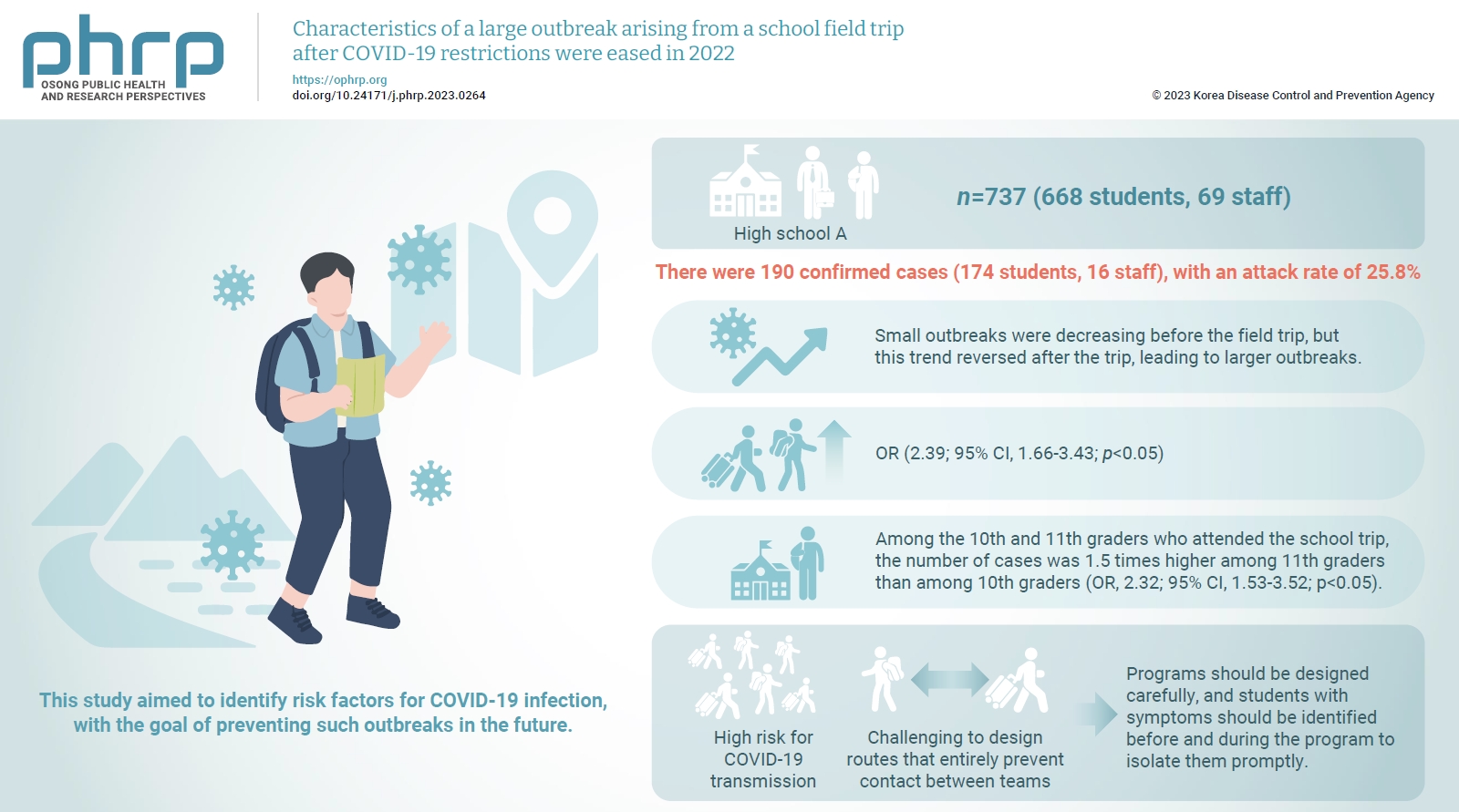
Objectives This study analyzed a large outbreak of coronavirus disease 2019 (COVID-19) that occurred during a high school field trip in the Jeonbuk region and aimed to identify risk factors for COVID-19 infection, with the goal of preventing such outbreaks in the future. Methods: A retrospective cohort study of 737 participants, including 668 students and 69 staff at High School A, was designed to describe the epidemiological characteristics of this large COVID-19 outbreak. Logistic regression analysis was performed to calculate relative risks (odds ratios [ORs]) and 95% confidence intervals (CIs). Results: There were 190 confirmed cases (174 students, 16 staff), with an attack rate of 25.8%. Small outbreaks were decreasing before the field trip, but this trend reversed after the trip, leading to larger outbreaks. Logistic regression showed an OR of 2.39 (95% CI, 1.66–3.43; p<0.05) for COVID-19 infection among field trip participants. Among them, 11th graders had an OR of 2.32 (95% CI, 1.53–3.52; p<0.05) compared to 10th graders, while no significant risk difference was found within same-grade teams. Conclusion: There was a high risk for COVID-19 transmission during extracurricular activities with a large number of participants, such as field trips, even after the nationwide Omicron variant epidemic subsided. Even when students are separated into teams and follow different routes, it is challenging to design routes that entirely prevent contact between teams. Thus, programs should be designed carefully, and students with symptoms should be identified before and during the program to isolate them promptly.
Citations
Citations to this article as recorded by
Uncommon pathogen, common activity: Streptococcus pneumoniae conjunctivitis outbreak traced to a primary school field trip Xiaojian Duan, Xiaobin Ren, Kai Song, Jiayun Wang, Yi Wang, Yuanming Zhang, Li Ren, Liangliang Huo, Jing Wang Frontiers in Public Health.2026;[Epub] CrossRef
Objectives It is crucial to establish the characteristics of coronavirus disease 2019 (COVID-19) outbreaks at army training centers to develop preventive measures. Therefore, this study aimed to determine the COVID-19 transmission patterns and risk factors in a sequence of outbreaks at an army training center from June to August 2021.
Methods This study included 1,324 trainees at an army training center where outbreaks occurred from June to August 2021. The outbreak was qualitatively analyzed according to the period, attack rate, demographic characteristics, vaccination history, and living areas. An aerodynamic experiment was performed to evaluate aerosol transmission in living areas.
Results Three outbreaks occurred at the army training center from June to August 2021. The first, second, and third outbreaks lasted for 32, 17, and 24 days, and the attack rates were 12.8%, 18.1%, and 8.9%, respectively. Confirmed cases were distributed in all age groups. Recruits and the unvaccinated were at higher risk for COVID-19. The aerodynamic experiment verified the possibility of aerosol transmission within the same living area.
Conclusion COVID-19 transmission at army training centers should be minimized through quarantine and post-admission testing during the latency period as part of integrated measures that include facility ventilation, vaccination, indoor mask-wearing, and social distancing.
Citations
Citations to this article as recorded by
Socioecological Model-based Factors Influencing Respiratory Infection Prevention Behaviors among Soldiers in an Army Training Center Eunbin Jeong, Sookyung Hyun Journal of Korean Public Health Nursing.2024; 38(2): 176. CrossRef
COVID-19 outbreak in a religious village community in Republic of Korea and risk factors for transmission Jiae Shim, Eunju Lee, Eunyoung Kim, Yeonhwa Choi, Giseok Kang, Bryan Inho Kim Osong Public Health and Research Perspectives.2023; 14(2): 110. CrossRef
Epidemiological Characteristics of a COVID-19 Outbreak in a Psychiatric Hospital in Chung-buk Se-Hyuk Jang, Young-Joon Park, Ji-Joo Lee, Woo-Jin Jung Healthcare.2023; 11(16): 2332. CrossRef
Objectives We described the trends and epidemiological characteristics of varicella outbreaks from 2016 to 2020 in the Republic of Korea. Methods: We investigated variables such as the outbreak setting, age of patients, vaccination status, and lesion count. The collected data were analyzed with the Cochrane-Armitage trend test and Kruskal-Wallis test. These statistical tests were performed using R ver. 4.0.3. Results: The number of varicella outbreaks increased from 2016 to 2018; however, after a slight decrease in the number of outbreaks in 2019, the number fell sharply in 2020. The median size of outbreaks decreased from 8 to 9 cases during 2016−2019 to 6 cases in 2020. The median duration of outbreaks was 18 days during 2016−2017, 28 days in 2018, 29 days in 2019, and 15 days in 2020. Varicella outbreaks occurred most frequently in elementary schools, and vaccination coverage of patients increased from 89.4% in 2016 to 97.2% in 2019. The median age of patients with outbreak-related varicella decreased from 8 years in 2016 to 6 years in 2020. Conclusion: Significant changes were observed in the age of patients with outbreak-related varicella. Ongoing monitoring of varicella outbreaks should be conducted. Further research will be needed to measure the disease burden of varicella and enable evidence-based policy decisions.
Citations
Citations to this article as recorded by
Seasonal Trends of Major Respiratory, Gastrointestinal, and Other Viral Infections in Korea: An Analysis Before, During, and After the Coronavirus Disease 2019 Pandemic Su-Kyung Lee, Ji Hyun Kim, Hyun Soo Kim Annals of Laboratory Medicine.2026; 46(2): 124. CrossRef
Epidemiological Characteristics and Spatiotemporal Clustering of Varicella in the Border City of Baise, Southwest China, 2010–2024 Hongyan Tian, Danjie Liang, Zhi Nong, Siyi Huang, Yang Li, Guangzi Qi Infection and Drug Resistance.2026; Volume 19: 1. CrossRef
Impacts of relaxed mask policies on COVID-19 epidemics: a modeling study in South Korea Jungmi Park, Jaeyoung Ha, Soyeon Chu, Asaph Young Chun, Kyung-Duk Min BMC Infectious Diseases.2026;[Epub] CrossRef
Incidence and Risk of Common Vaccine Preventable Diseases among Transplant Recipients in Korea: A Nationwide Population-Based Study (2009–2020) Sung Min Lim, Myeongjee Lee, Min Young Kim, Jong Gyun Ahn, Eun Hwa Kim, Seung Min Hahn, Kyong Ihn, Yu Ri Kim, JongHoon Hyun, Su Jin Jeong, Inkyung Jung, Ji-Man Kang Infection & Chemotherapy.2026; 58(2): 151. CrossRef
Waning immunity, an age shift, and rising adult burden of varicella after two decades of single-dose vaccination in South Korea Seong Yeon Park, Hee Jin Huh, Sungim Choi, Jae-Woo Chung, Yun Jung Chang, Yun Mo Kang Vaccine.2026; 94: 129240. CrossRef
Changes in Sero-immunological Status for Infectious Diseases in Solid Organ Transplantation: A 20-Year Single-Center Study in Korea Jinyoung Yang, Jae-Hoon Ko, Sanghoon Lee, Dong Hyun Sinn, Jongman Kim, Kyeongman Jeon, Jae Berm Park, Jin-Oh Choi, Wooseong Huh, Yae-Jean Kim, Eun-Suk Kang, Seung Hoo Lee, Min Seo Kang, Kyungmin Huh, Sun Young Cho, Cheol-In Kang, Doo Ryeon Chung, Kyong Ra Annals of Laboratory Medicine.2026; 46(6): 721. CrossRef
Epidemiologic Investigation of a Varicella Outbreak in an Elementary School in Gyeonggi Province, Republic of Korea Gipyo Sung, Jieun Jang, Kwan Lee Children.2025; 12(7): 949. CrossRef
Characteristics of Varicella Breakthrough Cases in Jinhua City, 2016–2024 Zhi-ping Du, Zhi-ping Long, Meng-an Chen, Wei Sheng, Yao He, Guang-ming Zhang, Xiao-hong Wu, Zhi-feng Pang Vaccines.2025; 13(8): 842. CrossRef
Computational exploration of nigerian bioactive compounds as potential inhibitors of septic shock Yemisi Elizabeth Asibor, Dayo Felix Latona, Banjo Semire Universitas Scientiarum.2025; : 224. CrossRef
A cost benefit analysis of varicella vaccination in South Korea Young Hwa Lee, Young June Choe Vaccine: X.2024; 19: 100521. CrossRef
The Protective Effectiveness of 2-Dose Varicella Vaccination in Children in Korea: A Case-control Study Young Hwa Lee, Young June Choe, Kwan Hong, Yoonsun Yoon, Yun-Kyung Kim Pediatric Infectious Disease Journal.2023; 42(8): 719. CrossRef



 First
 Prev


