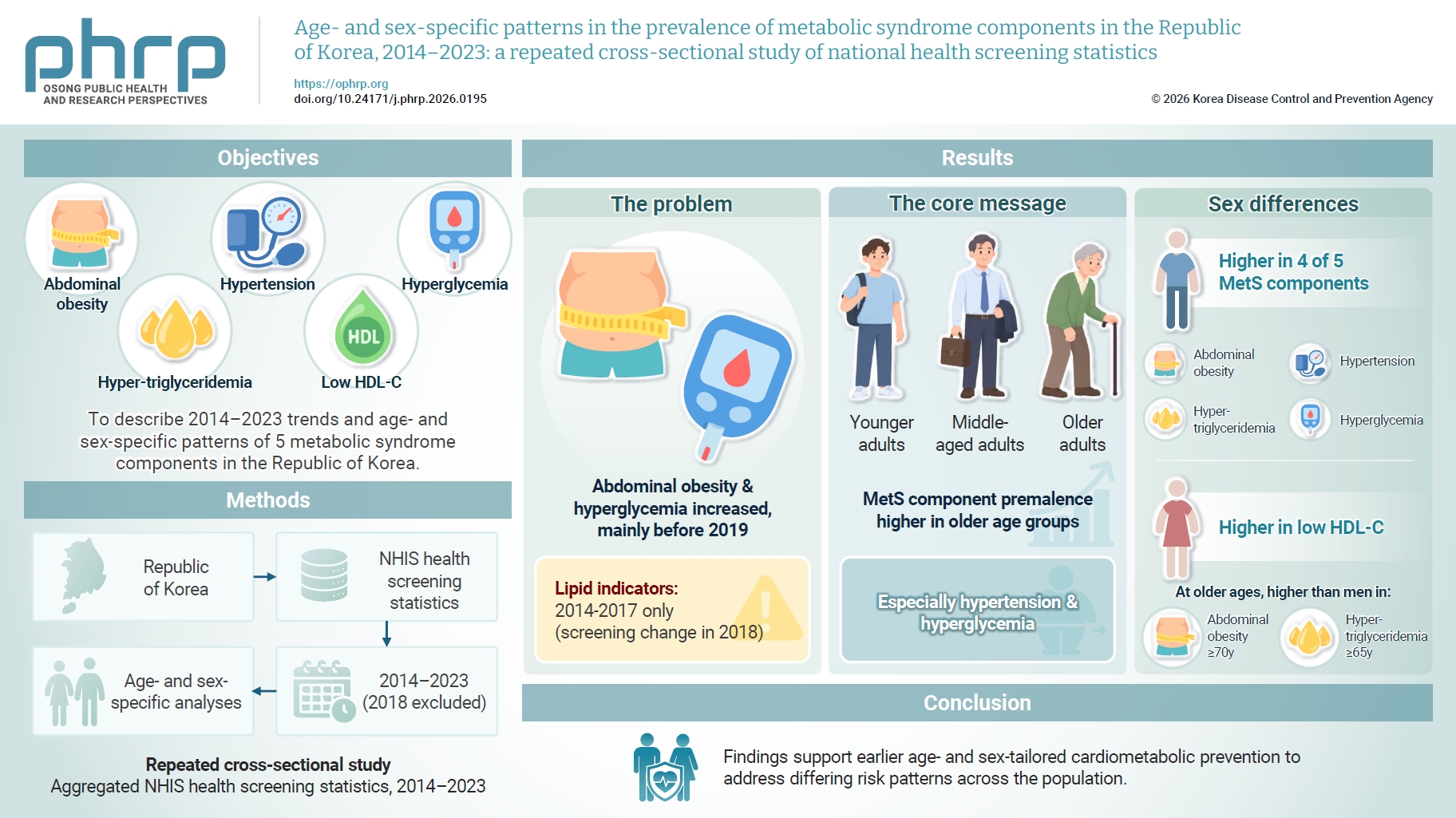
Objectives This study described 10-year trends in the prevalence of 5 metabolic syndrome (MetS) components and examined age- and sex-specific patterns in the Republic of Korea using aggregated national health screening statistics from 2014 to 2023. Methods: This repeated cross-sectional study used publicly available aggregated data from the National Health Screening Statistical Yearbook of the National Health Insurance Service. Annual prevalence estimates were summarized overall and by age group and sex. Linear and segmented regression summarized trends, and age- and sex-standardized prevalence was estimated. The 2018 yearbook tabulated risk factors only for examinees receiving the dyslipidemia panel (restricted from 2018 to men aged ≥24 years and women aged ≥40 years); therefore, 2018 was excluded, and lipid indicators were analyzed for 2014–2017. Results: From 2014 to 2023, crude prevalence increased for abdominal obesity (21.0% to 25.5%) and hyperglycemia (34.7% to 40.1%), mainly before 2019, and for hypertension (42.3% to 45.1%), although less after age standardization. In 2014–2017, hypertriglyceridemia increased (30.0% to 32.2%), whereas low high-density lipoprotein (HDL) cholesterol changed little (22.5% to 22.1%). Prevalence was higher in older age groups, especially for hypertension and hyperglycemia. Men had a higher prevalence of 4 components, and women of low HDL cholesterol. Conclusion: MetS components showed heterogeneous temporal, age-specific, and sex-specific patterns in Korean national health screening statistics. Increases in abdominal obesity and hyperglycemia, mainly before 2019, support earlier age- and sex-tailored cardiometabolic prevention, whereas lipid indicators were comparable only for 2014–2017. Individual-level longitudinal studies are needed to clarify these trends.
Objectives Adequate physical activity is essential for promoting healthy life expectancy among older adults. Park accessibility is an important environmental determinant of physical activity and may support multimorbidity management in this population. However, evidence on the association between park accessibility and multimorbidity remains limited, particularly in nationally representative Korean samples. This study examined the association between park accessibility and multimorbidity among older Korean adults.
Methods This cross-sectional study analyzed data from 10,078 individuals aged ≥65 years who participated in the 2023 National Survey of Older Koreans. Multiple logistic regression was used to examine the association between park accessibility and multimorbidity after adjustment for covariates. Stratified analyses assessed this association by physical activity level, and additional logistic regression analyses evaluated associations between park accessibility and common chronic diseases.
Results The prevalence of multimorbidity among older adults was 64.8%. After adjustment for all covariates, older adults living 30–59 minutes’ walking distance from a park had higher odds of multimorbidity than those living <15 minutes from a park (adjusted odds ratio, 1.33; 95% confidence interval, 1.12–1.59). Among the common chronic diseases examined, hypertension was significantly associated with park accessibility.
Conclusion Greater park accessibility may support physical activity and green-space exposure and may thereby contribute to multimorbidity management and healthy life expectancy among older adults.
Citations
Citations to this article as recorded by
Population Aging, Comorbidity Burden, Utilization Intensity, and Cost in Sanzhi and the Surrounding Service Area of Mackay Medical University: A Descriptive Ecological Analysis, 2018–2024 Mei-Miao Chiu, Chau-Shoun Lee, Ching-Hu Chung Healthcare.2026; 14(22): 3924. CrossRef
Objectives In alignment with the World Health Organization’s goal of eliminating hepatitis C, this study assessed the current treatment status and reasons for non-treatment among patients with hepatitis C in Jeonbuk State, Republic of Korea, to inform strategies for improving care engagement.
Methods Among 311 individuals diagnosed with hepatitis C and reported through the National Notifiable Infectious Disease Surveillance system between January 2023 and June 2024, 208 patients were surveyed after excluding those who had died or could not be contacted. Statistical analyses included the chi-square test, the Cochran-Armitage test for trend, and logistic regression.
Results Overall, 116 participants (55.8%) reported having received antiviral therapy. Among the 92 untreated individuals, the most common reason for non-treatment was the absence of symptoms (n=23; 25.0%), followed by the burden of drug costs (n=21; 22.8%).
Conclusion These findings highlight suboptimal treatment uptake and key barriers that may hinder progress toward hepatitis C elimination. Expanding screening and strengthening linkage-to-care strategies, while addressing financial barriers, will be essential to achieving national elimination targets.
Objectives The association between dietary fat intake and sleep quality remains unclear. This study investigated the impact of both dietary fat quality and quantity on sleep quality.
Methods In this cross-sectional study, participants completed a food frequency questionnaire and Pittsburgh Sleep Quality Index to assess quantity and quality of fat intake and sleep quality.
Results A total of 1,904 participants (55% female) were included in the study. Participants in the highest tertile of polyunsaturated fatty acids (PUFA) intake, compared with those in the lowest tertile, had significantly higher total sleep quality scores (odds ratio [OR], 1.27; 95% confidence interval [CI], 1.01–1.62) and longer sleep onset latency (OR, 1.40; 95% CI, 1.08–1.83). Participants with higher animal fat intake exhibited higher total sleep quality scores (OR, 1.44; 95% CI, 1.09–1.89) and increased sleep disturbances (OR, 1.37; 95% CI, 1.02–1.83). Among women, those in the highest tertile compared with the lowest tertile showed increased odds of higher total sleep quality scores with total fat (OR, 1.37; 95% CI, 1.04–1.82), PUFA (OR, 1.41; 95% CI, 1.07–1.87), monounsaturated fatty acids (OR, 1.44; 95% CI, 1.09–1.90), saturated fatty acid (OR, 1.33; 95% CI, 1.01–1.77), and animal fat (OR, 1.58; 95% CI, 1.18–2.11).
Conclusion These findings suggest that higher intakes of PUFA and animal fat are associated with higher total sleep quality scores. When stratified by sex, higher intake of total fat and unsaturated fats was associated with higher total sleep quality scores in women only.
Citations
Citations to this article as recorded by
The impact of fat quantity and quality on the development of metabolic syndrome: findings from a 2-year cohort study Melika Fallah, Azadeh Aminianfar, Maryam Fallah, Awat Feizi, Peyman Adibi, Hamid Reza Roohafza, Alireza Ani, Leila Azadbakht, Ahmad Esmaillzadeh Scientific Reports.2026;[Epub] CrossRef
Gustavo Vital de Mendonça, Crispim Cerutti Junior, Alfredo Carlos Rodrigues Feitosa, Brígida Franco Sampaio de Mendonça, Lucia Helena Sagrillo Pimassoni
Osong Public Health Res Perspect 2024;15(3):212-220. Published online June 27, 2024
Objectives The objective of this study was to examine the hypothesis that periodontal disease is associated with chronic non-communicable diseases. Methods: In this cross-sectional study, we evaluated the periodontal health condition of the population, based on the community periodontal index, as well as the number of missing teeth and the presence of systemic health conditions. We quantified the association between oral health and the presence of chronic diseases using simple logistic regression, adjusting for confounding factors including age, smoking, and overweight. Results: The study population consisted of 334 volunteers, aged between 19 and 81 years. In patients over 45 years old, periodontal disease was found to be significantly associated with hypertension and diabetes. Furthermore, in female patients, periodontal disease was significantly associated with hypertension, diabetes, and cancer. Conclusion: Our findings indicate that periodontal disease is positively and significantly associated with both arterial hypertension and diabetes, independent of potential confounding factors.
Citations
Citations to this article as recorded by
Comparative Antimicrobial and Antibiofilm Activity of Antiseptics and Commercial Mouthwashes Against Porphyromonas gingivalis ATCC 33277 Marzena Korbecka-Paczkowska, Tomasz M. Karpiński, Marcin Ożarowski Journal of Clinical Medicine.2025; 14(24): 8909. CrossRef




 First
 Prev


