Monkeypox disease, now commonly referred to as mpox, was once considered a geographically restricted zoonotic disease but has emerged as a global public health concern. The 2022 multinational outbreak marked a turning point, with notable shifts in transmission dynamics, affected populations, and clinical manifestations. Classical cases typically involve fever, lymphadenopathy, and a centrifugal vesiculopustular rash; however, recent outbreaks have revealed atypical presentations, including genital and perianal lesions, minimal or absent prodromal symptoms, and asynchronous rash evolution. These variations have complicated early clinical recognition and may contribute to delayed diagnosis and onward transmission. This review synthesizes current evidence on the evolving epidemiology of mpox, highlights differences between endemic and non-endemic outbreaks, and describes the full spectrum of typical and atypical clinical features. It also assesses diagnostic approaches, including molecular and point-of-care techniques, and evaluates the efficacy and limitations of current and emerging vaccines, such as JYNNEOS and ACAM2000. Future priorities include improving global surveillance, refining case definitions, expanding diagnostic access, and ensuring equitable vaccine distribution. Understanding the expanding clinical and epidemiological profile of mpox is essential for timely diagnosis, containment, and preparedness against future outbreaks.
Objectives Kudoa septempunctata is a marine myxosporean parasite implicated in seafood-borne acute gastroenteritis, predominantly associated with the consumption of raw olive flounder. This study aimed to characterize the molecular and genetic features of K. septempunctata-associated with foodborne outbreaks in the Republic of Korea from 2016 to 2024. Methods: We reviewed 415 suspected foodborne outbreaks reported through national surveillance between 2016 and 2024. Among these, 37 outbreaks with complete clinical, epidemiological, and laboratory data from 2020 to 2024—including K. septempunctata testing and genotyping—were analyzed in detail. Results: Diarrhea (88.8%) and vomiting (61.2%) were the most common symptoms. The detection rate of K. septempunctata was significantly higher in specimens collected ≤24 hours after raw fish consumption (69.8%) than in those collected > 24 hours after consumption (35.9%). Outbreak occurrence was higher during warmer months (May–October) than during other periods, although this difference was not statistically significant. All sequences obtained from patient specimens belonged to sequence type 3 (ST3) of K. septempunctata. Conclusion: Since 2020, the proportion of reported outbreaks associated with Kudoa has increased, indicating its continued public health relevance. The timing of specimen collection is a key determinant of K. septempunctata detection, as diagnostic yield declines significantly when specimens are collected more than 24 hours after exposure. These findings highlight the need for standardized rapid investigation protocols and an integrated surveillance system linking clinical data with seafood supply-chain information.
Objectives We examined national temporal trends, laboratory-confirmation performance, and climate associations in Lassa fever surveillance in Nigeria from 2020 to 2025, and assessed the impact of the coronavirus disease 2019 (COVID-19) pandemic on surveillance metrics. Methods: We analyzed 307 consecutive weeks of national Lassa fever surveillance data using an ecological study design. Primary outcomes included confirmed-case counts, case fatality rate (CFR), and laboratory-confirmation rate (LCR). Temporal trends were evaluated using regression models, climate associations using correlation and negative binomial regression analyses, and the impact of COVID-19 using interrupted time-series analysis. Results: Overall, 47,029 suspected cases, 6,288 confirmed cases, and 975 deaths were reported. The mean LCR was 11.2% (standard deviation, 7.2%), declining from 18.4% in 2020 to 9.9% in 2025 (p <0.001). The overall CFR was 15.5%, with no significant downward trend over time. Confirmed cases were inversely associated with weekly rainfall (rs=−0.589, p <0.0001) and positively associated with mean temperature (rs=0.462, p<0.0001). Peak season incidence was 5.3-fold higher than that during off-peak periods. The COVID-19 lockdown period was associated with an immediate reduction in confirmed cases without a corresponding reduction in suspected cases. Conclusion: Lassa fever surveillance in Nigeria from 2020 to 2025 was characterized by a declining LCR, persistently elevated CFR, and a climate-linked seasonal pattern of increasing intensity, findings that are consistent with, but do not definitively establish, systemic underascertainment. CFR trends may partly reflect case-mix variation and detection bias. Because of the ecological study design, causal inferences cannot be drawn. These findings underscore the need for resilient, climate-informed, One Health surveillance systems.
Objectives Climate variability, particularly ambient air temperature, is an emerging environmental determinant of blood pressure (BP); however, evidence from tropical lowand middle-income countries (LMICs) remains limited. We examined associations between monthly average ambient temperature with systolic BP (SBP) and diastolic BP (DBP) among adults in Bogor City, Indonesia. Methods: This longitudinal cohort analysis used secondary data collected between 2011 and 2018 from 1,648 participants with repeated BP measurements (19 assessments over 6 years). Average ambient temperature data were matched to the month of BP measurement. Generalized estimating equations models were used to assess the association between temperature and BP after adjustment for age, sex, education, and socioeconomic status. Results: Mean ambient temperature ranged from 24.6 °C to 28.9 °C. SBP varied more than DBP and tended to increase as ambient temperature decreased. The overall main effect of temperature on BP was not statistically significant. However, several visit-specific temperature–time interactions were negative and significant, suggesting inverse patterns between lower temperatures and higher SBP or DBP. Marginal effects plots demonstrated time-varying associations, with predicted SBP and DBP differences of approximately −4 to + 3 mmHg across follow-up visits at representative temperatures. Socioeconomic status and education were associated with SBP, whereas age and female sex were associated with DBP. Conclusion: Temperature variations were associated with time-varying BP changes among adults with hypertension in Bogor City during 2011–2018. Although the main temperature effect was non-significant, temperature–time interactions suggested modest inverse patterns within clinically plausible ranges. These findings support the need for updated, multi-site studies in tropical LMIC settings.
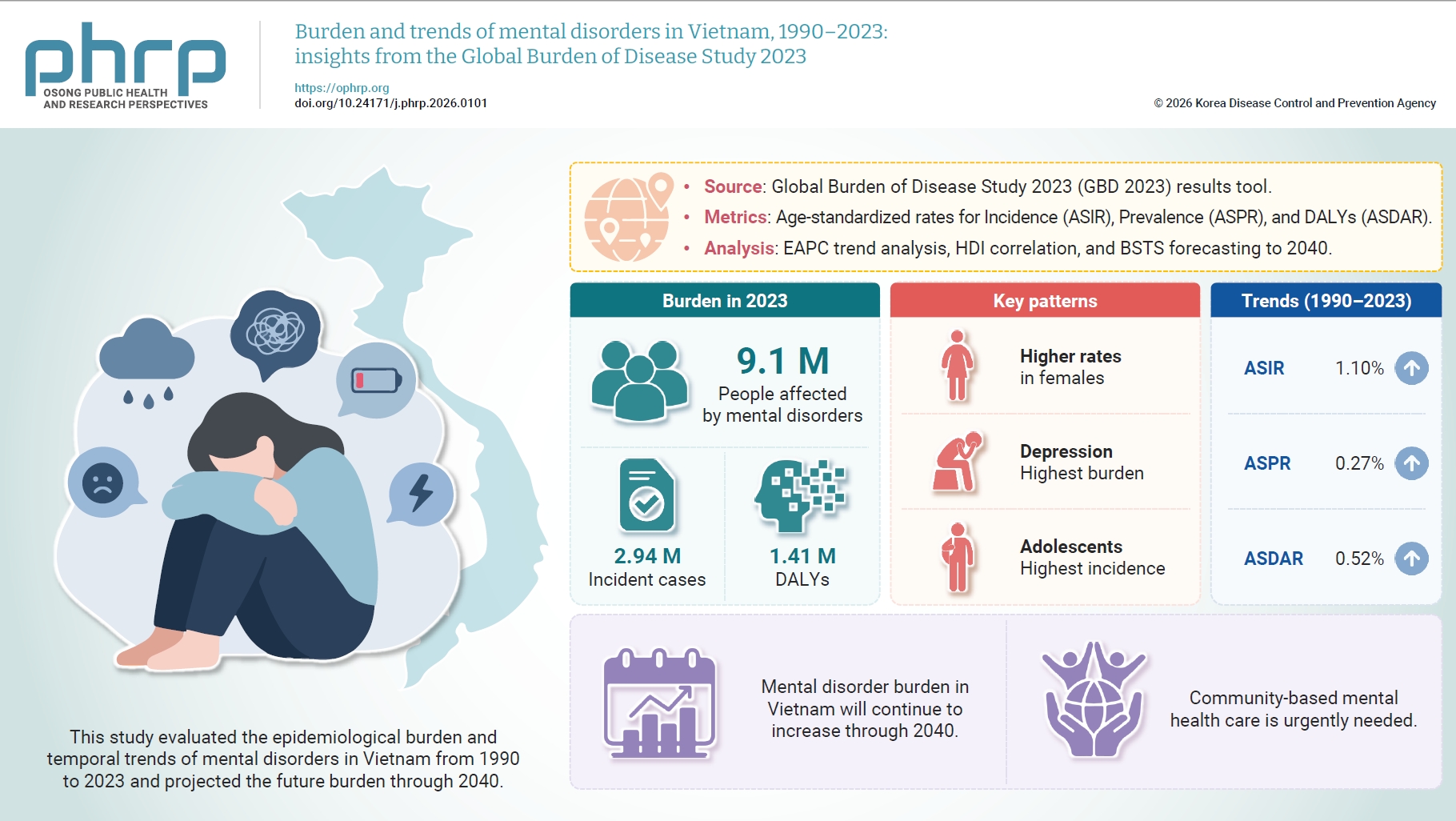
Objectives This study evaluated the epidemiological burden and temporal trends of mental disorders in Vietnam from 1990 to 2023 and projected the future burden through 2040. Methods: Global Burden of Disease Study 2023 data were used to analyze the age-standardized prevalence rate (ASPR), age-standardized incidence rate (ASIR), and age-standardized disability-adjusted life-year rate (ASDAR) by age, sex, and diagnostic subtype. Temporal trends were quantified using the estimated annual percentage change (EAPC), and Pearson correlation analysis examined associations with Vietnam’s human development index (HDI). Bayesian structural time series (BSTS) models were used to forecast the burden through 2040. Results: In 2023, approximately 9.1 million individuals in Vietnam had mental disorders, with 2.94 million annual incident cases and 1.41 million disability-adjusted life-years. Depressive disorders ranked highest across all metrics, and females consistently had higher agestandardized rates than males. Age-standardized rates increased significantly from 1990 to 2023: ASIR, 1.10% EAPC (95% confidence interval [CI], 0.87%–1.33%); ASPR, 0.27% EAPC (95% CI, 0.21%–0.33%); and ASDAR, 0.52% EAPC (95% CI, 0.46%–0.58%). Mental disorder burden was strongly positively correlated with HDI (r =0.773–0.909, all p<0.001). BSTS models projected continued increases through 2040 (ASPR, 9,003.75; ASIR, 3,307.11; ASDAR, 1,408.05 per 100,000 population). Conclusion: Mental disorders constitute an escalating public health challenge in Vietnam, with the burden increasing steadily over 3 decades and projected to continue rising through 2040. Reorientation toward an integrated, community-based care model, alongside targeted workforce expansion and systematic integration of mental health services into primary care, is essential to mitigate this growing burden.
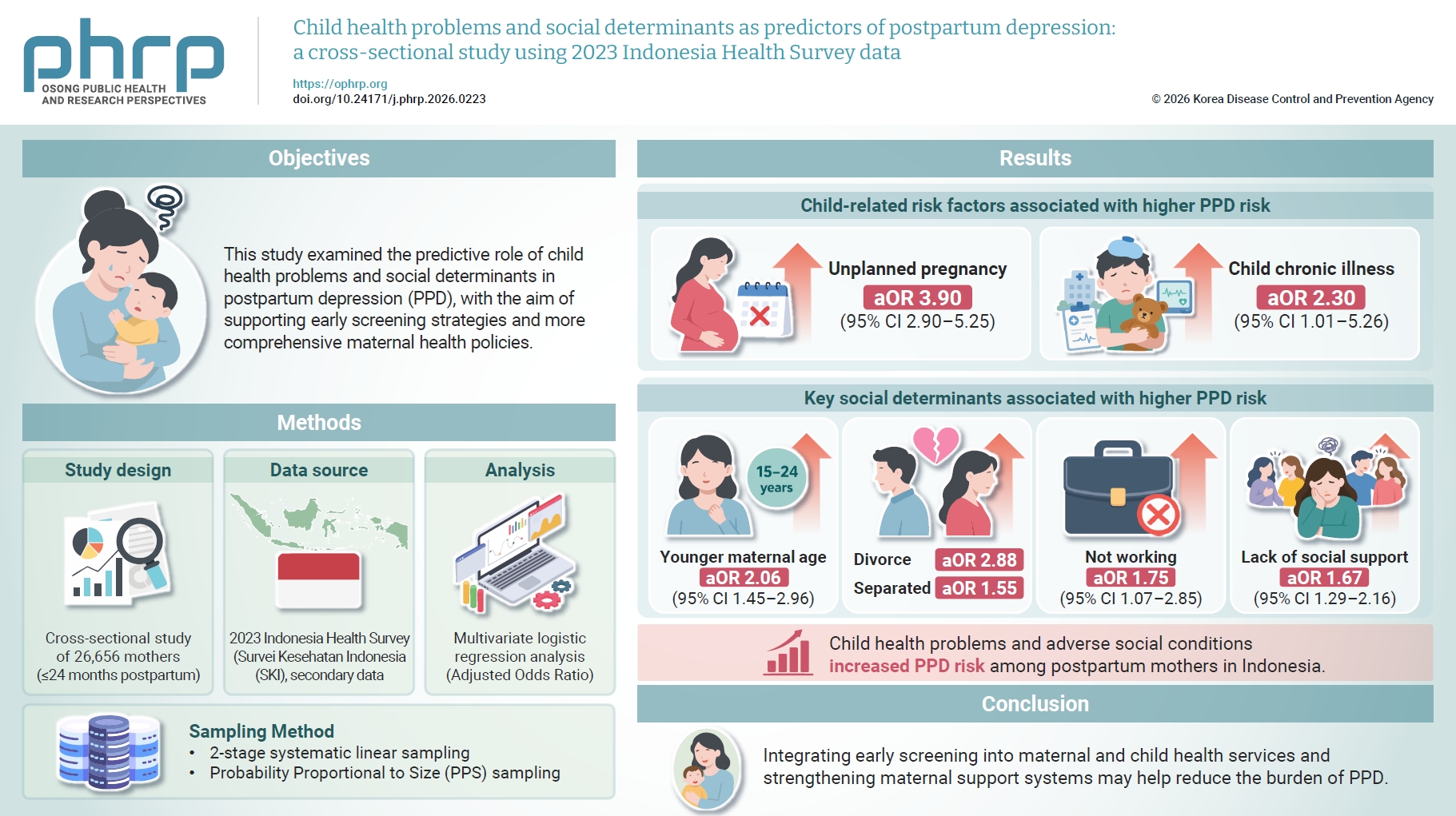
Objectives This study examined the predictive role of child health problems and social determinants in postpartum depression (PPD), with the aim of supporting early screening strategies and more comprehensive maternal health policies. Methods: This cross-sectional study used secondary data from the 2023 Indonesia Health Survey, conducted by the Indonesian Ministry of Health. The analysis included 26,656 postpartum women aged at least 15 years who had given birth within the previous 24 months. PPD was assessed using the Mini International Neuropsychiatric Interview. Multiple logistic regression was used to analyze the data. Results: Child health problems were among the strongest factors associated with PPD in Indonesia. Having had an unplanned pregnancy was associated with higher odds of PPD (adjusted odds ratio [aOR], 3.90; 95% confidence interval [CI], 2.90–5.25; p < 0.001), as was having a child with chronic illness (aOR, 2.30; 95% CI, 1.01–5.26; p= 0.048). Social risk factors, including younger maternal age, divorce or separation from a partner, unemployment, and lack of social support, were also associated with PPD in Indonesia. Conclusion: Child health problems and adverse social conditions were significantly associated with postpartum mental health in Indonesia. Integrating early screening into maternal and child health services and strengthening maternal support systems may help reduce the burden of PPD.
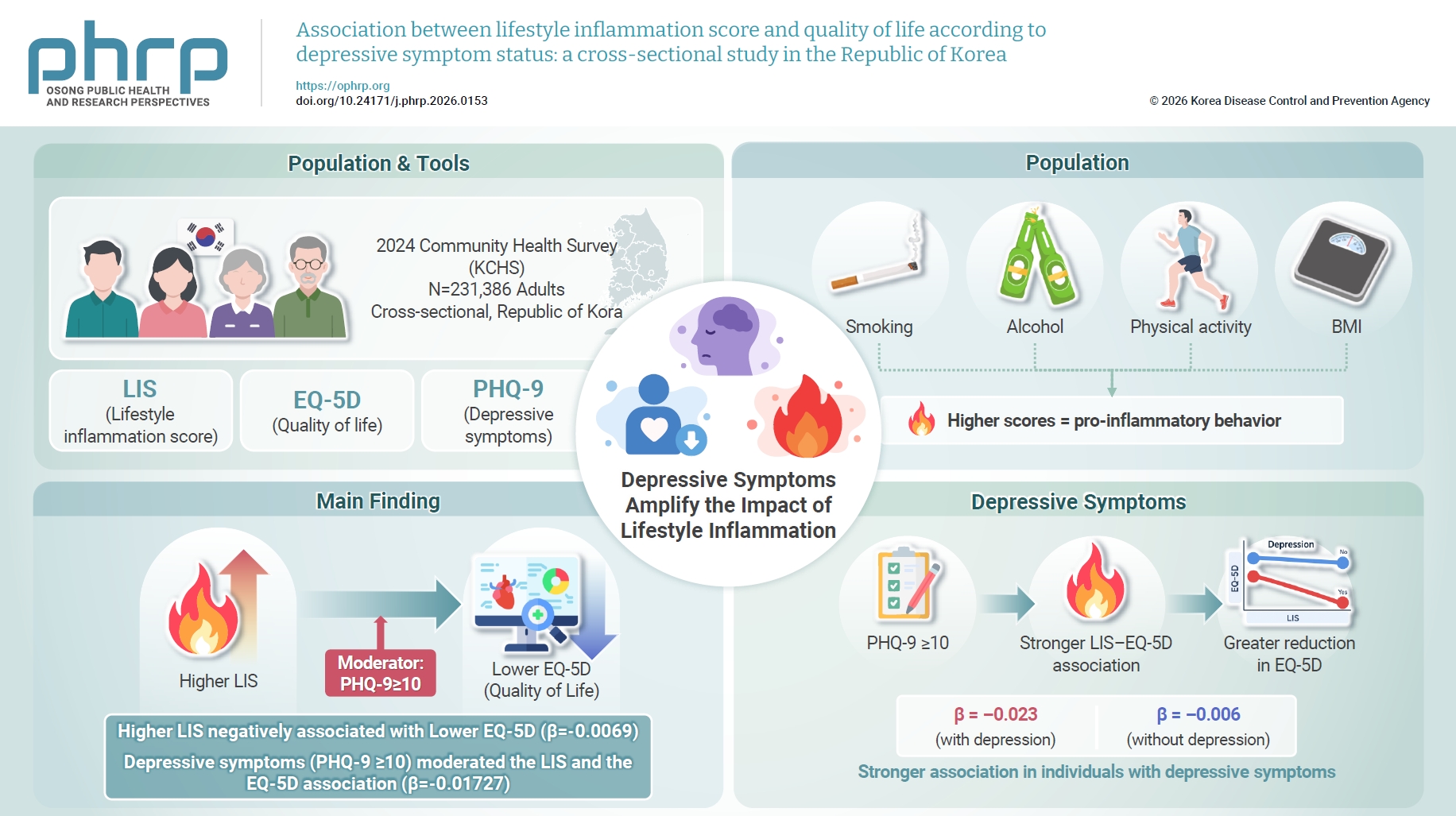
Objectives This study examined the association between lifestyle inflammation score (LIS) and health-related quality of life, assessed using the EuroQol-5 Dimensions (EQ-5D) index, among adults in the Republic of Korea. It also evaluated whether depressive symptoms moderated this association. Methods: Data from the 2024 Community Health Survey were analyzed, and 231,386 adults were included. LIS was calculated by integrating smoking, alcohol consumption, physical activity, and body mass index. The dependent variable, quality of life, was assessed using the EQ-5D index. Depressive symptoms, the moderator variable, were assessed using the Patient Health Questionnaire-9, with a score of ≥10 indicating depressive symptoms. Data were analyzed using complex-sample multivariable linear regression to examine interaction effects according to depressive symptom status, followed by simple-slope analyses. Results: After adjustment for demographic and health-related variables, LIS was significantly and negatively associated with the EQ-5D index (β= –0.0069, p< 0.001), indicating that higher levels of inflammation-related lifestyle behaviors were associated with poorer quality of life. Depressive symptoms significantly moderated the association between LIS and the EQ5D index (β= –0.01727, p< 0.001). Simple-slope analyses showed that the adverse association between LIS and quality of life was stronger among individuals with depressive symptoms (β= –0.02349) than among those without depressive symptoms (β= –0.00621). Conclusion: Inflammation-related lifestyle behaviors were associated with reduced quality of life, and this negative association was stronger among individuals with depressive symptoms. These findings suggest that considering both lifestyle-related inflammatory burden and depressive symptoms may help explain population-level differences in quality of life.



 First
 Prev


