

| Young-Man Kim | 2 Articles |
Objectives
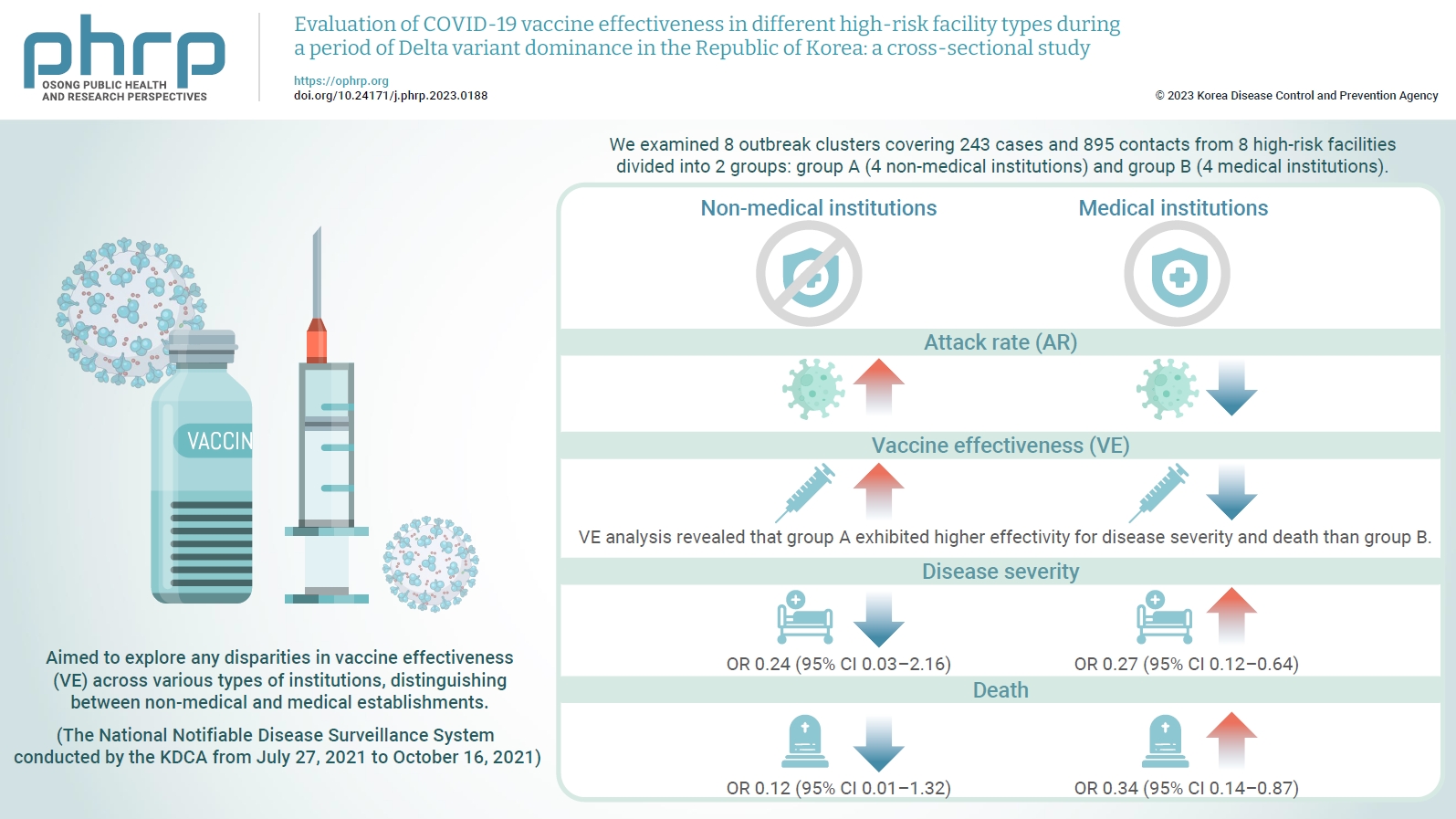
We evaluated the effectiveness of coronavirus disease 2019 vaccination in high-risk facilities in the Republic of Korea during the period when the highly transmissible Delta variant was prevalent. Additionally, we aimed to explore any disparities in vaccine effectiveness (VE) across various types of institutions, specifically distinguishing between non-medical and medical establishments. Methods: We examined 8 outbreak clusters covering 243 cases and 895 contacts from 8 high-risk facilities divided into 2 groups: group A (4 non-medical institutions) and group B (4 medical institutions). These clusters were observed from July 27, 2021 to October 16, 2021 for the attack rate (AR) and VE with respect to disease severity. A generalized linear model with a binomial distribution was used to determine the odds ratio (OR) for disease severity and death. Results: AR was notably lower in group B (medical institutions). Furthermore, VE analysis revealed that group A exhibited higher effectivity for disease severity and death than group B. The OR for disease severity was 0.24 (95% confidence interval [CI], 0.03–2.16) for group A and 0.27 (95% CI, 0.12–0.64) for group B, with the OR for death at 0.12 (95% CI, 0.01–1.32) in group A and 0.34 (95% CI, 0.14–0.87) in group B. Conclusion: Although VE may vary across institutions, our findings underscore the importance of implementing vaccinations in high-risk facilities. Customized vaccination programs, tailored response plans, and competent management personnel are essential for effectively addressing and mitigating public health challenges.
<p>This study describes the epidemiological characteristics of coronavirus disease 2019 (COVID-19) based on reported cases from long-term care facilities. As of April 20<sup>th</sup>, 2020, 3 long-term care facilities in a metropolitan area of South Korea had reported cases of COVID-19. These facilities’ employees were presumed to be the sources of infection. There were 2 nursing hospitals that did not report any additional cases. One nursing home had a total of 25 cases, with an attack rate of 51.4% (95% CI 35.6–67.0), and a fatality rate of 38.9% (95% CI 20.3–61.4) among residents. The results from this study suggest that early detection and maintenance of infection control minimizes the risk of rapid transmission.</p>
Citations
Citations to this article as recorded by

|
|


