

| Yeonjung Kim | 5 Articles |
Objectives
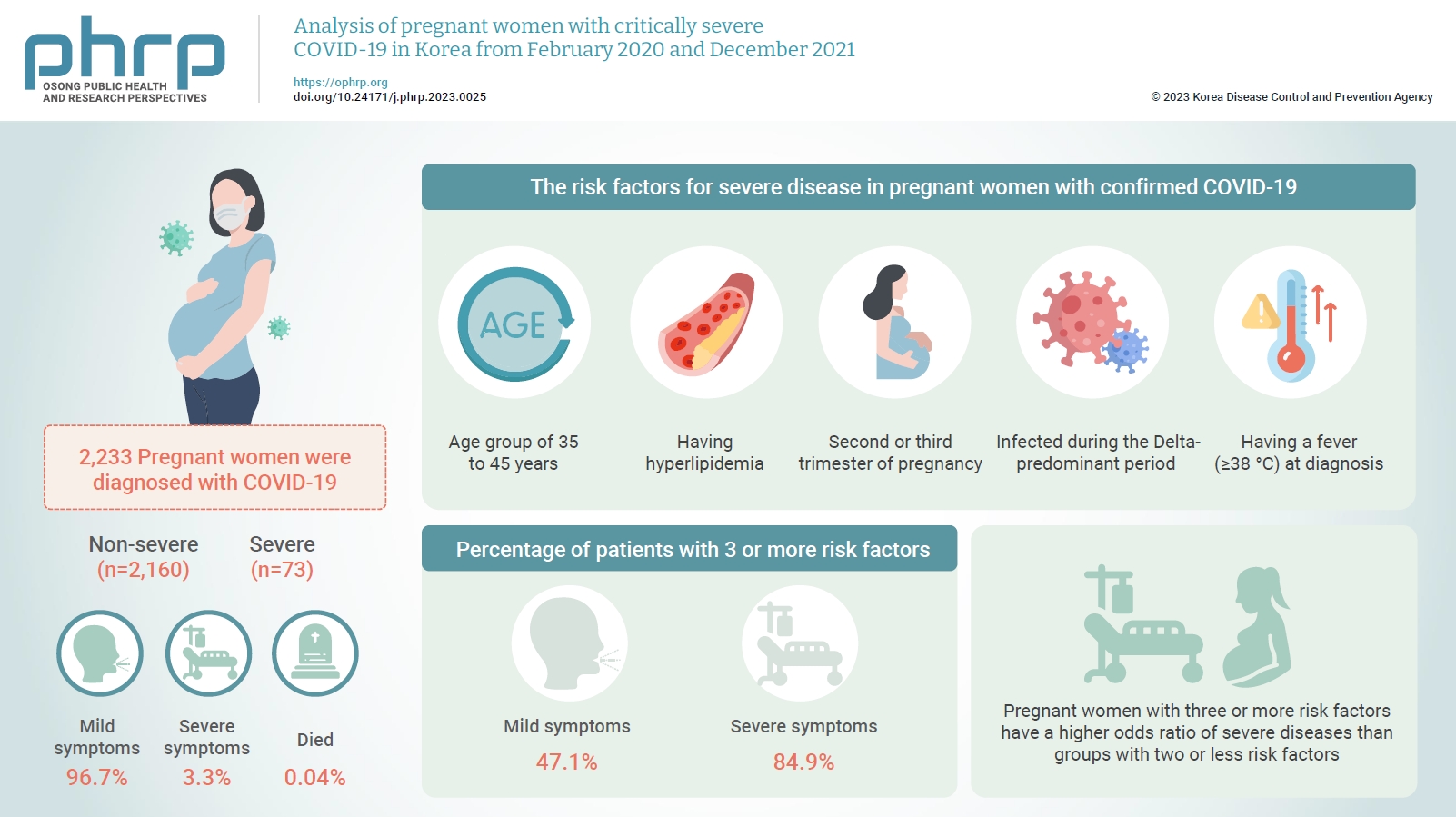
This study aimed to describe the characteristics and risk factors for severe disease in pregnant women infected with coronavirus disease 2019 (COVID-19) from the early days of the COVID-19 epidemic in Korea to the predominant period of the Delta variant. Methods A retrospective cohort study was conducted among pregnant women diagnosed with COVID-19 between February 2020 and December 2021. Logistic regression analysis was performed to compare severe and mild cases after adjusting for pregnant women’s age, nationality, infection route, outbreak area, infection period, symptoms, underlying disease, smoking status, trimester, and COVID-19 vaccination status. Results In total, 2,233 pregnant women were diagnosed with COVID-19 by December 2021. Among these, 96.7% had mild symptoms, 3.3% had severe symptoms, and 0.04% died. The risk factors for severe disease in pregnant women with confirmed COVID-19 were being in the age group of 35 to 45 years, having hyperlipidemia, being in the second or third trimester of pregnancy at the time of COVID-19 diagnosis, being infected during the Delta-predominant period, and having a fever (≥38 °C) at diagnosis. Furthermore, 47.1% of patients in the mild group and 84.9% of patients in the severe group had 3 or more risk factors. Conclusion Pregnant women with COVID-19 mainly experienced mild symptoms, but those with risk factors were at a higher risk of developing severe symptoms. Therefore, treatment and follow-up management should be thoroughly implemented.
Objectives
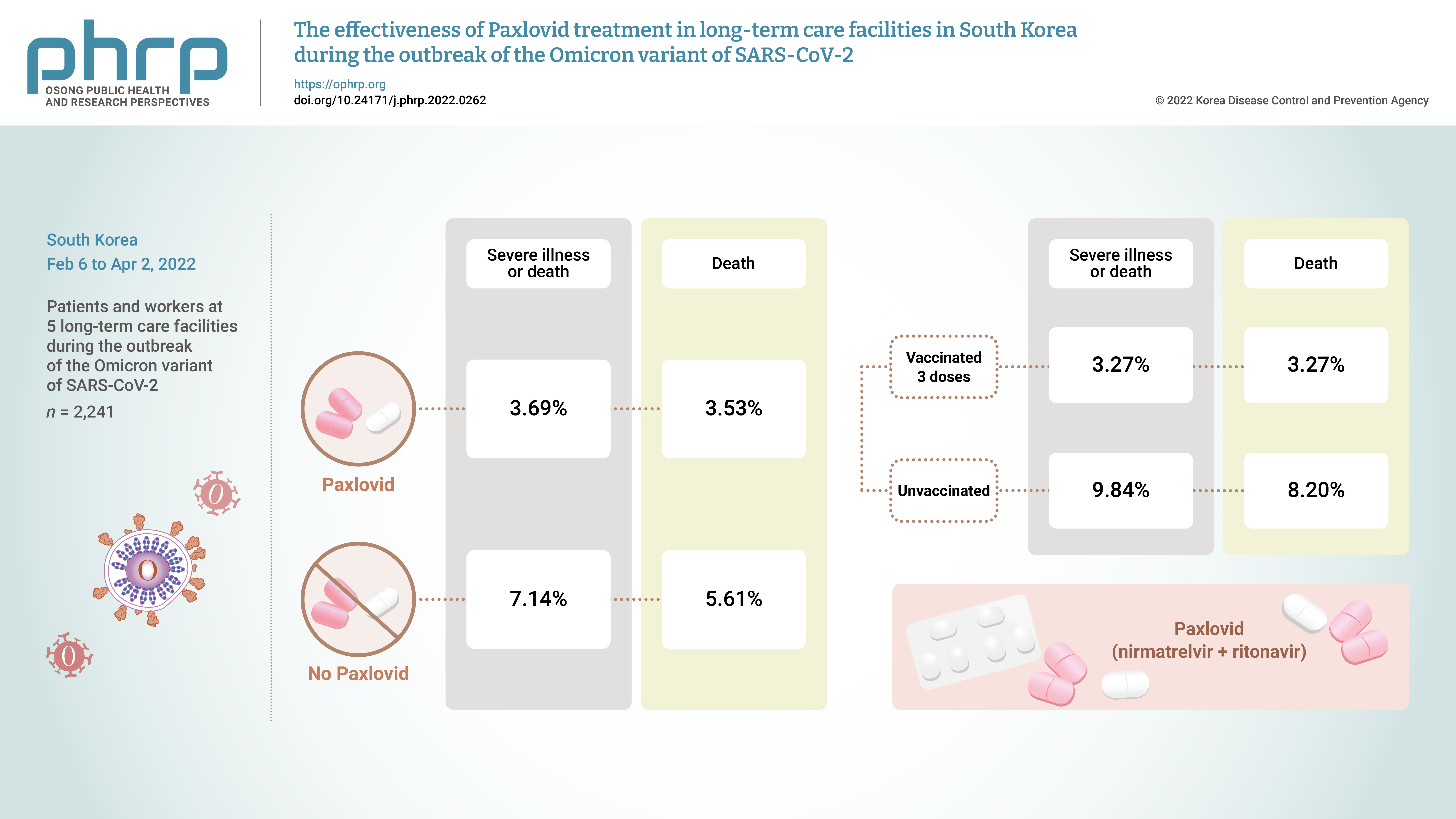
On November 5, 2021, Pfizer Inc. announced Paxlovid (nirmatrelvir +ritonavir) asa treatment method that could reduce the risk of hospitalization or death for patients withconfirmed coronavirus disease 2019 (COVID-19).Methods: From February 6, 2022 to April 2, 2022, the incidence of COVID-19 and the effectsof treatment with Paxlovid were analyzed in 2,241 patients and workers at 5 long-term carefacilities during the outbreak of the Omicron variant of severe acute respiratory syndromecoronavirus 2 in South Korea.Results: The rate of severe illness or death in the group given Paxlovid was 51% lower thanthat of the non-Paxlovid group (adjusted risk ratio [aRR], 0.49; 95% confidence interval [CI],0.24−0.98). Compared to unvaccinated patients, patients who had completed 3 doses of thevaccine had a 71% reduced rate of severe illness or death (aRR, 0.29; 95% CI, 0.13−0.64) and a65% reduced death rate (aRR, 0.35; 95% CI, 0.15−0.79).Conclusion: Patients given Paxlovid showed a lower rate of severe illness or death and alower fatality rate than those who did not receive Paxlovid. Patients who received 3 dosesof the vaccine had a lower rate of severe illness or death and a lower fatality rate than theunvaccinated group. Citations
Citations to this article as recorded by

Objectives
There are an increasing number of studies being carried out on depression in patients with diabetes. Individuals with diabetes have been reported as having a higher prevalence of depression compared to those without diabetes. However, only a few studies involving Korean patients have been conducted. The aims of this study were to examine the prevalence of depression and to find various risk factors according to the degree of depression among Korean patients with Type 2 diabetes mellitus (T2DM). Methods An Ansan-community-based epidemiological study was conducted from 2005 to 2012. The total number of participants in this study was 3,540, from which patients with diabetes (<i>n</i> = 753) have been selected. The presence of depression was evaluated using the Beck Depression Inventory total score. Results The prevalence of depression was 28.8%. The mean age of participants was 55.5 ± 8.2 years. We divided the participants into three groups (without-depression, moderate-depression, and severe-depression groups) to examine the depression prevalence among Korean T2DM patients. The unemployed participants had 2.40 [95% confidence interval (CI) 1.21–4.76], the low-income participants had 2.57 (95% CI 1.52–4.35), the participants using an oral diabetes medicine or insulin had 2.03 (95% CI 1.25–3.32), the participants who are currently smoking had 2.03 (95% CI 1.10–3.73), and those without regular exercise had 1.91 (95% CI 1.17–3.14) times higher odds of depression in the severe-depression group, compared with the without-depression group. Conclusion There was a significant association between depression prevalence and diabetes, and we found various risk factors according to the degree of depression in Korean patients with T2DM. Citations
Citations to this article as recorded by
Objectives
The prevalence of osteoporosis and related fractures has increased rapidly in Korean women. Proper nutrition intake is associated with the prevention of osteoporosis. We analyzed the association between dietary patterns and the risk of osteoporosis during a 4-year follow-up in postmenopausal Korean women. Methods Postmenopausal women (<i>n</i> = 1,725) who participated in the Korean Genome and Epidemiology Study were enrolled. Food intake was assessed using a validated semiquantitative food frequency questionnaire, and a quantitative ultrasound device was used to measure the speed of sound at the radius and tibia. Results Three major dietary patterns were identified using factor analysis based on baseline intake data: traditional (high intake of rice, kimchi, and vegetables), dairy (high intake of milk, dairy products, and green tea), and western (high intake of sugar, fat, and bread). Multivariate Cox proportional hazards models were used to estimate relative risk for osteoporosis. An inverse association was detected between the dairy dietary pattern and the osteoporosis incidence [relative risk (RR): 0.63, 95% confidence interval (CI): 0.42–0.93, <i>p</i>-trend=0.055 in radius; RR: 0.56, 95% CI: 0.35–0.90, <i>p</i>-trend=0.048 in tibia]. Individuals in the highest quintile for the traditional dietary pattern (<i>p</i>-trend = 0.009 in tibia) and western dietary pattern (<i>p</i>-trend = 0.043 in radius) demonstrated a higher risk of osteoporosis incidence than those in the lowest quintile. Conclusion These results suggested that high consumption of milk, dairy products, and green tea may reduce the risk of osteoporosis in postmenopausal Korean women. Citations
Citations to this article as recorded by
Objective
To investigate associations between plasma calcium and future incidence of hypertension in a healthy population. Methods We used prospective data from Ansung and Ansan cohorts (<i>n</i> = 10,038) of the Korean Genome and Epidemiology Study. Data from baseline (2001–02) to the fourth study (2007–08) were used. After excluding hypertensive cases at baseline, missing data, and outliers, 5560 participants were analyzed. Propensity scores for having higher plasma calcium (≥2.37 mmol/L) were created for each participant. After propensity score matching (1:1 nearest neighbor matching within caliper), 2153 pairs were left for analysis. Factors that were significantly different between the lower and higher plasma calcium groups before matching either became nonsignificant or the difference decreased in size. Results Using multivariable Cox proportional hazard models with robust standard errors accounting for clustering of matched pairs, higher plasma calcium was associated with higher incidence of hypertension (adjusted HR, 1.24; robust 95%CI, 1.07–1.43). Among those with higher plasma calcium, low dietary calcium intake increased the development of hypertension, but the effect was not significant. Sensitivity analysis showed that our results were robust to hidden bias. Conclusions Plasma calcium was positively associated with incidence of hypertension. These results expand on cross-sectional associations between hypercalcemia and the metabolic syndrome, and extend the link to future risk of hypertension. Citations
Citations to this article as recorded by
|
|


