

| VR Vijay | 3 Articles |

Objectives
The objective of this review was to analyze quantitative data on autism spectrum disorder (ASD) and to increase the accuracy of estimates of the prevalence of ASD. Methods This review, which was reported in accordance with the Preferred Reporting Items for Systematic Reviews and Meta-Analyses statement, included studies conducted from January 2008 to June 2024 on children aged 3 to 18 years that used standardized measurement tools and reported cut-off scores for ASD. The prevalence of ASD was the primary outcome analyzed in this review. The PubMed, Clinical Key, Scopus, Embase, CINAHL, and Web of Science databases were reviewed for relevant studies. The review protocol was registered with PROSPERO and followed the Cochrane collaboration guidelines. Results A total of 66 studies reported on the prevalence of ASD, screening 21,313,061 children worldwide. Among these, 25 studies were conducted in Europe, 22 in Asia, and 13 in America. Additionally, 3 studies each were reported from Africa and Australia. According to a meta-analysis, 0.77% of children globally are diagnosed with ASD, with boys comprising 1.14% of this group. Notably, Australia showed the highest prevalence rate, with an effect size of 2.18, highlighting it as a critical area for public health focus. Conclusion ASD represents a significant global health burden. Early detection, increased awareness among parents, and prompt intervention are crucial for mitigating developmental problems in children later in life. It is essential for health policymakers to acknowledge the prevalence and growing trends of ASD in order to implement effective interventions. Citations
Citations to this article as recorded by

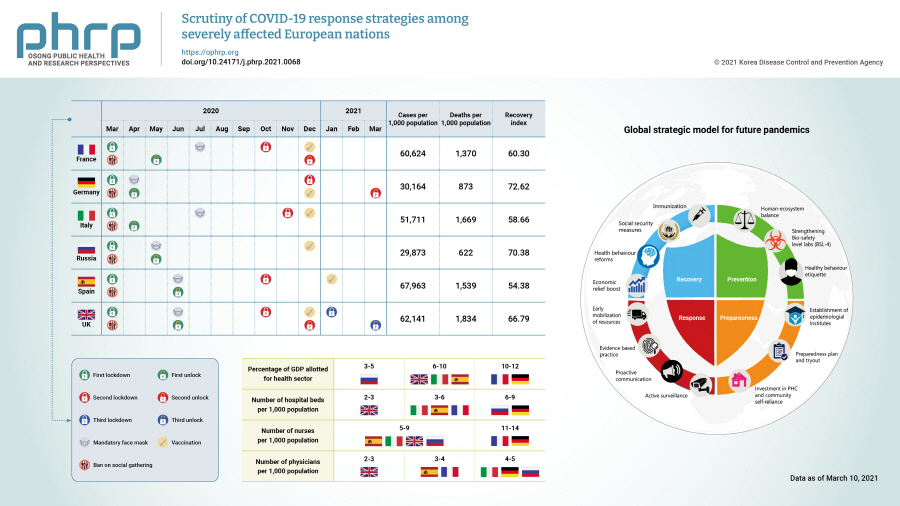
Although the health care systems in Europe are considered the global benchmark, European nations were severely affected by the coronavirus disease 2019 (COVID-19) pandemic. This manuscript aimed to examine the strategies implemented to combat the COVID-19 pandemic by France, the United Kingdom, Spain, Italy, Germany, and Russia and their outcomes in terms of the number of cases, testing, and deaths. This is the first review of its kind that extensively analyzes the preparedness, mitigation, and response strategies against the COVID-19 pandemic adopted by these nations. This paper further suggests a strategic preparedness model for future pandemics. From the analysis, we found that a decentralized approach, prompt decision-making and timely execution, coordination between local health authorities, and public participation in the implementation of strategies could substantially reduce the case fatality rate. Nations with a high percentage of gross domestic product invested in the health sector, as well as more nurses, physicians, hospital beds, intensive care unit beds, and ventilators, better managed the pandemic. Instead, nations that postponed their pandemic response by delaying tracking, tracing, testing, quarantine, and lockdown were badly affected. The lessons learned from the present pandemic could be used as a guide to prepare for further pandemics.
Citations
Citations to this article as recorded by
<p>The cataclysmic COVID-19 pandemic erupted silently causing colossal impact worldwide, the repercussions of which indicated a lackadaisical vigilance in preparation for such a pandemic. This review assessed the measures taken by nations to contain this pandemic. A literature review was conducted using Medline, Google Scholar, Science Direct, Scopus, and WHO website. There were 8 nations (selected from the GHS index list) appraised for containment strategies. This was achieved by using mortality rate (per million) as the primary endpoint. The nations which were proactive, initiated scientific strategies earlier with rigor, appeared to have succeeded in containing the pandemic, although it is still too early to arbitrate a verdict. The so called “pandemic war” mandates international, interdisciplinary, and interdepartmental collaboration. Furthermore, building trust and confidence between the government and the public, having transparent communication, information sharing, use of advanced research-technology, and plentiful resources are required in the fight against COVID-19.</p>
Citations
Citations to this article as recorded by
|
|


