

| Unyeong Go | 3 Articles |
Objectives
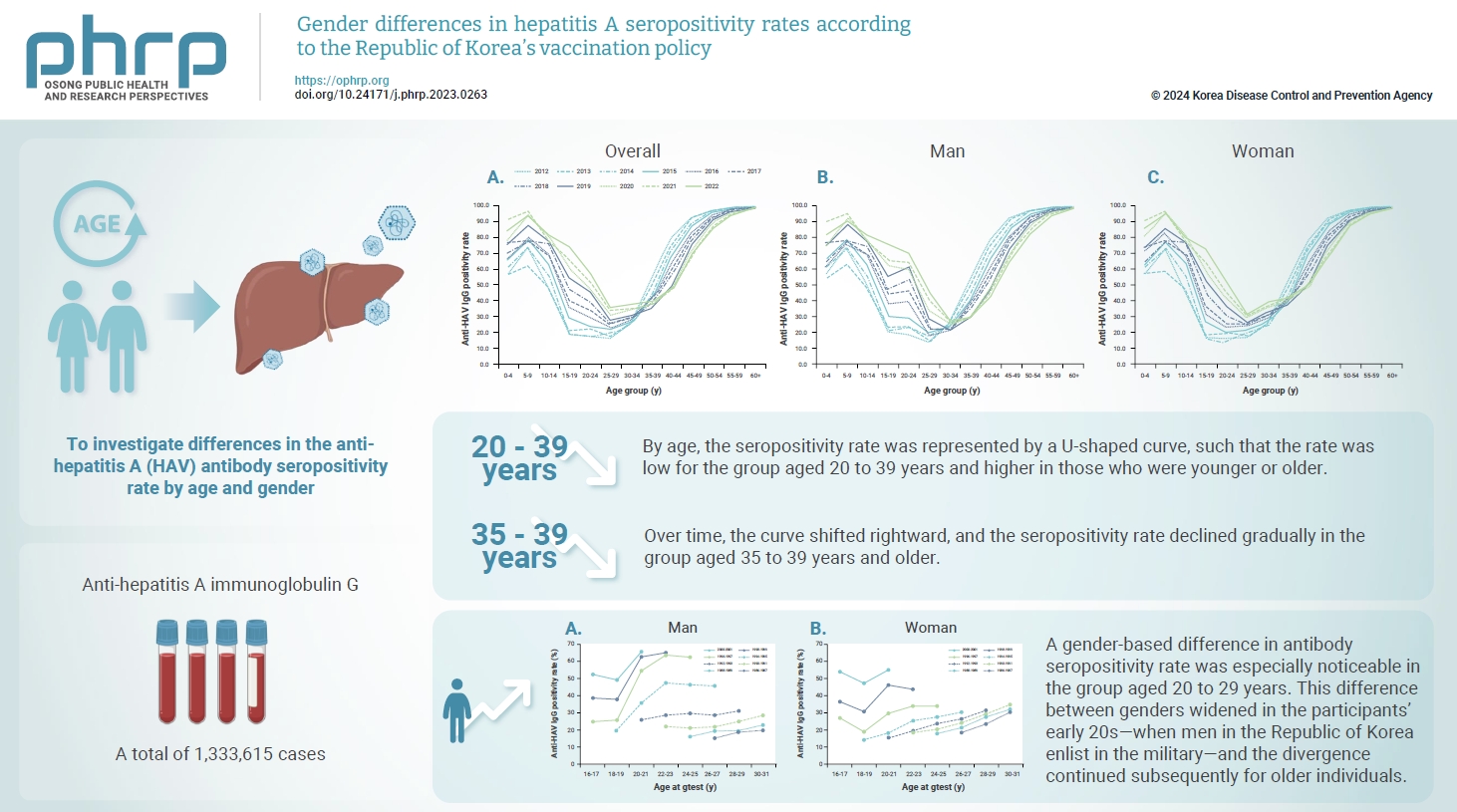
This study aimed to investigate differences in the anti-hepatitis A virus (HAV) antibody seropositivity rate by age and gender. Methods: We collected information on anti-HAV immunoglobulin G and immunoglobulin M status from samples submitted for HAV antibody testing in 2012–2022. A total of 1,333,615 cases were included in the analysis. Results: By age, the seropositivity rate was represented by a U-shaped curve, such that the rate was low for the group aged 20 to 39 years and higher in those who were younger or older. Over time, the curve shifted rightward, and the seropositivity rate declined gradually in the group aged 35 to 39 years and older. A gender-based difference in antibody seropositivity rate was especially noticeable in the group aged 20 to 29 years. This difference between genders widened in the participants’ early 20s—when men in the Republic of Korea enlist in the military—and the divergence continued subsequently for older individuals. Conclusion: These results indicate a higher risk of severe infection among older individuals and a gender-based difference in seroprevalence. Therefore, it is necessary to implement policies to promote vaccination in adults. Citations
Citations to this article as recorded by

Objectives
Completeness and timeliness are key attributes of accurate disease surveillance. This study aimed to evaluate the completeness and timeliness of tuberculosis (TB) notification in the Republic of Korea, by comparing notification data from the Korean National Tuberculosis Surveillance System and reimbursement data from the National Health Insurance. Methods We evaluated reimbursement data from 103,075 cases (2012–2014) and surveillance data from 215,055 cases (2011–2015); cases were matched using Resident Registration Numbers. Completeness was evaluated using notifications that were reported within 365 days of the corresponding insurance claim. Timeliness was evaluated using the delay between starting TB treatment and the corresponding notification. Multivariate logistic regression analysis was used to analyze factors that affected completeness (e.g., sex, age, institution type, and nationality). Results The completeness values were 90.0% in 2012 (33,094/36,775), 93.0% in 2013 (31,445/33,803), and 94.0% in 2014 (30,537/32,497). The rates of notification within 7 days of the corresponding claim were 81.6% in 2012 (27,323/33,489), 79.8% in 2013 (25,469/31,905), and 80.4% in 2014 (24,891/30,978). Increases over time were observed in the sex-, age-, institution type-, and nationality-specific analyses. Multivariate analyses revealed that completeness was affected by institution type [hospitals: odds ratio (OR) = 1.82, <i>p</i> < 0.001; general hospitals: OR = 4.18, <i>p</i> < 0.001] and nationality (native Korean status: OR = 1.48, <i>p</i> < 0.001). Conclusion Notification completeness exhibited a 4.0% increase during 2012–2014 in Korea, and institution type and nationality significantly affected the completeness of TB notifications. Citations
Citations to this article as recorded by
Objectives
This study aimed to check the status of the contact investigation in congregate settings to eradicate tuberculosis (TB) in the Republic of Korea. Methods The “Integrated System for Disease and Public Health Management” is used for care and follow-up for patients and contacts of TB. We downloaded data for contact investigations conducted from January to December 2013. Results A total of 1,200 contact investigations in congregate settings were carried out by 25 field investigators in 2013. We performed the status of contact investigation, TB, and LTBI rate by age, accept rate of LTBI treatment, and complete rate of LTBI treatment during 2013. A total of 1,547 index TB patients, 149,166 contacts, and 259 additional TB patients were found through the investigation. Kindergartens showed the highest LTBI rate, 19.8%, among educational facilities. The second highest was in elementary schools and the subtotal LTBI rate of educational facilities was 7.8%. Social welfare/correctional facilities and workplaces showed relatively high LTBI rates of 23.8% and 23.6%, respectively. By age, individuals >35 years showed the highest LTBI rate, followed by those aged 0–4 years, 30–34 years, and 5–9 years, with rates of 18.1%, 16.4%, and 15.4% respectively. When comparing the tuberculin skin test (TST) positive conversion ratio by facility, middle school and high school were relatively high compared to the others. The accept rate of LTBI treatment in the workplace was lowest at 63% and the complete rate in elementary schools was lowest at 76.5%. Conclusion TB contact investigation is considered as a meaningful strategy for preventing TB outbreaks in congregate settings and decreasing the prevalence of TB in young people. Results of this study could be used to establish the LTBI management policy. Citations
Citations to this article as recorded by
|
|


