

| Sang Eun Lee | 5 Articles |

Objectives
No study has yet analyzed risk factors to determine whether students with confirmed coronavirus disease 2019 (COVID-19) infections may affect students at neighboring schools. Therefore, this study aimed to determine risk factors for COVID-19 transmission among schools within a community in the Republic of Korea. Methods An epidemiological investigation was conducted among 696 students and school staff members at 3 schools where COVID-19 clusters began on October 15, 2021. Interviews, visit history surveys, a facility risk assessment, and closed-circuit television were used to identify risk factors. The statistical significance of risk factors was also evaluated. Results We confirmed 129 cases (18.5%) among the individuals exposed to COVID-19 at the 3 schools, many of whom had a history of visiting the same multi-use facilities. The odds ratio of having visited multi-use facilities such as karaoke rooms was 1.90 (95% confidence interval, 1.03–3.50); the number of visits to a karaoke room and the visit durations were significantly higher among confirmed cases than non-confirmed cases (p=0.02 and p=0.03, respectively). Conclusion Having a history of visiting karaoke rooms often and spending a long time there were risk factors for COVID-19 infection and inter-school transmission. Thus, it is necessary to investigate the status of multi-use facilities frequently visited by adolescents and consider incorporating them into the scope of school quarantine to prevent infectious diseases at schools in a community.
Objectives
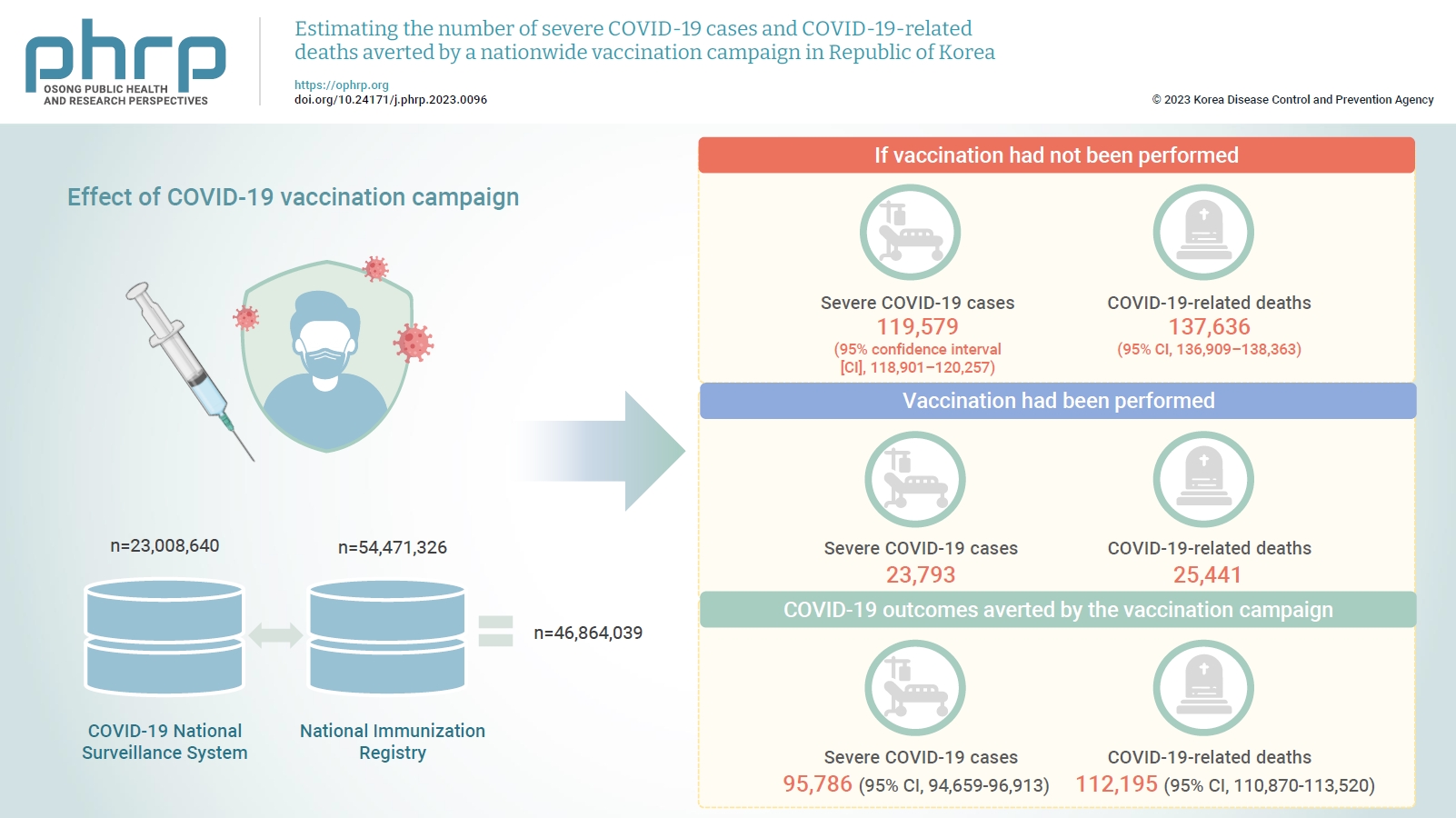
The Korea Disease Control and Prevention Agency promotes vaccination by regularly providing information on its benefits for reducing the severity of coronavirus disease 2019 (COVID-19). This study aimed to analyze the number of averted severe COVID-19 cases and COVID-19-related deaths by age group and quantify the impact of Republic of Korea’s nationwide vaccination campaign. Methods We analyzed an integrated database from the beginning of the vaccination campaign on February 26, 2021 to October 15, 2022. We estimated the cumulative number of severe cases and COVID-19-related deaths over time by comparing observed and estimated cases among unvaccinated and vaccinated groups using statistical modeling. We compared daily age-adjusted rates of severe cases and deaths in the unvaccinated group to those in the vaccinated group and calculated the susceptible population and proportion of vaccinated people by age. Results There were 23,793 severe cases and 25,441 deaths related to COVID-19. We estimated that 119,579 (95% confidence interval [CI], 118,901–120,257) severe COVID-19 cases and 137,636 (95% CI, 136,909–138,363) COVID-19-related deaths would have occurred if vaccination had not been performed. Therefore, 95,786 (95% CI, 94,659–96,913) severe cases and 112,195 (95% CI, 110,870–113,520) deaths were prevented as a result of the vaccination campaign. Conclusion We found that, if the nationwide COVID-19 vaccination campaign had not been implemented, the number of severe cases and deaths would have been at least 4 times higher. These findings suggest that Republic of Korea’s nationwide vaccination campaign reduced the number of severe cases and COVID-19 deaths. Citations
Citations to this article as recorded by

Objectives
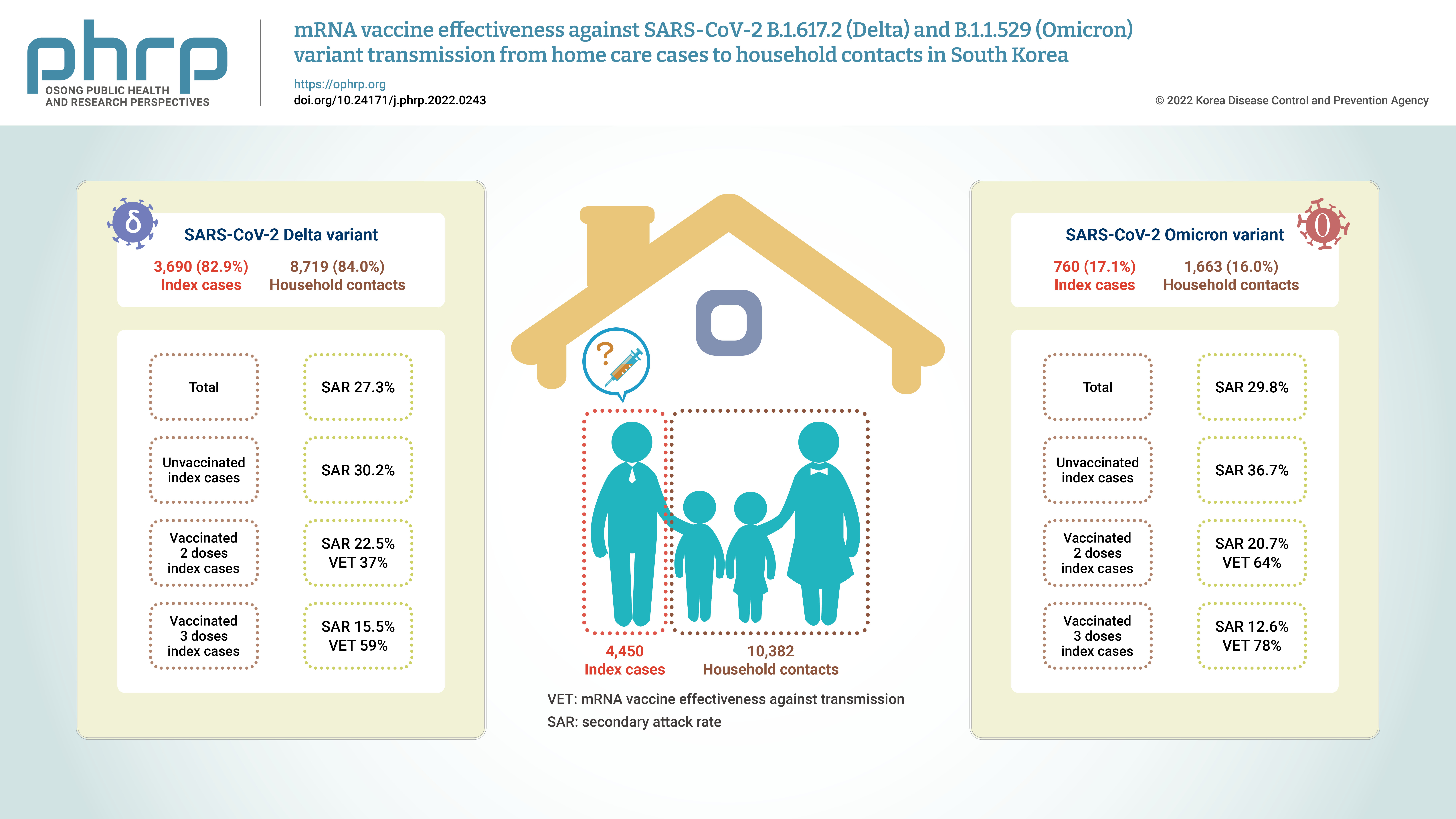
Household contacts of confirmed cases of coronavirus disease 2019 (COVID-19) areexposed to a high risk of viral transmission, and secondary incidence is an important indicatorof community transmission. This study analyzed the secondary attack rate and mRNA vaccineeffectiveness against transmission (VET) for index cases (patients treated at home) confirmedto be infected with the Delta and Omicron variants.Methods: The subjects of the study were 4,450 index cases and 10,382 household contacts.Logistic regression analysis was performed to compare the secondary attack rate byvaccination status, and adjusted relative risk and 95% confidence intervals were identified.Results: The secondary attack rate of the Delta variant was 27.3%, while the secondary attackrate of the Omicron variant was 29.8%. For the Delta variant, groups with less than 90 daysand more than 90 days after 2 doses of mRNA vaccination both showed a VET of 37%. For theOmicron variant, a 64% VET was found among those with less than 90 days after 2 doses ofmRNA vaccination.Conclusion: This study provides useful data on the secondary attack rate and VET of mRNAvaccines for household contacts of COVID-19 cases in South Korea. Citations
Citations to this article as recorded by
Objectives
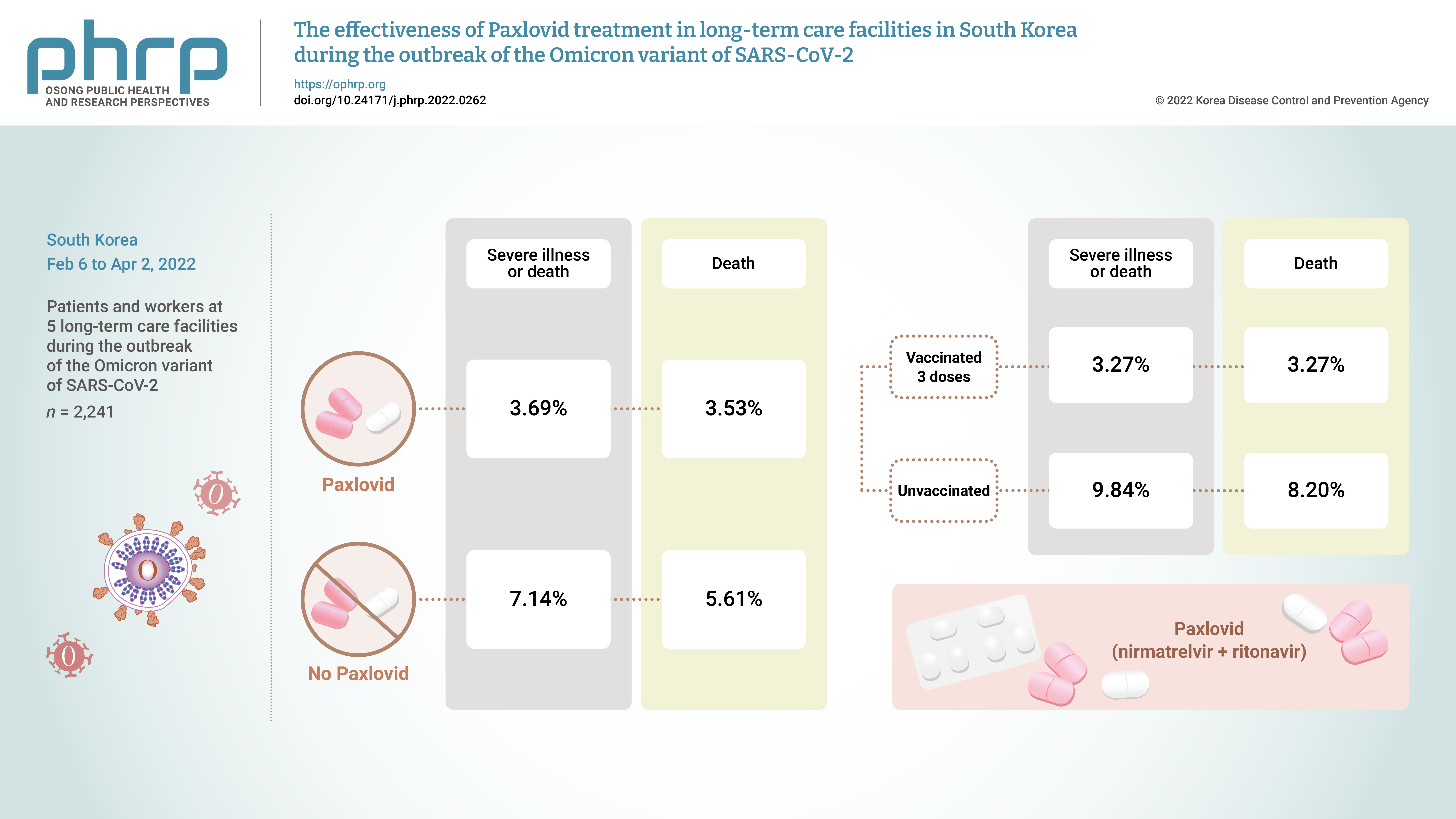
On November 5, 2021, Pfizer Inc. announced Paxlovid (nirmatrelvir +ritonavir) asa treatment method that could reduce the risk of hospitalization or death for patients withconfirmed coronavirus disease 2019 (COVID-19).Methods: From February 6, 2022 to April 2, 2022, the incidence of COVID-19 and the effectsof treatment with Paxlovid were analyzed in 2,241 patients and workers at 5 long-term carefacilities during the outbreak of the Omicron variant of severe acute respiratory syndromecoronavirus 2 in South Korea.Results: The rate of severe illness or death in the group given Paxlovid was 51% lower thanthat of the non-Paxlovid group (adjusted risk ratio [aRR], 0.49; 95% confidence interval [CI],0.24−0.98). Compared to unvaccinated patients, patients who had completed 3 doses of thevaccine had a 71% reduced rate of severe illness or death (aRR, 0.29; 95% CI, 0.13−0.64) and a65% reduced death rate (aRR, 0.35; 95% CI, 0.15−0.79).Conclusion: Patients given Paxlovid showed a lower rate of severe illness or death and alower fatality rate than those who did not receive Paxlovid. Patients who received 3 dosesof the vaccine had a lower rate of severe illness or death and a lower fatality rate than theunvaccinated group. Citations
Citations to this article as recorded by
<sec><title>Objectives</title><p>Korea was an endemic area for lymphatic filariasis (LF), caused by the nematode parasite <italic>Brugia malayi</italic>, until the 1970s. The World Health Organization recognized Korea as LF-free in June 2008. However, it is necessary to confirm that patients that have had LF in the past still test negative, to prevent the re-emergence of LF in Korea.</p></sec><sec><title>Methods</title><p>We followed up a total of 83 patients who had been diagnosed with LF between 2002 and 2010 in endemic LF areas.</p></sec><sec><title>Results</title><p>Fifty-two of the 83 subjects were negative for LF, whereas 31 subjects had re-located to a different city or province, were dead, or were unaccounted for. Most subjects with negative test results still exhibited edema in the legs or the arms, and some complained of redness and swelling in the legs or ankle joints. However, we found that these symptoms were due to diseases other than LF.</p></sec><sec><title>Conclusion</title><p>In this follow-up study, we did not find any evidence indicating the potential re-emergence of LF in Korea.</p></sec>
Citations
Citations to this article as recorded by
|
|


