

| Nam-Joo Lee | 5 Articles |
Objectives
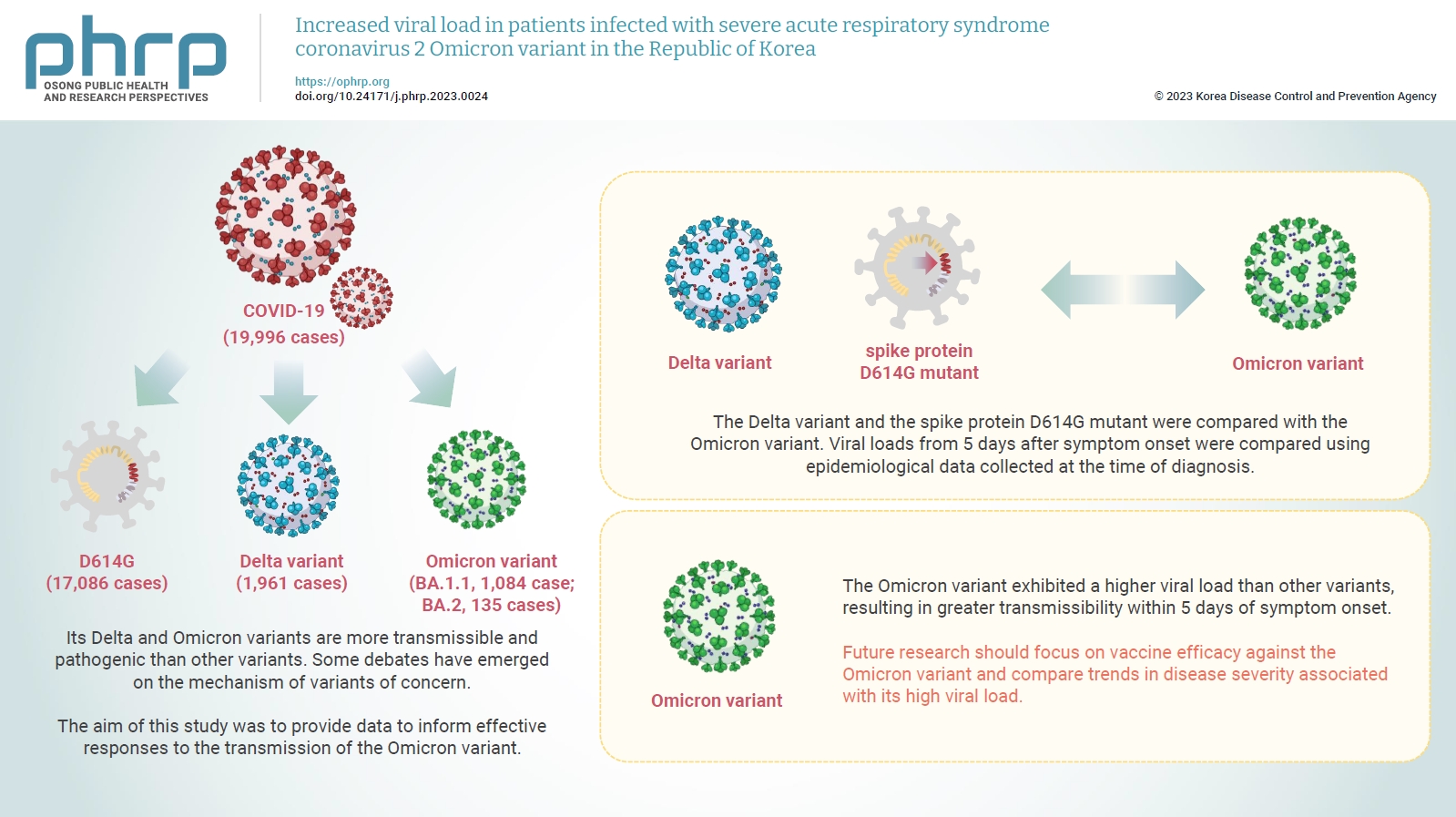
Coronavirus disease 2019 (COVID-19) has been declared a global pandemic owing to the rapid spread of the causative agent, severe acute respiratory syndrome coronavirus 2. Its Delta and Omicron variants are more transmissible and pathogenic than other variants. Some debates have emerged on the mechanism of variants of concern. In the COVID-19 wave that began in December 2021, the Omicron variant, first reported in South Africa, became identifiable in most cases globally. The aim of this study was to provide data to inform effective responses to the transmission of the Omicron variant. Methods The Delta variant and the spike protein D614G mutant were compared with the Omicron variant. Viral loads from 5 days after symptom onset were compared using epidemiological data collected at the time of diagnosis. Results The Omicron variant exhibited a higher viral load than other variants, resulting in greater transmissibility within 5 days of symptom onset. Conclusion Future research should focus on vaccine efficacy against the Omicron variant and compare trends in disease severity associated with its high viral load. Citations
Citations to this article as recorded by

<p>Since a novel beta-coronavirus, severe acute respiratory syndrome coronavirus 2 (SARS-CoV-2) was first reported in December 2019, there has been a rapid global spread of the virus. Genomic surveillance was conducted on samples isolated from infected individuals to monitor the spread of genetic variants of SARS-CoV-2 in Korea. The Korea Disease Control and Prevention Agency performed whole genome sequencing of SARS-CoV-2 in Korea for 1 year (January 2020 to January 2021). A total of 2,488 SARS-CoV-2 cases were sequenced (including 648 cases from abroad). Initially, the prevalent clades of SARS-CoV-2 were the S and V clades, however, by March 2020, GH clade was the most dominant. Only international travelers were identified as having G or GR clades, and since the first variant 501Y.V1 was identified (from a traveler from the United Kingdom on December 22<sup>nd</sup>, 2020), a total of 27 variants of 501Y.V1, 501Y.V2, and 484K.V2 have been classified (as of January 25<sup>th</sup>, 2021). The results in this study indicated that quarantining of travelers entering Korea successfully prevented dissemination of the SARS-CoV-2 variants in Korea.</p>
Citations
Citations to this article as recorded by
<sec><title>Objectives</title>
<p>Coronavirus Disease-19 (COVID-19) is a respiratory infection characterized by the main symptoms of pneumonia and fever. It is caused by the novel coronavirus severe acute respiratory syndrome Coronavirus-2 (SARS-CoV-2), which is known to spread via respiratory droplets. We aimed to determine the rate and likelihood of SARS-CoV-2 transmission from COVID-19 patients through non-respiratory routes.</p></sec>
<sec><title>Methods</title>
<p>Serum, urine, and stool samples were collected from 74 hospitalized patients diagnosed with COVID-19 based on the detection of SARS-CoV-2 in respiratory samples. The SARS-CoV-2 RNA genome was extracted from each specimen and real-time reverse transcription polymerase chain reaction performed. CaCo-2 cells were inoculated with the specimens containing the SARS-COV-2 genome, and subcultured for virus isolation. After culturing, viral replication in the cell supernatant was assessed.</p></sec>
<sec><title>Results</title>
<p>Of the samples collected from 74 COVID-19 patients, SARS-CoV-2 was detected in 15 serum, urine, or stool samples. The virus detection rate in the serum, urine, and stool samples were 2.8% (9/323), 0.8% (2/247), and 10.1% (13/129), and the mean viral load was 1,210 ± 1,861, 79 ± 30, and 3,176 ± 7,208 copy/µL, respectively. However, the SARS-CoV-2 was not isolated by the culture method from the samples that tested positive for the SARS-CoV-2 gene.</p></sec>
<sec><title>Conclusion</title>
<p>While the virus remained detectable in the respiratory samples of COVID-19 patients for several days after hospitalization, its detection in the serum, urine, and stool samples was intermittent. Since the virus could not be isolated from the SARS-COV-2-positive samples, the risk of viral transmission via stool and urine is expected to be low.</p></sec>
Citations
Citations to this article as recorded by
<sec>
<title>Objectives</title>
<p>Following reports of patients with unexplained pneumonia at the end of December 2019 in Wuhan, China, the causative agent was identified as coronavirus (SARS-CoV-2), and the 2019 novel coronavirus disease was named COVID-19 by the World Health Organization. Putative patients with COVID-19 have been identified in South Korea, and attempts have been made to isolate the pathogen from these patients.</p></sec>
<sec>
<title>Methods</title>
<p>Upper and lower respiratory tract secretion samples from putative patients with COVID-19 were inoculated onto cells to isolate the virus. Full genome sequencing and electron microscopy were used to identify the virus.</p></sec>
<sec>
<title>Results</title>
<p>The virus replicated in Vero cells and cytopathic effects were observed. Full genome sequencing showed that the virus genome exhibited sequence homology of more than 99.9% with SARS-CoV-2 which was isolated from patients from other countries, for instance China. Sequence homology of SARS-CoV-2 with SARS-CoV, and MERS-CoV was 77.5% and 50%, respectively. Coronavirus-specific morphology was observed by electron microscopy in virus-infected Vero cells.</p></sec>
<sec>
<title>Conclusion</title>
<p>SARS-CoV-2 was isolated from putative patients with unexplained pneumonia and intermittent coughing and fever. The isolated virus was named BetaCoV/Korea/KCDC03/2020.</p></sec>
Citations
Citations to this article as recorded by
Objectives
We aimed to evaluate the pathogenesis and chronologic localization of human influenza A (H1N1) virus in experimentally infected cotton rats. Methods The animals were intranasally inoculated with 10<sup>7</sup> plaque-forming units of A/Solomon Islands/3/2006 (H1N1) influenza virus and evaluated for pathogenicity for a period of 28 days. Virus replication kinetics and pathological properties were assessed chronologically. Acute antiviral responses were evaluated by mean of real-time polymerase chain reaction. Results Cotton rats infected with A/Solomon Islands/3/2006 virus lost weight until 6 days post-inoculation (DPI) and showed decreased activity until 3 DPI. At necropsy, focal areas of redness and consolidation of lungs were evident at 1, 2, and 3 DPI. Lung histopathology showed moderate to severe interstitial pneumonia, alveolitis and bronchiolitis. Influenza A specific viral protein was detected in bronchiolar epithelial cells, alveolar septa and pneumocytes. Influenza viruses were recovered from the lungs during the early period of infection and the titer peaked at 1 DPI. Viral proteins were detected from 4 hours to 6 hours DPI. These trends correlate with the up-regulation of mRNA expression of the IFN-α, Mx1, and Mx2 genes that play critical roles in the anti-influenza response at the early stage of infection. Conclusion Our results provide evidence that supports the use of cotton rats for the study of influenza virus pathogenesis and the immune response. Citations
Citations to this article as recorded by
|
|


